Chopper-stabilized Programmable Gain Amplifier
Abstract
A circuit including an amplifier having an input and an output. The circuit also includes a current-to-voltage amplifier having an input. The circuit further includes a current mirror coupled between the output of the amplifier and the input of the current-to-voltage amplifier. The current mirror is configured to chop current flowing through the first current mirror.
Claims (11)
1. A circuit, comprising: a first plurality of metal oxide semiconductor field effect transistors, each transistor of the first plurality having a gate, a drain, and a source; a second plurality of metal oxide semiconductor field effect transistors, each transistor of the second plurality having a gate, a drain, and a source; the sources of each transistor of the first and second pluralities coupled together; the drains of each transistor of the first plurality coupled together at a first node; the drains of each transistor of the second plurality coupled together at a second node, the first node not coupled to the second node; the gates of each transistor of the first and second pluralities is configured to receive separate control signals; and wherein in each clock cycle of a clock signal, only one of the first plurality of transistors is configured to be on and three of the four transistors of the second plurality of transistors are configured to be on.
6. A circuit, comprising: an amplifier having an input and an output; a current-to-voltage amplifier having an input; a first plurality of transistors coupled between the output of the amplifier and the input of the current-to-voltage amplifier, and a second plurality of transistors coupled between the output of the amplifier and the input of the current-to-voltage amplifier; wherein the first plurality of transistors from which at least one, but not all, of the transistors is activated in each clock cycle to pass a first current controlled by the output of the amplifier; and the second plurality of transistors from which at least two, but not all, of the transistors are activated in each clock cycle to pass a second current that mirrors the first current according to a 1:M current mirror ratio where M is an integer greater than one.
7. A circuit, comprising: a first plurality of metal oxide semiconductor field effect transistors, each transistor of the first plurality having a gate, a drain, and a source; a second plurality of metal oxide semiconductor field effect transistors, each transistor of the second plurality having a gate, a drain, and a source; the sources of each transistor of the first and second pluralities coupled together; the drains of each transistor of the first plurality coupled together at a first node; the drains of each transistor of the second plurality coupled together at a second node, the first node not coupled to the second node; the gates of each transistor of the first and second pluralities is configured to receive separate control signals; and a shift logic circuit having a clock input configured to receive a clock signal, the shift logic circuit having at least eight control outputs, each of the eight control outputs coupled to a respective gate of the first or second pluralities of transistors.
Show 8 dependent claims
2. The circuit of claim 1 , wherein the first plurality of transistors comprises four metal oxide semiconductor field effect transistors, and the second plurality of transistors comprises four metal oxide semiconductor field effect transistors.
3. The circuit of claim 1 , further comprising a shift logic circuit having a clock input configured to receive the clock signal, the shift logic circuit having at least eight control outputs, each of the eight control outputs coupled to a respective gate of the first or second pluralities of transistors.
4. The circuit of claim 1 , wherein all of the transistors of the first and second pluralities of metal oxide semiconductor field effect transistors comprise n-type metal oxide semiconductor field effect transistors.
5. The circuit of claim 1 , wherein all of the transistors of the first and second pluralities of metal oxide semiconductor field effect transistors comprise p-type metal oxide semiconductor field effect transistors.
8. The circuit of claim 7 , wherein the first plurality of transistors comprises four metal oxide semiconductor field effect transistors, and the second plurality of transistors comprises four metal oxide semiconductor field effect transistors.
9. The circuit of claim 7 , wherein in each clock cycles of the clock signal, only one of the first plurality of transistors is configured to be on and three of the four transistors of the second plurality of transistors are configured to be on.
10. The circuit of claim 8 , wherein all of the transistors of the first and second pluralities of metal oxide semiconductor field effect transistors comprise n-type metal oxide semiconductor field effect transistors.
11. The circuit of claim 8 , wherein all of the transistors of the first and second pluralities of metal oxide semiconductor field effect transistors comprise p-type metal oxide semiconductor field effect transistors.
Full Description
Show full text →
This continuation application claims priority to U.S. patent application Ser. No. 16/411,780, filed May 14, 2019, which application claims priority to and the benefit of U.S. Provisional Application No. 62/753,197, filed Oct. 31, 2018, both of which are hereby incorporated by reference in their entirety.
BACKGROUND
In some signal processing applications, an analog signal in a first voltage domain is to be digitized by an analog-to-digital converter (ADC) in a second voltage domain. For example, the analog signal may comprise any voltage up to +/−18 V, but the ADC operates from a 5 V power supply. A programmable gain amplifier (PGA) is included to attenuate the analog signal in cases in which the analog signal is outside the 5 V range of the ADC. The amplifier also is capable of amplifying the analog signal in cases in which the analog signal is small.
SUMMARY
In one example, a circuit including an amplifier having an input and an output. The circuit also includes a current-to-voltage amplifier having an input. The circuit further includes a current mirror coupled between the output of the amplifier and the input of the current-to-voltage amplifier. The current mirror is configured to chop current flowing through the first current mirror. The current mirror has a 1:M current mirror ratio, wherein M is greater than or equal to 1.
BRIEF DESCRIPTION OF THE DRAWINGS
For a detailed description of various examples, reference will now be made to the accompanying drawings in which:
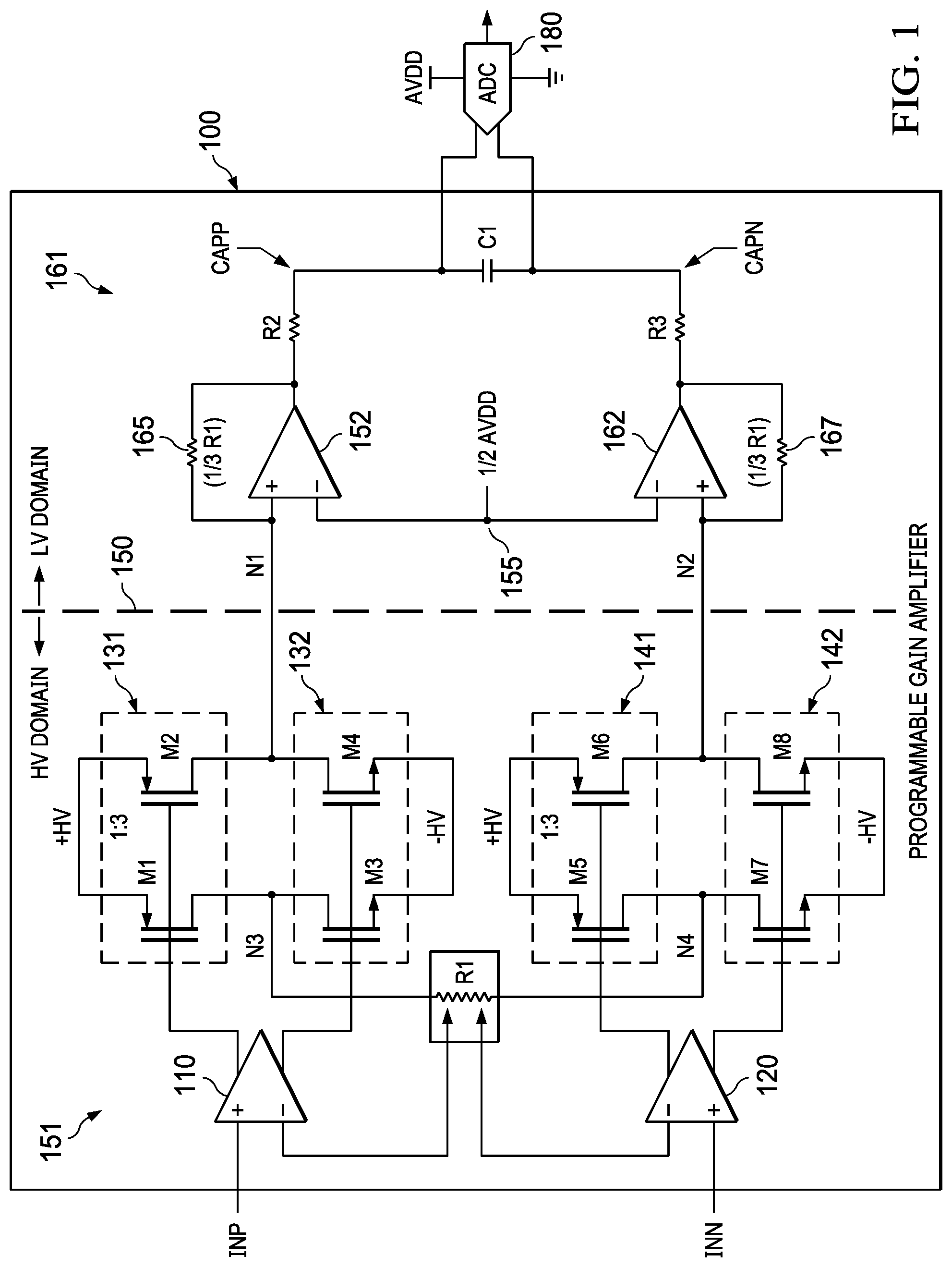
shows an example of a programmable gain amplifier coupled to an analog-to-digital converter (ADC).
illustrates chopping implemented in current mirrors within the programmable gain amplifier.
shows an example implementation of the use of a shift logic circuit to control the power state of multiple transistors to implement chopping.
shows an example implementation of the shift logic circuit of .
DETAILED DESCRIPTION
shows an example of a system comprising a PGA 100 having an input stage 151 and an output stage 161 . The PGA 100 is coupled to an ADC 180 . In this example, the PGA 100 is configured to receive differential input signal INP and INN. The input signals have a common mode voltage that can be within a range of voltages. The dashed line 150 within the PGA 100 indicates the demarcation between two different voltage domains within the PGA. The left side of dashed line 150 is a higher voltage (HV) domain, and the left side of the dashed line 150 is a lower voltage (LV) domain. The supply rails +HV and −HV represent supply voltages within the HV domain, and AVDD represents the supply voltage for the LV domain. In one example, +HV and −HV is +18V and −18V, respectively, and AVDD is 5V. Different voltages are possible as well in other examples. The input signals INP and INN are between +HV and −HV. In the example in which +HV and −HV is +18V and −18V, INP and INN are between +18V and −18V. The common mode of INP and INN may be 0V or a voltage other than 0V. In one example, the differential voltage between INP and INN is 2V and the common mode voltage is 0V, meaning that INP is +1V and INN is −1V. In another example, the differential voltage between INP and INN is also 2V, but the common mode is 14V, meaning that INP is +15V and INN is +13V.
The ADC 180 in this example, however, operates from a lower supply voltage AVDD (e.g., 5V) than the +HV and −HV supply voltages of the HV domain. Further, the common mode of INP, INN may be higher (e.g., 14V) than the highest permitted voltage for the ADC 180 (e.g., 5V). As such, the PGA 100 adjusts the common mode of the input INP/INN to a predetermined common mode voltage, ½ AVDD, and provides adjustable gain (both attenuation and gain) to ensure the signal provided to the ADC 180 is within the proper input range for the ADC.
The input stage 151 of PGA 00 includes input amplifiers 110 and 120 , a multi-tap resistor R 1 , and current mirrors 131 , 132 , 141 , and 142 . The output stage 161 includes amplifiers 152 and 162 , resistors R 2 and R 3 , and output capacitor C 1 . The voltage on the nodes on opposite sides of capacitor C 1 (CAPP and CAPN) comprise the signal to be provided to the input of the ADC 180 for digitization. INP is provided to the positive (+) input of input amplifier 110 , and INN is provided to the positive input of input amplifier 120 . The gain within the input stage 151 is programmable. Resistor R 1 comprises multiple resistors connected in series with a tap point between each series connected pair of resistors. The gain of the input stage 151 is programmable through selection of a desired tap point for connection to the negative (−) input of amplifiers 110 and 120 .
Current mirror 131 comprises transistors M 1 and M 2 . Current mirror 132 comprises transistors M 3 and M 4 . Current mirror 141 comprises transistors M 5 and M 6 . Current mirror 142 comprises transistors M 7 and M 8 . In this example, transistors M 1 , M 2 , M 5 , and M 6 are p-type metal oxide semiconductor field effect transistors (PMOS transistors), and transistors M 3 , M 4 , M 7 , and M 8 are n-type metal oxide semiconductor field effect transistors (NMOS transistors). A transistor has a control input and a pair of current terminals. As MOS transistors, the control input is the gate, and the current terminals are the drain and source. In some implementations, one or more of the transistors M 1 -M 8 are implemented as bipolar junction transistors (BJTs). As BJT transistors, the control input is the base, and the current terminals are the collector and emitter.
The differential output of amplifier 110 is coupled to the gates of transistors M 1 and M 2 as well as to the gates of transistors M 3 and M 4 , as shown. The sources of transistors M 1 and M 2 are connected together and to the +HV supply rail of the HV domain. The sources of transistors M 3 and M 4 are connected together and to the −HV supply rail of the HV domain. The drains of M 1 and M 3 are connected together at node N 3 and to one end terminal of resistor R 1 , and the drains of M 2 and M 4 are connected together at node N 1 . Node N 1 is connected to the positive input of amplifier 152 . The sources of transistors M 5 and M 6 are connected together and to the +HV supply rail. The sources of transistors M 7 and M 8 are connected together and to the −HV supply rail. The drains of M 5 and M 7 are connected together at node N 4 and to the other end terminal of resistor R 1 as shown, and the drains of M 6 and M 8 are connected together at node N 2 . Node N 2 is connected to the positive input of amplifier 162 .
The current mirror ratio of current mirrors 131 , 132 , 141 , and 142 is 1:3, but can be a different ratio in other examples (e.g., 1:2, 1:4, etc.). The current mirrors 131 , 132 , 141 , and 142 convert the output voltage from input amplifiers 110 and 120 into a current. With a current mirror ratio of 3, the current mirrors implement a gain factor of 3 for the current, and thus the output current from the current mirrors (through transistors M 2 , M 4 , M 6 , and M 8 ) is three times the input current to the current mirrors (through transistors M 1 , M 3 , M 5 , and M 7 ).
In the output stage 161 , a resistor 165 is connected between node N 1 and the output of amplifier 152 , and a resistor 167 is connected between node N 2 and the output of amplifier 162 . With the current mirror ratio of the current mirrors being 1:3, the resistance of resistors 165 and 167 is ⅓ R 1 . That is, resistor 165 has a resistance configured to be ⅓ of the resistance selected between node N 3 and the negative input of amplifier 110 . Similarly, resistor 167 has a resistance configured to be ⅓ of the resistance selected between node N 4 and the negative input of amplifier 120 . The output of amplifier 152 is connected to resistor R 2 , and the output of amplifier 162 is connected to resistor R 3 . Amplifiers 152 and 162 convert the current from the current mirrors back to a voltage, and a signal indicative of that voltage across capacitor C 1 is provided to the ADC 180 . The negative inputs of amplifiers 152 and 162 are biased at ½ AVDD. For an example AVDD of 5 V, the bias voltage for the negative inputs of amplifiers 152 and 162 is 2.5V. Biasing the negative inputs of amplifiers 152 and 162 at ½ AVDD forces the common mode between nodes N 1 and N 2 to be ½ AVDD.
By providing a gain in the current mirrors 131 , 132 , 141 , and 142 on the output of the input amplifiers 110 and 120 , the overall noise of the output signal from the PGA 100 is reduced, compared to using, for example, current mirrors with 1:1 current mirror ratio. Gain in the current mirror (e.g., 1:3) reduces the noise especially for the attenuation mode. Because overall noise performance is input-referred, implementing the gain stage at the earlier stage (i.e., closer to the input of the amplifier) helps reduce noise. For the attenuation mode, amplifiers 110 and 120 are always set at gain of 1 so by putting gain in the current mirror, the overall noise is reduced.
Chopping is also employed within the current mirrors to eliminate the effects of any current element mismatch (e.g., mismatch in transistor characteristics). illustrates chopping within current mirrors 131 and 132 . The same implementation can be employed for chopping within current mirrors 141 and 142 . Four cycles A, B, C, and D are illustrated for the chopping technique implemented for the current mirrors. In this example, the chopping pattern repeats every four cycles. Current mirror 131 within each cycle A-D includes transistors M 1 and M 2 , as well as transistors M 9 and M 10 and an error amplifier 210 . In this example, transistors M 9 and M 10 are PMOS transistors. The source of transistor M 9 is connected to the drain of transistor M 1 at node N 5 , and the source of transistor M 10 is connected to the drain of transistor M 2 at node N 6 . The inputs to error amplifier 210 are connected to nodes N 5 and N 6 . As such, error amplifier 210 amplifies the difference in the voltage been nodes N 5 and N 6 . The gate of transistor M 9 is biased at a voltage labeled Vbp, and the output of error amplifier 210 is connected to the gate of transistor M 10 . The output signal from the error amplifier 210 controls the gate-to-source voltage (Vgs) of transistor M 2 . The drain current through transistor M 2 is controlled to be three-times the drain current through transistor M 1 with the error amplifier controlling transistor M 10 to maintain the 3× current through transistor M 2 .
The current mirror 132 is similarly configured. Current mirror 131 within each cycle A-D includes transistors M 3 and M 4 , as well as transistors M 11 and M 12 and an error amplifier 220 . In this example, transistors M 11 and M 12 are NMOS transistors. The source of transistor M 11 is connected to the drain of transistor M 3 at node N 7 , and the source of transistor M 12 is connected to the drain of transistor M 4 at node N 8 . The inputs to error amplifier 220 are connected to nodes N 7 and N 8 . As such, error amplifier 220 amplifies the difference in the voltage been nodes N 7 and N 8 . The gate of transistor M 11 is biased at a voltage labeled Vbn, and the output of error amplifier 220 is connected to the gate of transistor M 12 . The output signal from the error amplifier 220 controls the gate-to-source voltage of transistor M 4 . The drain current through transistor M 4 is controlled to be three-times the drain current through transistor M 3 with the error amplifier 220 controlling the Vgs of transistor M 12 to maintain the 3× current through transistor M 4 .
Referring still to , the numbers in parentheses adjacent transistors M 1 , M 2 , M 3 , and M 4 illustrate the chopping technique. Transistor pair M 1 and M 2 is implemented from a selection and configuration of four transistors numbered 1 , 2 , 3 , and 4 . Similarly, transistor pair M 3 and M 4 is implemented from a selection and configuration of another four transistors numbered also numbered 1 , 2 , 3 , and 4 for illustration purposes. Transistors 1 - 4 associated with transistors M 1 and M 2 are all of the same size, as are transistors 1 - 4 associated with transistor M 3 and M 4 .
In cycle A, transistor M 1 (the X 1 size transistor) is implemented with transistor 1 , while transistor M 2 (the X 3 transistor) is implemented with transistors 2 - 4 . In cycle B, the X 1 transistor M 1 is implemented with transistor 2 , while the X 3 transistor M 2 is implemented with transistors 1 , 3 , and 4 . In cycle C, the X 1 transistor M 1 is implemented with transistor 3 , while the X 3 transistor M 2 is implemented with transistors 1 , 2 , and 4 . In cycle D, the X 1 transistor M 1 is implemented with transistor 4 , while the X 3 transistor M 2 is implemented with transistors 1 , 2 , and 3 . Thus, each of the transistors 1 - 4 are rotated being used to implement the smaller X 1 transistor within the current mirror 131 over the course of four cycles A-D, and then the pattern repeats. The same transistor rotation pattern is implemented as well for current mirror 132 .
In the example of , one transistor is used for the X 1 transistor and three transistors are used for the X 3 transistor within the current mirror. In other implementations, two transistors could be used to implement the X 1 transistor and six transistors used to implement the X 3 transistor and thus still maintain the 1:3 ratio for the current mirror. In general, H transistors are used for the X 1 transistor (where H is an integer greater than or equal to 1) and 3 H transistors are used for the X 3 transistor.
shows an example implementation of the current mirror 132 comprising transistors M 1 and M 2 employing a chopping technique. The example of includes shift logic circuit 310 and transistors M 13 -M 20 . The sources of all of transistors M 13 -M 20 are connected together. The drains of transistors M 13 , M 14 , M 15 and M 16 are connected together at node N 3 . The drains of transistors M 17 , M 18 , M 19 and M 20 are connected together at node N 1 . The gate of each transistor M 13 -M 20 is driven with a separate signal generated by shift logic 310 . Shift logic circuit 310 generates signals S<3:0> to drive the gates of transistors M 13 -M 16 as shown, and generates signals N<3:0> to drive the gates of transistors M 17 -M 20 . As such, shift logic circuit 310 can separately control the power state of the transistors M 13 -M 20 .
Transistor M 1 is implemented in each of the four cycles using a single transistor, while transistor M 2 is implemented in each cycle using three transistors. Shift logic circuit 310 controls which one transistor from among M 13 -M 16 is turned on each cycle to implement transistor M 1 , and which three transistors from among M 17 -M 20 are turned on to implement transistor M 2 . In one example, control signals S<3:0> comprise four bits with one of the four bits in each cycle being a logic 1 and the other three bits being a logic 0. The one bit that is a logic 1 causes the corresponding transistor M 13 -M 16 to turn on, and the other three bits that are logic 0 cause those corresponding transistors to turn off. The bit within S<3:0> that is a logic 1 rotates every time each time the clock input to shift logic circuit 310 is active (positive transitioning edges, negative transitioning edges)
Control signals N<3:0> also comprise four bits, and three of the four bits are logic 1 in each cycle and one bit is a logic 0. The three transistors M 17 -M 20 whose gates receive a logic 1 from shift control 310 turn on, while remaining transistor is off. The shift logic circuit 310 rotates which of the four transistors M 17 -M 20 are turned on. In one example, N<3:0> is the logic inverse of S<3:0>.
In one example, the rotating pattern of S<3:0> and N<3:0> four cycles of the shift control circuit 310 is provided below in Table I, along with the identification of those transistors that are on and those that are off in each of the corresponding cycles.
TABLE I
S<3: N<3:
0> 0> M13 M14 M15 M16 M17 M18 M19 M20
1000 0111 on off off off off on on on
0100 1011 off on off off on off on on
0010 1101 off off on off on on off on
0001 1110 off off off on on on on off
The configuration of the transistor pairs M 1 /M 2 , M 5 /M 6 , and M 7 /M 8 is implemented in the same manner as shown in for transistors M 3 and M 4 (although transistor pairs M 1 /M 2 and M 5 /M 6 comprise PMOS transistors).
shows an example implementation of shift logic circuit 310 . In this example, shift logic circuit 310 comprises four D flip-flops 410 , 420 , 430 , and 440 . Each D flip-flop 410 - 440 comprises a data (D) input, a clock input, a preset input (PREZ), and clear input (CLRZ). The PREZ and CLRZ inputs are active low. A logic low signal on the PREZ input causes the Q output of the flip-flop to be asserted to a logic 1 (and thus the Q bar output, QB, will be a logic 0). A logic low signal on the CLRZ input causes the Q output of the flip-flop to be a logic 0 (and thus the QB output will be a logic 1).
The reset signal (RST) is an active low signal to initialize the shift logic circuit 310 . RST is provided to the PREZ input of D flip-flop 410 and to the CLRZ inputs of each of D flip-flops 420 - 440 . Thus, when RST is low, the Q output of D flip-flop 410 is asserted high and the QB outputs of the D flip-flops 420 , 430 , and 440 are forced low. The S<3>, S<2>, S<1>, and S<0> control signals are the Q outputs of D flip-flops 410 , 420 , 430 , and 440 , respectively. The N<3>, N<2>, N<1>, and SN<0> control signals are the QB outputs of D flip-flops 410 , 420 , 430 , and 440 , respectively. Thus, when RST is asserted low, S<3:0> becomes <1000>, and N<3:0> becomes <0111>.
The Q output of D flip-flop 410 is coupled to the D input of D flip-flop 420 . The Q output of D flip-flop 420 is coupled to the D input of D flip-flop 430 , and the Q output of D flip-flop 430 is coupled to the D input of D flip-flop 440 . The Q output of D flip-flop 440 is provided to the D input of D flip-flop 410 .
After RST asserts low to initialize the S<3:0> and N<3:0> control signals, RST is forced high to release the reset state of the D flip-flops 410 - 440 . At that point, the state of the D flip-flops is controlled by the clock. With each assertion of the clock, the Q output of each D flop-flop is asserted to the logic level of its D input, which is the logic level of the preceding D flip-flop's Q output. As such, the D flip-flops in the example of implement the shift functionality described above in Table I.
In this description, the term “couple” or “couples” means either an indirect or direct wired or wireless connection. Thus, if a first device couples to a second device, that connection may be through a direct connection or through an indirect connection via other devices and connections. Modifications are possible in the described embodiments, and other embodiments are possible, within the scope of the claims.
Figures (4)
Citations
This patent cites (13)
- US5451902
- US6717474
- US7288967
- US8736370
- US9143111
- US9407226
- US9614502
- US10530302
- US10790594
- US20020000880
- US20130033326
- US20150077183
- US101026415