Semiconductor Light-emitting Device
Abstract
A semiconductor light-emitting device includes a lead frame, a semiconductor light-emitting element mounted on the top surface of the bonding region, and a case covering part of the lead frame. The bottom surface of the bonding region is exposed to the outside of the case. The lead frame includes a thin extension extending from the bonding region and having a top surface which is flush with the top surface of the bonding region. The thin extension has a bottom surface which is offset from the bottom surface of the bonding region toward the top surface of the bonding region.
Claims (13)
1. A semiconductor device comprising: a first lead frame including a bonding portion, the bonding portion having a lateral side extending in a first direction perpendicular to a thickness direction of the bonding portion; a second lead frame spaced apart from the first lead frame in the first direction; a first semiconductor element mounted on the bonding portion and electrically connected to the first lead frame and the second lead frame; and a case covering a part of the first lead frame and a part of the second lead frame, wherein the bonding portion includes an exposed surface exposed from the case, the second lead frame includes an exposed surface exposed from the case, the first lead frame further includes at least one thin extension and at least one thick extension, the thin extension extends from the lateral side of the bonding portion in a second direction perpendicular to the thickness direction and the first direction, the thin extension having a first surface located inward of the case with respect to the exposed surface of the bonding portion, wherein the first surface and the exposed surface of the bonding portion face in a same direction, the thick extension extends directly from the lateral side of the bonding portion in the second direction, the thick extension being disposed next to and spaced apart from the thin extension in the first direction, the thick extension being equal in thickness to the bonding portion, the thick extension having an exposed surface exposed from the case, and the exposed surface of the thick extension and the exposed surface of the bonding portion are flush with each other.
12. A mounting structure comprising a circuit board and a semiconductor device mounted on the circuit board, wherein the semiconductor device comprises: a first lead frame including a bonding portion, the bonding portion having a lateral side extending in a first direction perpendicular to a thickness direction of the bonding portion; a second lead frame spaced apart from the first lead frame in the first direction; a first semiconductor element mounted on the bonding portion and electrically connected to the first lead frame and the second lead frame; and a case covering a part of the first lead frame and a part of the second lead frame, wherein heat generated at the first semiconductor element is conducted to the circuit board via the bonding portion, the bonding portion has an exposed surface exposed from the case, the second lead frame has an exposed surface exposed from the case, and the first lead frame further comprises: a thick extension extending directly from the lateral side of the bonding portion in a second direction perpendicular to the thickness direction and the first direction, the thick extension being equal in thickness to the bonding portion, the thick extension having an exposed surface exposed from the case, a thin extension extending from the lateral side of the bonding portion in the second direction, the thin extension being smaller in thickness than the bonding portion, and the thin extension is located next to and spaced apart from the thick portion in the first direction wherein the exposed surface of the thick extension and the exposed surface of the bonding portion are flush with each other.
Show 11 dependent claims
2. The semiconductor device according to claim 1 , wherein the second lead frame comprises a thin extension that is smaller in thickness than the bonding portion.
3. The semiconductor device according to claim 1 , wherein the at least one thin extension of the first lead frame comprises a plurality of thin extensions.
4. The semiconductor device according to claim 3 , wherein the first lead frame is made of a metal.
5. The semiconductor device according to claim 3 , wherein no semiconductor elements are mounted on the first lead frame other than the first semiconductor element.
6. The semiconductor device according to claim 3 , wherein the first lead frame comprises a terminal portion protruding from the case in the first direction in plan view, the terminal portion being equal in thickness to the bonding portion, the terminal portion comprises a first protrusion and a second protrusion each extending in the first direction, and the terminal portion is formed with a recess disposed between the first protrusion and the second protrusion.
7. The semiconductor device according to claim 6 , wherein each of the first protrusion and the second protrusion is equal in thickness to the bonding portion.
8. The semiconductor device according to claim 6 , wherein the first protrusion and the second protrusion are equal in length in the first direction to each other.
9. The semiconductor device according to claim 3 , wherein the thick portion and the thin portion of the first lead frame are next to and spaced apart from each other in the first direction.
10. The semiconductor device according to claim 3 , wherein the at least one thick extension of the first lead frame comprises a plurality of thick extensions.
11. The semiconductor device according to claim 10 , wherein the plurality of thin extensions and the plurality of thick extensions are disposed alternately in the first direction.
13. The mounting structure according to claim 12 , wherein the thin extension has a first surface located inward of the case with respect to the exposed surface of the bonding portion, and the first surface and the exposed surface of the bonding portion face in a same direction.
Full Description
Show full text →
BACKGROUND OF THE INVENTION
1. Field of the Invention
The present invention relates to a semiconductor light-emitting device provided with a semiconductor light-emitting element.
2. Description of the Related Art
illustrate an example of conventional semiconductor light-emitting device (see JP-A-2005-353914, for example). The illustrated semiconductor light-emitting device X includes a lead frame 91 , an LED chip 92 , a case 93 , and a transparent resin 94 . The lead frame 91 includes two strip portions, i.e., a relatively long portion 91 a and a relatively short portion 91 b , as seen from . These two portions, having the same width as seen from , are fitted into a lower space in the case 93 in a manner such that the bottom surface of the lead frame 91 is exposed out of the case 93 . The LED chip 92 serves as a light source of the semiconductor light-emitting device X, and is bonded to the longer strip portion 91 a of the lead frame 91 . The LED chip 92 is connected to the shorter strip portion 91 b of the lead frame 91 via a wire 95 . The light-emitting device X may be mounted on a printed circuit board, for example.
In order to obtain stronger light emission from the semiconductor light-emitting device X, it is required to apply greater electrical power to the LED chip 92 . Inevitably, the amount of heat generated by the LED chip 92 is increased, and for maintaining the proper light emission, the heat should be conducted from the longer strip portion 91 a to the circuit board. One way to facilitate the heat conduction is to broaden the strip portion 91 a (hence the lead frame 91 ) to which the LED chip 92 is attached.
While the width of the longer strip portion 91 a is to be increased, the overall size of the case 93 may be unchanged so that the light-emitting device X is kept compact. In this case, the side walls of the case 93 need to be made thinner to permit the size increase of the longer strip portion 91 a . This configuration, however, will weaken the frame-holding force of the case 93 , which may allow the lead frame 91 to drop off from the case 93 .
SUMMARY OF THE INVENTION
The present invention has been proposed under above-described circumstances, and thus an object of the present invention is to provide a semiconductor light-emitting device that is compact and capable of emitting bright light.
According to the present invention, there is provided a semiconductor light-emitting device comprising: a lead frame including a bonding region having a top surface and a bottom surface; a semiconductor light-emitting element mounted on the top surface of the bonding region; and a case covering part of the lead frame. The bottom surface of the bonding region is exposed to an outside of the case. The lead frame includes a thin extension extending from the bonding region and having a top surface and a bottom surface. The top surface of the thin extension is flush with the top surface of the bonding region, while the bottom surface of the thin extension is offset from the bottom surface of the bonding region toward the top surface of the bonding region.
Preferably, the semiconductor light-emitting device of the present invention may further comprise a thick extension extending from the bonding region and having a top surface and a bottom surface. The thick extension is arranged adjacent to the thin extension and is the same in thickness as the bonding region. The bottom surface of the thick extension is exposed to the outside of the case.
Other features and advantages will be apparent from the following description with reference to the accompanying drawings.
BRIEF DESCRIPTION OF THE DRAWINGS
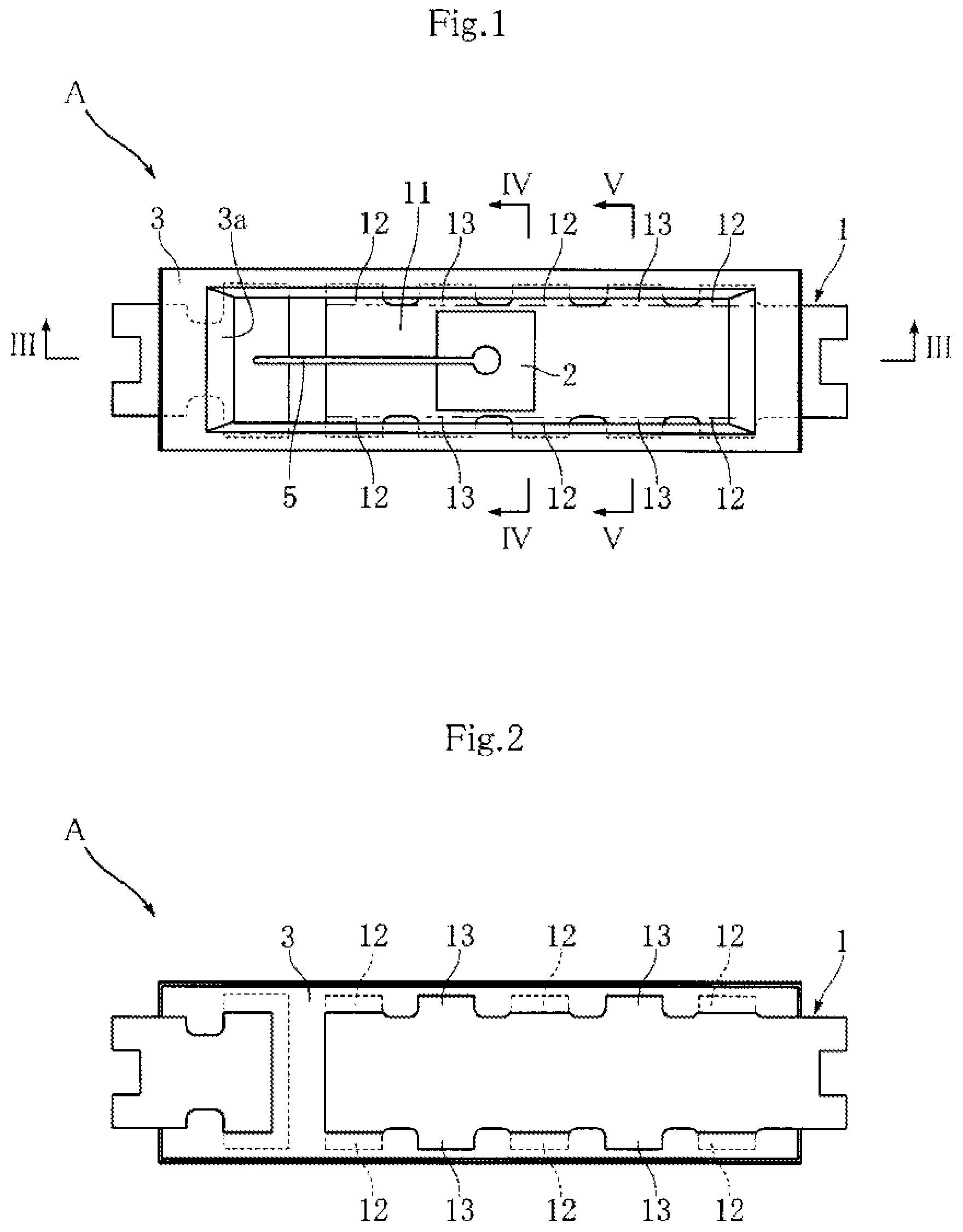
is a plan view illustrating the principal portions of a semiconductor light-emitting device according to the present invention.
is a bottom view illustrating the semiconductor light-emitting device shown in .
is a sectional view taken along lines III-III in .
is a sectional view taken along lines IV-IV in .
is a sectional view taken along lines V-V in .
is a sectional view illustrating a conventional semiconductor light-emitting device.
is a sectional view taken along lines VII-VII in .
DETAILED DESCRIPTION OF THE PREFERRED EMBODIMENTS
Preferred embodiments of the present invention will be described below with reference to the accompanying drawings.
illustrate a semiconductor light-emitting device according to the present invention. The semiconductor light-emitting device A includes a lead frame 1 , a light-emitting diode (LED) chip 2 , a case 3 , and a protection resin 4 that allows the passage of light emitted from the LED chip 2 . The light-emitting device A is a small rectangular parallelepiped having a length of about 4 mm, a width of about 1 mm, and a height of about 0.6 mm. In , for convenience of explanation, the protection resin 4 is not shown.
The lead frame 1 is made of Cu, Ni, or an alloy containing Cu and/or Ni. As shown in , the lead frame 1 is exposed out of the case 3 at its bottom surface, and is divided into a longer primary portion and a shorter secondary portion. The primary portion includes a bonding region 11 , a plurality of thin extensions 12 , and a plurality of thick extensions 13 . In , the boundary between the bonding region 11 and the extensions 12 , 13 is indicated by double-dot broken lines.
The bonding region 11 is a strip-shaped region on part of which the LED chip 2 is mounted. Each of the thin extensions 12 extends out from the bonding region 11 , and has a thickness which is about half the thickness of the bonding region 11 , for example. As shown in , the top surfaces of the thin extensions 12 are flush with the top surface of the bonding region 11 . The bottom surfaces of the thin extensions 12 are positioned higher than the bottom surface of the bonding portion 11 , as viewed vertically in (in other words, the bottom surfaces of the thin extensions 12 are offset toward the top surface of the bonding region 11 from the bottom surface of the bonding region 11 ). The bottom surfaces of the thin extensions 12 are covered by the case 3 .
As shown in , each of the thick extensions 13 extends out from the bonding region 11 , and has a thickness which is substantially the same as the thickness of the bonding region 11 . The top surfaces of the thick extensions 13 are flush with the top surface of the bonding region 11 , and the bottom surfaces of the thick extensions (which are flush with the bottom surface of the bonding region 11 ) are exposed to the outside of the case 3 . As shown in , the thin extensions 12 and the thick extensions 13 are arranged alternatively in the longitudinal direction of the lead frame 1 .
The LED chip 2 as a light source of the light-emitting device A is configured to emit light of a predetermined wavelength. The LED chip 2 is made of a semiconductor material such as GaN, for example, and emits blue light, green light, or red light by the recombination of electrons and holes at an active layer sandwiched by an n-type semiconductor layer and a p-type semiconductor layer. The LED chip 2 is connected to the shorter portion of the lead frame 1 via a wire 5 .
The case 3 is made of a white resin, for example, and is a generally rectangular frame. As shown in , the inner surfaces of the case 3 serve as a reflector 3 a that tapers downward. The reflector 3 a upwardly reflects light which is emitted laterally from the LED chip 2 . As shown in , the case 3 is held in unreleasable engagement with the thin extensions 12 . Further, as shown in , the case 3 is in mesh with the thin extensions 12 and the thick extensions 13 .
The protection resin 4 is made of a transparent or transparent epoxy resin, for example, filled in a space defined by the case 3 . The protection resin 4 covers the LED chip 2 , and while protecting the LED chip 2 .
Next, the functions of the semiconductor light device A will be described below.
As described above, the case 3 is held in unreleasable engagement with the thin extensions 12 . Thus, the lead frame 1 is reliably held by the case 3 , to be prevented from dropping off from the case 3 . As a result, though the light-emitting device A has a very small width (about 1 mm), the lead frame 1 is exposed out of the case 3 in a relatively large area, as seen from . Therefore, heat can be efficiently conducted from the LED chip 2 to a printed circuit board (CB in ), for example, which contributes to attaining light emission of desired intensity.
As described above, the thin extensions 12 and the thick extensions 13 are arranged to alternate with each other, and the bottom surfaces of the thick extensions 13 are exposed to the outside of the case 3 , as shown in . In this manner, the exposed area of the lead frame 1 can be increased. Advantageously, this facilitates the heat dissipation from the led chip 2 .
Figures (3)
Citations
This patent cites (70)
- US5062115
- US5719663
- US6081029
- US6143981
- US6281568
- US6501156
- US6630728
- US6661083
- US6680568
- US6809409
- US6873032
- US6967125
- US6984878
- US6995510
- US7042068
- US7205180
- US7242076
- US7359204
- US7436002
- US7655958
- US8129222
- US8946763
- US10008650
- US20020005573
- US20020041011
- US20040070056
- US20040080026
- US20040159850
- US20050051877
- US20050093117
- US20050151149
- US20050189626
- US20050258520
- US20050269587
- US20050280017
- US20060027902
- US20060170083
- US20060223238
- US20060255438
- US20070170570
- US20070176271
- US20080121921
- US20080185693
- US20120080674
- US20120132938
- US20120138967
- US20140117403
- US20190067172
- US20220208701
- US1288261
- US1822402
- US63-250163
- US2000-150765
- US2000-244022
- US2003-174200
- US2004-22862
- US2004-274027
- US2004-534405
- US2005-353914
- US2006-93470
- US2006-156704
- US2006-210909
- US3125666
- US2006-313943
- US2007-5378
- US2007-42755
- US2007-59677
- US2007-67443
- US2020-120118
- US2003/005458