Abstract
Memory devices are disclosed. In an embodiment of the disclosed technology, a memory device may include a substrate including an active region, and a first floating gate, a second floating gate, a third floating gate and a fourth floating gate formed on the substrate, arranged to partially overlap with the active region. The first floating gate and the third floating gate are arranged in a first direction at one side of the active region and asymmetrical about a center of the active region, and the second floating gate and the fourth floating gate are arranged in the first direction at another side of the active region and asymmetrical about the center of the active region.
Claims (20)
1. A memory device comprising: a substrate including an active region; and a first floating gate, a second floating gate, a third floating gate and a fourth floating gate formed on the substrate, arranged to partially overlap with the active region, wherein the first floating gate and the third floating gate are arranged in a first direction at one side of the active region and asymmetrical about a center of the active region, and the second floating gate and the fourth floating gate are arranged in the first direction at another side of the active region and asymmetrical about the center of the active region, and wherein the first floating gate and the second floating gate are arranged to face each other in a second direction perpendicular to the first direction, and the first floating gate is asymmetrical from the second floating gate, and the third floating gate and the fourth floating gate are arranged to face each other in the second direction, and the third floating gate is asymmetrical from the fourth floating gate.
10. A memory device comprising: a substrate; first and second well regions formed in the substrate and having different conductive types, the first and second well regions arranged parallel to each other in a first direction; an isolation layer formed in the substrate to define a first active region and a second active region in each of the first and second well regions; first and second selection gates formed on the substrate and structured to overlap with the first active region, the first and second selection gates arranged parallel to each other in a second direction substantially perpendicular to the first direction, and the first and second selection gates having a linear shape extending in the first direction; and first and second floating gates arranged adjacent to the first and second selection gates, respectively, the first and second floating gates overlapping with the first active region and the second active region, and the first and second floating gates facing each other in the second direction, wherein the first floating gate and the second floating gate face each other in the second direction and are asymmetrical from each other.
Show 18 dependent claims
2. The memory device of claim 1 , wherein the third floating gate and the fourth floating gate facing each other in the second direction are asymmetrical about an axis passing through the center of the active region in the first direction, and the fourth floating gate and the second floating gate facing each other in the first direction are asymmetrical about an axis passing through the center of the active region in the second direction.
3. The memory device of claim 1 , wherein the active region is structured to extend in the first direction, the first floating gate and the fourth floating gate are spaced apart from each other, and the second floating gate and the third floating gate overlap with one edge portion and the other edge portion of the active region, respectively, and the first floating gate overlaps with a portion of the active region between the one edge and the center of the active region, and the fourth floating gate overlaps with another portion of the active region between the other edge and the center of the active region.
4. The memory device of claim 3 , wherein the portions of the active regions where the first to fourth floating gates overlapping with the active region are arranged in the first direction and spaced apart by a gap.
5. The memory device of claim 1 , wherein the first floating gate and the fourth floating gate have L shapes, and a horizontal cross section of each of the second floating gate and the third floating gate has a vertical linear structure with a protruding horizontal linear structure.
6. The memory device of claim 1 , wherein each of the first to fourth floating gates comprises a first region having a linear shape extending in the first direction and a second region having a linear shape extending from the first region in the second direction.
7. The memory device of claim 6 , wherein each first region in each of the first to fourth floating gates has a length longer than a length of each second region in each of the first to fourth floating gates.
8. The memory device of claim 6 , wherein the second region is structured to cross the active region and partially overlap with the active region, and overlapped areas between the active region and the first to fourth floating gates are substantially equal to each other.
9. The memory device of claim 1 , wherein the active region is used as an active control gate.
11. The memory device of claim 10 , wherein the first selection gate and the first floating gate, and the second selection gate and the second floating gate have sidewalls facing each other in the second direction, and an insulation structure is formed between the sidewalls.
12. The memory device of claim 10 , wherein the second active region structured to extend in the first direction, a distance between the first selection gate and the second active region in the second direction is substantially the same as a distance between the second selection gate and the second active region in the second direction.
13. The memory device of claim 10 , wherein the second active region is used as an active control gate, a positive pumping voltage is applied to the second active region in a program operation and an erase operation, and the positive pumping voltage in the erase operation is higher than the positive pumping voltage in the program operation.
14. The memory device of claim 10 , wherein a cross section of the first floating gate has an L shape, and a cross section of the second floating gate has a vertical linear structure with a protruding horizontal linear structure.
15. The memory device of claim 10 , wherein each of the first and second floating gates comprises a first region having a linear shape extending in the first direction and a second region having a linear shape extending from the first region in the second direction.
16. The memory device of claim 15 , wherein the first region has a length longer than a length of the second region, the second region is structured to cross the second active region and partially overlap with the second active region, and overlapped areas between the second active region and the first and second floating gates are substantially equal to each other.
17. The memory device of claim 10 , further comprising: a third well region formed at the substrate, the third well region having a conductive type substantially the same as the conductive type of the first well region; a third active region defined in the third well region by the isolation layer, the third active region overlapping with the first selection gate and the second selection gate; and third and fourth floating gates arranged adjacent to the first and second selection gates, respectively, the third and fourth floating gates overlapping with the third active region and the second active region, and the third and fourth floating gates facing each other in the second direction, wherein the third floating gate and the fourth floating gate face each other in the second direction and are asymmetrical from each other.
18. The memory device of claim 17 , wherein the first floating gate and the third floating gate face each other in the first direction and are asymmetrical from each other.
19. The memory device of claim 17 , wherein the second floating gate and the fourth floating gate face each other in the first direction and are asymmetrical from each other.
20. The memory device of claim 17 , wherein overlapped areas in the first direction between the second active region and the first to fourth floating gates are substantially equal to each other.
Full Description
Show full text →
CROSS-REFERENCES TO RELATED APPLICATION
This patent document claims the priority and benefits of Korean patent application number 10-2020-0187100, filed on Dec. 30, 2020, which is incorporated herein by reference in its entirety.
TECHNICAL FIELD
The technology and implementations disclosed in this patent document generally relate to a semiconductor device.
BACKGROUND
The growing trend of using mobile devices to access information anytime and anywhere has increased the demand for highly integrated semiconductor devices. System-on chip (SoC) is the technology that integrates several computer components into one semiconductor device. SoC technology makes it possible to fabricate memory and non-memory on a single chip.
Embedded memory is the most sought after by many industries. Embedded memory is an on-chip memory integrated into an SoC that supports logic circuits on the SoC to perform intended functions. One example of the embedded memory is an electrically erasable programmable read only memory (EEPROM). The EEPROM can retain data in absence of power like a read only memory (ROM), and can be erased and reprogrammed through the application of a high voltage.
SUMMARY
The embodiments of the disclosed technology relate to a non-volatile memory device with improved reliability.
In some embodiments of the disclosed technology, a memory device may include a substrate including an active region, and a first floating gate, a second floating gate, a third floating gate and a fourth floating gate formed on the substrate, arranged to partially overlap with the active region. The first floating gate and the third floating gate are arranged in a first direction at one side of the active region and asymmetrical about a center of the active region, and the second floating gate and the fourth floating gate are arranged in the first direction at another side of the active region and asymmetrical about the center of the active region. The first floating gate and the second floating gate are arranged to face each other in a second direction perpendicular to the first direction, and the first floating gate is asymmetrical from the second floating gate, and the third floating gate and the fourth floating gate are arranged to face each other in the second direction, and the third floating gate is asymmetrical from the fourth floating gate.
In some embodiments of the disclosed technology, a memory device may include a substrate, first and second well regions formed in the substrate and having different conductive types, the first and second well regions arranged parallel to each other in a first direction, an isolation layer formed in the substrate to define a first active region and a second active region in each of the first and second well regions, first and second selection gates formed on the substrate and structured to overlap with the first active region, the first and second selection gates arranged parallel to each other in a second direction substantially perpendicular to the first direction, and the first and second selection gates having a linear shape extending in the first direction, and first and second floating gates arranged adjacent to the first and second selection gates, respectively, the first and second floating gates overlapping with the first active region and the second active region, and the first and second floating gates facing each other in the second direction. The first floating gate and the second floating gate face each other in the second direction and are asymmetrical from each other.
In some embodiments of the disclosed technology, the memory device may further include a third well region formed at the substrate, the third well region having a conductive type substantially the same as the conductive type of the first well region, a third active region defined in the third well region by the isolation layer, the third active region overlapping with the first selection gate and the second selection gate, and third and fourth floating gates arranged adjacent to the first and second selection gates, respectively, the third and fourth floating gates overlapping with the third active region and the second active region, and the third and fourth floating gates facing each other in the second direction. The third floating gate and the fourth floating gate face each other in the second direction and are asymmetrical from each other.
In some embodiments of the disclosed technology, a non-volatile memory device may include a substrate, a first floating gate, a second floating gate, a third floating gate and a fourth floating gate. The substrate may include an active region. The first to fourth floating gates may be formed on the substrate. The first to fourth floating gates may be radially arranged to be partially overlapped with the active region. The first floating gate and the third floating gate may face each other in a first direction. The first floating gate and the third floating gate may have asymmetrically planar shapes. The first floating gate and the second floating gate may face each other in a second direction substantially perpendicular to the first direction. The first floating gate and the second floating gate may have asymmetrically planar shapes. The third floating gate and the fourth floating gate may face each other in the second direction. The third floating gate and the fourth floating gate may have asymmetrically planar shapes. The fourth floating gate and the second floating gate may face each other in the first direction. The fourth floating gate and the second floating gate may have asymmetrically planar shapes.
In some embodiments of the disclosed technology, a non-volatile memory device may include first and second well regions, a device isolation layer, first and second selection gates and first and second floating gates. The first and second well regions may be formed at a substrate. The first and second well regions may have complementary conductive types. The first and second well regions may be arranged parallel to each other along a first direction. The device isolation region may be formed at the substrate to define a first active region in the first well region and a second active region in the second well region. The first and second selection gates may be formed on the substrate. The first and second selection gates may be overlapped with the first active region. The first and second selection gates may be arranged parallel to each other along a second direction substantially perpendicular to the first direction. The first and second selection gates may have a linear shape extended in the first direction. The first and second floating gates may be arranged adjacent to the first and second selection gates, respectively. The first and second floating gates may be overlapped with the first active region and the second active region, respectively. The first and second floating gates may face each other along the second direction. The first floating gate and the second floating gate may have asymmetrically planar shapes.
In some embodiments, the non-volatile memory device may further include a third well region, a third active region and third and fourth floating gates. The third well region may have a conductive type substantially the same as a conductive type of the first well region. The third active region may be defined in the third well region by the device isolation layer. The third active region may be overlapped with the first and second selection gates. The third and fourth floating gates may be arranged adjacent to the first and second selection gates, respectively. The third and fourth floating gates may face each other along the second direction. The third floating gate and the fourth floating gate may have asymmetrically planar shapes along the second direction. The first floating gate and the third floating gate may have asymmetrically planar shapes along the first direction. The second floating gate and the fourth floating gate may have asymmetrically planar shapes along the first direction.
In some embodiments of the disclosed technology, the plurality of the floating gates overlapped with the active region may have the asymmetrical planar shapes to prevent a non-uniformity of a coupling ratio with respect to each of the floating gates. Thus, the non-volatile memory device may have a uniform threshold voltage, a sufficient margin of a read operation, and improved operational reliability.
Further, a gap between the selection gates and the active region and a gap between the floating gates may be sufficiently wide to more improve the operational reliability.
BRIEF DESCRIPTION OF THE DRAWINGS
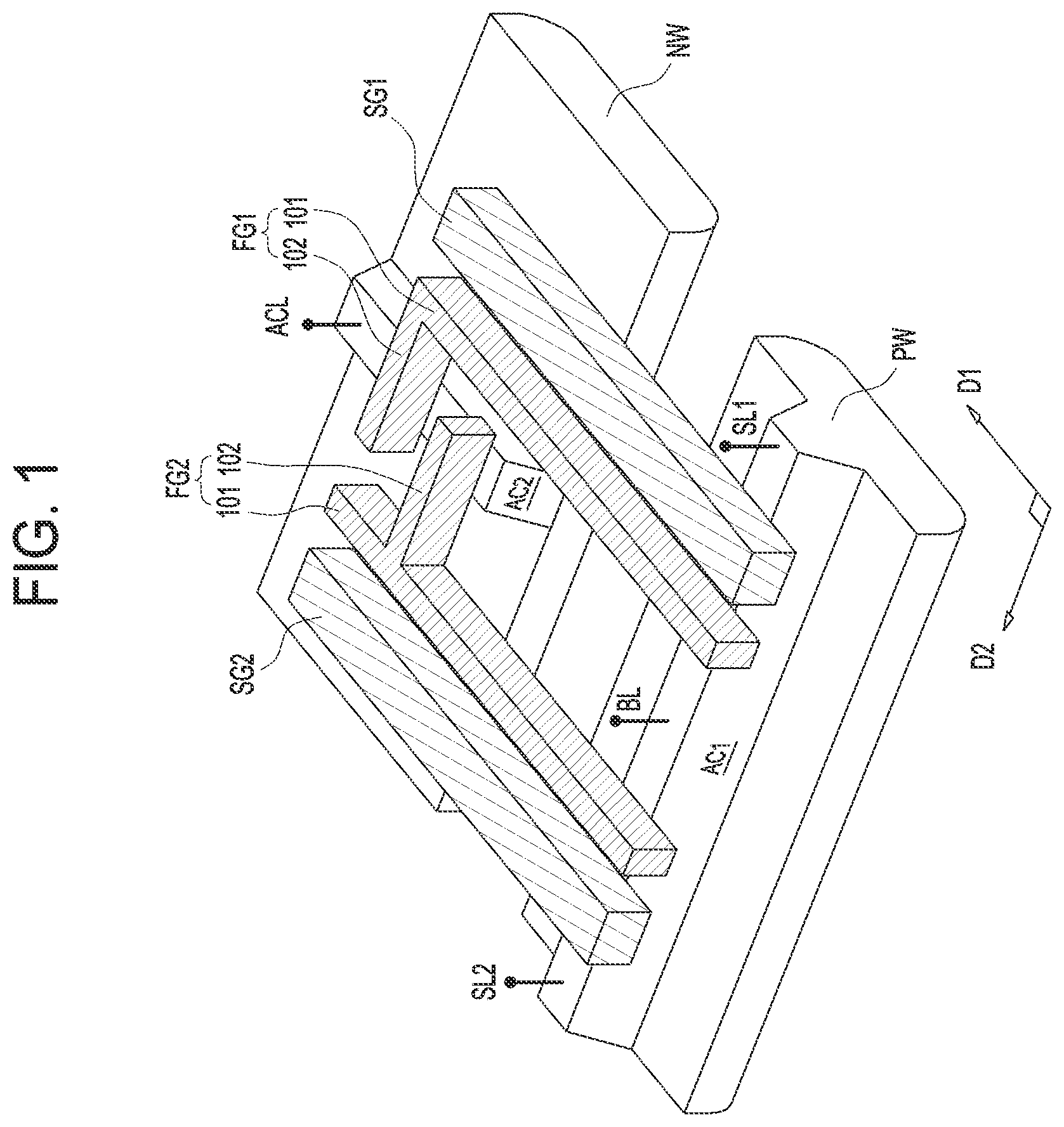
is an example of a unit cell of a non-volatile memory device based on some embodiments of the disclosed technology.
A and 2 B examples of a unit cell of a non-volatile memory device based on some embodiments of the disclosed technology.
is an example of a cell array of a non-volatile memory device based on some embodiments of the disclosed technology.
A is a cross-sectional view taken along a line A-A′ in .
B is a cross-sectional view taken along a line B-B′ in .
DETAILED DESCRIPTION
Features of the technology disclosed in this patent document are described by examples of an image sensing device with reference to the accompanying drawings. Although a few embodiments of the disclosed technology will be discussed, the disclosed technology can be implemented in various ways beyond the specifics of the examples described herein.
The disclosed technology can be implemented in some embodiments to provide a non-volatile memory device as an embedded memory that can be used as an analog trimming device in an SoC device that includes a digital circuit and an analog circuit or an internal memory for storing instructions and data that are used by the SoC device.
In some implementations, a first conductive type and a second conductive type may be N-type and P-type, respectively, or vice versa. That is, the non-volatile memory device based on some example embodiments of the disclosed technology may include an N-type channel or the P-type channel. In one example, the first conductive type and the second conductive type are P-type and N-type, respectively, and the non-volatile memory device has an N-type channel.
In some implementations, a first direction and a second direction may be substantially perpendicular to each other. For example, in an X-Y coordinate, the first direction may be an X-direction and the second direction D 2 may be a Y-direction.
is an example of a unit cell of a non-volatile memory device based on some embodiments of the disclosed technology. shows two unit-cells that share a first active region and a second active region for the sake of explanation. A and 2 B are examples of a unit cell of a non-volatile memory device based on some embodiments of the disclosed technology.
In some implementations, the non-volatile memory device may include a plurality of unit cells. Referring to , 2 A and 2 B , each of the unit cells may include a first well region PW having a first conductive type and a second well region NW having a second conductive type adjacent to the first well region PW. The first well region PW and the second well region NW may be formed in a substrate. In some implementations, two or more unit-cells may share the first well region PW and the second well region NW. The first well region PW and the second well region NW may have a linear shape extending in the second direction D 2 . The first well region PW and the second well region NW may be parallel to each other along the first direction D 1 . In an implementation, the first well region PW and the second well region NW may be spaced apart from each other in the first direction D 1 . In another implementation, the first well region PW may be in direct contact with the second well region NW in the first direction D 1 .
Each of the first well region PW and the second well region NW may include a first active region AC 1 and a second active region AC 2 defined by an isolation layer (not shown) in the substrate (not shown). Each of the unit cells may share the first active region AC 1 and the second active region AC 2 . The first active region AC 1 may be used for a programming operation and a read operation. The second active region AC 2 may be used for a programming operation and an erase operation. The first active region AC 1 may extend in the second direction D 2 . The second active region AC 2 may extend in the first direction D 1 .
A first unit cell may include a first selection gate SG 1 and a first floating gate FG 1 . The first selection gate SG 1 and the first floating gate FG 1 may extend in the first direction D 1 . The first selection gate SG 1 may be spaced apart from the first floating gate FG 1 in the second direction D 2 . The first selection gate SG 1 may be positioned adjacent to the first floating gate FG 1 . The first unit cell and a second unit cell adjacent to the first unit cell may share the first active region AC 1 and the second active region AC 2 . The second unit cell may include a second selection gate SG 2 and a second floating gate FG 2 . The second selection gate SG 2 and the second floating gate FG 2 may extend in the first direction D 1 . The second selection gate SG 2 may be spaced apart from the second floating gate FG 2 in the second direction D 2 . The second selection gate SG 2 may be positioned adjacent to the second floating gate FG 2 .
The first and second floating gates FG 1 and FG 2 may include a first region 101 and a second region 102 . The first region 101 may extend in the first direction D 1 . The first regions 101 of the first and second floating gates FG 1 and FG 2 may include a sidewall facing the first and second selection gates SG 1 and SG 2 , respectively. The second region 102 may extend from a portion of the first region 101 along the second direction D 2 . The second region 102 may overlap with the second active region AC 2 . In some implementations, the first floating gate FG 1 and the second floating gate FG 2 may have different shapes depending on where the second region 102 is in contact with the first region 101 . For example, the second region 102 of the first floating gate FG 1 may be connected to an end of the first region 101 of the first floating gate FG 1 . In some implementations, the first floating gate FG 1 may have a vertical linear structure with a protruding horizontal linear structure at an end of the vertical linear structure. In one example, the first floating gate FG 1 may have an “L” shape. In contrast, the second region 102 of the second floating gate FG 2 may be connected to a portion of the first region 101 of the second floating gate FG 2 other than the end of the first region 101 . In some implementations, the second floating gate FG 2 may have has a vertical linear structure with a protruding horizontal linear structure. In one example, a cross section of the second floating gate FG 2 may have a Tonfa shape or a “T” shape.
The first and second selection gates SG 1 and SG 2 may overlap with the first active region AC 1 . The first and second selection gates SG 1 and SG 2 may be used as a word line WL. The first and second selection gates SG 1 and SG 2 may function to prevent an over-erase condition in the erase operation. The first and second floating gates FG 1 and FG 2 may function to store logic information. The first and second floating gates FG 1 and FG 2 may overlap with the first active region AC 1 and the second active region AC 2 . Because the second active region AC 2 may be used as an active control gate ACG, the first and second floating gates FG 1 and FG 2 may overlap with the second active region AC 2 . That is, the second active region AC 2 may be used as a control gate for controlling the first and second floating gates FG 1 and FG 2 and the first and second selection gates SG 1 and SG 2 .
Therefore, the first and second floating gates FG 1 and FG 2 may be electrically activated in response to a bias applied to the first and second selection gates SG 1 and SG 2 , and/or a bias applied to the second active region AC 2 . That is, the first and second floating gates FG 1 and FG 2 may be coupled in response to the bias applied to the first and second selection gates SG 1 and SG 2 and/or the bias applied to the second active region AC 2 . The first and second floating gates FG 1 and FG 2 and the first and second selection gates SG 1 and SG 2 may be coupled to each other by a capacitance across surfaces of the first and second floating gates FG 1 and FG 2 and the first and second selection gates SG 1 and SG 2 facing each other. That is, the first and second floating gates FG 1 and FG 2 may be activated by a component of a first capacitor C 1 in response to the bias applied to the first and second selection gates SG 1 and SG 2 . Further, the first and second floating gates FG 1 and FG 2 and the second active region AC 2 may be coupled by a capacitance vertically generated in an overlapping region between the first and second floating gates FG 1 and FG 2 and the second active region AC 2 . That is, the first and second floating gates FG 1 and FG 2 may be activated by a component of a second capacitor C 2 in response to the bias applied to the second active region AC 2 . Because the first and second floating gates FG 1 and FG 2 may be coupled by the first and second selection gates SG 1 and SG 2 and/or the second active region AC 2 , coupling ratios may be different from each other depending on operational modes. As a result, a disturbance may be suppressed, improving operational reliability.
In A and 2 B , a reference numeral C 3 may indicate a third capacitor C 3 including the substrate (sub), a gate insulation layer and the first and second floating gates FG 1 and FG 2 . Although not depicted in the drawings, each of the unit cells may include an insulation structure that is formed in a gap or space between sidewalls of the first and second selection gates SG 1 and SG 2 and the first and second floating gates FG 1 and FG 2 facing each other. The insulation structure may include a spacer formed on each of sidewalls of the first and second selection gates SG 1 and SG 2 and the first and second floating gates FG 1 and FG 2 . The spacer may act as a dielectric layer of the first capacitor C 1 .
Further, in each of the unit cells, a bit line BL may be electrically connected with the first active region AC 1 adjacent to the first and second floating gates FG 1 and FG 2 . Source lines SL 1 and SL 2 may be electrically connected with the first active region AC 1 adjacent to the first and second selection gates SG 1 and SG 2 . An activation control line ACL may be electrically connected with the second active region AC 2 .
Hereinafter, the program operation, the erase operation and the read operation of the unit cell will be discussed with reference to A and 2 B .
The program operation of the unit cell may use a channel hot electron (CHE). For example, the program operation may include applying a positive pumping voltage to the selection gate SG and the second active region AC 2 , which is used as the active control gate ACG, and applying a program voltage and a ground voltage to the bit line BL and the source line SL, respectively. The positive pumping voltage may be higher than the program voltage. For example, a voltage of about 6V may be applied to the selection gate SG and the active control gate ACG, and a voltage of about 4.5V may be applied to the bit line BL. The pumping voltage may be a voltage obtained by raising voltage from a power supply voltage using, for example, a charge pump.
The erase operation of the unit cell may use a Fowler-Nordheim tunneling. For example, the erase operation may include applying a negative pumping voltage to the selection gate SG, applying a positive pumping voltage to the active control gate ACG, and applying a ground voltage to the bit line BL and the source line SL. An absolute value of the pumping voltage may be higher than an absolute value of the negative pumping voltage. For example, a voltage of about −6V may be applied to the selection gate SG, and a voltage of about 9V may be applied to the active control gate ACG.
The read operation of the unit cell may include applying a power supply voltage to the selection gate SG, applying a read voltage to the bit line BL, and applying a ground voltage to the active control gate ACG and the source line SL. The read voltage may be higher than the ground voltage and lower than the power supply voltage. For example, the power supply voltage may be about −3V and the read voltage may be about 1V.
Hereinafter, the non-volatile memory device of example embodiments may be illustrated in detail with reference to .
is an example of a cell array of a non-volatile memory device based on some embodiments of the disclosed technology. A is a cross-sectional view taken along a line A-A′ in , and B is a cross-sectional view taken along a line B-B′ in .
Referring to , 3 , 4 A and 4 B , the non-volatile memory device implemented based on some embodiments of the disclosed technology may include a cell array 11 . The cell array 11 may include a plurality of sub-arrays 11 - 1 and 11 - 2 arranged in rows and columns in a matrix array. Each of the sub-arrays 11 - 1 and 11 - 2 may include first to fourth unit cells 10 - 1 to 10 - 4 . Because the sub-arrays 11 - 1 and 11 - 2 may be arranged in the matrix array, the adjacent sub-arrays 11 - 1 and 11 - 2 may be symmetrical about the first and second directions D 1 and D 2 .
Each of the sub-arrays 11 - 1 and 11 - 2 may include a second well region NW, a first well region PW 1 and a third well region PW 2 . The second well region NW may be formed in the substrate Sub. The second well region NW may have the second conductive type. The first well region PW 1 may be positioned over the second well region NW. The first well region PW 1 may have the first conductive type. The third well region PW 2 may be positioned under the second well region NW. The third well region PW 2 may have the first conductive type. The first well region PW 1 , the second well region NW and the third well region PW 2 may be formed by implanting ions into the substrate Sub. The first well region PW 1 and the third well region PW 2 may be formed by implanting P type impurities such as boron (B) into the substrate Sub. The second well region NW may be formed by implanting N type impurities such as phosphorus (P), arsenic (As), etc. The first well region PW 1 , the second well region NW and the third well region PW 2 may have a linear planar shape extended in the second direction D 2 . In an implementation, the first well region PW 1 , the second well region NW and the third well region PW 2 may be spaced apart from each other in the first direction D 1 , not restricted within a specific structure. In another implementation, the second well region NW may be in direct contact with the first well region PW 1 and the third well region PW 2 , respectively.
The substrate Sub may include a semiconductor substrate. The semiconductor substrate Sub may include monocrystalline silicon. For example, the substrate Sub may include a bulk silicon substrate, a silicon-on-insulator (SOI) substrate including a supporting substrate, an insulation layer and a monocrystalline silicon layer sequentially stacked, etc.
Each of the first well region PW 1 and the third well region PW 2 may include a first active region AC 1 defined by an isolation layer 103 in the substrate Sub. The first active region AC 1 may be used for the program operation and the read operation. The first active region AC 1 may have a linear planar shape extended in the second direction D 2 . By way of example, shows one first active region AC 1 in each of the first well region PW 1 and the third well region PW 2 . In another implementation, each of the first well region PW 1 and the third well region PW 2 may include more than one first active regions AC 1 . For example, each of the first well region PW 1 and the third well region PW 2 may include two first active regions AC 1 spaced apart from each other in the first direction D 1 .
The second well region NW may include a second active region AC 2 defined by the isolation layer 103 . The second active region AC 2 may be used for the program operation and the erase operation. That is, the second active region AC 2 may be used as the active control gate ACG. Thus, the coupling ratios may be different from each other depending on the operational modes, suppressing the disturbance and improving the operational reliability. The second active region AC 2 may extend in the first direction D 1 . The second active region AC 2 extending in the first direction D 1 may prevent or reduce interference and punch-through effect between the first and second selection gates SG 1 and SG 2 , and the second active region AC 2 . Here, the punch-through effect may include an undesired electrical connection between the first and second selection gates SG 1 and SG 2 , and the second active region AC 2 .
The isolation layer 103 may be formed by a shallow trench isolation (STI) process. The isolation layer 103 may include an insulation material. The isolation layer 103 may have a depth measured from the top surface of the substrate Sub. In an implementation, the depths of the first well region PW 1 , the second well region NW and the third well region PW 2 may be deeper than that of the isolation layer 103 . In another implementation, the depth of the isolation layer 103 may be substantially equal to or deeper than the depths of the first well region PW 1 , the second well region NW and the third well region PW 2 .
Each of the sub-arrays 11 - 1 and 11 - 2 may include the first selection gate SG 1 and the second selection gate SG 2 formed at the substrate Sub. The first selection gate SG 1 may be used as a word line of the first unit cell 10 - 1 and the third unit cell 10 - 3 . The second selection gate SG 2 may be used as a word line of the second unit cell 10 - 2 and the fourth unit cell 10 - 4 . Each of the first selection gate SG 1 and the second selection gate SG 2 may function to prevent the over-erase in the erase operation. The first selection gate SG 1 and the second selection gate SG 2 may be spaced apart from each other in the second direction D 2 . Further, the selection gate SG 1 and the second selection gate SG 2 may be parallel to each other. A gap (g 1 ) between the second active region AC 2 and the first selection gate SG 1 may be identical or similar to a gap (g 2 ) between the second active region AC 2 and the second selection gate SG 2 . The gaps (g 1 and g 2 ) are sufficiently wide to effectively prevent the interference and the punch-through effect between the second active region AC 2 and the first and second selection gates SG 1 and SG 2 .
Each of the sub-arrays 11 - 1 and 11 - 2 may include a first floating gate FG 1 , a second floating gate FG 2 , a third floating gate FG 3 and a fourth floating gate FG 4 structured to be coupled to the second active region AC 2 . In some implementations, the first to fourth floating gates FG 1 to FG 4 are arranged in a longitudinal direction of the second active region AC 2 . In some implementations, the first and third floating gates FG 1 and FG 3 are arranged at one side of the second active region AC 2 that extends in the longitudinal direction of the second active region AC 2 , and the second and fourth floating gates FG 2 and FG 4 are arranged at the other side of the second active region AC 2 that extends in the longitudinal direction of the second active region AC 2 . Each of the first to fourth floating gates FG 1 to FG 4 includes a branch structured to extend toward the second active region AC 2 . The branches of the first to fourth floating gates FG 1 to FG 4 are coupled to the second active region AC 2 and are spaced apart from one another. In one example, the branches may include the second regions 102 of the first and fourth floating gates FG 1 and FG 4 . In some implementations, the first to fourth floating gates FG 1 , FG 2 , FG 3 and FG 4 may be structured to partially overlap with the second active region AC 2 . The first to fourth floating gates FG 1 , FG 2 , FG 3 and FG 4 may correspond to the first to fourth unit cells 10 - 1 , 10 - 2 , 10 - 3 and 10 - 4 , respectively. The first to fourth floating gates FG 1 , FG 2 , FG 3 and FG 4 may store electrical charge corresponding to one or more bits of information. The first to fourth floating gates FG 1 , FG 2 , FG 3 and FG 4 may overlap with the first active region AC 1 and the second active region AC 2 . The first floating gate FG 1 and the third floating gate FG 3 may be arranged adjacent to the first selection gate SG 1 and may be spaced apart from the first selection gate SG 1 by a gap 110 . The second floating gate FG 2 and the fourth floating gate FG 4 may be arranged adjacent to the second selection gate SG 2 and may be spaced apart from the second selection gate SG 2 by the gap 110 . The gap 110 may be filled with an insulation structure 112 . The insulation structure 112 may include a spacer formed on a sidewall of each of the selection gates SG 1 and SG 2 and the floating gates FG 1 -FG 4 .
The second region 102 of the first and fourth floating gates FG 1 and FG 4 may be connected to one end or the other end of the first region 101 of the first and fourth floating gates FG 1 and FG 4 so that the first and fourth floating gates FG 1 and FG 4 may have an “L” shape. In contrast, the second region 102 of the second and third floating gates FG 2 and FG 3 may be connected to one end or the other end of the first region 101 of the second and third floating gates FG 2 and FG 3 so that a horizontal cross section of each of the second and third floating gates FG 2 and FG 3 may have a vertical linear structure with a protruding horizontal linear structure. In one example, cross sections of the second and third floating gates FG 2 and FG 3 may have Tonfa shapes or “T” shapes. Thus, the first floating gate FG 1 and the third floating gate FG 3 facing each other in the first direction D 1 may have asymmetrically shapes. Further, as illustrated in the plan view on , the first floating gate FG 1 and the second floating gate FG 2 facing each other in the second direction D 2 may have asymmetrically shapes. The third floating gate FG 3 and the fourth floating gate FG 4 facing each other in the second direction D 2 may have asymmetrically shapes. The fourth floating gate FG 4 and the second floating gate FG 2 facing each other in the first direction D 1 may have asymmetrically shapes. These shapes of the floating gates FG 1 , FG 2 , FG 3 and FG 4 may prevent the interference between the floating gates FG 1 , FG 2 , FG 3 and FG 4 and provide the second capacitor C 2 in each of the unit cells 10 - 1 - 10 - 4 with a uniform capacitance to prevent or reduce discrepancy between the coupling ratios with respect to the floating gates FG 1 -FG 4 . Thus, each of the unit cells 10 - 1 - 10 - 4 may include floating gates FG 1 -FG 4 that are asymmetrical from each other and have branches spaced apart from each other to improve the threshold voltage uniformity. As a result, the reliability of the read operation may be improved.
In some implementations, each of the first to fourth floating gates FG 1 -FG 4 may include the first region 101 and the second region 102 . The first region 101 may have a structure that extends in the first direction D 1 . The second region 102 may protrude or extend from the first region 101 in the second direction D 2 . The first region 101 may partially overlap with the first active region AC 1 . The second region 102 may partially overlap with the second active region AC 2 . In order for the first capacitor C 1 in A and B to have a sufficiently high capacitance, the first region 101 may have a length longer than a length of the second region 102 . Further, in order for the second capacitor C 2 of each of the unit cells 10 - 1 - 10 - 4 in A and B to have uniform capacitance, the second region 102 may be structured to cross the second active region AC 2 . In one example, the second region 102 may be structured to cross the isolation layer 103 and the second active region AC 2 along the second direction D 2 . Thus, the second active region AC 2 and the first to fourth floating gates FG 1 -FG 4 may have substantially the same overlapped area.
The second regions 102 of the first to fourth floating gates FG 1 -FG 4 may be spaced apart from each other in the first direction D 1 . The second region 102 may be located at a central portion of the second active region AC 2 . The second regions 102 of the second and third floating gates FG 2 and FG 3 may be positioned at one edge and the other edge of the second active region AC 2 , respectively. The gap S between the second active region AC 2 and the first to fourth floating gates FG 1 -FGF 4 may be identical or similar.
The first active region AC 1 in each of the sub-arrays may include a first junction region 104 formed between the first floating gate FG 1 and the second floating gate FG 2 , and between the third floating gate FG 3 and the fourth floating gate FG 4 . Further, the first active region AC 1 may include a second junction region 106 and a third junction region 108 . The second junction region 106 may be formed in the first active region AC 1 adjacent to the first and second selection gates SG 1 and SG 2 . The third junction region 108 may be formed under the insulation structure 112 in the gap 110 . The first, second and third junction regions 104 , 106 and 108 may include impurity regions formed by implanting the second conductive type impurities into the first active region AC 1 . The first junction region 104 and the second junction region 106 may have an LDD structure. The third junction region 108 may function as to electrically connect an induced channel by the selection gate and the floating gate with the first active region AC 1 . The first junction region 104 may be connected to the bit line BL. A portion of the first junction region 104 between the first floating gate FG 1 and the second floating gate FG 2 and a portion of the first junction region 104 between the third floating gate FG 3 and the fourth floating gate FG 4 may be connected to different bit lines BL. The second junction region 106 may be connected to the source line SL. A portion of the second junction region 106 adjacent to the first selection gate SG 1 and a portion of the second junction region 106 adjacent to the second selection gate SG 2 may be electrically connected to different source lines SL.
The second active region AC 2 in each of the sub-arrays 11 - 1 and 11 - 2 may be electrically connected with an activation control line ACL parallel to the bit line BL. Although not depicted in the drawings, the second active region AC 2 may further include an impurity region for reducing a contact resistance between the activation control line ACL and the second active region AC 2 . The impurity region may be formed by implanting the second conductive type impurities. The impurity region may have a doping concentration higher than a doping concentration of the impurity region in the second well region NW.
In some embodiments of the disclosed technology, the plurality of the floating gates FG 1 -FG 4 overlapping with the second active region AC 2 may have asymmetrical shapes to prevent or reduce discrepancy between the coupling ratios with respect to the floating gates FG 1 -FG 4 . Thus, the non-volatile memory device may have a uniform threshold voltage, improving the reliability of a read operation.
Further, gaps (g 1 , g 2 ) between the selection gates SG 1 and SG 2 and the second active region AC 2 and a gap(S) between the floating gates FG 1 -FG 4 may be sufficiently wide to more improve the operational reliability.
The technical features disclosed in this patent document can be implemented in various configurations or ways and the disclosed embodiments are merely examples of certain implementations. Variations and enhancements of the disclosed embodiments and other embodiments can be made based on what is disclosed and/or illustrated in this patent document.
Figures (5)
Citations
This patent cites (2)
- US9293468
- US10680001