Abstract
A display device includes a display module that is foldable about first and second folding axes that are spaced apart from each other along a first direction and are extended in a second direction crossing the first direction, and a digitizer module below the display module. The digitizer module includes a plurality of first electrodes that are extended in the first direction and are arranged along the second direction, and a plurality of second electrodes that are extended in the second direction, are arranged along the first direction, and are electrically disconnected from the first electrodes. The plurality of first electrodes include a plurality of first sub-electrodes overlapped with the first folding axis and a plurality of second sub-electrodes overlapped with the second folding axis and located at a different layer from the first sub-electrodes.
Claims (21)
1. A display device, comprising: a display module comprising a first portion and a second portion adjacent to the first portion in a first direction; a plurality of first sub-electrodes under the first portion and extended in the first direction; a plurality of second sub-electrodes under the second portion and extended in the first direction; a plurality of third sub-electrodes between the first portion and the first sub-electrodes, extended in a second direction crossing the first direction, and located at a same layer as the second sub-electrodes; and a plurality of fourth sub-electrodes under the second sub-electrodes, extended in the second direction, and located at a same layer as the first sub-electrodes.
Show 20 dependent claims
2. The display device of claim 1 , wherein the first sub-electrodes are electrically connected to the second sub-electrodes.
3. The display device of claim 1 , wherein the first portion is foldable about a first folding axis, the second portion is foldable about a second folding axis, and the first folding axis and the second folding axis are spaced from each other along the first direction and extended in the second direction.
4. The display device of claim 3 , wherein the display module comprises: first, second, and third non-folding regions arranged along the first direction; a first folding region overlapped with the first folding axis and located between the first and second non-folding regions; and a second folding region overlapped with the second folding axis and located between the second and third non-folding regions, wherein the first non-folding region, the first folding region, and a portion of the second non-folding region adjacent to the first folding region are defined as the first portion, and the third non-folding region, the second folding region, and a portion of the second non-folding region adjacent to the second folding region are defined as the second portion.
5. The display device of claim 4 , wherein the first sub-electrodes are overlapped with the first non-folding region, the first folding region, and the second non-folding region, and wherein the second sub-electrodes are overlapped with the third non-folding region, the second folding region, and the second non-folding region.
6. The display device of claim 5 , wherein the second sub-electrodes are at a different layer from the first sub-electrodes, and the fourth sub-electrodes are at a different layer from the third sub-electrodes.
7. The display device of claim 6 , the display device further comprising a digitizer module below the display module, wherein the digitizer module comprises a base substrate, wherein the first sub-electrodes are below the base substrate, and wherein the second sub-electrodes are on the base substrate.
8. The display device of claim 7 , wherein the second sub-electrodes are electrically connected to the first sub-electrodes through via holes that are defined in the base substrate and overlapped with the second non-folding region.
9. The display device of claim 7 , wherein the third sub-electrodes are on the base substrate, and the fourth sub-electrodes are below the base substrate.
10. The display device of claim 4 , wherein the first folding region is foldable in an out-folding manner about the first folding axis such that the first folding region has a convex top surface.
11. The display device of claim 10 , further comprising: a digitizer module below the display module; a first supporting portion below the digitizer module and overlapped with the first non-folding region; a second supporting portion below the digitizer module and overlapped with the second non-folding region; and a plurality of joint units below the digitizer module and overlapped with the first folding region, wherein the joint units are extended in the second direction and are arranged along the first direction.
12. The display device of claim 11 , wherein, when viewed in the second direction, a width of each of the joint units decreases in a direction from a top of each of the joint units toward a bottom of each of the joint units.
13. The display device of claim 10 , wherein the second folding region is foldable in an in-folding manner about the second folding axis, such that the second folding region has a concave top surface.
14. The display device of claim 13 , further comprising: a digitizer module below the display module; and a third supporting portion below the digitizer module, spaced from a second supporting portion, and overlapped with the third non-folding region.
15. The display device of claim 4 , wherein the display module further comprises: a fourth non-folding region; and a third folding region between the third non-folding region and the fourth non-folding region, the third folding region being overlapped with a third folding axis extending in the second direction, wherein the display device further comprises fifth sub-electrodes overlapped with the third folding axis, and wherein the fifth sub-electrodes are at a same layer as the first sub-electrodes.
16. The display device of claim 15 , wherein the first and fifth sub-electrodes are below second electrodes comprising the third sub-electrodes and the fourth sub-electrodes, in the first and third folding regions, and wherein the second sub-electrodes are on the second electrodes, in the second folding region.
17. The display device of claim 16 , wherein the first and third folding regions are foldable in an out-folding manner about the first and third folding axes, respectively, such that the first and third folding regions have convex top surfaces, and wherein the second folding region is foldable in an in-folding manner about the second folding axis, such that the second folding region has a concave top surface.
18. The display device of claim 16 , the display device further comprising a digitizer module below the display module, wherein the digitizer module comprises a base substrate, wherein the first and fifth sub-electrodes are below the base substrate, wherein the second sub-electrodes are on the base substrate, and wherein the second electrodes are on the base substrate in the first and third folding regions and are below the base substrate in the second folding region.
19. The display device of claim 18 , wherein the second sub-electrodes are electrically connected to the first sub-electrodes through first via holes that are defined in the base substrate and overlapped with the second non-folding region, and wherein the second sub-electrodes are electrically connected to the fifth sub-electrodes through second via holes that are defined in the base substrate and overlapped with the third non-folding region.
20. The display device of claim 15 , wherein the first and fifth sub-electrodes overlap second electrodes comprising the third sub-electrodes and the fourth sub-electrodes in the first and third folding regions, and wherein the second sub-electrodes overlap the second electrodes in the second folding region.
21. The display device of claim 20 , wherein the first and third folding regions are foldable in an in-folding manner about the first and third folding axes, respectively, such that the first and third folding regions have concave top surfaces, and wherein the second folding region is foldable in an out-folding manner about the second folding axis, such that the second folding region has a convex top surface.
Full Description
Show full text →
CROSS-REFERENCE TO RELATED APPLICATIONS
This application is a continuation of U.S. patent application Ser. No. 16/892,140, filed Jun. 3, 2020, now U.S. Pat. No. 11,513,645, which claims priority to and the benefit of Korean Patent Application No. 10-2019-0075089, filed Jun. 24, 2019, the entire content of both of which is incorporated herein by reference.
BACKGROUND
1. Field
Embodiments of the present disclosure relate to a display device, and in particular, to a display device configured to reduce or prevent damage to a digitizer module.
2. Description of Related Art
Electronic products, such as a smart phone, a digital camera, a notebook computer, a navigation system, and a smart television, have a display device for displaying an image to a user. The display device generates an image and provides the image to a user through a screen.
In recent years, various display devices have been developed. An example of such a display device is a flexible display device that can be deformed to have a curved shape, folded, or rolled. The use of the flexible display device allows for improvement in portability and user convenience.
A foldable display device, which is one of the flexible display devices, can be folded about a folding axis. However, a component of the foldable display device at a folding region may be damaged by various causes when the foldable display device is folded because the folding region is changed from a flat shape to a curved shape.
SUMMARY
Aspects of some embodiments of the inventive concept are directed to a display device configured to prevent or reduce damage to a digitizer module, which is overlapped with folding regions.
According to some embodiments of the inventive concept, a display device may include a display module that is foldable about a first folding axis and a second folding axis, the first folding axis and the second folding axis being spaced apart from each other along a first direction and are extended in a second direction crossing the first direction, and a digitizer module below the display module. The digitizer module may include a plurality of first electrodes extended in the first direction and arranged along the second direction, and a plurality of second electrodes extended in the second direction and arranged along the first direction, the second electrodes being insulated from the first electrodes. The plurality of first electrodes may include a plurality of first sub-electrodes overlapped with the first folding axis and a plurality of second sub-electrodes overlapped with the second folding axis, the second sub-electrodes being at a different layer from the first sub-electrodes.
According to some embodiments of the inventive concept, a display device may include a display module that is foldable about a first folding axis and a second folding axis, the first folding axis and the second folding axis being spaced apart from each other along a first direction and extended in a second direction crossing the first direction, and a digitizer module below the display module. The digitizer module may include a plurality of first electrodes extended in the first direction and a plurality of second electrodes extended in the second direction and electrically disconnected from the first electrodes. The plurality of first electrodes may include a plurality of first sub-electrodes overlapped with the first folding axis and a plurality of second sub-electrodes overlapped with the second folding axis. The second sub-electrodes may be closer to the display module than the first sub-electrodes are.
According to some embodiments of the inventive concept, a display device may include a display module that is foldable about a first folding axis and a second folding axis, the first folding axis and the second folding axis being spaced apart from each other along a first direction and are extended in a second direction crossing the first direction, and a digitizer module below the display module. The digitizer module may include a plurality of first electrodes extended in the first direction and a plurality of second electrodes extended in the second direction and electrically disconnected from the first electrodes. The plurality of first electrodes may include a plurality of first sub-electrodes, a plurality of second sub-electrodes at a same layer as the first sub-electrodes, and a plurality of third sub-electrodes, which are overlapped with the first folding axis, are located between the first sub-electrodes and the second sub-electrodes, and are at a different layer from the first sub-electrodes.
BRIEF DESCRIPTION OF THE DRAWINGS
Example embodiments will be more clearly understood from the following brief description taken in conjunction with the accompanying drawings. The accompanying drawings represent non-limiting, example embodiments as described herein.
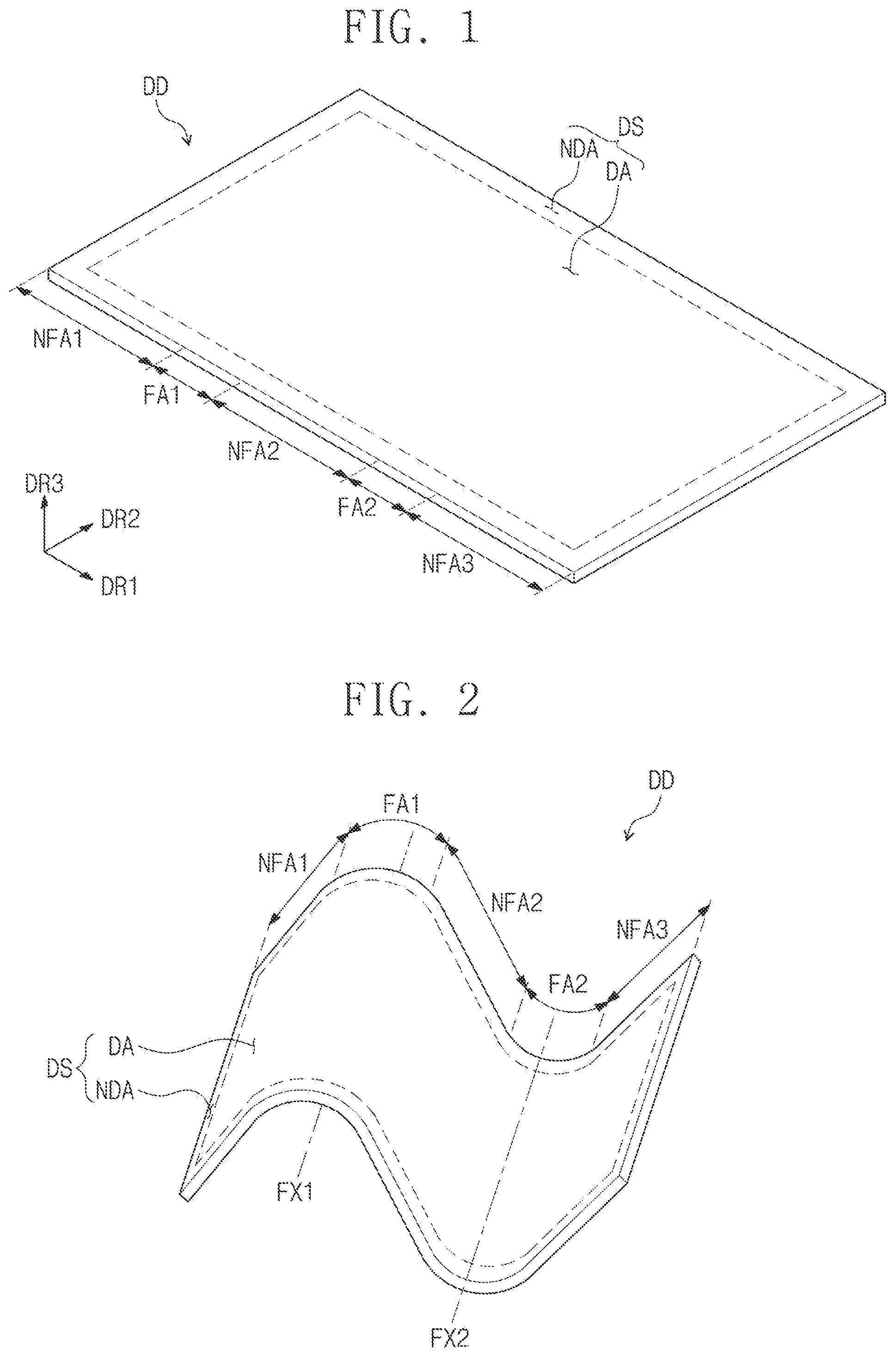
is a perspective view illustrating a display device according to some embodiments of the inventive concept.
is a perspective view illustrating a folded state of the display device of .
is a sectional view schematically illustrating a display module of a display device according to some embodiments of the inventive concept.
is a plan view illustrating the display module of .
is an equivalent circuit diagram exemplarily illustrating one of pixels of .
is a sectional view illustrating a portion of a display device, in which an emission element of is disposed.
is an exploded perspective view illustrating a display device according to some embodiments of the inventive concept.
is a plan view illustrating a digitizer module of .
is a sectional view taken along the line I-I′ of .
is a side view illustrating the display device of .
is a diagram illustrating a folded state of the display device of .
is a sectional view illustrating a digitizer module of .
is a diagram illustrating a display device according to some embodiments of the inventive concept.
is a diagram illustrating a folded state of the display device of .
is a plan view illustrating a digitizer module of .
is a diagram taken along the line II-II′ of .
is a side view schematically illustrating a display device according to some embodiments of the inventive concept.
is a diagram illustrating a folded state of the display device of .
is a plan view illustrating a digitizer module of .
is a sectional view taken along the line III-III′ of .
is a plan view illustrating a digitizer module according to some embodiments of the inventive concept.
is a sectional view taken along the line IV-IV′ of .
is a sectional view illustrating a folded state of a digitizer module of .
It should be noted that these figures are intended to illustrate the general characteristics of methods, structure and/or materials utilized in certain example embodiments and to supplement the written description provided below. These drawings, however, may not be drawn to scale and may not precisely reflect the precise structural or performance characteristics of any given embodiment, and should not be interpreted as defining or limiting the range of values or properties encompassed by example embodiments. For example, the relative thicknesses and positioning of molecules, layers, regions and/or structural elements may be reduced or exaggerated for clarity. The use of similar or identical reference numbers in the various drawings is intended to indicate the presence of a similar or identical element or feature.
DETAILED DESCRIPTION
Example embodiments of the inventive concepts will now be described more fully with reference to the accompanying drawings, in which example embodiments are shown. Example embodiments of the inventive concepts may, however, be embodied in many different forms and should not be construed as being limited to the embodiments set forth herein; rather, these embodiments are provided so that this disclosure will be thorough and complete, and will fully convey the concept of example embodiments to those of ordinary skill in the art. In the drawings, the thicknesses of layers and regions are exaggerated for clarity. Like reference numerals in the drawings denote like elements, and thus their description may be omitted.
It will be understood that when an element is referred to as being “connected” or “coupled” to another element, it can be directly connected or coupled to the other element or intervening elements may be present. In contrast, when an element is referred to as being “directly connected” or “directly coupled” to another element, there are no intervening elements present. Like numbers indicate like elements throughout. As used herein the term “and/or” includes any and all combinations of one or more of the associated listed items. Other words used to describe the relationship between elements or layers should be interpreted in a like fashion (e.g., “between” versus “directly between,” “adjacent” versus “directly adjacent,” “on” versus “directly on”).
It will be understood that, although the terms “first”, “second”, etc. may be used herein to describe various elements, components, regions, layers and/or sections, these elements, components, regions, layers and/or sections should not be limited by these terms. These terms are only used to distinguish one element, component, region, layer or section from another element, component, region, layer or section. Thus, a first element, component, region, layer or section discussed below could be termed a second element, component, region, layer or section without departing from the teachings of example embodiments.
Spatially relative terms, such as “beneath,” “below,” “lower,” “above,” “upper” and the like, may be used herein for ease of description to describe one element or feature's relationship to another element(s) or feature(s) as illustrated in the figures. It will be understood that the spatially relative terms are intended to encompass different orientations of the device in use or operation in addition to the orientation depicted in the figures. For example, if the device in the figures is turned over, elements described as “below” or “beneath” other elements or features would then be oriented “above” the other elements or features. Thus, the exemplary term “below” can encompass both an orientation of above and below. The device may be otherwise oriented (rotated 90 degrees or at other orientations) and the spatially relative descriptors used herein interpreted accordingly.
The terminology used herein is for the purpose of describing particular embodiments only and is not intended to be limiting of example embodiments. As used herein, the singular forms “a,” “an” and “the” are intended to include the plural forms as well, unless the context clearly indicates otherwise. It will be further understood that the terms “comprises”, “comprising”, “includes” and/or “including,” if used herein, specify the presence of stated features, integers, steps, operations, elements and/or components, but do not preclude the presence or addition of one or more other features, integers, steps, operations, elements, components and/or groups thereof.
Example embodiments of the inventive concepts are described herein with reference to cross-sectional illustrations that are schematic illustrations of idealized embodiments (and intermediate structures) of example embodiments. As such, variations from the shapes of the illustrations as a result, for example, of manufacturing techniques and/or tolerances, are to be expected. Thus, example embodiments of the inventive concepts should not be construed as limited to the particular shapes of regions illustrated herein but are to include deviations in shapes that result, for example, from manufacturing.
Unless otherwise defined, all terms (including technical and scientific terms) used herein have the same meaning as commonly understood by one of ordinary skill in the art to which example embodiments of the inventive concepts belong. It will be further understood that terms, such as those defined in commonly-used dictionaries, should be interpreted as having a meaning that is consistent with their meaning in the context of the relevant art and will not be interpreted in an idealized or overly formal sense unless expressly so defined herein.
is a perspective view illustrating a display device according to some embodiments of the inventive concept. is a perspective view illustrating a folded state of the display device of .
Referring to , a display device DD may have a rectangular or tetragonal shape, whose long sides are parallel to a first direction DR 1 and whose short sides are parallel to a second direction DR 2 crossing the first direction DR 1 . However, the inventive concept is not limited to this example, and in some embodiments, the display device DD may have various suitable shapes including shapes that are not rectangular or tetragonal.
Hereinafter, a direction perpendicular to or normal to both of the first and second directions DR 1 and DR 2 will be referred to as a third direction DR 3 . Furthermore, in the present specification, the expression “when viewed in a plan view” may refer to a relevant structure that is seen in the third direction DR 3 or a direction opposite the third direction DR 3 . In other words, “when viewed in a plan view” may refer to a top-down view, or any view from right over or a direction normal to a display surface of the display device DD.
The display device DD may include a plurality of non-folding regions NFA 1 , NFA 2 , and NFA 3 and a plurality of folding regions FA 1 and FA 2 . The folding regions FA 1 and FA 2 may be disposed between the non-folding regions NFA 1 , NFA 2 , and NFA 3 , and the non-folding regions NFA 1 , NFA 2 , and NFA 3 and the folding regions FA 1 and FA 2 may be arranged along the first direction DR 1 .
The non-folding regions NFA 1 , NFA 2 , and NFA 3 may include a first non-folding region NFA 1 , a second non-folding region NFA 2 , and a third non-folding region NFA 3 , which are sequentially arranged along the first direction DR 1 . The folding regions FA 1 and FA 2 may include a first folding region FA 1 , which is disposed between the first non-folding region NFA 1 and the second non-folding region NFA 2 , and a second folding region FA 2 , which is disposed between the second non-folding region NFA 2 and the third non-folding region NFA 3 . In other words, the folding regions FA 1 and FA 2 may be alternately arranged with the non-folding regions NFA 1 , NFA 2 , and NFA 3 . In some embodiments, each of the folding regions FA 1 and FA 2 is between two non-folding regions at opposing boundaries (or edges) of the folding regions.
Although three non-folding regions NFA 1 , NFA 2 , and NFA 3 and two folding regions FA 1 and FA 2 are illustrated as an example, the inventive concept is not limited to this example. For example, in some embodiments, the display device DD may include four or more non-folding regions and three or more folding regions. In other embodiments, the number of folding regions and non-folding regions may be different. For example, the number of folding regions may be less than or equal to the number of non-folding regions.
A top surface of the display device DD may be defined as a display surface DS and may be a flat surface defined by the first direction DR 1 and the second direction DR 2 . The display surface DS may include a display region DA and a non-display region NDA near or around (e.g., around the periphery of) the display region DA. The display region DA may be used to display an image, and the non-display region NDA may not be used to display an image. The non-display region NDA may enclose (e.g., encircle or surround) the display region DA and may define an edge (e.g., a periphery) of the display device DD that is printed with a set (e.g., predetermined) color.
Referring to , the display device DD may be a flexible display device. The display device DD may be a foldable display device that can be folded and unfolded. At least one of the first and second folding regions FA 1 and FA 2 may have a curved shape, when the display device DD is folded. In some embodiments, the non-folding regions NFA 1 , NFA 2 , and NFA 3 may have a substantially flat or flat shape when the display device DD is folded.
The first folding region FA 1 may be overlapped with a first folding axis FX 1 , and the second folding region FA 2 may be overlapped with a second folding axis FX 2 . The first folding axis FX 1 and the second folding axis FX 2 may be extended in the second direction DR 2 and may be spaced apart from each other along the first direction DR 1 . In some embodiments, the first folding axis FX 1 is at a center of the first folding region FA 1 and the second folding axis FX 2 is at a center of the second folding region FA 2 .
The display device DD may be folded along (e.g., about or with respect to) the first folding axis FX 1 and the second folding axis FX 2 . Due to this folding manner, the display device DD may be defined as a multi-folding display device (i.e., a device having more than one folding axis). In some embodiments, the display device DD may be folded in different directions on the first folding axis FX 1 and the second folding axis FX 2 .
The first folding region FA 1 may be folded along the first folding axis FX 1 . A portion of the top surface of the display device DD (e.g., a top surface of the first folding region FA 1 ) may be convexly curved, and another portion (e.g., a bottom surface of the first folding region FA 1 opposite to the top surface of the first folding region FA 1 ) may be concavely curved. In the case where the display surface DS (i.e., the top surface of the display device DD) is convexly curved, the display device DD may be referred to as being in an out-folding state.
The second folding region FA 2 may be folded along the second folding axis FX 2 . A portion of the top surface of the display device DD (e.g., a top surface of the second folding region FA 2 ) may be concavely curved and another portion (e.g., a bottom surface of the second folding region FA 2 opposite to the top surface of the second folding region FA 2 ) may be convexly curved. In the case where the top surface of the display device DD is concavely curved, the display device DD may be referred to as being in an in-folding state.
In some embodiments, the first folding region FA 1 may be folded to be in an out-folding state, and the second folding region FA 2 may be folded to be in an in-folding state. The first non-folding region NFA 1 , the second non-folding region NFA 2 , and the third non-folding region NFA 3 may be maintained to be in a substantially flat or flat state. In some embodiments, both the first and second folding regions FA 1 and FA 2 both may be convexly curved or concavely curved with respect to the respective folding axes FX 1 and FX 2 .
is a sectional view schematically illustrating a display module of a display device according to some embodiments of the inventive concept.
Referring to , a display module DM may include a display panel DP, a touch sensing part TSP disposed on the display panel DP, a window WIN disposed on the touch sensing part TSP, an adhesive agent OCA disposed between the touch sensing part TSP and the window WIN in the third direction DR 3 , and a cushion layer CSL disposed below (e.g., attached to or coupled to) the display panel DP.
In some embodiments, the display panel DP may be a light-emitting type display panel, but the inventive concept is not limited to a specific type of the display panel DP. For example, the display panel DP may be an organic light emitting display panel or a quantum dot light emitting display panel. An emission layer of the organic light emitting display panel may be formed of or include an organic luminescent material. An emission layer of the quantum dot light emitting display panel may include a quantum dot, a quantum rod, and/or the like. For the sake of simplicity, the description that follows will refer to an example in which the display panel DP is an organic light emitting display panel.
The display panel DP may include a substrate SUB, a pixel layer PXL disposed on the substrate SUB, a thin encapsulation layer TFE disposed on the substrate SUB to cover the pixel layer PXL, and a protection substrate PS disposed below (e.g., attached to or coupled to) the substrate SUB. The substrate SUB may be a transparent substrate and may include a flexible plastic substrate. For example, the substrate SUB may include polyimide (PI).
The substrate SUB may include the display region DA and the non-display region NDA near the display region DA, similar to the display surface DS of the display device DD. The pixel layer PXL may be disposed on the display region DA of the substrate SUB. The pixel layer PXL may include a plurality of pixels, each of which includes an emission element.
The thin encapsulation layer TFE may include at least two inorganic layers and an organic layer disposed between the inorganic layers. The inorganic layers may include an inorganic material and may protect the pixel layer PXL from moisture or oxygen. The organic layer may include an organic material and may protect the pixel layer PXL from a contamination material such as dust particles.
The protection substrate PS may protect a bottom portion of the substrate SUB. The protection substrate PS may include a flexible plastic substrate. For example, the protection substrate PS may include polyethylene terephthalate (PET), or any other suitable material known to those skilled in the art.
The touch sensing part TSP may sense an external input (e.g., a touch event from a user), may generate an input signal from the sensed external input, and may provide the input signal to the display panel DP. The touch sensing part TSP may include a plurality of touch sensor units, which are used to sense the external input. The touch sensor units may sense an external input in a capacitive manner. The display panel DP may receive the input signal from the touch sensing part TSP and may generate an image corresponding to the input signal.
The window WIN may protect the display panel DP and the touch sensing part TSP from an external scratch and/or an external impact. The window WIN may be attached to the touch sensing part TSP by the adhesive agent OCA. The adhesive agent OCA may include an optically clear adhesive. An image produced by the display panel DP may be provided to a user through the window WIN.
The cushion layer CSL may absorb an external impact, which is exerted on a lower portion of the display module DM, thereby protecting the display panel DP. The cushion layer CSL may include a foam sheet having an elastic property.
is a plan view illustrating the display module of .
Referring to , the display module DM may include the display panel DP, a scan driver SDV, a data driver DDV, and an emission driver EDV. A planar structure of the display panel DP is exemplarily illustrated in , but a planar structure of the touch sensing part TSP is not shown.
The display panel DP may be a flexible display panel. For example, the display panel DP may include a plurality of electronic devices disposed on a flexible substrate. The display panel DP may have a rectangular shape, whose long sides are parallel to the first direction DR 1 and whose short sides are parallel to the second direction DR 2 . The display panel DP may include a display region DA and a non-display region NDA enclosing (e.g., surrounding, encircling or around the periphery of) the display region DA, similar to the display surface DS of the display device DD.
The display panel DP may include a plurality of pixels PX, a plurality of scan lines SL 1 -SLm, a plurality of data lines DL 1 -DLn, and a plurality of emission lines EL 1 -ELm, where m and n are natural numbers. The pixels PX may be arranged in a matrix shape, but the inventive concept is not limited to this example. For example, the arrangement of the pixels PX may be variously changed in any suitable manner. The pixels PX may be disposed in the display region DA and may be connected to the scan lines SL 1 -SLm, the data lines DL 1 -DLn, and the emission lines EL 1 -ELm.
The scan driver SDV, the data driver DDV, and the emission driver EDV may be disposed in the non-display region NDA. The scan driver SDV and the emission driver EDV may be disposed adjacent to the long sides, respectively, of the display panel DP. The data driver DDV may be manufactured in the form of an integrated circuit chip and may be disposed adjacent to one of the short sides of the display panel DP.
The scan lines SL 1 -SLm may be extended in the second direction DR 2 and may be connected to the scan driver SDV. The data lines DL 1 -DLn may be extended in the first direction DR 1 and may be connected to the data driver DDV. The emission lines EL 1 -ELm may be extended in the second direction DR 2 and may be connected to the emission driver EDV.
The scan driver SDV may produce (or generate) a plurality of scan signals, and the scan signals may be applied to the pixels PX through the scan lines SL 1 -SLm. The scan signals may be sequentially applied to the pixels PX. The data driver DDV may produce (or generate) a plurality of data voltages, and the data voltages may be applied to the pixels PX through the data lines DL 1 -DLn. The emission driver EDV may produce (or generate) a plurality of emission signals, and the emission signals may be applied to the pixels PX through the emission lines EL 1 -ELm.
In some embodiments, the display module DM may include a timing controller for controlling operations of the scan driver SDV, the data driver DDV, and the emission driver EDV.
The timing controller may generate scan control signals, data control signals, and emission control signals in response to control signals to be transmitted from the outside. The timing controller may receive image signals from the outside, may convert the image signals to a data format, which is suitable for interface specifications for the data driver DDV, and may provide the converted data to the data driver DDV.
The scan driver SDV may produce (or generate) scan signals in response to the scan control signal, and the emission driver EDV may produce (or generate) emission signals in response to the emission control signal. The data driver DDV may receive the image signals of the converted data format and then may generate data voltages corresponding to the image signals, in response to the data control signal.
The pixels PX may receive the data voltages in response to the scan signals. The pixels PX may emit light, which has a brightness level corresponding to the data voltage and constitutes an image, in response to the emission signals. A light-emitting time period of the pixel PX may be controlled by the emission signals.
is an equivalent circuit diagram exemplarily illustrating one of pixels of .
Referring to , the pixel PX may include an emission element OLED and a pixel circuit CC. The pixel circuit CC may include a plurality of transistors T 1 -T 7 and a capacitor CP. The pixel circuit CC may control an amount of current flowing through the emission element OLED, in response to the data signal.
The emission element OLED may emit light, whose brightness is determined by an amount of current supplied from the pixel circuit CC. For this, a first voltage ELVDD may be set to a level that is higher than a level of a second voltage ELVSS.
Each of the transistors T 1 -T 7 may include an input or source electrode, an output or drain electrode, and a control or gate electrode. In the present specification, for convenience in description, one of the input and output electrodes may be referred to as “a first electrode”, and the other may be referred to as “a second electrode”.
The first electrode of the first transistor T 1 may be coupled to the first voltage ELVDD through the fifth transistor T 5 , and the second electrode of the first transistor T 1 may be coupled to an anode of the emission element OLED through the sixth transistor T 6 . The first transistor T 1 may be defined as (or referred to as) a driving transistor. The first transistor T 1 may control an amount of current flowing through the emission element OLED, in response to a voltage applied to the control electrode of the first transistor T 1 .
The first and second electrodes of the second transistor T 2 may be disposed between and coupled to a data line DL and the first electrode of the first transistor T 1 , and the control electrode of the second transistor T 2 may be coupled to an i-th scan line SLi. The second transistor T 2 may be turned on by an i-th scan signal Si, which is provided through the i-th scan line SLi, to electrically connect the data line DL to the first electrode of the first transistor T 1 .
The first and second electrodes of the third transistor T 3 may be disposed between and respectively coupled to the second and control electrodes of the first transistor T 1 . The control electrode of the third transistor T 3 may be coupled to the i-th scan line SLi. The third transistor T 3 may be turned on by the i-th scan signal Si, which is provided through the i-th scan line SLi to electrically connect the second and control electrodes of the first transistor T 1 to each other. If the third transistor T 3 is turned on, the first transistor T 1 may function as a diode.
The first and second electrodes of the fourth transistor T 4 may be disposed between and respectively coupled to a node ND and an initialization power generator (e.g., a power source for providing the initialization voltage Vint). The control electrode of the fourth transistor T 4 may be coupled to an (i−1)-th scan line SLi−1. The fourth transistor T 4 may be turned on by an (i−1)-th scan signal Si−1 provided through the (i−1)-th scan line SLi−1 to provide the initialization voltage Vint to the node ND.
The first and second electrodes of the fifth transistor T 5 may be disposed between and respectively coupled to a power line PL and the first electrode of the first transistor T 1 . The control electrode of the fifth transistor T 5 may be coupled to an i-th emission line ELi.
The first and second electrodes of the sixth transistor T 6 may be disposed between and respectively coupled to the second electrode of the first transistor T 1 and the anode of the emission element OLED. The control electrode of the sixth transistor T 6 may be coupled to the i-th emission line ELi.
The first and second electrodes of the seventh transistor T 7 may be disposed between and respectively coupled to the initialization power generator (i.e., the power source for providing the initialization voltage Vint) and the anode of the emission element OLED. The control electrode of the seventh transistor T 7 may be coupled to an (i+1)-th scan line SLi+1. The seventh transistor T 7 may be turned on by an (i+1)-th scan signal Si+1 provided through the (i+1)-th scan line SLi+1 to provide the initialization voltage Vint to the anode of the emission element OLED.
The capacitor CP may be disposed between the power line PL and the node ND. The capacitor CP may store a data voltage. When the fifth and sixth transistors T 5 and T 6 are turned on, an amount of current flowing through the first transistor T 1 may be controlled by a voltage stored in the capacitor CP.
illustrates an example in which PMOS transistors are used as the transistors T 1 -T 7 , but the inventive concept is not limited to this example. For example, the transistors T 1 -T 7 may be NMOS transistors, and those skilled in the art would appreciate relevant changes to the applied voltage levels and/or circuit configuration required.
is a sectional view illustrating a portion of a display device, in which an emission element of is disposed.
Referring to , the pixel PX may include the emission element OLED and a transistor TR connected to the emission element OLED. The emission element OLED may include a first electrode E 1 , a second electrode E 2 , and an organic emission layer OEL, which is disposed between the first electrode E 1 and the second electrode E 2 along the third direction DR 3 . The transistor TR may be the sixth transistor T 6 shown in , for example. The emission element OLED may be defined as an organic light emitting element.
The first electrode E 1 may be an anode, and the second electrode E 2 may be a cathode. The first electrode E 1 may be defined as a pixel electrode, and the second electrode E 2 may be defined as a common electrode.
The pixel PX may be divided into a pixel region PA and a non-pixel region NPA around (e.g., surrounding or around the periphery of) the pixel region PA. The emission element OLED may be disposed in the pixel region PA, and the transistor TR may be disposed in the non-pixel region NPA.
The transistor TR and the emission element OLED may be disposed on the substrate SUB. A buffer layer BFL may be disposed on the substrate SUB, and in some embodiments, the buffer layer BFL may be formed of or include at least one of inorganic materials.
A semiconductor layer SM of the transistor TR may be disposed on the buffer layer BFL. The semiconductor layer SM may be formed of or include at least one of suitable inorganic semiconductor materials, such as, for example, amorphous or polycrystalline silicon, or suitable organic semiconductor materials. In some embodiments, the semiconductor layer SM may be formed of or include at least one of suitable oxide semiconductor materials. In some embodiments, the semiconductor layer SM may include a source region, a drain region, and a channel region between the source region and the drain region.
A first insulating layer INS 1 may be disposed on the buffer layer BFL to cover the semiconductor layer SM. The first insulating layer INS 1 may be formed of or include an inorganic material. A gate electrode GE of the transistor TR may be disposed on the first insulating layer INS 1 and may be overlapped with the semiconductor layer SM. The gate electrode GE may be disposed to be overlapped with the channel region of the semiconductor layer SM.
A second insulating layer INS 2 may be disposed on the first insulating layer INS 1 to cover the gate electrode GE. The second insulating layer INS 2 may include an organic material and/or an inorganic material.
A source electrode SE and a drain electrode DE of the transistor TR may be disposed on the second insulating layer INS 2 , and are spaced apart from each other. The source electrode SE may be connected to the source region of the semiconductor layer SM through a first contact hole CH 1 , which is defined in the first insulating layer INS 1 and the second insulating layer INS 2 . The drain electrode DE may be connected to the drain region of the semiconductor layer SM through a second contact hole CH 2 , which is defined in the first insulating layer INS 1 and the second insulating layer INS 2 .
A third insulating layer INS 3 may be disposed on the second insulating layer INS 2 to cover the source electrode SE and the drain electrode DE of the transistor TR. The third insulating layer INS 3 may be defined as a planarization layer providing a substantially flat or flat top surface and may include an organic material.
The first electrode E 1 may be disposed on the third insulating layer INS 3 . The first electrode E 1 may be connected to the drain electrode DE of the transistor TR through third contact holes CH 3 defined in the third insulating layer INS 3 .
A pixel definition layer PDL may be disposed on the first electrode E 1 and the third insulating layer INS 3 to expose a specific portion of the first electrode E 1 . An opening PX_OP, which exposes the specific portion of the first electrode E 1 , may be defined in the pixel definition layer PDL.
The organic emission layer OEL may be disposed in the opening PX_OP and on the first electrode E 1 . The organic emission layer OEL may generate one of red, green, and blue lights. However, the inventive concept is not limited to this example, and in some embodiments, the organic emission layer OEL may generate a white light through combination of organic materials capable of generating red, green, and blue lights.
The second electrode E 2 may be disposed on the pixel definition layer PDL and the organic emission layer OEL. The thin encapsulation layer TFE may be disposed on the emission element OLED to cover the pixel PX. A layer between the substrate SUB and the thin encapsulation layer TFE may be defined as the pixel layer PXL.
The first voltage ELVDD may be applied to the first electrode E 1 , and the second voltage ELVSS may be applied to the second electrode E 2 . In the case where holes and electrons are injected into the organic emission layer OEL, the holes and electrons may be recombined to each other to produce excitons, and light may be emitted from the emission element OLED when the excitons transition to a ground state. The emission element OLED may emit red, green, or blue light, which constitutes a part of an image provided to a user, using a current flowing therethrough.
is an exploded perspective view illustrating a display device according to some embodiments of the inventive concept.
Referring to , the display device DD according to some embodiments of the inventive concept may include the display module DM, a digitizer module DTM disposed below (e.g., attached to or coupled to) the display module DM, and a supporting portion SP disposed below (e.g., attached to or coupled to) the digitizer module DTM.
The display module DM may include first, second, and third non-folding regions NFA 1 , NFA 2 , and NFA 3 and first and second folding regions FA 1 and FA 2 , like (e.g., similar to or substantially the same as) the display device DD. The first, second, and third non-folding regions NFA 1 , NFA 2 , and NFA 3 and the first and second folding regions FA 1 and FA 2 may be provided to have the same arrangement as that in the previous embodiment of , and thus, a detailed description thereof may be omitted (e.g., not repeated).
The digitizer module DTM may have a rectangular shape, whose long sides are parallel to the first direction DR 1 , whose short sides are parallel to the second direction DR 2 . The digitizer module DTM may be realized in a pressure sensing manner. The digitizer module DTM may be configured to sense a pressure applied to the display device DD.
In the case where a user exerts a pressure (e.g., presses) on the display device DD using a digitizer pen, the digitizer module DTM may sense a change in pressure caused by the digitizer pen. The digitizer module DTM may realize an input, which is associated with the sensed pressure. The display device DD may realize an output corresponding to the input. For example, a user may make a drawing on the display device DD using the digitizer pen.
The supporting portion SP may support the display module DM and the digitizer module DTM. The supporting portion SP may include a first supporting portion SP 1 , a second supporting portion SP 2 , a third supporting portion SP 3 , and a plurality of joint units JU. The first supporting portion SP 1 , the second supporting portion SP 2 , and the third supporting portion SP 3 may be arranged along the first direction DR 1 . The joint units JU may be disposed between the first supporting portion SP 1 and the second supporting portion SP 2 along the first direction DR 1 .
The first supporting portion SP 1 may be disposed below (e.g., attached to or coupled to) the digitizer module DTM and may be overlapped with the first non-folding region NFA 1 when viewed from a plan view. The second supporting portion SP 2 may be disposed below (e.g., attached to or coupled to) the digitizer module DTM and may be overlapped with the second non-folding region NFA 2 when viewed from a plan view. The joint units JU may be disposed below (e.g., attached to or coupled to) the digitizer module DTM and may be overlapped with the first folding region FA 1 when viewed from a plan view. The joint units JU may be extended in the second direction DR 2 and may be arranged along the first direction DR 1 .
The third supporting portion SP 3 may be disposed below (e.g., attached to or coupled to) the digitizer module DTM and may be overlapped with the third non-folding region NFA 3 when viewed from a plan view. The third supporting portion SP 3 may be spaced apart from the second supporting portion SP 2 along the first direction DR 1 . The supporting portion SP may not be disposed in a region overlapped with the second folding region FA 2 when viewed from a plan view. In some embodiments, the third supporting portion SP 3 and the second supporting portion SP 2 define opposite sides of an opening or gap in the supporting portion SP that is overlapped with the second folding region FA 2 when viewed from a plan view.
In some embodiments, adhesive agents may be disposed between the display module DM and the digitizer module DTM and between the digitizer module DTM and the supporting portion SP. The display module DM, the digitizer module DTM, and the supporting portion SP may be coupled to each other by the adhesive agents. The adhesive agents may be pressure sensitive adhesive agents, for example.
is a plan view illustrating a digitizer module of . is a sectional view taken along the line I-I′ of .
In order to provide a more detailed understanding of some embodiments of the inventive concept, the display module DM, along with the digitizer module, are illustrated in .
Referring to , the digitizer module DTM may include a plurality of first electrodes ET 1 and a plurality of second electrodes ET 2 , which are insulated from each other and are disposed to cross each other. For example, in some embodiments, the plurality of first electrodes ET 1 and the plurality of second electrodes ET 2 do not intersect or physically contact each other. The first electrodes ET 1 may be extended in the first direction DR 1 and may be arranged along the second direction DR 2 . The first electrodes ET 1 may be extended to cross the first and second folding axes FX 1 and FX 2 . The second electrodes ET 2 may be extended in the second direction DR 2 and may be arranged along the first direction DR 1 .
In the first folding region FA 1 , the first electrodes ET 1 may be disposed below (e.g., attached to or coupled to) the second electrodes ET 2 . In the second folding region FA 2 , the first electrodes ET 1 may be disposed on the second electrodes ET 2 .
The first electrodes ET 1 may include a plurality of first sub-electrodes SET 1 and a plurality of second sub-electrodes SET 2 . The first sub-electrodes SET 1 may be overlapped with the first folding axis FX 1 . In some embodiments, the first sub-electrodes SET 1 may be disposed to be overlapped with the first non-folding region NFA 1 , the first folding region FA 1 , and the second non-folding region NFA 2 .
The second sub-electrodes SET 2 may be overlapped with the second folding axis FX 2 . In some embodiments, the second sub-electrodes SET 2 may be disposed to be overlapped with the third non-folding region NFA 3 , the second folding region FA 2 , and the second non-folding region NFA 2 .
The first sub-electrodes SET 1 and the second sub-electrodes SET 2 may be disposed on different layers or at different layers from each other. In the second non-folding region NFA 2 , the first sub-electrodes SET 1 and the second sub-electrodes SET 2 , which are disposed at different layers, may be electrically connected to each other. Portions of the first sub-electrodes SET 1 may be electrically connected to portions of the second sub-electrodes SET 2 through via holes VH. The via holes VH according to some embodiments may be described in more detail with reference to .
The second electrodes ET 2 may include a plurality of third sub-electrodes SET 3 and a plurality of fourth sub-electrodes SET 4 . The third sub-electrodes SET 3 may be disposed to be overlapped with the first non-folding region NFA 1 , the first folding region FA 1 , and the second non-folding region NFA 2 . The fourth sub-electrodes SET 4 may be disposed to be overlapped with the third non-folding region NFA 3 , the second folding region FA 2 , and the second non-folding region NFA 2 .
The third sub-electrodes SET 3 may be disposed on a layer different from that below the fourth sub-electrodes SET 4 . For example, the third sub-electrodes SET 3 may be at a layer above the fourth sub-electrodes SET 4 . In other words, the fourth sub-electrodes SET 4 may be at a layer below the third sub-electrodes SET 3 . The third sub-electrodes SET 3 may be overlapped with the first sub-electrodes SET 1 , and the fourth sub-electrodes SET 4 may be overlapped with the second sub-electrodes SET 2 . The first sub-electrodes SET 1 may be disposed below (e.g., attached to or coupled to) the third sub-electrodes SET 3 , and the second sub-electrodes SET 2 may be disposed on the fourth sub-electrodes SET 4 .
Referring to , the digitizer module DTM may include a base substrate BS, a plurality of the first electrodes ET 1 , a plurality of the second electrodes ET 2 , a first insulating layer IS 1 , and a second insulating layer IS 2 . The base substrate BS may include a flexible plastic substrate. For example, the base substrate BS may include polyimide (PI).
The first sub-electrodes SET 1 may be disposed below (e.g., attached to or coupled to) the base substrate BS, and the second sub-electrodes SET 2 may be disposed on the base substrate BS. The third sub-electrodes SET 3 may be disposed on the base substrate BS, and the fourth sub-electrodes SET 4 may be disposed below (e.g., attached to or coupled to) the base substrate BS.
The first sub-electrodes SET 1 may be disposed at a level (or layer) lower than the second sub-electrodes SET 2 , and the third sub-electrodes SET 3 may be disposed at a level (or layer) higher than the fourth sub-electrodes SET 4 . Thus, the second sub-electrodes SET 2 and the third sub-electrodes SET 3 may be closer to the display module DM than the first sub-electrodes SET 1 and the fourth sub-electrodes SET 4 are to the display module DM.
The second sub-electrodes SET 2 may be electrically connected to the first sub-electrodes SET 1 through the via holes VH, which are defined in the base substrate BS and are overlapped with the second non-folding region NFA 2 . Portions of the second sub-electrodes SET 2 may be respectively connected to portions of the first sub-electrodes SET 1 through the via holes VH.
The first insulating layer IS 1 may be disposed below (e.g., attached to or coupled to) the base substrate BS to cover the first and fourth sub-electrodes SET 1 and SET 4 . The second insulating layer IS 2 may be disposed on the base substrate BS to cover the second and third sub-electrodes SET 2 and SET 3 .
is a side view illustrating the display device of according to some embodiments. is a diagram illustrating a folded state of the display device of .
illustrates a shape, viewed in the second direction DR 2 , of the display device DD, in which the display module DM, the digitizer module DTM, and the supporting portion SP are coupled to each other. An enlarged structure of the display device DD in a folded state is illustrated in so as to more clearly illustrate the folded structure of the display device DD.
Referring to , the first, second, and third supporting portions SP 1 , SP 2 , and SP 3 may be overlapped with the first, second, and third non-folding regions NFA 1 , NFA 2 , and NFA 3 , respectively, and the joint units JU may be overlapped with the first folding region FA 1 . In some embodiments, an opening or gap in the supporting portion SP defined by the second and third support portions SP 2 and SP 3 may be overlapped with the second folding region FA 2 . A width of each of the joint units JU may decrease (e.g., linearly decrease) in a direction (e.g., a direction opposite the third direction DR 3 ) from a top of each of the joint units JU toward a bottom of each of the joint units JU when viewed in the second direction DR 2 (e.g., see ). For example, when viewed in the second direction DR 2 , each of the joint units JU may have an inverted trapezoidal shape.
The first folding region FA 1 and the second folding region FA 2 of the display module DM may be overlapped with the first folding axis FX 1 and the second folding axis FX 2 , respectively. The first folding region FA 1 may be folded along the first folding axis FX 1 , and the second folding region FA 2 may be folded along the second folding axis FX 2 .
A top surface of the display module DM may be defined as the display surface DS of the display device DD. A bottom surface of the display module DM may be a surface, which is opposite to the top surface of the display module DM, and may be defined as a surface facing the digitizer module DTM.
When the first folding region FA 1 is folded, the top surface of the first folding region FA 1 , which is a portion of the top surface of the display module DM, may be convexly curved, and the bottom surface of the first folding region FA 1 may be concavely curved. In other words, the first folding region FA 1 may be folded in an out-folding manner. The first supporting portion SP 1 and the second supporting portion SP 2 may be disposed to face each other. By contrast, the first non-folding region NFA 1 and the second non-folding region NFA 2 may be disposed at opposite sides such that they do not face each other. Side surfaces of the joint units JU may be disposed adjacent to each other. In some embodiments, the side surfaces of adjacent joint units JU may contact (e.g., directly contact) each other when the display device DD is folded (e.g., see ).
When the second folding region FA 2 is folded, the top surface of the second folding region FA 2 , which is a portion of the top surface of the display module DM, may be concavely curved, and the bottom surface of the second folding region FA 2 may be convexly curved. In other words, the second folding region FA 2 may be folded in an in-folding manner. The third supporting portion SP 3 may be disposed not to face (e.g., to face away from) the second supporting portion SP 2 . For example, the second supporting portion SP 2 and the third supporting portion SP 3 may be disposed at opposite sides with the display module DM and the digitizer module DTM interposed therebetween. The second non-folding region NFA 2 and the third non-folding region NFA 3 may be disposed to face each other.
In some embodiments, the display device DD may further include a hinge structure, which is connected to the supporting portion SP to provide the first and second folding axes FX 1 and FX 2 to the display device DD.
is a sectional view illustrating a digitizer module of .
substantially illustrates a vertical section of the digitizer module DTM of , which is folded in the same manner as the display device DD of . An enlarged structure of the digitizer module DTM in a folded state is illustrated in so as to more clearly illustrate the folded structure of the digitizer module DTM according to some embodiments. Hereinafter, for convenience of description, the sectional structure of the digitizer module DTM of may be described with reference to the planar structure of the digitizer module DTM of .
Referring to , because the second electrodes ET 2 are extended parallel to first and second folding axes FX 1 and FX 2 , the second electrodes ET 2 may not be damaged, when the first and second folding regions FA 1 and FA 2 are folded along the first and second folding axes FX 1 and FX 2 .
However, because the first electrodes ET 1 are extended in a direction crossing the first and second folding axes FX 1 and FX 2 , the first electrodes ET 1 may be damaged, when the first and second folding regions FA 1 and FA 2 are folded along the first and second folding axes FX 1 and FX 2 . For example, in the case where the first folding region FA 1 is folded in an out-folding manner, a length of the top surface of the base substrate BS, which is deformed to have a convexly curved shape, may become longer than a length of the bottom surface of the base substrate BS, which is deformed to have a concavely curved shape, in the first folding region FA 1 .
In the case where the first sub-electrodes SET 1 are disposed on the top surface of the base substrate BS and the first folding region FA 1 is folded in an out-folding manner, the length of the top surface of the base substrate BS may be increased, and this may lead to an increase in strength of a tensile force exerted on the first sub-electrodes SET 1 . The first sub-electrodes SET 1 may be damaged, due to such a tensile force.
According to some embodiments of the inventive concept, because, in the first folding region FA 1 (i.e., the out-folding region), the first sub-electrodes SET 1 are disposed below (e.g., attached to or coupled to) the base substrate BS, which is deformed to have a concavely curved shape, and not on or above the base substrate BS having an increasing length, it may be possible to reduce a strength of a tensile force exerted on the first sub-electrodes SET 1 and thereby prevent or reduce damage to the first sub-electrodes SET 1 .
Similarly, because, in the second folding region FA 2 (i.e., the in-folding region), the second sub-electrodes SET 2 are disposed on the top surface of the base substrate BS, which is deformed to have a concavely curved shape, and not on the bottom surface of the base substrate BS having an increasing length, it may be possible to reduce a strength of a tensile force and thereby prevent or reduce damage to the second sub-electrodes SET 2 .
As a result, the display device DD according to some embodiments of the inventive concept may prevent or reduce damage to the digitizer module DTM, which may occur in the first and second folding regions FA 1 and FA 2 .
is a diagram illustrating a display device according to some embodiments of the inventive concept. is a diagram illustrating a folded state of the display device of .
substantially illustrate side views corresponding to . Thus, the following description may be focused on technical features of a display device DD_ 1 of that are different from those of the display device DD shown in , and a feature of an element previously described with reference to may be identified by the same reference number without repeating an overlapping description thereof. An enlarged structure of the display device DD_ 1 in a folded state is illustrated in .
Referring to , the display device DD_ 1 may include a display module DM_ 1 , a digitizer module DTM_ 1 disposed below (e.g., attached to or coupled to) the display module DM_ 1 , and a supporting portion SP_ 1 disposed below (e.g., attached to or coupled to) a digitizer module DTM_ 1 .
The display module DM_ 1 may include first, second, third, and fourth non-folding regions NFA 1 , NFA 2 , NFA 3 , and NFA 4 that are arranged along the first direction DR 1 , and first, second, and third folding regions FA 1 , FA 2 , and FA 3 that are disposed between the first, second, third, and fourth non-folding regions NFA 1 , NFA 2 , NFA 3 , and NFA 4 . The third folding region FA 3 may be disposed between the third non-folding region NFA 3 and the fourth non-folding region NFA 4 .
The supporting portion SP_ 1 may include first, second, third, and fourth supporting portions SP 1 , SP 2 , SP 3 , and SP 4 and first and second joint units JU 1 and JU 2 . The fourth supporting portion SP 4 may be disposed below (e.g., attached to or coupled to) the digitizer module DTM_ 1 and may be overlapped with the fourth non-folding region NFA 4 .
The first joint units JU 1 may be substantially the same as or the same as the joint units JU shown in . For example, the second joint units JU 2 may be substantially the same as or the same as (e.g., may have substantially the same shape as or the same shape as) the first joint units JU 1 . The second joint units JU 2 may be overlapped with the third folding region FA 3 and may be disposed below (e.g., attached to or coupled to) the digitizer module DTM_ 1 . The second joint units JU 2 may be disposed between the third supporting portion SP 3 and the fourth supporting portion SP 4 .
Other elements constituting the display module DM_ 1 and the supporting portion SP_ 1 may be substantially the same as or the same as those in the display module DM and the supporting portion SP described with reference to .
The first folding region FA 1 may be folded in an out-folding manner, and the second folding region FA 2 may be folded in an in-folding manner. The third folding region FA 3 may be overlapped with a third folding axis FX 3 extending in the second direction DR 2 and may be folded in an out-folding manner along the third folding axis FX 3 . A top surface of the third folding region FA 3 may be convexly curved, and a bottom surface of the third folding region FA 3 may be concavely curved. Side surfaces of the second joint units JU 2 may be disposed adjacent to each other.
is a plan view illustrating a digitizer module of . is a diagram taken along the line II-II′ of .
Referring to , the digitizer module DTM_ 1 may include a plurality of first electrodes ET 1 _ 1 , which are extended in the first direction DR 1 , and a plurality of second electrodes ET 2 , which are extended in the second direction DR 2 .
The first electrodes ET 1 _ 1 may include a plurality of first sub-electrodes SET 1 , a plurality of second sub-electrodes SET 2 , and a plurality of fifth sub-electrodes SET 5 . For convenience of description, the second electrodes ET 2 are depicted with a single reference numeral, without using the terms of the sub-electrodes as in .
The second sub-electrodes SET 2 may be electrically connected to the first sub-electrodes SET 1 through first via holes VH 1 . The first and second sub-electrodes SET 1 and SET 2 may have substantially the same or the same arrangement and connection structure as those of the first and second sub-electrodes SET 1 and SET 2 described with reference to , for example, and a detailed description thereof may be omitted (e.g., not repeated).
The fifth sub-electrodes SET 5 may be overlapped with the third folding axis FX 3 . In some embodiments, the fifth sub-electrodes SET 5 may be overlapped with the third non-folding region NFA 3 , the third folding region FA 3 , and the fourth non-folding region NFA 4 . The fifth sub-electrodes SET 5 and the first sub-electrodes SET 1 may be disposed on the same layer or at the same level. The first and fifth sub-electrodes SET 1 and SET 5 may be disposed below (e.g., attached to or coupled to) the second electrodes ET 2 in the first and third folding regions FA 1 and FA 3 , and the second sub-electrodes SET 2 may be disposed on the second electrodes ET 2 in the second folding region FA 2 .
The first and fifth sub-electrodes SET 1 and SET 5 may be disposed below (e.g., attached to or coupled to) the base substrate BS, and the second sub-electrodes SET 2 may be disposed on the base substrate BS. The second electrodes ET 2 may be disposed on the base substrate BS in the first and third folding regions FA 1 and FA 3 and may be disposed below (e.g., attached to or coupled to) the base substrate BS in the second folding region FA 2 . The second sub-electrodes SET 2 may be electrically connected to the fifth sub-electrodes SET 5 through second via holes VH 2 , which are defined in the base substrate BS and are overlapped with the third non-folding region NFA 3 .
Because, in the third folding region FA 3 (i.e., the out-folding region), the fifth sub-electrodes SET 5 extending across the third folding axis FX 3 are disposed below (e.g., attached to or coupled to) the base substrate BS, it may be possible to prevent or to reduce damage to the fifth sub-electrodes SET 5 .
is a side view schematically illustrating a display device according to some embodiments of the inventive concept. is a diagram illustrating a folded state of the display device of .
illustrate side views corresponding to . Thus, the following description may be focused on technical features of a display device DD_ 2 of that are different from those technical features of the display device DD_ 1 of . An enlarged structure of the display device DD_ 2 in a folded state is illustrated in .
Referring to , the display device DD_ 2 may include a display module DM_ 2 , a digitizer module DTM_ 2 disposed below (e.g., attached to or coupled to) the display module DM_ 2 , and a supporting portion SP_ 2 disposed below (e.g., attached to or coupled to) the digitizer module DTM_ 2 .
The display module DM_ 2 may include the first, second, third, and fourth non-folding regions NFA 1 , NFA 2 , NFA 3 , and NFA 4 and the first, second, and third folding regions FA 1 , FA 2 , and FA 3 , similar to the display module DM_ 1 shown in .
The supporting portion SP_ 2 may include the first, second, third, and fourth supporting portions SP 1 , SP 2 , SP 3 , and SP 4 and the joint units JU. The first, second, third, and fourth supporting portions SP 1 , SP 2 , SP 3 , and SP 4 may be arranged and disposed in the same manner as the first, second, third, and fourth supporting portions SP 1 , SP 2 , SP 3 , and SP 4 of . The joint units JU may be extended in the second direction DR 2 , may be arranged along the first direction DR 1 , and may be disposed between the second supporting portion SP 2 and the third supporting portion SP 3 .
The display device DD_ 2 may be folded in an opposite manner to the display device DD_ 1 . For example, the first folding region FA 1 and the third folding region FA 3 may be folded in an in-folding manner along the first folding axis FX 1 and the third folding axis FX 3 , respectively, such that the first folding region FA 1 and the third folding region FA 3 have concave top surfaces. The second folding region FA 2 may be folded in an out-folding manner along the second folding axis FX 2 , such that the second folding region FA 2 has a convex top surface.
is a plan view illustrating a digitizer module of . is a sectional view taken along the line III-III′ of .
For convenience of description, respectively illustrate plan and sectional views corresponding to .
Referring to , the digitizer module DTM_ 2 may include a plurality of first electrodes ET 1 _ 2 , which are extended in the first direction DR 1 , and a plurality of the second electrodes ET 2 , which are extended in the second direction DR 2 . The first electrodes ET 1 _ 2 may include a plurality of first sub-electrodes SET 1 _ 1 , a plurality of second sub-electrodes SET 2 _ 1 , and a plurality of fifth sub-electrodes SET 5 _ 1 .
The first sub-electrodes SET 1 _ 1 , the second sub-electrodes SET 2 _ 1 , and the fifth sub-electrodes SET 5 _ 1 may be disposed in an opposite manner to the first sub-electrodes SET 1 , the second sub-electrodes SET 2 , and the fifth sub-electrodes SET 5 shown in .
The first and fifth sub-electrodes SET 1 _ 1 and SET 5 _ 1 may be disposed on the second electrodes ET 2 in the first and third folding regions FA 1 and FA 3 , and the second sub-electrodes SET 2 _ 1 may be disposed below (e.g., attached to or coupled to) the second electrodes ET 2 in the second folding region FA 2 .
The first and fifth sub-electrodes SET 1 _ 1 and SET 5 _ 1 may be disposed on the base substrate BS, and the second sub-electrodes SET 2 _ 1 may be disposed below (e.g., attached to or coupled to) the base substrate BS. The second electrodes ET 2 may be disposed below (e.g., attached to or coupled to) the base substrate BS in the first and third folding regions FA 1 and FA 3 and may be disposed on the base substrate BS in the second folding region FA 2 .
The second sub-electrodes SET 2 _ 1 may be electrically connected to the first sub-electrodes SET 1 _ 1 and the fifth sub-electrodes SET 5 _ 1 through the first via holes VH 1 and the second via holes VH 2 , which are defined in the base substrate BS.
Because, in the second folding region FA 2 (i.e., the out-folding region), the second sub-electrodes SET 2 _ 1 extending across the second folding axis FX 2 are disposed below (e.g., attached to or coupled to) the base substrate BS, damage to the second sub-electrodes SET 2 _ 1 may be prevented or reduced.
is a plan view illustrating a digitizer module according to some embodiments of the inventive concept. is a sectional view taken along the line IV-IV′ of . is a sectional view illustrating a folded state of a digitizer module of .
For convenience in description, illustrates a plan view corresponding to . The following description may be focused on technical features of a digitizer module DTM_ 3 that are different from those of the digitizer module DTM of .
Referring to , the digitizer module DTM_ 3 may include a plurality of first electrodes ET 1 _ 3 , which are extended in the first direction DR 1 , and a plurality of second electrodes ET 2 , which are extended in the second direction DR 2 .
The first electrodes ET 1 _ 3 may include a plurality of first sub-electrodes SET 1 _ 2 , a plurality of second sub-electrodes SET 2 _ 2 , and a plurality of third sub-electrodes SET 3 _ 1 . The first sub-electrodes SET 1 _ 2 may be disposed to be overlapped with the first non-folding region NFA 1 . The second sub-electrodes SET 2 _ 2 may be disposed to be overlapped with the second and third non-folding regions NFA 2 and NFA 3 and the second folding region FA 2 . The second sub-electrodes SET 2 _ 2 and the first sub-electrodes SET 1 _ 2 may be disposed at (e.g., on) the same layer or at the same level.
The third sub-electrodes SET 3 _ 1 may be overlapped with the first folding axis FX 1 . In some embodiments, the third sub-electrodes SET 3 _ 1 may be disposed to be overlapped with the first folding region FA 1 and the first and second non-folding regions NFA 1 and NFA 2 . The third sub-electrodes SET 3 _ 1 may be disposed between the first sub-electrodes SET 1 _ 2 and the second sub-electrodes SET 2 _ 2 in a plan view.
The third sub-electrodes SET 3 _ 1 may be disposed at a level (or layer) different from that of the first sub-electrodes SET 1 _ 2 and the second sub-electrodes SET 2 _ 2 .
The first sub-electrodes SET 1 _ 2 and the second sub-electrodes SET 2 _ 2 may be disposed on the base substrate BS, and the third sub-electrodes SET 3 _ 1 may be disposed below (e.g., attached to or coupled to) the base substrate BS. The first sub-electrodes SET 1 _ 2 and the second sub-electrodes SET 2 _ 2 may be closer to the display module than the third sub-electrodes SET 3 _ 1 are to the display module.
The second electrodes ET 2 may be disposed on the third sub-electrodes SET 3 _ 1 in the first folding region FA 1 , and may be disposed below (e.g., attached to or coupled to) the first and second sub-electrodes SET 1 _ 2 and SET 2 _ 2 in the other regions NFA 1 , NFA 2 , NFA 3 , and FA 2 . The second electrodes ET 2 may be disposed on the base substrate BS in the first folding region FA 1 , and may be disposed below (e.g., attached to or coupled to) the base substrate BS in the other regions NFA 1 , NFA 2 , NFA 3 , and FA 2 .
The third sub-electrodes SET 3 _ 1 may be electrically connected to the first sub-electrodes SET 1 _ 2 through the first via holes VH 1 , which are defined in the base substrate BS and are overlapped with the first non-folding region NFA 1 . The third sub-electrodes SET 3 _ 1 may be electrically connected to the second sub-electrodes SET 2 _ 2 through the second via holes VH 2 , which are defined in the base substrate BS and are overlapped with the second non-folding region NFA 2 .
In some embodiments, a display device including the digitizer module DTM_ 3 may be folded in the same manner as the display device DD shown in . In other words, the first folding region FA 1 may be folded in an out-folding manner, and the second folding region FA 2 may be folded in an in-folding manner.
Referring to , because, in the first folding region FA 1 (i.e., the out-folding region), the third sub-electrodes SET 3 _ 1 extending across the first folding axis FX 1 are disposed below (e.g., attached to or coupled to) the base substrate BS, damage to the third sub-electrodes SET 3 _ 1 may be prevented or may be reduced.
According to some embodiments of the inventive concept, a digitizer module may include first electrodes, which are extended in a direction crossing folding axes, and the first electrodes of the digitizer module may be disposed below (e.g., attached to or coupled to) a base substrate in an out-folding region (e.g., a first folding region) and may be disposed on the base substrate in an in-folding region (e.g., a second folding region). Accordingly, it may be possible to prevent or to reduce damage to the first electrodes.
While example embodiments of the inventive concepts have been particularly shown and described, it will be understood by one of ordinary skill in the art that variations in form and detail may be made therein without departing from the spirit and scope of the attached claims, and equivalents thereof.
Figures (15)
Citations
This patent cites (12)
- US9678604
- US20130249860
- US20140071065
- US20150241924
- US20160291780
- US20170315645
- US20180335679
- US20180366685
- US20190064958
- US10-2013-0107640
- US10-1717637
- US10-2018-0138235