Abstract
A memory device includes: a first casing; a second casing on the first casing; a memory module in an inner space between the first and second casings; and a plate between the first and second casings, wherein the plate includes an air hole and a wing, and wherein the wing includes: a first segment near an outside of the first and second casings; and a second segment near the inner space, wherein the first segment is located at a level different from a level of the second segment.
Claims (6)
1. A solid state drive (SSD) comprising: a case including a first portion and a second portion coupled to the first portion; a first substrate disposed within the case, and including a first surface and a second surface; a second substrate disposed within the case, and including a third surface and a fourth surface, the third surface of the second substrate facing the first surface of the first substrate and being spaced apart from the first surface of the first substrate; a frame disposed between the first substrate and the second substrate, and contacting the first substrate and the second substrate; and a thermal board disposed between the first substrate and the second substrate, and contacting at least a portion of the frame, wherein the thermal board includes a thermal interface film on a first surface of the thermal board, the SSD further comprising: a first chip disposed on the first surface of the first substrate, wherein the thermal interface film directly contacts the first chip.
Show 5 dependent claims
2. The SSD of claim 1 , further comprising a second chip disposed on the third surface of the second substrate.
3. The SSD of claim 2 , wherein the thermal board dissipates heat generated by the first chip and the second chip.
4. The SSD of claim 1 , wherein an air gap is formed between the first substrate and the second substrate.
5. The SSD of claim 1 , wherein the frame includes a metal.
6. The SSD of claim 1 , wherein the case includes a metal.
Full Description
Show full text →
CROSS-REFERENCE TO RELATED APPLICATIONS
This application is a continuation of U.S. patent application Ser. No. 16/872,896 filed on May 12, 2020, which is a continuation of U.S. patent application Ser. No. 16/260,278 filed on Jan. 29, 2019, now U.S. Pat. No. 10,678,311 issued on Jun. 9, 2020, which claims priority under 35 U.S.C. § 119 to Korean Patent Application No. 10-2018-0057062 filed on May 18, 2018 in the Korean Intellectual Property Office, the disclosures of which are incorporated by reference herein in their entireties.
TECHNICAL FIELD
The inventive concept relates to a memory device, and more particularly, to a solid state drive (SSD) memory device.
DISCUSSION OF RELATED ART
A solid state drive or solid state disk (SSD) is a data storage device using integrated circuit assemblies as memory, such as flash memory, to store data persistently. The SSD is used as a replacement for a hard disk drive (HDD). In comparison with the HDD, the SSD has no moving mechanical components. Compared with the HDD, the SSD has quicker access time and lower latency.
In general, the SSD is provided in the form of a package in which memory chips are mounted on a printed circuit board. The SSD package is typically built in a closed-type housing or an open-type housing.
SUMMARY
According to an exemplary embodiment of the inventive concept, a memory device may include: a first casing; a second casing on the first casing; a memory module in an inner space between the first and second casings; and a plate between the first and second casings, wherein the plate includes an air hole and a wing, and wherein the wing includes: a first segment near an outside of the first and second casings; and a second segment near the inner space, wherein the first segment is located at a level different from a level of the second segment.
According to an exemplary embodiment of the inventive concept, a memory device may include: a first casing; a second casing on the first casing; a memory module provided in an inner space between the first and second casings; and a plate disposed along an outer edge of the first casing, wherein the plate includes an air hole between a first wing and a second wing, and wherein each of the wings include: a first portion located at the outer edge of the first casing; and a second portion protruded toward the inner space between the first and second casings, wherein the first portion and the second portion form an angle where they meet.
According to an exemplary embodiment of the inventive concept, a memory device may include: a first casing; a second casing on the first casing; a memory module provided in an inner space between the first and second casings; and a plate disposed along an outer edge of the first casing, wherein the plate includes an air hole between a first wing and a second wing, and wherein each of the wings includes: a first segment that extends lengthwise along the outer edge of the first casing; and a second segment connected to the first segment, the second segment forming an angle with the first segment, wherein the first segment is located closer to a bottom of the first casing than the second segment.
BRIEF DESCRIPTION OF THE DRAWINGS
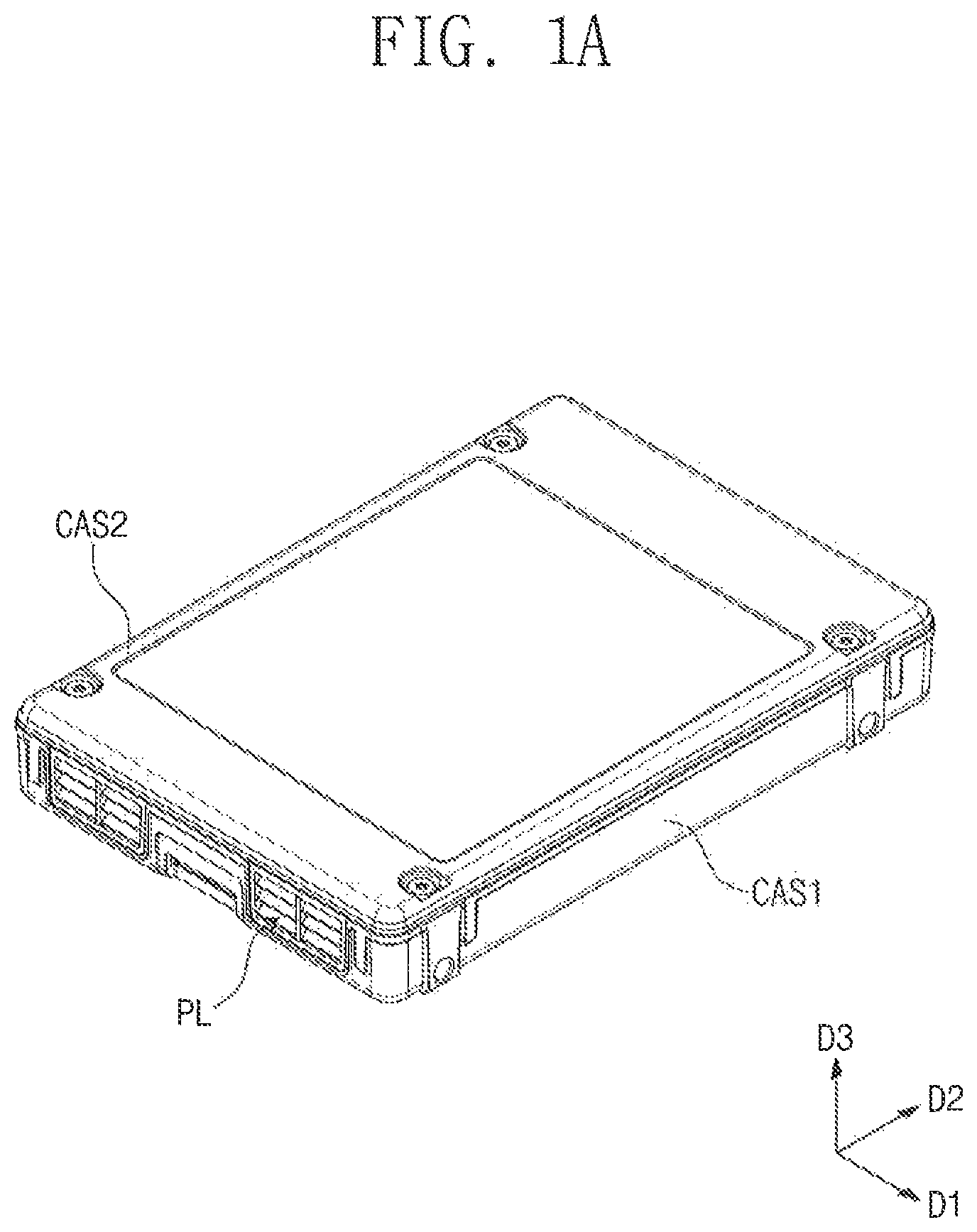
A illustrates a top perspective view showing a memory device according to an exemplary embodiment of the inventive concept.
B illustrates an exploded perspective view of A according to an exemplary embodiment of the inventive concept.
A illustrates a bottom perspective view showing a memory device according to an exemplary embodiment of the inventive concept.
B illustrates an exploded perspective view of A according to an exemplary embodiment of the inventive concept.
illustrates a perspective view showing a plate disconnected from a third recession of a first casing shown in B according to an exemplary embodiment of the inventive concept.
A illustrates a perspective view showing a cross-section of the plate shown in according to an exemplary embodiment of the inventive concept.
B illustrates a perspective view showing a cross-section of a first casing shown in B according to an exemplary embodiment of the inventive concept.
illustrates a perspective view showing a frame of a memory module according to an exemplary embodiment of the inventive concept.
illustrates a perspective view showing a memory module in which a frame is connected to first and second memory packages according to an exemplary embodiment of the inventive concept.
illustrates a side view showing a memory module according to an exemplary embodiment of the inventive concept.
illustrates a perspective view showing a frame of a memory module according to an exemplary embodiment of the inventive concept.
DETAILED DESCRIPTION OF THE EMBODIMENTS
A illustrates a top perspective view showing a memory device according to an exemplary embodiment of the inventive concept. B illustrates an exploded perspective view of A according to an exemplary embodiment of the inventive concept. A illustrates a bottom perspective view showing a memory device according to an exemplary embodiment of the inventive concept. B illustrates an exploded perspective view of A according to an exemplary embodiment of the inventive concept.
Referring to A, 1 B, 2 A, and 2 B , a memory device according to exemplary embodiments of the inventive concept may include a first casing CAS 1 , plates PL associated with the first casing CAS 1 , a second casing CAS 2 on the first casing CAS 1 , and a memory module MM provided in an internal space between the first casing CAS 1 and the second casing CAS 2 . Each of the first and second casings CAS 1 and CAS 2 may include metal, such as aluminum.
The first casing CAS 1 may include a panel-type bottom part BOP having four sides and a sidewall part SWP vertically extending from the four sides of the bottom part BOP. For example, the sidewall part SWP may extend in a third direction D 3 from the bottom part BOP.
The bottom part BOP of the first casing CAS 1 may include a first recession RS 1 (or first recess) that is recessed on one side of the bottom part BOP. A connector CNE, which will be discussed below, may be externally exposed through the first recession RS 1 of the first casing CAS 1 . In other words, the connector CNE may be accessed from the outside of the memory device.
The sidewall part SWP of the first casing CAS 1 may include a second recession RS 2 (or second recess) that is recessed toward the first recession RS 1 . For example, the second recession RS 2 may be recessed toward the bottom part BOP from a top surface of the sidewall part SWP. The second recession RS 2 may be engaged with a protruding sidewall PSW of the second casing CAS 2 which will be discussed below.
The sidewall part SWP of the first casing CAS 1 may further include third recessions RS 3 (or third recess) that are recessed toward the bottom part BOP from the top surface of the sidewall part SWP. For example, the third recessions RS 3 may be provided on a side opposite to that on which the first and second recessions RS 1 and RS 2 are provided. In B , one of the third recessions RS 3 is shown without a plate PL provided therein, while another of the third recessions RS 3 is shown with a plate PL provided therein.
A pad PAD may be provided on the bottom part BOP of the first casing CAS 1 . A capacitor CAP of the memory module MM may be provided on the pad PAD. The pad PAD may serve as a buffer that protects the capacitor CAP.
illustrates a perspective view showing a plate disconnected from a third recession of a first casing shown in B according to an exemplary embodiment of the inventive concept. A illustrates a perspective view showing a cross-section of the plate shown in according to an exemplary embodiment of the inventive concept. B illustrates a perspective view showing a cross-section of a first casing shown in B according to an exemplary embodiment of the inventive concept.
Referring to , 4 A, and 4 B , a guide part GP may be provided in each of the third recessions RS 3 . The guide part GP may be a recessed trench. The guide part GP may include a locking part EP that is recessed from the guide part GP. The guide part GP may further include holes HOL that are downwardly recessed from the guide part GP. For example, the holes HOL may be recessed into the first casing CAS 1 .
The bottom part BOP of the first casing CAS 1 may include first fastening parts FAP 1 that vertically protrude. The first fastening parts FAP may contact the sidewall part SWP of the first casing CAS 1 . Each of the first fastening parts FAP 1 may include a base BSP and a pillar PIP on the base BSP. The pillar PIP may include a screw hole SCH into which a screw SC is inserted. For example, the pillar PIP may have a hollow cylindrical shape.
The first casing CAS 1 may be configured such that at least one of the plates PL is associated with the third recession RS 3 of the sidewall part SWP. For example, two plates PL may be associated with the sidewall part SWP of the first casing CAS 1 . In other words, the two plates PL may be disposed in adjacent third recessions RS 3 of the sidewall part SWP. The two plates PL may be spaced apart from each other in a first direction D 1 .
Each of the plates PL may include wings WP, which define air holes AH. The air holes AH may fluidly connect internal and external sides of the memory device. For example, the air holes AH may allow air to flow between the internal and external sides of the memory device.
Each of the wings WP may extend in a second direction D 2 from outside the first casing CAS 1 toward inside the first casing CAS 1 . The wing WP may obliquely extend. For example, the wing WP may include a first segment PO 1 near an outside of the first casing CAS 1 and a second segment PO 2 near an inside of the first casing CAS 1 . The first segment PO 1 may be located at a first level LV 1 vertically from the bottom part BOP of the first casing CAS 1 . The second segment PO 2 may be located at a second level LV 2 vertically from the bottom part BOP of the first casing CAS 1 . The first and second levels LV 1 and LV 2 may be different from each other. For example, the second level LV 2 may be higher than the first level LV 1 . The first segment PO 1 and the second segment PO 2 form an angle where they meet.
The wing WP may have a bent-shaped cross section in the second direction D 2 . Alternatively, the wing WP may have a curved-shaped cross section in the second direction D 2 . Since each of the wings WP is bent-shaped or curved-shaped, the memory module MM in the memory device may be invisible from outside the memory device.
Each of the plates PL may include a protrusion PP extending along opposite sidewalls and a bottom surface thereof. The protrusion PP may be engaged with the guide part GP of the first casing CAS 1 . For example, the guide part GP of the first casing CAS 1 may guide the protrusion PP of the plate PL such that the plate PL may be slidably engaged with the first casing CAS 1 .
The protrusion PP may include a first hook HO 1 that projects from the protrusion PP. The first hook HO 1 may be provided on the protrusion PP on the sidewall of the plate PL. The first hook HO 1 and the locking part EP may be engaged with each other to fix the plate PL to the first casing CAS 1 . For example, the first hook HO 1 of the plate PL and the locking part EP of the first casing CAS 1 may be connected each other in a snap-fit manner.
The protrusion PP may further include sub-protrusions SPP that downwardly project from the protrusion PP. The sub-protrusions SPP may be provided on the protrusion PP on the bottom surface of the plate PL. The sub-protrusions SPP may be engaged with the holes HOL of the guide part GP. For example, the sub-protrusions SPP and the holes HOL may be engaged with each other to precisely align the plate PL within the third recession RS 3 of the first casing CAS 1 .
The plates PL may be formed of a material different from that of the first casing CAS 1 . For example, the plates PL may include plastic such as polyethylene (PE), polypropylene (PP), polystyrene (PS), or polyvinylchloride (PVC).
In the case that the wings WP are formed to have bent or curved shapes using the sidewall part SWP of the first casing CAS 1 instead of the plates PL, the wings WP may not have a desired shape, since the sidewall part SWP is made of metal. When, however, the plates PL are formed of plastic and not integrally formed with the SWP part of the first casing CAS 1 , it is easier to form the wings WP having bent or curved shapes. As a result, the plates PL may be easily produced in large quantities at low cost.
The bottom part BOP of the first casing CAS 1 may have a first thickness T 1 . The sidewall part SWP of the first casing CAS 1 may have a second thickness T 2 . The first thickness T 1 may be greater than the second thickness T 2 .
illustrates a perspective view showing a frame of a memory module according to an exemplary embodiment of the inventive concept. illustrates a perspective view showing a memory module in which a frame is connected to first and second memory packages according to an exemplary embodiment of the inventive concept. illustrates a side view showing a memory module according to an exemplary embodiment of the inventive concept.
Referring to , 6 , and 7 , the memory module MM may be disposed on the first casing CAS 1 . The memory module MM may be disposed in an inner space between the first and second casings CAS 1 and CAS 2 . The memory module MM may include a first memory package MPK 1 , a second memory package MPK 2 , a frame FR sandwiched between the first and second memory packages MPK 1 and MPK 2 , a capacitor CAP, and a connector (see CNE of B ).
The first memory package MPK 1 may include a first package substrate PS 1 and first memory chips MC 1 mounted on the first package substrate PS 1 . The first memory chips MC 1 may be disposed on top and bottom surfaces of the first package substrate PS 1 . The second memory package MPK 2 may include a second package substrate PS 2 and second memory chips MC 2 mounted on the second package substrate PS 2 . The second memory chips MC 2 may be disposed on top and bottom surfaces of the second package substrate PS 2 . Each of the first and second package substrates PS 1 and PS 2 may be a printed circuit board (PCB). For example, each of the first and second memory packages MPK 1 and MPK 2 may be a solid state drive (SSD) package.
The capacitor CAP may be provided on a side of the frame FR and electrically connected to the first and second memory packages MPK 1 and MPK 2 . The capacitor CAP may have a cylindrical shape. The connector CNE may be combined with the first package substrate PS 1 . The connector CNE may be externally exposed through the first recession RS 1 of the first casing CAS 1 .
A flexible printed circuit film FPC may be provided to electrically connect the first and second memory packages MPK 1 and MPK 2 to each other. The flexible printed circuit film FPC may include conductive lines through which the first and second memory packages MPK 1 and MPK 2 are electrically connected to each other.
The frame FR may include a first frame FR 1 and a second frame FR 2 . The first and second frames FR 1 and FR 2 may include different materials from each other. For example, the first frame FR 1 may include metal (e.g., aluminum), and the second frame FR 2 may include plastic (e.g., PE, PP, PS, or PVC). The inventive concept is not, however, limited to the materials discussed above. For example, the first and second frames FR 1 and FR 2 may be formed of the same plastic as each other to constitute a single frame FR.
The first frame FR 1 may include a first extension EP 1 and a second extension EP 2 that extend in parallel to the second direction D 2 . The first frame FR 1 may include a third extension EP 3 and a fourth extension EP 4 that extend in parallel to the first direction D 1 . The third extension EP 3 may connect a first end of the first extension EP 1 to a first end of the second extension EP 2 . The fourth extension EP 4 may connect a second end of the first extension EP 1 to a second end of the second extension EP 2 . The second end of the first extension EP 1 may be opposite to the first end of the first extension EP 1 , and the second end of the second extension EP 2 may be opposite to the first end of the second extension EP 2 . When viewed in plan, the first frame FR 1 may have a tetragonal shape having four sides.
The first extension EP 1 may have an outer sidewall SWe whose shape is curved. The flexible printed circuit film FPC may cover the outer sidewall SWe of the first extension EP 1 . For example, the flexible printed circuit film FPC may be curved along the outer sidewall SWe of the first extension EP 1 .
The first extension EP 1 may have a first height H 1 in the third direction D 3 , and the second extension EP 2 may have a second height H 2 in the third direction D 3 . The first and second heights H 1 and H 2 may be substantially the same as each other. For example, the first extension EP 1 may have a top surface TO 1 at substantially the same level as that of a top surface TO 2 of the second extension EP 2 . In addition, the first extension EP 1 may have a bottom surface BO 1 at substantially the same level as that of a bottom surface BO 2 of the second extension EP 2 .
The third extension EP 3 may have a third height H 3 in the third direction D 3 , and the fourth extension EP 4 may have a fourth height H 4 in the third direction D 3 . The third and fourth heights H 3 and H 4 may be substantially the same as each other. Each of the third and fourth heights H 3 and H 4 may be less than each of the first and second heights H 1 and H 2 . The bottom surfaces BO 3 and BO 4 of the third and fourth extensions EP 3 and EN may be at substantially the same level as that of the bottom surfaces BO 1 and BO 2 of the first and second extensions EP 1 and EP 2 . The top surfaces TO 3 and TO 4 of the third and fourth extensions EP 3 and EP 4 may be lower than the top surfaces TO 1 and TO 2 of the first and second extensions EP 1 and EP 2 . For example, the third and fourth extensions EP 3 and EP 4 may connect the bottom surface BO 1 of the first extension EP 1 to the bottom surface BO 2 of the second extension EP 2 .
The first package substrate PS 1 may be disposed on and in contact with the bottom surfaces BO 1 , BO 2 , BO 3 and BO 4 of the first, second, third and fourth extensions EP 1 , EP 2 , EP 3 and EP 4 . The second package substrate PS 2 may be disposed on and in contact with the top surfaces TO 1 and TO 2 of the first and second extensions EP 1 and EP 2 . Since each of the third and fourth extensions EP 3 and EP 4 has a height (e.g., H 3 and H 4 ) less than a height (e.g., H 1 and H 2 ) of each of the first and second extensions EP 1 and EP 2 , the second package substrate PS 2 may be vertically spaced apart from the top surfaces TO 3 and TO 4 of the third and fourth extensions EP 3 and EP 4 .
A first opening OP 1 may be defined by the first, second, and third extensions EP 1 , EP 2 , and EP 3 and by the second package substrate PS 2 . A second opening OP 2 may be defined by the first, second, and fourth extensions EP 1 , EP 2 , and EP 4 and by the second package substrate PS 2 . For example, since the second package substrate PS 2 is vertically spaced apart from the third and fourth extensions EP 3 and EP 4 , the first and second openings OP 1 and OP 2 may be present.
The first and second openings OP 1 and OP 2 may expose the first memory chips MC 1 mounted on the first package substrate PS 1 and also expose the second memory chips MC 2 mounted on the second package substrate PS 2 . Since the first and second memory chips MC 1 and MC 2 are exposed, air flow may allow heat to radiate from the first and second memory chips MC 1 and MC 2 . For example, the first opening OP 1 may be adjacent to the plates PL on which the air holes AH are formed, and the second opening OP 2 may be adjacent to the first recession RS 1 . Air may unidirectionally flow between the first recession RS 1 and the air holes AH. Air may flow between the first and second openings OP 1 and OP 2 . The first and second openings OP 1 and OP 2 may receive and externally discharge heat generated from the first and second memory chips MC 1 and MC 2 . In other words, heat may be dissipated to the outside of the memory device via the first and second openings OP 1 and OP 2 .
The second frame FR 2 may include second hooks H 02 that vertically protrude. One or a plurality of the second hooks H 02 may be coupled to the first package substrate PS 1 , and thus, the first package substrate PS 1 may be fixed on the frame FR. The remainder of the second hooks H 02 may be coupled to the second package substrate PS 2 , and thus, the second package substrate PS 2 may be fixed on the frame FR.
As discussed above, the second frame FR 2 may be formed of resilient plastic. Accordingly, when the first and second package substrates PS 1 and PS 2 are fixed on the frame FR, the second hooks H 102 may be resiliently deformed to be easily coupled to the first and second package substrates PS 1 and PS 2 . The first frame FR 1 may be formed of metal having excellent thermal conductivity. Therefore, heat may be externally discharged at high speed from the first and second memory chips MC 1 and MC 2 .
The first frame FR 1 may include recessed fourth recessions RS 4 (or fourth recess), and the second frame FR 2 may include recessed fifth recessions RS 5 (or fifth recess). The fourth and fifth recessions RS 4 and RS 5 may be engaged with the pillars PIP of the first fastening parts FAP 1 . The first package substrate PS 1 may be disposed on top surfaces of the bases BSP of the first fastening parts FAP 1 . Therefore, the first package substrate PS 1 may directly contact the bases BSP of the first fastening parts FAP 1 . As discussed above, the capacitor CAP may be disposed on and in direct contact with the pad PAD on the bottom part BOP of the first casing CAS 1 . The pad PAD may include a buffer material, which protects the capacitor CAP from external impact.
Referring back to B , the second casing CAS 2 may have a panel shape having four sides. The second casing CAS 2 may have a bottom surface including a depression DR. The depression DR may be provided on a location corresponding to that of the capacitor CAP. The second casing CAS 2 may be disposed on the first casing CAS 1 , and the capacitor CAP of the memory module MM may have an upper portion inserted into the depression DR of the second casing CAS 2 .
The second casing CAS 2 may include a protruding sidewall PSW that vertically protrudes from one side of the second casing CAS 2 . The protruding sidewall PSW may be engaged with the second recession RS 2 of the first casing CAS 1 . When the protruding sidewall PSW is engaged with second recession RS 2 , the first recession RS 2 of the first casing CAS 1 may externally expose the connector CNE.
The second casing CAS 2 may include second fastening parts FAP 2 . The second fastening parts FAP 2 may be positioned on locations corresponding to those of the first fastening parts FAP 1 . Each of the second fastening parts FAP 2 may include a through hole TH through which a screw SC passes. The through hole TH may be spatially connected to the screw hole SCH in the pillar PIP of the first fastening part FAP 1 . When the screw SC is inserted into the through hole TH of the second fastening part FAP 2 and into the screw hole SCH of the first fastening FAP 1 , the second casing CAS 2 may be fixed onto the first casing CAS 1 .
illustrates a perspective view showing a frame of a memory module according to an exemplary embodiment of the inventive concept. In the embodiment that follows, a detailed description of elements similar to those discussed above with reference to , 6 , and 7 may be omitted.
Referring to , 7 , and 8 , the frame FR may include a board BOA connected to an upper portion of the second extension EP 2 and a thermal interface film TIM on one surface of the board BOA. For example, the thermal interface film TIM may contact the first memory chips MC 1 of the first memory package MPK 1 that are disposed on the frame FR. In this case, the thermal interface film TIM may be disposed between the board BOA and the bottoms surface of the frame FR.
The thermal interface film TIM may have a relatively high thermal conductivity. For example, the thermal interface film TIM may include particles whose thermal conductivity is high. The thermal interface film TIM may externally discharge heat at high speed from the first memory chips MC 1 .
According to an exemplary embodiment of the inventive concept, a memory device may be configured such that a casing may be engaged with a plate having an air hole through which heat is externally discharged from inside the casing. In this case, it is possible to easily provide wings having bent or curved shapes defining the air hole.
According to another exemplary embodiment of the inventive concept, a frame between memory packages may define an opening that exposes memory chips. The opening may allow heat to externally radiate from the memory chips.
While the inventive concept has been described with reference to exemplary embodiments thereof, it will be understood by those of ordinary skill in the art that various changes in form and details may be made thereto without departing from the spirit and scope of inventive concept as set forth in the following claims.
Figures (9)
Citations
This patent cites (62)
- US5099393
- US5171183
- US5297000
- US5764492
- US6229699
- US8248808
- US8547694
- US8670231
- US9210817
- US9247660
- US9684345
- US9888610
- US10058011
- US10678311
- US10681844
- US20020030981
- US20030011287
- US20070212920
- US20090002941
- US20100061043
- US20130056090
- US20130109223
- US20130231041
- US20140022733
- US20140146461
- US20140306335
- US20150003008
- US20150036279
- US20150062805
- US20150092337
- US20150124397
- US20150156914
- US20160095259
- US20160165750
- US20160227670
- US20160270261
- US20160307818
- US20170060199
- US20170105290
- US20170198940
- US20180035551
- US20180242469
- US20190022568
- US20190354145
- US20200272210
- US201397680
- US102750563
- US103094758
- US203276843
- US105940567
- US206313672
- US206728400
- US107666772
- US207302629
- US2511879
- US2003-258453
- US2003311760
- US10-2013-0042293
- US10-2014-0004864
- US10-2017-0004148
- US10-2017-0115746
- USI596840