Containment Sleeve for Pressurized Piping System
Abstract
A containment sleeve for use with a pressurized piping system including a pliable fabric sheet having first and second opposing longitudinal edges, first and second opposing transverse edges, and first and second opposing major surfaces respectively defining an interior and exterior surfaces. At least one pleat extends between the first and second transverse edges, the pleat being in a normally closed position to define the interior surface with a first surface area. The sheet of pliable fabric to secure about a portion of a pressurized piping system with the interior major surface facing the pipe so as to form a sleeve having an initial interior volume there about. In response to a rupture of the pressurized piping system within the interior volume, the pleat to expand to an open position to expand the interior surface to a second surface area to increase the interior volume from the initial volume.
Claims (22)
1. A containment sleeve for use with a pressurized piping system, the containment sleeve comprising: a sheet of pliable fabric including: a first longitudinal edge and an opposing second longitudinal edge; a first transverse edge and an opposing second transverse edge; a first major surface defining an interior surface, and an opposing second major surface defining an exterior surface; and at least one pleat extending between first and second transverse edges, the at least one pleat in a normally closed position to define the interior surface with a first surface area; and a number of transversely extending straps disposed on the exterior surface between the first and second longitudinal edges, the straps to secure the sheet of pliable fabric about a portion of a pressurized pipe with the interior major surface facing the pipe so as to form a sleeve having an initial interior volume there about, in response to released pressure from a rupture of the portion of the pressurized pipe, the at least one pleat to expand to an open position to increase the surface area of the interior surface from the first surface area to a second surface area and thereby increase the interior volume of the sleeve from the initial volume to an expanded volume.
13. A containment sleeve for a pressurized piping system, the containment sleeve comprising: a sheet of pliable fabric including: a first major surface defining an interior surface, and an opposing second major surface defining an exterior surface; a first longitudinal edge and an opposing second longitudinal edge; and a first transverse edge and an opposing second transverse edge; a fold line extending longitudinally between the first and second transverse edges where the interior surface of the pliable fabric is folded over onto itself; and at least one pair of transverse folded pleats including: a first pleat of the pair extending from the fold line to the first longitudinal edge; and a second pleat of the pair disposed opposite the fold line from the first pleat of the pair and extending from the fold line to the second longitudinal edge; wherein the first and second pleats each increase in depth from the fold line to the corresponding longitudinal edge so as to form an angle in the containment sleeve at the first and second pleats to enable the containment sleeve to be wrapped around an angled segment of the pressurized piping system, when secured about the pressurized piping system, the at least one pair of folded transverse pleats to unfold in response to pressure from a rupture of the pressurized piping system to increase an interior volume of the containment sleeve from an initial volume to an expanded volume.
21. A containment sleeve securable about a pressurized piping system, the containment sleeve comprising: a sheet of pliable fabric including: a first major surface defining an interior surface, and an opposing second major surface defining an exterior surface; a first longitudinal edge and an opposing second longitudinal edge; a first transverse edge and an opposing second transverse edge; and the pliable fabric folded over onto itself to form at least one folded longitudinal pleat extending between the first and second transverse edges where opposing ends of the at least one folded longitudinal pleat along the first and second transverse edges are permanently closed, when wrapped about a piping segment of the pressurized piping system with the interior surface facing inward and the first and second transverse edges secured against the piping segment, the containment sleeve to enclose the piping segment within an interior volume where, in response to pressure from a rupture of the piping segment, the at least one folded longitudinal pleat to unfold between the permanently closed opposing ends so as to increase the interior volume from an initial volume to an expanded volume.
Show 19 dependent claims
2. The containment sleeve of claim 1 , the pliable fabric doubled back and folded onto itself to form the at least one pleat, the at least one pleat to unfold in response to the released pressure.
3. The containment sleeve of claim 1 , when in the closed position, the at least one pleat projecting from the interior surface of the sheet of pliable fabric so as to be disposed within the interior volume when the containment sleeve is installed about the portion of the piping system.
4. The containment sleeve of claim 1 , the at least one pleat having a base where it extends from one of the interior surface and the exterior surface, where opposing sides of the pleat are sewn together at the base with breakaway stitching which tears in response to the released pressure.
5. The containment sleeve of claim 4 , wherein opposing ends of the at least one pleat along the first and second transverse edges are sewn with non-breakaway stitching so as to remain closed in response to the released pressure.
6. The containment sleeve of claim 1 , the number of transversely extending straps including: a first end strap extending along the first transverse edge between the first and second longitudinal sides; and a second end strap extending along the second transverse edge between the first and second longitudinal sides the first and second end straps to sealably secure the first and second transverse sides about a circumference of the portion of the pressurized pipe.
7. The containment sleeve of claim 6 , the first and second edge straps permanently attached along their entire lengths to the pliable fabric.
8. The containment sleeve of claim 6 , the first and second edge straps slideably disposed within belt loops along the first and second transverse edges.
9. The containment sleeve of claim 1 , the number of transversely extending straps including: at least one middle strap disposed between the first and second transverse edges and extending from the first longitudinal edge toward the second longitudinal edge, wherein opposite ends of the at least one middle strap are permanently attached to the pliable fabric on opposite sides of the at least one pleat, and wherein a length of slack between the opposite ends forms a jumper over the at least one pleat to enable the at least one pleat to open to in response to the released pressure.
10. The containment sleeve of claim 1 , the pliable fabric comprises a liquid-resistant, semi-permeable fabric.
11. The containment sleeve of claim 10 , the pliable fabric comprising a ballistic nylon fabric.
12. The containment sleeve of claim 11 , the pliable fabric comprising 1050 ballistic nylon.
14. The containment sleeve of claim 13 , wherein the first and second pleats of the at least one pair of transverse folded pleats extend along a same line between the first and second longitudinal edges.
15. The containment sleeve of claim 13 , wherein the fold line comprises a longitudinal folded pleat extending between the first and second transverse edges, the longitudinal folded pleat to unfold in response to pressure from a rupture of the pressurized piping system to further increase the interior volume of the containment sleeve from the initial volume.
16. The containment sleeve of claim 13 , where the at least one pair of transverse folded pleats includes multiple pairs of transverse folded pleats, the multiple pairs of transverse pleats spaced apart from one another between the first and second transverse edges with each pair of transverse folded pleats forming an angle, the angles of each pair multiple of transverse folded pleats together forming one or more angles in the containment sleeve to correspond to one or more angles of the pressurized piping system.
17. The containment sleeve of claim 16 , a middle strap disposed between each adjacent pair of transverse folded pleats, each middle strap extending transversely between the first and second longitudinal edges, and each middle strap attached to the exterior surface on opposite sides of the fold line and including a length of slack which jumps over the fold line.
18. The containment sleeve of claim 13 , further including: first and second edge straps attached the exterior surface of the pliable fabric and extending transversely there across from the first longitudinal edge toward the second longitudinal edge, the first end strap extending along the first transverse edge and the second end strap extending along the second transverse edge, the first and second end straps to sealably secure the first and second transverse edges about the pressurized piping system.
19. The containment sleeve of claim 18 , the first and second edge straps permanently attached along their entire lengths to the pliable fabric.
20. The containment sleeve of claim 18 , the first and second edge straps slideably disposed within belt loops along the first and second transverse edges.
22. The containment sleeve of claim 21 , wherein the opposing ends of the at least one folded longitudinal pleat are permanently closed via stitching along the first and second transverse edges.
Full Description
Show full text →
CROSS REFERENCE TO RELATED APPLICATIONS
This Application is a Continuation of Non-Provisional patent application Ser. No. 16/747,278, filed Jan. 20, 2020, entitled “CONTAINMENT SLEEVE FOR PRESSURIZED PIPING SYSTEM” which is a Non-Provisional Application of Provisional Patent Application No. 62/794,300, filed Jan. 18, 2019, entitled “CONTAINMENT SLEEVE FOR PIPING SYSTEMS CONVEYING PRESSURIZED MATERIAL” both of which are incorporated herein by reference.
BACKGROUND
Liquid mixtures are often pumped through piping systems under high pressure. Over time, pipes may become worn and fail, particular at pipe bends, where such bends are often formed using pipe elbows joined to straight pipe sections or other pipe elbows via couplings. If a pipe or joint ruptures (e.g., due to wearing and/or obstructions), pressurized material may be ejected from rupture point at a high velocity and potentially injure bystanders and damage adjacent property.
Pressurized piping systems are commonly employed to pump concrete mixtures to desired locations on construction sites, such as to successive floors of multi-story structures. Such systems typically includes a delivery piping system which is connected to an outlet pipe of a concrete pumping vehicle via a piping transition system. Typically, such piping transition systems include a first 90-degree coupling connected to the outlet pipe of the truck, a second 90-degree coupling connected to the delivery pipe, and a straight transition pipe connected between the first and second 90-degree couplings.
Cement trucks pump concrete at pressures of about 1200 pounds per square inch (psi). The flow of high-pressure cement can cause internal wear of the pipes, particularly at the couplings, which can eventually lead to a catastrophic failure of the piping system. The ejection of high pressure cement represents a hazard to people and objects in the vicinity of the rupture. Unfortunately, it is difficult to predict when such failures may occur (e.g., such event may be precipitated by unpredictable obstructions or blockages in the piping system).
BRIEF DESCRIPTION OF THE DRAWINGS
The accompanying drawings are included to provide a further understanding of embodiments and are incorporated in and constitute a part of this specification. The drawings illustrate embodiments and together with the description serve to explain principles of embodiments. Other embodiments and many of the intended advantages of embodiments will be readily appreciated as they become better understood by reference to the following detailed description. The elements of the drawings are not necessarily to scale relative to each other. Like reference numerals designate corresponding similar parts.
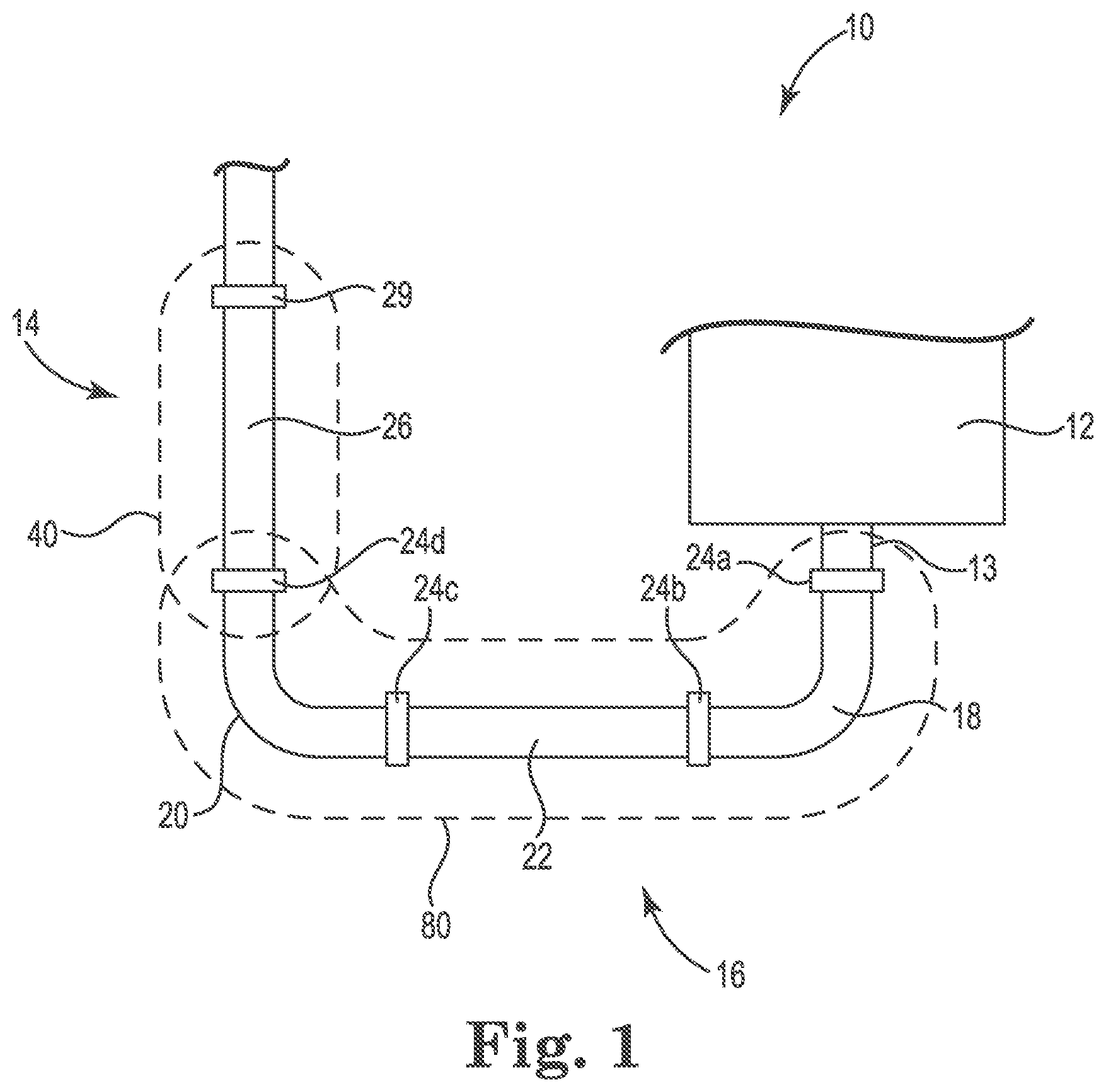
is a block and schematic diagram generally illustrating a pressurized piping system for transporting concrete, according to one example.
A is a top view generally illustrating a containment sleeve, according to one example.
B is a bottom view generally illustrating the containment sleeve of A , according to one example.
C is a cross-sectional view generally illustrating a pleat, according to one example.
D is a cross-sectional view generally illustrating a longitudinal pleat, according to one example.
E is a cross-sectional view generally illustrating a strap, according to one example.
F is a cross-sectional view generally illustrating the containment sleeve of A installed about a pipe, according to one example.
A is a top view generally illustrating a containment sleeve, according to one example.
B is a bottom view generally illustrating the containment sleeve of A , according to one example.
C is a perspective view generally illustrating the containment sleeve of A , according to one example.
D is a cross-sectional view generally illustrating a transverse pleat, according to one example.
E is a cross-sectional view generally illustrating a buckle and strap length adjustment system, according to one example.
is a perspective view generally illustrating the containment sleeve, according to one example.
DETAILED DESCRIPTION
In the following Detailed Description, reference is made to the accompanying drawings, which form a part hereof, and in which is shown by way of illustration specific embodiments in which the invention may be practiced. In this regard, directional terminology, such as “top,” “bottom,” “front,” “back,” “leading,” “trailing,” etc., is used with reference to the orientation of the Figure(s) being described. Because components of embodiments can be positioned in a number of different orientations, the directional terminology is used for purposes of illustration and is in no way limiting. It is to be understood that other embodiments may be utilized and structural or logical changes may be made without departing from the scope of the present invention. The following detailed description, therefore, is not to be taken in a limiting sense, and the scope of the present invention is defined by the appended claims.
It is to be understood that the features of the various exemplary embodiments described herein may be combined with each other, unless specifically noted otherwise.
Liquid mixtures are often pumped through piping systems under high pressure. Over time, pipes may become worn and fail, particular at pipe bends, where such bends are often formed by coupling pipe elbows to straight pipe sections or to other pipe elbows. If a pipe or joint ruptures (e.g., due to wearing and/or obstructions), pressurized material may be ejected from the rupture point at a high velocity and potentially injure bystanders and/or damage adjacent property.
Pressurized piping systems are commonly employed to pump concrete mixtures to desired locations on construction sites, such as to successive floors of multi-story structures. Such systems typically include a delivery piping system which is connected to an outlet pipe of a concrete pump via a piping transition system. Typically, such piping transition systems include a first 90-degree elbow coupled to the outlet pipe of the truck, a second 90-degree elbow coupled to the delivery pipe system, and a straight pipe section coupled between the first and second 90-degree elbows.
Concrete may be pumped at pressures of about 1200 pounds per square inch (psi). The flow of high-pressure cement causes internal wear of the piping system, particularly at the couplings and elbows, where such wear can eventually lead to a catastrophic failure of the piping system if undetected. The ejection of high pressure concrete represents a hazard to people and objects in the vicinity of the rupture. Unfortunately, even with regular inspections of the piping system, it is difficult to predict when such failures may occur, as such events may result from unexpected blockages within the piping system.
As will be described in greater detail herein, the present disclosure describes a pliable containment sleeve to wrap around pipes and couplings of a piping system to arrest the energy and contain concrete materials (or other materials in the case of piping systems other than concrete piping systems) in the case of a pipe failure (e.g., pipe rupture, coupling failure, etc.). In examples, the containment sleeve may be formed in different shapes and configurations for different applications (e.g., to fit different piping configurations).
In examples, each containment sleeve is made from a single, monolithic piece of fabric that includes no seams, as seams represent failure points that may not withstand the forces associated with a pipe rupture. In examples, the containment sleeves may include longitudinal pleats (to run in an axial direction of piping when installed thereon) and/or transverse pleats (running crossways to longitudinal axis of the piping system), wherein the pleats comprise regions of gathered material which are sewn with breakaway stitching to hold the pleats in place during installation on a piping system. The pleats improve the ease of installation of the containment sleeves by reducing the bulkiness of the containment sleeve to provide a more form-fitting installation, and reduce in interior volume of the containment sleeve when installed about a piping system.
During operation, upon rupture of a pipe, the breakaway stitching of the pleats “breaks away” under the pressure of the rupture and expands the internal volume of the warp from an initial volume to an expanded volume, thereby arresting the energy of the blowout and enabling the sleeve contain the contents of the blowout and providing protection to bystanders and property (as well protecting the environment and simplifying cleanup). In examples, the material of the containment sleeve is a high-strength (to withstand forces of a pipe blowout without tearing), light weight (to enable easy installation), liquid resistant, semi-permeable fabric that allows small amounts of gasses and liquids to seep through (e.g., water), but prevents the passage of particles (such as sand and aggregate of a concrete mixture, for example) and the spraying or “misting” of pressurized liquids. In one example, the material of the warp comprises ballistic nylon (e.g. 1050 ballistic nylon). While small amounts of liquid may seep through a containment sleeve of such fabric, high velocity ejection of liquids and solid particles is prevented.
The sleeves described herein represent an improvement over a netting type device that is designed to arrest energy as concrete ejects from the plumbing of a concrete pumping device. The containment sleeves disclosed herein contain the energy of a pipe rupture and direct expelled product along the pipe to remove risk to an operator. By containing the product, an operator that was exposed to mist and slurry that was too small to be contained by the netting type device, is protected from potential chemical burns and ejected solid particles. Secondarily, a containment sleeve, as described herein, contains expelled product so that cleanup can be performed in a more environmentally friendly fashion.
generally illustrates an example of a high-pressure concrete piping system 10 , where a concrete pumping vehicle 12 (e.g., concrete truck), having an outlet pipe 13 , is connected to a delivery piping system 14 via a transition piping system 16 . According to the illustrated example, transition piping system 16 includes first and second 90-degree elbows 18 and 20 , a straight transition pipe 22 , and a number of couplings 24 a - 24 d , where first elbow 18 is coupled to outlet pipe 13 via coupling 24 a , and transition pipe 22 is coupled between first and second elbows 18 and 20 via couplings 24 b and 24 c . Second elbow 20 is connected via coupling 24 d to a pipe section 26 of delivery piping system 14 . Delivery piping system 14 includes additional piping to extend to a desired pumping location, such as illustrating by pipe section 28 coupled to pipe section 26 via coupling 29 . It is noted that is for illustrative purposes, and that any number of piping configurations are possible, including transition piping systems including different numbers of straight pipe sections and elbows other than 90-degree elbows (e.g., 45-degrees, 30-degrees, etc.).
A- 2 E illustrate an example of a containment sleeve 40 , in accordance with the present disclosure, which is configured to provide containment for a straight pipe section and corresponding couplings, such as straight pipe section 26 and corresponding couplings 24 d and 29 of , for example. Containment sleeve 40 includes a main body 42 having a first major surface 44 and an opposing second major surface 46 extending between opposing first and second longitudinal edges 48 a and 48 b , and opposing first and second transverse edges 49 a and 49 b . First and second major surfaces 44 and 46 are respectively referred to as exterior and interior surfaces 44 and 46 , as first major surface 44 forms an exterior surface and second major surface 46 forms an interior surface of containment sleeve 40 when installed (i.e., wrapped around) around a pipe section. A and 2 B are top and bottom plan views respectively illustrating exterior major surface 44 and interior major surface 46 .
In one example, main body 42 is formed of a single, monolithic piece of fabric which includes no seams, as seams represent failure points that may not withstand the forces associated with pipe ruptures. In one example, main body 42 is formed of a light weight, high-strength, liquid resistant, semi-permeable fabric. In one example, the material of the main body 42 comprises ballistic nylon (e.g. 1050 ballistic nylon).
In examples, main body 42 includes a number of pleats 50 (e.g., one or more) which extend across at least a portion of main body 42 . In one example, as illustrated, pleats 50 extend longitudinally across main body 42 between opposing transverse edges 49 a and 49 b . In one example, as illustrated, main body 42 includes a pair of pleats 50 a and 50 b . In one example, pleats 50 extend in parallel with first and second longitudinal edges 48 a and 48 b.
C and 2 D respectively show transverse and longitudinal cross-sectional views of portions of containment sleeve 40 of A illustrating an example of a pleat 50 , such as pleat 50 a . As illustrated, pleat 50 a is formed by gathering fabric of main body 42 from interior surface 46 such that pleat 50 a extends from interior major surface 46 (away from exterior major surface 44 ). In other examples, pleats 50 may be arranged so as to extend from exterior major surface 44 (away from interior major surface 46 ). As illustrated by D , in one example, longitudinal pleats 50 are rectangular in shape.
In one example, opposite sides 52 a and 52 b of pleat 50 a are sewn together with breakaway stitching 54 at a base 56 of pleat 50 a , where sidewalls 52 a and 52 b extend from interior major surface 46 . In examples, breakaway stitching 56 is configured to hold pleats 50 in place under normal operating conditions (e.g., storage, installation/removal from piping systems), but to breakaway in response to forces from a piping system rupture so as to release pleat 50 a such that containment sleeve 40 expands from an initial interior volume to an expanded interior volume. A depth, D, of pleat 50 a and a length of pleat 50 a in the longitudinal directions determines a change in interior volume provided by pleat 50 a . In one example, the ends of pleats 50 at transverse edges 49 a and 49 b are sewn closed (i.e., sewn to main body 44 ) with non-breakaway stitching, as indicated at 58 a - 58 d (see A ), such that the ends of pleats 50 remain closed in response to forces from a pipe rupture so as to retain expelled material within the interior volume of containment sleeve 40 . By expanding from an initial volume to an expanded volume, containment sleeve 40 arrests the energy released by a pipe rupture and contains a volume of material expelled from the rupture (e.g., concrete).
Returning to A , containment sleeve 40 further includes a first end strap 60 a disposed along and in parallel with first transverse edge 49 a , a second end strap 60 b disposed along and in parallel with second transverse edge 49 b , and a number of transversely extending middle straps 62 , illustrated as middle straps 62 a - 62 c , spaced between first and second end straps 60 a and 60 b . Each end strap 60 and middle strap 62 is a continuous strap (e.g., nylon webbing) having a closure system disposed at opposite ends thereof, such as an interlocking ring-type buckle system (sometimes referred to as a quick buckle system), as indicated by buckle rings 64 a and 64 b . In one example, first and second end straps 60 a and 60 b are continuous straps which are sewn with non-breakaway stitching along their entire length to exterior major surface 44 so that straps 60 a and 60 b do not detach from main body 42 in response to a pipe rupture. Although illustrated as having three middle straps, more or fewer than three middle straps 62 may be employed.
E is a cross-sectional view of containment sleeve 40 generally illustrating a middle strap 62 , such as middle strap 62 a , according to one example. In contrast to end straps 60 , which are sewn with non-breakaway stitching along their entire lengths to main body 42 , middle straps 62 , as illustrated by middle strap 62 a , are sewn to main body 42 with non-breakaway stitching only at their opposing ends, as indicated by stitching 66 , so as to be permanently sewn between a longitudinal pleat 50 and longitudinal edge 48 . As illustrated, each middle strap 62 is permanently sewn to main body 42 on opposite sides of longitudinal pleats 50 . Between permanently sewn opposing ends, middle straps 62 are provided with slack 63 to jump over longitudinal pleats 50 , such as longitudinal pleats 50 a and 50 b , where such slack 63 enables the longitudinal pleats 50 to expand outwardly (toward exterior surface 44 ) under a pipe rupture condition. In one example, each middle strap 62 is folded over onto itself one or more times to form a stack 68 which is stitched with breakaway stitching to main body 42 between longitudinal pleats 50 , such as longitudinal pleats 50 a and 50 b , to prevent slack in strap 62 from accidentally catching on or becoming entangled with equipment and/or operators.
In one example, with reference to A , one end of each of the end straps 60 is spaced a distance D 2 from longitudinal edge 48 a , and one end of each of the middle straps 62 is spaced a distance D 3 from longitudinal edge 48 a such that a portion of main body 42 between longitudinal pleat 50 b and longitudinal edge 48 a forms a flap 70 . In one example, containment sleeve 40 includes a hook and loop type closure system, with a hook portion 72 permanently sewn along on exterior major surface 44 along longitudinal edge 48 a and a corresponding loop portion 74 permanently sewn on interior major surface 46 .
F is a cross-sectional view illustrating containment sleeve 40 installed about a pipe section, such as pipe section 26 in (as illustrated by the dashed lines in ). As illustrated, when wrapped around straight pipe section 26 , flap 70 tucks under longitudinal edge 48 b with hook portion 72 engaging loop portion 74 to assist in holding containment sleeve 40 about straight pipe section 26 (which may be extending vertically). Buckles 64 a and 64 b at opposing ends of each of end strap 60 and each middle strap 62 interlock with one another to secure containment sleeve 40 to the pipe section (e.g., pipe section 26 ). In one example, each of the end straps 60 and middle straps 62 is non-adjustable in length. In other examples, each of the end straps 60 and middle straps may be adjustable in length (such as illustrated by E below), so that the straps may be tightened or cinched, particularly end straps 60 , to better fit containment sleeve 40 about pipe 26 .
A- 3 E illustrate another example of a containment sleeve 80 , in accordance with the present disclosure. Since transition piping systems often include two 90-degree elbows joined by a straight pipe section which together form a curved or U-shaped piping transition, such as 90-degree elbows 18 and 20 , and straight pipe section 22 of transition piping system 16 of , containment sleeve 80 is arranged with a curved or U-shaped pocket to wrap around and contain such a transition piping system (such as indicated by the dashed lines in ).
A, 3 B, and 3 C respectively illustrate top, bottom, and perspective views of containment sleeve 80 , according to one example. Similar to containment sleeve 40 , containment sleeve 80 includes main body 42 having exterior major surface 44 , interior major surface 46 , first longitudinal edge 48 a , second longitudinal edge 48 b , first transverse edge 49 a , and second transverse edge 49 b . In contrast to containment sleeve 40 , which is configured for containment of straight pipe sections, as described above, containment sleeve 80 is arranged for containment of a U-shaped transition piping system, such as transition piping system 16 of , and is arranged with a central straight section 82 (for straight pipe 22 ), a first angled section 84 a (for elbow 18 ) at one end of straight section 82 and including first transverse edge 49 a , and a second angled section 84 b (for elbow 20 ) at an opposing end of straight section 82 and including second transverse edge 49 b.
In one example, a number of transverse pleats 90 a - 90 c extending from interior major surface 46 and extending between longitudinal edge 48 a and a fold line 86 , and a number of corresponding transverse pleats 92 a - 92 c extending from interior major surface 46 and extending between longitudinal edge 48 b and a fold line 86 together create the angle of first angled section 84 a . The angle is created by pleats transverse 90 a - 90 c and 92 a - 92 c having more fabric respectively gathered along first longitudinal edge 48 a and second longitudinal edge 48 b than along fold axis 86 so that the pleats are wedge-shaped in cross-section.
D is a side view generally illustrating transverse pleat 90 a , according to one example. As illustrated, transverse pleat 90 a is wedge-shaped, with more fabric of main body 42 gathered along first longitudinal surface 48 a than at fold axis 86 . Breakaway stitching 54 at a base of transverse pleat 90 a holds transverse pleat 90 a in place during normal operating conditions, but breaks away to enable transverse pleat 90 to expand outwardly (toward exterior surface 44 ) in response to forces of a pipe rupture.
Returning to A- 3 C , In one example, a number of transverse pleats 94 a - 94 c extending from interior major surface 46 and extending between longitudinal edge 48 a and a fold line 86 , and a number of corresponding transverse pleats 96 a - 96 c extending from interior major surface 46 and extending between longitudinal edge 48 b and a fold line 86 together create the angle of second angled section 84 b . Similar to the of first angled section 84 a , the angle of second angled section 84 b is created by transverse pleats 94 a - 94 c and 96 a - 96 c having more fabric respectively gathered along first longitudinal edge 48 a and second longitudinal edge 48 b so that the pleats are wedge-shaped in cross-section (see D ).
It is noted that any number of various angles may be achieved for angled sections 84 a and 84 b relative to central straight section 82 based on a number of transverse pleats employed and a depth of each pleat (see depth, D 4 , in D ). Although three transverse pleats are illustrated as being employed to form first and second angled sections 84 a and 84 b , more or fewer than three transverse pleats may be employed.
In one example, with reference to C , containment sleeve 80 further includes a longitudinal pleat 98 extending between first and second transverse edges 49 a and 49 b , where longitudinal pleat 98 forms fold line or axis 86 , and where longitudinal pleat 98 is similar to longitudinal pleats 50 a and 50 b of containment sleeve 40 (e.g., rectangular in cross-section, see D ).
According to one example, containment sleeve 80 further includes a first end strap 100 a disposed along and in parallel with first transverse edge 49 a , a second end strap 100 b disposed along an in parallel with second transverse edge 49 b , and a number of transversely extending middle strips 102 , illustrated as middle straps 102 a - 102 c , which are disposed between and do not cross over any of the transverse pleats 90 , 92 , 94 , and 96 . Each end strap 100 and middle strap 102 is continuous strap (e.g., formed of nylon webbing) having a closure system disposed at opposite ends thereof, such as an interlocking ring-type buckle system (sometimes referred to as a quick buckle system), as indicated by buckle rings 110 a and 110 b . In one example, end straps 110 a - 110 b , and middle straps 102 a - 102 c are adjustable in length at an end proximate to buckle 110 a adjacent to longitudinal edge 48 a via an adjust slide 110 c (see also E ).
In one example, each end strap 100 a and 100 b is permanently sewn at one end, proximate to second longitudinal edge 48 b , as indicated by stitching 120 and continuously extends through, and is free to slide within, corresponding belt loops 106 a / 106 b and 106 c / 106 d . As such, each end strap continuously extends about a portion of exterior major surface 44 of main body 42 . In one example, each middle strap 102 a - 102 c is permanently sewn to exterior major surface 44 of main body 42 on only one side of longitudinal pleat 98 , as indicated by stitching 122 and 124 , so as to enable longitudinal pleat 98 to expand in response to forces of a pipe rupture when containment sleeve 80 is disposed thereon. In one example, as illustrated, middle straps 102 a - 102 c are sewn to main body 42 between second longitudinal edge 48 b and fold line 86 .
With reference to C , forming transverse pleats 90 a - 90 c and 92 a - 92 c to form first angled section 84 a , and transverse pleats 94 a - 94 c and 96 a - 96 c to form second angled section 84 b results in main body 42 “folding over” along fold line or fold axis 86 to form a curved or U-shaped pocket 130 to receive transition piping system 16 (see ). In one example, central straight section 82 is to receive straight pipe section 22 , first angled section 84 a is to receive first elbow 18 , and second angled section 84 b is to receive second elbow 20 (as illustrated by dashed line 80 in ). After containment sleeve 80 has been slid onto transition piping system 16 , such that transition piping system 16 is within pocket 130 , first and second end straps can be respectively coupled and cinched about piping sections beyond couplings 24 a and 24 d to tightly secure first and second transverse edges 49 a and 49 b thereto. Middle straps 102 a - 102 c are coupled and cinched about couplings 24 b and 24 c , and about straight pipe section 22 .
In accordance with the present disclosure, a containment sleeve may include any number straight sections and angled sections, where each angled section can be at any desired angle based on a depth and number of wedge-shaped transversely extending pleats are employed. Additionally, by employing such wedge-shaped transversely extending pleats, such angled and straight sections may be formed from a single, monolithic piece of fabric forming main body 42 without requiring seams, thereby improving the strength and performance of the containment sleeve (as seams represent weak spots that may be susceptible to tearing in response to forces caused by a pipe rupture).
, for example, illustrates a containment sleeve 130 , which is similar to containment sleeve 80 , but includes three transversely extending pleats 132 a , 132 b , and 132 c extending between a longitudinally extending pleat 134 and first longitudinal edge 48 a of main body 42 , and three transversely extending pleats 136 a , 136 b , and 136 c extending between longitudinal pleat 134 and opposing second longitudinal edge 48 b . Such arrangement provides does not include a central straight section, with containment sleeve 130 configured to receive and wrap around a pipe elbow, such as pipe elbow 20 , for example (see ). It is noted that any number of configurations may be arranged from main body 42 using transversely extending, wedge-shaped pleats.
Although specific embodiments have been illustrated and described herein, it will be appreciated by those of ordinary skill in the art that a variety of alternate and/or equivalent implementations may be substituted for the specific embodiments shown and described without departing from the scope of the present invention. This application is intended to cover any adaptations or variations of the specific embodiments discussed herein. Therefore, it is intended that this invention be limited only by the claims and the equivalents thereof.
Figures (8)
Citations
This patent cites (24)
- US2343614
- US2897603
- US3833267
- US4164058
- US4168726
- US4207918
- US4263942
- US4452563
- US4643229
- US4840201
- US4930543
- US5027862
- US5195784
- US5522433
- US6102076
- US6298882
- US6386238
- US6997483
- US8752590
- US11313493
- US20050115625
- US20060249212
- US20150007902
- US20210222803