Abstract
Embodiments disclosed herein provide a pan-tissue cell atlas of healthy and diseased subjects obtained by single cell sequencing. The present invention discloses novel markers for cell types. Moreover, genes associated with disease, including HIV infection and tuberculosis are identified. The invention provides for diagnostic assays based on gene markers and cell composition, as well as therapeutic targets for controlling immune regulations and cell-cell communication of the cell types disclosed herein. In addition, novel cell types and methods of quantitating, detecting and isolating the cell types are disclosed.
Claims (11)
1. A method of diagnosing a latent HIV or anti-retroviral (ART)-resistant HIV infection in a cell or tissue, the method comprising detecting whether eight or more genes from Table 1 or Table 2 are overexpressed compared to a cell that is HIV free; or detecting whether eight or more genes from Table 3 are underexpressed compared to a cell that is HIV free.
2. A method of treating latent HIV or ART-resistant HIV in a patient comprising: detecting eight or more genes or gene products from Tables 1 or 2; determining whether the patient has a latent HIV or ART-resistant HIV infection based on the presence of the eight or more genes or gene products from Tables 1 or 2; and administering an anti-HIV therapeutic if the eight or more genes or gene products from Tables 1 or 2 are present.
Show 9 dependent claims
3. The method of claim 2 , wherein the step of detecting comprises detecting the presence of the eight or more gene products using an immunological assay.
4. The method of claim 3 , wherein the immunological assay comprises detection of specific binding between an antibody and the marker.
5. The method of claim 4 , wherein the marker is a peptide, polypeptide, or protein.
6. The method of claim 2 , further comprising monitoring HIV disease progression and/or treatment in the patient, comprising detecting expression of eight or more genes or gene products from Tables 1, 2 and 3 after administration of the anti-HIV therapeutic; and administering an additional or alternative round of anti-HIV therapy if expression of the eight or more genes from Table 1 or 2 has increased or not decreased, or if expression of the eight or more genes in Table 3 has decreased relative to prior to administering the first anti-HIV therapy.
7. The method of claim 6 wherein the additional or alternative round of anti-HIV therapy comprises the same drug or combination of drugs as the first round of anti-HIV therapy.
8. The method of claim 6 wherein the additional or alternative round of anti-HIV therapy comprises a different drug or combination of drugs than the first round of anti-HIV therapy.
9. The method of claim 1 , wherein the cell or tissue is from a subject having a latent HIV or anti-viral ART-resistant HIV infection.
10. The method of claim 6 , further comprising monitoring treatment of a latent HIV or (ART)-resistant HIV infection in a cell or tissue from the patient by detecting whether eight or more genes from Table 1 or Table 2 are overexpressed compared to a cell that is HIV free.
11. The method of claim 6 , further comprising monitoring treatment of a latent HIV or ART-resistant HIV infection in a cell or tissue from the patient by detecting whether eight or more genes from Table 3 are underexpressed compared to a cell that is HIV free.
Full Description
Show full text →
CROSS-REFERENCE TO RELATED APPLICATIONS
This application is the U.S. National Stage Application under 35 U.S.C. § 371 of Patent Cooperation Treaty application No.: PCT/US2018/056167, filed on Oct. 16, 2018, which claims the benefit of U.S. Provisional Application No. 62/573,025, filed Oct. 16, 2017. The entire contents of the above-identified applications are hereby fully incorporated herein by reference.
FEDERAL FUNDING LEGEND
This invention was made with federal funding under Grant No. GM119419 awarded by the National Institutes of Health. The government has certain rights to the invention.
REFERENCE TO AN ELECTRONIC SEQUENCE LISTING
The contents of the electronic sequence listing (BROD-2920US.ST25.txt”; Size is 8 Kilobytes and it was created on Jun. 5, 2023) is herein incorporated by reference in its entirety.
TECHNICAL FIELD
The subject matter disclosed herein is generally directed to a cell atlas of different cell types in healthy and disease states. The subject matter further relates to novel cell specific and disease specific markers. This invention relates generally to compositions and methods identifying and exploiting target genes or target gene products that modulate, control or otherwise influence cell-cell communication, differential expression, immune response in a variety of therapeutic and/or diagnostic indications.
BACKGROUND
Immune systems play an essential role in ensuring our health. From decades of laboratory and clinical work, there has been a basic understanding of immune balance and its importance for a healthy immune system. For example, hyperactivity can lead to allergy, inflammation, tissue damage, autoimmune disease and excessive cellular death. On the other hand, immunodeficiency can lead to outgrowth of cancers and the inability to kill or suppress external invaders. The immune system has evolved multiple modalities and redundancies that balance the system, including but not limited to memory, exhaustion, anergy, and senescence. Despite this basic understanding, a comprehensive landscape of immune regulations remains missing. Given the importance of the immune system, a systematic understanding of immune regulations on cell, tissue, and organism levels is crucial for clinicians and researchers to efficiently diagnose and develop treatments for immune system related disease.
Different cells and tissues in a diseased organism are often not impacted at the same level. Analyzing immune regulations with a comprehensive approach allows for identification of cells and tissues that are impacted and that are representative of the disease, interaction between cells, as well as pathways that can be specifically targeted to restore diseased cell or tissues to a normal state. In practice, certain tissues or specimens, for example blood or body fluids, are more easily obtainable than others from a patient. A systematic understanding of immune responses allows clinicians to use easily obtainable tissues as a proxy to diagnose disease and monitor disease state through easily obtainable tissues, and may further allow for treatment or amelioration of symptoms by restoring the state of suppressed immune cells or eliminating severely infected cells, for example, cells impacted with a chronic infection such as HIV infected cells/MTB infected cells.
HIV is a member of the lentivirus family of animal retroviruses, which include the visna virus of sheep and the bovine, feline, and simian immunodeficiency viruses (SIV). HIV preferentially infects CD4 T cells, reverse transcribes its DNA, and integrates into the host genome. During early infection, the host cell experiences a spike in viral load of HIV. Because of such high viral load in plasma, as infected T cells migrate throughout the entire host organism, all tissues can be exposed to HIV, causing profound and often irreversible changes to the adaptive and innate immune systems and establishing a permanent pool of integrated HIV in T cells, known as the HIV reservoir. Standard of care for HIV infection treatment involves anti-retroviral therapies that block various stages of the HIV life cycle. This treatment increases CD4 T cell counts and can decrease HIV levels to below the limit of detection by clinical assays. However, integrated HIV in the HIV reservoir persist and maintain active replication, in low levels of HIV harboring cells and tissues. These persistent HIV reservoir cells remain a critical barrier to cure, and are responsible for ongoing inflammation and pathology even under treatment.
SUMMARY
In one aspect, the invention provides a method of modulating a cell or tissue comprising a latent HIV or anti-retroviral therapy (ART)-resistant HIV infection. The method may comprise contacting the cell or tissue with a modulating agent in an amount sufficient to modify the HIV latency or ART-resistance of the cell or tissue as compared to the HIV latency or ART-resistance in the absence of the modulating agent, whereby the HIV latency or ART-resistance of the cell directly influences the latent HIV or ART-resistant HIV infection.
In alternative embodiments, the invention comprises a method of modulating a cell or tissue comprising a hepatitis B or hepatitis C virus infection.
In some embodiments, the modulating of a cell or tissue comprises modulating an immune cell. In some embodiments, the modulating of a cell or tissue comprises modulating a lymph node immune cell. In some embodiments, the modulating of a cell or tissue comprises modulating a T cell or T cell subset. In some embodiments, the modulating of a cell or tissue comprises modulating a CD3 + CD4 + PD1 + CXCR4 + T follicular helper cell or a CD45RA − CCR7 + CD27 + memory T cell. In some embodiments, the modulating of a cell or tissue comprises modulating a gene or product of one or more genes that is enriched for expression in HIV + cells. In some embodiments, the gene or gene product of two or more genes may be modulated. The one or more genes may be from Table 1 or Table 2.
The modulating of a cell or tissue may comprise modulating a gene or product of one or more genes that is enriched for expression in HIV − cells. As such, the method may comprise modulating a gene or product of two or more genes. The one or more genes may be selected from the genes of Table 3.
The method may comprise modulating a gene or product of one or more genes that is enriched for expression in HIV + cells and a gene or product of one or more genes that is enriched for expression in HIV − cells.
The T cell or T cell subset may be a CD4+ T cell, and the modulating of a cell or tissue may comprise modulating a gene selected from the group consisting of genes involved in unfolded protein response, HTLV-1 infection, herpes simplex infection, interferon gamma signaling pathway, antigen processing and presentation via MEW class I, positive regulation of apoptotic processes, T cell receptor signaling, virion assembly, and viral transcription.
In another aspect, provided herein is a method of diagnosing a cell or tissue in a subject having a latent HIV or anti-retroviral therapy (ART)-resistant HIV infection. The method may comprise detecting a gene expression profile in one or more cells or tissues associated with latent HIV or ART-resistant HIV infection.
In yet another aspect, provided herein is a method of diagnosing a latent HIV or ART-resistant HIV infection in a cell or tissue, the method comprising detecting whether one or more genes from Table 1 or Table 2 is overexpressed compared to a cell that is HIV − .
In yet another aspect, provided herein is a method of diagnosing a latent HIV or anti-retroviral therapy (ART)-resistant HIV infection in a cell or tissue, the method comprising detecting whether one or more genes from Table 3 is underexpressed compared to a cell that is HIV − .
In yet another aspect, the invention provides a method of monitoring treatment of a latent HIV or anti-retroviral therapy (ART)-resistant HIV infection in a cell or tissue, the method comprising detecting whether one or more genes from Table 1 or Table 2 is overexpressed compared to a cell that is HIV − .
In another aspect, the invention provides a method of monitoring treatment of a latent HIV or anti-retroviral therapy (ART)-resistant HIV infection in a cell or tissue, the method comprising detecting whether one or more genes from Table 3 is underexpressed compared to a cell that is HIV − .
In another aspect, the invention provides a method of treating HIV comprising detecting one or more genes or gene signatures from Tables 1 or 2; determining whether the patient has a latent HIV or ART-resistant HIV infection based on the presence of one or more genes or gene signatures from Tables 1 or 2; and administering an anti-HIV therapeutic if one or more genes or gene signatures from Tables 1 or 2 are present.
In some embodiments, the step of detecting comprises detecting the presence of a marker using an immunological assay. The immunological assay may comprise detection of specific binding between an antibody and the marker. The marker may be a peptide, polypeptide, or protein.
In another aspect, the invention provides a method of monitoring HIV disease progression and/or treatment comprising detecting expression of one or more genes or gene products from Tables 1, 2 and 3 prior to administration of an anti-HIV therapy; administering a first round of an anti-HIV therapy; detecting expression of one or more genes or gene products from Tables 1, 2 and 3 after administration of the anti-HIV therapeutic; and administering an additional or alternative round of anti-HIV therapy if expression of one or more genes from Table 1 or 2 has increased or not decreased, or if expression of one or more genes in Table 3 has decreased relative to prior to administering the first anti-HIV therapy.
In some embodiments, the additional or alternative round of anti-HIV therapy comprises the same drug or combination of drugs as the first round of anti-HIV therapy. In alternative embodiments, the additional or alternative round of anti-HIV therapy comprises a different drug or combination of drugs than the first round of anti-HIV therapy.
These and other aspects, objects, features, and advantages of the example embodiments will become apparent to those having ordinary skill in the art upon consideration of the following detailed description of illustrated example embodiments.
BRIEF DESCRIPTION OF THE DRAWINGS
An understanding of the features and advantages of the present invention will be obtained by reference to the following detailed description that sets forth illustrative embodiments, in which the principles of the invention may be utilized, and the accompanying drawings of which:
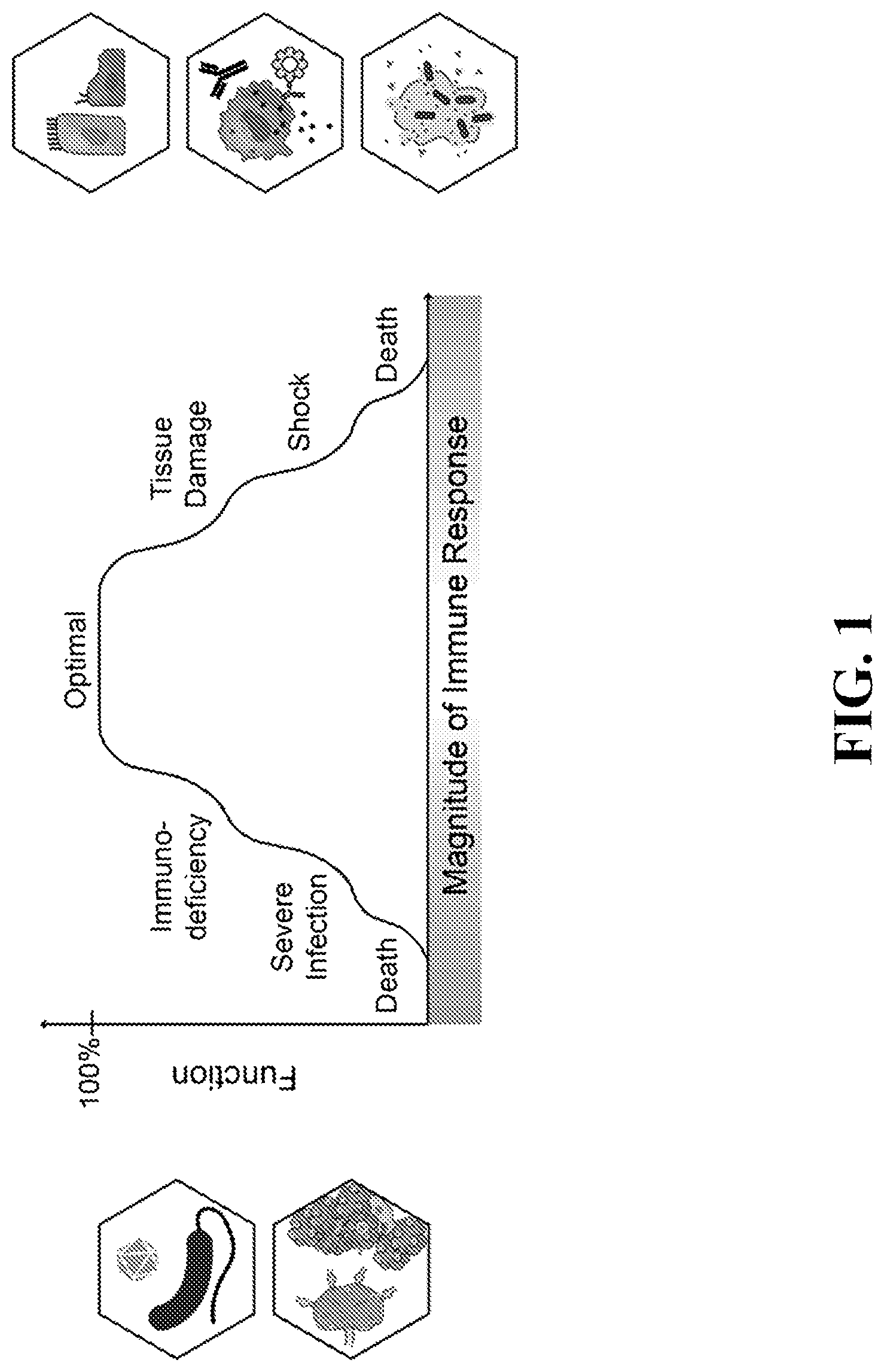
—Balance in the immune system determines health vs. disease. Hyperactivity can lead to tissue damage, allergy, inflammation, and cell death. Immunodeficiency can lead to outgrowth of cancers or external pathogens.
—Host-Pathogen Dynamics of HIV Infection. HIV preferentially infects CD4 T cells, reverse transcribes its DNA, and integrates into the host genome. Infection progresses through a spike in viral load, followed by a progressive decrease in CD4+ T cell count. Because of the high plasma viral load, and because T cells migrate throughout different locations, virtually all tissues can be exposed to the virus, causing profound, and often irreversible changes to the adaptive and innate immune systems, and establishing a permanent pool of integrated HIV termed the “reservoir.”
— Lymph node cells stain positive for HIV proteins such as p24 by flow cytometry indicating a significant fraction of cells are actively producing virus.
— Lymph node from an HIV-infected, antiretroviral-treated patient.
— HIV infection status of single cells. Detection of host mRNA and HIV-1 RNA from the same cell.
— HIV infection status of single cells. Detection of host mRNA and HIV-1 RNA from the same cell.
— Cellular identities of Active HIV Reservoir. Top: Single cell RNA detection distinguishes cells, including markers and pathways, that contribute to ongoing HIV replication. Bottom: Differential expression between HIV + and HIV − cells shown by gag-pol abundance identifies genes that drive HIV replication such as transcription factors that bind to HIV promoter regions. Genes associated with metabolism of anti-retroviral drugs are also detected and novel differentially expressed genes identified.
— Non-human primate model showing examples of cells and tissues useful for elaborating gene signatures associated with diseases and disorders.
— Single cell profiles define cells by tissue (left) and cell type (right).
— Single cell transcriptome expression profiles cluster by cell type.
— CD3E++CD3D++CD3G+ cells by tissue and cell type.
A —Tissue specific behavior of macrophages; B charts number of tissue specific cells of macrophages; C single cell transcriptomes of macrophages identify genes that define them. D single cell transcriptomes of macrophages identify tissue specific sub sets.
— Macrophage expression profiles correspond with tissues of origin.
— Single cell profiles define cells by tissue (left) and cell type (right).
— Identification of pneumocyte ( A ) and NK ( B ) cell clusters.
— Gene expression in pneumocytes indicates tissue-dependence.
— Gene expression in NK cells indicates common functions and potential differences driven by tissue-of-origin.
— Cell resolution looking at individual tissues.
— Cell expression profiles by tissue.
— Gene expression in PBMCs showing individual cell types and correlation with gene groups.
— Gene expression of cells in Ileum showing individual cell types and correlation with gene groups.
A- 22 C —Single cell genomics A Single cell genomics of cells from lymphoid tissue from healthy and SHIV-infected Rhesus macaques defines specific cell subsets. B Certain subsets have equal representation between healthy and SHIV, such as CD8 T cells or macrophages, while CD4 T cells and B cells, show major deviations due to prior SHIV infection. C Differential expression of genes in healthy and SHIV-infected CD4 T cells. As in humans, animals with suppressed viral replication as detected in blood show signatures in lymphoid resident T cells associated with ongoing viral replication and response to virus.
—Comparison of differentially expressed genes between HIV + and HIV − T cells in human lymph nodes with SHIV + and SHIV − T cells in non-human primates shows significant overlap.
A- 24 D —Impact of chronic SHIV infection on different tissue niches. A Single cell genomics of cells from lymphoid tissue and ileum compared. B In the mesenteric LN, T cells are affected by prior HIV infection, but in the ileum, a significant effect is not observed. C In the small intestine, T cells are more similar, but largest differential expression occurs among the epithelial enterocytes. D Identification of cell subsets altered by SHIV infection.
shows the proposed experimental workflow using a lymph node sample from an HIV + patient.
A- 26 C show flow cytometry data illustrating that J3 and 10-1074 bnAbs are specific for HIV + samples. A shows data for HIV − PBMCs. B shows data for HIV + (LN276) with stringent gating. C shows data for HIV + (LN276) with non-stringent gating.
A and 27 B show flow cytometry plots illustrating confirmatory staining with intracellular HIV gag.
A and 28 B show that J3 and 10-1074 bnAbs successfully enrich for HIV + cells.
shows results of Seq-Well on lymph nodes from an HIV + , ARV-treated patient.
shows results of Seq-Well on lymph nodes from an HIV + , ARV-treated patient.
shows results of Seq-Well on lymph nodes from an HIV + , ARV-treated patient.
shows a schematic of matched full-length sequencing of the HIV genome.
The figures herein are for illustrative purposes only and are not necessarily drawn to scale.
DETAILED DESCRIPTION OF THE EXAMPLE EMBODIMENTS
General Definitions
Unless defined otherwise, technical and scientific terms used herein have the same meaning as commonly understood by one of ordinary skill in the art to which this disclosure pertains. Definitions of common terms and techniques in molecular biology may be found in Molecular Cloning: A Laboratory Manual, 2 nd edition (1989) (Sambrook, Fritsch, and Maniatis); Molecular Cloning: A Laboratory Manual, 4 th edition (2012) (Green and Sambrook); Current Protocols in Molecular Biology (1987) (F. M. Ausubel et al. eds.); the series Methods in Enzymology (Academic Press, Inc.): PCR 2: A Practical Approach (1995) (M. J. MacPherson, B. D. Hames, and G. R. Taylor eds.): Antibodies, A Laboratory Manual (1988) (Harlow and Lane, eds.): Antibodies A Laboratory Manual, 2 nd edition 2013 (E. A. Greenfield ed.); Animal Cell Culture (1987) (R.I. Freshney, ed.); Benjamin Lewin, Genes IX, published by Jones and Bartlet, 2008 (ISBN 0763752223); Kendrew et al. (eds.), The Encyclopedia of Molecular Biology, published by Blackwell Science Ltd., 1994 (ISBN 0632021829); Robert A. Meyers (ed.), Molecular Biology and Biotechnology: a Comprehensive Desk Reference, published by VCH Publishers, Inc., 1995 (ISBN 9780471185710); Singleton et al., Dictionary of Microbiology and Molecular Biology 2 nd ed., J. Wiley & Sons (New York, N.Y. 1994), March, Advanced Organic Chemistry Reactions, Mechanisms and Structure 4th ed., John Wiley & Sons (New York, N.Y. 1992); and Marten H. Hofker and Jan van Deursen, Transgenic Mouse Methods and Protocols, 2 nd edition (2011).
As used herein, the singular forms “a”, “an”, and “the” include both singular and plural referents unless the context clearly dictates otherwise.
The term “optional” or “optionally” means that the subsequent described event, circumstance or substituent may or may not occur, and that the description includes instances where the event or circumstance occurs and instances where it does not.
The recitation of numerical ranges by endpoints includes all numbers and fractions subsumed within the respective ranges, as well as the recited endpoints.
The terms “about” or “approximately” as used herein when referring to a measurable value such as a parameter, an amount, a temporal duration, and the like, are meant to encompass variations of and from the specified value, such as variations of +/−10% or less, +/−5% or less, +/−1% or less, and +/−0.1% or less of and from the specified value, insofar such variations are appropriate to perform in the disclosed invention. It is to be understood that the value to which the modifier “about” or “approximately” refers is itself also specifically, and preferably, disclosed.
As used herein, a “biological sample” may contain whole cells and/or live cells and/or cell debris. The biological sample may contain (or be derived from) a “bodily fluid”. The present invention encompasses embodiments wherein the bodily fluid is selected from amniotic fluid, aqueous humour, vitreous humour, bile, blood serum, breast milk, cerebrospinal fluid, cerumen (earwax), chyle, chyme, endolymph, perilymph, exudates, feces, female ejaculate, gastric acid, gastric juice, lymph, mucus (including nasal drainage and phlegm), pericardial fluid, peritoneal fluid, pleural fluid, pus, rheum, saliva, sebum (skin oil), semen, sputum, synovial fluid, sweat, tears, urine, vaginal secretion, vomit and mixtures of one or more thereof. Biological samples include cell cultures, bodily fluids, cell cultures from bodily fluids. Bodily fluids may be obtained from a mammal organism, for example by puncture, or other collecting or sampling procedures.
The terms “subject,” “individual,” and “patient” are used interchangeably herein to refer to a vertebrate, preferably a mammal, more preferably a human. Mammals include, but are not limited to, murines, simians, humans, farm animals, sport animals, and pets. Tissues, cells and their progeny of a biological entity obtained in vivo or cultured in vitro are also encompassed.
Various embodiments are described hereinafter. It should be noted that the specific embodiments are not intended as an exhaustive description or as a limitation to the broader aspects discussed herein. One aspect described in conjunction with a particular embodiment is not necessarily limited to that embodiment and can be practiced with any other embodiment(s). Reference throughout this specification to “one embodiment”, “an embodiment,” “an example embodiment,” means that a particular feature, structure or characteristic described in connection with the embodiment is included in at least one embodiment of the present invention. Thus, appearances of the phrases “in one embodiment,” “in an embodiment,” or “an example embodiment” in various places throughout this specification are not necessarily all referring to the same embodiment, but may. Furthermore, the particular features, structures or characteristics may be combined in any suitable manner, as would be apparent to a person skilled in the art from this disclosure, in one or more embodiments. Furthermore, while some embodiments described herein include some but not other features included in other embodiments, combinations of features of different embodiments are meant to be within the scope of the invention. For example, in the appended claims, any of the claimed embodiments can be used in any combination.
All publications, published patent documents, and patent applications cited herein are hereby incorporated by reference to the same extent as though each individual publication, published patent document, or patent application was specifically and individually indicated as being incorporated by reference.
Overview
Embodiments disclosed herein provide a pan-tissue cell from healthy and diseased subjects. The atlas was obtained by single cell sequencing. The present invention discloses novel markers for cell types. Moreover, genes associated with chronic infection and disease, including those associated with HIV infection are identified. The invention provides for diagnostic assays based on gene markers and cell composition, as well as therapeutic targets for controlling differentiation, proliferation, maintenance and/or function of the cell types disclosed herein. In addition, novel cell types and methods of quantitating, detecting and isolating the cell types are disclosed.
In certain example embodiments, using Seq-Well for massively parallel scRNA-seq (Shalek reference Re: Seq-well) of surgical resections from individuals infected by HIV (HIV+) and healthy individuals (HIV−), cells and tissues representative of infection states were located, and biomarkers related to (latent) infection in specific cells were identified.
Methods of Modulating
Methods as disclosed herein are directed to modulating a cell or tissue infected with a viral infection. Such infections include, but are not necessarily limited to, Hepatitis B, Hepatitis C, or HIV. In specific embodiments, the methods comprise contacting a cell or tissue with a modulating agent in an amount sufficient to modify the HIV latency or ART-resistance of the cell or tissue as compared to the HIV latency or ART-resistance in the absence of the modulating agent. The methods of modulating may include modulating one or more host genes, or product of one or more host genes, which may include increasing or decreasing expression of particular host genes or gene products. Modulating may be based on the gene expression detected, and may be determined by the gene whose expression is increased in a cell infected with HIV. The order of steps provided herein is exemplary, certain steps may be carried out simultaneously or in a different order.
Contacting
The contacting may take place in vitro, in vivo, ex vivo. In some instances contacting can be performed by incubating a cell or tissue having a certain phenotype with the candidate modulating agent. In some instances contacting can be performed by delivering the candidate modulating agent to a subject in need thereof. The step of contacting is performed under conditions and for a time sufficient to allow the modulating agent and the cell, tissue, gene, or gene product to interact.
In some embodiments, the cells or population of cells may be obtained from a biological sample. The biological sample may be obtained from a subject suffering from a disease. The biological sample may be a tumor sample. The tumor may be any tumor. This may include, without limitation, liquid tumors such as leukemia (e.g., acute leukemia, acute lymphocytic leukemia, acute myelocytic leukemia, acute myeloblastic leukemia, acute promyelocytic leukemia, acute myelomonocytic leukemia, acute monocytic leukemia, acute erythroleukemia, chronic leukemia, chronic myelocytic leukemia, chronic lymphocytic leukemia), polycythemia vera, lymphoma (e.g., Hodgkin's disease, non-Hodgkin's disease), Waldenstrom's macroglobulinemia, heavy chain disease, or multiple myeloma.
As used herein, a “biological sample” may contain whole cells and/or tissue and/or live cells and/or cell debris. The biological sample may contain (or be derived from) a “bodily fluid”. The present invention encompasses embodiments wherein the bodily fluid is selected from amniotic fluid, aqueous humour, vitreous humour, bile, blood serum, breast milk, cerebrospinal fluid, cerumen (earwax), chyle, chyme, endolymph, perilymph, exudates, feces, female ejaculate, gastric acid, gastric juice, lymph, mucus (including nasal drainage and phlegm), pericardial fluid, peritoneal fluid, pleural fluid, pus, rheum, saliva, sebum (skin oil), semen, sputum, synovial fluid, sweat, tears, urine, vaginal secretion, vomit and mixtures of one or more thereof. Biological samples include cell cultures, bodily fluids, cell cultures from bodily fluids. Bodily fluids may be obtained from a mammal organism, for example by puncture, or other collecting or sampling procedures.
The terms “subject,” “individual,” and “patient” are used interchangeably herein to refer to a vertebrate, preferably a mammal, more preferably a human. Mammals include, but are not limited to, murines, simians, humans, farm animals, sport animals, and pets. Tissues, cells and their progeny of a biological entity obtained in vivo or cultured in vitro are also encompassed.
Modulating Agent
The modulating agent can be any composition that induces, represses, or otherwise affects a gene or gene product. Modulating agents may be selected in some instances, based on a particular pathway, degree of infection, and/or a gene expression signature that may have been detected.
As used herein, modulating, or to modulate, generally means either reducing or inhibiting the expression or activity of, or alternatively increasing the expression or activity of a target gene. In particular, modulating can mean either reducing or inhibiting the activity of, or alternatively increasing a (relevant or intended) biological activity of, a target or antigen as measured using a suitable in vitro, cellular or in vivo assay (which will usually depend on the target involved), by at least 5%, at least 10%, at least 25%, at least 50%, at least 60%, at least 70%, at least 80%, at least 90%, or more, compared to activity of the target in the same assay under the same conditions but without the presence of an agent. An increase or decrease refers to a statistically significant increase or decrease respectively. For the avoidance of doubt, an increase or decrease will be at least 10% relative to a reference, such as at least 10%, at least 20%, at least 30%, at least 40%, at least 50%, at least 60%, at least 70%, at least 80%, at least 90%, at least 95%, at least 97%, at least 98%, or more, up to and including at least 100% or more, in the case of an increase, for example, at least 2-fold, at least 3-fold, at least 4-fold, at least 5-fold, at least 6-fold, at least 7-fold, at least 8-fold, at least 9-fold, at least 10-fold, at least 50-fold, at least 100-fold, or more. Modulating can also involve effecting a change (which can either be an increase or a decrease) in affinity, avidity, specificity and/or selectivity of a target or antigen, such as a receptor and ligand. Modulating can also mean effecting a change with respect to one or more biological or physiological mechanisms, effects, responses, functions, pathways or activities in which the target or antigen (or in which its substrate(s), ligand(s) or pathway(s) are involved, such as its signaling pathway or metabolic pathway and their associated biological or physiological effects) is involved. Again, as will be clear to the skilled person, such an action as an agonist or an antagonist can be determined in any suitable manner and/or using any suitable assay known or described herein (e.g., in vitro or cellular assay), depending on the target or antigen involved. Accordingly, a modulating agent in an amount sufficient to modify the Mycobacterium Tuberculosis infection in a cell or tissue would provide the agent in an amount to effect a change in the amount of infection compared to the amount of infection in the cell or tissue in the absence of modulating agent, or untreated. The amount of modulating agent will vary according to the pathway, gene, or gene product targeted, the host, the tissue or cell, and the amount or copy number of the TB infection.
Modulating can, for example, also involve allosteric modulation of the target and/or reducing or inhibiting the binding of the target to one of its substrates or ligands and/or competing with a natural ligand, substrate for binding to the target. Modulating can also involve activating the target or the mechanism or pathway in which it is involved. Modulating can for example also involve effecting a change in respect of the folding or confirmation of the target, or in respect of the ability of the target to fold, to change its conformation (for example, upon binding of a ligand), to associate with other (sub)units, or to disassociate. Modulating can for example also involve effecting a change in the ability of the target to signal, phosphorylate, dephosphorylate, and the like.
As used herein, an “agent” can refer to a protein-binding agent that permits modulation of activity of proteins or disrupts interactions of proteins and other biomolecules, such as but not limited to disrupting protein-protein interaction, ligand-receptor interaction, or protein-nucleic acid interaction. Agents can also refer to DNA targeting or RNA targeting agents. Agents may include a fragment, derivative and analog of an active agent. The terms “fragment,” “derivative” and “analog” when referring to polypeptides as used herein refers to polypeptides which either retain substantially the same biological function or activity as such polypeptides. An analog includes a proprotein which can be activated by cleavage of the proprotein portion to produce an active mature polypeptide. Such agents include, but are not limited to, antibodies (“antibodies” includes antigen-binding portions of antibodies such as epitope- or antigen-binding peptides, paratopes, functional CDRs; recombinant antibodies; chimeric antibodies; humanized antibodies; nanobodies; tribodies; midibodies; or antigen-binding derivatives, analogs, variants, portions, or fragments thereof), protein-binding agents, nucleic acid molecules, small molecules, recombinant protein, peptides, aptamers, avimers and protein-binding derivatives, portions or fragments thereof. An “agent” as used herein, may also refer to an agent that inhibits expression of a gene, such as but not limited to a DNA targeting agent (e.g., CRISPR system, TALE, Zinc finger protein) or RNA targeting agent (e.g., inhibitory nucleic acid molecules such as RNAi, miRNA, ribozyme).
The agents of the present invention may be modified, such that they acquire advantageous properties for therapeutic use (e.g., stability and specificity), but maintain their biological activity.
It is well known that the properties of certain proteins can be modulated by attachment of polyethylene glycol (PEG) polymers, which increases the hydrodynamic volume of the protein and thereby slows its clearance by kidney filtration. (See, e.g., Clark et al., J. Biol. Chem. 271: 21969-21977 (1996)). Therefore, it is envisioned that certain agents can be PEGylated (e.g., on peptide residues) to provide enhanced therapeutic benefits such as, for example, increased efficacy by extending half-life in vivo. In certain embodiments, PEGylation of the agents may be used to extend the serum half-life of the agents and allow for particular agents to be capable of crossing the blood-brain barrier.
In regards to peptide PEGylation methods, reference is made to Lu et al., Int. J. Pept. Protein Res. 43: 127-38 (1994); Lu et al., Pept. Res. 6: 140-6 (1993); Felix et al., Int. J. Pept. Protein Res. 46: 253-64 (1995); Gaertner et al., Bioconjug. Chem. 7: 38-44 (1996); Tsutsumi et al., Thromb. Haemost. 77: 168-73 (1997); Francis et al., hit. J. Hematol. 68: 1-18 (1998); Roberts et al., J. Pharm. Sci. 87: 1440-45 (1998); and Tan et al., Protein Expr. Purif. 12: 45-52 (1998). Polyethylene glycol or PEG is meant to encompass any of the forms of PEG that have been used to derivatize other proteins, including, but not limited to, mono-(C1-10) alkoxy or aryloxy-polyethylene glycol. Suitable PEG moieties include, for example, 40 kDa methoxy poly(ethylene glycol) propionaldehyde (Dow, Midland, Mich.); 60 kDa methoxy poly(ethylene glycol) propionaldehyde (Dow, Midland, Mich.); 40 kDa methoxy poly(ethylene glycol) maleimido-propionamide (Dow, Midland, Mich.); 31 kDa alpha-methyl-w-(3-oxopropoxy), polyoxyethylene (NOF Corporation, Tokyo); mPEG2-NHS-40k (Nektar); mPEG2-MAL-40k (Nektar), SUNBRIGHT GL2-400MA ((PEG)240 kDa) (NOF Corporation, Tokyo), SUNBRIGHT ME-200MA (PEG20 kDa) (NOF Corporation, Tokyo). The PEG groups are generally attached to the peptide (e.g., neuromedin U receptor agonists or antagonists) via acylation or alkylation through a reactive group on the PEG moiety (for example, a maleimide, an aldehyde, amino, thiol, or ester group) to a reactive group on the peptide (for example, an aldehyde, amino, thiol, a maleimide, or ester group).
The PEG molecule(s) may be covalently attached to any Lys, Cys, or K(CO(CH2)2SH) residues at any position in a peptide. In certain embodiments, the neuromedin U receptor agonists described herein can be PEGylated directly to any amino acid at the N-terminus by way of the N-terminal amino group. A “linker arm” may be added to a peptide to facilitate PEGylation. PEGylation at the thiol side-chain of cysteine has been widely reported (see, e.g., Caliceti & Veronese, Adv. Drug Deliv. Rev. 55: 1261-77 (2003)). If there is no cysteine residue in the peptide, a cysteine residue can be introduced through substitution or by adding a cysteine to the N-terminal amino acid.
As used herein the term “altered expression” may particularly denote altered production of the recited gene products by a cell. As used herein, the term “gene product(s)” includes RNA transcribed from a gene (e.g., mRNA), or a polypeptide encoded by a gene or translated from RNA. Also, “altered expression” as intended herein may encompass modulating the activity of one or more endogenous gene products. Accordingly, “altered expression”, “altering expression”, “modulating expression”, or “detecting expression” or similar may be used interchangeably with respectively “altered expression or activity”, “altering expression or activity”, “modulating expression or activity”, or “detecting expression or activity” or similar. As used herein, “modulating” or “to modulate” generally means either reducing or inhibiting the activity of a target or antigen, or alternatively increasing the activity of the target or antigen, as measured using a suitable in vitro, cellular or in vivo assay. In particular, “modulating” or “to modulate” can mean either reducing or inhibiting the (relevant or intended) activity of, or alternatively increasing the (relevant or intended) biological activity of the target or antigen, as measured using a suitable in vitro, cellular or in vivo assay (which will usually depend on the target or antigen involved), by at least 5%, at least 10%, at least 25%, at least 50%, at least 60%, at least 70%, at least 80%, or 90% or more, compared to activity of the target or antigen in the same assay under the same conditions but without the presence of the inhibitor/antagonist agents or activator/agonist agents described herein.
As will be clear to the skilled person, “modulating” can also involve affecting a change (which can either be an increase or a decrease) in affinity, avidity, specificity and/or selectivity of a target or antigen, for one or more of its targets compared to the same conditions but without the presence of a modulating agent. Again, this can be determined in any suitable manner and/or using any suitable assay known per se, depending on the target. In particular, an action as an inhibitor/antagonist or activator/agonist can be such that an intended biological or physiological activity is increased or decreased, respectively, by at least 5%, at least 10%, at least 25%, at least 50%, at least 60%, at least 70%, at least 80%, or 90% or more, compared to the biological or physiological activity in the same assay under the same conditions but without the presence of the inhibitor/antagonist agent or activator/agonist agent. Modulating can also involve activating the target or antigen or the mechanism or pathway in which it is involved.
As used herein, a “blocking” antibody or an antibody “antagonist” is one which inhibits or reduces biological activity of the antigen(s) it binds. In certain embodiments, the blocking antibodies or antagonist antibodies or portions thereof described herein completely inhibit the biological activity of the antigen(s).
Antibodies may act as agonists or antagonists of the recognized polypeptides. For example, the present invention includes antibodies which disrupt receptor/ligand interactions either partially or fully. The invention features both receptor-specific antibodies and ligand-specific antibodies. The invention also features receptor-specific antibodies which do not prevent ligand binding but prevent receptor activation. Receptor activation (i.e., signaling) may be determined by techniques described herein or otherwise known in the art. For example, receptor activation can be determined by detecting the phosphorylation (e.g., tyrosine or serine/threonine) of the receptor or of one of its down-stream substrates by immunoprecipitation followed by western blot analysis. In specific embodiments, antibodies are provided that inhibit ligand activity or receptor activity by at least 95%, at least 90%, at least 85%, at least 80%, at least 75%, at least 70%, at least 60%, or at least 50% of the activity in absence of the antibody.
Upon infection, HIV remains latent in infected cells, a state in which it is present, but not actively producing viral particles. Latent HIV reservoirs are established during the earliest stage of HIV infection. Although ART can reduce the level of HIV in the blood to an undetectable level, latent reservoirs of HIV continue to survive so that, when a latently infected cell is reactivated, the cell begins to produce viral particles again. Although ART can suppress HIV levels, the therapy cannot eliminate latent HIV reservoirs, and thus cannot cure the infection. Termination of ART leads to almost immediate reactivation and replication of HIV genes within a couple of weeks upon termination of therapy. Furthermore, certain viral strains are resistant to ART treatment, causing HIV treatment to fail in certain individuals. Such individuals are said to have an ART-resistant HIV infection.
The term “amount sufficient”, “effective amount”, or “therapeutically effective amount” refers to the amount of an agent that is sufficient to effect beneficial or desired results. The therapeutically effective amount may vary depending upon one or more of: the subject and disease condition being treated, the weight and age of the subject, the severity of the disease condition, the manner of administration and the like, which can readily be determined by one of ordinary skill in the art. The term also applies to a dose that will provide an image for detection by any one of the imaging methods described herein. The specific dose may vary depending on one or more of: the particular agent chosen, the dosing regimen to be followed, whether it is administered in combination with other compounds, timing of administration, the tissue to be imaged, and the physical delivery system in which it is carried.
For example, in methods for treating cancer in a subject, an effective amount of a combination of inhibitors targeting epigenetic genes is any amount that provides an anti-cancer effect, such as reduces or prevents proliferation of a cancer cell or is cytotoxic towards a cancer cell. In certain embodiments, the effective amount of an inhibitor targeting an epigenetic gene is reduced when an inhibitor is administered concomitantly or in combination with one or more additional inhibitors targeting epigenetic genes as compared to the effective amount of the inhibitor when administered in the absence of one or more additional inhibitors targeting epigenetic genes. In certain embodiments, the inhibitor targeting an epigenetic gene does not reduce or prevent proliferation of a cancer cell when administered in the absence of one or more additional inhibitors targeting epigenetic genes.
In specific embodiments, in methods for modulating a cell or tissue having a latent HIV or ART-resistant HIV infection, an amount of a modulating agent sufficient to modify the HIV latency or ART-resistance of the cell or tissue is any amount that increases or decreases the expression of genes or gene products from Tables 1, 2, or 3 in that cell or tissue relative to a cell or tissue not exposed to or contacted with that modulating agent.
The terms “increased” or “increase” or “upregulated” or “upregulate” as used herein generally mean an increase by a statically significant amount. For avoidance of doubt, “increased” means a statistically significant increase of at least 10% as compared to a reference level, including an increase of at least 20%, at least 30%, at least 40%, at least 50%, at least 60%, at least 70%, at least 80%, at least 90%, at least 100% or more, including, for example at least 2-fold, at least 3-fold, at least 4-fold, at least 5-fold, at least 10-fold increase or greater as compared to a reference level, as that term is defined herein.
The term “reduced” or “reduce” or “decrease” or “decreased” or “downregulate” or “downregulated” as used herein generally means a decrease by a statistically significant amount relative to a reference. For avoidance of doubt, “reduced” means statistically significant decrease of at least 10% as compared to a reference level, for example a decrease by at least 20%, at least 30%, at least 40%, at least 50%, or at least 60%, or at least 70%, or at least 80%, at least 90% or more, up to and including a 100% decrease (i.e., absent level as compared to a reference sample), or any decrease between 10-100% as compared to a reference level, as that.
In some embodiments, the viral or latent viral infection in the cell or tissue is a latent HIV or anti-ART-resistant HIV infection as described herein.
In some embodiments, the viral infection is a hepatitis infection. In specific embodiments, the hepatitis infection is hepatitis B or hepatitis C. The pathway by which hepatic viruses cause viral hepatitis is best understood in the case of hepatitis B and C. The viruses do not directly cause apoptosis (cell death), rather, infection of liver cells activates the innate and adaptive arms of the immune system leading to an inflammatory response which causes cellular damage and death (Nakamoto et al. Curr Molec Med 3(6):537-544; 2003). Depending on the strength of the immune response, the types of immune cells involved and the ability of the virus to evade the body's defense, infection can either lead to clearance (acute disease) or persistence (chronic disease) of the virus. The chronic presence of the virus within liver cells results in multiple waves of inflammation, injury and wound healing that over time lead to scarring or fibrosis and culminate in hepatocellular carcinoma (Nakamoto et al. Curr Molec Med 3(6):537-544 (2003); Wong Clin Molec Hepatol 20(3):228-236 (2014)). Individuals with an impaired immune response are at greater risk of developing chronic infection. Natural killer cells are the primary drivers of the initial innate response and create a cytokine environment that results in the recruitment of CD4 T-helper and CD8 cytotoxic T-cells (Rehermann Cell Molec Gastr Hepatol 1(6):578-588 (2015); Heim et al. J Hepatol 61(1 Suppl): S14-25 (2014)). Type I interferons are the cytokines that drive the antiviral response (Heim et al. J Hepatol 61(1 Suppl): S14-25 (2014)). In chronic Hepatitis B and C, natural killer cell function is impaired (Rehermann Cell Molec Gastr Hepatol 1(6):578-588 (2015)).
In some embodiments, the HIV latency or ART-resistance of the cell directly influences the latent HIV or ART-resistant HIV infection, in that the state of the cell has an effect or impact on the viral infection.
The term “immune cell” as used throughout this specification generally encompasses any cell derived from a hematopoietic stem cell that plays a role in the immune response. The term is intended to encompass immune cells both of the innate or adaptive immune system. The immune cell as referred to herein may be a leukocyte, at any stage of differentiation (e.g., a stem cell, a progenitor cell, a mature cell) or any activation stage. Immune cells include lymphocytes (such as natural killer cells, T-cells (including, e.g., thymocytes, Th or Tc; Th1, Th2, Th17, Thαβ, CD4 + , CD8 + , effector Th, memory Th, regulatory Th, CD4 + /CD8 + thymocytes, CD4−/CD8− thymocytes, γδ T cells, etc.) or B-cells (including, e.g., pro-B cells, early pro-B cells, late pro-B cells, pre-B cells, large pre-B cells, small pre-B cells, immature or mature B-cells, producing antibodies of any isotype, T1 B-cells, T2 B-cells, naïve B-cells, GC B-cells, plasmablasts, memory B-cells, plasma cells, follicular B-cells, marginal zone B-cells, B-1 cells, B-2 cells, regulatory B cells, etc.), such as for instance, monocytes (including, e.g., classical, non-classical, or intermediate monocytes), (segmented or banded) neutrophils, eosinophils, basophils, mast cells, histiocytes, microglia, including various subtypes, maturation, differentiation, or activation stages, such as for instance hematopoietic stem cells, myeloid progenitors, lymphoid progenitors, myeloblasts, promyelocytes, myelocytes, metamyelocytes, monoblasts, promonocytes, lymphoblasts, prolymphocytes, small lymphocytes, macrophages (including, e.g., Kupffer cells, stellate macrophages, M1 or M2 macrophages), (myeloid or lymphoid) dendritic cells (including, e.g., Langerhans cells, conventional or myeloid dendritic cells, plasmacytoid dendritic cells, mDC-1, mDC-2, Mo-DC, HP-DC, veiled cells), granulocytes, polymorphonuclear cells, antigen-presenting cells (APC), etc.
As used throughout this specification, “immune response” refers to a response by a cell of the immune system, such as a B cell, T cell (CD4 + or CD8 + ), regulatory T cell, antigen-presenting cell, dendritic cell, monocyte, macrophage, NKT cell, NK cell, basophil, eosinophil, or neutrophil, to a stimulus. In some embodiments, the response is specific for a particular antigen (an “antigen-specific response”), and refers to a response by a CD4 T cell, CD8 T cell, or B cell via their antigen-specific receptor. In some embodiments, an immune response is a T cell response, such as a CD4 + response or a CD8 + response. Such responses by these cells can include, for example, cytotoxicity, proliferation, cytokine or chemokine production, trafficking, or phagocytosis, and can be dependent on the nature of the immune cell undergoing the response.
T cell response refers more specifically to an immune response in which T cells directly or indirectly mediate or otherwise contribute to an immune response in a subject. T cell-mediated response may be associated with cell mediated effects, cytokine mediated effects, and even effects associated with B cells if the B cells are stimulated, for example, by cytokines secreted by T cells. By means of an example but without limitation, effector functions of MHC class I restricted Cytotoxic T lymphocytes (CTLs), may include cytokine and/or cytolytic capabilities, such as lysis of target cells presenting an antigen peptide recognised by the T cell receptor (naturally-occurring TCR or genetically engineered TCR, e.g., chimeric antigen receptor, CAR), secretion of cytokines, preferably IFN gamma, TNF alpha and/or or more immunostimulatory cytokines, such as IL-2, and/or antigen peptide-induced secretion of cytotoxic effector molecules, such as granzymes, performs or granulysin. By means of example but without limitation, for MEW class II restricted T helper (Th) cells, effector functions may be antigen peptide-induced secretion of cytokines, preferably, IFN gamma, TNF alpha, IL-4, IL5, IL-10, and/or IL-2. By means of example but without limitation, for T regulatory (Treg) cells, effector functions may be antigen peptide-induced secretion of cytokines, preferably, IL-10, IL-35, and/or TGF-beta. B cell response refers more specifically to an immune response in which B cells directly or indirectly mediate or otherwise contribute to an immune response in a subject. Effector functions of B cells may include in particular production and secretion of antigen-specific antibodies by B cells (e.g., polyclonal B cell response to a plurality of the epitopes of an antigen (antigen-specific antibody response)), antigen presentation, and/or cytokine secretion.
During persistent immune activation, such as during uncontrolled tumor growth or chronic infections, subpopulations of immune cells, particularly of CD8+ or CD4+ T cells, become compromised to different extents with respect to their cytokine and/or cytolytic capabilities. Such immune cells, particularly CD8+ or CD4+ T cells, are commonly referred to as “dysfunctional” or as “functionally exhausted” or “exhausted”. As used herein, the term “dysfunctional” or “functional exhaustion” refer to a state of a cell where the cell does not perform its usual function or activity in response to normal input signals, and includes refractivity of immune cells to stimulation, such as stimulation via an activating receptor or a cytokine. Such a function or activity includes, but is not limited to, proliferation (e.g., in response to a cytokine, such as IFN-gamma) or cell division, entrance into the cell cycle, cytokine production, cytotoxicity, migration and trafficking, phagocytotic activity, or any combination thereof. Normal input signals can include, but are not limited to, stimulation via a receptor (e.g., T cell receptor, B cell receptor, co-stimulatory receptor). Unresponsive immune cells can have a reduction of at least 10%, 20%, 30%, 40%, 50%, 60%, 70%, 80%, 90%, 95%, or even 100% in cytotoxic activity, cytokine production, proliferation, trafficking, phagocytotic activity, or any combination thereof, relative to a corresponding control immune cell of the same type. In some particular embodiments of the aspects described herein, a cell that is dysfunctional is a CD8+ T cell that expresses the CD8+ cell surface marker. Such CD8+ cells normally proliferate and produce cell killing enzymes, e.g., they can release the cytotoxins perform, granzymes, and granulysin. However, exhausted/dysfunctional T cells do not respond adequately to TCR stimulation, and display poor effector function, sustained expression of inhibitory receptors and a transcriptional state distinct from that of functional effector or memory T cells. Dysfunction/exhaustion of T cells thus prevents optimal control of infection and tumors. Exhausted/dysfunctional immune cells, such as T cells, such as CD8+ T cells, may produce reduced amounts of IFN-gamma, TNF-alpha and/or one or more immunostimulatory cytokines, such as IL-2, compared to functional immune cells. Exhausted/dysfunctional immune cells, such as T cells, such as CD8+ T cells, may further produce (increased amounts of) one or more immunosuppressive transcription factors or cytokines, such as IL-10 and/or Foxp3, compared to functional immune cells, thereby contributing to local immunosuppression. Dysfunctional CD8+ T cells can be both protective and detrimental against disease control.
CD8+ T cell function is associated with their cytokine profiles. It has been reported that effector CD8+ T cells with the ability to simultaneously produce multiple cytokines (polyfunctional CD8+ T cells) are associated with protective immunity in patients with controlled chronic viral infections as well as cancer patients responsive to immune therapy (Spranger et al., 2014, J. Immunother. Cancer, vol. 2, 3). In the presence of persistent antigen CD8+ T cells were found to have lost cytolytic activity completely over time (Moskophidis et al., 1993, Nature, vol. 362, 758-761). It was subsequently found that dysfunctional T cells can differentially produce IL-2, TNFa and IFNg in a hierarchical order (Wherry et al., 2003, J. Virol., vol. 77, 4911-4927). Decoupled dysfunctional and activated CD8+ cell states have also been described (see, e.g., Singer, et al. (2016). A Distinct Gene Module for Dysfunction Uncoupled from Activation in Tumor-Infiltrating T Cells. Cell 166, 1500-1511 e1509; and WO/2017/075478).
The invention also provides compositions and methods for modulating T cell balance. The invention provides T cell modulating agents that modulate T cell balance. For example, in some embodiments, the invention provides T cell modulating agents and methods of using these T cell modulating agents to regulate, influence or otherwise impact the level of and/or balance between T cell types, e.g., between Th17 and other T cell types, for example, regulatory T cells (Tregs). For example, in some embodiments, the invention provides T cell modulating agents and methods of using these T cell modulating agents to regulate, influence or otherwise impact the level of and/or balance between Th17 activity and inflammatory potential. As used herein, terms such as “Th17 cell” and/or “Th17 phenotype” and all grammatical variations thereof refer to a differentiated T helper cell that expresses one or more cytokines selected from the group the consisting of interleukin 17A (IL-17A), interleukin 17F (IL-17F), and interleukin 17A/F heterodimer (IL17-AF). As used herein, terms such as “Th1 cell” and/or “Th1 phenotype” and all grammatical variations thereof refer to a differentiated T helper cell that expresses interferon gamma (IFNγ). As used herein, terms such as “Th2 cell” and/or “Th2 phenotype” and all grammatical variations thereof refer to a differentiated T helper cell that expresses one or more cytokines selected from the group the consisting of interleukin 4 (IL-4), interleukin 5 (IL-5) and interleukin 13 (IL-13). As used herein, terms such as “Treg cell” and/or “Treg phenotype” and all grammatical variations thereof refer to a differentiated T cell that expresses Foxp3.
In some embodiments, the modulating of a cell or tissue comprises modulating a lymph node immune cell. A lymph node is an organ of the lymphatic system and of the adaptive immune system, that is widely present throughout the body. Lymph nodes are linked by the lymphatic vessels as a part of the circulatory system and are major sites of B and T lymphocytes. The term “lymph node immune cell” as described herein, refers to B and T lymphocytes, and other white blood cells as described herein and listed above.
In some embodiments, the modulating of a cell or tissue as described herein comprises modulating a T cell or T cell subset. Specific subsets of T cells may include, but are not necessarily limited to, CD4+ T cells, CD8+ T cells, Tregs, T helper cells, NK cells. In specific embodiments, specific subsets of T cells as described herein, include, but are not necessarily limited to, CD3 + CD4 + PD1 + CXCR4 + T follicular helper cells or CD45RA − CCR7 + CD27 + memory T cells.
In some embodiments, the modulating of a cell or tissue may comprise modulating a gene or gene product that is enriched for expression in HIV + cells. Such genes or gene products may be more prominently expressed in HIV + cells, such as for example, but not necessarily limited to, the genes and gene products listed in Tables 1 and 2.
Identifying Modulating Agents
A further aspect of the invention relates to a method for identifying an agent capable of modulating one or more phenotypic aspects of a pathogen infected cell, comprising: a) applying a candidate agent to the cell or cell population; b) detecting modulation of one or more phenotypic aspects of the cell or cell population by the candidate agent, thereby identifying the agent.
The term “modulate” broadly denotes a qualitative and/or quantitative alteration, change or variation in that which is being modulated. Where modulation can be assessed quantitatively—for example, where modulation comprises or consists of a change in a quantifiable variable such as a quantifiable property of a cell or where a quantifiable variable provides a suitable surrogate for the modulation—modulation specifically encompasses both increase (e.g., activation) or decrease (e.g., inhibition) in the measured variable. The term encompasses any extent of such modulation, e.g., any extent of such increase or decrease, and may more particularly refer to statistically significant increase or decrease in the measured variable. By means of example, modulation may encompass an increase in the value of the measured variable by at least about 10%, e.g., by at least about 20%, preferably by at least about 30%, e.g., by at least about 40%, more preferably by at least about 50%, e.g., by at least about 75%, even more preferably by at least about 100%, e.g., by at least about 150%, 200%, 250%, 300%, 400% or by at least about 500%, compared to a reference situation without said modulation; or modulation may encompass a decrease or reduction in the value of the measured variable by at least about 10%, e.g., by at least about 20%, by at least about 30%, e.g., by at least about 40%, by at least about 50%, e.g., by at least about 60%, by at least about 70%, e.g., by at least about 80%, by at least about 90%, e.g., by at least about 95%, such as by at least about 96%, 97%, 98%, 99% or even by 100%, compared to a reference situation without said modulation. Preferably, modulation may be specific or selective, hence, one or more desired phenotypic aspects of a gut cell or gut cell population may be modulated without substantially altering other (unintended, undesired) phenotypic aspect(s).
The term “agent” broadly encompasses any condition, substance or agent capable of modulating one or more phenotypic aspects of cell or cell population as disclosed herein. Such conditions, substances or agents may be of physical, chemical, biochemical and/or biological nature. The term “candidate agent” refers to any condition, substance or agent that is being examined for the ability to modulate one or more phenotypic aspects of an gut cell or gut cell population as disclosed herein in a method comprising applying the candidate agent to the gut cell or gut cell population (e.g., exposing the gut cell or gut cell population to the candidate agent or contacting the gut cell or gut cell population with the candidate agent) and observing whether the desired modulation takes place.
Agents may include any potential class of biologically active conditions, substances or agents, such as for instance antibodies, proteins, peptides, nucleic acids, oligonucleotides, small molecules, or combinations thereof.
By means of example but without limitation, agents can include low molecular weight compounds, but may also be larger compounds, or any organic or inorganic molecule effective in the given situation, including modified and unmodified nucleic acids such as antisense nucleic acids, RNAi, such as siRNA or shRNA, CRISPR/Cas systems, peptides, peptidomimetics, receptors, ligands, and antibodies, aptamers, polypeptides, nucleic acid analogues or variants thereof. Examples include an oligomer of nucleic acids, amino acids, or carbohydrates including without limitation proteins, oligonucleotides, ribozymes, DNAzymes, glycoproteins, siRNAs, lipoproteins, aptamers, and modifications and combinations thereof. Agents can be selected from a group comprising: chemicals; small molecules; nucleic acid sequences; nucleic acid analogues; proteins; peptides; aptamers; antibodies; or fragments thereof. A nucleic acid sequence can be RNA or DNA, and can be single or double stranded, and can be selected from a group comprising; nucleic acid encoding a protein of interest, oligonucleotides, nucleic acid analogues, for example peptide—nucleic acid (PNA), pseudo-complementary PNA (pc-PNA), locked nucleic acid (LNA), modified RNA (mod-RNA), single guide RNA etc. Such nucleic acid sequences include, for example, but are not limited to, nucleic acid sequence encoding proteins, for example that act as transcriptional repressors, antisense molecules, ribozymes, small inhibitory nucleic acid sequences, for example but are not limited to RNAi, shRNAi, siRNA, micro RNAi (mRNAi), antisense oligonucleotides, CRISPR guide RNA, for example that target a CRISPR enzyme to a specific DNA target sequence etc. A protein and/or peptide or fragment thereof can be any protein of interest, for example, but are not limited to: mutated proteins; therapeutic proteins and truncated proteins, wherein the protein is normally absent or expressed at lower levels in the cell. Proteins can also be selected from a group comprising; mutated proteins, genetically engineered proteins, peptides, synthetic peptides, recombinant proteins, chimeric proteins, antibodies, midibodies, minibodies, triabodies, humanized proteins, humanized antibodies, chimeric antibodies, modified proteins and fragments thereof. Alternatively, the agent can be intracellular within the cell as a result of introduction of a nucleic acid sequence into the cell and its transcription resulting in the production of the nucleic acid and/or protein modulator of a gene within the cell. In some embodiments, the agent is any chemical, entity or moiety, including without limitation synthetic and naturally-occurring non-proteinaceous entities. In certain embodiments, the agent is a small molecule having a chemical moiety. Agents can be known to have a desired activity and/or property, or can be selected from a library of diverse compounds.
In certain embodiments, an agent may be a hormone, a cytokine, a lymphokine, a growth factor, a chemokine, a cell surface receptor ligand such as a cell surface receptor agonist or antagonist, or a mitogen.
Non-limiting examples of hormones include growth hormone (GH), adrenocorticotropic hormone (ACTH), dehydroepiandrosterone (DHEA), cortisol, epinephrine, thyroid hormone, estrogen, progesterone, testosterone, or combinations thereof.
Non-limiting examples of cytokines include lymphokines (e.g., interferon-γ, IL-2, IL-3, IL-4, IL-6, granulocyte-macrophage colony-stimulating factor (GM-CSF), interferon-γ, leukocyte migration inhibitory factors (T-LIF, B-LIF), lymphotoxin-alpha, macrophage-activating factor (MAF), macrophage migration-inhibitory factor (MIF), neuroleukin, immunologic suppressor factors, transfer factors, or combinations thereof), monokines (e.g., IL-1, TNF-alpha, interferon-α, interferon-β, colony stimulating factors, e.g., CSF2, CSF3, macrophage CSF or GM-CSF, or combinations thereof), chemokines (e.g., beta-thromboglobulin, C chemokines, CC chemokines, CXC chemokines, CX3C chemokines, macrophage inflammatory protein (MIP), or combinations thereof), interleukins (e.g., IL-1, IL-2, IL-3, IL-4, IL-5, IL-6, IL-7, IL-8, IL-9, IL-10, IL-11, IL-12, IL-13, IL-14, IL-15, IL-17, IL-18, IL-19, IL-20, IL-21, IL-22, IL-23, IL-24, IL-25, IL-26, IL-27, IL-28, IL-29, IL-30, IL-31, IL-32, IL-33, IL-34, IL-35, IL-36, or combinations thereof), and several related signaling molecules, such as tumour necrosis factor (TNF) and interferons (e.g., interferon-α, interferon-β, interferon-γ, interferon-λ, or combinations thereof).
Non-limiting examples of growth factors include those of fibroblast growth factor (FGF) family, bone morphogenic protein (BMP) family, platelet derived growth factor (PDGF) family, transforming growth factor beta (TGFbeta) family, nerve growth factor (NGF) family, epidermal growth factor (EGF) family, insulin related growth factor (IGF) family, hepatocyte growth factor (HGF) family, hematopoietic growth factors (HeGFs), platelet-derived endothelial cell growth factor (PD-ECGF), angiopoietin, vascular endothelial growth factor (VEGF) family, glucocorticoids, or combinations thereof.
Non-limiting examples of mitogens include phytohaemagglutinin (PHA), concanavalin A (conA), lipopolysaccharide (LPS), pokeweed mitogen (PWM), phorbol ester such as phorbol myristate acetate (PMA) with or without ionomycin, or combinations thereof.
Non-limiting examples of cell surface receptors the ligands of which may act as agents include Toll-like receptors (TLRs) (e.g., TLR1, TLR2, TLR3, TLR4, TLR5, TLR6, TLR7, TLR8, TLR9, TLR10, TLR11, TLR12 or TLR13), CD80, CD86, CD40, CCR7, or C-type lectin receptors.
Particular screening applications of this invention relate to the testing of pharmaceutical compounds in drug research. The reader is referred generally to the standard textbook In vitro Methods in Pharmaceutical Research, Academic Press, 1997, and U.S. Pat. No. 5,030,015. In certain aspects of this invention, the culture of the invention is used to grow and differentiate a cachectic target cell to play the role of test cells for standard drug screening and toxicity assays. Assessment of the activity of candidate pharmaceutical compounds generally involves combining the target cell (e.g., a myocyte, an adipocyte, a cardiomyocyte or a hepatocyte) with the candidate compound, determining any change in the morphology, marker phenotype, or metabolic activity of the cells that is attributable to the candidate compound (compared with untreated cells or cells treated with an inert compound, such as vehicle), and then correlating the effect of the candidate compound with the observed change. The screening may be done because the candidate compound is designed to have a pharmacological effect on the target cell, or because a candidate compound may have unintended side effects on the target cell. Alternatively, libraries can be screened without any predetermined expectations in hopes of identifying compounds with desired effects.
Cytotoxicity can be determined in the first instance by the effect on cell viability and morphology. In certain embodiments, toxicity may be assessed by observation of vital staining techniques, ELISA assays, immunohistochemistry, and the like or by analyzing the cellular content of the culture, e.g., by total cell counts, and differential cell counts or by metabolic markers such as MTT and XTT.
Additional further uses of the culture of the invention include, but are not limited to, its use in research e.g., to elucidate mechanisms leading to the identification of novel targets for therapies, and to generate genotype-specific cells for disease modeling, including the generation of new therapies customized to different genotypes. Such customization can reduce adverse drug effects and help identify therapies appropriate to the patient's genotype.
In certain embodiments, the present invention provides method for high-throughput screening. “High-throughput screening” (HTS) refers to a process that uses a combination of modern robotics, data processing and control software, liquid handling devices, and/or sensitive detectors, to efficiently process a large amount of (e.g., thousands, hundreds of thousands, or millions of) samples in biochemical, genetic or pharmacological experiments, either in parallel or in sequence, within a reasonably short period of time (e.g., days). Preferably, the process is amenable to automation, such as robotic simultaneous handling of 96 samples, 384 samples, 1536 samples or more. A typical HTS robot tests up to 100,000 to a few hundred thousand compounds per day. The samples are often in small volumes, such as no more than 1 mL, 500 μl, 200 μl, 100 μl, 50 μl or less. Through this process, one can rapidly identify active compounds, small molecules, antibodies, proteins or polynucleotides which modulate a particular biomolecular/genetic pathway. The results of these experiments provide starting points for further drug design and for understanding the interaction or role of a particular biochemical process in biology. Thus “high-throughput screening” as used herein does not include handling large quantities of radioactive materials, slow and complicated operator-dependent screening steps, and/or prohibitively expensive reagent costs, etc.
In certain embodiments, the present invention provides for gene signature screening. The concept of signature screening was introduced by Stegmaier et al. (Gene expression-based high-throughput screening (GE-HTS) and application to leukemia differentiation. Nature Genet. 36, 257-263 (2004)), who realized that if a gene-expression signature was the proxy for a phenotype of interest, it could be used to find small molecules that effect that phenotype without knowledge of a validated drug target. The signatures of the present invention may be used to screen for drugs that induce or reduce the signature in immune cells as described herein. The signature may be used for GE-HTS (Gene Expression-based High-Throughput Screening). In certain embodiments, pharmacological screens may be used to identify drugs that selectively activate gut cells.
The Connectivity Map (cmap) is a collection of genome-wide transcriptional expression data from cultured human cells treated with bioactive small molecules and simple pattern-matching algorithms that together enable the discovery of functional connections between drugs, genes and diseases through the transitory feature of common gene-expression changes (see, Lamb et al., The Connectivity Map: Using Gene-Expression Signatures to Connect Small Molecules, Genes, and Disease. Science 29 Sep. 2006: Vol. 313, Issue 5795, pp. 1929-1935, DOI: 10.1126/science.1132939; and Lamb, J., The Connectivity Map: a new tool for biomedical research. Nature Reviews Cancer January 2007: Vol. 7, pp. 54-60). In certain embodiments, Cmap can be used to screen for small molecules capable of modulating a signature of the present invention in silico.
Genetic Modification
In certain embodiments, one or more endogenous genes may be modified using a nuclease. The term “nuclease” as used herein broadly refers to an agent, for example a protein or a small molecule, capable of cleaving a phosphodiester bond connecting nucleotide residues in a nucleic acid molecule. In some embodiments, a nuclease may be a protein, e.g., an enzyme that can bind a nucleic acid molecule and cleave a phosphodiester bond connecting nucleotide residues within the nucleic acid molecule. A nuclease may be an endonuclease, cleaving a phosphodiester bonds within a polynucleotide chain, or an exonuclease, cleaving a phosphodiester bond at the end of the polynucleotide chain. Preferably, the nuclease is an endonuclease. Preferably, the nuclease is a site-specific nuclease, binding and/or cleaving a specific phosphodiester bond within a specific nucleotide sequence, which may be referred to as “recognition sequence”, “nuclease target site”, or “target site”. In some embodiments, a nuclease may recognize a single stranded target site, in other embodiments a nuclease may recognize a double-stranded target site, for example a double-stranded DNA target site. Some endonucleases cut a double-stranded nucleic acid target site symmetrically, i.e., cutting both strands at the same position so that the ends comprise base-paired nucleotides, also known as blunt ends. Other endonucleases cut a double-stranded nucleic acid target sites asymmetrically, i.e., cutting each strand at a different position so that the ends comprise unpaired nucleotides. Unpaired nucleotides at the end of a double-stranded DNA molecule are also referred to as “overhangs”, e.g., “5′-overhang” or “3′-overhang”, depending on whether the unpaired nucleotide(s) form(s) the 5′ or the 5′ end of the respective DNA strand.
The nuclease may introduce one or more single-strand nicks and/or double-strand breaks in the endogenous gene, whereupon the sequence of the endogenous gene may be modified or mutated via non-homologous end joining (NHEJ) or homology-directed repair (HDR).
In certain embodiments, the nuclease may comprise (i) a DNA-binding portion configured to specifically bind to the endogenous gene and (ii) a DNA cleavage portion. Generally, the DNA cleavage portion will cleave the nucleic acid within or in the vicinity of the sequence to which the DNA-binding portion is configured to bind.
In certain embodiments, the DNA-binding portion may comprise a zinc finger protein or DNA-binding domain thereof, a transcription activator-like effector (TALE) protein or DNA-binding domain thereof, or an RNA-guided protein or DNA-binding domain thereof.
In certain embodiments, the DNA-binding portion may comprise (i) Cas9 or Cpf1 or any Cas protein described herein modified to eliminate its nuclease activity, or (ii) DNA-binding domain of Cas9 or Cpf1 or any Cas protein described herein.
In certain embodiments, the DNA cleavage portion comprises FokI or variant thereof or DNA cleavage domain of FokI or variant thereof.
In certain embodiments, the nuclease may be an RNA-guided nuclease, such as Cas9 or Cpf1 or any Cas protein described herein.
With respect to general information on CRISPR-Cas Systems, components thereof, and delivery of such components, including methods, materials, delivery vehicles, vectors, particles, AAV, and making and using thereof, including as to amounts and formulations, all useful in the practice of the instant invention, reference is made to: U.S. Pat. Nos. 8,999,641, 8,993,233, 8,945,839, 8,932,814, 8,906,616, 8,895,308, 8,889,418, 8,889,356, 8,871,445, 8,865,406, 8,795,965, 8,771,945 and 8,697,359; US Patent Publications US 2014-0310830 (U.S. application Ser. No. 14/105,031), US 2014-0287938 A1 (U.S. application Ser. No. 14/213,991), US 2014-0273234 A1 (U.S. application Ser. No. 14/293,674), US2014-0273232 A1 (U.S. application Ser. No. 14/290,575), US 2014-0273231 (U.S. application Ser. No. 14/259,420), US 2014-0256046 A1 (U.S. application Ser. No. 14/226,274), US 2014-0248702 A1 (U.S. application Ser. No. 14/258,458), US 2014-0242700 A1 (U.S. application Ser. No. 14/222,930), US 2014-0242699 A1 (U.S. application Ser. No. 14/183,512), US 2014-0242664 A1 (U.S. application Ser. No. 14/104,990), US 2014-0234972 A1 (U.S. application Ser. No. 14/183,471), US 2014-0227787 A1 (U.S. application Ser. No. 14/256,912), US 2014-0189896 A1 (U.S. application Ser. No. 14/105,035), US 2014-0186958 (U.S. application Ser. No. 14/105,017), US 2014-0186919 A1 (U.S. application Ser. No. 14/104,977), US 2014-0186843 A1 (U.S. application Ser. No. 14/104,900), US 2014-0179770 A1 (U.S. application Ser. No. 14/104,837) and US 2014-0179006 A1 (U.S. application Ser. No. 14/183,486), US 2014-0170753 (U.S. application Ser. No. 14/183,429); European Patents EP 2 784 162 B1 and EP 2 771 468 B1; European Patent Applications EP 2 771 468 (EP13818570.7), EP 2 764 103 (EP13824232.6), and EP 2 784 162 (EP14170383.5); and PCT Patent Publications PCT Patent Publications WO 2014/093661 (PCT/US2013/074743), WO 2014/093694 (PCT/US2013/074790), WO 2014/093595 (PCT/US2013/074611), WO 2014/093718 (PCT/US2013/074825), WO 2014/093709 (PCT/US2013/074812), WO 2014/093622 (PCT/US2013/074667), WO 2014/093635 (PCT/US2013/074691), WO 2014/093655 (PCT/US2013/074736), WO 2014/093712 (PCT/US2013/074819), WO2014/093701 (PCT/US2013/074800), WO2014/018423 (PCT/US2013/051418), WO 2014/204723 (PCT/US2014/041790), WO 2014/204724 (PCT/US2014/041800), WO 2014/204725 (PCT/US2014/041803), WO 2014/204726 (PCT/US2014/041804), WO 2014/204727 (PCT/US2014/041806), WO 2014/204728 (PCT/US2014/041808), WO 2014/204729 (PCT/US2014/041809). Reference is also made to U.S. provisional patent applications 61/758,468; 61/802,174; 61/806,375; 61/814,263; 61/819,803 and 61/828,130, filed on Jan. 30, 2013; Mar. 15, 2013; Mar. 28, 2013; Apr. 20, 2013; May 6, 2013 and May 28, 2013 respectively. Reference is also made to U.S. provisional patent application 61/836,123, filed on Jun. 17, 2013. Reference is additionally made to U.S. provisional patent applications 61/835,931, 61/835,936, 61/836,127, 61/836,101, 61/836,080 and 61/835,973, each filed Jun. 17, 2013. Further reference is made to U.S. provisional patent applications 61/862,468 and 61/862,355 filed on Aug. 5, 2013; 61/871,301 filed on Aug. 28, 2013; 61/960,777 filed on Sep. 25, 2013 and 61/961,980 filed on Oct. 28, 2013. Reference is yet further made to: PCT Patent applications Nos: PCT/US2014/041803, PCT/US2014/041800, PCT/US2014/041809, PCT/US2014/041804 and PCT/US2014/041806, each filed Jun. 10, 2014 6/10/14; PCT/US2014/041808 filed Jun. 11, 2014; and PCT/US2014/62558 filed Oct. 28, 2014, and U.S. Provisional Patent Applications Ser. Nos. 61/915,150, 61/915,301, 61/915,267 and 61/915,260, each filed Dec. 12, 2013; 61/757,972 and 61/768,959, filed on Jan. 29, 2013 and Feb. 25, 2013; 61/835,936, 61/836,127, 61/836,101, 61/836,080, 61/835,973, and 61/835,931, filed Jun. 17, 2013; 62/010,888 and 62/010,879, both filed Jun. 11, 2014; 62/010,329 and 62/010,441, each filed Jun. 10, 2014; 61/939,228 and 61/939,242, each filed Feb. 12, 2014; 61/980,012, filed Apr. 15, 2014; 62/038,358, filed Aug. 17, 2014; 62/054,490, 62/055,484, 62/055,460 and 62/055,487, each filed Sep. 25, 2014; and 62/069,243, filed Oct. 27, 2014. Reference is also made to U.S. provisional patent applications Nos. 62/055,484, 62/055,460, and 62/055,487, filed Sep. 25, 2014; U.S. provisional patent application 61/980,012, filed Apr. 15, 2014; and U.S. provisional patent application 61/939,242 filed Feb. 12, 2014. Reference is made to PCT application designating, inter alia, the United States, application No. PCT/US14/41806, filed Jun. 10, 2014. Reference is made to U.S. provisional patent application 61/930,214 filed on Jan. 22, 2014. Reference is made to U.S. provisional patent applications 61/915,251; 61/915,260 and 61/915,267, each filed on Dec. 12, 2013. Reference is made to US provisional patent application U.S. Ser. No. 61/980,012 filed Apr. 15, 2014. Reference is made to PCT application designating, inter alia, the United States, application No. PCT/US14/41806, filed Jun. 10, 2014. Reference is made to U.S. provisional patent application 61/930,214 filed on Jan. 22, 2014. Reference is made to U.S. provisional patent applications 61/915,251; 61/915,260 and 61/915,267, each filed on Dec. 12, 2013.
Mention is also made of U.S. application 62/091,455, filed, 12 Dec. 14, PROTECTED GUIDE RNAS (PGRNAS); U.S. application 62/096,708, 24 Dec. 14, PROTECTED GUIDE RNAS (PGRNAS); U.S. application 62/091,462, 12 Dec. 14, DEAD GUIDES FOR CRISPR TRANSCRIPTION FACTORS; U.S. application 62/096,324, 23 Dec. 14, DEAD GUIDES FOR CRISPR TRANSCRIPTION FACTORS; U.S. application 62/091,456, 12 Dec. 14, ESCORTED AND FUNCTIONALIZED GUIDES FOR CRISPR-CAS SYSTEMS; U.S. application 62/091,461, 12 Dec. 14, DELIVERY, USE AND THERAPEUTIC APPLICATIONS OF THE CRISPR-CAS SYSTEMS AND COMPOSITIONS FOR GENOME EDITING AS TO HEMATOPOIETIC STEM CELLS (HSCs); U.S. application 62/094,903, 19 Dec. 14, UNBIASED IDENTIFICATION OF DOUBLE-STRAND BREAKS AND GENOMIC REARRANGEMENT BY GENOME-WISE INSERT CAPTURE SEQUENCING; U.S. application 62/096,761, 24 Dec. 14, ENGINEERING OF SYSTEMS, METHODS AND OPTIMIZED ENZYME AND GUIDE SCAFFOLDS FOR SEQUENCE MANIPULATION; U.S. application 62/098,059, 30 Dec. 14, RNA-TARGETING SYSTEM; U.S. application 62/096,656, 24 Dec. 14, CRISPR HAVING OR ASSOCIATED WITH DESTABILIZATION DOMAINS; U.S. application 62/096,697, 24 Dec. 14, CRISPR HAVING OR ASSOCIATED WITH AAV; U.S. application 62/098,158, 30 Dec. 14, ENGINEERED CRISPR COMPLEX INSERTIONAL TARGETING SYSTEMS; U.S. application 62/151,052, 22 Apr. 15, CELLULAR TARGETING FOR EXTRACELLULAR EXOSOMAL REPORTING; U.S. application 62/054,490, 24 Sep. 14, DELIVERY, USE AND THERAPEUTIC APPLICATIONS OF THE CRISPR-CAS SYSTEMS AND COMPOSITIONS FOR TARGETING DISORDERS AND DISEASES USING PARTICLE DELIVERY COMPONENTS; U.S. application 62/055,484, 25 Sep. 14, SYSTEMS, METHODS AND COMPOSITIONS FOR SEQUENCE MANIPULATION WITH OPTIMIZED FUNCTIONAL CRISPR-CAS SYSTEMS; U.S. application 62/087,537, 4 Dec. 14, SYSTEMS, METHODS AND COMPOSITIONS FOR SEQUENCE MANIPULATION WITH OPTIMIZED FUNCTIONAL CRISPR-CAS SYSTEMS; U.S. application 62/054,651, 24 Sep. 14, DELIVERY, USE AND THERAPEUTIC APPLICATIONS OF THE CRISPR-CAS SYSTEMS AND COMPOSITIONS FOR MODELING COMPETITION OF MULTIPLE CANCER MUTATIONS IN VIVO; U.S. application 62/067,886, 23 Oct. 14, DELIVERY, USE AND THERAPEUTIC APPLICATIONS OF THE CRISPR-CAS SYSTEMS AND COMPOSITIONS FOR MODELING COMPETITION OF MULTIPLE CANCER MUTATIONS IN VIVO; U.S. application 62/054,675, 24 Sep. 14, DELIVERY, USE AND THERAPEUTIC APPLICATIONS OF THE CRISPR-CAS SYSTEMS AND COMPOSITIONS IN NEURONAL CELLS/TISSUES; U.S. application 62/054,528, 24 Sep. 14, DELIVERY, USE AND THERAPEUTIC APPLICATIONS OF THE CRISPR-CAS SYSTEMS AND COMPOSITIONS IN IMMUNE DISEASES OR DISORDERS; U.S. application 62/055,454, 25 Sep. 14, DELIVERY, USE AND THERAPEUTIC APPLICATIONS OF THE CRISPR-CAS SYSTEMS AND COMPOSITIONS FOR TARGETING DISORDERS AND DISEASES USING CELL PENETRATION PEPTIDES (CPP); U.S. application 62/055,460, 25 Sep. 14, MULTIFUNCTIONAL-CRISPR COMPLEXES AND/OR OPTIMIZED ENZYME LINKED FUNCTIONAL-CRISPR COMPLEXES; U.S. application 62/087,475, 4 Dec. 14, FUNCTIONAL SCREENING WITH OPTIMIZED FUNCTIONAL CRISPR-CAS SYSTEMS; U.S. application 62/055,487, 25 Sep. 14, FUNCTIONAL SCREENING WITH OPTIMIZED FUNCTIONAL CRISPR-CAS SYSTEMS; U.S. application 62/087,546, 4 Dec. 14, MULTIFUNCTIONAL CRISPR COMPLEXES AND/OR OPTIMIZED ENZYME LINKED FUNCTIONAL-CRISPR COMPLEXES; and U.S. application 62/098,285, 30 Dec. 14, CRISPR MEDIATED IN VIVO MODELING AND GENETIC SCREENING OF TUMOR GROWTH AND METASTASIS.
Each of these patents, patent publications, and applications, and all documents cited therein or during their prosecution (“appln cited documents”) and all documents cited or referenced in the appln cited documents, together with any instructions, descriptions, product specifications, and product sheets for any products mentioned therein or in any document therein and incorporated by reference herein, are hereby incorporated herein by reference, and may be employed in the practice of the invention. All documents (e.g., these patents, patent publications and applications and the appln cited documents) are incorporated herein by reference to the same extent as if each individual document was specifically and individually indicated to be incorporated by reference.
Also with respect to general information on CRISPR-Cas Systems, mention is made of the following (also hereby incorporated herein by reference):
• Multiplex genome engineering using CRISPR/Cas systems. Cong, L., Ran, F. A., Cox, D., Lin, S., Barretto, R., Habib, N., Hsu, P. D., Wu, X., Jiang, W., Marraffini, L. A., & Zhang, F. Science February 15; 339(6121):819-23 (2013); • RNA-guided editing of bacterial genomes using CRISPR-Cas systems. Jiang W., Bikard D., Cox D., Zhang F, Marraffini L A. Nat Biotechnol March; 31(3):233-9 (2013); • One-Step Generation of Mice Carrying Mutations in Multiple Genes by CRISPR/Cas-Mediated Genome Engineering. Wang H., Yang H., Shivalila C S., Dawlaty M M., Cheng A W., Zhang F., Jaenisch R. Cell May 9; 153(4):910-8 (2013); • Optical control of mammalian endogenous transcription and epigenetic states. Konermann S, Brigham M D, Trevino A E, Hsu P D, Heidenreich M, Cong L, Platt R J, Scott D A, Church G M, Zhang F. Nature. August 22; 500(7463):472-6. doi: 10.1038/Nature12466. Epub 2013 Aug. 23 (2013); • Double Nicking by RNA-Guided CRISPR Cas9 for Enhanced Genome Editing Specificity. Ran, F A., Hsu, P D., Lin, C Y., Gootenberg, J S., Konermann, S., Trevino, A E., Scott, D A., Inoue, A., Matoba, S., Zhang, Y., & Zhang, F. Cell August 28. pii: S0092-8674(13)01015-5 (2013-A); • DNA targeting specificity of RNA-guided Cas9 nucleases. Hsu, P., Scott, D., Weinstein, J., Ran, F A., Konermann, S., Agarwala, V., Li, Y., Fine, E., Wu, X., Shalem, O., Cradick, T J., Marraffini, L A., Bao, G., & Zhang, F. Nat Biotechnol doi:10.1038/nbt.2647 (2013); • Genome engineering using the CRISPR-Cas9 system. Ran, F A., Hsu, P D., Wright, J., Agarwala, V., Scott, D A., Zhang, F. Nature Protocols November; 8(11):2281-308 (2013-B); • Genome-Scale CRISPR-Cas9 Knockout Screening in Human Cells. Shalem, O., Sanjana, N E., Hartenian, E., Shi, X., Scott, D A., Mikkelson, T., Heckl, D., Ebert, B L., Root, D E., Doench, J G., Zhang, F. Science December 12. (2013). [Epub ahead of print]; • Crystal structure of cas9 in complex with guide RNA and target DNA. Nishimasu, H., Ran, F A., Hsu, P D., Konermann, S., Shehata, S I., Dohmae, N., Ishitani, R., Zhang, F., Nureki, O. Cell February 27, 156(5):935-49 (2014); • Genome-wide binding of the CRISPR endonuclease Cas9 in mammalian cells. Wu X., Scott D A., Kriz A J., Chiu A C., Hsu P D., Dadon D B., Cheng A W., Trevino A E., Konermann S., Chen S., Jaenisch R., Zhang F., Sharp P A. Nat Biotechnol. April 20. doi: 10.1038/nbt.2889 (2014); • CRISPR-Cas9 Knockin Mice for Genome Editing and Cancer Modeling. Platt R J, Chen S, Zhou Y, Yim M J, Swiech L, Kempton H R, Dahlman J E, Parnas O, Eisenhaure T M, Jovanovic M, Graham D B, Jhunjhunwala S, Heidenreich M, Xavier R J, Langer R, Anderson D G, Hacohen N, Regev A, Feng G, Sharp P A, Zhang F. Cell 159(2): 440-455 DOI: 10.1016/j.cell.2014.09.014(2014); • Development and Applications of CRISPR-Cas9 for Genome Engineering, Hsu P D, Lander E S, Zhang F., Cell. June 5; 157(6):1262-78 (2014). • Genetic screens in human cells using the CRISPR/Cas9 system, Wang T, Wei J J, Sabatini D M, Lander E S., Science. January 3; 343(6166): 80-84. doi:10.1126/science.1246981 (2014); • Rational design of highly active sgRNAs for CRISPR-Cas9-mediated gene inactivation, Doench J G, Hartenian E, Graham D B, Tothova Z, Hegde M, Smith I, Sullender M, Ebert B L, Xavier R J, Root D E., (published online 3 Sep. 2014) Nat Biotechnol. December; 32(12):1262-7 (2014); • In vivo interrogation of gene function in the mammalian brain using CRISPR-Cas9, Swiech L, Heidenreich M, Banerjee A, Habib N, Li Y, Trombetta J, Sur M, Zhang F., (published online 19 Oct. 2014) Nat Biotechnol. January; 33(1):102-6 (2015); • Genome-scale transcriptional activation by an engineered CRISPR-Cas9 complex, Konermann S, Brigham M D, Trevino A E, Joung J, Abudayyeh O O, Barcena C, Hsu P D, Habib N, Gootenberg J S, Nishimasu H, Nureki O, Zhang F., Nature. January 29; 517(7536):583-8 (2015). • A split-Cas9 architecture for inducible genome editing and transcription modulation, Zetsche B, Volz S E, Zhang F., (published online 2 Feb. 2015) Nat Biotechnol. February; 33(2):139-42 (2015); • Genome-wide CRISPR Screen in a Mouse Model of Tumor Growth and Metastasis, Chen S, Sanjana N E, Zheng K, Shalem O, Lee K, Shi X, Scott D A, Song J, Pan J Q, Weissleder R, Lee H, Zhang F, Sharp P A. Cell 160, 1246-1260, Mar. 12, 2015 (multiplex screen in mouse), and • In vivo genome editing using Staphylococcus aureus Cas9, Ran F A, Cong L, Yan W X, Scott D A, Gootenberg J S, Kriz A J, Zetsche B, Shalem O, Wu X, Makarova K S, Koonin E V, Sharp P A, Zhang F., (published online 1 Apr. 2015), Nature. April 9; 520(7546):186-91 (2015). • Shalem et al., “High-throughput functional genomics using CRISPR-Cas9,” Nature Reviews Genetics 16, 299-311 (May 2015). • Xu et al., “Sequence determinants of improved CRISPR sgRNA design,” Genome Research 25, 1147-1157 (August 2015). • Parnas et al., “A Genome-wide CRISPR Screen in Primary Immune Cells to Dissect Regulatory Networks,” Cell 162, 675-686 (Jul. 30, 2015). • Ramanan et al., CRISPR/Cas9 cleavage of viral DNA efficiently suppresses hepatitis B virus,” Scientific Reports 5:10833. doi: 10.1038/srep10833 (Jun. 2, 2015) • Nishimasu et al., Crystal Structure of Staphylococcus aureus Cas9,” Cell 162, 1113-1126 (Aug. 27, 2015) • Zetsche et al., “Cpf1 Is a Single RNA-Guided Endonuclease of a Class 2 CRISPR-Cas System,” Cell 163, 1-13 (Oct. 22, 2015) • Shmakov et al., “Discovery and Functional Characterization of Diverse Class 2 CRISPR-Cas Systems,” Molecular Cell 60, 1-13 (Available online Oct. 22, 2015)
each of which is incorporated herein by reference, may be considered in the practice of the instant invention, and discussed briefly below:
Cong et al. engineered type II CRISPR-Cas systems for use in eukaryotic cells based on both Streptococcus thermophilus Cas9 and also Streptococcus pyogenes Cas9 and demonstrated that Cas9 nucleases can be directed by short RNAs to induce precise cleavage of DNA in human and mouse cells. Their study further showed that Cas9 as converted into a nicking enzyme can be used to facilitate homology-directed repair in eukaryotic cells with minimal mutagenic activity. Additionally, their study demonstrated that multiple guide sequences can be encoded into a single CRISPR array to enable simultaneous editing of several at endogenous genomic loci sites within the mammalian genome, demonstrating easy programmability and wide applicability of the RNA-guided nuclease technology. This ability to use RNA to program sequence specific DNA cleavage in cells defined a new class of genome engineering tools. These studies further showed that other CRISPR loci are likely to be transplantable into mammalian cells and can also mediate mammalian genome cleavage. Importantly, it can be envisaged that several aspects of the CRISPR-Cas system can be further improved to increase its efficiency and versatility.
Jiang et al. used the clustered, regularly interspaced, short palindromic repeats (CRISPR)-associated Cas9 endonuclease complexed with dual-RNAs to introduce precise mutations in the genomes of Streptococcus pneumoniae and Escherichia coli . The approach relied on dual-RNA:Cas9-directed cleavage at the targeted genomic site to kill unmutated cells and circumvents the need for selectable markers or counter-selection systems. The study reported reprogramming dual-RNA:Cas9 specificity by changing the sequence of short CRISPR RNA (crRNA) to make single- and multinucleotide changes carried on editing templates. The study showed that simultaneous use of two crRNAs enabled multiplex mutagenesis. Furthermore, when the approach was used in combination with recombineering, in S. pneumoniae , nearly 100% of cells that were recovered using the described approach contained the desired mutation, and in E. coli, 65% that were recovered contained the mutation.
Wang et al. (2013) used the CRISPR/Cas system for the one-step generation of mice carrying mutations in multiple genes which were traditionally generated in multiple steps by sequential recombination in embryonic stem cells and/or time-consuming intercrossing of mice with a single mutation. The CRISPR/Cas system will greatly accelerate the in vivo study of functionally redundant genes and of epistatic gene interactions.
Konermann et al. (2013) addressed the need in the art for versatile and robust technologies that enable optical and chemical modulation of DNA-binding domains based CRISPR Cas9 enzyme and also Transcriptional Activator Like Effectors
Ran et al. (2013-A) described an approach that combined a Cas9 nickase mutant with paired guide RNAs to introduce targeted double-strand breaks. This addresses the issue of the Cas9 nuclease from the microbial CRISPR-Cas system being targeted to specific genomic loci by a guide sequence, which can tolerate certain mismatches to the DNA target and thereby promote undesired off-target mutagenesis. Because individual nicks in the genome are repaired with high fidelity, simultaneous nicking via appropriately offset guide RNAs is required for double-stranded breaks and extends the number of specifically recognized bases for target cleavage. The authors demonstrated that using paired nicking can reduce off-target activity by 50- to 1,500-fold in cell lines and to facilitate gene knockout in mouse zygotes without sacrificing on-target cleavage efficiency. This versatile strategy enables a wide variety of genome editing applications that require high specificity.
Hsu et al. (2013) characterized SpCas9 targeting specificity in human cells to inform the selection of target sites and avoid off-target effects. The study evaluated >700 guide RNA variants and SpCas9-induced indel mutation levels at >100 predicted genomic off-target loci in 293T and 293FT cells. The authors that SpCas9 tolerates mismatches between guide RNA and target DNA at different positions in a sequence-dependent manner, sensitive to the number, position and distribution of mismatches. The authors further showed that SpCas9-mediated cleavage is unaffected by DNA methylation and that the dosage of SpCas9 and sgRNA can be titrated to minimize off-target modification. Additionally, to facilitate mammalian genome engineering applications, the authors reported providing a web-based software tool to guide the selection and validation of target sequences as well as off-target analyses.
Ran et al. (2013-B) described a set of tools for Cas9-mediated genome editing via non-homologous end joining (NHEJ) or homology-directed repair (HDR) in mammalian cells, as well as generation of modified cell lines for downstream functional studies. To minimize off-target cleavage, the authors further described a double-nicking strategy using the Cas9 nickase mutant with paired guide RNAs. The protocol provided by the authors experimentally derived guidelines for the selection of target sites, evaluation of cleavage efficiency and analysis of off-target activity. The studies showed that beginning with target design, gene modifications can be achieved within as little as 1-2 weeks, and modified clonal cell lines can be derived within 2-3 weeks.
Shalem et al. described a new way to interrogate gene function on a genome-wide scale. Their studies showed that delivery of a genome-scale CRISPR-Cas9 knockout (GeCKO) library targeted 18,080 genes with 64,751 unique guide sequences enabled both negative and positive selection screening in human cells. First, the authors showed use of the GeCKO library to identify genes essential for cell viability in cancer and pluripotent stem cells. Next, in a melanoma model, the authors screened for genes whose loss is involved in resistance to vemurafenib, a therapeutic that inhibits mutant protein kinase BRAF. Their studies showed that the highest-ranking candidates included previously validated genes NF1 and MED12 as well as novel hits NF2, CUL3, TADA2B, and TADA1. The authors observed a high level of consistency between independent guide RNAs targeting the same gene and a high rate of hit confirmation, and thus demonstrated the promise of genome-scale screening with Cas9.
Nishimasu et al. reported the crystal structure of Streptococcus pyogenes Cas9 in complex with sgRNA and its target DNA at 2.5 A° resolution. The structure revealed a bilobed architecture composed of target recognition and nuclease lobes, accommodating the sgRNA:DNA heteroduplex in a positively charged groove at their interface. Whereas the recognition lobe is essential for binding sgRNA and DNA, the nuclease lobe contains the HNH and RuvC nuclease domains, which are properly positioned for cleavage of the complementary and non-complementary strands of the target DNA, respectively. The nuclease lobe also contains a carboxyl-terminal domain responsible for the interaction with the protospacer adjacent motif (PAM). This high-resolution structure and accompanying functional analyses have revealed the molecular mechanism of RNA-guided DNA targeting by Cas9, thus paving the way for the rational design of new, versatile genome-editing technologies.
Wu et al. mapped genome-wide binding sites of a catalytically inactive Cas9 (dCas9) from Streptococcus pyogenes loaded with single guide RNAs (sgRNAs) in mouse embryonic stem cells (mESCs). The authors showed that each of the four sgRNAs tested targets dCas9 to between tens and thousands of genomic sites, frequently characterized by a 5-nucleotide seed region in the sgRNA and an NGG protospacer adjacent motif (PAM). Chromatin inaccessibility decreases dCas9 binding to other sites with matching seed sequences; thus 70% of off-target sites are associated with genes. The authors showed that targeted sequencing of 295 dCas9 binding sites in mESCs transfected with catalytically active Cas9 identified only one site mutated above background levels. The authors proposed a two-state model for Cas9 binding and cleavage, in which a seed match triggers binding but extensive pairing with target DNA is required for cleavage.
Platt et al. established a Cre-dependent Cas9 knockin mouse. The authors demonstrated in vivo as well as ex vivo genome editing using adeno-associated virus (AAV)-, lentivirus-, or particle-mediated delivery of guide RNA in neurons, immune cells, and endothelial cells.
Hsu et al. (2014) is a review article that discusses generally CRISPR-Cas9 history from yogurt to genome editing, including genetic screening of cells.
Wang et al. (2014) relates to a pooled, loss-of-function genetic screening approach suitable for both positive and negative selection that uses a genome-scale lentiviral single guide RNA (sgRNA) library.
Doench et al. created a pool of sgRNAs, tiling across all possible target sites of a panel of six endogenous mouse and three endogenous human genes and quantitatively assessed their ability to produce null alleles of their target gene by antibody staining and flow cytometry. The authors showed that optimization of the PAM improved activity and also provided an on-line tool for designing sgRNAs.
Swiech et al. demonstrate that AAV-mediated SpCas9 genome editing can enable reverse genetic studies of gene function in the brain.
Konermann et al. (2015) discusses the ability to attach multiple effector domains, e.g., transcriptional activator, functional and epigenomic regulators at appropriate positions on the guide such as stem or tetraloop with and without linkers.
Zetsche et al. demonstrates that the Cas9 enzyme can be split into two and hence the assembly of Cas9 for activation can be controlled.
Chen et al. relates to multiplex screening by demonstrating that a genome-wide in vivo CRISPR-Cas9 screen in mice reveals genes regulating lung metastasis.
Ran et al. (2015) relates to SaCas9 and its ability to edit genomes and demonstrates that one cannot extrapolate from biochemical assays.
Shalem et al. (2015) described ways in which catalytically inactive Cas9 (dCas9) fusions are used to synthetically repress (CRISPRi) or activate (CRISPRa) expression, showing. advances using Cas9 for genome-scale screens, including arrayed and pooled screens, knockout approaches that inactivate genomic loci and strategies that modulate transcriptional activity.
Xu et al. (2015) assessed the DNA sequence features that contribute to single guide RNA (sgRNA) efficiency in CRISPR-based screens. The authors explored efficiency of CRISPR/Cas9 knockout and nucleotide preference at the cleavage site. The authors also found that the sequence preference for CRISPRi/a is substantially different from that for CRISPR/Cas9 knockout.
Parnas et al. (2015) introduced genome-wide pooled CRISPR-Cas9 libraries into dendritic cells (DCs) to identify genes that control the induction of tumor necrosis factor (Tnf) by bacterial lipopolysaccharide (LPS). Known regulators of Tlr4 signaling and previously unknown candidates were identified and classified into three functional modules with distinct effects on the canonical responses to LPS.
Ramanan et al (2015) demonstrated cleavage of viral episomal DNA (cccDNA) in infected cells. The HBV genome exists in the nuclei of infected hepatocytes as a 3.2 kb double-stranded episomal DNA species called covalently closed circular DNA (cccDNA), which is a key component in the HBV life cycle whose replication is not inhibited by current therapies. The authors showed that sgRNAs specifically targeting highly conserved regions of HBV robustly suppresses viral replication and depleted cccDNA.
Nishimasu et al. (2015) reported the crystal structures of SaCas9 in complex with a single guide RNA (sgRNA) and its double-stranded DNA targets, containing the 5′-TTGAAT-3′ PAM and the 5′-TTGGGT-3′ PAM. A structural comparison of SaCas9 with SpCas9 highlighted both structural conservation and divergence, explaining their distinct PAM specificities and orthologous sgRNA recognition.
Zetsche et al. (2015) reported the characterization of Cpf1, a putative class 2 CRISPR effector. It was demonstrated that Cpf1 mediates robust DNA interference with features distinct from Cas9. Identifying this mechanism of interference broadens our understanding of CRISPR-Cas systems and advances their genome editing applications.
Shmakov et al. (2015) reported the characterization of three distinct Class 2 CRISPR-Cas systems. The effectors of two of the identified systems, C2c1 and C2c3, contain RuvC like endonuclease domains distantly related to Cpf1. The third system, C2c2, contains an effector with two predicted HEPN RNase domains.
Also, “Dimeric CRISPR RNA-guided FokI nucleases for highly specific genome editing”, Shengdar Q. Tsai, Nicolas Wyvekens, Cyd Khayter, Jennifer A. Foden, Vishal Thapar, Deepak Reyon, Mathew J. Goodwin, Martin J. Aryee, J. Keith Joung Nature Biotechnology 32(6): 569-77 (2014), relates to dimeric RNA-guided FokI Nucleases that recognize extended sequences and can edit endogenous genes with high efficiencies in human cells.
In general, the CRISPR-Cas or CRISPR system is as used in the foregoing documents, such as WO 2014/093622 (PCT/US2013/074667) and refers collectively to transcripts and other elements involved in the expression of or directing the activity of CRISPR-associated (“Cas”) genes, including sequences encoding a Cas gene, a tracr (trans-activating CRISPR) sequence (e.g. tracrRNA or an active partial tracrRNA), a tracr-mate sequence (encompassing a “direct repeat” and a tracrRNA-processed partial direct repeat in the context of an endogenous CRISPR system), a guide sequence (also referred to as a “spacer” in the context of an endogenous CRISPR system), or “RNA(s)” as that term is herein used (e.g., RNA(s) to guide Cas, such as Cas9, e.g. CRISPR RNA and transactivating (tracr) RNA or a single guide RNA (sgRNA) (chimeric RNA)) or other sequences and transcripts from a CRISPR locus. In general, a CRISPR system is characterized by elements that promote the formation of a CRISPR complex at the site of a target sequence (also referred to as a protospacer in the context of an endogenous CRISPR system). In the context of formation of a CRISPR complex, “target sequence” refers to a sequence to which a guide sequence is designed to have complementarity, where hybridization between a target sequence and a guide sequence promotes the formation of a CRISPR complex. A target sequence may comprise any polynucleotide, such as DNA or RNA polynucleotides. In some embodiments, a target sequence is located in the nucleus or cytoplasm of a cell. In some embodiments, direct repeats may be identified in silico by searching for repetitive motifs that fulfill any or all of the following criteria: 1. found in a 2Kb window of genomic sequence flanking the type II CRISPR locus; 2. span from 20 to 50 bp; and 3. interspaced by 20 to 50 bp. In some embodiments, 2 of these criteria may be used, for instance 1 and 2, 2 and 3, or 1 and 3. In some embodiments, all 3 criteria may be used.
In embodiments of the invention the terms guide sequence and guide RNA, i.e. RNA capable of guiding Cas to a target genomic locus, are used interchangeably as in foregoing cited documents such as WO 2014/093622 (PCT/US2013/074667). In general, a guide sequence is any polynucleotide sequence having sufficient complementarity with a target polynucleotide sequence to hybridize with the target sequence and direct sequence-specific binding of a CRISPR complex to the target sequence. In some embodiments, the degree of complementarity between a guide sequence and its corresponding target sequence, when optimally aligned using a suitable alignment algorithm, is about or more than about 50%, 60%, 75%, 80%, 85%, 90%, 95%, 97.5%, 99%, or more. Optimal alignment may be determined with the use of any suitable algorithm for aligning sequences, non-limiting example of which include the Smith-Waterman algorithm, the Needleman-Wunsch algorithm, algorithms based on the Burrows-Wheeler Transform (e.g. the Burrows Wheeler Aligner), ClustalW, Clustal X, BLAT, Novoalign (Novocraft Technologies; available at www.novocraft.com), ELAND (Illumina, San Diego, Calif.), SOAP (available at soap.genomics.org.cn), and Maq (available at maq.sourceforge.net). In some embodiments, a guide sequence is about or more than about 5, 10, 11, 12, 13, 14, 15, 16, 17, 18, 19, 20, 21, 22, 23, 24, 25, 26, 27, 28, 29, 30, 35, 40, 45, 50, 75, or more nucleotides in length. In some embodiments, a guide sequence is less than about 75, 50, 45, 40, 35, 30, 25, 20, 15, 12, or fewer nucleotides in length. Preferably the guide sequence is 10 30 nucleotides long. The ability of a guide sequence to direct sequence-specific binding of a CRISPR complex to a target sequence may be assessed by any suitable assay. For example, the components of a CRISPR system sufficient to form a CRISPR complex, including the guide sequence to be tested, may be provided to a host cell having the corresponding target sequence, such as by transfection with vectors encoding the components of the CRISPR sequence, followed by an assessment of preferential cleavage within the target sequence, such as by Surveyor assay as described herein. Similarly, cleavage of a target polynucleotide sequence may be evaluated in a test tube by providing the target sequence, components of a CRISPR complex, including the guide sequence to be tested and a control guide sequence different from the test guide sequence, and comparing binding or rate of cleavage at the target sequence between the test and control guide sequence reactions. Other assays are possible, and will occur to those skilled in the art.
In a classic CRISPR-Cas system, the degree of complementarity between a guide sequence and its corresponding target sequence can be about or more than about 50%, 60%, 75%, 80%, 85%, 90%, 95%, 97.5%, 99%, or 100%; a guide or RNA or sgRNA can be about or more than about 5, 10, 11, 12, 13, 14, 15, 16, 17, 18, 19, 20, 21, 22, 23, 24, 25, 26, 27, 28, 29, 30, 35, 40, 45, 50, 75, or more nucleotides in length; or guide or RNA or sgRNA can be less than about 75, 50, 45, 40, 35, 30, 25, 20, 15, 12, or fewer nucleotides in length; and advantageously tracr RNA is 30 or 50 nucleotides in length. However, an aspect of the invention is to reduce off-target interactions, e.g., reduce the guide interacting with a target sequence having low complementarity. Indeed, in the examples, it is shown that the invention involves mutations that result in the CRISPR-Cas system being able to distinguish between target and off-target sequences that have greater than 80% to about 95% complementarity, e.g., 83%-84% or 88-89% or 94-95% complementarity (for instance, distinguishing between a target having 18 nucleotides from an off-target of 18 nucleotides having 1, 2 or 3 mismatches). Accordingly, in the context of the present invention the degree of complementarity between a guide sequence and its corresponding target sequence is greater than 94.5% or 95% or 95.5% or 96% or 96.5% or 97% or 97.5% or 98% or 98.5% or 99% or 99.5% or 99.9%, or 100%. Off target is less than 100% or 99.9% or 99.5% or 99% or 99% or 98.5% or 98% or 97.5% or 97% or 96.5% or 96% or 95.5% or 95% or 94.5% or 94% or 93% or 92% or 91% or 90% or 89% or 88% or 87% or 86% or 85% or 84% or 83% or 82% or 81% or 80% complementarity between the sequence and the guide, with it advantageous that off target is 100% or 99.9% or 99.5% or 99% or 99% or 98.5% or 98% or 97.5% or 97% or 96.5% or 96% or 95.5% or 95% or 94.5% complementarity between the sequence and the guide.
In particularly preferred embodiments according to the invention, the guide RNA (capable of guiding Cas to a target locus) may comprise (1) a guide sequence capable of hybridizing to a genomic target locus in the eukaryotic cell; (2) a tracr sequence; and (3) a tracr mate sequence. All (1) to (3) may reside in a single RNA, i.e. an sgRNA (arranged in a 5′ to 3′ orientation), or the tracr RNA may be a different RNA than the RNA containing the guide and tracr sequence. The tracr hybridizes to the tracr mate sequence and directs the CRISPR/Cas complex to the target sequence.
The methods according to the invention as described herein comprehend inducing one or more mutations in a eukaryotic cell (in vitro, i.e. in an isolated eukaryotic cell) as herein discussed comprising delivering to cell a vector as herein discussed. The mutation(s) can include the introduction, deletion, or substitution of one or more nucleotides at each target sequence of cell(s) via the guide(s) RNA(s) or sgRNA(s). The mutations can include the introduction, deletion, or substitution of 1-75 nucleotides at each target sequence of said cell(s) via the guide(s) RNA(s) or sgRNA(s). The mutations can include the introduction, deletion, or substitution of 1, 5, 10, 11, 12, 13, 14, 15, 16, 17, 18, 19, 20, 21, 22, 23, 24, 25, 26, 27, 28, 29, 30, 35, 40, 45, 50, or 75 nucleotides at each target sequence of said cell(s) via the guide(s) RNA(s) or sgRNA(s). The mutations can include the introduction, deletion, or substitution of 5, 10, 11, 12, 13, 14, 15, 16, 17, 18, 19, 20, 21, 22, 23, 24, 25, 26, 27, 28, 29, 30, 35, 40, 45, 50, or 75 nucleotides at each target sequence of said cell(s) via the guide(s) RNA(s) or sgRNA(s). The mutations include the introduction, deletion, or substitution of 10, 11, 12, 13, 14, 15, 16, 17, 18, 19, 20, 21, 22, 23, 24, 25, 26, 27, 28, 29, 30, 35, 40, 45, 50, or 75 nucleotides at each target sequence of said cell(s) via the guide(s) RNA(s) or sgRNA(s). The mutations can include the introduction, deletion, or substitution of 20, 21, 22, 23, 24, 25, 26, 27, 28, 29, 30, 35, 40, 45, 50, or 75 nucleotides at each target sequence of said cell(s) via the guide(s) RNA(s) or sgRNA(s). The mutations can include the introduction, deletion, or substitution of 40, 45, 50, 75, 100, 200, 300, 400 or 500 nucleotides at each target sequence of said cell(s) via the guide(s) RNA(s) or sgRNA(s).
For minimization of toxicity and off-target effect, it will be important to control the concentration of Cas mRNA and guide RNA delivered. Optimal concentrations of Cas mRNA and guide RNA can be determined by testing different concentrations in a cellular or non-human eukaryote animal model and using deep sequencing the analyze the extent of modification at potential off-target genomic loci. Alternatively, to minimize the level of toxicity and off-target effect, Cas nickase mRNA (for example S. pyogenes Cas9 with the D10A mutation) can be delivered with a pair of guide RNAs targeting a site of interest. Guide sequences and strategies to minimize toxicity and off-target effects can be as in WO 2014/093622 (PCT/US2013/074667); or, via mutation as herein.
Typically, in the context of an endogenous CRISPR system, formation of a CRISPR complex (comprising a guide sequence hybridized to a target sequence and complexed with one or more Cas proteins) results in cleavage of one or both strands in or near (e.g. within 1, 2, 3, 4, 5, 6, 7, 8, 9, 10, 20, 50, or more base pairs from) the target sequence. Without wishing to be bound by theory, the tracr sequence, which may comprise or consist of all or a portion of a wild-type tracr sequence (e.g. about or more than about 20, 26, 32, 45, 48, 54, 63, 67, 85, or more nucleotides of a wild-type tracr sequence), may also form part of a CRISPR complex, such as by hybridization along at least a portion of the tracr sequence to all or a portion of a tracr mate sequence that is operably linked to the guide sequence.
The nucleic acid molecule encoding a Cas is advantageously codon optimized Cas. An example of a codon optimized sequence, is in this instance a sequence optimized for expression in a eukaryote, e.g., humans (i.e. being optimized for expression in humans), or for another eukaryote, animal or mammal as herein discussed; see, e.g., SaCas9 human codon optimized sequence in WO 2014/093622 (PCT/US2013/074667). Whilst this is preferred, it will be appreciated that other examples are possible and codon optimization for a host species other than human, or for codon optimization for specific organs is known. In some embodiments, an enzyme coding sequence encoding a Cas is codon optimized for expression in particular cells, such as eukaryotic cells. The eukaryotic cells may be those of or derived from a particular organism, such as a mammal, including but not limited to human, or non-human eukaryote or animal or mammal as herein discussed, e.g., mouse, rat, rabbit, dog, livestock, or non-human mammal or primate. In some embodiments, processes for modifying the germ line genetic identity of human beings and/or processes for modifying the genetic identity of animals which are likely to cause them suffering without any substantial medical benefit to man or animal, and also animals resulting from such processes, may be excluded. In general, codon optimization refers to a process of modifying a nucleic acid sequence for enhanced expression in the host cells of interest by replacing at least one codon (e.g. about or more than about 1, 2, 3, 4, 5, 10, 15, 20, 25, 50, or more codons) of the native sequence with codons that are more frequently or most frequently used in the genes of that host cell while maintaining the native amino acid sequence. Various species exhibit particular bias for certain codons of a particular amino acid. Codon bias (differences in codon usage between organisms) often correlates with the efficiency of translation of messenger RNA (mRNA), which is in turn believed to be dependent on, among other things, the properties of the codons being translated and the availability of particular transfer RNA (tRNA) molecules. The predominance of selected tRNAs in a cell is generally a reflection of the codons used most frequently in peptide synthesis. Accordingly, genes can be tailored for optimal gene expression in a given organism based on codon optimization. Codon usage tables are readily available, for example, at the “Codon Usage Database” available at www.kazusa.or.jp/codon/ and these tables can be adapted in a number of ways. See Nakamura, Y., et al. “Codon usage tabulated from the international DNA sequence databases: status for the year 2000” Nucl. Acids Res. 28:292 (2000). Computer algorithms for codon optimizing a particular sequence for expression in a particular host cell are also available, such as Gene Forge (Aptagen; Jacobus, Pa.), are also available. In some embodiments, one or more codons (e.g. 1, 2, 3, 4, 5, 10, 15, 20, 25, 50, or more, or all codons) in a sequence encoding a Cas correspond to the most frequently used codon for a particular amino acid.
In certain embodiments, the methods as described herein may comprise providing a Cas transgenic cell in which one or more nucleic acids encoding one or more guide RNAs are provided or introduced operably connected in the cell with a regulatory element comprising a promoter of one or more gene of interest. As used herein, the term “Cas transgenic cell” refers to a cell, such as a eukaryotic cell, in which a Cas gene has been genomically integrated. The nature, type, or origin of the cell are not particularly limiting according to the present invention. Also, the way how the Cas transgene is introduced in the cell is may vary and can be any method as is known in the art. In certain embodiments, the Cas transgenic cell is obtained by introducing the Cas transgene in an isolated cell. In certain other embodiments, the Cas transgenic cell is obtained by isolating cells from a Cas transgenic organism. By means of example, and without limitation, the Cas transgenic cell as referred to herein may be derived from a Cas transgenic eukaryote, such as a Cas knock-in eukaryote. Reference is made to WO 2014/093622 (PCT/US13/74667), incorporated herein by reference. Methods of US Patent Publication Nos. 20120017290 and 20110265198 assigned to Sangamo BioSciences, Inc. directed to targeting the Rosa locus may be modified to utilize the CRISPR Cas system of the present invention. Methods of US Patent Publication No. 20130236946 assigned to Cellectis directed to targeting the Rosa locus may also be modified to utilize the CRISPR Cas system of the present invention. By means of further example reference is made to Platt et. al. (Cell; 159(2):440-455 (2014)), describing a Cas9 knock-in mouse, which is incorporated herein by reference. The Cas transgene can further comprise a Lox-Stop-polyA-Lox(LSL) cassette thereby rendering Cas expression inducible by Cre recombinase. Alternatively, the Cas transgenic cell may be obtained by introducing the Cas transgene in an isolated cell. Delivery systems for transgenes are well known in the art. By means of example, the Cas transgene may be delivered in for instance eukaryotic cell by means of vector (e.g., AAV, adenovirus, lentivirus) and/or particle and/or nanoparticle delivery, as also described herein elsewhere.
It will be understood by the skilled person that the cell, such as the Cas transgenic cell, as referred to herein may comprise further genomic alterations besides having an integrated Cas gene or the mutations arising from the sequence specific action of Cas when complexed with RNA capable of guiding Cas to a target locus, such as for instance one or more oncogenic mutations, as for instance and without limitation described in Platt et al. (2014), Chen et al., (2014) or Kumar et al. (2009).
In some embodiments, the Cas sequence is fused to one or more nuclear localization sequences (NLSs), such as about or more than about 1, 2, 3, 4, 5, 6, 7, 8, 9, 10, or more NLSs. In some embodiments, the Cas comprises about or more than about 1, 2, 3, 4, 5, 6, 7, 8, 9, 10, or more NLSs at or near the amino-terminus, about or more than about 1, 2, 3, 4, 5, 6, 7, 8, 9, 10, or more NLSs at or near the carboxy-terminus, or a combination of these (e.g. zero or at least one or more NLS at the amino-terminus and zero or at one or more NLS at the carboxy terminus). When more than one NLS is present, each may be selected independently of the others, such that a single NLS may be present in more than one copy and/or in combination with one or more other NLSs present in one or more copies. In a preferred embodiment of the invention, the Cas comprises at most 6 NLSs. In some embodiments, an NLS is considered near the N- or C-terminus when the nearest amino acid of the NLS is within about 1, 2, 3, 4, 5, 10, 15, 20, 25, 30, 40, 50, or more amino acids along the polypeptide chain from the N- or C-terminus. Non-limiting examples of NLSs include an NLS sequence derived from: the NLS of the SV40 virus large T-antigen, having the amino acid sequence PKKKRKV (SEQ ID NO: 1); the NLS from nucleoplasmin (e.g. the nucleoplasmin bipartite NLS with the sequence KRPAATKKAGQAKKKK) (SEQ ID NO: 2); the c-myc NLS having the amino acid sequence PAAKRVKLD (SEQ ID NO: 3) or RQRRNELKRSP (SEQ ID NO: 4); the hRNPA1 M9 NLS having the sequence NQSSNFGPMKGGNFGGRSSGPYGGGGQYFAKPRNQGGY (SEQ ID NO: 5); the sequence RMRIZFKNKGKDTAELRRRRVEVSVELRKAKKDEQILKRRNV (SEQ ID NO: 6) of the IBB domain from importin-alpha; the sequences VSRKRPRP (SEQ ID NO: 7) and PPKKARED (SEQ ID NO: 8) of the myoma T protein; the sequence POPKKKPL (SEQ ID NO: 9) of human p53; the sequence SALIKKKKKMAP (SEQ ID NO: 10) of mouse c-abl IV; the sequences DRLRR (SEQ ID NO: 11) and PKQKKRK (SEQ ID NO: 12) of the influenza virus NS1; the sequence RKLKKKIKKL (SEQ ID NO: 13) of the Hepatitis virus delta antigen; the sequence REKKKFLKRR (SEQ ID NO: 14) of the mouse Mx1 protein; the sequence KRKGDEVDGVDEVAKKKSKK (SEQ ID NO: 15) of the human poly(ADP-ribose) polymerase; and the sequence RKCLQAGMNLEARKTKK (SEQ ID NO: 16) of the steroid hormone receptors (human) glucocorticoid. In general, the one or more NLSs are of sufficient strength to drive accumulation of the Cas in a detectable amount in the nucleus of a eukaryotic cell. In general, strength of nuclear localization activity may derive from the number of NLSs in the Cas, the particular NLS(s) used, or a combination of these factors. Detection of accumulation in the nucleus may be performed by any suitable technique. For example, a detectable marker may be fused to the Cas, such that location within a cell may be visualized, such as in combination with a means for detecting the location of the nucleus (e.g. a stain specific for the nucleus such as DAPI). Cell nuclei may also be isolated from cells, the contents of which may then be analyzed by any suitable process for detecting protein, such as immunohistochemistry, Western blot, or enzyme activity assay. Accumulation in the nucleus may also be determined indirectly, such as by an assay for the effect of CRISPR complex formation (e.g. assay for DNA cleavage or mutation at the target sequence, or assay for altered gene expression activity affected by CRISPR complex formation and/or Cas enzyme activity), as compared to a control no exposed to the Cas or complex, or exposed to a Cas lacking the one or more NLSs.
Zinc Finger and TALE
One type of programmable DNA-binding domain is provided by artificial zinc-finger (ZF) technology, which involves arrays of ZF modules to target new DNA-binding sites in the genome. Each finger module in a ZF array targets three DNA bases. A customized array of individual zinc finger domains is assembled into a ZF protein (ZFP).
ZFPs can comprise a functional domain. The first synthetic zinc finger nucleases (ZFNs) were developed by fusing a ZF protein to the catalytic domain of the Type IIS restriction enzyme FokI. (Kim, Y. G. et al., 1994, Chimeric restriction endonuclease, Proc. Natl. Acad. Sci. U.S.A. 91, 883-887; Kim, Y. G. et al., 1996, Hybrid restriction enzymes: zinc finger fusions to Fok I cleavage domain. Proc. Natl. Acad. Sci. U.S.A. 93, 1156-1160). Increased cleavage specificity can be attained with decreased off target activity by use of paired ZFN heterodimers, each targeting different nucleotide sequences separated by a short spacer. (Doyon, Y. et al., 2011, Enhancing zinc-finger-nuclease activity with improved obligate heterodimeric architectures. Nat. Methods 8, 74-79). ZFPs can also be designed as transcription activators and repressors and have been used to target many genes in a wide variety of organisms.
In advantageous embodiments of the invention, the methods provided herein use isolated, non-naturally occurring, recombinant or engineered DNA binding proteins that comprise TALE monomers or TALE monomers or half monomers as a part of their organizational structure that enable the targeting of nucleic acid sequences with improved efficiency and expanded specificity.
Naturally occurring TALEs or “wild type TALEs” are nucleic acid binding proteins secreted by numerous species of proteobacteria. TALE polypeptides contain a nucleic acid binding domain composed of tandem repeats of highly conserved monomer polypeptides that are predominantly 33, 34 or 35 amino acids in length and that differ from each other mainly in amino acid positions 12 and 13. In advantageous embodiments the nucleic acid is DNA. As used herein, the term “polypeptide monomers”, “TALE monomers” or “monomers” will be used to refer to the highly conserved repetitive polypeptide sequences within the TALE nucleic acid binding domain and the term “repeat variable di-residues” or “RVD” will be used to refer to the highly variable amino acids at positions 12 and 13 of the polypeptide monomers. As provided throughout the disclosure, the amino acid residues of the RVD are depicted using the IUPAC single letter code for amino acids. A general representation of a TALE monomer which is comprised within the DNA binding domain is X1-11-(X12X13)-X14-33 or 34 or 35, where the subscript indicates the amino acid position and X represents any amino acid. X12X13 indicate the RVDs. In some polypeptide monomers, the variable amino acid at position 13 is missing or absent and in such monomers, the RVD consists of a single amino acid. In such cases the RVD may be alternatively represented as X*, where X represents X12 and (*) indicates that X13 is absent. The DNA binding domain comprises several repeats of TALE monomers and this may be represented as (X1-11-(X12X13)-X14-33 or 34 or 35)z, where in an advantageous embodiment, z is at least 5 to 40. In a further advantageous embodiment, z is at least 10 to 26.
The TALE monomers have a nucleotide binding affinity that is determined by the identity of the amino acids in its RVD. For example, polypeptide monomers with an RVD of NI preferentially bind to adenine (A), monomers with an RVD of NG preferentially bind to thymine (T), monomers with an RVD of HD preferentially bind to cytosine (C) and monomers with an RVD of NN preferentially bind to both adenine (A) and guanine (G). In yet another embodiment of the invention, monomers with an RVD of IG preferentially bind to T. Thus, the number and order of the polypeptide monomer repeats in the nucleic acid binding domain of a TALE determines its nucleic acid target specificity. In still further embodiments of the invention, monomers with an RVD of NS recognize all four base pairs and may bind to A, T, G or C. The structure and function of TALEs is further described in, for example, Moscou et al., Science 326:1501 (2009); Boch et al., Science 326:1509-1512 (2009); and Zhang et al., Nature Biotechnology 29:149-153 (2011), each of which is incorporated by reference in its entirety.
The polypeptides used in methods of the invention are isolated, non-naturally occurring, recombinant or engineered nucleic acid-binding proteins that have nucleic acid or DNA binding regions containing polypeptide monomer repeats that are designed to target specific nucleic acid sequences.
As described herein, polypeptide monomers having an RVD of HN or NH preferentially bind to guanine and thereby allow the generation of TALE polypeptides with high binding specificity for guanine containing target nucleic acid sequences. In a preferred embodiment of the invention, polypeptide monomers having RVDs RN, NN, NK, SN, NH, KN, HN, NQ, HH, RG, KH, RH and SS preferentially bind to guanine. In a much more advantageous embodiment of the invention, polypeptide monomers having RVDs RN, NK, NQ, HH, KH, RH, SS and SN preferentially bind to guanine and thereby allow the generation of TALE polypeptides with high binding specificity for guanine containing target nucleic acid sequences. In an even more advantageous embodiment of the invention, polypeptide monomers having RVDs HH, KH, NH, NK, NQ, RH, RN and SS preferentially bind to guanine and thereby allow the generation of TALE polypeptides with high binding specificity for guanine containing target nucleic acid sequences. In a further advantageous embodiment, the RVDs that have high binding specificity for guanine are RN, NH RH and KH. Furthermore, polypeptide monomers having an RVD of NV preferentially bind to adenine and guanine. In more preferred embodiments of the invention, monomers having RVDs of H*, HA, KA, N*, NA, NC, NS, RA, and S* bind to adenine, guanine, cytosine and thymine with comparable affinity.
The predetermined N-terminal to C-terminal order of the one or more polypeptide monomers of the nucleic acid or DNA binding domain determines the corresponding predetermined target nucleic acid sequence to which the polypeptides of the invention will bind. As used herein the monomers and at least one or more half monomers are “specifically ordered to target” the genomic locus or gene of interest. In plant genomes, the natural TALE-binding sites always begin with a thymine (T), which may be specified by a cryptic signal within the non-repetitive N-terminus of the TALE polypeptide; in some cases, this region may be referred to as repeat 0. In animal genomes, TALE binding sites do not necessarily have to begin with a thymine (T) and polypeptides of the invention may target DNA sequences that begin with T, A, G or C. The tandem repeat of TALE monomers always ends with a half-length repeat or a stretch of sequence that may share identity with only the first 20 amino acids of a repetitive full length TALE monomer and this half repeat may be referred to as a half-monomer ( ). Therefore, it follows that the length of the nucleic acid or DNA being targeted is equal to the number of full monomers plus two.
As described in Zhang et al., Nature Biotechnology 29:149-153 (2011), TALE polypeptide binding efficiency may be increased by including amino acid sequences from the “capping regions” that are directly N-terminal or C-terminal of the DNA binding region of naturally occurring TALEs into the engineered TALEs at positions N-terminal or C-terminal of the engineered TALE DNA binding region. Thus, in certain embodiments, the TALE polypeptides described herein further comprise an N-terminal capping region and/or a C-terminal capping region.
An exemplary amino acid sequence of a N-terminal capping region is:
(SEQ ID NO: 17)
M D P I R S R T P S P A R E L L S G P Q P D G V
Q P T A D R G V S P P A G G P L D G L P A R R T
M S R T R L P S P P A P S P A F S A D S F S D L
L R Q F D P S L F N T S L F D S L P P F G A H H
T E A A T G E W D E V Q S G L R A A D A P P P T
M R V A V T A A R P P R A K P A P R R R A A Q P
S D A S P A A Q V D L R T L G Y S Q Q Q Q E K I
K P K V R S T V A Q H H E A L V G H G F T H A H
I V A L S Q H P A A L G T V A V K Y Q D M I A A
L P E A T H E A I V G V G K Q W S G A R A L E A
L L T V A G E L R G P P L Q L D T G Q L L K I A
K R G G V T A V E A V H A W R N A L T G A P L N
An exemplary amino acid sequence of a C-terminal camping region is:
(SEQ ID NO: 18)
R P A L E S I V A Q L S R P D P A L A A L T N D
H L V A L A C L G G R P A L D A V K K G L P H A
P A L I K R T N R R I P E R T S H R V A D H A Q
V V R V L G F F Q C H S H P A Q A F D D A M T Q
F G M S R H G L L Q L F R R V G V T E L E A R S
G T L P P A S Q R W D R I L Q A S G M K R A K P
S P T S T Q T P D Q A S L H A F A D S L E R D L
D A P S P M H E G D Q T R A S
As used herein the predetermined “N-terminus” to “C terminus” orientation of the N-terminal capping region, the DNA binding domain comprising the repeat TALE monomers and the C-terminal capping region provide structural basis for the organization of different domains in the d-TALEs or polypeptides of the invention.
The entire N-terminal and/or C-terminal capping regions are not necessary to enhance the binding activity of the DNA binding region. Therefore, in certain embodiments, fragments of the N-terminal and/or C-terminal capping regions are included in the TALE polypeptides described herein.
In certain embodiments, the TALE polypeptides described herein contain a N-terminal capping region fragment that included at least 10, 20, 30, 40, 50, 54, 60, 70, 80, 87, 90, 94, 100, 102, 110, 117, 120, 130, 140, 147, 150, 160, 170, 180, 190, 200, 210, 220, 230, 240, 250, 260 or 270 amino acids of an N-terminal capping region. In certain embodiments, the N-terminal capping region fragment amino acids are of the C-terminus (the DNA-binding region proximal end) of an N-terminal capping region. As described in Zhang et al., Nature Biotechnology 29:149-153 (2011), N-terminal capping region fragments that include the C-terminal 240 amino acids enhance binding activity equal to the full length capping region, while fragments that include the C-terminal 147 amino acids retain greater than 80% of the efficacy of the full length capping region, and fragments that include the C-terminal 117 amino acids retain greater than 50% of the activity of the full-length capping region.
In some embodiments, the TALE polypeptides described herein contain a C-terminal capping region fragment that included at least 6, 10, 20, 30, 37, 40, 50, 60, 68, 70, 80, 90, 100, 110, 120, 127, 130, 140, 150, 155, 160, 170, 180 amino acids of a C-terminal capping region. In certain embodiments, the C-terminal capping region fragment amino acids are of the N-terminus (the DNA-binding region proximal end) of a C-terminal capping region. As described in Zhang et al., Nature Biotechnology 29:149-153 (2011), C-terminal capping region fragments that include the C-terminal 68 amino acids enhance binding activity equal to the full length capping region, while fragments that include the C-terminal 20 amino acids retain greater than 50% of the efficacy of the full length capping region.
In certain embodiments, the capping regions of the TALE polypeptides described herein do not need to have identical sequences to the capping region sequences provided herein. Thus, in some embodiments, the capping region of the TALE polypeptides described herein have sequences that are at least 50%, 60%, 70%, 80%, 85%, 90%, 91%, 92%, 93%, 94%, 95%, 96%, 97%, 98% or 99% identical or share identity to the capping region amino acid sequences provided herein. Sequence identity is related to sequence homology. Homology comparisons may be conducted by eye, or more usually, with the aid of readily available sequence comparison programs. These commercially available computer programs may calculate percent (%) homology between two or more sequences and may also calculate the sequence identity shared by two or more amino acid or nucleic acid sequences. In some preferred embodiments, the capping region of the TALE polypeptides described herein have sequences that are at least 95% identical or share identity to the capping region amino acid sequences provided herein.
Sequence homologies may be generated by any of a number of computer programs known in the art, which include but are not limited to BLAST or FASTA. Suitable computer program for carrying out alignments like the GCG Wisconsin Bestfit package may also be used. Once the software has produced an optimal alignment, it is possible to calculate % homology, preferably % sequence identity. The software typically does this as part of the sequence comparison and generates a numerical result.
In advantageous embodiments described herein, the TALE polypeptides of the invention include a nucleic acid binding domain linked to the one or more effector domains. The terms “effector domain” or “regulatory and functional domain” refer to a polypeptide sequence that has an activity other than binding to the nucleic acid sequence recognized by the nucleic acid binding domain. By combining a nucleic acid binding domain with one or more effector domains, the polypeptides of the invention may be used to target the one or more functions or activities mediated by the effector domain to a particular target DNA sequence to which the nucleic acid binding domain specifically binds.
In some embodiments of the TALE polypeptides described herein, the activity mediated by the effector domain is a biological activity. For example, in some embodiments the effector domain is a transcriptional inhibitor (i.e., a repressor domain), such as an mSin interaction domain (SID). SID4X domain or a Krüppel-associated box (KRAB) or fragments of the KRAB domain. In some embodiments the effector domain is an enhancer of transcription (i.e. an activation domain), such as the VP16, VP64 or p65 activation domain. In some embodiments, the nucleic acid binding is linked, for example, with an effector domain that includes but is not limited to a transposase, integrase, recombinase, resolvase, invertase, protease, DNA methyltransferase, DNA demethylase, histone acetylase, histone deacetylase, nuclease, transcriptional repressor, transcriptional activator, transcription factor recruiting, protein nuclear-localization signal or cellular uptake signal.
In some embodiments, the effector domain is a protein domain which exhibits activities which include but are not limited to transposase activity, integrase activity, recombinase activity, resolvase activity, invertase activity, protease activity, DNA methyltransferase activity, DNA demethylase activity, histone acetylase activity, histone deacetylase activity, nuclease activity, nuclear-localization signaling activity, transcriptional repressor activity, transcriptional activator activity, transcription factor recruiting activity, or cellular uptake signaling activity. Other preferred embodiments of the invention may include any combination the activities described herein.
Methods of Diagnosing
Also provided within the scope of the invention are methods of diagnosing viral or latent viral infections. Such infections include, but are not necessarily limited to, Hepatitis B, Hepatitis C, latent HIV or ART-resistant HIV infection in a cell or tissue in a subject. Such methods may comprise detecting a gene expression profile in one or more cells or tissues associated with latent HIV or ART-resistant HIV infection.
Gene Expression Profiles
The term “biomarker” is widespread in the art and commonly broadly denotes a biological molecule, more particularly an endogenous biological molecule, and/or a detectable portion thereof, whose qualitative and/or quantitative evaluation in a tested object (e.g., in or on a cell, cell population, tissue, organ, or organism, e.g., in a biological sample of a subject) is predictive or informative with respect to one or more aspects of the tested object's phenotype and/or genotype. The terms “marker” and “biomarker” may be used interchangeably throughout this specification. Biomarkers as intended herein may be nucleic acid-based or peptide-, polypeptide- and/or protein-based. For example, a marker may be comprised of peptide(s), polypeptide(s) and/or protein(s) encoded by a given gene, or of detectable portions thereof. Further, whereas the term “nucleic acid” generally encompasses DNA, RNA and DNA/RNA hybrid molecules, in the context of markers the term may typically refer to heterogeneous nuclear RNA (hnRNA), pre-mRNA, messenger RNA (mRNA), or complementary DNA (cDNA), or detectable portions thereof. Such nucleic acid species are particularly useful as markers, since they contain qualitative and/or quantitative information about the expression of the gene. Particularly preferably, a nucleic acid-based marker may encompass mRNA of a given gene, or cDNA made of the mRNA, or detectable portions thereof. Any such nucleic acid(s), peptide(s), polypeptide(s) and/or protein(s) encoded by or produced from a given gene are encompassed by the term “gene product(s)”.
Preferably, markers as intended herein may be extracellular or cell surface markers, as methods to measure extracellular or cell surface marker(s) need not disturb the integrity of the cell membrane and may not require fixation/permeabilization of the cells.
Unless otherwise apparent from the context, reference herein to any marker, such as a peptide, polypeptide, protein, or nucleic acid, may generally also encompass modified forms of said marker, such as bearing post-expression modifications including, for example, phosphorylation, glycosylation, lipidation, methylation, cysteinylation, sulphonation, glutathionylation, acetylation, oxidation of methionine to methionine sulphoxide or methionine sulphone, and the like.
The term “peptide” as used throughout this specification preferably refers to a polypeptide as used herein consisting essentially of 50 amino acids or less, e.g., 45 amino acids or less, preferably 40 amino acids or less, e.g., 35 amino acids or less, more preferably 30 amino acids or less, e.g., 25 or less, 20 or less, 15 or less, 10 or less or 5 or less amino acids.
The term “polypeptide” as used throughout this specification generally encompasses polymeric chains of amino acid residues linked by peptide bonds. Hence, insofar a protein is only composed of a single polypeptide chain, the terms “protein” and “polypeptide” may be used interchangeably herein to denote such a protein. The term is not limited to any minimum length of the polypeptide chain. The term may encompass naturally, recombinantly, semi-synthetically or synthetically produced polypeptides. The term also encompasses polypeptides that carry one or more co- or post-expression-type modifications of the polypeptide chain, such as, without limitation, glycosylation, acetylation, phosphorylation, sulfonation, methylation, ubiquitination, signal peptide removal, N-terminal Met removal, conversion of pro-enzymes or pre-hormones into active forms, etc. The term further also includes polypeptide variants or mutants which carry amino acid sequence variations vis-à-vis a corresponding native polypeptide, such as, e.g., amino acid deletions, additions and/or substitutions. The term contemplates both full-length polypeptides and polypeptide parts or fragments, e.g., naturally-occurring polypeptide parts that ensue from processing of such full-length polypeptides.
The term “protein” as used throughout this specification generally encompasses macromolecules comprising one or more polypeptide chains, i.e., polymeric chains of amino acid residues linked by peptide bonds. The term may encompass naturally, recombinantly, semi-synthetically or synthetically produced proteins. The term also encompasses proteins that carry one or more co- or post-expression-type modifications of the polypeptide chain(s), such as, without limitation, glycosylation, acetylation, phosphorylation, sulfonation, methylation, ubiquitination, signal peptide removal, N-terminal Met removal, conversion of pro-enzymes or pre-hormones into active forms, etc. The term further also includes protein variants or mutants which carry amino acid sequence variations vis-à-vis a corresponding native protein, such as, e.g., amino acid deletions, additions and/or substitutions. The term contemplates both full-length proteins and protein parts or fragments, e.g., naturally-occurring protein parts that ensue from processing of such full-length proteins.
The reference to any marker, including any peptide, polypeptide, protein, or nucleic acid, corresponds to the marker commonly known under the respective designations in the art. The terms encompass such markers of any organism where found, and particularly of animals, preferably warm-blooded animals, more preferably vertebrates, yet more preferably mammals, including humans and non-human mammals, still more preferably of humans.
The terms particularly encompass such markers, including any peptides, polypeptides, proteins, or nucleic acids, with a native sequence, i.e., ones of which the primary sequence is the same as that of the markers found in or derived from nature. A skilled person understands that native sequences may differ between different species due to genetic divergence between such species. Moreover, native sequences may differ between or within different individuals of the same species due to normal genetic diversity (variation) within a given species. Also, native sequences may differ between or even within different individuals of the same species due to somatic mutations, or post-transcriptional or post-translational modifications. Any such variants or isoforms of markers are intended herein. Accordingly, all sequences of markers found in or derived from nature are considered “native”. The terms encompass the markers when forming a part of a living organism, organ, tissue or cell, when forming a part of a biological sample, as well as when at least partly isolated from such sources. The terms also encompass markers when produced by recombinant or synthetic means.
In certain embodiments, markers, including any peptides, polypeptides, proteins, or nucleic acids, may be human, i.e., their primary sequence may be the same as a corresponding primary sequence of or present in a naturally occurring human markers. Hence, the qualifier “human” in this connection relates to the primary sequence of the respective markers, rather than to their origin or source. For example, such markers may be present in or isolated from samples of human subjects or may be obtained by other means (e.g., by recombinant expression, cell-free transcription or translation, or non-biological nucleic acid or peptide synthesis).
In certain embodiments, markers, including any peptides, polypeptides, proteins, or nucleic acids, may originate from non-human primates, i.e., their primary sequence may be the same as a corresponding primary sequence of or present in a naturally occurring non-human primate markers. Hence, the qualifier “non-human primate” in this connection relates to the primary sequence of the respective markers, rather than to their origin or source. For example, such markers may be present in or isolated from samples of non-human primate subjects or may be obtained by other means (e.g., by recombinant expression, cell-free transcription or translation, or non-biological nucleic acid or peptide synthesis).
The reference herein to any marker, including any peptide, polypeptide, protein, or nucleic acid, also encompasses fragments thereof. Hence, the reference herein to measuring (or measuring the quantity of) any one marker may encompass measuring the marker and/or measuring one or more fragments thereof.
For example, any marker and/or one or more fragments thereof may be measured collectively, such that the measured quantity corresponds to the sum amounts of the collectively measured species. In another example, any marker and/or one or more fragments thereof may be measured each individually. The terms encompass fragments arising by any mechanism, in vivo and/or in vitro, such as, without limitation, by alternative transcription or translation, exo- and/or endo-proteolysis, exo- and/or endo-nucleolysis, or degradation of the peptide, polypeptide, protein, or nucleic acid, such as, for example, by physical, chemical and/or enzymatic proteolysis or nucleolysis.
The term “fragment” as used throughout this specification with reference to a peptide, polypeptide, or protein generally denotes a portion of the peptide, polypeptide, or protein, such as typically an N- and/or C-terminally truncated form of the peptide, polypeptide, or protein. Preferably, a fragment may comprise at least about 30%, e.g., at least about 50% or at least about 70%, preferably at least about 80%, e.g., at least about 85%, more preferably at least about 90%, and yet more preferably at least about 95% or even about 99% of the amino acid sequence length of said peptide, polypeptide, or protein. For example, insofar not exceeding the length of the full-length peptide, polypeptide, or protein, a fragment may include a sequence of ≥5 consecutive amino acids, or ≥10 consecutive amino acids, or ≥20 consecutive amino acids, or ≥30 consecutive amino acids, e.g., ≥40 consecutive amino acids, such as for example ≥50 consecutive amino acids, e.g., ≥60, ≥70, ≥80, ≥90, ≥100, ≥200, ≥300, ≥400, ≥500 or ≥600 consecutive amino acids of the corresponding full-length peptide, polypeptide, or protein.
The term “fragment” as used throughout this specification with reference to a nucleic acid (polynucleotide) generally denotes a 5′- and/or 3′-truncated form of a nucleic acid. Preferably, a fragment may comprise at least about 30%, e.g., at least about 50% or at least about 70%, preferably at least about 80%, e.g., at least about 85%, more preferably at least about 90%, and yet more preferably at least about 95% or even about 99% of the nucleic acid sequence length of said nucleic acid. For example, insofar not exceeding the length of the full-length nucleic acid, a fragment may include a sequence of ≥5 consecutive nucleotides, or ≥10 consecutive nucleotides, or ≥20 consecutive nucleotides, or ≥30 consecutive nucleotides, e.g., ≥40 consecutive nucleotides, such as for example ≥50 consecutive nucleotides, e.g., ≥60, ≥70, ≥80, ≥90, ≥100, ≥200, ≥300, ≥400, ≥500 or ≥600 consecutive nucleotides of the corresponding full-length nucleic acid.
Cells such as central nerve system cells, stem cells, and immune cells as disclosed herein may in the context of the present specification be said to “comprise the expression” or conversely to “not express” one or more markers, such as one or more genes or gene products; or be described as “positive” or conversely as “negative” for one or more markers, such as one or more genes or gene products; or be said to “comprise” a defined “gene or gene product signature”.
Such terms are commonplace and well-understood by the skilled person when characterizing cell phenotypes. By means of additional guidance, when a cell is said to be positive for or to express or comprise expression of a given marker, such as a given gene or gene product, a skilled person would conclude the presence or evidence of a distinct signal for the marker when carrying out a measurement capable of detecting or quantifying the marker in or on the cell. Suitably, the presence or evidence of the distinct signal for the marker would be concluded based on a comparison of the measurement result obtained for the cell to a result of the same measurement carried out for a negative control (for example, a cell known to not express the marker) and/or a positive control (for example, a cell known to express the marker). Where the measurement method allows for a quantitative assessment of the marker, a positive cell may generate a signal for the marker that is at least 1.5-fold higher than a signal generated for the marker by a negative control cell or than an average signal generated for the marker by a population of negative control cells, e.g., at least 2-fold, at least 4-fold, at least 10-fold, at least 20-fold, at least 30-fold, at least 40-fold, at least 50-fold higher or even higher. Further, a positive cell may generate a signal for the marker that is 3.0 or more standard deviations, e.g., 3.5 or more, 4.0 or more, 4.5 or more, or 5.0 or more standard deviations, higher than an average signal generated for the marker by a population of negative control cells.
The present invention is also directed to signatures and uses thereof. As used herein a “signature” may encompass any gene or genes, protein or proteins, or epigenetic element(s) whose expression profile or whose occurrence is associated with a specific cell type, subtype, or cell state of a specific cell type or subtype within a population of cells. For ease of discussion, when discussing gene expression, any gene or genes, protein or proteins, or epigenetic element(s) may be substituted. Reference to a gene name throughout the specification encompasses the human gene, non-human primate gene, mouse gene and all other orthologues as known in the art in other organisms. As used herein, the terms “signature”, “expression profile”, or “expression program” may be used interchangeably. It is to be understood that also when referring to proteins (e.g. differentially expressed proteins), such may fall within the definition of “gene” signature. Levels of expression or activity or prevalence may be compared between different cells in order to characterize or identify for instance signatures specific for cell (sub)populations. Increased or decreased expression or activity of signature genes may be compared between different cells in order to characterize or identify for instance specific cell (sub)populations. The detection of a signature in single cells may be used to identify and quantitate for instance specific cell (sub)populations. A signature may include a gene or genes, protein or proteins, or epigenetic element(s) whose expression or occurrence is specific to a cell (sub)population, such that expression or occurrence is exclusive to the cell (sub)population. A gene signature as used herein, may thus refer to any set of up- and down-regulated genes that are representative of a cell type or subtype. A gene signature as used herein, may also refer to any set of up- and down-regulated genes between different cells or cell (sub)populations derived from a gene-expression profile. For example, a gene signature may comprise a list of genes differentially expressed in a distinction of interest.
The signature as defined herein (being it a gene signature, protein signature or other genetic or epigenetic signature) can be used to indicate the presence of a cell type, a subtype of the cell type, the state of the microenvironment of a population of cells, a particular cell type population or subpopulation, and/or the overall status of the entire cell (sub)population. Furthermore, the signature may be indicative of cells within a population of cells in vivo. The signature may also be used to suggest for instance particular therapies, or to follow up treatment, or to suggest ways to modulate immune systems. The signatures of the present invention may be discovered by analysis of expression profiles of single-cells within a population of cells from isolated samples (e.g. tumor samples), thus allowing the discovery of novel cell subtypes or cell states that were previously invisible or unrecognized. The presence of subtypes or cell states may be determined by subtype specific or cell state specific signatures. The presence of these specific cell (sub)types or cell states may be determined by applying the signature genes to bulk sequencing data in a sample. Not being bound by a theory the signatures of the present invention may be microenvironment specific, such as their expression in a particular spatio-temporal context. Not being bound by a theory, signatures as discussed herein are specific to a particular pathological context. Not being bound by a theory, a combination of cell subtypes having a particular signature may indicate an outcome. Not being bound by a theory, the signatures can be used to deconvolute the network of cells present in a particular pathological condition. Not being bound by a theory, the signatures can be used to indicate cell-cell interaction in a particular pathological or physiological condition. Not being bound by a theory, the signatures may be indicative of regulatory pathways in immune regulations. Not being bound by a theory, the presence of specific cells and cell subtypes are indicative of a particular response to treatment, such as including increased or decreased susceptibility to treatment. The signature may indicate the presence of one particular cell type.
The signature according to certain embodiments of the present invention may comprise or consist of one or more genes, proteins and/or epigenetic elements, such as for instance 1, 2, 3, 4, 5, 6, 7, 8, 9, 10 or more. In certain embodiments, the signature may comprise or consist of two or more genes, proteins and/or epigenetic elements, such as for instance 2, 3, 4, 5, 6, 7, 8, 9, 10 or more. In certain embodiments, the signature may comprise or consist of three or more genes, proteins and/or epigenetic elements, such as for instance 3, 4, 5, 6, 7, 8, 9, 10 or more. In certain embodiments, the signature may comprise or consist of four or more genes, proteins and/or epigenetic elements, such as for instance 4, 5, 6, 7, 8, 9, 10 or more. In certain embodiments, the signature may comprise or consist of five or more genes, proteins and/or epigenetic elements, such as for instance 5, 6, 7, 8, 9, 10 or more. In certain embodiments, the signature may comprise or consist of six or more genes, proteins and/or epigenetic elements, such as for instance 6, 7, 8, 9, 10 or more. In certain embodiments, the signature may comprise or consist of seven or more genes, proteins and/or epigenetic elements, such as for instance 7, 8, 9, 10 or more. In certain embodiments, the signature may comprise or consist of eight or more genes, proteins and/or epigenetic elements, such as for instance 8, 9, 10 or more. In certain embodiments, the signature may comprise or consist of nine or more genes, proteins and/or epigenetic elements, such as for instance 9, 10 or more. In certain embodiments, the signature may comprise or consist of ten or more genes, proteins and/or epigenetic elements, such as for instance 10, 11, 12, 13, 14, 15, or more. It is to be understood that a signature according to the invention may for instance also include genes or proteins as well as epigenetic elements combined.
In certain embodiments, a signature is characterized as being specific for a particular cell or cell (sub)population state if it is upregulated or only present, detected or detectable in that particular cell or cell (sub)population state (e.g., disease or healthy), or alternatively is downregulated or only absent, or undetectable in that particular cell or cell (sub)population state. In this context, a signature consists of one or more differentially expressed genes/proteins or differential epigenetic elements when comparing different cells or cell (sub)populations, including comparing different gut cell or gut cell (sub)populations, as well as comparing gut cell or gut cell (sub)populations with healthy or disease (sub)populations. It is to be understood that “differentially expressed” genes/proteins include genes/proteins which are up- or down-regulated as well as genes/proteins which are turned on or off. When referring to up- or down-regulation, in certain embodiments, such up- or down-regulation is preferably at least two-fold, such as two-fold, three-fold, four-fold, five-fold, or more, such as for instance at least ten-fold, at least 20-fold, at least 30-fold, at least 40-fold, at least 50-fold, or more. Alternatively, or in addition, differential expression may be determined based on common statistical tests, as is known in the art.
As discussed herein, differentially expressed genes/proteins, or differential epigenetic elements may be differentially expressed on a single cell level, or may be differentially expressed on a cell population level. Preferably, the differentially expressed genes/proteins or epigenetic elements as discussed herein, such as constituting the gene signatures as discussed herein, when as to the cell population or subpopulation level, refer to genes that are differentially expressed in all or substantially all cells of the population or subpopulation (such as at least 80%, preferably at least 90%, such as at least 95% of the individual cells). This allows one to define a particular subpopulation of immune cells. As referred to herein, a “subpopulation” of cells preferably refers to a particular subset of cells of a particular cell type which can be distinguished or are uniquely identifiable and set apart from other cells of this cell type. The cell subpopulation may be phenotypically characterized, and is preferably characterized by the signature as discussed herein. A cell (sub)population as referred to herein may constitute of a (sub)population of cells of a particular cell type characterized by a specific cell state.
When referring to induction, or alternatively suppression of a particular signature, preferably it is meant: induction or alternatively suppression (or upregulation or downregulation) of at least one gene/protein and/or epigenetic element of the signature, such as for instance at least two, at least three, at least four, at least five, at least six, or all genes/proteins and/or epigenetic elements of the signature.
In certain embodiments, signature genes and biomarkers related to HIV-infection may be identified by comparing single cell expression profiles obtained from HIV-infected individuals with healthy individuals.
In certain embodiments, signature genes and biomarkers related to HIV-infection may be identified by comparing single cell expression profiles obtained from healthy individuals with cART treated HIV infected individuals. In another embodiment, signature genes and biomarkers related to HIV-infection may be identified by comparing single cell expression profiles obtained from healthy individuals and single cell expression profile from cells obtained from cART treated HIV infected individuals and further reactivated.
Various aspects and embodiments of the invention may involve analyzing gene signatures, protein signature, and/or other genetic or epigenetic signature based on single cell analyses (e.g. single cell RNA sequencing) or alternatively based on cell population analyses, as is defined herein elsewhere.
In certain example embodiments, the signature genes may be used to distinguish cell types, characterize individual cell phenotypes, cell signatures, cell expression profiles or expression programs, and identify cell-cell interaction in the network of cells within a sampled population present in HIV infected individual or cells based on comparing them to data from bulk analysis of HIV infected sample. In certain example embodiments, the presence of specific immune cells and immune cell subtypes may be indicative of HIV infection, latent HIV infection, and/or resistance to treatment. In certain example embodiments, induction or suppression of specific signature genes may be indicative of HIV infection, latent HIV infection, and/or resistance to treatment. In one example embodiment, detection of one or more signature genes may indicate the presence of a particular cell type or cell types. In certain example embodiments, the presence of immune cell types within HIV infected cell population may indicate that the cells will be sensitive to a treatment.
Detection of Cell Sub-Populations
In one embodiment, the method comprises detecting or quantifying HIV infected cells in a biological sample. A marker, for example a gene or gene product, for example a peptide, polypeptide, protein, or nucleic acid, or a group of two or more markers, is “detected” or “measured” in a tested object (e.g., in or on a cell, cell population, tissue, organ, or organism, e.g., in a biological sample of a subject) when the presence or absence and/or quantity of said marker or said group of markers is detected or determined in the tested object, preferably substantially to the exclusion of other molecules and analytes, e.g., other genes or gene products.
In one embodiment, the method comprises detecting or quantifying a sub-population of cells harboring persistent or latent HIV-infection in a biological sample. A marker, for example a gene or gene product, for example a peptide, polypeptide, protein, or nucleic acid, or a group of two or more markers, is “detected” or “measured” in a tested object (e.g., in or on a cell, cell population, tissue, organ, or organism, e.g., in a biological sample of a subject) when the presence or absence and/or quantity of said marker or said group of markers is detected or determined in the tested object, preferably substantially to the exclusion of other molecules and analytes, e.g., other genes or gene products.
In a preferred embodiment, the method comprises detecting or quantifying pathogen in an easily obtainable sample such as blood or body fluid as a proxy or surrogate indicative of infection states of the tested sub population of cells, a different sub population of cells, a different tissue, or the whole organism.
The terms “sample” or “biological sample” as used throughout this specification include any biological specimen obtained from a subject. Particularly useful samples are those known to comprise, or expected or predicted to comprise gut cells as taught herein. Preferably, a sample may be readily obtainable by minimally invasive methods, such as blood collection or tissue biopsy, allowing the removal/isolation/provision of the sample from the subject (e.g., colonoscopy).
The terms “quantity”, “amount” and “level” are synonymous and generally well-understood in the art. The terms as used throughout this specification may particularly refer to an absolute quantification of a marker in a tested object (e.g., in or on a cell, cell population, tissue, organ, or organism, e.g., in a biological sample of a subject), or to a relative quantification of a marker in a tested object, i.e., relative to another value such as relative to a reference value, or to a range of values indicating a base-line of the marker. Such values or ranges may be obtained as conventionally known.
An absolute quantity of a marker may be advantageously expressed as weight or as molar amount, or more commonly as a concentration, e.g., weight per volume or mol per volume. A relative quantity of a marker may be advantageously expressed as an increase or decrease or as a fold-increase or fold-decrease relative to said another value, such as relative to a reference value. Performing a relative comparison between first and second variables (e.g., first and second quantities) may but need not require determining first the absolute values of said first and second variables. For example, a measurement method may produce quantifiable readouts (such as, e.g., signal intensities) for said first and second variables, wherein said readouts are a function of the value of said variables, and wherein said readouts may be directly compared to produce a relative value for the first variable vs. the second variable, without the actual need to first convert the readouts to absolute values of the respective variables.
Reference values may be established according to known procedures previously employed for other cell populations, biomarkers and gene or gene product signatures. For example, a reference value may be established in an individual or a population of individuals characterized by a particular diagnosis, prediction and/or prognosis of said disease or condition (i.e., for whom said diagnosis, prediction and/or prognosis of the disease or condition holds true). Such population may comprise without limitation 2 or more, 10 or more, 100 or more, or even several hundred or more individuals.
A “deviation” of a first value from a second value may generally encompass any direction (e.g., increase: first value>second value; or decrease: first value<second value) and any extent of alteration.
For example, a deviation may encompass a decrease in a first value by, without limitation, at least about 10% (about 0.9-fold or less), or by at least about 20% (about 0.8-fold or less), or by at least about 30% (about 0.7-fold or less), or by at least about 40% (about 0.6-fold or less), or by at least about 50% (about 0.5-fold or less), or by at least about 60% (about 0.4-fold or less), or by at least about 70% (about 0.3-fold or less), or by at least about 80% (about 0.2-fold or less), or by at least about 90% (about 0.1-fold or less), relative to a second value with which a comparison is being made.
For example, a deviation may encompass an increase of a first value by, without limitation, at least about 10% (about 1.1-fold or more), or by at least about 20% (about 1.2-fold or more), or by at least about 30% (about 1.3-fold or more), or by at least about 40% (about 1.4-fold or more), or by at least about 50% (about 1.5-fold or more), or by at least about 60% (about 1.6-fold or more), or by at least about 70% (about 1.7-fold or more), or by at least about 80% (about 1.8-fold or more), or by at least about 90% (about 1.9-fold or more), or by at least about 100% (about 2-fold or more), or by at least about 150% (about 2.5-fold or more), or by at least about 200% (about 3-fold or more), or by at least about 500% (about 6-fold or more), or by at least about 700% (about 8-fold or more), or like, relative to a second value with which a comparison is being made.
Preferably, a deviation may refer to a statistically significant observed alteration. For example, a deviation may refer to an observed alteration which falls outside of error margins of reference values in a given population (as expressed, for example, by standard deviation or standard error, or by a predetermined multiple thereof, e.g., ±1×SD or ±2×SD or ±3×SD, or ±1×SE or ±2×SE or ±3×SE). Deviation may also refer to a value falling outside of a reference range defined by values in a given population (for example, outside of a range which comprises ≥40%, ≥50%, ≥60%, ≥70%, ≥75% or ≥80% or ≥85% or ≥90% or ≥95% or even ≥100% of values in said population).
In a further embodiment, a deviation may be concluded if an observed alteration is beyond a given threshold or cut-off. Such threshold or cut-off may be selected as generally known in the art to provide for a chosen sensitivity and/or specificity of the prediction methods, e.g., sensitivity and/or specificity of at least 50%, or at least 60%, or at least 70%, or at least 80%, or at least 85%, or at least 90%, or at least 95%.
For example, receiver-operating characteristic (ROC) curve analysis can be used to select an optimal cut-off value of the quantity of a given immune cell population, biomarker or gene or gene product signatures, for clinical use of the present diagnostic tests, based on acceptable sensitivity and specificity, or related performance measures which are well-known per se, such as positive predictive value (PPV), negative predictive value (NPV), positive likelihood ratio (LR+), negative likelihood ratio (LR−), Youden index, or similar.
The terms “diagnosis” and “monitoring” are commonplace and well-understood in medical practice. By means of further explanation and without limitation the term “diagnosis” generally refers to the process or act of recognizing, deciding on or concluding on a disease or condition in a subject on the basis of symptoms and signs and/or from results of various diagnostic procedures (such as, for example, from knowing the presence, absence and/or quantity of one or more biomarkers characteristic of the diagnosed disease or condition).
The term “monitoring” generally refers to the follow-up of a disease or a condition in a subject for any changes which may occur over time.
The terms “prognosing” or “prognosis” generally refer to an anticipation on the progression of a disease or condition and the prospect (e.g., the probability, duration, and/or extent) of recovery. A good prognosis of the diseases or conditions taught herein may generally encompass anticipation of a satisfactory partial or complete recovery from the diseases or conditions, preferably within an acceptable time period. A good prognosis of such may more commonly encompass anticipation of not further worsening or aggravating of such, preferably within a given time period. A poor prognosis of the diseases or conditions as taught herein may generally encompass anticipation of a substandard recovery and/or unsatisfactorily slow recovery, or to substantially no recovery or even further worsening of such.
The terms also encompass prediction of a disease. The terms “predicting” or “prediction” generally refer to an advance declaration, indication or foretelling of a disease or condition in a subject not (yet) having said disease or condition. For example, a prediction of a disease or condition in a subject may indicate a probability, chance or risk that the subject will develop said disease or condition, for example within a certain time period or by a certain age. Said probability, chance or risk may be indicated inter alia as an absolute value, range or statistics, or may be indicated relative to a suitable control subject or subject population (such as, e.g., relative to a general, normal or healthy subject or subject population). Hence, the probability, chance or risk that a subject will develop a disease or condition may be advantageously indicated as increased or decreased, or as fold-increased or fold-decreased relative to a suitable control subject or subject population. As used herein, the term “prediction” of the conditions or diseases as taught herein in a subject may also particularly mean that the subject has a ‘positive’ prediction of such, i.e., that the subject is at risk of having such (e.g., the risk is significantly increased vis-à-vis a control subject or subject population). The term “prediction of no” diseases or conditions as taught herein as described herein in a subject may particularly mean that the subject has a ‘negative’ prediction of such, i.e., that the subject's risk of having such is not significantly increased vis-à-vis a control subject or subject population.
Methods of Detection and Isolation of Cell Types Using Biomarkers
In certain embodiments, the cell types disclosed herein may be detected, quantified or isolated using a technique selected from the group consisting of flow cytometry, mass cytometry, fluorescence activated cell sorting (FACS), fluorescence microscopy, affinity separation, magnetic cell separation, microfluidic separation, RNA-seq (e.g., bulk or single cell), quantitative PCR, MERFISH (multiplex (in situ) RNA FISH) and combinations thereof. The technique may employ one or more agents capable of specifically binding to one or more gene products expressed or not expressed by the gut cells, preferably on the cell surface of the gut cells. The one or more agents may be one or more antibodies. Other methods including absorbance assays and colorimetric assays are known in the art and may be used herein.
Depending on factors that can be evaluated and decided on by a skilled person, such as, inter alia, the type of a marker (e.g., peptide, polypeptide, protein, or nucleic acid), the type of the tested object (e.g., a cell, cell population, tissue, organ, or organism, e.g., the type of biological sample of a subject, e.g., whole blood, plasma, serum, tissue biopsy), the expected abundance of the marker in the tested object, the type, robustness, sensitivity and/or specificity of the detection method used to detect the marker, etc., the marker may be measured directly in the tested object, or the tested object may be subjected to one or more processing steps aimed at achieving an adequate measurement of the marker.
In other example embodiments, detection of a marker may include immunological assay methods, wherein the ability of an assay to separate, detect and/or quantify a marker (such as, preferably, peptide, polypeptide, or protein) is conferred by specific binding between a separable, detectable and/or quantifiable immunological binding agent (antibody) and the marker. Immunological assay methods include without limitation immunohistochemistry, immunocytochemistry, flow cytometry, mass cytometry, fluorescence activated cell sorting (FACS), fluorescence microscopy, fluorescence based cell sorting using microfluidic systems, immunoaffinity adsorption based techniques such as affinity chromatography, magnetic particle separation, magnetic activated cell sorting or bead based cell sorting using microfluidic systems, enzyme-linked immunosorbent assay (ELISA) and ELISPOT based techniques, radioimmunoassay (MA), Western blot, etc.
In certain example embodiments, detection of a marker or signature may include biochemical assay methods, including inter alia assays of enzymatic activity, membrane channel activity, substance-binding activity, gene regulatory activity, or cell signaling activity of a marker, e.g., peptide, polypeptide, protein, or nucleic acid.
In other example embodiments, detection of a marker may include mass spectrometry analysis methods. Generally, any mass spectrometric (MS) techniques that are capable of obtaining precise information on the mass of peptides, and preferably also on fragmentation and/or (partial) amino acid sequence of selected peptides (e.g., in tandem mass spectrometry, MS/MS; or in post source decay, TOF MS), may be useful herein for separation, detection and/or quantification of markers (such as, preferably, peptides, polypeptides, or proteins). Suitable peptide MS and MS/MS techniques and systems are well-known per se (see, e.g., Methods in Molecular Biology, vol. 146: “Mass Spectrometry of Proteins and Peptides”, by Chapman, ed., Humana Press 2000, ISBN 089603609x; Biemann 1990. Methods Enzymol 193: 455-79; or Methods in Enzymology, vol. 402: “Biological Mass Spectrometry”, by Burlingame, ed., Academic Press 2005, ISBN 9780121828073) and may be used herein. MS arrangements, instruments and systems suitable for biomarker peptide analysis may include, without limitation, matrix-assisted laser desorption/ionisation time-of-flight (MALDI-TOF) MS; MALDI-TOF post-source-decay (PSD); MALDI-TOF/TOF; surface-enhanced laser desorption/ionization time-of-flight mass spectrometry (SELDI-TOF) MS; electrospray ionization mass spectrometry (ESI-MS); ESI-MS/MS; ESI-MS/(MS)n (n is an integer greater than zero); ESI 3D or linear (2D) ion trap MS; ESI triple quadrupole MS; ESI quadrupole orthogonal TOF (Q-TOF); ESI Fourier transform MS systems; desorption/ionization on silicon (DIOS); secondary ion mass spectrometry (SIMS); atmospheric pressure chemical ionization mass spectrometry (APCI-MS); APCI-MS/MS; APCI-(MS)n; atmospheric pressure photoionization mass spectrometry (APPI-MS); APPI-MS/MS; and APPI-(MS)n. Peptide ion fragmentation in tandem MS (MS/MS) arrangements may be achieved using manners established in the art, such as, e.g., collision induced dissociation (CID). Detection and quantification of markers by mass spectrometry may involve multiple reaction monitoring (MRM), such as described among others by Kuhn et al. 2004 (Proteomics 4: 1175-86). MS peptide analysis methods may be advantageously combined with upstream peptide or protein separation or fractionation methods, such as for example with the chromatographic and other methods.
In other example embodiments, detection of a marker may include chromatography methods. In a one example embodiment, chromatography refers to a process in which a mixture of substances (analytes) carried by a moving stream of liquid or gas (“mobile phase”) is separated into components as a result of differential distribution of the analytes, as they flow around or over a stationary liquid or solid phase (“stationary phase”), between said mobile phase and said stationary phase. The stationary phase may be usually a finely divided solid, a sheet of filter material, or a thin film of a liquid on the surface of a solid, or the like. Chromatography may be columnar. While particulars of chromatography are well known in the art, for further guidance see, e.g., Meyer M., 1998, ISBN: 047198373X, and “Practical HPLC Methodology and Applications”, Bidlingmeyer, B. A., John Wiley & Sons Inc., 1993. Exemplary types of chromatography include, without limitation, high-performance liquid chromatography (HPLC), normal phase HPLC (NP-HPLC), reversed phase HPLC (RP-HPLC), ion exchange chromatography (IEC), such as cation or anion exchange chromatography, hydrophilic interaction chromatography (HILIC), hydrophobic interaction chromatography (HIC), size exclusion chromatography (SEC) including gel filtration chromatography or gel permeation chromatography, chromatofocusing, affinity chromatography such as immunoaffinity, immobilised metal affinity chromatography, and the like.
In certain embodiments, further techniques for separating, detecting and/or quantifying markers may be used in conjunction with any of the above described detection methods. Such methods include, without limitation, chemical extraction partitioning, isoelectric focusing (IEF) including capillary isoelectric focusing (CIEF), capillary isotachophoresis (CITP), capillary electrochromatography (CEC), and the like, one-dimensional polyacrylamide gel electrophoresis (PAGE), two-dimensional polyacrylamide gel electrophoresis (2D-PAGE), capillary gel electrophoresis (CGE), capillary zone electrophoresis (CZE), micellar electrokinetic chromatography (MEKC), free flow electrophoresis (FFE), etc.
In certain examples, such methods may include separating, detecting and/or quantifying markers at the nucleic acid level, more particularly RNA level, e.g., at the level of hnRNA, pre-mRNA, mRNA, or cDNA. Standard quantitative RNA or cDNA measurement tools known in the art may be used. Non-limiting examples include hybridization-based analysis, microarray expression analysis, digital gene expression profiling (DGE), RNA-in-situ hybridization (RISH), Northern-blot analysis and the like; PCR, RT-PCR, RT-qPCR, end-point PCR, digital PCR or the like; supported oligonucleotide detection, pyrosequencing, polony cyclic sequencing by synthesis, simultaneous bi-directional sequencing, single-molecule sequencing, single molecule real time sequencing, true single molecule sequencing, hybridization-assisted nanopore sequencing, sequencing by synthesis, single-cell RNA sequencing (scRNA-seq), or the like. By means of an example, methods to profile the RNA content of large numbers of individual cells have been recently developed. The cell of origin is determined by a cellular barcode. In certain embodiments, special microfluidic devices have been developed to encapsulate each cell in an individual drop, associate the RNA of each cell with a ‘cell barcode’ unique to that cell/drop, measure the expression level of each RNA with sequencing, and then use the cell barcodes to determine which cell each RNA molecule came from. In these regards, reference is made to Macosko et al., 2015, “Highly Parallel Genome-wide Expression Profiling of Individual Cells Using Nanoliter Droplets” Cell 161, 1202-1214; International patent application number PCT/US2015/049178, published as WO2016/040476 on Mar. 17, 2016; Klein et al., 2015, “Droplet Barcoding for Single-Cell Transcriptomics Applied to Embryonic Stem Cells” Cell 161, 1187-1201; International patent application number PCT/US2016/027734, published as WO2016168584A1 on Oct. 20, 2016; Zheng, et al., 2016, “Haplotyping germline and cancer genomes with high-throughput linked-read sequencing” Nature Biotechnology 34, 303-311; Zheng, et al., 2017, “Massively parallel digital transcriptional profiling of single cells” Nat. Commun. 8, 14049 doi: 10.1038/ncomms14049; International patent publication number WO 2014210353 A2; Zilionis, et al., 2017, “Single-cell barcoding and sequencing using droplet microfluidics” Nat Protoc. January; 12(1):44-73; Cao et al., 2017, “Comprehensive single cell transcriptional profiling of a multicellular organism by combinatorial indexing” bioRxiv preprint first posted online Feb. 2, 2017, doi: dx.doi.org/10.1101/104844; and Rosenberg et al., 2017, “Scaling single cell transcriptomics through split pool barcoding” bioRxiv preprint first posted online Feb. 2, 2017, doi: dx.doi.org/10.1101/105163, all the contents and disclosure of each of which are herein incorporated by reference in their entirety.
In certain embodiments, the invention involves single nucleus RNA sequencing. In this regard, reference is made to Swiech et al., 2014, “In vivo interrogation of gene function in the mammalian brain using CRISPR-Cas9” Nature Biotechnology Vol. 33, pp. 102-106; and Habib et al., 2016, “Div-Seq: Single-nucleus RNA-Seq reveals dynamics of rare adult newborn neurons” Science, Vol. 353, Issue 6302, pp. 925-928, both of which are herein incorporated by reference in their entirety.
The terms “isolating” or “purifying” as used throughout this specification with reference to a particular component of a composition or mixture (e.g., the tested object such as the biological sample) encompass processes or techniques whereby such component is separated from one or more or (substantially) all other components of the composition or mixture (e.g., the tested object such as the biological sample). The terms do not require absolute purity. Instead, isolating or purifying the component will produce a discrete environment in which the abundance of the component relative to one or more or all other components is greater than in the starting composition or mixture (e.g., the tested object such as the biological sample). A discrete environment may denote a single medium, such as for example a single solution, dispersion, gel, precipitate, etc. Isolating or purifying the specified cells from the tested object such as the biological sample may increase the abundance of the specified cells relative to all other cells comprised in the tested object such as the biological sample, or relative to other cells of a select subset of the cells comprised in the tested object such as the biological sample, e.g., relative to other white blood cells, peripheral blood mononuclear cells, immune cells, antigen presenting cells, or dendritic cells comprised in the tested object such as the biological sample. By means of example, isolating or purifying the specified cells from the tested object such as the biological sample may yield a cell population, in which the specified cells constitute at least 40% (by number) of all cells of said cell population, for example, at least 45%, preferably at least 50%, at least 55%, more preferably at least 60%, at least 65%, still more preferably at least 70%, at least 75%, even more preferably at least 80%, at least 85%, and yet more preferably at least 90%, at least 95%, at least 96%, at least 97%, at least 98%, at least 99%, or even 100% of all cells of said cell population.
The method may allow a skilled person to detect or conclude the presence or absence of the specified cells in a tested object (e.g., in a cell population, tissue, organ, organism, or in a biological sample of a subject). The method may also allow a skilled person to quantify the specified cells in a tested object (e.g., in a cell population, tissue, organ, organism, or in a biological sample of a subject). The quantity of the specified cells in the tested object such as the biological sample may be suitably expressed for example as the number (count) of the specified immune cells per standard unit of volume (e.g., ml, μl or nl) or weight (e.g., g or mg or ng) of the tested object such as the biological sample. The quantity of the specified cells in the tested object such as the biological sample may also be suitably expressed as a percentage or fraction (by number) of all cells comprised in the tested object such as the biological sample, or as a percentage or fraction (by number) of a select subset of the cells comprised in the tested object such as the biological sample, e.g., as a percentage or fraction (by number) of white blood cells, peripheral blood mononuclear cells, immune cells, antigen presenting cells, or dendritic cells comprised in the tested object such as the biological sample. The quantity of the specified cells in the tested object such as the biological sample may also be suitably represented by an absolute or relative quantity of a suitable surrogate analyte, such as a peptide, polypeptide, protein, or nucleic acid expressed or comprised by the specified cells.
Where a marker is detected in or on a cell, the cell may be conventionally denoted as positive ( + ) or negative (−) for the marker. Semi-quantitative denotations of marker expression in cells are also commonplace in the art, such as particularly in flow cytometry quantifications, for example, “dim” vs. “bright”, or “low” vs. “medium”/“intermediate” vs. “high”, or “−” vs. “ + ” vs. “ ++ ”, commonly controlled in flow cytometry quantifications by setting of the gates. Where a marker is quantified in or on a cell, absolute quantity of the marker may also be expressed for example as the number of molecules of the marker comprised by the cell.
Where a marker is detected and/or quantified on a single cell level in a cell population, the quantity of the marker may also be expressed as a percentage or fraction (by number) of cells comprised in said population that are positive for said marker, or as percentages or fractions (by number) of cells comprised in said population that are “dim” or “bright”, or that are “low” or “medium”/“intermediate” or “high”, or that are “−” or “ + ” or “ ++ ”. By means of an example, a sizeable proportion of the tested cells of the cell population may be positive for the marker, e.g., at least about 20%, at least about 40%, at least about 50%, at least about 60%, at least about 70%, at least about 80%, at least about 90%, at least about 95%, or up to 100%.
Use of Specific Binding Agents
In certain embodiments, the aforementioned methods and techniques may employ agent(s) capable of specifically binding to one or more gene products, e.g., peptides, polypeptides, proteins, or nucleic acids, expressed or not expressed by the immune cells as taught herein. In certain preferred embodiments, such one or more gene products, e.g., peptides, polypeptides, or proteins, may be expressed on the cell surface of the immune cells (i.e., cell surface markers, e.g., transmembrane peptides, polypeptides or proteins, or secreted peptides, polypeptides or proteins which remain associated with the cell surface). Hence, further disclosed are binding agents capable of specifically binding to markers, such as genes or gene products, e.g., peptides, polypeptides, proteins, or nucleic acids as taught herein. Binding agents as intended throughout this specification may include inter alia antibodies, aptamers, spiegelmers (L-aptamers), photoaptamers, protein, peptides, peptidomimetics, nucleic acids such as oligonucleotides (e.g., hybridization probes or amplification or sequencing primers and primer pairs), small molecules, or combinations thereof.
The term “aptamer” refers to single-stranded or double-stranded oligo-DNA, oligo-RNA or oligo-DNA/RNA or any analogue thereof that specifically binds to a target molecule such as a peptide. Advantageously, aptamers display fairly high specificity and affinity (e.g., KA in the order 1×10⁹ M-1) for their targets. Aptamer production is described inter alia in U.S. Pat. No. 5,270,163; Ellington & Szostak 1990 (Nature 346: 818-822); Tuerk & Gold 1990 (Science 249: 505-510); or “The Aptamer Handbook: Functional Oligonucleotides and Their Applications”, by Klussmann, ed., Wiley-VCH 2006, ISBN 3527310592, incorporated by reference herein. The term “photoaptamer” refers to an aptamer that contains one or more photoreactive functional groups that can covalently bind to or crosslink with a target molecule. The term “spiegelmer” refers to an aptamer which includes L-DNA, L-RNA, or other left-handed nucleotide derivatives or nucleotide-like molecules. Aptamers containing left-handed nucleotides are resistant to degradation by naturally occurring enzymes, which normally act on substrates containing right-handed nucleotides. The term “peptidomimetic” refers to a non-peptide agent that is a topological analogue of a corresponding peptide. Methods of rationally designing peptidomimetics of peptides are known in the art. For example, the rational design of three peptidomimetics based on the sulphated 8-mer peptide CCK26-33, and of two peptidomimetics based on the 11-mer peptide Substance P, and related peptidomimetic design principles, are described in Horwell 1995 (Trends Biotechnol 13: 132-134).
Binding agents may be in various forms, e.g., lyophilised, free in solution, or immobilised on a solid phase. They may be, e.g., provided in a multi-well plate or as an array or microarray, or they may be packaged separately, individually, or in combination.
The term “specifically bind” as used throughout this specification means that an agent (denoted herein also as “specific-binding agent”) binds to one or more desired molecules or analytes (e.g., peptides, polypeptides, proteins, or nucleic acids) substantially to the exclusion of other molecules which are random or unrelated, and optionally substantially to the exclusion of other molecules that are structurally related. The term “specifically bind” does not necessarily require that an agent binds exclusively to its intended target(s). For example, an agent may be said to specifically bind to target(s) of interest if its affinity for such intended target(s) under the conditions of binding is at least about 2-fold greater, preferably at least about 5-fold greater, more preferably at least about 10-fold greater, yet more preferably at least about 25-fold greater, still more preferably at least about 50-fold greater, and even more preferably at least about 100-fold, or at least about 1000-fold, or at least about 104-fold, or at least about 105-fold, or at least about 106-fold or more greater, than its affinity for a non-target molecule, such as for a suitable control molecule (e.g., bovine serum albumin, casein).
Preferably, the specific binding agent may bind to its intended target(s) with affinity constant (KA) of such binding KA≥1×10⁶ M-1, more preferably KA≥1×10⁷ M-1, yet more preferably KA≥1×10⁸ M-1, even more preferably KA≥1×10⁹ M-1, and still more preferably KA≥1×10¹⁰ M-1 or KA≥1×10¹¹ M-1 or KA≥1×10¹² M-1, wherein KA=[SBA_T]/[SBA][T], SBA denotes the specific-binding agent, T denotes the intended target. Determination of KA can be carried out by methods known in the art, such as for example, using equilibrium dialysis and Scatchard plot analysis.
In certain embodiments, the one or more binding agents may be one or more antibodies. As used herein, the term “antibody” is used in its broadest sense and generally refers to any immunologic binding agent. The term specifically encompasses intact monoclonal antibodies, polyclonal antibodies, multivalent (e.g., 2-, 3- or more-valent) and/or multi-specific antibodies (e.g., bi- or more-specific antibodies) formed from at least two intact antibodies, and antibody fragments insofar they exhibit the desired biological activity (particularly, ability to specifically bind an antigen of interest, i.e., antigen-binding fragments), as well as multivalent and/or multi-specific composites of such fragments. The term “antibody” is not only inclusive of antibodies generated by methods comprising immunization, but also includes any polypeptide, e.g., a recombinantly expressed polypeptide, which is made to encompass at least one complementarity-determining region (CDR) capable of specifically binding to an epitope on an antigen of interest. Hence, the term applies to such molecules regardless whether they are produced in vitro or in vivo. Antibodies also encompasses chimeric, humanized and fully humanized antibodies.
An antibody may be any of IgA, IgD, IgE, IgG and IgM classes, and preferably IgG class antibody. An antibody may be a polyclonal antibody, e.g., an antiserum or immunoglobulins purified there from (e.g., affinity-purified). An antibody may be a monoclonal antibody or a mixture of monoclonal antibodies. Monoclonal antibodies can target a particular antigen or a particular epitope within an antigen with greater selectivity and reproducibility. By means of example and not limitation, monoclonal antibodies may be made by the hybridoma method first described by Kohler et al. 1975 (Nature 256: 495), or may be made by recombinant DNA methods (e.g., as in U.S. Pat. No. 4,816,567). Monoclonal antibodies may also be isolated from phage antibody libraries using techniques as described by Clackson et al. 1991 (Nature 352: 624-628) and Marks et al. 1991 (J Mol Biol 222: 581-597), for example.
Antibody binding agents may be antibody fragments. “Antibody fragments” comprise a portion of an intact antibody, comprising the antigen-binding or variable region thereof. Examples of antibody fragments include Fab, Fab′, F(ab′)2, Fv and scFv fragments, single domain (sd) Fv, such as VH domains, VL domains and VHH domains; diabodies; linear antibodies; single-chain antibody molecules, in particular heavy-chain antibodies; and multivalent and/or multispecific antibodies formed from antibody fragment(s), e.g., diabodies, tribodies, and multibodies. The above designations Fab, Fab′, F(ab′)2, Fv, scFv etc. are intended to have their art-established meaning.
The term antibody includes antibodies originating from or comprising one or more portions derived from any animal species, preferably vertebrate species, including, e.g., birds and mammals. Without limitation, the antibodies may be chicken, turkey, goose, duck, guinea fowl, quail or pheasant. Also without limitation, the antibodies may be human, murine (e.g., mouse, rat, etc.), donkey, rabbit, goat, sheep, guinea pig, camel (e.g., Camelus bactrianus and Camelus dromedarius ), llama (e.g., Lama pacos, Lama glama or Lama vicugna ) or horse.
A skilled person will understand that an antibody can include one or more amino acid deletions, additions and/or substitutions (e.g., conservative substitutions), insofar such alterations preserve its binding of the respective antigen. An antibody may also include one or more native or artificial modifications of its constituent amino acid residues (e.g., glycosylation, etc.).
Methods of producing polyclonal and monoclonal antibodies as well as fragments thereof are well known in the art, as are methods to produce recombinant antibodies or fragments thereof (see for example, Harlow and Lane, “Antibodies: A Laboratory Manual”, Cold Spring Harbour Laboratory, New York, 1988; Harlow and Lane, “Using Antibodies: A Laboratory Manual”, Cold Spring Harbour Laboratory, New York, 1999, ISBN 0879695447; “Monoclonal Antibodies: A Manual of Techniques”, by Zola, ed., CRC Press 1987, ISBN 0849364760; “Monoclonal Antibodies: A Practical Approach”, by Dean & Shepherd, eds., Oxford University Press 2000, ISBN 0199637229; Methods in Molecular Biology, vol. 248: “Antibody Engineering: Methods and Protocols”, Lo, ed., Humana Press 2004, ISBN 1588290921).
Nucleic acid binding agents, such as oligonucleotide binding agents, are typically at least partly antisense to a target nucleic acid of interest. The term “antisense” generally refers to an agent (e.g., an oligonucleotide) configured to specifically anneal with (hybridise to) a given sequence in a target nucleic acid, such as for example in a target DNA, hnRNA, pre-mRNA or mRNA, and typically comprises, consist essentially of or consist of a nucleic acid sequence that is complementary or substantially complementary to said target nucleic acid sequence. Antisense agents suitable for use herein, such as hybridisation probes or amplification or sequencing primers and primer pairs) may typically be capable of annealing with (hybridizing to) the respective target nucleic acid sequences at high stringency conditions, and capable of hybridising specifically to the target under physiological conditions. The terms “complementary” or “complementarity” as used throughout this specification with reference to nucleic acids, refer to the normal binding of single-stranded nucleic acids under permissive salt (ionic strength) and temperature conditions by base pairing, preferably Watson-Crick base pairing. By means of example, complementary Watson-Crick base pairing occurs between the bases A and T, A and U or G and C. For example, the sequence 5′-A-G-U-3′ is complementary to sequence 5′-A-C-U-3′.
The reference to oligonucleotides may in particular but without limitation include hybridization probes and/or amplification primers and/or sequencing primers, etc., as commonly used in nucleic acid detection technologies.
Binding agents as discussed herein may suitably comprise a detectable label. The term “label” refers to any atom, molecule, moiety or biomolecule that may be used to provide a detectable and preferably quantifiable read-out or property, and that may be attached to or made part of an entity of interest, such as a binding agent. Labels may be suitably detectable by for example mass spectrometric, spectroscopic, optical, colorimetric, magnetic, photochemical, biochemical, immunochemical or chemical means. Labels include without limitation dyes; radiolabels such as 32P, 33P, 35S, 125I, 131I; electron-dense reagents; enzymes (e.g., horse-radish peroxidase or alkaline phosphatase as commonly used in immunoassays); binding moieties such as biotin-streptavidin; haptens such as digoxigenin; luminogenic, phosphorescent or fluorogenic moieties; mass tags; and fluorescent dyes alone or in combination with moieties that may suppress or shift emission spectra by fluorescence resonance energy transfer (FRET).
In some embodiments, binding agents may be provided with a tag that permits detection with another agent (e.g., with a probe binding partner). Such tags may be, for example, biotin, streptavidin, his-tag, myc tag, maltose, maltose binding protein or any other kind of tag known in the art that has a binding partner. Example of associations which may be utilised in the probe:binding partner arrangement may be any, and includes, for example biotin: streptavidin, his-tag:metal ion (e.g., Ni2+), maltose:maltose binding protein, etc.
The marker-binding agent conjugate may be associated with or attached to a detection agent to facilitate detection. Examples of detection agents include, but are not limited to, luminescent labels; colorimetric labels, such as dyes; fluorescent labels; or chemical labels, such as electroactive agents (e.g., ferrocyanide); enzymes; radioactive labels; or radiofrequency labels. The detection agent may be a particle. Examples of such particles include, but are not limited to, colloidal gold particles; colloidal sulphur particles; colloidal selenium particles; colloidal barium sulfate particles; colloidal iron sulfate particles; metal iodate particles; silver halide particles; silica particles; colloidal metal (hydrous) oxide particles; colloidal metal sulfide particles; colloidal lead selenide particles; colloidal cadmium selenide particles; colloidal metal phosphate particles; colloidal metal ferrite particles; any of the above-mentioned colloidal particles coated with organic or inorganic layers; protein or peptide molecules; liposomes; or organic polymer latex particles, such as polystyrene latex beads. Preferable particles may be colloidal gold particles.
In certain embodiments, the one or more binding agents are configured for use in a technique selected from the group consisting of flow cytometry, fluorescence activated cell sorting, mass cytometry, fluorescence microscopy, affinity separation, magnetic cell separation, microfluidic separation, and combinations thereof.
In some embodiments, provided herein are methods for diagnosing a latent HIV or ART-resistant HIV infection in a cell or tissue, the method comprising detecting whether one or more genes from Table 1 or Table 2 is overexpressed, or has a higher or increased level of expression compared to a cell that is HIV−.
In some embodiments, provided herein are methods for diagnosing a latent HIV or ART-resistant HIV infection in a cell or tissue, the method comprising detecting whether one or more genes from Table 3 is underexpressed, or has a lower or reduced level of expression compared to a cell that is HIV−.
Methods of Monitoring
Also provided within the scope of the invention are methods of monitoring treatment of a viral or latent viral infection. Such infections include, but are not necessarily limited to, Hepatitis B, Hepatitis C, HIV or ART-resistant HIV infection in a cell or tissue. Such methods may comprise detecting whether one or more genes from Table 1 or Table 2 is overexpressed, or has a higher or increased level of expression compared to a cell that is HIV−.
As described herein, the terms “increased” or “increase” or “upregulated” or “upregulate” as used herein generally mean an increase by a statically significant amount. For avoidance of doubt, “increased” means a statistically significant increase of at least 10% as compared to a reference level, including an increase of at least 20%, at least 30%, at least 40%, at least 50%, at least 60%, at least 70%, at least 80%, at least 90%, at least 100% or more, including, for example at least 2-fold, at least 3-fold, at least 4-fold, at least 5-fold, at least 10-fold increase or greater as compared to a reference level, as that term is defined herein.
In some embodiments, methods of monitoring are provided, comprising detecting whether one or more genes from Table 3 is underexpressed, or has a lower or reduced level of expression compared to a cell that is HIV − .
As described herein, the term “reduced” or “reduce” or “decrease” or “decreased” or “downregulate” or “downregulated” as used herein generally means a decrease by a statistically significant amount relative to a reference. For avoidance of doubt, “reduced” means statistically significant decrease of at least 10% as compared to a reference level, for example a decrease by at least 20%, at least 30%, at least 40%, at least 50%, or at least 60%, or at least 70%, or at least 80%, at least 90% or more, up to and including a 100% decrease (i.e., absent level as compared to a reference sample), or any decrease between 10-100% as compared to a reference level, as that.
Also provided within the scope of the invention are methods of monitoring HIV disease progression and/or treatment. Such methods may comprise detecting expression of one or more genes or gene products from Tables 1, 2 and 3 prior to administration of an anti-HIV therapy; administering a first round of an anti-HIV therapy; detecting expression of one or more genes or gene products from Tables 1, 2 and 3 after administration of the anti-HIV therapeutic; and administering an additional or alternative round or anti-HIV therapy if expression of one or more genes from Table 1 or 2 has increased or not decreased, or if expression of one or more genes in Table 3 has decreased relative to prior to administering the first anti-HIV therapy.
Anti-HIV therapy used within the scope of the invention includes, but is not necessarily limited to any anti-HIV therapy known in the art. Such therapies include entry or fusion inhibitors, nucleoside reverse transcriptase inhibitors (NRTI), non-nucleoside reverse transcriptase inhibitors (NNRTI), protease inhibitors (PI), or integrase inhibitors. Common entry inhibitors include, but are not necessarily limited to, maraviroc and enfuvirtide. Common NRTIs include, but are not necessarily limited to, zidovudine, abacavir, lamivudine, emtricitabine, and tenofovir. Common NNRTIs include, but are not necessarily limited to, nevirapine, efavirenz, etravirine, and rilpivirine. Common PIs include, but are not necessarily limited to, lopinavir, indinavir, nelfinavir, amprenavir, ritonavir, darunavir, atazanavir. Common integrase inhibitors include, but are not necessarily limited to, raltegravir, elvitegravir, and dolutegravir.
These therapies may be used in single doses, multiple doses, single drug, or combinations of drugs, in any combination. Fixed-dose combinations are multiple antiretroviral drugs combined into a single pill.
In some embodiments, the additional or alternative round of anti-HIV therapy may comprise the same drug or combination of drugs as the first round of anti-HIV therapy.
In alternative embodiments, the additional or alternative round of anti-HIV therapy may comprise a different drug or combination of drugs than the first round of anti-HIV therapy.
Methods of Treating
Provided herein are also methods of treating viral infections. Such viral infections may include, but are not necessarily limited to, HIV, by detecting one or more genes or gene signatures from Tables 1 or 2; determining whether the patient has a latent HIV or ART-resistant HIV infection based on the presence of one or more genes or gene signatures from Tables 1 or 2; and administering an anti-HIV therapeutic if one or more genes or gene signatures from Tables 1 or 2 are present.
Detection may be done by means of any of the methods know in the art or described herein. A marker, for example a gene or gene product, for example a peptide, polypeptide, protein, or nucleic acid, or a group of two or more markers, is “detected” or “measured” in a tested object (e.g., in or on a cell, cell population, tissue, organ, or organism, e.g., in a biological sample of a subject) when the presence or absence and/or quantity of said marker or said group of markers is detected or determined in the tested object, preferably substantially to the exclusion of other molecules and analytes, e.g., other genes or gene products.
Based on the detection of the presence of one or more genes or gene signatures from Tables 1 or 2, one may then determine or conclude whether the patient has a latent HIV or ART-resistant HIV infection, as described herein.
The patient may then be administered an anti-HIV therapeutic if one or more genes or gene signatures from Tables 1 or 2 are present.
It will be appreciated that administration of therapeutic entities in accordance with the invention will occur with suitable carriers, excipients, and other agents that are incorporated into formulations to provide improved transfer, delivery, tolerance, and the like. A multitude of appropriate formulations can be found in the formulary known to all pharmaceutical chemists: Remington's Pharmaceutical Sciences (15th ed, Mack Publishing Company, Easton, Pa. (1975)), particularly Chapter 87 by Blaug, Seymour, therein. These formulations include, for example, powders, pastes, ointments, jellies, waxes, oils, lipids, lipid (cationic or anionic) containing vesicles (such as Lipofectin™), DNA conjugates, anhydrous absorption pastes, oil-in-water and water-in-oil emulsions, emulsions carbowax (polyethylene glycols of various molecular weights), semi-solid gels, and semi-solid mixtures containing carbowax. Any of the foregoing mixtures may be appropriate in treatments and therapies in accordance with the present invention, provided that the active ingredient in the formulation is not inactivated by the formulation and the formulation is physiologically compatible and tolerable with the route of administration. See also Baldrick P. “Pharmaceutical excipient development: the need for preclinical guidance.” Regul. Toxicol Pharmacol. 32(2):210-8 (2000), Wang W. “Lyophilization and development of solid protein pharmaceuticals.” Int. J. Pharm. 203(1-2):1-60 (2000), Charman WN “Lipids, lipophilic drugs, and oral drug delivery-some emerging concepts.” J Pharm Sci. 89(8):967-78 (2000), Powell et al. “Compendium of excipients for parenteral formulations” PDA J Pharm Sci Technol. 52:238-311 (1998) and the citations therein for additional information related to formulations, excipients and carriers well known to pharmaceutical chemists.
The medicaments of the invention are prepared in a manner known to those skilled in the art, for example, by means of conventional dissolving, lyophilizing, mixing, granulating or confectioning processes. Methods well known in the art for making formulations are found, for example, in Remington: The Science and Practice of Pharmacy, 20th ed., ed. A. R. Gennaro, 2000, Lippincott Williams & Wilkins, Philadelphia, and Encyclopedia of Pharmaceutical Technology, eds. J. Swarbrick and J. C. Boylan, 1988-1999, Marcel Dekker, New York.
Administration of medicaments of the invention may be by any suitable means that results in a compound concentration that is effective for treating or inhibiting (e.g., by delaying) the development of a disease. The compound is admixed with a suitable carrier substance, e.g., a pharmaceutically acceptable excipient that preserves the therapeutic properties of the compound with which it is administered. One exemplary pharmaceutically acceptable excipient is physiological saline. The suitable carrier substance is generally present in an amount of 1-95% by weight of the total weight of the medicament. The medicament may be provided in a dosage form that is suitable for administration. Thus, the medicament may be in form of, e.g., tablets, capsules, pills, powders, granulates, suspensions, emulsions, solutions, gels including hydrogels, pastes, ointments, creams, plasters, drenches, delivery devices, injectables, implants, sprays, or aerosols.
The agents disclosed herein (e.g., antibodies) may be used in a pharmaceutical composition when combined with a pharmaceutically acceptable carrier. Such compositions comprise a therapeutically-effective amount of the agent and a pharmaceutically acceptable carrier. Such a composition may also further comprise (in addition to an agent and a carrier) diluents, fillers, salts, buffers, stabilizers, solubilizers, and other materials well known in the art. Compositions comprising the agent can be administered in the form of salts provided the salts are pharmaceutically acceptable. Salts may be prepared using standard procedures known to those skilled in the art of synthetic organic chemistry.
The term “pharmaceutically acceptable salts” refers to salts prepared from pharmaceutically acceptable non-toxic bases or acids including inorganic or organic bases and inorganic or organic acids. Salts derived from inorganic bases include aluminum, ammonium, calcium, copper, ferric, ferrous, lithium, magnesium, manganic salts, manganous, potassium, sodium, zinc, and the like. Particularly preferred are the ammonium, calcium, magnesium, potassium, and sodium salts. Salts derived from pharmaceutically acceptable organic non-toxic bases include salts of primary, secondary, and tertiary amines, substituted amines including naturally occurring substituted amines, cyclic amines, and basic ion exchange resins, such as arginine, betaine, caffeine, choline, N,N′-dibenzylethylenediamine, diethylamine, 2-diethylaminoethanol, 2-dimethylaminoethanol, ethanolamine, ethylenediamine, N-ethyl-morpholine, N-ethylpiperidine, glucamine, glucosamine, histidine, hydrabamine, isopropylamine, lysine, methylglucamine, morpholine, piperazine, piperidine, polyamine resins, procaine, purines, theobromine, triethylamine, trimethylamine, tripropylamine, tromethamine, and the like. The term “pharmaceutically acceptable salt” further includes all acceptable salts such as acetate, lactobionate, benzenesulfonate, laurate, benzoate, malate, bicarbonate, maleate, bisulfate, mandelate, bitartrate, mesylate, borate, methylbromide, bromide, methylnitrate, calcium edetate, methyl sulfate, camsylate, mucate, carbonate, napsylate, chloride, nitrate, clavulanate, N-methylglucamine, citrate, ammonium salt, dihydrochloride, oleate, edetate, oxalate, edisylate, pamoate (embonate), estolate, palmitate, esylate, pantothenate, fumarate, phosphate/diphosphate, gluceptate, polygalacturonate, gluconate, salicylate, glutamate, stearate, glycolylarsanilate, sulfate, hexylresorcinate, subacetate, hydrabamine, succinate, hydrobromide, tannate, hydrochloride, tartrate, hydroxynaphthoate, teoclate, iodide, tosylate, isothionate, tri ethi odi de, lactate, pamoate, valerate, and the like which can be used as a dosage form for modifying the solubility or hydrolysis characteristics or can be used in sustained release or pro-drug formulations. It will be understood that, as used herein, references to specific agents (e.g., neuromedin U receptor agonists or antagonists), also include the pharmaceutically acceptable salts thereof.
Methods of administering the pharmacological compositions, including agonists, antagonists, antibodies or fragments thereof, to an individual include, but are not limited to, intradermal, intrathecal, intramuscular, intraperitoneal, intravenous, subcutaneous, intranasal, epidural, by inhalation, and oral routes. The compositions can be administered by any convenient route, for example by infusion or bolus injection, by absorption through epithelial or mucocutaneous linings (for example, oral mucosa, rectal and intestinal mucosa, and the like), ocular, and the like and can be administered together with other biologically-active agents. Administration can be systemic or local. In addition, it may be advantageous to administer the composition into the central nervous system by any suitable route, including intraventricular and intrathecal injection. Pulmonary administration may also be employed by use of an inhaler or nebulizer, and formulation with an aerosolizing agent. It may also be desirable to administer the agent locally to the area in need of treatment; this may be achieved by, for example, and not by way of limitation, local infusion during surgery, topical application, by injection, by means of a catheter, by means of a suppository, or by means of an implant.
Various delivery systems are known and can be used to administer the pharmacological compositions including, but not limited to, encapsulation in liposomes, microparticles, microcapsules; minicells; polymers; capsules; tablets; and the like. In one embodiment, the agent may be delivered in a vesicle, in particular a liposome. In a liposome, the agent is combined, in addition to other pharmaceutically acceptable carriers, with amphipathic agents such as lipids which exist in aggregated form as micelles, insoluble monolayers, liquid crystals, or lamellar layers in aqueous solution. Suitable lipids for liposomal formulation include, without limitation, monoglycerides, diglycerides, sulfatides, lysolecithin, phospholipids, saponin, bile acids, and the like. Preparation of such liposomal formulations is within the level of skill in the art, as disclosed, for example, in U.S. Pat. Nos. 4,837,028 and 4,737,323. In yet another embodiment, the pharmacological compositions can be delivered in a controlled release system including, but not limited to: a delivery pump (See, for example, Saudek, et al., New Engl. J. Med. 321: 574 (1989) and a semi-permeable polymeric material (See, for example, Howard, et al., J. Neurosurg. 71: 105 (1989)). Additionally, the controlled release system can be placed in proximity of the therapeutic target (e.g., a tumor or infected tissue), thus requiring only a fraction of the systemic dose. See, for example, Goodson, In: Medical Applications of Controlled Release, 1984. (CRC Press, Boca Raton, Fla.).
The amount of the agents which will be effective in the treatment of a particular disorder or condition will depend on the nature of the disorder or condition, and may be determined by standard clinical techniques by those of skill within the art. In addition, in vitro assays may optionally be employed to help identify optimal dosage ranges. The precise dose to be employed in the formulation will also depend on the route of administration, and the overall seriousness of the disease or disorder, and should be decided according to the judgment of the practitioner and each patient's circumstances. Ultimately, the attending physician will decide the amount of the agent with which to treat each individual patient. In certain embodiments, the attending physician will administer low doses of the agent and observe the patient's response. Larger doses of the agent may be administered until the optimal therapeutic effect is obtained for the patient, and at that point the dosage is not increased further. In general, the daily dose range of a drug lie within the range known in the art for a particular drug or biologic. Effective doses may be extrapolated from dose-response curves derived from in vitro or animal model test systems. Ultimately the attending physician will decide on the appropriate duration of therapy using compositions of the present invention. Dosage will also vary according to the age, weight and response of the individual patient.
Methods for administering antibodies for therapeutic use is well known to one skilled in the art. In certain embodiments, small particle aerosols of antibodies or fragments thereof may be administered (see e.g., Piazza et al., J. Infect. Dis., Vol. 166, pp. 1422-1424, 1992; and Brown, Aerosol Science and Technology, Vol. 24, pp. 45-56, 1996). In certain embodiments, antibodies are administered in metered-dose propellant driven aerosols. In certain embodiments, antibodies may be administered in liposomes, i.e., immunoliposomes (see, e.g., Maruyama et al., Biochim. Biophys. Acta, Vol. 1234, pp. 74-80, 1995). In certain embodiments, immunoconjugates, immunoliposomes or immunomicrospheres containing an agent of the present invention is administered by inhalation.
In certain embodiments, antibodies may be topically administered to mucosa, such as the oropharynx, nasal cavity, respiratory tract, gastrointestinal tract, eye such as the conjunctival mucosa, vagina, urogenital mucosa, or for dermal application. In certain embodiments, antibodies are administered to the nasal, bronchial or pulmonary mucosa. In order to obtain optimal delivery of the antibodies to the pulmonary cavity in particular, it may be advantageous to add a surfactant such as a phosphoglyceride, e.g. phosphatidylcholine, and/or a hydrophilic or hydrophobic complex of a positively or negatively charged excipient and a charged antibody of the opposite charge.
Other excipients suitable for pharmaceutical compositions intended for delivery of antibodies to the respiratory tract mucosa may be a) carbohydrates, e.g., monosaccharides such as fructose, galactose, glucose. D-mannose, sorbose, and the like; disaccharides, such as lactose, trehalose, cellobiose, and the like; cyclodextrins, such as 2-hydroxypropyl-β-cyclodextrin; and polysaccharides, such as raffinose, maltodextrins, dextrans, and the like; b) amino acids, such as glycine, arginine, aspartic acid, glutamic acid, cysteine, lysine and the like; c) organic salts prepared from organic acids and bases, such as sodium citrate, sodium ascorbate, magnesium gluconate, sodium gluconate, tromethamine hydrochloride, and the like: d) peptides and proteins, such as aspartame, human serum albumin, gelatin, and the like; e) alditols, such mannitol, xylitol, and the like, and f) polycationic polymers, such as chitosan or a chitosan salt or derivative.
For dermal application, the antibodies of the present invention may suitably be formulated with one or more of the following excipients: solvents, buffering agents, preservatives, humectants, chelating agents, antioxidants, stabilizers, emulsifying agents, suspending agents, gel-forming agents, ointment bases, penetration enhancers, and skin protective agents.
Examples of solvents are e.g. water, alcohols, vegetable or marine oils (e.g. edible oils like almond oil, castor oil, cacao butter, coconut oil, corn oil, cottonseed oil, linseed oil, olive oil, palm oil, peanut oil, poppy seed oil, rapeseed oil, sesame oil, soybean oil, sunflower oil, and tea seed oil), mineral oils, fatty oils, liquid paraffin, polyethylene glycols, propylene glycols, glycerol, liquid polyalkylsiloxanes, and mixtures thereof.
Examples of buffering agents are e.g. citric acid, acetic acid, tartaric acid, lactic acid, hydrogenphosphoric acid, diethyl amine etc. Suitable examples of preservatives for use in compositions are parabens, such as methyl, ethyl, propyl p-hydroxybenzoate, butylparaben, isobutylparaben, isopropylparaben, potassium sorbate, sorbic acid, benzoic acid, methyl benzoate, phenoxyethanol, bronopol, bronidox, MDM hydantoin, iodopropynyl butylcarbamate, EDTA, benzalkonium chloride, and benzylalcohol, or mixtures of preservatives.
Examples of humectants are glycerin, propylene glycol, sorbitol, lactic acid, urea, and mixtures thereof.
Examples of antioxidants are butylated hydroxy anisole (BHA), ascorbic acid and derivatives thereof, tocopherol and derivatives thereof, cysteine, and mixtures thereof.
Examples of emulsifying agents are naturally occurring gums, e.g. gum acacia or gum tragacanth; naturally occurring phosphatides, e.g. soybean lecithin, sorbitan monooleate derivatives: wool fats; wool alcohols; sorbitan esters; monoglycerides; fatty alcohols; fatty acid esters (e.g. triglycerides of fatty acids); and mixtures thereof.
Examples of suspending agents are e.g. celluloses and cellulose derivatives such as, e.g., carboxymethyl cellulose, hydroxyethylcellulose, hydroxypropylcellulose, hydroxypropylmethylcellulose, carrageenan, acacia gum, arabic gum, tragacanth, and mixtures thereof.
Examples of gel bases, viscosity-increasing agents or components which are able to take up exudate from a wound are: liquid paraffin, polyethylene, fatty oils, colloidal silica or aluminum, zinc soaps, glycerol, propylene glycol, tragacanth, carboxyvinyl polymers, magnesium-aluminum silicates, Carbopol®, hydrophilic polymers such as, e.g. starch or cellulose derivatives such as, e.g., carboxymethylcellulose, hydroxyethylcellulose and other cellulose derivatives, water-swellable hydrocolloids, carrageenans, hyaluronates (e.g. hyaluronate gel optionally containing sodium chloride), and alginates including propylene glycol alginate.
Examples of ointment bases are e.g. beeswax, paraffin, cetanol, cetyl palmitate, vegetable oils, sorbitan esters of fatty acids (Span), polyethylene glycols, and condensation products between sorbitan esters of fatty acids and ethylene oxide, e.g. polyoxyethylene sorbitan monooleate (Tween).
Examples of hydrophobic or water-emulsifying ointment bases are paraffins, vegetable oils, animal fats, synthetic glycerides, waxes, lanolin, and liquid polyalkylsiloxanes. Examples of hydrophilic ointment bases are solid macrogols (polyethylene glycols). Other examples of ointment bases are triethanolamine soaps, sulphated fatty alcohol and polysorbates.
Examples of other excipients are polymers such as carmellose, sodium carmellose, hydroxypropylmethylcellulose, hydroxyethylcellulose, hydroxypropylcellulose, pectin, xanthan gum, locust bean gum, acacia gum, gelatin, carbomer, emulsifiers like vitamin E, glyceryl stearates, cetearyl glucoside, collagen, carrageenan, hyaluronates and alginates and chitosans.
There are a variety of techniques available for introducing nucleic acids into viable cells. The techniques vary depending upon whether the nucleic acid is transferred into cultured cells in vitro, or in vivo in the cells of the intended host. Techniques suitable for the transfer of nucleic acid into mammalian cells in vitro include the use of liposomes, electroporation, microinjection, cell fusion, DEAE-dextran, the calcium phosphate precipitation method, etc. The currently preferred in vivo gene transfer techniques include transduction with viral (typically lentivirus, adeno associated virus (AAV) and adenovirus) vectors.
The pharmaceutical composition can be applied parenterally, rectally, orally or topically. Preferably, the pharmaceutical composition may be used for intravenous, intramuscular, subcutaneous, peritoneal, peridural, rectal, nasal, pulmonary, mucosal, or oral application. In a preferred embodiment, the pharmaceutical composition according to the invention is intended to be used as an infuse. The skilled person will understand that compositions which are to be administered orally or topically will usually not comprise cells, although it may be envisioned for oral compositions to also comprise cells, for example when gastro-intestinal tract indications are treated. Each of the cells or active components (e.g., modulants, immunomodulants, antigens) as discussed herein may be administered by the same route or may be administered by a different route. By means of example, and without limitation, cells may be administered parenterally and other active components may be administered orally.
Liquid pharmaceutical compositions may generally include a liquid carrier such as water or a pharmaceutically acceptable aqueous solution. For example, physiological saline solution, tissue or cell culture media, dextrose or other saccharide solution or glycols such as ethylene glycol, propylene glycol or polyethylene glycol may be included. The composition may include one or more cell protective molecules, cell regenerative molecules, growth factors, anti-apoptotic factors or factors that regulate gene expression in the cells. Such substances may render the cells independent of their environment. Such pharmaceutical compositions may contain further components ensuring the viability of the cells therein. For example, the compositions may comprise a suitable buffer system (e.g., phosphate or carbonate buffer system) to achieve desirable pH, more usually near neutral pH, and may comprise sufficient salt to ensure isosmotic conditions for the cells to prevent osmotic stress. For example, suitable solution for these purposes may be phosphate-buffered saline (PBS), sodium chloride solution, Ringer's Injection or Lactated Ringer's Injection, as known in the art. Further, the composition may comprise a carrier protein, e.g., albumin (e.g., bovine or human albumin), which may increase the viability of the cells.
Further suitably pharmaceutically acceptable carriers or additives are well known to those skilled in the art and for instance may be selected from proteins such as collagen or gelatine, carbohydrates such as starch, polysaccharides, sugars (dextrose, glucose and sucrose), cellulose derivatives like sodium or calcium carboxymethylcellulose, hydroxypropyl cellulose or hydroxypropylmethyl cellulose, pregelatinized starches, pectin agar, carrageenan, clays, hydrophilic gums (acacia gum, guar gum, arabic gum and xanthan gum), alginic acid, alginates, hyaluronic acid, polyglycolic and polylactic acid, dextran, pectins, synthetic polymers such as water-soluble acrylic polymer or polyvinylpyrrolidone, proteoglycans, calcium phosphate and the like.
If desired, cell preparation can be administered on a support, scaffold, matrix or material to provide improved tissue regeneration. For example, the material can be a granular ceramic, or a biopolymer such as gelatine, collagen, or fibrinogen. Porous matrices can be synthesized according to standard techniques (e.g., Mikos et al., Biomaterials 14: 323, 1993; Mikos et al., Polymer 35:1068, 1994; Cook et al., J. Biomed. Mater. Res. 35:513, 1997). Such support, scaffold, matrix or material may be biodegradable or non-biodegradable. Hence, the cells may be transferred to and/or cultured on suitable substrate, such as porous or non-porous substrate, to provide for implants.
For example, cells that have proliferated, or that are being differentiated in culture dishes, can be transferred onto three-dimensional solid supports in order to cause them to multiply and/or continue the differentiation process by incubating the solid support in a liquid nutrient medium of the invention, if necessary. Cells can be transferred onto a three-dimensional solid support, e.g. by impregnating the support with a liquid suspension containing the cells. The impregnated supports obtained in this way can be implanted in a human subject. Such impregnated supports can also be re-cultured by immersing them in a liquid culture medium, prior to being finally implanted. The three-dimensional solid support needs to be biocompatible so as to enable it to be implanted in a human. It may be biodegradable or non-biodegradable.
The cells or cell populations can be administered in a manner that permits them to survive, grow, propagate and/or differentiate towards desired cell types (e.g. differentiation) or cell states. The cells or cell populations may be grafted to or may migrate to and engraft within the intended organ. In certain embodiments, a pharmaceutical cell preparation as taught herein may be administered in a form of liquid composition. In embodiments, the cells or pharmaceutical composition comprising such can be administered systemically, topically, within an organ or at a site of organ dysfunction or lesion.
The term “therapeutically effective amount” refers to an amount which can elicit a biological or medicinal response in a tissue, system, animal or human that is being sought by a researcher, veterinarian, medical doctor or other clinician, and in particular can prevent or alleviate one or more of the local or systemic symptoms or features of a disease or condition being treated.
A further aspect of the invention provides a modulating infection in a population of infected cells as taught herein. The terms “cell population” or “population” denote a set of cells having characteristics in common. The characteristics may include in particular the one or more marker(s) or gene or gene product signature(s) as taught herein. The cells as taught herein may be comprised in a cell population. By means of example, the specified cells may constitute at least 40% (by number) of all cells of the cell population, for example, at least 45%, preferably at least 50%, at least 55%, more preferably at least 60%, at least 65%, still more preferably at least 70%, at least 75%, even more preferably at least 80%, at least 85%, and yet more preferably at least 90%, at least 95%, at least 96%, at least 97%, at least 98%, at least 99%, or even 100% of all cells of the cell population.
The isolated cells, cells, or populations thereof as disclosed throughout this specification may be suitably cultured or cultivated in vitro. The term “in vitro” generally denotes outside, or external to, a body, e.g., an animal or human body. The term encompasses “ex vivo”. The terms “culturing” or “cell culture” are common in the art and broadly refer to maintenance of cells and potentially expansion (proliferation, propagation) of cells in vitro. Typically, animal cells, such as mammalian cells, such as human cells, are cultured by exposing them to (i.e., contacting them with) a suitable cell culture medium in a vessel or container adequate for the purpose (e.g., a 96-, 24-, or 6-well plate, a T-25, T-75, T-150 or T-225 flask, or a cell factory), at art-known conditions conducive to in vitro cell culture, such as temperature of 37° C., 5% v/v CO2 and >95% humidity. The term “medium” as used herein broadly encompasses any cell culture medium conducive to maintenance of cells, preferably conducive to proliferation of cells. Typically, the medium will be a liquid culture medium, which facilitates easy manipulation (e.g., decantation, pipetting, centrifugation, filtration, and such) thereof.
In some embodiments, patients may be administered an anti-HIV therapeutic for ART-resistant strains of HIV. Such regimens may include, but are not necessarily limited to, second-line ART or third-line ART (Global Action Plan on HIV Drug Resistance 2017-2021 (WHO) 2017). Second-line ART may include, but is not necessarily limited to, a boosted PI plus two NRTIs. Third-line ART may include, but is not necessarily limited to, integrase inhibitors and second-generation NNRTIs and PIs.
In some embodiments, the step of detecting one or more genes or gene signatures from Table 1 or Table 2 may comprise detecting the presence of a marker using an immunological assay as described herein. In some embodiments, the immunological assay may comprise detection of specific binding between an antibody and the marker. The marker may be a peptide, polypeptide, or protein as described herein.
Pharmaceuticals
Another aspect of the invention provides a composition, pharmaceutical composition or vaccine comprising the immune cells or populations thereof, as taught herein.
One aspect of the invention provides for a composition, pharmaceutical composition or vaccine directed to HIV-infected cells, including cells harbouring persistent HIV infections
One aspect of the invention provides for a composition, pharmaceutical composition or vaccine directed to Hepatitis B- or Hepatitis C-infected cells.
A “pharmaceutical composition” refers to a composition that usually contains an excipient, such as a pharmaceutically acceptable carrier that is conventional in the art and that is suitable for administration to cells or to a subject.
The term “pharmaceutically acceptable” as used throughout this specification is consistent with the art and means compatible with the other ingredients of a pharmaceutical composition and not deleterious to the recipient thereof.
As used herein, “carrier” or “excipient” includes any and all solvents, diluents, buffers (such as, e.g., neutral buffered saline or phosphate buffered saline), solubilisers, colloids, dispersion media, vehicles, fillers, chelating agents (such as, e.g., EDTA or glutathione), amino acids (such as, e.g., glycine), proteins, disintegrants, binders, lubricants, wetting agents, emulsifiers, sweeteners, colorants, flavourings, aromatisers, thickeners, agents for achieving a depot effect, coatings, antifungal agents, preservatives, stabilisers, antioxidants, tonicity controlling agents, absorption delaying agents, and the like. The use of such media and agents for pharmaceutical active components is well known in the art. Such materials should be non-toxic and should not interfere with the activity of the cells or active components.
The precise nature of the carrier or excipient or other material will depend on the route of administration. For example, the composition may be in the form of a parenterally acceptable aqueous solution, which is pyrogen-free and has suitable pH, isotonicity and stability. For general principles in medicinal formulation, the reader is referred to Cell Therapy: Stem Cell Transplantation, Gene Therapy, and Cellular Immunotherapy, by G. Morstyn & W. Sheridan eds., Cambridge University Press, 1996; and Hematopoietic Stem Cell Therapy, E. D. Ball, J. Lister & P. Law, Churchill Livingstone, 2000.
The pharmaceutical composition can be applied parenterally, rectally, orally or topically. Preferably, the pharmaceutical composition may be used for intravenous, intramuscular, subcutaneous, peritoneal, peridural, rectal, nasal, pulmonary, mucosal, or oral application. In a preferred embodiment, the pharmaceutical composition according to the invention is intended to be used as an infuse. The skilled person will understand that compositions which are to be administered orally or topically will usually not comprise cells, although it may be envisioned for oral compositions to also comprise cells, for example when gastro-intestinal tract indications are treated. Each of the cells or active components (e.g., modulants, immunomodulants, antigens) as discussed herein may be administered by the same route or may be administered by a different route. By means of example, and without limitation, cells may be administered parenterally and other active components may be administered orally.
Liquid pharmaceutical compositions may generally include a liquid carrier such as water or a pharmaceutically acceptable aqueous solution. For example, physiological saline solution, tissue or cell culture media, dextrose or other saccharide solution or glycols such as ethylene glycol, propylene glycol or polyethylene glycol may be included.
The composition may include one or more cell protective molecules, cell regenerative molecules, growth factors, anti-apoptotic factors or factors that regulate gene expression in the cells. Such substances may render the cells independent of their environment.
Such pharmaceutical compositions may contain further components ensuring the viability of the cells therein. For example, the compositions may comprise a suitable buffer system (e.g., phosphate or carbonate buffer system) to achieve desirable pH, more usually near neutral pH, and may comprise sufficient salt to ensure isosmotic conditions for the cells to prevent osmotic stress. For example, suitable solution for these purposes may be phosphate-buffered saline (PBS), sodium chloride solution, Ringer's Injection or Lactated Ringer's Injection, as known in the art. Further, the composition may comprise a carrier protein, e.g., albumin (e.g., bovine or human albumin), which may increase the viability of the cells.
Further suitably pharmaceutically acceptable carriers or additives are well known to those skilled in the art and for instance may be selected from proteins such as collagen or gelatine, carbohydrates such as starch, polysaccharides, sugars (dextrose, glucose and sucrose), cellulose derivatives like sodium or calcium carboxymethylcellulose, hydroxypropyl cellulose or hydroxypropylmethyl cellulose, pregelatinized starches, pectin agar, carrageenan, clays, hydrophilic gums (acacia gum, guar gum, arabic gum and xanthan gum), alginic acid, alginates, hyaluronic acid, polyglycolic and polylactic acid, dextran, pectins, synthetic polymers such as water-soluble acrylic polymer or polyvinylpyrrolidone, proteoglycans, calcium phosphate and the like.
If desired, cell preparation can be administered on a support, scaffold, matrix or material to provide improved tissue regeneration. For example, the material can be a granular ceramic, or a biopolymer such as gelatine, collagen, or fibrinogen. Porous matrices can be synthesized according to standard techniques (e.g., Mikos et al., Biomaterials 14: 323, 1993; Mikos et al., Polymer 35:1068, 1994; Cook et al., J. Biomed. Mater. Res. 35:513, 1997). Such support, scaffold, matrix or material may be biodegradable or non-biodegradable. Hence, the cells may be transferred to and/or cultured on suitable substrate, such as porous or non-porous substrate, to provide for implants.
For example, cells that have proliferated, or that are being differentiated in culture dishes, can be transferred onto three-dimensional solid supports in order to cause them to multiply and/or continue the differentiation process by incubating the solid support in a liquid nutrient medium of the invention, if necessary. Cells can be transferred onto a three-dimensional solid support, e.g. by impregnating the support with a liquid suspension containing the cells. The impregnated supports obtained in this way can be implanted in a human subject. Such impregnated supports can also be re-cultured by immersing them in a liquid culture medium, prior to being finally implanted. The three-dimensional solid support needs to be biocompatible so as to enable it to be implanted in a human. It may be biodegradable or non-biodegradable.
The cells or cell populations can be administered in a manner that permits them to survive, grow, propagate and/or differentiate towards desired cell types (e.g. differentiation) or cell states. The cells or cell populations may be grafted to or may migrate to and engraft within the intended organ.
In certain embodiments, a pharmaceutical cell preparation as taught herein may be administered in a form of liquid composition. In embodiments, the cells or pharmaceutical composition comprising such can be administered systemically, topically, within an organ or at a site of organ dysfunction or lesion.
Preferably, the pharmaceutical compositions may comprise a therapeutically effective amount of the specified intestinal epithelial cells, intestinal epithelial stem cells, or intestinal immune cells (preferably intestinal epithelial cells) and/or other active components. The term “therapeutically effective amount” refers to an amount which can elicit a biological or medicinal response in a tissue, system, animal or human that is being sought by a researcher, veterinarian, medical doctor or other clinician, and in particular can prevent or alleviate one or more of the local or systemic symptoms or features of a disease or condition being treated.
A further aspect of the invention provides a population of the epithelial cells, epithelial stem cells, or epithelial immune cells as taught herein. The terms “cell population” or “population” denote a set of cells having characteristics in common. The characteristics may include in particular the one or more marker(s) or gene or gene product signature(s) as taught herein. The epithelial cells, epithelial stem cells, or epithelial immune cells (preferably mucosal immune cells) cells as taught herein may be comprised in a cell population. By means of example, the specified cells may constitute at least 40% (by number) of all cells of the cell population, for example, at least 45%, preferably at least 50%, at least 55%, more preferably at least 60%, at least 65%, still more preferably at least 70%, at least 75%, even more preferably at least 80%, at least 85%, and yet more preferably at least 90%, at least 95%, at least 96%, at least 97%, at least 98%, at least 99%, or even 100% of all cells of the cell population.
The isolated intestinal epithelial cells, intestinal epithelial stem cells, or intestinal immune cells (preferably intestinal epithelial cells) of populations thereof as disclosed throughout this specification may be suitably cultured or cultivated in vitro. The term “in vitro” generally denotes outside, or external to, a body, e.g., an animal or human body. The term encompasses “ex vivo”.
The terms “culturing” or “cell culture” are common in the art and broadly refer to maintenance of cells and potentially expansion (proliferation, propagation) of cells in vitro. Typically, animal cells, such as mammalian cells, such as human cells, are cultured by exposing them to (i.e., contacting them with) a suitable cell culture medium in a vessel or container adequate for the purpose (e.g., a 96-, 24-, or 6-well plate, a T-25, T-75, T-150 or T-225 flask, or a cell factory), at art-known conditions conducive to in vitro cell culture, such as temperature of 37° C., 5% v/v CO2 and >95% humidity.
The term “medium” as used herein broadly encompasses any cell culture medium conducive to maintenance of cells, preferably conducive to proliferation of cells. Typically, the medium will be a liquid culture medium, which facilitates easy manipulation (e.g., decantation, pipetting, centrifugation, filtration, and such) thereof.
In certain example embodiments, the agent modulates HIV-infected cells by modulating one or more of the genes listed in Table 1. The genes identified in Table 1 and subsequent tables were determined using scRNA-seq analysis of a combination of healthy control, infected with HIV.
In certain example embodiments, the agent modulates HIV-infected cells by modulating one or more of the genes listed in Table 2. In another example embodiment, the agent modulates HIV-infected cells by modulating one or more of the genes listed in Table 2 (expression induced/increased in HIV+ cells) and/or Table 3 (expression suppressed/decreased in HIV+ cells). The cluster numbers in Table 2 and Table 3 refer to the clusters and cell types as labeled.
The invention having now been described by way of written description, those of skill in the art will recognize that the invention can be practiced in a variety of embodiments and that the foregoing description and examples below are for purposes of illustration and not limitation of the claims that follow.
Although the present invention and its advantages have been described in detail, it should be understood that various changes, substitutions and alterations can be made herein without departing from the spirit and scope of the invention as defined in the appended claims.
EXAMPLES
Example 1
HIV preferentially infects CD4+ T cells, reverse transcribes its DNA, and integrates into the host genome. Infection progresses through a spike in viral load, followed by a progressive decrease in CD4+ T cell count. Because of the high plasma viral load, and because T cells migrate throughout different locations, virtually all tissues can be exposed to the virus, causing profound, and often irreversible changes to the adaptive and innate immune systems, and establishing a permanent pool of integrated HIV termed the “reservoir.”
Patients treated with anti-retrovirals may have undetectable virus in peripheral blood, but demonstrate HIV viral production and replication in about 1% of cells in harvested lymph nodes. Lymph nodes from suppressed donors were thawed, “reactivated/reanimated” for 18 hours with PHA/IL2 and sorted into Seq-Well arrays and evaluated for gene expression.
provides an expression profile from lymph node from an HIV-infected, antiretroviral-treated patient. shows HIV infection of subsets of T Cells and APCs. shows infection status of single cells and HIV infection of subsets of T Cells and APCs.
demonstrates host cell gene expression in HIV infected cells of genes involved in anti-retroviral metabolism, HIV pathogenesis, as well as genes of unexplored function.
The following tables provide genes differentially expressed in HIV infected cell.
Approximately 16,000 genes were evaluated for differential expression between HIV+ and HIV− cells. Table 1 identifies genes whose expression most positively correlated with HIV infection. Table 2 provides a larger list of genes positively correlated with HIV infection, though to a lesser extent (lower cutoff). Table 3 provides host genes most positively correlated with cells free of HIV.
TABLE 1
HIV+ high cutoff
Category Count Genes
Proteomics 57 TGOLN2, UTP18, CAPZA2, STOML2, TCEAL8, CNOT7, SKAP1, THADA,
identification KLHL7, NDUFS6, GTF2E2, WDR73, NUDCD1, RAE1, MAPKAP1, EIF1AY,
PTBP3, BCL10, NCOA7, TOPBP1, MESDC2, CCDC137, ARL16, CCNC,
RBBP7, MFN2, PYCR1, DOK2, DCUN1D1, NCOA4, ADSL, LRCH3, SNRPG,
SNX9, MEAF6, CRLF3, NOB1, PXK, ARF5, VARS, SRRT, CCDC124,
NFAT5, STK38L, USP33, TFDP1, PRPF40A, GPS1, GCDH, TMEM120B,
RBMX, PTPN11, PWP1, PSMG4, MRPL28, CUL4A, SNRNP25
Acetylation 28 MEAF6, SNX9, CRLF3, CAPZA2, STOML2, VARS, SRRT, NDUFS6,
GTF2E2, ATAD3B, MAPKAP1, NFAT5, PTBP3, DDA1, STK38L, PRPF40A,
TFDP1, STX6, GCDH, BCL10, NCOA7, RBBP7, RBMX, PTPN11, PYCR1,
DCUN1D1, ADSL, HIGD2A
Phosphoprotein 43 TGOLN2, SNX9, MEAF6, UTP18, CAPZA2, NOC3L, NOB1, STOML2,
VARS, SKAP1, THADA, SRRT, GTF2E2, NUDCD1, RAE1, CCDC124,
MAPKAP1, NFAT5, PTBP3, DDA1, STK38L, USP33, TFDP1, PRPF40A,
STX6, GPS1, BCL10, EFCAB14, NCOA7, CCNC, CCDC137, TOPBP1,
RBBP7, RBMX, PWP1, NOC2L, PTPN11, MFN2, PYCR1, DOK2, CUL4A,
ADSL, LRCH3
nucleoplasm 22 TGOLN2, GPS1, MEAF6, UTP18, NOB1, TOPBP1, CCNC, CNOT7, RBBP7,
RBMX, NOC2L, KLHL7, SRRT, GTF2E2, CUL4A, MAPKAP1, NFAT5,
USP33, SNRNP25, TFDP1, SNRPG, PRPF40A
Nucleus 30 MEAF6, UTP18, NOC3L, NOB1, TCEAL8, CNOT7, SKAP1, KLHL7, SRRT,
GTF2E2, NUDCD1, RAE1, MAPKAP1, NFAT5, TFDP1, PRPF40A, GPS1,
TMEM120B, NCOA7, CCNC, TOPBP1, RBBP7, RBMX, PTPN11, NOC2L,
PWP1, DCUN1D1, EIF5AL1, SNRNP25, SNRPG
GO:0044822~poly(A) 12 SRRT, GTF2E2, MRPL28, CCDC124, UTP18, NOC3L, PTBP3, CCDC137,
RNA binding RBMX, PRPF40A, NOC2L, SNRPG
GO:0042101~T cell 3 BCL10, STOML2, SKAP1
receptor complex
Activator 8 SRRT, MEAF6, NCOA4, NFAT5, NCOA7, CCNC, RBMX, TFDP1
GO:0000398~mRNA 5 SRRT, RBMX, SNRNP25, PRPF40A, SNRPG
splicing, via
spliceosome
SM00320:WD40 5 WDR73, UTP18, RAE1, RBBP7, PWP1
GO:1901796~regulation 4 MEAF6, TOPBP1, RBBP7, NOC2L
of signal
transduction by p53
class mediator
mRNA splicing 5 PTBP3, RBMX, SNRNP25, PRPF40A, SNRPG
GO:0005515~protein 31 SNX9, MEAF6, CRLF3, STOML2, ARF5, VARS, CNOT7, SKAP1, SRRT,
binding GTF2E2, STK38L, USP33, TFDP1, PRPF40A, STX6, BCL10, ARL16, CCNC,
TOPBP1, RBBP7, RBMX, NOC2L, PTPN11, MFN2, PYCR1, DCUN1D1,
MRPL28, CUL4A, HSPA13, SNRNP25, SNRPG
repeat:WD 3 5 WDR73, UTP18, RAE1, RBBP7, PWP1
GO:0003723~RNA 7 RAE1, PTBP3, CNOT7, RBBP7, RBMX, PRPF40A, SNRPG
binding
WD repeat 5 WDR73, UTP18, RAE1, RBBP7, PWP1
repeat:WD 2 5 WDR73, UTP18, RAE1, RBBP7, PWP1
repeat:WD 1 5 WDR73, UTP18, RAE1, RBBP7, PWP1
IPR001680:WD40 5 WDR73, UTP18, RAE1, RBBP7, PWP1
repeat
IPR019775:WD40 4 UTP18, RAE1, RBBP7, PWP1
repeat, conserved site
mRNA processing 5 PTBP3, RBMX, SNRNP25, PRPF40A, SNRPG
IPR017986:WD40- 5 WDR73, UTP18, RAE1, RBBP7, PWP1
repeat-containing
domain
Ubl conjugation 12 MFN2, SNX9, MEAF6, CUL4A, EIF1AY, NFAT5, ADSL, TOPBP1, RBBP7,
RBMX, USP33, PRPF40A
GO:0005730~nucleolus 8 KLHL7, MEAF6, UTP18, RAE1, NOC3L, CCDC137, PWP1, NOC2L
GO:0043130~ubiquitin 3 BCL10, RAE1, USP33
binding
IPR015943:WD40/YVTN 5 WDR73, UTP18, RAE1, RBBP7, PWP1
repeat-like-
containing domain
GO:0015629~actin 4 CAPZA2, STOML2, TOPBP1, STK38L
cytoskeleton
Repressor 6 CCNC, PTBP3, CNOT7, RBBP7, RBMX, NOC2L
IPR020472:G-protein 3 RAE1, RBBP7, PWP1
beta WD-40 repeat
IPR011991:Winged 4 GPS1, GTF2E2, CUL4A, TFDP1
helix-turn-helix
DNA-binding
domain
GO:0005634~nucleus 26 UTP18, NOC3L, TCEAL8, PXK, CNOT7, SKAP1, KLHL7, GTF2E2,
NUDCD1, RAE1, MAPKAP1, NFAT5, PTBP3, TFDP1, BCL10, NCOA7,
TOPBP1, CCNC, RBBP7, RBMX, PWP1, NOC2L, PTPN11, DCUN1D1,
NCOA4, SNRNP25
repeat:WD 4 4 UTP18, RAE1, RBBP7, PWP1
mutagenesis site 13 TGOLN2, GCDH, BCL10, NCOA7, PXK, SKAP1, PTPN11, MFN2, CUL4A,
NCOA4, EIF5AL1, USP33, STK38L
Mitochondrion inner 4 NDUFS6, ATAD3B, STOML2, HIGD2A
membrane
Coiled coil 16 STX6, MEAF6, CRLF3, TMEM120B, NOC3L, STOML2, NCOA7, CCDC137,
TCEAL8, ARF5, VARS, THADA, MFN2, SRRT, ATAD3B, CCDC124
GO:0071004~U2- 2 PRPF40A, SNRPG
type prespliceosome
GO:0045944~positive 8 CRLF3, NFAT5, NCOA7, CCNC, CNOT7, SKAP1, RBMX, TFDP1
regulation of
transcription from
RNA polymerase II
promoter
GO:0005737~cytoplasm 25 GPS1, BCL10, SNX9, MEAF6, CRLF3, TOPBP1, PXK, ARF5, SKAP1,
PTPN11, NOC2L, KLHL7, SRRT, GTF2E2, NUDCD1, MRPL28, CCDC124,
RAE1, MAPKAP1, NFAT5, LRCH3, USP33, STK38L, SNRNP25, PRPF40A
GO:0005685~U1 2 PRPF40A, SNRPG
snRNP
GO:0070469~respiratory 2 NDUFS6, HIGD2A
chain
Spliceosome 3 RBMX, SNRNP25, SNRPG
GO:0005743~mitochondrial 5 NDUFS6, ATAD3B, MRPL28, STOML2, HIGD2A
inner membrane
Mitochondrion 8 MFN2, GCDH, PYCR1, NDUFS6, ATAD3B, MRPL28, STOML2, HIGD2A
Isopeptide bond 8 MEAF6, CUL4A, EIF1AY, NFAT5, ADSL, RBBP7, RBMX, PRPF40A
hsa03040:Spliceosome 3 RBMX, PRPF40A, SNRPG
GO:0031625~ubiquitin 4 MFN2, BCL10, SNX9, CUL4A
protein ligase
binding
GO:0005794~Golgi 7 TGOLN2, STX6, MAPKAP1, TOPBP1, ARF5, USP33, PWP1
apparatus
GO:0005802~trans- 3 TGOLN2, STX6, SNX9
Golgi network
Transcription 13 SRRT, MEAF6, GTF2E2, NCOA4, NFAT5, NCOA7, CCNC, TCEAL8,
CNOT7, RBBP7, RBMX, NOC2L, TFDP1
GO:0000715~nucleotide- 2 GPS1, CUL4A
excision repair,
DNA damage
recognition
GO:0046580~negative 2 MFN2, MAPKAP1
regulation of Ras
protein signal
transduction
GO:0005689~U12- 2 SNRNP25, SNRPG
type spliceosomal
complex
Protein biosynthesis 3 EIF5AL1, EIF1AY, VARS
Chromosomal 4 BCL10, MEAF6, NCOA4, THADA
rearrangement
GO:0050852~T cell 3 BCL10, STOML2, SKAP1
receptor signaling
pathway
TABLE 2
HIV + low cutoff
Category Count Genes
Enrichment Score: 5.645742662204743
Mitochondrion 43 HSD17B10, MRPS35, OXA1L, NDUFB6, MRPS33, COA3, FKBP4, TIMM10,
STOML2, PTRH2, MTIF3, HADHA, NDUFS6, MRPL13, ATAD3B, DDX3X,
TIMM9, REXO2, MRPL54, ABHD10, YRDC, APEX1, GCDH, MRPS26,
MRPL4, NDUFA2, MMADHC, HCLS1, AK2, TOMM40, TMEM126B, SOD2,
MFN2, PYCR1, MRPL22, MRPL28, PPM1K, CLPP, ATP5C1, MRPL48,
SLC25A39, BCO2, HIGD2A
GO: 0005743~ 24 MRPS35, MRPS26, MRPL4, NDUFA2, OXA1L, MRPS33, NDUFB6, TIMM10,
mitochondrial inner STOML2, AK2, TMEM126B, HADHA, SOD2, NDUFS6, MRPL22, MRPL13,
membrane ATAD3B, MRPL28, TIMM9, MRPL54, ATP5C1, MRPL48, SLC25A39,
HIGD2A
transit 20 GCDH, MRPS35, MRPS26, OXA1L, MMADHC, PTRH2, MTIF3, HADHA,
peptide: Mitochondrion SOD2, NDUFS6, MRPL22, MRPL28, PPM1K, CLPP, REXO2, MRPL54,
ATP5C1, ABHD10, YRDC, MRPL48
Transit peptide 21 GCDH, MRPS35, MRPS26, OXA1L, MMADHC, STOML2, PTRH2, MTIF3,
HADHA, SOD2, NDUFS6, MRPL22, MRPL28, PPM1K, REXO2, CLPP,
MRPL54, ATP5C1, ABHD10, YRDC, MRPL48
Enrichment Score: 4.175905846577495
mRNA splicing 20 HNRNPA1L2, SRSF1, DDX39A, PRPF4B, YTHDC1, PRPF39, RBMX, GCFC2,
PRPF6, CIR1, CD2BP2, CDC40, DHX15, RBMXL1, PTBP3, SREK1IP1,
SNRNP25, THOC1, SNRPG, PRPF40A
mRNA processing 21 HNRNPA1L2, SRSF1, DDX39A, PRPF4B, YTHDC1, PRPF39, RBMX, GCFC2,
SLBP, PRPF6, CIR1, CD2BP2, CDC40, DHX15, RBMXL1, PTBP3, SREK1IP1,
SNRNP25, THOC1, SNRPG, PRPF40A
GO: 0000398~mRNA 15 SRSF1, DDX39A, PRPF4B, POLR2K, CWC27, RBMX, PRPF6, SRRT,
splicing, via CD2BP2, HTATSF1, CDC40, DHX15, SNRNP25, SNRPG, PRPF40A
spliceosome
GO: 0008380~RNA 12 HNRNPA1L2, CIR1, PRPF4B, CDC40, DHX15, RBMXL1, PTBP3, SREK1IP1,
splicing SNRNP25, THOC1, PRPF6, SNRPG
hsa03040: Spliceosome 10 HNRNPA1L2, SRSF1, CDC40, DHX15, RBMXL1, RBMX, THOC1, PRPF6,
PRPF40A, SNRPG
Spliceosome 8 HNRNPA1L2, SRSF1, PRPF4B, CDC40, RBMX, SNRNP25, PRPF6, SNRPG
GO: 0071013~catalytic 7 SRSF1, PRPF4B, CWC27, CDC40, RBMX, PRPF6, SNRPG
step 2
spliceosome
GO: 0005681~splice 5 HNRNPA1L2, DDX39A, CDC40, PRPF6, SNRPG
osomal complex
Enrichment Score: 3.1886930162792817
Protein biosynthesis 16 AARS, DENR, VARS, ETF1, MTIF3, EIF2S1, EIF5AL1, EIF3F, EIF1AY,
HARS, TCEB3, TCEA1, EIF1, SUPT5H, MCTS1, EIF4E2
Initiation factor 8 EIF2S1, EIF1AY, EIF3F, EIF1, DENR, MCTS1, MTIF3, EIF4E2
GO: 0003743~translation 8 EIF2S1, EIF1AY, EIF3F, EIF1, DENR, MCTS1, MTIF3, EIF4E2
initiation factor
activity
GO: 0032790~ribosome 3 DENR, MCTS1, MTIF3
disassembly
hsa03013: RNA 10 NXT1, NUP62, RAE1, EIF2S1, EIF1AY, PABPC4, EIF3F, EIF1, EIF4E2,
transport THOC1
GO: 0006413~ 7 EIF2S1, EIF1AY, EIF3F, RPL35, EIF1, RPL39, EIF4E2
translational initiation
GO: 0001731~formation 3 EIF3F, DENR, MCTS1
of translation
preinitiation
complex
GO: 0008135~translation 3 EIF1, MTIF3, EIF4E2
factor activity,
RNA binding
Enrichment Score: 3.1727290299421798
Ribonucleoprotein 18 HNRNPA1L2, MRPS35, MRPS26, MRPL4, MRPS33, RPL35, RPL39, SRP19,
RBMX, RPS19BP1, SLBP, MRPL22, MRPL13, MRPL28, MRPL54, RBMXL1,
MRPL48, SNRPG
GO: 0070125~ 9 MRPS35, MRPS26, MRPL22, MRPL4, MRPL13, MRPS33, MRPL28, MRPL54,
mitochondrial MRPL48
translational
elongation
GO: 0070126~ 9 MRPS35, MRPS26, MRPL22, MRPL4, MRPL13, MRPS33, MRPL28, MRPL54,
mitochondrial MRPL48
translational
termination
Ribosomal protein 12 MRPS35, MRPS26, MRPL22, MRPL4, MRPL13, MRPS33, MRPL28, MRPL54,
RPL35, MRPL48, RPL39, RPS19BP1
GO: 0006412~translation 10 MRPL22, MRPL4, MRPL13, MRPS33, MRPL28, PABPC4, HARS, RPL35,
SLC25A39, RPL39
GO: 0003735~structural 9 MRPS35, MRPL22, MRPL4, MRPL13, MRPS33, MRPL28, RPL35, SLC25A39,
constituent of RPL39
ribosome
hsa03010: Ribosome 6 MRPL22, MRPL4, MRPL13, MRPL28, RPL35, RPL39
Enrichment Score: 2.5160173816834086
GO: 0006406~mRNA 9 NXT1, SRSF1, DDX39A, NUP62, RAE1, CDC40, SMG1, SLBP, THOC1
export from
nucleus
GO: 0006405~RNA 6 NXT1, SRSF1, DDX39A, NUP62, CDC40, THOC1
export from nucleus
GO: 0006369~ 6 SRSF1, DDX39A, CDC40, SLBP, THOC1, SNRPG
termination of RNA
polymerase II
transcription
GO: 0031124~mRNA 4 SRSF1, DDX39A, CDC40, THOC1
3′-end processing
Enrichment Score: 2.126966020626473
GO: 0006368~ 7 TAF11, ADRM1, GTF2E2, POLR2K, TCEB3, TCEA1, SUPT5H
transcription elongation
from RNA
polymerase II
promoter
Elongation factor 4 EIF5AL1, TCEB3, TCEA1, SUPT5H
GO: 0003746~ 4 EIF5AL1, TCEB3, TCEA1, SUPT5H
translation elongation
factor activity
Enrichment Score: 1.874526987901123
DNA repair 12 UBE2N, PSMD14, CUL4A, BABAM1, SMG1, PRKDC, TOPBP1, USP10,
APEX1, SMC3, TRIP12, BOD1L1
DNA damage 13 PRKDC, SMG1, TOPBP1, SMC3, BOD1L1, UBE2N, PSMD14, CUL4A,
BABAM1, USP10, APEX1, MCTS1, TRIP12
GO: 0006281~DNA 7 SMG1, TOPBP1, APEX1, ASF1A, SMC3, TRIP12, BOD1L1
repair
Enrichment Score: 1.8713442584451319
Neuropathy 7 MFN2, AARS, LMNA, HARS, WNK1, DNMT1, DNM2
Charcot-Marie- 5 MFN2, AARS, LMNA, HARS, DNM2
Tooth disease
Neurodegeneration 7 MFN2, ELOVL5, AARS, LMNA, HARS, WNK1, DNM2
Enrichment Score: 1.8468573086564095
Cell division 13 SNX9, ATAD3B, GNAI2, CCDC124, IST1, CDC40, CKS2, CENPV, BABAM1,
SMC2, SMC3, MCM5, PRPF40A
Cell cycle 18 SNX9, USP8, GNAI2, SMC2, MCM4, SMC3, MCM5, ATAD3B, CSNK2A1,
CCDC124, IST1, CDC40, BABAM1, CENPV, CKS2, MCTS1, TFDP1,
PRPF40A
GO: 0051301~cell 12 ATAD3B, GNAI2, CCDC124, IST1, CDC40, CKS2, CENPV, BABAM1, SMC2,
division MCM5, SMC3, PRPF40A
Enrichment Score: 1.679241294734509
Isomerase 7 TOP1, FKBP4, CWC27, PPID, FKBP3, TOPBP1, TSTA3
Rotamase 4 FKBP4, CWC27, PPID, FKBP3
GO: 0061077~chaperone- 4 CSNK2A1, FKBP4, PPID, FKBP3
mediated
protein folding
GO: 0000413~protein 4 FKBP4, CWC27, PPID, FKBP3
peptidyl-prolyl
isomerization
GO: 0003755~ 4 FKBP4, CWC27, PPID, FKBP3
peptidyl-prolyl cis-trans
isomerase activity
Enrichment Score: 1.6747845841936386
Repressor 20 RCOR1, CCNC, NFKB2, MAF1, CNOT7, RBBP7, RBMX, GCFC2, NOC2L,
SUZ12, KDM1A, CIR1, SP3, MLX, DNMT1, PTBP3, SUPT5H, APEX1, C1D,
KAT6A
Activator 19 MEAF6, FOXO1, NCOA7, PHF11, CCNC, NFKB2, RBMX, PURA, SRRT,
NCOA4, SP3, HTATSF1, MLX, NFAT5, DNMT1, SUPT5H, APEX1, KAT6A,
TFDP1
Transcription 46 MEAF6, POLR2K, FOXO1, TCEAL8, NFKB2, MAF1, CNOT7, VPS72, PRIM1,
SRRT, KDM1A, GTF2E2, CSNK2A1, CIR1, DDX3X, HTATSF1, GTF3C6,
NFAT5, TCEA1, SUPT5H, ASF1A, APEX1, TFDP1, CHD3, RCOR1, NCOA7,
POLR1C, CCNC, PHF11, RBBP7, UBE2L3, RBMX, GCFC2, PURA, NOC2L,
TAF11, SUZ12, NCOA4, MLX, SP3, TCEB3, DNMT1, MCTS1, THOC1,
KAT6A, C1D
Transcription 41 MEAF6, FOXO1, TCEAL8, NFKB2, CNOT7, MAF1, VPS72, SRRT, KDM1A,
regulation GTF2E2, CSNK2A1, CIR1, DDX3X, HTATSF1, NFAT5, TCEA1, SUPT5H,
ASF1A, APEX1, TFDP1, CHD3, RCOR1, NCOA7, CCNC, PHF11, RBBP7,
UBE2L3, GCFC2, PURA, NOC2L, TAF11, SUZ12, NCOA4, MLX, SP3,
TCEB3, DNMT1, MCTS1, THOC1, KAT6A, C1D
GO: 0006351~ 38 MEAF6, POLR2K, FOXO1, TCEAL8, CNOT7, MAF1, VPS72, KDM1A, CIR1,
transcription, DNA- CSNK2A1, DDX3X, HTATSF1, GTF3C6, TCEA1, ASF1A, APEX1, TFDP1,
templated CHD3, RCOR1, NCOA7, POLR1C, PHF11, RBBP7, UBE2L3, GCFC2, PURA,
PWP1, NOC2L, SUZ12, NUP62, NCOA4, MLX, SP3, DNMT1, TCEB3,
MCTS1, KAT6A, C1D
Enrichment Score: 1.6402823990813864
Nucleotide-binding 40 PRPF4B, GNAI2, DTYMK, CTPS1, RAB1B, UBA6, PRKDC, ASNS, ARF5,
VARS, HPRT1, ATAD3B, CSNK2A1, DDX3X, DHX15, STK38L, CHD3,
DDX39A, ITK, AARS, ATP11B, WNK1, AK2, SMG1, ACLY, ARL16,
UBE2L3, MCM4, SMC2, MCM5, SMC3, MFN2, UBE2N, HYOU1, PSMC4,
RFK, ARF3, HARS, HSPA13, DNM2
ATP-binding 32 PRPF4B, DTYMK, CTPS1, UBA6, PRKDC, ASNS, VARS, ATAD3B,
CSNK2A1, DDX3X, DHX15, STK38L, CHD3, DDX39A, ITK, AARS, ATP11B,
WNK1, SMG1, AK2, ACLY, UBE2L3, SMC2, MCM4, MCM5, SMC3, UBE2N,
HYOU1, PSMC4, RFK, HARS, HSPA13
GO: 0005524~ATP 35 PRPF4B, FKBP4, DTYMK, CTPS1, UBA6, PRKDC, ASNS, PXK, VARS,
binding ATAD3B, CSNK2A1, DDX3X, DHX15, STK38L, CHD3, DDX39A, ITK,
SMCHD1, AARS, ATP11B, WNK1, SMG1, AK2, ACLY, UBE2L3, SMC2,
MCM4, MCM5, SMC3, UBE2N, HYOU1, PSMC4, RFK, HARS, HSPA13
nucleotide 19 DDX39A, ITK, PRPF4B, DTYMK, WNK1, UBA6, AK2, ACLY, SMC2, MCM4,
phosphate-binding SMC3, MCM5, ATAD3B, CSNK2A1, DDX3X, PSMC4, DHX15, STK38L,
region: ATP CHD3
Enrichment Score: 1.5505018585302555
GO: 0006890~ 7 COPB2, KDELR2, ARF3, TMED10, RAB1B, LMAN2, ARF5
retrograde vesicle-
mediated transport,
Golgi to ER
GO: 0030133~ 6 TGOLN2, COPB2, KDELR2, ERP29, TMED10, RAB1B
transport vesicle
GO: 0033116~ 4 TMED10, RAB1B, LMAN2, ERGIC3
endoplasmic reticulum-
Golgi intermediate
compartment
membrane
GO: 0006888~ER to 5 HYOU1, COPB2, TMED10, RAB1B, LMAN2
Golgi vesicle-
mediated transport
Enrichment Score: 1.3417297598441402
GO: 0006270~DNA 5 PRIM1, TOPBP1, MCM4, MCM5, PURA
replication initiation
hsa03030: DNA 4 PRIM1, POLE4, MCM4, MCM5
replication
GO: 0000082~G1/S 5 PRIM1, CUL4A, CRLF3, MCM4, MCM5
transition of mitotic
cell cycle
DNA replication 4 PRIM1, RBBP7, MCM4, MCM5
GO: 0006260~DNA 5 TOP1, TOPBP1, RBBP7, MCM4, MCM5
replication
Enrichment Score: 1.312801362788877
hsa00240: Pyrimidine 7 PRIM1, POLE4, POLR2K, DTYMK, CTPS1, POLR1C, ENTPD4
metabolism
hsa00230: Purine 8 PRIM1, POLE4, POLR2K, ADSL, AK2, POLR1C, ENTPD4, HPRT1
metabolism
DNA-directed RNA 3 PRIM1, POLR2K, POLR1C
polymemse
Enrichment Score: 1.3089793413612678
SM00320: WD40 10 COPB2, WDR36, WDR73, UTP18, RAE1, CDC40, AAMP, WDR4, RBBP7,
PWP1
repeat: WD 3 10 COPB2, WDR36, WDR73, UTP18, RAE1, CDC40, AAMP, WDR4, RBBP7,
PWP1
WD repeat 10 COPB2, WDR36, WDR73, UTP18, RAE1, CDC40, AAMP, WDR4, RBBP7,
PWP1
repeat: WD 1 10 COPB2, WDR36, WDR73, UTP18, RAE1, CDC40, AAMP, WDR4, RBBP7,
PWP1
repeat: WD 2 10 COPB2, WDR36, WDR73, UTP18, RAE1, CDC40, AAMP, WDR4, RBBP7,
PWP1
IPR001680: WD40 10 COPB2, WDR36, WDR73, UTP18, RAE1, CDC40, AAMP, WDR4, RBBP7,
repeat PWP1
repeat: WD 4 9 COPB2, WDR36, UTP18, RAE1, CDC40, AAMP, WDR4, RBBP7, PWP1
IPR019775: WD40 7 WDR36, UTP18, RAE1, CDC40, AAMP, RBBP7, PWP1
repeat, conserved
site
IPR017986: WD40- 10 COPB2, WDR36, WDR73, UTP18, RAE1, CDC40, AAMP, WDR4, RBBP7,
repeat-containing PWP1
domain
IPR015943: WD40/ 10 COPB2, WDR36, WDR73, UTP18, RAE1, CDC40, AAMP, WDR4, RBBP7,
YVTN repeat-like- PWP1
containing domain
repeat: WD 5 7 COPB2, WDR36, UTP18, CDC40, AAMP, RBBP7, PWP1
repeat: WD 6 6 COPB2, WDR36, UTP18, CDC40, AAMP, RBBP7
IPR020472: G- 4 COPB2, RAE1, RBBP7, PWP1
protein beta WD-40
repeat
repeat: WD 7 5 COPB2, WDR36, CDC40, AAMP, RBBP7
repeat: WD 8 3 COPB2, WDR36, AAMP
Enrichment Score: 1.2247677909485253
SM00360: RRM 8 HNRNPA1L2, SRSF1, HTATSF1, PABPC4, RBMXL1, RBM6, PTBP3, RBMX
SM00361: RRM_1 3 PABPC4, RBMXL1, RBMX
IPR012677: Nucleotide- 9 HNRNPA1L2, SRSF1, SRRT, HTATSF1, PABPC4, RBMXL1, RBM6, PTBP3,
binding, alpha- RBMX
beta plait
GO: 0000166~nucleotide 11 HNRNPA1L2, SRSF1, SRRT, HTATSF1, PABPC4, RBMXL1, RBM6, PTBP3,
binding PXK, HPRT1, RBMX
IPR003954: RNA 3 PABPC4, RBMXL1, RBMX
recognition motif
domain, eukaryote
IPR000504: RNA 8 HNRNPA1L2, SRSF1, HTATSF1, PABPC4, RBMXL1, RBM6, PTBP3, RBMX
recognition motif
domain
GO: 0030529~ 6 HNRNPA1L2, NUP62, PABPC4, RBMXL1, RBMX, SLBP
intracellular
ribonucleoprotein
complex
domain: RRM 1 5 HNRNPA1L2, SRSF1, HTATSF1, PABPC4, PTBP3
domain: RRM 2 5 HNRNPA1L2, SRSF1, HTATSF1, PABPC4, PTBP3
Enrichment Score: 1.1799339425906339
GO: 0050852~T cell 9 UBE2N, ITK, BCL10, PSMB4, PSMD14, PSMB7, PSMC4, STOML2, SKAP1
receptor signaling
pathway
GO: 0038061~NIK/ 6 PSMB4, PSMD14, PSMB7, PSMC4, NFKB2, PPP4C
NF-kappaB
signaling
Proteasome 5 PSMB4, ADRM1, PSMD14, PSMB7, PSMC4
GO: 0000502~proteasome 5 PSMB4, ADRM1, PSMD14, PSMB7, PSMC4
complex
GO: 0038095~Fc- 8 UBE2N, ITK, BCL10, PSMB4, PSMD14, PSMB7, PSMC4, PPP3R1
epsilon receptor
signaling pathway
GO: 0002223~ 6 UBE2N, BCL10, PSMB4, PSMD14, PSMB7, PSMC4
stimulatory C-type lectin
receptor signaling
pathway
GO: 0006521~ 4 PSMB4, PSMD14, PSMB7, PSMC4
regulation of cellular
amino acid
metabolic process
hsa03050: Proteasome 4 PSMB4, PSMD14, PSMB7, PSMC4
GO: 0000209~protein 7 PSMB4, PSMD14, PSMB7, PSMC4, UBE2V2, UBE2L3, TRIP12
polyubiquitination
GO: 0002479~antigen 4 PSMB4, PSMD14, PSMB7, PSMC4
processing and
presentation of
exogenous peptide
antigen via MHC
class I, TAP-
dependent
GO: 0043488~ 5 PSMB4, PSMD14, PSMB7, PSMC4, APEX1
regulation of mRNA
stability
GO: 0051436~ 4 PSMB4, PSMD14, PSMB7, PSMC4
negative regulation of
ubiquitin-protein
ligase activity
involved in mitotic
cell cycle
GO: 0051437~positive 4 PSMB4, PSMD14, PSMB7, PSMC4
regulation of
ubiquitin-protein
ligase activity
involved in
regulation of mitotic
cell cycle transition
GO: 0031145~ 4 PSMB4, PSMD14, PSMB7, PSMC4
anaphase-promoting
complex-dependent
catabolic process
GO: 0060071~Wnt 4 PSMB4, PSMD14, PSMB7, PSMC4
signaling pathway,
planar cell polarity
pathway
GO: 0090090~negative 5 PSMB4, PSMD14, PSMB7, PSMC4, FOXO1
regulation of
canonical Wnt
signaling pathway
GO: 0033209~tumor 4 PSMB4, PSMD14, PSMB7, PSMC4
necrosis factor-
mediated signaling
pathway
GO: 0090263~positive 4 PSMB4, PSMD14, PSMB7, PSMC4
regulation of
canonical Wnt
signaling pathway
GO: 0043161~proteasome- 5 PSMB4, PSMD14, PSMB7, CUL4A, PSMC4
mediated
ubiquitin-dependent
protein catabolic
process
GO: 0000165~MAPK 5 PSMB4, PSMD14, PSMB7, PSMC4, CCL5
cascade
Enrichment Score: 0.9835956335357907
GO: 0005643~nuclear 5 NXT1, NUP62, RAE1, EIF5AL1, KPNA3
pore
GO: 0075733~ 3 NUP62, RAE1, KPNA3
intracellular transport of
virus
GO: 0006606~protein 3 NUP62, RAE1, KPNA3
import into
nucleus
Enrichment Score: 0.9465955034396142
GO: 0032981~ 5 NDUFS6, NDUFA2, OXA1L, NDUFB6, TMEM126B
mitochondrial respiratory
chain complex I
assembly
hsa05010: Alzheimer's 8 HSD17B10, NDUFS6, NDUFA2, CASP3, NDUFB6, PPP3R1, ATP5C1, ITPR3
disease
Respiratory chain 4 NDUFS6, NDUFA2, NDUFB6, HIGD2A
hsa05012: Parkinson's 7 NDUFS6, NDUFA2, CASP3, NDUFB6, GNAI2, ATP5C1, UBE2L3
disease
hsa05016: Huntington's 8 NDUFS6, NDUFA2, CASP3, NDUFB6, POLR2K, RCOR1, ATP5C1, SOD2
disease
GO: 0005747~ 3 NDUFS6, NDUFA2, NDUFB6
mitochondrial respiratory
chain complex I
hsa04932: Non- 6 NDUFS6, NDUFA2, CASP3, NDUFB6, EIF2S1, MLX
alcoholic fatty liver
disease (NAFLD)
GO: 0008137~NADH 3 NDUFS6, NDUFA2, NDUFB6
dehydrogenase
(ubiquinone) activity
GO: 0006120~ 3 NDUFS6, NDUFA2, NDUFB6
mitochondrial electron
transport, NADH to
ubiquinone
Electron transport 4 NDUFS6, NDUFA2, NDUFB6, HIGD2A
hsa00190: Oxidative 4 NDUFS6, NDUFA2, NDUFB6, ATP5C1
phosphorylation
Enrichment Score: 0.9077271811850836
h_tnfr1Pathway: 3 CASP3, LMNA, PRKDC
TNFR1 Signaling
Pathway
h_fasPathway: FAS 3 CASP3, LMNA, PRKDC
signaling pathway
(CD95)
h_hivnefPathway: HIV- 3 CASP3, LMNA, PRKDC
I Nef: negative
effector of Fas and
TNF
Enrichment Score: 0.8974242711787185
Helicase 6 DDX39A, DDX3X, DHX15, MCM4, MCM5, CHD3
GO: 0004003~ATP- 3 DDX3X, MCM4, CHD3
dependent DNA
helicase activity
GO: 0004386~ 3 DDX3X, MCM4, CHD3
helicase activity
Enrichment Score: 0.8844871978021877
GO: 0005794~Golgi 23 TGOLN2, STX6, KDELR2, USP8, ATP11B, NDFIP2, RAB1B, TOPBP1, ARF5,
apparatus LMAN2, ERGIC3, PWP1, TAF11, EI24, SP3, ARF3, MAPKAP1, STX16,
TMED10, USP33, FGD3, DNM2, KAT6A
Golgi apparatus 15 TGOLN2, STX6, SNX9, ATP11B, NDFIP2, ARF5, LMAN2, UXS1, ERGIC3,
COPB2, ARF3, STX16, TMED10, ENTPD4, USP33
GO: 0000139~Golgi 10 STX6, COPB2, KDELR2, ARF3, STX16, NDFIP2, TMED10, RAB1B, LMAN2,
membrane DNM2
Enrichment Score: 0.8697007217508498
IPR016135: Ubiquitin- 4 UBE2N, UFC1, UBE2V2, UBE2L3
conjugating
enzyme/RWD-like
GO: 0061631~ubiquitin 3 UBE2N, UBE2V2, UBE2L3
conjugating
enzyme activity
IPR000608: Ubiquitin- 3 UBE2N, UBE2V2, UBE2L3
conjugating
enzyme, E2
GO: 0016567~protein 7 KLHL7, UBE2N, NUB1, UBA6, UBE2V2, UBE2L3, TRAF4
ubiquitination
Enrichment Score: 0.8007359177589985
SM00312: PX 3 SNX9, PXK, SNX10
domain: PX 3 SNX9, PXK, SNX10
GO: 0035091~ 4 SNX9, PXK, ITPR3, SNX10
phosphatidylinositol
binding
IPR001683: Phox 3 SNX9, PXK, SNX10
homologous domain
Enrichment Score: 0.7905595110088506
Thiol protease 6 CASP3, USP8, EIF3F, USP10, USP33, ALG13
GO: 0004197~cysteine- 4 CASP3, USP8, USP10, USP33
type
endopeptidase
activity
GO: 0004843~thiol- 4 USP8, EIF3F, USP10, USP33
dependent ubiquitin-
specific protease
activity
GO: 0016579~protein 4 USP8, EIF3F, USP10, USP33
deubiquitination
IPR018200: Peptidase 3 USP8, USP10, USP33
C19, ubiquitin
carboxyl-terminal
hydrolase 2,
conserved site
IPR001394: Peptidase 3 USP8, USP10, USP33
C19, ubiquitin
carboxyl-terminal
hydrolase 2
Enrichment Score: 0.7329253582520423
active site: Glycyl 5 UBE2N, UFC1, UBA6, UBE2L3, TRIP12
thioester
intermediate
GO: 0042787~protein 5 KLHL7, CUL4A, UBA6, UBE2L3, TRIP12
ubiquitination
involved in
ubiquitin-dependent
protein catabolic
process
GO: 0006464~cellular 4 UBE2N, UBA6, PRKDC, UBE2L3
protein
modification process
hsa04120: Ubiquitin 5 UBE2N, CUL4A, UBA6, UBE2L3, TRIP12
mediated proteolysis
GO: 0004842~ubiquitin- 6 KLHL7, UBE2N, UBE2L3, TTC3, TRIP12, TRAF4
protein
transferase activity
Enrichment Score: 0.7159098666001777
Helicase 6 DDX39A, DDX3X, DHX15, MCM4, MCM5, CHD3
SM00490: HELICc 4 DDX39A, DDX3X, DHX15, CHD3
SM00487: DEXDc 4 DDX39A, DDX3X, DHX15, CHD3
domain: Helicase C- 4 DDX39A, DDX3X, DHX15, CHD3
terminal
domain: Helicase 4 DDX39A, DDX3X, DHX15, CHD3
ATP-binding
IPR001650: Helicase, 4 DDX39A, DDX3X, DHX15, CHD3
C-terminal
IPR014001: Helicase, 4 DDX39A, DDX3X, DHX15, CHD3
superfamily ½,
ATP-binding
domain
GO: 0004004~ATP- 3 DDX39A, DDX3X, DHX15
dependent RNA
helicase activity
IPR011545: DNA/ 3 DDX39A, DDX3X, DHX15
RNA helicase,
DEAD/DEAH box
type, N-terminal
Enrichment Score: 0.69498312277083
Aminoacyl-tRNA 3 AARS, HARS, VARS
synthetase
GO: 0006418~tRNA 3 AARS, HARS, VARS
aminoacylation for
protein translation
Ligase 8 AARS, HARS, UBA6, CTPS1, ASNS, VARS, TTC3, TRIP12
hsa00970: Aminoacyl- 3 AARS, HARS, VARS
tRNA biosynthesis
Enrichment Score: 0.5293095748164424
lipid moiety-binding 5 HPCAL1, GNAI2, ARF3, PPP3R1, ARF5
region: N-myristoyl
glycine
Myristate 5 HPCAL1, GNAI2, ARF3, PPP3R1, ARF5
GO: 0003924~GTPase 6 MFN2, DDX3X, GNAI2, ARF3, ARF5, DNM2
activity
Lipoprotein 10 RGS10, HPCAL1, S1PR1, GNAI2, ARF3, PPP3R1, LMNA, RAB1B, STOML2,
ARF5
Enrichment Score: 0.5161555683114979
IPR024156: Small 3 ARF3, ARL16, ARF5
GTPase superfamily,
ARF type
IPR006689: Small 3 ARF3, ARL16, ARF5
GTPase superfamily,
ARF/SAR type
nucleotide 7 MFN2, GNAI2, ARF3, RAB1B, ARL16, ARF5, DNM2
phosphate-binding
region: GTP
GO: 0003924~GTPase 6 MFN2, DDX3X, GNAI2, ARF3, ARF5, DNM2
activity
GTP-binding 7 MFN2, GNAI2, ARF3, RAB1B, ARL16, ARF5, DNM2
GO: 0005525~GTP 8 MFN2, GNAI2, FKBP4, ARF3, RAB1B, ARL16, ARF5, DNM2
binding
IPR005225: Small 3 ARF3, RAB1B, ARF5
GTP-binding protein
domain
GO: 0007264~small 4 ARF3, RAB1B, ARL16, ARF5
GTPase mediated
signal transduction
Enrichment Score: 0.49661457171690665
IPR011990: 7 GPS1, NUB1, FKBP4, PPID, PRPF39, TTC3, PRPF6
Tetratricopeptide-
like helical
SM00028: TPR 4 FKBP4, PPID, TTC3, PRPF6
IPR013026: 4 FKBP4, PPID, TTC3, PRPF6
Tetratricopeptide repeat-
containing domain
IPR019734: 4 FKBP4, PPID, TTC3, PRPF6
Tetratricopeptide repeat
repeat: TPR 3 4 FKBP4, PPID, PRKDC, TTC3
TPR repeat 4 FKBP4, PPID, PRKDC, TTC3
repeat: TPR 2 4 FKBP4, PPID, PRKDC, TTC3
repeat: TPR 1 4 FKBP4, PPID, PRKDC, TTC3
Enrichment Score: 0.46491176000453827
IPR002909: Cell 3 NFAT5, NFKB2, EXOC2
surface receptor
IPT/TIG
IPR014756: Immuno 3 NFAT5, NFKB2, EXOC2
globulin E-set
IPR013783: Immuno 4 CRLF3, NFAT5, NFKB2, EXOC2
globulin-like fold
Enrichment Score: 0.4285527179810236
GO: 0016491~ 6 HSD17B10, KDM1A, AKR1A1, TSTA3, KIAA1191, APEX1
oxidoreductase activity
GO: 0055114~ 12 GLRX3, HSD17B10, KDM1A, PYCR1, OXA1L, AKR1A1, TSTA3, KIAA1191,
oxidation-reduction APEX1, BCO2, HIGD2A, SOD2
process
Oxidoreductase 10 GCDH, HSD17B10, KDM1A, PYCR1, AKR1A1, TSTA3, KIAA1191, HADHA,
BCO2, SOD2
NADP 4 PYCR1, AKR1A1, TSTA3, KIAA1191
Enrichment Score:
0.36591445625467517
SM00249: PHD 3 PHF11, CHD3, KAT6A
IPR011011: Zinc 4 PHF11, FGD3, CHD3, KAT6A
finger, FYVE/PHD-
type
IPR001965: Zinc 3 PHF11, CHD3, KAT6A
finger, PHD-type
IPR013083: Zinc 7 PHF11, USP33, TTC3, TRAF4, FGD3, CHD3, KAT6A
finger,
RING/FYVE/PHD-
type
Enrichment Score: 0.25507693482602034
domain: SH3 4 ITK, SNX9, HCLS1, SKAP1
SM00326: SH3 4 ITK, SNX9, HCLS1, SKAP1
SH3 domain 4 ITK, SNX9, HCLS1, SKAP1
IPR001452: Src 4 ITK, SNX9, HCLS1, SKAP1
homology-3 domain
Enrichment Score: 0.2406171678396523
SM00233: PH 5 ITK, DOK2, SKAP1, FGD3, DNM2
domain: PH 5 ITK, ADRM1, DOK2, SKAP1, DNM2
IPR001849: Pleckstrin 5 ITK, DOK2, SKAP1, FGD3, DNM2
homology domain
IPR011993: Pleckstrin 6 ITK, DOK2, EPB41, SKAP1, FGD3, DNM2
homology-like
domain
Enrichment Score: 0.1905601056044362
hsa04924: Renin 3 GNAI2, PPP3R1, ITPR3
secretion
hsa04724: Glutamatergic 3 GNAI2, PPP3R1, ITPR3
synapse
hsa04921: Oxytocin 3 GNAI2, PPP3R1, ITPR3
signaling pathway
hsa04022: cGMP- 3 GNAI2, PPP3R1, ITPR3
PKG signaling
pathway
Enrichment Score: 0.1700736372529799
Kinase 13 ITK, PRPF4B, DTYMK, WNK1, SMG1, PRKDC, AK2, PXK, DOK2,
CSNK2A1, RFK, MAPKAP1, STK38L
GO: 0004672~protein 8 PRPF4B, CSNK2A1, WNK1, SMG1, PRKDC, PXK, CCL5, STK38L
kinase activity
GO: 0004674~protein 8 PRPF4B, CSNK2A1, WNK1, SMG1, PRKDC, CCNC, CPNE3, STK38L
serine/threonine
kinase activity
GO: 0018105~peptidyl- 3 SMG1, PRKDC, STK38L
serine
phosphorylation
Serine/threonine- 6 PRPF4B, CSNK2A1, WNK1, SMG1, PRKDC, STK38L
protein kinase
IPR011009: Protein 8 ITK, PRPF4B, CSNK2A1, WNK1, SMG1, PRKDC, PXK, STK38L
kinase-like domain
GO: 0006468~protein 7 PRPF4B, CSNK2A1, WNK1, CCNC, CPNE3, PXK, STK38L
phosphorylation
active site: Proton 9 GCDH, HSD17B10, ITK, PRPF4B, CSNK2A1, WNK1, ADSL, APEX1, STK38L
acceptor
binding site: ATP 7 ITK, PRPF4B, CSNK2A1, RFK, WNK1, VARS, STK38L
domain: Protein 6 ITK, PRPF4B, CSNK2A1, WNK1, PXK, STK38L
kinase
SM00220: S_TKc 4 PRPF4B, CSNK2A1, WNK1, STK38L
IPR008271: Serine/ 4 PRPF4B, CSNK2A1, WNK1, STK38L
threonine-protein
kinase, active site
IPR000719: Protein 6 ITK, PRPF4B, CSNK2A1, WNK1, PXK, STK38L
kinase, catalytic
domain
IPR017441: Protein 3 ITK, CSNK2A1, STK38L
kinase, ATP binding
site
Enrichment Score: 0.11135414381747946
topological 10 KDELR2, SEC11A, ALG5, TMED10, SPCS1, LMAN2, ENTPD4, UXS1, SSR2,
domain: Lumenal ERGIC3
topological 21 TGOLN2, STX6, KDELR2, SEC11A, GPR171, ATP11B, ALG5, CD99,
domain: Cytoplasmic LMAN2, ITPR3, UXS1, ERGIC3, MFN2, S1PR1, STX16, TMEM170A,
TMED10, SPCS1, ENTPD4, SSR2, HIGD2A
signal peptide 15 TGOLN2, HYOU1, CST7, ERP29, CNPY3, CCDC47, TMED10, CD99, LRCH3,
MESDC2, HSPA13, LMAN2, CCL5, SSR2, SOD2
Glycoprotein 23 TGOLN2, EPB41, CWC27, GPR171, WNK1, CNPY3, ALG5, CCDC47, CD99,
MESDC2, LMAN2, CCL5, UXS1, RBMX, ERGIC3, HYOU1, S1PR1, NUP62,
CST7, TMEM170A, TMED10, ENTPD4, SSR2
Signal 18 TGOLN2, ERP29, WNK1, CNPY3, CCDC47, CD99, MESDC2, LMAN2, CCL5,
HYOU1, RAE1, CST7, TMED10, ABHD10, LRCH3, HSPA13, BCO2, SSR2
glycosylation site: N- 17 TGOLN2, CWC27, GPR171, CNPY3, ALG5, CCDC47, MESDC2, LMAN2,
linked (GlcNAc . . . ) UXS1, ERGIC3, HYOU1, S1PR1, CST7, TMEM170A, TMED10, ENTPD4,
SSR2
Enrichment Score: 0.0903744092851981
repeat: 5 3 TGOLN2, NUP62, DNMT1
repeat: 4 3 TGOLN2, NUP62, DNMT1
repeat: 3 3 TGOLN2, NUP62, DNMT1
repeat: 1 3 TGOLN2, NUP62, DNMT1
repeat: 2 3 TGOLN2, NUP62, DNMT1
Enrichment Score: 0.069370372136031
GO: 0098609~cell- 4 SNX9, USP8, DDX3X, IST1
cell adhesion
GO: 0098641~cadherin 4 SNX9, USP8, DDX3X, IST1
binding involved
in cell-cell adhesion
GO: 0005913~cell- 4 SNX9, USP8, DDX3X, IST1
cell adherens
junction
Enrichment Score: 0.05747010288539574
domain: EF-hand 2 3 HPCAL1, EFCAB14, PPP3R1
domain: EF-hand 1 3 HPCAL1, EFCAB14, PPP3R1
IPR002048: EF-hand 3 HPCAL1, EFCAB14, PPP3R1
domain
IPR011992: EF- 3 HPCAL1, EFCAB14, PPP3R1
hand-like domain
Calcium 7 HPCAL1, EFCAB14, PPP3R1, TKT, LMAN2, ENTPD4, ITPR3
GO: 0005509~calcium 5 HPCAL1, EFCAB14, PPP3R1, CCDC47, ITPR3
ion binding
Enrichment Score: 0.04306870373594361
IPR013083: Zinc 7 PHF11, USP33, TTC3, TRAF4, FGD3, CHD3, KAT6A
finger,
RING/FYVE/PHD-
type
GO: 0008270~zinc 13 POLR2K, TIMM9, AARS, TIMM10, DNMT1, PHF11, TCEA1, SREK1IP1,
ion binding USP33, TTC3, TRAF4, CHD3, KAT6A
Zinc 24 VPS29, ITK, POLR2K, AARS, TIMM10, NOB1, PHF11, TTC3, SUZ12, PRIM1,
LAP3, PSMD14, RFK, SP3, TIMM9, DNMT1, TCEA1, SREK1IP1, USP33,
FGD3, TRAF4, GPATCH8, CHD3, KAT6A
Zinc-finger 15 ITK, POLR2K, PHF11, TTC3, SUZ12, SP3, DNMT1, TCEA1, SREK1IP1,
USP33, TRAF4, GPATCH8, FGD3, CHD3, KAT6A
Enrichment Score: 9.170272943712669E−6
Membrane 78 TGOLN2, OXA1L, COA3, UTP18, CAPZA2, DNAJB14, ALG5, STOML2,
RAB1B, LINC00116, SKAP1, UXS1, THADA, NDUFS6, COPB2, ATAD3B,
S1PR1, ELOVL5, DNAJC9, MAPKAP1, TIMM9, YRDC, STX6, KDELR2,
BCL10, GPR171, CCDC47, TMEM126B, ERGIC3, MFN2, EIF5AL1,
TMEM170A, ATP5C1, AAMP, LRCH3, SLC25A39, VPS26B, SNX10,
HIGD2A, VPS29, SNX9, USP8, NDUFB6, GNAI2, CRLF3, PPP3R1, TIMM10,
UBA6, ARF5, LMAN2, PXK, PTRH2, DDX3X, STX16, NFAT5, TMED10,
ENTPD4, STK38L, TRAF4, NDUFA2, HPCAL1, SMCHD1, FIBP, HCLS1,
SEC11A, TMEM120B, FDPS, ATP11B, CD99, TOMM40, NDFIP2, ITPR3,
E124, SPCS1, CPNE3, TEX10, SSR2, DNM2
GO: 0016021~integral 46 TGOLN2, OXA1L, NDUFB6, COA3, CRLF3, UTP18, CAPZA2, DNAJB14,
component of UBA6, ALG5, LINC00116, PTRH2, UXS1, THADA, S1PR1, ELOVL5, STX16,
membrane NFAT5, TMED10, ENTPD4, STX6, KDELR2, SMCHD1, SEC11A, GPR171,
TMEM120B, ATP11B, FDPS, NDFIP2, CCDC47, TOMM40, CD99,
TMEM126B, ITPR3, ERGIC3, MFN2, EI24, TMEM170A, TCEB3, LRCH3,
SPCS1, SLC25A39, VPS26B, TEX10, SSR2, HIGD2A
Transmembmne 46 TGOLN2, OXA1L, NDUFB6, COA3, CRLF3, UTP18, CAPZA2, DNAJB14,
UBA6, ALG5, LINC00116, LMAN2, PTRH2, UXS1, THADA, S1PR1,
ELOVL5, STX16, NFAT5, TMED10, ENTPD4, STX6, KDELR2, SMCHD1,
SEC11A, GPR171, TMEM120B, ATP11B, FDPS, NDFIP2, CCDC47, TOMM40,
CD99, TMEM126B, ITPR3, ERGIC3, MFN2, EI24, TMEM170A, LRCH3,
SPCS1, SLC25A39, VPS26B, TEX10, SSR2, HIGD2A
Transmembmne 45 TGOLN2, OXA1L, NDUFB6, COA3, UTP18, CRLF3, CAPZA2, DNAJB14,
helix UBA6, ALG5, LINC00116, LMAN2, PTRH2, UXS1, THADA, S1PR1,
ELOVL5, STX16, NFAT5, TMED10, ENTPD4, STX6, KDELR2, SMCHD1,
SEC11A, GPR171, TMEM120B, ATP11B, FDPS, NDFIP2, CCDC47, CD99,
TMEM126B, ITPR3, ERGIC3, MFN2, EI24, TMEM170A, LRCH3, SPCS1,
SLC25A39, VPS26B, TEX10, SSR2, HIGD2A
topological 21 TGOLN2, STX6, KDELR2, SEC11A, GPR171, ATP11B, ALG5, CD99,
domain: Cytoplasmic LMAN2, ITPR3, UXS1, ERGIC3, MFN2, S1PR1, STX16, TMEM170A,
TMED10, SPCS1, ENTPD4, SSR2, HIGD2A
transmembmne 35 TGOLN2, OXA1L, NDUFB6, COA3, DNAJB14, ALG5, LINC00116, LMAN2,
region UXS1, S1PR1, ELOVL5, STX16, TMED10, ENTPD4, SREK1IP1, STX6,
KDELR2, SEC11A, GPR171, TMEM120B, ATP11B, NDFIP2, CCDC47, CD99,
TMEM126B, ITPR3, ERGIC3, MFN2, EI24, TMEM170A, SPCS1, SLC25A39,
SSR2, TEX10, HIGD2A
Acetylation 143 MRPS33, PRPF4B, CAPZA2, DTYMK, RAB1B, STOML2, FOXO1, PRIM1,
TOP1, GTF2E2, S1PR1, ELOVL5, VPS13D, TIMM9, EIF1, PTBP3, PPP4C,
SUPT5H, DDX39A, BCL10, AARS, ERGIC3, ADRM1, PYCR1, DCUN1D1,
EIF2S1, CLPP, ATP5C1, HARS, ADSL, HIGD2A, SNX9, MEAF6, HSD17B10,
UBA6, CTPS1, UBE2V2, BANF1, HADHA, PSMB4, POLE4, DDX3X,
HTATSF1, MTPN, EIF3F, STK38L, TFDP1, PRPF40A, GCDH, ARL14EP,
SMCHD1, FIBP, CCDC25, MMADHC, FDPS, AK2, SMG1, TKT, DENR,
TPD52L2, UBE2L3, RBMX, PTPN11, HYOU1, EI24, NUP62, PSMC4, PPID,
METTL10, WDR4, BABAM1, RBMXL1, DNMT1, EIF4E2, GPATCH8,
KAT6A, SRSF1, HNRNPA1L2, COA3, TCOF1, BOD1L1, COPB2, NDUFS6,
CASP3, ATAD3B, MAPKAP1, USP10, DDA1, STX6, NCOA7, POLR1C,
RBBP7, MCM4, MCM5, PURA, UBE2N, TAF11, LAP3, KPNA3, THOC1,
VPS29, GLRX3, NXT1, NDUFB6, CRLF3, FKBP4, FKBP3, RNH1, RPL35,
PRKDC, ASNS, VARS, HPRT1, SRRT, MRPL13, FAM107B, AKR1A1,
CD2BP2, REXO2, DHX15, NFAT5, GTF3C6, TCEA1, APEX1, EXOC2,
TRIP12, NDUFA2, CWC27, HCLS1, LMNA, ACLY, ETF1, COTL1, SMC2,
SMC3, SOD2, PPP1R2, SP3, CKS2, TCEB3, PSAT1, SSNA1, DNM2
Proteomics 235 TGOLN2, OXA1L, DNAJB14, RAB1B, STOML2, UXS1, PRIM1, C1ORF109,
identification WDR73, VPS13D, RAE1, EIF1AY, PTBP3, SREK1IP1, SUPT5H, RCOR1,
AARS, WNK1, CCDC137, ERGIC3, EIF2S1, HARS, ADSL, LRCH3, MRPL48,
CPSF3L, HSD17B10, GNAI2, PABPC4, UBA6, PXK, ARF5, BANF1, HADHA,
HTATSF1, STX16, CDC40, TMED10, PRPF40A, GCDH, HPCAL1,
TMEM120B, ATP11B, NDFIP2, YTHDC1, TKT, TPD52L2, GCFC2, PTPN11,
HYOU1, EI24, NUP62, MLX, METTL10, UTP14A, SNRNP25, ALG13, BCO2,
KAT6A, SRSF1, UTP18, TCOF1, NFKB2, RPS19BP1, BOD1L1, COPB2,
WDR36, USP10, KDELR2, MRPL4, CNPY3, PRPF39, POLR1C, CCNC,
MESDC2, RBBP7, DOK2, THOC1, USP8, POLR2K, NOB1, RPL35, SRRT,
MRPL13, CIR1, REXO2, TCEA1, TSTA3, USP33, EXOC2, TRIP12, NUB1,
CWC27, HCLS1, LMNA, ACLY, PHF11, ETF1, SOD2, PSMD14, MRPL22,
PPP1R2, MRPL28, IST1, TCEB3, SSNA1, SSR2, TEX10, DNM2, MRPS35,
MRPS33, PRPF4B, CAPZA2, DTYMK, RBM6, TCEAL8, SRP19, CNOT7,
MAF1, KLHL7, KDM1A, GTF2E2, CSNK2A1, NUDCD1, ELOVL5, TIMM9,
EIF1, PPP4C, IFRD2, DDX39A, BCL10, ERP29, HMCES, ARL16, TOPBP1,
TMEM126B, SUZ12, ADRM1, PYCR1, DCUN1D1, SMARCE1, RFK, CLPP,
SLC25A39, VPS26B, SNRPG, SNX9, MEAF6, UBE2V2, LMAN2, PTRH2,
CCL5, FAM207A, TTC3, PSMB7, DDX3X, MTPN, EIF3F, ENTPD4, STK38L,
TRAF4, TFDP1, ITK, ARL14EP, SMCHD1, FIBP, CCDC25, EPB41,
MMADHC, SEC11A, FDPS, AK2, TOMM40, SMG1, THUMPD2, DENR,
RBMX, PPID, BABAM1, DNMT1, CPNE3, SPCS1, EIF4E2, GPATCH8, COA3,
SKAP1, THADA, NDUFS6, CASP3, MAPKAP1, ABHD10, FTSJ3, METTL5,
CCDC47, NCOA7, MCM4, MCM5, LAP3, MFN2, UBE2N, NCOA4, PPM1K,
AAMP, KPNA3, KIAA1191, SNX10, C1D, VPS29, NDUFB6, CRLF3, FKBP4,
FKBP3, PPP3R1, RNH1, PRKDC, ASNS, VARS, AKR1A1, FAM107B, UFM1,
CCDC124, NFAT5, APEX1, CHD3, GPS1, CD99, COTL1, SMC2, RSBN1,
SLBP, PWP1, PSMG4, CUL4A, SP3, CENPV
Phosphoprotein 193 TGOLN2, OXA1L, STOML2, RAB1B, UXS1, S1PR1, RAE1, VPS13D, PTBP3,
SUPT5H, SREK1IP1, EFCAB14, RCOR1, AARS, WNK1, KRT10, CCDC137,
ERGIC3, EIF2S1, HARS, ATP5C1, ADSL, LRCH3, MCTS1, NOC3L, PABPC4,
UBA6, BANF1, HADHA, VPS72, HTATSF1, CDC40, STX16, PRPF40A,
ATP11B, NDFIP2, YTHDC1, TKT, TPD52L2, GCFC2, PTPN11, HYOU1, EI24,
NUP62, MLX, METTL10, RBMXL1, UTP14A, KAT6A, SRSF1, UTP18,
TCOF1, NFKB2, RPS19BP1, BOD1L1, COPB2, WDR36, USP10, STX6,
PRPF39, CCNC, POLR1C, RBBP7, NOC2L, DOK2, THOC1, USP8, RPL35,
NOB1, HPRT1, NUFIP2, SRRT, CIR1, CD2BP2, REXO2, DHX15, TCEA1,
USP33, TRIP12, EXOC2, HCLS1, CWC27, LMNA, ACLY, ITPR3, ETF1,
PSMD14, PPP1R2, IST1, TCEB3, PSAT1, TEX10, DNM2, PRPF4B, CAPZA2,
FOXO1, RBM6, MAF1, TOP1, KDM1A, GTF2E2, CSNK2A1, ELOVL5,
NUDCD1, DNAJC9, EIF1, DDX39A, BCL10, ERP29, HMCES, TMEM126B,
TOPBP1, SUZ12, PYCR1, ADRM1, SMARCE1, VPS26B, MEAF6, SNX9,
CTPS1, TTC3, FAM207A, PSMB4, POLE4, DDX3X, MTPN, EIF3F, ASF1A,
STK38L, TRAF4, FGD3, TFDP1, ARL14EP, ITK, SMCHD1, CCDC25, EPB41,
SMG1, AK2, DENR, RBMX, PSMC4, PPID, BABAM1, WDR4, DNMT1,
CPNE3, GPATCH8, EIF4E2, HNRNPA1L2, SKAP1, THADA, CASP3,
MAPKAP1, YRDC, DDA1, FTSJ3, NCOA7, MCM4, MCM5, PRPF6, PURA,
LAP3, MFN2, PPM1K, AAMP, KIAA1191, KPNA3, C1D, GLRX3, FKBP4,
FKBP3, PPP3R1, RNH1, PRKDC, ASNS, VARS, RGS10, AKR1A1, CCDC124,
GTF3C6, NFAT5, APEX1, CHD3, GPS1, CD99, RSBN1, SMC3, PWP1, SLBP,
CUL4A, SP3, CENPV
GO: 0044822~poly 63 SRSF1, MRPS35, PRPF4B, UTP18, TCOF1, RBM6, SRP19, RPS19BP1, TOP1,
(A) RNA binding GTF2E2, WDR36, USP10, PTBP3, EIF1, SUPT5H, FTSJ3, DDX39A, MRPL4,
CCDC47, CCDC137, PURA, NOC2L, PRPF6, UBE2N, EIF2S1, ATP5C1,
SNRPG, GLRX3, HSD17B10, FKBP4, NOC3L, FKBP3, PABPC4, RPL35,
PRKDC, NUFIP2, SRRT, MRPL13, DDX3X, CCDC124, HTATSF1, CDC40,
MRPL54, DHX15, APEX1, CHD3, PRPF40A, MRPS26, FDPS, SMG1,
YTHDC1, TPD52L2, ETF1, UBE2L3, RBMX, SLBP, MRPL22, MRPL28,
CPNE3, UTP14A, ALG13, EIF4E2, GPATCH8
GO: 0005654~ 100 TGOLN2, PRPF4B, FOXO1, MAF1, CNOT7, KLHL7, PRIM1, TOP1, KDM1A,
nucleoplasm GTF2E2, CSNK2A1, SUPT5H, PPP4C, DDX39A, RCOR1, TOPBP1, SUZ12,
ADRM1, SMARCE1, SNRPG, CPSF3L, MEAF6, GNAI2, UBE2V2, BANF1,
VPS72, PSMB4, PSMB7, HTATSF1, CDC40, ASF1A, TFDP1, PRPF40A,
MRPS26, FDPS, TOMM40, TKT, RBMX, GCFC2, PSMC4, PPID, BABAM1,
WDR4, DNMT1, UTP14A, SNRNP25, KAT6A, SRSF1, UTP18, NFKB2,
RPS19BP1, BOD1L1, CASP3, WDR36, MAPKAP1, USP10, CCNC, POLR1C,
RBBP7, MCM4, MCM5, PRPF6, NOC2L, UBE2N, TAF11, LAP3, KPNA3,
C1D, THOC1, NXT1, NDUFB6, USP8, POLR2K, FKBP4, RNH1, NOB1,
PPP3R1, PRKDC, SRRT, CD2BP2, GTF3C6, NFAT5, TCEA1, APEX1, USP33,
TRIP12, CHD3, GPS1, LMNA, ACLY, ITPR3, SMC2, SMC3, SLBP, PSMD14,
CUL4A, SP3, CENPV, TCEB3, TEX10
Nucleus 128 PRPF4B, RBM6, FOXO1, TCEAL8, CNOT7, MAF1, KLHL7, KDM1A, TOP1,
GTF2E2, CSNK2A1, NUDCD1, RAE1, DNAJC9, PPP4C, SUPT5H, DDX39A,
RCOR1, TOPBP1, SUZ12, ADRM1, DCUN1D1, SMARCE1, TMEM170A,
SNRPG, CPSF3L, MEAF6, NOC3L, BANF1, TTC3, VPS72, PSMB4, POLE4,
PSMB7, DDX3X, MTPN, HTATSF1, CDC40, ASF1A, TRAF4, TFDP1,
PRPF40A, FIBP, EPB41, TMEM120B, YTHDC1, SMG1, UBE2L3, RBMX,
GCFC2, PTPN11, EI24, NUP62, PSMC4, PPID, MLX, WDR4, BABAM1,
RBMXL1, DNMT1, CPNE3, UTP14A, SNRNP25, KAT6A, HNRNPA1L2,
SRSF1, UTP18, TCOF1, NFKB2, SKAP1, RPS19BP1, WDR36, MAPKAP1,
USP10, FTSJ3, NCOA7, PRPF39, CCNC, POLR1C, RBBP7, MCM4, MCM5,
PURA, PRPF6, NOC2L, UBE2N, TAF11, EIF5AL1, KPNA3, THOC1, C1D,
NXT1, USP8, POLR2K, FKBP4, FKBP3, NOB1, PRKDC, NUFIP2, RGS10,
SRRT, CIR1, CD2BP2, UFM1, REXO2, DHX15, NFAT5, GTF3C6, TCEA1,
APEX1, TRIP12, CHD3, GPS1, NUB1, LMNA, PHF11, COTL1, SMC2, SMC3,
RSBN1, SLBP, PWP1, IST1, SP3, CENPV, TCEB3, SSNA1, TEX10
Ubl conjugation 59 SRSF1, PRPF4B, TCOF1, RBM6, FOXO1, NFKB2, MAF1, BOD1L1, TOP1,
EIF1AY, USP10, SUPT5H, DDX39A, AARS, WNK1, HMCES, TOPBP1,
RBBP7, MCM4, UBE2N, SUZ12, MIN2, ADRM1, SMARCE1, ADSL, C1D,
THOC1, SNX9, MEAF6, USP8, FKBP4, PRKDC, PTRH2, HPRT1, NUFIP2,
DDX3X, UFM1, NFAT5, TCEA1, USP33, APEX1, TRAF4, CHD3, PRPF40A,
ITK, SMCHD1, LMNA, NDFIP2, YTHDC1, ACLY, UBE2L3, RBMX, RSBN1,
CUL4A, SP3, DNMT1, RBMXL1, UTP14A, EIF4E2
GO: 0005737~ 127 MRPS35, FOXO1, SRP19, MAF1, KLHL7, GTF2E2, NUDCD1, RAE1,
cytoplasm DNAJC9, EIF1, PDRG1, PPP4C, DDX39A, BCL10, AARS, WNK1, KRT10,
TOPBP1, ADRM1, RFK, CST7, EIF2S1, HARS, LRCH3, MCTS1, CPSF3L,
SNX9, MEAF6, HSD17B10, GNAI2, PABPC4, UBA6, UBE2V2, ARF5, PXK,
CCL5, BANF1, TTC3, PSMB4, PSMB7, DDX3X, STX16, STK38L, TRAF4,
FGD3, PRPF40A, ARL14EP, EPB41, MMADHC, FDPS, NDFIP2, TOMM40,
SMG1, TPD52L2, UBE2L3, PTPN11, EI24, NUP62, PSMC4, PPID, MLX,
METTL10, WDR4, BABAM1, DNMT1, CPNE3, EIF4E2, SNRNP25, SRSF1,
HNRNPA1L2, TCOF1, UFC1, NFKB2, SKAP1, RPS19BP1, CASP3,
MAPKAP1, USP10, YRDC, PURA, NOC2L, UBE2N, LAP3, AAMP, KPNA3,
KIAA1191, THOC1, C1D, VPS29, NXT1, USP8, CRLF3, FKBP4, RNH1,
RPL35, HPRT1, NUFIP2, SRRT, CIR1, CCDC124, CD2BP2, UFM1, DHX15,
NFAT5, TSTA3, USP33, APEX1, TRIP12, CHD3, GPS1, NUB1, HCLS1,
LMNA, CD99, ACLY, COTL1, ITPR3, ETF1, SMC2, SMC3, SLBP, MRPL28,
SP3, CENPV, PSAT1, TEX10, DNM2
Protein biosynthesis 16 AARS, DENR, VARS, ETF1, MTIF3, EIF2S1, EIF5AL1, EIF3F, EIF1AY,
HARS, TCEB3, TCEA1, EIF1, SUPT5H, MCTS1, EIF4E2
mRNA splicing 20 HNRNPA1L2, SRSF1, DDX39A, PRPF4B, YTHDC1, PRPF39, RBMX, GCFC2,
PRPF6, CIR1, CD2BP2, CDC40, DHX15, RBMXL1, PTBP3, SREK1IP1,
SNRNP25, THOC1, SNRPG, PRPF40A
Mitochondrion 43 HSD17B10, MRPS35, OXA1L, NDUFB6, MRPS33, COA3, FKBP4, TIMM10,
STOML2, PTRH2, MTIF3, HADHA, NDUFS6, MRPL13, ATAD3B, DDX3X,
TIMM9, REXO2, MRPL54, ABHD10, YRDC, APEX1, GCDH, MRPS26,
MRPL4, NDUFA2, MMADHC, HCLS1, AK2, TOMM40, TMEM126B, SOD2,
MFN2, PYCR1, MRPL22, MRPL28, PPM1K, CLPP, ATP5C1, MRPL48,
SLC25A39, BCO2, HIGD2A
Isopeptide bond 43 SRSF1, MEAF6, PRPF4B, FKBP4, TCOF1, RBM6, NFKB2, PTRH2, MAF1,
HPRT1, NUFIP2, BOD1L1, TOP1, DDX3X, UFM1, EIF1AY, NFAT5, TCEA1,
SUPT5H, PRPF40A, CHD3, DDX39A, SMCHD1, HMCES, LMNA, YTHDC1,
ACLY, RBBP7, RBMX, RSBN1, UBE2N, SUZ12, ADRM1, CUL4A,
SMARCE1, SP3, RBMXL1, ADSL, DNMT1, UTP14A, EIF4E2, THOC1, C1D
GO: 0005515~protein 145 OXA1L, PRPF4B, RAB1B, STOML2, FOXO1, CNOT7, KDM1A, C1ORF109,
binding TOP1, GTF2E2, CSNK2A1, ELOVL5, PPP4C, SUPT5H, SREK1IP1, DDX39A,
BCL10, RCOR1, ARL16, TOPBP1, SUZ12, ADRM1, PYCR1, DCUN1D1,
SMARCE1, EIF2S1, CLPP, TMEM170A, MRPL48, SNRPG, CPSF3L, SNX9,
MEAF6, HSD17B10, GNAI2, UBA6, UBE2V2, ARF5, PTRH2, CCL5, BANF1,
TTC3, VPS72, POLE4, PSMB7, DDX3X, STX16, EIF3F, TMED10, STK38L,
ASF1A, TRAF4, TFDP1, PRPF40A, ITK, HPCAL1, EPB41, TSR2, MMADHC,
ATP11B, YTHDC1, NDFIP2, SMG1, UBE2L3, RBMX, PTPN11, PSMC4,
NUP62, PPID, WDR4, BABAM1, DNMT1, SPCS1, CPNE3, HSPA13, EIF4E2,
SNRNP25, KAT6A, SRSF1, COA3, UFC1, NFKB2, SKAP1, RPS19BP1,
CASP3, USP10, STX6, CCNC, POLR1C, RBBP7, MCM4, MCM5, PURA,
PRPF6, NOC2L, MFN2, UBE2N, TAF11, PPM1K, KPNA3, SNX10, THOC1,
C1D, VPS29, GLRX3, NXT1, USP8, CRLF3, FKBP4, RNH1, PPP3R1, PRKDC,
HPRT1, VARS, NUFIP2, SRRT, MRPL13, CIR1, CD2BP2, DHX15, GTF3C6,
USP33, APEX1, EXOC2, TRIP12, CHD3, NUB1, HCLS1, LMNA, ACLY,
ITPR3, ETF1, SMC2, SMC3, SLBP, PSMD14, PPP1R2, CUL4A, MRPL28,
IST1, SP3, CKS2, TCEB3, SSNA1, DNM2
mRNA processing 21 HNRNPA1L2, SRSF1, DDX39A, PRPF4B, YTHDC1, PRPF39, RBMX, GCFC2,
SLBP, PRPF6, CIR1, CD2BP2, CDC40, DHX15, RBMXL1, PTBP3, SREK1IP1,
SNRNP25, THOC1, SNRPG, PRPF40A
GO: 0005739~ 47 HSD17B10, MRPS35, OXA1L, NDUFB6, MRPS33, COA3, FKBP4, DTYMK,
mitochondrion PPP3R1, TIMM10, FOXO1, RAB1B, PTRH2, SRP19, VARS, UXS1, MTIF3,
HADHA, TIMM9, REXO2, ABHD10, YRDC, APEX1, TFDP1, GCDH,
MRPS26, MRPL4, FIBP, MMADHC, HCLS1, AARS, NDFIP2, TOMM40,
PTPN11, SOD2, MIN2, LAP3, PYCR1, MRPL22, MRPL28, RFK, PPM1K,
CLPP, HARS, ATP5C1, ADSL, BCO2
GO: 0005743~ 24 MRPS35, MRPS26, MRPL4, NDUFA2, OXA1L, MRPS33, NDUFB6, TIMM10,
mitochondrial inner STOML2, AK2, TMEM126B, HADHA, SOD2, NDUFS6, MRPL22, MRPL13,
membrane ATAD3B, MRPL28, TIMM9, MRPL54, ATP5C1, MRPL48, SLC25A39,
HIGD2A
Cytoplasm 106 RAB1B, STOML2, FOXO1, CNOT7, MAF1, SRP19, WDR73, NUDCD1, RAE1,
DNAJC9, PDRG1, PPP4C, DDX39A, BCL10, AARS, WNK1, TOPBP1,
ADRM1, RFK, CST7, HARS, VPS26B, MCTS1, SNRPG, CPSF3L, SNX9,
GNAI2, PABPC4, ARF5, PXK, BANF1, PSMB4, PSMB7, DDX3X, MTPN,
EIF3F, STX16, STK38L, TRAF4, FGD3, ARL14EP, ITK, EPB41, MMADHC,
FDPS, SMG1, UBE2L3, PTPN11, EI24, NUP62, PSMC4, PPID, ARF3, MLX,
METTL10, BABAM1, CPNE3, HNRNPA1L2, SRSF1, NFKB2, SKAP1, COPB2,
CASP3, USP10, UBE2N, LAP3, EIF5AL1, AAMP, KPNA3, KIAA1191, SNX10,
THOC1, C1D, VPS29, GLRX3, NXT1, USP8, CRLF3, FKBP4, RNH1, PPP3R1,
HPRT1, NUFIP2, RGS10, SRRT, CIR1, CCDC124, CD2BP2, UFM1, REXO2,
NFAT5, APEX1, USP33, CHD3, GPS1, HCLS1, ACLY, COTL1, ETF1, SMC2,
SLBP, IST1, CENPV, SSNA1, TEX10, DNM2
GO: 0005634~nucleus 122 DTYMK, RBM6, FOXO1, TCEAL8, SRP19, CNOT7, MAF1, KLHL7, KDM1A,
TOP1, GTF2E2, CSNK2A1, NUDCD1, RAE1, DNAJC9, PTBP3, EIF1, PPP4C,
SUPT5H, IFRD2, DDX39A, BCL10, RCOR1, KRT10, TOPBP1, SUZ12,
ADRM1, DCUN1D1, SMARCE1, EIF2S1, PABPC4, NOC3L, UBE2V2, PXK,
BANF1, TTC3, VPS72, PSMB4, POLE4, PSMB7, DDX3X, MTPN, HTATSF1,
ASF1A, TRAF4, TFDP1, EPB41, FIBP, TSR2, YTHDC1, SMG1, TKT,
UBE2L3, RBMX, GCFC2, PTPN11, PSMC4, PPID, MLX, WDR4, BABAM1,
RBMXL1, DNMT1, CPNE3, SNRNP25, KAT6A, SRSF1, UTP18, TCOF1,
NFKB2, SKAP1, CASP3, MAPKAP1, USP10, FTSJ3, NCOA7, CCNC, RBBP7,
MCM4, MCM5, PURA, PRPF6, NOC2L, UBE2N, LAP3, NCOA4, KPNA3,
SNX10, THOC1, C1D, GLRX3, POLR2K, FKBP3, NUFIP2, RGS10, CIR1,
CD2BP2, UFM1, REXO2, DHX15, NFAT5, TCEA1, APEX1, TRIP12, CHD3,
NUB1, HCLS1, LMNA, PHF11, COTL1, ETF1, SMC2, SMC3, RSBN1, SLBP,
PWP1, PSMD14, SP3, CENPV, TCEB3, SSNA1, DNM2
Chaperone 15 FKBP4, TIMM10, DNAJB14, CNPY3, MESDC2, TMEM126B, RBBP7, COTL1,
HYOU1, PSMG4, DNAJC9, PPID, TIMM9, PDRG1, ASF1A
Ribonucleoprotein 18 HNRNPA1L2, MRPS35, MRPS26, MRPL4, MRPS33, RPL35, RPL39, SRP19,
RBMX, RPS19BP1, SLBP, MRPL22, MRPL13, MRPL28, MRPL54, RBMXL1,
MRPL48, SNRPG
GO: 0005730~nucleolus 34 MEAF6, UTP18, NOC3L, TCOF1, RPL35, PRKDC, SRP19, MAF1, RPS19BP1,
TTC3, KLHL7, TOP1, WDR36, RAE1, REXO2, DHX15, TCEA1, APEX1,
FTSJ3, CHD3, NUB1, CCDC137, ITPR3, SMC2, GCFC2, PWP1, NOC2L,
SUZ12, UBE2N, PPID, UTP14A, TEX10, KAT6A, C1D
GO: 0003723~RNA 27 HNRNPA1L2, SRSF1, PABPC4, RBM6, CNOT7, RPL39, NUFIP2, DDX3X,
binding RAE1, HTATSF1, PTBP3, PRPF40A, MRPL4, YTHDC1, THUMPD2, ETF1,
RBBP7, RBMX, PRPF6, PURA, SUZ12, SMARCE1, DNMT1, RBMXL1,
THOC1, C1D, SNRPG
GO: 0005829~cytosol 83 TGOLN2, CAPZA2, DTYMK, FOXO1, NFKB2, SRP19, MAF1, CNOT7,
SKAP1, COPB2, CASP3, WDR73, CSNK2A1, S1PR1, MAPKAP1, ABHD10,
STX6, BCL10, AARS, WNK1, POLR1C, MFN2, UBE2N, DOK2, RFK, EIF2S1,
HARS, ADSL, VPS26B, KPNA3, SNRPG, VPS29, NXT1, USP8, GNAI2,
POLR2K, FKBP4, PPP3R1, NOB1, RPL35, UBA6, CTPS1, PRKDC, ASNS,
HPRT1, VARS, RPL39, PTRH2, BANF1, PSMB4, RGS10, PSMB7, AKR1A1,
MTPN, EIF3F, STX16, TSTA3, EXOC2, TRIP12, FGD3, ITK, MMADHC,
LMNA, FDPS, AK2, SMG1, TKT, ACLY, ITPR3, ETF1, SMC2, SMC3,
PTPN11, SLBP, PSMD14, PSMC4, IST1, WDR4, CPNE3, PSAT1, SSNA1,
EIF4E2, DNM2
GO: 0000398~mRNA 15 SRSF1, DDX39A, PRPF4B, POLR2K, CWC27, RBMX, PRPF6, SRRT,
splicing, via CD2BP2, HTATSF1, CDC40, DHX15, SNRNP25, SNRPG, PRPF40A
spliceosome
Initiation factor 8 EIF2S1, EIF1AY, EIF3F, EIF1, DENR, MCTS1, MTIF3, EIF4E2
GO: 0003743~translation 8 EIF2S1, EIF1AY, EIF3F, EIF1, DENR, MCTS1, MTIF3, EIF4E2
initiation factor
activity
GO: 0070125~ 9 MRPS35, MRPS26, MRPL22, MRPL4, MRPL13, MRPS33, MRPL28, MRPL54,
mitochondrial MRPL48
translational
elongation
mutagenesis site 55 SRSF1, TGOLN2, FOXO1, UFC1, RAB1B, NFKB2, SKAP1, KDM1A, TOP1,
S1PR1, USP10, SUPT5H, PPP4C, BCL10, NCOA7, UBE2N, MFN2, PPM1K,
NCOA4, EIF5AL1, MCTS1, THOC1, CPSF3L, VPS29, NXT1, PRKDC, UBA6,
ASNS, PXK, BANF1, DDX3X, AKR1A1, UFM1, HTATSF1, REXO2, ASF1A,
STK38L, USP33, APEX1, GCDH, EPB41, NUB1, LMNA, SMG1, COTL1,
SLBP, PTPN11, SOD2, CUL4A, SP3, IST1, CENPV, DNMT1, EIF4E2, KAT6A
GO: 0070126~ 9 MRPS35, MRPS26, MRPL22, MRPL4, MRPL13, MRPS33, MRPL28, MRPL54,
mitochondrial MRPL48
translational
termination
Ribosomal protein 12 MRPS35, MRPS26, MRPL22, MRPL4, MRPL13, MRPS33, MRPL28, MRPL54,
RPL35, MRPL48, RPL39, RPS19BP1
transit 20 GCDH, MRPS35, MRPS26, OXA1L, MMADHC, PTRH2, MTIF3, HADHA,
peptide: Mitochondrion SOD2, NDUFS6, MRPL22, MRPL28, PPM1K, CLPP, REXO2, MRPL54,
ATP5C1, ABHD10, YRDC, MRPL48
RNA-binding 24 HNRNPA1L2, DDX39A, SRSF1, PABPC4, AARS, YTHDC1, RBM6,
THUMPD2, CNOT7, SRP19, RBMX, NUFIP2, SLBP, DDX3X, EIF5AL1,
HTATSF1, EIF2S1, RBMXL1, PTBP3, APEX1, EIF4E2, THOC1, C1D, SNRPG
Transit peptide 21 GCDH, MRPS35, MRPS26, OXA1L, MMADHC, STOML2, PTRH2, MTIF3,
HADHA, SOD2, NDUFS6, MRPL22, MRPL28, PPM1K, REXO2, CLPP,
MRPL54, ATP5C1, ABHD10, YRDC, MRPL48
GO: 0008380~RNA 12 HNRNPA1L2, CIR1, PRPF4B, CDC40, DHX15, RBMXL1, PTBP3, SREK1IP1,
splicing SNRNP25, THOC1, PRPF6, SNRPG
Protein transport 22 VPS29, NXT1, STX6, SNX9, KDELR2, TIMM10, RAB1B, TOMM40, ARF5,
LMAN2, COPB2, NUP62, PPID, EIF5AL1, ARF3, STX16, TIMM9, TMED10,
VPS26B, KPNA3, SNX10, EXOC2
GO: 0006406~mRNA 9 NXT1, SRSF1, DDX39A, NUP62, RAE1, CDC40, SMG1, SLBP, THOC1
export from
nucleus
GO: 0016607~nuclear 12 NXT1, SRSF1, CIR1, DDX3X, CD2BP2, NOC3L, LMNA, YTHDC1, APEX1,
speck THOC1, PRPF6, PRPF40A
Coiled coil 65 MRPS35, COA3, TCOF1, RBM6, STOML2, TCEAL8, NFKB2, THADA,
COPB2, KDM1A, TOP1, ATAD3B, DNAJC9, SREK1IP1, SUPT5H, FTSJ3,
STX6, RCOR1, WNK1, CNPY3, CCDC47, NCOA7, KRT10, CCDC137, PURA,
MFN2, SMARCE1, EIF2S1, HARS, MEAF6, USP8, CRLF3, FKBP4, NOC3L,
ARF5, VARS, TTC3, SRRT, FAM107B, CCDC124, STX16, EXOC2, TRAF4,
CHD3, SMCHD1, CCDC25, NUB1, CWC27, HCLS1, TMEM120B, LMNA,
SMG1, YTHDC1, TPD52L2, ITPR3, SMC2, GCFC2, SMC3, NUP62, PSMC4,
IST1, MLX, UTP14A, SSNA1, GPATCH8
GO: 0003682~chromatin 17 NOC3L, FOXO1, NFKB2, RBMX, SMC3, MCM5, NOC2L, KDM1A, TOP1,
binding SMARCE1, NUP62, SP3, CKS2, DNMT1, SUPT5H, ASF1A, TEX10
Repressor 20 RCOR1, CCNC, NFKB2, MAF1, CNOT7, RBBP7, RBMX, GCFC2, NOC2L,
SUZ12, KDM1A, CIR1, SP3, MLX, DNMT1, PTBP3, SUPT5H, APEX1, C1D,
KAT6A
hsa03040: Spliceosome 10 HNRNPA1L2, SRSF1, CDC40, DHX15, RBMXL1, RBMX, THOC1, PRPF6,
PRPF40A, SNRPG
GO: 0032784~regulation 4 HTATSF1, TCEA1, SUPT5H, THOC1
of DNA-
templated
transcription,
elongation
hsa03008: Ribosome 8 NXT1, WDR36, CSNK2A1, UTP18, REXO2, TCOF1, NOB1, UTP14A
biogenesis in
eukaryotes
Mitochondrion inner 12 NDUFS6, NDUFA2, OXA1L, NDUFB6, ATAD3B, COA3, TIMM9, TIMM10,
membrane ATP5C1, STOML2, SLC25A39, HIGD2A
GO: 0006270~DNA 5 PRIM1, TOPBP1, MCM4, MCM5, PURA
replication initiation
Neuropathy 7 MFN2, AARS, LMNA, HARS, WNK1, DNMT1, DNM2
GO: 0006890~ 7 COPB2, KDELR2, ARF3, TMED10, RAB1B, LMAN2, ARF5
retrograde vesicle-
mediated transport,
Golgi to ER
GO: 0006405~RNA 6 NXT1, SRSF1, DDX39A, NUP62, CDC40, THOC1
export from nucleus
Spliceosome 8 HNRNPA1L2, SRSF1, PRPF4B, CDC40, RBMX, SNRNP25, PRPF6, SNRPG
SM00968: SM00968 3 SMCHD1, SMC2, SMC3
GO: 0006368~ 7 TAF11, ADRM1, GTF2E2, POLR2K, TCEB3, TCEA1, SUPT5H
transcription elongation
from RNA
polymerase II
promoter
Chromatin regulator 12 SUZ12, KDM1A, MEAF6, SMARCE1, RCOR1, BABAM1, DNMT1, RBBP7,
ASF1A, VPS72, CHD3, KAT6A
GO: 0071013~catalytic 7 SRSF1, PRPF4B, CWC27, CDC40, RBMX, PRPF6, SNRPG
step 2
spliceosome
GO: 0006511~ubiquitin- 10 UBE2N, PSMD14, USP8, CUL4A, NUB1, UBA6, USP10, UBE2L3, USP33,
dependent TTC3
protein catabolic
process
DNA repair 12 UBE2N, PSMD14, CUL4A, BABAM1, SMG1, PRKDC, TOPBP1, USP10,
APEX1, SMC3, TRIP12, BOD1L1
GO: 0050852~T cell 9 UBE2N, ITK, BCL10, PSMB4, PSMD14, PSMB7, PSMC4, STOML2, SKAP1
receptor signaling
pathway
IPR010935: SMCs 3 SMCHD1, SMC2, SMC3
flexible hinge
GO: 0006369~termination 6 SRSF1, DDX39A, CDC40, SLBP, THOC1, SNRPG
of RNA
polymerase II
transcription
GO: 0000784~nuclear 8 KDM1A, SMCHD1, PRKDC, APEX1, MCM4, MCM5, THOC1, PURA
chromosome,
telomeric region
DNA damage 13 PRKDC, SMG1, TOPBP1, SMC3, BOD1L1, UBE2N, PSMD14, CUL4A,
BABAM1, USP10, APEX1, MCTS1, TRIP12
GO: 1901796~regulation 8 TAF11, MEAF6, CSNK2A1, TOPBP1, RBBP7, CHD3, KAT6A, NOC2L
of signal
transduction by p53
class mediator
GO: 0038061~NIK/ 6 PSMB4, PSMD14, PSMB7, PSMC4, NFKB2, PPP4C
NF-kappaB
signaling
Nucleotide-binding 40 PRPF4B, GNAI2, DTYMK, CTPS1, RAB1B, UBA6, PRKDC, ASNS, ARF5,
VARS, HPRT1, ATAD3B, CSNK2A1, DDX3X, DHX15, STK38L, CHD3,
DDX39A, ITK, AARS, ATP11B, WNK1, AK2, SMG1, ACLY, ARL16,
UBE2L3, MCM4, SMC2, MCM5, SMC3, MFN2, UBE2N, HYOU1, PSMC4,
RFK, ARF3, HARS, HSPA13, DNM2
GO: 0043234~protein 15 BCL10, OXA1L, EPB41, FKBP4, PXK, VPS72, PTPN11, UBE2N, KDM1A,
complex SMARCE1, NUP62, DNMT1, USP10, ASF1A, DNM2
Translation, 6 CPSF3L, METTL5, EIF2S1, HARS, MCTS1, MTIF3
ribosomal structure
and biogenesis
GO: 0005694~ 7 TOP1, PRPF4B, SMCHD1, CCDC137, TOPBP1, SMC3, BOD1L 1
chromosome
Charcot-Marie- 5 MFN2, AARS, LMNA, HARS, DNM2
Tooth disease
GO: 0005758~ 6 DTYMK, REXO2, TIMM9, TIMM10, AK2, STOML2
mitochondrial
intermembrane
space
GO: 0070536~ 4 PSMD14, USP8, BABAM1, USP33
protein K63-linked
deubiquitination
Activator 19 MEAF6, FOXO1, NCOA7, PHF11, CCNC, NFKB2, RBMX, PURA, SRRT,
NCOA4, SP3, HTATSF1, MLX, NFAT5, DNMT1, SUPT5H, APEX1, KAT6A,
TFDP1
Proteasome 5 PSMB4, ADRM1, PSMD14, PSMB7, PSMC4
GO: 0032790~ 3 DENR, MCTS1, MTIF3
ribosome disassembly
hsa03013: RNA 10 NXT1, NUP62, RAE1, EIF2S1, EIF1AY, PABPC4, EIF3F, EIF1, EIF4E2,
transport THOC1
GO: 0043130~ 6 UBE2N, BCL10, NUP62, RAE1, CKS2, USP33
ubiquitin binding
GO: 0043022~ 5 EIF5AL1, EIF2S1, SPCS1, ETF1, MTIF3
ribosome binding
Isomerase 7 TOP1, FKBP4, CWC27, PPID, FKBP3, TOPBP1, TSTA3
Ubl conjugation 19 USP8, UFC1, UBA6, UBE2V2, UBE2L3, TTC3, UBE2N, KLHL7, DCUN1D1,
pathway PSMD14, CUL4A, UFM1, EIF3F, BABAM1, DDA1, USP10, USP33, ALG13,
TRIP12
Elongation factor 4 EIF5AL1, TCEB3, TCEA1, SUPT5H
ATP-binding 32 PRPF4B, DTYMK, CTPS1, UBA6, PRKDC, ASNS, VARS, ATAD3B,
CSNK2A1, DDX3X, DHX15, STK38L, CHD3, DDX39A, ITK, AARS, ATP11B,
WNK1, SMG1, AK2, ACLY, UBE2L3, SMC2, MCM4, MCM5, SMC3, UBE2N,
HYOU1, PSMC4, RFK, HARS, HSPA13
Cell division 13 SNX9, ATAD3B, GNAI2, CCDC124, IST1, CDC40, CKS2, CENPV, BABAM1,
SMC2, SMC3, MCM5, PRPF40A
SM00320: WD40 10 COPB2, WDR36, WDR73, UTP18, RAE1, CDC40, AAMP, WDR4, RBBP7,
PWP1
hsa01130: Biosynthesis 11 GCDH, HSD17B10, PYCR1, AKR1A1, FDPS, ADSL, AK2, ACLY, TKT,
of antibiotics PSAT1, HADHA
GO: 0006457~protein 9 CSNK2A1, GNAI2, FKBP4, CWC27, PPID, ERP29, AARS, MESDC2, PDRG1
folding
hsa03060: Protein 4 OXA1L, SEC11A, SPCS1, SRP19
export
ER-Golgi transport 6 COPB2, KDELR2, ARF3, TMED10, ARF5, ERGIC3
Cell cycle 18 SNX9, USP8, GNAI2, SMC2, MCM4, SMC3, MCM5, ATAD3B, CSNK2A1,
CCDC124, IST1, CDC40, BABAM1, CENPV, CKS2, MCTS1, TFDP1,
PRPF40A
GO: 0045739~positive 4 UBE2N, BABAM1, UBE2V2, APEX1
regulation of
DNA repair
GO: 0050699~WW 4 NDFIP2, TCEAL8, TRAF4, DNM2
domain binding
GO: 0000502~ 5 PSMB4, ADRM1, PSMD14, PSMB7, PSMC4
proteasome complex
GO: 0005794~Golgi 23 TGOLN2, STX6, KDELR2, USP8, ATP11B, NDFIP2, RAB1B, TOPBP1, ARF5,
apparatus LMAN2, ERGIC3, PWP1, TAF11, EI24, SP3, ARF3, MAPKAP1, STX16,
TMED10, USP33, FGD3, DNM2, KAT6A
GO: 0038095~Fc- 8 UBE2N, ITK, BCL10, PSMB4, PSMD14, PSMB7, PSMC4, PPP3R1
epsilon receptor
signaling pathway
GO: 0005840~ribosome 8 MRPL4, MRPL13, MRPS33, EIF2S1, MRPL54, RPL35, APEX1, RPS19BP1
Rotamase 4 FKBP4, CWC27, PPID, FKBP3
GO: 0030133~ 6 TGOLN2, COPB2, KDELR2, ERP29, TMED10, RAB1B
transport vesicle
hsa00240: Pyrimidine 7 PRIM1, POLE4, POLR2K, DTYMK, CTPS1, POLR1C, ENTPD4
metabolism
repeat: WD 3 10 COPB2, WDR36, WDR73, UTP18, RAE1, CDC40, AAMP, WDR4, RBBP7,
PWP1
GO: 0010494~ 4 DDX3X, EIF2S1, PABPC4, NUFIP2
cytoplasmic stress granule
GO: 0003746~ 4 EIF5AL1, TCEB3, TCEA1, SUPT5H
translation elongation
factor activity
GO: 0006303~ 5 UBE2N, PSMD14, BABAM1, PRKDC, UBE2V2
double-strand break repair
via nonhomologous
end joining
GO: 0006626~protein 4 MFN2, TIMM9, TIMM10, TOMM40
targeting to
mitochondrion
GO: 0032981~ 5 NDUFS6, NDUFA2, OXA1L, NDUFB6, TMEM126B
mitochondrial respiratory
chain complex I
assembly
WD repeat 10 COPB2, WDR36, WDR73, UTP18, RAE1, CDC40, AAMP, WDR4, RBBP7,
PWP1
active site: Glycyl 5 UBE2N, UFC1, UBA6, UBE2L3, TRIP12
thioester
intermediate
GO: 0061077~chaperone- 4 CSNK2A1, FKBP4, PPID, FKBP3
mediated
protein folding
GO: 0003713~ 10 TAF11, BCL10, SMARCE1, NCOA4, NFKB2, UBE2L3, APEX1, PRPF6,
transcription coactivator KAT6A, TFDP1
activity
repeat: WD 1 10 COPB2, WDR36, WDR73, UTP18, RAE1, CDC40, AAMP, WDR4, RBBP7,
PWP1
repeat: WD 2 10 COPB2, WDR36, WDR73, UTP18, RAE1, CDC40, AAMP, WDR4, RBBP7,
PWP1
Chromosomal 11 SUZ12, HSD17B10, BCL10, TOP1, MEAF6, NCOA4, FOXO1, TCEA1,
rearrangement NFKB2, THADA, KAT6A
GO: 0006974~cellular 9 DDX39A, CASP3, CUL4A, FOXO1, TOPBP1, USP10, MCTS1, TRIP12,
response to DNA BOD1L1
damage stimulus
IPR001680: WD40 10 COPB2, WDR36, WDR73, UTP18, RAE1, CDC40, AAMP, WDR4, RBBP7,
repeat PWP1
SM00360: RRM 8 HNRNPA1L2, SRSF1, HTATSF1, PABPC4, RBMXL1, RBM6, PTBP3, RBMX
GO: 0005643~nuclear 5 NXT1, NUP62, RAE1, EIF5AL1, KPNA3
pore
GO: 0006412~translation 10 MRPL22, MRPL4, MRPL13, MRPS33, MRPL28, PABPC4, HARS, RPL35,
SLC25A39, RPL39
GO: 0006450~ 3 AARS, YRDC, VARS
regulation of translational
fidelity
GO: 00044074~ 4 KDM1A, RCOR1, RBBP7, CHD3
histone deacetylase
activity
GO: 0006413~ 7 EIF2S1, EIF1AY, EIF3F, RPL35, EIF1, RPL39, EIF4E2
translational initiation
GO: 0051301~cell 12 ATAD3B, GNAI2, CCDC124, IST1, CDC40, CKS2, CENPV, BABAM1, SMC2,
division MCM5, SMC3, PRPF40A
GO: 0042795~snRN 5 TAF11, CPSF3L, SRRT, GTF2E2, POLR2K
A transcription from
RNA polymerase II
promoter
GO: 0005682~U5 3 CD2BP2, PRPF6, SNRPG
snRNP
GO: 0071004~U2- 3 PRPF39, PRPF40A, SNRPG
type prespliceosome
GO: 0002223~stimulatory 6 UBE2N, BCL10, PSMB4, PSMD14, PSMB7, PSMC4
C-type lectin
receptor signaling
pathway
GO: 0031072~heat 4 FKBP4, DNAJC9, PPID, LMAN2
shock protein
binding
GO: 0005759~ 11 GCDH, HSD17B10, PYCR1, PPM1K, DTYMK, REXO2, CLPP, ATP5C1,
mitochondrial matrix ABHD10, BCO2, SOD2
GO: 0008565~protein 5 VPS29, TIMM9, TIMM10, KPNA3, VPS26B
transporter activity
GO: 0031372~UBC1 2 UBE2N, UBE2V2
3-MMS2 complex
GO: 0042101~T cell 3 BCL10, STOML2, SKAP1
receptor complex
GO: 0016581~NuRD 3 CSNK2A1, RBBP7, CHD3
complex
GO: 0006376~mRNA 3 SRSF1, YTHDC1, RBMXL1
splice site
selection
GO: 0051262~protein 4 OXA1L, ADSL, CCL5, UXS1
tetramerization
GO: 0005524~ATP 35 PRPF4B, FKBP4, DTYMK, CTPS1, UBA6, PRKDC, ASNS, PXK, VARS,
binding ATAD3B, CSNK2A1, DDX3X, DHX15, STK38L, CHD3, DDX39A, ITK,
SMCHD1, AARS, ATP11B, WNK1, SMG1, AK2, ACLY, UBE2L3, SMC2,
MCM4, MCM5, SMC3, UBE2N, HYOU1, PSMC4, RFK, HARS, HSPA13
GO: 0003735~ 9 MRPS35, MRPL22, MRPL4, MRPL13, MRPS33, MRPL28, RPL35, SLC25A39,
structural constituent of RPL39
ribosome
Transcription 46 MEAF6, POLR2K, FOXO1, TCEAL8, NFKB2, MAF1, CNOT7, VPS72, PRIM1,
SRRT, KDM1A, GTF2E2, CSNK2A1, CIR1, DDX3X, HTATSF1, GTF3C6,
NFAT5, TCEA1, SUPT5H, ASF1A, APEX1, TFDP1, CHD3, RCOR1, NCOA7,
POLR1C, CCNC, PHF11, RBBP7, UBE2L3, RBMX, GCFC2, PURA, NOC2L,
TAF11, SUZ12, NCOA4, MLX, SP3, TCEB3, DNMT1, MCTS1, THOC1,
KAT6A, C1D
GO: 0000413~protein 4 FKBP4, CWC27, PPID, FKBP3
peptidyl-prolyl
isomerization
repeat: WD 4 9 COPB2, WDR36, UTP18, RAE1, CDC40, AAMP, WDR4, RBBP7, PWP1
GO: 0005685~U1 3 PRPF39, PRPF40A, SNRPG
snRNP
hsa03030: DNA 4 PRIM1, POLE4, MCM4, MCM5
replication
rRNA processing 5 WDR36, TSR2, UTP18, FTSJ3, CID
GO: 0007077~mitotic 4 NUP62, RAE1, LMNA, BANF1
nuclear envelope
disassembly
IPR012340: Nucleic 5 EIF5AL1, EIF2S1, EIF1AY, MCM4, MCM5
acid-binding, OB-
fold
GO: 0048037~cofactor 3 ACLY, TKT, ASNS
binding
compositionally 8 HTATSF1, TCOF1, MRPL48, TTC3, RSBN1, THADA, CHD3, KAT6A
biased region: Poly-
Lys
GO: 0006886~ 9 STX6, VPS29, SNX9, COPB2, KDELR2, STX16, ERP29, TMED10, VPS26B
intracellular protein
transport
GO: 0005545~1- 3 SNX9, EPB41, SNX10
phosphatidylinositol
binding
IPR019775: WD40 7 WDR36, UTP18, RAE1, CDC40, AAMP, RBBP7, PWP1
repeat, conserved
site
GO: 0003755~peptidyl- 4 FKBP4, CWC27, PPID, FKBP3
prolyl cis-trans
isomerase activity
GO: 0031625~ubiquitin 10 MFN2, UBE2N, BCL10, SNX9, CUL4A, FOXO1, UBE2V2, UBE2L3, EIF4E2,
protein ligase TRAF4
binding
GO: 0008134~ 10 KDM1A, BCL10, DDX3X, RCOR1, PPID, MLX, PRKDC, KAT6A, TFDP1,
transcription factor PURA
binding
GO: 0071008~U2- 2 DHX15, GCFC2
type post-mRNA
release spliceosomal
complex
GO: 1900087~positive 3 DDX3X, CUL4A, APEX1
regulation of
G1/S transition of
mitotic cell cycle
SM00361: RRM_1 3 PABPC4, RBMXL1, RBMX
IPR017986: WD40- 10 COPB2, WDR36, WDR73, UTP18, RAE1, CDC40, AAMP, WDR4, RBBP7,
repeat-containing PWP1
domain
GO: 0031124~mRNA 4 SRSF1, DDX39A, CDC40, THOC1
3′-end processing
Protease 14 LAP3, PSMB4, PSMD14, CASP3, PSMB7, USP8, SEC11A, EIF3F, CLPP,
HMCES, SPCS1, USP10, USP33, ALG13
GO: 0051443~positive 3 UBE2N, DCUN1D1, UBE2L3
regulation of
ubiquitin-protein
transferase activity
GO: 0006521~ 4 PSMB4, PSMD14, PSMB7, PSMC4
regulation of cellular
amino acid
metabolic process
GO: 0032481~ 4 POLR2K, PRKDC, POLR1C, NFKB2
positive regulation of type
I interferon
production
hsa05010: Alzheimer's 8 HSD17B10, NDUFS6, NDUFA2, CASP3, NDUFB6, PPP3R1, ATP5C1, ITPR3
disease
Amino-acid 3 PYCR1, ASNS, PSAT1
biosynthesis
GO: 0017053~ 4 SMARCE1, RCOR1, SP3, CID
transcriptional repressor
complex
Hydrolase 33 CPSF3L, USP8, PTRH2, CNOT7, PSMB4, CASP3, PSMB7, DDX3X, REXO2,
EIF3F, DHX15, ABHD10, USP10, ENTPD4, PPP4C, USP33, APEX1, CHD3,
DDX39A, SEC11A, HMCES, ATP11B, MCM4, MCM5, PTPN11, LAP3, MFN2,
PSMD14, PPM1K, CLPP, SPCS1, ALG13, DNM2
IPR012677: Nucleotide- 9 HNRNPA1L2, SRSF1, SRRT, HTATSF1, PABPC4, RBMXL1, RBM6, PTBP3,
binding, alpha- RBMX
beta plait
GO: 0001731~ 3 EIF3F, DENR, MCTS1
formation of translation
preinitiation
complex
Helicase 6 DDX39A, DDX3X, DHX15, MCM4, MCM5, CHD3
GO: 0005802~trans- 6 TGOLN2, STX6, LAP3, SNX9, STX16, DNM2
Golgi network
IPR016135: 4 UBE2N, UFC1, UBE2V2, UBE2L3
Ubiquitin-conjugating
enzyme/RWD-like
GO: 0006357~regulation 13 TCEAL8, NFKB2, PURA, SOD2, KDM1A, CIR1, SMARCE1, HTATSF1,
of transcription TCEB3, TCEA1, SUPT5H, CHD3, TFDP1
from RNA
polymerase II
promoter
GO: 0032403~protein 8 CASP3, IST1, HCLS1, TMED10, APEX1, SKAP1, HADHA, DNM2
complex binding
GO: 0005763~ 3 MRPS35, MRPS26, MRPS33
mitochondrial small
ribosomal subunit
hsa03050: Proteasome 4 PSMB4, PSMD14, PSMB7, PSMC4
GO: 0005681~ 5 HNRNPA1L2, DDX39A, CDC40, PRPF6, SNRPG
spliceosomal complex
GO: 0000166~nucleotide 11 HNRNPA1L2, SRSF1, SRRT, HTATSF1, PABPC4, RBMXL1, RBM6, PTBP3,
binding PXK, HPRT1, RBMX
Proto-oncogene 8 SUZ12, TOP1, DCUN1D1, CSNK2A1, NCOA4, FOXO1, NFKB2, KAT6A
IPR016040: NAD(P)- 7 HSD17B10, PYCR1, UBA6, ACLY, TSTA3, UXS1, HADHA
binding domain
IPR024969: Rpn11/ 2 PSMD14, EIF3F
EIF3F C-terminal
domain
IPR001950: Translation 2 EIF1, DENR
initiation factor
SUI1
GO: 1990391~DNA 2 KDM1A, RCOR1
repair complex
GO: 0030906~retromer, 2 VPS29, VPS26B
cargo-selective
complex
IPRO03954: RNA 3 PABPC4, RBMXL1, RBMX
recognition motif
domain, eukaryote
GO: 0005689~U12- 3 DHX15, SNRNP25, SNRPG
type spliceosomal
complex
GO: 0009055~ 5 GLRX3, GCDH, NDUFS6, AKR1A1, TSTA3
electron carrier activity
GO: 0070062~ 54 SRSF1, CAPZA2, RAB1B, UFC1, UXS1, VPS13D, KDELR2, ERP29, AARS,
extracellular exosome KRT10, LAP3, UBE2N, EIF2S1, ATP5C1, VPS29, GLRX3, SNX9, GNAI2,
FKBP4, RNH1, UBE2V2, LMAN2, ARF5, HPRT1, BANF1, PSMB4, PSMB7,
AKR1A1, DDX3X, UFM1, MTPN, TMED10, TSTA3, HPCAL1, FIBP,
CCDC25, SEC11A, AK2, TOMM40, ACLY, TKT, UBE2L3, COTL1, SMC2,
RBMX, SOD2, HYOU1, PSMD14, IST1, ARF3, CPNE3, HSPA13, PSAT1,
DNM2
Respiratory chain 4 NDUFS6, NDUFA2, NDUFB6, HIGD2A
GO: 0015031~protein 12 VPS29, KDELR2, IST1, ARF3, EIF5AL1, PPID, TIMM9, RAB1B, LMAN2,
transport ARF5, SNX10, EXOC2
IPR000504: RNA 8 HNRNPA1L2, SRSF1, HTATSF1, PABPC4, RBMXL1, RBM6, PTBP3, RBMX
recognition motif
domain
hsa00230: Purine 8 PRIM1, POLE4, POLR2K, ADSL, AK2, POLR1C, ENTPD4, HPRT1
metabolism
Mental retardation 9 HSD17B10, WDR73, DDX3X, SMARCE1, ASNS, RBMX, SMC3, KAT6A,
PURA
GO: 0015949~ 3 DTYMK, CTPS1, AK2
nucleobase-containing
small molecule
interconversion
GO: 0046580~negative 3 MFN2, NUP62, MAPKAP1
regulation of Ras
protein signal
transduction
GO: 0030529~ 6 HNRNPA1L2, NUP62, PABPC4, RBMXL1, RBMX, SLBP
intracellular
ribonucleoprotein
complex
hsa05012: Parkinson′s 7 NDUFS6, NDUFA2, CASP3, NDUFB6, GNAI2, ATP5C1, UBE2L3
disease
Thiol protease 6 CASP3, USP8, EIF3F, USP10, USP33, ALG13
Ribosome 4 WDR36, DDX3X, UTP14A, FTSJ3
biogenesis
GO: 0006364~rRNA 8 WDR36, UTP18, NOB1, RPL35, RPL39, UTP14A, TEX10, C1D
processing
GO: 0045070~positive 3 DDX3X, PPID, CCL5
regulation of viral
genome replication
GO: 0000245~ 3 GCFC2, PRPF6, SNRPG
spliceosomal complex
assembly
mRNA transport 5 HNRNPA1L2, SRSF1, NUP62, EIF5AL1, THOC1
GO: 0005761~ 3 MRPL13, MRPL28, MRPL48
mitochondrial ribosome
GO: 0014823~ 4 DNMT1, PRKDC, CCL5, SOD2
response to activity
IPR015943: WD40/ 10 COPB2, WDR36, WDR73, UTP18, RAE1, CDC40, AAMP, WDR4, RBBP7,
YVTN repeat-like- PWP1
containing domain
GO: 0051879~Hsp90 3 CSNK2A1, NUP62, PPID
protein binding
GO: 0046966~thyroid 3 TAF11, NUP62, TRIP12
hormone receptor
binding
GO: 0030687~ 3 AAMP, FTSJ3, TEX10
preribosome, large subunit
precursor
IPR024704: Structural 2 SMC2, SMC3
maintenance of
chromosomes
protein
IPR001509: NAD- 2 TSTA3, UXS1
dependent
epimemse/dehydratase
GO: 0042719~ 2 TIMM9, TIMM10
mitochondrial
intermembrane
space protein
transporter complex
GO: 0031313~ 2 USP8, SNX10
extrinsic component of
endosome
membrane
GO: 0047485~protein 5 TAF11, CSNK2A1, SMARCE1, BANF1, EXOC2
N-terminus
binding
GO: 0006397~mRNA 7 HNRNPA1L2, SRSF1, CIR1, DHX15, RBMXL1, PTBP3, SREK1IP1
processing
GO: 0033116~ 4 TMED10, RAB1B, LMAN2, ERGIC3
endoplasmic reticulum-
Golgi intermediate
compartment
membrane
GO: 0048471~ 16 STX6, BCL10, FKBP4, LMNA, NDFIP2, ARF5, TPD52L2, MAF1, ITPR3,
perinuclear region of ARF3, MTPN, STX16, APEX1, USP33, TRAF4, DNM2
cytoplasm
GO: 0051881~ 3 PYCR1, BCO2, SOD2
regulation of
mitochondrial
membrane potential
SM01343: SM01343 2 SMG1, PRKDC
GO: 0004197~cysteine- 4 CASP3, USP8, USP10, USP33
type
endopeptidase
activity
GO: 0002192~IRES- 2 DENR, MCTS1
dependent
translational
initiation
GO: 0071569~protein 2 UFM1, UFC1
ufmylation
GO: 1990592~protein 2 UFM1, UFC1
K69-linked
ufmylation
GO: 0051169~nuclear 2 NUP62, BANF1
transport
GO: 0042531~positive 2 HCLS1, CCL5
regulation of
tyrosine
phosphorylation of
STAT protein
GO: 0045039~protein 2 TIMM9, TIMM10
import into
mitochondrial inner
membrane
GO: 0008283~cell 11 SRRT, KDM1A, USP8, GNAI2, DTYMK, CKS2, PRKDC, UBE2V2, RBBP7,
proliferation UBE2L3, TFDP1
GO: 0000209~protein 7 PSMB4, PSMD14, PSMB7, PSMC4, UBE2V2, UBE2L3, TRIP12
polyubiquitination
GO: 0061631~ 3 UBE2N, UBE2V2, UBE2L3
ubiquitin conjugating
enzyme activity
GO: 0008135~ 3 EIF1, MTIF3, EIF4E2
translation factor activity,
RNA binding
h_tnfr1Pathway: 3 CASP3, LMNA, PRKDC
TNFR1 Signaling
Pathway
Endoplasmic 22 KDELR2, SEC11A, ERP29, ATP11B, DNAJB14, CNPY3, ALG5, MESDC2,
reticulum LMAN2, ITPR3, ERGIC3, HYOU1, EI24, ELOVL5, EIF5AL1, TMEM170A,
TMED10, SPCS1, HSPA13, APEX1, ALG13, SSR2
IPR002909: Cell 3 NFAT5, NFKB2, EXOC2
surface receptor
IPT/TIG
GO: 0016020~ 43 GNAI2, CAPZA2, RPL35, DNAJB14, PRKDC, CTPS1, STOML2, ALG5,
membrane LMAN2, CNOT7, PTRH2, NUFIP2, PRIM1, ELOVL5, STX16, EIF3F, YRDC,
STK38L, EXOC2, PRPF40A, DDX39A, HPCAL1, FIBP, HCLS1, ERP29,
AARS, ATP11B, WNK1, CCDC47, KRT10, ACLY, ITPR3, MCM4, RBMX,
MCM5, PRPF6, ERGIC3, ADRM1, HYOU1, EI24, PSMC4, EIF2S1, ATP5C1
GO: 0002479~antigen 4 PSMB4, PSMD14, PSMB7, PSMC4
processing and
presentation of
exogenous peptide
antigen via MHC
class I, TAP-
dependent
domain: FATC 2 SMG1, PRKDC
domain: FAT 2 SMG1, PRKDC
short sequence 2 TIMM9, TIMM10
motif: Twin CX3C
motif
IPR027417: P-loop 20 DDX39A, GNAI2, DTYMK, AK2, RAB1B, CTPS1, ARL16, ARF5, SMC2,
containing MCM4, SMC3, MCM5, MFN2, ATAD3B, DDX3X, PSMC4, ARF3, DHX15,
nucleoside CHD3, DNM2
triphosphate
hydrolase
GO: 0000082~G1/S 5 PRIM1, CUL4A, CRLF3, MCM4, MCM5
transition of mitotic
cell cycle
IPR024156: Small 3 ARF3, ARL16, ARF5
GTPase superfamily,
ARF type
GO: 0005762~ 3 MRPL22, MRPL13, MRPL28
mitochondrial large
ribosomal subunit
Apoptosis 13 BCL10, FOXO1, PTRH2, NOC2L, MFN2, EI24, CASP3, CSNK2A1, DDX3X,
PPID, TRAF4, C1D, THOC1
GO: 0043488~ 5 PSMB4, PSMD14, PSMB7, PSMC4, APEX1
regulation of mRNA
stability
IPR004217: Tim10/ 2 TIMM9, TIMM10
DDP family zinc
finger
IPR003152: PIK- 2 SMG1, PRKDC
related kinase,
FATC
IPR014009: PIK- 2 SMG1, PRKDC
related kinase
IPR018525: Mini- 2 MCM4, MCM5
chromosome
maintenance,
conserved site
hsa05016: Huntington's 8 NDUFS6, NDUFA2, CASP3, NDUFB6, POLR2K, RCOR1, ATP5C1, SOD2
disease
lipid moiety-binding 5 HPCAL1, GNAI2, ARF3, PPP3R1, ARF5
region: N-myristoyl
glycine
GO: 0004003~ATP- 3 DDX3X, MCM4, CHD3
dependent DNA
helicase activity
h_fasPathway: FAS 3 CASP3, LMNA, PRKDC
signaling pathway
(CD95)
GO: 0051573~negative 2 KDM1A, DNMT1
regulation of
histone H3-K9
methylation
GO: 0000395~mRNA 2 SRSF1, PRPF39
5′-splice site
recognition
GO: 0019076~viral 2 IST1, PPID
release from host
cell
GO: 0046939~nucleotide 2 DTYMK, AK2
phosphorylation
GO: 0061133~ 2 ADRM1, PSMD14
endopeptidase activator
activity
GO: 0007032~ 3 STX6, USP8, SNX10
endosome organization
GO: 0070911~global 3 UBE2N, CUL4A, UBE2V2
genome nucleotide-
excision repair
IPR006689: Small 3 ARF3, ARL16, ARF5
GTPase superfamily,
ARF/SAR type
Magnesium 13 GNAI2, FDPS, ATP11B, TKT, ACLY, HPRT1, CNOT7, LAP3, PPM1K, RFK,
ENTPD4, APEX1, STK38L
repeat: HAT 7 2 PRPF39, PRPF6
region of 2 SMC2, SMC3
interest: Flexible
hinge
PIRSF005719: 2 SMC2, SMC3
structural maintenance of
chromosomes
protein
GO: 0042147~ 4 STX6, VPS29, STX16, VPS26B
retrograde transport,
endosome to Golgi
TABLE 3
HIV- low cutoff
Category Count Genes
Enrichment Score:
8.518413481739762
Zinc-finger 282 UTRN, RP9, RNF216, RORA, ZNF638, ZNRF1, BRPF1, CUL9, ZFP90,
ZNF106, ZNF394, ZNF101, ZNF43, ESCO1, POLK, RNF220, ZC3HC1, PAN3,
ZNF44, ROCK1, ZNF644, RXRB, ROCK2, ZHX1, VPS41, UBR2, OPTN,
BRAP, ZNF37A, UHRF2, UBR7, PIAS4, PARP12, MTF2, MLLT10, TRMT13,
ACAP1, ACAP2, PRDM2, AMFR, PIAS1, ZNHIT3, ZNF131, ZNF511, ASAP1,
MYO9B, RFFL, DIDO1, NR1H2, TCF20, ARIH2, RCHY1, PLAGL2, ASXL2,
IKZF5, DNMT3A, ESRRA, ZNF529, IKZF2, ZC3H18, KLF13, ZNF121, KLF10,
CREBBP, RYBP, ZBTB40, CBLB, RNF4, IRF2BPL, JAZF1, HGS, KAT6B,
RERE, TAF1B, ZNF292, ZNF534, ZMAT5, ZNF675, HELZ, ZEB1, ZBTB38,
SMAP1, MBTD1, ASH2L, ZNF148, NSMCE1, NSMCE2, USP16, ZNF493,
ZFP36, ZCCHC10, BRF1, ZC3H7A, BRF2, POGZ, ZC3H7B, APTX, GTF2H3,
HERC2, MBD1, GTF2B, PJA2, ASH1L, ZNF277, USP22, ZNF746, ZNF740,
REV3L, ZNF276, ZNF275, ZNF274, USP3, ZBTB10, ZBTB11, WRNIP1, USP5,
PML, TRIM14, EEA1, CBLL1, ZNF780B, ZNF780A, POLR2B, MYCBP2,
ZFP36L2, DGKE, MORC3, GATAD2A, ZSCAN25, THAP1, THAP2, MLLT6,
BAZ2B, ZNF268, BAZ2A, RASA2, RBM22, BRD1, ZNF28, TRIM27, TRIM26,
PPP1R10, PHF10, DGKH, TRIM25, SF3A2, ATMIN, TRIM22, ZNF664,
ZNF672, PLEKHF2, PHF14, YAF2, ARAF, WHSC1L1, MEX3C, DGKZ,
ZBTB2, ZNF764, ZNF766, BARD1, MKRN1, ZNF583, ZC3HAV1, GATA3,
RBCK1, RNF149, RBM10, RNF146, PHRF1, MTA2, NEIL2, ZNF814, ZNF7,
TRERF1, TRIM38, EP300, TRIM33, KDM2A, MIB2, NBR1, RNF139, RNF138,
SLU7, PYGO2, AKAP8, ZNF587, FBXO11, ZNF586, ZFAND6, TRAF2,
ARFGAP2, ZFAND5, ZNF430, AGFG2, ZFAND1, ZNF330, CXXC1, RNF166,
TRIM69, RNF168, RNF10, RNF167, RUNX1, TRAF5, TRAF3, ZMYM2,
TRIP4, VAV3, ZMYM4, ZMYM5, NR4A1, KAT5, FOXP3, VAV1, MSL2,
PHF3, PDZD8, PHF1, HIVEP2, HIVEP1, CTCF, ZKSCAN1, CBFA2T2, ZZEF1,
TRIM4, PCGF5, PEX2, RSPRY1, ZNF721, RANBP2, ZCCHC6, KDM5B,
KDM5C, ZCCHC7, NFX1, INO80B, EGR1, ZCCHC3, ZFX, PRKCI, PRKCH,
IRF2BP2, PRKCD, PRKCB, XPA, BPTF, ZFAND2A, ZFAND2B, CPSF4,
JMJD1C, MDM4, PRKD3, DPF2, ING4, ING3, ING2, KMT2A, XIAP, KMT2C,
ZNF800, EGLN1, RNF125, RPA1, RNF126, MAP3K1, XAF1, ZC3H12D,
DUS3L, L3MBTL2, CBL, RAF1, TAB3, ZBED2, RNF115, RPAP2, SP1,
ZBED5, KDM4C, ARAP2, RNF113A, RNF111
Zinc 339 UTRN, RP9, RNF216, RORA, ZNF638, ZNRF1, BRPF1, CUL9, ZFP90, ERAP1,
ZNF106, ZNF394, ZNF101, ZNF43, ESCO1, POLK, RNF220, PAN3, ZC3HC1,
ZNF44, ROCK1, ZNF644, RXRB, ROCK2, ZHX1, VPS41, UBR2, OPTN,
BRAP, ZNF37A, UHRF2, UBR7, PIAS4, PARP12, MTF2, MLLT10, TRMT13,
ACAP1, ACAP2, PRDM2, PIAS1, AMFR, ZNHIT3, MOB4, ZNF131, ZNF511,
ASAP1, UBA5, MYO9B, DUSP12, RFFL, DIDO1, NR1H2, TCF20, ARIH2,
RCHY1, PLAGL2, IKZF5, ASXL2, DNMT3A, ESRRA, ZNF529, IKZF2,
ZC3H18, KLF13, ZNF121, KLF10, CREBBP, RYBP, ZBTB40, SMAD3,
CSRP1, CBLB, RNF4, LASP1, IRF2BPL, JAZF1, HGS, KAT6B, RERE, TAF1B,
SPG7, LIMA1, ZNF292, ZNF534, FAM96A, ZMAT5, ZNF675, HELZ, ZEB1,
ZBTB38, LNPEP, SMAP1, MBTD1, ASH2L, ZNF148, NSMCE1, NSMCE2,
USP16, ZNF493, ZFP36, ZCCHC10, BRF1, POGZ, BRF2, ZC3H7A, ZC3H7B,
POLR1A, GTF2H3, APTX, HERC2, GTF2B, MBD1, RAD50, PJA2, ASH1L,
ZNF277, USP22, ZNF746, ZNF740, REV3L, ZNF276, ZNF275, LIMS1,
ZNF274, USP3, ZBTB10, YPEL5, ZBTB11, WRNIP1, USP5, YPEL3, USP4,
MKNK2, PML, TRIM14, EEA1, CBLL1, QTRT1, ZNF780B, ZNF780A,
POLR2B, MYCBP2, ZFP36L2, LPXN, DGKE, MORC3, PITRM1, GATAD2A,
PPP3CB, ZSCAN25, THAP1, THAP2, MLLT6, BAZ2B, ZNF268, BAZ2A,
RASA2, RBM22, BRD1, ZNF28, TRIM27, TRIM26, PHF10, MSRB1, PPP1R10,
DGKH, TRIM25, SF3A2, ATMIN, TRIM22, MT1X, ZNF664, DNPEP, ZNF672,
PLEKHF2, PHF14, YAF2, ARAF, WHSC1L1, MEX3C, DGKZ, NLN, ZBTB2,
ZNF764, ZNF766, BARD1, MKRN1, ZNF583, ZC3HAV1, IDE, APOBEC3G,
APOBEC3C, APOBEC3D, GATA3, RBCK1, RNF149, RBM10, RNF146,
PHRF1, PDXK, MTA2, NEIL2, ZNF814, ZNF7, TRERF1, TIMM8A, TRIM38,
EP300, TRIM33, KDM2A, MIB2, NBR1, RNF139, RNF138, SLU7, PYGO2,
AKAP8, ZNF587, FBXO11, ZNF586, ZFAND6, TRAF2, ARFGAP2, ZFAND5,
ZNF430, ELAC2, AGFG2, ZFAND1, ZNF330, CXXC1, RNF166, TRIM69,
STAMBPL1, SLC30A5, RNF168, RNF10, RNF167, RUNX1, TRAF5, TRAF3,
SETDB1, ZMYM2, TRIP4, VAV3, EHMT1, RABIF, ZMYM4, ZMYM5,
NR4A1, KAT5, FOXP3, VAV1, MSL2, PDZD8, PHF3, PHF1, MTR, HIVEP2,
HIVEP1, UTY, CTCF, ZKSCAN1, CBFA2T2, ZZEF1, TRIM4, PCGF5, PEX2,
RSPRY1, MOB3A, ZYX, ZNF721, RANBP2, ZCCHC6, KDM5B, KDM5C,
ZCCHC7, NFX1, INO80B, EGR1, ZCCHC3, ZFX, PRKCI, PRKCH, IRF2BP2,
PRKCD, PRKCB, HAGH, XPA, BPTF, ZFAND2A, ZFAND2B, MDM4, CPSF4,
JMJD1C, CPSF3, PRKD3, ABLIM1, DPF2, ING4, ING3, MOB1B, ING2,
KMT2A, XIAP, KMT2C, MGMT, ZNF800, EGLN1, NGLY1, RNF125, RPA1,
RNF126, MAP3K1, SLC39A6, CCS, XAF1, SLC39A3, ZC3H12D, DUS3L,
STAMBP, DCTD, L3MBTL2, CBL, SAMHD1, RAF1, SIRT6, SIRT7, TAB3,
SIRT2, ZBED2, RNF115, RPAP2, SP1, ZBED5, KDM4C, ARAP2, RNF113A,
RNF111
GO:0008270~zinc 202 UTRN, ZNF638, RORA, ZNRF1, BRPF1, CUL9, ERAP1, ZC3HC1, RNF220,
ion binding RXRB, UBR2, VPS41, BRAP, UHRF2, PIAS4, UBR7, MTF2, MLLT10,
PRDM2, AMFR, PIAS1, DUSP12, OAS1, MYO9B, OAS2, RFFL, DIDO1,
NR1H2, TCF20, ARIH2, RCHY1, ESRRA, CREBBP, RYBP, SMAD3, CSRP1,
CBLB, RNF4, LASP1, KAT6B, RERE, LIMA1, SPG7, ZMAT5, ZNF675, ZEB1,
PTER, LNPEP, MBTD1, NSMCE1, NSMCE2, USP16, ZCCHC10, BRF1,
ZDHHC3, BRF2, ZDHHC8, POLR1A, HERC2, MBD1, GTF2B, TTF2, PJA2,
CHMP1A, ZDHHC16, ASH1L, ZDHHC12, USP22, ZNF276, LIMS1, USP3,
USP5, TRIM14, PML, EEA1, CBLL1, MYCBP2, LPXN, MORC3, PITRM1,
GATAD2A, THAP1, BAZ2B, MLLT6, BAZ2A, BRD1, TRIM27, TRIM26,
MSRB1, PHF10, TRIM25, SF3A2, TRIM22, MT1X, DNPEP, PHF14, YAF2,
WHSC1L1, MEX3C, BARD1, MKRN1, CNDP2, IDE, APOBEC3G,
APOBEC3C, APOBEC3D, GATA3, RBCK1, RNF149, RBM10, RNF146,
PHRF1, PDXK, MTA2, NEIL2, TRIM38, EP300, KDM2A, TRIM33, MIB2,
NBR1, RNF139, PYGO2, SLU7, RNF138, AKAP8, FBXO11, TRAF1, ZFAND6,
TRAF2, ZFAND5, ZFAND1, ZNF330, CXXC1, RNF166, TRIM69, SLC30A5,
RNF10, RNF168, RNF167, TRAF5, TRAF3, SETDB1, ZMYM2, EHMT1,
TRIP4, ZMYM4, RABIF, ZMYM5, NR4A1, MSL2, PHF3, PHF1, MTR,
CRYZL1, UQCRC1, CTCF, ZZEF1, TRIM4, PCGF5, RSPRY1, PEX2,
RANBP2, ZYX, KDM5B, ZCCHC6, ZCCHC7, KDM5C, NFX1, EGR1,
ZCCHC3, PRKCB, BPTF, ZFAND2A, ZFAND2B, COMMD3, CPSF4, MDM4,
DPF2, ABLIM1, ING4, ING3, ING2, XIAP, KMT2A, KMT2C, RNF125,
RNF126, MAP3K1, CCS, XAF1, DCTD, L3MBTL2, CBL, SAMHD1, SIRT6,
SIRT2, TAB3, RNF115, KDM4C, RNF113A, RNF111
Metal-binding 467 RP9, ZNF638, RORA, OGDH, CIAPIN1, BRPF1, PGP, CUL9, ZNF106,
ZNF394, MAP2K7, ZNF101, ZNF43, ZNF44, ROCK1, ZNF644, RXRB,
ROCK2, ZHX1, VPS41, BRAP, MARK2, ZNF37A, NME3, ZNHIT3, MOB4,
ZNF131, ZNF511, UBA5, DUSP12, DIDO1, ARIH2, RCHY1, ASXL2,
DNMT3A, MGAT4A, ESRRA, ZNF529, ZC3H18, KLF13, ZNF121, KLF10,
ATP11A, HSPB11, LASP1, HGS, RERE, TAF1B, LIMA1, ZNF292, ZNF534,
ZNF675, LATS1, LNPEP, SMAP1, ZNF148, USP16, ZNF493, BRF1, ZC3H7A,
BRF2, ZC3H7B, GTF2H3, PAPD5, PJA2, ZNF277, CHSY1, ZNF746, USP22,
ZNF740, ZNF276, ZNF275, ZNF274, REPS1, WRNIP1, MKNK2, PML,
TRIM14, EEA1, ERI3, CBLL1, QTRT1, ZNF780B, HSCB, ZNF780A,
MYCBP2, SNRK, DGKE, PITRM1, PPP2CB, PPP3CB, ILVBL, ZSCAN25,
ZNF268, C1GALT1, RASA2, BRD1, MAT2A, ZNF28, TRIM27, TRIM26,
PPP1R10, PHF10, DGKH, TRIM25, SF3A2, PCK2, TRIM22, MT1X, ZNF664,
RPS6KA3, ZNF672, PLEKHF2, PHF14, SDHC, ARAF, MCFD2, WHSC1L1,
DGKZ, ZBTB2, ZNF764, ZNF766, BARD1, GNA13, ZNF583, CNOT8,
NT5C3A, ATOX1, CNDP2, IDE, IDH3G, PDE4B, CTDSP1, ENOPH1, RNF149,
SAR1B, RNF146, PHRF1, NUDT1, PDXK, NUDT4, ACTN4, MTA2, NUDT5,
NEIL2, STIM1, PDE4D, ZNF7, TATDN3, EP300, KDM2A, MIB2, RNF139,
RNF138, ZNF587, FBXO11, ZNF586, ARFGAP2, TRAF2, ZNF430, ELAC2,
ME2, ZNF330, CXXC1, RNF166, RNF168, LIAS, RNF167, TRAF5, SDF4,
TRAF3, B4GALT3, VAV3, TRIP4, EHMT1, SYT11, IREB2, NR4A1, HDDC3,
VAV1, FURIN, PDZD8, PDE7A, NDUFV2, HIVEP2, HIVEP1, ABL2, DICER1,
CTCF, ZKSCAN1, TRIM4, PEX2, CDK5RAP1, KDM5B, ZCCHC6, NDUFS1,
KDM5C, ZCCHC7, NFX1, INO80B, ZCCHC3, ZFX, IRF2BP2, CDK2, ARL3,
HAGH, ZFAND2A, ZFAND2B, CPSF4, JMJD1C, CPSF3, ABLIM1, DPF2,
GALNT2, KMT2A, ETHE1, KMT2C, PPM1A, EGLN1, NGLY1, RNF125,
RNF126, CCS, XAF1, EHD1, EHD4, ALKBH7, CBL, ANXA1, SAMHD1,
RAF1, TAB3, ADI1, ZBED2, RNF115, ZBED5, KDM4C, JAK2, ALKBH5,
RNF113A, RNF111, RCN2, S100A4, ADCY7, UTRN, RNASEH1, RNF216,
ZNRF1, ATP2B4, ZFP90, ERAP1, YDJC, ESCO1, POLK, RNF220, ZC3HC1,
PAN3, CAPNS1, TRABD2A, PIM1, POLB, UBR2, OPTN, MGAT1, UHRF2,
UBR7, PIAS4, PARP12, ATP2C1, MTF2, TRMT13, ACAP1, MLLT10, PGM1,
ACAP2, FBXL5, PRDM2, AMFR, PIAS1, ASAP1, OAS1, MYO9B, RFFL,
OAS2, PPAT, NR1H2, TCF20, KRAS, IDH2, PLAGL2, IKZF5, IKZF2,
CREBBP, S100A11, RYBP, ZBTB40, SMAD3, OXSR1, CSRP1, CBLB,
ATP13A1, RNF4, IRF2BPL, DCP2, JAZF1, KAT6B, SPG7, FAM96A, ZMAT5,
HELZ, ZEB1, ZBTB38, EFHD2, PTER, MBTD1, ASH2L, NSMCE1, NSMCE2,
TOP2B, NT5C, ZFP36, ZCCHC10, POGZ, POLR1A, APTX, CYB5A, HERC2,
MBD1, GTF2B, RAD50, ASH1L, MAP3K13, REV3L, LIMS1, USP3, ZBTB10,
YPEL5, ZBTB11, USP5, USP4, YPEL3, CETN2, POLR2B, ZFP36L2, LPXN,
GNPTAB, MORC3, TYW1, GATAD2A, AGO2, THAP1, PRKAA1, THAP2,
NENF, MLLT6, BAZ2B, BAZ2A, RBM22, MSRB1, ATMIN, DNPEP, JMJD6,
YAF2, MEX3C, NLN, MKRN1, ZC3HAV1, APOBEC3G, APOBEC3C,
APOBEC3D, GATA3, RBCK1, RBM10, ZNF814, CHP1, PPP1CB, TRERF1,
TIMM8A, TRIM38, TRIM33, NBR1, SLU7, PYGO2, AKAP8, PRPS2, PRPS1,
ZFAND6, ZFAND5, AGFG2, ITGAE, AGMAT, ZFAND1, ITGB1, PEF1,
TRIM69, CNOT6L, STAMBPL1, RNF10, RUNX1, SETDB1, ZMYM2, RABIF,
ZMYM4, ZMYM5, KAT5, FOXP3, MSL2, PHF3, PHF1, MTR, RHOT1,
RHOT2, UTY, FOXK2, UQCRFS1, ZZEF1, CBFA2T2, GSS, PCGF5, TPP1,
RSPRY1, MOB3A, DBR1, ATP8B2, ZYX, ZNF721, RANBP2, EGR1, PFKL,
PRKCI, PRKCH, PRKCD, PRKCB, NUCB1, XPA, BPTF, NUCB2, COMMD1,
MDM4, PRKD3, ING4, GLRX5, MOB1B, ING3, ING2, XIAP, MGMT,
ZNF800, RSAD2, GLRX2, RPA1, MTHFS, MAP3K3, MAP3K1, ZC3H12D,
SCO2, DUS3L, STAMBP, DCTD, L3MBTL2, SIRT6, SIRT7, SIRT2, RPAP2,
SP1, TDP2, ARAP2
Enrichment Score:
6.51824669041824
IPR019787:Zinc 31 DPF2, ING4, ING3, ING2, KMT2A, KMT2C, DIDO1, CXXC1, BRPF1, BAZ2B,
finger, PHD-finger MLLT6, KDM5B, BAZ2A, KDM5C, NFX1, BRD1, PHRF1, PHF10, PHF3,
UHRF2, KDM2A, PHF14, BPTF, TRIM33, PHF1, MTF2, MLLT10, WHSC1L1,
ASH1L, PYGO2, KAT6B
SM00249:PHD 32 DPF2, ING4, ING3, ING2, KMT2A, KMT2C, DIDO1, CXXC1, TCF20, BRPF1,
BAZ2B, MLLT6, KDM5B, BAZ2A, KDM5C, BRD1, PHRF1, PHF10, PHF3,
UHRF2, KDM2A, BPTF, TRIM33, PHF14, PHF1, MTF2, MLLT10, WHSC1L1,
ASH1L, KDM4C, PYGO2, KAT6B
IPR001965:Zinc 32 DPF2, ING4, ING3, ING2, KMT2A, KMT2C, DIDO1, CXXC1, TCF20, BRPF1,
finger, PHD-type BAZ2B, MLLT6, KDM5B, BAZ2A, KDM5C, BRD1, PHRF1, PHF10, PHF3,
UHRF2, KDM2A, BPTF, TRIM33, PHF14, PHF1, MTF2, MLLT10, WHSC1L1,
ASH1L, KDM4C, PYGO2, KAT6B
IPR011011:Zinc 38 DPF2, ING4, ING3, ING2, KMT2A, KMT2C, EEA1, RFFL, DIDO1, CXXC1,
finger, FYVE/PHD- BRPF1, BAZ2B, MLLT6, KDM5B, BAZ2A, KDM5C, BRD1, PHRF1, CREBBP,
type PHF10, PHF3, PLEKHF2, UHRF2, KDM2A, UBR7, BPTF, TRIM33, PHF14,
PHF1, MTF2, MLLT10, WHSC1L1, ASH1L, KDM4C, HGS, PYGO2, SYTL3,
KAT6B
IPR019786:Zinc 23 ING4, BRD1, PHRF1, ING3, ING2, DIDO1, CXXC1, BRPF1, PHF3, PHF14,
finger, PHD-type, KDM2A, BPTF, PHF1, TRIM33, MTF2, MLLT10, WHSC1L1, ASH1L, PYGO2,
conserved site MLLT6, KDM5B, KDM5C, NFX1
zinc finger 14 DPF2, PHF14, BPTF, KMT2A, PHF1, MTF2, MLLT10, KMT2C, WHSC1L1,
region:PHD-type 2 KDM4C, KAT6B, MLLT6, KDM5B, KDM5C
zinc finger 14 DPF2, PHF14, BPTF, KMT2A, PHF1, MTF2, MLLT10, KMT2C, WHSC1L1,
region:PHD-type 1 KDM4C, KAT6B, MLLT6, KDM5B, KDM5C
zinc finger 16 BRD1, ING4, PHRF1, ING3, ING2, DIDO1, CXXC1, BRPF1, PHF3, UHRF2,
region:PHD-type KDM2A, TRIM33, ASH1L, PYGO2, BAZ2B, BAZ2A
Enrichment Score:
6.341978088960009
Ub1 conjugation 142 MKRN1, RNF216, SAE1, ZNRF1, CUL3, CUL2, CUL9, KLHL9, FBXO25,
pathway RBCK1, RNF149, RNF146, ZC3HC1, RNF220, SOCS3, ANAPC4, SOCS1,
UBE2J1, UBR2, UBE2J2, BRAP, TRIM38, UHRF2, KDM2A, UBR7, PIAS4,
TRIM33, MIB2, FBXL5, RNF139, RNF138, PIAS1, AMFR, FBXO11, TRAF2,
ZFAND5, UBA5, ANAPC10, KEAP1, RFFL, COMMD9, UBAC1, COMMD10,
UBE2D4, FBXW7, ARIH2, KRAS, FBXW5, TRIM69, FBXO6, STAMBPL1,
FBXW2, HECTD4, RNF168, RCHY1, RNF167, TRAF3, HECTD1, SPOP,
PELI1, KIAA1586, CDC23, MALT1, CDC27, ATE1, MSL2, CBLB, RNF4,
UBA3, SMURF2, FBXO34, UBE2E1, UBE2G1, BAP1, TRIM4, NSMCE2,
RANBP2, USP16, FBXL15, USP15, DCAF16, DCAF15, NFX1, VCPIP1,
TBL1XR1, UBE2A, HERC6, HERC5, HERC2, PJA2, WDR48, UFL1, ATG4B,
MED8, DDB2, COMMD3, UBE2W, COMMD1, UCHL3, CAND1, USP22,
USP24, OTUD5, UBE2Z, USP3, XIAP, USP5, USP4, CBLL1, FEM1B, STUB1,
FEM1A, UBE2R2, MYCBP2, PRPF19, RNF125, RNF126, USP36, USP34,
FBXW11, STAMBP, WDTC1, USP40, UBE4A, VHL, LRRC41, CBL, TRIM27,
BIRC6, TRIM25, TRIM22, NAE1, WSB1, RNF115, USP47, MEX3C,
TRPC4AP, CUL4B, TBL1X, USP42, RNF111, BARD1
IPR013083:Zinc 96 MKRN1, ZNRF1, TRIM4, PCGF5, BRPF1, PEX2, RSPRY1, NSMCE2, RBCK1,
finger, RNF149, USP16, KDM5B, KDM5C, RNF146, PHRF1, RNF220, VPS41, BRAP,
RING/FYVE/PHD- PJA2, TRIM38, UHRF2, KDM2A, PIAS4, TRIM33, BPTF, UBR7, MTF2, MIB2,
type MLLT10, ASH1L, COMMD3, RNF139, PYGO2, RNF138, MDM4, USP22,
AMFR, ZNHIT3, DPF2, TRAF2, ING4, ING3, ING2, KMT2A, USP3, USP5,
KMT2C, PML, EEA1, RFFL, CBLL1, STUB1, DIDO1, CXXC1, MYCBP2,
RNF125, PRPF19, RNF126, ARIH2, RNF166, TRIM69, MAP3K1, RNF10,
RNF168, RNF167, RCHY1, MLLT6, BAZ2B, TRAF5, BAZ2A, TRAF3, BRD1,
UBE4A, CBL, CREBBP, TRIM27, TRIM26, PHF10, TRIM25, TRIM22, CBLB,
PHF3, RNF115, PLEKHF2, PHF1, PHF14, RNF4, WHSC1L1, MEX3C, HGS,
KDM4C, SYTL3, KAT6B, RNF113A, BARD1, RNF111
Ligase 76 MKRN1, SAE1, RNF216, ZNRF1, GSS, TRIM4, NSMCE1, RBCK1, NSMCE2,
RNF149, RANBP2, RNF146, NFX1, RNF220, HERC6, HERC5, UBR2, HERC2,
GMPS, BRAP, UFL1, PJA2, TRIM38, GLUL, UHRF2, PIAS4, TRIM33, UBR7,
MIB2, FARSB, RNF139, RNF138, AMFR, YARS2, PIAS1, PCCB, TRAF2,
XIAP, FARS2, WARS2, RFFL, CBLL1, STUB1, MYCBP2, RNF125, PRPF19,
MTHFS, RNF126, ARIH2, TRIM69, HECTD4, RNF168, RNF167, RCHY1,
ACSL4, ACSL3, ACSL5, TRAF3, HECTD1, PELI1, KIAA1586, UBE4A, CBL,
TRIM27, BIRC6, TRIM25, TRIM22, MSL2, CBLB, RNF115, RNF4, UBA3,
MEX3C, SMURF2, BARD1, RNF111
GO:0016874~ligase 63 MKRN1, RNF216, ZNRF1, TRIM4, NSMCE1, RBCK1, NSMCE2, RNF149,
activity RANBP2, RNF146, NFX1, RNF220, HERC6, HERC5, UBR2, HERC2, BRAP,
PJA2, UFL1, TRIM38, UHRF2, PIAS4, TRIM33, UBR7, MIB2, RNF139,
RNF138, AMFR, PIAS1, PCCB, TRAF2, XIAP, RFFL, CBLL1, STUB1,
MYCBP2, PRPF19, RNF125, RNF126, ARIH2, TRIM69, HECTD4, RNF168,
RNF167, RCHY1, ACSL3, TRAF3, HECTD1, PELI1, KIAA1586, UBE4A, CBL,
TRIM27, BIRC6, TRIM22, MSL2, CBLB, RNF115, RNF4, MEX3C, SMURF2,
BARD1, RNF111
GO:0004842~ubiquitin- 71 MKRN1, BACH2, UBE2G1, RNF216, ZNRF1, CUL3, NSMCE1, KLHL9,
protein FBXO25, RBCK1, KLHL24, FBXL15, RNF146, UBE2A, RNF220, HERC6,
transferase activity ANAPC4, HERC5, UBR2, HERC2, BRAP, PJA2, UHRF2, TRIM33, MIB2,
DDB2, RNF139, FBXL5, UBE2W, AMFR, FBXO11, TRAF2, XIAP, KEAP1,
CBLL1, FEM1B, STUB1, FEM1A, UBE2R2, PRPF19, UBE2D4, ARIH2,
FBXW7, KBTBD2, TRIM69, FBXO6, FBXW2, HECTD4, RNF10, RNF168,
RNF167, RCHY1, TRAF5, FBXW11, TRAF3, HECTD1, VHL, CBL, TRIM27,
CDC23, BIRC6, MALT1, TRIM25, TSPAN17, WSB1, CBLB, RNF115, RNF4,
SMURF2, UBE2E1, BARD1
GO:0016567~protein 73 BACH2, SAE1, CUL3, TRIM4, NSMCE1, CUL9, KLHL9, FBXO25, KLHL24,
ubiquitination RNF149, FBXL15, DCAF16, VCPIP1, DCAF15, ZC3HC1, RNF220, SOCS3,
SOCS1, UBE2J1, MED11, HERC2, TMEM189, BRAP, PJA2, UHRF2, TRIM33,
UBR7, MED17, MED8, FBXL5, RNF139, RNF138, CAND1, NFE2L2, MDM4,
MED1, FBXO11, XIAP, KEAP1, CBLL1, UBAC1, FEM1B, STUB1, FEM1A,
MYCBP2, UBE2D4, ARIH2, FBXW7, KBTBD2, FBXW5, FBXW2, RNF168,
RCHY1, TRAF5, FBXW11, TRAF3, WDTC1, VHL, LRRC41, SPSB3, CBL,
BIRC6, MALT1, TSPAN17, TRIM22, WSB1, MED31, MSL2, RNF4,
TRPC4AP, UBE2E1, BARD1, RNF111
IPR001841:Zinc 58 MKRN1, ZNRF1, TRIM4, PCGF5, RSPRY1, PEX2, CUL9, NSMCE1, RBCK1,
finger, RING-type RNF149, RNF146, NFX1, PHRF1, RNF220, VPS41, BRAP, PJA2, TRIM38,
UHRF2, TRIM33, MIB2, COMMD3, RNF139, RNF138, AMFR, MDM4,
TRAF2, XIAP, KMT2C, PML, RFFL, CBLL1, MYCBP2, RNF125, RNF126,
ARIH2, RNF166, TRIM69, MAP3K1, RNF168, RNF10, RCHY1, RNF167,
TRAF5, TRAF3, CBL, TRIM27, TRIM26, TRIM25, TRIM22, MSL2, CBLB,
RNF115, RNF4, MEX3C, RNF113A, RNF111, BARD1
SM00184:RING 48 MKRN1, TRAF2, XIAP, KMT2C, PML, RFFL, ZNRF1, MYCBP2, TRIM4,
RNF125, PCGF5, RNF126, ARIH2, RNF166, RSPRY1, PEX2, TRIM69,
RBCK1, RNF168, RNF10, RCHY1, RNF149, RNF167, TRAF5, RNF146, NFX1,
PHRF1, CBL, TRIM27, TRIM26, TRIM25, TRIM22, BRAP, PJA2, TRIM38,
CBLB, UHRF2, RNF115, TRIM33, RNF4, MIB2, COMMD3, MEX3C, RNF139,
RNF138, AMFR, RNF113A, RNF111
zinc finger 44 MKRN1, TRAF2, CHMP3, XIAP, KMT2C, PML, RFFL, CBLL1, TRIM4,
region:RING-type RNF125, PCGF5, RNF126, RNF166, RSPRY1, PEX2, TRIM69, MAP3K1,
RBCK1, RNF168, RNF10, RCHY1, TRAF5, RNF146, TRAF3, RNF220, CBL,
TRIM27, TRIM26, TRIM25, TRIM22, BRAP, TRIM38, MSL2, CBLB, UHRF2,
RNF115, TRIM33, RNF4, MEX3C, RNF138, MDM4, AMFR, RNF113A,
BARD1
IPR017907:Zinc 30 MKRN1, TRAF2, PML, CBLL1, RNF125, TRIM4, PCGF5, ARIH2, RNF166,
finger, RING-type, PEX2, TRIM69, CUL9, RBCK1, RNF10, TRAF5, RNF146, TRAF3, PHRF1,
conserved site CBL, TRIM27, TRIM25, TRIM22, TRIM38, CBLB, UHRF2, TRIM33, RNF4,
COMMD3, BARD1, RNF113A
Enrichment Score:
5.35889838477318
GO:0051607~defense 43 ABCF3, CD8A, IFITM1, ZC3HAV1, IFITM2, UNC93B1, PML, BNIP3, RSAD2,
response to virus OAS1, APOBEC3G, OAS2, APOBEC3C, APOBEC3D, SERINC3, NLRC5,
BCL2, C19ORF66, IFNG, PYCARD, MX1, MX2, POLR3F, POLR3H, RELA,
FAM111A, EXOSC5, HERC5, SAMHD1, FADD, TRIM25, POLR3C, TRIM22,
POLR3E, IFNAR1, IFIT3, IFNAR2, PLSCR1, UNC13D, IFIT5, BNIP3L, IRF3,
GBP3
Antiviral defense 31 ABCF3, IFITM1, ZC3HAV1, IFITM2, UNC93B1, PML, RSAD2, OAS1,
APOBEC3G, OAS2, APOBEC3C, APOBEC3D, SERINC3, C19ORF66, IFNG,
MX1, MX2, POLR3F, POLR3H, FAM111A, HERC5, SAMHD1, TRIM25,
POLR3C, TRIM22, POLR3E, IFIT3, PLSCR1, IFIT5, IRF3, GBP3
Innate immunity 50 ZC3HAV1, APOBEC3G, APOBEC3C, APOBEC3D, TRIM4, NLRC5,
ANKRD17, GATA3, MX1, MX2, IRAK1, LY96, HERC5, FADD, ECSIT, CD84,
TRIM38, CHID1, RIPK2, AKAP8, IFITM1, IFITM2, CSF1, PML, UNC93B1,
RSAD2, OAS1, OAS2, SEC14L1, SERINC3, IRAK4, PSTPIP1, PYCARD, MR1,
TBKBP1, POLR3F, POLR3H, ANXA1, MSRB1, SAMHD1, TRIM25, SLAMF7,
POLR3C, POLR3E, SIRT2, IFIT3, CD55, IFIT5, JAK2, IRF3
Enrichment Score:
5.143098283847529
Cell cycle 120 ITGB3BP, CHMP3, MAU2, KNTC1, INO80, CASP8AP2, KLHL9, RALB,
VPS4A, TLK1, CDCA4, STAG1, ESCO1, ZC3HC1, ANAPC4, RINT1, PIM1,
HMG20B, PPP1CB, MAPK1, UHRF2, EP300, RCC2, MAPK6, PRCC, BIN3,
CDCA7L, PDCD6IP, ARL8B, MPLKIP, CACUL1, STK10, AHCTF1, ARF6,
CEP164, ANAPC10, CCNG1, CCNG2, NIPBL, PPP2R2D, SSSCA1, CINP,
WDR6, CDC23, PMF1, CDC27, ATM, CDKN1B, DMTF1, UBA3, CCNT2,
E2F3, E2F4, TSG101, CCNT1, LATS1, NDE1, NSMCE2, CDK10, USP16,
CDK13, ARL2, RBBP4, POGZ, CCNH, DYNLT3, PKN2, DYNLT1, PAPD5,
BANP, CDK7, PRKCD, RAD50, CDK2, MCM6, ARL3, GAK, SASS6,
CHMP1A, NSL1, CDK11B, MAPRE2, WASL, USP22, MAPRE1, PDCD2L,
SPAST, HAUS3, ING4, HAUS6, RABGAP1, ASUN, USP3, HAUS2, HAUS1,
CETN2, NUMA1, MAP10, TSPYL2, MDC1, RB1CC1, NPAT, PAFAH1B1,
THAP1, FBXW11, TERF2, TERF1, CSNK1A1, BOD1, PDS5B, SMC5, BIRC6,
RGS14, SIRT2, NAE1, SMC4, RPS6KA3, MAPK13, CUL4B, C9ORF69
Cell division 73 ITGB3BP, CCNT2, CHMP3, MAU2, TSG101, CCNT1, KNTC1, INO80, LATS1,
NDE1, KLHL9, RALB, VPS4A, NSMCE2, CDK10, USP16, CDCA4, CDK13,
STAG1, ZC3HC1, POGZ, ANAPC4, PKN2, DYNLT3, DYNLT1, PAPD5,
CDK7, PPP1CB, CDK2, ARL3, CHMP1A, RCC2, NSL1, BIN3, CDK11B,
MAPRE2, CDCA7L, ARL8B, WASL, MAPRE1, PDCD6IP, SPAST, HAUS3,
HAUS6, ASUN, MPLKIP, HAUS2, HAUS1, CETN2, AHCTF1, ARF6,
ANAPC10, CEP164, CCNG1, CCNG2, NUMA1, MAP10, PAFAH1B1,
PPP2R2D, TERF1, CSNK1A1, SSSCA1, BOD1, PDS5B, CINP, SMC5, CDC23,
BIRC6, PMF1, CDC27, SIRT2, RGS14, SMC4
GO:0051301~cell 66 ITGB3BP, CCNT2, MAU2, TSG101, CCNT1, KNTC1, INO80, LATS1, NDE1,
division NSMCE2, VPS4A, CDK10, TUBA1A, USP16, CDCA4, TUBA1C, CDK13,
STAG1, ZC3HC1, POGZ, ANAPC4, PKN2, DYNLT3, PAPD5, DYNLT1,
CDK7, PPP1CB, CDK2, CHMP1A, RCC2, NSL1, CDK11B, MAPRE2,
CDCA7L, ARL8B, WASL, MAPRE1, HAUS3, HAUS6, ASUN, MPLKIP,
HAUS2, HAUS1, CETN2, ARF6, ANAPC10, CEP164, CCNG1, CCNG2,
NUMA1, MAP10, PPP2R2D, TERF1, CSNK1A1, SSSCA1, BOD1, PDS5B,
CINP, SMC5, CDC23, BIRC6, PMF1, CDC27, SIRT2, RGS14, SMC4
GO:0007067~mitotic 49 ITGB3BP, HAUS3, HAUS6, ASUN, MPLKIP, HAUS2, HAUS1, KNTC1,
nuclear division CETN2, ANAPC10, CEP164, CLTC, CCNG1, CCNG2, LATS1, OFD1,
NUMA1, FBXW5, KLHL9, NSMCE2, PAFAH1B1, USP16, PPP2R2D, STAG1,
TERF1, VCPIP1, CSNK1A1, SSSCA1, BOD1, ZC3HC1, TADA2A, ANAPC4,
SMC5, DYNLT3, CDC23, BIRC6, PAPD5, DYNLT1, PMF1, SIRT2, RGS14,
CDK2, RCC2, NSL1, CDK11B, MAPRE2, MAPRE1, WASL, AKAP8
Mitosis 46 ITGB3BP, HAUS3, HAUS6, ASUN, MPLKIP, MAU2, HAUS2, HAUS1,
KNTC1, INO80, CETN2, CEP164, ANAPC10, CCNG1, CCNG2, LATS1,
NUMA1, NDE1, KLHL9, NSMCE2, PAFAH1B1, USP16, PPP2R2D, STAG1,
TERF1, CSNK1A1, SSSCA1, BOD1, ZC3HC1, PDS5B, ANAPC4, SMC5,
DYNLT3, CDC23, BIRC6, PAPD5, DYNLT1, PMF1, SIRT2, CDK2, SMC4,
RCC2, NSL1, MAPRE2, MAPRE1, WASL
Enrichment Score:
5.023865225499397
DNA damage 68 RAD51C, INO80, NSMCE1, AEN, NSMCE2, TLK1, BRD4, INO80D, INO80C,
INO80B, POLK, UBE2A, NEIL2, FMR1, APTX, GTF2H3, CDK9, MBD4,
POLB, HERC2, CDK7, CDK2, RAD50, RAD1, XPA, NABP1, XPC, HIPK2,
DDB2, RNF138, UBE2W, PSME4, REV3L, USP3, WRNIP1, HUS1, MGMT,
CETN2, MUM1, CEP164, MAPKAPK2, STUB1, XAB2, PRPF19, RPA1,
CHD1L, MDC1, FBXO6, RNF168, ACTL6A, ERCC3, MSH6, MSH2, TAOK1,
TP53BP1, CINP, SMC5, SMC6, ATMIN, UIMC1, ATM, MPG, PHF1, TDP2,
USP47, CUL4B, OGG1, BARD1
DNA repair 56 RAD51C, INO80, NSMCE1, NSMCE2, INO80D, INO80C, INO80B, POLK,
UBE2A, NEIL2, APTX, GTF2H3, CDK9, MBD4, POLB, HERC2, CDK7,
CDK2, RAD50, RAD1, XPA, NABP1, XPC, DDB2, UBE2W, RNF138, PSME4,
REV3L, MGMT, CETN2, MUM1, CEP164, STUB1, XAB2, RPA1, PRPF19,
CHD1L, MDC1, FBXO6, RNF168, ACTL6A, ERCC3, MSH6, TAOK1, MSH2,
TP53BP1, CINP, SMC5, SMC6, UIMC1, MPG, TDP2, USP47, CUL4B, OGG1,
BARD1
GO:0006281~DNA 49 RAD51C, USP3, MGMT, HUS1, INO80, MUM1, HSPA1A, CEP164, TRRAP,
repair STUB1, RPA1, CHD1L, NSMCE1, FBXO6, ACTL6A, ERCC3, INO80D,
INO80C, INO80B, POLK, MSH6, UBE2A, NUDT1, PDS5B, TAOK1, MSH2,
NEIL2, CINP, APTX, GTF2H3, CDK9, MBD4, POLB, ATM, RAD50, CDK2,
RAD1, XPA, RECQL, NABP1, XPC, CSNK1D, BTG2, CSNK1E, DDB2,
UBE2W, PSME4, PARP4, OGG1
Enrichment Score:
4.995051000869093
Nucleotide-binding 267 RAD51C, DYNC1LI2, ADCY7, ATP2B4, PSKH1, CLK2, CUL9, CLK4, ILK,
DHX34, VPS4A, TLK1, DDX10, MAP2K7, PAN3, TNIK, ROCK1, ROCK2,
PIM1, UBE2J1, UBE2J2, MARK2, MAPK1, GLUL, NME3, RAB18, MAPK6,
DHX29, CAMK4, ATP2C1, RFC2, MAPK8, ARL8B, CLCN3, PFKFB3, FARS2,
UBA5, WARS2, HSPA1A, OAS1, MYO9B, ARF6, OAS2, MTIF2, NAGK,
UHMK1, MOV10, KRAS, VRK3, RAC1, ZAP70, NAT10, KIF3B, MOCS2,
TAOK1, MAP2K4, ATP11A, OXSR1, ATM, ATP13A1, UBA3, ARF4, RIT1,
SPG7, ABCF3, RAB5B, RAB5C, FASTK, UBE2G1, GTPBP10, GNL3L, HELZ,
PMVK, LATS1, ATAD3A, LONP1, ARL5A, DYNC1H1, TOP2B, NT5C,
SRPK2, RAP2C, PIK3C2A, PI4KB, DGUOK, GMPS, SRPK1, RAD50, TTF2,
CBWD2, TRAP1, RIPK1, RRM1, RAB5A, FARSB, CDK11B, MAP3K14,
ARL4C, MAP3K13, ARL4A, WRNIP1, MKNK2, KTI12, SNRK, DGKE,
STK40, DDX19A, TYW1, RAB11B, DHX16, PRKAA1, CERK, ACSL4,
ACSL3, SPATA5, ACSL5, CSNK1A1, DNM3, MAT2A, PDK3, DGKH, PCK2,
NRAS, RPS6KA3, RAB30, CSNK1D, CSNK1E, MAPK13, RAB35, GSK3B,
ARAF, DGKZ, GNA13, NT5C3A, IDE, PASK, HBS1L, INO80, DSTYK,
PI4K2B, NLRC5, PRKAR2A, IDH3G, DDX23, AAK1, ORC4, RALB,
PRKACB, SAR1B, MX1, MX2, MATK, PDXK, CSNK1G2, EFTUD2, RIPK2,
CSNK1G3, YARS2, SMARCA2, PCCB, GBP3, PRPS2, PRPS1, GPN3, MVD,
STK10, MAPKAPK5, MAP4K1, MAPKAPK2, RRAGC, IRAK4, UBE2D4,
GFM2, FICD, GFM1, DDX42, NIN, RYK, MYO1G, ABCB7, RAB33A,
RAB33B, PSMC5, PSMC2, ULK3, DYRK1A, GTF2F2, DDX50, RHOT1,
RHOT2, ABL2, DDX51, UBE2E1, ATL3, PRKAG2, DICER1, HINT2, PPIP5K2,
SKIV2L2, SLFN5, PIP5K1A, GSS, SLK, CDK12, MKKS, ATP8B2, CDK10,
TUBA1A, RHOF, CHUK, TUBA1C, CDK13, AKT2, ARL2, IRAK1, UBE2A,
PFKL, PRKCI, PKN2, PRKCH, CDK9, CDK7, PRKCD, CDK2, ARL3, PRKCB,
GAK, MCM6, TOR2A, PANK4, RECQL, PANK2, HIPK1, HIPK2, UBE2W,
PRKD3, SPAST, NKIRAS2, BTAF1, PGS1, UBE2Z, DCK, UBE2R2, N4BP2,
MTHFS, CHD9, CHD7, CHD1L, MAP3K3, MAP3K1, UCK1, HSPA4, ERCC3,
EHD1, CHD6, EHD4, MSH6, GIMAP5, MSH2, SMC5, SMC6, RAF1, DRG1,
DRG2, SMC4, GIMAP1, JAK2
SM00220:S_TKc 74 PASK, DSTYK, LATS1, PSKH1, SLK, CLK2, AAK1, CLK4, CDK12, TLK1,
CDK10, PRKACB, MAP2K7, CHUK, CDK13, AKT2, SRPK2, IRAK1, TNIK,
ROCK1, CSNK1G2, ROCK2, PRKCI, PKN2, PIM1, PRKCH, CDK9, CDK7,
PRKCD, SRPK1, CDK2, MARK2, GAK, PRKCB, MAPK1, MAPK6, CAMK4,
HIPK1, RIPK1, HIPK2, RIPK2, CDK11B, MAPK8, CSNK1G3, MAP3K14,
MAP3K13, PRKD3, STK10, MAPKAPK5, MKNK2, MAP4K1, MAPKAPK2,
UHMK1, TRIB2, IRAK4, MAP3K3, VRK3, SNRK, STK40, MAP3K1,
PRKAA1, CSNK1A1, TAOK1, MAP2K4, RAF1, OXSR1, RPS6KA3, CSNK1D,
CSNK1E, MAPK13, GSK3B, ARAF, ULK3, DYRK1A
ATP-binding 210 RAD51C, DYNC1LI2, ADCY7, ATP2B4, PSKH1, CLK2, CUL9, CLK4, ILK,
DHX34, VPS4A, TLK1, DDX10, MAP2K7, PAN3, TNIK, ROCK1, ROCK2,
UBE2J1, PIM1, UBE2J2, MARK2, MAPK1, GLUL, NME3, MAPK6, DHX29,
CAMK4, RFC2, ATP2C1, MAPK8, CLCN3, PFKFB3, FARS2, UBA5, WARS2,
HSPA1A, OAS1, MYO9B, OAS2, NAGK, UHMK1, MOV10, KRAS, ZAP70,
NAT10, KIF3B, TAOK1, MAP2K4, ATP11A, OXSR1, ATM, ATP13A1, UBA3,
ABCF3, SPG7, FASTK, UBE2G1, HELZ, PMVK, LATS1, LONP1, ATAD3A,
DYNC1H1, TOP2B, SRPK2, PIK3C2A, DGUOK, PI4KB, GMPS, SRPK1,
RAD50, TTF2, CBWD2, TRAP1, RIPK1, RRM1, FARSB, CDK11B, MAP3K14,
MAP3K13, WRNIP1, MKNK2, SNRK, DGKE, STK40, KTI12, DDX19A,
DHX16, PRKAA1, CERK, ACSL4, ACSL3, SPATA5, ACSL5, CSNK1A1,
MAT2A, PDK3, DGKH, RPS6KA3, CSNK1D, CSNK1E, MAPK13, GSK3B,
ARAF, DGKZ, PASK, IDE, DSTYK, INO80, PI4K2B, NLRC5, IDH3G, DDX23,
AAK1, ORC4, PRKACB, MATK, PDXK, CSNK1G2, RIPK2, CSNK1G3,
YARS2, PCCB, SMARCA2, PRPS2, PRPS1, MVD, STK10, MAPKAPK5,
MAP4K1, MAPKAPK2, IRAK4, UBE2D4, FICD, DDX42, RYK, MYO1G,
ABCB7, PSMC5, PSMC2, ULK3, DYRK1A, GTF2F2, DDX50, ABL2, DDX51,
UBE2E1, DICER1, PRKAG2, PPIP5K2, SKIV2L2, SLFN5, PIP5K1A, GSS,
SLK, CDK12, MKKS, ATP8B2, CDK10, CHUK, CDK13, AKT2, IRAK1,
UBE2A, PFKL, PRKCI, PKN2, PRKCH, CDK9, CDK7, PRKCD, CDK2,
PRKCB, GAK, MCM6, TOR2A, PANK4, RECQL, PANK2, HIPK1, HIPK2,
UBE2W, PRKD3, SPAST, BTAF1, PGS1, UBE2Z, DCK, UBE2R2, N4BP2,
CHD9, MTHFS, CHD1L, CHD7, MAP3K3, MAP3K1, UCK1, HSPA4, CHD6,
ERCC3, EHD1, EHD4, MSH6, MSH2, SMC5, SMC6, RAF1, SMC4, JAK2
IPR008271:Serine/threonine- 66 PASK, DSTYK, LATS1, PSKH1, SLK, CLK2, AAK1, CLK4, CDK12, TLK1,
protein CDK10, PRKACB, MAP2K7, CHUK, CDK13, AKT2, SRPK2, IRAK1, TNIK,
kinase, active site ROCK1, CSNK1G2, ROCK2, PRKCI, PKN2, PIM1, PRKCH, CDK9, CDK7,
PRKCD, SRPK1, CDK2, MARK2, GAK, PRKCB, MAPK1, MAPK6, CAMK4,
HIPK1, RIPK1, HIPK2, RIPK2, CDK11B, MAPK8, CSNK1G3, MAP3K14,
MAP3K13, PRKD3, MAPKAPK5, STK10, MKNK2, MAPKAPK2, SNRK,
STK40, MAP3K1, PRKAA1, CSNK1A1, TAOK1, MAP2K4, RAF1, RPS6KA3,
CSNK1D, CSNK1E, GSK3B, ARAF, ULK3, DYRK1A
Serine/threonine- 75 FASTK, PASK, DSTYK, LATS1, PSKH1, SLK, CLK2, AAK1, CLK4, ILK,
protein kinase CDK12, TLK1, CDK10, PRKACB, MAP2K7, CHUK, CDK13, AKT2, SRPK2,
IRAK1, TNIK, ROCK1, CSNK1G2, ROCK2, PRKCI, PKN2, PIM1, PRKCH,
CDK9, CDK7, PRKCD, SRPK1, CDK2, MARK2, GAK, PRKCB, MAPK1,
MAPK6, CAMK4, HIPK1, RIPK1, HIPK2, RIPK2, CDK11B, MAPK8,
CSNK1G3, MAP3K14, MAP3K13, PRKD3, MAPKAPK5, STK10, MKNK2,
MAP4K1, MAPKAPK2, UHMK1, IRAK4, MAP3K3, SNRK, STK40, MAP3K1,
PRKAA1, CSNK1A1, TAOK1, MAP2K4, RAF1, OXSR1, ATM, RPS6KA3,
CSNK1D, CSNK1E, MAPK13, GSK3B, ARAF, ULK3, DYRK1A
nucleotide 156 RAD51C, DYNC1LI2, PASK, INO80, DSTYK, NLRC5, PSKH1, IDH3G,
phosphate-binding DDX23, CLK2, CUL9, AAK1, CLK4, ILK, DHX34, ORC4, VPS4A, TLK1,
region:ATP PRKACB, DDX10, MAP2K7, MATK, TNIK, PDXK, ROCK1, CSNK1G2,
ROCK2, PIM1, MARK2, MAPK1, MAPK6, DHX29, CAMK4, RFC2, RIPK2,
MAPK8, CSNK1G3, SMARCA2, PRPS2, PRPS1, CLCN3, PFKFB3,
MAPKAPK5, STK10, MAP4K1, MYO9B, MAPKAPK2, NAGK, UHMK1,
IRAK4, MOV10, VRK3, ZAP70, NAT10, DDX42, KIF3B, RYK, TAOK1,
MAP2K4, OXSR1, ABCB7, PSMC5, PSMC2, UBA3, GTF2F2, DYRK1A,
ULK3, DDX50, ABL2, DDX51, SPG7, DICER1, HELZ, SKIV2L2, SLFN5,
PMVK, LATS1, GSS, ATAD3A, LONP1, SLK, CDK12, MKKS, CDK10,
TOP2B, DYNC1H1, CHUK, CDK13, AKT2, SRPK2, IRAK1, PFKL, PRKCI,
PKN2, PRKCH, CDK9, DGUOK, CDK7, GMPS, PRKCD, SRPK1, CDK2,
RAD50, TTF2, PRKCB, MCM6, CBWD2, TOR2A, RECQL, HIPK1, RIPK1,
HIPK2, CDK11B, MAP3K14, MAP3K13, PRKD3, SPAST, BTAF1, PGS1,
WRNIP1, MKNK2, DCK, N4BP2, CHD9, MTHFS, CHD1L, CHD7, KTI12,
STK40, MAP3K3, SNRK, DDX19A, MAP3K1, DHX16, PRKAA1, UCK1,
CHD6, EHD1, ERCC3, EHD4, CSNK1A1, MSH6, MAT2A, MSH2, PDK3,
SMC5, SMC6, RAF1, SMC4, RPS6KA3, CSNK1D, CSNK1E, MAPK13,
GSK3B, ARAF, JAK2
Kinase 120 PASK, NELL2, DSTYK, PI4K2B, PRKAR2A, PSKH1, CLK2, AAK1, CLK4,
ILK, TLK1, PRKACB, MAP2K7, MATK, TNIK, PDXK, ROCK1, CSNK1G2,
ROCK2, PRKAB1, PIM1, PKIA, MARK2, WDR83, MAPK1, NME3, CAMK4,
MAPK6, RIPK2, MAPK8, CSNK1G3, PRPS2, PRPS1, PHKA2, PFKFB3,
STK10, MAPKAPK5, MAP4K1, AKAP10, MAPKAPK2, NAGK, UHMK1,
IRAK4, VRK3, PRKRA, ZAP70, TAOK1, RYK, CINP, MAP2K4, FN3KRP,
OXSR1, ATM, CDKN1B, DYRK1A, ULK3, HGS, ABL2, FASTK, PRKAG2,
PPIP5K2, PIP5K1A, PMVK, LATS1, SLK, CDK12, CDK10, CHUK, CDK13,
AKT2, SRPK2, IRAK1, PFKL, PIK3C2A, PKN2, PRKCI, CDK9, PRKCH,
DGUOK, PI4KB, CDK7, PRKCD, SRPK1, CDK2, GAK, PRKCB, PANK4,
PANK2, HIPK1, RIPK1, HIPK2, CDK11B, MAP3K14, MAP3K13, PRKD3,
MOB1B, DCK, MKNK2, MAP3K3, STK40, DGKE, SNRK, MAP3K1, UCK1,
PRKAA1, CERK, PIK3R1, CSNK1A1, PDK3, RAF1, DGKH, PCK2, RPS6KA3,
CSNK1D, CSNK1E, MAPK13, GSK3B, ARAF, DGKZ, JAK2
binding site:ATP 94 SPG7, PASK, DSTYK, PMVK, LATS1, GSS, PSKH1, SLK, CLK2, AAK1,
CLK4, ILK, CDK12, TLK1, CDK10, PRKACB, MAP2K7, CHUK, CDK13,
AKT2, MATK, SRPK2, IRAK1, TNIK, ROCK1, CSNK1G2, ROCK2, PIM1,
PKN2, PRKCI, CDK9, PRKCH, CDK7, PRKCD, SRPK1, CDK2, MARK2,
PRKCB, TRAP1, MAPK1, NME3, HIPK1, CAMK4, MAPK6, RIPK1, HIPK2,
RIPK2, CDK11B, MAPK8, CSNK1G3, YARS2, MAP3K14, MAP3K13, PRKD3,
PRPS2, PRPS1, STK10, MAPKAPK5, MKNK2, MAP4K1, UBA5, MAPKAPK2,
NAGK, UHMK1, IRAK4, MTHFS, MAP3K3, VRK3, SNRK, STK40, MAP3K1,
ZAP70, PRKAA1, UCK1, EHD1, EHD4, CSNK1A1, MAT2A, RYK, TAOK1,
PDK3, MAP2K4, RAF1, OXSR1, RPS6KA3, CSNK1D, CSNK1E, MAPK13,
GSK3B, ARAF, ULK3, DYRK1A, JAK2, ABL2
GO:0004674~protein 72 CCNT2, FASTK, PASK, CCNT1, DSTYK, LATS1, PSKH1, SLK, CLK2,
serine/threonine AAK1, CLK4, ILK, TLK1, CDK10, PRKACB, CDK13, AKT2, SRPK2, IRAK1,
kinase activity TNIK, ROCK1, CSNK1G2, ROCK2, PRKCI, PKN2, PIM1, PRKCH, CDK9,
CDK7, PRKCD, SRPK1, CDK2, MARK2, GAK, PRKCB, MAPK1, MAPK6,
HIPK1, RIPK1, HIPK2, RIPK2, CDK11B, MAPK8, CSNK1G3, MAP3K14,
MAP3K13, MAPKAPK5, STK10, MKNK2, MAP4K1, MAPKAPK2, UHMK1,
IRAK4, VRK3, SNRK, STK40, MAP3K1, PRKAA1, CSNK1A1, TAOK1,
PDK3, RAF1, OXSR1, ATM, RPS6KA3, CSNK1D, CSNK1E, MAPK13,
GSK3B, ARAF, ULK3, DYRK1A
GO:0006468~protein 83 CCNT2, FASTK, PRKAG2, PASK, CCNT1, LATS1, ST3GAL1, PSKH1, CLK2,
phosphorylation AAK1, ILK, TLK1, CDK10, PRKACB, CHUK, MATK, SRPK2, IRAK1,
CTBP1, PAN3, TNIK, ROCK1, CSNK1G2, ROCK2, CCNH, PIM1, PRKCI,
PKN2, PRKAB1, PRKCH, CDK9, DGUOK, CDK7, PRKCD, SRPK1, MARK2,
GAK, HCST, PRKCB, MAPK1, MAPK6, CAMK4, HIPK1, HIPK2, CDK11B,
MAPK8, MAP3K13, PRKD3, PHKA2, STK10, HUS1, MKNK2, MAP4K1,
MAPKAPK2, NPRL2, TRIB2, SNRK, STK40, MORC3, MAP3K1, PRKRA,
PPP3CB, ZAP70, PRKAA1, ERCC3, PIK3R1, CSNK1A1, FYB, TAOK1, RYK,
CREB1, RAF1, BIRC6, OXSR1, ATM, GMFB, RPS6KA3, CSNK1D, CSNK1E,
RSRC1, GSK3B, DYRK1A, JAK2
active site:Proton 105 CNDP2, PASK, IDE, DSTYK, PSKH1, CLK2, AAK1, CLK4, TLK1, PRKACB,
acceptor MAP2K7, MATK, TNIK, ROCK1, CSNK1G2, ROCK2, PIM1, MARK2,
MAPK1, CAMK4, MAPK6, RIPK2, KDSR, MAPK8, CSNK1G3, MDH1,
HSD17B11, ME2, STK10, MAPKAPK5, MAP4K1, MAPKAPK2, ACAT2,
UHMK1, IRAK4, GALM, VRK3, IVD, ZAP70, TAOK1, RYK, MAP2K4,
OXSR1, ULK3, DYRK1A, ABL2, DCXR, HTATIP2, DHRSX, LATS1, SLK,
CDK12, CDK10, CHUK, CDK13, AKT2, IRAK1, SRPK2, PFKL, PKN2,
PRKCI, CDK9, PRKCH, CDK7, PRKCD, CDK2, SRPK1, GAK, DHRS7,
PRKCB, G6PD, HIPK1, RIPK1, TGDS, HIPK2, RRM1, TXNRD1, CDK11B,
MAP3K14, MAP3K13, PRKD3, ALDH9A1, MKNK2, ERI3, MAP3K3, STK40,
SNRK, MAP3K1, PITRM1, PRKAA1, HSD17B8, CSNK1A1, RAF1, SIRT6,
SIRT7, SIRT2, SDHA, RPS6KA3, CSNK1D, CSNK1E, TDP2, MAPK13,
GSK3B, ARAF, JAK2
GO:0004672~protein 67 FASTK, PASK, CLK2, AAK1, ILK, CDK12, CDK10, MAP2K7, CHUK,
kinase activity CDK13, AKT2, SRPK2, IRAK1, TNIK, PAN3, ROCK1, CSNK1G2, PRKCI,
PKN2, PRKAB1, GTF2H3, PRKCH, CDK9, CDK7, PRKCD, SRPK1, CDK2,
MARK2, GAK, PRKCB, CAMK4, HIPK1, RIPK1, HIPK2, CDK11B,
CSNK1G3, MAP3K14, CCL3, MAPKAPK5, MKNK2, MAP4K1, MAPKAPK2,
NPRL2, TRIB2, IRAK4, VRK3, SNRK, MAP3K3, MAP3K1, PRKAA1, ERCC3,
CSNK1A1, TAOK1, RYK, PDK3, MAP2K4, RAF1, RPS6KA3, CSNK1D,
CSNK1E, MAPK13, GSK3B, ARAF, ULK3, DYRK1A, JAK2, ABL2
domain:Protein 79 PASK, DSTYK, LATS1, PSKH1, SLK, CLK2, AAK1, CLK4, ILK, CDK12,
kinase TLK1, CDK10, PRKACB, MAP2K7, CHUK, CDK13, AKT2, MATK, SRPK2,
IRAK1, PAN3, TNIK, ROCK1, CSNK1G2, ROCK2, PIM1, PRKCI, PKN2,
PRKCH, CDK9, CDK7, PRKCD, SRPK1, CDK2, MARK2, GAK, PRKCB,
MAPK1, MAPK6, CAMK4, HIPK1, RIPK1, HIPK2, RIPK2, CDK11B, MAPK8,
CSNK1G3, MAP3K14, MAP3K13, PRKD3, STK10, MAPKAPK5, MKNK2,
MAP4K1, MAPKAPK2, UHMK1, TRIB2, IRAK4, MAP3K3, VRK3, SNRK,
STK40, MAP3K1, ZAP70, PRKAA1, CSNK1A1, TAOK1, RYK, MAP2K4,
RAF1, OXSR1, CSNK1D, CSNK1E, MAPK13, GSK3B, ARAF, ULK3,
DYRK1A, ABL2
IPR000719:Protein 81 PASK, DSTYK, LATS1, PSKH1, SLK, CLK2, AAK1, CLK4, ILK, CDK12,
kinase, catalytic TLK1, CDK10, PRKACB, MAP2K7, CHUK, CDK13, AKT2, MATK, SRPK2,
domain IRAK1, PAN3, TNIK, ROCK1, CSNK1G2, ROCK2, PIM1, PRKCI, PKN2,
PRKCH, CDK9, CDK7, PRKCD, SRPK1, CDK2, MARK2, GAK, PRKCB,
MAPK1, CAMK4, MAPK6, HIPK1, RIPK1, HIPK2, RIPK2, CDK11B, MAPK8,
CSNK1G3, MAP3K14, MAP3K13, PRKD3, STK10, MAPKAPK5, MKNK2,
MAP4K1, MAPKAPK2, UHMK1, TRIB2, IRAK4, MAP3K3, VRK3, SNRK,
STK40, MAP3K1, ZAP70, PRKAA1, CSNK1A1, TAOK1, RYK, MAP2K4,
RAF1, OXSR1, RPS6KA3, CSNK1D, CSNK1E, MAPK13, GSK3B, ARAF,
ULK3, DYRK1A, JAK2, ABL2
IPR011009:Protein 86 PASK, DSTYK, LATS1, PSKH1, SLK, CLK2, AAK1, CLK4, ILK, CDK12,
kinase-like domain TLK1, CDK10, PRKACB, MAP2K7, CHUK, CDK13, AKT2, MATK, SRPK2,
IRAK1, PAN3, TNIK, ROCK1, CSNK1G2, ROCK2, PIK3C2A, PIM1, PRKCI,
PKN2, CDK9, PRKCH, PI4KB, CDK7, PRKCD, SRPK1, CDK2, GAK, MARK2,
PRKCB, MAPK1, CAMK4, MAPK6, HIPK1, RIPK1, HIPK2, RIPK2, CDK11B,
MAPK8, CSNK1G3, MAP3K14, MAP3K13, PRKD3, STK10, MAPKAPK5,
MKNK2, MAP4K1, MAPKAPK2, TRRAP, UHMK1, TRIB2, IRAK4, MAP3K3,
VRK3, SNRK, STK40, MAP3K1, ZAP70, PRKAA1, CSNK1A1, TAOK1, RYK,
MAP2K4, RAF1, FN3KRP, OXSR1, ATM, RPS6KA3, CSNK1D, CSNK1E,
MAPK13, GSK3B, ARAF, ULK3, DYRK1A, JAK2, ABL2
GO:0005524~ATP 216 RAD51C, DYNC1LI2, ADCY7, ATP2B4, PSKH1, CLK2, CUL9, CLK4, ILK,
binding DHX34, VPS4A, TLK1, DDX10, MAP2K7, PAN3, TNIK, ROCK1, ROCK2,
UBE2J1, PIM1, UBE2J2, MARK2, MAPK1, GLUL, NME3, MAPK6, DHX29,
CAMK4, ATP2C1, RFC2, MAPK8, CLCN3, PFKFB3, FARS2, UBA5, WARS2,
HSPA1A, OAS1, MYO9B, OAS2, NAGK, UHMK1, MOV10, KRAS, VRK3,
ZAP70, NAT10, KIF3B, TAOK1, MAP2K4, ATP11A, OXSR1, ATM,
ATP13A1, UBA3, ABCF3, SPG7, FASTK, UBE2G1, HELZ, PMVK, LATS1,
LONP1, ATAD3A, DYNC1H1, TOP2B, SRPK2, PIK3C2A, DGUOK, PI4KB,
GMPS, SRPK1, RAD50, TTF2, CBWD2, TRAP1, RIPK1, RRM1, FARSB,
CDK11B, MAP3K14, MAP3K13, WRNIP1, MKNK2, SNRK, DGKE, STK40,
KTI12, DDX19A, DHX16, PRKAA1, CERK, ACSL4, ACSL3, SPATA5,
ACSL5, CSNK1A1, PDS5B, MAT2A, PDK3, DGKH, RPS6KA3, CSNK1D,
CSNK1E, MAPK13, GSK3B, ARAF, DGKZ, PASK, IDE, DSTYK, INO80,
PI4K2B, NLRC5, IDH3G, DDX23, AAK1, ORC4, PRKACB, MATK, PDXK,
CSNK1G2, PNPLA8, RIPK2, CSNK1G3, YARS2, SLFN12L, SMARCA2,
PCCB, PRPS2, PRPS1, MVD, STK10, MAPKAPK5, MAP4K1, MAPKAPK2,
IRAK4, UBE2D4, FICD, RUNX1, DDX42, RYK, MYO1G, ABCB7, PSMC5,
PSMC2, ULK3, DYRK1A, GTF2F2, DDX50, ABL2, DDX51, UBE2E1,
DICER1, PRKAG2, PPIP5K2, SKIV2L2, SLFN5, PIP5K1A, GSS, SLK, CDK12,
MKKS, ATP8B2, CDK10, CHUK, CDK13, AKT2, IRAK1, UBE2A, PFKL,
PRKCI, PKN2, PRKCH, CDK9, CDK7, PRKCD, CDK2, PRKCB, GAK, MCM6,
TOR2A, PANK4, RECQL, PANK2, HIPK1, HIPK2, UBE2W, PRKD3, SPAST,
BTAF1, PGS1, UBE2Z, DCK, TRIB2, UBE2R2, N4BP2, CHD9, MTHFS,
CHD1L, CHD7, MAP3K3, MAP3K1, UCK1, HSPA4, CHD6, ERCC3, EHD1,
EHD4, MSH6, MSH2, SMC5, SMC6, RAF1, SMC4, JAK2
IPR017441:Protein 62 PASK, DSTYK, PSKH1, SLK, CLK2, CLK4, CDK12, TLK1, CDK10,
kinase, ATP binding PRKACB, CHUK, CDK13, MATK, AKT2, IRAK1, SRPK2, TNIK, ROCK1,
site CSNK1G2, ROCK2, PRKCI, PKN2, PIM1, PRKCH, CDK9, CDK7, PRKCD,
CDK2, SRPK1, MARK2, PRKCB, MAPK1, MAPK6, CAMK4, HIPK1, HIPK2,
CSNK1G3, MAP3K14, PRKD3, STK10, MKNK2, MAP4K1, MAPKAPK2,
SNRK, MAP3K1, ZAP70, PRKAA1, CSNK1A1, TAOK1, MAP2K4, RAF1,
OXSR1, RPS6KA3, CSNK1D, CSNK1E, MAPK13, GSK3B, ARAF, ULK3,
DYRK1A, JAK2, ABL2
Enrichment Score:
4.4354405219010475
Mitochondrion 173 RAD51C, TSPO, MRPL42, CMC2, MALSU1, GFER, MPV17, TMEM11,
OGDH, CIAPIN1, FAM210A, HIBADH, MFF, IDH3G, VPS13C, CASP8AP2,
CPOX, SLC25A28, MRPL34, MRPL35, TIMMDC1, CRLS1, NUDT1,
BCL2L11, TIMM8A, NFU1, SLC25A32, GLUL, SLC25A38, YARS2, TFB1M,
PCCB, MTFMT, MPST, MRPL44, ME2, ELAC2, MRPS14, MCL1, GLUD2,
TXN2, FARS2, MRPS11, SFXN4, WARS2, AKAP10, OAS1, CHCHD4, OAS2,
RBFA, PIN4, AGMAT, MTIF2, SDHAF1, FAM65B, SLC11A2, FIS1, GFM2,
C12ORF10, IVD, GFM1, BLOC1S1, IDH2, MRPL55, LIAS, TRAF3, FH,
MRPS23, MRPS25, C21ORF33, MPC1, MPC2, GLOD4, MRRF, ABCB7, PPIF,
TEFM, NDUFV3, METTL12, SYNE2, BBC3, NDUFV2, RHOT1, RHOT2,
SLC25A16, C19ORF12, PHYKPL, METTL17, NDUFAF4, SPG7, COX11,
UQCRC1, FASTK, HINT2, BNIP3, UQCRFS1, ARL2BP, ACOT9, LONP1,
DNAJC15, ATAD3A, PARL, DNAJC11, ATP5H, NDUFS1, ARL2, SQRDL,
AIFM1, DGUOK, PI4KB, ECSIT, RHBDD1, NDUFA10, MRPS2, TIMM22,
IMMP1L, HAGH, TRAP1, PANK2, MRPS9, BNIP1, TCHP, ATPAF1,
C7ORF73, GLRX5, PGS1, BCAT2, NDUFB7, ETHE1, RSAD2, QTRT1, HSCB,
TACO1, GLRX2, NUDT9, BCL2, PITRM1, MRPL16, PYCARD, XAF1,
ACSL4, LACTB, PDHX, ACSL3, SPATA5, SCO2, ACSL5, ETFA, C14ORF119,
HSD17B8, ECI1, DLST, ALKBH7, ECI2, GIMAP5, IMMT, NDUFA9, PDK3,
RAF1, BAD, PCK2, IFIT3, SDHA, MPG, APOPT1, SDHC, TSFM, MTFP1,
BNIP3L, NLN, OGG1, SCP2, SLC25A53
Transit peptide 87 COX11, MRPL42, UQCRC1, HINT2, OGDH, UQCRFS1, HIBADH, ACOT9,
LONP1, IDH3G, PARL, CPOX, MRPL34, NDUFS1, MRPL35, SQRDL,
NUDT1, AIFM1, DGUOK, NDUFA10, ECSIT, HAGH, TRAP1, NFU1, PANK2,
MRPS9, YARS2, TFB1M, ATPAF1, PCCB, MTFMT, MRPL44, PGS1, GLRX5,
BCAT2, ELAC2, ME2, TXN2, GLUD2, FARS2, ETHE1, MRPS11, WARS2,
AKAP10, RBFA, MTIF2, AGMAT, HSCB, GLRX2, GFM2, C12ORF10,
NUDT9, IVD, GFM1, MRPL16, PITRM1, IDH2, MRPL55, LIAS, LACTB,
PDHX, SCO2, ETFA, FH, ECI1, ECI2, DLST, ALKBH7, NDUFA9, IMMT,
PDK3, C21ORF33, PCK2, MRRF, ABCB7, NDUFV3, TEFM, PPIF, SDHA,
METTL12, MPG, APOPT1, SDHC, TSFM, NDUFV2, NLN, METTL17
transit 80 COX11, MRPL42, UQCRC1, HINT2, OGDH, UQCRFS1, HIBADH, ACOT9,
peptide:Mitochondrion LONP1, IDH3G, PARL, CPOX, MRPL34, NDUFS1, MRPL35, SQRDL, AIFM1,
DGUOK, NDUFA10, ECSIT, HAGH, TRAP1, NFU1, PANK2, MRPS9, YARS2,
TFB1M, ATPAF1, PCCB, MTFMT, MRPL44, PGS1, BCAT2, ME2, TXN2,
GLUD2, FARS2, ETHE1, MRPS11, WARS2, AKAP10, RBFA, MTIF2,
AGMAT, HSCB, GLRX2, GFM2, C12ORF10, NUDT9, IVD, GFM1, MRPL16,
PITRM1, IDH2, MRPL55, LIAS, LACTB, PDHX, SCO2, ETFA, FH, ECI1,
DLST, ECI2, NDUFA9, PDK3, C21ORF33, PCK2, MRRF, ABCB7, NDUFV3,
PPIF, SDHA, METTL12, TXNDC12, SDHC, TSFM, NDUFV2, NLN, METTL17
GO:0005759~mitochondrial 57 FASTK, MALSU1, OGDH, HIBADH, ARL2BP, ACOT9, GPX1, LONP1,
matrix IDH3G, NDUFS1, ARL2, NUDT1, DGUOK, NDUFA10, HAGH, TRAP1,
YARS2, TFB1M, PCCB, GLRX5, ME2, ELAC2, BCAT2, MCL1, TXN2,
ETHE1, FARS2, WARS2, PIN4, SDHAF1, GLRX2, MTHFS, GFM2, NUDT9,
IVD, GFM1, PITRM1, BLOC1S1, IDH2, LIAS, PDHX, SCO2, ETFA,
HSD17B8, FH, ECI1, ALKBH7, DLST, NDUFA9, CREB1, PDK3, MRRF,
PCK2, TEFM, PPIF, TSFM, PHYKPL
Enrichment Score:
4.367762624189855
domain:MBD 8 SETDB1, MECP2, MBD6, MBD5, MBD4, BAZ2B, MBD1, BAZ2A
SM0039:MBD 8 SETDB1, MECP2, MBD6, MBD5, MBD4, BAZ2B, MBD1, BAZ2A
IPR016177:DNA- 8 SETDB1, MECP2, MBD6, MBD5, MBD4, BAZ2B, MBD1, BAZ2A
binding, integrase-
type
IPR001739:Methyl- 8 SETDB1, MECP2, MBD6, MBD5, MBD4, BAZ2B, MBD1, BAZ2A
CpG DNA binding
Enrichment Score:
4.255632723903859
SM00320:WD40 55 COPA, SEC31B, SEC31A, STRN, TSSC1, WDR74, SHKBP1, WDR77, ZNF106,
MLST8, NSMAF, TBL1XR1, ELP2, RBBP4, GNB1L, STRN3, TLE3, PRPF4,
ARPC1A, WDR48, WDR83, EML3, SMU1, MED16, NOL10, DDB2, THOC6,
DYNC1I2, WDR45, WDR60, LRBA, WDR45B, PRPF19, PHIP, FBXW7,
NUP214, WDR54, FBXW5, FBXW2, WDR12, PAFAH1B1, FBXW11,
PPP2R2D, GEMIN5, WDTC1, WDR5, WDR6, WIPI2, PWP2, WSB1, POC1B,
WDR26, WRAP73, TBL1X, CSTF1
IPR017986:WD40- 62 COPA, TAF1C, SEC31B, SEC31A, KNTC1, STRN, TSSC1, WDR74, SHKBP1,
repeat-containing WDR77, ZNF106, MLST8, NSMAF, ITFG2, TBL1XR1, ELP2, RBBP4, GNB1L,
domain STRN3, ANAPC4, TLE3, VPS41, PRPF4, ARPC1A, WDR48, WDR83, EML3,
SMU1, MED16, DDB2, NOL10, THOC6, NOL11, DYNC1I2, WDR45, LRBA,
WDR60, SF3B3, WDR45B, PRPF19, PHIP, FBXW7, WDR54, FBXW5,
WDR12, FBXW2, PAFAH1B1, FBXW11, VPS39, PPP2R2D, GEMIN5,
WDTC1, WDR5, WDR6, WIPI2, PWP2, WSB1, POC1B, WDR26, WRAP73,
TBL1X, CSTF1
repeat:WD 3 54 COPA, SEC31B, SEC31A, STRN, TSSC1, WDR74, SHKBP1, WDR77, ZNF106,
MLST8, NSMAF, TBL1XR1, ELP2, RBBP4, GNB1L, STRN3, TLE3, HERC2,
PRPF4, ARPC1A, WDR48, WDR83, EML3, SMU1, MED16, NOL10, DDB2,
THOC6, DYNC1I2, WDR45, WDR60, LRBA, PRPF19, PHIP, FBXW7, WDR54,
FBXW5, FBXW2, WDR12, PAFAH1B1, FBXW11, PPP2R2D, GEMIN5,
WDTC1, WDR5, WDR6, WIPI2, PWP2, WSB1, POC1B, WDR26, WRAP73,
TBL1X, CSTF1
IPR001680:WD40 55 COPA, SEC31B, SEC31A, STRN, TSSC1, WDR74, SHKBP1, WDR77, ZNF106,
repeat MLST8, NSMAF, TBL1XR1, ELP2, RBBP4, GNB1L, STRN3, TLE3, PRPF4,
ARPC1A, WDR48, WDR83, EML3, SMU1, MED16, NOL10, DDB2, THOC6,
DYNC1I2, WDR45, WDR60, LRBA, WDR45B, PRPF19, PHIP, FBXW7,
NUP214, WDR54, FBXW5, FBXW2, WDR12, PAFAH1B1, FBXW11,
PPP2R2D, GEMIN5, WDTC1, WDR5, WDR6, WIPI2, PWP2, WSB1, POC1B,
WDR26, WRAP73, TBL1X, CSTF1
repeat:WD 1 55 COPA, SEC31B, SEC31A, STRN, TSSC1, WDR74, SHKBP1, WDR77, ZNF106,
MLST8, NSMAF, TBL1XR1, ELP2, RBBP4, GNB1L, STRN3, TLE3, HERC2,
PRPF4, ARPC1A, WDR48, WDR83, EML3, SMU1, MED16, NOL10, DDB2,
THOC6, DYNC1I2, WDR45, WDR60, LRBA, WDR45B, PRPF19, PHIP,
FBXW7, WDR54, FBXW5, FBXW2, WDR12, PAFAH1B1, FBXW11,
PPP2R2D, GEMIN5, WDTC1, WDR5, WDR6, WIPI2, PWP2, WSB1, POC1B,
WDR26, WRAP73, TBL1X, CSTF1
repeat:WD 2 55 COPA, SEC31B, SEC31A, STRN, TSSC1, WDR74, SHKBP1, WDR77, ZNF106,
MLST8, NSMAF, TBL1XR1, ELP2, RBBP4, GNB1L, STRN3, TLE3, HERC2,
PRPF4, ARPC1A, WDR48, WDR83, EML3, SMU1, MED16, NOL10, DDB2,
THOC6, DYNC1I2, WDR45, WDR60, LRBA, WDR45B, PRPF19, PHIP,
FBXW7, WDR54, FBXW5, FBXW2, WDR12, PAFAH1B1, FBXW11,
PPP2R2D, GEMIN5, WDTC1, WDR5, WDR6, WIPI2, PWP2, WSB1, POC1B,
WDR26, WRAP73, TBL1X, CSTF1
repeat:WD 4 51 COPA, SEC31B, SEC31A, STRN, TSSC1, SHKBP1, WDR74, WDR77, ZNF106,
MLST8, NSMAF, TBL1XR1, ELP2, RBBP4, GNB1L, STRN3, TLE3, HERC2,
PRPF4, ARPC1A, WDR48, WDR83, EML3, SMU1, MED16, NOL10, DDB2,
THOC6, DYNC1I2, WDR60, LRBA, PRPF19, PHIP, FBXW7, WDR54,
FBXW2, WDR12, PAFAH1B1, FBXW11, PPP2R2D, GEMIN5, WDTC1,
WDR5, WDR6, PWP2, WSB1, POC1B, WDR26, WRAP73, TBL1X, CSTF1
WD repeat 54 COPA, SEC31B, SEC31A, STRN, TSSC1, WDR74, SHKBP1, WDR77, ZNF106,
MLST8, NSMAF, TBL1XR1, ELP2, RBBP4, GNB1L, STRN3, TLE3, PRPF4,
ARPC1A, WDR48, WDR83, EML3, SMU1, MED16, NOL10, DDB2, THOC6,
DYNC1I2, WDR45, WDR60, LRBA, WDR45B, PRPF19, PHIP, FBXW7,
WDR54, FBXW5, FBXW2, WDR12, PAFAH1B1, FBXW11, PPP2R2D,
GEMIN5, WDTC1, WDR5, WDR6, WIPI2, PWP2, WSB1, POC1B, WDR26,
WRAP73, TBL1X, CSTF1
repeat:WD 6 42 COPA, SEC31B, SEC31A, LRBA, STRN, WDR74, PRPF19, PHIP, FBXW7,
WDR12, ZNF106, PAFAH1B1, MLST8, NSMAF, FBXW11, PPP2R2D,
GEMIN5, TBL1XR1, ELP2, WDTC1, RBBP4, GNB1L, STRN3, WDR5, WDR6,
TLE3, HERC2, PRPF4, PWP2, WDR48, ARPC1A, WSB1, WDR83, EML3,
SMU1, POC1B, WDR26, WRAP73, THOC6, TBL1X, CSTF1, DYNC1I2
repeat:WD 5 48 COPA, SEC31B, SEC31A, LRBA, STRN, TSSC1, WDR74, PRPF19, SHKBP1,
PHIP, FBXW7, WDR77, WDR12, PAFAH1B1, ZNF106, MLST8, NSMAF,
FBXW11, PPP2R2D, GEMIN5, TBL1XR1, ELP2, WDTC1, RBBP4, GNB1L,
STRN3, WDR5, WDR6, TLE3, HERC2, PRPF4, PWP2, WDR48, ARPC1A,
WSB1, WDR83, EML3, SMU1, POC1B, WDR26, WRAP73, MED16, NOL10,
THOC6, DDB2, TBL1X, CSTF1, DYNC1I2
IPR020472:G- 24 COPA, TBL1XR1, RBBP4, STRN3, WDR5, STRN, PRPF4, PWP2, WDR48,
protein beta WD-40 WDR83, PRPF19, WSB1, SMU1, FBXW7, POC1B, WDR26, FBXW2, WDR12,
repeat PAFAH1B1, MLST8, TBL1X, CSTF1, FBXW11, GEMIN5
IPR015943:WD40/ 58 COPA, SEC31B, SEC31A, STRN, TSSC1, WDR74, SHKBP1, WDR77, ZNF106,
YVTN repeat-like- MLST8, NSMAF, TBL1XR1, ELP2, RBBP4, GNB1L, STRN3, ANAPC4, TLE3,
containing domain VPS41, PRPF4, ARPC1A, WDR48, WDR83, EML3, SMU1, MED16, NOL10,
DDB2, THOC6, DYNC1I2, WDR45, WDR60, LRBA, WDR45B, PRPF19, PHIP,
FBXW7, NUP214, WDR54, FBXW5, WDR12, FBXW2, PAFAH1B1, FBXW11,
PPP2R2D, GEMIN5, WDTC1, WDR5, WDR6, BIRC6, WIPI2, PWP2, WSB1,
POC1B, WDR26, WRAP73, TBL1X, CSTF1
IPR019775:WD40 31 COPA, SEC31B, STRN, TSSC1, PRPF19, PHIP, FBXW7, WDR77, FBXW2,
repeat, conserved WDR12, PAFAH1B1, MLST8, FBXW11, GEMIN5, TBL1XR1, RBBP4,
site GNB1L, WDR5, STRN3, TLE3, PRPF4, PWP2, WDR48, WDR83, WSB1,
SMU1, POC1B, THOC6, DDB2, TBL1X, CSTF1
repeat:WD 7 26 SEC31B, SEC31A, PHIP, PRPF19, FBXW7, WDR12, PAFAH1B1, MLST8,
FBXW11, PPP2R2D, GEMIN5, TBL1XR1, WDTC1, ELP2, WDR5, WDR6,
TLE3, PRPF4, PWP2, WDR48, WDR83, EML3, POC1B, THOC6, TBL1X,
DYNC1I2
Enrichment Score:
3.829453652617158
Transcription 336 ITGB3BP, MEF2A, BBX, MED23, RORA, ZNF638, MXI1, TBPL2, BRPF1,
SIN3A, ZFP90, ZNF394, TBPL1, ZNF101, ZNF43, ZNF44, TADA2A, ZNF644,
RXRB, PCBD1, ZHX1, MECP2, MED11, HMG20B, MED13, PPARGC1A,
ZNF37A, MED19, MAPK1, PIAS4, ASCC2, HES4, MED16, MLLT10, JUN,
MED17, PRDM2, CDCA7L, PIAS1, SUDS3, CRTC3, CRTC2, ZNF131, TAF9B,
ZNF511, XAB2, NR1H2, MOV10, TCF20, LEO1, TCF3, PLAGL2, IKZF5,
ASXL2, TCF7, ESRRA, ZNF529, IKZF2, NRBF2, KLF13, TP53BP1, ZNF121,
KLF10, CREBBP, RYBP, ZBTB40, SMAD3, PMF1, RNF4, DMTF1, PPRC1,
JAZF1, HOPX, KAT6B, RERE, NCOR2, NKAP, CCNT2, CREBRF, TAF1B,
TAF1C, ZNF292, ELF2, BACH2, ZNF534, EZH1, CCNT1, COPRS, ZNF675,
ZEB1, RFXANK, DAXX, ZBTB38, DNAJC17, MBTD1, ASH2L, ZNF148,
BRD4, USP16, TWISTNB, MYB, DEDD2, ZNF493, SERTAD2, BRD8,
ATF7IP, NFKBIZ, CTBP1, BRF1, RBBP4, POLR1E, BRF2, CCNH, POLR1A,
TLE3, GTF2H3, SPEN, MBD1, GTF2B, TTF2, MXD4, TAF10, TAF13,
CHMP1A, GTF2I, MED8, ASH1L, ZNF277, NOL11, CNOT11, USP22,
ZNF746, ZNF740, MED1, ZNF276, ZNF275, ETV7, ZNF274, ZBTB10,
ZBTB11, PML, ZNF780B, ZNF780A, POLR2B, MYCBP2, STAT6, LPXN,
RB1CC1, NPAT, GATAD2A, ZSCAN25, BCL3, AGO2, THAP1, ACTL6A,
PRKAA1, HBP1, BAZ2B, ZNF268, BAZ2A, POLR3F, POLR3H, ZNF28,
PPHLN1, TRIM27, PHF10, POLR3C, ATMIN, TRIM22, POLR3E, IWS1,
ZNF664, ZNF672, BRMS1, JMJD6, YAF2, MAPK13, WHSC1L1, ZBTB2,
ZNF764, ZNF766, RALY, ZNF583, CNOT8, IL16, TBP, CBX7, TCEAL4,
GABPB1, DPY30, CASP8AP2, CGGBP1, MDFIC, TARDBP, GATA3, RELA,
ZNF7, ARID1B, TRERF1, EP300, TRIM33, KDM2A, NFE2L2, AKAP8,
NFE2L3, ZNF587, TFB1M, SMARCA2, ZNF586, CAMTA2, ZNF430, LITAF,
SETD1A, KEAP1, C14ORF166, ELK3, TRRAP, COMMD9, SRF, COMMD10,
CXXC1, PELP1, CNOT6L, RNF10, RUNX1, SETDB1, ZMYM2, TRIP4,
CREBZF, TAF6, RFX5, WDR5, ZMYM5, NR4A1, SNW1, KAT5, MED13L,
FOXP3, ATF7IP2, UIMC1, SAFB2, SREBF2, CTR9, TEFM, ATF6, ATF5,
NRF1, PHF1, GTF2F1, GTF2F2, CPNE1, HIVEP2, HIVEP1, E2F3, E2F4,
ARID4A, GPBP1, YLPM1, FOXK2, CTCF, ZKSCAN1, CBFA2T2, PCGF5,
GTF2A1, ZNF721, INO80D, KDM5B, INO80C, KDM5C, NFX1, INO80B,
ELMSAN1, EGR1, TBL1XR1, ELP2, SSBP3, LRIF1, ELP6, ELP5, ARID5A,
ZFX, PKN2, CDK9, IRF2BP2, BANP, CDK7, FOXJ3, LPIN1, NRIP1, PRKCB,
NCOA1, NCOA2, BTG2, BPTF, HIPK1, FAM120B, HIPK2, KHSRP,
COMMD3, COMMD1, WASL, JMJD1C, DPF2, ING3, SBNO2, ING2, KMT2A,
FRYL, KMT2C, ZNF800, NFYC, NFYB, PAXBP1, CHD9, CHD7, TSPYL2,
ECD, NFATC2, ERCC3, CHD6, GTF3C1, GTF3C3, L3MBTL2, L3MBTL3,
CREB1, SIRT7, MRGBP, SIRT2, MED31, RPAP2, SP1, DR1, KDM4C, IRF3,
TBL1X, VPS25
Transcription 324 ITGB3BP, MEF2A, BBX, MED23, RORA, ZNF638, MXI1, TBPL2, BRPF1,
regulation SIN3A, ZFP90, ZNF394, TBPL1, ZNF101, ZNF43, ZNF44, TADA2A, ZNF644,
RXRB, PCBD1, ZHX1, MECP2, MED11, HMG20B, MED13, PPARGC1A,
ZNF37A, MED19, MAPK1, PIAS4, ASCC2, HES4, MED16, MLLT10, JUN,
MED17, PRDM2, CDCA7L, PIAS1, SUDS3, CRTC3, CRTC2, ZNF131, TAF9B,
ZNF511, NR1H2, MOV10, TCF20, LEO1, TCF3, PLAGL2, IKZF5, ASXL2,
TCF7, ESRRA, ZNF529, IKZF2, NRBF2, KLF13, TP53BP1, ZNF121, KLF10,
CREBBP, RYBP, ZBTB40, SMAD3, PMF1, RNF4, DMTF1, PPRC1, JAZF1,
HOPX, KAT6B, RERE, NCOR2, NKAP, CCNT2, CREBRF, TAF1B, TAF1C,
ZNF292, ELF2, ZNF534, BACH2, EZH1, CCNT1, COPRS, ZNF675, ZEB1,
RFXANK, DAXX, ZBTB38, DNAJC17, MBTD1, ASH2L, ZNF148, BRD4,
USP16, MYB, DEDD2, ZNF493, SERTAD2, BRD8, ATF7IP, NFKBIZ, CTBP1,
BRF1, RBBP4, BRF2, CCNH, TLE3, GTF2H3, SPEN, MBD1, GTF2B, TTF2,
MXD4, TAF10, TAF13, CHMP1A, GTF2I, MED8, ASH1L, ZNF277, NOL11,
CNOT11, USP22, ZNF746, ZNF740, MED1, ZNF276, ZNF275, ETV7, ZNF274,
ZBTB10, ZBTB11, PML, ZNF780B, ZNF780A, MYCBP2, STAT6, LPXN,
RB1CC1, NPAT, GATAD2A, ZSCAN25, BCL3, AGO2, THAP1, ACTL6A,
PRKAA1, HBP1, BAZ2B, ZNF268, BAZ2A, ZNF28, PPHLN1, TRIM27,
PHF10, ATMIN, TRIM22, IWS1, ZNF664, ZNF672, BRMS1, JMJD6, YAF2,
MAPK13, WHSC1L1, ZBTB2, ZNF764, ZNF766, RALY, ZNF583, CNOT8,
IL16, TBP, CBX7, TCEAL4, GABPB1, DPY30, CASP8AP2, CGGBP1, MDFIC,
TARDBP, GATA3, RELA, ZNF7, ARID1B, TRERF1, EP300, TRIM33,
KDM2A, NFE2L2, AKAP8, NFE2L3, ZNF587, TFB1M, SMARCA2, ZNF586,
CAMTA2, ZNF430, LITAF, SETD1A, KEAP1, C14ORF166, ELK3, TRRAP,
COMMD9, SRF, COMMD10, CXXC1, CNOT6L, RNF10, RUNX1, SETDB1,
ZMYM2, TRIP4, CREBZF, TAF6, RFX5, WDR5, ZMYM5, NR4A1, SNW1,
KAT5, MED13L, FOXP3, ATF7IP2, UIMC1, SAFB2, SREBF2, CTR9, ATF6,
TEFM, ATF5, NRF1, PHF1, GTF2F1, GTF2F2, CPNE1, HIVEP2, HIVEP1,
E2F3, E2F4, ARID4A, GPBP1, YLPM1, FOXK2, CTCF, ZKSCAN1, CBFA2T2,
PCGF5, GTF2A1, ZNF721, INO80D, KDM5B, INO80C, KDM5C, NFX1,
INO80B, ELMSAN1, EGR1, TBL1XR1, ELP2, SSBP3, LRIF1, ELP6, ELP5,
ZFX, ARID5A, PKN2, CDK9, IRF2BP2, BANP, CDK7, FOXJ3, LPIN1, NRIP1,
PRKCB, NCOA1, NCOA2, BTG2, BPTF, HIPK1, FAM120B, HIPK2, KHSRP,
COMMD3, COMMD1, WASL, JMJD1C, DPF2, ING3, SBNO2, ING2, KMT2A,
FRYL, KMT2C, ZNF800, NFYC, NFYB, PAXBP1, CHD9, CHD7, TSPYL2,
ECD, NFATC2, ERCC3, CHD6, L3MBTL2, L3MBTL3, CREB1, SIRT7,
MRGBP, SIRT2, MED31, RPAP2, SP1, DR1, KDM4C, IRF3, TBL1X, VPS25
GO:0006351~transcription, 271 ITGB3BP, MEF2A, BBX, RORA, ZNF638, MXI1, BRPF1, SIN3A, ZFP90,
DNA- ZNF394, ZNF101, ZNF43, ZNF44, ZNF644, RXRB, PCBD1, ZHX1, MECP2,
templated MED11, HMG20B, ZNF37A, MED19, MAPK1, PIAS4, ASCC2, HES4,
MLLT10, PRDM2, CDCA7L, PIAS1, SUDS3, CRTC3, CRTC2, NFKBIB,
ZNF131, ZNF511, DIDO1, XAB2, NR1H2, MOV10, TCF20, TCF3, ASXL2,
IKZF5, ESRRA, TCF7, ZNF529, IKZF2, TP53BP1, ZNF121, KLF10, RYBP,
ZBTB40, SMAD3, RNF4, DMTF1, HOPX, JAZF1, PPRC1, KAT6B, RERE,
NCOR2, NKAP, CCNT2, CREBRF, TAF1B, ELF2, ZNF534, EZH1, CCNT1,
COPRS, ZNF675, ZEB1, RFXANK, DAXX, ZBTB38, DNAJC17, MBTD1,
ASH2L, BRD4, USP16, DEDD2, ZNF493, BRD8, SERTAD2, ATF7IP,
NFKBIZ, CTBP1, RBBP4, POLR1E, LIN52, CCNH, POLR1A, TLE3, SPEN,
MXD4, CHMP1A, ZNF277, NOL11, CNOT11, USP22, ZNF746, ZNF740,
ZNF276, ZNF275, ZNF274, ZBTB10, ZBTB11, PML, ZNF780B, ZNF780A,
POLR2B, MYCBP2, STAT6, LPXN, RB1CC1, NPAT, GATAD2A, ZSCAN25,
BCL3, AGO2, THAP1, ACTL6A, PRKAA1, HBP1, BAZ2B, ZNF268, BAZ2A,
POLR3H, ZNF28, PPHLN1, TRIM27, PPP1R10, PHF10, POLR3C, ATMIN,
TRIM22, POLR3E, IWS1, ZNF664, ZNF672, BRMS1, JMJD6, YAF2, MAPK13,
WHSC1L1, ZBTB2, ZNF764, ZNF766, RALY, ZNF583, CNOT8, IL16, INO80,
CBX7, TCEAL4, GABPB1, DPY30, CASP8AP2, MDFIC, CGGBP1, ZNF7,
ARID1B, TRERF1, TRIM33, KDM2A, NFE2L2, AKAP8, NFE2L3, ZNF587,
TFB1M, SMARCA2, ZNF586, ZNF430, LITAF, SETD1A, KEAP1,
C14ORF166, TRRAP, COMMD9, COMMD10, RRAGC, CXXC1, PELP1,
CNOT6L, RNF10, SETDB1, ZMYM2, TRIP4, CREBZF, RFX5, WDR5,
ZMYM5, NR4A1, KAT5, MED13L, FOXP3, ATF7IP2, UIMC1, SAFB2,
SREBF2, CTR9, ATF6, PHF3, PHF1, CPNE1, E2F3, E2F4, GPBP1, YLPM1,
ZKSCAN1, CBFA2T2, PCGF5, ZNF721, INO80D, KDM5B, KDM5C, INO80C,
ELMSAN1, INO80B, TBL1XR1, SSBP3, LRIF1, ELP6, LDB1, ELP5, ZFX,
ARID5A, PKN2, BANP, IRF2BP2, FOXJ3, LPIN1, NRIP1, PRKCB, NCOA1,
NCOA2, BPTF, HIPK1, BTG2, FAM120B, HIPK2, COMMD3, KHSRP,
COMMD1, WASL, JMJD1C, DPF2, ING3, SBNO2, ING2, FRYL, KMT2C,
ZNF800, NFYB, PAXBP1, CHD9, CHD7, TSPYL2, CHD6, GTF3C1, GTF3C3,
L3MBTL2, L3MBTL3, DRG1, MRGBP, SIRT2, DR1, KDM4C, TBL1X, VPS25
GO:0006355~regulation 196 ITGB3BP, MEF2A, BBX, MED23, ZNF638, RORA, MXI1, SIN3A, ZFP90,
of transcription, ZNF394, TBPL1, ZNF101, ZNF43, ZNF44, ZNF644, RXRB, HMG20B,
DNA-templated PPARGC1A, ZNF37A, ASCC2, HES4, CDCA7L, PRDM2, ZNHIT3, ZNF131,
ZNF511, AHCTF1, TCF20, MOV10, TCF3, ASXL2, IKZF5, ZNF529, ESRRA,
NRBF2, ZNF121, CREBBP, ZBTB40, SMAD3, PMF1, DMTF1, KAT6B,
TAF1B, CREBRF, TAF1C, ZNF534, COPRS, ZNF675, DAXX, MBTD1,
ASH2L, MYB, ZNF493, BRD8, RBBP4, BRF1, BRF2, TLE3, GTF2H3, GTF2B,
TTF2, TAF10, POGK, ZNF277, CNOT11, CDK11B, ZNF746, ZNF740, ZNF276,
ZNF275, ZNF274, ZBTB10, ZBTB11, PML, ZNF780B, ZNF780A, MLF2,
MYCBP2, ZFP36L2, LPXN, RB1CC1, ZSCAN25, PRKAA1, HBP1, THAP1,
ZNF268, BAZ2B, USP34, MLLT6, BAZ2A, ZNF28, PPHLN1, PHF10, AFF1,
TRIM22, IWS1, ZNF664, ZNF672, MAPK13, JMJD6, WHSC1L1, ZBTB2,
ZNF764, OGG1, ZNF766, GOLGB1, RALY, CNOT8, ZNF583, IL16,
AKAP17A, CASP8AP2, ZNF814, ZNF7, RALGAPA1, EP300, KDM2A,
AKAP8, TFB1M, ZNF587, SMARCA2, ZNF586, ZNF430, SETD1A, KEAP1,
TRRAP, COMMD9, CXXC1, COMMD10, CNOT6L, TRIP4, RFX5, FOXP3,
KAT5, VAV1, ATF7IP2, CTR9, SAFB2, TEFM, ATF5, PHF1, CDKN2AIP,
CPNE1, HIVEP2, GPBP1, FOXK2, YLPM1, ZKSCAN1, GTF2A1, RBAK-
RBAKDN, ZNF721, ZNF720, INO80D, INO80C, INO80B, SSBP2, LRIF1,
LDB1, ZFX, ELP5, PKN2, IRF2BP2, NCOA1, NCOA2, HIPK1, BPTF,
FAM120B, COMMD3, KHSRP, JMJD1C, WASL, DPF2, SBNO1, SBNO2,
ING3, ING2, FRYL, KMT2C, ZNF800, NFYC, NFYB, GLRX2, CHD9,
TSC22D3, TSPYL2, CHD7, NFATC2, L3MBTL2, L3MBTL3, VHL, CREB1,
CBL, RGS19, SP1, POFUT1, VPS25
DNA-binding 227 RAD51C, HMGN3, MEF2A, BBX, H1FX, ZNF638, RORA, MXI1, HMGN4,
TBPL2, BRPF1, ZFP90, ZNF394, TBPL1, ZNF101, ZNF43, POLK, ZNF44,
ZNF644, TADA2A, RXRB, ZHX1, MECP2, HMG20B, POLB, TOX4, ZNF37A,
MAPK1, UHRF2, PIAS4, MTF2, HES4, MLLT10, JUN, PRDM2, PIAS1,
ZNF131, AHCTF1, ZNF511, PIN4, NR1H2, TCF20, TCF3, PLAGL2, IKZF5,
DNMT3A, ZNF529, ESRRA, TCF7, IKZF2, KLF13, ZNF121, KLF10, TP53BP1,
RYBP, ZBTB40, SMAD3, ATM, RNF4, DMTF1, H3F3A, NCOR2, TAF1B,
TAF1C, ZNF292, ELF2, ZNF534, BACH2, ZNF675, ZEB1, RFXANK, ZBTB38,
LONP1, ASH2L, ZNF148, TOP2B, MYB, DEDD2, ZNF493, ZFP36, POGZ,
AIFM1, APTX, MBD4, PAPD5, SPEN, MBD1, TTF2, MXD4, POGK, GTF2I,
ZNF277, ZNF746, MED1, REV3L, ZNF276, ZNF275, ETV7, ZNF274, ZBTB10,
ZBTB11, PML, ZNF780B, ZNF780A, STAT6, ZFP36L2, ZSCAN25, THAP1,
HBP1, THAP2, BAZ2B, ZNF268, BAZ2A, ZNF28, TRIM27, PPP1R10, ZNF664,
PLSCR1, ZNF672, ZBTB2, ZNF764, ZNF766, ZNF583, INO80, TBP, CGGBP1,
TARDBP, GATA3, ORC4, RELA, MTA2, NEIL2, ZNF7, ARID1B, TRERF1,
NABP1, TRIM33, KDM2A, RNF138, AKAP8, NFE2L2, TFB1M, ZNF587,
NFE2L3, SMARCA2, ZNF586, ZNF430, CERS6, CERS4, ELK3, SRF, CXXC1,
POLE3, CERS2, RNF10, RUNX1, RFX5, NR4A1, TSN, FOXP3, SAFB2,
SREBF2, ATF6, ATF5, NRF1, GTF2F1, GTF2F2, HIVEP2, HIVEP1, GLYR1,
IER2, HIST4H4, E2F3, E2F4, GPBP1, FOXK2, ZKSCAN1, CTCF, FOS,
ZNF721, NFX1, ELMSAN1, EGR1, SSBP3, SSBP2, ZFX, ARID5A, BANP,
FOXJ3, MCM6, NUCB1, XPA, RECQL, XPC, HIPK1, HIPK2, NUCB2, DDB2,
KHSRP, BTAF1, KMT2A, KMT2C, MGMT, ZNF800, NFYC, NFYB, PAXBP1,
APLP2, RPA1, CHD9, CHD7, HMGXB4, HMGXB3, NFATC2, ERCC3, CHD6,
GTF3C1, TERF2, GTF3C3, TERF1, MSH6, MSH2, CREB1, TOX, SP1, DR1,
IRF3
Enrichment Score:
3.4484346569016893
Immunity 81 CD8A, ZC3HAV1, CD8B, PTPN22, APOBEC3G, PDCD1, APOBEC3C,
APOBEC3D, TRIM4, ANKRD17, NLRC5, GATA3, IL4R, ERAP1, JAGN1,
MX1, MX2, DBNL, IRAK1, SIT1, LY96, HERC5, FADD, ECSIT, PRKCB,
CD84, TRIM38, BTN3A1, CHID1, TNFSF13B, CAMK4, RIPK2, LRMP, HLA-
DPA1, AKAP8, GBP3, BTN3A2, ORAI1, IFITM1, IFITM2, CSF1, UNC93B1,
PML, RSAD2, OAS1, OAS2, SEC14L1, RNF125, IRAK4, SERINC3, PYCARD,
ZAP70, PSTPIP1, HLA-DPB1, INPP5D, MR1, TBKBP1, TRAF3, POLR3F,
POLR3H, MYO1G, CTLA4, ANXA1, SAMHD1, MSRB1, TRIM25, PIBF1,
SLAMF7, POLR3C, LGALS9, POLR3E, SIRT2, IFIT3, BTLA, CD55, IFIT5,
CD79B, JAK2, IRF3, TAPBPL, IL2
Innate immunity 50 ZC3HAV1, APOBEC3G, APOBEC3C, APOBEC3D, TRIM4, NLRC5,
ANKRD17, GATA3, MX1, MX2, IRAK1, LY96, HERC5, FADD, ECSIT, CD84,
TRIM38, CHID1, RIPK2, AKAP8, IFITM1, IFITM2, CSF1, PML, UNC93B1,
RSAD2, OAS1, OAS2, SEC14L1, SERINC3, IRAK4, PSTPIP1, PYCARD, MR1,
TBKBP1, POLR3F, POLR3H, ANXA1, MSRB1, SAMHD1, TRIM25, SLAMF7,
POLR3C, POLR3E, SIRT2, IFIT3, CD55, IFIT5, JAK2, IRF3
GO:0045087~innate 56 ZC3HAV1, APOBEC3G, IGHM, APOBEC3C, APOBEC3D, TRIM4, NLRC5,
immune response ANKRD17, GATA3, MX1, KLRD1, MX2, CHUK, MATK, IRAK1, SRPK2,
LY96, HERC5, FADD, ECSIT, SRPK1, CD84, CHID1, IPO7, RIPK2, AKAP8,
CSF1, PML, TRIM14, UNC93B1, TRDC, SEC14L1, SERINC3, IRAK4,
PSTPIP1, ZAP70, PYCARD, MR1, TBKBP1, TRAF3, POLR3F, POLR3H,
TRIM27, ANXA1, TRIM26, MSRB1, MALT1, TRIM25, POLR3C, POLR3E,
SIRT2, CD55, APOL1, IFIT5, JAK2, ABL2
Enrichment Score:
3.4148927968910225
hsa04668:TNF 31 TRAF1, CSF2, TRAF2, CSF1, LIF, TNFRSF1A, BAG4, FOS, CASP7, CASP8,
signaling pathway BCL3, MAP2K7, TRAF5, CHUK, PIK3R1, AKT2, TRAF3, ICAM1, IL18R1,
SOCS3, CREB1, RELA, MAP2K4, FADD, TAB3, MAPK1, MAPK13, JUN,
RIPK1, MAPK8, MAP3K14
hsa04620:Toll-like 24 IRAK1, CCL3, LY96, RELA, MAP2K4, FADD, CCL4, IFNAR1, IRAK4,
receptor signaling MAPK1, FOS, IFNAR2, MAPK13, JUN, RIPK1, CASP8, RAC1, IRF3, MAPK8,
pathway MAP2K7, CHUK, PIK3R1, AKT2, TRAF3
hsa04380:Osteoclast 25 TRAF2, CSF1, FOS, TNFRSF1A, IFNG, RAC1, PPP3CB, NFATC2, MAP2K7,
differentiation IFNGR2, PIK3R1, CHUK, AKT2, SOCS3, RELA, CREB1, SOCS1, IFNAR1,
MAPK1, IFNAR2, CAMK4, MAPK13, JUN, MAPK8, MAP3K14
Enrichment Score:
3.2064615359892623
Bromodomain 14 BRD1, KMT2A, CREBBP, PHIP, BRPF1, EP300, TRIM33, BPTF, ASH1L,
BRD4, BAZ2B, BAZ2A, SMARCA2, BRD8
SM00297:BROMO 14 BRD1, KMT2A, CREBBP, PHIP, BRPF1, EP300, TRIM33, BPTF, ASH1L,
BRD4, BAZ2B, BAZ2A, SMARCA2, BRD8
IPR001487:Bromodomain 14 BRD1, KMT2A, CREBBP, PHIP, BRPF1, EP300, TRIM33, BPTF, ASH1L,
BRD4, BAZ2B, BAZ2A, SMARCA2, BRD8
IPR018359:Bromodomain, 10 PHIP, BRD1, BRPF1, EP300, BPTF, CREBBP, BRD4, BAZ2B, SMARCA2,
conserved BAZ2A
site
domain:Bromo 10 BRD1, BRPF1, EP300, TRIM33, BPTF, CREBBP, ASH1L, BAZ2B, SMARCA2,
BAZ2A
Enrichment Score:
3.1111268555872935
mRNA processing 63 RALY, SCAF1, CRNKL1, ZMAT5, U2AF2, SKIV2L2, SART3, SART1,
AKAP17A, DDX23, TARDBP, CDK12, QKI, DBR1, LSM3, RBM10, LSM1,
TSEN2, CDK13, SRPK2, SYMPK, PAN3, EFTUD2, FMR1, PAPD5, CSTF2T,
PRPF4, SRPK1, TTF2, WDR83, PCF11, KHSRP, THOC6, SLU7, CPSF4,
CPSF3, FIP1L1, XAB2, SF3B4, SF3B3, PRPF19, CNOT6L, ECD, ISY1,
DHX16, GEMIN6, RBM28, GEMIN5, RBM22, TSEN54, SREK1, ALYREF,
SNW1, CASC3, SF3A2, IWS1, SUGP1, CLASRP, JMJD6, RSRC1, LSM10,
RNPC3, CSTF1
mRNA splicing 50 RALY, SCAF1, ZMAT5, CRNKL1, U2AF2, SKIV2L2, SART3, SART1,
AKAP17A, DDX23, TARDBP, CDK12, QKI, LSM3, LSM1, RBM10, CDK13,
SRPK2, EFTUD2, FMR1, PRPF4, TTF2, SRPK1, WDR83, KHSRP, THOC6,
SLU7, XAB2, SF3B4, SF3B3, PRPF19, ECD, ISY1, DHX16, GEMIN6, RBM28,
GEMIN5, RBM22, SREK1, ALYREF, SNW1, CASC3, SF3A2, IWS1, SUGP1,
CLASRP, JMJD6, RSRC1, LSM10, RNPC3
GO:0008380~RNA 36 SCAF1, ZMAT5, RP9, ZNF638, IVNS1ABP, SF3B4, SF3B3, RRAGC,
splicing AKAP17A, DDX23, TARDBP, ECD, CDK12, QKI, DHX16, RBM10, LSM1,
RBM28, SRPK2, EFTUD2, SREK1, FMR1, SF3A2, PPARGC1A, PRPF4, IWS1,
TTF2, SRPK1, PPIG, CLASRP, JMJD6, RSRC1, KHSRP, THOC6, LSM10,
RNPC3
GO:0000398~mRNA 44 RALY, FIP1L1, ZMAT5, CRNKL1, U2AF2, SKIV2L2, SART3, SF3B4, XAB2,
splicing, via SART1, SF3B3, POLR2B, PRPF19, METTL3, DDX23, ISY1, DHX16, DBR1,
spliceosome LSM3, GEMIN6, GEMIN5, RBM22, EFTUD2, ALYREF, ELAVL1, SNW1,
CASC3, SPEN, SF3A2, PRPF4, WDR83, PCF11, HNRNPH2, UPF3B, SUGP1,
GTF2F1, RSRC1, GTF2F2, RBMX2, SLU7, RNPC3, CPSF3, RBM15, CSTF1
Spliceosome 27 RALY, ZMAT5, CRNKL1, U2AF2, SKIV2L2, SF3B4, XAB2, SART1, SF3B3,
PRPF19, AKAP17A, DDX23, ISY1, LSM3, RBM28, RBM22, SREK1, EFTUD2,
ALYREF, SNW1, SF3A2, PRPF4, TTF2, WDR83, SUGP1, SLU7, RNPC3
GO:0006397~mRNA 37 SCAF1, U2AF2, HNRNPLL, SF3B4, SF3B3, AKAP17A, METTL3, CNOT6L,
processing TARDBP, ECD, CDK12, QKI, LSM3, TSEN2, RBM10, LSM1, RBM28, PHRF1,
TSEN54, RBM23, PAN3, EFTUD2, SREK1, FMR1, PAPD5, CASC3, SF3A2,
PPARGC1A, IWS1, TTF2, SRPK1, CLASRP, JMJD6, KHSRP, LSM10, CPSF4,
ALKBH5
GO:0071013~catalytic 18 RBM22, RALY, CRNKL1, EFTUD2, ALYREF, SKIV2L2, SNW1, SF3A2,
step 2 XAB2, SART1, SF3B3, WDR83, PRPF19, DDX23, ISY1, RBMX2, SLU7,
spliceosome LSM3
hsa03040:Spliceosome 22 RBM22, CHERP, CRNKL1, CCDC12, U2AF2, EFTUD2, ALYREF, SNW1,
HSPA1A, SF3A2, PRPF4, XAB2, SF3B4, SART1, SF3B3, PRPF19, DDX23,
ISY1, SLU7, DHX16, LSM3, DDX42
Enrichment Score:
3.0807772438702044
hsa03022:Basal 16 TAF6, CCNH, TAF9B, GTF2H3, TBP, CDK7, GTF2B, TBPL2, TAF10, TAF13,
transcription factors GTF2A1, GTF2I, GTF2F1, GTF2F2, ERCC3, TBPL1
GO:0006367~transcription 33 E2F3, TAF9B, MED23, TBP, RORA, POLR2B, NR1H2, GTF2A1, ERCC3,
initiation ESRRA, NRBF2, TAF6, CCNH, RXRB, CREBBP, GTF2H3, CDK9, NR4A1,
from RNA SNW1, MED13, CDK7, GTF2B, PPARGC1A, MED31, TAF10, TAF13, GTF2I,
polymerase II MED16, GTF2F1, MED8, MED17, GTF2F2, MED1
promoter
GO:0006368~transcription 19 CCNT2, ELP2, TAF6, CCNH, CCNT1, TAF9B, GTF2H3, CDK9, TBP, CDK7,
elongation GTF2B, POLR2B, TAF10, TAF13, GTF2A1, GTF2F1, GTF2F2, LEO1, ERCC3
from RNA
polymerase II
promoter
Enrichment Score:
3.020215334274786
hsa04662:B cell 22 VAV3, NFKBIB, RELA, RAF1, MALT1, VAV1, NRAS, MAPK1, FOS, KRAS,
receptor signaling JUN, GSK3B, SOS1, CD81, RAC1, PPP3CB, CD79B, INPP5D, NFATC2,
pathway CHUK, PIK3R1, AKT2
h_fcer1Pathway:Fc 14 MAP2K4, RAF1, VAV1, PRKCB, MAPK1, FOS, MAP3K1, SOS1, JUN,
Epsilon Receptor I PPP3CB, MAPK8, NFATC2, MAP2K7, PIK3R1
Signaling in Mast
Cells
GO:0038095~Fc- 30 PSMB10, FOS, KRAS, MAP3K1, SOS1, RAC1, PPP3CB, PSMD3, PSMD5,
epsilon receptor NFATC2, MAP2K7, FBXW11, CHUK, PIK3R1, VAV3, RELA, MAP2K4,
signaling pathway MALT1, VAV1, TAB3, NRAS, MAPK1, PSMC5, PSMD13, PSMD12, JUN,
PSMC2, MAPK8, PSME4, GRAP2
Enrichment Score:
2.697299540563712
hsa04722:Neurotrophin 30 ZNF274, NFKBIB, MAPKAPK2, IRAK4, KRAS, MAP3K3, BCL2, SOS1,
signaling MAP3K1, RAC1, MAP2K7, RAPGEF1, PIK3R1, MATK, AKT2, IRAK1,
pathway RELA, RAF1, BAD, PRKCD, NRAS, MAPK1, RPS6KA3, CRKL, CAMK4,
MAPK13, JUN, GSK3B, RIPK2, MAPK8
hsa04012:ErbB 21 MAP2K4, CBL, RAF1, BAD, PRKCB, NRAS, MAPK1, NCK2, CBLB, CRKL,
signaling pathway KRAS, CDKN1B, JUN, GSK3B, SOS1, ARAF, MAPK8, MAP2K7, ABL2,
PIK3R1, AKT2
hsa04912:GnRH 17 ADCY7, MAP2K4, RAF1, PRKCD, PRKCB, ITPR2, NRAS, MAPK1, KRAS,
signaling pathway MAP3K3, MAPK13, JUN, MAP3K1, SOS1, MAPK8, PRKACB, MAP2K7
Enrichment Score:
2.6555136612397368
domain:LisH 10 OFD1, TBL1XR1, SMU1, MKLN1, SSBP3, SSBP2, WDR26, NPAT,
PAFAH1B1, TBL1X
SM00667:LisH 9 OFD1, TBL1XR1, SMU1, MKLN1, SSBP3, SSBP2, NPAT, PAFAH1B1,
TBL1X
IPR006594:LisH 10 OFD1, TBL1XR1, SMU1, MKLN1, SSBP3, SSBP2, WDR26, NPAT,
dimerisation motif PAFAH1B1, TBL1X
Enrichment Score:
2.5486858895909723
Nuclear pore 17 NUP98, NUP160, AHCTF1, NUP93, NUP85, NUP188, PARP11, NUP155,
complex NDC1, NUP214, DDX19A, NUP210, RANBP2, XPO7, MX2, EIF5A2, MVP
GO:0016925~protein 30 NUP98, NUP160, PML, NUP93, CETN2, SAE1, NUP188, RANGAP1, NDC1,
sumoylation RPA1, NUP214, MDC1, NUP210, NSMCE1, NSMCE2, RNF168, RANBP2,
TOP2B, STAG1, L3MBTL2, KIAA1586, TP53BP1, SMC5, SMC6, NUP85,
HERC2, NUP155, XPC, PIAS4, PIAS1
GO:1900034~regulation 22 NUP98, NUP160, CREBBP, NUP93, NUP85, NUP188, HSPA1A, MAPKAPK2,
of cellular NUP155, ATM, NDC1, RPA1, BAG5, BAG4, MAPK1, NUP214, EP300,
response to heat GSK3B, NUP210, MLST8, RANBP2, DNAJB6
mRNA transport 26 NUP98, NUP160, NUP93, AHCTF1, NUP188, NDC1, NUP214, DDX19A,
NUP210, QKI, RANBP2, MX2, FMR1, ALYREF, NUP85, PARP11, CASC3,
NUP155, IWS1, UPF3B, POLDIP3, THOC6, KHSRP, XPO7, EIF5A2, MVP
Translocation 21 NUP98, NUP160, AHCTF1, NUP93, NUP85, NUP188, PARP11, CHCHD4,
NUP155, TIMM22, TIMM8A, NDC1, NUP214, DNAJC15, DDX19A, NUP210,
RANBP2, XPO7, MX2, EIF5A2, MVP
GO:0005643~nuclear 19 NUP98, NUP160, AHCTF1, NUP93, PARP11, RANGAP1, NUP155, NDC1,
pore IPO7, DDX19A, NUP210, KPNA6, NUTF2, RANBP2, XPO7, MX2, EIF5A2,
KPNA1, MVP
GO:0006406~mRNA 24 NUP98, FIP1L1, NUP160, SMG5, U2AF2, ALYREF, NUP93, NUP85, NUP188,
export from CASC3, NUP155, NDC1, NUP214, UPF3B, EIF4E, DDX19A, POLDIP3,
nucleus NUP210, RBMX2, THOC6, SLU7, RANBP2, CPSF3, ALKBH5
GO:0007077~mitotic 13 NDC1, NUP214, NUP98, NUP160, NUP210, NUP93, CNEP1R1, NUP85,
nuclear envelope NUP188, RANBP2, NUP155, LPIN1, PRKCB
disassembly
hsa03013:RNA 32 RPP38, NUP98, ELAC2, NUP160, NUP93, RANGAP1, NUP188, NDC1,
transport NUP214, EIF4EBP2, NUP210, RANBP2, GEMIN6, EIF2B4, EIF2B5, GEMIN5,
ALYREF, FMR1, NUP85, EIF1B, CASC3, FXR2, NUP155, TACC3, EIF2B1,
EIF4G3, EIF4E, UPF3B, THOC6, POP4, POP5, POP7
GO:0006409~tRNA 10 NDC1, NUP214, NUP98, NUP160, NUP210, NUP93, NUP85, NUP188,
export from nucleus RANBP2, NUP155
GO:0010827~regulation 10 NDC1, NUP214, NUP98, NUP160, NUP210, NUP93, NUP85, NUP188,
of glucose RANBP2, NUP155
transport
GO:0075733~intracellular 13 NDC1, NUP214, NUP98, NUP160, TSG101, NUP210, NUP93, VPS37B,
transport of NUP85, NUP188, RANBP2, NUP155, KPNA1
virus
GO:0017056~structural 7 NDC1, NUP214, NUP98, NUP93, NUP85, NUP188, NUP155
constituent of
nuclear pore
GO:0031047~gene 21 NUP98, HIST4H4, NUP160, FMR1, DICER1, NUP93, NUP85, NUP188, TSN,
silencing by RNA NUP155, POLR2B, NDC1, NUP214, CNOT6L, NUP210, PRKRA, CNOT11,
H3F3A, AGO2, RANBP2, TNRC6A
GO:0006606~protein 11 NUP214, IPO7, PTTG1IP, NUP93, KPNA6, PPP1R10, NUP85, NUTF2,
import into NUP188, NUP155, KPNA1
nucleus
GO:0019083~viral 11 NDC1, RPL17, NUP214, NUP98, NUP160, NUP210, NUP93, NUP85, NUP188,
transcription RANBP2, NUP155
Enrichment Score:
2.3663661637495768
IPR009060:UBA- 18 USP5, CBL, UBAC1, LATS1, N4BP2, CBLB, C6ORF106, ASCC2, TDP2,
like NBR1, TSFM, UBAP2L, FAF2, UBASH3A, SPATS2L, UBAP2, USP24, UBAP1
IPR015940:Ubiquitin- 13 USP5, CBL, UBAC1, LATS1, MARK2, CBLB, SNRK, NBR1, UBAP2L,
associated/translation UBASH3A, UBAP2, USP24, UBAP1
elongation factor
EF1B, N-terminal,
eukaryote
domain:UBA 11 CBLB, SNRK, NBR1, CBL, UBAP2L, UBASH3A, FAF2, UBAP2, USP24,
LATS1, MARK2
SM00165:UBA 7 CBLB, USP5, CBL, UBAP2L, UBAC1, UBAP2, MARK2
Enrichment Score:
2.185234142205886
GO:1904115~axon 13 KIF3B, SPG7, NDEL1, BLOC1S5, AP3M2, AP3M1, BLOC1S1, AP3S1,
cytoplasm SNAPIN, RANGAP1, PAFAH1B1, DTNBP1, SPAST
GO:0008089~anterograde 10 SPG7, KIF3B, BLOC1S5, AP3M2, AP3M1, BLOC1S1, AP3S1, SNAPIN,
axonal DTNBP1, SPAST
transport
GO:0048490~anterograde 7 BLOC1S5, AP3M2, AP3M1, BLOC1S1, AP3S1, SNAPIN, DTNBP1
synaptic
vesicle transport
GO:0031083~BLOC-1 6 BLOC1S5, KXD1, BLOC1S1, KIAA1033, SNAPIN, DTNBP1
complex
GO:0032438~melanosome 5 BLOC1S5, AP1G1, BLOC1S1, SNAPIN, DTNBP1
organization
Enrichment Score:
2.109254171296502
IPR004939:Anaphase- 6 HSPB11, CUL9, ANAPC10, HERC2, ZZEF1, MYCBP2
promoting
complex, subunit
10/DOC domain
SM01337:SM01337 5 CUL9, ANAPC10, HERC2, ZZEF1, MYCBP2
domain:DOC 5 CUL9, ANAPC10, HERC2, ZZEF1, MYCBP2
IPR008979:Galactose- 13 ANAPC10, HERC2, FURIN, ZZEF1, MYCBP2, NGLY1, MKLN1, HSPB11,
binding domain- CUL9, FBXO6, PCSK7, HECTD1, SUCO
like
Enrichment Score:
2.052960731204601
GO:0005913~cell- 54 RTN4, ABCF3, LIMA1, ZC3HAV1, VAPB, H1FX, RANGAP1, EFHD2, SLK,
cell adherens LRRC59, ZYX, DBNL, BSG, PKN2, TXNDC9, CLIC1, FLNA, MARK2, CRKL,
junction DHX29, USO1, SDCBP, MAPRE1, UBAP2, CD226, ADD1, SNX2, ASAP1,
KEAP1, HSPA1A, ITGB1, SH3GLB2, RAB11B, FASN, CNN2, CCS, EHD1,
EHD4, PLEC, APC, CBL, ARFIP2, S100A11, ANXA1, TRIM25, GLOD4,
TMEM2, ANXA2, TIGIT, CSNK1D, LASP1, AHSA1, YKT6, CD200
GO:0098641~cadherin 48 RTN4, ABCF3, LIMA1, ZC3HAV1, VAPB, SNX2, ASAP1, H1FX, HSPA1A,
binding involved RANGAP1, ITGB1, EFHD2, SLK, SH3GLB2, LRRC59, FASN, RAB11B,
in cell-cell adhesion CNN2, CCS, EHD1, PLEC, EHD4, DBNL, BSG, CBL, ANXA1, S100A11,
ARFIP2, PKN2, TRIM25, TXNDC9, CLIC1, GLOD4, FLNA, ANXA2, MARK2,
TMEM2, CRKL, CSNK1D, DHX29, LASP1, USO1, SDCBP, MAPRE1, UBAP2,
YKT6, AHSA1, ADD1
GO:0098609~cell- 45 RTN4, LIMA1, ABCF3, ZC3HAV1, VAPB, SNX2, ASAP1, H1FX, HSPA1A,
cell adhesion RANGAP1, EFHD2, SLK, SH3GLB2, LRRC59, FASN, RAB11B, CNN2, CCS,
EHD1, PLEC, EHD4, DBNL, BSG, CREBBP, CBL, S100A11, ARFIP2, PKN2,
TRIM25, TXNDC9, GLOD4, ANXA2, MARK2, TMEM2, CRKL, CSNK1D,
DHX29, LASP1, USO1, SDCBP, MAPRE1, UBAP2, YKT6, AHSA1, ADD1
Enrichment Score:
1.9864300666381447
IPR005225:Small 34 RAB5B, RAB5C, ARF6, MTIF2, GFM2, ARL5A, KRAS, GFM1, RAC1, RALB,
GTP-binding protein RAB11B, SAR1B, RHOF, ARL2, RAP2C, EFTUD2, DRG1, DRG2, RAB33A,
domain RAB33B, ARL3, NRAS, RAB30, RAB18, RAB35, ARF4, RHOT1, RAB5A,
RHOT2, RIT1, ARL8B, ARL4C, NKIRAS2, ARL4A
GO:0007264~small 47 RAB5B, RAB5C, RGL4, IQGAP2, ARF6, RRAGC, DOCK2, ARL5A, KRAS,
GTPase mediated SOS1, RAC1, RAPGEF6, RAB11B, DOCK10, RAPGEF1, RHOF, ARL2,
signal transduction RAP2C, VAV3, RABIF, RALBP1, ARFIP2, RGS19, CHP1, DOCK8, VAV1,
RAB33A, RALGDS, RAB33B, ARL3, ARHGAP30, NRAS, SH2D3C, RAB30,
SH2D3A, RAB18, RAB35, KRIT1, ARF4, RAB5A, RHOT1, RHOT2, RIT1,
ARL8B, ARL4C, NKIRAS2, ARL4A
GO:0003924~GTPase 41 GNA13, RAB5B, RAB5C, HBS1L, GTPBP10, ATL3, GNL3L, ARF6, MTIF2,
activity RRAGC, GFM2, KRAS, GFM1, RAC1, RAB11B, RALB, TUBA1A, MX1,
SAR1B, RHOF, MX2, TUBA1C, ARL2, DNM3, NUDT1, EFTUD2, RAB33A,
RAB33B, ARL3, RAB30, RAB18, RAB35, ARF4, RAB5A, RHOT1, RHOT2,
RIT1, ARL8B, ARL4C, GBP3, NKIRAS2
nucleotide 48 GNA13, GPN3, RAB5B, RAB5C, HBS1L, GTPBP10, ATL3, GNL3L, ARF6,
phosphate-binding MTIF2, RRAGC, GFM2, ARL5A, KRAS, GFM1, RAC1, RAB11B, RALB,
region:GTP TUBA1A, MX1, SAR1B, RHOF, MX2, TUBA1C, ARL2, DNM3, RAP2C,
GIMAP5, NIN, EFTUD2, DRG1, DRG2, PCK2, RAB33A, RAB33B, ARL3,
NRAS, RAB30, RAB18, RAB35, ARF4, RAB5A, RIT1, ARL8B, ARL4C, GBP3,
NKIRAS2, ARL4A
GTP-binding 51 GNA13, RAB5B, RAB5C, GTPBP10, ATL3, HBS1L, GNL3L, ARL5A, RALB,
SAR1B, MX1, TUBA1A, RHOF, MX2, TUBA1C, ARL2, RAP2C, EFTUD2,
ARL3, RAB18, RAB5A, ARL8B, GBP3, ARL4C, NKIRAS2, ARL4A, GPN3,
ARF6, MTIF2, RRAGC, GFM2, KRAS, GFM1, RAC1, RAB11B, DNM3,
GIMAP5, NIN, DRG1, DRG2, PCK2, RAB33A, RAB33B, GIMAP1, NRAS,
RAB30, RAB35, ARF4, RHOT1, RHOT2, RIT1
IPR027417:P-loop 119 GNA13, RAD51C, DYNC1LI2, HBS1L, IQGAP2, INO80, NLRC5, DDX23,
containing DHX34, RALB, AAGAB, ORC4, VPS4A, DDX10, MX1, SAR1B, MX2,
nucleoside EFTUD2, IFI44, DHX29, RAB18, RFC2, ARL8B, GBP3, SMARCA2, GPN3,
triphosphate PFKFB3, MYO9B, ARF6, MTIF2, RRAGC, GFM2, MOV10, KRAS, GFM1,
hydrolase RAC1, DDX42, SMG9, KIF3B, MYO1G, ABCB7, RAB33A, RAB33B, PSMC5,
PSMC2, ARF4, RHOT1, DDX50, RHOT2, RIT1, DDX51, ABCF3, SPG7,
RAB5B, RAB5C, ATL3, GTPBP10, DICER1, YLPM1, GNL3L, HELZ,
SKIV2L2, SLFN5, PMVK, ARL5A, ATAD3A, LONP1, DYNC1H1, RHOF,
ARL2, RAP2C, MPP6, DGUOK, NDUFA10, TTF2, RAD50, MCM6, ARL3,
TOR2A, CBWD2, RECQL, RAB5A, ARL4C, NKIRAS2, SPAST, ARL4A,
BTAF1, SBNO1, SBNO2, WRNIP1, DCK, N4BP2, CHD9, CHD1L, CHD7,
KTI12, DDX19A, RAB11B, DHX16, UCK1, CHD6, EHD1, ERCC3, SPATA5,
EHD4, DNM3, MSH6, GIMAP5, MSH2, SMC5, SMC6, DRG1, DRG2,
GIMAP1, SMC4, NRAS, RAB30, RAB35, SAMD9
GO:0005525~GTP 58 GNA13, RAB5B, RAB5C, HBS1L, GTPBP10, ATL3, GNL3L, ARL5A, RALB,
binding TUBA1A, SAR1B, MX1, RHOF, MX2, TUBA1C, ARL2, RAP2C, EFTUD2,
ARL3, RAB18, RAB5A, ARL8B, IRGQ, GBP3, ARL4C, NKIRAS2, ARL4A,
GPN3, GLUD2, ARF6, MTIF2, RRAGC, GFM2, KRAS, GFM1, RAC1,
RAB11B, ERCC3, EHD1, EHD4, DNM3, GIMAP5, NIN, ARFIP2, DRG1,
DRG2, PCK2, RAB33A, GIMAP1, RAB33B, NRAS, RAB30, RAB35, ARF4,
RHOT1, RHOT2, RIT1, C9ORF69
IPR001806:Small 19 RAP2C, RAB5B, RAB5C, RAB33A, RAB33B, NRAS, RAB30, KRAS, RAB18,
GTPase superfamily RAB35, RAC1, RALB, RAB11B, RHOT1, RAB5A, RHOT2, RIT1, RHOF,
NKIRAS2
Enrichment Score:
1.9444899254576018
GO:0097296~activation 7 TNFRSF10A, TRAF2, RIPK1, CASP8, SMAD3, FADD, JAK2
of cysteine-type
endopeptidase
activity involved in
apoptotic signaling
pathway
GO:0097191~extrinsic 11 TNFRSF10A, HIPK1, RIPK1, CASP8, IFNG, PML, SMAD3, FADD, JAK2,
apoptotic BAD, CD27
signaling pathway
GO:0006919~activation 17 TRAF2, AIFM1, PML, SMAD3, FADD, BAD, BCL2L11, TNFRSF10A,
of cysteine-type SLC11A2, CDKN1B, CASP8AP2, BBC3, RIPK1, CASP8, PYCARD, JAK2,
endopeptidase DAP
activity involved in
apoptotic process
Enrichment Score:
1.9286031923588833
SM00291:ZnF_ZZ 7 EP300, NBR1, MIB2, UTRN, CREBBP, HERC2, ZZEF1
IPR000433:Zinc 7 EP300, NBR1, MIB2, UTRN, CREBBP, HERC2, ZZEF1
finger, ZZ-type
zinc finger 6 EP300, NBR1, MIB2, UTRN, CREBBP, HERC2
region:ZZ-type
Enrichment Score:
1.9043308100071867
IPR000571:Zinc 17 ZFP36, RBM22, MKRN1, PAN3, ZC3H7A, ZMAT5, ZC3HAV1, ZC3H18,
finger, CCCH-type ZC3H7B, PPP1R10, HELZ, ZFP36L2, PARP12, CPSF4, ZC3H12D, RNF113A,
DUS3L
SM00356:ZnF_C3H1 14 ZFP36, MKRN1, RBM22, PAN3, ZMAT5, ZC3H18, ZC3H7A, ZC3H7B,
PPP1R10, HELZ, ZFP36L2, PARP12, CPSF4, RNF113A
zinc finger 9 ZFP36, MKRN1, ZFP36L2, ZC3H7A, ZC3HAV1, PARP12, ZC3H7B, CPSF4,
region:C3H1-type 2 DUS3L
zinc finger 9 ZFP36, MKRN1, ZFP36L2, ZC3H7A, ZC3HAV1, PARP12, ZC3H7B, CPSF4,
region:C3H1-type 1 DUS3L
zinc finger 7 RBM22, ZC3H18, ZMAT5, PPP1R10, HELZ, ZC3H12D, RNF113A
region:C3H1-type
zinc finger 5 MKRN1, ZC3HAV1, PARP12, ZC3H7B, CPSF4
region:C3H1-type 4
zinc finger 6 MKRN1, ZC3H7A, ZC3HAV1, PARP12, ZC3H7B, CPSF4
region:C3H1-type 3
Enrichment Score:
1.889023537159269
active site:Glycyl 18 UBE2A, UBE2Z, UBE2G1, HERC6, UBE2J1, HERC5, BIRC6, UBA5, HERC2,
thioester UBE2J2, UBE2R2, UBE2D4, UBA3, UBE2W, SMURF2, HECTD4, HECTD1,
intermediate UBE2E1
IPR016135:Ubiquitin- 14 UBE2A, UBE2Z, TSG101, UBE2G1, IMPACT, UBE2J1, BIRC6, UBE2J2,
conjugating UBE2R2, UBE2D4, KRAS, UBE2W, RWDD3, UBE2E1
enzyme/RWD-like
GO:0061631~ubiquitin 9 UBE2D4, UBE2A, UBE2Z, UBE2G1, UBE2J1, BIRC6, UBE2J2, UBE2E1,
conjugating UBE2R2
enzyme activity
IPR000608:Ubiquitin- 11 UBE2D4, UBE2A, UBE2Z, KRAS, UBE2G1, UBE2J1, UBE2W, BIRC6,
conjugating UBE2J2, UBE2E1, UBE2R2
enzyme, E2
IPR023313:Ubiquitin- 6 UBE2D4, UBE2A, KRAS, UBE2G1, UBE2E1, UBE2R2
conjugating
enzyme, active site
Enrichment Score:
1.888346683338545
IPR000313:PWWP 8 BRD1, DNMT3A, MSH6, BRPF1, PWWP2A, WHSC1L1, MBD5, GLYR1
domain:PWWP 7 BRD1, DNMT3A, MSH6, BRPF1, PWWP2A, MBD5, GLYR1
SM00293:PWWP 7 BRD1, DNMT3A, MSH6, BRPF1, PWWP2A, WHSC1L1, GLYR1
Enrichment Score:
1.8759534254878043
short sequence 9 ASXL2, CHD9, NCOA1, NCOA2, PELP1, MED13, MED13L, NRIP1, MED1
motif:LXXLL motif
1
short sequence 9 ASXL2, CHD9, NCOA1, NCOA2, PELP1, MED13, MED13L, NRIP1, MED1
motif:LXXLL motif
2
short sequence 5 CHD9, NCOA1, NCOA2, PELP1, NRIP1
motif:LXXLL motif
4
short sequence 5 CHD9, NCOA1, NCOA2, PELP1, NRIP1
motif:LXXLL motif
3
short sequence 4 CHD9, NCOA1, PELP1, NRIP1
motif:LXXLL motif
5
short sequence 3 NCOA1, PELP1, NRIP1
motif:LXXLL motif
7
GO:0035257~nuclear 7 NCOA1, NCOA2, EP300, ACTN4, SNW1, NRIP1, MED1
hormone receptor
binding
short sequence 3 NCOA1, PELP1, NRIP1
motif:LXXLL motif
6
Enrichment Score:
1.8475951130819195
GO:0036258~multivesicular 14 CHMP3, TSG101, VTA1, CHMP6, CHMP4A, STAM2, CHMP7, VPS37B,
body CHMP1A, VPS4A, HGS, STAM, PDCD6IP, VPS25
assembly
GO:0016197~endosomal 19 CHMP3, TSG101, STAM2, CHMP6, VTA1, CHMP4A, CHMP7, KIAA0196,
transport VPS37B, WAS, DPY30, RAB35, BLOC1S1, KIAA1033, VPS4A, HGS, STAM,
AP5M1, VPS25
GO:0006997~nucleus 10 NUMA1, CHMP1A, CHMP3, CHMP4A, CHMP6, CHMP7, VPS4A, H3F3A,
organization PDCD6IP, BIN1
GO:0039702~viral 9 CHMP1A, CHMP3, TSG101, CHMP4A, CHMP6, CHMP7, VPS4A, VPS37B,
budding via host PDCD6IP
ESCRT complex
GO:0000815~ESCR 6 CHMP1A, CHMP3, CHMP4A, CHMP6, CHMP7, VPS4A
T III complex
GO:0019058~viral 10 CHMP3, TSG101, CHMP4A, CHMP6, VTA1, CHMP7, VPS4A, VPS37B,
life cycle PDCD6IP, FURIN
GO:0000920~cell 7 CHMP1A, CHMP3, CHMP4A, CHMP6, CHMP7, VPS4A, PDCD6IP
separation after
cytokinesis
GO:0007080~mitotic 10 CUL3, CHMP1A, CHMP3, CHMP4A, CHMP6, CHMP7, VPS4A, CDC23,
metaphase plate PIBF1, PDCD6IP
congression
GO:1903774~positive 3 TSG101, VPS4A, VPS37B
regulation of viral
budding via host
ESCRT complex
IPR005024:Snf7 5 CHMP1A, CHMP3, CHMP4A, CHMP6, CHMP7
GO:0007034~vacuolar 5 CHMP1A, CHMP4A, CHMP6, CHMP7, ATP6V0D1
transport
GO:1904903~ESCR 4 CHMP1A, VTA1, CHMP7, VPS4A
T III complex
disassembly
GO:1902188~positive 4 CHMP3, TSG101, VPS4A, VPS37B
regulation of viral
release from host
cell
GO:0010824~regulation 4 CHMP1A, CHMP3, FBXW5, PDCD6IP
of centrosome
duplication
GO:1901673~regulation 3 CHMP1A, CHMP3, PDCD6IP
of mitotic
spindle assembly
Enrichment Score:
1.827917602900078
GO:0003684~damaged 19 MSH6, POLK, MSH2, CREBBP, NEIL2, MGMT, APTX, GTF2H3, POLB,
DNA binding RAD1, RPA1, XPA, MPG, XPC, EP300, DDB2, CUL4B, OGG1, ERCC3
GO:0006294~nucleotide- 11 RPA1, XPA, XPC, CHD1L, CCNH, DDB2, GTF2H3, CETN2, CDK7, CUL4B,
excision repair, ERCC3
preincision complex
assembly
GO:0000717~nucleotide- 8 XPA, XPC, CHD1L, DDB2, GTF2H3, CETN2, CUL4B, ERCC3
excision repair,
DNA duplex
unwinding
GO:0006283~transcription- 17 POLK, CCNH, COPS7A, GTF2H3, COPS7B, CDK7, COPS8, XAB2, POLR2B,
coupled PRPF19, RPA1, XPA, EP300, RFC2, ISY1, CUL4B, ERCC3
nucleotide-excision
repair
GO:0000715~nucleotide- 8 XPA, XPC, DDB2, COPS7A, CETN2, COPS7B, COPS8, CUL4B
excision repair,
DNA damage
recognition
hsa03420:Nucleotide 12 RPA1, XPA, XPC, CCNH, POLE3, RFC2, DDB2, GTF2H3, CETN2, CDK7,
excision repair CUL4B, ERCC3
GO:0070911~global 9 XPA, XPC, CHD1L, DDB2, GTF2H3, CETN2, CUL4B, ERCC3, RNF111
genome nucleotide-
excision repair
GO:0033683~nucleotide- 10 RPA1, XPA, POLK, CHD1L, RFC2, DDB2, GTF2H3, CUL4B, OGG1, ERCC3
excision repair,
DNA incision
GO:0006293~nucleotide- 7 RPA1, XPA, CHD1L, DDB2, GTF2H3, CUL4B, ERCC3
excision repair,
preincision complex
stabilization
GO:0070914~UV- 5 XPA, XPC, DDB2, INO80, CUL4B
damage excision
repair
GO:0006295~nucleotide- 7 RPA1, XPA, CHD1L, DDB2, GTF2H3, CUL4B, ERCC3
excision repair,
DNA incision, 3′-to
lesion
GO:0006289~nucleotide- 10 RPA1, XPA, XPC, NEIL2, HUS1, DDB2, GTF2H3, CETN2, OGG1, ERCC3
excision repair
GO:0006296~nucleotide- 9 RPA1, XPA, POLK, CHD1L, RFC2, DDB2, GTF2H3, CUL4B, ERCC3
excision repair,
DNA incision, 5′-to
lesion
Xeroderma 4 XPA, XPC, DDB2, ERCC3
pigmentosum
Enrichment Score:
1.8167726915130153
SM00154:ZnF_AN1 5 ZFAND6, ZFAND5, ZFAND2A, ZFAND2B, ZFAND1
IPR000058:Zinc 5 ZFAND6, ZFAND5, ZFAND2A, ZFAND2B, ZFAND1
finger, AN1-type
zinc finger 3 ZFAND2A, ZFAND2B, ZFAND1
region:AN1-type 2
zinc finger 3 ZFAND2A, ZFAND2B, ZFAND1
region:AN1-type 1
Enrichment Score:
1.8153950109695944
Centromere 27 ITGB3BP, ZNF276, PPP2R5A, KNTC1, AHCTF1, CTCF, RANGAP1, DAXX,
ZNF330, NDE1, PPP2CB, STAG1, CSNK1A1, BOD1, CENPM, KANSL1,
TP53BP1, FMR1, DYNLT3, NUP85, DCTN5, PMF1, DCTN6, NDEL1, RCC2,
NSL1, NGDN
Kinetochore 18 CSNK1A1, ZNF276, ITGB3BP, BOD1, CENPM, KANSL1, TP53BP1, KNTC1,
DYNLT3, AHCTF1, NUP85, DCTN5, RANGAP1, PMF1, DCTN6, NDE1,
NDEL1, NSL1
GO:0000777~condensed 16 CSNK1A1, ITGB3BP, ZNF276, BOD1, CENPM, KANSL1, TP53BP1, KNTC1,
chromosome DYNLT3, AHCTF1, NUP85, DCTN5, RANGAP1, DCTN6, NDE1, NDEL1
kinetochore
Enrichment Score:
1.7131033299195293
hsa05210:Colorectal 19 MSH6, TCF7, MSH2, RAF1, SMAD3, BAD, RALGDS, MAPK1, FOS, KRAS,
cancer JUN, BCL2, GSK3B, ARAF, RAC1, MAPK8, PIK3R1, AKT2, APC
hsa05211:Renal cell 18 VHL, CREBBP, RAF1, EGLN1, CUL2, NRAS, MAPK1, EP300, CRKL, KRAS,
carcinoma JUN, SOS1, RAC1, ARAF, RAPGEF1, PIK3R1, AKT2, FH
hsa04012:ErbB 21 MAP2K4, CBL, RAF1, BAD, PRKCB, NRAS, MAPK1, NCK2, CBLB, CRKL,
signaling pathway KRAS, CDKN1B, JUN, GSK3B, SOS1, ARAF, MAPK8, MAP2K7, ABL2,
PIK3R1, AKT2
hsa05215:Prostate 21 E2F3, TCF7, CREB1, RELA, CREBBP, RAF1, BAD, PTEN, CDK2, NRAS,
cancer MAPK1, EP300, KRAS, CDKN1B, BCL2, GSK3B, SOS1, ARAF, CHUK,
PIK3R1, AKT2
hsa05160:Hepatitis 28 TRAF2, OAS1, OAS2, TNFRSF1A, KRAS, SOS1, PPP2CB, PPP2R2D, PIK3R1,
C CHUK, AKT2, TRAF3, SOCS3, RELA, RAF1, BAD, IFNAR1, NRAS, MAPK1,
IFNAR2, MAPK13, GSK3B, RIPK1, ARAF, CD81, IRF3, MAPK8, PIAS1
hsa05220:Chronic 18 CTBP1, E2F3, RELA, CBL, RAF1, BAD, NRAS, MAPK1, CBLB, CRKL,
myeloid leukemia KRAS, CDKN1B, SOS1, ARAF, RUNX1, CHUK, PIK3R1, AKT2
hsa05221:Acute 15 TCF7, RELA, PML, PIM1, RAF1, BAD, NRAS, MAPK1, KRAS, SOS1, ARAF,
myeloid leukemia RUNX1, PIK3R1, CHUK, AKT2
hsa04664:Fc epsilon 17 CSF2, VAV3, MAP2K4, RAF1, VAV1, PRKCB, NRAS, MAPK1, KRAS,
RI signaling MAPK13, SOS1, RAC1, MAPK8, INPP5D, MAP2K7, PIK3R1, AKT2
pathway
hsa05213:Endometrial 14 TCF7, RAF1, BAD, PTEN, NRAS, MAPK1, KRAS, SOS1, GSK3B, ARAF, ILK,
cancer PIK3R1, AKT2, APC
hsa05212:Pancreatic 16 E2F3, RALBP1, RELA, RAF1, SMAD3, BAD, RALGDS, MAPK1, KRAS,
cancer ARAF, RAC1, RALB, MAPK8, PIK3R1, CHUK, AKT2
hsa04370:VEGF 15 RAF1, BAD, MAPKAPK2, PRKCB, SH2D2A, NRAS, MAPK1, KRAS,
signaling pathway MAPK13, RAC1, PPP3CB, HSPB1, NFATC2, PIK3R1, AKT2
hsa04917:Prolactin 16 SOCS3, RELA, SOCS1, LHCGR, RAF1, NRAS, MAPK1, FOS, KRAS,
signaling pathway MAPK13, SOS1, GSK3B, MAPK8, JAK2, PIK3R1, AKT2
hsa05223:Non-small 12 MAPK1, NRAS, E2F3, KRAS, RXRB, SOS1, ARAF, RAF1, BAD, PIK3R1,
cell lung cancer PRKCB, AKT2
hsa05214:Glioma 11 MAPK1, NRAS, E2F3, KRAS, SOS1, ARAF, RAF1, PTEN, PIK3R1, PRKCB,
AKT2
hsa05230:Central 10 MAPK1, NRAS, KRAS, G6PD, PFKL, RAF1, SIRT6, PTEN, PIK3R1, AKT2
carbon metabolism
in cancer
hsa04730:Long-term 9 GNA13, MAPK1, NRAS, KRAS, PPP2CB, ARAF, RAF1, PRKCB, ITPR2
depression
hsa05218:Melanoma 10 MAPK1, NRAS, E2F3, KRAS, ARAF, RAF1, BAD, PTEN, PIK3R1, AKT2
hsa05219:Bladder 6 MAPK1, NRAS, E2F3, KRAS, ARAF, RAF1
cancer
hsa04550:Signaling 16 SETDB1, IL6ST, RAF1, SMAD3, LIF, PCGF5, NRAS, MAPK1, KRAS,
pathways regulating MAPK13, GSK3B, JAK2, TCF3, PIK3R1, AKT2, APC
pluripotency of stem
cells
hsa04726:Serotonergic 8 MAPK1, NRAS, KRAS, ARAF, RAF1, PRKACB, PRKCB, ITPR2
synapse
Enrichment Score:
1.6875120920381086
GO:0015035~protein 9 GLRX5, ENOX2, TXN2, GFER, CCS, TXNRD1, CHCHD4, GLRX2, GLRX
disulfide
oxidoreductase
activity
Redox-active center 12 TXNDC12, GLRX5, TXNDC11, TXN2, TMX3, TXNRD1, CHCHD4, PDIA4,
MIEN1, GLRX2, GLRX, MPST
domain:Glutaredoxin 4 GLRX5, TXNRD1, GLRX2, GLRX
IPR002109:Glutaredoxin 4 GLRX5, TXNRD1, GLRX2, GLRX
Enrichment Score:
1.6621257484122156
GO:0006406~mRNA 24 NUP98, FIP1L1, NUP160, SMG5, U2AF2, ALYREF, NUP93, NUP85, NUP188,
export from CASC3, NUP155, NDC1, NUP214, UPF3B, EIF4E, DDX19A, POLDIP3,
nucleus NUP210, RBMX2, THOC6, SLU7, RANBP2, CPSF3, ALKBH5
GO:0006405~RNA 12 NUP214, NUP98, EIF4E, UPF3B, POLDIP3, U2AF2, ALYREF, THOC6, SLU7,
export from nucleus NUP188, CASC3, NUP155
GO:0031124~mRNA 11 PCF11, FIP1L1, UPF3B, POLDIP3, U2AF2, ALYREF, THOC6, SLU7, CASC3,
3′-end processing CPSF3, CSTF1
GO:0006369~termination 13 PCF11, FIP1L1, UPF3B, POLDIP3, U2AF2, ALYREF, THOC6, SLU7, LSM10,
of RNA CASC3, CPSF3, CSTF1, TTF2
polymerase II
transcription
Enrichment Score:
1.6151522301062358
IPR012677:Nucleotide- 48 RALY, RBM33, ENOX2, U2AF2, SETD1A, KIAA0430, TMEM63A, ZNF638,
binding, alpha- HNRNPLL, SART3, SF3B4, UHMK1, DNAJC17, R3HCC1L, AKAP17A, TIA1,
beta plait TARDBP, PPIL4, MSI2, RBM10, RBM28, TNRC6A, RBM22, R3HCC1,
RBM42, RBM23, SREK1, ALYREF, ELAVL1, MTHFSD, SPEN, CSTF2T,
RCAN3, PPARGC1A, LARP4B, BRAP, SAFB2, TRNAU1AP, HNRNPH2,
UPF3B, POLDIP3, RBM18, PPRC1, RBMX2, DDX50, RBM19, RNPC3,
RBM15
SM00360:RRM 37 RALY, RBM33, ENOX2, U2AF2, KIAA0430, SETD1A, ZNF638, HNRNPLL,
SART3, SF3B4, UHMK1, TARDBP, TIA1, PPIL4, MSI2, RBM10, RBM28,
RBM22, RBM42, RBM23, SREK1, ALYREF, ELAVL1, MTHFSD, SPEN,
CSTF2T, PPARGC1A, SAFB2, TRNAU1AP, HNRNPH2, POLDIP3, RBM18,
PPRC1, RBMX2, RBM19, RNPC3, RBM15
IPR000504:RNA 38 RALY, RBM33, ENOX2, U2AF2, KIAA0430, SETD1A, ZNF638, HNRNPLL,
recognition motif SART3, SF3B4, UHMK1, DNAJC17, TARDBP, TIA1, PPIL4, MSI2, RBM10,
domain RBM28, RBM22, RBM42, RBM23, SREK1, ALYREF, ELAVL1, MTHFSD,
SPEN, CSTF2T, PPARGC1A, SAFB2, TRNAU1AP, HNRNPH2, POLDIP3,
RBM18, PPRC1, RBMX2, RBM19, RNPC3, RBM15
GO:0000166~nucleotide 54 RALY, ENOX2, NT5C3A, U2AF2, KIAA0430, HINT2, HNRNPLL, ZNF638,
binding SART3, DNAJC17, AKAP17A, TIA1, TARDBP, ORC4, RBM10, R3HCC1,
RBM42, SPEN, CSTF2T, PPARGC1A, BRAP, TRNAU1AP, RBMX2, REV3L,
RBM33, SETD1A, TMEM63A, SF3B4, TRIB2, EXOSC10, R3HCC1L, CHD1L,
PPIL4, MSI2, RBM28, TNRC6A, RBM22, RBM23, MOCS2, SREK1, ALYREF,
ELAVL1, MTHFSD, RCAN3, LARP4B, SAFB2, HNRNPH2, UPF3B, POLDIP3,
PPRC1, RBM18, RBM19, RNPC3, RBM15
domain:RRM 23 RBM22, RALY, RBM33, RBM42, ENOX2, SREK1, ALYREF, KIAA0430,
SETD1A, MTHFSD, CSTF2T, PPARGC1A, LARP4B, UHMK1, SAFB2,
DNAJC17, AKAP17A, POLDIP3, PPIL4, RBM18, PPRC1, RBMX2, TNRC6A
domain:RRM 2 19 RBM23, U2AF2, ELAVL1, ZNF638, HNRNPLL, SPEN, SART3, SF3B4,
TRNAU1AP, HNRNPH2, TARDBP, TIA1, CPNE1, RBM19, MSI2, RNPC3,
RBM10, RBM28, RBM15
domain:RRM 1 19 RBM23, U2AF2, ELAVL1, ZNF638, HNRNPLL, SPEN, SART3, SF3B4,
TRNAU1AP, HNRNPH2, TARDBP, TIA1, CPNE1, RBM19, MSI2, RNPC3,
RBM10, RBM28, RBM15
domain:RRM 3 10 HNRNPH2, TIA1, U2AF2, CPNE1, ELAVL1, RBM19, SPEN, HNRNPLL,
RBM28, RBM15
Enrichment Score:
1.6134569375887315
GO:0006362~transcription 10 TAF1B, TAF1C, POLR1E, CCNH, POLR1A, GTF2H3, TBP, CDK7, TWISTNB,
elongation ERCC3
from RNA
polymerase I
promoter
GO:0006363~termination 10 TAF1B, TAF1C, POLR1E, CCNH, POLR1A, GTF2H3, TBP, CDK7, TWISTNB,
of RNA ERCC3
polymerase I
transcription
GO:0006361~transcription 10 TAF1B, TAF1C, POLR1E, CCNH, POLR1A, GTF2H3, TBP, CDK7, TWISTNB,
initiation ERCC3
from RNA
polymerase I
promoter
GO:0005675~holo 5 CCNH, GTF2F2, GTF2H3, CDK7, ERCC3
TFIIH complex
GO:0045815~positive 9 TAF1B, TAF1C, HIST4H4, EP300, POLR1E, POLR1A, H3F3A, TBP,
regulation of TWISTNB
gene expression,
epigenetic
Enrichment Score:
1.611575588162036
GO:0000178~exosome 10 DIS3, ZFP36, EXOSC10, EXOSC6, EXOSC7, EXOSC5, KHSRP, EXOSC3,
(RNase SKIV2L2, MPHOSPH6
complex)
hsa03018:RNA 21 CNOT8, PAN3, PFKL, EXOSC6, EXOSC7, TTC37, EXOSC5, EXOSC3,
degradation SKIV2L2, PAPD5, EXOSC10, DIS3, BTG2, CNOT6L, DCP2, DCP1A, LSM3,
MPHOSPH6, LSM1, TOB2, ZCCHC7
rRNA processing 20 EXOSC6, EXOSC7, EXOSC5, EXOSC3, LAS1L, SKIV2L2, PAPD5, RBFA,
RPF1, EXOSC10, DIS3, CHD7, NOL11, WDR12, NAT10, TFB1M,
MPHOSPH6, UTP20, NSUN5, DDX51
GO:0000176~nuclear 7 DIS3, EXOSC10, EXOSC6, EXOSC7, EXOSC5, EXOSC3, MPHOSPH6
exosome (RNase
complex)
GO:0043928~exonucleolytic 10 DIS3, CNOT8, EXOSC6, DCP2, EXOSC7, DCP1A, EXOSC5, EXOSC3, LSM3,
nuclear- LSM1
transcribed mRNA
catabolic process
involved in
deadenylation-
dependent decay
Exosome 6 DIS3, EXOSC10, EXOSC6, EXOSC7, EXOSC5, EXOSC3
GO:0000175~3′-5′- 7 DIS3, EXOSC10, CNOT8, EXOSC7, EXOSC5, EXOSC3, ISG20L2
exoribonuclease
activity
GO:0000177~cytoplasmic 5 DIS3, EXOSC6, EXOSC7, EXOSC5, EXOSC3
exosome
(RNase complex)
GO:0034475~U4 4 EXOSC6, EXOSC7, EXOSC5, EXOSC3
snRNA 3′-end
processing
GO:0045006~DNA 3 EXOSC6, EXOSC5, EXOSC3
deamination
GO:0071034~CUT 3 DIS3, EXOSC10, EXOSC3
catabolic process
GO:0004532~exoribonuclease 5 EXOSC10, EXOSC6, EXOSC7, EXOSC5, EXOSC3
activity
GO:0034427~nuclear- 4 EXOSC6, EXOSC7, EXOSC5, EXOSC3
transcribed mRNA
catabolic process,
exonucleolytic, 3′-5′
GO:0071028~nuclear 4 EXOSC10, EXOSC6, EXOSC7, EXOSC5
mRNA
surveillance
GO:0035327~transcriptionally 6 EXOSC10, PELP1, EXOSC5, TTC37, EXOSC3, CTR9
active
chromatin
GO:0071051~polyadenylation- 3 EXOSC6, EXOSC5, EXOSC3
dependent snoRNA
3′-end processing
GO:0016075~rRNA 4 DIS3, EXOSC6, EXOSC5, DEDD2
catabolic process
IPR027408:PNPase/ 3 EXOSC6, EXOSC7, EXOSC5
RNase PH domain
GO:0071035~nuclear 3 EXOSC10, EXOSC7, EXOSC3
polyadenylation-
dependent rRNA
catabolic process
IPR001247:Exoribonuclease, 3 EXOSC6, EXOSC7, EXOSC5
phosphorolytic
domain 1
IPR015847:Exoribonuclease, 3 EXOSC6, EXOSC7, EXOSC5
phosphorolytic
domain 2
Enrichment Score:
1.610351623898193
h_tnfr1Pathway:TNFR1 12 TRAF2, TNFRSF1A, BAG4, LMNB2, MADD, JUN, RIPK1, MAP3K1, CASP8,
Signaling MAP2K4, MAPK8, FADD
Pathway
h_fasPathway:FAS 11 LMNB2, CASP7, JUN, MAP3K1, CASP8, MAP2K4, RIPK2, MAPK8, FADD,
signaling pathway (CD95) FAF1, DAXX
77.IkBa_Kinase_JNK_MEKK1 4 JUN, MAP3K1, MAP2K4, MAPK8
Enrichment Score:
1.591424971929435
IPR002219:Protein 17 VAV3, ROCK1, ROCK2, PRKCI, PRKCH, RAF1, DGKH, MYO9B, PRKCD,
kinase C-like, VAV1, PRKCB, PDZD8, DGKE, NSMCE1, ARAF, DGKZ, PRKD3
phorbol
ester/diacylglycerol
binding
SM00109:C1 16 VAV3, ROCK1, ROCK2, PRKCI, PRKCH, RAF1, DGKH, MYO9B, VAV1,
PRKCD, PRKCB, PDZD8, DGKE, ARAF, DGKZ, PRKD3
GO:0004697~protein 6 PRKCI, PKN2, PRKCH, PRKCD, PRKD3, PRKCB
kinase C activity
zinc finger 7 DGKE, DGKZ, PRKCH, DGKH, PRKCD, PRKD3, PRKCB
region:Phorbol-
ester/DAG-type 2
zinc finger 7 DGKE, DGKZ, PRKCH, DGKH, PRKCD, PRKD3, PRKCB
region:Phorbol-
ester/DAG-type 1
IPR020454:Diacylglycerol/ 7 ARAF, PRKCI, PRKCH, RAF1, PRKCD, PRKD3, PRKCB
phorbol-ester
binding
zinc finger 9 PDZD8, VAV3, ROCK1, ROCK2, ARAF, PRKCI, RAF1, MYO9B, VAV1
region:Phorbol-
ester/DAG-type
GO:0030168~platelet 17 GNA13, VAV3, PRKCH, RAF1, DGKH, PRKCD, VAV1, SRF, FLNA, PRKCB,
activation ITPR2, PLSCR1, MAPK1, DGKE, RAC1, DGKZ, PIK3R1
Enrichment Score:
1.5519301743432432
h_PPARgPathway:Role 6 NCOA1, NCOA2, EP300, CREBBP, PPARGC1A, MED1
of PPAR-gamma
Coactivators in
Obesity and
Thermogenesis
IPR009110:Nuclear 4 NCOA1, NCOA2, EP300, CREBBP
receptor coactivator,
interlocking
GO:0035257~nuclear 7 NCOA1, NCOA2, EP300, ACTN4, SNW1, NRIP1, MED1
hormone receptor
binding
h_vdrPathway:Control 7 NCOA1, NCOA2, EP300, CREBBP, ACTL6A, TOP2B, MED1
of Gene
Expression by
Vitamin D Receptor
Enrichment Score:
1.5475594146838438
GO:0042800~histone 8 DPY30, ASH2L, KMT2A, KMT2C, WDR5, SETD1A, ASH1L, CXXC1
methyltransferase
activity (H3-K4
specific)
hsa00310:Lysine 14 SETDB1, DLST, EHMT1, KMT2A, KMT2C, SETD1A, OGDH, ACAT2,
degradation COLGALT1, ALDH3A2, WHSC1L1, ASH1L, PHYKPL, ALDH9A1
GO:0051568~histone 8 DPY30, ASH2L, KMT2A, KMT2C, WDR5, SETD1A, ASH1L, CXXC1
H3-K4
methylation
Methyltransferase 33 KMT2A, EZH1, KMT2C, MGMT, TRMT2B, SETD1A, VCPKMT, ASH2L,
METTL3, ASMTL, NSUN3, NSUN5, SETDB1, DNMT3A, EHMT1, METTL6,
METTL2A, METTL2B, METTL12, METTL13, KDM2A, JMJD6, TRMT13,
WHSC1L1, MTR, ASH1L, SETD6, PCMTD1, PRDM2, TFB1M, SETD4,
METTL17, COMTD1
GO:0018024~histone- 11 SETDB1, DPY30, EHMT1, ASH2L, KMT2A, EZH1, KMT2C, WDR5,
lysine N- WHSC1L1, SETD1A, PRDM2
methyltransferase
activity
domain:Post-SET 6 SETDB1, KMT2A, KMT2C, WHSC1L1, SETD1A, ASH1L
IPR003616:Post- 6 SETDB1, KMT2A, KMT2C, WHSC1L1, SETD1A, ASH1L
SET domain
GO:0048188~Set1C/ 5 DPY30, ASH2L, WDR5, SETD1A, CXXC1
COMPASS
complex
S-adenosyl-L- 28 KMT2A, KMT2C, EZH1, TRMT2B, SETD1A, RSAD2, VCPKMT, METTL3,
methionine TYW1, ASMTL, LIAS, NSUN3, CDK5RAP1, NSUN5, SETDB1, DNMT3A,
EHMT1, METTL2A, METTL2B, TRMT13, WHSC1L1, MTR, ASH1L, SETD6,
PRDM2, TFB1M, SETD4, COMTD1
domain:SET 11 SETDB1, EHMT1, KMT2A, EZH1, KMT2C, WHSC1L1, SETD1A, ASH1L,
SETD6, PRDM2, SETD4
GO:0035097~histone 7 DPY30, ASH2L, KMT2A, KMT2C, WDR5, SETD1A, CXXC1
methyltransferase
complex
SM00317:SET 9 SETDB1, EHMT1, KMT2A, EZH1, KMT2C, WHSC1L1, SETD1A, ASH1L,
PRDM2
IPR001214:SET 11 SETDB1, EHMT1, KMT2A, EZH1, KMT2C, WHSC1L1, SETD1A, ASH1L,
domain SETD6, PRDM2, SETD4
GO:0018026~peptidyl- 4 EHMT1, KMT2A, SETD6, SETD4
lysine
monomethylation
GO:0044666~MLL3/ 4 DPY30, ASH2L, KMT2C, WDR5
4 complex
zinc finger 4 KMT2A, KMT2C, WHSC1L1, KDM5B
region:PHD-type 3
SM00508:PostSET 4 KMT2A, KMT2C, WHSC1L1, SETD1A
GO:0034968~histone 4 SETDB1, WHSC1L1, SETD6, PRDM2
lysine methylation
Enrichment Score:
1.4904218811914152
h_ceramidePathway: 15 TRAF2, AIFM1, RELA, MAP2K4, RAF1, FADD, BAD, MAPK1, TNFRSF1A,
Ceramide Signaling MAP3K1, BCL2, RIPK1, CASP8, MAPK8, NSMAF
Pathway
GO:0071550~death- 6 TRAF2, TNFRSF1A, RIPK1, CASP8, RAF1, FADD
inducing signaling
complex assembly
GO:0097296~activation 7 TNFRSF10A, TRAF2, RIPK1, CASP8, SMAD3, FADD, JAK2
of cysteine-type
endopeptidase
activity involved in
apoptotic signaling
pathway
h_tnfr1Pathway:TN 12 TRAF2, TNFRSF1A, BAG4, LMNB2, MADD, JUN, RIPK1, MAP3K1, CASP8,
FR1 Signaling MAP2K4, MAPK8, FADD
Pathway
GO:0005123~death 7 CASP8AP2, MADD, RIPK1, CASP8, FADD, TMBIM1, FEM1B
receptor binding
GO:0010803~regulation 10 TRAF1, TRAF2, TNFRSF1A, HIPK1, MADD, RIPK1, CASP8, PYCARD,
of tumor RBCK1, CHUK
necrosis factor-
mediated signaling
pathway
GO:1902041~regulation 7 TNFRSF10A, TRAF2, MADD, RIPK1, CASP8, FADD, FEM1B
of extrinsic
apoptotic signaling
pathway via death
domain receptors
GO:1902042~negative 10 TNFRSF10A, ICAM1, TRAF2, GPX1, RIPK1, CASP8, RAF1, FADD, TMBIM1,
regulation of RFFL
extrinsic apoptotic
signaling pathway
via death domain
receptors
h_soddPathway:SODD/ 6 TRAF2, TNFRSF1A, BAG4, RIPK1, CASP8, FADD
TNFR1
Signaling Pathway
99.NF- 9 IRAK1, TRAF2, TNFRSF1A, RELA, BCL2, CREBBP, FADD, MAP3K14,
kB_activation TRAF5
h_deathPathway:Induction 11 TNFRSF10A, TRAF2, XIAP, CASP7, RELA, RIPK1, BCL2, CASP8, FADD,
of apoptosis MAP3K14, CHUK
through DR3 and
DR4/5 Death
Receptors
h_relaPathway:Acetylation 7 TNFRSF1A, EP300, RELA, RIPK1, CREBBP, FADD, CHUK
and
Deacetylation of
RelA in The
Nucleus
GO:0036462~TRAIL- 3 TNFRSF10A, CASP8, FADD
activated
apoptotic signaling
pathway
GO:0045651~positive 5 LIF, CSF1, RIPK1, CASP8, FADD
regulation of
macrophage
differentiation
h_nfkbPathway:NF- 8 IRAK1, TNFRSF1A, RELA, RIPK1, MAP3K1, FADD, MAP3K14, CHUK
kB Signaling
Pathway
GO:2001238~positive 7 TRAF2, RIPK1, PML, PYCARD, RBCK1, FADD, DEDD2
regulation of
extrinsic apoptotic
signaling pathway
46.P13K_PTEN 6 TNFRSF1A, CASP7, BCL2, CASP8, FADD, BAD
GO:0035666~TRIF- 7 LY96, RIPK1, CASP8, FADD, IRF3, CHUK, TRAF3
dependent toll-like
receptor signaling
pathway
40.Deg_of_Chrom_DNA_TNF- 5 TRAF2, TNFRSF1A, RIPK1, CASP8, FADD
ind_apoptosis
44.Sig_Trans_TNFR1- 4 TRAF2, RIPK1, CASP8, FADD
DR3-DR4_DR5
GO:0010939~regulation 4 PPIF, TRAF2, RIPK1, CASP8
of necrotic cell
death
domain:Death 7 TNFRSF10A, IRAK4, TNFRSF1A, MADD, RIPK1, FADD, MALT1
GO:0031264~death- 3 RIPK1, CASP8, FADD
inducing signaling
complex
GO:0097342~ripoptosome 3 RIPK1, CASP8, FADD
72.IAP_interaction_with_cell_death_pathways 5 TNFRSF1A, XIAP, CASP7, CASP8, FADD
IPR011029:Death- 12 TNFRSF10A, IRAK4, IRAK1, TNFRSF1A, CARD16, RIPK1, CASP8,
like domain PYCARD, RIPK2, FADD, MALT1, DEDD2
150.caspase_and_NFKB_activation 5 TNFRSF1A, RELA, RIPK1, CASP8, FADD
IPR000488:Death 5 TNFRSF10A, IRAK1, TNFRSF1A, RIPK1, FADD
domain
SM00005:DEATH 4 TNFRSF10A, TNFRSF1A, RIPK1, FADD
Enrichment Score:
1.45222941807591
domain:VHS 5 STAM2, HGS, STAM, GGA1, GGA3
SM00288:VHS 5 STAM2, HGS, STAM, GGA1, GGA3
IPR002014:VHS 5 STAM2, HGS, STAM, GGA1, GGA3
GO:0033565~ESCRT- 3 STAM2, HGS, STAM
0 complex
repeat:UIM 4 RNF166, STAM2, HGS, STAM
IPR008942:ENTH/ 7 PCF11, CHERP, STAM2, HGS, STAM, GGA1, GGA3
VHS
IPR003903:Ubiquitin 6 STAM2, ZFAND2B, HGS, DNAJB2, STAM, UIMC1
interacting motif
GO:0042059~negative 8 RNF126, RNF115, TSG101, AP2A1, STAM2, CBL, HGS, STAM
regulation of
epidermal growth
factor receptor
signaling pathway
Enrichment Score:
1.419973773347531
hsa04130:SNARE 12 SNAP29, BNIP1, STX17, BET1, VAMP5, USE1, SEC22B, BET1L, SNAP23,
interactions in VAMP2, STX10, YKT6
vesicular transport
GO:0061025~membrane 13 SNAP29, DNM3, RABIF, UBXN2A, UBXN2B, STX17, USO1, CHP1, BET1L,
fusion NAPA, SNAP23, VAMP2, STX10
GO:0031201~SNARE 14 SNAP29, BET1, STXBP2, NAPA, SNX4, BNIP1, STX17, VAMP5, SEC22B,
complex BET1L, VAMP2, SNAP23, STX10, YKT6
GO:0005484~SNAP 10 SNAP29, BNIP1, STX17, VAMP5, SEC22B, BET1L, SNAP23, VAMP2, STX10,
receptor activity YKT6
IPR000727:Target 6 SNAP29, STX17, BET1, BET1L, SNAP23, STX10
SNARE coiled-coil
domain
domain:t-SNARE 5 SNAP29, STX17, BET1, BET1L, STX10
coiled-coil
homology
SM00397:t_SNARE 5 SNAP29, STX17, BET1, SNAP23, STX10
GO:0019905~syntax 9 SNAP29, SYT11, BET1, SEC22B, NAPA, SYTL3, SNAP23, VAMP2, STX10
in binding
Enrichment Score:
1.4061663679110412
h_41BBPathway:The 9 TRAF2, TNFRSF9, RELA, JUN, MAP3K1, IFNG, MAPK8, CHUK, IL2
4-1BB-dependent
immune response
h_tall1Pathway:TACI 8 TRAF2, TNFSF13B, RELA, MAPK8, MAP3K14, TRAF5, CHUK, TRAF3
and BCMA
stimulation of B cell
immune responses.
h_stressPathway:TNF/ 10 TRAF2, TNFRSF1A, RELA, JUN, RIPK1, MAP3K1, MAP2K4, MAPK8,
Stress Related MAP3K14, CHUK
Signaling
h_tnfr2Pathway:TNFR2 8 TRAF1, TRAF2, RELA, RIPK1, MAP3K1, MAP3K14, CHUK, TRAF3
Signaling
Pathway
h_nfkbPathway:NF- 8 IRAK1, TNFRSF1A, RELA, RIPK1, MAP3K1, FADD, MAP3K14, CHUK
kB Signaling
Pathway
h_tollPathway:Toll- 11 IRAK1, FOS, LY96, RELA, JUN, MAP3K1, MAP2K4, MAPK8, MAP3K14,
Like Receptor ECSIT, CHUK
Pathway
h_cd40Pathway:CD40L 5 RELA, MAP3K1, MAP3K14, CHUK, TRAF3
Signaling
Pathway
h_il1rPathway:Signal 8 IRAK1, RELA, JUN, MAP3K1, MAPK8, MAP3K14, ECSIT, CHUK
transduction
through IL1R
h_rnaPathway:Double 3 RELA, MAP3K14, CHUK
Stranded RNA
Induced Gene
Expression
Enrichment Score:
1.3724915407975329
GO:0000781~chromosome, 12 DPY30, TP53BP1, NSMCE1, SMC5, NSMCE2, SMC6, TINF2, SIRT2, TERF2,
telomeric ATM, CDK2, TERF1
region
GO:0090398~cellular 8 ULK3, PML, SMC5, NSMCE2, SMC6, PRKCD, SRF, TERF2
senescence
GO:0030915~Smc5- 4 NSMCE1, SMC5, NSMCE2, SMC6
Smc6 complex
Telomere 8 NSMCE1, SMC5, NSMCE2, SMC6, TINF2, TERF2, RAD50, TERF1
GO:0000722~telomere 7 RPA1, RAD51C, RFC2, SMC5, NSMCE2, SMC6, RAD50
maintenance via
recombination
Enrichment Score:
1.3688179640343465
Biological rhythms 25 ENOX2, KMT2A, ROCK2, CREB1, KLF10, CREBBP, PML, RORA,
PPARGC1A, PPP1CB, NRIP1, EP300, NCOA2, SIN3A, SP1, CSNK1D,
METTL3, CSNK1E, GSK3B, GFPT1, MAPK8, PRKAA1, KDM5B, FBXW11,
KDM5C
GO:0042752~regulation 10 CSNK1D, CSNK1E, ROCK2, CREB1, KLF10, PML, PRKAA1, MAPK8,
of circadian PPARGC1A, PPP1CB
rhythm
GO:0032922~circadian 10 NCOA2, CSNK1D, KMT2A, CSNK1E, GFPT1, PML, RORA, PPARGC1A,
regulation of PPP1CB, NRIP1
gene expression
Enrichment Score:
1.341911280785786
repeat:RCC1 1 7 IBTK, SERGEF, RCC2, HERC6, HERC5, HERC2, MYCBP2
repeat:RCC1 2 7 IBTK, SERGEF, RCC2, HERC6, HERC5, HERC2, MYCBP2
repeat:RCC1 3 7 IBTK, SERGEF, RCC2, HERC6, HERC5, HERC2, MYCBP2
IPR000408:Regulator 7 IBTK, SERGEF, RCC2, HERC6, HERC5, HERC2, MYCBP2
of chromosome
condensation, RCC1
IPR009091:Regulator 7 IBTK, SERGEF, RCC2, HERC6, HERC5, HERC2, MYCBP2
of chromosome
condensation 1/beta-
lactamase-inhibitor
protein II
repeat:RCC1 5 6 SERGEF, RCC2, HERC6, HERC5, HERC2, MYCBP2
repeat:RCC1 4 6 SERGEF, RCC2, HERC6, HERC5, HERC2, MYCBP2
Cell division and 7 IBTK, SERGEF, RCC2, HERC6, HERC5, HERC2, MYCBP2
chromosome
partitioning/
Cytoskeleton
repeat:RCC1 7 3 SERGEF, RCC2, HERC2
repeat:RCC1 6 3 SERGEF, RCC2, HERC2
Enrichment Score:
1.3338979660581836
SM00490:HELICc 21 BTAF1, DICER1, INO80, SKIV2L2, TTF2, CHD9, RECQL, CHD7, CHD1L,
DHX29, DDX23, DDX19A, DHX34, DDX50, DHX16, DDX10, CHD6, ERCC3,
SMARCA2, DDX51, DDX42
domain:Helicase C- 21 BTAF1, DICER1, INO80, SKIV2L2, TTF2, CHD9, RECQL, CHD7, CHD1L,
terminal DHX29, DDX23, DDX19A, DHX34, DDX50, DHX16, DDX10, CHD6, ERCC3,
SMARCA2, DDX51, DDX42
SM00487:DEXDc 21 BTAF1, DICER1, INO80, SKIV2L2, TTF2, CHD9, RECQL, CHD7, CHD1L,
DHX29, DDX23, DDX19A, DHX34, DDX50, DHX16, DDX10, CHD6, ERCC3,
SMARCA2, DDX51, DDX42
Helicase 25 BTAF1, DICER1, INO80, HELZ, SKIV2L2, CHD9, MOV10, CHD1L, CHD7,
DDX23, DDX19A, DHX34, DHX16, DDX10, ERCC3, CHD6, DDX42, TTF2,
MCM6, RECQL, DHX29, GTF2F2, DDX50, SMARCA2, DDX51
IPR001650:Helicase, 21 BTAF1, DICER1, INO80, SKIV2L2, TTF2, CHD9, RECQL, CHD7, CHD1L,
C-terminal DHX29, DDX23, DDX19A, DHX34, DDX50, DHX16, DDX10, CHD6, ERCC3,
SMARCA2, DDX51, DDX42
IPR014001:Helicase, 21 BTAF1, DICER1, INO80, SKIV2L2, TTF2, CHD9, RECQL, CHD7, CHD1L,
superfamily 1/2, DHX29, DDX23, DDX19A, DHX34, DDX50, DHX16, DDX10, CHD6, ERCC3,
ATP-binding SMARCA2, DDX51, DDX42
domain
domain:Helicase 21 BTAF1, DICER1, INO80, SKIV2L2, TTF2, CHD9, RECQL, CHD7, CHD1L,
ATP-binding DHX29, DDX23, DDX19A, DHX34, DDX50, DHX16, DDX10, CHD6, ERCC3,
SMARCA2, DDX51, DDX42
GO:0004386~helicase 17 BTAF1, DICER1, ANXA1, HELZ, CHD9, MOV10, CHD7, DDX23, DDX19A,
activity GTF2F2, DHX34, DDX50, DDX10, ERCC3, SMARCA2, DDX51, DDX42
IPR000330:SNF2- 8 CHD9, BTAF1, CHD7, CHD1L, INO80, CHD6, SMARCA2, TTF2
related
GO:0008026~ATP- 7 RECQL, CHD1L, DDX23, DHX29, DHX16, CHD6, TTF2
dependent helicase
activity
IPR011545:DNA/RNA 12 RECQL, DDX23, DHX29, DDX19A, DICER1, DHX34, DDX50, DHX16,
helicase, SKIV2L2, DDX10, DDX51, DDX42
DEAD/DEAH box
type, N-terminal
IPR002464:DNA/RNA 5 CHD1L, DHX29, DHX16, CHD6, TTF2
helicase, ATP-
dependent, DEAH-
box type, conserved
site
short sequence 7 CHD9, CHD7, CHD1L, DHX29, DHX16, CHD6, TTF2
motif:DEAH box
GO:0004004~ATP- 9 DDX23, DHX29, DDX19A, DHX34, DDX50, DHX16, DDX10, DDX51,
dependent RNA DDX42
helicase activity
Enrichment Score:
1.3229064054856214
domain:PCI 7 PSMD13, PSMD12, PCID2, COPS7A, PSMD3, COPS7B, COPS8
IPR000717:Proteasome 6 PSMD13, PSMD12, PCID2, COPS7A, PSMD3, COPS7B
component (PCI)
domain
GO:0022624~proteasome 6 PSMD13, PSMC5, PSMD12, PSMC2, PSMD3, PSMD5
accessory
complex
SM00088:PINT 5 PSMD13, PSMD12, COPS7A, PSMD3, COPS7B
GO:0008541~proteasome 3 PSMD13, PSMD12, PSMD3
regulatory
particle, lid
subcomplex
Enrichment Score:
1.318551447098944
Iron-sulfur 13 GLRX5, TYW1, NDUFV2, IREB2, RSAD2, LIAS, UQCRFS1, CDK5RAP1,
CIAPIN1, NDUFS1, PPAT, GLRX2, REV3L
2Fe—2S 6 GLRX5, NDUFV2, UQCRFS1, CIAPIN1, NDUFS1, GLRX2
GO:0051537~2 iron, 6 GLRX5, NDUFV2, UQCRFS1, CIAPIN1, NDUFS1, GLRX2
2 sulfur cluster
binding
Enrichment Score:
1.309987729796792
IPR016159:Cullin 6 CUL3, CUL2, EXOC7, CACUL1, VPS51, CUL4B
repeat-like-
containing domain
IPR001373:Cullin, 5 CUL3, CUL2, CACUL1, CUL9, CUL4B
N-terminal
IPR016157:Cullin, 4 CUL3, CUL2, CUL9, CUL4B
conserved site
SM00884:SM00884 4 CUL3, CUL2, CUL9, CUL4B
IPR019559:Cullin 4 CUL3, CUL2, CUL9, CUL4B
protein, neddylation
domain
IPR016158:Cullin 4 CUL3, CUL2, CUL9, CUL4B
homology
GO:0031461~cullin- 4 CUL3, CUL2, CUL9, CAND1
RING ubiquitin
ligase complex
cross-link:Glycyl 3 CUL3, CUL2, CUL4B
lysine isopeptide
(Lys-Gly)
(interchain with G-
Cter in NEDD8)
SM00182:CULLIN 3 CUL3, CUL2, CUL4B
Enrichment Score:
1.3095823857533413
zinc finger 6 YAF2, RYBP, RBCK1, MDM4, RBM10, TAB3
region:RanBP2-type
IPR001876:Zinc 7 YAF2, RYBP, RBCK1, MDM4, RANBP2, RBM10, TAB3
finger, RanBP2-type
SM00547:ZnF_RBZ 6 YAF2, RYBP, RBCK1, RANBP2, RBM10, TAB3
Enrichment Score:
1.3076994990472324
active site:Glycyl 18 UBE2A, UBE2Z, UBE2G1, HERC6, UBE2J1, HERC5, BIRC6, UBA5, HERC2,
thioester UBE2J2, UBE2R2, UBE2D4, UBA3, UBE2W, SMURF2, HECTD4, HECTD1,
intermediate UBE2E1
repeat:RCC1 5 6 SERGEF, RCC2, HERC6, HERC5, HERC2, MYCBP2
repeat:RCC1 4 6 SERGEF, RCC2, HERC6, HERC5, HERC2, MYCBP2
domain:HECT 6 HERC6, HERC5, HECTD4, SMURF2, HERC2, HECTD1
SM00119:HECTc 6 HERC6, HERC5, HECTD4, SMURF2, HERC2, HECTD1
IPR000569:HECT 6 HERC6, HERC5, HECTD4, SMURF2, HERC2, HECTD1
Enrichment Score:
1.303394556655991
h_metPathway:Signaling 13 MAP4K1, RAF1, ITGB1, PTEN, FOS, MAPK1, CRKL, SOS1, JUN, MAPK8,
of Hepatocyte RAPGEF1, RASA1, PIK3R1
Growth Factor
Receptor
h_integrinPathway:Integrin 11 MAPK1, CAPNS1, CRKL, ROCK1, JUN, SOS1, RAF1, MAPK8, ZYX,
Signaling RAPGEF1, ITGB1
Pathway
hsa04510:Focal 27 XIAP, ITGB1, PTEN, SOS1, BCL2, ILK, RAC1, ZYX, RAPGEF1, PIK3R1,
adhesion AKT2, PARVG, VAV3, ACTN4, ROCK1, ROCK2, RAF1, BAD, VAV1,
PPP1CB, FLNA, PRKCB, MAPK1, CRKL, JUN, GSK3B, MAPK8
Enrichment Score:
1.3018570193497914
GO:0000175~3′-5′- 7 DIS3, EXOSC10, CNOT8, EXOSC7, EXOSC5, EXOSC3, ISG20L2
exoribonuclease
activity
GO:0090503~RNA 8 DIS3, EXOSC10, CNOT8, PAN3, CNOT6L, DCP2, EXOSC5, ISG20L2
phosphodiester bond
hydrolysis,
exonucleolytic
Exonuclease 9 DIS3, EXOSC10, RAD1, CNOT8, CNOT6L, AEN, REXO1, ERI3, ISG20L2
Enrichment Score:
1.3001157372818273
domain:J 12 DNAJC17, DNAJC15, DNAJC16, DNAJB9, DNAJC11, SACS, DNAJC5,
DNAJB2, HSCB, DNAJB6, DNAJC30, GAK
IPR001623:DnaJ 12 DNAJC17, DNAJC15, DNAJC16, DNAJB9, DNAJC11, SACS, DNAJC5,
domain DNAJB2, HSCB, DNAJB6, DNAJC30, GAK
SM00271:DnaJ 10 DNAJC17, DNAJC15, DNAJC16, DNAJB9, DNAJC11, DNAJC5, DNAJB2,
DNAJB6, DNAJC30, GAK
IPR018253:DnaJ 6 DNAJC16, DNAJB9, DNAJC11, DNAJC5, DNAJB2, DNAJB6
domain, conserved
site
Enrichment Score:
1.296835482359286
hsa04130:SNARE 12 SNAP29, BNIP1, STX17, BET1, VAMP5, USE1, SEC22B, BET1L, SNAP23,
interactions in VAMP2, STX10, YKT6
vesicular transport
GO:0005484~SNAP 10 SNAP29, BNIP1, STX17, VAMP5, SEC22B, BET1L, SNAP23, VAMP2, STX10,
receptor activity YKT6
domain:v-SNARE 4 VAMP5, SEC22B, VAMP2, YKT6
coiled-coil
homology
IPR001388:Synaptobrevin 4 VAMP5, SEC22B, VAMP2, YKT6
GO:0000149~SNARE 7 GABARAPL2, STX17, VAMP5, SEC22B, SNAPIN, VAMP2, YKT6
binding
Enrichment Score:
1.2920732660982135
GO:0016578~histone 6 TAF10, USP3, USP22, TRRAP, USP16, USP34
deubiquitination
zinc finger 5 USP3, USP5, USP22, USP16, BRAP
region:UBP-type
IPR001607:Zinc 5 USP3, USP5, USP22, USP16, BRAP
finger, UBP-type
SM00290:ZnF_UBP 4 USP3, USP5, USP16, BRAP
Enrichment Score:
1.271806287569803
GO:0042809~vitamin 6 MED16, MED17, SNW1, MED13, TOB2, MED1
D receptor binding
GO:0046966~thyroid 8 HMGN3, MED16, MED17, JMJD1C, MED13, GTF2B, MED1, ZNHIT3
hormone receptor
binding
GO:0016592~mediator 9 MED31, MED19, MED16, MED8, MED17, MED11, MED13, MED13L, MED1
complex
GO:0030518~intracellular 4 MED16, MED17, MED13, MED1
steroid
hormone receptor
signaling pathway
Enrichment Score:
1.271330707752596
zinc finger 3 BRF1, BRF2, GTF2B
region:TFIIB-type
IPR000812:Transcription 3 BRF1, BRF2, GTF2B
factor TFIIB
IPR013137:Zinc 3 BRF1, BRF2, GTF2B
finger, TFIIB-type
IPR013763:Cyclin- 9 CCNT2, BRF1, BRF2, CCNH, CCNT1, CCNG1, CCNG2, GTF2B, CASD1
like
Enrichment Score:
1.269935983244461
h_tcrPathway:T Cell 18 PTPN7, RELA, CD247, MAP2K4, RAF1, VAV1, PRKCB, FOS, JUN, MAP3K1,
Receptor Signaling SOS1, RAC1, ZAP70, PPP3CB, MAPK8, NFATC2, RASA1, PIK3R1
Pathway
h_gleevecPathway:Inhibition 11 FOS, CRKL, JUN, SOS1, MAP3K1, MAP2K4, RAF1, MAPK8, JAK2, BAD,
of Cellular PIK3R1
Proliferation by
Gleevec
h_fcer1Pathway:Fc 14 MAP2K4, RAF1, VAV1, PRKCB, MAPK1, FOS, MAP3K1, SOS1, JUN,
Epsilon Receptor I PPP3CB, MAPK8, NFATC2, MAP2K7, PIK3R1
Signaling in Mast
Cells
h_egfPathway:EGF 11 FOS, JUN, SOS1, MAP3K1, MAP2K4, RAF1, MAPK8, SRF, PIK3R1, RASA1,
Signaling Pathway PRKCB
h_metPathway:Signaling 13 MAP4K1, RAF1, ITGB1, PTEN, FOS, MAPK1, CRKL, SOS1, JUN, MAPK8,
of Hepatocyte RAPGEF1, RASA1, PIK3R1
Growth Factor
Receptor
h_pdgfPathway:PDGF 11 FOS, JUN, SOS1, MAP3K1, MAP2K4, RAF1, MAPK8, SRF, PIK3R1, RASA1,
Signaling PRKCB
Pathway
h_arenrf2Pathway:Oxidative 9 MAPK1, FOS, JUN, CREB1, AKR7A2, MAPK8, KEAP1, NFE2L2, PRKCB
Stress
Induced Gene
Expression Via Nrf2
h_bcrPathway:BCR 12 FOS, JUN, SOS1, MAP3K1, RAC1, PPP3CB, RAF1, MAPK8, CD79B,
Signaling Pathway NFATC2, VAV1, PRKCB
h_pyk2Pathway:Links 10 MAPK1, CRKL, JUN, SOS1, MAP3K1, RAC1, MAP2K4, RAF1, MAPK8,
between Pyk2 PRKCB
and Map Kinases
h_insulinPathway:Insulin 8 FOS, JUN, SOS1, RAF1, MAPK8, SRF, PIK3R1, RASA1
Signaling
Pathway
h_igf1Pathway:IGF-1 8 FOS, JUN, SOS1, RAF1, MAPK8, SRF, PIK3R1, RASA1
Signaling Pathway
hsa04912:GnRH 17 ADCY7, MAP2K4, RAF1, PRKCD, PRKCB, ITPR2, NRAS, MAPK1, KRAS,
signaling pathway MAP3K3, MAPK13, JUN, MAP3K1, SOS1, MAPK8, PRKACB, MAP2K7
h_at1rPathway:Angiotensin 10 MAPK1, MEF2A, JUN, SOS1, MAP3K1, RAC1, MAP2K4, RAF1, MAPK8,
II mediated PRKCB
activation of JNK
Pathway via Pyk2
dependent signaling
h_malPathway:Role 7 MAPK1, ROCK1, MAP3K1, RAC1, RAF1, MAPK8, SRF
of MAL in Rho-
Mediated Activation
of SRF
h_tpoPathway:TPO 8 FOS, JUN, SOS1, RAF1, JAK2, PIK3R1, RASA1, PRKCB
Signaling Pathway
102.Cholesterol_Stress_Response 4 MAP3K1, RAC1, RAF1, MAPK8
67.Ikaros_and_signaling_inhibitors 9 MAPK1, FOS, CD8A, JUN, SOS1, RAF1, NFATC2, VAV1, IL2
h_il6Pathway:IL 6 7 FOS, IL6ST, JUN, SOS1, RAF1, JAK2, SRF
signaling pathway
h_cdmacPathway:Cadmium 6 MAPK1, FOS, RELA, JUN, RAF1, PRKCB
induces
DNA synthesis and
proliferation in
macrophages
h_ccr5Pathway:Pertussis 6 FOS, CXCR4, JUN, MAPK8, CCL4, PRKCB
toxin-
insensitive CCR5
Signaling in
Macrophage
h_il2Pathway:IL 2 7 FOS, IL2RB, JUN, SOS1, RAF1, MAPK8, IL2
signaling pathway
h_crebPathway:Transcription 8 MAPK1, PRKAR2A, CREB1, SOS1, RAC1, PRKACB, PIK3R1, PRKCB
factor
CREB and its
extracellular signals
h_ghPathway:Growth 8 MAPK1, SOS1, SOCS1, RAF1, JAK2, SRF, PIK3R1, PRKCB
Hormone
Signaling Pathway
68.Mitogen_signaling_in_growth_control 4 MAPK1, SOS1, MAP3K1, RAF1
GO:0051090~regulation 6 MAPK1, FOS, TAF6, CREBZF, JUN, MAPK8
of sequence-
specific DNA
binding transcription
factor activity
h_epoPathway:EPO 6 FOS, JUN, SOS1, RAF1, MAPK8, JAK2
Signaling Pathway
77.IkBa_Kinase_JNK_MEKK1 4 JUN, MAP3K1, MAP2K4, MAPK8
h_ngfPathway:Nerve 6 FOS, JUN, SOS1, RAF1, MAPK8, PIK3R1
growth factor
pathway (NGF)
3.T_cell_receptor 7 FOS, JUN, CTLA4, ZAP70, MAPK8, VAV1, IL2
GO:0035994~response 4 FOS, RELA, JUN, RAF1
to muscle stretch
100.MAPK_signaling_cascades 7 MAPK1, MAP3K3, MAP3K1, MAP2K4, RAF1, MAPK8, MAP2K7
h_il3Pathway:IL 3 4 FOS, SOS1, RAF1, JAK2
signaling pathway
GO:0061029~eyelid 3 JUN, SOS1, SRF
development in
camera-type eye
h_trkaPathway:Trka 3 SOS1, PIK3R1, PRKCB
Receptor Signaling
Pathway
Enrichment Score:
1.263372828431808
h_tall1Pathway:TACI 8 TRAF2, TNFSF13B, RELA, MAPK8, MAP3K14, TRAF5, CHUK, TRAF3
and BCMA
stimulation of B cell
immune responses.
h_tnfr2Pathway:TNFR2 8 TRAF1, TRAF2, RELA, RIPK1, MAP3K1, MAP3K14, CHUK, TRAF3
Signaling
Pathway
GO:0031996~thioesterase 6 TRAF1, TRAF2, RAC1, ARF6, TRAF5, TRAF3
binding
IPR012227:TNF 4 TRAF1, TRAF2, TRAF5, TRAF3
receptor-associated
factor TRAF
PIRSF015614:TNF 4 TRAF1, TRAF2, TRAF5, TRAF3
receptor-associated
factor (TRAF)
domain:MATH 5 TRAF1, TRAF2, TRAF5, SPOP, TRAF3
SM00061:MATH 5 TRAF1, TRAF2, TRAF5, SPOP, TRAF3
IPR002083:MATH 5 TRAF1, TRAF2, TRAF5, SPOP, TRAF3
zinc finger 3 TRAF2, TRAF5, TRAF3
region:TRAF-type 1
zinc finger 3 TRAF2, TRAF5, TRAF3
region:TRAF-type 2
GO:0005164~tumor 7 TRAF1, TRAF2, TRAP1, TNFSF13B, CASP8, FADD, TRAF3
necrosis factor
receptor binding
GO:0035631~CD40 4 TRAF2, TRAF5, CHUK, TRAF3
receptor complex
IPR008974:TRAF- 6 TRAF1, TRAF2, XAF1, TRAF5, SPOP, TRAF3
like
IPR001293:Zinc 4 TRAF2, XAF1, TRAF5, TRAF3
finger, TRAF-type
51.CD40_and_EBV 4 TRAF1, TRAF2, MAPK8, TRAF3
IPR018957:Zinc 5 MKRN1, TRAF2, PEX2, TRAF5, TRAF3
finger, C3HC4
RING-type
Enrichment Score:
1.261550763230275
DNA-binding 5 PDS5B, KMT2A, ASH1L, MECP2, BAZ2A
region:A.T hook 2
DNA-binding 5 PDS5B, KMT2A, ASH1L, MECP2, BAZ2A
region:A.T hook 1
DNA-binding 4 PDS5B, KMT2A, ASH1L, BAZ2A
region:A.T hook 3
Enrichment Score:
1.2578929146832885
Redox-active center 12 TXNDC12, GLRX5, TXNDC11, TXN2, TMX3, TXNRD1, CHCHD4, PDIA4,
MIEN1, GLRX2, GLRX, MPST
GO:0045454~cell 17 TMX2, GLRX5, TXN2, AIFM1, TMX3, TXNDC9, PDIA4, GLRX2, GPX1,
redox homeostasis TXNDC12, TXNDC11, DNAJC16, KRIT1, TXNRD1, NFE2L2, SCO2, GLRX
IPR012336:Thioredoxin- 24 TMX2, GLRX5, TXN2, MRPS25, TMX3, TXNDC9, PDIA4, CLIC1, AAED1,
like fold MIEN1, GLRX2, GPX1, SH3BGRL, TXNDC12, TXNDC11, DNAJC16,
EEF1E1, NDUFV2, FAF2, TXNRD1, FAF1, GPX7, SCO2, GLRX
IPR013766:Thioredoxin 9 TMX2, TXNDC12, TXNDC11, DNAJC16, TXN2, TMX3, TXNDC9, PDIA4,
domain SCO2
domain:Thioredoxin 6 TMX2, DNAJC16, TXN2, TMX3, TXNDC9, SCO2
GO:0005623~cell 13 TMX2, TXNDC11, DNAJC16, AIFM1, TXN2, NELL2, TMX3, MCPH1,
SLC41A1, TXNRD1, PDIA4, XCL1, GLRX2
Enrichment Score:
1.2512406598500696
GO:0035267~NuA4 6 ING3, ACTL6A, TRRAP, KAT5, MRGBP, BRD8
histone
acetyltransferase
complex
GO:0040008~regulation 12 ING3, ING2, ENOX2, SOCS3, NELL2, SOCS1, CD81, IFNG, ACTL6A, KAT5,
of growth MRGBP, BRD8
Growth regulation 11 ING3, ING2, ENOX2, TSG101, SOCS3, SOCS1, IFNG, ACTL6A, KAT5,
MRGBP, BRD8
Enrichment Score:
1.2449747006931964
GO:0008536~Ran 9 XPO6, IPO7, RANGAP1, NUTF2, RANGRF, RANBP2, TNPO2, XPO7, TNPO1
GTPase binding
domaim:Importin N- 5 XPO6, IPO7, TNPO2, XPO7, TNPO1
terminal
SM00913:SM00913 5 XPO6, IPO7, TNPO2, XPO7, TNPO1
IPR001494:Importin- 5 XPO6, IPO7, TNPO2, XPO7, TNPO1
beta, N-terminal
Enrichment Score:
1.219152476389818
SM00455:RBD 4 TIAM1, ARAF, RAF1, RGS14
IPR003116:Raf-like 4 TIAM1, ARAF, RAF1, RGS14
Ras-binding
GO:0005057~receptor 9 BAG4, IFITM1, TIAM1, IL4R, ARAF, RAF1, NSMAF, DAXX, RGS14
signaling protein
activity
domain:RBD 3 TIAM1, ARAF, RAF1
Enrichment Score:
1.2191033373017977
GO:0000974~Prp19 6 RBM22, PRPF19, CRNKL1, U2AF2, ISY1, XAB2
complex
GO:0071014~post- 3 CRNKL1, ISY1, XAB2
mRNA release
spliceosomal
complex
GO:0071012~catalytic 3 CRNKL1, ISY1, XAB2
step 1
spliceosome
Enrichment Score:
1.2188361598202275
IPR000814:TATA- 3 TBPL2, TBP, TBPL1
box binding protein
GO:0006352~DNA- 9 TBPL2, TAF10, TAF13, HIST4H4, BRF2, TAF6, TBP, GTF2B, TBPL1
templated
transcription,
initiation
IPR012295:Beta2- 3 TBPL2, TBP, TBPL1
adaptin/TBP, C-
terminal domain
Enrichment Score:
1.2120424551901947
GO:0004697~protein 6 PRKCI, PKN2, PRKCH, PRKCD, PRKD3, PRKCB
kinase C activity
GO:0034351~negative 4 TRAF2, PRKCI, PRKCH, PRKCD
regulation of glial
cell apoptotic
process
IPR020454:Diacylglycerol/ 7 ARAF, PRKCI, PRKCH, RAF1, PRKCD, PRKD3, PRKCB
phorbol-ester
binding
domain:AGC-kinase 11 RPS6KA3, ROCK1, ROCK2, PRKCI, PKN2, PRKCH, PRKACB, PRKCD,
C-terminal LATS1, PRKCB, AKT2
SM00133:S_TK_X 10 RPS6KA3, ROCK1, ROCK2, PRKCI, PKN2, PRKCH, PRKACB, PRKCD,
PRKCB, AKT2
IPR000961:AGC- 11 RPS6KA3, ROCK1, ROCK2, PRKCI, PKN2, PRKCH, PRKACB, PRKCD,
kinase, C-terminal LATS1, PRKCB, AKT2
IPR017892:Protein 7 RPS6KA3, PRKCI, PKN2, PRKCH, PRKCD, PRKCB, AKT2
kinase, C-terminal
Enrichment Score:
1.1705954418260636
IPR027267:Arfaptin 9 ICA1, SH3GLB2, ACAP1, ACAP2, ARFIP2, ASAP1, ARHGAP17, BIN3, BIN1
homology (AH)
domain/BAR
domain
domain:BAR 6 SH3GLB2, ACAP1, ACAP2, ARHGAP17, BIN3, BIN1
SM00721:BAR 4 SH3GLB2, ARHGAP17, BIN3, BIN1
IPR004148:BAR 4 SH3GLB2, ARHGAP17, BIN3, BIN1
domain
Enrichment Score:
1.167006763733174
IPR006689:Small 9 ARL2, ARL5A, ARF4, ARF6, ARL8B, SAR1B, ARL4C, ARL3, ARL4A
GTPase superfamily,
ARF/SAR type
IPR024156:Small 8 ARL2, ARL5A, ARF4, ARF6, ARL8B, ARL4C, ARL3, ARL4A
GTPase superfamily,
ARF type
binding site:GTP; 3 ARL2, ARL5A, ARL3
via amide nitrogen
Enrichment Score:
1.1575764161081228
GO:0009165~nucleotide 6 DCTD, DCK, DGUOK, PRPS2, PRPS1, PRPSAP2
biosynthetic
process
Nucleotide 4 DCTD, PRPS2, PRPS1, PRPSAP2
biosynthesis
IPR005946:Ribose- 3 PRPS2, PRPS1, PRPSAP2
phosphate
diphosphokinase
GO:0004749~ribose 3 PRPS2, PRPS1, PRPSAP2
phosphate
diphosphokinase
activity
IPR000836:Phosphoribosyltransferase 4 PRPS2, PPAT, PRPS1, PRPSAP2
domain
Enrichment Score:
1.1356123741363102
domain:ARID 5 ARID4A, ARID5A, ARID1B, KDM5B, KDM5C
SM00501:BRIGHT 5 ARID4A, ARID5A, ARID1B, KDM5B, KDM5C
IPR001606:ARID/BRIGHT 5 ARID4A, ARID5A, ARID1B, KDM5B, KDM5C
DNA-
binding domain
Enrichment Score:
1.1355492828606781
hsa00020:Citrate 9 SDHA, DLST, IDH3G, SDHC, IDH2, PCK2, OGDH, MDH1, FH
cycle (TCA cycle)
Tricarboxylic acid 7 SDHA, DLST, IDH3G, SDHC, IDH2, MDH1, FH
cycle
GO:0006099~tricarboxylic 8 SDHA, DLST, IDH3G, SDHC, IDH2, OGDH, MDH1, FH
acid cycle
GO:0006734~NADH 4 DLST, IDH3G, OGDH, MDH1
metabolic process
hsa01200:Carbon 18 DLST, ME2, PFKL, GLUD2, OGDH, ACAT2, SDHA, PGP, G6PD, IDH3G,
metabolism SDHC, PHGDH, IDH2, PCCB, PRPS2, MDH1, FH, PRPS1
GO:0006103~2- 4 DLST, IDH3G, IDH2, OGDH
oxoglutarate
metabolic process
Enrichment Score:
1.1310275733652524
hsa05212:Pancreatic 16 E2F3, RALBP1, RELA, RAF1, SMAD3, BAD, RALGDS, MAPK1, KRAS,
cancer ARAF, RAC1, RALB, MAPK8, PIK3R1, CHUK, AKT2
h_rasPathway:Ras 8 RALBP1, RELA, RAC1, RAF1, BAD, PIK3R1, CHUK, RALGDS
Signaling Pathway
h_raccycdPathway:Influence 8 MAPK1, CDKN1B, RELA, RAC1, RAF1, PIK3R1, CHUK, CDK2
of Ras and
Rho proteins on G1
to S Transition
h_aktPathway:AKT 4 RELA, BAD, PIK3R1, CHUK
Signaling Pathway
Enrichment Score:
1.1043180593977402
zinc finger 16 ARFGAP2, TRIP4, AGFG2, GTF2H3, ASAP1, POLR2B, RPA1, BRPF1,
region:C4-type SMAP1, ASH2L, ACAP1, MLLT10, ACAP2, MLLT6, ARAP2, REV3L
domain:Arf-GAP 7 ARFGAP2, SMAP1, AGFG2, ACAP1, ACAP2, ASAP1, ARAP2
SM00105:ArfGap 7 ARFGAP2, SMAP1, AGFG2, ACAP1, ACAP2, ASAP1, ARAP2
IPR001164:Arf 7 ARFGAP2, SMAP1, AGFG2, ACAP1, ACAP2, ASAP1, ARAP2
GTPase activating
protein
Enrichment Score:
1.0984383664834843
GO:0060334~regulation 6 SOCS3, SOCS1, IFNG, JAK2, PIAS1, IFNGR2
of interferon-
gamma-mediated
signaling pathway
h_tidPathway:Chaperones 6 TNFRSF1A, RELA, IFNG, HSPA1A, JAK2, IFNGR2
modulate
interferon Signaling
Pathway
h_ifngPathway:IFN 3 IFNG, JAK2, IFNGR2
gamma signaling
pathway
Enrichment Score:
1.0873412249855727
GO:0001844~protein 4 MOAP1, BBC3, BAD, BCL2L11
insertion into
mitochondrial
membrane involved
in apoptotic
signaling pathway
GO:2001244~positive 8 FIS1, BBC3, BCL2, PRKRA, BAD, BCL2L11, PLAGL2, BCAP31
regulation of
intrinsic apoptotic
signaling pathway
short sequence 5 MCL1, BBC3, BCL2, BAD, BCL2L11
motif:BH3
GO:1900740~positive 7 BBC3, BCL2, CASP8, MAPK8, GZMB, BAD, BCL2L11
regulation of
protein insertion into
mitochondrial
membrane involved
in apoptotic
signaling pathway
Enrichment Score:
1.0840410197958643
TPR repeat 29 MAU2, UTY, FKBP5, FEM1B, FEM1A, STUB1, FIS1, FICD, KLC1, VPS13A,
RANBP2, GTF3C3, TTC31, TTC14, WDTC1, ZC3H7A, ZC3H7B, TTC37,
CDC23, NAA25, CLUH, CDC27, SGTB, TTC17, CTR9, IFIT3, RPAP3, IFIT5,
EMC2
IPR011990:Tetratricopeptide- 37 CRNKL1, MAU2, FKBP5, UTY, NAPA, HELZ, TRRAP, CLTC, SART3,
like helical STUB1, FEM1A, XAB2, FIS1, FICD, KLC1, PSMD3, RANBP2, GTF3C3,
TTC31, TTC14, WDTC1, ZC3H7A, ZC3H7B, SMG5, TTC37, NAA25, CDC23,
CLUH, VPS41, TTC17, CDC27, SGTB, CTR9, IFIT3, RPAP3, IFIT5, EMC2
IPR013026:Tetratricopeptide 24 TTC31, TTC14, WDTC1, CRNKL1, ZC3H7B, UTY, FKBP5, TTC37, NAA25,
repeat- CDC23, CDC27, TTC17, XAB2, SGTB, STUB1, CTR9, IFIT3, RPAP3, FICD,
containing domain KLC1, IFIT5, EMC2, RANBP2, GTF3C3
SM00028:TPR 22 TTC31, TTC14, WDTC1, MAU2, ZC3H7B, UTY, FKBP5, TTC37, CDC23,
CDC27, TTC17, STUB1, XAB2, SGTB, CTR9, IFIT3, RPAP3, KLC1, IFIT5,
EMC2, RANBP2, GTF3C3
repeat:TPR 1 26 MAU2, FKBP5, UTY, STUB1, FEM1A, FICD, KLC1, VPS13A, GTF3C3,
TTC31, WDTC1, TTC14, ZC3H7A, ZC3H7B, TTC37, CDC23, NAA25, CLUH,
SGTB, TTC17, CDC27, CTR9, RPAP3, IFIT3, IFIT5, EMC2
repeat:TPR 2 26 MAU2, FKBP5, UTY, STUB1, FEM1A, FICD, KLC1, VPS13A, GTF3C3,
TTC31, WDTC1, TTC14, ZC3H7A, ZC3H7B, TTC37, CDC23, NAA25, CLUH,
SGTB, TTC17, CDC27, CTR9, RPAP3, IFIT3, IFIT5, EMC2
IPR019734:Tetratricopeptide 23 TTC31, TTC14, WDTC1, MAU2, ZC3H7B, UTY, FKBP5, TTC37, CDC23,
repeat CDC27, TTC17, STUB1, XAB2, SGTB, CTR9, IFIT3, RPAP3, FICD, KLC1,
IFIT5, EMC2, RANBP2, GTF3C3
repeat:TPR 4 17 TTC14, MAU2, UTY, TTC37, CDC23, NAA25, CLUH, CDC27, SGTB, TTC17,
CTR9, IFIT3, RPAP3, KLC1, IFIT5, VPS13A, GTF3C3
repeat:TPR 3 23 TTC31, TTC14, ZC3H7A, MAU2, ZC3H7B, UTY, FKBP5, TTC37, NAA25,
CDC23, CLUH, CDC27, TTC17, SGTB, STUB1, CTR9, IFIT3, RPAP3, KLC1,
IFIT5, VPS13A, EMC2, GTF3C3
repeat:TPR 6 12 RPAP3, IFIT3, UTY, KLC1, IFIT5, TTC37, CDC23, VPS13A, CDC27, TTC17,
GTF3C3, CTR9
repeat:TPR 8 9 IFIT3, UTY, IFIT5, TTC37, CDC23, VPS13A, CDC27, GTF3C3, CTR9
repeat:TPR 7 10 RPAP3, IFIT3, UTY, IFIT5, TTC37, CDC23, VPS13A, CDC27, GTF3C3, CTR9
repeat:TPR 5 12 RPAP3, IFIT3, UTY, KLC1, IFIT5, TTC37, CDC23, VPS13A, CDC27, TTC17,
GTF3C3, CTR9
repeat:TPR 9 6 TTC37, CDC23, VPS13A, CDC27, GTF3C3, CTR9
repeat:TPR 10 4 TTC37, VPS13A, GTF3C3, CTR9
repeat:TPR 11 3 TTC37, GTF3C3, CTR9
Enrichment Score:
1.0812045401748829
GO:0051287~NAD 11 CTBP1, ME2, IDH3G, PHGDH, IDH2, AHCYL1, GRHPR, GLYR1, HIBADH,
binding ALDH9A1, MDH1
nucleotide 15 CTBP1, ME2, SIRT6, SIRT7, HIBADH, ALDH3A2, SIRT2, DHRS7, IDH3G,
phosphate-binding PHGDH, OXNAD1, GLYR1, ALDH9A1, MDH1, HSD17B8
region:NAD
binding site:NAD 6 CTBP1, ME2, PHGDH, GLYR1, HIBADH, MDH1
Enrichment Score:
1.0596664654758672
GO:0032481~positive 13 IRAK1, POLR3F, POLR3H, ZC3HAV1, RELA, CREBBP, PTPN22, POLR3GL,
regulation of type POLR3C, POLR3E, STAT6, EP300, IRF3
I interferon
production
hsa00240:Pyrimidine 21 DCTD, POLR3F, POLR3H, NT5C3A, POLR1E, POLR1A, UPP1, DCK,
metabolism POLR3GL, POLR3C, PNP, POLR2B, POLR3E, NME3, POLE3, RRM1,
ENTPD6, TXNRD1, UCK1, TWISTNB, NT5C
hsa03020:RNA 9 POLR3F, POLR3H, POLR1E, POLR1A, POLR3GL, TWISTNB, POLR3C,
polymerase POLR2B, POLR3E
GO:0006383~transcription 9 POLR3F, POLR3H, BRF1, TBP, IVNS1ABP, POLR3C, GTF3C1, POLR3E,
from RNA GTF3C3
polymerase III
promoter
DNA-directed RNA 8 POLR3F, POLR3H, POLR1E, POLR1A, TWISTNB, POLR3C, POLR2B,
polymerase POLR3E
hsa04623:Cytosolic 12 POLR3F, POLR3H, RELA, NFKBIB, RIPK1, PYCARD, POLR3GL, IRF3,
DNA-sensing POLR3C, CCL4, CHUK, POLR3E
pathway
GO:0006359~regulation 4 POLR3F, BRF2, POLR3GL, POLR3C
of transcription
from RNA
polymerase III
promoter
GO:0003899~DNA- 8 POLR3F, POLR3H, POLR1E, POLR1A, TWISTNB, POLR3C, POLR2B,
directed RNA POLR3E
polymerase activity
GO:0001056~RNA 5 POLR3F, POLR3H, POLR3GL, POLR3C, POLR3E
polymerase III
activity
GO:0005666~DNA- 5 POLR3F, POLR3H, POLR3GL, POLR3C, POLR3E
directed RNA
polymerase III
complex
GO:0001054~RNA 3 POLR1E, POLR1A, TWISTNB
polymerase I activity
GO:0005736~DNA- 3 POLR1E, POLR1A, TWISTNB
directed RNA
polymerase I
complex
Enrichment Score:
1.0231268518510328
GO:0051536~iron- 7 NFU1, TYW1, RSAD2, CDK5RAP1, CIAPIN1, NDUFS1, PPAT
sulfur cluster
binding
Iron-sulfur 13 GLRX5, TYW1, NDUFV2, IREB2, RSAD2, LIAS, UQCRFS1, CDK5RAP1,
CIAPIN1, NDUFS1, PPAT, GLRX2, REV3L
IPR007197:Radical 4 TYW1, RSAD2, LIAS, CDK5RAP1
SAM
4Fe—4S 8 TYW1, IREB2, RSAD2, LIAS, CDK5RAP1, NDUFS1, PPAT, REV3L
GO:0051539~4 iron, 9 NFU1, TYW1, IREB2, RSAD2, LIAS, CDK5RAP1, NDUFS1, PPAT, REV3L
4 sulfur cluster
binding
metal ion-binding 3 TYW1, RSAD2, CDK5RAP1
site:Iron-sulfur (4Fe—4S—S-AdoMet)
SM00729:Elp3 3 RSAD2, LIAS, CDK5RAP1
IPR006638:Elongator 3 RSAD2, LIAS, CDK5RAP1
protein
3/MiaB/NifB
metal ion-binding 3 IREB2, CDK5RAP1, PPAT
site:Iron-sulfur (4Fe—4S)
Enrichment Score:
1.0174059112189755
SM00800:uDENN 5 DENND5A, SBF1, MADD, DENND4B, DENND2D
SM00799:DENN 5 DENND5A, SBF1, MADD, DENND4B, DENND2D
SM00801:dDENN 5 DENND5A, SBF1, MADD, DENND4B, DENND2D
IPR005113:uDENN 5 DENND5A, SBF1, MADD, DENND4B, DENND2D
domain
IPR001194:DENN 5 DENND5A, SBF1, MADD, DENND4B, DENND2D
domain
IPR005112:dDENN 5 DENND5A, SBF1, MADD, DENND4B, DENND2D
domain
domain:uDENN 5 DENND5A, SBF1, MADD, DENND4B, DENND2D
domain:DENN 5 DENND5A, SBF1, MADD, DENND4B, DENND2D
domain:dDENN 5 DENND5A, SBF1, MADD, DENND4B, DENND2D
GO:0017112~Rab 7 RAB3GAP2, DENND5A, SBF1, MADD, TRAPPC4, DENND4B, DENND2D
guanyl-nucleotide
exchange factor
activity
Enrichment Score:
1.013340358660417
SM00809:Alpha_adaptinC2 4 AP1G1, AP2A1, GGA1, GGA3
IPR008152:Clathrin 4 AP1G1, AP2A1, GGA1, GGA3
adaptor,
alpha/beta/gamma-
adaptin, appendage,
Ig-like subdomain
domain:GAE 3 AP1G1, GGA1, GGA3
GO:0030131~clathrin 5 AP3M2, AP1G1, AP3M1, GGA1, GGA3
adaptor complex
IPR008153:Clathrin 3 AP1G1, GGA1, GGA3
adaptor, gamma-
adaptin, appendage
IPR013041:Coatomer/ 4 AP1G1, AP2A1, GGA1, GGA3
clathrin adaptor
appendage, Ig-like
subdomain
Enrichment Score:
0.997471155798655
domain:CUE 4 N4BP2, ASCC2, AMFR, TAB3
IPR003892:Ubiquitin 4 N4BP2, ASCC2, AMFR, TAB3
system component
Cue
SM00546:CUE 3 ASCC2, AMFR, TAB3
Enrichment Score:
0.9788942570619484
GO:0035267~NuA4 6 ING3, ACTL6A, TRRAP, KAT5, MRGBP, BRD8
histone
acetyltransferase
complex
GO:0000812~Swr1 4 ING3, TRRAP, KAT5, BRD8
complex
GO:0043967~histone 7 ING3, NCOA1, EP300, ACTL6A, USP22, TRRAP, BRD8
H4 acetylation
GO:0043968~histone 4 ING3, ACTL6A, TRRAP, BRD8
H2A acetylation
Enrichment Score:
0.9757250476428545
IPR005225:Small 34 RAB5B, RAB5C, ARF6, MTIF2, GFM2, ARL5A, KRAS, GFM1, RAC1, RALB,
GTP-binding protein RAB11B, SAR1B, RHOF, ARL2, RAP2C, EFTUD2, DRG1, DRG2, RAB33A,
domain RAB33B, ARL3, NRAS, RAB30, RAB18, RAB35, ARF4, RHOT1, RAB5A,
RHOT2, RIT1, ARL8B, ARL4C, NKIRAS2, ARL4A
GO:0019003~GDP 13 RAP2C, RAB5B, RAB5C, RRAGC, ARL3, KRAS, RAB18, RAB35, RALB,
binding RAB11B, RAB5A, ARL8B, PRPS1
IPR001806:Small 19 RAP2C, RAB5B, RAB5C, RAB33A, RAB33B, NRAS, RAB30, KRAS, RAB18,
GTPase superfamily RAB35, RAC1, RALB, RAB11B, RHOT1, RAB5A, RHOT2, RIT1, RHOF,
NKIRAS2
short sequence 14 RAP2C, RAB5B, RAB5C, NRAS, RAB30, KRAS, RAB18, RAB35, RAC1,
motif:Effector RAB11B, RAB5A, RALB, RHOF, NKIRAS2
region
Prenylation 21 PHKA2, RAP2C, RAB5B, RAB5C, LMNB2, BROX, MIEN1, RAB33A,
RAB33B, NRAS, RAB30, KRAS, RAB18, PEX19, RAB35, RAC1, RALB,
RAB11B, RAB5A, YKT6, RHOF
lipid moiety-binding 13 RAP2C, RAB30, RAB18, RAB5B, RAB5C, RAB35, RAC1, RALB, RAB5A,
region:S- RAB11B, RHOF, RAB33A, RAB33B
geranylgeranyl
cysteine
propeptide:Removed 13 PSMB10, NRAS, CD55, RAP2C, KRAS, RAB30, RAB18, TPP1, CD59, RAC1,
in mature form RALB, RAB11B, RHOF
Enrichment Score:
0.9749120956358032
GO:0005777~peroxisome 20 MVD, IDE, KIAA0430, MPV17, AKAP11, SZT2, PEX3, PMVK, ALDH3A2,
ACBD5, FAR1, MFF, FIS1, PNPLA8, GBF1, PEX19, PEX16, IDH2, GNPAT,
SCP2
GO:0016557~peroxisome 3 PEX19, PEX16, PEX3
membrane
biogenesis
Peroxisome 4 PEX19, PEX2, PEX16, PEX3
biogenesis
Peroxisome 16 ECI2, KIAA0430, SZT2, PEX3, PMVK, ACBD5, FAR1, MFF, FIS1, PEX19,
PEX2, PEX16, GNPAT, ACSL4, ACSL3, SCP2
GO:0005778~peroxisomal 11 FAR1, PNPLA8, PEX19, PEX2, PEX16, GNPAT, PEX3, ACSL4, ACSL3,
membrane ALDH3A2, ACBD5
Zellweger syndrome 4 PEX19, PEX2, PEX16, PEX3
GO:0045046~protein 3 PEX19, PEX16, PEX3
import into
peroxisome
membrane
GO:0007031~peroxisome 5 PEX19, PEX2, PEX16, PEX3, SCP2
organization
hsa04146:Peroxisome 14 ECI2, MPV17, PEX3, PMVK, FAR1, PEX19, PEX2, PEX16, IDH2, GNPAT,
ACSL4, ACSL3, SCP2, ACSL5
GO:0005779~integral 4 FIS1, PEX2, PEX16, PEX3
component of
peroxisomal
membrane
Peroxisome 4 PEX19, PEX2, PEX16, PEX3
biogenesis disorder
Enrichment Score:
0.9705769247177995
SM00571:DDT 3 BPTF, BAZ2B, BAZ2A
IPR018501:DDT 3 BPTF, BAZ2B, BAZ2A
domain superfamily
domain:DDT 3 BPTF, BAZ2B, BAZ2A
Enrichment Score:
0.9586769438708357
GO:0043015~gamma- 7 OFD1, TUBGCP5, CEP57, PDE4B, B9D2, MZT1, TUBGCP2
tubulin binding
GO:0000923~equatorial 3 TUBGCP5, MZT1, TUBGCP2
microtubule
organizing center
GO:0051415~interphase 3 TUBGCP5, MZT1, TUBGCP2
microtubule
nucleation by
interphase
microtubule
organizing center
Enrichment Score:
0.9480710390828481
compositionally 4 SMC5, SMC6, RAD50, SMC4
biased
region:Ala/Asp-rich
(DA-box)
region of 3 SMC5, SMC6, SMC4
interest:Flexible
hinge
IPR003395:RecF/RecN/ 3 SMC5, SMC6, SMC4
SMC
Enrichment Score:
0.9463520308175999
SM00592:BRK 4 CHD9, CHD7, CHD6, SMARCA2
IPR006576:BRK 4 CHD9, CHD7, CHD6, SMARCA2
domain
IPR000330:SNF2- 8 CHD9, BTAF1, CHD7, CHD1L, INO80, CHD6, SMARCA2, TTF2
related
IPR016197:Chromo 7 CHD9, CHD7, ARID4A, CBX1, KAT5, CHD6, CBX7
domain-like
SM00298:CHROMO 7 CHD9, CHD7, ARID4A, CBX1, KAT5, CHD6, CBX7
IPR000953:Chromo 7 CHD9, CHD7, ARID4A, CBX1, KAT5, CHD6, CBX7
domain/shadow
domain:Chromo 1 4 CHD9, CHD7, CBX1, CHD6
domain:Chromo 2 3 CHD9, CHD7, CHD6
short sequence 7 CHD9, CHD7, CHD1L, DHX29, DHX16, CHD6, TTF2
motif:DEAH box
IPR023780:Chromo 5 CHD9, CHD7, CBX1, CHD6, CBX7
domain
Enrichment Score:
0.9456837667749796
domain:PCI 7 PSMD13, PSMD12, PCID2, COPS7A, PSMD3, COPS7B, COPS8
Signalosome 4 COPS7A, COPS7B, COPS8, TESPA1
GO:0010388~cullin 3 COPS7A, COPS7B, COPS8
deneddylation
GO:0008180~COP9 5 WDR6, COPS7A, COPS7B, COPS8, TESPA1
signalosome
Enrichment Score:
0.9432970300617087
GO:0003950~NAD + 7 ZC3HAV1, PARP12, PARP8, PARP11, SIRT6, PARP4, SIRT2
ADP-
ribosyltransferase
activity
domain:PARP 5 ZC3HAV1, PARP12, PARP8, PARP11, PARP4
catalytic
IPR012317:Poly(ADP- 5 ZC3HAV1, PARP12, PARP8, PARP11, PARP4
ribose)
polymerase,
catalytic domain
IPR004170:WWE 4 ZC3HAV1, PARP12, PARP11, RNF146
domain
Enrichment Score:
0.916012864240317
active site:Schiff- 3 NEIL2, POLB, OGG1
base intermediate
with DNA
GO:0006284~base- 8 RPA1, XPA, MPG, NEIL2, USP47, SIRT6, POLB, OGG1
excision repair
hsa03410:Base 7 MPG, POLE3, NEIL2, MBD4, POLB, PARP4, OGG1
excision repair
Enrichment Score:
0.9063741277695219
Protein biosynthesis 25 FARS2, HBS1L, WARS2, MTIF2, TCEAL4, GFM2, EIF4EBP2, GFM1, EIF2B4,
EIF2B5, EIF4ENIF1, BRF1, EIF1B, MRRF, EIF2B1, EIF4G3, TRNAU1AP,
EIF4E, DHX29, TSFM, EEF1E1, FARSB, YARS2, EIF5A2, MTFMT
Initiation factor 11 EIF4ENIF1, EIF4G3, EIF4EBP2, EIF4E, BRF1, DHX29, EIF1B, MTIF2,
EIF2B1, EIF2B4, EIF2B5
GO:0003743~translation 12 EIF4ENIF1, EIF4G3, EIF4EBP2, EIF4E, BRF1, DHX29, AGO2, EIF1B, MTIF2,
initiation factor EIF2B1, EIF2B4, EIF2B5
activity
GO:0006413~translational 10 RPL17, EIF4G3, EIF4E, DHX29, AGO2, EIF1B, EIF2B1, MTFMT, EIF2B4,
initiation EIF2B5
Enrichment Score:
0.9057102063061746
IPR014721:Ribosomal 7 GFM2, LONP1, MRPS9, MVD, GFM1, EFTUD2, TOP2B
protein S5 domain
2-type fold,
subgroup
GO:0032790~ribosome 4 GFM2, HBS1L, MTIF2, MRRF
disassembly
SM00889:SM00889 3 GFM2, GFM1, EFTUD2
IPR005517:Translation 3 GFM2, GFM1, EFTUD2
elongation factor
EFG/EF2, domain
IV
SM00838:SM00838 3 GFM2, GFM1, EFTUD2
IPR000640:Translation 3 GFM2, GFM1, EFTUD2
elongation factor
EFG, V domain
IPR009022:Elongation 3 GFM2, GFM1, EFTUD2
factor G, III-V
domain
IPR000795:Elongation 5 GFM2, GFM1, EFTUD2, HBS1L, MTIF2
factor, GTP-
binding domain
GO:0003746~translation 7 GFM2, TSFM, EEF1E1, GFM1, HBS1L, EIF5A2, TCEAL4
elongation
factor activity
Elongation factor 6 GFM2, TSFM, GFM1, HBS1L, EIF5A2, TCEAL4
IPR004161:Translation 4 GFM2, GFM1, EFTUD2, HBS1L
elongation factor
EFTu/EF1A, domain
2
IPR009000:Translation 5 GFM2, GFM1, EFTUD2, HBS1L, MTIF2
elongation/initiation
factor/Ribosomal,
beta-barrel
Enrichment Score:
0.9035692912975634
GO:0070652~HAUS 4 HAUS3, HAUS6, HAUS2, HAUS1
complex
GO:0051297~centrosome 7 ARL2, HAUS3, HAUS6, CEP120, BNIP2, HAUS2, HAUS1
organization
GO:0051225~spindle 6 HAUS3, HAUS6, CSNK1D, HAUS2, HAUS1, INO80
assembly
Enrichment Score:
0.9019097275135531
GO:0090630~activation 19 TBC1D10C, RABGAP1, RALGAPB, RABGAP1L, PIP5K1A, TBC1D22B,
of GTPase TBC1D15, RALGAPA1, NDEL1, TSC1, RCC2, SGSM2, TIAM1, SIPA1L1,
activity TBC1D13, TBC1D4, TBC1D1, AKT2, TBC1D9B
GO:0031338~regulation 10 TBC1D15, RABGAP1, TBC1D10C, SGSM2, TBC1D13, TBC1D4, RABGAP1L,
of vesicle fusion TBC1D1, TBC1D22B, TBC1D9B
domain:Rab-GAP 10 TBC1D15, RABGAP1, TBC1D10C, SGSM2, TBC1D13, TBC1D4, RABGAP1L,
TBC TBC1D1, TBC1D22B, TBC1D9B
GO:0017137~Rab 22 RAB3GAP2, DENND5A, TBC1D10C, RABGAP1, AP1G1, RABGAP1L, OPTN,
GTPase binding TBC1D22B, ANXA2, TBC1D15, UNC13D, PDE6D, SGSM2, AP3M1,
TBC1D13, RAC1, ACAP2, TBC1D4, SYTL3, EHD1, TBC1D1, TBC1D9B
GO:0012505~endomembrane 19 RABGAP1, TBC1D10C, TBC1D22B, BCL2L11, RTN3, TBC1D15, DOCK2,
system CHMP1A, SGSM2, PGRMC1, PGRMC2, TBC1D13, TBC1D4, RNF167,
NSMAF, TBC1D1, NENF, CDC42EP3, TBC1D9B
SM00164:TBC 10 TBC1D15, RABGAP1, TBC1D10C, SGSM2, TBC1D13, TBC1D4, RABGAP1L,
TBC1D1, TBC1D22B, TBC1D9B
IPR000195:Rab- 10 TBC1D15, RABGAP1, TBC1D10C, SGSM2, TBC1D13, TBC1D4, RABGAP1L,
GTPase-TBC TBC1D1, TBC1D22B, TBC1D9B
domain
GO:1902017~regulation 7 TBC1D15, RABGAP1, TBC1D10C, TBC1D13, TBC1D1, TBC1D22B,
of cilium TBC1D9B
assembly
domain:PID 4 ANKS1A, RABGAP1, RABGAP1L, TBC1D1
SM00462:PTB 5 ANKS1A, RABGAP1, TBC1D4, RABGAP1L, TBC1D1
IPR006020:Phosphotyrosine 5 ANKS1A, RABGAP1, TBC1D4, RABGAP1L, TBC1D1
interaction
domain
Enrichment Score:
0.8869149577293349
SM00717:SANT 11 TADA2A, DMTF1, MTA2, EZH1, MYB, TRERF1, NCOR2, RERE, TERF2,
ELMSAN1, TERF1
IPR001005:SANT/ 11 TADA2A, DMTF1, MTA2, EZH1, MYB, TRERF1, NCOR2, RERE, TERF2,
Myb domain ELMSAN1, TERF1
IPR017930:Myb 4 DMTF1, MYB, TERF2, TERF1
domain
GO:0000118~histone 8 TBL1XR1, MTA2, TBL1X, TRERF1, NCOR2, RERE, NRIP1, ELMSAN1
deacetylase
complex
domain:SANT 5 TADA2A, MTA2, TRERF1, RERE, ELMSAN1
IPR017884:SANT 6 TADA2A, MTA2, TRERF1, NCOR2, RERE, ELMSAN1
domain
domain:ELM2 4 MTA2, TRERF1, RERE, ELMSAN1
SM01189:SM01189 4 MTA2, TRERF1, RERE, ELMSAN1
IPR000949:ELM2 4 MTA2, TRERF1, RERE, ELMSAN1
domain
domain:HTH myb- 3 DMTF1, TERF2, TERF1
type
DNA-binding 4 DMTF1, MYB, TERF2, TERF1
region:H-T-H motif
IPR009057:Homeodomain- 20 RABGAP1, POGZ, TADA2A, MTA2, ZHX1, CERS6, CERS4, ZEB1, TRERF1,
like CASP8AP2, POGK, CERS2, DMTF1, HOPX, MYB, NCOR2, TERF2, RERE,
ELMSAN1, TERF1
Enrichment Score:
0.8828129877584019
GO:0070979~protein 8 UBE2D4, UBE2A, RNF4, ANAPC4, UBE2W, CDC23, ANAPC10, CDC27
K11-linked
ubiquitination
GO:0051439~regulation 6 ANAPC4, CDC23, ANAPC10, CDC27, CDK2, UBE2E1
of ubiquitin-
protein ligase
activity involved in
mitotic cell cycle
GO:0005680~anaphase- 5 CACUL1, ANAPC4, CDC23, ANAPC10, CDC27
promoting
complex
GO:0030071~regulation 3 ANAPC4, CDC23, ANAPC10
of mitotic
metaphase/anaphase
transition
Enrichment Score:
0.8760120979730552
domain:Cytochrome 5 PGRMC1, PGRMC2, CYB5A, HERC2, NENF
b5 heme-binding
SM01117:SM01117 5 PGRMC1, PGRMC2, CYB5A, HERC2, NENF
IPR001199:Cytochrome 5 PGRMC1, PGRMC2, CYB5A, HERC2, NENF
b5-like
heme/steroid
binding domain
GO:0020037~heme 5 PGRMC1, SDHC, PGRMC2, CYB5A, JAK2
binding
Enrichment Score:
0.8696720280102501
domain:EH 3 SYNRG, EHD1, EHD4
SM00027:EH 4 SYNRG, REPS1, EHD1, EHD4
IPR000261:EPS15 4 SYNRG, REPS1, EHD1, EHD4
homology (EH)
domain:EF-hand 7 GNPTAB, REPS1, STIM1, EHD1, ZZEF1, EHD4, TBC1D9B
Enrichment Score:
0.859210233084765
GO:0045862~positive 6 EP300, CASP8, FADD, BAD, FBXW11, CLN6
regulation of
proteolysis
46.P13K_PTEN 6 TNFRSF1A, CASP7, BCL2, CASP8, FADD, BAD
GO:0097202~activation 4 CASP8, PYCARD, FADD, BAD
of cysteine-type
endopeptidase
activity
86.Apoptosis_Nematode&_Vert 4 BCL2, CASP8, FADD, BAD
Enrichment Score:
0.8578437407621964
IPR020850:GTPase 4 DNM3, CREBZF, MX1, MX2
effector domain,
GED
IPR022812:Dynamin 5 DNM3, MX1, EHD1, MX2, EHD4
SM00302:GED 3 DNM3, MX1, MX2
IPR019762:Dynamin, 3 DNM3, MX1, MX2
GTPase region,
conserved site
IPR000375:Dynamin 3 DNM3, MX1, MX2
central domain
domain:GED 3 DNM3, MX1, MX2
SM00053:DYNc 3 DNM3, MX1, MX2
IPR003130:Dynamin 3 DNM3, MX1, MX2
GTPase effector
IPR001401:Dynamin, 3 DNM3, MX1, MX2
GTPase domain
Enrichment Score:
0.85187387805759
GO:0000422~mitophagy 11 ATG2B, GABARAPL2, FIS1, ATG4B, RB1CC1, BNIP3, WIPI2, PPARGC1A,
WDR45B, WDR45, MARK2
GO:0034045~pre- 5 ATG2B, RB1CC1, WIPI2, WDR45B, WDR45
autophagosomal
structure membrane
GO:0044804~nucleophagy 5 ATG2B, ATG4B, WIPI2, WDR45B, WDR45
GO:0034497~protein 4 STX17, WIPI2, WDR45B, WDR45
localization to pre-
autophagosomal
structure
GO:0080025~phosphatidylinositol- 5 GBF1, COMMD1, WIPI2, WDR45B, WDR45
3,5-bisphosphate
binding
GO:0000045~autophagosome 7 ATG2B, GABARAPL2, ATG4B, RB1CC1, WIPI2, WDR45B, WDR45
assembly
GO:0006497~protein 3 WIPI2, WDR45B, WDR45
lipidation
GO:0032266~phosphatidylinositol- 5 SNX19, WIPI2, SNX13, WDR45B, WDR45
3-phosphate binding
Enrichment Score:
0.842501378699483
GO:0061158~3′- 5 ZFP36, ZFP36L2, KHSRP, QKI, ZC3H12D
UTR-mediated
mRNA
destabilization
GO:0017091~AU- 5 ZFP36, ZFP36L2, EXOSC7, TIA1, ELAVL1
rich element binding
GO:0035925~mRNA 4 ZFP36, ZFP36L2, KHSRP, ELAVL1
3′-UTR AU-rich
region binding
GO:0006402~mRNA 5 DIS3, ZFP36, ZFP36L2, DCP2, KHSRP
catabolic process
GO:0003730~mRNA 7 ZFP36, ZFP36L2, TARDBP, FMR1, KHSRP, PUM1, ELAVL1
3′-UTR binding
Enrichment Score:
0.8299126897208382
IPR000980:SH2 21 VAV3, SOCS3, SOCS1, CBL, VAV1, STAT6, NCK2, SH2D3C, SH2D2A,
domain CBLB, SH2D3A, CRKL, RINL, ZAP70, JAK2, INPP5D, GRAP2, ABL2,
RASA1, PIK3R1, MATK
SM00252:SH2 18 VAV3, SOCS3, SOCS1, VAV1, STAT6, NCK2, SH2D3C, SH2D2A, SH2D3A,
CRKL, ZAP70, JAK2, INPP5D, GRAP2, ABL2, RASA1, PIK3R1, MATK
SH2 domain 18 VAV3, SOCS3, SOCS1, VAV1, STAT6, NCK2, SH2D3C, SH2D2A, SH2D3A,
CRKL, ZAP70, JAK2, INPP5D, GRAP2, ABL2, RASA1, PIK3R1, MATK
GO:0005070~SH3/SH2 10 SH2D2A, NCK2, SH2D3C, SH3BGRL, VAV3, CRKL, SH2D3A, LASP1,
adaptor activity STAM, GRAP2
domain:SH2 14 VAV3, SOCS3, SOCS1, VAV1, STAT6, SH2D3C, SH2D2A, NCK2, SH2D3A,
CRKL, INPP5D, GRAP2, ABL2, MATK
domain:SH3 1 5 NCK2, VAV3, CRKL, GRAP2, VAV1
domain:SH3 2 5 NCK2, VAV3, CRKL, GRAP2, VAV1
Enrichment Score:
0.8204630664582663
GO:0050072~m7G(5′)pppN 5 NUDT1, NUDT4, DCP2, NUDT5, NUDT16L1
diphosphatase
activity
domain:Nudix 6 NUDT1, NUDT4, DCP2, NUDT9, NUDT22, NUDT5
hydrolase
IPR020084:NUDIX 4 NUDT1, NUDT4, DCP2, NUDT5
hydrolase, conserved
site
IPR000086:NUDIX 6 NUDT1, NUDT4, DCP2, NUDT9, NUDT22, NUDT5
hydrolase domain
GO:0034656~nucleobase- 3 NUDT1, NUDT9, NUDT5
containing
small molecule
catabolic process
IPR015797:NUDIX 6 NUDT1, NUDT4, DCP2, NUDT9, NUDT5, NUDT16L1
hydrolase domain-
like
short sequence 5 NUDT1, NUDT4, DCP2, NUDT9, NUDT5
motif:Nudix box
GO:0030515~snoRNA 5 NUDT1, NUDT4, NUDT5, NUDT16L1, PWP2
binding
Enrichment Score:
0.8167271376205175
zinc finger 3 ZMYM2, ZMYM4, ZMYM5
region:MYM-type 2
zinc finger 3 ZMYM2, ZMYM4, ZMYM5
region:MYM-type 3
zinc finger 3 ZMYM2, ZMYM4, ZMYM5
region:MYM-type 1
zinc finger 3 ZMYM2, ZMYM4, ZMYM5
region:MYM-type 4
IPR010507:Zinc 3 ZMYM2, ZMYM4, ZMYM5
finger, MYM-type
SM00746:TRASH 3 ZMYM2, ZMYM4, ZMYM5
IPR011017:TRASH 3 ZMYM2, ZMYM4, ZMYM5
domain
Enrichment Score:
0.8116396013515808
repeat:HAT 6 4 CRNKL1, SFI1, SART3, XAB2
repeat:HAT 5 4 CRNKL1, SFI1, SART3, XAB2
repeat:HAT 8 3 CRNKL1, SART3, XAB2
repeat:HAT 4 4 CRNKL1, SFI1, SART3, XAB2
repeat:HAT 2 4 CRNKL1, SFI1, SART3, XAB2
repeat:HAT 1 4 CRNKL1, SFI1, SART3, XAB2
repeat:HAT 3 4 CRNKL1, SFI1, SART3, XAB2
repeat:HAT 7 3 CRNKL1, SART3, XAB2
SM00386:HAT 3 CRNKL1, SART3, XAB2
IPR003107:RNA- 3 CRNKL1, SART3, XAB2
processing protein,
HAT helix
Enrichment Score:
0.8053738526498081
GO:0005655~nucleolar 4 RPP38, POP4, POP5, POP7
ribonuclease P
complex
GO:0004526~ribonuclease 4 RPP38, POP4, POP5, POP7
P activity
GO:0001682~tRNA 4 RPP38, POP4, POP5, POP7
5′-leader removal
hsa03008:Ribosome 10 RPP38, REXO1, GNL3L, NAT10, POP4, POP5, SPATA5, RBM28, POP7, PWP2
biogenesis in
eukaryotes
Enrichment Score:
0.8035933138094512
GO:0004722~protein 12 MTMR14, RPAP2, PPP2CB, PPP3CB, DUSP23, PPM1A, MTMR6, PPP1R15B,
serine/threonine UBLCP1, PTEN, PPP1CB, PPP2R2D
phosphatase activity
Protein phosphatase 20 PTPN7, PTPRE, PTPRA, STYX, DUSP23, PPM1A, DUSP22, PTPN22,
DUSP12, PPP1CB, PTEN, DUSP4, DUSP28, PGP, RPAP2, PPP2CB, DUSP16,
PPP3CB, CTDSP1, UBLCP1
GO:0006470~protein 16 PTPN7, PTPRE, STYX, PPM1A, DUSP22, PTPN22, PPP1CB, PTEN, SBF1,
dephosphorylation BCL2, PPP2CB, PPP3CB, CTDSP1, UBLCP1, MTMR6, FBXW11
Enrichment Score:
0.8010857129206969
GO:0034450~ubiquitin- 5 PRPF19, PELI1, UBE4A, AMFR, STUB1
ubiquitin ligase
activity
domain:U-box 3 PRPF19, UBE4A, STUB1
SM00504:Ubox 3 PRPF19, UBE4A, STUB1
IPR003613:U box 3 PRPF19, UBE4A, STUB1
domain
Enrichment Score:
0.7901368844841442
GO:0005868~cytoplasmic 8 DYNC1LI2, DYNLT3, SNX4, DYNLT1, DYNC1H1, DYNLRB1, BCL2L11,
dynein DYNC1I2
complex
Dynein 6 DYNC1LI2, DYNLT3, DYNLT1, DYNC1H1, DYNLRB1, DYNC1I2
GO:0007018~microtubule- 9 KIF3B, DYNC1LI2, SNX29, AP2A1, KLC1, DYNC1H1, DYNLRB1, DYNC1I2,
based ACTR10
movement
GO:0003777~microtubule 7 KIF3B, DYNC1LI2, SNX29, KLC1, DYNC1H1, DYNLRB1, DYNC1I2
motor activity
Motor protein 11 DNM3, KIF3B, DYNC1LI2, KLC1, MYO1G, DYNLT3, MYO9B, DYNLT1,
DYNC1H1, DYNLRB1, DYNC1I2
Enrichment Score:
0.7810728163809908
domain:Leucine- 23 E2F3, BACH2, E2F4, CREBZF, CREB1, TSN, MED13L, FOXP3, SREBF2,
zipper ATF6, ATF5, FOS, TSC22D3, TCF20, JUN, MLLT10, NFE2L2, MLLT6, MYB,
NFE2L3, TCF3, CHUK, API5
IPR004827:Basic- 10 CREBRF, ATF6, ATF5, FOS, BACH2, CREBZF, JUN, CREB1, NFE2L2,
leucine zipper NFE2L3
domain
IPR008917:Eukaryotic 4 BACH2, JUN, NFE2L2, NFE2L3
transcription
factor, Skn-1-like,
DNA-binding
SM00338:BRLZ 8 ATF6, ATF5, FOS, BACH2, JUN, CREB1, NFE2L2, NFE2L3
IPR004826:Basic 3 BACH2, NFE2L2, NFE2L3
leucine zipper
domain, Maf-type
DNA-binding 16 BACH2, CREBZF, CREB1, MXI1, MXD4, SREBF2, ATF6, ATF5, FOS,
region:Basic motif NCOA1, NCOA2, HES4, JUN, NFE2L2, NFE2L3, TCF3
Enrichment Score:
0.7790223053007594
IPR018503:Tetraspanin, 6 CD37, TSPAN5, CD81, CD63, CD151, TSPAN17
conserved site
PIRSF002419:tetraspanin 7 CD37, TSPAN31, TSPAN5, CD81, CD63, CD151, TSPAN17
IPR000301:Tetraspanin 7 CD37, TSPAN31, TSPAN5, CD81, CD63, CD151, TSPAN17
IPR018499:Tetraspanin/ 7 CD37, TSPAN31, TSPAN5, CD81, CD63, CD151, TSPAN17
Peripherin
IPR008952:Tetraspanin, 6 CD37, TSPAN5, CD81, CD63, CD151, TSPAN17
EC2 domain
73.Integrins_and_other_cell- 4 CD37, CD81, CD63, CD151
surface_receptors
Enrichment Score:
0.7789647933825644
Steroid biosynthesis 9 HSD17B11, EBP, MSMO1, MVD, HINT2, HMGCS1, PRKAA1, PMVK,
HSD17B8
Sterol biosynthesis 6 EBP, MSMO1, MVD, HMGCS1, PRKAA1, PMVK
Cholesterol 5 EBP, MVD, HMGCS1, PRKAA1, PMVK
biosynthesis
Cholesterol 10 SOAT1, EBP, APOL1, NPC2, INSIG2, MVD, HMGCS1, PRKAA1, PMVK,
metabolism SREBF2
GO:0006695~cholesterol 8 EBP, MSMO1, G6PD, INSIG2, MVD, HMGCS1, PRKAA1, PMVK
biosynthetic
process
Sterol metabolism 11 SOAT1, EBP, APOL1, MSMO1, NPC2, INSIG2, MVD, HMGCS1, PRKAA1,
PMVK, SREBF2
hsa00900:Terpenoid 5 NUS1, MVD, HMGCS1, PMVK, ACAT2
backbone
biosynthesis
Steroid metabolism 11 SOAT1, EBP, APOL1, MSMO1, NPC2, INSIG2, MVD, HMGCS1, PRKAA1,
PMVK, SREBF2
GO:0008203~cholesterol 9 STARD3, SOAT1, APOL2, EBP, APOL1, NPC2, INSIG2, CLN6, SREBF2
metabolic
process
Enrichment Score:
0.7599731845015745
zinc finger 3 UBR7, UBR2, FBXO11
region:UBR-type
SM00396:ZnF_UBR1 3 UBR7, UBR2, FBXO11
IPR003126:Zinc 3 UBR7, UBR2, FBXO11
finger, N-recognin
Enrichment Score:
0.7582256458667048
GO:0008654~phospholipid 11 CDIPT, CRLS1, PGS1, DGKE, LPGAT1, SERINC1, HEXB, MBOAT1,
biosynthetic PCYT1A, PIP5K1A, PTDSS1
process
Phospholipid 9 CDIPT, CRLS1, PGS1, LPGAT1, SERINC1, MBOAT1, ABHD3, PCYT1A,
metabolism PTDSS1
GO:0016780~phosphotransferase 3 CDIPT, CRLS1, PGS1
activity, for other
substituted
phosphate groups
Phospholipid 8 CDIPT, CRLS1, PGS1, LPGAT1, SERINC1, MBOAT1, PCYT1A, PTDSS1
biosynthesis
GO:0047144~2- 3 CRLS1, LPGAT1, MBOAT1
acylglycerol-3-
phosphate O-
acyltransferase
activity
hsa00564:Glycerophospholipid 13 PLD3, CDIPT, CRLS1, PGS1, DGKE, LPGAT1, MBOAT1, DGKZ, GNPAT,
metabolism DGKH, PCYT1A, PTDSS1, LPIN1
GO:0003841~1- 3 CRLS1, LPGAT1, MBOAT1
acylglycerol-3-
phosphate O-
acyltransferase
activity
Enrichment Score:
0.7529768935912621
GO:0000123~histone 7 ING4, ELP2, EP300, KANSL1, WDR5, CREBBP, TRRAP
acetyltransferase
complex
GO:0043984~histone 6 MSL2, ING4, KANSL1, KMT2A, MSL1, WDR5
H4—K16
acetylation
GO:0043981~histone 3 ING4, KANSL1, WDR5
H4—K5 acetylation
GO:0043982~histone 3 ING4, KANSL1, WDR5
H4—K8 acetylation
Enrichment Score:
0.7505920508733883
GO:0000724~double- 14 RAD51C, HUS1, SMC5, INO80, SMC6, RAD50, ATM, WDR48, RPA1,
strand break repair RECQL, NABP1, NSMCE1, RNF138, NSMCE2
via homologous
recombination
GO:0000722~telomere 7 RPA1, RAD51C, RFC2, SMC5, NSMCE2, SMC6, RAD50
maintenance via
recombination
DNA recombination 11 RPA1, RAD51C, NSMCE1, SMC5, INO80, NSMCE2, SMC6, ACTL6A,
INO80D, INO80C, INO80B
Enrichment Score:
0.7363395749707299
GO:0030422~production 3 PRKRA, DICER1, MRPL44
of siRNA
involved in RNA
interference
GO:0031054~pre- 4 PRKRA, DICER1, AGO2, MRPL44
miRNA processing
IPR014720:Double- 6 CDKN2AIP, PRKRA, DICER1, STAU2, STAU1, MRPL44
stranded RNA-
binding-like domain
Enrichment Score:
0.7343641660048325
repeat:HEAT 5 8 BTAF1, EIF4G3, NIPBL, KIAA0368, CAND1, PSME4, TNPO2, TNPO1
repeat:HEAT 3 10 HEATR6, BTAF1, EIF4G3, NIPBL, KIAA0368, TBCD, CAND1, PSME4,
TNPO2, TNPO1
repeat:HEAT 4 9 HEATR6, BTAF1, EIF4G3, NIPBL, KIAA0368, CAND1, PSME4, TNPO2,
TNPO1
repeat:HEAT 2 11 HEATR6, BTAF1, EIF4G3, NIPBL, KIAA0368, TBCD, CAND1, PSME4,
TNPO2, UTP20, TNPO1
repeat:HEAT 1 11 HEATR6, BTAF1, EIF4G3, NIPBL, KIAA0368, TBCD, CAND1, PSME4,
TNPO2, UTP20, TNPO1
repeat:HEAT 8 5 BTAF1, KIAA0368, CAND1, TNPO2, TNPO1
repeat:HEAT 6 6 BTAF1, KIAA0368, CAND1, PSME4, TNPO2, TNPO1
repeat:HEAT 7 5 BTAF1, KIAA0368, CAND1, TNPO2, TNPO1
repeat:HEAT 13 3 KIAA0368, CAND1, TNPO2
repeat:HEAT 12 3 KIAA0368, CAND1, TNPO2
repeat:HEAT 11 3 KIAA0368, CAND1, TNPO2
repeat:HEAT 10 3 KIAA0368, CAND1, TNPO2
repeat:HEAT 9 3 KIAA0368, CAND1, TNPO2
Enrichment Score:
0.7306880194943396
GO:0070555~response 8 IRAK1, RELA, IGBP1, CREBBP, ANXA1, PRKCI, RIPK2, LGALS9
to interleukin-1
GO:0034134~toll- 3 IRAK1, RIPK2, LGALS9
like receptor 2
signaling pathway
GO:0034142~toll- 4 IRAK1, LY96, RIPK2, LGALS9
like receptor 4
signaling pathway
Enrichment Score:
0.7265386581976017
domain:JmjC 8 KDM2A, UTY, JMJD6, JMJD8, KDM4C, JMJD1C, KDM5B, KDM5C
IPR003347:JmjC 8 KDM2A, UTY, JMJD6, JMJD8, KDM4C, JMJD1C, KDM5B, KDM5C
domain
SM00558:JmjC 7 KDM2A, UTY, JMJD6, KDM4C, JMJD1C, KDM5B, KDM5C
GO:0032452~histone 6 KDM2A, UTY, JMJD6, KDM4C, KDM5B, KDM5C
demethylase
activity
domain:JmjN 3 KDM4C, KDM5B, KDM5C
Dioxygenase 12 ADI1, ALKBH7, KDM2A, UTY, JMJD6, ETHE1, KDM4C, EGLN1, JMJD1C,
KDM5B, ALKBH5, KDM5C
SM00545:JmjN 3 KDM4C, KDM5B, KDM5C
IPR003349:Transcription 3 KDM4C, KDM5B, KDM5C
factor jumonji,
JmjN
GO:0051213~dioxygenase 4 ALKBH7, UTY, KDM4C, JMJD1C
activity
metal ion-binding 4 KDM2A, JMJD6, KDM4C, JMJD1C
site:Iron; catalytic
Enrichment Score:
0.7246856105034599
zinc finger 3 PIAS4, NSMCE2, PIAS1
region:SP-RING-
type
IPR004181:Zinc 3 PIAS4, NSMCE2, PIAS1
finger, MIZ-type
GO:0019789~SUMO 4 PIAS4, NSMCE2, PIAS1, RANBP2
transferase
activity
Enrichment Score:
0.7213724303242848
GO:0002223~stimulatory 21 PSMB10, RELA, CREBBP, ICAM3, RAF1, MALT1, PRKCD, TAB3, NRAS,
C-type lectin PSMD13, PSMC5, EP300, KRAS, PSMD12, PSMC2, PSMD3, PRKACB,
receptor signaling PSMD5, PSME4, FBXW11, CHUK
pathway
GO:0022624~proteasome 6 PSMD13, PSMC5, PSMD12, PSMC2, PSMD3, PSMD5
accessory
complex
GO:0033209~tumor 20 PSMB10, TRAF2, TNFRSF10A, TNFRSF1A, BAG4, TNFRSF9, PSMD13,
necrosis factor- PSMC5, PSMD12, TNFSF13B, PSMC2, RIPK1, PYCARD, PSMD3, JAK2,
mediated signaling PSMD5, PSME4, MAP3K14, CD27, TRAF3
pathway
GO:0051436~negative 13 PSMB10, ANAPC4, CDC23, ANAPC10, CDC27, CDK2, PSMD13, PSMC5,
regulation of PSMD12, PSMC2, PSMD3, PSMD5, UBE2E1
ubiquitin-protein
ligase activity
involved in mitotic
cell cycle
GO:0031145~anaphase- 14 PSMB10, ANAPC4, CDC23, ANAPC10, CDC27, CUL3, PSMD13, PSMC5,
promoting PSMD12, PSMC2, PSMD3, PSMD5, PSME4, UBE2E1
complex-dependent
catabolic process
GO:0038061~NIK/ 12 PSMB10, PSMD13, PSMC5, PSMD12, PSMC2, UBA3, PSMD3, PSME4,
NF-kappaB PSMD5, MAP3K14, FBXW11, CHUK
signaling
GO:0000502~proteasome 11 PSMB10, PSMD13, PSMC5, PSMD12, KIAA0368, ZFAND2A, PSMC2,
complex HSPB1, PSMD3, PSME4, PSMD5
GO:0051437~positive 13 PSMB10, ANAPC4, CDC23, ANAPC10, CDC27, PSMD13, PSMC5, PSMD12,
regulation of PSMC2, PSMD3, PSMD5, PSME4, UBE2E1
ubiquitin-protein
ligase activity
involved in
regulation of mitotic
cell cycle transition
GO:0008541~proteasome 3 PSMD13, PSMD12, PSMD3
regulatory
particle, lid
subcomplex
GO:0031595~nuclear 3 PSMC5, PSMD12, PSMC2
proteasome
complex
GO:0006521~regulation 9 PSMB10, PSMD13, PSMC5, PSMD12, PSMC2, PSMD3, AZIN1, PSME4,
of cellular PSMD5
amino acid
metabolic process
hsa03050:Proteasome 8 PSMB10, PSMD13, PSMC5, PSMD12, PSMC2, IFNG, PSMD3, PSME4
Proteasome 8 PSMB10, PSMD13, PSMC5, PSMD12, KIAA0368, PSMC2, PSMD3, PSME4
GO:0060071~Wnt 13 PSMB10, PSMD13, PSMC5, PSMD12, TIAM1, AP2A1, PSMC2, RAC1,
signaling pathway, PSMD3, SMURF2, PSME4, PSMD5, CLTC
planar cell polarity
pathway
GO:0008540~proteasome 3 PSMC5, PSMC2, PSMD5
regulatory
particle, base
subcomplex
GO:0090263~positive 16 PSMB10, RNF220, XIAP, PSMD13, PSMC5, PSMD12, CSNK1D, CSNK1E,
regulation of PSMC2, ILK, PSMD3, SMURF2, PSMD5, PSME4, USP34, RNF146
canonical Wnt
signaling pathway
GO:0002479~antigen 8 PSMB10, PSMD13, PSMC5, PSMD12, PSMC2, PSMD3, PSME4, PSMD5
processing and
presentation of
exogenous peptide
antigen via MHC
class I, TAP-
dependent
GO:0090090~negative 17 CSNK1A1, PSMB10, EGR1, RGS19, LATS1, CUL3, PSMD13, PSMC5,
regulation of PSMD12, GSK3B, PSMC2, KIAA0922, PSMD3, PSMD5, PSME4, RAPGEF1,
canonical Wnt APC
signaling pathway
Enrichment Score:
0.7193769298441833
domain:UBX 4 UBXN2A, UBXN2B, FAF2, FAF1
IPR001012:UBX 4 UBXN2A, UBXN2B, FAF2, FAF1
SM00166:UBX 3 UBXN2A, UBXN2B, FAF1
Enrichment Score:
0.7013692853684937
GO:0004843~thiol- 15 STAMBP, OTUD5, USP3, USP5, USP4, BAP1, USP47, USP36, UCHL3, USP22,
dependent ubiquitin- USP34, USP16, USP15, USP42, VCPIP1
specific protease
activity
Thiol protease 23 CAPN7, OTUD5, USP40, USPL1, USP3, USP5, USP4, BAP1, CTSL, ATG4B,
CASP7, CASP8, USP47, USP36, CTSC, UCHL3, USP22, USP34, USP16,
USP24, USP15, USP42, VCPIP1
IPR018200:Peptidase 12 USP40, USP3, USP5, USP4, USP47, USP36, USP22, USP16, USP34, USP24,
C19, ubiquitin USP42, USP15
carboxyl-terminal
hydrolase 2,
conserved site
GO:0016579~protein 15 STAMBP, OTUD5, USP40, USP3, USP5, USP4, BAP1, WDR48, UCHL3,
deubiquitination USP36, USP22, USP34, USP24, USP15, USP42
IPR001394:Peptidase 12 USP40, USP3, USP5, USP4, USP47, USP36, USP22, USP16, USP34, USP24,
C19, ubiquitin USP42, USP15
carboxyl-terminal
hydrolase 2
GO:0036459~thiol- 9 USP40, USP3, USP4, USP36, USP22, USP34, USP24, USP42, USP15
dependent
ubiquitinyl
hydrolase activity
Enrichment Score:
0.694228209931004
Glucose metabolism 5 G6PD, PDK3, PGM1, DCXR, AKT2
Carbohydrate 14 PHKA2, GNPDA2, PDK3, PPP1CB, GALM, PGP, G6PD, GSK3B, PGM1,
metabolism POFUT1, DCXR, YDJC, AKT2, PYGB
GO:0006006~glucose 11 GALM, WDTC1, G6PD, GNPDA2, PDK3, PGM1, HECTD4, PRKAA1, OAS1,
metabolic process DCXR, AKT2
Enrichment Score:
0.6913577368544611
zinc finger 7 DGKE, DGKZ, PRKCH, DGKH, PRKCD, PRKD3, PRKCB
region:Phorbol-
ester/DAG-type 2
zinc finger 7 DGKE, DGKZ, PRKCH, DGKH, PRKCD, PRKD3, PRKCB
region:Phorbol-
ester/DAG-type 1
SM00046:DAGKc 4 DGKE, DGKZ, DGKH, CERK
domain:DAGKc 4 DGKE, DGKZ, DGKH, CERK
IPR001206:Diacylglycerol 4 DGKE, DGKZ, DGKH, CERK
kinase,
catalytic domain
IPR016064:ATP- 4 DGKE, DGKZ, DGKH, CERK
NAD kinase-like
domain
SM00045:DAGKa 3 DGKE, DGKZ, DGKH
IPR000756:Diacylglycerol 3 DGKE, DGKZ, DGKH
kinase,
accessory domain
hsa00561:Glycerolipid 9 DGKE, GLA, AKR1B1, MBOAT1, DGKZ, DGKH, LPIN1, ALDH3A2,
metabolism ALDH9A1
GO:0004143~diacylglycerol 3 DGKE, DGKZ, DGKH
kinase
activity
GO:0046834~lipid 3 DGKE, DGKZ, CERK
phosphorylation
GO:0007205~protein 5 DGKE, DGKZ, DGKH, PRKD3, IL2
kinase C-
activating G-protein
coupled receptor
signaling pathway
Enrichment Score:
0.6727450347449508
domain:Exonuclease 4 AEN, REXO1, ERI3, ISG20L2
Exonuclease 9 DIS3, EXOSC10, RAD1, CNOT8, CNOT6L, AEN, REXO1, ERI3, ISG20L2
SM00479:EXOIII 4 AEN, REXO1, ERI3, ISG20L2
IPR013520:Exonuclease, 4 AEN, REXO1, ERI3, ISG20L2
RNase T/DNA
polymerase III
IPR012337:Ribonuclease 12 EXOSC10, TEFM, CNOT8, KIAA1586, ZBED5, AEN, REXO1, AGO2,
H-like domain RNASEH1, ERI3, ISG20L2, REV3L
GO:0004527~exonuclease 3 AEN, REXO1, ERI3
activity
Enrichment Score:
0.6697712403636995
domain:BRCT 2 4 MDC1, TP53BP1, MCPH1, BARD1
domain:BRCT 1 4 MDC1, TP53BP1, MCPH1, BARD1
SM00292:BRCT 4 TP53BP1, MCPH1, PARP4, BARD1
IPR001357:BRCT 5 MDC1, TP53BP1, MCPH1, PARP4, BARD1
domain
Enrichment Score:
0.667787729765459
GO:0031146~SCF- 6 FBXW7, FBXW5, FBXO6, FBXL5, FBXL15, FBXW11
dependent
proteasomal
ubiquitin-dependent
protein catabolic
process
GO:0019005~SCF 9 FBXW7, FBXW5, FBXO6, USP47, FBXL5, FBXO25, FBXL15, FBXW11,
ubiquitin ligase SPOP
complex
SM00256:FBOX 7 FBXW7, FBXW5, FBXO6, FBXL5, FBXW2, FBXW11, FBXO11
domain:F-box 11 FBXW7, KDM2A, FBXW5, FBXO6, FBXL5, FBXO25, FBXW2, FBXO34,
FBXL15, FBXW11, FBXO11
IPR001810:F-box 11 FBXW7, KDM2A, FBXW5, FBXO6, FBXL5, FBXO25, FBXW2, FBXO34,
domain, cyclin-like FBXL15, FBXW11, FBXO11
Enrichment Score:
0.6636972705479839
GO:1904354~negative 3 TERF2, ATM, RAD50
regulation of
telomere capping
Telomere 8 NSMCE1, SMC5, NSMCE2, SMC6, TINF2, TERF2, RAD50, TERF1
GO:0003691~double- 3 TERF2, RAD50, TERF1
stranded telomeric
DNA binding
GO:0007004~telomere 4 TERF2, ATM, RAD50, TERF1
maintenance via
telomerase
GO:0000723~telomere 6 RPA1, HSPA1A, TERF2, ATM, RAD50, TERF1
maintenance
Enrichment Score:
0.6493097279002905
domain:Deacetylase 3 SIRT6, SIRT7, SIRT2
sirtuin-type
IPR003000:Sirtuin 3 SIRT6, SIRT7, SIRT2
family
IPR026590:Sirtuin 3 SIRT6, SIRT7, SIRT2
family, catalytic
core domain
GO:0070403~NAD + 3 SIRT6, SIRT7, SIRT2
binding
Enrichment Score:
0.633804002670718
domain:PI3K/PI4K 5 PIK3C2A, PI4K2B, TRRAP, PI4KB, ATM
IPR000403:Phosphatidylinositol 5 PIK3C2A, PI4K2B, TRRAP, PI4KB, ATM
3-/4-
kinase, catalytic
domain
SM00146:PI3Kc 4 PIK3C2A, TRRAP, PI4KB, ATM
IPR018936:Phosphatidylinositol 3 PIK3C2A, PI4KB, ATM
3/4-
kinase, conserved
site
Enrichment Score:
0.6336349362349432
SM00147:RasGEF 7 SH2D3C, SH2D3A, SOS1, RAPGEF6, RGL4, RAPGEF1, RALGDS
IPR023578:Ras 7 SH2D3C, SH2D3A, SOS1, RAPGEF6, RGL4, RAPGEF1, RALGDS
guanine nucleotide
exchange factor,
domain
IPR001895:Guanine- 7 SH2D3C, SH2D3A, SOS1, RAPGEF6, RGL4, RAPGEF1, RALGDS
nucleotide
dissociation
stimulator CDC25
domain:Ras-GEF 6 SH2D3C, SOS1, RAPGEF6, RGL4, RAPGEF1, RALGDS
SM00229:RasGEFN 4 SOS1, RAPGEF6, RAPGEF1, RALGDS
domain:N-terminal 4 SOS1, RAPGEF6, RAPGEF1, RALGDS
Ras-GEF
IPR000651:Ras-like 4 SOS1, RAPGEF6, RAPGEF1, RALGDS
guanine nucleotide
exchange factor, N-
terminal
IPR019804:Ras 3 SOS1, RAPGEF1, RALGDS
guanine-nucleotide
exchange factor,
conserved site
Enrichment Score:
0.6315415331478075
GO:0005086~ARF 6 NCK2, GBF1, ARF4, PSD4, CYTH2, ARFGEF2
guanyl-nucleotide
exchange factor
activity
h_arapPathway:ADP- 6 COPA, GBF1, ASAP1, CYTH2, ARFGEF2, ARAP2
Ribosylation Factor
IPR023394:SEC7- 4 GBF1, PSD4, CYTH2, ARFGEF2
like, alpha
orthogonal bundle
SM00222:Sec7 4 GBF1, PSD4, CYTH2, ARFGEF2
IPR000904:SEC7- 4 GBF1, PSD4, CYTH2, ARFGEF2
like
domain:SEC7 4 GBF1, PSD4, CYTH2, ARFGEF2
GO:0032012~regulation 4 GBF1, PSD4, CYTH2, ARFGEF2
of ARF protein
signal transduction
Enrichment Score:
0.6256109532042883
repeat:MBT 3 3 MBTD1, L3MBTL2, L3MBTL3
repeat:MBT 2 3 MBTD1, L3MBTL2, L3MBTL3
repeat:MBT 1 3 MBTD1, L3MBTL2, L3MBTL3
SM00561:MBT 3 MBTD1, L3MBTL2, L3MBTL3
IPR004092:Mbt 3 MBTD1, L3MBTL2, L3MBTL3
repeat
Enrichment Score:
0.6246957617788174
DNA-binding 8 TOX, TCF7, HMGXB4, BBX, HMGXB3, HMG20B, HBP1, TOX4
region:HMG box
SM00398:HMG 9 TOX, TCF7, HMGXB4, KMT2C, BBX, HMGXB3, HMG20B, HBP1, TOX4
IPR009071:High 9 TOX, TCF7, HMGXB4, KMT2C, BBX, HMGXB3, HMG20B, HBP1, TOX4
mobility group
(HMG) box domain
Enrichment Score:
0.6234949961410196
GO:0031588~nucleotide- 5 PRKAR2A, PRKAG2, PRKAB1, PRKAA1, SESN2
activated
protein kinase
complex
hsa04710:Circadian 8 CSNK1D, CSNK1E, CREB1, PRKAG2, PRKAB1, PRKAA1, RORA, FBXW11
rhythm
GO:0004679~AMP- 3 PRKAG2, PRKAB1, PRKAA1
activated protein
kinase activity
GO:0006633~fatty 9 ELOVL1, MSMO1, PRKAG2, PRKAB1, FASN, PRKAA1, ACSL3, PCCB,
acid biosynthetic HSD17B8
process
h_chrebpPathway:ChREBP 5 PRKAR2A, PRKAG2, PRKAB1, PRKAA1, PRKACB
regulation
by carbohydrates
and cAMP
h_leptinPathway:Reversal 3 PRKAG2, PRKAB1, PRKAA1
of Insulin
Resistance by Leptin
Fatty acid 6 ELOVL1, PRKAG2, PRKAB1, FASN, PRKAA1, HSD17B8
biosynthesis
hsa05410:Hypertrophic 4 PRKAG2, PRKAB1, PRKAA1, ITGB1
cardiomyopathy
(HCM)
Enrichment Score:
0.6150311927361685
Isomerase 19 ECI1, FUOM, ECI2, EBP, FKBP5, TMX3, PDIA4, PIN4, PMM2, PUS7, NKTR,
PPIF, GALM, PPIG, PGM1, PPIL4, TOP2B, FKBP11, TRUB2
Cyclosporin 3 PPIF, PPIG, NKTR
GO:0016018~cyclosporin 3 PPIF, PPIG, NKTR
A binding
Rotamase 7 PPIF, PPIG, FKBP5, PPIL4, PIN4, FKBP11, NKTR
GO:0000413~protein 8 PPIF, PPIG, FKBP5, PPIL4, RANBP2, PIN4, FKBP11, NKTR
peptidyl-prolyl
isomerization
domain:PPIase 5 PPIF, PPIG, PPIL4, RANBP2, NKTR
cyclophilin-type
IPR002130:Cyclophilin- 5 PPIF, PPIG, PPIL4, RANBP2, NKTR
like peptidyl-
prolyl cis-trans
isomerase domain
GO:0003755~peptidyl- 8 PPIF, PPIG, FKBP5, PPIL4, RANBP2, PIN4, FKBP11, NKTR
prolyl cis-trans
isomerase activity
IPR020892:Cyclophilin- 4 PPIF, PPIG, RANBP2, NKTR
type peptidyl-
prolyl cis-trans
isomerase,
conserved site
IPR024936:Cyclophilin- 4 PPIF, PPIG, PPIL4, NKTR
type peptidyl-
prolyl cis-trans
isomerase
Enrichment Score:
0.6145856221059713
SM00666:PB1 4 MAP3K3, NBR1, PRKCI, TFG
IPR000270:Phox/Bem1p 4 MAP3K3, NBR1, PRKCI, TFG
domain:OPR 3 MAP3K3, NBR1, PRKCI
Enrichment Score:
0.6107555591477245
GO:0000159~protein 6 PPP2R5A, STRN3, PPP2CB, STRN, PPP2R5E, PPP2R2D
phosphatase type
2A complex
GO:0008601~protein 4 PPP2R5A, IGBP1, PPP2R5E, PPP2R2D
phosphatase type
2A regulator activity
GO:0034047~regulation 4 PPP2R5A, IGBP1, PPP2R5E, PPP2R2D
of protein
phosphatase type 2A
activity
Enrichment Score:
0.6081273857570164
domain:DRBM 3 3 PRKRA, STAU2, STAU1
IPR014720:Double- 6 CDKN2AIP, PRKRA, DICER1, STAU2, STAU1, MRPL44
stranded RNA-
binding-like domain
SM00358:DSRM 4 PRKRA, DICER1, STAU2, STAU1
domain:DRBM 2 3 PRKRA, STAU2, STAU1
domain:DRBM 1 3 PRKRA, STAU2, STAU1
Enrichment Score:
0.6034239543605878
GO:0070412~R- 6 FOS, TRIM33, JUN, PPM1A, SMAD3, LDLRAD4
SMAD binding
GO:1902895~positive 5 FOS, RELA, JUN, SMAD3, SRF
regulation of pri-
miRNA
transcription from
RNA polymerase II
promoter
GO:0060395~SMAD 6 LNPEP, FOS, JUN, HIPK2, NUP93, SMAD3
protein signal
transduction
Enrichment Score:
0.5981131911799106
GO:0008625~extrinsic 12 TNFRSF10A, TNFRSF9, TNFRSF1A, MOAP1, CASP8AP2, BCL2, FADD,
apoptotic BAD, DAXX, PIK3R1, DEDD2, CD27
signaling pathway
via death domain
receptors
SM00208:TNFR 4 TNFRSF10A, TNFRSF9, TNFRSF1A, CD27
repeat:TNFR-Cys 3 4 TNFRSF10A, TNFRSF9, TNFRSF1A, CD27
IPR001368:TNFR/NGFR 4 TNFRSF10A, TNFRSF9, TNFRSF1A, CD27
cysteine-rich
region
GO:0005031~tumor 4 TNFRSF10A, TNFRSF9, TNFRSF1A, CD27
necrosis factor-
activated receptor
activity
repeat:TNFR-Cys 2 4 TNFRSF10A, TNFRSF9, TNFRSF1A, CD27
repeat:TNFR-Cys 1 4 TNFRSF10A, TNFRSF9, TNFRSF1A, CD27
Enrichment Score:
0.5972512359197256
GO:0006661~phosphatidylinositol 12 CDIPT, SH3YL1, MTMR14, PIK3C2A, INPP5D, PI4K2B, PIP5K1A, PI4KB,
biosynthetic process MTMR6, PTEN, PIK3R1, SACM1L
hsa04070:Phosphatidylinositol 17 CDIPT, PIK3C2A, PPIP5K2, DGKH, PI4K2B, PIP5K1A, PI4KB, PTEN,
signaling TMEM55B, PRKCB, ITPR2, MTMR14, DGKE, DGKZ, INPP5D, MTMR6,
system PIK3R1
hsa00562:Inositol 9 CDIPT, MTMR14, PIK3C2A, INPP5D, PI4K2B, PIP5K1A, PI4KB, MTMR6,
phosphate PTEN
metabolism
GO:0046854~phosphatidylinositol 6 PIK3C2A, PI4K2B, PIP5K1A, PI4KB, VAV1, PIK3R1
phosphorylation
Enrichment Score:
0.5959966330149766
IPR011249:Metalloenzyme, 3 UQCRC1, IDE, PITRM1
LuxS/M16
peptidase-like
IPR011237:Peptidase 3 UQCRC1, IDE, PITRM1
M16 domain
IPR011765:Peptidase 3 UQCRC1, IDE, PITRM1
M16, N-terminal
IPR007863:Peptidase 3 UQCRC1, IDE, PITRM1
M16, C-terminal
domain
GO:0004222~metalloendopeptidase 6 SPG7, UQCRC1, TRABD2A, IDE, PITRM1, NLN
activity
Enrichment Score:
0.5695312810104746
IPR003903:Ubiquitin 6 STAM2, ZFAND2B, HGS, DNAJB2, STAM, UIMC1
interacting motif
SM00726:UIM 4 STAM2, ZFAND2B, DNAJB2, UIMC1
repeat:UIM 2 3 ZFAND2B, DNAJB2, UIMC1
repeat:UIM 1 3 ZFAND2B, DNAJB2, UIMC1
Enrichment Score:
0.5600728887088808
Telomere 8 NSMCE1, SMC5, NSMCE2, SMC6, TINF2, TERF2, RAD50, TERF1
GO:0070187~telosome 3 TINF2, TERF2, TERF1
GO:0000783~nuclear 3 TINF2, TERF2, TERF1
telomere cap
complex
GO:0016233~telomere 4 HIST4H4, TINF2, TERF2, TERF1
capping
GO:0042162~telomeric 4 SMG5, TINF2, TERF2, TERF1
DNA binding
Enrichment Score:
0.5582412750967661
2.Cytokine_Receptors 5 MAPK1, SOS1, RAF1, VAV1, PIK3R1
h_il2rbPathway:IL-2 12 MAPK1, FOS, IL2RB, CRKL, SOCS3, BCL2, SOS1, SOCS1, CBL, RAF1, BAD,
Receptor Beta Chain PIK3R1
in T cell Activation
h_ptenPathway:PTEN 7 MAPK1, CDKN1B, SOS1, ILK, PTEN, ITGB1, PIK3R1
dependent cell
cycle arrest and
apoptosis
h_cdmacPathway:Cadmium 6 MAPK1, FOS, RELA, JUN, RAF1, PRKCB
induces
DNA synthesis and
proliferation in
macrophages
h_ghPathway:Growth 8 MAPK1, SOS1, SOCS1, RAF1, JAK2, SRF, PIK3R1, PRKCB
Hormone
Signaling Pathway
68.Mitogen_signaling_in_growth_control 4 MAPK1, SOS1, MAP3K1, RAF1
h_igf1rPathway:Multiple 7 MAPK1, PRKAR2A, SOS1, RAF1, PRKACB, BAD, PIK3R1
antiapoptotic
pathways from IGF-
1R signaling lead to
BAD
phosphorylation
82.TCR_and_Cap_or_SMAC 5 MAPK1, ZAP70, MAPK8, VAV1, WAS
h_ngfPathway:Nerve 6 FOS, JUN, SOS1, RAF1, MAPK8, PIK3R1
growth factor
pathway (NGF)
h_her2Pathway:Role 6 MAPK1, EP300, IL6ST, SOS1, RAF1, PIK3R1
of ERBB2 in Signal
Transduction and
Oncology
54.T-cell_anergy 6 MAPK1, SOS1, ZAP70, RAF1, MAPK8, IL2
h_spryPathway:Sprouty 5 MAPK1, SOS1, CBL, RAF1, RASA1
regulation of
tyrosine kinase
signals
h_cxcr4Pathway:CXCR4 6 MAPK1, CXCR4, RELA, RAF1, PIK3R1, PRKCB
Signaling
Pathway
107.mRNA_translation- 5 MAPK1, EIF4E, RAF1, EIF2B1, PIK3R1
protein_synthesis
63.LAT_couples_T- 5 MAPK1, SOS1, ZAP70, VAV1, PIK3R1
cell_receptor
h_ecmPathway:Erk 5 MAPK1, ROCK1, RAF1, ITGB1, PIK3R1
and PI-3 Kinase Are
Necessary for
Collagen Binding in
Corneal Epithelia
106.Glycogen_synthase- 3 MAPK1, RAF1, PIK3R1
synthesis
h_tffPathway:Trefoil 5 MAPK1, SOS1, BAD, ITGB1, PIK3R1
Factors Initiate
Mucosal Healing
h_sppaPathway:Aspirin 4 MAPK1, RAF1, ITGB1, PRKCB
Blocks Signaling
Pathway Involved in
Platelet Activation
105.Signaling_glucose_uptake 3 MAPK1, RAF1, PIK3R1
h_erkPathway:Erk1/ 5 MAPK1, SOS1, MKNK2, RAF1, ITGB1
Erk2 Mapk
Signaling pathway
h_ccr3Pathway:CCR3 4 MAPK1, ROCK2, RAF1, PRKCB
signaling in
Eosinophils
h_biopeptidesPathway:Bioactive 6 MAPK1, SOS1, RAF1, MAPK8, JAK2, PRKCB
Peptide
Induced Signaling
Pathway
104.Insulin_signaling 4 MAPK1, SOS1, RAF1, PIK3R1
GO:0014066~regulation of 5 MAPK1, C3ORF58, PIP5K1A, VAV1, PIK3R1
phosphatidylinositol
3-kinase signaling
Enrichment Score:
0.5573531878002459
zinc finger 4 ARIH2, CUL9, MIB2, RNF216
region:RING-type 2
IPR002867:Zinc 4 ARIH2, CUL9, RBCK1, RNF216
finger, C6HC-type
zinc finger 3 ARIH2, CUL9, RNF216
region:IBR-type
SM00647:IBR 3 ARIH2, CUL9, RNF216
Enrichment Score:
0.5552661855962138
h_crebPathway:Transcription 8 MAPK1, PRKAR2A, CREB1, SOS1, RAC1, PRKACB, PIK3R1, PRKCB
factor
CREB and its
extracellular signals
h_igf1rPathway:Multiple 7 MAPK1, PRKAR2A, SOS1, RAF1, PRKACB, BAD, PIK3R1
antiapoptotic
pathways from IGF-
1R signaling lead to
BAD
phosphorylation
h_badPathway:Regulation 6 MAPK1, PRKAR2A, BCL2, PRKACB, BAD, PIK3R1
of BAD
phosphorylation
h_mPRPathway:How 4 ARPC1A, MAPK1, PRKAR2A, PRKACB
Progesterone
Initiates the Oocyte
Maturation
Enrichment Score:
0.5494432470362846
SM00568:GRAM 4 SBF1, NSMAF, GRAMD1A, TBC1D9B
domain:GRAM 4 TSC22D3, SBF1, NSMAF, GRAMD1A
IPR004182:GRAM 4 SBF1, NSMAF, GRAMD1A, TBC1D9B
Enrichment Score:
0.547117417296358
GO:1904885~beta- 3 CSNK1A1, GSK3B, APC
catenin destruction
complex assembly
GO:0030877~beta- 4 CSNK1A1, GSK3B, RGS19, APC
catenin destruction
complex
h_wntPathway:WNT 6 CSNK1A1, CTBP1, CSNK1D, GSK3B, CREBBP, APC
Signaling Pathway
GO:1904886~beta- 3 CSNK1A1, GSK3B, APC
catenin destruction
complex
disassembly
Enrichment Score:
0.5364694676464031
IPR013763:Cyclin- 9 CCNT2, BRF1, BRF2, CCNH, CCNT1, CCNG1, CCNG2, GTF2B, CASD1
like
GO:0000079~regulation 8 CCNT2, CDKN1B, CCNT1, HERC5, CNPPD1, CDK7, CCNG1, PTEN
of cyclin-
dependent protein
serine/threonine
kinase activity
SM00385:CYCLIN 7 CCNT2, BRF1, CCNH, CCNT1, CCNG1, CCNG2, GTF2B
GO:1901409~positive 3 CCNT2, CCNH, CCNT1
regulation of
phosphorylation of
RNA polymerase II
C-terminal domain
Cyclin 6 CCNT2, CDKN1B, CCNH, CCNT1, CCNG1, CCNG2
GO:0016538~cyclin- 3 CCNT2, CCNH, CCNT1
dependent protein
serine/threonine
kinase regulator
activity
IPR006671:Cyclin, 5 CCNT2, CCNH, CCNT1, CCNG1, CCNG2
N-terminal
GO:0045737~positive 4 CCNT2, CDKN1B, CCNH, CCNT1
regulation of
cyclin-dependent
protein
serine/threonine
kinase activity
Enrichment Score:
0.5349369033767776
IPR016192:APOBEC/ 4 DCTD, APOBEC3G, APOBEC3C, APOBEC3D
CMP deaminase,
zinc-binding
GO:0010529~negative 3 APOBEC3G, APOBEC3C, APOBEC3D
regulation of
transposition
IPR016193:Cytidine 4 DCTD, APOBEC3G, APOBEC3C, APOBEC3D
deaminase-like
IPR002125:CMP/dCMP 4 DCTD, APOBEC3G, APOBEC3C, APOBEC3D
deaminase, zinc-
binding
GO:0016814~hydrolase 3 APOBEC3G, APOBEC3C, APOBEC3D
activity, acting
on carbon-nitrogen
(but not peptide)
bonds, in cyclic
amidines
IPR013158:APOBEC- 3 APOBEC3G, APOBEC3C, APOBEC3D
like, N-terminal
Enrichment Score:
0.5346599394830712
SM00233:PH 34 OSBP, ASAP1, CYTH2, ARHGAP15, APBB1IP, TIAM1, SOS1, SNTB1,
RTKN2, IPCEF1, DOCK10, RASA1, RASA2, AKT2, DNM3, ARHGEF3,
OSBPL3, VAV3, ARHGEF1, ROCK1, ROCK2, PSD4, DGKH, VAV1,
PLEKHA3, PLEKHF2, SBF1, DEF6, ACAP1, ACAP2, OSBPL11, ARAP2,
PRKD3, PLEKHA1
IPR011993:Pleckstrin 53 OSBP, ARHGAP15, TIAM1, NECAP2, SNTB1, NECAP1, MSN, RANBP2,
homology-like NSMAF, DOCK10, AKT2, ARHGEF3, ANKS1A, ARHGEF1, ROCK1, ROCK2,
domain PSD4, WAS, MTMR12, SBF1, DEF6, ACAP1, FRMD4B, ACAP2, OSBPL11,
WASL, PRKD3, RABGAP1, LRBA, ASAP1, RABGAP1L, CYTH2, APBB1IP,
SOS1, RTKN2, TBC1D4, IPCEF1, TBC1D1, MTMR6, RASA1, RASA2, DNM3,
OSBPL3, VAV3, EVL, DGKH, VAV1, PLEKHA3, PLEKHF2, DCP1A, JAK2,
ARAP2, PLEKHA1
domain:PH 30 OSBP, ASAP1, CYTH2, ARHGAP15, APBB1IP, SOS1, RTKN2, IPCEF1,
DOCK10, RASA1, RASA2, AKT2, DNM3, ARHGEF3, OSBPL3, VAV3,
ARHGEF1, ROCK1, ROCK2, PSD4, DGKH, VAV1, PLEKHA3, PLEKHF2,
SBF1, DEF6, ACAP1, ACAP2, OSBPL11, PRKD3
IPR001849:Pleckstrin 34 OSBP, ASAP1, CYTH2, ARHGAP15, APBB1IP, TIAM1, SOS1, SNTB1,
homology domain RTKN2, IPCEF1, DOCK10, RASA1, RASA2, AKT2, DNM3, ARHGEF3,
OSBPL3, VAV3, ARHGEF1, ROCK1, ROCK2, PSD4, DGKH, VAV1,
PLEKHA3, PLEKHF2, SBF1, DEF6, ACAP1, ACAP2, OSBPL11, ARAP2,
PRKD3, PLEKHA1
Enrichment Score:
0.5310103373589384
domain:Ubiquitin- 9 DDI2, HERPUD1, UHRF2, UBL4A, RBCK1, TMUB1, UBAC1, UBLCP1,
like HERPUD2
IPR000626:Ubiquitin 9 DDI2, HERPUD1, UHRF2, UBL4A, SACS, RBCK1, TMUB1, UBLCP1,
HERPUD2
SM00213:UBQ 5 HERPUD1, UHRF2, UBL4A, UBLCP1, HERPUD2
Enrichment Score:
0.5255766583646028
GO:0004386~helicase 17 BTAF1, DICER1, ANXA1, HELZ, CHD9, MOV10, CHD7, DDX23, DDX19A,
activity GTF2F2, DHX34, DDX50, DDX10, ERCC3, SMARCA2, DDX51, DDX42
IPR011545:DNA/RNA 12 RECQL, DDX23, DHX29, DDX19A, DICER1, DHX34, DDX50, DHX16,
helicase, SKIV2L2, DDX10, DDX51, DDX42
DEAD/DEAH box
type, N-terminal
IPR000629:RNA 5 DDX23, CETN2, DDX10, DDX51, DDX42
helicase, ATP-
dependent, DEAD-
box, conserved site
GO:0010501~RNA 7 DDX23, DDX19A, DDX50, AGO2, DDX10, DDX51, DDX42
secondary structure
unwinding
short sequence 6 DDX23, DDX19A, DDX50, DDX10, DDX51, DDX42
motif:Q motif
GO:0004004~ATP- 9 DDX23, DHX29, DDX19A, DHX34, DDX50, DHX16, DDX10, DDX51,
dependent RNA DDX42
helicase activity
short sequence 5 DDX23, DDX19A, DDX10, DDX51, DDX42
motif:DEAD box
IPR014014:RNA 5 DDX23, DDX19A, DDX50, DDX10, DDX42
helicase, DEAD-box
type, Q motif
Enrichment Score:
0.5235257150362578
IPR003959:ATPase, 11 SPG7, LONP1, ATAD3A, PSMC5, RFC2, PSMC2, WRNIP1, ORC4, VPS4A,
AAA-type, core SPATA5, SPAST
IPR003960:ATPase, 5 PSMC5, PSMC2, VPS4A, SPATA5, SPAST
AAA-type,
conserved site
SM00382:AAA 15 ABCF3, SPG7, WRNIP1, ABCB7, TOR2A, ATAD3A, LONP1, PSMC5, RFC2,
PSMC2, ORC4, VPS4A, DYNC1H1, SPATA5, SPAST
IPR003593:AAA+ 15 ABCF3, SPG7, WRNIP1, ABCB7, TOR2A, ATAD3A, LONP1, PSMC5, RFC2,
ATPase domain PSMC2, ORC4, VPS4A, DYNC1H1, SPATA5, SPAST
Enrichment Score:
0.5084367621409388
GO:0002230~positive 20 TMEM203, TNIK, CRNKL1, PML, PTPN22, MBD5, NUP93, APOBEC3G,
regulation of PEX3, FXR2, ANXA5, MRPS2, FAM13B, SIN3A, CD93, DNAAF2, RBM18,
defense response to PYCARD, ALKBH5, MDH1
virus by host
GO:0098792~xenophagy 16 TMEM203, TNIK, CRNKL1, MBD5, NUP93, OPTN, PEX3, ANXA5, FXR2,
FAM13B, MRPS2, CD93, DNAAF2, RBM18, ALKBH5, MDH1
GO:0098779~mitophagy 15 TMEM203, CNRKL1, MBD5, NUP93, LARP1B, PEX3, ANXA5, FAM13B,
in response to MRPS2, CD93, DNAAF2, BLOC1S1, MEX3C, KRCC1, MDH1
mitochondrial
depolarization
Enrichment Score:
0.505808532604712
domain:BAH 3 MTA2, ASH1L, RERE
SM00439:BAH 3 MTA2, ASH1L, RERE
IPR001025:Bromo 3 MTA2, ASH1L, RERE
adjacent homology
(BAH) domain
Enrichment Score:
0.4971762083345744
GO:0019706~protein- 6 GOLGA7, ZDHHC16, ZDHHC3, ZDHHC8, ZDHHC12, YKT6
cysteine S-
palmitoyltransferase
activity
zinc finger 5 ZDHHC16, ZDHHC3, KMT2X, ZDHHC8, ZDHHC12
region:DHHC-type
GO:0016409~palmitoyltransferase 4 ZDHHC16, ZDHHC3, ZDHHC8, ZDHHC12
activity
IPR001594:Zinc 5 ZDHHC16, ZDHHC3, KMT2C, ZDHHC8, ZDHHC12
finger, DHHC-type,
palmitoyltransferase
GO:0018345~protein 4 ZDHHC16, ZDHHC3, ZDHHC8, ZDHHC12
palmitoylation
Enrichment Score:
0.48722466637005296
short sequence 4 MAPK1, MAPK6, MAPK13, MAPK8
motif:TXY
GO:0004707~MAP 4 MAPK1, MAPK6, MAPK13, MAPK8
kinase activity
IPR003527:Mitogen- 3 MAPK1, MAPK13, MAPK8
activated protein
(MAP) kinase,
conserved site
has04723:Retrograde 7 MAPK1, ADCY7, MAPK13, MAPK8, PRKACB, PRKCB, ITPR2
endocannabinoid
signaling
Enrichment Score:
0.4869638417073476
h_cdmacPathway:Cadmium 6 MAPK1, FOS, RELA, JUN, RAF1, PRKCB
induces
DNA synthesis and
proliferation in
macrophages
GO:1902895~positive 5 FOS, RELA, JUN, SMAD3, SRF
regulation of pri-
miRNA
transcription from
RNA polymerase II
promoter
GO:0035994~response 4 FOS, RELA, JUN, RAF1
to muscle stretch
h_cardiacEGFPathway:Role 4 FOS, RELA, JUN, PRKCB
of EGF
Receptor
Transactivation by
GPCRs in Cardiac
Hypertrophy
GO:0051591~response 5 FOS, BSG, RELA, JUN, CDK2
to cAMP
Enrichment Score:
0.48175618712662555
GO:0016791~phosphatase 9 DUSP4, DUSP28, DUSP16, DUSP23, CTDSP1, PTPN22, DUSP12, PPP1CB,
activity SACM1L
Protein phosphatase 20 PTPN7, PTPRE, PTPRA, STYX, DUSP23, PPM1A, DUSP22, PTPN22,
DUSP12, PPP1CB, PTEN, DUSP4, DUSP28, PGP, RPAP2, PPP2CB, DUSP16,
PPP3CB, CTDSP1, UBLCP1
SM00195:DSPc 7 DUSP4, DUSP28, DUSP16, STYX, DUSP23, DUSP22, DUSP12
IPR000340:Dual 8 DUSP4, DUSP28, DUSP16, STYX, DUSP23, DUSP22, DUSP12, PTEN
specificity
phosphatase,
catalytic domain
IPR020422:Dual 7 DUSP4, DUSP28, DUSP16, STYX, DUSP23, DUSP22, DUSP12
specificity
phosphatase,
subgroup, catalytic
domain
GO:0008138~protein 7 DUSP28, SBF1, STYX, DUSP23, DUSP22, DUSP12, PTEN
tyrosine/serine/threonine
phosphatase
activity
IPR024950:Dual 6 DUSP4, DUSP28, DUSP16, STYX, DUSP22, DUSP12
specificity
phosphatase
active 12 PTPN7, DUSP4, DUSP28, PTPRE, PTPRA, DUSP16, DUSP23, DUSP22,
site:Phosphocysteine PTPN22, DUSP12, MTMR6, PTEN
intermediate
domain:Tyrosine- 9 PTPN7, DUSP4, DUSP28, DUSP16, STYX, DUSP23, DUSP22, PTPN22,
protein phosphatase DUSP12
GO:0035335~peptidyl- 14 PTPN7, PTPRE, PTPRA, DUSP23, PTPN22, DUSP22, DUSP12, PTEN, DUSP4,
tyrosine MTMR14, PGP, DUSP28, DUSP16, MTMR6
dephosphorylation
GO:0004725~protein 14 PTPN7, PTPRE, PTPRA, DUSP23, PTPN22, DUSP22, DUSP12, PTEN, DUSP4,
tyrosine MTMR14, PGP, DUSP28, DUSP16, MTMR6
phosphatase activity
IPR000387:Protein- 11 PTPN7, DUSP4, DUSP28, PTPRE, PTPRA, DUSP16, STYX, DUSP23, DUSP22,
tyrosine/Dual PTPN22, DUSP12
specificity
phosphatase
IPR016130:Protein- 10 PTPN7, DUSP4, MTMR14, PTPRE, PTPRA, DUSP16, DUSP23, PTPN22,
tyrosine MTMR6, PTEN
phosphatase, active
site
SM00404:PTPc_motif 8 PTPN7, DUSP4, PTPRE, PTPRA, DUSP23, PTPN22, MTMR6, PTEN
IPR003595:Protein- 8 PTPN7, DUSP4, PTPRE, PTPRA, DUSP23, PTPN22, MTMR6, PTEN
tyrosine
phosphatase,
catalytic
GO:0000188~inactivation 4 DUSP4, DUSP16, DUSP22, GPS2
of MAPK
activity
SM00194:PTPc 4 PTPN7, PTPRE, PTPRA, PTPN22
IPR000242:Protein- 4 PTPN7, PTPRE, PTPRA, PTPN22
tyrosine
phosphatase,
receptor/non-
receptor type
Enrichment Score:
0.480513926399985
IPR001715:Calponin 14 PARVG, VAV3, ACTN4, CEP95, UTRN, IQGAP2, VAV1, FLNA, SYNE2,
homology domain CAMSAP1, MAPRE2, CNN2, MAPRE1, PLEC
domain:CH 2 6 PARVG, SYNE2, ACTN4, UTRN, FLNA, PLEC
domain:CH 1 6 PARVG, SYNE2, ACTN4, UTRN, FLNA, PLEC
domain:Actin- 5 SYNE2, ACTN4, UTRN, FLNA, PLEC
binding
IPR001589:Actinin- 5 SYNE2, ACTN4, UTRN, FLNA, PLEC
type, actin-binding,
conserved site
SM00033:CH 10 PARVG, VAV3, SYNE2, ACTN4, UTRN, IQGAP2, CNN2, VAV1, FLNA,
PLEC
repeat:Spectrin 4 4 SYNE2, ACTN4, UTRN, PLEC
repeat:Spectrin 3 4 SYNE2, ACTN4, UTRN, PLEC
domain:CH 6 VAV3, IQGAP2, MAPRE2, CNN2, MAPRE1, VAV1
repeat:Spectrin 2 4 SYNE2, ACTN4, UTRN, PLEC
repeat:Spectrin 1 4 SYNE2, ACTN4, UTRN, PLEC
SM00150:SPEC 4 SYNE2, ACTN4, UTRN, PLEC
IPR018159:Spectrin/ 4 SYNE2, ACTN4, UTRN, PLEC
alpha-actinin
IPR002017:Spectrin 3 SYNE2, ACTN4, UTRN
repeat
Enrichment Score:
0.46920356835197363
hsa04720:Long-term 14 CREBBP, RAF1, PPP1CB, PRKCB, ITPR2, NRAS, MAPK1, RPS6KA3, EP300,
potentiation KRAS, CAMK4, ARAF, PPP3CB, PRKACB
hsa05223:Non-small 12 MAPK1, NRAS, E2F3, KRAS, RXRB, SOS1, ARAF, RAF1, BAD, PIK3R1,
cell lung cancer PRKCB, AKT2
hsa05214:Glioma 11 MAPK1, NRAS, E2F3, KRAS, SOS1, ARAF, RAF1, PTEN, PIK3R1, PRKCB,
AKT2
65.Integrin_affinity_modulation 3 MAPK1, NRAS, KRAS
hsa04730:Long-term 9 GNA13, MAPK1, NRAS, KRAS, PPP2CB, ARAF, RAF1, PRKCB, ITPR2
depression
hsa05218:Melanoma 10 MAPK1, NRAS, E2F3, KRAS, ARAF, RAF1, BAD, PTEN, PIK3R1, AKT2
hsa04540:Gap 12 MAPK1, NRAS, KRAS, CSNK1D, ADCY7, SOS1, RAF1, PRKACB, TUBA1A,
junction TUBA1C, PRKCB, ITPR2
hsa04921:Oxytocin 20 ROCK1, ADCY7, ROCK2, PRKAG2, PRKAB1, RAF1, PPP1CB, PRKCB,
signaling pathway ITPR2, FOS, NRAS, MAPK1, KRAS, CAMK4, JUN, PPP3CB, PRKAA1,
PRKACB, NFATC2, PIK3R1
hsa05219:Bladder 6 MAPK1, NRAS, E2F3, KRAS, ARAF, RAF1
cancer
hsa04725:Cholinergic 14 ADCY7, CREB1, PRKCB, ITPR2, NRAS, MAPK1, FOS, KRAS, CAMK4,
synapse BCL2, JAK2, PRKACB, PIK3R1, AKT2
hsa04916:Melanogenesis 12 MAPK1, NRAS, TCF7, KRAS, EP300, ADCY7, CREB1, GSK3B, CREBBP,
RAF1, PRKACB, PRKCB
hsa04726:Serotonergic 8 MAPK1, NRAS, KRAS, ARAF, RAF1, PRKACB, PRKCB, ITPR2
synapse
hsa05034:Alcoholism 12 MAPK1, NRAS, HIST4H4, KRAS, CAMK4, CREB1, SOS1, ARAF, RAF1,
H3F3A, PKIA, PPP1CB
Enrichment Score:
0.4584026793393616
domain:DHR-2 3 DOCK2, DOCK8, DOCK10
domain:DHR-1 3 DOCK2, DOCK8, DOCK10
IPR027357:DHR-2 3 DOCK2, DOCK8, DOCK10
domain
IPR027007:DHR-1 3 DOCK2, DOCK8, DOCK10
domain
IPR026791:Dedicator 3 DOCK2, DOCK8, DOCK10
of cytokinesis
IPR010703:Dedicator 3 DOCK2, DOCK8, DOCK10
of cytokinesis C-
terminal
Enrichment Score:
0.45728497291694326
Nucleotidyltransferase 13 POLK, FICD, CMAS, POLE3, POLR1A, OAS1, POLB, PCYT1A, PAPD5,
OAS2, ZCCHC6, POLR2B, REV3L
DNA-directed DNA 5 POLK, POLE3, POLB, PAPD5, REV3L
polymerase
GO:0003887~DNA- 5 POLK, POLE3, POLB, PAPD5, REV3L
directed DNA
polymerase activity
GO:0071897~DNA 3 POLE3, POLB, PAPD5
biosynthetic process
Enrichment Score:
0.44605748185239036
Signal transduction 9 RGS1, SOCS3, GSK3B, SOCS1, RGS19, SNX13, LDLRAD4, RGS14, SEC14L1
inhibitor
GO:0001965~G- 5 NUCB1, RGS1, IGF2R, RGS19, RGS14
protein alpha-
subunit binding
IPR016137:Regulator 6 ARHGEF1, RGS1, RGS19, AKAP10, SNX13, RGS14
of G protein
signalling
superfamily
SM00315:RGS 5 RGS1, RGS19, AKAP10, SNX13, RGS14
domain:RGS 4 RGS1, RGS19, SNX13, RGS14
IPR024066:Regulator 3 RGS1, RGS19, RGS14
of G-protein
signaling, domain 1
Enrichment Score:
0.4417241398856797
GO:0000729~DNA 4 KAT5, ATM, RAD50, BARD1
double-strand break
processing
GO:0000732~strand 5 RAD51C, KAT5, ATM, RAD50, BARD1
displacement
GO:0000731~DNA 6 RAD51C, WRNIP1, KAT5, ATM, RAD50, BARD1
synthesis involved in
DNA repair
GO:0007131~reciprocal 5 RAD51C, MSH6, MSH2, ATM, RAD50
meiotic
recombination
Enrichment Score:
0.4412701245717094
zinc finger 3 ZCCHC3, ZCCHC6, ZCCHC7
region:CCHC-type 3
zinc finger 3 ZCCHC3, ZCCHC6, ZCCHC7
region:CCHC-type 2
zinc finger 3 ZCCHC3, ZCCHC6, ZCCHC7
region:CCHC-type 1
SM00343:ZnF_C2HC 4 ZCCHC3, CPSF4, ZCCHC6, ZCCHC7
IPR001878:Zinc 5 ZCCHC3, ZCCHC10, CPSF4, ZCCHC6, ZCCHC7
finger, CCHC-type
Enrichment Score:
0.42704739477485376
h_crebPathway:Transcription 8 MAPK1, PRKAR2A, CREB1, SOS1, RAC1, PRKACB, PIK3R1, PRKCB
factor
CREB and its
extracellular signals
h_agpcrPathway:Attenuation 3 PRKAR2A, PRKACB, PRKCB
of GPCR
Signaling
h_nos1Pathway:Nitric 4 PRKAR2A, PPP3CB, PRKACB, PRKCB
Oxide Signaling
Pathway
Enrichment Score:
0.42570578914927665
h_gpcrPathway:Signaling 10 FOS, PRKAR2A, RPS6KA3, JUN, CREB1, PPP3CB, RAF1, PRKACB,
Pathway from NFATC2, PRKCB
G-Protein Families
h_dreamPathway:Repression 5 FOS, PRKAR2A, JUN, CREB1, PRKACB
of Pain
Sensation by the
Transcriptional
Regulator DREAM
hsa05031:Amphetamine 8 FOS, CAMK4, JUN, CREB1, PPP3CB, PRKACB, PPP1CB, PRKCB
addiction
hsa05030:Cocaine 4 RELA, JUN, CREB1, PRKACB
addiction
hsa04713:Circadian 6 MAPK1, FOS, ADCY7, CREB1, PRKACB, PRKCB
entrainment
Enrichment Score:
0.4211948096599511
GO:0000132~establishment 6 NUMA1, NDE1, NDEL1, MCPH1, PAFAH1B1, DYNLT1
of mitotic
spindle orientation
GO:2000574~regulation 3 NDE1, NDEL1, PAFAH1B1
of microtubule
motor activity
GO:0047496~vesicle 3 NDE1, NDEL1, PAFAH1B1
transport along
microtubule
GO:0001764~neuron 9 NDE1, NDEL1, CXCR4, CCR4, GATA3, PAFAH1B1, TOP2B, SRF, MARK2
migration
GO:0005871~kinesin 4 NDE1, NDEL1, KLC1, PAFAH1B1
complex
Enrichment Score:
0.4188790271143383
domain:Ras- 6 RASSF3, RAPGEF6, MYO9B, APBB1IP, ARAP2, RALGDS
associating
SM00314:RA 5 RASSF3, RAPGEF6, MYO9B, APBB1IP, RALGDS
IPR000159:Ras- 6 RASSF3, RAPGEF6, MYO9B, APBB1IP, ARAP2, RALGDS
association
Enrichment Score:
0.41763318415020556
GO:0030148~sphingolipid 10 ELOVL1, SPTLC2, CSNK1G2, VAPB, CERS2, CERS6, SPTSSA, KDSR,
biosynthetic CERS4, ALDH3A2
process
IPR016439:Longevity 3 CERS2, CERS6, CERS4
assurance,
LAG1/LAC1
PIRSF005225:longevity 3 CERS2, CERS6, CERS4
assurance
protein LAG1/LAC1
GO:0046513~ceramide 6 SAMD8, SPTLC2, CERS2, CERS6, SPTSSA, CERS4
biosynthetic
process
GO:0050291~sphingosine 3 CERS2, CERS6, CERS4
N-acyltransferase
activity
hsa00600:Sphingolipid 8 SPTLC2, GLA, CERS2, CERS6, KDSR, CERS4, CERK, ASAH1
metabolism
domain:TLC 3 CERS2, CERS6, CERS4
SM00724:TLC 3 CERS2, CERS6, CERS4
IPR006634:TRAM/ 3 CERS2, CERS6, CERS4
LAG1/CLN8
homology domain
Homeobox 8 HIPK1, CERS2, ZHX1, HIPK2, HOPX, CERS6, CERS4, ZEB1
DNA-binding 3 CERS2, CERS6, CERS4
region:Homeobox
IPR001356:Homeodomain 6 CERS2, ZHX1, HOPX, CERS6, CERS4, ZEB1
SM00389:HOX 3 ZHX1, HOPX, ZEB1
Enrichment Score:
0.41325609345633085
IPR023214:HAD- 15 NT5C3A, CMAS, ATP11A, CECR5, LPIN1, PMM2, PGP, ATP13A1, ATP2B4,
like domain ATP2C1, ATP8B2, CTDSP1, ENOPH1, UBLCP1, NT5C
active site:4- 6 ATP13A1, ATP2B4, ATP2C1, ATP11A, ATP8B2, CTDSP1
aspartylphosphate
intermediate
IPR018303:P-type 5 ATP13A1, ATP2B4, ATP2C1, ATP11A, ATP8B2
ATPase,
phosphorylation site
IPR023299:P-type 5 ATP13A1, ATP2B4, ATP2C1, ATP11A, ATP8B2
ATPase,
cytoplasmic domain
N
IPR008250:P-type 5 ATP13A1, ATP2B4, ATP2C1, ATP11A, ATP8B2
ATPase, A domain
IPR001757:Cation- 5 ATP13A1, ATP2B4, ATP2C1, ATP11A, ATP8B2
transporting P-type
ATPase
Enrichment Score:
0.40955924999908333
IPR016181:Acyl- 8 NAT6, SAT2, MGEA5, NAT10, KAT6B, KAT5, NAT9, ATE1
CoA N-
acyltransferase
GO:0008080~N- 5 ESCO1, NAT6, SAT2, NAT10, NAT9
acetyltransferase
activity
domain:N- 4 NAT6, SAT2, NAT10, NAT9
acetyltransferase
IPR000182:GNAT 4 NAT6, SAT2, NAT10, NAT9
domain
Enrichment Score:
0.4082289580528521
IPR001180:Citron- 4 TNIK, MAP4K1, VPS39, WDR45
like
SM00036:CNH 3 TNIK, MAP4K1, VPS39
domain:CNH 3 TNIK, MAP4K1, VPS39
Enrichment Score:
0.3922449877254785
repeat:ANK 25 3 ANKRD52, ANKRD17, ANKRD44
repeat:ANK 24 3 ANKRD52, ANKRD17, ANKRD44
repeat:ANK 22 3 ANKRD52, ANKRD17, ANKRD44
repeat:ANK 23 3 ANKRD52, ANKRD17, ANKRD44
repeat:ANK 20 3 ANKRD52, ANKRD17, ANKRD44
repeat:ANK 21 3 ANKRD52, ANKRD17, ANKRD44
repeat:ANK 7 9 ANKRD52, ANKRD17, ANKRD44, NFKBIZ, EHMT1, MIB2, BCL3, FEM1B,
FEM1A
repeat:ANK 17 3 ANKRD52, ANKRD17, ANKRD44
repeat:ANK 18 3 ANKRD52, ANKRD17, ANKRD44
repeat:ANK 19 3 ANKRD52, ANKRD17, ANKRD44
repeat:ANK 8 7 ANKRD52, ANKRD17, ANKRD44, EHMT1, MIB2, FEM1B, FEM1A
repeat:ANK 16 3 ANKRD52, ANKRD17, ANKRD44
repeat:ANK 13 3 ANKRD52, ANKRD17, ANKRD44
repeat:ANK 14 3 ANKRD52, ANKRD17, ANKRD44
repeat:ANK 15 3 ANKRD52, ANKRD17, ANKRD44
repeat:ANK 12 3 ANKRD52, ANKRD17, ANKRD44
repeat:ANK 9 5 ANKRD52, ANKRD17, ANKRD44, MIB2, FEM1A
repeat:ANK 11 3 ANKRD52, ANKRD17, ANKRD44
repeat:ANK 10 3 ANKRD52, ANKRD17, ANKRD44
Enrichment Score:
0.38403808705196346
domain:CRIB 4 CDC42SE1, WASL, CDC42EP3, WAS
IPR000095:PAK- 4 CDC42SE1, WASL, CDC42EP3, WAS
box/P21-Rho-
binding
SM00285:PBD 3 WASL, CDC42EP3, WAS
Enrichment Score:
0.37683206426825694
Host cell receptor 9 ICAM1, LAMP1, CD55, CXCR4, SLC20A2, IDE, HSPA1A, SLC52A2, ITGB1
for virus entry
GO:0001618~virus 10 ICAM1, LAMP1, CD55, CXCR4, SLC20A2, IDE, HSPA1A, SLC52A2, ITGB1,
receptor activity DPP4
GO:0046718~viral 11 ICAM1, LAMP1, CD55, SLC20A2, IDE, CD81, DYNLT1, HSPA1A, SLC52A2,
entry into host cell ITGB1, DPP4
Enrichment Score:
0.37484614935515076
SM00461:WH1 3 EVL, WASL, WAS
IPR000697:EVH1 3 EVL, WASL, WAS
domain:WH1 3 EVL, WASL, WAS
GO:0008154~actin 3 EVL, WASL, WAS
polymerization or
depolymerization
GO:0007015~actin 9 NCK2, BCL2, PRKCI, BIN3, EVL, WASL, RHOF, WAS, WHAMM
filament
organization
Enrichment Score:
0.3728731212996016
h_eif4Pathway:Regulation 6 MAPK1, EIF4G3, EIF4E, PTEN, PIK3R1, PRKCB
of eIF4e and
p70 S6 Kinase
h_igf1mtorPathway: 5 EIF4E, GSK3B, PTEN, PIK3R1, EIF2B5
Skeletal muscle
hypertrophy is
regulated via
AKT/mTOR
pathway
h_mtorPathway:mTOR 5 EIF4G3, EIF4E, TSC1, PTEN, PIK3R1
Signaling
Pathway
Enrichment Score:
0.3673728728107017
GO:1902187~negative 5 CHMP3, PML, TRIM27, TRIM26, TRIM25
regulation of viral
release from host
cell
GO:0070206~protein 3 TRIM4, TRIM27, TRIM22
trimerization
SM00449:SPRY 13 TRIM4, TRIM38, BTN3A1, ASH2L, RSPRY1, TRIM69, SPSB3, TRIM27,
TRIM14, TRIM26, TRIM25, TRIM22, SPRYD4
domain:B30.2/SPRY 13 TRIM4, TRIM38, BTN3A1, ASH2L, RSPRY1, TRIM69, SPSB3, TRIM27,
TRIM14, TRIM26, TRIM25, TRIM22, SPRYD4
IPR003877:SPla/RY 13 TRIM4, TRIM38, BTN3A1, ASH2L, RSPRY1, TRIM69, SPSB3, TRIM27,
anodine receptor TRIM14, TRIM26, TRIM25, TRIM22, SPRYD4
SPRY
IPR003879:Butyrophylin- 10 TRIM4, TRIM38, BTN3A1, TRIM69, TRIM14, TRIM27, TRIM26, TRIM25,
like TRIM22, SPRYD4
SM00589:PRY 7 TRIM38, BTN3A1, TRIM69, TRIM14, TRIM27, TRIM26, TRIM25
IPR001870:B30.2/SPRY 13 TRIM4, TRIM38, BTN3A1, ASH2L, RSPRY1, TRIM69, SPSB3, TRIM27,
domain TRIM14, TRIM26, TRIM25, TRIM22, SPRYD4
IPR006574:SPRY- 7 TRIM38, BTN3A1, TRIM69, TRIM14, TRIM27, TRIM26, TRIM25
associated
zinc finger region:B 8 TRIM4, TRIM38, TRIM14, TRIM27, RBCK1, TRIM26, TRIM22, MYCBP2
box-type
SM00336:BBOX 8 TRIM4, TRIM38, TRIM33, TRIM14, PML, TRIM27, TRIM26, TRIM22
IPR000315:Zinc 9 TRIM4, TRIM38, TRIM33, TRIM69, TRIM14, PML, TRIM27, TRIM26,
finger, B-box TRIM22
IPR013320:Concanavalin 18 TSPEAR, SPSB3, NELL2, CLSTN1, TRIM27, LRBA, TRIM14, TRIM26,
A-like TRIM25, TRIM22, SPRYD4, LGALS9, TRIM4, TRIM38, BTN3A1, ASH2L,
lectin/glucanase, TRIM69, RSPRY1
subgroup
Enrichment Score:
0.3661268358100964
hsa04611:Platelet 18 GNA13, ORAI1, ARHGEF1, ROCK1, ADCY7, ROCK2, PRKCI, STIM1,
activation APBB1IP, PPP1CB, ITGB1, ITPR2, MAPK1, MAPK13, SNAP23, PRKACB,
PIK3R1, AKT2
hsa05205:Proteoglycans 26 ITGB1, KRAS, TIAM1, SOS1, RAC1, NUDT16L1, PRKACB, MSN, PIK3R1,
in cancer AKT2, ARHGEF1, ROCK1, ROCK2, CBL, RAF1, CD63, PPP1CB, FLNA,
PRKCB, ITPR2, CTSL, NRAS, MAPK1, CBLB, MAPK13, ARAF
hsa04270:Vascular 14 GNA13, ARHGEF1, ROCK1, ADCY7, ROCK2, PRKCH, RAF1, PPP1CB,
smooth muscle PRKCD, PRKCB, ITPR2, MAPK1, ARAF, PRKACB
contraction
Enrichment Score:
0.3655181734902265
IPR004088K: 7 ANKRD17, FMR1, KHSRP, MEX3C, EXOSC3, QKI, FXR2
Homology domain,
type 1
SM00322:KH 6 ANKRD17, FMR1, KHSRP, MEX3C, QKI, FXR2
IPR004087:K 6 ANKRD17, FMR1, KHSRP, MEX3C, QKI, FXR2
Homology domain
domain:KH 2 4 FMR1, KHSRP, MEX3C, FXR2
domain:KH 1 4 FMR1, KHSRP, MEX3C, FXR2
Enrichment Score:
0.3643845176662146
Electron transport 17 ENOX2, UQCRC1, NDUFB7, NDUFA9, TXN2, CYB5A, NDUFA10,
UQCRFS1, GLRX2, NDUFV3, SDHA, SDHC, NDUFV2, TXNRD1, NDUFS1,
ETFA, GLRX
hsa05016:Huntington's 27 UQCRC1, NDUFB7, TBP, CLTC, UQCRFS1, POLR2B, TBPL2, SIN3A,
disease CASP8, ATP5H, NDUFS1, TBPL1, NDUFA9, CREB1, CREBBP, NDUFA10,
PPARGC1A, SDHA, PPIF, NDUFV3, NRF1, EP300, SP1, BBC3, AP2A1,
SDHC, NDUFV2
hsa05010:Alzheimer's 24 UQCRC1, APH1A, NDUFB7, NDUFA9, IDE, FADD, BAD, NDUFA10,
disease UQCRFS1, NAE1, ITPR2, NDUFV3, ATF6, SDHA, TNFRSF1A, MAPK1,
CASP7, GSK3B, SDHC, CASP8, NDUFV2, PPP3CB, ATP5H, NDUFS1
GO:0032981~mitochondrial 10 NDUFAF4, NDUFV3, TIMMDC1, NDUFB7, AIFM1, NDUFA9, NDUFV2,
respiratory ECSIT, NDUFA10, NDUFS1
chain complex I
assembly
Respiratory chain 8 NDUFV3, UQCRC1, NDUFB7, NDUFA9, NDUFV2, UQCRFS1, NDUFA10,
NDUFS1
hsa00190:Oxidative 16 COX11, UQCRC1, NDUFB7, NDUFA9, ATP6V1H, NDUFA10, UQCRFS1,
phosphorylation ATP6V1F, NDUFV3, SDHA, SDHC, ATP6V1E1, NDUFV2, ATP6V0D1,
ATP5H, NDUFS1
GO:0005747~mitochondrial 6 NDUFV3, NDUFB7, NDUFA9, NDUFV2, NDUFA10, NDUFS1
respiratory
chain complex I
GO:0008137~NADH 6 NDUFV3, NDUFB7, NDUFA9, NDUFV2, NDUFA10, NDUFS1
dehydrogenase
(ubiquinone) activity
hsa05012:Parkinson's 16 UQCRC1, NDUFB7, NDUFA9, UBE2G1, UBE2J1, UBE2J2, NDUFA10,
disease UQCRFS1, NDUFV3, PPIF, SDHA, SDHC, NDUFV2, PRKACB, ATP5H,
NDUFS1
GO:0006120~mitochondrial 6 NDUFV3, NDUFB7, NDUFA9, NDUFV2, NDUFA10, NDUFS1
electron
transport, NADH to
ubiquinone
Ubiquinone 3 NDUFV2, NDUFA10, NDUFS1
Enrichment Score:
0.35390729447514874
IPR000209:Peptidase 4 TPP1, TPP2, PCSK7, FURIN
S8/S53 domain
IPR023828:Peptidase 3 TPP2, PCSK7, FURIN
S8, subtilisin, Ser-
active site
IPR022398:Peptidase 3 TPP2, PCSK7, FURIN
S8, subtilisin, His-
active site
IPR015500:Peptidase 3 TPP2, PCSK7, FURIN
S8, subtilisin-
related
IPR009020:Proteinase 3 TPP1, PCSK7, FURIN
inhibitor,
propeptide
Serine protease 9 LONP1, PARL, TPP1, TPP2, GZMB, PCSK7, RHBDD1, FURIN, DPP4
active site:Charge 11 APEH, CES2, ABHD17B, TPP1, TPP2, ABHD3, ABHD2, GZMB, PCSK7,
relay system FURIN, DPP4
GO:0004252~serine- 14 GZMB, RHBDD1, FURIN, RHBDD2, IMMP1L, CTSL, APEH, LONP1, PARL,
type endopeptidase TPP1, TPP2, CTSC, PCSK7, DPP4
activity
Enrichment Score:
0.3488604922902843
SM00849:SM00849 3 HAGH, ETHE1, CPSF3
IPR001279:Beta- 4 HAGH, ELAC2, ETHE1, CPSF3
lactamase-like
metal ion-binding 8 HAGH, EHMT1, ETHE1, ARAF, PML, RAF1, USP16, CPSF3
site:Zinc 1
Enrichment Score:
0.3388633674945358
GO:0005851~eukaryotic 3 EIF2B1, EIF2B4, EIF2B5
translation
initiation factor 2B
complex
GO:0043434~response 9 CD55, BSG, CDKN1B, BTG2, SOCS1, ANXA1, EIF2B1, EIF2B4, EIF2B5
to peptide
hormone
h_vegfPathway:VEGF, 7 VHL, ELAVL1, EIF2B1, PIK3R1, EIF2B4, PRKCB, EIF2B5
Hypoxia, and
Angiogenesis
GO:0014003~oligodendrocyte 3 EIF2B1, EIF2B4, EIF2B5
development
Leukodystrophy 3 EIF2B1, EIF2B4, EIF2B5
GO:0009408~response 6 SOCS3, HSPA1A, MAP2K7, EIF2B1, EIF2B4, EIF2B5
to heat
Enrichment Score:
0.3332483915134039
IPR020103:Pseudouridine 3 RPUSD3, TRUB2, PUS7
synthase,
catalytic domain
GO:0009982~pseudouridine 3 RPUSD3, TRUB2, PUS7
synthase
activity
GO:0001522~pseudouridine 3 RPUSD3, TRUB2, PUS7
synthesis
Enrichment Score:
0.3283640348823858
SM00312:PX 7 SNX19, SNX29, PIK3C2A, SNX2, SNX4, SNX13, SNX11
GO:0035091~phosphatidylinositol 12 SNX19, SH3YL1, SNX29, ING2, PIK3C2A, PASK, SNX2, SNX4, PITPNC1,
binding SNX13, SNX11, ITPR2
domain:PX 7 SNX19, SNX29, PIK3C2A, SNX2, SNX4, SNX13, SNX11
IPR001683:Phox 7 SNX19, SNX29, PIK3C2A, SNX2, SNX4, SNX13, SNX11
homologous domain
GO:0016050~vesicle 4 SNX2, SNX4, WASL, SNX11
organization
Enrichment Score:
0.3248740734594386
72.IAP_interaction_with_cell_death_pathways 5 TNFRSF1A, XIAP, CASP7, CASP8, FADD
h_mitochondriaPathway:Role 5 XIAP, AIFM1, CASP7, BCL2, CASP8
of Mitochondria in
Apoptotic Signaling
h_caspasePathway:Caspase 5 XIAP, LMNB2, CASP7, CASP8, GZMB
Cascade in
Apoptosis
Enrichment Score:
0.3159225008635777
GO:0004859~phospholipase 3 ANXA1, ANXA5, ANXA2
inhibitor
activity
Annexin 3 ANXA1, ANXA5, ANXA2
SM00335:ANX 3 ANXA1, ANXA5, ANXA2
IPR018502:Annexin 3 ANXA1, ANXA5, ANXA2
repeat
IPR018252:Annexin 3 ANXA1, ANXA5, ANXA2
repeat, conserved
site
IPR001464:Annexin 3 ANXA1, ANXA5, ANXA2
Calcium/phospholipid- 3 ANXA1, ANXA5, ANXA2
binding
repeat:Annexin 1 3 ANXA1, ANXA5, ANXA2
repeat:Annexin 3 3 ANXA1, ANXA5, ANXA2
repeat:Annexin 2 3 ANXA1, ANXA5, ANXA2
repeat:Annexin 4 3 ANXA1, ANXA5, ANXA2
GO:0005544~calcium- 7 C2CD5, SYT11, ANXA1, CPNE1, SYTL3, ANXA5, ANXA2
dependent
phospholipid
binding
Enrichment Score:
0.31228187414723185
h_cxcr4Pathway:CXCR4 6 MAPK1, CXCR4, RELA, RAF1, PIK3R1, PRKCB
Signaling
Pathway
h_eif4Pathway:Regulation 6 MAPK1, EIF4G3, EIF4E, PTEN, PIK3R1, PRKCB
of eIF4e and
p70 S6 Kinase
h_edg1Pathway:Phospholipids 5 MAPK1, RAC1, PIK3R1, ASAH1, PRKCB
as signalling
intermediaries
hsa04960:Aldosterone- 4 MAPK1, KRAS, PIK3R1, PRKCB
regulated sodium
reabsorption
Enrichment Score:
0.3071399535752837
SM00323:RasGAP 3 IQGAP2, RASA1, RASA2
IPR023152:Ras 3 IQGAP2, RASA1, RASA2
GTPase-activating
protein, conserved
site
domain:Ras-GAP 3 IQGAP2, RASA1, RASA2
IPR001936:Ras 3 IQGAP2, RASA1, RASA2
GTPase-activating
protein
Enrichment Score:
0.2948433234633509
IPR000225:Armadillo 7 USO1, KPNA6, ARMCX3, ARMC6, KPNA1, ARMC1, APC
repeat:ARM 3 6 USO1, KPNA6, ARMCX3, ARMC6, KPNA1, APC
repeat:ARM 2 6 USO1, KPNA6, ARMCX3, ARMC6, KPNA1, APC
repeat:ARM 4 5 USO1, KPNA6, ARMC6, KPNA1, APC
repeat:ARM 7 4 USO1, KPNA6, KPNA1, APC
repeat:ARM 6 4 USO1, KPNA6, KPNA1, APC
repeat:ARM 9 3 USO1, KPNA6, KPNA1
repeat:ARM 5 4 USO1, KPNA6, KPNA1, APC
SM00185:ARM 5 USO1, KPNA6, ARMC6, KPNA1, APC
repeat:ARM 1 4 USO1, ARMCX3, ARMC6, APC
repeat:ARM 8 3 USO1, KPNA6, KPNA1
Enrichment Score:
0.29256414347139453
IPR010920:Like-Sm 5 LSM14A, LSM14B, LSM3, LSM10, LSM1
(LSM) domain
SM00651:Sm 3 LSM3, LSM10, LSM1
IPR001163:Ribonucleoprotein 3 LSM3, LSM10, LSM1
LSM
domain
Enrichment Score:
0.28416826259197325
SM00450:RHOD 4 DUSP4, DUSP16, TSTD1, MPST
IPR001763:Rhodanese- 4 DUSP4, DUSP16, TSTD1, MPST
like domain
domain:Rhodanese 3 DUSP4, DUSP16, TSTD1
Enrichment Score:
0.2825610876287823
hsa00061:Fatty acid 4 FASN, ACSL4, ACSL3, ACSL5
biosynthesis
GO:0102391~decanoate-- 3 ACSL4, ACSL3, ACSL5
CoA ligase
activity
hsa00071:Fatty acid 8 ECI1, ECI2, ACSL4, ACAT2, ACSL3, ALDH3A2, ALDH9A1, ACSL5
degradation
GO:0004467~long- 3 ACSL4, ACSL3, ACSL5
chain fatty acid-CoA
ligase activity
GO:0035338~long- 6 ELOVL1, ACOT9, FASN, ACSL4, ACSL3, ACSL5
chain fatty-acyl-
CoA biosynthetic
process
GO:0001676~long- 3 ACSL4, ACSL3, ACSL5
chain fatty acid
metabolic process
hsa03320:PPAR 7 RXRB, ILK, ACSL4, PCK2, ACSL3, SCP2, ACSL5
signaling pathway
IPR020845:AMP- 3 ACSL4, ACSL3, ACSL5
binding, conserved
site
hsa01212:Fatty acid 5 FASN, ACSL4, ACAT2, ACSL3, ACSL5
metabolism
Fatty acid 11 ECI1, ELOVL1, PRKAG2, PRKAB1, FASN, PRKAA1, ACSL4, LPIN1, ACSL3,
metabolism ACSL5, HSD17B8
IPR000873:AMP- 3 ACSL4, ACSL3, ACSL5
dependent
synthetase/ligase
Enrichment Score:
0.2825385029515912
GO:0051056~regulation 19 ARHGEF3, VAV3, RALBP1, RALGAPB, ARHGAP17, MYO9B, ARHGAP15,
of small VAV1, FAM13B, ARHGAP30, RALGAPA1, TIAM1, SOS1, SIPA1L1, RAC1,
GTPase mediated RHOT1, RHOT2, ARAP2, RHOF
signal transduction
SM00324:RhoGAP 8 ARHGAP30, RALBP1, MYO9B, ARHGAP17, ARHGAP15, ARAP2, PIK3R1,
FAM13B
IPR008936:Rho 11 ARHGAP30, RALBP1, IQGAP2, MYO9B, ARHGAP17, ARHGAP15, ARAP2,
GTPase activation PIK3R1, RASA1, FAM13B, RASA2
protein
domain:Rho-GAP 8 ARHGAP30, RALBP1, MYO9B, ARHGAP17, ARHGAP15, ARAP2, PIK3R1,
FAM13B
IPR000198:Rho 8 ARHGAP30, RALBP1, MYO9B, ARHGAP17, ARHGAP15, ARAP2, PIK3R1,
GTPase-activating FAM13B
protein domain
Enrichment Score:
0.27812245787260176
repeat:ANK 7 9 ANKRD52, ANKRD17, ANKRD44, NFKBIZ, EHMT1, MIB2, BCL3, FEM1B,
FEM1A
repeat:ANK 3 25 CAMTA2, OSTF1, NFKBID, NFKBIB, FEM1B, FEM1A, RFXANK,
ANKRD36, ANKRD52, ANKRD17, GABPB1, ILK, ANKRD37, BCL3,
HECTD1, IBTK, NFKBIZ, ANKS1A, EHMT1, ANKRD44, ACAP1, KRIT1,
MIB2, ACAP2, BARD1
repeat:ANK 1 29 CAMTA2, OSTF1, NFKBID, NFKBIB, ASAP1, FEM1B, FEM1A, RFXANK,
ANKRD36, ANKRD52, ANKRD17, GABPB1, ILK, ANKRD37, BCL3,
HECTD1, IBTK, NFKBIZ, ANKS1A, EHMT1, GPANK1, ANKRD40,
ANKRD44, ACAP1, MIB2, KRIT1, ACAP2, DGKZ, BARD1
repeat:ANK 2 29 CAMTA2, OSTF1, NFKBID, NFKBIB, ASAP1, FEM1B, FEM1A, RFXANK,
ANKRD36, ANKRD52, ANKRD17, GABPB1, ILK, ANKRD37, BCL3,
HECTD1, IBTK, NFKBIZ, ANKS1A, EHMT1, GPANK1, ANKRD40,
ANKRD44, ACAP1, MIB2, KRIT1, ACAP2, DGKZ, BARD1
repeat:ANK 6 12 ANKRD52, ANKRD17, ANKRD44, NFKBIZ, ANKS1A, EHMT1, NFKBID,
MIB2, NFKBIB, BCL3, FEM1B, FEM1A
ANK repeat 29 CAMTA2, OSTF1, NFKBID, NFKBIB, ASAP1, FEM1B, FEM1A, RFXANK,
ANKRD36, ANKRD52, ANKRD17, GABPB1, ILK, ANKRD37, BCL3,
HECTD1, IBTK, NFKBIZ, ANKS1A, EHMT1, GPANK1, ANKRD40,
ANKRD44, ACAP1, MIB2, KRIT1, ACAP2, DGKZ, BARD1
SM00248:ANK 27 OSTF1, NFKBID, NFKBIB, ASAP1, FEM1B, FEM1A, RFXANK, ANKRD36,
ANKRD52, ANKRD17, GABPB1, ILK, ANKRD37, BCL3, HECTD1, IBTK,
NFKBIZ, ANKS1A, EHMT1, ANKRD40, ANKRD44, ACAP1, MIB2, KRIT1,
ACAP2, DGKZ, BARD1
IPR020683:Ankyrin 29 CAMTA2, OSTF1, NFKBID, NFKBIB, ASAP1, FEM1B, FEM1A, RFXANK,
repeat-containing ANKRD36, ANKRD52, ANKRD17, GABPB1, ILK, ANKRD37, BCL3,
domain HECTD1, IBTK, NFKBIZ, ANKS1A, EHMT1, GPANK1, ANKRD40,
ANKRD44, ACAP1, MIB2, KRIT1, ACAP2, DGKZ, BARD1
repeat:ANK 4 18 NFKBIZ, ANKS1A, EHMT1, NFKBID, NFKBIB, FEM1B, FEM1A, RFXANK,
ANKRD36, ANKRD52, ANKRD17, GABPB1, ANKRD44, MIB2, KRIT1, ILK,
BCL3, HECTD1
repeat:ANK 5 15 NFKBIZ, ANKS1A, EHMT1, NFKBID, NFKBIB, FEM1B, RFXANK, FEM1A,
ANKRD52, ANKRD17, ANKRD44, GABPB1, MIB2, ILK, BCL3
IPR002110:Ankyrin 27 OSTF1, NFKBID, NFKBIB, ASAP1, FEM1B, FEM1A, RFXANK, ANKRD36,
repeat ANKRD52, ANKRD17, GABPB1, ILK, ANKRD37, BCL3, HECTD1, IBTK,
NFKBIZ, ANKS1A, EHMT1, ANKRD40, ANKRD44, ACAP1, MIB2, KRIT1,
ACAP2, DGKZ, BARD1
Enrichment Score:
0.2668097961653456
GO:0042276~error- 4 RPA1, POLK, RFC2, REV3L
prone translesion
synthesis
DNA replication 12 RPA1, POLK, RBBP4, RFC2, WRNIP1, FAM111A, RRM1, CINP, ORC4,
POLB, MCM6, REV3L
GO:0006297~nucleotide- 4 RPA1, POLK, RFC2, POLB
excision repair,
DNA gap filling
GO:0019985~translesion 5 RPA1, POLK, RFC2, TRIM25, REV3L
synthesis
hsa03460:Fanconi 5 WDR48, RPA1, RAD51C, POLK, REV3L
anemia pathway
Enrichment Score:
0.25720288166374317
GO:0004114~3′,5′- 5 PDE6D, PDE7A, PDE4B, PDE4D, RUNX1
cyclic-nucleotide
phosphodiesterase
activity
IPR002073:3′5′- 4 PDE7A, PDE4B, PDE4D, RUNX1
cyclic nucleotide
phosphodiesterase,
catalytic domain
cAMP 5 PRKAR2A, PDE7A, PDE4B, PDE4D, PRKACB
GO:0004115~3′,5′- 3 PDE7A, PDE4B, PDE4D
cyclic-AMP
phosphodiesterase
activity
GO:0006198~cAMP 3 PDE7A, PDE4B, PDE4D
catabolic process
metal ion-binding 4 PTER, PDE7A, PDE4B, PDE4D
site:Divalent metal
cation 1
metal ion-binding 4 PTER, PDE7A, PDE4B, PDE4D
site:Divalent metal
cation 2
IPR023088:3′5′- 3 PDE7A, PDE4B, PDE4D
cyclic nucleotide
phosphodiesterase
IPR023174:3′5′- 3 PDE7A, PDE4B, PDE4D
cyclic nucleotide
phosphodiesterase,
conserved site
hsa05032:Morphine 6 ADCY7, PDE7A, PDE4B, PDE4D, PRKACB, PRKCB
addiction
Enrichment Score:
0.24930966068454638
SM00326:SH3 24 FYB, DBNL, OSTF1, VAV3, STAM2, MPP6, ASAP1, VAV1, NCK2, DOCK2,
SH3YL1, CRKL, SH3GLB2, LASP1, PSTPIP1, STAM, UBASH3A, GRAP2,
BIN1, ABL2, RASA1, SASH3, PIK3R1, MATK
SH3 domain 24 FYB, DBNL, OSTF1, VAV3, STAM2, MPP6, ASAP1, VAV1, NCK2, DOCK2,
SH3YL1, CRKL, SH3GLB2, LASP1, PSTPIP1, STAM, UBASH3A, GRAP2,
BIN1, ABL2, RASA1, SASH3, PIK3R1, MATK
domain:SH3 19 FYB, DBNL, OSTF1, STAM2, MPP6, ASAP1, DOCK2, SH3YL1, SH3GLB2,
LASP1, PSTPIP1, UBASH3A, STAM, BIN1, ABL2, RASA1, SASH3, PIK3R1,
MATK
IPR001452:Src 24 FYB, DBNL, OSTF1, VAV3, STAM2, MPP6, ASAP1, VAV1, NCK2, DOCK2,
homology-3 domain SH3YL1, CRKL, SH3GLB2, LASP1, PSTPIP1, STAM, UBASH3A, GRAP2,
BIN1, ABL2, RASA1, SASH3, PIK3R1, MATK
Enrichment Score:
0.24872976470051114
GO:0004004~ATP- 9 DDX23, DHX29, DDX19A, DHX34, DDX50, DHX16, DDX10, DDX51,
dependent RNA DDX42
helicase activity
IPR011709:Domain 3 DHX29, DHX34, DHX16
of unknown function
DUF1605
SM00847:SM00847 3 DHX29, DHX34, DHX16
IPR007502:Helicase- 3 DHX29, DHX34, DHX16
associated domain
Enrichment Score:
0.23256970544677066
binding site:NADP 5 G6PD, AKR7A2, IDH2, GRHPR, DCXR
nucleotide 9 HSD17B11, HTATIP2, G6PD, AKR1B1, AKR7A2, IDH2, KDSR, GRHPR,
phosphate-binding DCXR
region:NADP
NADP 15 HSD17B11, HTATIP2, GLUD2, PYROXD1, GRHPR, FAR1, G6PD, AKR1B1,
AKR7A2, FASN, IDH2, KDSR, TXNRD1, DCXR, CRYZL1
Enrichment Score:
0.23055832452848027
GO:0070125~mitochondrial 14 MRPL42, MRPS14, MRPS23, MRPS25, MRPS11, GFM2, MRPS9, TSFM,
translational GFM1, MRPL16, MRPL55, MRPL34, MRPL44, MRPL35
elongation
GO:0070126~mitochondrial 13 MRPL42, MRPS23, MRPS14, MRPS25, MRPS11, MRRF, GFM2, MRPS9,
translational MRPL16, MRPL55, MRPL34, MRPL44, MRPL35
termination
GO:0005763~mitochondrial 5 MRPL42, MRPS9, MRPS14, MRPS11, MRPS2
small
ribosomal subunit
Ribonucleoprotein 31 RALY, RPL17, MRPL42, MRPS14, MRPS11, LARP1B, HNRNPLL, LSM14A,
LSM14B, MRPL16, MRPL55, AGO2, LSM3, LSM1, MRPL34, MRPL35,
MRPS23, RXRB, MRPS25, EFTUD2, FMR1, MRPS2, RPS6KA3, HNRNPH2,
MRPS9, LSM10, PARP4, CPSF3, METTL17, MVP, MRPL44
GO:0006412~translation 25 RPL17, MRPL42, MRPS14, MRPS11, HBS1L, EIF4EBP2, MRPL16, AGO2,
MRPL55, SLC25A28, MRPL34, MRPL35, MRPS23, EFTUD2, GTF2H3,
MRRF, MRPS2, SLC25A32, MRPS9, SLC25A38, FARSB, YARS2, SLC25A16,
SLC25A53, METTL17
Ribosomal protein 16 RPL17, MRPL42, MRPS14, MRPS23, RXRB, MRPS25, MRPS11, MRPS2,
RPS6KA3, MRPS9, MRPL16, MRPL55, MRPL34, METTL17, MRPL44,
MRPL35
GO:0005840~ribosome 15 MRPL42, MRPS14, MRPS23, RXRB, MRPS25, MRPS11, MRPS2, RPS6KA3,
MRPS9, MRPL16, MRPL55, MRPL34, METTL17, MRPL44, MRPL35
GO:0003735~structural 17 RPL17, MRPL42, MRPS14, MRPS23, MRPS25, MRPS11, MRPS2, SLC25A32,
constituent of MRPS9, MRPL16, SLC25A38, SLC25A28, MRPL55, SLC25A16, MRPL34,
ribosome SLC25A53, MRPL35
hsa03010:Ribosome 8 RPL17, MRPS9, MRPS14, MRPL16, MRPS11, MRPL34, MRPS2, MRPL35
Enrichment Score:
0.23040649502848873
repeat:WD 8 9 WDR48, PHIP, TBL1XR1, EML3, ELP2, WDR6, TBL1X, PWP2, GEMIN5
repeat:WD 13 3 ELP2, PWP2, GEMIN5
repeat:WD 11 4 ELP2, WDR6, PWP2, GEMIN5
repeat:WD 10 4 ELP2, WDR6, PWP2, GEMIN5
repeat:WD 12 3 ELP2, PWP2, GEMIN5
repeat:WD 9 5 EML3, ELP2, WDR6, PWP2, GEMIN5
Enrichment Score:
0.2297546707824956
GO:0033572~transferrin 7 SLC11A2, ATP6V1E1, RAB11B, ATP6V1H, CLTC, ATP6V0D1, ATP6V1F
transport
GO:0016241~regulation 7 CAPNS1, EXOC7, ATP6V1E1, ATP6V1H, MAPK8, ATP6V0D1, VPS26A
of macroautophagy
hsa04721:Synaptic 9 DNM3, AP2A1, ATP6V1E1, ATP6V1H, NAPA, VAMP2, CLTC, ATP6V0D1,
vesicle cycle ATP6V1F
GO:0046961~proton- 4 ATP6V1E1, ATP6V1H, ATP6V0D1, ATP6V1F
transporting
ATPase activity,
rotational
mechanism
hsa05110: Vibrio 7 ATP6V1E1, ATP6V1H, PRKACB, PDIA4, ATP6V0D1, ATP6V1F, PRKCB
cholerae infection
GO:0090383~phagosome 4 ATP6V1E1, ATP6V1H, ATP6V0D1, ATP6V1F
acidification
GO:0015991~ATP 4 ATP6V1E1, ATP6V1H, ATP6V0D1, ATP6V1F
hydrolysis coupled
proton transport
GO:0015078~hydrogen 4 SLC11A2, ATP6V0D1, ATP5H, ATP6V1F
ion transmembrane
transporter activity
Hydrogen ion 5 ATP6V1E1, ATP6V1H, ATP6V0D1, ATP5H, ATP6V1F
transport
hsa04966:Collecting 3 ATP6V1E1, ATP6V0D1, ATP6V1F
duct acid secretion
GO:0015992~proton 4 ATP6V1E1, HVCN1, ATP6V0D1, ATP6V1F
transport
Enrichment Score:
0.22901571749480087
SM00156:PP2Ac 3 PPP2CB, PPP3CB, PPP1CB
IPR006186:Serine/threonine- 3 PPP2CB, PPP3CB, PPP1CB
specific
protein
phosphatase/bis(5-
nucleosyl)-
tetraphosphatase
IPR004843:Metallophosphoesterase 4 PPP2CB, PPP3CB, DBR1, PPP1CB
domain
GO:0004721~phosphoprotein 6 PGP, PPP2CB, DUSP16, PPP3CB, PTEN, PPP1CB
phosphatase activity
metal ion-binding 4 PPP2CB, PPP3CB, EGLN1, PPP1CB
site:Iron
Enrichment Score:
0.219815162312881
domain:G-patch 4 CHERP, SUGP1, GPANK1, RBM10
SM00443:G_patch 4 CHERP, SUGP1, GPANK1, RBM10
IPR000467:G-patch 4 CHERP, SUGP1, GPANK1, RBM10
domain
Enrichment Score:
0.21462490830549383
SM00516:SEC14 4 TTPAL, GDAP2, BNIP2, SEC14L1
domain:CRAL- 4 TTPAL, GDAP2, BNIP2, SEC14L1
TRIO
IPR001251:CRAL- 4 TTPAL, GDAP2, BNIP2, SEC14L1
TRIO domain
Enrichment Score:
0.21380660245611388
GO:0005385~zinc 4 SLC11A2, SLC30A5, SLC39A6, SLC39A3
ion transmembrane
transporter activity
GO:0071577~zinc II 3 SLC30A5, SLC39A6, SLC39A3
ion transmembrane
transport
Zinc transport 3 SLC30A5, SLC39A6, SLC39A3
Enrichment Score:
0.2125851179351233
domain:BTB 18 BACH2, ZBTB10, ZBTB11, ZNF131, ZBTB40, KCTD20, KEAP1, KCTD2,
IVNS1ABP, KCTD6, ZBTB38, SHKBP1, KBTBD2, KLHL9, KCTD18, ZBTB2,
KLHL24, SPOP
SM00225:BTB 19 IBTK, BACH2, ZBTB10, ZBTB11, ZNF131, BTBD7, ZBTB40, KCTD20,
KEAP1, KCTD2, IVNS1ABP, KCTD6, ZBTB38, SHKBP1, KBTBD2, KLHL9,
ZBTB2, KLHL24, SPOP
GO:0031463~Cul3- 8 CUL3, KBTBD2, BACH2, KLHL9, KEAP1, KLHL24, KCTD2, SPOP
RING ubiquitin
ligase complex
IPR000210:BTB/POZ- 19 IBTK, BACH2, ZBTB10, ZBTB11, ZNF131, BTBD7, ZBTB40, KCTD20,
like KEAP1, KCTD2, IVNS1ABP, KCTD6, ZBTB38, SHKBP1, KBTBD2, KLHL9,
ZBTB2, KLHL24, SPOP
IPR011333:BTB/POZ 20 IBTK, BACH2, ZBTB10, ZBTB11, ZNF131, BTBD7, ZBTB40, KCTD20,
fold KEAP1, KCTD2, IVNS1ABP, ZBTB38, KCTD6, SHKBP1, KBTBD2, KLHL9,
KCTD18, ZBTB2, KLHL24, SPOP
Enrichment Score:
0.20376403779805952
Aminopeptidase 5 LNPEP, TPP2, ERAP1, DPP4, DNPEP
GO:0004177~amino 4 LNPEP, TPP2, ERAP1, DNPEP
peptidase activity
GO:0070006~metalloaminopeptidase 3 LNPEP, ERAP1, DNPEP
activity
GO:0008237~metallopeptidase 7 STAMBP, LNPEP, CHMP1A, CNDP2, STAMBPL1, ERAP1, DNPEP
activity
Enrichment Score:
0.195467663648754
h_cdc42racPathway: 4 ARPC1A, RAC1, WASL, PIK3R1
Role of PI3K
subunit p85 in
regulation of Actin
Organization and
Cell Migration
h_salmonellaPathway:How 3 ARPC1A, RAC1, WASL
does
salmonella hijack a
cell
h_actinYPathway:Y 3 ARPC1A, RAC1, WASL
branching of actin
filaments
Enrichment Score:
0.19234790118499914
GO:0030676~Rac 4 DOCK2, VAV3, TIAM1, VAV1
guanyl-nucleotide
exchange factor
activity
IPR001331:Guanine- 4 ARHGEF3, VAV3, TIAM1, VAV1
nucleotide
dissociation
stimulator, CDC24,
conserved site
GO:0035023~regulation 8 ARHGEF3, VAV3, ARHGEF1, TIAM1, SOS1, RAF1, MYO9B, VAV1
of Rho protein
signal transduction
domain:DH 6 ARHGEF3, VAV3, ARHGEF1, TIAM1, SOS1, VAV1
SM00325:RhoGEF 6 ARHGEF3, VAV3, ARHGEF1, TIAM1, SOS1, VAV1
IPR000219:Dbl 6 ARHGEF3, VAV3, ARHGEF1, TIAM1, SOS1, VAV1
homology (DH)
domain
GO:0005089~Rho 6 ARHGEF3, VAV3, ARHGEF1, TIAM1, SOS1, VAV1
guanyl-nucleotide
exchange factor
activity
Enrichment Score:
0.1850282990952521
region of 5 NR1H2, RXRB, NR4A1, RORA, MR1
interest:Ligand-
binding
IPR013088:Zinc 8 NR1H2, ESRRA, RXRB, GATA3, GATAD2A, NR4A1, RORA, RERE
finger, NHR/GATA-
type
GO:0030522~intracellular 6 ESRRA, NCOA1, NCOA2, NR4A1, RORA, BRD8
receptor
signaling pathway
GO:0004879~RNA 5 NR1H2, ESRRA, RXRB, NR4A1, RORA
polymerase II
transcription factor
activity, ligand-
activated sequence-
specific DNA
binding
GO:0003707~steroid 7 NR1H2, ESRRA, RXRB, PGRMC2, NR4A1, ABHD2, RORA
hormone receptor
activity
GO:0043401~steroid 7 NR1H2, ESRRA, RXRB, PGRMC2, NR4A1, ABHD2, RORA
hormone mediated
signaling pathway
DNA-binding 5 NR1H2, ESRRA, RXRB, NR4A1, RORA
region:Nuclear
receptor
zinc finger 5 NR1H2, ESRRA, RXRB, NR4A1, RORA
region:NR C4-type
SM00399:ZnF_C4 5 NR1H2, ESRRA, RXRB, NR4A1, RORA
IPR001628:Zinc 5 NR1H2, ESRRA, RXRB, NR4A1, RORA
finger, nuclear
hormone receptor-
type
SM00430:HOLI 5 NR1H2, ESRRA, RXRB, NR4A1, RORA
IPR001723:Steroid 5 NR1H2, ESRRA, RXRB, NR4A1, RORA
hormone receptor
IPR000536:Nuclear 5 NR1H2, ESRRA, RXRB, NR4A1, RORA
hormone receptor,
ligand-binding, core
Enrichment Score:
0.18471285738684817
IPR008984:SMAD/ 7 MDC1, SLMAP, FOXK2, APTX, TIFA, SMAD3, IRF3
FHA domain
IPR000253:Forkhead- 5 MDC1, SLMAP, FOXK2, APTX, TIFA
associated (FHA)
domain
SM00240:FHA 3 MDC1, SLMAP, FOXK2
domain:FHA 4 MDC1, SLMAP, FOXK2, TIFA
Enrichment Score:
0.18296343468740298
GO:2000503~positive 3 CCL3, XCL1, CCL4
regulation of
natural killer cell
chemotaxis
GO:0030593~neutrophil 11 CCL3, VAV3, GBF1, PDE4B, CKLF, IFNG, PDE4D, XCL1, VAV1, CCL4,
chemotaxis XCL2
Chemotaxis 11 CCL3, IL16, CKLF, CMTM7, PLGRKT, CXCR3, XCL1, CMTM3, CCL4,
XCL2, LGALS9
GO:0002548~monocyte 5 CCL3, ANXA1, XCL1, CCL4, XCL2
chemotaxis
GO:0050729~positive 8 TNFRSF1A, CCL3, MAPK13, JAK2, XCL1, CCL4, XCL2, IL2
regulation of
inflammatory
response
GO:0071346~cellular 6 CCL3, HLA-DPA1, XCL1, CCL4, XCL2, LGALS9
response to
interferon-gamma
GO:0008009~chemokine 5 CCL3, CKLF, XCL1, CCL4, XCL2
activity
GO:0070098~chemokine- 7 CCL3, CXCR4, CCR4, CXCR3, XCL1, CCL4, XCL2
mediated
signaling pathway
GO:0071347~cellular 8 ICAM1, CCL3, RELA, PYCARD, RORA, XCL1, CCL4, XCL2
response to
interleukin-1
SM00199:SCY 4 CCL3, XCL1, CCL4, XCL2
IPR001811:Chemokine 4 CCL3, XCL1, CCL4, XCL2
interleukin-8-
like domain
GO:0070374~positive 13 ICAM1, FBXW7, CCL3, JUN, PYCARD, RIPK2, DSTYK, PTPN22, XCL1,
regulation of PTEN, CCL4, XCL2, LGALS9
ERK1 and ERK2
cascade
Enrichment Score:
0.17552852657218157
Pharmaceutical 9 LIF, CSF2, GLA, SOCS3, IFNG, MS4A1, ANXA1, CTLA4, IL2
h_stemPathway:Regulation 4 CSF2, CD8A, CSF1, IL2
of hematopoiesis by
cytokines
88.Alternatively_Activated_APC 3 CSF2, CSF1, IFNG
h_inflamPathway:Cytokines 4 CSF2, CSF1, IFNG, IL2
and Inflammatory
Response
IPR009079:Four- 5 LIF, CSF2, CSF1, IFNG, IL2
helical cytokine-like,
core
IPR012351:Four- 4 LIF, CSF2, IFNG, IL2
helical cytokine,
core
Growth factor 7 LIF, GMFB, CSF2, CD320, CSF1, GFER, IL2
GO:0005125~cytokine 11 LIF, CSF2, IL16, TNFSF13B, FAM3C, CSF1, IFNG, CMTM7, CMTM3, CCL4,
activity IL2
GO:0008083~growth 8 LIF, GMFB, CSF2, CD320, CSF1, GFER, NENF, IL2
factor activity
Enrichment Score:
0.1745910687704443
domain:LIM zinc- 3 ABLIM1, LPXN, LIMS1
binding 4
domain:LIM zinc- 4 ABLIM1, LPXN, LIMS1, ZYX
binding 3
LIM domain 7 ABLIM1, LIMA1, LPXN, LIMS1, LASP1, CSRP1, ZYX
domain:LIM zinc- 5 ABLIM1, LPXN, LIMS1, CSRP1, ZYX
binding 1
domain:LIM zinc- 5 ABLIM1, LPXN, LIMS1, CSRP1, ZYX
binding 2
SM00132:LIM 7 ABLIM1, LIMA1, LPXN, LIMS1, LASP1, CSRP1, ZYX
IPR001781:Zinc 7 ABLIM1, LIMA1, LPXN, LIMS1, LASP1, CSRP1, ZYX
finger, LIM-type
Enrichment Score:
0.16053907483471863
GO:0051603~proteolysis 7 PSMB10, CTSL, LONP1, CASP8, IDE, CTSA, CTSC
involved in
cellular protein
catabolic process
GO:0008234~cysteine- 5 CTSL, ATG4B, CASP7, CASP8, CTSC
type peptidase
activity
Zymogen 11 PSMB10, CTSL, TPP1, CASP7, CASP8, HEXB, CTSA, CTSC, GZMB, PCSK7,
FURIN
Enrichment Score:
0.15875242349997273
domain:EF-hand 5 5 PEF1, CAPNS1, NIN, SDF4, RCN2
calcium-binding 13 NUCB1, EFHD2, PEF1, CAPNS1, ACTN4, MCFD2, NUCB2, RHOT1, RHOT2,
region:2 CETN2, CHP1, SDF4, RCN2
domain:EF-hand 4 7 PEF1, CAPNS1, NIN, CETN2, CHP1, SDF4, RCN2
IPR011992:EF- 30 S100A4, MCL1, REPS1, SPOCK2, UTRN, CETN2, ZZEF1, EFHD2, STAT6,
hand-like domain PEF1, EHD1, SDF4, EHD4, TBC1D9B, SYNRG, CAPNS1, ACTN4, NIN, CBL,
S100A11, S100A10, CHP1, NUCB1, CBLB, DEF6, NUCB2, MCFD2, RHOT1,
RHOT2, RCN2
calcium-binding 13 NUCB1, EFHD2, PEF1, CAPNS1, ACTN4, MCFD2, NUCB2, RHOT1, RHOT2,
region:1 CETN2, CHP1, SDF4, RCN2
IPR018247:EF- 17 S100A4, CAPNS1, ACTN4, REPS1, S100A11, CETN2, NUCB1, PEF1,
Hand 1, calcium- GNPTAB, NUCB2, MCFD2, RHOT1, RHOT2, EHD1, SDF4, RCN2, EHD4
binding site
IPR002048:EF-hand 22 S100A4, CAPNS1, ACTN4, NIN, REPS1, S100A11, CHP1, CETN2, ZZEF1,
domain EFHD2, NUCB1, PEF1, GNPTAB, NUCB2, MCFD2, RHOT1, RHOT2, EHD1,
SDF4, RCN2, TBC1D9B, EHD4
domain:EF-hand 2 16 S100A4, CAPNS1, NIN, ACTN4, S100A11, CHP1, CETN2, EFHD2, NUCB1,
PEF1, MCFD2, NUCB2, RHOT1, RHOT2, SDF4, RCN2
SM00054:EFh 12 S100A4, EFHD2, PEF1, ACTN4, NUCB2, RHOT1, S100A11, CETN2, CHP1,
ZZEF1, SDF4, RCN2
domain:EF-hand 1 15 S100A4, NIN, ACTN4, S100A11, CHP1, CETN2, EFHD2, NUCB1, PEF1,
MCFD2, NUCB2, RHOT1, RHOT2, SDF4, RCN2
domain:EF-hand 3 7 PEF1, CAPNS1, NIN, CETN2, CHP1, SDF4, RCN2
GO:0005509~calcium 46 S100A4, PGS1, ME2, SPOCK2, REPS1, MGMT, CLSTN1, NELL2, CETN2,
ion binding ZZEF1, EFHD2, PEF1, CD93, GNPTAB, PPP3CB, RUNX1, EHD1, SDF4,
EHD4, TBC1D9B, CAPNS1, NIN, ACTN4, C2CD5, SYT11, CBL, ANXA1,
S100A11, S100A10, CHP1, STIM1, ANXA5, ANXA2, ITPR2, NUCB1,
PLSCR1, CBLB, BNIP2, ATP2C1, MCFD2, NUCB2, RHOT1, CPNE1, RHOT2,
SYTL3, RCN2
Calcium 49 S100A4, ORAI1, SPOCK2, REPS1, ITGAE, CLSTN1, NELL2, UTRN,
TMEM63A, CETN2, OGDH, ITGB1, EFHD2, PEF1, ATP2B4, GNPTAB, TPP1,
SNTB1, ENTPD6, CERK, EHD1, SDF4, EHD4, CAPNS1, ACTN4, C2CD5,
SYT11, CBL, ANXA1, S100A11, CHP1, STIM1, ANXA5, FURIN, ANXA2,
PRKCB, ITPR2, NUCB1, PLSCR1, CBLB, HSPB11, CAMK4, ATP2C1,
MCFD2, NUCB2, RHOT1, RHOT2, TMCO1, RCN2
Enrichment Score:
0.1459899659776129
GO:1904355~positive 3 MAPK1, MAPKAPK5, MAP2K7
regulation of
telomere capping
GO:0032212~positive 4 MAPK1, MAPKAPK5, MAP2K7, ATM
regulation of
telomere
maintenance via
telomerase
GO:0051973~positive 3 MAPK1, MAPKAPK5, MAP2K7
regulation of
telomerase activity
Enrichment Score:
0.14095903672022314
hsa05332:Graft- 5 IFNG, GZMB, HLA-DPA1, HLA-DPB1, IL2
versus-host disease
hsa05330:Allograft 5 IFNG, GZMB, HLA-DPA1, HLA-DPB1, IL2
rejection
hsa04672:Intestinal 6 TNFSF13B, CXCR4, HLA-DPA1, HLA-DPB1, MAP3K14, IL2
immune network for
IgA production
hsa04940:Type I 5 IFNG, GZMB, HLA-DPA1, HLA-DPB1, IL2
diabetes mellitus
hsa05320:Autoimmune 5 CTLA4, GZMB, HLA-DPA1, HLA-DPB1, IL2
thyroid disease
hsa05322:Systemic 6 HIST4H4, ACTN4, IFNG, H3F3A, HLA-DPA1, HLA-DPB1
lupus erythematosus
Enrichment Score:
0.1385599701644631
hsa00330:Arginine 6 CNDP2, SAT2, AGMAT, SMS, ALDH3A2, ALDH9A1
and proline
metabolism
hsa00410:beta- 4 CNDP2, SMS, ALDH3A2, ALDH9A1
Alanine metabolism
hsa00340:Histidine 3 CNDP2, ALDH3A2, ALDH9A1
metabolism
Enrichment Score:
0.13496059793813844
15.T- 5 CXCR4, CCR4, IFNG, CXCR3, TSN
cell_polarization-
chemokine_receptors
IPR000355:Chemokine 3 CXCR4, CCR4, CXCR3
receptor family
14.chemokine_receptor- 3 CXCR4, CCR4, CXCR3
ligand
GO:0070098~chemokine- 7 CCL3, CXCR4, CCR4, CXCR3, XCL1, CCL4, XCL2
mediated
signaling pathway
IPR000276:G 9 P2RY8, P2RY10, RABGAP1, HRH2, CXCR4, LPAR6, CCR4, LHCGR, CXCR3
protein-coupled
receptor, rhodopsin-
like
IPR017452:GPCR, 9 P2RY8, P2RY10, RABGAP1, HRH2, CXCR4, LPAR6, CCR4, LHCGR, CXCR3
rhodopsin-like, 7TM
Enrichment Score:
0.12648159925240066
domain:SAM 9 SAMD8, L3MBTL3, SAMD9, STIM1, SAMHD1, DGKH, ARAP2, SAMD9L,
SASH3
SM00454:SAM 9 SAMD8, ANKS1A, L3MBTL3, SAMD9, STIM1, SAMHD1, DGKH, ARAP2,
SASH3
IPR001660:Sterile 10 SAMD8, ANKS1A, L3MBTL3, SAMD9, STIM1, SAMHD1, DGKH, ARAP2,
alpha motif domain SAMD9L, SASH3
IPR013761:Sterile 11 SAMD8, ETV7, ANKS1A, L3MBTL3, SAMD9, STIM1, SAMHD1, DGKH,
alpha motif/pointed ARAP2, SAMD9L, SASH3
domain
Enrichment Score:
0.12568460664505718
SM00513:SAP 3 PIAS4, PIAS1, SAFB2
domain:SAP 3 PIAS4, PIAS1, SAFB2
IPR003034:SAP 3 PIAS4, PIAS1, SAFB2
domain
Enrichment Score:
0.12346097305495686
domain:C2 9 C2CD5, PIK3C2A, PKN2, PRKCH, WWC2, SMURF2, PRKCD, RASA1,
PRKCB
IPR000008:C2 17 CEP120, C2CD5, PIK3C2A, SYT11, PKN2, WWC2, PRKCH, PTEN, PRKCD,
calcium-dependent PRKCB, GAK, UNC13D, CPNE1, SMURF2, SYTL3, RASA1, RASA2
membrane targeting
SM00239:C2 12 UNC13D, C2CD5, PIK3C2A, SYT11, PKN2, CPNE1, PRKCH, SMURF2,
SYTL3, RASA1, RASA2, PRKCB
Enrichment Score:
0.1227848794008889
repeat:2-1 4 HNRNPH2, PRRC2A, CSTF2T, COIL
repeat:2-2 4 HNRNPH2, PRRC2A, CSTF2T, COIL
repeat:1-1 4 HNRNPH2, PRRC2A, CSTF2T, COIL
repeat:1-2 3 HNRNPH2, PRRC2A, COIL
Enrichment Score:
0.1141619803729114
SM00253:SOCS 3 WSB1, SOCS3, SOCS1
domain:SOCS box 4 WSB1, SOCS3, SPSB3, SOCS1
SM00969:SM00969 4 WSB1, SOCS3, SPSB3, SOCS1
IPR001496:SOCS 4 WSB1, SOCS3, SPSB3, SOCS1
protein, C-terminal
Enrichment Score:
0.1035300297726019
GO:0050660~flavin 8 SDHA, IVD, AIFM1, GFER, TXNRD1, DUS1L, ETFA, DUS3L
adenine dinucleotide
binding
Flavoprotein 12 SDHA, SQRDL, IVD, AIFM1, NDUFA9, PYROXD1, GFER, TXNRD1,
NDUFA10, DUS1L, ETFA, DUS3L
nucleotide 6 SDHA, TXNDC12, IVD, AIFM1, TXNRD1, ETFA
phosphate-binding
region:FAD
FAD 10 SDHA, SQRDL, IVD, AIFM1, NDUFA9, PYROXD1, GFER, TXNRD1,
NDUFA10, ETFA
IPR023753:Pyridine 5 SDHA, SQRDL, AIFM1, PYROXD1, TXNRD1
nucleotide-
disulphide
oxidoreductase,
FAD/NAD(P)-
binding domain
Enrichment Score:
0.09911308677931861
IPR001202:WW 6 UTRN, FNBP4, WWC2, IQGAP2, SMURF2, CEP164
domain
SM00456:WW 5 UTRN, FNBP4, WWC2, SMURF2, CEP164
domain:WW 2 3 FNBP4, WWC2, SMURF2
domain:WW 1 3 FNBP4, WWC2, SMURF2
Enrichment Score:
0.09869704499668493
IPR014352:FERM/acyl- 6 ECI2, FRMD8, KRIT1, FRMD4B, MSN, ACBD5
CoA-binding
protein, 3-helical
bundle
domain:FERM 5 FRMD8, KRIT1, FRMD4B, JAK2, MSN
SM00295:B41 5 FRMD8, KRIT1, FRMD4B, JAK2, MSN
IPR000299:FERM 5 FRMD8, KRIT1, FRMD4B, JAK2, MSN
domain
IPR019749:Band 4.1 5 FRMD8, KRIT1, FRMD4B, JAK2, MSN
domain
IPR019748:FERM 5 FRMD8, KRIT1, FRMD4B, JAK2, MSN
central domain
Enrichment Score:
0.09404515348769645
GO:0004623~phospholipase 5 RARRES3, PNPLA8, ABHD3, PAFAH1B1, PAFAH1B2
A2 activity
GO:0016042~lipid 7 PLD3, RARRES3, TBL1XR1, DDHD1, PAFAH1B1, PAFAH1B2, IAH1
catabolic process
Lipid degradation 8 PLD3, RARRES3, PNPLA8, DDHD1, ABHD2, PAFAH1B1, PAFAH1B2, IAH1
hsa00565:Ether lipid 3 PLD3, PAFAH1B1, PAFAH1B2
metabolism
Enrichment Score:
0.09224012967461757
GO:0006418~tRNA 5 EEF1E1, FARS2, FARSB, WARS2, YARS2
aminoacylation for
protein translation
Aminoacyl-tRNA 4 FARS2, FARSB, WARS2, YARS2
synthetase
hsa00970:Aminoacyl- 5 FARS2, FARSB, WARS2, YARS2, MTFMT
tRNA biosynthesis
Enrichment Score:
0.09104106578512094
domain:BACK 4 KLHL9, KEAP1, KLHL24, IVNS1ABP
IPR015916:Galactose 4 KLHL9, KEAP1, KLHL24, IVNS1ABP
oxidase, beta-
propeller
GO:0031463~Cul3- 8 CUL3, KBTBD2, BACH2, KLHL9, KEAP1, KLHL24, KCTD2, SPOP
RING ubiquitin
ligase complex
IPR017096:Kelch- 5 KBTBD2, KLHL9, KEAP1, KLHL24, IVNS1ABP
like protein,
gigaxonin
PIRSF037037:kelch- 5 KBTBD2, KLHL9, KEAP1, KLHL24, IVNS1ABP
like protein,
gigaxonin type
SM00875:SM00875 6 KBTBD2, KLHL9, BTBD7, KEAP1, KLHL24, IVNS1ABP
IPR011705:BTB/Kelch- 6 KBTBD2, KLHL9, BTBD7, KEAP1, KLHL24, IVNS1ABP
associated
repeat:Kelch 6 5 MKLN1, KLHL9, KEAP1, KLHL24, IVNS1ABP
repeat:Kelch 5 6 MKLN1, KBTBD2, KLHL9, KEAP1, KLHL24, IVNS1ABP
IPR006652:Kelch 6 MKLN1, KBTBD2, KLHL9, KEAP1, KLHL24, IVNS1ABP
repeat type 1
repeat:Kelch 4 6 MKLN1, KBTBD2, KLHL9, KEAP1, KLHL24, IVNS1ABP
SM00612:Kelch 5 KBTBD2, KLHL9, KEAP1, KLHL24, IVNS1ABP
Kelch repeat 6 MKLN1, KBTBD2, KLHL9, KEAP1, KLHL24, IVNS1ABP
repeat:Kelch 2 6 MKLN1, KBTBD2, KLHL9, KEAP1, KLHL24, IVNS1ABP
repeat:Kelch 3 6 MKLN1, KBTBD2, KLHL9, KEAP1, KLHL24, IVNS1ABP
repeat:Kelch 1 6 MKLN1, KBTBD2, KLHL9, KEAP1, KLHL24, IVNS1ABP
IPR015915:Kelch- 3 MKLN1, KBTBD2, KEAP1
type beta propeller
Enrichment Score:
0.09096561156622553
GO:0008037~cell 4 TIGIT, CD5, CD200, CD226
recognition
GO:0050839~cell 5 TIGIT, MSN, CD200, ITGB1, CD226
adhesion molecule
binding
GO:0007157~heterophilic 4 TIGIT, ICAM1, CD200, CD226
cell-cell
adhesion via plasma
membrane cell
adhesion molecules
GO:0007156~homophilic 7 CD84, TIGIT, ME2, CLSTN1, CD200, ITGB1, CD226
cell adhesion
via plasma
membrane adhesion
molecules
Enrichment Score:
0.08637800045583548
GO:0005544~calcium- 7 C2CD5, SYT11, ANXA1, CPNE1, SYTL3, ANXA5, ANXA2
dependent
phospholipid
binding
SM00239:C2 12 UNC13D, C2CD5, PIK3C2A, SYT11, PKN2, CPNE1, PRKCH, SMURF2,
SYTL3, RASA1, RASA2, PRKCB
domain:C2 2 5 UNC13D, SYT11, CPNE1, SYTL3, RASA2
domain:C2 1 5 UNC13D, SYT11, CPNE1, SYTL3, RASA2
Enrichment Score:
0.08611979646447755
IPR001751:S100/Calbindin- 3 S100A4, S100A11, S100A10
D9k, conserved site
SM01394:SM01394 3 S100A4, S100A11, S100A10
IPR013787:S100/CaBP- 3 S100A4, S100A11, S100A10
9k-type, calcium
binding, subdomain
Enrichment Score:
0.08562305074820027
GO:0034199~activation 3 PRKAR2A, ADCY7, PRKACB
of protein kinase
A activity
GO:0003091~renal 3 PRKAR2A, ADCY7, PRKACB
water homeostasis
GO:0071377~cellular 3 PRKAR2A, ADCY7, PRKACB
response to
glucagon stimulus
Enrichment Score:
0.0850459219054058
DNA-binding 3 ETV7, ELF2, ELK3
region:ETS
SM00413:ETS 3 ETV7, ELF2, ELK3
IPR000418:Ets 3 ETV7, ELF2, ELK3
domain
Enrichment Score:
0.08339481617003926
GO:0004715~non- 7 DYRK1A, ZAP70, RIPK2, JAK2, ABL2, PRKCD, MATK
membrane spanning
protein tyrosine
kinase activity
IPR001245:Serine- 15 IRAK1, RYK, DSTYK, RAF1, GAK, IRAK4, RIPK1, ARAF, ILK, ZAP70,
threonine/tyrosine- RIPK2, JAK2, ABL2, MAP3K13, MATK
protein kinase
catalytic domain
Tyrosine-protein 11 CLK2, RYK, DYRK1A, CLK4, MAP2K4, ZAP70, DSTYK, JAK2, MAP2K7,
kinase ABL2, MATK
GO:0031234~extrinsic 7 KRAS, RGS1, TIAM1, ZAP70, JAK2, ABL2, MATK
component of
cytoplasmic side of
plasma membrane
GO:0038083~peptidyl- 4 ZAP70, JAK2, ABL2, MATK
tyrosine
autophosphorylation
GO:0004713~protein 13 CSF2, ZMYM2, CLK2, RYK, DYRK1A, CLK4, MAP2K4, ZAP70, DSTYK,
tyrosine kinase JAK2, MAP2K7, ABL2, MATK
activity
GO:0018108~peptidyl- 15 CSF2, ZMYM2, RYK, MAP2K4, TRIM27, DSTYK, PRKCD, CLK2, CLK4,
tyrosine DYRK1A, ZAP70, RIPK2, JAK2, MAP2K7, ABL2
phosphorylation
GO:0007169~trans 7 CD8A, CD8B, CSF1, ZAP70, RAPGEF1, ABL2, MATK
membrane receptor
protein tyrosine
kinase signaling
pathway
SM00219:TyrKc 5 RYK, ZAP70, JAK2, ABL2, MATK
IPR020635:Tyrosine- 5 RYK, ZAP70, JAK2, ABL2, MATK
protein kinase,
catalytic domain
IPR008266:Tyrosine- 5 RYK, ZAP70, JAK2, ABL2, MATK
protein kinase,
active site
Enrichment Score:
0.07308177427976495
GO:0004553~hydrolase 4 CHID1, GLA, HEXB, HEXDC
activity,
hydrolyzing O-
glycosyl compounds
IPR017853:Glycoside 5 CHID1, GLA, HEXB, MGEA5, HEXDC
hydrolase,
superfamily
Glycosidase 7 GLA, NEIL2, HEXB, MGEA5, MOGS, OGG1, HEXDC
IPR013781:Glycoside 3 CHID1, HEXB, HEXDC
hydrolase,
catalytic domain
Enrichment Score:
0.07228030757809481
repeat:Solcar 3 5 SLC25A32, SLC25A38, SLC25A28, SLC25A16, SLC25A53
repeat:Solcar 1 5 SLC25A32, SLC25A38, SLC25A28, SLC25A16, SLC25A53
repeat:Solcar 2 5 SLC25A32, SLC25A38, SLC25A28, SLC25A16, SLC25A53
IPR023395:Mitochondrial 5 SLC25A32, SLC25A38, SLC25A28, SLC25A16, SLC25A53
carrier domain
IPR018108:Mitochondrial 5 SLC25A32, SLC25A38, SLC25A28, SLC25A16, SLC25A53
substrate/solute
carrier
Enrichment Score:
0.07048632895684756
Viral nucleoprotein 3 EFTUD2, LARP1B, HNRNPLL
GO:0019013~viral 3 EFTUD2, LARP1B, HNRNPLL
nucleocapsid
Virion 4 ERVK13-1, EFTUD2, LARP1B, HNRNPLL
Enrichment Score:
0.07022853299749594
zinc finger 4 PLEKHF2, HGS, EEA1, RFFL
region:FYVE-type
SM00064:FYVE 3 PLEKHF2, HGS, EEA1
IPR000306:Zinc 3 PLEKHF2, HGS, EEA1
finger, FYVE-type
IPR017455:Zinc 3 PLEKHF2, HGS, EEA1
finger, FYVE-
related
Enrichment Score:
0.06811532390904307
zinc finger 11 ZNF43, ZNF529, ZNF44, ZNF28, ZNF121, ZNF675, ZNF766, ATMIN, ZNF586,
region:C2H2-type 2; ZBTB38, ZNF37A
degenerate
zinc finger 5 ZNF43, ZNF28, ZNF131, ZNF675, ZNF493
region:C2H2-type 4;
degenerate
zinc finger 4 ZNF43, ZNF721, ZNF268, ZNF493
region:C2H2-type
22
zinc finger 4 ZNF43, ZNF268, ZNF780B, ZNF493
region:C2H2-type
21
GO:0003676~nucleic 112 RALY, ZNF583, CNOT8, RNASEH1, ZNF638, SART3, DDX23, ZFP90, TIA1,
acid binding TARDBP, DHX34, RBM10, ZNF101, ZNF43, R3HCC1, ZNF44, ZNF644,
ZNF814, ZNF7, DHX29, ZNF587, ZNF586, ZNF430, SETD1A, ZNF131, RAC1,
PPIL4, DDX42, ZNF529, IKZF2, KIAA1586, KLF13, SREK1, ZNF121,
ZBTB40, MTHFSD, ENDOD1, SAFB2, JAZF1, PPRC1, HIVEP1, RNPC3,
POP7, DDX51, ZNF292, ZNF534, ENOX2, KIAA0430, ZNF675, ZKSCAN1,
HNRNPLL, ZEB1, ZBTB38, ZNF148, AEN, RBAK-RBAKDN, ZNF721,
ZNF720, TSEN2, ZCCHC6, ZNF493, ZCCHC7, ZCCHC10, RBM42, ZFX,
SPEN, TTF2, RECQL, POGK, RBMX2, ZNF746, CPSF4, ZNF740, ZNF276,
ZNF275, ZNF274, RBM33, ZBTB10, ZBTB11, CBLL1, ERB, ZNF780B,
ZNF780A, SF3B4, SF3B3, CHD1L, DDX19A, REXO1, AGO2, DHX16,
ZSCAN25, MSI2, THAP1, ZNF268, RBM28, EHD4, TTC14, RBM23, ZNF28,
ALYREF, TRIM27, RAF1, GPANK1, SAMHD1, SF3A2, ZNF664, ZNF672,
POLDIP3, RBM19, ZNF764, ZNF766, RBM15
zinc finger 4 ZNF43, ZNF268, ZNF780B, ZNF493
region:C2H2-type
20
zinc finger 12 ZNF529, ZNF44, ZNF28, ZNF121, ZNF800, ZNF675, ZNF746, ZNF721,
region:C2H2-type 1; ZNF766, ZNF493, ZNF586, ZNF37A
degenerate
zinc finger 8 ZNF43, ZNF44, ZNF28, ZNF721, ZNF268, ZNF780B, ZNF780A, ZNF493
region:C2H2-type
17
zinc finger 6 ZNF43, ZNF28, ZNF721, ZNF268, ZNF780B, ZNF493
region:C2H2-type
18
zinc finger 5 ZNF43, ZNF721, ZNF268, ZNF780B, ZNF493
region:C2H2-type
19
zinc finger 11 ZNF43, ZNF44, ZNF534, ZNF28, ZNF675, ZNF7, ZNF721, ZNF268, ZNF780B,
region:C2H2-type ZNF780A, ZNF493
15
zinc finger 8 ZNF43, ZNF44, ZNF28, ZNF721, ZNF268, ZNF780B, ZNF780A, ZNF493
region:C2H2-type
16
zinc finger 12 ZNF43, ZNF44, ZNF672, ZNF534, ZNF28, ZNF675, ZNF7, ZNF721, ZNF268,
region:C2H2-type ZNF780B, ZNF780A, ZNF493
14
zinc finger 49 ZNF276, ZNF275, ZNF430, ZNF274, ZNF292, ZNF534, ZNF583, ZBTB10,
region:C2H2-type 1 ZBTB11, ZNF131, ZNF511, CTCF, ZKSCAN1, ZEB1, ZNF780B, ZNF780A,
ZBTB38, ZNF148, ZFP90, ZSCAN25, ZNF394, ZNF268, ZNF101, PLAGL2,
IKZF5, ZNF43, EGR1, IKZF2, ZNF644, KLF13, KLF10, ZHX1, ZFX, ZBTB40,
ZNF7, ATMIN, TRERF1, ZNF664, ZNF672, SP1, ZNF277, JAZF1, HIVEP2,
PRDM2, ZBTB2, HIVEP1, ZNF764, ZNF587, ZNF740
zinc finger 28 ZNF275, ZNF430, ZNF583, ZNF534, ZBTB11, ZNF675, CTCF, ZNF780B,
region:C2H2-type ZNF780A, ZBTB38, ZFP90, ZNF721, ZNF268, ZNF493, ZNF101, ZNF43,
10 ZNF529, ZNF44, ZNF28, ZNF121, ZFX, ZBTB40, ZNF7, ZNF37A, ZNF672,
ZNF587, ZNF766, ZNF586
zinc finger 31 ZNF275, ZNF292, ZNF430, ZNF583, ZNF534, ZBTB11, ZNF675, CTCF,
region:C2H2-type 9 ZNF780B, ZNF780A, ZBTB38, ZFP90, ZNF721, ZNF268, ZNF493, ZNF101,
ZNF43, ZNF529, ZNF44, ZNF28, POGZ, ZNF121, ZFX, ZBTB40, ZNF7,
ZNF37A, ZNF664, ZNF672, ZNF587, ZNF766, ZNF586
zinc finger 23 ZNF43, ZNF275, ZNF529, ZNF430, ZNF44, ZNF583, ZNF534, ZNF28,
region:C2H2-type ZNF121, ZBTB11, ZFX, ZNF675, ZNF7, ZNF780B, ZNF780A, ZNF37A,
11 ZNF672, ZFP90, ZNF721, ZNF268, ZNF587, ZNF493, ZNF586
zinc finger 19 ZNF43, ZNF44, ZNF583, ZNF534, ZNF28, ZBTB11, ZFX, ZBTB40, ZNF675,
region:C2H2-type ZNF7, ZNF780B, ZNF780A, ZNF37A, ZNF672, ZFP90, ZNF721, ZNF268,
12 ZNF587, ZNF493
zinc finger 52 ZNF292, ZNF583, ZNF534, ZKSCAN1, CTCF, ZEB1, ZNF148, ZFP90,
region:C2H2-type 2 ZNF394, ZNF721, ZNF493, ZNF101, EGR1, ZNF44, ZNF644, POGZ, ZHX1,
ZFX, ZNF7, TRERF1, ZNF277, PRDM2, ZNF746, ZNF587, ZNF740, ZNF276,
ZNF275, ZNF274, ZNF430, ZBTB10, ZBTB11, ZNF131, ZNF800, ZNF511,
ZNF780B, ZNF780A, ZSCAN25, ZNF268, PLAGL2, IKZF5, IKZF2, KLF13,
KLF10, ZBTB40, ZNF664, ZNF672, SP1, JAZF1, HIVEP2, HIVEP1, ZBTB2,
ZNF764
zinc finger 41 ZNF275, ZNF430, ZNF292, ZNF583, ZNF534, ZBTB11, ZNF131, ZNF800,
region:C2H2-type 6 ZNF675, ZKSCAN1, CTCF, ZEB1, ZNF780B, ZNF780A, ZBTB38, ZFP90,
ZSCAN25, ZNF721, ZNF394, ZNF268, ZNF101, PLAGL2, ZNF43, ZNF529,
ZNF44, IKZF2, ZNF644, ZNF28, POGZ, ZNF121, ZFX, ZBTB40, ZNF7,
ZNF664, ZNF37A, ZNF672, PRDM2, ZNF764, ZNF587, ZNF766, ZNF586
IPR007087:Zinc 72 ZNF292, ZNF534, ZNF583, ZNF675, CTCF, ZKSCAN1, ZEB1, ZNF638,
finger, C2H2 ZBTB38, BRPF1, ZNF148, ZFP90, ZNF106, ZNF721, ZNF394, RBM10,
ZNF493, ZNF101, ZNF43, EGR1, ZNF44, ZNF644, POGZ, ZFX, ZHX1,
ZNF814, APTX, ZNF7, TRERF1, ZNF37A, ZNF277, PRDM2, ZNF746,
ZNF587, ZNF740, ZNF586, ZNF276, DPF2, ZNF275, ZNF430, ZNF274,
ZBTB10, ZBTB11, ZNF131, ZNF800, ZNF511, DUSP12, EEA1, ZNF780B,
ZNF780A, ZSCAN25, ZNF268, PLAGL2, IKZF5, ZNF529, IKZF2, ZNF28,
KLF13, ZNF121, KLF10, ZBTB40, FOXP3, ATMIN, ZNF664, ZNF672, SP1,
JAZF1, HIVEP2, HIVEP1, ZBTB2, ZNF764, ZNF766
SM00355:ZnF_C2H2 66 ZNF292, ZNF534, ZNF583, ZNF675, CTCF, ZKSCAN1, ZEB1, ZNF638,
ZBTB38, ZNF148, ZFP90, ZNF106, ZNF721, ZNF394, ZNF493, ZNF101,
ZNF43, EGR1, ZNF44, ZNF644, POGZ, ZFX, ZHX1, ZNF814, ZNF7, TRERF1,
ZNF37A, ZNF277, PRDM2, ZNF746, ZNF587, ZNF740, ZNF586, ZNF276,
DPF2, ZNF275, ZNF430, ZNF274, ZBTB10, ZBTB11, ZNF131, ZNF800,
ZNF511, ZNF780B, ZNF780A, ZSCAN25, ZNF268, PLAGL2, IKZF5, ZNF529,
IKZF2, ZNF28, KLF13, ZNF121, KLF10, ZBTB40, ATMIN, ZNF664, ZNF672,
SP1, JAZF1, HIVEP2, HIVEP1, ZBTB2, ZNF764, ZNF766
zinc finger 14 ZNF43, ZNF44, ZNF534, ZNF28, ZFX, ZNF675, ZNF7, ZNF780B, ZNF780A,
region:C2H2-type ZNF672, ZFP90, ZNF268, ZNF587, ZNF493
13
zinc finger 44 ZNF276, ZNF275, ZNF430, ZNF274, ZNF292, ZNF583, ZNF534, ZBTB11,
region:C2H2-type 5 ZNF131, ZNF800, ZNF675, ZKSCAN1, CTCF, ZEB1, ZNF780B, ZNF780A,
ZBTB38, ZFP90, ZSCAN25, ZNF394, ZNF268, ZNF493, ZNF101, PLAGL2,
IKZF5, ZNF43, ZNF529, ZNF44, IKZF2, ZNF644, ZNF28, POGZ, ZNF121,
ZFX, ZBTB40, ZNF7, ZNF664, ZNF37A, PRDM2, HIVEP1, ZNF764, ZNF587,
ZNF766, ZNF586
domain:KRAB 25 ZNF275, ZNF430, ZNF534, ZNF583, ZNF675, ZKSCAN1, ZNF780B,
ZNF780A, ZFP90, ZNF394, ZNF268, ZNF720, ZNF101, ZNF43, ZNF529,
ZNF44, ZNF28, ZNF7, ZNF37A, POGK, ZNF764, ZNF746, ZNF587, ZNF766,
ZNF586
IPR015880:Zinc 66 ZNF292, ZNF534, ZNF583, ZNF675, CTCF, ZKSCAN1, ZEB1, ZNF638,
finger, C2H2-like ZBTB38, ZNF148, ZFP90, ZNF106, ZNF721, ZNF394, ZNF493, ZNF101,
ZNF43, EGR1, ZNF44, ZNF644, POGZ, ZFX, ZHX1, ZNF814, ZNF7, TRERF1,
ZNF37A, ZNF277, PRDM2, ZNF746, ZNF587, ZNF740, ZNF586, ZNF276,
DPF2, ZNF275, ZNF430, ZNF274, ZBTB10, ZBTB11, ZNF131, ZNF800,
ZNF511, ZNF780B, ZNF780A, ZSCAN25, ZNF268, PLAGL2, IKZF5, ZNF529,
IKZF2, ZNF28, KLF13, ZNF121, KLF10, ZBTB40, ATMIN, ZNF664, ZNF672,
SP1, JAZF1, HIVEP2, HIVEP1, ZBTB2, ZNF764, ZNF766
SM00349:KRAB 29 ZNF274, ZNF430, ZNF583, ZNF534, ZNF675, ZKSCAN1, ZNF780B,
ZNF780A, ZFP90, RBAK-RBAKDN, ZNF394, ZNF721, ZNF268, ZNF720,
ZNF493, ZNF101, ZNF43, ZNF529, ZNF44, ZNF28, ZNF814, ZNF7, ZNF37A,
POGK, ZNF764, ZNF746, ZNF587, ZNF766, ZNF586
IPR013087:Zinc 60 ZNF292, ZNF583, ZNF534, ZNF675, ZKSCAN1, CTCF, ZEB1, ZBTB38,
finger C2H2- ZNF148, ZFP90, ZNF721, ZNF394, ZNF493, ZNF101, ZNF43, EGR1, ZNF44,
type/integrase DNA- ZNF644, ZFX, ZNF814, ZNF7, ZNF37A, PRDM2, ZNF746, ZNF587, ZNF740,
binding domain ZNF586, ZNF276, ZNF275, ZNF430, ZNF274, ZBTB10, ZBTB11, ZNF131,
ZNF800, ZNF511, CBLL1, ZNF780B, ZNF780A, ZSCAN25, ZNF268, PLAGL2,
IKZF5, ZNF529, IKZF2, ZNF28, KLF13, ZNF121, KLF10, ZBTB40, FOXP3,
ZNF664, ZNF672, SP1, JAZF1, HIVEP2, HIVEP1, ZBTB2, ZNF764, ZNF766
zinc finger 50 ZNF292, ZNF583, ZNF534, ZKSCAN1, CTCF, ZEB1, ZBTB38, ZNF148,
region:C2H2-type 3 ZFP90, ZNF394, ZNF493, EGR1, ZNF44, ZNF644, POGZ, ZFX, ZNF7,
TRERF1, ZNF37A, PRDM2, ZNF746, ZNF587, ZNF276, ZNF275, ZNF274,
ZNF430, ZBTB11, ZNF131, ZNF800, ZNF511, ZNF780B, ZNF780A,
ZSCAN25, ZNF268, PLAGL2, IKZF5, ZNF529, IKZF2, ZNF28, KLF13,
ZNF121, KLF10, ZBTB40, ZNF664, ZNF672, SP1, HIVEP2, HIVEP1, ZNF764,
ZNF766
IPR001909:Krueppel- 30 ZNF274, ZNF430, ZNF583, ZNF534, ZNF675, ZKSCAN1, ZNF780B,
associated box ZNF780A, ZFP90, ZSCAN25, RBAK-RBAKDN, ZNF394, ZNF721, ZNF268,
ZNF720, ZNF493, ZNF101, ZNF43, ZNF529, ZNF44, ZNF28, ZNF814, ZNF7,
ZNF37A, POGK, ZNF746, ZNF764, ZNF587, ZNF766, ZNF586
zinc finger 34 ZNF275, ZNF430, ZNF292, ZNF583, ZNF534, ZBTB11, ZNF800, ZNF675,
region:C2H2-type 7 CTCF, ZNF780B, ZNF780A, ZBTB38, ZFP90, ZNF721, ZNF394, ZNF268,
ZNF101, ZNF43, ZNF529, ZNF44, ZNF644, ZNF28, POGZ, ZNF121, ZFX,
ZBTB40, ZNF7, ZNF37A, ZNF664, ZNF672, ZNF764, ZNF587, ZNF766,
ZNF586
zinc finger 30 ZNF275, ZNF292, ZNF430, ZNF583, ZNF534, ZBTB11, ZNF675, CTCF,
region:C2H2-type 8 ZNF780B, ZNF780A, ZBTB38, ZFP90, ZNF721, ZNF268, ZNF101, ZNF43,
ZNF529, ZNF44, ZNF28, POGZ, ZNF121, ZFX, ZBTB40, ZNF7, ZNF37A,
ZNF664, ZNF672, ZNF587, ZNF766, ZNF586
zinc finger 43 ZNF276, ZNF275, ZNF430, ZNF274, ZNF292, ZNF583, ZNF534, ZBTB11,
region:C2H2-type 4 ZNF800, ZKSCAN1, CTCF, ZNF780B, ZNF780A, ZBTB38, ZNF148, ZFP90,
ZSCAN25, ZNF721, ZNF394, ZNF268, ZNF101, PLAGL2, IKZF5, ZNF529,
ZNF44, IKZF2, ZNF644, POGZ, ZNF121, ZFX, ZBTB40, ZNF7, ZNF37A,
ZNF664, ZNF672, HIVEP2, PRDM2, HIVEP1, ZNF746, ZNF764, ZNF587,
ZNF766, ZNF586
Enrichment Score:
0.06745858636176846
short sequence 3 IL2RB, IL6ST, IL4R
motif:Box 1 motif
short sequence 3 IL2RB, IL6ST, IL4R
motif:WSXWS
motif
IPR003961:Fibronectin, 9 ATF7IP, IFNAR2, IL2RB, IL6ST, IL4R, LRRN3, IFNGR2, ATF7IP2, IFNAR1
type III
Enrichment Score:
0.06738194626763314
domain:Ig-like C1- 4 HLA-DPA1, MR1, HLA-DPB1, TAPBPL
type
region of 4 HLA-DPA1, MR1, HLA-DPB1, CRYBB2
interest:Connecting
peptide
GO:0042605~peptide 3 HLA-DPA1, MR1, HLA-DPB1
antigen binding
IPR003597:Immunoglobulin 6 HLA-DPA1, MR1, HLA-DPB1, TRDC, TAPBPL, IGHM
C1-set
IPR003006:Immunoglobulin/ 5 HLA-DPA1, MR1, HLA-DPB1, TAPBPL, IGHM
major histocompatibility
complex, conserved
site
SM00407:IGc1 5 HLA-DPA1, MR1, HLA-DPB1, TAPBPL, IGHM
IPR011162:MHC 3 HLA-DPA1, MR1, HLA-DPB1
classes I/II-like
antigen recognition
protein
Enrichment Score:
0.0547491368027546
IPR023415:Low- 4 DGCR2, CD320, LRP10, LDLRAD4
density lipoprotein
(LDL) receptor class
A, conserved site
SM00192:LDLa 4 DGCR2, CD320, LRP10, LDLRAD4
IPR002172:Low- 4 DGCR2, CD320, LRP10, LDLRAD4
density lipoprotein
(LDL) receptor class
A repeat
Enrichment Score:
0.05398774065645578
metal ion-binding 3 SYT11, PMF1, PRKCB
site:Calcium 3
metal ion-binding 5 ATP2C1, SYT11, PMF1, FURIN, PRKCB
site:Calcium 2
metal ion-binding 4 SYT11, PMF1, FURIN, PRKCB
site:Calcium 1
Enrichment Score:
0.05304803073201943
Thiol protease 4 XIAP, CARD16, CSTB, BIRC6
inhibitor
GO:0004869~cysteine- 3 CARD16, CSTB, BIRC6
type endopeptidase
inhibitor activity
GO:0010951~negative 8 SERPINB9, CARD16, SPOCK2, CSTB, SERPINB1, BIRC6, FURIN, APLP2
regulation of
endopeptidase
activity
Protease inhibitor 7 SERPINB9, XIAP, CARD16, CSTB, SERPINB1, BIRC6, APLP2
Serine protease 3 SERPINB9, SERPINB1, APLP2
inhibitor
GO:0004867~serine- 4 SERPINB9, SERPINB1, FURIN, APLP2
type endopeptidase
inhibitor activity
Enrichment Score:
0.04732472305636867
GO:0046983~protein 16 E2F3, E2F4, AIFM1, PEX3, MXI1, ATM, MXD4, SREBF2, PEF1, NCOA1,
dimerization NCOA2, HES4, NUP210, GATA3, PPP3CB, FBXW11
activity
DNA-binding 16 BACH2, CREBZF, CREB1, MXI1, MXD4, SREBF2, ATF6, ATF5, FOS,
region:Basic motif NCOA1, NCOA2, HES4, JUN, NFE2L2, NFE2L3, TCF3
SM00353:HLH 7 NCOA1, NCOA2, HES4, MXI1, TCF3, MXD4, SREBF2
domain:Helix-loop- 7 NCOA1, NCOA2, HES4, MXI1, TCF3, MXD4, SREBF2
helix motif
IPR011598:Myc- 7 NCOA1, NCOA2, HES4, MXI1, TCF3, MXD4, SREBF2
type, basic helix-
loop-helix (bHLH)
domain
Enrichment Score:
0.04017008442387107
hsa04918:Thyroid 9 GPX1, ADCY7, CREB1, PRKACB, PDIA4, GPX7, TTF2, PRKCB, ITPR2
hormone synthesis
hsa04925:Aldosterone 9 ORAI1, CAMK4, ADCY7, CREB1, NR4A1, PRKACB, PRKD3, PRKCB, ITPR2
synthesis and
secretion
hsa04750:Inflammatory 10 ADCY7, MAPK13, PRKCH, MAPK8, PRKACB, PRKCD, PPP1CB, PIK3R1,
mediator PRKCB, ITPR2
regulation of TRP
channels
hsa04971:Gastric 5 ADCY7, HRH2, PRKACB, PRKCB, ITPR2
acid secretion
hsa04970:Salivary 6 ATP2B4, ADCY7, PRKACB, VAMP2, PRKCB, ITPR2
secretion
hsa04723:Retrograde 7 MAPK1, ADCY7, MAPK13, MAPK8, PRKACB, PRKCB, ITPR2
endocannabinoid
signaling
hsa04724:Glutamatergic 8 MAPK1, GRM4, GLUL, ADCY7, PPP3CB, PRKACB, PRKCB, ITPR2
synapse
hsa05032:Morphine 6 ADCY7, PDE7A, PDE4B, PDE4D, PRKACB, PRKCB
addiction
hsa04713:Circadian 6 MAPK1, FOS, ADCY7, CREB1, PRKACB, PRKCB
entrainment
hsa04020:Calcium 13 PHKA2, PPIF, ORAI1, ATP2B4, CAMK4, ADCY7, HRH2, LHCGR, PPP3CB,
signaling pathway STIM1, PRKACB, PRKCB, ITPR2
hsa04911:Insulin 5 ADCY7, CREB1, PRKACB, VAMP2, PRKCB
secretion
hsa04727:GABAergic 5 GABARAPL2, GLUL, ADCY7, PRKACB, PRKCB
synapse
hsa04972:Pancreatic 5 ATP2B4, ADCY7, RAC1, PRKCB, ITPR2
secretion
Enrichment Score:
0.03512913972098621
domain:IQ 1 3 CAMTA2, IQGAP2, MYO9B
domain:IQ 2 3 CAMTA2, IQGAP2, MYO9B
IPR000048:IQ 3 CAMTA2, IQGAP2, MYO9B
motif, EF-hand
binding site
Enrichment Score:
0.03283703716156655
GO:0035025~positive 4 P2RY8, P2RY10, LPAR6, RAC1
regulation of Rho
protein signal
transduction
GO:0051482~positive 3 P2RY8, P2RY10, LPAR6
regulation of
cytosolic calcium
ion concentration
involved in
phospholipase C-
activating G-protein
coupled signaling
pathway
hsa04080:Neuroactive 7 P2RY8, GRM4, TSPO, P2RY10, HRH2, LPAR6, LHCGR
ligand-receptor
interaction
IPR000276:G 9 P2RY8, P2RY10, RABGAP1, HRH2, CXCR4, LPAR6, CCR4, LHCGR, CXCR3
protein-coupled
receptor, rhodopsin-
like
G-protein coupled 10 P2RY8, GRM4, P2RY10, RABGAP1, HRH2, CXCR4, LPAR6, CCR4, LHCGR,
receptor CXCR3
IPR017452:GPCR, 9 P2RY8, P2RY10, RABGAP1, HRH2, CXCR4, LPAR6, CCR4, LHCGR, CXCR3
rhodopsin-like, 7TM
GO:0004930~G- 9 P2RY8, GRM4, P2RY10, RABGAP1, TM2D1, CXCR4, LPAR6, IGF2R, TPRA1
protein coupled
receptor activity
Transducer 11 GNA13, P2RY8, GRM4, P2RY10, RABGAP1, HRH2, CXCR4, LPAR6, CCR4,
LHCGR, CXCR3
Enrichment Score:
0.015490657362452302
domain:Ig-like V- 13 TIGIT, BTLA, BSG, CD8A, CD8B, CTLA4, CD79B, TAPBPL, CD200,
type BTN3A2, LSR, LAG3, PDCD1
Immunoglobulin 29 CD8A, CD8B, IL6ST, IGHM, LSR, PDCD1, EMB, MR1, LAG3, ICAM1,
domain IL18R1, C10ORF54, BSG, LRRN3, ICAM3, CTLA4, MALT1, SLAMF7, TIGIT,
BTLA, CD84, IGSF8, BTN3A1, CD79B, MFAP3, TAPBPL, BTN3A2, CD200,
CD226
SM00409:IG 27 CD8A, CD8B, IGHM, LSR, PDCD1, EMB, LAG3, ICAM1, IL18R1, C10ORF54,
BSG, LRRN3, ICAM3, CTLA4, MALT1, TIGIT, BTLA, CD84, IGSF8,
BTN3A1, SP1, CD79B, MFAP3, TAPBPL, CD200, BTN3A2, CD226
IPR003599:Immunoglobulin 27 CD8A, CD8B, IGHM, LSR, PDCD1, EMB, LAG3, ICAM1, IL18R1, C10ORF54,
subtype BSG, LRRN3, ICAM3, CTLA4, MALT1, TIGIT, BTLA, CD84, IGSF8,
BTN3A1, SP1, CD79B, MFAP3, TAPBPL, CD200, BTN3A2, CD226
SM00406:IGv 8 BTN3A1, CD8A, CD8B, CTLA4, IGHM, BTN3A2, CD200, PDCD1
IPR013106:Immunoglobulin 16 C10ORF54, CD8A, CD8B, CTLA4, SLAMF7, IGHM, PDCD1, TIGIT, BTN3A1,
V-set IGSF8, SP1, CD79B, TAPBPL, CD200, CD226, BTN3A2
IPR007110:Immunoglobulin- 33 CD8A, IL6ST, CD8B, TRDC, IGHM, LSR, PDCD1, HLA-DPB1, EMB, MR1,
like domain LAG3, ICAM1, IL18R1, C10ORF54, BSG, ICAM3, LRRN3, CTLA4, MALT1,
SLAMF7, TIGIT, BTLA, CD84, IGSF8, BTN3A1, SP1, CD79B, HLA-DPA1,
MFAP3, TAPBPL, BTN3A2, CD200, CD226
IPR013783:Immunoglobulin- 43 CD8A, IL6ST, CD8B, TRDC, IGHM, LSR, PDCD1, MYCBP2, IL4R, HLA-
like fold DPB1, EMB, MR1, NFATC2, IFNGR2, LAG3, ATF7IP, ICAM1, C10ORF54,
IL18R1, IL2RB, BSG, RELA, ICAM3, LRRN3, CTLA4, MALT1, SLAMF7,
FLNA, IFNAR1, CD84, TIGIT, BTLA, IFNAR2, BTN3A1, IGSF8, SP1, CD79B,
HLA-DPA1, MFAP3, TAPBPL, BTN3A2, CD200, CD226
Enrichment Score:
0.012624733221056823
SM00431:SCAN 4 ZNF274, ZSCAN25, ZKSCAN1, ZNF394
domain:SCAN box 4 ZNF274, ZSCAN25, ZKSCAN1, ZNF394
IPR003309:Transcription 4 ZNF274, ZSCAN25, ZKSCAN1, ZNF394
regulator
SCAN
IPR008916:Retrovirus 4 ZNF274, ZSCAN25, ZKSCAN1, ZNF394
capsid, C-
terminal
Enrichment Score:
0.01039742026464367
domain:VWFA 5 ITGAE, INTS6, CPNE1, PARP4, ITGB1
IPR002035:von 5 ITGAE, INTS6, CPNE1, PARP4, ITGB1
Willebrand factor,
type A
SM00327:VWA 3 ITGAE, CPNE1, PARP4
Enrichment Score:
0.010098512996503222
SM00339:FH 3 FOXK2, FOXJ3, FOXP3
DNA-binding 3 FOXK2, FOXJ3, FOXP3
region:Fork-head
IPR001766:Transcription 3 FOXK2, FOXJ3, FOXP3
factor, fork
head
Enrichment Score:
0.009453656970068324
GO:0014069~postsynaptic 15 DBNL, LZTS3, DNM3, SYT11, FMR1, RGS19, STRN, DTNBP1, RGS14, PJA2,
density NCOA2, SIPA1L1, SOS1, PDE4B, GOPC
Postsynaptic cell 11 PJA2, PRR7, LZTS3, SIPA1L1, FMR1, UTRN, CLSTN1, GOPC, TMUB1,
membrane DTNBP1, RGS14
Cell junction 51 LZTS3, LIMA1, UTRN, CLSTN1, DSTYK, ARHGAP17, ZNRF1, MFF,
CXCR4, TIAM1, GOPC, ILK, SNTB1, TMUB1, ZYX, DPP4, PARVG, SYMPK,
DBNL, ACTN4, FMR1, PKN2, VEZT, GAK, PJA2, SIPA1L1, KRIT1, TBCD,
ASH1L, TCHP, SDCBP, VAMP2, MPST, LIMS1, ARFGEF2, ITGB1, APBB1IP,
DTNBP1, PRR7, LPXN, RAB11B, SNAP23, EMB, PLEC, APC, FYB, ICA1,
SYT11, SNAPIN, RGS14, SYNE2
GO:0045211~postsynaptic 13 LZTS3, FMR1, CLSTN1, UTRN, STRN, PTEN, DTNBP1, RGS14, PRR7, PJA2,
membrane SIPA1L1, GOPC, TMUB1
Synapse 23 LZTS3, DBNL, ICA1, SYT11, FMR1, UTRN, CLSTN1, SNAPIN, ZNRF1,
ARFGEF2, DTNBP1, RGS14, PJA2, PRR7, MFF, SIPA1L1, GOPC, RAB11B,
TMUB1, VAMP2, SNAP23, EMB, MPST
GO:0030054~cell 32 LZTS3, OSBP, UTRN, CLSTN1, DSTYK, ZNRF1, ARFGEF2, DTNBP1, PRR7,
junction MFF, CXCR4, GOPC, ILK, RAB11B, TMUB1, EMB, FYB, ICA1, SYT11,
FMR1, PKN2, SMC5, SNAPIN, RGS14, NRIP1, PJA2, DCP2, GTF2F1,
SIPA1L1, DDB2, VAMP2, MPST
Enrichment Score:
0.004733778950614591
GO:0005244~voltage- 3 TMEM109, CLIC1, HVCN1
gated ion channel
activity
GO:0034765~regulation 3 TMEM109, CLIC1, HVCN1
of ion
transmembrane
transport
Voltage-gated 3 TMEM109, CLIC1, HVCN1
channel
Enrichment Score:
0.0031554828769724845
domain:PDZ 7 PDZD8, TIAM1, SIPA1L1, GOPC, RAPGEF6, SNTB1, MPP6
SM00228:PDZ 9 PDZD8, IL16, TIAM1, SIPA1L1, GOPC, RAPGEF6, SNTB1, SDCBP, MPP6
IPR001478:PDZ 9 PDZD8, IL16, TIAM1, SIPA1L1, GOPC, RAPGEF6, SNTB1, SDCBP, MPP6
domain
Enrichment Score:
0.0017938227712904558
repeat:LRR 12 6 NLRC5, SYNE2, LRRC8B, LRRN3, LRRC8D, SHOC2
repeat:LRR 11 6 NLRC5, SYNE2, LRRC8B, LRRN3, LRRC8D, SHOC2
repeat:LRR 10 7 NLRC5, SYNE2, PPP1R7, LRRC8B, LRRN3, LRRC8D, SHOC2
repeat:LRR 13 4 NLRC5, SYNE2, LRRC8B, SHOC2
repeat:LRR 9 7 NLRC5, SYNE2, PPP1R7, LRRC8B, LRRN3, LRRC8D, SHOC2
repeat:LRR 7 10 NLRC5, RSU1, SYNE2, PPP1R7, LRRC8B, LRRC41, LRRN3, LRRC8D,
LHCGR, SHOC2
repeat:LRR 6 12 NLRC5, RSU1, SYNE2, PPP1R7, LRRC8B, LRRC41, LRRN3, LRRC8D,
LHCGR, SHOC2, RANGAP1, XRRA1
repeat:LRR 8 7 NLRC5, SYNE2, PPP1R7, LRRC8B, LRRN3, LRRC8D, SHOC2
repeat:LRR 5 13 NLRC5, RSU1, SYNE2, PPP1R7, LRRC8B, LRRC41, LRRN3, LRRC8D,
LRRC59, LHCGR, SHOC2, RANGAP1, XRRA1
SM00369:LRR_TYP 9 RSU1, PPP1R7, LRRC8B, CNOT6L, LRRN3, LRRC8D, LRRC59, SHOC2,
XRRA1
IPR003591:Leucine- 9 RSU1, PPP1R7, LRRC8B, CNOT6L, LRRN3, LRRC8D, LRRC59, SHOC2,
rich repeat, typical XRRA1
subtype
repeat:LRR 4 14 NLRC5, RSU1, SYNE2, PPP1R7, LRRC8B, LRRC41, LRRN3, LRRC8D,
LRRC59, LHCGR, FBXL5, SHOC2, RANGAP1, XRRA1
repeat:LRR 3 16 RSU1, LRRC8B, LRRC41, LRRC8D, LHCGR, LRRN3, SHOC2, RANGAP1,
XRRA1, NLRC5, SYNE2, PPP1R7, KDM2A, CNOT6L, LRRC59, FBXL5
Leucine-rich repeat 16 RSU1, LRRC8B, LRRC41, LRRC8D, LHCGR, LRRN3, SHOC2, RANGAP1,
XRRA1, NLRC5, PPP1R7, KDM2A, CNOT6L, LRRC59, FBXL5, FBXL15
repeat:LRR 1 17 RSU1, LRRC8B, LRRC41, LRRC8D, LHCGR, LRRN3, SHOC2, RANGAP1,
XRRA1, NLRC5, SYNE2, KDM2A, PPP1R7, CNOT6L, LRRC59, FBXL5,
HECTD4
repeat:LRR 2 17 RSU1, LRRC8B, LRRC41, LRRC8D, LHCGR, LRRN3, SHOC2, RANGAP1,
XRRA1, NLRC5, SYNE2, KDM2A, PPP1R7, CNOT6L, LRRC59, FBXL5,
HECTD4
IPR001611:Leucine- 13 RSU1, LRRC8B, LRRN3, LRRC8D, SHOC2, RANGAP1, XRRA1, NLRC5,
rich repeat PPP1R7, CNOT6L, LRRC59, FBXL5, FBXL15
Enrichment Score:
5.610490263279422E−4
GO:0006814~sodium 4 NDUFA9, COMMD3, SLC38A10, COMMD9
ion transport
Sodium 5 SLC20A2, COMMD3, SLC38A10, POLB, COMMD9
Sodium transport 4 SLC20A2, COMMD3, SLC38A10, COMMD9
Enrichment Score:
2.1717103654966732E−4
domain:Ig-like C2- 3 ICAM1, IGSF8, ICAM3
type 4
domain:Ig-like C2- 5 ICAM1, IL18R1, IGSF8, ICAM3, LAG3
type 3
domain:Ig-like C2- 7 ICAM1, IL18R1, IGSF8, ICAM3, MALT1, CD226, LAG3
type 1
domain:Ig-like C2- 7 ICAM1, IL18R1, IGSF8, ICAM3, MALT1, CD226, LAG3
type 2
Enrichment Score:
1.8372944146090797E−4
domain:C-type 3 DGCR2, CD93, KLRD1
lectin
SM00034:CLECT 3 DGCR2, CD93, KLRD1
IPR016186:C-type 4 DGCR2, CLECL1, CD93, KLRD1
lectin-like
IPR001304:C-type 3 DGCR2, CD93, KLRD1
lectin
IPR016187:C-type 4 DGCR2, CLECL1, CD93, KLRD1
lectin fold
Lectin 7 GALNT2, BSG, DGCR2, CLECL1, CD93, KLRD1, LGALS9
Enrichment Score:
1.3260097487500437E−4
repeat:1 16 BRF1, BRF2, VHL, TBP, GTF2B, IWS1, GLTP, PEF1, CCDC6, IGF2R,
KHSRP, HIVEP2, PCYT1A, PIAS1, RANBP2, NFATC2
repeat:2 15 BRF1, BRF2, VHL, TBP, GTF2B, GLTP, IWS1, PEF1, CCDC6, IGF2R,
KHSRP, HIVEP2, RANBP2, PIAS1, NFATC2
repeat:8 4 PEF1, VHL, IGF2R, HIVEP2
repeat:9 3 PEF1, IGF2R, HIVEP2
repeat:7 4 PEF1, VHL, IGF2R, HIVEP2
repeat:5 5 PEF1, CCDC6, VHL, IGF2R, HIVEP2
repeat:6 4 PEF1, VHL, IGF2R, HIVEP2
repeat:3 7 PEF1, CCDC6, VHL, IGF2R, KHSRP, HIVEP2, PCYT1A
repeat:4 5 PEF1, VHL, IGF2R, KHSRP, HIVEP2
Enrichment Score:
3.460852670649958E−5
Vision 4 UNC119, PDE6D, MKKS, CRYBB2
GO:0007601~visual 8 ABLIM1, ATF6, UNC119, DRAM2, PDE6D, MKKS, CLN6, CRYBB2
perception
Sensory transduction 5 UNC119, PDE6D, MKKS, DTNBP1, CRYBB2
Enrichment Score:
8.483999996378984E−6
Membrane 712 CCZ1B, CDIPT, USE1, VPS53, STRN, MPV17, RANGAP1, SLC52A2, IGHM,
FAM210A, TESPA1, ACBD5, TMEM140, TMEM147, ILK, VPS4A, JAGN1,
TMEM14B, G0LGA8A, KLRD1, IBTK, TIMMDC1, BSG, ROCK1, ROCK2,
UBE2J1, VPS41, UBE2J2, PIK3IP1, ERGIC1, BCL2L11, MARK2, TMEM131,
UNC13D, CD320, TMEM138, SIPA1L1, HLA-DPA1, ARL8B, CD226, ORAI1,
KIAA1109, MOB4, C16ORF91, RER1, CCDC91, ARF6, ARFGEF2, SLC29A1,
TMEM50B, SYPL1, RAC1, CKLF, ZAP70, HLA-DPB1, CDC42EP3, MGAT4A,
LAPTM4A, ATP11A, SPTSSA, MPC1, MPC2, APOL2, TMEM115, SYNE2,
APOL1, RGS1, ERVK13-1, ARF4, HGS, SMURF2, SYTL3, TMEM41A,
TMEM41B, C19ORF12, CD200, RTN4, LZTS3, ENOX2, SLC20A2, TSG101,
BNIP3, AP3S1, FAM169A, RTN3, OFD1, LNPEP, AP1S3, FAM168B,
TMEM109, SMAP1, SLMAP, IL4R, SPG21, CLDND1, MYB, LAG3, DPP4,
BRD8, PARVG, SYMPK, FMNL3, ZDHHC3, ARHGEF1, RAP2C, PIK3C2A,
AIFM1, ZDHHC8, KCTD20, GLCCI1, CLIC1, PI4KB, PJA2, BNIP1, BNIP2,
RIPK1, RRM1, TCHP, LRMP, OSBPL11, CHSY1, EIF5A2, ARL4C,
GRAMD1A, TMCO1, WDR45, ARL4A, CLN6, SNAP29, MFSD6, RABGAP1,
EXOC7, REPS1, CSF1, MFSD5, PML, ABHD3, EEA1, ABHD2, APBB1IP,
DGKE, DDX19A, NUP210, MPDU1, RAB11B, ILVBL, ARMCX3, CERK,
SNAP23, PCSK7, ACSL4, TRIP11, ACSL3, C1GALT1, ACSL5, SOAT1,
NBPF10, VTA1, CTLA4, DGKH, TMEM5, TTC17, TMEM2, NAE1, SDHA,
PLSCR1, MPHOSPH9, NRAS, P2RY10, PLEKHF2, CSNK1D, GSK3B, SDHC,
BNIP3L, CMTM7, DGKZ, TAPBPL, YKT6, CMTM3, NCLN, GNA13, AP1G1,
ATP6AP2, UNC50, HBS1L, TSPAN5, IDE, SLC7A6, ELOVL1, ST3GAL1,
MFF, PRKAR2A, SMIM7, PGRMC1, AAK1, SMIM8, PGRMC2, LRRC59,
RALB, DNAJC5, RNF149, SAR1B, DDOST, MATK, TMEM205, TMEM203,
SPTLC2, FMR1, STIM1, PSD4, ZNF7, PDE4D, TMEM208, HCST, PNPLA8,
TMEM106B, RNF139, VAMP5, PCMTD1, VAMP2, MFAP3, SLFN12L,
DCUN1D5, PHKA2, ARFGAP2, LITAF, IFITM1, TMEM214, IFITM2, STK10,
STAM2, LRBA, CERS6, TMEM219, SLC38A10, CDC42SE1, CERS4, TRDC,
P2RY8, DOCK2, FICD, PDE6D, CERS2, PCYT1A, RNF167, FKRP, SDF4,
TMEM30A, LYSMD3, TMEM223, HERPUD1, B4GALT3, PHACTR2, PRAF2,
TMEM222, MSMO1, SYT11, MYO1G, NIPA2, SNAPIN, PLGRKT, WIPI2,
ABCB7, FURIN, HERPUD2, NDUFV3, ATF6, TIGIT, LAMP1, LAMP2, TSC1,
NDUFV2, TRAF3IP3, PTTG1IP, NDUFAF4, LRRC8B, ATL3, LRRC8D,
CLSTN1, TMEM237, MFSD2A, PEX3, PIP5K1A, MBP, PEX2, SNTB1, VPS16,
AP5M1, CCDC107, PTDSS1, RHOF, NDUFS1, EBAG9, TBL1XR1, SIT1,
AVL9, C17ORF62, PKN2, STXBP2, TMEM248, BANP, NUP85, LPIN1, M6PR,
TMEM245, TIMM22, TMEM243, ARL3, SH2D3C, TNFSF13B, DEF6, TBCD,
IGF2R, GINM1, SLC35E1, SLC41A1, MFSD10, EMC1, SNX13, SNX11,
SNX19, GALNT2, TAPT1, NUP98, APH1A, TPRA1, PPM1A, NUP93,
TMEM259, ALDH3A2, APLP2, RNF125, NDC1, AP3M2, AP3M1, HRH2,
TSPAN31, SHISA5, SLC35B4, TMED1, SEC22B, PAFAH1B1, CCS, INPP5D,
EHD1, CD5, VPS39, EHD4, GTF3C3, EBP, VHL, ATRAID, CBL, ANXA1,
RAF1, DPYSL2, BAD, TSPAN17, TMEM55B, ADI1, CLPTM1, LMBR1L,
IFIT5, JAK2, FAF1, GGA1, GGA3, VPS25, RARRES3, SEC31B, TMEM19,
MRPL42, CHMP3, SEC31A, B3GALT6, ADCY7, IL6ST, VAPB, CHMP6,
NELL2, LHCGR, UTRN, CNPPD1, TMEM11, ZNRF1, PSKH1, ATP2B4,
VPS13C, GBF1, INSIG2, RAPGEF6, ERAP1, TMUB1, STAM, C6ORF136,
SAYSD1, TBC1D9B, PLD3, DBNL, GPR137, CRLS1, CAPNS1, STRN3,
TRABD2A, RINT1, PIM1, NKTR, MGAT1, MGAT2, CD37, BTN3A1, RAB18,
ATP2C1, CCR4, LPAR6, ACAP1, ACAP2, CDCA7L, AMFR, TMEM184C,
ADD3, BTN3A2, ADD1, SUCO, TMX2, GPATCH2L, GLG1, CLCN3, LMNB2,
TMX3, BROX, NPIPB4, ASAP1, SFXN4, AKAP10, RFFL, PPAT, FAM65B,
SERINC3, SLC11A2, KRAS, SERINC1, STX17, EMB, STX10, GPR155,
ST6GAL1, OSBPL3, TM2D1, S100A10, SLAMF7, CD63, CDC27, BTLA,
CD55, ATP13A1, RNF4, CD59, KIAA0922, CNIH4, BET1L, RIT1, SPG7,
COX11, RAB5B, RAB5C, VPS37B, HELZ, CD151, HVCN1, ATG2B, FAR1,
EFHD2, ATAD3A, DNAJC15, GOLGA7, DNAJC16, PARL, GNPAT,
ATP6V0D1, ATP5H, C10ORF54, ICAM1, LPGAT1, JKAMP, ICAM3, VEZT,
CYB5A, FAM76B, RHBDD1, METTL2B, MIEN1, RHBDD2, TNFRSF10A,
GRM4, TRAP1, CHMP1A, ZDHHC16, NUS1, ZDHHC12, RAB5A, CNEP1R1,
ORMDL3, MOSPD1, FKBP11, MAP3K13, LIMS1, BET1, DNAJC30, SFT2D2,
LPXN, STT3A, PEX19, GNPTAB, TYW1, BCL2, PEX16, IPCEF1, CD27,
IL18R1, IMMT, LRRN3, BIRC6, ITPR2, SAMD8, COG3, COG5, DRAM2,
RAB30, SLC16A7, AP2A1, EEF1E1, MTFP1, RAB35, MBOAT1, RBM15,
FAM126B, GOLGB1, TSPO, CHMP4A, DSTYK, PI4K2B, STARD3, GLT8D1,
TIAM1, CPOX, MS4A1, SLC25A28, PRKACB, LEPROT, MCOLN2, MX1,
SPN, TOR1AIP2, SCAMP3, SMIM15, MADD, C2CD5, TOR1AIP1, CHP1,
FAM118A, MOGS, TIMM8A, BCAP31, SLC25A32, IGSF8, LRP10, USO1,
SLC25A38, SDCBP, KDSR, SMIM20, VPS26A, GBP3, DERL1, MCL1, ITGAE,
CEP95, TMEM63A, UNC93B1, SNX2, RABGAP1L, NAPA, SNX4, MUM1,
ITGB1, CASD1, PRR7, PEF1, FIS1, SLC30A5, ENTPD6, HECTD4, B3GNT2,
RUNX1, YIPF6, RYK, RAB33A, SREBF2, RAB33B, REEP5, PLEKHA3,
TXNDC11, RHOT1, CPNE1, RHOT2, CD79B, AHCYL1, SLC25A16, IFI6,
DCXR, PLEKHA1, COPA, OSBP, UQCRC1, CD8A, CD8B, UTY, ECHDC1,
ARHGAP17, CXCR3, CLTC, UQCRFS1, ARHGAP15, LSR, WHAMM,
PDCD1, DGCR2, CD93, PIGF, CXCR4, GOPC, NECAP2, NECAP1, ATP8B2,
MKKS, RANBP2, MSN, TM9SF4, IFNGR2, AKT2, TM9SF2, CCDC88B,
SYNRG, RALBP1, ELP6, PRKCI, MPP6, PIGS, TMEM189, LDLRAD4,
PRKCD, PRKCB, SACM1L, IFNAR1, IMMP1L, CD84, FAM134B, NUCB1,
TNFRSF9, FAM134C, IFNAR2, C5ORF15, CLECL1, KRIT1, TMEM69, CD81,
NUCB2, UBE2W, COMMD1, C16ORF54, SPAST, PRKD3, C7ORF73, GPR108,
FAM173B, FAM173A, NDUFB7, CD247, RSAD2, CYTH2, DTNBP1,
TNFRSF1A, PSTPIP1, TMEM87A, SLC39A6, APMAP, MR1, CCZ1, SLC39A3,
APC, STAMBP, IL2RB, ICA1, PTPRE, GIMAP5, PTPRA, SUN2, RGS19,
TMBIM1, NUP155, SLC10A3, RGS14, SIRT2, CYSTM1, GIMAP1, MPG,
TMEM43, SLC6A6, SLC25A53, C9ORF69, COMTD1
Transmembrane 455 CDIPT, USE1, MPV17, SLC52A2, IGHM, FAM210A, ACBD5, TMEM140,
TMEM147, JAGN1, TMEM14B, KLRD1, TIMMDC1, BSG, UBE2J1, UBE2J2,
PIK3IP1, ERGIC1, TMEM131, CD320, TMEM138, HLA-DPA1, CD226,
ORAI1, KIAA1109, C16ORF91, RER1, SLC29A1, TMEM50B, SYPL1, CKLF,
HLA-DPB1, MGAT4A, LAPTM4A, ATP11A, MPC1, SPTSSA, MPC2, APOL2,
TMEM115, SYNE2, APOL1, ERVK13-1, ARF4, SMURF2, TMEM41A,
C19ORF12, TMEM41B, CD200, RTN4, SLC20A2, BNIP3, RTN3, FAM168B,
LNPEP, OFD1, TMEM109, IL4R, SLMAP, CLDND1, MYB, LAG3, DPP4,
BRD8, ZDHHC3, AIFM1, ZDHHC8, KCTD20, CLIC1, GLCCI1, BNIP1,
BNIP2, RRM1, LRMP, CHSY1, TMCO1, GRAMD1A, WDR45, CLN6, MFSD6,
RABGAP1, CSF1, MFSD5, ABHD3, ABHD2, DGKE, NUP210, MPDU1,
ILVBL, ARMCX3, SNAP23, PCSK7, ACSL4, ACSL3, C1GALT1, ACSL5,
SOAT1, NBPF10, CTLA4, TMEM5, TMEM2, PLSCR1, P2RY10, SDHC,
BNIP3L, CMTM7, TAPBPL, CMTM3, NCLN, ATP6AP2, UNC50, TSPAN5,
HBS1L, SLC7A6, ST3GAL1, ELOVL1, MFF, SMIM7, PGRMC1, SMIM8,
LRRC59, PGRMC2, DNAJC5, RNF149, DDOST, TMEM205, TMEM203,
SPTLC2, STIM1, ZNF7, HCST, TMEM208, TMEM106B, PNPLA8, RNF139,
VAMP5, MFAP3, VAMP2, SLFN12L, DCUN1D5, TMEM214, IFITM1, LITAF,
IFITM2, LRBA, CERS6, TMEM219, SLC38A10, CERS4, TRDC, P2RY8, FICD,
CERS2, RNF167, FKRP, TMEM30A, LYSMD3, TMEM223, HERPUD1,
B4GALT3, PRAF2, MSMO1, TMEM222, SYT11, NIPA2, PLGRKT, ABCB7,
HERPUD2, FURIN, TIGIT, ATF6, LAMP1, LAMP2, TRAF3IP3, PTTG1IP,
LRRC8B, ATL3, LRRC8D, CLSTN1, TMEM237, MFSD2A, PEX3, PEX2,
PTDSS1, CCDC107, EBAG9, TBL1XR1, SIT1, AVL9, C17ORF62, PKN2,
STXBP2, TMEM248, BANP, TMEM245, M6PR, TMEM243, TIMM22,
TNFSF13B, IGF2R, GINM1, SLC35E1, SLC41A1, MFSD10, EMC1, SNX13,
TAPT1, GALNT2, APH1A, TPRA1, PPM1A, TMEM259, APLP2, ALDH3A2,
NDC1, HRH2, TSPAN31, SLC35B4, SHISA5, TMED1, SEC22B, CCS, CD5,
GTF3C3, EBP, ATRAID, TSPAN17, TMEM55B, CLPTM1, LMBR1L, FAF1,
RARRES3, MRPL42, TMEM19, ADCY7, B3GALT6, IL6ST, VAPB, NELL2,
LHCGR, CNPPD1, TMEM11, ATP2B4, INSIG2, TMUB1, ERAP1, C6ORF136,
SAYSD1, TBC1D9B, PLD3, GPR137, CRLS1, TRABD2A, MGAT1, MGAT2,
CD37, BTN3A1, ATP2C1, LPAR6, CCR4, CDCA7L, AMFR, TMEM184C,
BTN3A2, SUCO, GPATCH2L, GLG1, TMX2, CLCN3, TMX3, NPIPB4,
ASAP1, SFXN4, PPAT, SERINC3, SLC11A2, STX17, SERINC1, EMB, STX10,
GPR155, ST6GAL1, TM2D1, S100A10, SLAMF7, CD63, CDC27, BTLA,
ATP13A1, RNF4, KIAA0922, CNIH4, BET1L, SPG7, COX11, HELZ, CD151,
HVCN1, FAR1, DNAJC15, ATAD3A, DNAJC16, PARL, C10ORF54, ICAM1,
JKAMP, LPGAT1, ICAM3, CYB5A, VEZT, FAM76B, METTL2B, RHBDD1,
RHBDD2, TNFRSF10A, GRM4, ZDHHC16, NUS1, ZDHHC12, CNEP1R1,
ORMDL3, MOSPD1, FKBP11, BET1, DNAJC30, SFT2D2, STT3A, GNPTAB,
BCL2, TYW1, PEX16, CD27, IL18R1, IMMT, LRRN3, ITPR2, SAMD8,
DRAM2, SLC16A7, MTFP1, EEF1E1, MBOAT1, GOLGB1, TSPO, STARD3,
GLT8D1, CPOX, MS4A1, SLC25A28, MCOLN2, LEPROT, SPN, TOR1AIP2,
SCAMP3, SMIM15, TOR1AIP1, FAM118A, MOGS, BCAP31, SLC25A32,
IGSF8, LRP10, SLC25A38, SDCBP, KDSR, SMIM20, DERL1, MCL1, CEP95,
ITGAE, TMEM63A, UNC93B1, RABGAP1L, MUM1, ITGB1, CASD1, PRR7,
FIS1, SLC30A5, ENTPD6, HECTD4, B3GNT2, RUNX1, YIPF6, RYK, SREBF2,
REEP5, TXNDC11, RHOT1, RHOT2, CD79B, SLC25A16, IFI6, CD8A, CD8B,
UTY, ECHDC1, CXCR3, UQCRFS1, LSR, PDCD1, DGCR2, CD93, PIGF,
CXCR4, MKKS, ATP8B2, TM9SF4, IFNGR2, TM9SF2, ELP6, PIGS,
TMEM189, LDLRAD4, IFNAR1, SACM1L, FAM134B, CD84, IFNAR2,
FAM134C, C5ORF15, TNFRSF9, CLECL1, TMEM69, CD81, UBE2W,
C16ORF54, SPAST, C7ORF73, GPR108, FAM173B, FAM173A, CD247,
TNFRSF1A, TMEM87A, SLC39A6, MR1, APMAP, SLC39A3, IL2RB, ICA1,
PTPRE, GIMAP5, PTPRA, SUN2, TMBIM1, SLC10A3, CYSTM1, GIMAP1,
MPG, TMEM43, SLC6A6, C9ORF69, SLC25A53, COMTD1
Transmembrane 453 CDIPT, USE1, MPV17, SLC52A2, FAM210A, ACBD5, TMEM140, TMEM147,
helix JAGN1, TMEM14B, KLRD1, TIMMDC1, BSG, UBE2J1, UBE2J2, PIK3IP1,
ERGIC1, TMEM131, CD320, TMEM138, HLA-DPA1, CD226, ORAI1,
KIAA1109, C16ORF91, RER1, SLC29A1, TMEM50B, SYPL1, CKLF, HLA-
DPB1, MGAT4A, LAPTM4A, ATP11A, MPC1, SPTSSA, MPC2, APOL2,
TMEM115, SYNE2, APOL1, ERVK13-1, ARF4, SMURF2, TMEM41A,
C19ORF12, TMEM41B, CD200, RTN4, SLC20A2, BNIP3, RTN3, FAM168B,
LNPEP, OFD1, TMEM109, IL4R, SLMAP, CLDND1, MYB, LAG3, DPP4,
BRD8, ZDHHC3, AIFM1, ZDHHC8, KCTD20, CLIC1, GLCCI1, BNIP1,
BNIP2, RRM1, LRMP, CHSY1, TMCO1, GRAMD1A, WDR45, CLN6, MFSD6,
RABGAP1, CSF1, MFSD5, ABHD3, ABHD2, DGKE, NUP210, MPDU1,
ILVBL, ARMCX3, SNAP23, PCSK7, ACSL4, ACSL3, C1GALT1, ACSL5,
SOAT1, NBPF10, CTLA4, TMEM5, TMEM2, PLSCR1, P2RY10, SDHC,
BNIP3L, CMTM7, TAPBPL, CMTM3, NCLN, ATP6AP2, UNC50, TSPAN5,
HBS1L, SLC7A6, ST3GAL1, ELOVL1, MFF, SMIM7, PGRMC1, SMIM8,
LRRC59, PGRMC2, DNAJC5, RNF149, DDOST, TMEM205, TMEM203,
SPTLC2, STIM1, ZNF7, HCST, TMEM208, TMEM106B, PNPLA8, RNF139,
VAMP5, MFAP3, VAMP2, SLFN12L, DCUN1D5, TMEM214, IFITM1, LITAF,
IFITM2, LRBA, CERS6, TMEM219, SLC38A10, CERS4, TRDC, P2RY8, FICD,
CERS2, RNF167, FKRP, TMEM30A, LYSMD3, TMEM223, HERPUD1,
B4GALT3, PRAF2, MSMO1, TMEM222, SYT11, NIPA2, PLGRKT, ABCB7,
HERPUD2, FURIN, TIGIT, ATF6, LAMP1, LAMP2, TRAF3IP3, PTTG1IP,
LRRC8B, ATL3, LRRC8D, CLSTN1, TMEM237, MFSD2A, PEX3, PEX2,
PTDSS1, CCDC107, EBAG9, TBL1XR1, SIT1, AVL9, C17ORF62, PKN2,
STXBP2, TMEM248, BANP, TMEM245, M6PR, TMEM243, TIMM22,
TNFSF13B, IGF2R, GINM1, SLC35E1, SLC41A1, MFSD10, EMC1, SNX13,
TAPT1, GALNT2, APH1A, TPRA1, PPM1A, TMEM259, APLP2, ALDH3A2,
NDC1, HRH2, TSPAN31, SLC35B4, SHISA5, TMED1, SEC22B, CCS, CD5,
GTF3C3, EBP, ATRAID, TSPAN17, TMEM55B, CLPTM1, LMBR1L, FAF1,
RARRES3, MRPL42, TMEM19, ADCY7, B3GALT6, IL6ST, VAPB, NELL2,
LHCGR, CNPPD1, TMEM11, ATP2B4, INSIG2, TMUB1, ERAP1, C6ORF136,
SAYSD1, TBC1D9B, PLD3, GPR137, CRLS1, TRABD2A, MGAT1, MGAT2,
CD37, BTN3A1, ATP2C1, LPAR6, CCR4, CDCA7L, AMFR, TMEM184C,
BTN3A2, SUCO, GPATCH2L, GLG1, TMX2, CLCN3, TMX3, NPIPB4,
ASAP1, SFXN4, PPAT, SERINC3, SLC11A2, STX17, SERINC1, EMB, STX10,
GPR155, ST6GAL1, TM2D1, S100A10, SLAMF7, CD63, CDC27, BTLA,
ATP13A1, RNF4, KIAA0922, CNIH4, BET1L, SPG7, COX11, HELZ, CD151,
HVCN1, FAR1, DNAJC15, ATAD3A, DNAJC16, PARL, C10ORF54, ICAM1,
JKAMP, LPGAT1, ICAM3, CYB5A, VEZT, FAM76B, METTL2B, RHBDD1,
RHBDD2, TNFRSF10A, GRM4, ZDHHC16, NUS1, ZDHHC12, CNEP1R1,
ORMDL3, MOSPD1, FKBP11, BET1, DNAJC30, SFT2D2, STT3A, GNPTAB,
BCL2, TYW1, PEX16, CD27, IL18R1, IMMT, LRRN3, ITPR2, SAMD8,
DRAM2, SLC16A7, MTFP1, EEF1E1, MBOAT1, GOLGB1, TSPO, STARD3,
GLT8D1, CPOX, MS4A1, SLC25A28, MCOLN2, LEPROT, SPN, TOR1AIP2,
SCAMP3, SMIM15, TOR1AIP1, FAM118A, MOGS, BCAP31, SLC25A32,
IGSF8, LRP10, SLC25A38, SDCBP, KDSR, SMIM20, DERL1, MCL1, CEP95,
ITGAE, TMEM63A, UNC93B1, RABGAP1L, MUM1, ITGB1, CASD1, PRR7,
FIS1, SLC30A5, ENTPD6, HECTD4, B3GNT2, YIPF6, RYK, SREBF2, REEP5,
TXNDC11, RHOT1, RHOT2, CD79B, SLC25A16, IFI6, CD8A, CD8B, UTY,
ECHDC1, CXCR3, UQCRFS1, LSR, PDCD1, DGCR2, CD93, PIGF, CXCR4,
MKKS, ATP8B2, TM9SF4, IFNGR2, TM9SF2, ELP6, PIGS, TMEM189,
LDLRAD4, IFNAR1, SACM1L, FAM134B, CD84, IFNAR2, FAM134C,
C5ORF15, TNFRSF9, CLECL1, TMEM69, CD81, UBE2W, C16ORF54, SPAST,
C7ORF73, GPR108, FAM173B, FAM173A, CD247, TNFRSF1A, TMEM87A,
SLC39A6, MR1, APMAP, SLC39A3, IL2RB, ICA1, PTPRE, GIMAP5, PTPRA,
SUN2, TMBIM1, SLC10A3, CYSTM1, GIMAP1, MPG, TMEM43, SLC6A6,
C9ORF69, SLC25A53, COMTD1
GO:0016021~integral 431 CDIPT, USE1, MPV17, VPS51, IGHM, FAM210A, ACBD5, TMEM140,
component of TMEM147, JAGN1, TMEM14B, KLRD1, TIMMDC1, BSG, UBE2J1, UBE2J2,
membrane PIK3IP1, ERGIC1, TMEM131, CD320, TMEM138, HLA-DPA1, CD226,
ORAI1, KIAA1109, C16ORF91, RER1, TMEM50B, SYPL1, CKLF, HLA-
DPB1, MGAT4A, LAPTM4A, ATP11A, MPC1, SPTSSA, MPC2, APOL2,
TMEM115, SYNE2, APOL1, ERVK13-1, ARF4, SMURF2, TMEM41A,
C19ORF12, TMEM41B, CD200, RTN4, SLC20A2, BNIP3, RTN3, FAM168B,
OFD1, TMEM109, IL4R, SLMAP, CLDND1, MYB, LAG3, DPP4, BRD8,
ZDHHC3, AIFM1, ZDHHC8, KCTD20, GLCCI1, BNIP2, RRM1, LRMP,
CHSY1, TMCO1, GRAMD1A, WDR45, CLN6, MFSD6, RABGAP1, MFSD5,
CSF1, ABHD3, ABHD2, DGKE, NUP210, MPDU1, ILVBL, ARMCX3, PCSK7,
SNAP23, CERK, ACSL4, ACSL3, C1GALT1, ACSL5, SOAT1, NBPF10,
CTLA4, TMEM5, TMEM2, P2RY10, SDHC, BNIP3L, CMTM7, TAPBPL,
CMTM3, YKT6, NCLN, ATP6AP2, UNC50, TSPAN5, HBS1L, SLC7A6,
ST3GAL1, ELOVL1, MFF, SMIM7, PGRMC1, LRRC59, PGRMC2, SMIM8,
DNAJC5, RNF149, DDOST, TMEM205, TMEM203, SPTLC2, ZNF7, HCST,
TMEM208, TMEM106B, PNPLA8, RNF139, MFAP3, VAMP2, SLFN12L,
DCUN1D5, TMEM214, IFITM1, LITAF, IFITM2, LRBA, CERS6, TMEM219,
SLC38A10, CERS4, TRDC, P2RY8, FICD, CERS2, RNF167, FKRP,
TMEM30A, LYSMD3, TMEM223, HERPUD1, B4GALT3, PRAF2, MSMO1,
TMEM222, NIPA2, ABCB7, HERPUD2, FURIN, TIGIT, LAMP1, LAMP2,
TRAF3IP3, PTTG1IP, LRRC8B, ATL3, LRRC8D, CLSTN1, TMEM237,
MFSD2A, PEX2, PTDSS1, CCDC107, EBAG9, TBL1XR1, SIT1, AVL9,
C17ORF62, PKN2, STXBP2, TMEM248, BANP, TMEM245, M6PR,
TMEM243, TIMM22, TNFSF13B, IGF2R, GINM1, SLC35E1, MFSD10,
SLC41A1, EMC1, SNX13, TAPT1, GALNT2, APH1A, TPRA1, PPM1A,
TMEM259, APLP2, ALDH3A2, NDC1, TSPAN31, SLC35B4, SHISA5, TMED1,
SEC22B, CCS, CD5, GTF3C3, EBP, ATRAID, TSPAN17, TMED8, TMEM55B,
CLPTM1, LMBR1L, FAF1, RARRES3, MRPL42, TMEM19, ADCY7,
B3GALT6, IL6ST, VAPB, NELL2, LHCGR, CNPPD1, ATP2B4, INSIG2,
TMUB1, ERAP1, C6ORF136, SAYSD1, TBC1D9B, PLD3, GPR137, CRLS1,
MGAT1, MGAT2, BTN3A1, CD37, ATP2C1, LPAR6, CCR4, CDCA7L, AMFR,
TMEM184C, BTN3A2, SUCO, GPATCH2L, GLG1, TMX2, CLCN3, TMX3,
NPIPB4, SFXN4, ASAP1, PPAT, SERINC3, SLC11A2, STX17, SERINC1,
EMB, STX10, GPR155, ST6GAL1, TM2D1, S100A10, SLAMF7, CD63,
CDC27, BTLA, ATP13A1, RNF4, KIAA0922, CNIH4, BET1L, COX11, SPG7,
HELZ, CD151, HVCN1, FAR1, DNAJC15, ATAD3A, DNAJC16, PARL,
C10ORF54, ICAM1, JKAMP, LPGAT1, ICAM3, CYB5A, VEZT, FAM76B,
METTL2B, RHBDD1, RHBDD2, TNFRSF10A, GRM4, ZDHHC16, NUS1,
ZDHHC12, CNEP1R1, ORMDL3, MOSPD1, FKBP11, BET1, SEC14L1,
DNAJC30, SFT2D2, STT3A, GNPTAB, PEX19, BCL2, TYW1, IL18R1, IMMT,
LRRN3, ITPR2, SAMD8, DRAM2, MTFP1, EEF1E1, MBOAT1, GOLGB1,
TSPO, STARD3, GLT8D1, CPOX, SLC25A28, MCOLN2, LEPROT, SPN,
TOR1AIP2, SCAMP3, SMIM15, MADD, TOR1AIP1, FAM118A, MOGS,
BCAP31, SLC25A32, IGSF8, LRP10, SLC25A38, SDCBP, KDSR, SMIM20,
DERL1, MCL1, CEP95, TMEM63A, UNC93B1, RABGAP1L, MUM1, CASD1,
PRR7, SLC30A5, ENTPD6, HECTD4, B3GNT2, RUNX1, YIPF6, RYK, REEP5,
TXNDC11, RHOT1, SLC25A16, IFI6, CD8A, CD8B, UTY, ECHDC1, CXCR3,
LSR, PDCD1, DGCR2, PIGF, CD93, CXCR4, MKKS, ATP8B2, TM9SF4,
IFNGR2, TM9SF2, ELP6, TMEM189, LDLRAD4, SACM1L, IFNAR2,
FAM134C, C5ORF15, TNFRSF9, CLECL1, SBF1, TMEM69, CD81, UBE2W,
C16ORF54, SPAST, C7ORF73, GPR108, FAM173B, FAM173A, CD247,
TNFRSF1A, TMEM87A, SLC39A6, MR1, APMAP, SLC39A3, ICA1, PTPRE,
GIMAP5, PTPRA, TMBIM1, SLC10A3, CYSTM1, GIMAP1, MPG, TMEM43,
SLC6A6, C9ORF69, SLC25A53, COMTD1
transmembrane 387 CDIPT, USE1, MPV17, SLC52A2, FAM210A, ACBD5, TMEM140, TMEM147,
region JAGN1, TMEM14B, KLRD1, TIMMDC1, BSG, UBE2J1, UBE2J2, PIK3IP1,
ERGIC1, TMEM131, CD320, TMEM138, HLA-DPA1, CD226, ORAI1,
KIAA1109, C16ORF91, RER1, TMEM50B, SLC29A1, SYPL1, CKLF, HLA-
DPB1, MGAT4A, LAPTM4A, SPTSSA, ATP11A, TMEM115, SYNE2,
TMEM41A, C19ORF12, TMEM41B, CD200, RTN4, SLC20A2, BNIP3, RTN3,
LNPEP, TMEM109, IL4R, SLMAP, CLDND1, DPP4, LAG3, ZDHHC3,
ZDHHC8, CLIC1, BNIP1, LRMP, CHSY1, TMCO1, GRAMD1A, CLN6,
MFSD6, MFSD5, CSF1, ABHD3, ABHD2, DGKE, NUP210, MPDU1,
ARMCX3, ILVBL, PCSK7, ACSL4, ACSL3, C1GALT1, ACSL5, SOAT1,
CTLA4, TMEM5, TMEM2, PLSCR1, P2RY10, SDHC, BNIP3L, CMTM7,
TAPBPL, CMTM3, NCLN, ATP6AP2, TSPAN5, UNC50, SLC7A6, ST3GAL1,
ELOVL1, MFF, SMIM7, PGRMC1, LRRC59, PGRMC2, SMIM8, RNF149,
DDOST, TMEM205, TMEM203, SPTLC2, STIM1, HCST, TMEM208,
TMEM106B, PNPLA8, VAMP5, RNF139, MFAP3, VAMP2, TMEM214,
IFITM1, IFITM2, CERS6, LRBA, SLC38A10, TMEM219, CERS4, P2RY8,
FICD, CERS2, RNF167, TMEM30A, LYSMD3, TMEM223, HERPUD1, PRAF2,
B4GALT3, MSMO1, TMEM222, SYT11, NIPA2, PLGRKT, ABCB7,
HERPUD2, FURIN, TIGIT, ATF6, LAMP1, LAMP2, TRAF3IP3, PTTG1IP,
LRRC8B, CLSTN1, LRRC8D, ATL3, TMEM237, MFSD2A, PEX3, PEX2,
PTDSS1, CCDC107, EBAG9, SIT1, AVL9, C17ORF62, TMEM248, TMEM245,
M6PR, TMEM243, TIMM22, TNFSF13B, GINM1, IGF2R, SLC35E1, MFSD10,
SLC41A1, EMC1, TAPT1, GALNT2, APH1A, TPRA1, TMEM259, APLP2,
ALDH3A2, NDC1, TSC22D3, HRH2, TSPAN31, TMED1, SLC35B4, SHISA5,
SEC22B, CD5, EBP, ATRAID, TSPAN17, TMEM55B, CLPTM1, LMBR1L,
ALKBH5, TMEM19, CHMP3, ADCY7, B3GALT6, VAPB, IL6ST, LHCGR,
CNPPD1, TMEM11, ATP2B4, INSIG2, TMUB1, ERAP1, SAYSD1, TBC1D9B,
PLD3, GPR137, CRLS1, TRABD2A, MGAT1, MGAT2, BTN3A1, CD37,
LPAR6, CCR4, ATP2C1, TMEM184C, AMFR, BTN3A2, SUCO, GPATCH2L,
GLG1, TMX2, CLCN3, TMX3, SFXN4, SERINC3, SLC11A2, STX17,
SERINC1, EMB, STX10, GPR155, ST6GAL1, TM2D1, SLAMF7, CD63, BTLA,
ATP13A1, CNIH4, KIAA0922, BET1L, COX11, SPG7, HVCN1, CD151, FAR1,
DNAJC15, DNAJC16, PARL, ICAM1, C10ORF54, JKAMP, LPGAT1, ICAM3,
CYB5A, VEZT, RHBDD1, RHBDD2, TNFRSF10A, GRM4, ZDHHC16, NUS1,
ZDHHC12, CNEP1R1, MOSPD1, ORMDL3, FKBP11, BET1, SFT2D2, STT3A,
GNPTAB, BCL2, PEX16, CD27, IL18R1, EPB41L4A-AS1, IMMT, LRRN3,
ITPR2, SAMD8, DRAM2, MBOAT1, GOLGB1, TSPO, STARD3, GLT8D1,
MS4A1, SLC25A28, MCOLN2, LEPROT, SPN, TOR1AIP2, SCAMP3,
SMIM15, MADD, TOR1AIP1, FAM118A, MOGS, BCAP31, SLC25A32, IGSF8,
LRP10, SLC25A38, KDSR, SMIM20, GBP3, DERL1, MCL1, ITGAE,
UNC93B1, TMEM63A, ITGB1, CASD1, PRR7, FIS1, ENTPD6, SLC30A5,
HECTD4, B3GNT2, YIPF6, RYK, REEP5, SREBF2, TXNDC11, RHOT1,
RHOT2, CD79B, SLC25A16, IFI6, CD8A, CD8B, CXCR3, LSR, PDCD1,
DGCR2, PIGF, CD93, CXCR4, ATP8B2, TM9SF4, IFNGR2, TM9SF2, PIGS,
TMEM189, LDLRAD4, IFNAR1, SACM1L, FAM134B, CD84, IFNAR2,
FAM134C, C5ORF15, TNFRSF9, CLECL1, TMEM69, CD81, C16ORF54,
SPAST, GPR108, FAM173B, FAM173A, CD247, TNFRSF1A, SLC39A6,
TMEM87A, MR1, APMAP, SLC39A3, IL2RB, GIMAP5, PTPRE, PTPRA,
SUN2, TMBIM1, SLC10A3, GIMAP1, RPAP2, TMEM43, SLC6A6, SLC25A53,
COMTD1
topological 213 B3GALT6, ADCY7, VAPB, IL6ST, LHCGR, USE1, TMEM140, ATP2B4,
domain:Cytoplasmic ERAP1, JAGN1, KLRD1, PLD3, GPR137, BSG, TRABD2A, UBE2J1, UBE2J2,
PIK3IP1, ERGIC1, MGAT1, MGAT2, CD37, BTN3A1, CD320, ATP2C1, CCR4,
LPAR6, HLA-DPA1, AMFR, CD226, BTN3A2, GLG1, TMX2, ORAI1, CLCN3,
C16ORF91, TMX3, SLC11A2, SERINC3, SLC29A1, SYPL1, STX17, SERINC1,
HLA-DPB1, EMB, STX10, MGAT4A, ST6GAL1, SPTSSA, ATP11A, SLAMF7,
CD63, BTLA, ATP13A1, SYNE2, KIAA0922, BET1L, CD200, RTN4,
SLC20A2, CD151, HVCN1, LNPEP, DNAJC16, IL4R, SLMAP, LAG3, DPP4,
ICAM1, C10ORF54, ZDHHC3, JKAMP, ZDHHC8, ICAM3, TNFRSF10A,
GRM4, ZDHHC16, BNIP1, NUS1, LRMP, CHSY1, CSF1, BET1, SFT2D2,
STT3A, NUP210, PEX16, PCSK7, ACSL4, ACSL3, C1GALT1, CD27, ACSL5,
IL18R1, EPB41L4A-AS1, LRRN3, CTLA4, TMEM5, ITPR2, SAMD8, PLSCR1,
P2RY10, TAPBPL, NCLN, GOLGB1, ATP6AP2, UNC50, TSPAN5, SLC7A6,
ST3GAL1, GLT8D1, STARD3, MFF, SMIM7, LRRC59, MS4A1, DDOST, SPN,
SCAMP3, STIM1, MOGS, HCST, BCAP31, IGSF8, LRP10, VAMP5, KDSR,
VAMP2, MFAP3, DERL1, ITGAE, CERS6, ITGB1, PRR7, P2RY8, FIS1,
CERS2, ENTPD6, SLC30A5, B3GNT2, LYSMD3, PRAF2, B4GALT3,
TMEM222, RYK, SYT11, NIPA2, SREBF2, ATF6, TIGIT, LAMP1, LAMP2,
TRAF3IP3, PTTG1IP, RHOT1, RHOT2, CD79B, CD8A, CD8B, ATL3,
CLSTN1, PEX3, CXCR3, LSR, PDCD1, DGCR2, CD93, CXCR4, ATP8B2,
IFNGR2, EBAG9, TM9SF2, SIT1, PIGS, M6PR, LDLRAD4, IFNAR1, CD84,
TNFRSF9, C5ORF15, IFNAR2, TNFSF13B, CLECL1, GINM1, IGF2R, CD81,
EMC1, GALNT2, CD247, ALDH3A2, APLP2, NDC1, TNFRSF1A, HRH2,
TSPAN31, TMED1, SHISA5, SEC22B, SLC39A6, MR1, APMAP, SLC39A3,
CD5, IL2RB, PTPRE, GIMAP5, ATRAID, PTPRA, TSPAN17, GIMAP1,
CLPTM1, LMBR1L, SLC6A6
Enrichment Score:
6.831574760707297E−6
IPR003961:Fibronectin, 9 ATF7IP, IFNAR2, IL2RB, IL6ST, IL4R, LRRN3, IFNGR2, ATF7IP2, IFNAR1
type III
domain:Fibronectin 3 IL6ST, IFNGR2, IFNAR1
type-III 2
domain:Fibronectin 3 IL6ST, IFNGR2, IFNAR1
type-III 1
Enrichment Score:
1.9767078533785107E−10
IPR013032:EGF- 3 CD93, ATRAID, NELL2
like, conserved site
EGF-like domain 3 CD93, ATRAID, NELL2
IPR000742:Epidermal 3 CD93, ATRAID, NELL2
growth factor-like
domain
Enrichment Score:−0.0
disulfide bond 121 IL6ST, LHCGR, NELL2, GFER, IGHM, ST3GAL1, MS4A1, KLRD1, BSG,
PMCH, PIK3IP1, TIMM8A, IGSF8, BTN3A1, NPC2, CD320, LRP10, LPAR6,
CCR4, HLA-DPA1, MFAP3, CD226, BTN3A2, CCL3, TXN2, ITGAE, TMX3,
CTSA, CCL4, ITGB1, LIF, BLOC1S5, ENTPD6, PCYT1A, HLA-DPB1, EMB,
ST6GAL1, B4GALT3, S100A11, MALT1, SLAMF7, PMF1, FURIN, TIGIT,
DNASE2, BTLA, TXNDC12, LAMP1, CD55, TXNDC11, LAMP2, CD59,
CD79B, XCL1, CD200, XCL2, CD8A, FAM3C, CD8B, HEXB, PDIA4, CXCR3,
UQCRFS1, LSR, PDCD1, DGCR2, CD93, CXCR4, IL4R, LAG3, DPP4, ICAM1,
C10ORF54, SIT1, AIFM1, LY96, ICAM3, GZMB, CLIC1, LDLRAD4, MIEN1,
IFNAR1, CD84, TNFRSF10A, TNFRSF9, IFNAR2, CTSL, TNFSF13B, IGF2R,
CD81, RRM1, MGEA5, TXNRD1, CTSC, CSF2, GALNT2, SPOCK2, CSF1,
CD247, APLP2, GLRX2, TNFRSF1A, GNPTAB, HRH2, PITRM1, CCS, MR1,
CD5, CD27, GLRX, IL18R1, CES2, IL2RB, ATRAID, LRRN3, CTLA4,
P2RY10, GLA, IRF3, TAPBPL, IL2
Disulfide bond 145 IL6ST, LHCGR, NELL2, PTPN22, GFER, IGHM, SLC7A6, ST3GAL1, MS4A1,
ERAP1, KLRD1, BSG, PMCH, PIK3IP1, TIMM8A, HCST, MGAT1, IGSF8,
BTN3A1, UHRF2, NPC2, CD320, LRP10, LPAR6, CCR4, HLA-DPA1, MFAP3,
CD226, BTN3A2, MPST, CCL3, TXN2, ITGAE, TMX3, CTSA, CHCHD4,
TRDC, HEXDC, CCL4, ITGB1, LIF, RAC1, ENTPD6, HLA-DPB1, EMB,
FKRP, ST6GAL1, B4GALT3, S100A11, MALT1, SLAMF7, FURIN, BTLA,
TIGIT, DNASE2, TXNDC12, LAMP1, LAMP2, CD55, TXNDC11, ERVK13-1,
CD59, CD79B, XCL1, CD200, XCL2, BACH2, CD8A, FAM3C, CD8B, HEXB,
CXCR3, PDIA4, UQCRFS1, LSR, PDCD1, DGCR2, CD93, TPP1, CXCR4,
IL4R, RANBP2, LAG3, DPP4, AKT2, ICAM1, C10ORF54, SIT1, LY96,
ICAM3, GZMB, CLIC1, LDLRAD4, MIEN1, IFNAR1, CD84, TNFRSF10A,
TNFRSF9, GRM4, CTSL, IFNAR2, TNFSF13B, IGF2R, CD81, RRM1,
TXNRD1, CTSC, CSF2, GALNT2, NDUFB7, SPOCK2, CSF1, USP5, CD247,
APLP2, GLRX2, MYCBP2, TNFRSF1A, GNPTAB, HRH2, PITRM1, CCS,
MR1, CD5, C1GALT1, CD27, GLRX, SOAT1, IL18R1, CES2, IL2RB,
ATRAID, LRRN3, ANXA1, CTLA4, RAF1, NUP155, P2RY10, GLA, IRF3,
TAPBPL, POFUT1, FEZ2, GOLGB1, IL2
signal peptide 165 ATP6AP2, IL6ST, NELL2, LHCGR, SLC52A2, IGHM, SMIM7, IFNG, RNF149,
DDOST, IZUMO4, SPN, GPR137, BSG, PMCH, TRABD2A, STIM1, PIK3IP1,
CECR5, HCST, IGSF8, ABHD17B, BTN3A1, CHID1, NPC2, LRP10, CD320,
HLA-DPA1, KDSR, MFAP3, AMFR, CD226, UGGT1, BTN3A2, SUCO,
HSD17B11, GLG1, TMX2, CCL3, C16ORF91, ITGAE, TMX3, CTSA, CCL4,
ITGB1, CASD1, LIF, BLOC1S5, C1ORF56, HLA-DPB1, RNF167, EMB, SDF4,
FKRP, SDF2, TM2D1, RYK, ENDOD1, SLAMF7, PMF1, FURIN, BTLA,
DNASE2, TIGIT, LAMP1, TXNDC12, LAMP2, CD55, APOL1, CD59,
KIAA0922, PTTG1IP, CD79B, TMEM41A, XCL1, CD200, XCL2, IFI6, CD8A,
CD8B, FAM3C, HEXB, CLSTN1, PDIA4, DHRSX, ASAH1, PDCD1,
TMEM109, DGCR2, DNAJC16, CD93, TPP1, RSPRY1, IL4R, GPX7, TM9SF4,
CCDC107, IFNGR2, LAG3, ICAM1, TM9SF2, C10ORF54, SIT1, AIFM1, LY96,
ICAM3, GZMB, M6PR, DHRS7, IFNAR1, KIAA0100, CD84, TNFRSF10A,
NUCB1, TOR2A, TNFRSF9, GRM4, CTSL, IFNAR2, C5ORF15, NUS1,
GINM1, IGF2R, NUCB2, OXNAD1, EMC1, CTSC, FKBP11, CSF2, GPR108,
TSPEAR, SPOCK2, CSF1, CD247, COLGALT1, APLP2, TNFRSF1A,
C12ORF49, NUP210, TMED1, SHISA5, TMEM87A, SLC39A6, PCSK7, MR1,
NENF, CD5, CD27, IL18R1, ALKBH7, IL2RB, CES2, PTPRE, ATRAID,
PTPRA, LRRN3, CTLA4, C3ORF58, GLA, MCFD2, TAPBPL, POFUT1,
NCLN, IL2, RCN2
Enrichment Score:−0.0
Glycoprotein 208 B3GALT6, ADCY7, IL6ST, LHCGR, NELL2, IGHM, TMEM140, IFNG,
ERAP1, KLRD1, IZUMO4, PLD3, GPR137, BSG, TRABD2A, PIK3IP1,
ERGIC1, TMEM131, MGAT2, CD37, BTN3A1, NPC2, CAMK4, CD320, CCR4,
TMEM138, LPAR6, HLA-DPA1, CD226, BTN3A2, SUCO, GLG1, ORAI1,
CLCN3, TMX3, OAS2, SLC11A2, SERINC3, LIF, SLC29A1, SYPL1,
SERINC1, RAC1, HLA-DPB1, EMB, MGAT4A, GPR155, ST6GAL1, TM2D1,
SLAMF7, CD63, BTLA, CD55, APOL1, ATP13A1, CD59, KIAA0922,
TMEM41A, CD200, ENOX2, SLC20A2, AP1AR, CD151, ASAH1, LNPEP,
DNAJC16, IL4R, CLDND1, DPP4, LAG3, ICAM1, C10ORF54, LY96, ICAM3,
GZMB, TNFRSF10A, GRM4, MTMR14, NUS1, CHSY1, CSF2, CSF1, ABHD2,
COLGALT1, NUP214, NUMA1, STT3A, GNPTAB, C12ORF49, NUP210,
PCSK7, CD27, IL18R1, CES2, LRRN3, CTLA4, TMEM2, P2RY10, GLA,
NCLN, IL2, TSPAN5, ST3GAL1, GLT8D1, RNF149, SPN, TOR1AIP2,
TOR1AIP1, STIM1, MOGS, HCST, PNPLA8, TMEM106B, IGSF8, LRP10,
MFAP3, UGGT1, TMEM214, ITGAE, CERS6, UNC93B1, TMEM219, CTSA,
TRDC, ITGB1, SRF, P2RY8, CERS2, ENTPD6, RNF167, B3GNT2, FKRP,
SDF4, TMEM30A, LYSMD3, B4GALT3, YIPF6, RYK, FURIN, ATF6,
DNASE2, TIGIT, LAMP1, LAMP2, PTTG1IP, CD79B, LRRC8B, CD8B,
HEXB, CLSTN1, MFSD2A, CXCR3, PDCD1, DGCR2, CD93, TPP1, RSPRY1,
CXCR4, IFNGR2, AKT2, SIT1, PFKL, PIGS, M6PR, TMEM245, MCM6,
IFNAR1, KIAA0100, CD84, NUCB1, TOR2A, TNFRSF9, C5ORF15, IFNAR2,
CTSL, TNFSF13B, CLECL1, GINM1, IGF2R, EMC1, CTSC, C16ORF54,
GPR108, FAM173A, TSPEAR, SPOCK2, TPRA1, TMEM259, APLP2,
TNFRSF1A, HRH2, TSPAN31, TMEM87A, SLC39A6, MR1, APMAP, CD5,
IL2RB, PTPRE, ATRAID, PTPRA, SUN2, NUP155, TSPAN17, CLPTM1, SP1,
SLC6A6, POFUT1
signal peptide 165 ATP6AP2, IL6ST, NELL2, LHCGR, SLC52A2, IGHM, SMIM7, IFNG, RNF149,
DDOST, IZUMO4, SPN, GPR137, BSG, PMCH, TRABD2A, STIM1, PIK3IP1,
CECR5, HCST, IGSF8, ABHD17B, BTN3A1, CHID1, NPC2, LRP10, CD320,
HLA-DPA1, KDSR, MFAP3, AMFR, CD226, UGGT1, BTN3A2, SUCO,
HSD17B11, GLG1, TMX2, CCL3, C16ORF91, ITGAE, TMX3, CTSA, CCL4,
ITGB1, CASD1, LIF, BLOC1S5, C1ORF56, HLA-DPB1, RNF167, EMB, SDF4,
FKRP, SDF2, TM2D1, RYK, ENDOD1, SLAMF7, PMF1, FURIN, BTLA,
DNASE2, TIGIT, LAMP1, TXNDC12, LAMP2, CD55, APOL1, CD59,
KIAA0922, PTTG1IP, CD79B, TMEM41A, XCL1, CD200, XCL2, IFI6, CD8A,
CD8B, FAM3C, HEXB, CLSTN1, PDIA4, DHRSX, ASAH1, PDCD1,
TMEM109, DGCR2, DNAJC16, CD93, TPP1, RSPRY1, IL4R, GPX7, TM9SF4,
CCDC107, IFNGR2, LAG3, ICAM1, TM9SF2, C10ORF54, SIT1, AIFM1, LY96,
ICAM3, GZMB, M6PR, DHRS7, IFNAR1, KIAA0100, CD84, TNFRSF10A,
NUCB1, TOR2A, TNFRSF9, GRM4, CTSL, IFNAR2, C5ORF15, NUS1,
GINM1, IGF2R, NUCB2, OXNAD1, EMC1, CTSC, FKBP11, CSF2, GPR108,
TSPEAR, SPOCK2, CSF1, CD247, COLGALT1, APLP2, TNFRSF1A,
C12ORF49, NUP210, TMED1, SHISA5, TMEM87A, SLC39A6, PCSK7, MR1,
NENF, CD5, CD27, IL18R1, ALKBH7, IL2RB, CES2, PTPRE, ATRAID,
PTPRA, LRRN3, CTLA4, C3ORF58, GLA, MCFD2, TAPBPL, POFUT1,
NCLN, IL2, RCN2
glycosylation site:N- 189 ADCY7, B3GALT6, IL6ST, NELL2, TSPAN5, LHCGR, IGHM, TMEM140,
linked (GlcNAc . . .) ST3GAL1, GLT8D1, IFNG, ERAP1, RNF149, KLRD1, IZUMO4, SPN,
TOR1AIP2, PLD3, GPR137, BSG, TRABD2A, TOR1AIP1, STIM1, MOGS,
ERGIC1, TMEM131, MGAT2, PNPLA8, TMEM106B, BTN3A1, CD37, IGSF8,
NPC2, LRP10, CD320, CCR4, LPAR6, TMEM138, HLA-DPA1, MFAP3,
AMFR, BTN3A2, CD226, UGGT1, SUCO, GLG1, ORAI1, CLCN3, TMEM214,
ITGAE, TMX3, TMEM63A, CERS6, UNC93B1, TMEM219, CTSA, ITGB1,
SLC29A1, SERINC3, SLC11A2, P2RY8, LIF, SYPL1, CERS2, SERINC1,
ENTPD6, HLA-DPB1, EMB, RNF167, B3GNT2, FKRP, SDF4, TMEM30A,
LYSMD3, MGAT4A, GPR155, ST6GAL1, B4GALT3, YIPF6, TM2D1, RYK,
SLAMF7, CD63, FURIN, BTLA, ATF6, DNASE2, TIGIT, LAMP1, LAMP2,
CD55, APOL1, ATP13A1, CD59, KIAA0922, PTTG1IP, CD79B, TMEM41A,
CD200, LRRC8B, CD8B, SLC20A2, AP1AR, HEXB, LRRC8D, CLSTN1,
CXCR3, CD151, ASAH1, PDCD1, LNPEP, DGCR2, DNAJC16, CD93, TPP1,
RSPRY1, CXCR4, IL4R, CLDND1, IFNGR2, LAG3, DPP4, ICAM1,
C10ORF54, SIT1, LY96, ICAM3, PIGS, GZMB, TMEM245, M6PR, IFNAR1,
KIAA0100, CD84, TNFRSF10A, TOR2A, TNFRSF9, GRM4, CTSL, IFNAR2,
C5ORF15, MTMR14, CLECL1, TNFSF13B, GINM1, IGF2R, EMC1, CHSY1,
CTSC, CSF2, GPR108, FAM173A, TSPEAR, SPOCK2, CSF1, TPRA1,
TMEM259, COLGALT1, TNFRSF1A, STT3A, GNPTAB, C12ORF49, HRH2,
NUP210, TSPAN31, TMEM87A, SLC39A6, PCSK7, MR1, APMAP, CD5,
CD27, IL18R1, IL2RB, CES2, PTPRE, ATRAID, PTPRA, LRRN3, CTLA4,
SUN2, TSPAN17, TMEM2, CLPTM1, P2RY10, GLA, SLC6A6, POFUT1,
NCLN
Signal 235 CDIPT, TMEM19, SEC31A, IL6ST, LHCGR, NELL2, MPV17, SLC52A2,
HIBADH, SHKBP1, PGP, IFNG, ERAP1, IZUMO4, TIMMDC1, BSG, CAPNS1,
PMCH, TRABD2A, UBR2, PIK3IP1, TMEM131, BTN3A1, NPC2, CD320,
HLA-DPA1, FAM177A1, CD226, BTN3A2, SUCO, TMX2, HSD17B11, GLG1,
C16ORF91, TMX3, NPIPB4, AKAP10, LIF, C1ORF56, RAC1, HLA-DPB1,
EMB, GPR155, LAPTM4A, TM2D1, SLAMF7, BTLA, APOL3, CD55, APOL1,
ATP13A1, CD59, KIAA0922, TMEM41A, CD200, METTL17, FAM96A,
FAM3C, VPS37B, PDIA4, ASAH1, TMEM109, DNAJC16, IL4R, GPX7,
CLDND1, LAG3, ICAM1, C10ORF54, LY96, ICAM3, GZMB, ECSIT,
TNFRSF10A, GRM4, MTMR14, FKBP11, CSF2, EXOC7, USP3, CSF1,
COLGALT1, DNAJC30, STAU1, NUP214, C12ORF49, NUP210, PCSK7,
NENF, CD27, IL18R1, CES2, LRRN3, CTLA4, DNPEP, SDHA, FAM78A,
GLA, MCFD2, JMJD8, PHGDH, TAPBPL, OGG1, NCLN, GOLGB1, IL2,
RALY, TSPO, ATP6AP2, HBS1L, RGL4, SMIM7, RNF149, DDOST, SPN,
TMEM205, STIM1, CECR5, HCST, RALGAPA1, IGSF8, ABHD17B, CHID1,
LRP10, KDSR, MFAP3, SMARCA2, UGGT1, PCCB, CCL3, ITGAE,
TMEM219, MUM1, CTSA, ITGB1, CCL4, CASD1, FBXW7, C12ORF10,
RNF167, SDF4, SDF2, RYK, C21ORF33, ENDOD1, ABCB7, FURIN, DNASE2,
TIGIT, TXNDC12, LAMP1, LAMP2, TXNDC11, DNAJB9, PDE7A, PTTG1IP,
CD79B, XCL1, XCL2, IFI6, CD8A, CD8B, YLPM1, HEXB, CLSTN1, DHRSX,
LSR, ZZEF1, PDCD1, DGCR2, CD93, RSPRY1, TPP1, CCDC107, TM9SF4,
IFNGR2, EBAG9, TM9SF2, ELP2, CCDC88B, SIT1, DYNLT3, M6PR,
IFNAR1, DHRS7, KIAA0100, NUCB1, CD84, TOR2A, CTSL, C5ORF15,
TNFRSF9, IFNAR2, PANK2, HIPK1, GINM1, IGF2R, CD81, HIPK2, DDT,
NUCB2, OXNAD1, CTSC, EMC1, KPNA1, C7ORF73, GPR108, TSPEAR,
SPOCK2, CD247, APLP2, TNFRSF1A, NUDT9, TSPAN31, TMED1, SHISA5,
TMEM87A, SLC39A6, MR1, CD5, IL2RB, PTPRE, ATRAID, PTPRA, CBL,
RAF1, SLC10A3, GORAB, WSB1, ADI1, C3ORF58, TDP2, SLC6A6, POFUT1,
RCN2
topological 213 B3GALT6, ADCY7, VAPB, IL6ST, LHCGR, USE1, TMEM140, ATP2B4,
domain:Cytoplasmic ERAP1, JAGN1, KLRD1, PLD3, GPR137, BSG, TRABD2A, UBE2J1, UBE2J2,
PIK3IP1, ERGIC1, MGAT1, MGAT2, CD37, BTN3A1, CD320, ATP2C1, CCR4,
LPAR6, HLA-DPA1, AMFR, CD226, BTN3A2, GLG1, TMX2, ORAI1, CLCN3,
C16ORF91, TMX3, SLC11A2, SERINC3, SLC29A1, SYPL1, STX17, SERINC1,
HLA-DPB1, EMB, STX10, MGAT4A, ST6GAL1, SPTSSA, ATP11A, SLAMF7,
CD63, BTLA, ATP13A1, SYNE2, KIAA0922, BET1L, CD200, RTN4,
SLC20A2, CD151, HVCN1, LNPEP, DNAJC16, IL4R, SLMAP, LAG3, DPP4,
ICAM1, C10ORF54, ZDHHC3, JKAMP, ZDHHC8, ICAM3, TNFRSF10A,
GRM4, ZDHHC16, BNIP1, NUS1, LRMP, CHSY1, CSF1, BET1, SFT2D2,
STT3A, NUP210, PEX16, PCSK7, ACSL4, ACSL3, C1GALT1, CD27, ACSL5,
IL18R1, EPB41L4A-AS1, LRRN3, CTLA4, TMEM5, ITPR2, SAMD8, PLSCR1,
P2RY10, TAPBPL, NCLN, GOLGB1, ATP6AP2, UNC50, TSPAN5, SLC7A6,
ST3GAL1, GLT8D1, STARD3, MFF, SMIM7, LRRC59, MS4A1, DDOST, SPN,
SCAMP3, STIM1, MOGS, HCST, BCAP31, IGSF8, LRP10, VAMP5, KDSR,
VAMP2, MFAP3, DERL1, ITGAE, CERS6, ITGB1, PRR7, P2RY8, FIS1,
CERS2, ENTPD6, SLC30A5, B3GNT2, LYSMD3, PRAF2, B4GALT3,
TMEM222, RYK, SYT11, NIPA2, SREBF2, ATF6, TIGIT, LAMP1, LAMP2,
TRAF3IP3, PTTG1IP, RHOT1, RHOT2, CD79B, CD8A, CD8B, ATL3,
CLSTN1, PEX3, CXCR3, LSR, PDCD1, DGCR2, CD93, CXCR4, ATP8B2,
IFNGR2, EBAG9, TM9SF2, SIT1, PIGS, M6PR, LDLRAD4, IFNAR1, CD84,
TNFRSF9, C5ORF15, IFNAR2, TNFSF13B, CLECL1, GINM1, IGF2R, CD81,
EMC1, GALNT2, CD247, ALDH3A2, APLP2, NDC1, TNFRSF1A, HRH2,
TSPAN31, TMED1, SHISA5, SEC22B, SLC39A6, MR1, APMAP, SLC39A3,
CD5, IL2RB, PTPRE, GIMAP5, ATRAID, PTPRA, TSPAN17, GIMAP1,
CLPTM1, LMBR1L, SLC6A6
topological 130 IL6ST, ATP6AP2, LHCGR, TSPAN5, SLC7A6, TMEM140, STARD3, ATP2B4,
domain:Extracellular SMIM7, KLRD1, SPN, GPR137, BSG, TRABD2A, STIM1, PIK3IP1, HCST,
IGSF8, CD37, BTN3A1, CD320, LRP10, LPAR6, CCR4, HLA-DPA1, AMFR,
MFAP3, CD226, BTN3A2, GLG1, TMX2, ORAI1, C16ORF91, ITGAE, ITGB1,
P2RY8, SERINC3, SLC11A2, SLC29A1, PRR7, SERINC1, SLC30A5, HLA-
DPB1, EMB, LYSMD3, PRAF2, TMEM222, RYK, ATP11A, NIPA2, SLAMF7,
CD63, BTLA, TIGIT, ATP13A1, KIAA0922, TRAF3IP3, PTTG1IP, CD79B,
CD200, CD8A, SLC20A2, CD8B, CLSTN1, CXCR3, CD151, HVCN1, LSR,
PDCD1, LNPEP, DGCR2, DNAJC16, CD93, CXCR4, IL4R, SLMAP, ATP8B2,
IFNGR2, LAG3, DPP4, EBAG9, ICAM1, C10ORF54, SIT1, ICAM3,
LDLRAD4, IFNAR1, CD84, TNFRSF10A, TNFRSF9, GRM4, C5ORF15,
IFNAR2, NUS1, TNFSF13B, CLECL1, GINM1, CD81, EMC1, CD247, APLP2,
TNFRSF1A, HRH2, TSPAN31, TMED1, SHISA5, SLC39A6, PCSK7, APMAP,
MR1, SLC39A3, CD5, CD27, IL18R1, IL2RB, PTPRE, GIMAP5, ATRAID,
PTPRA, LRRN3, CTLA4, TMEM5, TSPAN17, GIMAP1, ITPR2, CLPTM1,
LMBR1L, PLSCR1, P2RY10, SLC6A6
Example 2. A Comprehensive Single Cell Atlas of Non-Human Primate Cells During Homeostasis and Pathogenic Infection
Immune systems play an essential role in ensuring our health. From decades of laboratory and clinical work, there has been a basic understanding of immune balance and its importance for a healthy immune system. For example, hyperactivity can lead to allergy, inflammation, tissue damage, autoimmune disease and excessive cellular death. On the other hand, immunodeficiency can lead to outgrowth of cancers and the inability to kill or suppress external invaders. The immune system has evolved multiple modalities and redundancies that balance the system, including but not limited to memory, exhaustion, anergy, and senescence.
As the gene-expression program of a given cell closely reflects both its identity and function (Heinz et al., 2015), a systematic atlas of single-cell RNA profiles can help address many questions about immune regulations, their networks and molecular processes, and the response to pathogenic stimuli. Given the importance of the immune system, a systematic understanding of immune regulations on cell, tissue, and organism levels is crucial for clinicians and researchers to efficiently diagnose and develop treatments for immune system related disease.
Here, using scRNA-seq, this study identified gene signatures involved in SHIV− infection and immune responses, characterized cellular heterogeneity within specific cell-types, and demonstrated how these cell types and states change dynamically at different states of infection. More importantly, this study provides a resourceful pan-tissue database of expression profiles of healthy non-human primates that serves as a detailed reference data set for follow up studies regarding HIV as well as more diseases and pathogenic states. Given the resemblance between HIV and SHIV, and the kinship between human and non-human primates, the atlas disclosed by this study also allows for parallel comparison and identifications of specific sub cell types as well as differentially regulated genes involved in human HIV infection.
Four Rhesus Macaques were sacrificed with full necropsy. Single cells from 12 distinct tissues were collected and single cell RNA-Sequencing was performed on these cells. Three Rhesus Macaques were infected with SHIV for 6 months, anti-retroviral therapy was applied for 6 months, and the animals were then sacrificed with full necropsy. Eight distinct tissues per SHIV+ animal were collected for single cell RNA-Sequencing. Tissues were collected as population controls in multiple forms, including RNALater, paraffin embedded, live cells frozen, lysed post dissociation and saved for control experiments and validations.
Single cell sequencing data were partitioned and annotated with supervised clustering, the results of which were visualized using tSNE (Amir el et al., 2013; Shekhar et al., 2016; van der Maaten and Hinton, 2008a). Based on expression profiles, individual cells are clustered and defined by tissues and cell types ( ). Particularly, this study identifies tissue specific phenotypes and behaviors of T cells (CD3E+, CD3D+, and CD3G+ cells), neutrophils, microglia, B cells, glandular epithelia, enterocytes, fibroblasts, megakaryocytes, erythroid precursor, DC, NK, macrophages, pneumocytes, eosinophil, and basophil cells are differentiated by expression profiles in axillary lymph nodes, central nerve system, colon, ileum, liver, lung, mesenteric lymph nodes, blood, spleen, thymus, and tonsil tissues, as illustrated in . Specifically, in macrophages from different tissues, gene expression (S100A8, HBB, MNP1A, CAMP, LOC710097, gene 24745, gene 18845, LOC703853, LOC706282, RTD1B, LOC106994075, PLACE, CLEC9A, GZMB, IRF8, FCER1A, KNG1, IGFBP6, CCDC50, NCOA7, C1QB, SEPP1, FABP4, C1QC, GPNMB, APOE, ACP5, YMRM176B, ADAMDEC1, CCDC 152, S100A6, FCGR3, VCAN, FGR, LILRB1, FCN1, AHNAK, FN1, C5AR1, TIMP1) distinguishes individual cells by their tissue of origins ( ).
By comparing single cell profiles of healthy subjects with SHIV infected ones, this study identified subsets of cells in specific tissues differentially respond to SHIV infection ( A and 22 B ). In lymphoid tissue, certain immune cells such as CD8+ T cells and macrophages appear to be equally represented in both healthy and SHIV infected cells, while other cells such as CD4+ T cells and B cells show marked difference between the two states. The comparison further identifies pathways and genes that are differentially expressed in healthy and SHIV infected cells. In CD4+ T cells, genes involved in cyclin dependent signaling, chemokine signaling, RNA helicase, mRNA export from nucleus, DNA damage, spliceosome mRNA processing, and transcription regulation are identified as correlated with healthy cells, and genes involved in unfolded protein response, HTLV-1 infection, herpes simplex infection, interferon gamma signaling pathway, antigen processing and presentation via MHC class I, positive regulation of apoptotic processes, T cell receptor signaling, virion assembly, and viral transcription are associated with HIV infection ( C and 22 D ). More comprehensively, this study identified gene markers that are differentially expressed in SHIV infected cells. This study also validated the close relationship between SHIV and HIV infection in non-human primate and human cells, by comparing differentially expressed genes between HIV infected and healthy human lymph node cells with SHIV infected and healthy T cells in non-human primates. The significant overlap of the two sets of differentially expressed genes ( ) confirm that biomarkers identified in this study can further be used in diagnosis, monitoring, and treatment of human HIV related disease.
Example 3— Host-Pathogen Interactions Observed in the Lymph Node of a Human HIV+Patient
shows the proposed experimental workflow. The ideal dataset is as follows:
•
• 4 HIV+LN, ARV-treated, suppressed • 2-3 HIV+LN, virologic failure • 2-3 HIV− LN
˜4 arrays per patient
Matched uninfected PBMCs as staining controls
A- 26 C illustrate that J3 and 10-1074 bnAbs are specific for HIV + samples. Env antibody staining was done using 10-1074 (NIH) and J3 llama nanobody from Kiera Clayton (Walker lab) (originally developed by Robin Weiss at UCL).
A and 28 B illustrate that J3 and 10-1074 bnAbs successfully enrich for HIV+ cells. The protocol was as follows:
1. Prepare in vitro HIV-1 infected (NL-AD8) and uninfected PBMCs
2. Stain with J3, 10-1074
3. Sort 5 populations into RLT+1% BME (1000 cells each)
1. Uninfected cells
2. HIV+ J3− 10-1074−
3. HIV+ J3− 10-1074+
4. HIV+ J3+ 10-1074−
5. HIV+ J3+10-1074+
4. RT, PCR for Clade B rev
shows results of Seq-Well on a lymph node sample from an HIV+, ARV-treated patient. The protocol was as follows:
•
• 1. Thawed LN276 (HIV+) and PBMCs (HIV−) • 2. Saved 15,000 cells from unstained LN276 (HIV+) for Seq-Well • 3. Stained with J3 (A647), 10-1074 (A488) • 4. Sorted Env− (J3− 10-1074−) and Env+ (˜5000 J3 or 10-1074 single positive, ˜5000 J3/10-1074 double positive) • 5. Ran 3 Seq-Well Arrays (most up-to-date protocol) • 1. Unsorted • 2. Env positive • 3. Env negative
shows results of Seq-Well on a lymph node sample from an HIV+, ARV− treated patient. Applicants concluded that high quality libraries were generated from samples, including live cells and successful Seq-Well data. They also determined the following points:
•
• Cell type specific depletion Sorted vs. Unsorted samples • Depletion of gag+env+ subset after sorting—fragility of infected cells? • Low relative yield single cells from Env+ fraction • Env− loaded ˜20,000: yield ˜1500 cells • Env+ loaded ˜10,000: yield ˜250 cells • Env+ cells show modest enrichment for HIV mRNA, are largely CD4+ monocytes/macrophages
Various modifications and variations of the described methods, pharmaceutical compositions, and kits of the invention will be apparent to those skilled in the art without departing from the scope and spirit of the invention. Although the invention has been described in connection with specific embodiments, it will be understood that it is capable of further modifications and that the invention as claimed should not be unduly limited to such specific embodiments. Indeed, various modifications of the described modes for carrying out the invention that are obvious to those skilled in the art are intended to be within the scope of the invention. This application is intended to cover any variations, uses, or adaptations of the invention following, in general, the principles of the invention and including such departures from the present disclosure come within known customary practice within the art to which the invention pertains and may be applied to the essential features herein before set forth.
Figures (20)
Citations
This patent cites (6)
- US5030015
- US20130005792
- US2016/183276
- US2017/147196
- USWO-2017147196
- US2019/079361