Vector Including a Translation-impaired Dihydrofolate Reductase Gene Cassette and Ubiquitously Acting Chromatin Opening Element
Abstract
The present invention provides mammalian cell expression vectors that impart to mammalian host cells an ability to produce high levels of foreign gene-derived proteins. A ubiquitously acting chromatin opening element (UCOE) is introduced into an expression vector that has a plasmid DNA integrated into a transcriptional hot spot on the chromosome of a dihydrofolate reductase gene-deficient host cell so that it allows for selection of strains that grow in hypoxanthine-thymidine (hereinafter denoted as HT)-free medium, whereby transformants will produce a protein of interest in increased amounts.
Claims (20)
1. An expression vector comprising the following (a), (b) and (c): (a) a translation-impaired dihydrofolate reductase gene cassette (translation-impaired DHFR gene cassette) comprising a region with altered codons, wherein the altered codons comprise GCA for alanine, CGA for arginine, AAU for asparagine, GAU for aspartic acid, UGU for cysteine, CAA for glutamine, GAA for glutamic acid, GGU for glycine, CAU for histidine, UUA for leucine, AAA for lysine, CCA for proline, UUU for phenylalanine, UCA for serine, ACU for threonine, UAU for tyrosine, and/or GUA for valine, and wherein the region with altered codons accounts for 30% or more of the full length of the DHFR gene from the 5′ end of the DHFR gene; (b) a gene cassette comprising a cloning site for integration of a foreign gene between a transcriptionally active promoter and a stable polyadenylation signal; and (c) a ubiquitously acting chromatin opening element (UCOE), wherein the UCOE comprises the nucleotide sequence as shown in SEQ ID NO: 1.
Show 19 dependent claims
2. The expression vector of claim 1 , wherein the translation-impaired DHFR gene cassette of (a) uses a promoter derived from a gene of a non-mammalian cell or a promoter whose enhancer portion has been removed.
3. A method for producing a transformant that produces a foreign gene-derived protein, which comprises integrating a foreign gene into the expression vector of claim 1 , and transforming a dihydrofolate reductase gene-deficient host cell with the expression vector.
4. A method for producing a foreign gene-derived protein, which comprises the following (a) to (d): (a) integrating a foreign gene into the expression vector of claim 1 ; (b) transforming a dihydrofolate reductase gene-deficient host cell with the expression vector; (c) culturing the resultant transformant in a hypoxanthine-thymidine-free medium; and (d) collecting the foreign gene-derived protein from the cultured transformant.
5. The method of claim 4 , wherein a chemically defined medium (CD medium) or a CD medium supplemented with non-animal-based additives is used for culturing in (c).
6. A method of screening for a transformant that produces a foreign gene-derived protein, which comprises the following (a), (b) and (c): (a) integrating a foreign gene into the expression vector of claim 1 ; (b) transforming a dihydrofolate reductase gene-deficient host cell with the expression vector; and (c) culturing the resultant transformant in a hypoxanthine-thymidine-free medium.
7. A foreign gene expression vector which has a foreign gene integrated into the expression vector of claim 1 .
8. A host cell which has been transformed with the foreign gene expression vector of claim 7 .
9. A method for producing a transformant that produces a foreign gene-derived protein, which comprises integrating a foreign gene into the expression vector of claim 2 , and transforming a dihydrofolate reductase gene-deficient host cell with the expression vector.
10. A method for producing a foreign gene-derived protein, which comprises the following (a) to (d): (a) integrating a foreign gene into the expression vector of claim 2 ; (b) transforming a dihydrofolate reductase gene-deficient host cell with the expression vector; (c) culturing the resultant transformant in a hypoxanthine-thymidine-free medium; and (d) collecting the foreign gene-derived protein from the cultured transformant.
11. A method of screening for a transformant that produces a foreign gene-derived protein, which comprises the following (a), (b) and (c): (a) integrating a foreign gene into the expression vector of claim 2 ; (b) transforming a dihydrofolate reductase gene-deficient host cell with the expression vector; and (c) culturing the resultant transformant in a hypoxanthine-thymidine-free medium.
12. A foreign gene expression vector which has a foreign gene integrated into the expression vector of claim 2 .
13. The expression vector according to claim 1 , wherein the expression vector comprises more than one UCOE.
14. The expression vector according to claim 13 , wherein the UCOEs are introduced in such positions that the gene cassette of (b) is sandwiched therebetween.
15. The expression vector according to claim 2 , wherein the expression vector comprises more than one UCOE.
16. The expression vector according to claim 15 , wherein the UCOEs are introduced in such positions that the gene cassette of (b) is sandwiched therebetween.
17. A method for producing a transformant that produces a foreign gene-derived protein, which comprises integrating a foreign gene into the expression vector of claim 13 , and transforming a dihydrofolate reductase gene-deficient host cell with the expression vector.
18. A method for producing a foreign gene-derived protein, which comprises the following (a) to (d): (a) integrating a foreign gene into the expression vector of claim 13 ; (b) transforming a dihydrofolate reductase gene-deficient host cell with the expression vector; (c) culturing the resultant transformant in a hypoxanthine-thymidine-free medium; and (d) collecting the foreign gene-derived protein from the cultured transformant.
19. A method of screening for a transformant that produces a foreign gene-derived protein, which comprises the following (a), (b) and (c): (a) integrating a foreign gene into the expression vector of claim 13 ; (b) transforming a dihydrofolate reductase gene-deficient host cell with the expression vector; and (c) culturing the resultant transformant in a hypoxanthine-thymidine-free medium.
20. A foreign gene expression vector which has a foreign gene integrated into the expression vector of claim 13 .
Full Description
Show full text →
TECHNICAL FIELD
The present invention relates to novel vectors and use thereof. More specifically, the present invention relates to mammalian cell expression vectors that impart to mammalian host cells an ability to produce high levels of foreign gene-derived proteins. The expression vectors of the present invention are particularly suitable for production of mammalian proteins that rarely exhibit adequate activity upon genetic recombination using E. coli or yeast as host and which require glycosylation and folding that are unique to mammals.
BACKGROUND ART
A large number of vectors have been developed for producing recombinant proteins and the expression levels of proteins are high in expression systems where bacteria typified by E. coli , eukaryotic microorganisms typified by yeast, and insect cells are used as host. However, in the case of expressing proteins that are unique to mammals, they may not form a normal three-dimensional structure and, most of the time, present a problem with post-translational modifications such as glycosylation. Thus, it is necessary to establish expression systems that use mammalian cells as host, but in most cases, the expression level is generally low. As for animal cells which are in a higher form of life than insect cells, expression systems involving recombinant virus vectors are also used but removing recombinant virus vectors from the expressed proteins is a very cumbersome process and the risk of the virus vectors themselves cannot be denied.
Cases of recombinant protein production using a mammalian cell as host include tissue plasminogen activator (Patent Document No. 1), erythropoietin (Patent Document No. 2 and Non-Patent Documents Nos. 1-3), IFN-γ (Non-Patent Document No. 4), and IFN-β (Patent Document No. 3 and Non-Patent Document No. 5). Furthermore, there are many reports on recombinant production of monoclonal antibodies (Patent Documents Nos. 4-6, and Non-Patent Documents Nos. 6-8). In addition, an example of a high expression vector for mammalian cells is pNOW/CMV-AA (Patent Document No. 7). The production level of conglutinin using this vector was up to 11.8 μg/mL after four days of culture. However, it can hardly be assumed that the production level of recombinant proteins is sufficient in these cases.
The manufacture of pharmaceutical agents using mammalian cells, particularly Chinese hamster ovary cells (hereinafter, CHO cells) has been confirmed to be safe and is currently a common technique. In the manufacture of recombinant proteins using mammalian cells, a higher productivity is very important from such aspects as cost reduction and medical bill saving. To this end, it is essential to develop expression vectors for producing transformants with high-level production ability through efficient gene transfer.
To facilitate high-level production of recombinant proteins in mammalian cells, efficient gene transfer is necessary. Efficient gene transfer means high probability of obtaining clones with high-level productivity in spite of the ease with which clone selection can be achieved. Specifically, the following are meant: with respect to all transformed cells, the number of viable cell clones after drug selection is relatively small, which makes it easy to select clones with high-level productivity; what is more, in spite of the small number of cells that produce the protein of interest, the expected value for the emergence of clones with high-level productivity is high. As more cells are obtained, the time and labor that are required for selection are increased correspondingly, which leads not only to lower efficiency but also to high likelihood of overlooking clones that potentially have high-level production capacity.
High-level production capacity refers to high expression level of recombinant protein in the transformed cell clones obtained by gene transfer, and this is considered to be mainly due to the characteristics and performance of the expression vectors. It has been shown that the level of gene expression differs considerably depending on the chromosomal position (Non-Patent Document No. 9), and introduction of a gene of interest into a region on the chromosome that has high transcriptional activity (hereinafter, a transcriptional hot spot) will predictably increase the level of recombinant protein production.
Suzuki et al. have successfully developed expression vectors that have a plasmid DNA integrated into a transcriptional hot spot on the chromosome of a dihydrofolate reductase gene-deficient host cell and which have a mechanism that allows for selection as strains that grow in a hypoxanthine-thymidine (HT)-free medium (Patent Document No. 8). Being necessary for biosynthesis of nucleobases, dihydrofolate reductase (DHFR) is an enzyme essential for all organisms that use DNA as a genetic information material. Therefore, dihydrofolate reductase gene-deficient host cells cannot grow in a medium that does not contain HT which is a component of nucleic acids. When a construct into which the gene of a protein of interest and the DHFR gene have been integrated is introduced into dihydrofolate reductase gene-deficient host cells and if these cells are cultured under HT-free conditions, cells that express the protein of interest can be selected. This method, compared to the one that comprises introducing a construct incorporating the gene of a protein of interest and the neomycin phosphotransferase gene and then performing selection with G418, allows gene amplification by MTX which is a DHFR inhibitor and is therefore more suitable for obtaining strains producing the protein of interest at high levels. As a result, an expression vector enabling high-level and stable protein production could be constructed.
PRIOR ART LITERATURE
Patent Documents
• Patent Document No. 1: Japanese Unexamined Patent Publication S59-183693 • Patent Document No. 2: Japanese Unexamined Patent Publication 2002-45191 • Patent Document No. 3: Japanese Unexamined Patent Publication H7-265084 • Patent Document No. 4: Japanese Unexamined Patent Publication H7-67648 • Patent Document No. 5: Japanese Unexamined Patent Publication H6-30788 • Patent Document No. 6: Japanese Unexamined Patent Publication H6-217786 • Patent Document No. 7: Japanese Unexamined Patent Publication H10-179169 • Patent Document No. 8: Japanese Patent No. 5704753
Non-Patent Documents
• Non-Patent Document No. 1: Fermentation Bioengineering, 4, p. 257, 1989 • Non-Patent Document No. 2: Proc. Natl. Acad. Sci. USA, 83, p. 6465, 1986 • Non-Patent Document No. 3: Biotechnology, 6, p. 67, 1988 • Non-Patent Document No. 4: Proc. Natl. Acad. Sci. USA, 80, p. 4564, 1983 • Non-Patent Document No. 5: Cytotechnology, 4, p. 173, 1990 • Non-Patent Document No. 6: Biotechnology, 10, p. 169, 1992 • Non-Patent Document No. 7: J. Immunol. Methods, 125, p. 191, 1989 • Non-Patent Document No. 8: Biotechnology, 10, p. 1455, 1992 • Non-Patent Document No. 9: Annu. Rev. Cell Biol., 6, p. 679, 1990
DISCLOSURE OF THE INVENTION
Problem for Solution by the Invention
It is an object of the present invention to provide expression vectors for mammalian cells which impart to mammalian host cells an ability to produce foreign gene-derived proteins at high levels. It is another object of the present invention to provide a method of preparing transformants using the above expression vectors, as well as a method of producing foreign gene-derived proteins using the above expression vectors.
Means to Solve the Problem
The present inventors introduced a ubiquitously acting chromatin opening element (UCOE) into the above-described expression vector developed by Suzuki et al. which had a plasmid DNA integrated into the transcriptional hot spot on the chromosome of a dihydrofolate reductase gene-deficient host cell and which had a mechanism that would allow for selection as strains growing in HT-free medium; as a result, the present inventors have succeeded not only in increasing the production levels of proteins of interest in transformants but also in enhancing the stability of their expression
The present invention is summarized as follows.
(1) An expression vector comprising the following (a), (b) and (c):
(a) a translation-impaired dihydrofolate reductase gene cassette (translation-impaired DHFR gene cassette) comprising a region with altered codons, wherein the altered codons comprise GCA for alanine, CGA for arginine, AAU for asparagine, GAU for aspartic acid, UGU for cysteine, CAA for glutamine, GAA for glutamic acid, GGU for glycine, CAU for histidine, UUA for leucine, AAA for lysine, CCA for proline, UUU for phenylalanine, UCA for serine, ACU for threonine, UAU for tyrosine, and/or GUA for valine, and wherein the region with altered codons accounts for 30% or more of the full length of the DHFR gene from the 5′ end of the DHFR gene; (b) a gene cassette comprising a cloning site for integration of a foreign gene that is located between a transcriptionally active promoter and a stable polyadenylation signal; and (c) a ubiquitously acting chromatin opening element (UCOE). (2) The expression vector of (1) above, wherein the translation-impaired DHFR gene cassette of (a) uses a promoter derived from a gene of a non-mammalian cell or a promoter whose enhancer portion has been removed. (3) The expression vector of (1) or (2) above, wherein the UCOE comprises the nucleotide sequence as shown in SEQ ID NO: 1. (4) A method of preparing a transformant that produces a foreign gene-derived protein, which comprises integrating a foreign gene into the expression vector of any one of (1) to (3) above, and transforming a dihydrofolate reductase gene-deficient host cell with the expression vector. (5) A method of producing a foreign gene-derived protein, which comprises the following (a) to (d): (a) integrating a foreign gene into the expression vector of any one of (1) to (3) above; (b) transforming a dihydrofolate reductase gene-deficient host cell with the expression vector; (c) culturing the resultant transformant in a hypoxanthine-thymidine-free medium; and (d) collecting the foreign gene-derived protein from the cultured transformant. (6) The method of (5) above, wherein a chemically defined medium (CD medium) or a CD medium supplemented with non-animal-based additives is used for culturing in (c). (7) A method of screening for a transformant that produces a foreign gene-derived protein, which comprises the following (a), (b) and (c): (a) integrating a foreign gene into the expression vector of any one of (1) to (3) above; (b) transforming a dihydrofolate reductase gene-deficient host cell with the expression vector; and (c) culturing the resultant transformant in a hypoxanthine-thymidine-free medium. (8) A foreign gene expression vector which has a foreign gene integrated into the expression vector of any one of (1) to (3) above. (9) A host cell which has been transformed with the foreign gene expression vector of (8) above.
The present specification encompasses the contents disclosed in the specifications and/or drawings of Japanese Patent Applications No. 2018-99704 and No. 2018-168591 based on which the present patent application claims priority.
BRIEF DESCRIPTION OF THE DRAWINGS
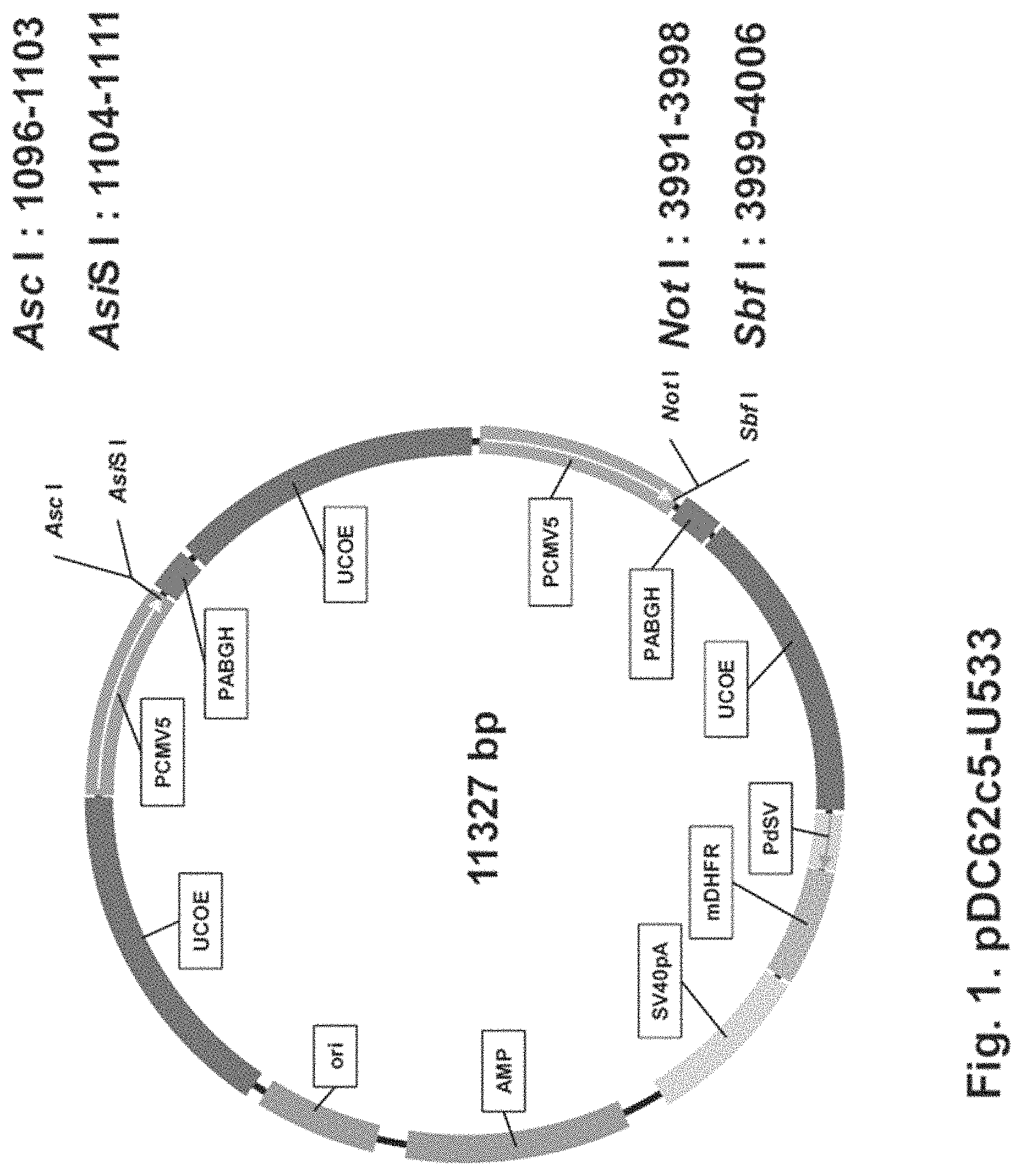
This figure shows pDC62c5-U533 construct. PCMV5, or CMV5 promoter which is a fusion promoter of human cytomegalovirus promoter and adenovirus promoter (Nucleic Acid Research, 30, p. 2, 2002); PABGH, or a bovine growth hormone gene polyadenylation signal; UCOE, or a ubiquitously acting chromatin opening element; PdSV, or an enhancer-deleted simian virus 40 promoter; mDHFR, or a translation-impaired dihydrofolate reductase gene; SV40 pA, or a simian virus 40 polyadenylation signal; AMP, or a selection marker in E. coli (β-lactamase gene); ori, or a pUC plasmid-derived origin of replication. AscI, AsiSI, NotI and SbfI each represent a restriction enzyme cleavage site.
This figure shows pDC62c5-U533-OMLH construct. PCMV5, or CMV5 promoter which is a fusion promoter of human cytomegalovirus promoter and adenovirus promoter (Nucleic Acid Research, 30, p. 2, 2002); IgL-OM, or Omalizumab light chain cDNA; PABGH, or a bovine growth hormone gene polyadenylation signal; UCOE, or a ubiquitously acting chromatin opening element; IgH-OM, or Omalizumab heavy chain cDNA; PdSV, or an enhancer-deleted simian virus 40 promoter; mDHFR, or a translation-impaired dihydrofolate reductase gene; SV40 pA, or a simian virus 40 polyadenylation signal; AMP, or a selection marker in E. coli (β-lactamase gene); ori, or a pUC plasmid-derived origin of replication. AscI, AsiSI, NotI and SbfI each represent a restriction enzyme cleavage site.
This figure shows pDC61-OMLH construct. PCMV, or a human cytomegalovirus promoter (Nucleic Acid Research, 30, p. 2, 2002); INRBG, or a rabbit β-globin gene intron sequence; IgL-OM, or Omalizumab light chain cDNA; PABGH, or a bovine growth hormone gene polyadenylation signal; IgH-OM, or Omalizumab heavy chain cDNA; PdSV, or an enhancer-deleted simian virus 40 promoter; mDHFR, or a translation-impaired dihydrofolate reductase gene; SV40 pA, or a simian virus 40 polyadenylation signal; AMP, or a selection marker in E. coli (β-lactamase gene); ori, or a pUC plasmid-derived origin of replication. AscI, AsiSI, NotI and SbfI each represent a restriction enzyme cleavage site.
This figure shows pNC32c-U533-OMLH construct. PCMV, or a human cytomegalovirus promoter (Nucleic Acid Research, 30, p. 2, 2002); IgL-OM, or Omalizumab light chain cDNA; SV40 pA, or a simian virus 40 polyadenylation signal; UCOE, or a ubiquitously acting chromatin opening element; IgH-OM, or Omalizumab heavy chain cDNA; PSV40, or a simian virus 40 promoter; NTP, or a neomycin phosphotransferase gene; SV40 pA, or a simian virus 40 polyadenylation signal; AMP, or a selection marker in E. coli (β-lactamase gene); ori, or a pUC plasmid-derived origin of replication. AscI, AsiSI, NotI and SbfI each represent a restriction enzyme cleavage site.
This figure shows pUCOE-Hu-P2-OMLH construct. UCOE, or a ubiquitously acting chromatin opening element; PgpCMV, or a guinea pig cytomegalovirus promoter (Nucleic Acid Research, 30, p. 2, 2002); IgL-OM, or Omalizumab light chain cDNA; SV40 pA, or a simian virus 40 polyadenylation signal; IgH-OM, or Omalizumab heavy chain cDNA; PPGK, or a mouse phosphoglycerate kinase promoter; PUR, or a puromycin N-acetyltransferase gene; PAC2, or a complement factor 2 gene polyadenylation signal; AMP, or a selection marker in E. coli (β-lactamase gene); ori, or a pUC plasmid-derived origin of replication. AscI, AsiSI, NotI and SbfI each represent a restriction enzyme cleavage site.
This figure shows distribution of the expression level of an antibody produced by CHO cells transfected with pDC62c5-U533-OMLH (expression vector of the present invention), pDC61-OMLH (conventional vector), pNC32c-U533-OMLH (control vector) or pUCOE-Hu-P2/OMLH (vector manufactured by Millipore) (data obtained by 3-day culture).
This figure shows changes in the level of an antibody produced by CHO cells transfected with pDC62c5-U533-OMLH (expression vector of the present invention) or pDC61-OMLH (conventional vector) (over 1 to 12 weeks from the start of culture).
This figure shows pDC62c5-U533 construct that has only one site for foreign gene insertion. PCMV5, or CMV5 promoter which is a fusion promoter of human cytomegalovirus promoter and adenovirus promoter (Nucleic Acid Research, 30, p. 2, 2002); PABGH, or a bovine growth hormone gene polyadenylation signal; UCOE, or a ubiquitously acting chromatin opening element; PdSV, or an enhancer-deleted simian virus 40 promoter; mDHFR, or a translation-impaired dihydrofolate reductase gene; SV40 pA, or a simian virus 40 polyadenylation signal; AMP, or a selection marker in E. coli (β-lactamase gene); ori, or a pUC plasmid-derived origin of replication. AscI, AsiSI and ClaI each represent a restriction enzyme cleavage site.
Expression of canine CTLA-4-Ig by a high expression CHO cell line established with pDC62c5-U533 vector. Canine CTLA-4-Ig expression and viable cell count are shown for each of the indicated days during 14-day culture.
SDS-PAGE images of canine CTLA-4-Ig purified from culture supernatant. Canine CTLA-4-Ig was electrophoresed under reducing and non-reducing conditions, and visualized by CBB staining. A single band was observed at around 45 kDa under reducing conditions and at around 90 kDa under non-reducing conditions. The detection of contamination bands was almost zero.
This figure shows pDC62c5-U533-TRLH construct.
This figure shows distribution of the expression level of an antibody produced by CHO cells transfected with pDC62c5-U533-TRLH (expression vector of the present invention) (data obtained by 3-day culture).
This figure shows changes in the level of an antibody produced by CHO cells transfected with pDC62c5-U533-TRLH (expression vector of the present invention) (for 0 to 10 weeks from the start of culture in productivity test).
This figure shows levels of an antibody as produced by cell strains obtained by culturing each of those clones in the presence of 60 nM MTX which had been obtained from the plates seeded with CHO cells (Clone01-10) transfected with pDC62c5-U533-OMLH (expression vector of the present invention) (data obtained by 3-day culture).
BEST MODES FOR CARRYING OUT THE INVENTION
The present inventors altered the codons of the DHFR gene to those which would be least frequently used in mammals so as to extremely attenuate the expressabililty of DHFR, whereby even transformants were rendered difficult to survive under selection in HT-free media unless the plasmid gene to be incorporated was introduced into a position with extremely high expressability on the chromosome of dihydrofolate reductase gene-deficient host cells. Further, the present inventors introduced a ubiquitously acting chromatin opening element (UCOE) into the plasmid gene, whereby the production level of a protein of interest in the resultant transformant was increased while at the same time, the stability of its expression was enhanced.
Specifically, the present invention provides expression vectors for inducing high-level production of genetically recombined proteins in mammalian host cells.
The expression vector of the present invention is constructed by comprising the following (a), (b) and (c) on a backbone vector:
(a) a translation-impaired dihydrofolate reductase gene cassette whose expression is weakened by altering codons to those which are least frequently used in mammals (a translation-impaired DHFR gene cassette);
(b) a gene cassette comprising a cloning site for integration of a foreign gene that is located between a promoter and a polyadenylation signal; and
(c) a ubiquitously acting chromatin opening element (UCOE).
In the present invention, a promoter as a component of a DHFR gene cassette (cistron) in which the codons of the DHFR gene have been altered to those which are least frequently used in mammals to lower the ability to induce the expression of DHFR is used so that the mechanism of DHFR expression in the host cell transformed through gene transfer is considerably impaired. As used herein, the term “gene cassette” refers to a unit for expressing a protein through transcription/translation that comprises a promoter, a structural gene, and a polyadenylation signal (polyA) as the basic components, and DNA sequences that are either associated with any of these components or of any other types may also be included as insertion sequences. The DHFR gene cassettes of the present invention are defined as “translation-impaired DHFR gene cassette” because unlike those in which the promoter is simply attenuated, they allow for specific acquisition of strains that can grow in HT-free media and which have the plasmid gene introduced into a transcriptional hot spot.
In the present invention, “the codons which are least frequently used in mammals” refers to preferably, for example, the codons which are least frequently used in humans. The codons which are least frequently used in humans include the codons disclosed in Kim et al. (Gene, 199, p. 293, 1997). Specific examples of such codons are GCA for alanine, CGA for arginine, AAU for asparagine, GAU for aspartic acid, UGU for cysteine, CAA for glutamine, GAA for glutamic acid, GGU for glycine, CAU for histidine, UUA for leucine, AAA for lysine, CCA for proline, UUU for phenylalanine, UCA for serine, ACU for threonine, UAU for tyrosine, and/or GUA for valine, to which the codon candidates are by no means limited.
In the present invention, “expression is weakened” if gene expression has been weakened at the transcription and/or translation stage, and specifically, this can be achieved by altering the codons to the above-described “codons which are least frequently used in mammals”.
In the above-described “translation-impaired DHFR gene cassette”, the region with altered codons is not particularly limited. Preferably, codons in a region corresponding to 30% or more (for example, 40% or more, 50% or more, 60% or more, 70% or more, 80% or more, 90% or more, 95% or more, or 100%) of the full length of the gene cassette are altered. The range of the codon-altered region may be determined arbitrarily by considering other conditions of the vector.
As the promoter in the above-described “translation-impaired DHFR gene cassette”, those which are derived from the promoter of a protein gene that is usually difficult to be expressed in mammalian cells (e.g., promoter derived from a gene of non-mammalian cells) or a normal promoter from which the enhancer has been deleted may be used. More specifically, the SV40 virus antigen promoter from which the enhancer region has been removed (Mol. Cell Biol., 6, p. 2593, 1986) or promoters that are comparably very low in the ability to express are preferably used.
Integration of plasmid DNA into a transcriptional hot spot on the dihydrofolate reductase gene-deficient host cell chromosome can be eventually accomplished by selection in HT-free media according to the properties of the DHFR gene cassette, but expression per se of the foreign gene-derived protein at the transcriptional hot spot on the chromosome need be strongly induced. To this end, the promoter and polyadenylation signal (hereinafter, called polyA) in the cloning site (hereinafter, referred to as CS) where the protein gene is to be integrated may be selected from those having the strongest ability to induce expression. Examples of the promoters include, but are not limited to, human cytomegalovirus immediate early (hCMV MIE: Cell, 41, p. 521, 1985) promoter, CMV5 promoter which is a fusion promoter of human cytomegalovirus promoter and adenovirus promoter (Nucleic Acid Research, 30, p. 2, 2002), and β-actin promoter (Proc. Natl. Acad. Sci. USA, 84, p. 4831, 1987); and examples of polyA include, but are not limited to, bovine growth hormone-derived polyA sequence (DNA, 5, p. 115, 1986). The cloning site is composed of restriction enzyme cleavage sites. Examples of restriction enzyme cleavage site include, but are not limited to, Asc I, AsiS I, Acc65I, BamHI, BclI, BsaI, BsiWI, BstBI, BstEI, Bsu36I, DraIII, EagI, FseI, KpnI, MboI, Nhe I, Not I, PacI, RsrII, SalI, Sbf I, SexAI, SgfI and XcmI. Herein, a DNA fragment carrying this cloning site for integrating the protein gene of interest is called a “gene expression cassette”.
UCOE is a DNA element present in close proximity to ubiquitously highly expressed genes; UCOE has such an ability that by creating an open chromatin environment, the likelihood that a gene introduced in the vicinity is transcribed into messenger RNA is maximized to eventually maximize the amount in which the protein encoded by the introduced gene is expressed. Furthermore, UCOE has anti-silencing activity based on its ability to inhibit methylation of the DNA in promoter region, so that it inhibits lowered transcriptional activity of the introduced gene due to long term subculture, which eventually inhibits a decrease in the amount of expression of the protein encoded by the introduced gene. Consequently, one may expect that by introducing UCOE into the expression vector of the present invention, the production level of a protein of interest in the resultant transformant will be increased while at the same time, the stability of its expression will be enhanced.
The nucleotide sequence of UCOE introduced into the expression vector in an Example described later is shown in SEQ ID NO: 1. The nucleotide sequence shown in SEQ ID NO: 1 may have mutations, e.g. substitution, deletion or insertion of nucleotides, introduced thereinto as long as the object of the present invention is achieved. The number of UCOEs to be introduced into the expression vector may be one or more. UCOEs may be suitably introduced in such positions that the gene cassette to be expressed is sandwiched therebetween.
The expression vector of the present invention may carry a selection marker which is either a drug resistance gene (e.g., ampicillin resistance gene, kanamycin resistance gene, chloramphenicol resistance gene, etc.) or an origin of replication (e.g., pUC-derived origin of replication, ColE1-derived origin of replication, p15A-derived origin of replication, pSC101-derived origin of replication, etc.).
The expression vectors of the present invention are exemplified by the expression vector specifically described in Examples (pDC62c5-U533), to which they are by no means limited.
Furthermore, the present invention provides a method for producing transformants that produce foreign gene-derived proteins, which comprises integrating a foreign gene into the above-described expression vector and transforming dihydrofolate reductase gene-deficient host cells using the expression vector. The transformants may have an ability to produce foreign gene-derived proteins at high levels and an ability to grow in HT-free media.
To describe a specific method that may be employed, a foreign gene encoding a protein to be expressed is integrated into the cloning site (hereinafter, referred to as CS) of an expression vector of the present invention; then, dihydrofolate reductase gene-deficient host cells are transformed with the expression vector by making use of a transfection method (examples of the transfection method referred to herein include methods well known to those skilled in the art such as lipofectin method, electroporation, calcium phosphate method, and microinjection); and then transformants are selected by resistance in HT-free media to thereby obtain those transformants which have high productivity for the protein of interest. For example, when pDC62c5-U533 is used, a foreign gene cDNA may be inserted between Asc I and Sfb I. When the foreign gene is an antibody gene, antibody light chain cDNA may be inserted between Asc I and AsiS I, and antibody heavy chain cDNA between Not I and Sbf I, of pDC62c5-U533. In pDC62c5-U533, Asc I and AsiS I, as well as Not I and Sbf I provide cloning sites. Consider, for example, the case of pDC62c5-U533 that has only one site for insertion of a foreign gene; a foreign gene cDNA may be inserted between Asc I and AsiS I. In pDC62c5-U533 which has only one site for insertion of a foreign gene, Asc I and AsiS I provide a cloning site. Kozak is preferably added to a foreign gene before it is integrated into the expression vector of the present invention. Kozak is preferably optimized, with the sequence of the optimized Kozak being shown in SEQ ID NO: 2. Kozak may be suitably added upstream of the initiation codon of the foreign gene cDNA.
The present invention also provides a foreign gene expression vector which has a foreign gene integrated into the expression vector of the present invention.
In the present invention, host cells are not particularly limited as long as they are cells suitable for expressing foreign gene-derived proteins. Preferably, dihydrofolate reductase gene-deficient mammalian cells, and more preferably, dihydrofolate reductase gene-deficient Chinese hamster ovary cells (CHO cells) may be enumerated.
Many of the transformed cells surviving the selection in an HT-free medium have already achieved a relatively high level of protein expression, but to select from these cells such transformants that have an even higher level of production ability, the level of protein expression may be measured.
The present invention also provides a host cell transformed with the foreign gene expression vector of the present invention.
Furthermore, the present invention provides a method for producing a foreign gene-derived protein, which comprises the following (a) to (d):
(a) integrating a foreign gene into an expression vector of the present invention;
(b) transforming a dihydrofolate reductase gene-deficient host cell with the expression vector;
(c) culturing the resultant transformant in an HT-free medium; and
(d) collecting the foreign gene-derived protein from the cultured transformant.
In (c) above of the present invention, transformants (colonies) showing highly efficient protein expression can be selected by culturing in an HT-free medium. The selected transformants may be continuously cultured in the same medium, or they may be cultured after being transferred to another medium such as a medium for large-scale expression.
In the present invention, media for culturing or adapting transformants are not particularly limited, but they are preferably exemplified by a serum-free medium, more preferably a CD medium which may optionally be supplemented with non-animal-based additives (e.g., salts, amino acids, saccharides, vitamins, recombinant insulin, recombinant transferrin, etc.)
When collecting foreign gene-derived proteins from transformants that have been cultured in the present invention, the proteins may be purified by methods known to those skilled in the art (filtration, centrifugation, column purification, and so forth). It is also possible to express the foreign gene-derived proteins as fusion proteins with other proteins for such purposes as facilitating purification.
Furthermore, the present invention provides a method of screening for transformants that produce a foreign gene-derived protein, which comprises the following (a) to (c):
(a) integrating a foreign gene into an expression vector of the present invention;
(b) transforming a dihydrofolate reductase gene-deficient host cell with the expression vector; and
(c) culturing the resultant transformant in an HT-free medium.
All prior art documents cited herein are incorporated herein by reference.
EXAMPLE
Hereinbelow, Examples of the present invention will be described.
[Example 1] Preparation of pDC62c5-U533
A backbone vector pDC6 (Japanese Patent No. 5704753) was modified to construct pDC62c5-U533, a vector of the present invention. The entire nucleotide sequence of the backbone vector pDC62c5-U533 is shown in SEQ ID NO: 3. The vector pDC62c5-U533 carries a translation-impaired DHFR gene introduced in the region of 6067-6630, with the DHFR nucleotide sequence being such that codons in the range of 180 nucleotides from the 5′ end have been altered to those which are least frequently used in mammals ( ). Further, a UCOE has been introduced in the regions of 1339-2889, 4234-5784 and 9771-11321. The nucleotide sequence of UCOE is shown in SEQ ID NO: 1.
[Example 2] Preparation of pDC62c5-U533-OMLH
The nucleotide sequences No. 1098 to No. 1108 of pDC62c5-U533 were substituted with a cDNA encoding the light chain of a human omalizumab (OMLH) (having an optimized Kozak added upstream of the initiation codon) as shown in SEQ ID NO: 4, and, further, the nucleotide sequences No. 3993 to No. 4004 of pDC62c5-U533 were substituted with a cDNA encoding the heavy chain of the human omalizumab (OMLH) (having an optimized Kozak added upstream of the initiation codon) as shown in SEQ ID NO: 5, whereby pDC62c5-U533-OMLH ( ) was constructed. The sequence of the optimized Kozak is shown in SEQ ID NO: 2.
Prior to gene transfer, the vector was linearized with a restriction enzyme ClaI.
[Example 3] Transfection of pDC62c5-U533-OMLH into CHO Cells, Selection, Productivity Test and Expression Stability Test
18 μg of pDC62c5-U533-OMLH was transfected into 15,000,000 CHO cells (CHO DG44 cells) in 125 ml culture flasks (Erlenmeyer Flask, Baffled, 125 ml, Vent Cap, cat #431405, Corning) using the Lipofectin method (with FreeStyle MAX Reagent, Life Technologies).
The method of transfection was in accordance with the manufacturer's instructions for use. Following 48 hours after transfection, the number of cells was counted, and then the cells were diluted with CD OptiCHO medium (Life Technologies) supplemented with 4 mM GlutaMAX-I (Life Technologies). In a 96-well microtiter plate, mixing with 12,000 cells/well of non-transfected cells was conducted at a concentration of 4,000 transfected cells/well. The mixed cells were then seeded in 10 plates (960 wells) and cultured in the presence of 8% carbon dioxide gas at 37° C. for approximately three weeks. From the viable cells, 35 HT-free medium resistant clones were randomly selected. In a fresh 96-well microtiter plate, mixing with 12,000 cells/well of non-transfected cells was conducted at a concentration of 16,000 transfected cells/well. The mixed cells were then seeded in 10 plates (960 wells) and cultured in the presence of 8% carbon dioxide gas at 37° C. for approximately three weeks. From the viable cells, 71 HT-free medium resistant clones were randomly selected to thereby obtain a total of 106 clones. The thus obtained HT-free medium resistant clones were transferred to a 24-well plate together with CD OptiCHO medium (Life Technologies) supplemented with 4 mM GlutaMAX-I (Life Technologies), and cultured until cells occupied ⅓ or more of the base area of each well. The cells grown in the 24-well plate were transferred to a 6-well plate together with CD OptiCHO medium (Life Technologies) supplemented with 4 mM GlutaMAX-I (Life Technologies), and cultured until cells occupied ⅓ or more of the base area of each well.
Each clone (1 ml) was placed in a sterile tube and centrifuged at 300×g for 7 min. The supernatant was discarded, and the cells were suspended in 0.55 ml of a fresh medium (CD OptiCHO medium (Life Technologies) supplemented with 4 mM GlutaMAX-I (Life Technologies)), and cell counting was done. After the cells were diluted with a medium to give a viable cell density of 2×10{circumflex over ( )}5 cells/ml, 0.4 ml of the dilution was transferred to a fresh 24-well plate and subjected to rotary shaking culture (125 rpm) in the presence of 8% carbon dioxide gas at 37° C. for 72 hrs. After culture, cell counting was done, followed by centrifugation at 9300×g for 2 min and collection of the supernatant. Subsequently, IgG concentration in the culture supernatant was measured by ELISA. As a result, the IgG yield from the clone of maximum productivity was 28.5 μg/ml/3 days, with 16 out of the 106 clones (15.1%) producing 10 μg/ml or more of IgG ( ).
Next, top 10 clones in terms of IgG yield were selected and subjected to an expression stability test. In the expression stability test, subculture was started from a frozen stock of each clone. In subculture, cells were diluted to give a density of 2×10{circumflex over ( )}5 cells/ml and subjected to rotary shaking culture for 3 to 4 days. The resultant cells were diluted again to give a density of 2×10{circumflex over ( )}5 cells/ml. These operations were carried out repeatedly. At days 0, 7, 14, 21, 28, 35, 42, 49, 56, 63, 72, 79 and 86 from the start of rotary shaking culture, cells were diluted to give a density of 2×10{circumflex over ( )}5 cells/ml and 0.4 ml of the dilution was subjected to rotary shaking culture (125 rpm) on a 24-well plate for 72 hrs. The supernatant was collected and measured for IgG yield by ELISA. IgG yields from the 10 clones were 28.5-13.0 mg/L at week 0 and 15.6-3.8 mg/L at week 12. As regards the expression stability of pDC62c5-U533-OMLH-transfected cells, 7 out of the 10 clones retained 70% or more of IgG production capacity until week 8 as relative to the value before preparation of the frozen stock; 2 clones retained 50% to less than 70% of IgG production capacity; and 1 clone retained less than 50% of IgG production capacity. At week 12, 2 clones retained 70% or more of IgG production capacity; 5 clones retained 50% to less than 70% of IgG production capacity; and 3 clones retained less than 50% of IgG production capacity ( ).
[Example 4] Preparation of pDC61
The nucleotide sequences No. 3182 to No. 5843 of pDC6 (Japanese Patent No. 5704753) were substituted with the sequence shown in SEQ ID NO: 7 to thereby construct pDC61. The entire nucleotide sequence of the backbone vector pDC61 is shown in SEQ ID NO: 6.
[Example 5] Preparation of pDC61/OMLH
The nucleotide sequences No. 1267 to No. 1273 of pDC61 were substituted with a cDNA encoding the light chain of a human omalizumab (OMLH) as shown in SEQ ID NO: 8 and the nucleotide sequences No. 2765 to No. 2771 of pDC61 were substituted with a cDNA encoding the heavy chain of the human omalizumab (OMLH) as shown in SEQ ID NO: 9, whereby pDC61/OMLH ( ) was constructed.
Prior to gene transfer, the vector was linearized with a restriction enzyme ClaI.
[Example 6] Transfection of pDC61/OMLH into CHO Cells, Selection, Productivity Test and Expression Stability Test
18 μg of pDC61/OMLH was transfected into 15,000,000 CHO cells (CHO DG44 cells) in 125 ml culture flasks (Erlenmeyer Flask, Baffled, 125 ml, Vent Cap, cat #431405, Corning) using the Lipofectin method (with FreeStyle MAX Reagent, Life Technologies). The method of transfection was in accordance with the manufacturer's instructions for use. Following 48 hours after transfection, the number of cells was counted, and then the cells were diluted with CD OptiCHO medium (Life Technologies) supplemented with 4 mM GlutaMAX-I (Life Technologies). In a 96-well microtiter plate, mixing with 12,000 cells/well of non-transfected cells was conducted at a concentration of 40,000 transfected cells/well. The mixed cells were then seeded in 10 plates (960 wells) and cultured in the presence of 8% carbon dioxide gas at 37° C. for approximately three weeks. From the viable cells, 118 HT-free medium resistant clones were randomly selected. The thus obtained HT-free medium resistant clones were transferred to a 24-well plate together with CD OptiCHO medium (Life Technologies) supplemented with 4 mM GlutaMAX-I (Life Technologies), and cultured until cells occupied ⅓ or more of the base area of each well. The cells grown in the 24-well plate were transferred to a 6-well plate together with CD OptiCHO medium (Life Technologies) supplemented with 4 mM GlutaMAX-I (Life Technologies), and cultured until cells occupied ⅓ or more of the base area of each well. Each clone (1 ml) was placed in a sterile tube and centrifuged at 300 xg for 7 min. The supernatant was discarded, and the cells were suspended in 0.55 ml of a fresh medium (CD OptiCHO medium (Life Technologies) supplemented with 4 mM GlutaMAX-I (Life Technologies)), and cell counting was done. After the cells were diluted with a medium to give a viable cell density of 2×10{circumflex over ( )}5 cells/ml, 0.4 ml of the dilution was transferred to a fresh 24-well plate and subjected to rotary shaking culture (125 rpm) in the presence of 8% carbon dioxide gas at 37° C. for 72 hrs. After culture, cell counting was done, followed by centrifugation at 9300×g for 2 min and collection of the supernatant. Subsequently, IgG concentration in the culture supernatant was measured by ELISA. As a result, the IgG yield from the clone of maximum productivity was 16.4 μg/ml/3 days, with 2 out of the 118 clones (1.7%) producing 10 μg/ml or more of IgG ( ).
Next, top 10 clones in terms of IgG yield were selected and subjected to an expression stability test. In the expression stability test, subculture was started from a frozen stock of each clone. In subculture, cells were diluted to give a density of 2×10{circumflex over ( )}5 cells/ml and subjected to rotary shaking culture for 3 to 4 days. The resultant cells were diluted to give a density of 2×10{circumflex over ( )}5 cells/ml again. These operations were carried out repeatedly. At days 0, 7, 14, 21, 28, 35, 42, 49, 56, 63, 72, 79 and 86 from the start of rotary shaking culture, cells were diluted to give a density of 2×10{circumflex over ( )}5 cells/ml and 0.4 ml of the dilution was subjected to rotary shaking culture (125 rpm) on a 24-well plate for 72 hrs. The supernatant was collected and measured for IgG yield by ELISA. The IgG yields of the 10 clones were 16.4-3.1 mg/L at week 0 and 6.3-0.1 mg/L at week 12. As regards the expression stability of pDC61/OMLH-transfected cells, 3 out of the 10 clones retained 70% or more of IgG production capacity until week 8 as relative to the value before preparation of the frozen stock; 2 clones retained 50% to less than 70% of IgG production capacity; and 5 clones retained less than 50% of IgG production capacity. At week 12, no clones retained 70% or more of IgG production capacity; 5 clones retained 50% to less than 70% of IgG production capacity; and 5 clones retained less than 50% of IgG production capacity.
[Example 7] Preparation of pNC32c-U533
The backbone vector pDC61 (prepared in Example 4) was modified to construct pNC32c-U533, a vector of the present invention. The entire nucleotide sequence of the backbone vector pNC32c-U533 is shown in SEQ ID NO: 10. The vector pNC32c-U533 has a neomycin phosphotransferase gene introduced in the region of nucleotide sequences No. 5196 to No. 5990. It also has a UCOE introduced in the region of nucleotide sequences No. 867 to No. 2417, the region of No. 3291 to No. 4841 and the region of No. 9130 to No. 10680. The nucleotide sequence of UCOE is shown in SEQ ID NO: 1.
[Example 8] Preparation of pNC32c-U533-OMLH
The nucleotide sequences No. 658 to No. 668 of pNC32c-U533 were substituted with a cDNA encoding the light chain of a human omalizumab (OMLH) as shown in SEQ ID NO: 11 and the nucleotide sequences No. 3081 to No. 3092 of pNC32c-U533 were substituted with a cDNA encoding the heavy chain of the human omalizumab (OMLH) as shown in SEQ ID NO: 12, whereby pNC32c-U533-OMLH ( ) was constructed.
Prior to gene transfer, the vector was linearized with a restriction enzyme ClaI.
[Example 9] Transfection of pNC32c-U533-OMLH into CHO Cells, Selection and Productivity Test
18 μg of pNC32c-U533-OMLH was transfected into 15,000,000 CHO cells (CHO DG44 cells) in 125 ml culture flasks (Erlenmeyer Flask, Baffled, 125 ml, Vent Cap, cat #431405, Corning) using the Lipofectin method (with FreeStyle MAX Reagent, Life Technologies). The method of transfection was in accordance with the manufacturer's instructions for use. Following 48 hours after transfection, the number of cells was counted, and then the cells were diluted with CD OptiCHO medium (Life Technologies) supplemented with 4 mM GlutaMAX-I (Life Technologies), 400 μg/ml G418 sulfate (Wako) and 1×HT Supplement (Life Technologies). In a 96-well microtiter plate, mixing with 12,000 cells/well of non-transfected cells was conducted at a concentration of 800 transfected cells/well. The mixed cells were then seeded in 10 plates (960 wells) and cultured in the presence of 8% carbon dioxide gas at 37° C. for approximately three weeks. From the viable cells, 108 clones with G418 resistance were randomly selected. The thus obtained G418 resistant clones were transferred to a 24-well plate together with CD OptiCHO medium (Life Technologies) supplemented with 4 mM GlutaMAX-I (Life Technologies), 400 μg/ml G418 sulfate (Wako) and 1×HT Supplement (Life Technologies), and cultured until cells occupied ⅓ or more of the base area of each well. The cells grown in the 24-well plate were transferred to a 6-well plate together with CD OptiCHO medium (Life Technologies) supplemented with 4 mM GlutaMAX-I (Life Technologies), 400 μg/ml G418 sulfate (Wako) and 1×HT Supplement (Life Technologies), and cultured until cells occupied ⅓ or more of the base area of each well. Each clone (1 ml) was placed in a sterile tube and centrifuged at 300×g for 7 min. The supernatant was discarded, and the cells were suspended in 0.55 ml of a fresh medium (CD OptiCHO medium (Life Technologies) supplemented with 4 mM GlutaMAX-I (Life Technologies), 400 μg/ml G418 sulfate (Wako) and 1×HT Supplement (Life Technologies)), and cell counting was done. After the cells were diluted with a medium to give a viable cell density of 2×10{circumflex over ( )}5 cells/ml, 0.4 ml of the dilution was transferred to a fresh 24-well plate and subjected to rotary shaking culture (125 rpm) in the presence of 8% carbon dioxide gas at 37° C. for 72 hrs.
After culture, cell counting was done, followed by centrifugation at 9300×g for 2 min and collection of the supernatant. Subsequently, IgG concentration in the culture supernatant was measured by ELISA. As a result, the IgG yield from the clone of maximum productivity was 2.6 μg/ml/3 days, with 0 out of 105 clones producing 10 μg/ml or more of IgG.
[Example 10] Preparation of UCOE-Hu-P2/OMLH
The nucleotide sequences No. 5309 to No. 5311 of a commercially available vector UCOE® Expression Vector—Human 4 kb Puro Set (Merck, cat #5.04867.0001) were substituted with the sequence shown in SEQ ID NO: 13, whereby a recognition site for restriction enzyme BstBI was created (UCOE-Hu-P2).
Using FseI recognition site and BstBI recognition site on UCOE-Hu-P2, the sequence shown in SEQ ID NO: 14 comprising a cDNA encoding human omalizumab light chain (OML) as linked to a simian virus 40 polyadenylation signal (SV40 pA), a guinea pig cytomegalovirus promoter (PgpCMV) and a cDNA encoding human omalizumab heavy chain (OMR) was inserted into UCOE-Hu-P2 to thereby construct UCOE-Hu-P2/OMLH ( ).
Prior to gene transfer, the vector was linearized with restriction enzyme HindIII.
[Example 11] Transfection of UCOE-Hu-P2/OMLH into CHO Cells, Selection and Productivity Test
18 μg of UCOE-Hu-P2/OMLH was transfected into 15,000,000 CHO cells (CHO DG44 cells) in 125 ml culture flasks (Erlenmeyer Flask, Baffled, 125 ml, Vent Cap, cat #431405, Corning) using the Lipofectin method (with FreeStyle MAX Reagent, Life Technologies). The method of transfection was in accordance with the manufacturer's instructions for use. Following 48 hours after transfection, the number of cells was counted, and then the cells were diluted with CD OptiCHO medium (Life Technologies) supplemented with 4 mM GlutaMAX-I (Life Technologies), 100 μg/ml puromycin dihydrochloride (Thermo Fisher Scientific) and 1×HT Supplement (Life Technologies).
In a 96-well microtiter plate, mixing with 12,000 cells/well of non-transfected cells was conducted at a concentration of 4,000 transfected cells/well. The mixed cells were then seeded in 10 plates (960 wells) and cultured in the presence of 8% carbon dioxide gas at 37° C. for approximately three weeks. From the viable cells, 33 puromycin resistant clones were randomly selected. In a 96-well microtiter plate, mixing with 12,000 cells/well of non-transfected cells was conducted at a concentration of 16,000 transfected cells/well. The mixed cells were then seeded in 10 plates (960 wells) and cultured in the presence of 8% carbon dioxide gas at 37° C. for approximately three weeks. From the viable cells, 84 puromycin resistant clones were randomly selected to thereby obtain a total of 117 clones. The thus obtained puromycin resistant clones were transferred to a 24-well plate together with CD OptiCHO medium (Life Technologies) supplemented with 4 mM GlutaMAX-I (Life Technologies), 100 μg/ml puromycin dihydrochloride (Thermo Fisher Scientific) and 1×HT Supplement (Life Technologies), and cultured until cells occupied ⅓ or more of the base area of each well. The cells grown in the 24-well plate were transferred to a 6-well plate together with CD OptiCHO medium (Life Technologies) supplemented with 4 mM GlutaMAX-I (Life Technologies), 100 μg/ml puromycin dihydrochloride (Thermo Fisher Scientific) and 1×HT Supplement (Life Technologies), and cultured until cells occupied ⅓ or more of the base area of each well. Each clone (1 ml) was placed in a sterile tube and centrifuged at 300×g for 7 min. The supernatant was discarded, and the cells were suspended in 0.55 ml of a fresh medium (CD OptiCHO medium (Life Technologies) supplemented with 4 mM GlutaMAX-I (Life Technologies), 100 μg/ml puromycin dihydrochloride (Thermo Fisher Scientific) and 1×HT Supplement (Life Technologies)), and cell counting was done. After the cells were diluted with a medium to give a viable cell density of 2×10{circumflex over ( )}5 cells/ml, 0.4 ml of the dilution was transferred to a fresh 24-well plate and subjected to rotary shaking culture (125 rpm) in the presence of 8% carbon dioxide gas at 37° C. for 72 hrs. After culture, cell counting was done, followed by centrifugation at 9300×g for 2 min and collection of the supernatant. Subsequently, IgG concentration in the culture supernatant was measured by ELISA. As a result, the IgG yield from the clone of maximum productivity was 4.7 μg/ml/3 days, with 0 out of the 117 clones producing 10 μg/ml or more of IgG.
[Example 12] Expression of Canine CTLA-4-Ig Using pDC62c5-U533
A vector pDC62c5-U533 having only one site for foreign gene insertion (between AscI and AsisSI) was prepared by a method well known to those skilled in the art. Briefly, the region of the nucleotide sequences No. 2896 to No. 5784 (nucleotide sequences encoding PCMV5, PABGH and UCOE) was deleted from the pDC62c5-U533 prepared in Example 1.
Gene sequences for canine CTLA-4 and canine IgG-D have already been registered at The National Center for Biotechnology Information (NCBI) (GenBank accession numbers; NM_001003106.1 and AF354267.1). An amino acid sequence having a putative extracellular region of canine CTLA-4 connected to the hinge as well as CH2 and CH3 regions of canine IgG-D was prepared and codon optimization for CHO cells was performed [SEQ ID NO: 15 (amino acid sequence) and SEQ ID NO: 16 (nucleotide sequence after codon optimization)]. Subsequently, gene synthesis was performed in such a manner that AscI restriction enzyme recognition sequence, Kozak sequence, canine CTLA-4-Ig sequence, and AsiSI restriction enzyme recognition sequence would be located in this order. Using restriction enzyme recognition sites, the synthesized genetic strand was integrated into the pDC62c5-U533 having only one site for foreign gene insertion (SEQ ID NO: 17; ) at the cloning site (nucleotide sequences No. 1098 to No. 1108; AscI and AsiSI restriction enzyme recognition sequences between PRCMV5 and PABGH) in such a manner that the above-described sequences would be located in the above-described order, whereby a canine CTLA-4-Ig expression vector was constructed. This expression vector was linearized with restriction enzyme ClaI and then used to transfect CHO DG44 cells (CHO-DG44 (dhfr−/−)) (dihydrofolate reductase gene deficient cells) using Lipofectamine LTX (Thermo Fisher Scientific). Following 48 hours after transfection, the medium was exchanged with thymidine- and hypoxanthine-free Opti-CHO medium (Life Technologies) supplemented with 4 mM GlutaMAX-I (Life Technologies) for selection of transformants. As a result, stably expressing clones were obtained. Further, cloning of cells was performed by limiting dilution method and clones of high expression yield were selected by dot blotting and 3-day shaking culture test. The established CHO-DG44 cell clones capable of high-yield expression of canine CTLA-4-Ig were adapted to Dynamis medium (Life Technologies) supplemented with 4 mM GlutaMAX-I (Life Technologies) and cultured under shaking (125 rpm, 37° C., 8% CO 2 ) at a density of 5×10{circumflex over ( )}5 cells/ml, with a liquid volume of 30 ml, in 125 ml culture flasks (Corning) for 14 days. At days 3, 5, 7 and 10 of culture, EfficientFeed B+(Life Technologies) tripled in concentration was added to the medium at 3.3% v/v. Further, at days 3, 5 and 7 of culture, 45% glucose in solution (Kanto Chemical Co., Inc.) was added to the medium to give final concentrations of 4, 4 and 6 g/L, respectively. As a result, approximately 300 mg/L of canine CTLA-4-Ig recombinant protein was expressed in the culture supernatant at day 14 ( ). The concentration of canine CTLA-4-Ig in the culture supernatant was quantified by sandwich ELISA using a goat anti-canine IgG1 polyclonal antibody (Bethyl Laboratories) and the number of viable cells were counted by trypan blue staining without including dead cells.
The canine CTLA-4-Ig produced was purified from the culture supernatant using Ab-Capcher ExTra (protein A mutant; ProteNova). For binding to resin, the open column method was used. As an equilibrating buffer and a washing buffer, phosphate-buffered physiological saline (PBS; pH 7.4) was used. As an elution buffer, 0.1 M Glycine-HCl was used. As a neutralization buffer, 1 M Tris-HCl was used. Using PD-MidiTrap G-25 (GE Healthcare), buffer replacement with PBS was performed. Purified canine CTLA-4-Ig was passed through a 0.2 μm filter and stored at 4° C. until use in subsequent experiments. Protein concentrations were quantified with Pierce BCA Protein Assay Kit (Thermo Fisher Scientific) and used in the subsequent experiments.
In order to check for the purity of the purified canine CTLA-4-Ig, Ig proteins were detected by SDS-PAGE and CBB staining. Using SuperSep Ace 5-20% gradient gel (Wako), the canine CTLA-4-Ig was electrophoresed under both reducing and non-reducing conditions. After staining with Quick-CBB kit (Wako), decoloring was performed in distilled water. A band was observed at positions corresponding to molecular weights of around 45 kDa (under reducing conditions) and around 90 kDa (under non-reducing conditions.) The molecular weight of canine CTLA-4-Ig as calculated from its amino acid sequence was approx. 79 kDa for dimer and approx. 39.5 kDa for monomer. The emergence of bands at positions corresponding to the larger molecular weights was assumed to result from glycosylation and other effects. Bands of seemingly contaminant proteins were hardly visible ( ).
[Example 13] Preparation of pDC62c5-U533-TRLH
The nucleotide sequences No. 1098 to No. 1108 of pDC62c5-U533 were substituted with a cDNA encoding the light chain of a human trastuzumab (TRLH) (having an optimized Kozak added upstream of the initiation codon) as shown in SEQ ID NO: 18 and the nucleotide sequences No. 3993 to No. 4004 of pDC62c5-U533 were substituted with a cDNA encoding the heavy chain of the human trastuzumab (TRLH) (having the optimized Kozak added upstream of the initiation codon) as shown in SEQ ID NO: 19, whereby pDC62c5-U533-TRLH ( ) was constructed. The sequence of the optimized Kozak is shown in SEQ ID NO: 2.
Prior to gene transfer, the vector was linearized with a restriction enzyme ClaI.
[Example 14] Transfection of pDC62c5-U533-TRLH into CHO Cells, Selection, Productivity Test and Expression Stability Test
18 μg of pDC62c5-U533-TRLH was transfected into 15,000,000 CHO cells (CHO DG44 cells) in 125 ml culture flasks (Erlenmeyer Flask, Baffled, 125 ml, Vent Cap, cat #431405, Corning) using the Lipofectin method (with FreeStyle MAX Reagent, Life Technologies).
The method of transfection was in accordance with the manufacturer's instructions for use. Following 48 hours after transfection, the number of cells was counted, and then the cells were diluted with CD OptiCHO medium (Life Technologies) supplemented with 4 mM GlutaMAX-I (Life Technologies). In a 96-well microtiter plate, mixing with 12,000 cells/well of non-transfected cells was conducted at a concentration of 400 transfected cells/well. The mixed cells were then seeded in 12 plates (1152 wells) and cultured in the presence of 8% carbon dioxide gas at 37° C. for approximately three weeks. From the viable cells, 188 HT-free medium resistant clones were randomly selected. The thus obtained HT-free medium resistant clones were transferred to a 24-well plate together with CD OptiCHO medium (Life Technologies) supplemented with 4 mM GlutaMAX-I (Life Technologies), and cultured therein.
Each clone (0.6 ml) was placed in a sterile tube and centrifuged at 300×g for 7 min. The supernatant was discarded, and the cells were suspended in 0.3 ml of a fresh medium (CD OptiCHO medium (Life Technologies) supplemented with 4 mM GlutaMAX-I (Life Technologies)), and cell counting was done. After the cells were diluted with a medium to give a viable cell density of 2×10{circumflex over ( )}5 cells/ml, 0.4 ml of the dilution was transferred to a fresh 24-well plate and subjected to rotary shaking culture (125 rpm) in the presence of 8% carbon dioxide gas at 37° C. for 72 hrs. After culture, cell counting was done, followed by centrifugation at 9300×g for 2 min and collection of the supernatant.
Subsequently, IgG concentration in the culture supernatant was measured by ELISA. As a result, the IgG yield from the clone of maximum production was 47.8 μg/ml/3 days, with 81 out of the 188 clones (43.1%) producing 10 μg/ml or more of IgG ( ).
Next, top 10 clones in terms of IgG yield were selected and subjected to an expression stability test. In the expression stability test, subculture was started from a frozen stock of each clone. For adaptation culture, CD OptiCHO medium (Life Technologies) supplemented with 4 mM GlutaMAX-I (Life Technologies) and Dynamis medium (Life Technologies) supplemented with 4 mM GlutaMAX-I (Life Technologies) were used. As passaging progressed, the ratio of the latter medium was increased from 75:25 through 50:50 to 25:75, whereby the cells were adapted. After adaptation, an expression stability test was conducted. In subculture during the test period, cells were diluted using Dynamis medium (Life Technologies) supplemented with 4 mM GlutaMAX-I (Life Technologies) to give a density of 2 or 1.5×10{circumflex over ( )}5 cells/ml and thereafter subjected to rotary shaking culture for 3 to 4 days. The resultant cells were diluted again to give a density of 2 or 1.5×10{circumflex over ( )}5 cells/ml, and these operations were carried out repeatedly. At days 0, 7, 14, 21, 28, 35, 42, 49, 56, 63 and 70 from the start of test culture, cells were diluted to give a density of 2×10{circumflex over ( )}5 cells/ml and 0.4 ml of the dilution was subjected to rotary shaking culture (125 rpm) on a 24-well plate for 72 hrs. The culture supernatant was collected and measured for IgG yield therein by ELISA. IgG yields from the 10 clones were 50.9-16.5 mg/L at week 0 and 37.0-0.5 mg/L at week 10. As regards the expression stability of pDC62c5-U533-TRLH-transfected cells, 8 out of the 10 clones retained 70% or more of IgG production capacity until week 8 as relative to the production capacity before preparation of the frozen stock; 1 clone retained 50% to less than 70% of IgG production capacity; and 1 clone retained less than 50% of IgG production capacity. At week 10, 9 clones retained 70% or more of IgG production capacity; and 1 clone retained less than 50% of IgG production capacity ( ).
[Example 15] MTX Selection and Productivity Test of pDC62c5-U533-OMLH-Transfected CHO Cells
As for the top 10 clones in terms of IgG yield (Clone01-10) that were obtained in Example 3, subculture from the frozen stock of each clone was performed for 2 or 3 passages. Then, cells were diluted with CD OptiCHO medium (Life Technologies) supplemented with 4 mM GlutaMAX-I (Life Technologies) and 60 nM MTX (Wako). For each clone, mixing with 12,000 cells/well of non-transfected cells was conducted at densities of 1, 3, 10, 30, 100, 300, 1000, 3000 and 10000 transfected cells/well in a 96-well microtiter plate. The mixed cells were then seeded in 10 plates (960 wells) (2 plates for each density) and cultured in the presence of 8% carbon dioxide gas at 37° C. for 3 to 4 weeks. MTX resistant clones were randomly selected from the viable cells. The resultant clones were transferred to a 24-well plate and cultured until cells occupied more than ⅓ of the base area in each well. As regards the cells grown in the 24-well plate, 0.5 ml of each clone was placed in a sterile tube and centrifuged at 300×g for 7 min. The supernatant was discarded and the cells were suspended in 0.3 ml of a fresh medium (CD OptiCHO medium (Life Technologies) supplemented with 4 mM GlutaMAX-I (Life Technologies) and 60 nM MTX (Wako)), and cell counting was done. After the cells were diluted with a medium to give a viable cell density of 2×10{circumflex over ( )}5 cells/ml, 0.4 ml of the dilution was transferred to a fresh 24-well plate and subjected to rotary shaking culture (125 rpm) in the presence of 8% carbon dioxide gas at 37° C. for 72 hrs. After culture, cell counting was done, followed by centrifugation at 9300×g for 2 min and collection of the supernatant. Subsequently, IgG concentration in the culture supernatant was measured by ELISA ( ).
As regards Clone01, 18 clones were obtained from the plates seeded at densities of 1, 3 and 10 cells/well, following 29 to 32 days after seeding. The IgG yield from the clone of maximum production was 58.0 μg/ml/3 days, which was twice the value for the parent strain (28.5 μg/ml/3 days).
As regards Clone02, 24 clones were obtained from the plates seeded at densities of 1 and 3 cells/well, following 22 to 32 days after seeding. The IgG yield from the clone of maximum production was 105.5 μg/ml/3 days, which was 4.1 times the value for the parent strain (25.8 μg/ml/3 days).
As regards Clone03, 19 clones were obtained from the plates seeded at densities of 1 and 3 cells/well, following 22 to 32 days after seeding. The IgG yield from the clone of maximum production was 78.7 μg/ml/3 days, which was 3.4 times the value for the parent strain (23.0 μg/ml/3 days).
As regards Clone04, 33 clones were obtained from the plate seeded at a density of 1 cell/well, following 22 to 32 days after seeding. The IgG yield from the clone of maximum production was 83.7 μg/ml/3 days, which was 4.0 times the value for the parent strain (20.9 μg/ml/3 days).
As regards Clone05, 23 clones were obtained from the plates seeded at densities of 1 and 3 cells/well, following 27 to 39 days after seeding. The IgG yield from the clone of maximum production was 71.0 μg/ml/3 days, which was 3.7 times the value for the parent strain (19.2 μg/ml/3 days).
As regards Clone06, 16 clones were obtained from the plates seeded at densities of 3, 10 and 30 cells/well, following 26 to 39 days after seeding. The IgG yield from the clone of maximum production was 56.2 μg/ml/3 days, which was 3.0 times the value for the parent strain (18.4 μg/ml/3 days).
As regards Clone07, 8 clones were obtained from the plates seeded at densities of 3, 10 and 30 cells/well, following 29 to 39 days after seeding. The IgG yield from the clone of maximum production was 65.3 μg/ml/3 days, which was 3.8 times the value for the parent strain (17.1 μg/ml/3 days).
As regards Clone08, 24 clones were obtained from the plates seeded at densities of 100, 300 and 1000 cells/well, following 27 to 41 days after seeding. The IgG yield from the clone of maximum production was 47.9 μg/ml/3 days, which was 3.1 times the value for the parent strain (15.1 μg/ml/3 days).
As regards Clone09, 12 clones were obtained from the plates seeded at densities of 100, 1000, 3000 and 10000 cells/well, following 26 to 41 days after seeding. The IgG yield from the clone of maximum production was 21.9 μg/ml/3 days, which was 1.5 times the value for the parent strain (14.3 μg/ml/3 days).
As regards Clone10, 18 clones were obtained from the plates seeded at densities of 1, 3 and 10 cells/well, following 22 to 39 days after seeding. The IgG yield from the clone of maximum production was 131.4 μg/ml/3 days, which was 10.1 times the value for the parent strain (13.0 μg/ml/3 days).
All publications, patents and patent applications cited herein are incorporated herein by reference in their entirety.
INDUSTRIAL APPLICABILITY
According to the present invention, it is possible to provide expression vectors that enable production of foreign gene-derived proteins at high levels using dihydrofolate reductase gene deficient mammal cells as host. With the expression vector of the present invention, it is also possible to produce those proteins which have post-translational modifications inherent in mammals, as well as high biological activity. Therefore, it is possible to greatly reduce the production cost of proteinaceous useful substances such as biopharmaceuticals.
Furthermore, since the method of producing proteins by the present invention does not use virus or other microorganisms, highly safe protein production is possible.
SEQUENCE LISTING FREE TEXT
Nucleotide sequences of UCOE.
<SEQ ID NO: 1>
GGCCCTCCGCGCCTACAGCTCAAGCCACATCCGAAGGGGGAGGGAGCCGGGAGCTGCGCGCGGGGCCGCCGGGGGG
AGGGGTGGCACCGCCCACGCCGGGCGGCCACGAAGGGCGGGGCAGCGGGCGCGCGCGCGGCGGGGGGAGGGGCC
GGCGCCGCGCCCGCTGGGAATTGGGGCCCTAGGGGGAGGGCGGAGGCGCCGACGACCGCGGCACTTACCGTTCGCG
GCGTGGCGCCCGGTGGTCCCCAAGGGGAGGGAAGGGGGAGGCGGGGCGAGGACAGTGACCGGAGTCTCCTCAGCG
GTGGCTTTTCTGCTTGGCAGCCTCAGCGGCTGGCGCCAAAACCGGACTCCGCCCACTTCCTCGCCCGCCGGTGCGAG
GGTGTGGAATCCTCCAGACGCTGGGGGAGGGGGAGTTGGGAGCTTAAAAACTAGTACCCCTTTGGGACCACTTTCAG
CAGCGAACTCTCCTGTACACCAGGGGTCAGTTCCACAGACGCGGGCCAGGGGTGGGTCATTGCGGCGTGAACAATAA
TTTGACTAGAAGTTGATTCGGGTGTTTCCGGAAGGGGCCGAGTCAATCCGCCGAGTTGGGGCACGGAAAACAAAAAG
GGAAGGCTACTAAGATTTTTCTGGCGGGGGTTATCATTGGCGTAACTGCAGGGACCACCTCCCGGGTTGAGGGGGCT
GGATCTCCAGGCTGCGGATTAAGCCCCTCCCGTCGGCGTTAATTTCAAACTGCGCGACGTTTCTCACCTGCCTTCGCC
AAGGCAGGGGCCGGGACCCTATTCCAAGAGGTAGTAACTAGCAGGACTCTAGCCTTCCGCAATTCATTGAGCGCATTT
ACGGAAGTAACGTCGGGTACTGTCTCTGGCCGCAAGGGTGGGAGGAGTACGCATTTGGCGTAAGGTGGGGCGTAGAG
CCTTCCCGCCATTGGCGGCGGATAGGGCGTTTACGCGACGGCCTGACGTAGCGGAAGACGCCTTAGTGGGGGGGAAG
GTTCTAGAAAAGCGGCGGCAGCGGCTCTAGCGGCAGTAGCAGCAGCGCCGGGTCCCGTGCGGAGGTGCTCCTCGCA
GAGTTGTTTCTCCAGCAGCGGCAGTTCTCACTACAGCGCCAGGACGAGTCCGGTTCGTGTTCGTCCGCGGAGATCTCT
CTCATCTCGCTCGGCTGCGGGAAATCGGGCTGAAGCGACTGAGTCCGCGATGGAGGTAACGGGTTTGAAATCAATGA
GTTATTGAAAAGGGCATGGCGAGGCCGTTGGCGCCTCAGTGGAAGTCGGCCAGCCGCCTCCGTGGGAGAGAGGCAG
GAAATCGGACCAATTCAGTAGCAGTGGGGCTTAAGGTTTATGAACGGGGTCTTGAGCGGAGGCCTGAGCGTACAAAC
AGCTTCCCCACCCTCAGCCTCCCGGCGCCATTTCCCTTCACTGGGGGTGGGGGATGGGGAGCTTTCACATGGCGGAC
GCTGCCCCGCTGGGGTGAAAGTGGGGCGCGGAGGCGGGACTTCTTATTCCCTTTCTAAAGCACGCTGCTTCGGGGGC
CACGGCGTCTCCTCGGA
This sequence shows an optimized Kozak sequence. In this sequence, ATG is
the initiation codon.
<SEQ ID NO: 2>
CCGCCGCCACCATGG
Entire sequence of pDC62c5-U533.
<SEQ ID NO: 3>
CGATGTACGGGCCAGATATACGCGTTGACATTGATTATTGACTAGTCGCGTTACATAACTTACGGTAAATGGCCCGCCT
GGCTGACCGCCCAACGACCCCCGCCCATTGACGTCAATAATGACGTATGTTCCCATAGTAACGCCAATAGGGACTTTC
CATTGACGTCAATGGGTGGAGTATTTACGGTAAACTGCCCACTTGGCAGTACATCAAGTGTATCATATGCCAAGTCCGC
CCCCTATTGACGTCAATGACGGTAAATGGCCCGCCTGGCATTATGCCCAGTACATGACCTTACGGGACTTTCCTACTTG
GCAGTACATCTACGTATTAGTCATCGCTATTACCATGGTGATGCGGTTTTGGCAGTACACCAATGGGCGTGGATAGCGG
TTTGACTCACGGGGATTTCCAAGTCTCCACCCCATTGACGTCAATGGGAGTTTGTTTTGGCACCAAAATCAACGGGAC
TTTCCAAAATGTCGTAATAACCCCGCCCCGTTGACGCAAATGGGCGGTAGGCGTGTACGGTGGGAGGTCTATATAAGC
AGAGCTCGTTTAGTGAACCGTCAGATCCTCACTCTCTTCCGCATCGCTGTCTGCGAGGGCCAGCTGTTGGGCTCGCGG
TTGAGGACAAACTCTTCGCGGTCTTTCCAGTACTCTTGGATCGGAAACCCGTCGGCCTCCGAACGGTACTCCGCCACC
GAGGGACCTGAGCGAGTCCGCATCGACCGGATCGGAAAACCTCTCGAGAAAGGCGTCTAACCAGTCACAGTCGCAAG
GTAGGCTGAGCACCGTGGCGGGCGGCAGCGGGTGGCGGTCGGGGTTGTTTCTGGCGGAGGTGCTGCTGATGATGTA
ATTAAAGTAGGCGGTCTTGAGACGGCGGATGGTCGAGGTGAGGTGTGGCAGGCTTGAGATCCAGCTGTTGGGGTGAG
TACTCCCTCTCAAAAGCGGGCATGACTTCTGCGCTAAGATTGTCAGTTTCCAAAAACGAGGAGGATTTGATATTCACCT
GGCCCGATCTGGCCATACACTTGAGTGACAATGACATCCACTTTGCCTTTCTCTCCACAGGTGTCCACTCCCAGGTCC
AAGGCGCGCCGCGATCGCGCCTCGACTGTGCCTTCTAGTTGCCAGCCATCTGTTGTTTGCCCCTCCCCCGTGCCTTCC
TTGACCCTGGAAGGTGCCACTCCCACTGTCCTTTCCTAATAAAATGAGGAAATTGCATCGCATTGTCTGAGTAGGTGTC
ATTCTATTCTGGGGGGTGGGGTGGGGCAGGACAGCAAGGGGGAGGATTGGGAAGACAATAGCAGGCATGCTGGGGA
GGATCTCCGCGGGGCCCTCCGCGCCTACAGCTCAAGCCACATCCGAAGGGGGAGGGAGCCGGGAGCTGCGCGCGGG
GCCGCCGGGGGGAGGGGTGGCACCGCCCACGCCGGGCGGCCACGAAGGGCGGGGCAGCGGGCGCGCGCGCGGCGG
GGGGAGGGGCCGGCGCCGCGCCCGCTGGGAATTGGGGCCCTAGGGGGAGGGCGGAGGCGCCGACGACCGCGGCAC
TTACCGTTCGCGGCGTGGCGCCCGGTGGTCCCCAAGGGGAGGGAAGGGGGAGGCGGGGCGAGGACAGTGACCGGA
GTCTCCTCAGCGGTGGCTTTTCTGCTTGGCAGCCTCAGCGGCTGGCGCCAAAACCGGACTCCGCCCACTTCCTCGCC
CGCCGGTGCGAGGGTGTGGAATCCTCCAGACGCTGGGGGAGGGGGAGTTGGGAGCTTAAAAACTAGTACCCCTTTGG
GACCACTTTCAGCAGCGAACTCTCCTGTACACCAGGGGTCAGTTCCACAGACGCGGGCCAGGGGTGGGTCATTGCGG
CGTGAACAATAATTTGACTAGAAGTTGATTCGGGTGTTTCCGGAAGGGGCCGAGTCAATCCGCCGAGTTGGGGCACG
GAAAACAAAAAGGGAAGGCTACTAAGATTTTTCTGGCGGGGGTTATCATTGGCGTAACTGCAGGGACCACCTCCCGGG
TTGAGGGGGCTGGATCTCCAGGCTGCGGATTAAGCCCCTCCCGTCGGCGTTAATTTCAAACTGCGCGACGTTTCTCAC
CTGCCTTCGCCAAGGCAGGGGCCGGGACCCTATTCCAAGAGGTAGTAACTAGCAGGACTCTAGCCTTCCGCAATTCAT
TGAGCGCATTTACGGAAGTAACGTCGGGTACTGTCTCTGGCCGCAAGGGTGGGAGGAGTACGCATTTGGCGTAAGGT
GGGGCGTAGAGCCTTCCCGCCATTGGCGGCGGATAGGGCGTTTACGCGACGGCCTGACGTAGCGGAAGACGCCTTAG
TGGGGGGGAAGGTTCTAGAAAAGCGGCGGCAGCGGCTCTAGCGGCAGTAGCAGCAGCGCCGGGTCCCGTGCGGAGG
TGCTCCTCGCAGAGTTGTTTCTCCAGCAGCGGCAGTTCTCACTACAGCGCCAGGACGAGTCCGGTTCGTGTTCGTCCG
CGGAGATCTCTCTCATCTCGCTCGGCTGCGGGAAATCGGGCTGAAGCGACTGAGTCCGCGATGGAGGTAACGGGTTT
GAAATCAATGAGTTATTGAAAAGGGCATGGCGAGGCCGTTGGCGCCTCAGTGGAAGTCGGCCAGCCGCCTCCGTGGG
AGAGAGGCAGGAAATCGGACCAATTCAGTAGCAGTGGGGCTTAAGGTTTATGAACGGGGTCTTGAGCGGAGGCCTGA
GCGTACAAACAGCTTCCCCACCCTCAGCCTCCCGGCGCCATTTCCCTTCACTGGGGGTGGGGGATGGGGAGCTTTCA
CATGGCGGACGCTGCCCCGCTGGGGTGAAAGTGGGGCGCGGAGGCGGGACTTCTTATTCCCTTTCTAAAGCACGCTG
CTTCGGGGGCCACGGCGTCTCCTCGGAGAATTCCGATGTACGGGCCAGATATACGCGTTGACATTGATTATTGACTAG
TCGCGTTACATAACTTACGGTAAATGGCCCGCCTGGCTGACCGCCCAACGACCCCCGCCCATTGACGTCAATAATGAC
GTATGTTCCCATAGTAACGCCAATAGGGACTTTCCATTGACGTCAATGGGTGGAGTATTTACGGTAAACTGCCCACTTG
GCAGTACATCAAGTGTATCATATGCCAAGTCCGCCCCCTATTGACGTCAATGACGGTAAATGGCCCGCCTGGCATTATG
CCCAGTACATGACCTTACGGGACTTTCCTACTTGGCAGTACATCTACGTATTAGTCATCGCTATTACCATGGTGATGCG
GTTTTGGCAGTACACCAATGGGCGTGGATAGCGGTTTGACTCACGGGGATTTCCAAGTCTCCACCCCATTGACGTCAA
TGGGAGTTTGTTTTGGCACCAAAATCAACGGGACTTTCCAAAATGTCGTAATAACCCCGCCCCGTTGACGCAAATGGG
CGGTAGGCGTGTACGGTGGGAGGTCTATATAAGCAGAGCTCGTTTAGTGAACCGTCAGATCCTCACTCTCTTCCGCAT
CGCTGTCTGCGAGGGCCAGCTGTTGGGCTCGCGGTTGAGGACAAACTCTTCGCGGTCTTTCCAGTACTCTTGGATCG
GAAACCCGTCGGCCTCCGAACGGTACTCCGCCACCGAGGGACCTGAGCGAGTCCGCATCGACCGGATCGGAAAACCT
CTCGAGAAAGGCGTCTAACCAGTCACAGTCGCAAGGTAGGCTGAGCACCGTGGCGGGCGGCAGCGGGTGGCGGTCG
GGGTTGTTTCTGGCGGAGGTGCTGCTGATGATGTAATTAAAGTAGGCGGTCTTGAGACGGCGGATGGTCGAGGTGAG
GTGTGGCAGGCTTGAGATCCAGCTGTTGGGGTGAGTACTCCCTCTCAAAAGCGGGCATGACTTCTGCGCTAAGATTGT
CAGTTTCCAAAAACGAGGAGGATTTGATATTCACCTGGCCCGATCTGGCCATACACTTGAGTGACAATGACATCCACTT
TGCCTTTCTCTCCACAGGTGTCCACTCCCAGGTCCAAGCGGCCGCCCTGCAGGGCCTCGACTGTGCCTTCTAGTTGCC
AGCCATCTGTTGTTTGCCCCTCCCCCGTGCCTTCCTTGACCCTGGAAGGTGCCACTCCCACTGTCCTTTCCTAATAAAA
TGAGGAAATTGCATCGCATTGTCTGAGTAGGTGTCATTCTATTCTGGGGGGTGGGGTGGGGCAGGACAGCAAGGGGG
AGGATTGGGAAGACAATAGCAGGCATGCTGGGGAGGATCTCCGCGGGGCCCTCCGCGCCTACAGCTCAAGCCACATC
CGAAGGGGGAGGGAGCCGGGAGCTGCGCGCGGGGCCGCCGGGGGGAGGGGTGGCACCGCCCACGCCGGGCGGCCA
CGAAGGGCGGGGCAGCGGGCGCGCGCGCGGCGGGGGGAGGGGCCGGCGCCGCGCCCGCTGGGAATTGGGGCCCTA
GGGGGAGGGCGGAGGCGCCGACGACCGCGGCACTTACCGTTCGCGGCGTGGCGCCCGGTGGTCCCCAAGGGGAGG
GAAGGGGGAGGCGGGGCGAGGACAGTGACCGGAGTCTCCTCAGCGGTGGCTTTTCTGCTTGGCAGCCTCAGCGGCT
GGCGCCAAAACCGGACTCCGCCCACTTCCTCGCCCGCCGGTGCGAGGGTGTGGAATCCTCCAGACGCTGGGGGAGG
GGGAGTTGGGAGCTTAAAAACTAGTACCCCTTTGGGACCACTTTCAGCAGCGAACTCTCCTGTACACCAGGGGTCAGT
TCCACAGACGCGGGCCAGGGGTGGGTCATTGCGGCGTGAACAATAATTTGACTAGAAGTTGATTCGGGTGTTTCCGG
AAGGGGCCGAGTCAATCCGCCGAGTTGGGGCACGGAAAACAAAAAGGGAAGGCTACTAAGATTTTTCTGGCGGGGGT
TATCATTGGCGTAACTGCAGGGACCACCTCCCGGGTTGAGGGGGCTGGATCTCCAGGCTGCGGATTAAGCCCCTCCC
GTCGGCGTTAATTTCAAACTGCGCGACGTTTCTCACCTGCCTTCGCCAAGGCAGGGGCCGGGACCCTATTCCAAGAGG
TAGTAACTAGCAGGACTCTAGCCTTCCGCAATTCATTGAGCGCATTTACGGAAGTAACGTCGGGTACTGTCTCTGGCC
GCAAGGGTGGGAGGAGTACGCATTTGGCGTAAGGTGGGGCGTAGAGCCTTCCCGCCATTGGCGGCGGATAGGGCGTT
TACGCGACGGCCTGACGTAGCGGAAGACGCCTTAGTGGGGGGGAAGGTTCTAGAAAAGCGGCGGCAGCGGCTCTAG
CGGCAGTAGCAGCAGCGCCGGGTCCCGTGCGGAGGTGCTCCTCGCAGAGTTGTTTCTCCAGCAGCGGCAGTTCTCAC
TACAGCGCCAGGACGAGTCCGGTTCGTGTTCGTCCGCGGAGATCTCTCTCATCTCGCTCGGCTGCGGGAAATCGGGC
TGAAGCGACTGAGTCCGCGATGGAGGTAACGGGTTTGAAATCAATGAGTTATTGAAAAGGGCATGGCGAGGCCGTTG
GCGCCTCAGTGGAAGTCGGCCAGCCGCCTCCGTGGGAGAGAGGCAGGAAATCGGACCAATTCAGTAGCAGTGGGGC
TTAAGGTTTATGAACGGGGTCTTGAGCGGAGGCCTGAGCGTACAAACAGCTTCCCCACCCTCAGCCTCCCGGCGCCAT
TTCCCTTCACTGGGGGTGGGGGATGGGGAGCTTTCACATGGCGGACGCTGCCCCGCTGGGGTGAAAGTGGGGCGCG
GAGGCGGGACTTCTTATTCCCTTTCTAAAGCACGCTGCTTCGGGGGCCACGGCGTCTCCTCGGAACCGGTTGTGGAAT
GTGTGTCAGTTAGGGTGTGGAAAGTCCCCAGGCTCCCCAGCAGGCAGAAGTATGCAAAGCATGCATCTCAATTAGTCA
GCAACCATAGTCCCGCCCCTAACTCCGCCCATCCCGCCCCTAACTCCGCCCAGTTCCGCCCATTCTCCGCCCCATGGC
TGACTAATTTTTTTTATTTATGCAGAGGCCGAGGCCGCCTCGGCCTCTGAGCTATTCCAGAAGTAGTGAGGAGGCTTTT
TTGGAGGCCTAGGCTTTTGCAAAAAAGCTGCAGATGGTACGACCATTAAATTGTATTGTAGCAGTATCACAAAATATGG
GTATTGGTAAAAATGGTGATTTACCATGGCCACCATTACGAAATGAATTTAAATATTTTCAACGAATGACTACTACTTCA
TCAGTAGAAGGTAAACAAAATTTAGTAATTATGGGTCGAAAAACTTGGTTTTCAATTCCTGAGAAGAATCGACCTTTAA
AGGACAGAATTAATATAGTTCTCAGTAGAGAACTCAAAGAACCACCACGAGGAGCTCATTTTCTTGCCAAAAGTTTGG
ATGATGCCTTAAGACTTATTGAACAACCGGAATTGGCAAGTAAAGTAGACATGGTTTGGATAGTCGGAGGCAGTTCTG
TTTACCAGGAAGCCATGAATCAACCAGGCCACCTCAGACTCTTTGTGACAAGGATCATGCAGGAATTTGAAAGTGACA
CGTTTTTCCCAGAAATTGATTTGGGGAAATATAAACTTCTCCCAGAATACCCAGGCGTCCTCTCTGAGGTCCAGGAGG
AAAAAGGCATCAAGTATAAGTTTGAAGTCTACGAGAAGAAAGACTAAAGATCCGTGACATAATTGGACAAACTACCTAC
AGAGATTTAAAGCTCTAAGGTAAATATAAAATTTTTAAGTGTATAATGTGTTAAACTACTGATTCTAATTGTTTGTGTATT
TTAGATTCCAACCTATGGAACTGATGAATGGGAGCAGTGGTGGAATGCCTTTAATGAGGAAAACCTGTTTTGCTCAGA
AGAAATGCCATCTAGTGATGATGAGGCTACTGCTGACTCTCAACATTCTACTCCTCCAAAAAAGAAGAGAAAGGTAGA
AGACCCCAAGGACTTTCCTTCAGAATTGCTAAGTTTTTTGAGTCATGCTGTGTTTAGTAATAGAACTCTTGCTTGCTTT
GCTATTTACACCACAAAGGAAAAAGCTGCACTGCTATACAAGAAAATTATGGAAAAATATTCTGTAACCTTTATAAGTAG
GCATAACAGTTATAATCATAACATACTGTTTTTTCTTACTCCACACAGGCATAGAGTGTCTGCTATTAATAACTATGCTCA
AAAATTGTGTACCTTTAGCTTTTTAATTTGTAAAGGGGTTAATAAGGAATATTTGATGTATAGTGCCTTGACTAGAGATC
ATAATCAGCCATACCACATTTGTAGAGGTTTTACTTGCTTTAAAAAACCTCCCACACCTCCCCCTGAACCTGAAACATA
AAATGAATGCAATTGTTGTTGTTAACTTGTTTATTGCAGCTTATAATGGTTACAAATAAAGCAATAGCATCACAAATTTC
ACAAATAAAGCATTTTTTTCACTGCATTCTAGTTGTGGTTTGTCCAAACTCATCAATGTATCTTATCATGTCTGGGCCCA
TCGATGCCGACGTAGCGCCTGATGCGGTATTTTCTCCTTACGCATCTGTGCGGTATTTCACACCGCATATGGTGCACTC
TCAGTACAATCTGCTCTGATGCCGCATAGTTAAGCCAGCCCCGACACCCGCCAACACCCGCTGACGCGCCCTGACGGG
CTTGTCTGCTCCCGGCATCCGCTTACAGACAAGCTGTGACCGTCTCCGGGAGCTGCATGTGTCAGAGGTTTTCACCGT
CATCACCGAAACGCGCGAGACGAAAGGGCCTCGTGATACGCCTATTTTTATAGGTTAATGTCATGATAATAATGGTTTC
TTAGACGTCAGGTGGCACTTTTCGGGGAAATGTGCGCGGAACCCCTATTTGTTTATTTTTCTAAATACATTCAAATATGT
ATCCGCTCATGAGACAATAACCCTGATAAATGCTTCAATAATATTGAAAAAGGAAGAGTATGAGTATTCAACATTTCCGT
GTCGCCCTTATTCCCTTTTTTGCGGCATTTTGCCTTCCTGTTTTTGCTCACCCAGAAACGCTGGTGAAAGTAAAAGATG
CTGAAGATCAGTTGGGTGCACGAGTGGGTTACATCGAACTGGATCTCAACAGCGGTAAGATCCTTGAGAGTTTTCGCC
CCGAAGAACGTTTTCCAATGATGAGCACTTTTAAAGTTCTGCTATGTGGCGCGGTATTATCCCGTATTGACGCCGGGCA
AGAGCAACTCGGTCGCCGCATACACTATTCTCAGAATGACTTGGTTGAGTACTCACCAGTCACAGAAAAGCATCTTAC
GGATGGCATGACAGTAAGAGAATTATGCAGTGCTGCCATAACCATGAGTGATAACACTGCGGCCAACTTACTTCTGAC
AACGATCGGAGGACCGAAGGAGCTAACCGCTTTTTTGCACAACATGGGGGATCATGTAACTCGCCTTGATCGTTGGGA
ACCGGAGCTGAATGAAGCCATACCAAACGACGAGCGTGACACCACGATGCCTGTAGCAATGGCAACAACGTTGCGCA
AACTATTAACTGGCGAACTACTTACTCTAGCTTCCCGGCAACAATTAATAGACTGGATGGAGGCGGATAAAGTTGCAGG
ACCACTTCTGCGCTCGGCCCTTCCGGCTGGCTGGTTTATTGCTGATAAATCTGGAGCCGGTGAGCGTGGGTCTCGCGG
TATCATTGCAGCACTGGGGCCAGATGGTAAGCCCTCCCGTATCGTAGTTATCTACACGACGGGGAGTCAGGCAACTAT
GGATGAACGAAATAGACAGATCGCTGAGATAGGTGCCTCACTGATTAAGCATTGGTAACTGTCAGACCAAGTTTACTC
ATATATACTTTAGATTGATTTAAAACTTCATTTTTAATTTAAAAGGATCTAGGTGAAGATCCTTTTTGATAATCTCATGAC
CAAAATCCCTTAACGTGAGTTTTCGTTCCACTGAGCGTCAGACCCCGTAGAAAAGATCAAAGGATCTTCTTGAGATCCT
TTTTTTCTGCGCGTAATCTGCTGCTTGCAAACAAAAAAACCACCGCTACCAGCGGTGGTTTGTTTGCCGGATCAAGAG
CTACCAACTCTTTTTCCGAAGGTAACTGGCTTCAGCAGAGCGCAGATACCAAATACTGTTCTTCTAGTGTAGCCGTAGT
TAGGCCACCACTTCAAGAACTCTGTAGCACCGCCTACATACCTCGCTCTGCTAATCCTGTTACCAGTGGCTGCTGCCAG
TGGCGATAAGTCGTGTCTTACCGGGTTGGACTCAAGACGATAGTTACCGGATAAGGCGCAGCGGTCGGGCTGAACGG
GGGGTTCGTGCACACAGCCCAGCTTGGAGCGAACGACCTACACCGAACTGAGATACCTACAGCGTGAGCTATGAGAA
AGCGCCACGCTTCCCGAAGGGAGAAAGGCGGACAGGTATCCGGTAAGCGGCAGGGTCGGAACAGGAGAGCGCACGA
GGGAGCTTCCAGGGGGAAACGCCTGGTATCTTTATAGTCCTGTCGGGTTTCGCCACCTCTGACTTGAGCGTCGATTTT
TGTGATGCTCGTCAGGGGGGCGGAGCCTATGGAAAAACGCCAGCAACGCGGCCTTTTTACGGTTCCTGGCCTTTTGCT
GGCCTTTTGCTCACATGTTCTTTCCTGCGTTATCCCCTGATTCTGTGGATAACCGTATTACCGCCTTTGAGTGAGCTGA
TACCGCTCGCCGCAGCCGAACGACCGAGCGCAGCGAGTCAGTGAGCGAGGAAGCGGAAGAGCGCCCAATACGCAAA
CCGCCTCTCCCCGCGCGTTGGCCGATTCATTAATGCAGCTGGGCCCTCCGCGCCTACAGCTCAAGCCACATCCGAAGG
GGGAGGGAGCCGGGAGCTGCGCGCGGGGCCGCCGGGGGGAGGGGTGGCACCGCCCACGCCGGGCGGCCACGAAGG
GCGGGGCAGCGGGCGCGCGCGCGGCGGGGGGAGGGGCCGGCGCCGCGCCCGCTGGGAATTGGGGCCCTAGGGGGA
GGGCGGAGGCGCCGACGACCGCGGCACTTACCGTTCGCGGCGTGGCGCCCGGTGGTCCCCAAGGGGAGGGAAGGG
GGAGGCGGGGCGAGGACAGTGACCGGAGTCTCCTCAGCGGTGGCTTTTCTGCTTGGCAGCCTCAGCGGCTGGCGCC
AAAACCGGACTCCGCCCACTTCCTCGCCCGCCGGTGCGAGGGTGTGGAATCCTCCAGACGCTGGGGGAGGGGGAGT
TGGGAGCTTAAAAACTAGTACCCCTTTGGGACCACTTTCAGCAGCGAACTCTCCTGTACACCAGGGGTCAGTTCCACA
GACGCGGGCCAGGGGTGGGTCATTGCGGCGTGAACAATAATTTGACTAGAAGTTGATTCGGGTGTTTCCGGAAGGGG
CCGAGTCAATCCGCCGAGTTGGGGCACGGAAAACAAAAAGGGAAGGCTACTAAGATTTTTCTGGCGGGGGTTATCATT
GGCGTAACTGCAGGGACCACCTCCCGGGTTGAGGGGGCTGGATCTCCAGGCTGCGGATTAAGCCCCTCCCGTCGGCG
TTAATTTCAAACTGCGCGACGTTTCTCACCTGCCTTCGCCAAGGCAGGGGCCGGGACCCTATTCCAAGAGGTAGTAAC
TAGCAGGACTCTAGCCTTCCGCAATTCATTGAGCGCATTTACGGAAGTAACGTCGGGTACTGTCTCTGGCCGCAAGGG
TGGGAGGAGTACGCATTTGGCGTAAGGTGGGGCGTAGAGCCTTCCCGCCATTGGCGGCGGATAGGGCGTTTACGCGA
CGGCCTGACGTAGCGGAAGACGCCTTAGTGGGGGGGAAGGTTCTAGAAAAGCGGCGGCAGCGGCTCTAGCGGCAGT
AGCAGCAGCGCCGGGTCCCGTGCGGAGGTGCTCCTCGCAGAGTTGTTTCTCCAGCAGCGGCAGTTCTCACTACAGCG
CCAGGACGAGTCCGGTTCGTGTTCGTCCGCGGAGATCTCTCTCATCTCGCTCGGCTGCGGGAAATCGGGCTGAAGCG
ACTGAGTCCGCGATGGAGGTAACGGGTTTGAAATCAATGAGTTATTGAAAAGGGCATGGCGAGGCCGTTGGCGCCTC
AGTGGAAGTCGGCCAGCCGCCTCCGTGGGAGAGAGGCAGGAAATCGGACCAATTCAGTAGCAGTGGGGCTTAAGGTT
TATGAACGGGGTCTTGAGCGGAGGCCTGAGCGTACAAACAGCTTCCCCACCCTCAGCCTCCCGGCGCCATTTCCCTTC
ACTGGGGGTGGGGGATGGGGAGCTTTCACATGGCGGACGCTGCCCCGCTGGGGTGAAAGTGGGGCGCGGAGGCGGG
ACTTCTTATTCCCTTTCTAAAGCACGCTGCTTCGGGGGCCACGGCGTCTCCTCGGAAAGCTT
Nucleotide sequence of antibody (OMLH) light chain gene cDNA to which an
optimized Kozak has been added upstream of the initiation codon.
<SEQ ID NO: 4>
CGCGCCCCGCCGCCACCATGGGTTGGTCTTGTATCATCTTATTTTTAGTTGCTACTGCTACTGGTGTTCATTCTGATATA
CAGCTCACCCAAAGCCCATCATCTCTGTCTGCAAGCGTCGGCGACAGGGTGACCATTACCTGTCGCGCAAGCCAAAGC
GTTGACTACGACGGCGACAGCTACATGAACTGGTACCAGCAGAAGCCCGGCAAGGCTCCTAAGCTGCTGATCTATGCC
GCCTCCTACCTTGAATCTGGAGTGCCTTCTCGTTTTTCCGGCTCAGGGTCCGGAACTGATTTTACCCTGACCATTTCCT
CCCTCCAGCCCGAGGATTTTGCCACTTACTACTGTCAGCAGTCCCACGAGGACCCATATACATTCGGACAAGGTACAA
AGGTAGAAATCAAGCGTACGGTGGCTGCCCCATCCGTGTTCATATTTCCTCCTAGCGACGAACAACTCAAGTCCGGTA
CCGCCAGCGTGGTCTGCCTGTTGAACAATTTTTATCCAAGAGAAGCTAAGGTCCAGTGGAAGGTTGACAACGCCCTTC
AGTCCGGAAATAGCCAAGAGAGCGTCACCGAACAGGACTCCAAGGACAGTACATACTCACTGAGCTCTACACTGACCC
TTTCTAAGGCCGACTACGAGAAGCACAAGGTCTACGCATGCGAAGTGACCCATCAGGGACTCAGTAGCCCTGTAACAA
AGAGTTTTAATCGAGGCGAGTGCTAAGCGAT
Nucleotide sequence of antibody (OMLH) heavy chain gene cDNA to which an optimized
Kozak has been added upstream of the initiation codon.
<SEQ ID NO: 5>
GGCCGCCCGCCGCCACCATGGAATTTGGTTTATCTTGGGTTTTTTTAGTTGCTTTATTAAGAGGTGTTCAATGTGAGGT
GCAGTTGGTCGAATCCGGCGGCGGACTCGTGCAACCAGGCGGAAGTTTGCGGCTGTCCTGCGCAGTGTCTGGTTACA
GCATCACCTCCGGGTATAGCTGGAACTGGATCCGCCAGGCTCCTGGAAAGGGGCTTGAGTGGGTGGCTTCCATTACCT
ACGACGGCTCCACTAACTATAACCCGAGCGTCAAAGGCAGAATCACCATCTCTCGGGACGACTCAAAGAATACCTTCT
ACCTGCAGATGAACTCACTGAGGGCCGAAGATACCGCAGTTTACTACTGCGCCAGGGGGTCCCACTATTTCGGCCACT
GGCACTTCGCCGTGTGGGGACAGGGCACACTCGTGACCGTTAGTAGCGCTAGCACCAAAGGCCCCTCTGTGTTCCCA
CTTGCTCCCTCCAGTAAATCTACCTCCGGAGGAACCGCAGCCCTCGGCTGCCTGGTGAAGGATTACTTCCCAGAGCCC
GTCACCGTCTCTTGGAACTCCGGAGCCTTGACTAGCGGAGTGCACACTTTCCCTGCTGTATTGCAGTCCAGCGGCTTG
TATTCACTGAGTAGCGTCGTCACCGTGCCTTCAAGCAGCCTCGGGACACAGACATACATATGTAATGTCAACCATAAGC
CATCAAACACTAAAGTTGATAAAAAGGTGGAACCTAAGAGTTGCGATAAGACCCATACCTGTCCTCCTTGCCCTGCTCC
TGAGCTGCTGGGAGGCCCTAGCGTGTTTCTGTTCCCCCCCAAGCCCAAAGATACACTGATGATTTCCCGCACACCTGA
AGTAACATGTGTCGTGGTTGATGTGAGTCACGAGGATCCAGAGGTCAAGTTTAATTGGTACGtGGACGGAGTGGAGGT
GCACAACGCTAAGACTAAGCCTCGGGAGGAACAGTACAACAGCACATACCGCGTGGTCAGCGTTTTGACTGTGCTGC
ATCAAGACTGGCTCAATGGAAAGGAATACAAGTGCAAGGTCTCTAATAAAGCCCTCCCCGCTCCTATTGAGAAGACTAT
TTCTAAAGCCAAGGGCCAGCCTCGCGAACCTCAGGTATATACTTTGCCACCCTCTCGCGAAGAAATGACAAAGAATCA
GGTCTCACTCACTTGCCTCGTCAAAGGGTTTTACCCTTCTGACATCGCTGTCGAATGGGAAAGTAATGGTCAGCCAGA
AAACAATTACAAGACTACTCCACCAGTGCTCGATTCTGATGGAAGTTTCTTTCTCTACAGTAAGCTCACTGTGGACAAA
TCTCGCTGGCAGCAGGGTAACGTATTCTCATGCTCCGTGATGCATGAAGCCCTCCACAACCATTACACCCAGAAGAGC
CTGTCTCTGAGCCCAGGCAAGTAACCTGCA
Entire sequence of pDC61.
<SEQ ID NO: 6>
CGATGTACGGGCCAGATATACGCGTTGACATTGATTATTGACTAGTTATTAATAGTAATCAATTACGGGGTCATTAGTTC
ATAGCCCATATATGGAGTTCCGCGTTACATAACTTACGGTAAATGGCCCGCCTGGCTGACCGCCCAACGACCCCCGCC
CATTGACGTCAATAATGACGTATGTTCCCATAGTAACGCCAATAGGGACTTTCCATTGACGTCAATGGGTGGAGTATTT
ACGGTAAACTGCCCACTTGGCAGTACATCAAGTGTATCATATGCCAAGTACGCCCCCTATTGACGTCAATGACGGTAAA
TGGCCCGCCTGGCATTATGCCCAGTACATGACCTTATGGGACTTTCCTACTTGGCAGTACATCTACGTATTAGTCATCG
CTATTACCATGGTGATGCGGTTTTGGCAGTACATCAATGGGCGTGGATAGCGGTTTGACTCACGGGGATTTCCAAGTC
TCCACCCCATTGACGTCAATGGGAGTTTGTTTTGGCACCAAAATCAACGGGACTTTCCAAAATGTCGTAACAACTCCG
CCCCATTGACGCAAATGGGCGGTAGGCGTGTACGGTGGGAGGTCTATATAAGCAGAGCTCTCTGGCTAACTAGAGAAC
CCACTGTTAACTGGCTTATCGAAATTGTCGAGGAGAACTTCAGGGTGAGTTTGGGGACCCTTGATTGTTCTTTCTTTTT
CGCTATTGTAAAATTCATGTTATATGGAGGGGGCAAAGTTTTCAGGGTGTTGTTTAGAATGGGAAGATGTCCCTTGTAT
CACCATGGACCCTCATGATAATTTTGTTTCTTTCACTTTCTACTCTGTTGACAACCATTGTCTCCTCTTATTTTCTTTTCA
TTTTCTGTAACTTTTTCGTTAAACTTTAGCTTGCATTTGTAACGAATTTTTAAATTCACTTTTGTTTATTTGTCAGATTGT
AAGTACTTTCTCTAATCACTTTTTTTTCAAGGCAATCAGGGTATATTATATTGTACTTCAGCACAGTTTTAGAGAACAAT
TGTTATAATTAAATGATAAGGTAGAATATTTCTGCATATAAATTCTGGCTGGCGTGGAAATATTCTTATTGGTAGAAACA
ACTACATCCTGGTCATCATCCTGCCTTTCTCTTTATGGTTACAATGATATACACTGTTTGAGATGAGGATAAAATACTCT
GAGTCCAAACCGGGCCCCTCTGCTAACCATGTTCATGCCTTCTTCTTTTTCCTACAGCTCCTGGGCAACGTGCTGGCG
GCCGCCCCGGGGCCTCGACTGTGCCTTCTAGTTGCCAGCCATCTGTTGTTTGCCCCTCCCCCGTGCCTTCCTTGACCC
TGGAAGGTGCCACTCCCACTGTCCTTTCCTAATAAAATGAGGAAATTGCATCGCATTGTCTGAGTAGGTGTCATTCTAT
TCTGGGGGGTGGGGTGGGGCAGGACAGCAAGGGGGAGGATTGGGAAGACAATAGCAGGCATGCTGGGGACTCGAGC
GATGTACGGGCCAGATATACGCGTTGACATTGATTATTGACTAGTTATTAATAGTAATCAATTACGGGGTCATTAGTTCA
TAGCCCATATATGGAGTTCCGCGTTACATAACTTACGGTAAATGGCCCGCCTGGCTGACCGCCCAACGACCCCCGCCC
ATTGACGTCAATAATGACGTATGTTCCCATAGTAACGCCAATAGGGACTTTCCATTGACGTCAATGGGTGGAGTATTTA
CGGTAAACTGCCCACTTGGCAGTACATCAAGTGTATCATATGCCAAGTACGCCCCCTATTGACGTCAATGACGGTAAAT
GGCCCGCCTGGCATTATGCCCAGTACATGACCTTATGGGACTTTCCTACTTGGCAGTACATCTACGTATTAGTCATCGC
TATTACCATGGTGATGCGGTTTTGGCAGTACATCAATGGGCGTGGATAGCGGTTTGACTCACGGGGATTTCCAAGTCT
CCACCCCATTGACGTCAATGGGAGTTTGTTTTGGCACCAAAATCAACGGGACTTTCCAAAATGTCGTAACAACTCCGC
CCCATTGACGCAAATGGGCGGTAGGCGTGTACGGTGGGAGGTCTATATAAGCAGAGCTCTCTGGCTAACTAGAGAACC
CACTGTTAACTGGCTTATCGAAATTGTCGAGGAGAACTTCAGGGTGAGTTTGGGGACCCTTGATTGTTCTTTCTTTTTC
GCTATTGTAAAATTCATGTTATATGGAGGGGGCAAAGTTTTCAGGGTGTTGTTTAGAATGGGAAGATGTCCCTTGTATC
ACCATGGACCCTCATGATAATTTTGTTTCTTTCACTTTCTACTCTGTTGACAACCATTGTCTCCTCTTATTTTCTTTTCAT
TTTCTGTAACTTTTTCGTTAAACTTTAGCTTGCATTTGTAACGAATTTTTAAATTCACTTTTGTTTATTTGTCAGATTGTA
AGTACTTTCTCTAATCACTTTTTTTTCAAGGCAATCAGGGTATATTATATTGTACTTCAGCACAGTTTTAGAGAACAATT
GTTATAATTAAATGATAAGGTAGAATATTTCTGCATATAAATTCTGGCTGGCGTGGAAATATTCTTATTGGTAGAAACAA
CTACATCCTGGTCATCATCCTGCCTTTCTCTTTATGGTTACAATGATATACACTGTTTGAGATGAGGATAAAATACTCTG
AGTCCAAACCGGGCCCCTCTGCTAACCATGTTCATGCCTTCTTCTTTTTCCTACAGCTCCTGGGCAACGTGCTGGCGC
GCCTCTAGAGCCTCGACTGTGCCTTCTAGTTGCCAGCCATCTGTTGTTTGCCCCTCCCCCGTGCCTTCCTTGACCCTG
GAAGGTGCCACTCCCACTGTCCTTTCCTAATAAAATGAGGAAATTGCATCGCATTGTCTGAGTAGGTGTCATTCTATTC
TGGGGGGTGGGGTGGGGCAGGACAGCAAGGGGGAGGATTGGGAAGACAATAGCAGGCATGCTGGGGAGGATCTCCG
CGGTGTGGAATGTGTGTCAGTTAGGGTGTGGAAAGTCCCCAGGCTCCCCAGCAGGCAGAAGTATGCAAAGCATGCAT
CTCAATTAGTCAGCAACCATAGTCCCGCCCCTAACTCCGCCCATCCCGCCCCTAACTCCGCCCAGTTCCGCCCATTCTC
CGCCCCATGGCTGACTAATTTTTTTTATTTATGCAGAGGCCGAGGCCGCCTCGGCCTCTGAGCTATTCCAGAAGTAGTG
AGGAGGCTTTTTTGGAGGCCTAGGCTTTTGCAAAAAAGCTGCAGATGGTACGACCATTAAATTGTATTGTAGCAGTATC
ACAAAATATGGGTATTGGTAAAAATGGTGATTTACCATGGCCACCATTACGAAATGAATTTAAATATTTTCAACGAATGA
CTACTACTTCATCAGTAGAAGGTAAACAAAATTTAGTAATTATGGGTCGAAAAACTTGGTTTTCAATTCCTGAGAAGAA
TCGACCTTTAAAGGACAGAATTAATATAGTTCTCAGTAGAGAACTCAAAGAACCACCACGAGGAGCTCATTTTCTTGCC
AAAAGTTTGGATGATGCCTTAAGACTTATTGAACAACCGGAATTGGCAAGTAAAGTAGACATGGTTTGGATAGTCGGA
GGCAGTTCTGTTTACCAGGAAGCCATGAATCAACCAGGCCACCTCAGACTCTTTGTGACAAGGATCATGCAGGAATTT
GAAAGTGACACGTTTTTCCCAGAAATTGATTTGGGGAAATATAAACTTCTCCCAGAATACCCAGGCGTCCTCTCTGAGG
TCCAGGAGGAAAAAGGCATCAAGTATAAGTTTGAAGTCTACGAGAAGAAAGACTAAAGATCCGTGACATAATTGGACA
AACTACCTACAGAGATTTAAAGCTCTAAGGTAAATATAAAATTTTTAAGTGTATAATGTGTTAAACTACTGATTCTAATTG
TTTGTGTATTTTAGATTCCAACCTATGGAACTGATGAATGGGAGCAGTGGTGGAATGCCTTTAATGAGGAAAACCTGTT
TTGCTCAGAAGAAATGCCATCTAGTGATGATGAGGCTACTGCTGACTCTCAACATTCTACTCCTCCAAAAAAGAAGAGA
AAGGTAGAAGACCCCAAGGACTTTCCTTCAGAATTGCTAAGTTTTTTGAGTCATGCTGTGTTTAGTAATAGAACTCTTG
CTTGCTTTGCTATTTACACCACAAAGGAAAAAGCTGCACTGCTATACAAGAAAATTATGGAAAAATATTCTGTAACCTTT
ATAAGTAGGCATAACAGTTATAATCATAACATACTGTTTTTTCTTACTCCACACAGGCATAGAGTGTCTGCTATTAATAA
CTATGCTCAAAAATTGTGTACCTTTAGCTTTTTAATTTGTAAAGGGGTTAATAAGGAATATTTGATGTATAGTGCCTTGA
CTAGAGATCATAATCAGCCATACCACATTTGTAGAGGTTTTACTTGCTTTAAAAAACCTCCCACACCTCCCCCTGAACC
TGAAACATAAAATGAATGCAATTGTTGTTGTTAACTTGTTTATTGCAGCTTATAATGGTTACAAATAAAGCAATAGCATC
ACAAATTTCACAAATAAAGCATTTTTTTCACTGCATTCTAGTTGTGGTTTGTCCAAACTCATCAATGTATCTTATCATGT
CTGGGCCCATCGATGAATTCACTGGCCGTCGTTTTACAACGTCGTGACTGGGAAAACCCTGGCGTTACCCAACTTAAT
CGCCTTGCAGCACATCCCCCTTTCGCCAGCTGGCGTAATAGCGAAGAGGCCCGCACCGATCGCCCTTCCCAACAGTTG
CGCAGCCTGAATGGCGAATGGCGCCTGATGCGGTATTTTCTCCTTACGCATCTGTGCGGTATTTCACACCGCATATGGT
GCACTCTCAGTACAATCTGCTCTGATGCCGCATAGTTAAGCCAGCCCCGACACCCGCCAACACCCGCTGACGCGCCCT
GACGGGCTTGTCTGCTCCCGGCATCCGCTTACAGACAAGCTGTGACCGTCTCCGGGAGCTGCATGTGTCAGAGGTTTT
CACCGTCATCACCGAAACGCGCGAGACGAAAGGGCCTCGTGATACGCCTATTTTTATAGGTTAATGTCATGATAATAAT
GGTTTCTTAGACGTCAGGTGGCACTTTTCGGGGAAATGTGCGCGGAACCCCTATTTGTTTATTTTTCTAAATACATTCA
AATATGTATCCGCTCATGAGACAATAACCCTGATAAATGCTTCAATAATATTGAAAAAGGAAGAGTATGAGTATTCAACA
TTTCCGTGTCGCCCTTATTCCCTTTTTTGCGGCATTTTGCCTTCCTGTTTTTGCTCACCCAGAAACGCTGGTGAAAGTA
AAAGATGCTGAAGATCAGTTGGGTGCACGAGTGGGTTACATCGAACTGGATCTCAACAGCGGTAAGATCCTTGAGAGT
TTTCGCCCCGAAGAACGTTTTCCAATGATGAGCACTTTTAAAGTTCTGCTATGTGGCGCGGTATTATCCCGTATTGACG
CCGGGCAAGAGCAACTCGGTCGCCGCATACACTATTCTCAGAATGACTTGGTTGAGTACTCACCAGTCACAGAAAAGC
ATCTTACGGATGGCATGACAGTAAGAGAATTATGCAGTGCTGCCATAACCATGAGTGATAACACTGCGGCCAACTTACT
TCTGACAACGATCGGAGGACCGAAGGAGCTAACCGCTTTTTTGCACAACATGGGGGATCATGTAACTCGCCTTGATCG
TTGGGAACCGGAGCTGAATGAAGCCATACCAAACGACGAGCGTGACACCACGATGCCTGTAGCAATGGCAACAACGT
TGCGCAAACTATTAACTGGCGAACTACTTACTCTAGCTTCCCGGCAACAATTAATAGACTGGATGGAGGCGGATAAAGT
TGCAGGACCACTTCTGCGCTCGGCCCTTCCGGCTGGCTGGTTTATTGCTGATAAATCTGGAGCCGGTGAGCGTGGGTC
TCGCGGTATCATTGCAGCACTGGGGCCAGATGGTAAGCCCTCCCGTATCGTAGTTATCTACACGACGGGGAGTCAGGC
AACTATGGATGAACGAAATAGACAGATCGCTGAGATAGGTGCCTCACTGATTAAGCATTGGTAACTGTCAGACCAAGTT
TACTCATATATACTTTAGATTGATTTAAAACTTCATTTTTAATTTAAAAGGATCTAGGTGAAGATCCTTTTTGATAATCTC
ATGACCAAAATCCCTTAACGTGAGTTTTCGTTCCACTGAGCGTCAGACCCCGTAGAAAAGATCAAAGGATCTTCTTGA
GATCCTTTTTTTCTGCGCGTAATCTGCTGCTTGCAAACAAAAAAACCACCGCTACCAGCGGTGGTTTGTTTGCCGGATC
AAGAGCTACCAACTCTTTTTCCGAAGGTAACTGGCTTCAGCAGAGCGCAGATACCAAATACTGTTCTTCTAGTGTAGCC
GTAGTTAGGCCACCACTTCAAGAACTCTGTAGCACCGCCTACATACCTCGCTCTGCTAATCCTGTTACCAGTGGCTGCT
GCCAGTGGCGATAAGTCGTGTCTTACCGGGTTGGACTCAAGACGATAGTTACCGGATAAGGCGCAGCGGTCGGGCTG
AACGGGGGGTTCGTGCACACAGCCCAGCTTGGAGCGAACGACCTACACCGAACTGAGATACCTACAGCGTGAGCTAT
GAGAAAGCGCCACGCTTCCCGAAGGGAGAAAGGCGGACAGGTATCCGGTAAGCGGCAGGGTCGGAACAGGAGAGCG
CACGAGGGAGCTTCCAGGGGGAAACGCCTGGTATCTTTATAGTCCTGTCGGGTTTCGCCACCTCTGACTTGAGCGTCG
ATTTTTGTGATGCTCGTCAGGGGGGCGGAGCCTATGGAAAAACGCCAGCAACGCGGCCTTTTTACGGTTCCTGGCCTT
TTGCTGGCCTTTTGCTCACATGTTCTTTCCTGCGTTATCCCCTGATTCTGTGGATAACCGTATTACCGCCTTTGAGTGA
GCTGATACCGCTCGCCGCAGCCGAACGACCGAGCGCAGCGAGTCAGTGAGCGAGGAAGCGGAAGAGCGCCCAATAC
GCAAACCGCCTCTCCCCGCGCGTTGGCCGATTCATTAATGCAGCTGGCACGACAGGTTTCCCGACTGGAAAGCGGGC
AGTGAGCGCAACGCAATTAATGTGAGTTAGCTCACTCATTAGGCACCCCAGGCTTTACACTTTATGCTTCCGGCTCGTA
TGTTGTGTGGAATTGTGAGCGGATAACAATTTCACACAGGAAACAGCTATGACCATGATTACGCCAAGCTT
A sequence that replaced a sequence within pDC6 (pDC61).
<SEQ ID NO: 7>
AATTCACTGGCCGTCGTTTTACAACGTCGTGACTGGGAAAACCCTGGCGTTACCCAACTTAATCGCCTTGCAGCACAT
CCCCCTTTCGCCAGCTGGCGTAATAGCGAAGAGGCCCGCACCGATCGCCCTTCCCAACAGTTGCGCAGCCTGAATGG
CGAATGGCGCCTGATGCGGTATTTTCTCCTTACGCATCTGTGCGGTATTTCACACCGCATATGGTGCACTCTCAGTACA
ATCTGCTCTGATGCCGCATAGTTAAGCCAGCCCCGACACCCGCCAACACCCGCTGACGCGCCCTGACGGGCTTGTCTG
CTCCCGGCATCCGCTTACAGACAAGCTGTGACCGTCTCCGGGAGCTGCATGTGTCAGAGGTTTTCACCGTCATCACCG
AAACGCGCGAGACGAAAGGGCCTCGTGATACGCCTATTTTTATAGGTTAATGTCATGATAATAATGGTTTCTTAGACGT
CAGGTGGCACTTTTCGGGGAAATGTGCGCGGAACCCCTATTTGTTTATTTTTCTAAATACATTCAAATATGTATCCGCTC
ATGAGACAATAACCCTGATAAATGCTTCAATAATATTGAAAAAGGAAGAGTATGAGTATTCAACATTTCCGTGTCGCCC
TTATTCCCTTTTTTGCGGCATTTTGCCTTCCTGTTTTTGCTCACCCAGAAACGCTGGTGAAAGTAAAAGATGCTGAAGA
TCAGTTGGGTGCACGAGTGGGTTACATCGAACTGGATCTCAACAGCGGTAAGATCCTTGAGAGTTTTCGCCCCGAAGA
ACGTTTTCCAATGATGAGCACTTTTAAAGTTCTGCTATGTGGCGCGGTATTATCCCGTATTGACGCCGGGCAAGAGCAA
CTCGGTCGCCGCATACACTATTCTCAGAATGACTTGGTTGAGTACTCACCAGTCACAGAAAAGCATCTTACGGATGGC
ATGACAGTAAGAGAATTATGCAGTGCTGCCATAACCATGAGTGATAACACTGCGGCCAACTTACTTCTGACAACGATCG
GAGGACCGAAGGAGCTAACCGCTTTTTTGCACAACATGGGGGATCATGTAACTCGCCTTGATCGTTGGGAACCGGAGC
TGAATGAAGCCATACCAAACGACGAGCGTGACACCACGATGCCTGTAGCAATGGCAACAACGTTGCGCAAACTATTAA
CTGGCGAACTACTTACTCTAGCTTCCCGGCAACAATTAATAGACTGGATGGAGGCGGATAAAGTTGCAGGACCACTTC
TGCGCTCGGCCCTTCCGGCTGGCTGGTTTATTGCTGATAAATCTGGAGCCGGTGAGCGTGGGTCTCGCGGTATCATTG
CAGCACTGGGGCCAGATGGTAAGCCCTCCCGTATCGTAGTTATCTACACGACGGGGAGTCAGGCAACTATGGATGAAC
GAAATAGACAGATCGCTGAGATAGGTGCCTCACTGATTAAGCATTGGTAACTGTCAGACCAAGTTTACTCATATATACT
TTAGATTGATTTAAAACTTCATTTTTAATTTAAAAGGATCTAGGTGAAGATCCTTTTTGATAATCTCATGACCAAAATCC
CTTAACGTGAGTTTTCGTTCCACTGAGCGTCAGACCCCGTAGAAAAGATCAAAGGATCTTCTTGAGATCCTTTTTTTCT
GCGCGTAATCTGCTGCTTGCAAACAAAAAAACCACCGCTACCAGCGGTGGTTTGTTTGCCGGATCAAGAGCTACCAAC
TCTTTTTCCGAAGGTAACTGGCTTCAGCAGAGCGCAGATACCAAATACTGTTCTTCTAGTGTAGCCGTAGTTAGGCCAC
CACTTCAAGAACTCTGTAGCACCGCCTACATACCTCGCTCTGCTAATCCTGTTACCAGTGGCTGCTGCCAGTGGCGATA
AGTCGTGTCTTACCGGGTTGGACTCAAGACGATAGTTACCGGATAAGGCGCAGCGGTCGGGCTGAACGGGGGGTTCG
TGCACACAGCCCAGCTTGGAGCGAACGACCTACACCGAACTGAGATACCTACAGCGTGAGCTATGAGAAAGCGCCAC
GCTTCCCGAAGGGAGAAAGGCGGACAGGTATCCGGTAAGCGGCAGGGTCGGAACAGGAGAGCGCACGAGGGAGCTT
CCAGGGGGAAACGCCTGGTATCTTTATAGTCCTGTCGGGTTTCGCCACCTCTGACTTGAGCGTCGATTTTTGTGATGC
TCGTCAGGGGGGCGGAGCCTATGGAAAAACGCCAGCAACGCGGCCTTTTTACGGTTCCTGGCCTTTTGCTGGCCTTTT
GCTCACATGTTCTTTCCTGCGTTATCCCCTGATTCTGTGGATAACCGTATTACCGCCTTTGAGTGAGCTGATACCGCTC
GCCGCAGCCGAACGACCGAGCGCAGCGAGTCAGTGAGCGAGGAAGCGGAAGAGCGCCCAATACGCAAACCGCCTCT
CCCCGCGCGTTGGCCGATTCATTAATGCAGCTGGCACGACAGGTTTCCCGACTGGAAAGCGGGCAGTGAGCGCAACG
CAATTAATGTGAGTTAGCTCACTCATTAGGCACCCCAGGCTTTACACTTTATGCTTCCGGCTCGTATGTTGTGTGGAAT
TGTGAGCGGATAACAATTTCACACAGGAAACAGCTATGACCATGATTACGCCA
cDNA encoding human omalizumab (OMLH) light chain that replaced the nucleotide
sequences No. 1267 to No. 1273 of pDC61.
<SEQ ID NO: 8>
GGCCGCCACCATGGGTTGGTCTTGTATCATCTTATTTTTAGTTGCTACTGCTACTGGTGTTCATTCTGATATACAGCTCA
CCCAAAGCCCATCATCTCTGTCTGCAAGCGTCGGCGACAGGGTGACCATTACCTGTCGCGCAAGCCAAAGCGTTGACT
ACGACGGCGACAGCTACATGAACTGGTACCAGCAGAAGCCCGGCAAGGCTCCTAAGCTGCTGATCTATGCCGCCTCCT
ACCTTGAATCTGGAGTGCCTTCTCGTTTTTCCGGCTCAGGGTCCGGAACTGATTTTACCCTGACCATTTCCTCCCTCCA
GCCCGAGGATTTTGCCACTTACTACTGTCAGCAGTCCCACGAGGACCCATATACATTCGGACAAGGTACAAAGGTAGA
AATCAAGCGTACGGTGGCTGCCCCATCCGTGTTCATATTTCCTCCTAGCGACGAACAACTCAAGTCCGGTACCGCCAG
CGTGGTCTGCCTGTTGAACAATTTTTATCCAAGAGAAGCTAAGGTCCAGTGGAAGGTTGACAACGCCCTTCAGTCCGG
AAATAGCCAAGAGAGCGTCACCGAACAGGACTCCAAGGACAGTACATACTCACTGAGCTCTACACTGACCCTTTCTAA
GGCCGACTACGAGAAGCACAAGGTCTACGCATGCGAAGTGACCCATCAGGGACTCAGTAGCCCTGTAACAAAGAGTT
TTAATCGAGGCGAGTGCTAAC
cDNA encoding human omalizumab (OMLH) heavy chain that replaced the nucleotide
sequences No. 2765 to No. 2771 of pDC61.
<SEQ ID NO: 9>
CGCGCCACCATGGAATTTGGTTTATCTTGGGTTTTTTTAGTTGCTTTATTAAGAGGTGTTCAATGTGAGGTGCAGTTGG
TCGAATCCGGCGGCGGACTCGTGCAACCAGGCGGAAGTTTGCGGCTGTCCTGCGCAGTGTCTGGTTACAGCATCACC
TCCGGGTATAGCTGGAACTGGATCCGCCAGGCTCCTGGAAAGGGGCTTGAGTGGGTGGCTTCCATTACCTACGACGG
CTCCACTAACTATAACCCGAGCGTCAAAGGCAGAATCACCATCTCTCGGGACGACTCAAAGAATACCTTCTACCTGCA
GATGAACTCACTGAGGGCCGAAGATACCGCAGTTTACTACTGCGCCAGGGGGTCCCACTATTTCGGCCACTGGCACTT
CGCCGTGTGGGGACAGGGCACACTCGTGACCGTTAGTAGCGCTAGCACCAAAGGCCCCTCTGTGTTCCCACTTGCTC
CCTCCAGTAAATCTACCTCCGGAGGAACCGCAGCCCTCGGCTGCCTGGTGAAGGATTACTTCCCAGAGCCCGTCACCG
TCTCTTGGAACTCCGGAGCCTTGACTAGCGGAGTGCACACTTTCCCTGCTGTATTGCAGTCCAGCGGCTTGTATTCAC
TGAGTAGCGTCGTCACCGTGCCTTCAAGCAGCCTCGGGACACAGACATACATATGTAATGTCAACCATAAGCCATCAA
ACACTAAAGTTGATAAAAAGGTGGAACCTAAGAGTTGCGATAAGACCCATACCTGTCCTCCTTGCCCTGCTCCTGAGC
TGCTGGGAGGCCCTAGCGTGTTTCTGTTCCCCCCCAAGCCCAAAGATACACTGATGATTTCCCGCACACCTGAAGTAA
CATGTGTCGTGGTTGATGTGAGTCACGAGGATCCAGAGGTCAAGTTTAATTGGTACGtGGACGGAGTGGAGGTGCACA
ACGCTAAGACTAAGCCTCGGGAGGAACAGTACAACAGCACATACCGCGTGGTCAGCGTTTTGACTGTGCTGCATCAAG
ACTGGCTCAATGGAAAGGAATACAAGTGCAAGGTCTCTAATAAAGCCCTCCCCGCTCCTATTGAGAAGACTATTTCTAA
AGCCAAGGGCCAGCCTCGCGAACCTCAGGTATATACTTTGCCACCCTCTCGCGAAGAAATGACAAAGAATCAGGTCTC
ACTCACTTGCCTCGTCAAAGGGTTTTACCCTTCTGACATCGCTGTCGAATGGGAAAGTAATGGTCAGCCAGAAAACAA
TTACAAGACTACTCCACCAGTGCTCGATTCTGATGGAAGTTTCTTTCTCTACAGTAAGCTCACTGTGGACAAATCTCGC
TGGCAGCAGGGTAACGTATTCTCATGCTCCGTGATGCATGAAGCCCTCCACAACCATTACACCCAGAAGAGCCTGTCT
CTGAGCCCAGGCAAGTAAT
Entire nucleotide sequence of backbone vector pNC32c-U533.
<SEQ ID NO: 10>
CGATGTACGGGCCAGATATACGCGTTGACATTGATTATTGACTAGTTATTAATAGTAATCAATTACGGGGTCATTAGTTC
ATAGCCCATATATGGAGTTCCGCGTTACATAACTTACGGTAAATGGCCCGCCTGGCTGACCGCCCAACGACCCCCGCC
CATTGACGTCAATAATGACGTATGTTCCCATAGTAACGCCAATAGGGACTTTCCATTGACGTCAATGGGTGGAGTATTT
ACGGTAAACTGCCCACTTGGCAGTACATCAAGTGTATCATATGCCAAGTACGCCCCCTATTGACGTCAATGACGGTAAA
TGGCCCGCCTGGCATTATGCCCAGTACATGACCTTATGGGACTTTCCTACTTGGCAGTACATCTACGTATTAGTCATCG
CTATTACCATGGTGATGCGGTTTTGGCAGTACATCAATGGGCGTGGATAGCGGTTTGACTCACGGGGATTTCCAAGTC
TCCACCCCATTGACGTCAATGGGAGTTTGTTTTGGCACCAAAATCAACGGGACTTTCCAAAATGTCGTAACAACTCCG
CCCCATTGACGCAAATGGGCGGTAGGCGTGTACGGTGGGAGGTCTATATAAGCAGAGCTCTCTGGCTAACTAGAGAAC
CCACTGTTAACTGGCTTATCGAAATTGGCGCGCCGCGATCGCCCTCCCACACCTCCCCCTGAACCTGAAACATAAAAT
GAATGCAATTGTTGTTGTTAACTTGTTTATTGCAGCTTATAATGGTTACAAATAAAGCAATAGCATCACAAATTTCACAA
ATAAAGCATTTTTTTCACTGCATTCTAGTTGTGGTTTGTCCAAACTCATCAATGTATCTTATCATGTCTGGATCTCCGCG
GCCCTCCGCGCCTACAGCTCAAGCCACATCCGAAGGGGGAGGGAGCCGGGAGCTGCGCGCGGGGCCGCCGGGGGGA
GGGGTGGCACCGCCCACGCCGGGCGGCCACGAAGGGCGGGGCAGCGGGCGCGCGCGCGGCGGGGGGAGGGGCCG
GCGCCGCGCCCGCTGGGAATTGGGGCCCTAGGGGGAGGGCGGAGGCGCCGACGACCGCGGCACTTACCGTTCGCGG
CGTGGCGCCCGGTGGTCCCCAAGGGGAGGGAAGGGGGAGGCGGGGCGAGGACAGTGACCGGAGTCTCCTCAGCGG
TGGCTTTTCTGCTTGGCAGCCTCAGCGGCTGGCGCCAAAACCGGACTCCGCCCACTTCCTCGCCCGCCGGTGCGAGG
GTGTGGAATCCTCCAGACGCTGGGGGAGGGGGAGTTGGGAGCTTAAAAACTAGTACCCCTTTGGGACCACTTTCAGC
AGCGAACTCTCCTGTACACCAGGGGTCAGTTCCACAGACGCGGGCCAGGGGTGGGTCATTGCGGCGTGAACAATAAT
TTGACTAGAAGTTGATTCGGGTGTTTCCGGAAGGGGCCGAGTCAATCCGCCGAGTTGGGGCACGGAAAACAAAAAGG
GAAGGCTACTAAGATTTTTCTGGCGGGGGTTATCATTGGCGTAACTGCAGGGACCACCTCCCGGGTTGAGGGGGCTG
GATCTCCAGGCTGCGGATTAAGCCCCTCCCGTCGGCGTTAATTTCAAACTGCGCGACGTTTCTCACCTGCCTTCGCCA
AGGCAGGGGCCGGGACCCTATTCCAAGAGGTAGTAACTAGCAGGACTCTAGCCTTCCGCAATTCATTGAGCGCATTTA
CGGAAGTAACGTCGGGTACTGTCTCTGGCCGCAAGGGTGGGAGGAGTACGCATTTGGCGTAAGGTGGGGCGTAGAGC
CTTCCCGCCATTGGCGGCGGATAGGGCGTTTACGCGACGGCCTGACGTAGCGGAAGACGCCTTAGTGGGGGGGAAGG
TTCTAGAAAAGCGGCGGCAGCGGCTCTAGCGGCAGTAGCAGCAGCGCCGGGTCCCGTGCGGAGGTGCTCCTCGCAG
AGTTGTTTCTCCAGCAGCGGCAGTTCTCACTACAGCGCCAGGACGAGTCCGGTTCGTGTTCGTCCGCGGAGATCTCTC
TCATCTCGCTCGGCTGCGGGAAATCGGGCTGAAGCGACTGAGTCCGCGATGGAGGTAACGGGTTTGAAATCAATGAG
TTATTGAAAAGGGCATGGCGAGGCCGTTGGCGCCTCAGTGGAAGTCGGCCAGCCGCCTCCGTGGGAGAGAGGCAGG
AAATCGGACCAATTCAGTAGCAGTGGGGCTTAAGGTTTATGAACGGGGTCTTGAGCGGAGGCCTGAGCGTACAAACA
GCTTCCCCACCCTCAGCCTCCCGGCGCCATTTCCCTTCACTGGGGGTGGGGGATGGGGAGCTTTCACATGGCGGACG
CTGCCCCGCTGGGGTGAAAGTGGGGCGCGGAGGCGGGACTTCTTATTCCCTTTCTAAAGCACGCTGCTTCGGGGGCC
ACGGCGTCTCCTCGGAGAATTCCGATGTACGGGCCAGATATACGCGTTGACATTGATTATTGACTAGTTATTAATAGTA
ATCAATTACGGGGTCATTAGTTCATAGCCCATATATGGAGTTCCGCGTTACATAACTTACGGTAAATGGCCCGCCTGGC
TGACCGCCCAACGACCCCCGCCCATTGACGTCAATAATGACGTATGTTCCCATAGTAACGCCAATAGGGACTTTCCATT
GACGTCAATGGGTGGAGTATTTACGGTAAACTGCCCACTTGGCAGTACATCAAGTGTATCATATGCCAAGTACGCCCCC
TATTGACGTCAATGACGGTAAATGGCCCGCCTGGCATTATGCCCAGTACATGACCTTATGGGACTTTCCTACTTGGCAG
TACATCTACGTATTAGTCATCGCTATTACCATGGTGATGCGGTTTTGGCAGTACATCAATGGGCGTGGATAGCGGTTTG
ACTCACGGGGATTTCCAAGTCTCCACCCCATTGACGTCAATGGGAGTTTGTTTTGGCACCAAAATCAACGGGACTTTC
CAAAATGTCGTAACAACTCCGCCCCATTGACGCAAATGGGCGGTAGGCGTGTACGGTGGGAGGTCTATATAAGCAGAG
CTCTCTGGCTAACTAGAGAACCCACTGTTAACTGGCTTATCGAAATTGCGGCCGCCCTGCAGGCCTCCCACACCTCCC
CCTGAACCTGAAACATAAAATGAATGCAATTGTTGTTGTTAACTTGTTTATTGCAGCTTATAATGGTTACAAATAAAGCA
ATAGCATCACAAATTTCACAAATAAAGCATTTTTTTCACTGCATTCTAGTTGTGGTTTGTCCAAACTCATCAATGTATCT
TATCATGTCTGGACTCCGCGGGGCCCTCCGCGCCTACAGCTCAAGCCACATCCGAAGGGGGAGGGAGCCGGGAGCTG
CGCGCGGGGCCGCCGGGGGGAGGGGTGGCACCGCCCACGCCGGGCGGCCACGAAGGGCGGGGCAGCGGGCGCGCG
CGCGGCGGGGGGAGGGGCCGGCGCCGCGCCCGCTGGGAATTGGGGCCCTAGGGGGAGGGCGGAGGCGCCGACGAC
CGCGGCACTTACCGTTCGCGGCGTGGCGCCCGGTGGTCCCCAAGGGGAGGGAAGGGGGAGGCGGGGCGAGGACAG
TGACCGGAGTCTCCTCAGCGGTGGCTTTTCTGCTTGGCAGCCTCAGCGGCTGGCGCCAAAACCGGACTCCGCCCACT
TCCTCGCCCGCCGGTGCGAGGGTGTGGAATCCTCCAGACGCTGGGGGAGGGGGAGTTGGGAGCTTAAAAACTAGTAC
CCCTTTGGGACCACTTTCAGCAGCGAACTCTCCTGTACACCAGGGGTCAGTTCCACAGACGCGGGCCAGGGGTGGGT
CATTGCGGCGTGAACAATAATTTGACTAGAAGTTGATTCGGGTGTTTCCGGAAGGGGCCGAGTCAATCCGCCGAGTTG
GGGCACGGAAAACAAAAAGGGAAGGCTACTAAGATTTTTCTGGCGGGGGTTATCATTGGCGTAACTGCAGGGACCAC
CTCCCGGGTTGAGGGGGCTGGATCTCCAGGCTGCGGATTAAGCCCCTCCCGTCGGCGTTAATTTCAAACTGCGCGAC
GTTTCTCACCTGCCTTCGCCAAGGCAGGGGCCGGGACCCTATTCCAAGAGGTAGTAACTAGCAGGACTCTAGCCTTCC
GCAATTCATTGAGCGCATTTACGGAAGTAACGTCGGGTACTGTCTCTGGCCGCAAGGGTGGGAGGAGTACGCATTTGG
CGTAAGGTGGGGCGTAGAGCCTTCCCGCCATTGGCGGCGGATAGGGCGTTTACGCGACGGCCTGACGTAGCGGAAGA
CGCCTTAGTGGGGGGGAAGGTTCTAGAAAAGCGGCGGCAGCGGCTCTAGCGGCAGTAGCAGCAGCGCCGGGTCCCG
TGCGGAGGTGCTCCTCGCAGAGTTGTTTCTCCAGCAGCGGCAGTTCTCACTACAGCGCCAGGACGAGTCCGGTTCGT
GTTCGTCCGCGGAGATCTCTCTCATCTCGCTCGGCTGCGGGAAATCGGGCTGAAGCGACTGAGTCCGCGATGGAGGT
AACGGGTTTGAAATCAATGAGTTATTGAAAAGGGCATGGCGAGGCCGTTGGCGCCTCAGTGGAAGTCGGCCAGCCGC
CTCCGTGGGAGAGAGGCAGGAAATCGGACCAATTCAGTAGCAGTGGGGCTTAAGGTTTATGAACGGGGTCTTGAGCG
GAGGCCTGAGCGTACAAACAGCTTCCCCACCCTCAGCCTCCCGGCGCCATTTCCCTTCACTGGGGGTGGGGGATGGG
GAGCTTTCACATGGCGGACGCTGCCCCGCTGGGGTGAAAGTGGGGCGCGGAGGCGGGACTTCTTATTCCCTTTCTAA
AGCACGCTGCTTCGGGGGCCACGGCGTCTCCTCGGAACCGGTTGTGGAATGTGTGTCAGTTAGGGTGTGGAAAGTCC
CCAGGCTCCCCAGCAGGCAGAAGTATGCAAAGCATGCATCTCAATTAGTCAGCAACCAGGTGTGGAAAGTCCCCAGG
CTCCCCAGCAGGCAGAAGTATGCAAAGCATGCATCTCAATTAGTCAGCAACCATAGTCCCGCCCCTAACTCCGCCCAT
CCCGCCCCTAACTCCGCCCAGTTCCGCCCATTCTCCGCCCCATGGCTGACTAATTTTTTTTATTTATGCAGAGGCCGAG
GCCGCCTCGGCCTCTGAGCTATTCCAGAAGTAGTGAGGAGGCTTTTTTGGAGGCCTAGGCTTTTGCAAAAAAGCTGCA
GATGATTGAACAAGATGGATTGCACGCAGGTTCTCCGGCCGCTTGGGTGGAGAGGCTATTCGGCTATGACTGGGCACA
ACAGACAATCGGCTGCTCTGATGCCGCCGTGTTCCGGCTGTCAGCGCAGGGGCGCCCGGTTCTTTTTGTCAAGACCG
ACCTGTCCGGTGCCCTGAATGAACTGCAGGACGAGGCAGCGCGGCTATCGTGGCTGGCCACGACGGGCGTTCCTTGC
GCAGCTGTGCTCGACGTTGTCACTGAAGCGGGAAGGGACTGGCTGCTATTGGGCGAAGTGCCGGGGCAGGATCTCCT
GTCATCTCACCTTGCTCCTGCCGAGAAAGTATCCATCATGGCTGATGCAATGCGGCGGCTGCATACGCTTGATCCGGC
TACCTGCCCATTCGACCACCAAGCGAAACATCGCATCGAGCGAGCACGTACTCGGATGGAAGCCGGTCTTGTCGATCA
GGATGATCTGGACGAAGAGCATCAGGGGCTCGCGCCAGCCGAACTGTTCGCCAGGCTCAAGGCGCGCATGCCCGACG
GCGAGGATCTCGTCGTGACCCATGGCGATGCCTGCTTGCCGAATATCATGGTGGAAAATGGCCGCTTTTCTGGATTCA
TCGACTGTGGCCGGCTGGGTGTGGCGGACCGCTATCAGGACATAGCGTTGGCTACCCGTGATATTGCTGAAGAGCTTG
GCGGCGAATGGGCTGACCGCTTCCTCGTGCTTTACGGTATCGCCGCTCCCGATTCGCAGCGCATCGCCTTCTATCGCC
TTCTTGACGAGTTCTTCTGAGATCCGTGACATAATTGGACAAACTACCTACAGAGATTTAAAGCTCTAAGGTAAATATA
AAATTTTTAAGTGTATAATGTGTTAAACTACTGATTCTAATTGTTTGTGTATTTTAGATTCCAACCTATGGAACTGATGAA
TGGGAGCAGTGGTGGAATGCCTTTAATGAGGAAAACCTGTTTTGCTCAGAAGAAATGCCATCTAGTGATGATGAGGCT
ACTGCTGACTCTCAACATTCTACTCCTCCAAAAAAGAAGAGAAAGGTAGAAGACCCCAAGGACTTTCCTTCAGAATTG
CTAAGTTTTTTGAGTCATGCTGTGTTTAGTAATAGAACTCTTGCTTGCTTTGCTATTTACACCACAAAGGAAAAAGCTG
CACTGCTATACAAGAAAATTATGGAAAAATATTCTGTAACCTTTATAAGTAGGCATAACAGTTATAATCATAACATACTGT
TTTTTCTTACTCCACACAGGCATAGAGTGTCTGCTATTAATAACTATGCTCAAAAATTGTGTACCTTTAGCTTTTTAATTT
GTAAAGGGGTTAATAAGGAATATTTGATGTATAGTGCCTTGACTAGAGATCATAATCAGCCATACCACATTTGTAGAGGT
TTTACTTGCTTTAAAAAACCTCCCACACCTCCCCCTGAACCTGAAACATAAAATGAATGCAATTGTTGTTGTTAACTTGT
TTATTGCAGCTTATAATGGTTACAAATAAAGCAATAGCATCACAAATTTCACAAATAAAGCATTTTTTTCACTGCATTCTA
GTTGTGGTTTGTCCAAACTCATCAATGTATCTTATCATGTCTGGGCCCATCGATGCCGACGTAGCGCCTGATGCGGTAT
TTTCTCCTTACGCATCTGTGCGGTATTTCACACCGCATATGGTGCACTCTCAGTACAATCTGCTCTGATGCCGCATAGT
TAAGCCAGCCCCGACACCCGCCAACACCCGCTGACGCGCCCTGACGGGCTTGTCTGCTCCCGGCATCCGCTTACAGA
CAAGCTGTGACCGTCTCCGGGAGCTGCATGTGTCAGAGGTTTTCACCGTCATCACCGAAACGCGCGAGACGAAAGGG
CCTCGTGATACGCCTATTTTTATAGGTTAATGTCATGATAATAATGGTTTCTTAGACGTCAGGTGGCACTTTTCGGGGAA
ATGTGCGCGGAACCCCTATTTGTTTATTTTTCTAAATACATTCAAATATGTATCCGCTCATGAGACAATAACCCTGATAA
ATGCTTCAATAATATTGAAAAAGGAAGAGTATGAGTATTCAACATTTCCGTGTCGCCCTTATTCCCTTTTTTGCGGCATT
TTGCCTTCCTGTTTTTGCTCACCCAGAAACGCTGGTGAAAGTAAAAGATGCTGAAGATCAGTTGGGTGCACGAGTGGG
TTACATCGAACTGGATCTCAACAGCGGTAAGATCCTTGAGAGTTTTCGCCCCGAAGAACGTTTTCCAATGATGAGCAC
TTTTAAAGTTCTGCTATGTGGCGCGGTATTATCCCGTATTGACGCCGGGCAAGAGCAACTCGGTCGCCGCATACACTAT
TCTCAGAATGACTTGGTTGAGTACTCACCAGTCACAGAAAAGCATCTTACGGATGGCATGACAGTAAGAGAATTATGC
AGTGCTGCCATAACCATGAGTGATAACACTGCGGCCAACTTACTTCTGACAACGATCGGAGGACCGAAGGAGCTAACC
GCTTTTTTGCACAACATGGGGGATCATGTAACTCGCCTTGATCGTTGGGAACCGGAGCTGAATGAAGCCATACCAAAC
GACGAGCGTGACACCACGATGCCTGTAGCAATGGCAACAACGTTGCGCAAACTATTAACTGGCGAACTACTTACTCTA
GCTTCCCGGCAACAATTAATAGACTGGATGGAGGCGGATAAAGTTGCAGGACCACTTCTGCGCTCGGCCCTTCCGGCT
GGCTGGTTTATTGCTGATAAATCTGGAGCCGGTGAGCGTGGGTCTCGCGGTATCATTGCAGCACTGGGGCCAGATGGT
AAGCCCTCCCGTATCGTAGTTATCTACACGACGGGGAGTCAGGCAACTATGGATGAACGAAATAGACAGATCGCTGAG
ATAGGTGCCTCACTGATTAAGCATTGGTAACTGTCAGACCAAGTTTACTCATATATACTTTAGATTGATTTAAAACTTCA
TTTTTAATTTAAAAGGATCTAGGTGAAGATCCTTTTTGATAATCTCATGACCAAAATCCCTTAACGTGAGTTTTCGTTCC
ACTGAGCGTCAGACCCCGTAGAAAAGATCAAAGGATCTTCTTGAGATCCTTTTTTTCTGCGCGTAATCTGCTGCTTGCA
AACAAAAAAACCACCGCTACCAGCGGTGGTTTGTTTGCCGGATCAAGAGCTACCAACTCTTTTTCCGAAGGTAACTGG
CTTCAGCAGAGCGCAGATACCAAATACTGTTCTTCTAGTGTAGCCGTAGTTAGGCCACCACTTCAAGAACTCTGTAGCA
CCGCCTACATACCTCGCTCTGCTAATCCTGTTACCAGTGGCTGCTGCCAGTGGCGATAAGTCGTGTCTTACCGGGTTG
GACTCAAGACGATAGTTACCGGATAAGGCGCAGCGGTCGGGCTGAACGGGGGGTTCGTGCACACAGCCCAGCTTGGA
GCGAACGACCTACACCGAACTGAGATACCTACAGCGTGAGCTATGAGAAAGCGCCACGCTTCCCGAAGGGAGAAAGG
CGGACAGGTATCCGGTAAGCGGCAGGGTCGGAACAGGAGAGCGCACGAGGGAGCTTCCAGGGGGAAACGCCTGGTA
TCTTTATAGTCCTGTCGGGTTTCGCCACCTCTGACTTGAGCGTCGATTTTTGTGATGCTCGTCAGGGGGGCGGAGCCT
ATGGAAAAACGCCAGCAACGCGGCCTTTTTACGGTTCCTGGCCTTTTGCTGGCCTTTTGCTCACATGTTCTTTCCTGC
GTTATCCCCTGATTCTGTGGATAACCGTATTACCGCCTTTGAGTGAGCTGATACCGCTCGCCGCAGCCGAACGACCGA
GCGCAGCGAGTCAGTGAGCGAGGAAGCGGAAGAGCGCCCAATACGCAAACCGCCTCTCCCCGCGCGTTGGCCGATTC
ATTAATGCAGCTGGGCCCTCCGCGCCTACAGCTCAAGCCACATCCGAAGGGGGAGGGAGCCGGGAGCTGCGCGCGG
GGCCGCCGGGGGGAGGGGTGGCACCGCCCACGCCGGGCGGCCACGAAGGGCGGGGCAGCGGGCGCGCGCGCGGCG
GGGGGAGGGGCCGGCGCCGCGCCCGCTGGGAATTGGGGCCCTAGGGGGAGGGCGGAGGCGCCGACGACCGCGGCA
CTTACCGTTCGCGGCGTGGCGCCCGGTGGTCCCCAAGGGGAGGGAAGGGGGAGGCGGGGCGAGGACAGTGACCGG
AGTCTCCTCAGCGGTGGCTTTTCTGCTTGGCAGCCTCAGCGGCTGGCGCCAAAACCGGACTCCGCCCACTTCCTCGC
CCGCCGGTGCGAGGGTGTGGAATCCTCCAGACGCTGGGGGAGGGGGAGTTGGGAGCTTAAAAACTAGTACCCCTTTG
GGACCACTTTCAGCAGCGAACTCTCCTGTACACCAGGGGTCAGTTCCACAGACGCGGGCCAGGGGTGGGTCATTGCG
GCGTGAACAATAATTTGACTAGAAGTTGATTCGGGTGTTTCCGGAAGGGGCCGAGTCAATCCGCCGAGTTGGGGCAC
GGAAAACAAAAAGGGAAGGCTACTAAGATTTTTCTGGCGGGGGTTATCATTGGCGTAACTGCAGGGACCACCTCCCGG
GTTGAGGGGGCTGGATCTCCAGGCTGCGGATTAAGCCCCTCCCGTCGGCGTTAATTTCAAACTGCGCGACGTTTCTCA
CCTGCCTTCGCCAAGGCAGGGGCCGGGACCCTATTCCAAGAGGTAGTAACTAGCAGGACTCTAGCCTTCCGCAATTCA
TTGAGCGCATTTACGGAAGTAACGTCGGGTACTGTCTCTGGCCGCAAGGGTGGGAGGAGTACGCATTTGGCGTAAGG
TGGGGCGTAGAGCCTTCCCGCCATTGGCGGCGGATAGGGCGTTTACGCGACGGCCTGACGTAGCGGAAGACGCCTTA
GTGGGGGGGAAGGTTCTAGAAAAGCGGCGGCAGCGGCTCTAGCGGCAGTAGCAGCAGCGCCGGGTCCCGTGCGGAG
GTGCTCCTCGCAGAGTTGTTTCTCCAGCAGCGGCAGTTCTCACTACAGCGCCAGGACGAGTCCGGTTCGTGTTCGTCC
GCGGAGATCTCTCTCATCTCGCTCGGCTGCGGGAAATCGGGCTGAAGCGACTGAGTCCGCGATGGAGGTAACGGGTT
TGAAATCAATGAGTTATTGAAAAGGGCATGGCGAGGCCGTTGGCGCCTCAGTGGAAGTCGGCCAGCCGCCTCCGTGG
GAGAGAGGCAGGAAATCGGACCAATTCAGTAGCAGTGGGGCTTAAGGTTTATGAACGGGGTCTTGAGCGGAGGCCTG
AGCGTACAAACAGCTTCCCCACCCTCAGCCTCCCGGCGCCATTTCCCTTCACTGGGGGTGGGGGATGGGGAGCTTTC
ACATGGCGGACGCTGCCCCGCTGGGGTGAAAGTGGGGCGCGGAGGCGGGACTTCTTATTCCCTTTCTAAAGCACGCT
GCTTCGGGGGCCACGGCGTCTCCTCGGAAAGCTT
cDNA encoding human omalizumab (OMLH) light chain that replaced the nucleotide
sequences No. 658 to No. 668 of pNC32c-U533.
<SEQ ID NO: 11>
CGCGCCACCATGGGTTGGTCTTGTATCATCTTATTTTTAGTTGCTACTGCTACTGGTGTTCATTCTGATATACAGCTCAC
CCAAAGCCCATCATCTCTGTCTGCAAGCGTCGGCGACAGGGTGACCATTACCTGTCGCGCAAGCCAAAGCGTTGACTA
CGACGGCGACAGCTACATGAACTGGTACCAGCAGAAGCCCGGCAAGGCTCCTAAGCTGCTGATCTATGCCGCCTCCTA
CCTTGAATCTGGAGTGCCTTCTCGTTTTTCCGGCTCAGGGTCCGGAACTGATTTTACCCTGACCATTTCCTCCCTCCAG
CCCGAGGATTTTGCCACTTACTACTGTCAGCAGTCCCACGAGGACCCATATACATTCGGACAAGGTACAAAGGTAGAA
ATCAAGCGTACGGTGGCTGCCCCATCCGTGTTCATATTTCCTCCTAGCGACGAACAACTCAAGTCCGGTACCGCCAGC
GTGGTCTGCCTGTTGAACAATTTTTATCCAAGAGAAGCTAAGGTCCAGTGGAAGGTTGACAACGCCCTTCAGTCCGGA
AATAGCCAAGAGAGCGTCACCGAACAGGACTCCAAGGACAGTACATACTCACTGAGCTCTACACTGACCCTTTCTAAG
GCCGACTACGAGAAGCACAAGGTCTACGCATGCGAAGTGACCCATCAGGGACTCAGTAGCCCTGTAACAAAGAGTTTT
AATCGAGGCGAGTGCTAAGCGAT
cDNA encoding human omalizumab (OMLH) heavy chain that replaced the nucleotide
sequences No. 3081 to No. 3092 of pNC32c-U533.
<SEQ ID NO: 12>
GGCCGCCACCATGGAATTTGGTTTATCTTGGGTTTTTTTAGTTGCTTTATTAAGAGGTGTTCAATGTGAGGTGCAGTTG
GTCGAATCCGGCGGCGGACTCGTGCAACCAGGCGGAAGTTTGCGGCTGTCCTGCGCAGTGTCTGGTTACAGCATCAC
CTCCGGGTATAGCTGGAACTGGATCCGCCAGGCTCCTGGAAAGGGGCTTGAGTGGGTGGCTTCCATTACCTACGACG
GCTCCACTAACTATAACCCGAGCGTCAAAGGCAGAATCACCATCTCTCGGGACGACTCAAAGAATACCTTCTACCTGC
AGATGAACTCACTGAGGGCCGAAGATACCGCAGTTTACTACTGCGCCAGGGGGTCCCACTATTTCGGCCACTGGCACT
TCGCCGTGTGGGGACAGGGCACACTCGTGACCGTTAGTAGCGCTAGCACCAAAGGCCCCTCTGTGTTCCCACTTGCT
CCCTCCAGTAAATCTACCTCCGGAGGAACCGCAGCCCTCGGCTGCCTGGTGAAGGATTACTTCCCAGAGCCCGTCACC
GTCTCTTGGAACTCCGGAGCCTTGACTAGCGGAGTGCACACTTTCCCTGCTGTATTGCAGTCCAGCGGCTTGTATTCA
CTGAGTAGCGTCGTCACCGTGCCTTCAAGCAGCCTCGGGACACAGACATACATATGTAATGTCAACCATAAGCCATCA
AACACTAAAGTTGATAAAAAGGTGGAACCTAAGAGTTGCGATAAGACCCATACCTGTCCTCCTTGCCCTGCTCCTGAG
CTGCTGGGAGGCCCTAGCGTGTTTCTGTTCCCCCCCAAGCCCAAAGATACACTGATGATTTCCCGCACACCTGAAGTA
ACATGTGTCGTGGTTGATGTGAGTCACGAGGATCCAGAGGTCAAGTTTAATTGGTACGtGGACGGAGTGGAGGTGCAC
AACGCTAAGACTAAGCCTCGGGAGGAACAGTACAACAGCACATACCGCGTGGTCAGCGTTTTGACTGTGCTGCATCAA
GACTGGCTCAATGGAAAGGAATACAAGTGCAAGGTCTCTAATAAAGCCCTCCCCGCTCCTATTGAGAAGACTATTTCTA
AAGCCAAGGGCCAGCCTCGCGAACCTCAGGTATATACTTTGCCACCCTCTCGCGAAGAAATGACAAAGAATCAGGTCT
CACTCACTTGCCTCGTCAAAGGGTTTTACCCTTCTGACATCGCTGTCGAATGGGAAAGTAATGGTCAGCCAGAAAACA
ATTACAAGACTACTCCACCAGTGCTCGATTCTGATGGAAGTTTCTTTCTCTACAGTAAGCTCACTGTGGACAAATCTCG
CTGGCAGCAGGGTAACGTATTCTCATGCTCCGTGATGCATGAAGCCCTCCACAACCATTACACCCAGAAGAGCCTGTC
TCTGAGCCCAGGCAAGTAACCTGCA
A sequence comprising BstBI recognition site that replaced the nucleotide
sequences No. 5309 to No. 5311 of UCOE-Hu-P.
<SEQ ID NO: 13>
CCTAGTAGTAGTAGTAGTTCGAAG
Sequence comprising cDNA encoding a human omalizumab light chain (OML) as
linked to Simian Virus 40 polyadenylation signal (SV40pA), guinea pig
cytomegalovirus promoter (PgpCMV) and cDNA encoding a human omalizumab
heavy chain (OMH).
<SEQ ID NO: 14>
CCCACCATGGGTTGGTCTTGTATCATCTTATTTTTAGTTGCTACTGCTACTGGTGTTCATTCTGATATACAGCTCACCCA
AAGCCCATCATCTCTGTCTGCAAGCGTCGGCGACAGGGTGACCATTACCTGTCGCGCAAGCCAAAGCGTTGACTACGA
CGGCGACAGCTACATGAACTGGTACCAGCAGAAGCCCGGCAAGGCTCCTAAGCTGCTGATCTATGCCGCCTCCTACCT
TGAATCTGGAGTGCCTTCTCGTTTTTCCGGCTCAGGGTCCGGAACTGATTTTACCCTGACCATTTCCTCCCTCCAGCCC
GAGGATTTTGCCACTTACTACTGTCAGCAGTCCCACGAGGACCCATATACATTCGGACAAGGTACAAAGGTAGAAATC
AAGCGTACGGTGGCTGCCCCATCCGTGTTCATATTTCCTCCTAGCGACGAACAACTCAAGTCCGGTACCGCCAGCGTG
GTCTGCCTGTTGAACAATTTTTATCCAAGAGAAGCTAAGGTCCAGTGGAAGGTTGACAACGCCCTTCAGTCCGGAAAT
AGCCAAGAGAGCGTCACCGAACAGGACTCCAAGGACAGTACATACTCACTGAGCTCTACACTGACCCTTTCTAAGGCC
GACTACGAGAAGCACAAGGTCTACGCATGCGAAGTGACCCATCAGGGACTCAGTAGCCCTGTAACAAAGAGTTTTAAT
CGAGGCGAGTGCTAAGCGATCGCGCTAGCGCGGCCACGTAGTCGACTACGTAGAGCTCGGTACCCGGGGATCCTCTA
GAGTCGACCTGCAGGCATGCAAGCTGGCCGCGACTCTAGATCATAATCAGCCATACCACATTTGTAGAGGTTTTACTTG
CTTTAAAAAACCTCCCACACCTCCCCCTGAACCTGAAACATAAAATGAATGCAATTGTTGTTGTTAACTTGTTTATTGCA
GCTTATAATGGTTACAAATAAAGCAATAGCATCACAAATTTCACAAATAAAGCATTTTTTTCACTGCATTCTAGTTGTGG
TTTGTCCAAACTCATCAATGTATCTTAACCGGTTATGTTACTTGGCAGAGGCCGCATGGAAAGTCCCTGGACGTGGGA
CATCTGATTAATACGTGAGGAGGTCAGCCATGTTCTTTTTGGCAAAGGACTACGGTCATTGGACGTTTGATTGGCATGG
GATAGGGTCAGCCAGAGTTAACAGTGTTCTTTTGGCAAAGGGATACGTGGAAAGTCCCGGGCCATTTACAGTAAACTG
ATACGGGGACAAAGCACAGCCATATTTAGTCATGTATTGCTTGGCAGAGGGTCTATGGAAAGTCCCTGGACGTGGGAC
GTCTGATTAATATGAAAGAAGGTCAGCCAGAGGTAGCTGTGTCCTTTTTGGCAAAGGGATACGGTTATGGGACGTTTG
ATTGGACTGGGATAGGGTCAGCCAGAGTTAACAGTGTTCTTTTGGCAAAGGAAACGTGGAAAGTCCCGGGCCATTTAC
AGTAAACTGATACTGGGACAAAGTACACCCATATTTAGTCATGTTCTTTTTGGCAAAGAGCATCTGGAAAGTCCCGGGC
AGCATTATAGTCACTTGGCAGAGGGAAAGGGTCACTCAGAGTTAAGTACATCTTTCCAGGGCCAATATTCCAGTAAATT
ACACTTAGTTTTATGCAAATCAGCCACAAAGGGGATTTTCCCGGTCAATTATGACTTTTTCCTTAGTCATGCGGTATCCA
ATTACTGCCAAATTGGCAGTACATACTAGGTGATTCACTGACATTTGGCCGTCCTCTGGAAAGTCCCTGGAAACCGCTC
AAGTACTGTATCATGGTGACTTTGCATTTTTGGAGAGCACGCCCCACTCCACCATTGGTCCACGTACCCTATGGGGGA
GTGGTTTATGAGTATATAAGGGGCTCCGGTTTAGAAGCCGGGCAGAGCGGAATTCGAGCTCCCTGCAGGTTAGTTAAG
TTAACGGCGCGCCACCATGGAATTTGGTTTATCTTGGGTTTTTTTAGTTGCTTTATTAAGAGGTGTTCAATGTGAGGTG
CAGTTGGTCGAATCCGGCGGCGGACTCGTGCAACCAGGCGGAAGTTTGCGGCTGTCCTGCGCAGTGTCTGGTTACAG
CATCACCTCCGGGTATAGCTGGAACTGGATCCGCCAGGCTCCTGGAAAGGGGCTTGAGTGGGTGGCTTCCATTACCTA
CGACGGCTCCACTAACTATAACCCGAGCGTCAAAGGCAGAATCACCATCTCTCGGGACGACTCAAAGAATACCTTCTA
CCTGCAGATGAACTCACTGAGGGCCGAAGATACCGCAGTTTACTACTGCGCCAGGGGGTCCCACTATTTCGGCCACTG
GCACTTCGCCGTGTGGGGACAGGGCACACTCGTGACCGTTAGTAGCGCTAGCACCAAAGGCCCCTCTGTGTTCCCAC
TTGCTCCCTCCAGTAAATCTACCTCCGGAGGAACCGCAGCCCTCGGCTGCCTGGTGAAGGATTACTTCCCAGAGCCCG
TCACCGTCTCTTGGAACTCCGGAGCCTTGACTAGCGGAGTGCACACTTTCCCTGCTGTATTGCAGTCCAGCGGCTTGT
ATTCACTGAGTAGCGTCGTCACCGTGCCTTCAAGCAGCCTCGGGACACAGACATACATATGTAATGTCAACCATAAGCC
ATCAAACACTAAAGTTGATAAAAAGGTGGAACCTAAGAGTTGCGATAAGACCCATACCTGTCCTCCTTGCCCTGCTCCT
GAGCTGCTGGGAGGCCCTAGCGTGTTTCTGTTCCCCCCCAAGCCCAAAGATACACTGATGATTTCCCGCACACCTGAA
GTAACATGTGTCGTGGTTGATGTGAGTCACGAGGATCCAGAGGTCAAGTTTAATTGGTACGtGGACGGAGTGGAGGTG
CACAACGCTAAGACTAAGCCTCGGGAGGAACAGTACAACAGCACATACCGCGTGGTCAGCGTTTTGACTGTGCTGCAT
CAAGACTGGCTCAATGGAAAGGAATACAAGTGCAAGGTCTCTAATAAAGCCCTCCCCGCTCCTATTGAGAAGACTATTT
CTAAAGCCAAGGGCCAGCCTCGCGAACCTCAGGTATATACTTTGCCACCCTCTCGCGAAGAAATGACAAAGAATCAGG
TCTCACTCACTTGCCTCGTCAAAGGGTTTTACCCTTCTGACATCGCTGTCGAATGGGAAAGTAATGGTCAGCCAGAAA
ACAATTACAAGACTACTCCACCAGTGCTCGATTCTGATGGAAGTTTCTTTCTCTACAGTAAGCTCACTGTGGACAAATC
TCGCTGGCAGCAGGGTAACGTATTCTCATGCTCCGTGATGCATGAAGCCCTCCACAACCATTACACCCAGAAGAGCCT
GTCTCTGAGCCCAGGCAAGTAATCTAGATT
Amino acid sequence of canine CTLA-4-Ig.
<SEQ ID NO: 15>
MAGFGFRRHGAQPDLASRTWPCTALFSLLFIPVFSKGMHVAQPAVVLASSRGVASFVCEYGSSGNAAEVRVTVLRQAGS
QMTEVCAATYTVEDELAFLDDSTCTGTSSGNKVNLTIQGLRAMDTGLYICKVELMYPPPYYVGMGNGTQIYVIDPEPCP
DSDPKESTCKCISPCPVPESLGGPSVFIFPPKPKDILRITRTPEITCVVLDLGREDPEVQISWFVDGKEVHTAKTQPREQQ
FNSTYRVVSVLPIEHQDWLTGKEFKCRVNHIGLPSPIERTISKARGQAHQPSVYVLPPSPKELSSSDTVTLTCLIKDFFPP
EIDVEWQSNGQPEPESKYHTTAPQLDEDGSYFLYSKLSVDKSRWQQGDTFTCAVMHEALQNHYTDLSLSHSPGK
Nucleotide sequence of canine CTLA-4-Ig after codon optimization.
<SEQ ID NO: 16>
ATGGCTGGATTTGGATTCAGAAGGCACGGAGCCCAGCCCGACCTGGCATCTCGCACTTGGCCCTGTACCGCACTGTTT
TCACTGCTGTTCATCCCAGTGTTCAGCAAGGGAATGCACGTGGCTCAGCCAGCTGTGGTGCTGGCTTCCAGCAGAGG
CGTGGCTTCCTTCGTGTGCGAGTACGGCTCTTCCGGCAACGCCGCTGAGGTGAGAGTGACCGTGCTGAGGCAGGCTG
GCTCCCAGATGACAGAGGTGTGCGCCGCTACCTATACAGTGGAGGACGAGCTGGCTTTCCTGGACGATAGCACCTGTA
CAGGCACCAGCTCTGGCAACAAGGTCAATCTGACCATCCAGGGCCTGCGCGCCATGGATACAGGCCTGTACATCTGTA
AGGTGGAGCTGATGTATCCCCCTCCATACTATGTGGGCATGGGCAATGGCACCCAGATCTACGTGATCGACCCCGAGC
CTTGCCCAGACTCTGATCCAAAGGAGTCGACATGCAAGTGTATCTCTCCATGTCCTGTGCCAGAGAGCCTGGGAGGAC
CTTCCGTGTTCATCTTTCCCCCTAAGCCAAAGGATATCCTGAGGATCACACGGACCCCTGAGATCACCTGCGTGGTGC
TGGACCTGGGAAGGGAGGATCCAGAGGTGCAGATCTCCTGGTTCGTGGACGGCAAGGAGGTGCATACCGCTAAGACA
CAGCCCAGAGAGCAGCAGTTTAACTCCACCTATCGCGTGGTGAGCGTGCTGCCTATCGAGCACCAGGATTGGCTGACA
GGCAAGGAGTTTAAGTGCCGGGTGAATCATATCGGCCTGCCCTCTCCTATCGAGAGGACCATCTCCAAGGCTAGGGGA
CAGGCTCACCAGCCAAGCGTGTACGTGCTGCCACCCTCTCCTAAGGAGCTGTCCAGCTCTGACACAGTGACCCTGAC
ATGTCTGATCAAGGACTTCTTTCCTCCAGAGATCGACGTGGAGTGGCAGTCCAACGGCCAGCCAGAGCCCGAGAGCA
AGTATCATACCACAGCCCCCCAGCTGGACGAGGATGGCTCTTACTTCCTGTATTCCAAGCTGAGCGTGGACAAGTCCA
GGTGGCAGCAGGGCGATACCTTTACATGTGCTGTGATGCACGAAGCCCTGCAGAATCATTACACCGACCTGTCACTGT
CCCACTCCCCTGGCAAATAA
Entire nucleotide sequence of pDC62c5-U533 that has only one site for foreign
gene insertion.
<SEQ ID NO: 17>
CGATGTACGGGCCAGATATACGCGTTGACATTGATTATTGACTAGTCGCGTTACATAACTTACGGTAAATGGCCCGCCT
GGCTGACCGCCCAACGACCCCCGCCCATTGACGTCAATAATGACGTATGTTCCCATAGTAACGCCAATAGGGACTTTC
CATTGACGTCAATGGGTGGAGTATTTACGGTAAACTGCCCACTTGGCAGTACATCAAGTGTATCATATGCCAAGTCCGC
CCCCTATTGACGTCAATGACGGTAAATGGCCCGCCTGGCATTATGCCCAGTACATGACCTTACGGGACTTTCCTACTTG
GCAGTACATCTACGTATTAGTCATCGCTATTACCATGGTGATGCGGTTTTGGCAGTACACCAATGGGCGTGGATAGCGG
TTTGACTCACGGGGATTTCCAAGTCTCCACCCCATTGACGTCAATGGGAGTTTGTTTTGGCACCAAAATCAACGGGAC
TTTCCAAAATGTCGTAATAACCCCGCCCCGTTGACGCAAATGGGCGGTAGGCGTGTACGGTGGGAGGTCTATATAAGC
AGAGCTCGTTTAGTGAACCGTCAGATCCTCACTCTCTTCCGCATCGCTGTCTGCGAGGGCCAGCTGTTGGGCTCGCGG
TTGAGGACAAACTCTTCGCGGTCTTTCCAGTACTCTTGGATCGGAAACCCGTCGGCCTCCGAACGGTACTCCGCCACC
GAGGGACCTGAGCGAGTCCGCATCGACCGGATCGGAAAACCTCTCGAGAAAGGCGTCTAACCAGTCACAGTCGCAAG
GTAGGCTGAGCACCGTGGCGGGCGGCAGCGGGTGGCGGTCGGGGTTGTTTCTGGCGGAGGTGCTGCTGATGATGTA
ATTAAAGTAGGCGGTCTTGAGACGGCGGATGGTCGAGGTGAGGTGTGGCAGGCTTGAGATCCAGCTGTTGGGGTGAG
TACTCCCTCTCAAAAGCGGGCATGACTTCTGCGCTAAGATTGTCAGTTTCCAAAAACGAGGAGGATTTGATATTCACCT
GGCCCGATCTGGCCATACACTTGAGTGACAATGACATCCACTTTGCCTTTCTCTCCACAGGTGTCCACTCCCAGGTCC
AAGGCGCGCCGCGATCGCGCCTCGACTGTGCCTTCTAGTTGCCAGCCATCTGTTGTTTGCCCCTCCCCCGTGCCTTCC
TTGACCCTGGAAGGTGCCACTCCCACTGTCCTTTCCTAATAAAATGAGGAAATTGCATCGCATTGTCTGAGTAGGTGTC
ATTCTATTCTGGGGGGTGGGGTGGGGCAGGACAGCAAGGGGGAGGATTGGGAAGACAATAGCAGGCATGCTGGGGA
GGATCTCCGCGGGGCCCTCCGCGCCTACAGCTCAAGCCACATCCGAAGGGGGAGGGAGCCGGGAGCTGCGCGCGGG
GCCGCCGGGGGGAGGGGTGGCACCGCCCACGCCGGGCGGCCACGAAGGGCGGGGCAGCGGGCGCGCGCGCGGCGG
GGGGAGGGGCCGGCGCCGCGCCCGCTGGGAATTGGGGCCCTAGGGGGAGGGCGGAGGCGCCGACGACCGCGGCAC
TTACCGTTCGCGGCGTGGCGCCCGGTGGTCCCCAAGGGGAGGGAAGGGGGAGGCGGGGCGAGGACAGTGACCGGA
GTCTCCTCAGCGGTGGCTTTTCTGCTTGGCAGCCTCAGCGGCTGGCGCCAAAACCGGACTCCGCCCACTTCCTCGCC
CGCCGGTGCGAGGGTGTGGAATCCTCCAGACGCTGGGGGAGGGGGAGTTGGGAGCTTAAAAACTAGTACCCCTTTGG
GACCACTTTCAGCAGCGAACTCTCCTGTACACCAGGGGTCAGTTCCACAGACGCGGGCCAGGGGTGGGTCATTGCGG
CGTGAACAATAATTTGACTAGAAGTTGATTCGGGTGTTTCCGGAAGGGGCCGAGTCAATCCGCCGAGTTGGGGCACG
GAAAACAAAAAGGGAAGGCTACTAAGATTTTTCTGGCGGGGGTTATCATTGGCGTAACTGCAGGGACCACCTCCCGGG
TTGAGGGGGCTGGATCTCCAGGCTGCGGATTAAGCCCCTCCCGTCGGCGTTAATTTCAAACTGCGCGACGTTTCTCAC
CTGCCTTCGCCAAGGCAGGGGCCGGGACCCTATTCCAAGAGGTAGTAACTAGCAGGACTCTAGCCTTCCGCAATTCAT
TGAGCGCATTTACGGAAGTAACGTCGGGTACTGTCTCTGGCCGCAAGGGTGGGAGGAGTACGCATTTGGCGTAAGGT
GGGGCGTAGAGCCTTCCCGCCATTGGCGGCGGATAGGGCGTTTACGCGACGGCCTGACGTAGCGGAAGACGCCTTAG
TGGGGGGGAAGGTTCTAGAAAAGCGGCGGCAGCGGCTCTAGCGGCAGTAGCAGCAGCGCCGGGTCCCGTGCGGAGG
TGCTCCTCGCAGAGTTGTTTCTCCAGCAGCGGCAGTTCTCACTACAGCGCCAGGACGAGTCCGGTTCGTGTTCGTCCG
CGGAGATCTCTCTCATCTCGCTCGGCTGCGGGAAATCGGGCTGAAGCGACTGAGTCCGCGATGGAGGTAACGGGTTT
GAAATCAATGAGTTATTGAAAAGGGCATGGCGAGGCCGTTGGCGCCTCAGTGGAAGTCGGCCAGCCGCCTCCGTGGG
AGAGAGGCAGGAAATCGGACCAATTCAGTAGCAGTGGGGCTTAAGGTTTATGAACGGGGTCTTGAGCGGAGGCCTGA
GCGTACAAACAGCTTCCCCACCCTCAGCCTCCCGGCGCCATTTCCCTTCACTGGGGGTGGGGGATGGGGAGCTTTCA
CATGGCGGACGCTGCCCCGCTGGGGTGAAAGTGGGGCGCGGAGGCGGGACTTCTTATTCCCTTTCTAAAGCACGCTG
CTTCGGGGGCCACGGCGTCTCCTCGGAGAATTCaaatgggACCGGTTGTGGAATGTGTGTCAGTTAGGGTGTGGAAAGT
CCCCAGGCTCCCCAGCAGGCAGAAGTATGCAAAGCATGCATCTCAATTAGTCAGCAACCATAGTCCCGCCCCTAACTC
CGCCCATCCCGCCCCTAACTCCGCCCAGTTCCGCCCATTCTCCGCCCCATGGCTGACTAATTTTTTTTATTTATGCAGA
GGCCGAGGCCGCCTCGGCCTCTGAGCTATTCCAGAAGTAGTGAGGAGGCTTTTTTGGAGGCCTAGGCTTTTGCAAAA
AAGCTGCAGATGGTACGACCATTAAATTGTATTGTAGCAGTATCACAAAATATGGGTATTGGTAAAAATGGTGATTTACC
ATGGCCACCATTACGAAATGAATTTAAATATTTTCAACGAATGACTACTACTTCATCAGTAGAAGGTAAACAAAATTTAG
TAATTATGGGTCGAAAAACTTGGTTTTCAATTCCTGAGAAGAATCGACCTTTAAAGGACAGAATTAATATAGTTCTCAG
TAGAGAACTCAAAGAACCACCACGAGGAGCTCATTTTCTTGCCAAAAGTTTGGATGATGCCTTAAGACTTATTGAACAA
CCGGAATTGGCAAGTAAAGTAGACATGGTTTGGATAGTCGGAGGCAGTTCTGTTTACCAGGAAGCCATGAATCAACCA
GGCCACCTCAGACTCTTTGTGACAAGGATCATGCAGGAATTTGAAAGTGACACGTTTTTCCCAGAAATTGATTTGGGG
AAATATAAACTTCTCCCAGAATACCCAGGCGTCCTCTCTGAGGTCCAGGAGGAAAAAGGCATCAAGTATAAGTTTGAA
GTCTACGAGAAGAAAGACTAAAGATCCGTGACATAATTGGACAAACTACCTACAGAGATTTAAAGCTCTAAGGTAAATA
TAAAATTTTTAAGTGTATAATGTGTTAAACTACTGATTCTAATTGTTTGTGTATTTTAGATTCCAACCTATGGAACTGATG
AATGGGAGCAGTGGTGGAATGCCTTTAATGAGGAAAACCTGTTTTGCTCAGAAGAAATGCCATCTAGTGATGATGAGG
CTACTGCTGACTCTCAACATTCTACTCCTCCAAAAAAGAAGAGAAAGGTAGAAGACCCCAAGGACTTTCCTTCAGAAT
TGCTAAGTTTTTTGAGTCATGCTGTGTTTAGTAATAGAACTCTTGCTTGCTTTGCTATTTACACCACAAAGGAAAAAGC
TGCACTGCTATACAAGAAAATTATGGAAAAATATTCTGTAACCTTTATAAGTAGGCATAACAGTTATAATCATAACATACT
GTTTTTTCTTACTCCACACAGGCATAGAGTGTCTGCTATTAATAACTATGCTCAAAAATTGTGTACCTTTAGCTTTTTAA
TTTGTAAAGGGGTTAATAAGGAATATTTGATGTATAGTGCCTTGACTAGAGATCATAATCAGCCATACCACATTTGTAGA
GGTTTTACTTGCTTTAAAAAACCTCCCACACCTCCCCCTGAACCTGAAACATAAAATGAATGCAATTGTTGTTGTTAAC
TTGTTTATTGCAGCTTATAATGGTTACAAATAAAGCAATAGCATCACAAATTTCACAAATAAAGCATTTTTTTCACTGCA
TTCTAGTTGTGGTTTGTCCAAACTCATCAATGTATCTTATCATGTCTGGGCCCATCGATGCCGACGTAGCGCTGATGCG
GTATTTTCTCCTTACGCATCTGTGCGGTATTTCACACCGCATATGGTGCACTCTCAGTACAATCTGCTCTGATGCCGCAT
AGTTAAGCCAGCCCCGACACCCGCCAACACCCGCTGACGCGCCCTGACGGGCTTGTCTGCTCCCGGCATCCGCTTAC
AGACAAGCTGTGACCGTCTCCGGGAGCTGCATGTGTCAGAGGTTTTCACCGTCATCACCGAAACGCGCGAGACGAAA
GGGCCTCGTGATACGCCTATTTTTATAGGTTAATGTCATGATAATAATGGTTTCTTAGACGTCAGGTGGCACTTTTCGG
GGAAATGTGCGCGGAACCCCTATTTGTTTATTTTTCTAAATACATTCAAATATGTATCCGCTCATGAGACAATAACCCTG
ATAAATGCTTCAATAATATTGAAAAAGGAAGAGTATGAGTATTCAACATTTCCGTGTCGCCCTTATTCCCTTTTTTGCGG
CATTTTGCCTTCCTGTTTTTGCTCACCCAGAAACGCTGGTGAAAGTAAAAGATGCTGAAGATCAGTTGGGTGCACGAG
TGGGTTACATCGAACTGGATCTCAACAGCGGTAAGATCCTTGAGAGTTTTCGCCCCGAAGAACGTTTTCCAATGATGA
GCACTTTTAAAGTTCTGCTATGTGGCGCGGTATTATCCCGTATTGACGCCGGGCAAGAGCAACTCGGTCGCCGCATAC
ACTATTCTCAGAATGACTTGGTTGAGTACTCACCAGTCACAGAAAAGCATCTTACGGATGGCATGACAGTAAGAGAATT
ATGCAGTGCTGCCATAACCATGAGTGATAACACTGCGGCCAACTTACTTCTGACAACGATCGGAGGACCGAAGGAGCT
AACCGCTTTTTTGCACAACATGGGGGATCATGTAACTCGCCTTGATCGTTGGGAACCGGAGCTGAATGAAGCCATACC
AAACGACGAGCGTGACACCACGATGCCTGTAGCAATGGCAACAACGTTGCGCAAACTATTAACTGGCGAACTACTTAC
TCTAGCTTCCCGGCAACAATTAATAGACTGGATGGAGGCGGATAAAGTTGCAGGACCACTTCTGCGCTCGGCCCTTCC
GGCTGGCTGGTTTATTGCTGATAAATCTGGAGCCGGTGAGCGTGGGTCTCGCGGTATCATTGCAGCACTGGGGCCAGA
TGGTAAGCCCTCCCGTATCGTAGTTATCTACACGACGGGGAGTCAGGCAACTATGGATGAACGAAATAGACAGATCGC
TGAGATAGGTGCCTCACTGATTAAGCATTGGTAACTGTCAGACCAAGTTTACTCATATATACTTTAGATTGATTTAAAAC
TTCATTTTTAATTTAAAAGGATCTAGGTGAAGATCCTTTTTGATAATCTCATGACCAAAATCCCTTAACGTGAGTTTTCG
TTCCACTGAGCGTCAGACCCCGTAGAAAAGATCAAAGGATCTTCTTGAGATCCTTTTTTTCTGCGCGTAATCTGCTGCT
TGCAAACAAAAAAACCACCGCTACCAGCGGTGGTTTGTTTGCCGGATCAAGAGCTACCAACTCTTTTTCCGAAGGTAA
CTGGCTTCAGCAGAGCGCAGATACCAAATACTGTTCTTCTAGTGTAGCCGTAGTTAGGCCACCACTTCAAGAACTCTGT
AGCACCGCCTACATACCTCGCTCTGCTAATCCTGTTACCAGTGGCTGCTGCCAGTGGCGATAAGTCGTGTCTTACCGG
GTTGGACTCAAGACGATAGTTACCGGATAAGGCGCAGCGGTCGGGCTGAACGGGGGGTTCGTGCACACAGCCCAGCT
TGGAGCGAACGACCTACACCGAACTGAGATACCTACAGCGTGAGCATTGAGAAAGCGCCACGCTTCCCGAAGGGAGA
AAGGCGGACAGGTATCCGGTAAGCGGCAGGGTCGGAACAGGAGAGCGCACGAGGGAGCTTCCAGGGGGAAACGCCT
GGTATCTTTATAGTCCTGTCGGGTTTCGCCACCTCTGACTTGAGCGTCGATTTTTGTGATGCTCGTCAGGGGGGCGGA
GCCTATGGAAAAACGCCAGCAACGCGGCCTTTTTACGGTTCCTGGCCTTTTGCTGGCCTTTTGCTCACATGTTCTTTCC
TGCGTTATCCCCTGATTCTGTGGATAACCGTATTACCGCCTTTGAGTGAGCTGATACCGCTCGCCGCAGCCGAACGAC
CGAGCGCAGCGAGTCAGTGAGCGAGGAAGCGGAAGAGCGCCCAATACGCAAACCGCCTCTCCCCGCGCGTTGGCCG
ATTCATTAATGCAGCTGGGCCCTCCGCGCCTACAGCTCAAGCCACATCCGAAGGGGGAGGGAGCCGGGAGCTGCGCG
CGGGGCCGCCGGGGGGAGGGGTGGCACCGCCCACGCCGGGCGGCCACGAAGGGCGGGGCAGCGGGCGCGCGCGCG
GCGGGGGGAGGGGCCGGCGCCGCGCCCGCTGGGAATTGGGGCCCTAGGGGGAGGGCGGAGGCGCCGACGACCGCG
GCACTTACCGTTCGCGGCGTGGCGCCCGGTGGTCCCCAAGGGGAGGGAAGGGGGAGGCGGGGCGAGGACAGTGACC
GGAGTCTCCTCAGCGGTGGCTTTTCTGCTTGGCAGCCTCAGCGGCTGGCGCCAAAACCGGACTCCGCCCACTTCCTC
GCCCGCCGGTGCGAGGGTGTGGAATCCTCCAGACGCTGGGGGAGGGGGAGTTGGGAGCTTAAAAACTAGTACCCCTT
TGGGACCACTTTCAGCAGCGAACTCTCCTGTACACCAGGGGTCAGTTCCACAGACGCGGGCCAGGGGTGGGTCATTG
CGGCGTGAACAATAATTTGACTAGAAGTTGATTCGGGTGTTTCCGGAAGGGGCCGAGTCAATCCGCCGAGTTGGGGC
ACGGAAAACAAAAAGGGAAGGCTACTAAGATTTTTCTGGCGGGGGTTATCATTGGCGTAACTGCAGGGACCACCTCCC
GGGTTGAGGGGGCTGGATCTCCAGGCTGCGGATTAAGCCCCTCCCGTCGGCGTTAATTTCAAACTGCGCGACGTTTCT
CACCTGCCTTCGCCAAGGCAGGGGCCGGGACCCTATTCCAAGAGGTAGTAACTAGCAGGACTCTAGCCTTCCGCAATT
CATTGAGCGCATTTACGGAAGTAACGTCGGGTACTGTCTCTGGCCGCAAGGGTGGGAGGAGTACGCATTTGGCGTAA
GGTGGGGCGTAGAGCCTTCCCGCCATTGGCGGCGGATAGGGCGTTTACGCGACGGCCTGACGTAGCGGAAGACGCCT
TAGTGGGGGGGAAGGTTCTAGAAAAGCGGCGGCAGCGGCTCTAGCGGCAGTAGCAGCAGCGCCGGGTCCCGTGCGG
AGGTGCTCCTCGCAGAGTTGTTTCTCCAGCAGCGGCAGTTCTCACTACAGCGCCAGGACGAGTCCGGTTCGTGTTCG
TCCGCGGAGATCTCTCTCATCTCGCTCGGCTGCGGGAAATCGGGCTGAAGCGACTGAGTCCGCGATGGAGGTAACGG
GTTTGAAATCAATGAGTTATTGAAAAGGGCATGGCGAGGCCGTTGGCGCCTCAGTGGAAGTCGGCCAGCCGCCTCCG
TGGGAGAGAGGCAGGAAATCGGACCAATTCAGTAGCAGTGGGGCTTAAGGTTTATGAACGGGGTCTTGAGCGGAGGC
CTGAGCGTACAAACAGCTTCCCCACCCTCAGCCTCCCGGCGCCATTTCCCTTCACTGGGGGTGGGGGATGGGGAGCT
TTCACATGGCGGACGCTGCCCCGCTGGGGTGAAAGTGGGGCGCGGAGGCGGGACTTCTTATTCCCTTTCTAAAGCAC
GCTGCTTCGGGGGCCACGGCGTCTCCTCGGAAAGCTT
Nucleotide sequence of antibody (TRLH) light chain gene cDNA to which an
optimized Kozak has been added upstream of the initiation codon.
<SEQ ID NO: 18>
CGCGCCCCGCCGCCACCATGGGTTGGTCTTGTATCATCTTATTTTTAGTTGCTACTGCTACTGGTGTTCATTCTGATA
TACAGATGACCCAAAGCCCATCATCTCTGTCTGCAAGCGTCGGCGACAGGGTGACCATTACCTGTCGCGCAAGCCAAG
ACGTTAATACAGCAGTGGCTTGGTACCAGCAGAAGCCCGGCAAGGCTCCTAAGCTGCTGATCTATAGCGCCTCCTTTC
TTTATTCTGGAGTGCCTTCTCGTTTTTCCGGCTCAAGGTCCGGAACTGATTTTACCCTGACCATTTCCTCCCTCCAGC
CCGAGGATTTTGCCACTTACTACTGTCAGCAGCACTATACCACACCACCTACATTCGGACAAGGTACAAAGGTAGAAA
TCAAGCGTACGGTGGCTGCCCCATCCGTGTTCATATTTCCTCCTAGCGACGAACAACTCAAGTCCGGTACCGCCAGCG
TGGTCTGCCTGTTGAACAATTTTTATCCAAGAGAAGCTAAGGTCCAGTGGAAGGTTGACAACGCCCTTCAGTCCGGAA
ATAGCCAAGAGAGCGTCACCGAACAGGACTCCAAGGACAGTACATACTCACTGAGCTCTACACTGACCCTTTCTAAGG
CCGACTACGAGAAGCACAAGGTCTACGCATGCGAAGTGACCCATCAGGGACTCAGTAGCCCTGTAACAAAGAGTTTTA
ATCGAGGCGAGTGCTAAGCGAT
Nucleotide sequence of antibody (TRLH) heavy chain gene cDNA to which an
optimized Kozak has been added upstream of the initiation codon.
<SEQ ID NO: 19>
GGCCGCCCGCCGCCACCATGGAATTTGGTTTATCTTGGGTTTTTTTAGTTGCTTTATTAAGAGGTGTTCAATGTGAGG
TGCAGTTGGTCGAATCCGGCGGCGGACTCGTGCAACCAGGCGGAAGTTTGCGGCTGTCCTGCGCAGCCTCTGGTTTTA
ACATCAAAGATACCTATATTCATTGGGTACGCCAGGCTCCTGGAAAGGGGCTTGAGTGGGTGGCTCGAATTTACCCAA
CCAATGGCTACACTCGGTATGCCGACAGCGTCAAAGGCAGATTCACCATCTCTGCAGACACATCAAAGAATACCGCTTA
CCTGCAGATGAACTCACTGAGGGCCGAAGATACCGCAGTTTACTACTGCTCCAGGTGGGGGGGGGACGGCTTCTACGCC
ATGGATTACTGGGGACAGGGCACACTCGTGACCGTTAGTAGCGCTAGCACCAAAGGCCCCTCTGTGTTCCCACTTGCTC
CCTCCAGTAAATCTACCTCCGGAGGAACCGCAGCCCTCGGCTGCCTGGTGAAGGATTACTTCCCAGAGCCCGTCACCGT
CTCTTGGAACTCCGGAGCCTTGACTAGCGGAGTGCACACTTTCCCTGCTGTATTGCAGTCCAGCGGCTTGTATTCACTG
AGTAGCGTCGTCACCGTGCCTTCAAGCAGCCTCGGGACACAGACATACATATGTAATGTCAACCATAAGCCATCAAACA
CTAAAGTTGATAAAAAGGTGGAACCTAAGAGTTGCGATAAGACCCATACCTGTCCTCCTTGCCCTGCTCCTGAGCTGCT
GGGAGGCCCTAGCGTGTTTCTGTTCCCCCCCAAGCCCAAAGATACACTGATGATTTCCCGCACACCTGAAGTAACATGT
GTCGTGGTTGATGTGAGTCACGAGGATCCAGAGGTCAAGTTTAATTGGTACGTGGACGGAGTGGAGGTGCACAACGCTA
AGACTAAGCCTCGGGAGGAACAGTACAACAGCACATACCGCGTGGTCAGCGTTTTGACTGTGCTGCATCAAGACTGGCT
CAATGGAAAGGAATACAAGTGCAAGGTCTCTAATAAAGCCCTCCCCGCTCCTATTGAGAAGACTATTTCTAAAGCCAAG
GGCCAGCCTCGCGAACCTCAGGTATATACTTTGCCACCCTCTCGCGAAGAAATGACAAAGAATCAGGTCTCACTCACTT
GCCTCGTCAAAGGGTTTTACCCTTCTGACATCGCTGTCGAATGGGAAAGTAATGGTCAGCCAGAAAACAATTACAAGAC
TACTCCACCAGTGCTCGATTCTGATGGAAGTTTCTTTCTCTACAGTAAGCTCACTGTGGACAAATCTCGCTGGCAGCAG
GGTAACGTATTCTCATGCTCCGTGATGCATGAAGCCCTCCACAACCATTACACCCAGAAGAGCCTGTCTCTGAGCCCAG
GCTAACCTGCA
Figures (14)
Citations
This patent cites (9)
- US20030166890
- US20040161817
- US20060141577
- US20120122083
- US2004-535189
- US2008-518613
- US2010-42033
- US5704753
- US5704753