Enhanced Heat Stability Polypropylene
Abstract
A process forming a high MFR polypropylene includes providing a reactor powder polypropylene, the reactor powder polypropylene having a melt flow rate of less than 100 dg/min. The process also includes mixing the reactor powder polypropylene with a free-radical initiator to form a powder/initiator mixture and subjecting the powder/initiator mixture to post-reactor forming. The present disclosure further provides for a vis-broken polypropylene and a polymer article.
Claims (25)
1. A process for forming a high melt flow rate (MFR) polypropylene comprising: providing a reactor powder polypropylene, wherein the reactor powder polypropylene comprises a nucleator comprising talc, and wherein the reactor powder polypropylene has a MFR of less than 100 dg/min as determined by ASTM D1238; mixing the reactor powder polypropylene with a free-radical initiator to form a powder/initiator mixture; and subjecting the powder/initiator mixture to post-reactor forming to form discrete particle comprising a vis-broken polypropylene as the high MFR polypropylene, wherein the vis-broken polypropylene has a MFR greater than the MFR of the reactor powder polypropylene and in a range of from 80 dg/min to 150 dg/min.
22. A process for forming a high melt flow rate (MFR) polypropylene comprising: providing a reactor powder polypropylene, the reactor powder polypropylene comprising a nucleator and having a MFR of less than 100 dg/min as determined by ASTM D1238; mixing the reactor powder polypropylene with a free-radical initiator to form a powder/initiator mixture; and subjecting the powder/initiator mixture to post-reactor forming to form discrete particle comprising a vis-broken polypropylene as the high MFR polypropylene, wherein the vis-broken polypropylene has a MFR greater than the MFR of the reactor powder propylene and in a range of from 80 dg/min to 150 dg/min; wherein the nucleator is talc and the talc is present in the reactor powder polypropylene in an amount between 500 ppm and 20,000 ppm.
24. A process for forming a high melt flow rate (MFR) polypropylene comprising: providing a reactor powder polypropylene, the reactor powder polypropylene having a MFR of less than 100 dg/min as determined by ASTM D1238; mixing the reactor powder polypropylene with a free-radical initiator to form a powder/initiator mixture; and subjecting the powder/initiator mixture to post-reactor forming to form discrete particle comprising a vis-broken polypropylene as the high MFR polypropylene, wherein the vis-broken polypropylene has a MFR greater than the MFR of the reactor powder polypropylene and in a range of from 80 dg/min to 150 dg/min; wherein the powder/initiator mixture is combined with talc.
Show 22 dependent claims
2. The process of claim 1 , wherein the reactor powder polypropylene is a homopolymer, a random copolymer, or an impact copolymer.
3. The process of claim 1 , wherein the reactor powder polypropylene has a MFR greater than or equal to 10 and less than 100 dg/min as measured by ASTM D1238.
4. The process of claim 1 , wherein the nucleator further comprises silica, a metallic-silicate hydrate, an organic derivative of dibenzylidene sorbitol, a sorbitol acetal, or a combination thereof.
5. The process of claim 1 , wherein the free radical initiator is an organic peroxide.
6. The process of claim 5 , wherein organic peroxide is 3,6,9-triethyl-3,6,9-trimethyl-1,4,7-triperoxonane, or 2,5-bis(tert-butylperoxy)-2,5-dimethylhexane.
7. The process of claim 6 , wherein the organic peroxide is 3,6,9-triethyl-3,6,9-trimethyl-1,4,7-triperoxonane and no 2,5-bis(tert-butylperoxy)-2,5-dimethylhexane is present.
8. The process of claim 5 , wherein an amount of organic peroxide present in the powder/initiator mixture is between 50 ppm to 1500 ppm.
9. The process of claim 1 , wherein a ratio of MFR of the vis-broken polypropylene to the reactor powder polypropylene is between 1.25:1 to 25:1.
10. The process of claim 9 , wherein the ratio of MFR of the vis-broken polypropylene to the reactor powder polypropylene is between 2.5:1 to 12:1.
11. The process of claim 1 , wherein the powder/initiator mixture is combined with a secondary antioxidant.
12. The process of claim 11 , wherein the secondary antioxidant is a phosphite, hindered amine stabilizer or hydroxylamine.
13. The process of claim 12 , wherein the secondary antioxidant is present in the powder/initiator mixture in an amount between 0.1% to 3 wt %.
14. The process of claim 1 , wherein, following post-reactor forming, a TGA of the high MFR polypropylene at 230° C. has a 2% loss in weight of between 75 minutes and 200 minutes.
15. The process of claim 14 , wherein, following post-reactor forming, the TGA of the high MFR polypropylene at 230° C. has a 3% loss in weight of between 77 minutes and 210 minutes.
16. The process of claim 1 , wherein the post-reaction forming is accomplished by extrusion into pellets, compaction into a fused/physically bonded pellet, prill bead manufacturing, pastillation, or melt atomization.
17. A vis-broken polypropylene obtained by the process of claim 1 .
18. The process of claim 1 further comprising forming the discrete particle into an article.
19. The process of claim 18 , wherein the article is a motor vehicle component, appliance, or filter media.
20. A polymer article formed from the vis-broken polypropylene of claim 1 .
21. The process of claim 1 , wherein the MFR of the high MFR polypropylene is in a range of from about 100 dg/min to 150 dg/min.
23. The process of claim 22 , wherein the MFR of the high MFR polypropylene is in a range of from about 100 dg/min to 150 dg/min.
25. The process of claim 24 , wherein the MFR of the high MFR polypropylene is in a range of from about 100 dg/min to 150 dg/min.
Full Description
Show full text →
CROSS REFERENCE TO RELATED APPLICATIONS
This application claims the benefit of U.S. Provisional Application No. 62/808,152, filed Feb. 20, 2019, which is incorporated herein by reference in its entirety for all purposes.
BACKGROUND
Polyolefins, particularly polypropylene, may be used in a variety of applications. Polypropylene with good thermal stability may be useful in such applications as composites and compounding. Composites may be formed by wetting a fiber, such as a glass fiber, with polypropylene. Polypropylene with good thermal stability may also be used in nonwovens, such as for automobiles and in filtration. Polypropylene with good thermal stability may also be used in durable good applications where high temperature resistance is desirable. Such durable goods include, but are not limited to, coffee makers, hair dryers, washing machines and dish washers.
SUMMARY
The present disclosure provides for a process forming a high MFR polypropylene. The process includes providing a reactor powder polypropylene, the reactor powder polypropylene having a melt flow rate of less than 100 dg/min. The process also includes mixing the reactor powder polypropylene with a free-radical initiator to form a powder/initiator mixture and subjecting the powder/initiator mixture to post-reactor forming. The present disclosure further provides for a vis-broken polypropylene and a polymer article.
BRIEF DESCRIPTION OF DRAWINGS
The present disclosure may be understood from the following detailed description when read with the accompanying figures.
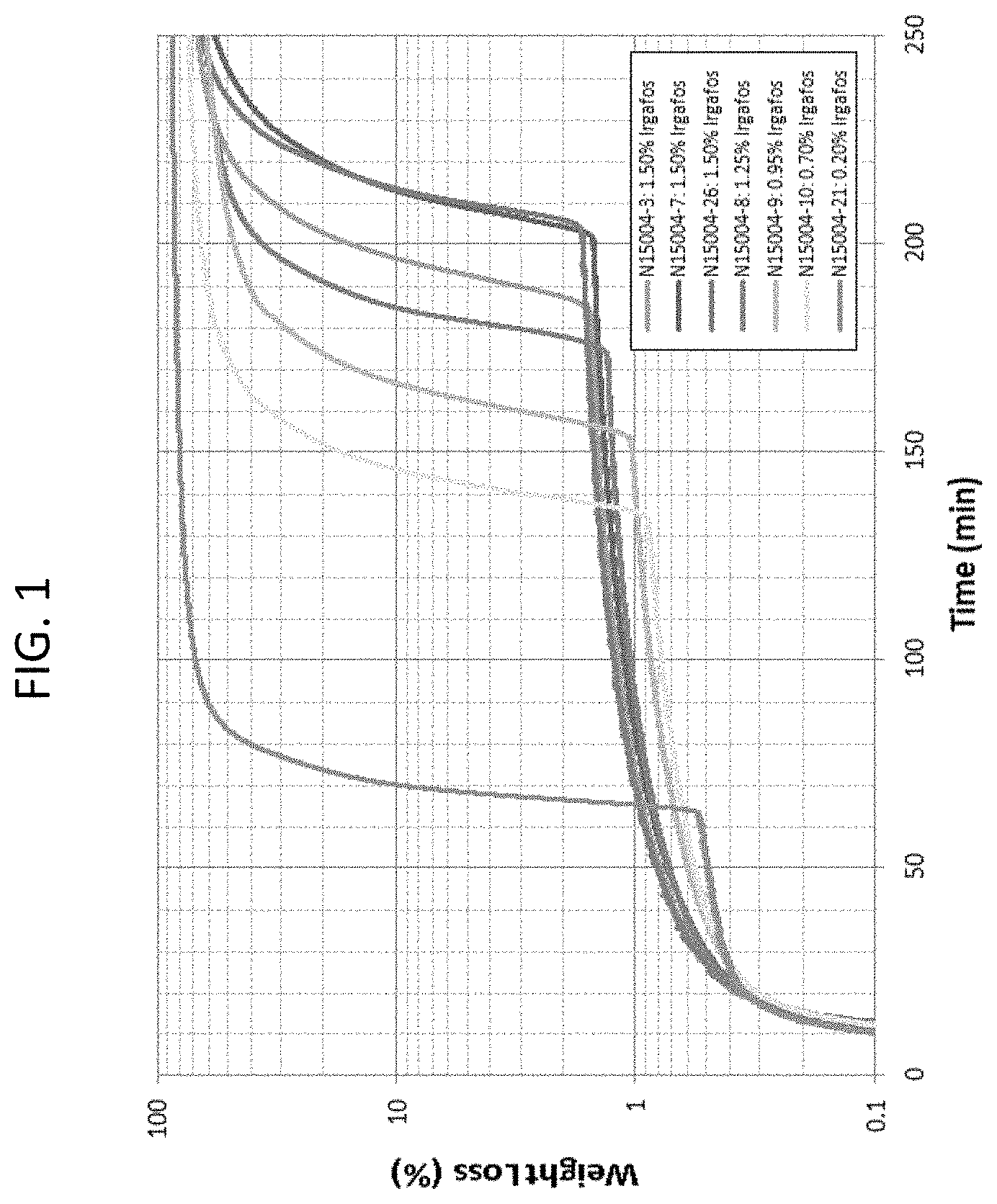
is a graph of Percent Weight-Loss versus Time for Compounds with Irgafos 168 consistent with certain embodiments of the present disclosure.
is a graph of Percent Weight-Loss versus Time for Compounds with Doverphos S9228T consistent with certain embodiments of the present disclosure.
is a graph of TGA Time at 2% Weight-loss versus Weight Percent of secondary antioxidant consistent with certain embodiments of the present disclosure.
is a graph of TGA Time at 2% Weight-loss versus secondary antioxidant with Curve-Fits consistent with certain embodiments of the present disclosure.
is a graph of Recrystallization Temperature versus Weight Percent of Talc consistent with certain embodiments of the present disclosure.
DETAILED DESCRIPTION
A detailed description will now be provided. The following disclosure includes specific embodiments, versions and examples, but the disclosure is not limited to these embodiments, versions or examples, which are included to enable a person having ordinary skill in the art to make and use the disclosure when the information in this application is combined with available information and technology.
Various terms as used herein are shown below. To the extent a term used in a claim is not defined below, it should be given the broadest definition persons in the pertinent art have given that term as reflected in printed publications and issued patents. Further, unless otherwise specified, all compounds described herein may be substituted or unsubstituted and the listing of compounds includes derivatives thereof.
Further, various ranges and/or numerical limitations may be expressly stated below. It should be recognized that unless stated otherwise, it is intended that endpoints are to be interchangeable. Where numerical ranges or limitations are expressly stated, such express ranges or limitations should be understood to include iterative ranges or limitations of like magnitude falling within the expressly stated ranges or limitations (e.g., from about 1 to about 10 includes, 2, 3, 4, etc.; greater than 0.10 includes 0.11, 0.12, 0.13, etc.).
Embodiments of the present disclosure generally relate to high melt flow rate controlled polypropylene with good thermal stability. Certain embodiments of the present disclosure relate to a process of forming a high melt flow rate (MFR) polypropylene with long term thermal performance characteristics, referred hereinafter as “forming a high MFR polypropylene.” In such embodiments, the process of forming a high MFR polypropylene includes providing a reactor powder polypropylene and subjecting the reactor powder polypropylene to post-reactor forming. MFR is measured herein using ASTM D1238.
Reactor Powder Polymer
The reactor powder polypropylene may be a homopolymer that may contain up to 5% of another alpha-olefin, including but not limited to C2-C8 alpha-olefins such as ethylene and 1-butene. The polypropylene homopolymer may be atactic polypropylene, isotactic polypropylene, hemi-isotactic, syndiotactic polypropylene, or combinations thereof. A polymer is “atactic” when its pendant groups are arranged in a random fashion on both sides of the chain of the polymer. In contrast, a polymer is “isotactic” when all of its pendant groups are arranged on the same side of the chain and “syndiotactic” when its pendant groups alternate on opposite sides of the chain. In hemi-isotactic polymer, every other repeat unit has a random substituent.
In certain embodiments, the reactor powder polymer is a heterophasic polypropylene. In other embodiments, the polypropylene copolymer may be a polypropylene heterophasic copolymer (PPHC) wherein a polypropylene homopolymer phase or component is joined to a copolymer phase or component. The PPHC may comprise from greater than 6.5 wt. % to less than 20 wt. % ethylene by total weight of the PPHC, alternatively from 8.5 wt. % to less than 18 wt. %, alternatively from 9.5 wt. % to less than 16%.
The copolymer phase of a PPHC may be a random copolymer of propylene and ethylene, also referred to as an ethylene/propylene rubber (EPR). PP heterophasic copolymers show distinct homopolymer phases that are interrupted by short sequences or blocks having a random arrangement of ethylene and propylene. In comparison to random copolymers, the block segments comprising the EPR may have certain polymeric characteristics (e.g., intrinsic viscosity) that differ from that of the copolymer as a whole. Without wishing to be limited by theory, the EPR portion of the PPHC has rubbery characteristics which, when incorporated within the matrix of the homopolymer component, may function to provide increased impact strength to the PPHC. In an embodiment, the EPR portion of the PPHC comprises greater than 14 wt. % of the PPHC, alternatively greater than 18 wt. % of the PPHC, alternatively from 14 wt. % to 18 wt. % of the PPHC.
The amount of ethylene present in the EPR portion of the PPHC may be from 38 wt. % to 60 wt. %, alternatively from 40 wt. % to 45 wt. % based on the total weight of the EPR portion. In an embodiment, the PPHC may have a melt flow rate (MFR) of from 1 g/10 min. to 100 g/10 min., alternatively from 1.5 g/10 min. to 50 g/10 min.
In another embodiment, the reactor powder polymer is a polypropylene homopolymer with a density of from 0.895 g/cc to 0.920 g/cc, alternatively from 0.900 g/cc to 0.915 g/cc, and alternatively from 0.905 g/cc to 0.915 g/cc as determined in accordance with ASTM D1505. In certain embodiments of the present disclosure, the propylene homopolymer may have a MFR of between 10 and less than 100 dg/min, between 20 and 90 dg/min or between 30 and 70 dg/min as measured by ASTM D1238. In certain embodiments, the MFR of the propylene homopolymer is less than 100 dg/min. U.S. Pat. No. 4,822,546 teaches that polypropylenes with a MFR above about 40 are difficult to pelletize. U.S. Patent Application No. 2017/0051118 discloses similar results with examples where 50 MFR polypropylene results in misshapen pellets. Such difficulties in pelletization increase as MFR increases from 50 dg/min. In addition, fines production may increase with higher MFRs, as shown in WO 2006025917. Polypropylenes having a MFR of 80 dg/min or greater may be difficult to manufacture, lowering production rates by 20% or more. Difficulties in pelletization of high melt flow polyolefins are described in U.S. Pat. No. 5,611,983, WO 2007126994 A1, and U.S. Pat. No. 6,423,800. Fines generation are described in U.S. Pat. No. 8,232,358, WO2006025917 and WO 2000042077.
Post-Reactor Forming
The reactor powder polypropylene may be subjected to post-reactor forming. In post-reactor forming, the reactor powder polypropylene is formed into larger, discrete particles. Post reactor forming may be accomplished by, for example, extrusion into pellets, compaction into a fused/physically bonded pellet, prill bead manufacturing, pastillation, or melt atomization.
Post-reactor forming may provide such advantages as reducing or eliminating explosion hazards found with dust handling, increasing bulk density, improving material handling, and improved product consistency such as by improving particle-to-particle consistency. Other post-reactor forming advantages may include increasing manufacturing versatility and intimate dispersion of additives within the polypropylene molecules, such as when the post-reactor forming step involves melting the polypropylene in making the larger, discrete particle.
In certain embodiments, MFR of the polypropylene is increased during post-reactor forming by mixing the reactor powder polypropylene with a free radical initiator, such as a peroxide to form a powder/initiator mixture and then subjecting the powder/initiator mixture to post-reactor forming. In certain embodiments, the peroxide is an organic peroxide. Examples of organic peroxides may include, but are not limited to, 3,6,9-triethyl-3,6,9-trimethyl-1,4,7-triperoxonane, commercially available from AKZONOBEL® under the tradename TRIGONOX® 301 (CAS #24748-23-0); 2,5-bis(tert-butylperoxy)-2,5-dimethylhexane, commercially available from AKZONOBEL® as LUPERSOL™ 101, 2,5-dimethyl 2,5 bis-(t-butylperoxy) hexyne-3 and 4 methyl 4 t-butylperoxy-2 pentanone, 3,6,6,9,9-pentamethyl-3-(ethyl acetate), 1,2,4,5-textraoxy cyclononane, 4-(t-amylperoxy)-4-methyl-2-pentanol, dihexylene glycol peroxide, 4-(t-hexylperoxy)-4-methyl-2-pentanol, 4-(t-octylperoxy)-4-methyl-2-pentanol, 2-methyl-2-t-amylperoxy-4-pentanone, di-t-butyl peroxide, di-t-hexyl peroxide; di-t-octyl peroxide, dicumyl peroxide, and α,α′ bis-(tert-butylperoxy) diisopropyl benzene. In certain embodiments, where the large, discrete particle is to be free of tertiary butyl alcohols, 2,5-bis(tert-butylperoxy)-2,5-dimethylhexane is not used and 3,6,9-triethyl-3,6,9-trimethyl-1,4,7-triperoxonane is used.
The peroxide may be present in the powder/initiator mixture in an amount ranging from greater than 0 ppm to 1500 ppm, or 50 ppm to 1500 ppm, or 100 ppm to 750 ppm, or 250 ppm to 500 ppm (all by weight), for example.
Post-reactor forming of the powder/initiator mixture may result in vis-breaking of the polypropylene, resulting in an increased MFR of the vis-broken polypropylene. In certain embodiments, the vis-broken polypropylene may have a melt flow rate of 50 dg/min to 500 dg/min, from 70 dg/min to 300 dg/min or from 80 dg/min to 150 dg/min. In some embodiments, the ratio of the large, discrete particle MFR to reactor powder polypropylene may be from 1.25:1 to 25:1, from 2:1 to 15:1 or from of 2.5:1 to 12:1. In certain embodiments, the amount of initiator may be adjusted to achieve the desired MFR.
In certain embodiments, the powder/initiator mixture may include an antioxidant, such as a primary antioxidant or a secondary antioxidant. As used herein, a primary antioxidant is a radical scavenger. Examples include sterically hindered phenols, such as Irganox 1010 (CAS 6683-19-8), Irganox 1076 (CAS 2082-79-3), Irganox 3114 (CAS 27676-62-6), Irganox 1330 (CAS 1709-70-2), and Cyanox 1790 (CAS 40601-76-1). As used herein, a secondary antioxidant is a hyperoxide decomposing compound. The secondary antioxidant may aid in reducing premature weight loss in the propylene homopolymer, particularly at elevated temperatures. Examples of secondary antioxidants include, but are not limited to phosphites, hindered amine stabilizers and hydroxylamines. Phenol-free antioxidants are suitable as well, such as for example those based on hindered amine stabilizers, phosphites, hydroxylamines. Examples of suitable secondary antioxidants are BNX DSTDP (Dioctadecyl 3,3′-thiodipropionate) (CAS 693-36-7), Irgafos 168 (CAS 31570-04-4), Doverphos S9228T (CAS 154862-43-8), Ultranox 626 (CAS 26741-53-7), Weston 618F (CAS 3806-34-6), TNPP (CAS 26523-78-4), Hostanox P-EPQ (CAS 119345-01-6), and Irgastab FS-042 (CAS 143925-92-2). The secondary antioxidant may be present in the powder/initiator mixture between, for instance, 0.1% to 3% by weight, between 0.2% and 1.5% by weight, or between 0.15% and 0.75% by weight.
In certain embodiments, talc may be added to the powder/initiator mixture. Talc may be present in the powder/initiator mixture between 0.1 wt % to 2 wt % or between 0.3% to 1%, all by weight. In certain embodiments, talc may increase the recrystallization temperature of the polypropylene.
In certain embodiments, by vis-breaking the reactor powder polypropylene in post-reactor forming, a higher MFR polypropylene may be formed without adversely affecting the production rate of the reactor powder polypropylene while maintaining the long term heat aging performance (LHTA) of the polypropylene. One measure of LHTA is Isothermal Thermo-Gravimetric Analysis (TGA). TGA measures weight loss of the polypropylene at an elevated temperature. To measure TGA, a sample is started at 25° C. steadily heated to 230° C. over 15 minutes. The sample is held at 230° C. for 4 hours. An air purge gas atmosphere is used throughout the procedure. Weight loss may be calculated based on difference between the weight of the sample after four hours compared to the initial weight of the sample. Results of TGA multiple measurement may be averaged. In one measure of TGA, the time at a pre-determined elevated temperature to achieve a predetermined weight loss may be found. In certain embodiments of the present disclosure, following post-reactor forming, at 230° C., have a 1% loss in weight from between 25 and 250 minutes, or between 50 and 150 minutes, a 2% loss in weight between 50 minutes and 300 minutes or between 75 and 200 minutes, and a 3% loss in weight between 50 minutes and 300 minutes or between 77 and 210 minutes.
Articles
In some embodiments, the pellets may be processed to make an article, such as by methods known to those of ordinary skill in the art. For example and without limitation, the pellets may be processed by injection molding, fiber extrusion, film extrusion, sheet extrusion, pipe extrusion, blow molding, rotomolding, slush molding, injection-stretch blow molding or extrusion-thermoforming to produce an article. The article may be a motor vehicle component, appliance, or filter media, for example.
EXAMPLES
The disclosure having been generally described, the following examples show particular embodiments of the disclosure. It is understood that the example is given by way of illustration and is not intended to limit the specification or the claims. All compositions percentages given in the examples are by weight.
Example 1
Samples of powder/initiator mixture were prepared in accordance with Table 1. Sample 1 is a comparative reactor grade 100 melt flow rate propylene homopolymer fluff. Samples 2-26 are a controlled rheology grade 30 melt flow propylene homopolymer fluff with xylene solubles targeted at 2 consistent with the present disclosure as described herein above.
TABLE 1
TOTAL PETROCHEMICALS ENHANCED HEAT
STABILITY CRED PP WITH A HIGH MFR
1 2 3 4 5 6 7 8 9
DSTDP 0.4 0.4 0.4 0.4 0.4 0.4 0.4 0.4 0.4
Irganox 1010 0.45 0.45 0.45 0.45 0.45 0.45 0.45 0.45 0.45
Irganox 1076 0.005 0.005 0.005 0.005 0.005 0.005 0.005 0.005 0.005
Hydrotalcite 0.07 0.07 0.07 0.07 0.07 0.07 0.07 0.07 0.07
Irgafos 168 0.2 1.5 1.5 1.5 1.5 1.25 0.95
Trigonox 301 0.074 0.08 0.08 0.074 0.08 0.08 0.08 0.08
IMI Fabi Talc BT 0.5
Doverphos S9228T 0.75 0.75
Sample #
10 11 12 13 14 15 16 17 18
DSTDP 0.4 0.4 0.4 0.4 0.4 0.4 0.4 0.4 0.4
Irganox 1010 0.45 0.45 0.45 0.45 0.45 0.45 0.45 0.45 0.45
Irganox 1076 0.005 0.005 0.005 0.005 0.005 0.005 0.005 0.005 0.005
Hydrotalcite 0.07 0.07 0.07 0.07 0.07 0.07 0.07 0.07 0.07
Irgafos 168 0.7 0.95 0.95
Trigonox 301 0.08 0.08 0.08 0.08 0.08 0.08 0.08 0.08 0.08
IMI Fabi Talc BT 0.3 1 0.3 1
Doverphos S9228T 0.35 0.27 0.2 0.27 0.27 0.16
Sample #
19 20 21 22 23 24 25 26
DSTDP 0.4 0.4 0.4 0.4 0.4 0.4 0.4 0.4
Irganox 1010 0.45 0.45 0.45 0.45 0.45 0.45 0.45 0.45
Irganox 1076 0.005 0.005 0.005 0.005 0.005 0.005 0.005 0.005
Hydrotalcite 0.07 0.07 0.07 0.07 0.07 0.07 0.07 0.07
Irgafos 168 0.2 1.5
Trigonox 301 0.08 0.08 0.08 0.07 0.08 0.09 0.08 0.08
IMI Fabi Talc BT 0.3 1
Doverphos S9228T 0.16 0.16 0.27 0.27 0.27 0.2
Values provided for components of the powder/initiator mixture are in weight percent of the total powder/initiator mixture weight. Trigonix 301, as used in Table 2, is based on a 41% mixture of Trigonix 301, e.g., a 800 ppm loading of 41% Trignoix 301 is 328 ppm of peroxide.
Example 2
Samples from Example 1 were subjected to post-reactor forming and molding. Results are shown in Table 2:
TABLE 2
After Compounding After Molding
GC GC
Additives MFR GPC Active GPC Active
Irgafos Trig Talc Dover MFR Mn Mw Mz Peroxide Mn Mw Mz Peroxide
# % % % % dg/min Daltons Daltons Daltons ppm Daltons Daltons Daltons ppm
1 0.2 103 22555 144293 686180
2 1.5 0.074 102 30141 179651 625411
3 1.5 0.08 116 30123 177736 607270
4 1.5 0.08 0.5 112 30117 178797 622089
5 0.074 0.75 104 30096 178636 610805
6 0.08 0.75 113 29762 179695 663599
7 1.5 0.08 112 30904 188677 707374 227 30183 176105 608175 122.9
8 1.25 0.08 120 30637 188192 680674 224 30057 173057 576910 127.9
9 0.95 0.08 118 30956 183891 643708 230 30070 173565 581917 126.5
10 0.7 0.08 130 30828 184539 647249 222 30040 171494 575858 121
11 0.08 0.35 122 30624 184850 662387 224 29757 167825 548760 116.8
12 0.08 0.27 124 30630 186673 677449 228 29216 155300 479965 95.5
13 0.08 0.2 130 30767 184756 657247 222 29810 165165 522529 111.7
14 0.95 0.08 0.3 130 30811 190011 761662 237 30284 180774 632070 143
15 0.95 0.08 1 130 30781 188180 686716 238 30331 176347 595963 121.2
16 0.08 0.3 0.27 134 30541 184066 670980 30018 164549 519389
17 0.08 1 0.27 124 30446 182072 644894 30109 166058 525467
18 0.08 0.16 120 30548 189579 709814 30361 172528 568530
19 0.08 0.3 0.16 110 30551 186276 683907 30242 171094 568825
20 0.08 1 0.16 130 30517 183947 668936 30078 166009 531130
21 0.2 0.08 133 30537 187328 730193
22 0.07 0.27 102 30557 184081 660742 188
23 0.08 0.27 121 30821 185897 662044 197
24 0.09 0.27 138 30696 184648 675854 260
25 0.08 0.2 130 30652 185801 690027
26 1.5 0.08 121 30735 187231 683896
The effect of peroxide on long term heat performance is shown in the data presented in Tables 3 and 9. TGA measurement and DSC results for the Samples from Example 1 are shown in Table 3.
The TGA data is presented in the format Weight-Loss versus Exposure Time at 230° C. for compounds containing Irgafos 168 ( ) and Doverphos 59228T ( ). Performance increases for increasing loading for both Irgafos 168) and Doverphos 59228T. Most loading levels studied exceeded the ˜100 minute to 2% weight-loss that is typical of Sample 1. Irgafos 168 exhibits a greater initial weight-loss rate than the Doverphos 59228T. depicts the Time at 2% Weight-Loss versus anti-oxidant weight for Irgafos 168 and Doverphos 59228T in pellet and molded form. depicts compounds using no talc and 800 ppm of Trigonox 301. Doverphos 59228T generally outperforms Irgafos 168 by a ratio of 3:1 with identical additive weight.
illustrates the recrystallization temperature versus talc loading. shows that including talc increases the recrystallization temperature by 3-8° C.
TABLE 3
After Compounding After Molding
TGA TGA
Time Time
at DSC at DSC after Molding
2% 2nd 2% 2nd
Additives wt. Melt □H2 Recry □H % wt. Melt □H2 Recry □H %
Irgafos Trig Talc Dover loss Peak Melt Peak Recry Crystal loss Peak Melt Peak Recry Crystal
# % % % % min ° C. J/g ° C. J/g % min ° C. J/g ° C. J/g %
1 0.2 94 164 105 121 102 50.4
2 1.5 0.074 172 164 104 120 100 49.5
3 1.5 0.08 198 164 104 120 100 49.6
4 1.5 0.08 0.5 200 165 108 127 102 51.5
5 0.074 0.75 265 165 107 121 104 51.1
6 0.08 0.75 265 164 101 120 99 48.4
7 1.5 0.08 204 164 111 123 107 52.9 190 163 111 123 107 53
8 1.25 0.08 178 163 110 121 106 52.4 164 162 112 121 108 53.3
9 0.95 0.08 166 163 109 120 104 52.2 186 162 112 120 107 53.3
10 0.7 0.08 139 162 109 119 107 52.2 121 163 109 119 105 52.1
11 0.08 0.35 177 162 111 120 108 52.9 196 162 111 120 107 52.9
12 0.08 0.27 148 162 110 119 108 52.8 166 162 110 119 106 52.7
13 0.08 0.2 112 162 111 119 109 53.0 80 161 111 119 109 53.3
14 0.95 0.08 0.3 181 164 112 127 109 53.6 169 164 113 127 110 54.3
15 0.95 0.08 1 174 164 113 128 109 53.8 165 164 114 128 110 54.6
16 0.08 0.3 0.27 161 164 112 127 109 53.7 165 129 127 126 61.7
17 0.08 1 0.27 148 164 114 128 110 54.4 164 128 128 123 61.1
18 0.08 0.16 77 163 115 123 110 55.0 165 121 122 121 57.8
19 0.08 0.3 0.16 77 165 114 126 109 54.4 165 126 126 121 60.1
20 0.08 1 0.16 92 164 113 128 109 53.8 167 120 127 119 57.3
21 0.2 0.08 66 162 115 121 110 55.0
22 0.07 0.27 150 163 112 120 109 53.7
23 0.08 0.27 135 162 116 121 111 55.3
24 0.09 0.27 135 162 113 120 109 54.1
25 0.08 0.2 114 162 113 121 109 54.0
26 1.5 0.08 206 162 111 120 109 53.1
Table 4 depict a subset of data from Table 3. As shown in Table 4, the controlled rheology sample #21 matches sample #1 in formulation, except with Trigonox 301 peroxide addition to increase the MFR from 30 to the 100 MFR target. With the balance of the additive package held constant, TGA is reduced to 66 minutes in comparison to the reactor grade #1 baseline of 94 minutes. An antagonistic effect exists between vis-breaking and long term heat stability. As shown with respect to sample #18, a similar effect is observed when using Doverphos S9228T at a similar loading level of 1600 ppm, even though Doverphos S9228T shows much higher efficacy in conventional polymer formulations. Replacing 2000 ppm Irgafos 168 with 1600 ppm Doverphos S9228T is not sufficient to match sample 1 performance. Only by using a 1:1 replacement of Doverphos S9228T for Irgafos 168, as shown with sample #13, does a vis-broken PP formulation match or exceed that of the sample #1 baseline.
TABLE 4
Additives TGA
Irgafos Trig. Dover. Time at 2%
168 301 Talc S9228T wt. loss
# % % % % min
1 0.2 94
21 0.2 0.08 66
18 0.08 0.16 77
13 0.08 0.2 112
As shown in Table 5, increasing Irgafos 168 leads to a TGA result that exceeds sample #1's TGA measurement of 94 minutes. Using the results of samples #7, #8, #9, #10 and #21, an interpolated TGA time of 94 minutes is determined at 0.425% Irgafos 168. However, at 0.08% Trigonox 301 this yields a 131 MFR, well above the 100 MFR target of sample #1.
TABLE 5
TGA
Time
Additives at 2%
Irgafos Trig. Dover. wt. MFR
168 301 Talc S9228T loss MFR
# % % % % min dg/min
1 0.2 94 103
21 0.2 0.08 66 133
10 0.7 0.08 139 130
9 0.95 0.08 166 118
8 1.25 0.08 178 120
7 1.5 0.08 204 112
Interpolated Fit 0.425 0.08 94 131
Table 6 depicts samples #2, #3, and #26 and an interpolated fit using 0.45% Irgafos 168 and 0.068% Trigonox 301, yielding a balance of TGA performance and a nominal 100 MFR pellet. These results matching the Sample #1.
TABLE 6
TGA
Time
Additives at 2%
Irgafos Trig. Dover. wt. MFR
168 301 Talc S9228T loss MFR
# % % % % min dg/min
1 0.2 94 103
21 0.2 0.08 66 133
10 0.7 0.08 139 130
9 0.95 0.08 166 118
8 1.25 0.08 178 120
7 1.5 0.08 204 112
3 1.5 0.08 198 116
26 1.5 0.08 206 121
2 1.5 0.074 172 102
Interpolated Fit 0.45 0.068 98 102
Achieving a balance of TGA performance and a nominal 100 MFR pellet is shown in Table 7 with Doverphos 59228T, a higher performance phosphite-based melt stabilizer. Higher performance melt stabilizers may reduce the amount of additive used. For example, adding >0.4% Irgafos 168 could present additive feeding challenges and problems with product consistency. If a high performance antioxidant can be used for similar efficacy as, for instance, Irgafos 168, industrial performance may improve.
The results in Table 7 use of a high performance antioxidant like Doverphos S9228T. As shown in Table 7, an interpolated fit to the data indicate similar efficacy at only ˜33% the loading needed with Irgafos 168. Adding 0.16% Doverphos S9228T would be similar to adding 0.2% Irgafos 168, making use of Doverpos S9228T feasible. Table 7 show a match of Sample #1 TGA and MFR measurements using a balance of peroxide and Doverphos S9228T.
TABLE 7
TGA
Time
Additives at 2%
Irgafos Trig. Dover. wt. MFR
168 301 Talc S9228T loss MFR
# % % % % min dg/min
1 0.2 94 103
22 0.07 0.27 150 102
23 0.08 0.27 135 121
24 0.09 0.27 135 138
25 0.08 0.2 114 130
11 0.08 0.35 177 122
12 0.08 0.27 148 124
13 0.08 0.2 112 130
18 0.08 0.16 77 120
Interpolated Fit 0.065 0.16 99 99
In certain embodiments, it may be desirable to manufacture molded parts from CRed polypropylene that have LTHA performance that matches or exceeds that of sample #1. The results, set forth in Table 8, demonstrate such performance with an additive package. After molding, all compounds but one retain TGA values higher than that of sample #1. Adding an additional melt processing step and consuming more residual active peroxide is tenable. Any modest loss in TGA performance between compounding and molding as shown in Table 8 may be compensated by formulation optimization.
TABLE 8
After Compounding After Molding
TGA TGA
GC Time at GC Time at
GPC Active 2% wt. GPC Active 2% wt.
Mn Mw Mz Peroxide loss Mn Mw Mz Peroxide loss
# Daltons Daltons Daltons Ppm min Daltons Daltons Daltons ppm min
7 30904 188677 707374 227 204 30183 176105 608175 122.9 190
8 30637 188192 680674 224 178 30057 173057 576910 127.9 164
9 30956 183891 643708 230 166 30070 173565 581917 126.5 186
10 30828 184539 647249 222 139 30040 171494 575858 121 121
11 30624 184850 662387 224 177 29757 167825 548760 116.8 196
12 30630 186673 677449 228 148 29216 155300 479965 95.5 166
13 30767 184756 657247 222 112 29810 165165 522529 111.7 80
14 30811 190011 761662 237 181 30284 180774 632070 143 169
15 30781 188180 686716 238 174 30331 176347 595963 121.2 165
Tensile strength, flexural modulus and HDT were measured for samples selected from Example 2. The results are shown in Table 9. As shown in Table 9, tensile strength at yield, HDT of samples #2-#20, the controlled rheology polymer subject to post reaction forming of the present disclosure, are consistent with that of sample #1, the comparative reactor grade 100 melt flow rate propylene. Specifically, in applications requiring the modulus and HDT value to match sample 1, use of a nucleating agent like talc in these examples achieves that requirement without adversely impacting TGA or MFR performance.
TABLE 9
Tensile Flex HDT
Tensile Stress Strain Stress Strain Flex Std. HDT
Irgafos Trig Talc Dover Modulus @Yield @Yield @Break @Break Modulus Dev. Value
Compound % % % % ksi psi % psi % kpsi kpsi ° F.
1 0.2 252.7 5271 5.9 5015 8 228 1.7 239
2 1.5 0.074
3 1.5 0.08 241.1 5152 6.8 4513 11 205 3.8 219
4 1.5 0.08 0.5 264.4 5333 5.9 4617 10 235 2.6
5 0.074 0.75
6 0.08 0.75 247.3 5258 6.5 4715 11 211 2 225
7 1.5 0.08 247.3 5261 6.7 3624 14 220 3.7 234
8 1.25 0.08 237.4 5132 6.9 3822 14 206 1.8 224
9 0.95 0.08 234.5 5126 7.1 3764 15 204 2.5 219
10 0.7 0.08 237.0 5157 7 4062 14 207 3.5 218
11 0.08 0.35 238.4 5172 6.8 4105 13 208 2.6 217
12 0.08 0.27 235.7 5149 6.9 4090 14 202 3.2 218
13 0.08 0.2 231.2 5105 7.1 4078 14 204 2.5 213
14 0.95 0.08 0.3 254.6 5347 6.3 4332 11 229 3.6 240
15 0.95 0.08 1 258.5 5312 6 4524 11 238 1.4 243
16 0.08 0.3 0.27 273.3 5438 5.8 4660 11 240 4
17 0.08 1 0.27 280.3 5419 5.4 4743 9 249 2.1
18 0.08 0.16 264.3 5402 6.2 4289 11 230 1.1
19 0.08 0.3 0.16 273.9 5448 5.7 4687 10 239 5.2
20 0.08 1 0.16 281.1 5426 5.4 4674 10 245 2.5
Certain TGA and MFR performance only, as shown above, will meet some application needs, but other applications will require a performance level in other physical properties. These physical properties include stiffness, tensile stress at yield and heat deflection temperature. As shown in Table 9 and highlighted in the following table below, the Cred grades often are slightly lower than the Sample #1 comparative. As shown in Table 10, modulus for certain samples is 10 to 20 kpsi lower, tensile strain at yield averages 0.9% higher and HDT averages 18° F. lower than sample #1.
TABLE 10
Time
at
2%
Irgafos Trig. Dover. Tensile Stress Strain Flex HDT wt.
Com- 168 301 Talc S9228T Modulus @Yield @Yield Modulus Value loss MFR
pound % % % % ksi psi % kpsi ° F. min dg/min
1 0.2 252.7 5271 5.9 228 239 94 103
3 1.5 0.08 241.1 5152 6.8 205 219 198 116
6 0.08 0.75 247.3 5258 6.5 211 225 265 113
7 1.5 0.08 247.3 5261 6.7 220 234 204 112
8 1.25 0.08 237.4 5132 6.9 206 224 178 120
9 0.95 0.08 234.5 5126 7.1 204 219 166 118
10 0.7 0.08 237.0 5157 7 207 218 139 130
11 0.08 0.35 238.4 5172 6.8 208 217 177 122
12 0.08 0.27 235.7 5149 6.9 202 218 148 124
13 0.08 0.2 231.2 5105 7.1 204 213 112 130
18 0.08 0.16 264.3 5402 6.2 230 77 120
Average for vis-broken compounds: 241.4 5191 6.8 210 221 166 121
In certain samples, talc was used as a nucleator although other nucleators are permissible. Adding talc improved stiffness, yield stress and HDT, which, on average as shown below in Table 11, exceeded those of the sample #1 reactor grade comparative. Likewise, strain at yield was reduced to 5.8% on average, closely resembling sample #1. No antagonistic effects were observed in TGA or MFR results. The use of a nucleator, such as talc, makes it possible to make a vis-broken LTHA PP compound that mirrors sample 1 for long term thermal stability, MFR, stiffness, TGA and percent strain at yield.
TABLE 11
Time
at
2%
Irgafos Trig. Dover. Tensile Stress Strain Flex HDT wt.
Com- 168 301 Talc S9228T Modulus @Yield @Yield Modulus Value loss MFR
pound % % % % ksi psi % kpsi ° F. min dg/min
1 0.2 252.7 5271 5.9 228 239 94 103
4 1.5 0.08 0.5 264.4 5333 5.9 235 200 112
14 0.95 0.08 0.3 254.6 5347 6.3 229 240 181 130
15 0.95 0.08 1 258.5 5312 6 238 243 174 130
16 0.08 0.3 0.27 273.3 5438 5.8 240 161 134
17 0.08 1 0.27 280.3 5419 5.4 249 148 124
19 0.08 0.3 0.16 273.9 5448 5.7 239 77 110
20 0.08 1 0.16 281.1 5426 5.4 245 92 130
Average for vis-broken compounds w/ talc: 269.4 5389 5.8 239.3 241.5 148 124
Example 3
A 30 melt flow rate propylene homopolymer fluff was produced in a commercial reactor and subjected to post-reactor forming to achieve a 100 melt flow rate polypropylene. Multiple lots were tested. Results are shown in Table 12. Trigonix 301 was used as the peroxide, with the amount of peroxide in Trigonix 301 reflected in Table 12. The TGA data for the runs is presented in the format Weight-Loss versus Exposure Time at 230° C.
TABLE 12
TGA
Formulation Weight
Melt Flow Irganox Doverphos Loss Exposure
Fluff Pellet 1010 DSTDP Peroxide S9228T Threshold Time
Name MFR MFR (%) (%) (%) (%) % (min)
Lot 1 79.5 0.45 0.424 0.025 0.241 2 94.04
Lot 2 28.09 87.9 0.45 0.392 0.025 0.240 2 93.18
Lot 3 35.33 94.4 0.45 0.432 0.025 0.245 2 97.76
Lot 4 34.07 107.7 0.45 0.504 0.025 0.250 2 90.01
Lot 5 34.07 105.1 0.45 0.444 0.025 0.245 2 89.67
Lot 6 33.85 102.2 0.45 0.392 0.025 0.240 2 87.25
Average 33.082 96.13833 0.45 0.431333 0.025 0.243542 2 91.985
As shown in Table 12, TGA performance for 30 melt flow rate propylene homopolymer fluff produced in a commercial reactor and subjected to post-reactor forming to achieve a 100 melt flow rate polypropylene is consistent with Sample 1 of Examples 1 and 2.
Example 4
Samples of a 30 melt flow propylene homopolymer fluff with xylene solubles targeted at 2 were mixed with the additive packages as shown below in Table 13. The TGA data is presented in the format Weight-Loss versus Exposure Time at 230° C.
TABLE 13
TGA at 2%
Sample Description (min)
A Lupersol 101 + no secondary antioxidant 15.13
B Trignox 301 + 0.05% Irg 168 (no peroxide) 15.05
C no Peroxide + no secondary antioxidant 14.94
As is shown in Table 13, an unbalanced additive package in combination with the homopolymer fluff, i.e., with peroxide but without a secondary antioxidant, or without peroxide but with antioxidants, or without peroxide or antioxidants does not perform as shown above with properly balanced additive packages. Specifically, samples with the unbalanced additive package in combination the homopolymer fluff have much lower TGA performance than sample 1 and samples 20-26.
Depending on the context, all references herein to the “disclosure” may in some cases refer to certain specific embodiments only. In other cases it may refer to subject matter recited in one or more, but not necessarily all, of the claims. While the foregoing is directed to embodiments, versions and examples of the present disclosure, which are included to enable a person of ordinary skill in the art to make and use the disclosures when the information in this patent is combined with available information and technology, the disclosures are not limited to only these particular embodiments, versions and examples. Other and further embodiments, versions and examples of the disclosure may be devised without departing from the basic scope thereof and the scope thereof is determined by the claims that follow.
Figures (5)
Citations
This patent cites (30)
- US3558532
- US4822546
- US5532282
- US5611983
- US6160029
- US6194060
- US6303233
- US6326434
- US6423800
- US6855777
- US7470727
- US7659349
- US7902300
- US8232358
- US9365710
- US9527989
- US10538645
- US11299564
- US20090160073
- US20100324225
- US20110293869
- US20170051118
- US20170313865
- US20210261699
- US2711391
- US2782961
- US2898016
- US0042077
- US2006025917
- US2007126994