Methods and Apparatuses for Distilling Seawater and Brine and Removing Salt
Abstract
A seawater distillation system for distilling seawater and brine and removing salt. The seawater distillation system includes an apparatus having at least a vessel, a separation assembly, and at least one mist eliminator. The vessel may be adapted to hold a volume of seawater comprising a volume of salt, wherein vessel is one of externally heated and internally heated to evaporate the volume of seawater to a volume of steam and to precipitate the volume of salt. The separation assembly may be operably engaged with the vessel, wherein the separation assembly is configured to separate the volume of salt from the volume of seawater inside of the vessel. The at least one mist eliminator may be operably engaged with the vessel and positioned vertically above the separation assembly, wherein the at least one mist eliminator is configured to eliminate water droplets and salt from the volume of steam.
Claims (20)
1. An apparatus, comprising: a vessel adapted to hold a volume of seawater comprising a volume of salt, wherein the vessel is one of externally heated and internally heated to evaporate the volume of seawater to a volume of steam and to precipitate the volume of salt; a separation assembly operably engaged with the vessel and comprising of at least a support structure having a first lateral wall and a second lateral wall opposite to the first lateral wall and at least one set of colanders operably engaged with the support structure and positioned intermediate of the first lateral wall and the second lateral wall, wherein the at least one set of colanders is configured to separate the volume of salt from the volume of seawater inside of the vessel; and at least one mist eliminator operably engaged with the vessel and positioned vertically above the separation assembly, wherein the at least one mist eliminator is configured to eliminate water droplets and salt from the volume of steam.
15. An apparatus, comprising: a vessel adapted to hold a volume of seawater comprising a volume of salt, wherein the vessel is one of externally heated and internally heated to evaporate the volume of seawater to a volume of steam and to precipitate the volume of salt; a separation assembly operably engaged with the vessel, wherein the separation assembly is configured to separate the volume of salt from the volume of seawater inside of the vessel, and wherein the separation assembly comprises: a support structure having a first lateral wall and a second lateral wall opposite to the first lateral wall; and at least one set of colanders operably engaged with the support structure and positioned intermediate of the first lateral wall and the second lateral wall, wherein each colander of the at least set of colanders is positioned between a first support wall and a second support wall opposite to the first support wall and is configured to drain the volume of seawater while retaining the volume of salt; and at least one mist eliminator operably engaged with the vessel and positioned vertically above the separation assembly, wherein the at least one mist eliminator is configured to eliminate water droplets and salt from the volume of steam.
16. An apparatus, comprising: a vessel adapted to hold a volume of seawater comprising a volume of salt, wherein the vessel is one of externally heated and internally heated to evaporate the volume of seawater to a volume of steam and to precipitate the volume of salt; a separation assembly operably engaged with the vessel, wherein the separation assembly is configured to separate the volume of salt from the volume of seawater inside of the vessel, and wherein the separation assembly comprises: a support structure having a first lateral wall, a second lateral wall opposite to the first lateral wall, a first intermediate wall positioned between the first lateral wall and the second lateral wall, a second intermediate wall positioned between the first intermediate wall and the second lateral wall, and a set of support tubes operably engaging the first lateral wall, the second lateral, the first intermediate wall, and the second intermediate wall with one another; and at least one set of colanders operably engaged with the support structure and positioned intermediate of the first lateral wall and the second lateral wall, wherein each colander of the at least set of colanders is positioned between a first support wall and a second support wall opposite to the first support wall and is configured to drain the volume of seawater while retaining the volume of salt; and at least one mist eliminator operably engaged with the vessel and positioned vertically above the separation assembly, wherein the at least one mist eliminator is configured to eliminate water droplets and salt from the volume of steam.
17. An apparatus, comprising: a vessel adapted to hold a volume of seawater comprising a volume of salt, wherein the vessel is one of externally heated and internally heated to evaporate the volume of seawater to a volume of steam and to precipitate the volume of salt; a separation assembly operably engaged with the vessel, wherein the separation assembly is configured to separate the volume of salt from the volume of seawater inside of the vessel, and wherein the separation assembly comprises: a support structure having a first lateral wall, a second lateral wall opposite to the first lateral wall, a first intermediate wall positioned between the first lateral wall and the second lateral wall, a second intermediate wall positioned between the first intermediate wall and the second lateral wall, and a set of support tubes operably engaging the first lateral wall, the second lateral, the first intermediate wall, and the second intermediate wall with one another; and a first set of colanders operably engaged with the first lateral wall and the first intermediate wall and positioned between the first lateral wall and the first intermediate wall; a second set of colanders operably engaged with the first intermediate wall and the second intermediate wall and positioned between the first intermediate wall and the second intermediate wall; and a third set of colanders operably engaged with the second intermediate wall and the second lateral wall and positioned between the second intermediate wall and the second lateral wall; wherein each colander of the first set of colanders, a second set of colanders, and a third set of colanders is configured to drain the volume of seawater while retaining the volume of salt; and at least one mist eliminator operably engaged with the vessel and positioned vertically above the separation assembly, wherein the at least one mist eliminator is configured to eliminate water droplets and salt from the volume of steam.
18. An apparatus, comprising: a vessel adapted to hold a volume of seawater comprising a volume of salt, wherein the vessel is one of externally heated and internally heated to evaporate the volume of seawater to a volume of steam and to precipitate the volume of salt; a separation assembly operably engaged with the vessel, wherein the separation assembly is configured to separate the volume of salt from the volume of seawater inside of the vessel, and wherein the separation assembly comprises: a support structure having a first lateral wall and a second lateral wall opposite to the first lateral wall; and at least one set of colanders operably engaged with the support structure and positioned intermediate of the first lateral wall and the second lateral wall; wherein the at least one set colanders is configured to separate the volume of salt from the volume of seawater; a drive shaft operably engaged with the support structure; a motor operably engaged with the drive shaft and being adapted to rotatably move the support structure and the at least one set of colanders inside of the vessel via the drive shaft; and at least one mist eliminator operably engaged with the vessel and positioned vertically above the separation assembly, wherein the at least one mist eliminator is configured to eliminate water droplets and salt from the volume of steam.
19. An apparatus, comprising: a vessel adapted to hold a volume of seawater comprising a volume of salt, wherein the vessel is one of externally heated and internally heated to evaporate the volume of seawater to a volume of steam and to precipitate the volume of salt; a separation assembly operably engaged with the vessel and comprising of at least a support structure having a first lateral wall and a second lateral wall opposite to the first lateral wall and at least one set of colanders operably engaged with the support structure and positioned intermediate of the first lateral wall and the second lateral wall, wherein the separation assembly is configured to separate the volume of salt from the volume of seawater inside of the vessel; a conveyor assembly operably engaged with the vessel and comprising at least a support frame, at least one pulley rotatably engaged with the support frame, and a conveyor belt rotatably engaged with the at least one pulley, wherein the conveyor assembly is positioned inside of the separation assembly, and wherein the conveyor assembly is configured to remove the volume of salt separated by the separation assembly from the vessel; a chamber defined by the vessel having an internal pressure different than an external pressure exterior to the chamber; and a discharge chute assembly operably engaged with the vessel and comprising at least a discharge chute that operably engages with the vessel, wherein the discharge chute is aligned with the conveyor assembly for transporting the volume of salt from the vessel, and wherein the discharge chute assembly is in fluid communication with the chamber and is configured to maintain the internal pressure inside of the chamber when transporting the volume of salt from the vessel; a first exit valve operably engaged with the discharge chute at a first position; a second exit valve operably engaged with the discharge chute at a second position vertically below the first exit valve; and at least one mist eliminator operably engaged with the vessel and positioned vertically above the separation assembly, wherein the at least one mist eliminator is configured to eliminate water droplets and salt from the volume of steam.
20. An apparatus, comprising: a vessel adapted to hold a volume of seawater comprising a volume of salt, wherein the vessel is one of externally heated and internally heated to evaporate the volume of seawater to a volume of steam and to precipitate the volume of salt; a separation assembly operably engaged with the vessel and comprising of at least a support structure having a first lateral wall and a second lateral wall opposite to the first lateral wall and at least one set of colanders operably engaged with the support structure and positioned intermediate of the first lateral wall and the second lateral wall, wherein the separation assembly is configured to separate the volume of salt from the volume of seawater inside of the vessel; a conveyor assembly operably engaged with the vessel and comprising at least a support frame, at least one pulley rotatably engaged with the support frame, and a conveyor belt rotatably engaged with the at least one pulley, wherein the conveyor assembly is positioned inside of the separation assembly, wherein the conveyor assembly is configured to remove the volume of salt separated by the separation assembly from the vessel; a chamber defined by the vessel having an internal pressure different than an external pressure exterior to the chamber; and a discharge chute assembly operably engaged with the vessel and comprising at least a discharge chute that operably engages with the vessel, wherein the discharge chute is aligned with the conveyor assembly for transporting the volume of salt from the vessel, and wherein the discharge chute assembly is in fluid communication with the chamber and is configured to maintain the internal pressure inside of the chamber when transporting the volume of salt from the vessel; a first exit valve operably engaged with the discharge chute at a first position; a second exit valve operably engaged with the discharge chute at a second position vertically below the first exit valve; and at least one mist eliminator operably engaged with the vessel and positioned vertically above the separation assembly, wherein the at least one mist eliminator is configured to eliminate water droplets and salt from the volume of steam; wherein when the first exit valve is provided in an open position, the second exit valve is provided in a closed position to maintain the internal pressure inside of the chamber; and wherein when the second exit valve is provided in an open position, the first exit valve is provided in a closed position to maintain the internal pressure inside of the chamber.
Show 13 dependent claims
2. The apparatus of claim 1 , wherein each colander of the at least one set of colanders comprises: a first support wall; a second support wall opposite to the first support wall; and a perforated wall operably engaged with the first support wall and the second support wall and positioned intermediate of the first support wall and the second support wall; wherein the perforated wall is configured to drain the volume of seawater while retaining the volume of salt.
3. The apparatus of claim 2 , wherein the separation assembly further comprises: a first intermediate wall of the support structure positioned between the first lateral wall and the second lateral wall; and a second intermediate wall of the support structure positioned between the first intermediate wall and the second lateral wall; and a set of support tubes operably engaging the first lateral wall, the second lateral, the first intermediate wall, and the second intermediate wall with one another.
4. The apparatus of claim 3 , wherein the at least one set of colanders comprises: a first set of colanders operably engaged with the first lateral wall and the first intermediate wall and positioned between the first lateral wall and the first intermediate wall; a second set of colanders operably engaged with the first intermediate wall and the second intermediate wall and positioned between the first intermediate wall and the second intermediate wall; and a third set of colanders operably engaged with the second intermediate wall and the second lateral wall and positioned between the second intermediate wall and the second lateral wall.
5. The apparatus of claim 1 , further comprising: a drive shaft operably engaged with the support structure; and a motor operably engaged with the drive shaft; wherein the motor is adapted to rotatably move the support structure and the at least one set of colanders inside of the vessel via the drive shaft.
6. The apparatus of claim 1 , further comprising: a conveyor assembly operably engaged with the vessel and comprising at least a support frame, at least one pulley rotatably engaged with the support frame, and a conveyor belt rotatably engaged with the at least one pulley, wherein the conveyor assembly is positioned inside of the separation assembly; wherein the conveyor assembly is configured to remove the volume of salt separated by the separation assembly from the vessel.
7. The apparatus of claim 6 , wherein the conveyor assembly further comprises: a first pulley of the at least one pulley rotatably engaged with the support frame at a first position inside of the vessel; and a second pulley of the at least one pulley rotatably engaged with the support frame at a second position outside of the vessel and opposite to the first pulley wherein the conveyor belt is configured to remove the volume of salt separated by the separation assembly from the vessel.
8. The apparatus of claim 6 , further comprising: a chamber defined by the vessel having an internal pressure different than an external pressure exterior to the chamber; and a discharge chute assembly operably engaged with the vessel and comprising at least a discharge chute that operably engages with the vessel; wherein the discharge chute is aligned with the conveyor assembly for transporting the volume of salt from the vessel; wherein the discharge chute assembly is in fluid communication with the chamber and is configured to maintain the internal pressure inside of the chamber when transporting the volume of salt from the vessel.
9. The apparatus of claim 8 , wherein the discharge chute assembly further comprises: a first exit valve operably engaged with the discharge chute at a first position; and a second exit valve operably engaged with the discharge chute at a second position vertically below the first exit valve.
10. The apparatus of claim 9 , wherein when the first exit valve is provided in an open position, the second exit valve is provided in a closed position to maintain the internal pressure inside of the chamber; and wherein when the second exit valve is provided in an open position, the first exit valve is provided in a closed position to maintain the internal pressure inside of the chamber.
11. The apparatus of claim 1 , further comprising: a bearing assembly operably engaged with the separation assembly and comprising at least an outer roller bearing that operably engages with the support structure at a first position and at least one inner roller bearing that operably engages with the support structure at a second position; wherein the bearing assembly is configured to guide the separation assembly inside of the vessel.
12. The apparatus of claim 1 , further comprising: a heating tube assembly operably engaged with the vessel and positioned inside of the vessel and comprising of at least a manifold and a set of heating tubes operably engaged with the manifold; wherein the heating tube assembly is configured to heat the volume of seawater to a predetermined temperature to transition the volume of seawater to the volume of steam.
13. The apparatus of claim 1 , further comprising: a vessel jacket operably engaged with the vessel and positioned outside of the vessel; wherein the vessel jacket is configured to retain heat inside of the vessel.
14. The apparatus of claim 1 , wherein the at least one mist eliminator further comprises: a first mist eliminator operably engaged with the vessel and positioned inside of the vessel vertically above the separation assembly; and a second mist eliminator operably engaged with the vessel and positioned inside of the vessel vertically above the separation assembly and the first mist eliminator; wherein the first mist eliminator is configured to eliminate water droplets and salt from the volume of steam in a first stage; wherein the second mist eliminator is configured to eliminate water droplets and salt from the volume of steam in a second stage subsequent to the first stage.
Full Description
Show full text →
CROSS REFERENCE TO RELATED APPLICATIONS
This application claims the benefit of U.S. Provisional Application Ser. No. 63/303,541, filed on, Jan. 27, 2022, and U.S. Provisional Application Ser. No. 63/251,891, filed on, Oct. 4, 2021; the disclosures of which are incorporated herein by reference.
TECHNICAL FIELD
The present disclosure is directed to seawater distillation systems for distilling seawater and brine while removing salt precipitate.
BACKGROUND
In current times, it is well known that the global population lacks a sufficient amount of fresh water. According to certain reports, nearly 1.8 billion people in seventeen countries, or a quarter of the world's population, appear to be veering towards a water crisis—with the potential of severe shortages in the next few years. The population of the world is constantly increasing which puts additional pressure on clean water supplies. Additionally, according to UNICEF, climate change is disrupting weather patterns, leading to extreme weather events, unpredictable water availability, exacerbating water scarcity, and contaminating water supplies. Such impacts can drastically affect the quantity and quality of water that children need to survive meaning large populations of children are at risk.
To combat this global crisis of sufficient water supply, the method of desalination systems is currently being used to produce clean water. Generally, seawater desalination systems are operational around the world and continue to be built to supply drinking water to people and industries. However, desalination has numerous disadvantages even though this method is able to produce clean water.
In one instance, these desalination systems require large amounts of energy. Desalination techniques have the potential to increase fossil fuel dependence, increase greenhouse gas emissions, and exacerbate climate change if renewable energy sources are not used for freshwater production.
In another instance, desalination techniques lack sufficiency. For example, for every two and a half gallons of seawater taken in, a desalination plant will produce one gallon of desalinated water and one and a half gallons of brine. Additionally, a desalination plant will also provide high salinity of brine that fresh water. This creation of brine devoid of dissolved oxygen as a result of the desalination process. This brine compound is returned to the sea and if it is released into calm water, it can sink to the bottom as a plume of salty water that can kill organisms on the sea bed from a lack of oxygen.
In yet another instance, the desalination creates unwanted waste products and/or by-products that must be taken care of during this process. The process of desalination requires pre-treatment and cleaning chemicals, which are added to water before desalination to make the treatment more efficient and successful. These chemicals include chlorine, hydrochloric acid, and hydrogen peroxide, which can be used for only a limited amount of time. Once these chemicals have lost their ability to clean the water, these are essentially dumped, which becomes a major environmental concern. These chemicals often find their way back into the ocean, which may poison plant and animal life. The organisms most commonly affected by brine and chemical discharge from desalination plants are plankton and phytoplankton, which form the base of all marine life by forming the base of the food chain. Desalination plants therefore have the ability to negatively affect the population of animals in the ocean
In yet another instance, desalination processes include filters that have to be replaced periodically. Such replacement creates ongoing cost and labor to purchase, remove, and install filters. Moreover, the used filters must then be disposed of causing more waste from these desalination processes.
SUMMARY
In one aspect, an exemplary embodiment of the present disclosure may provide an apparatus. The apparatus may include a vessel that is adapted to hold a volume of seawater comprising of salt. The vessel may be externally heated to evaporate the seawater to steam. The apparatus may also include a separation assembly operably engaged with the vessel where the separation assembly is configured to separate a volume of salt from the volume of seawater inside of the vessel. The apparatus may also include a mist eliminator operably engaged with the vessel where the mist eliminator is configured to eliminate water droplets and salt from the steam.
In another aspect, an exemplary embodiment of the present disclosure may provide a system. The system may include an apparatus configured to separate a volume of salt from a volume of seawater, and the apparatus is configured to evaporate the volume of seawater into steam without water droplets and without salt. The system may include a tower operably engaged with the apparatus, wherein the tower is configured to maintain the apparatus at a predetermined height from ground level. The system may also include a plurality of heliostats directed at the apparatus, wherein the plurality of heliostats is configured to heat the apparatus at a predetermined temperature to evaporate the seawater into steam. The system may also include a plurality of photovoltaic cells operably engaged with the apparatus, wherein the plurality of photovoltaic cells is adapted to provide power to the apparatus. The system may also include at least one condensing assembly operably engaged with the apparatus, wherein the at least one condensing assembly is configured to condense the steam into fresh water.
In another aspect, an exemplary embodiment of the present disclosure may provide a method of converting seawater into fresh water. The method comprises the step of introducing a volume of seawater into a vessel of a machine; separating the volume of seawater, via a separation assembly of the machine, inside of the vessel; conveying a volume of salt, via a conveyor of the separation assembly, outside of the vessel; evaporating the volume of seawater to steam, via an external device, inside of the vessel; eliminating water droplets and salt from the steam, via a mist eliminator, inside of the vessel; converting steam into fresh water, via at least one condenser, remote from the machine.
In another aspect, an exemplary embodiment of the present disclosure may provide an apparatus. The apparatus may include a vessel adapted to hold a volume of seawater comprising of salt, wherein vessel is externally heated to evaporate the seawater to steam. The apparatus may also include a separation assembly operably engaged with the vessel. The separation assembly has at least one set of collecting members configured to separate a volume of salt from the volume of seawater inside of the vessel. The apparatus may also include a first mist eliminator operably engaged with the vessel, where the first mist eliminator is configured to eliminate water droplets and salt from the steam. The apparatus may also include a second mist eliminator operably engaged with the vessel, where the second mist eliminator is configured to eliminate water droplets and salt from the steam.
In another aspect, an exemplary embodiment of the present disclosure may provide an apparatus. The apparatus may include a vessel adapted to hold a volume of seawater comprising of salt, where vessel is externally heated to evaporate the seawater to steam. The apparatus may also include a separation assembly operably engaged with the vessel. The separation assembly having at least one set of collecting members configured to separate a volume of salt from the volume of seawater inside of the vessel. The apparatus may also include a first mist eliminator operably engaged with the vessel, where the first mist eliminator is configured to eliminate water droplets and salt from the steam. The apparatus may also include a second mist eliminator operably engaged with the vessel, where the second mist eliminator is configured to eliminate water droplets and salt from the steam. The apparatus may also include a third mist eliminator operably engaged with the vessel, where the third mist eliminator is configured to eliminate water droplets and salt from the steam.
In another aspect, an exemplary embodiment of the present disclosure may provide a system. The system may include a machine configured to separate a volume of salt from a volume of seawater, where the machine is configured to evaporate the volume of seawater into steam without droplets and without salt. The system may also include at least one heater operably engaged with the machine, where the at least one heater is configured to provide external heat to the machine at a predetermined temperature to evaporate the seawater into steam. The system may also include a plurality of photovoltaic cells operably engaged with the machine, where the plurality of photovoltaic cells is adapted to provide power to the machine. The system may also include at least one condensing assembly operably engaged with the machine, where the at least one condensing assembly is configured to condense the steam into fresh water.
In another aspect, an exemplary embodiment of the present disclosure may provide a method of converting seawater into fresh water. The method comprises the step of introducing a volume of seawater into a vessel of a machine; heating the volume of seawater via at least one heater; separating a volume of salt from the volume of seawater, via a separation assembly of the machine, inside of the vessel; conveying a volume of salt, via a conveyor of the separation assembly, outside of the vessel; evaporating the volume of seawater to steam, via an external device, inside of the vessel; eliminating water droplets and salt from the steam, via a mist evaporator, inside of the vessel; and converting steam into fresh water, via at least one condenser, remote from the machine.
In another aspect, an exemplary embodiment of the present disclosure may provide an apparatus. The apparatus may include a vessel adapted to hold a volume of seawater comprising a volume of salt, wherein vessel is one of externally heated and internally heated to evaporate the volume of seawater to a volume of steam and to precipitate the volume of salt. The apparatus may also include a separation assembly operably engaged with the vessel, wherein the separation assembly is configured to separate the volume of salt from the volume of seawater inside of the vessel. The apparatus may also include at least one mist eliminator operably engaged with the vessel and positioned vertically above the separation assembly, wherein the at least one mist eliminator is configured to eliminate water droplets and salt from the volume of steam.
This exemplary embodiment or another exemplary embodiment may further include that the separation assembly comprises: a support structure having a first lateral wall and a second lateral wall opposite to the first lateral wall; and at least one set of collecting members operably engaged with the support structure and positioned intermediate of the first lateral wall and the second lateral wall; wherein the at least one set of collecting member is configured to separate the volume of salt from the volume of seawater. This exemplary embodiment or another exemplary embodiment may further include that each collecting member of the at least one set of collecting members comprises: a first support wall; a second support wall opposite to the first support wall; and a perforated wall operably engaged with the first support wall and the second support wall and positioned intermediate of the first support wall and the second support wall; wherein the perforated wall is configured to drain the volume of seawater while retaining the volume of salt. This exemplary embodiment or another exemplary embodiment may further include that the separation assembly further comprises a first intermediate wall of the support structure positioned between the first lateral wall and the second lateral wall; and a second intermediate wall of the support structure positioned between the first intermediate wall and the second lateral wall; and a set of support tubes operably engaging the first lateral wall, the second lateral, the first intermediate wall, and the second intermediate wall with one another. This exemplary embodiment or another exemplary embodiment may further include that the at least one set of collecting members comprises: a first set of collecting members operably engaged with the first lateral wall and the first intermediate wall and positioned between the first lateral wall and the first intermediate wall; a second set of collecting members operably engaged with the first intermediate wall and the second intermediate wall and positioned between the first intermediate wall and the second intermediate wall; and a third set of collecting members operably engaged with the second intermediate wall and the second lateral wall and positioned between the second intermediate wall and the second lateral wall. This exemplary embodiment or another exemplary embodiment may further include a drive shaft operably engaged with the support structure; and a motor operably engaged with the drive shaft; wherein the motor is adapted to rotatably move the support structure and the at least one set of collecting members inside of the vessel via the drive shaft. This exemplary embodiment or another exemplary embodiment may further include a conveyor assembly operably engaged with the vessel and positioned inside of the separation assembly; wherein the conveyor assembly is configured to remove the volume of salt separated by the separation assembly from the vessel. This exemplary embodiment or another exemplary embodiment may further include that the conveyor assembly comprises: a support frame operably engaged with the vessel; a first pulley rotatably engaged with the support frame at a first position inside of the vessel; and a second pulley rotatably engaged with the support frame at a second position outside of the vessel and opposite to the first pulley; and a conveyor belt rotatably engaged with the first pulley and the second pulley; wherein the conveyor belt is configured to remove the volume of salt separated by the separation assembly from the vessel. This exemplary embodiment or another exemplary embodiment may further include a chamber defined by the vessel having an internal pressure different than an external pressure exterior to the chamber; and a discharge chute assembly operably engaged with the vessel and aligned with the conveyor assembly for transporting the volume of salt from the vessel; wherein the discharge chute assembly is in fluid communication with chamber and is configured to maintain the internal pressure inside of the chamber when transporting the volume of salt from the vessel. This exemplary embodiment or another exemplary embodiment may further include that the discharge chute assembly comprises: a discharge chute operably engaged with the vessel and aligned with the conveyor assembly; a first exit valve operably engaged with the discharge chute at a first position; and a second exit valve operably engaged with the discharge chute at a second position vertically below the first exit valve. This exemplary embodiment or another exemplary embodiment may further include that when the first exit valve is provided in an open position, the second exit valve is provided in a closed position to maintain the internal pressure inside of the chamber; and wherein when the second exit valve is provided in an open position, the first exit valve is provided in a closed position to maintain the internal pressure inside of the chamber. This exemplary embodiment or another exemplary embodiment may further include a bearing assembly operably engaged with the separation assembly; wherein the bearing assembly is configured to guide the separation assembly inside of the vessel. This exemplary embodiment or another exemplary embodiment may further include a heating tube assembly operably engaged with the vessel and positioned inside of the vessel; wherein the heating tube assembly is configured to heat the volume of seawater to a predetermined temperature to transition the volume of seawater to a volume of steam. This exemplary embodiment or another exemplary embodiment may further include a vessel jacket operably engaged with the vessel and positioned outside of the vessel; wherein the vessel jacket is configured to retain heat inside of the vessel. This exemplary embodiment or another exemplary embodiment may further include that the at least one mist eliminator further comprises: a first mist eliminator operably engaged with the vessel and positioned inside of the vessel vertically above the separation assembly; and a second mist eliminator operably engaged with the vessel and positioned inside of the vessel vertically above the separation assembly and the first mist eliminator; wherein the first mist eliminator is configured to eliminate water droplets and salt from the volume of steam in a first stage; wherein the second mist eliminator is configured to eliminate water droplets and salt from the volume of steam in a second stage subsequent to the first stage.
In another aspect, an exemplary embodiment of the present disclosure may provide a method. The method comprises steps of introducing a volume of seawater into a vessel of an apparatus; heating the volume of seawater, via at least one heating tube assembly of the apparatus, inside of the vessel; evaporating the volume of seawater to a volume of steam inside of the vessel; separating a volume of salt from the volume of seawater, via a separation assembly of the apparatus, inside of the vessel; eliminating water droplets and salt from the volume of steam, via at least one mist evaporator, inside of the vessel; and converting the volume of steam into a volume of fresh water, via at least one condenser, remote from the apparatus.
This exemplary embodiment or another exemplary embodiment may further include steps of conveying the volume of salt, via a conveyor assembly of the apparatus, to a dispensing chute assembly of the apparatus; and transporting the volume of salt outside of the vessel via the dispensing chute assembly. This exemplary embodiment or another exemplary embodiment may further include steps of actuating a first exit valve of the dispensing chute assembly from a closed position to an open position; enabling the volume of salt to pass through the first exit valve; and retaining a second exit valve of the dispensing chute assembly at a closed position to maintain an internal pressure inside of the vessel. This exemplary embodiment or another exemplary embodiment may further include steps of actuating the first exit valve of the dispensing chute assembly from the open position to the closed position; actuating the second exit valve of the dispensing chute assembly from the closed position to the open position; and enabling the volume of salt to pass through the second exit valve while maintaining the internal pressure inside of the vessel. This exemplary embodiment or another exemplary embodiment may further include that the step of eliminating the water droplets and the salt from the volume of steam, via at least one mist evaporator, inside of the vessel further comprises: eliminating the water droplets and the salt from the volume of steam, via a first mist eliminator, inside of the vessel at a first stage; and eliminating the water droplets and the salt from the volume of steam, via a second mist eliminator, inside of the vessel at a second stage.
BRIEF DESCRIPTION OF THE SEVERAL VIEWS OF THE DRAWINGS
Sample embodiments of the present disclosure are set forth in the following description, are shown in the drawings and are particularly and distinctly pointed out and set forth in the appended claims.
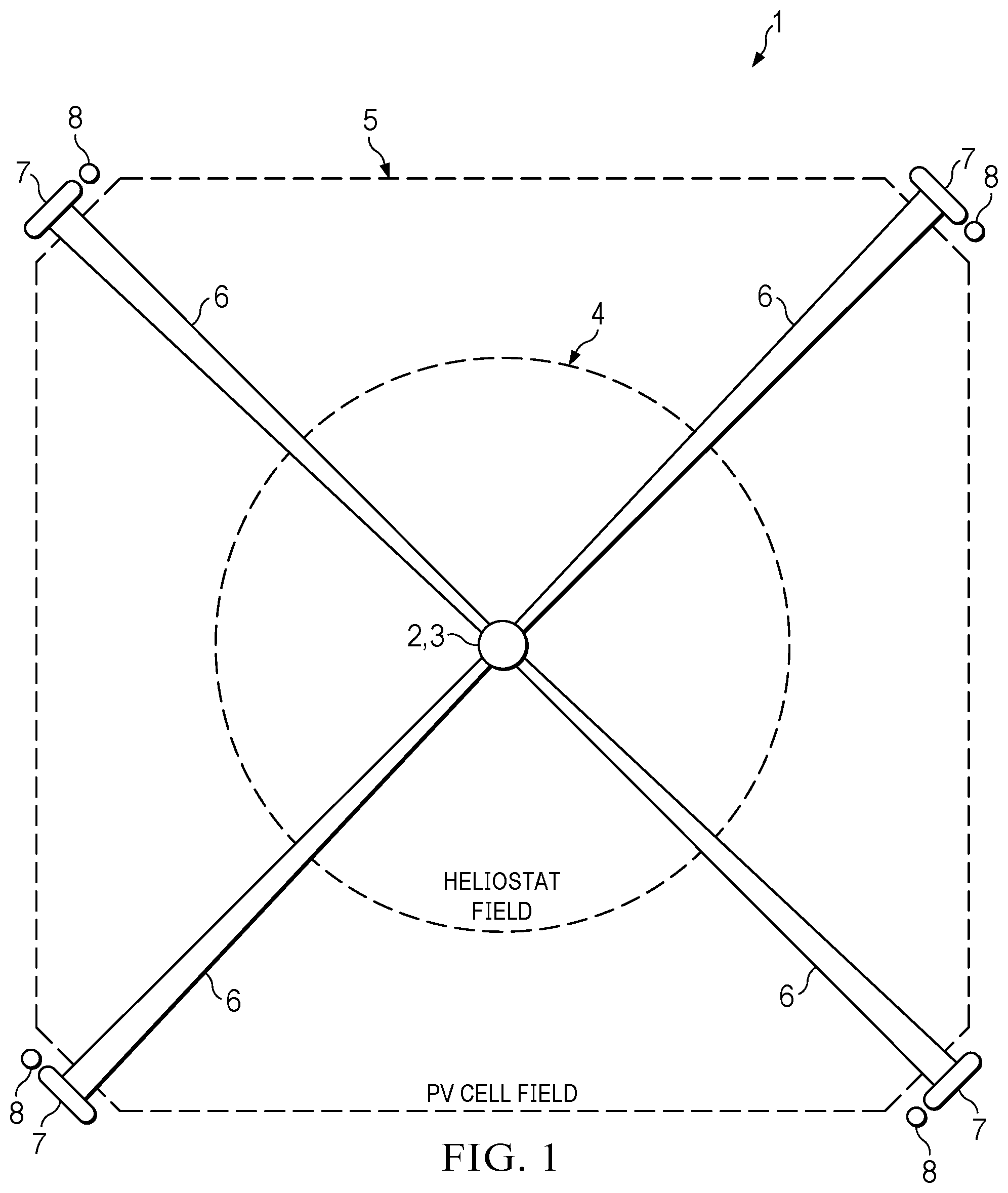
is a top plan view of a seawater distillation system in accordance with an aspect of the present disclosure.
is a diagrammatic view of the seawater distillation system in accordance with the aspect of the present disclosure shown in .
is a partial longitudinal section view of an apparatus of the seawater distillation system taken in the direction of line 3 - 3 shown in .
is a partial longitudinal section view of the apparatus of the seawater distillation system taken in the direction of line 4 - 4 shown in .
is a partial longitudinal section view of an alternative apparatus of the seawater distillation system.
is a partial longitudinal section view of the alternative apparatus of the seawater distillation system shown in .
is an exemplary method flowchart for evaporating seawater and removing salt.
is a diagrammatic view of another seawater distillation system in accordance with another aspect of the present disclosure.
is a diagrammatic view of another seawater distillation system in accordance with another aspect of the present disclosure.
is a longitudinal sectional view of another apparatus of a seawater distillation system.
is a cross-sectional view of the apparatus taken in the direction line 11 - 11 in .
is a longitudinal sectional view of another apparatus of a seawater distillation system.
is a cross-sectional view of the apparatus taken in the direction line 13 - 13 in .
is a longitudinal sectional view of another apparatus of a seawater distillation system.
is a diagrammatic view of another seawater distillation system in accordance with another aspect of the present disclosure.
A is a sectional view of another apparatus of a seawater distillation system.
B is an enlargement that is highlighted in A .
is a sectional view of the apparatus taken in the direction of line 17 - 17 shown in A .
is a sectional view of another apparatus of a seawater distillation system.
A is a partial cut away view of a conveyor assembly and a heating tube assembly of the apparatus shown in .
B is a sectional view of the apparatus taken in the direction of line 19 B- 19 B shown in .
C is an enlargement that is highlighted in B .
Similar numbers refer to similar parts throughout the drawings.
DETAILED DESCRIPTION
illustrates a seawater distillation system (hereinafter “SDS”), generally referred to as 1 . SDS 1 may include a solar tower 2 that is positioned at a central location in the SDS 1 . SDS 1 may also include an apparatus or machine, generally referred to as 3 , that is operably engaged with the solar tower 2 (see ). The apparatus 3 may be operably engaged at a terminal end of the solar tower 2 at a predetermined height above ground level (see ). In other exemplary embodiment, an apparatus of a SDS may be positioned at any suitable location on a tower or remote from the tower. As explained in more detail below, the apparatus 3 is configured to separate precipitated salt from volumes of seawater entering into the machine via a seawater pipeline operably engaged with the tower 2 and the apparatus 3 . As explained in more detail below, the apparatus 3 is also configured to evaporate seawater into steam inside of the apparatus 3 during distillation operations. Such components and assemblies of the apparatus 3 are provided in more detail below.
Referring to , SDS 1 also includes a plurality of heliostats provided at ground surface, which is generally referred to as 4 . The plurality of heliostats 4 are circumferentially arranged about the solar tower 2 and the apparatus 3 in the SDS 1 (see arrangement labeled “Heliostat Field” in ). In other exemplary embodiments, any suitable arrangement may be used to arrange a plurality of heliostats about a solar tower and an apparatus. Each heliostat of the plurality of heliostats 4 is also configured to the reflect a beam of photons, received from the Sun, at the apparatus 3 . Such reflection of photons on the apparatus 3 via the plurality of heliostats 4 provides an external heat source on the apparatus 3 that is independent of said apparatus 3 . The heat source provided on the apparatus 3 from the plurality of heliostats 4 is equal to or greater than the boiling point of water. Such use of external heat created by the plurality of heliostats 4 on the apparatus 3 is described in more detail below. In other exemplary embodiments, any suitable source of power or energy may be used to heat the apparatus 3 to a desired temperature, preferably equal to or greater than the boiling point of water. Examples of suitable sources of power or energy used to heat an apparatus may include solar energy, geothermal energy, nuclear energy, fossil fuel energy, wood energy, hydrogen energy, or other types of energy suitable to heat an apparatus at a desired temperature, preferably equal to or greater than the boiling point of water
In the illustrated embodiment, each heliostat of a plurality of heliostats 4 may provide flat mirror design to provide an external heat source on the apparatus 3 . In other exemplary embodiments, any suitable plurality of heliostats may be used to provide an external heat source on an apparatus. In one exemplary embodiment, each heliostat of the plurality of heliostats may have a curved or parabolic mirror design to provide a more concentrated external heat source on an apparatus.
Still referring to , SDS 1 also includes a plurality of photovoltaic cells (hereinafter “PV cells”) provided at ground surface, which is generally referred to as 5 . The plurality of PV cells 5 are circumferentially arranged about the plurality of heliostats 4 and about the tower 2 and apparatus 3 (see arrangement labeled “PV Cell Field” in ). In other exemplary embodiments, any suitable arrangement may be used to arrange a plurality of PV cells about a plurality of heliostats, a solar tower, and an apparatus. In the illustrated embodiment, the plurality of PV cells 5 is electrically connected to the apparatus 3 for providing external power to the mechanical and electrical components of the apparatus 3 , which are described in more detail below. Moreover, the plurality of PV cells 5 may be electrically connected to other devices or components provided in SDS 1 .
While the plurality of PV cells 5 provided power to the electrical and mechanical devices of the apparatus 3 , any suitable power source may be used to power electrical and mechanical devices of an apparatus. Examples of suitable power source to power electrical and mechanical devices of an apparatus include solar energy, geothermal energy, nuclear energy, fossil fuel energy, wood energy, hydrogen energy, or other types of energy for providing power to electrical and mechanical devices of an apparatus
Still referring to , SDS 1 may also include at least one steam line 6 operably engaged with the tower 2 and the apparatus 3 . The at least one steam line 6 is configured to convey a volume of steam from the apparatus 3 to at least one condenser 7 of SDS 1 , which is described in more detail below. In the illustrated embodiment, SDS 1 includes four steam lines 6 that operably engage with the tower 2 and the apparatus 3 and convey steam to four condensers 7 . In other exemplary embodiments, any suitable number of steam lines and condenser may be used in a SDS based on various considerations, including the volume of seawater converted to steam, the overall size of the SDS, and other various considerations. Additionally, the at least one condenser 7 of SDS 1 is configured to convert and/or condense a volume of steam into fresh, distilled water. Such removal of salt from the seawater, via the apparatus 3 , is described in more detail below. The at least one condenser 7 may be operably engaged with at least one PV cell of the plurality of PV cells 5 for powering the at least one condenser 7 . In other exemplary embodiments, any suitable power source may power at least one condenser to convert steam into fresh water.
The fresh water condensed by the at least one condenser 7 is pumped into at least one fresh water tank 8 via at least one pump 9 . The at least one pump 9 is operably engaged to the at least one condenser 7 and the at least one fresh water tank 8 via water line “WL” shown in . The at least one pump 9 may be operably engaged with at least one PV cell of the plurality of PV cells 5 for powering the at least one pump 9 . In other exemplary embodiments, any suitable power source may power at least one pump to convey fresh water from at least one condenser to at least one fresh water tank.
Referring to , SDS 1 may include a salt tank or container 10 that is operably engaged with the apparatus 3 and the solar tower 2 . The salt tank 10 may be configured to receive and house precipitated salt separated and collected by the apparatus 3 during a separation operation, which is described in more detail below. The apparatus 3 may convey the precipitated salt to the salt tank 10 via at least one salt line “SL” shown in . The precipitated salt collected by the apparatus and housed in the salt tank 10 may be used for other suitable purposes deemed fit.
Referring to , the apparatus 3 may include a vessel 20 . The vessel 20 may have a closed top end 20 A, an opposing closed bottom end 20 B, and a longitudinal axis defined therebetween. A portion of the vessel 20 proximate to the bottom end 20 B may be rounded or curvilinear. Such use of the rounded or curvilinear shape is described in more detail below. In other exemplary embodiments, a portion of a vessel proximate to a bottom end may define any suitable shape or configuration. The vessel 20 also includes a circumferential wall 22 that extends between the top end 20 A and the bottom end 20 B. The vessel 20 also defines a chamber 24 that extends between the top end 20 A and the bottom end 20 B. With the closed ends 20 A, 20 B of the vessel 20 , the vessel 20 is pressurized and sealed at a desired atmospheric pressure greater than the ambient pressure exterior to the chamber 24 .
Referring to , the vessel 20 defines an inlet opening 26 in the circumferential wall 22 between the top end 20 A and the bottom end 20 B. The inlet opening 26 of the vessel 20 provides fluid communication between a seawater line 29 A and the chamber 24 defined by the vessel 20 where the seawater line 29 A is able to deliver seawater from a body of seawater into the vessel 20 via at least one pump connected to a main seawater line “SWL” (see ). The vessel 20 also defines an output opening 28 A in the circumferential wall 22 between the top end 20 A and the bottom end 20 B opposite to the inlet opening 26 relative to the longitudinal axis of the vessel 20 . The output opening 28 A of the vessel 20 provides fluid communication between a vessel steam line 29 B and the chamber 24 defined by the vessel 20 where the vessel steam line 29 B is able to deliver steam from the apparatus 3 to the at least one steam line 6 previously described above. The vessel 20 also defines a lower output opening 28 B in the circumferential wall 22 between the top end 20 A and the bottom end 20 B. The lower output opening 28 B is defined opposite to the inlet opening 26 and defined vertically below the output opening 28 A relative to the longitudinal axis of the vessel 20 . The lower output opening 28 B of the vessel 20 provides fluid communication between the chamber 24 defined by the vessel 20 and the salt line “SL” where the salt line “SL” is able to deliver precipitated salt from the apparatus 3 to the at least one salt tank 10 previously described above. To maintain pressure inside of the vessel, at least one lock chamber (not illustrated) may be positioned within the salt line “SL” to transport precipitated salt from the apparatus 3 to the salt tank 10 without depressurizing the vessel 20 . In other words, the lock chamber creates a two-stage seal mechanism that prevents depressurization of the vessel 20 during operation.
Referring to , the apparatus 3 may include a separation or removal assembly 40 operably engaged with the vessel 20 . The separation assembly 40 may also be configured to separate and/or remove a volume of salt from the volume of seawater inside of the vessel 20 . The separation assembly 40 includes a structural support 42 that is operably engaged with the vessel 20 . The structural support 42 includes a first end 42 A, an opposing second end 42 B, and a longitudinal axis defined therebetween. The first end 42 A and the second end 42 B of the structural support 42 is operably engaged with the circumferential wall 22 of the vessel 20 inside of the chamber 24 . The structural support 42 is also structurally configured with the vessel 20 A that the structural support 42 is able to rotate about its longitudinal axis when engaged with the vessel 20 . Such rotation of the structural support 42 is described in more detail below.
Referring to , the separation assembly 40 may include a bearing set 44 operably engaged with the structural support 42 . The bearing set 44 is adapted to provide stability and support to the structural support 42 when the structural support 42 is rotating during a separation operation. As illustrated in , the bearing set 44 includes a first bearing 44 A and an opposing second bearing 44 B. The first bearing 44 A is operably engaged with the structural support 42 at the first end 42 A of the structural support 42 . The second bearing 44 B is also operably engaged with the structural support 42 but at the second end 42 B of the structural support 42 . In the illustrated embodiment, the first and second bearings 44 A, 44 B may be ball bearings that provide stability and support to the structural support 42 when the structural support 42 is rotating during a separation operation. In other exemplary embodiments, any suitable bearing or rotational support member may be used to provide stability and support to a structural support when the structural support is rotating during a separation operation.
Still referring to , the separation assembly 40 may include a drive assembly 46 that is operably engaged with the structural support 42 and the vessel 20 . The drive assembly 46 may be configured to provide movement and rotation to the structural support 42 to perform a separation operation, which is described in more detail below. The drive assembly 46 may include any suitable components, devices, apparatus, or machines to suitable rotate the structural support during a separation operation. As illustrated in , the drive assembly 46 is a rotary-style drive assembly that rotates the structural support 42 and other components operably engaged with the structural support 42 (explained in detail below) about the longitudinal axis of said structural support 42 . As illustrated in , an alternative separation assembly 40 ′ of an alternative apparatus 3 ′ may include a drive assembly 46 ′ that is a chain and sprocket-style drive assembly that rotates the structural support 42 ′ and other components operably engaged with the structural support 42 ′ (explained in detail below) about the longitudinal axis of said structural support 42 ′.
Still referring to , the separation assembly 40 may include at least one rotating frame 48 operably engaged with the structural support 42 and radially extends away from the structural support 42 . The at least one rotating frame 48 include a terminal end 49 that is complementary in shape with the bottom end 20 B of the vessel 20 . In the illustrated embodiment, the terminal end 49 of the at least one rotating frame 48 is curvilinear and/or rounded to complementary match the curvilinear and/or rounded bottom end 20 B of the vessel 20 . Such complementary shape between the at least one rotating frame 48 and the bottom end 20 B of the vessel 20 is considered advantageous at least because the at least one rotating frame 48 may be able to efficiently collect a volume of salt from the seawater bath that settle at the bottom end 20 B of the vessel 20 . As illustrated in , the separation assembly 40 includes six equally distanced rotating frames 48 that are operably engaged with the structural support 42 and radially extend away from the structural support 42 .
Still referring to , the separation assembly 40 may include a set of screens or colanders 50 operably engaged with the at least one rotating frame 48 . The set of screens 50 are configured to the collect and gather precipitate salt from the externally heat seawater while allowing the water to permeate through each collecting member of the set of screens 50 . As such, the set of screens 50 are adapted to hold a predetermined volume of salt when rotating with the at least one rotating frame 48 and structural support 42 during a separation operation. In the illustrated embodiment, the set of screens 50 provided on the at least one rotating frame 48 includes four screens 50 . In other exemplary embodiments, any suitable number of screens or colander may be operably engaged with a single rotating frame including but not limited to one screen, at least one screen, two screens, a plurality of screens, three screens, and any other suitable numbers of screens or colanders operably engaged with a single rotating frame. In the illustrated embodiment, the set of screens 50 are relatively flat and parallel with the at least one rotating frame (see ). In other exemplary embodiments, each screen of a set of screens may defined any suitable size, shape, or configuration based on various considerations, including the configuration of a vessel, the amount of seawater injected into the vessel, and other various considerations.
Still referring to , the separation assembly 40 may include a housing member 52 . The housing member 52 may be operably engaged with the structural support 42 . In one exemplary embodiment, a housing member may be operably engaged with a vessel and remote from the structural support in which the housing member is independent of the structural support. The housing member 52 may define a cavity 54 that is configured to collect precipitated salt from the set of screens 50 once the set of screens 50 of at least one rotating frame 48 is substantially vertical above the housing member 52 and the precipitated salt falls off of the screens 50 . In other exemplary embodiments, a housing member may be omitted and a cavity may be defined in a structural support for collecting precipitated salt from a set of screens.
Still referring to , the separation assembly 40 may include a salt conveyor 56 . The salt conveyor 56 includes a first end 56 A, an opposing second end 56 B, and a longitudinal axis defined therebetween. The salt conveyor 56 may be operably engaged with the vessel 20 and extend through the lower output opening 28 B of the vessel 20 . The salt conveyor 56 may be powered by the drive assembly 46 or be powered by an independent drive assembly separate from the drive assembly 46 . The salt conveyor 56 is also configured to receive a continuous volume of precipitate salt from the cavity 54 and transport the volume of precipitate salt to the at least one salt tank 10 via the salt line “SL.” In the illustrated embodiment, the salt conveyor 56 may be sloped upwardly from the first end 56 A to the second end 56 B relative to a longitudinal axis of the structural support 42 . The upward slope or angle of the salt conveyor 56 allows for water to drip off of the precipitated salt when being transported along the longitudinal axis of the salt conveyor 56 from the first end 56 A to the second end 56 B in other exemplary embodiments, a salt conveyor may be configured at any suitable angle relative to the structural support.
Referring to , the apparatus 3 may include at least one mist eliminator 70 . In the illustrated embodiment, the apparatus 3 includes a single mist eliminator 70 . In other exemplary embodiments, any suitable number of mist eliminators may be used in an apparatus based on various considerations, including the size, shape, and configuration of the vessel, the volume of seawater injected into the vessel, and other various considerations of the like. The mist eliminator 70 may be operably engaged with the circumferential wall 22 inside of the chamber 24 vertically above the separation assembly 40 and vertically above the seawater bath that is held inside of the vessel 20 . In the illustrated embodiment, the mist eliminator 70 is configured to remove water droplets and precipitated salt from the steam when converted from the seawater. As the steam passes through the mist eliminator 70 into the vessel steam line 29 B, the steam fails to contain or comprise of any water droplets or salt. In other words, the mist eliminator 70 purifies the steam converted from seawater prior to be transported to the at least one condenser 7 .
Having now described the components and assemblies of the apparatus 3 , methods of using the apparatus 3 may be described below.
As illustrated in , a continuous volume of seawater is pumped into the vessel 20 , via the seawater line 29 A, from the main seawater pipeline “SWL” of the SDS 1 . Once the seawater enters into the vessel 20 , via the inlet opening 26 , a seawater bath is formed inside of the vessel 20 . Once inside of the vessel 20 , the seawater bath begins to increase in temperature due to the external heat created on the vessel 20 via the plurality of heliostats 4 directed at the apparatus 3 .
Upon entrance of the seawater, the separation assembly 40 may begin separating and/or removing precipitated salt from the seawater bath once the salt from the seawater begins to precipitate or crystallize out of the seawater (via the external heat source). During this operation, the drive assembly 46 may begin rotating the structural support 42 about the longitudinal axis of the structural support 42 . Once the structural support 42 begins to rotate, the at least one rotating frame 48 with the set of screens 50 rotates with the structural support 42 inside of the vessel 20 . During the separation operation, the at least one rotating frame 48 rotates towards the bottom end 20 B of the vessel 20 where the set of screens 50 collects and traps a volume of precipitated salt from seawater bath while allowing seawater to permeate through. The set of screens 50 are able to collect the volume of precipitate salt due to the configuration of the screens 50 entrapping salt. Moreover, the external heat created by the plurality of heliostats on the vessel 20 may be provide ease of gathering and collecting precipitate salt from the seawater bath.
Once a volume of precipitate salt is collected, the at least one rotating frame 48 , along with the set of screens 50 , rotates away from the bottom end 20 B of the vessel 20 towards the mist eliminator 70 and the top end 20 A of the vessel 20 (see ). Once the at least one rotating frame 48 is substantially vertically over the cavity 54 , the precipitated salt on the set of screens 50 falls from the screens 50 and into the cavity 54 towards the salt conveyor 56 . Once on the salt conveyor 56 , the precipitated salt is transported from the first end 56 A towards the second end 56 B and into the salt line “SL.” During transportation, any excess water provided on the precipitated salt may be drained from the precipitated salt due to the angle of the salt conveyor 56 inside of the vessel 20 .
Once inside of the salt line “SL” and away from the vessel, the precipitated salt may be housed inside of the lock chamber downstream on the salt line “SL” and away from the vessel 20 . The lock chamber may be configured to transport a volume of precipitated salt from the vessel 20 to the at least one salt tank 10 while maintaining the pressure and heat inside of the vessel 20 . In other exemplary embodiments, any suitable number of lock chambers may be used with an apparatus for transporting volumes of precipitated salt from a vessel to at least one salt tank while maintaining the constant pressure and heat inside of the vessel.
Referring to , the bath of seawater housed inside of the vessel 20 may convert from the liquid to steam via the external heat created by the plurality of heliostats 4 on the vessel 20 . As the steam rises from the seawater bath, the steam permeates through the mist eliminator 70 . As described above, the mist eliminator 70 will purify the steam by eliminating and/or removing water droplets and/or precipitated salt from the steam. As the steam passes through the mist eliminator 70 , the steam travels through the output opening 28 A and into the vessel steam line 29 B. Once inside of the vessel steam line 29 B, the steam is transported into the at least one steam line 6 of SDS 1 and into the at least one condenser 7 . Once inside of the at least one condenser 7 , the at least one condenser 7 condenses and/or converts the purified steam into fresh, distilled water. The fresh water condensed by the at least one condenser is transported to at least one fresh water tank via water lines “WL” shown in .
The separation of salt and distillation of seawater may be repeated discretely or continuously based on the SDS. As illustrated above, the SDS 1 would be a continuous operation in which separation of salt and distillation of seawater would be continuously performed.
It should be understood that are diagrammatic only for the SDS 1 and do not illustrate exact and precise dimensions of any component, assembly, or apparatus provided herein. Such diagrammatic illustrations of the apparatus 3 and the remaining machines, components, and systems of the SDS 1 shown in should not limit the exact positioning, orientation, or location of the apparatus 3 and the remaining machines, components, and systems of the SDS 1 relative to one another.
illustrates a method 100 of converting seawater into fresh water. An initial step 102 of method 100 includes introducing a volume of seawater into a vessel of a machine. Another step 104 includes separating a volume of salt from the volume of seawater, via a separation assembly of the machine, inside of the vessel. Another step 106 includes conveying a volume of salt, via a conveyor of the separation assembly, outside of the vessel. Another step 108 includes evaporating the volume of seawater to steam, via an external device, inside of the vessel. Another step 110 includes eliminating water droplets and salt from the steam, via a mist evaporator, inside of the vessel. Another step includes converting steam into fresh water, via at least one condenser, remote from the machine.
illustrates another system 200 similar to system 1 provided in , except as detailed below. In the illustrated embodiment, the system 200 may be configured to use solar power to distill seawater into fresh water and salt. As illustrated in , a plurality of parabolic troughs 204 may be provided in the system 200 (see “Solar Field” label in ). Each parabolic trough of the plurality of parabolic troughs 204 may include a parabolic reflector or curved mirror that houses an absorber tube or trough holding a volume of molten salt. The molten salt may be transported from plurality of parabolic troughs 204 via a molten salt transport system 210 . The molten salt transport system 210 may include a hot salt tank 210 A, which is in fluid communication with the plurality of parabolic troughs 204 . The hot salt tank 210 A is adapted to be heated at a first temperature to maintain or further heat the molten salt.
The molten salt is then transported into an apparatus 203 (substantially similar to apparatus 3 described above) for heating the apparatus 203 as compared to be heated by the plurality of heliostats 4 in SDS 1 described above. In other exemplary embodiment, molten salt transported into an apparatus via a molten salt transport system may provide an internal heat source to the apparatus while a plurality of heliostats provides an external heat source on an apparatus. In system 200 , the apparatus 203 is remote from the plurality of parabolic troughs 204 .
Once separated by the apparatus 203 , the molten salt is then transported to a cold salt tank 210 B of the molten salt transport system 210 , which is in fluid with the apparatus 203 . Additionally, salt collected by the apparatus 203 may be transferred into the molten salt transport system 210 or into a salt transport system 212 for housing useable salt (similar to the salt storage 10 described above). In this salt transport system 212 , the salt would be transported to a salt processing stage 212 A for suitable processing techniques and methods and then transported to a salt storage 212 B. The cold salt tank 210 B is adapted to be heated at a second temperature less than first temperature of the hot salt tank 210 A. This molten salt is then transported back into the plurality of parabolic troughs 204 to be heated once again. This transportation of molten salt along the molten salt transport system 210 may continuously provide internal heat to the apparatus 203 to convert seawater into steam.
It should be understood that is diagrammatic only for the SDS 200 and do not illustrate exact and precise dimensions of any component, assembly, or apparatus provided herein. Such diagrammatic illustrations of the apparatuses, machines, components, and systems of the SDS 200 shown in should not limit the exact positioning, orientation, or location of the apparatuses, machines, components, and systems of the SDS 200 relative to one another.
illustrates another system 300 similar to systems 1 and 200 provided in , except as detailed below. In the illustrated embodiment, the system 300 may be configured to use solar power to distill seawater into fresh water and salt (i.e., using concentrated solar power technology). As illustrated in , a solar tower 302 may be provided in an epicenter of a plurality of heliostats 304 that is circumferentially disposed about the tower 302 . As compared to systems 1 and 200 , the tower 302 holds a continuous volume of molten salt that is heated via the external heat source created by the plurality of heliostats 304 . The molten salt may be transported from tower 302 and away from tower 302 via a molten salt transport system 310 . The molten salt transport system 310 may include a hot salt tank 310 A, which is in fluid communication with the tower 302 . The hot salt tank 310 A is adapted to be heated at a first temperature to maintain or further heat the molten salt.
The molten salt is then transported into an apparatus 303 (substantially similar to apparatuses 3 , 203 described above) for heating the apparatus 303 as compared to be heated by the plurality of heliostats 4 in SDS 1 described above. In other exemplary embodiment, molten salt transported into an apparatus via a molten salt transport system may provide an internal heat source to the apparatus while a plurality of heliostats provides an external heat source on an apparatus. In the illustrated embodiment, the apparatus 303 may be provided at ground level remote from the tower 302 . In other exemplary embodiments, an apparatus may be placed at any suitable location relative to a tower.
Once separated by the apparatus 303 , the molten salt is then transported to a cold salt tank 3108 of the molten salt transport system 310 , which is in fluid with the apparatus 303 . Additionally, salt collected by the apparatus 303 may be transferred into the molten salt transport system 310 or into a salt transport system 312 for housing useable salt (similar to the salt storage 10 described above). In this salt transport system 312 , the salt would be transported to a salt processing stage 312 A for suitable processing techniques and methods and then transported to a salt storage 312 B. The cold salt tank 310 B is adapted to be heated at a second temperature less than first temperature of the hot salt tank 310 A. This molten salt is then transported back into the tower 302 to be heated once again via the external heat source created by the plurality of heliostats 304 . This transportation of molten salt along the molten salt transport system 310 may continuously provide internal heat to the apparatus 303 to convert seawater into steam.
It should be understood that is diagrammatic only for the SDS 300 and do not illustrate exact and precise dimensions of any component, assembly, or apparatus provided herein. Such diagrammatic illustrations of the apparatuses, machines, components, and systems of the SDS 300 shown in should not limit the exact positioning, orientation, or location of the apparatuses, machines, components, and systems of the SDS 300 relative to one another.
illustrate another seawater distillation system (SDS) 400 that is substantially similar to the SDS 1 illustrated in through 4 , except as detailed below. The SDS 400 has an apparatus 403 that is substantially similar to the apparatus 3 of the SDS 1 , except as detailed below.
Referring to , the apparatus 403 may include a vessel 420 . The vessel 420 may have a closed top end 420 A, an opposing closed bottom end 420 B, and a longitudinal axis defined therebetween. A portion of the vessel 420 proximate to the bottom end 420 B may be rounded or curvilinear. Such use of the rounded or curvilinear shape is described in more detail below. In other exemplary embodiments, a portion of a vessel proximate to a bottom end may define any suitable shape or configuration. The vessel 420 also includes a circumferential wall 422 that extends between the top end 420 A and the bottom end 420 B. The circumferential wall 422 defines a diameter 423 (see ) that is continuous from the top end 420 A towards the bottom end 420 B. In one exemplary embodiment, the diameter 423 defined by the circumferential wall 422 is about four feet. The top end 420 A, the bottom end 420 B, and the circumferential wall 422 collectively define a chamber 424 that extends between the top end 420 A and the bottom end 420 B. With the closed ends 420 A, 420 B of the vessel 420 , the vessel 420 is pressurized and sealed at a desired atmospheric pressure greater than the ambient pressure exterior to the chamber 424 .
Referring to , the vessel 420 defines an inlet opening 426 in the circumferential wall 422 at a position between the top end 420 A and the bottom end 420 B. The inlet opening 426 of the vessel 420 provides fluid communication between a seawater line 429 A (see ) and the chamber 424 defined by the vessel 420 . The seawater line 429 A is able to deliver seawater from a body of seawater into the vessel 420 via at least one pump (e.g., the at least one pump 9 ) connected to a main seawater line “SWL” (see ). The vessel 420 also defines an output opening 428 A in the circumferential wall 422 at a position between the top end 420 A and the bottom end 420 B opposite to the inlet opening 426 relative to the longitudinal axis of the vessel 420 . The output opening 428 A of the vessel 420 provides fluid communication between a vessel steam line 429 B and the chamber 424 defined by the vessel 420 ; the vessel steam line 429 B is able to deliver steam from the apparatus 403 to the at least one steam line previously described above.
Still referring to , the apparatus 403 may include a base frame 430 to hold the vessel 420 . The base frame 430 may include a first or top end 430 A, an opposing second or bottom end 430 B, a first or left side 430 C, and an opposing second or right side 430 D. The base frame 430 also includes a platform 432 that is operably engaged between the left and right sides 430 C, 430 D of the base frame 430 . The platform 432 includes an upper support wall 434 that extends longitudinally along the platform 432 between the left and right sides of the base frame 430 . The platform 432 may also include a set of heat shields 436 . Each heat shield of the set of heat shields 436 may be operably engaged with the base frame 430 to fully encapsulate devices operably engaged with the platform 432 inside of the base frame 430 . Such use and purpose of the set of heat shields 436 is described in more detail below.
Referring to , the apparatus 403 may include a separation or removal assembly 440 operably engaged with the vessel 420 . The separation assembly 440 may also be configured to separate and/or remove a volume of salt from the volume of seawater inside of the vessel 420 , which is described in more detail below. The separation assembly 440 includes a structural support or wheel 442 that is operably engaged with the vessel 420 . The wheel 442 includes a circumferential base wall 442 A operably engaged with a first lateral wall 442 B and an opposing second lateral wall 442 C (see ). The wheel 442 is also structurally configured with the vessel 420 where the wheel 442 is able to move and/or rotate inside of the vessel 420 during separation operations. Such rotation of the wheel 442 is described in more detail below. The wheel 442 also defines a diameter 443 (see ) that is complementary to the diameter 423 of the vessel 420 . In other words, the diameter 443 of the wheel 442 is substantially equal to the diameter 423 of the vessel 420 where the wheel 442 is able to collect and gather precipitate salt while still being able to move and/or rotate inside of the vessel 420 during separation operations. In one exemplary embodiment, the diameter 443 of the wheel 442 is about four feet where the wheel 442 is able to collect and gather precipitate salt while still being able to move and/or rotate inside of the vessel 420 .
The separation assembly 440 also includes a drive assembly 444 operably engaged with the wheel 442 . As illustrated in , the drive assembly 444 has a drive shaft 444 A with a first or front end 444 A 1 , an opposing second or rear end 444 A 2 , and a longitudinal axis defined therebetween. The drive shaft 444 A is operably engaged with the wheel 442 via first and second cross members 444 B, 444 C. In the illustrated embodiment, the first and second cross members 444 B, 444 C are operably engaged with the circumferential base wall 442 A of the wheel 442 . Such engagement between the drive assembly 444 and the wheel 442 allows the drive assembly 444 to move the wheel 442 about the longitudinal axis of the drive shaft 444 A via a motor (not illustrated) or similar mechanism operably engaged with said drive shaft 444 A. The movement of the wheel 442 via the drive assembly 444 is denoted by arrows labeled “R 1 ” in .
Referring to , the separation assembly 440 may include at least one bearing set 446 operably engaged with the base frame 430 . The at least bearing set 446 is adapted to provide stability and support to the wheel 442 when the wheel 442 is rotating during a separation operation. As illustrated in , the bearing set 446 includes a first bearing 446 A and an opposing second bearing 446 B. The first bearing 446 A is operably engaged with the drive shaft 444 A proximate to the first end 444 A 1 of the drive shaft 444 A. Similarly, the second bearing 446 B is operably engaged with the drive shaft 444 A proximate to the second end 444 A 2 of the drive shaft 444 A. In the illustrated embodiment, the first and second bearings 446 A, 446 B may be ball bearings that provide stability and support to the drive shaft 444 A of the drive assembly 444 when the drive shaft 444 A is rotating during a separation operation. In other exemplary embodiments, any suitable bearing or rotational support member may be used to provide stability and support to a structural support when the structural support is rotating during a separation operation.
Still referring to , the separation assembly 440 may include at least one set of collecting members 448 operably engaged with the wheel 442 . Specifically, the at least one set of collecting members 448 is operably engaged with the circumferential base wall 442 A, the first lateral wall 442 B, and the second lateral wall 442 C. In the illustrated embodiment, the separation assembly 440 includes a single set or flight of collecting members 448 . The set of collecting members 448 is considered advantageous at least because the set of collecting members 448 are configured to collect a volume of salt from the seawater bath that settle at the bottom end 420 B of the vessel 420 while allowing the water to drain through the set of collecting members 448 and back into the vessel 420 . Such separation operation by the set of collecting members 448 is described in more detail below.
The set of collecting members 448 is configured to the collect and gather precipitate salt from the externally heat seawater while allowing the water to permeate through each collecting member of the set of collecting members 448 . As such, the set of collecting members 448 are adapted to hold a predetermined volume of salt when rotating with the wheel 442 and drive assembly 444 during a separation operation. As illustrated in , each collecting member of the set of collecting members 448 has a first end 448 A operably engaged with the circumferential base wall 442 A, and opposing second end 448 B free from engagement and remote from the circumferential base wall 442 A, and a longitudinal axis defined therebetween. Each collecting member of the set of collecting members 448 also has a length 449 A defined between the first and second ends 448 A, 448 B (See ) and a width 449 B defined between the first and second lateral walls 442 B, 442 C (see ). In one exemplary embodiment, the width 449 B of each collecting member of the set of collecting members 448 is about sixteen inches based on a three to one ratio between the diameter 443 of the wheel 442 and the width 449 B of each collecting member of the set of collecting members 448 .
The second or terminal end 448 B of each collecting member of the set of collecting members 448 is complementary in shape with the bottom end 420 B of the vessel 420 . Such complementary shape between the at least one set of collecting members 448 and the bottom end 420 B of the vessel 420 is considered advantageous at least because the at least one set of collecting members 448 may be able to efficiently collect a volume of salt from the seawater bath that settles at the bottom end 420 B of the vessel 420 . As illustrated in , the separation assembly 440 includes sixteen equally distanced collecting members in the set of collecting members 448 that are operably engaged with the circumferential base wall 442 A and radially extend away from the circumferential base wall 442 A. In other exemplary embodiments, a separation assembly may include any suitable number of collecting members in a set of screens based on various considerations, including the size, shape, and configuration of the wheel, the size, shape and configuration of the vessel, and other various considerations of the like.
As illustrated in , each collecting member of the set of collecting members 448 is disposed at an angle relative to one or both of the first and second lateral walls 442 B, 442 C of the wheel 442 . The structural configuration of each collecting member of the set of collecting members 448 being disposed at an angle relative to one or both of the first and second lateral walls 442 B, 442 C is considered advantageous at least because the at least one set of collecting members 448 may be able to collect a volume of salt from the seawater bath that settles at the bottom end 420 B of the vessel 420 while draining water back into the seawater bath inside of the vessel 420 . In the illustrated embodiment, each collecting member of the set of collecting members 448 are relatively flat along its length (see ). In other exemplary embodiments, each collecting member of a set of collecting members may define any suitable size, shape, or configuration based on various considerations, including the configuration of a vessel, the amount of seawater pumped into the vessel, and other various considerations.
In the illustrated embodiment, each collecting member of the set of collecting members 448 is a porous wall (e.g., a screen, colander, and other devices of the like) to collect a volume of salt from the seawater bath that settle at the bottom end 420 B of the vessel 420 . Having each collecting member of set of collecting members being a porous wall is considered advantageous at least because the set of collecting members may be able to collect a volume of salt from the seawater bath that settle at a bottom end of a vessel while allowing the water to drain through the set of collecting members and back into the vessel for steam and condensing purposes. Such separation operation by the set of collecting members 448 is described in more detail below. In one exemplary embodiment, each collecting member of the set of collecting member may be a solid wall for scooping and retaining a volume of precipitate salt and water. In other words, each collecting member of the set of collecting member may act as a basket to collect a volume of salt from the seawater bath that settle at a bottom end of a vessel.
Referring to , a receptacle 450 is defined between each collecting member of the set of collecting members 448 , a portion of the circumferential base wall 442 A, a portion of the first lateral wall 442 B, and a portion of the second lateral wall 442 C. The receptacle 450 inside each collecting member of the set of collecting members 448 is configured to the collect and gather precipitate salt from the externally heat seawater while allowing the water to permeate through each collecting member of the set of collecting members 448 . As such, the set of collecting members 448 are adapted to hold a predetermined volume of salt when rotating with the wheel 442 and drive assembly 444 during a separation operation
Still referring to , the separation assembly 440 may include a salt conveyor 452 operably engaged with the vessel 420 . In the illustrated embodiment, the salt conveyor 452 is integral with the vessel 420 where the salt conveyor 452 and the vessel 420 depict a single, unitary member. The salt conveyor 452 defines an inlet opening 454 A that provides an additional access point into the chamber 424 of the vessel 420 . The salt conveyor 452 also defines an outlet opening 454 B at a position away from the vessel 420 exterior to the chamber 424 . As provided herein, the salt conveyor 452 is configured to receive a continuous volume of precipitate salt from the wheel 442 , collected by the set of collecting members 448 , and to transport the volume of precipitate salt to the at least one salt tank 10 via a salt line (e.g., salt line “SL”). In the illustrated embodiment, the salt conveyor 452 may have a funneled portion that extends inwardly from the inlet opening 454 A to the outlet opening 454 B for transporting volume of precipitate salt to the at least one salt tank 10 .
During operation, the salt conveyor 452 delivers the precipitated salt into the salt line where the salt line is able to deliver said precipitated salt from the apparatus 403 to at least one salt tank previously described above (e.g., the at least one salt tank 10 ). To maintain pressure inside of the vessel, at least one lock chamber (not illustrated) may be positioned within the salt line to transport precipitated salt from the apparatus 403 to the at least one salt tank without depressurizing the vessel 420 . In other words, the lock chamber creates a two-stage seal mechanism that prevents depressurization of the vessel 420 during operation. Such configuration is substantially equal to the lock chamber provided in the apparatus 3 described above.
Referring to , the apparatus 403 may include at least one mist eliminator 470 . In the illustrated embodiment, the apparatus 403 includes a first mist eliminator 470 A and a second mist eliminator 470 B. In other exemplary embodiments, any suitable number of mist eliminators may be used in an apparatus based on various considerations, including the size, shape, and configuration of the vessel, the volume of seawater injected into the vessel, and other various considerations of the like.
Each of the first and second mist eliminators 470 A, 470 B may be operably engaged with the circumferential wall 422 of the vessel 420 inside of the chamber 424 vertically above the separation assembly 440 and vertically above the seawater bath that is held inside of the vessel 420 . In the illustrated embodiment, the first and second mist eliminators 470 A, 470 B are configured to remove water droplets and precipitated salt from the steam when converted from the seawater. As the steam initially passes through the first mist eliminator 470 A, the steam endures a first purification stage where the first mist eliminator 470 A removes any water droplets or excess salt precipitate from said steam. For further removal, the steam endures a second purification stage where the second mist eliminator 470 B removes any remaining water droplets or excess salt precipitate from said steam. Upon passing through the first and second mist eliminators 470 A, 470 B, the steam is free of any water droplets or precipitated salt. In other words, the first and second mist eliminators 470 A, 470 B purifies the steam converted from seawater prior to be transported to the at least one condenser (e.g., the at least one condenser 7 ).
In the illustrated embodiment, the first mist eliminator 470 A is a single mesh type mist eliminator, and the second mist eliminator 470 B is a single vane or chevron (plate) type mist eliminator. In other exemplary embodiment, first and second mist eliminator may be any suitable type of mist eliminator geometry described herein or other available geometries based on the application for removing water droplets, precipitate salt, or other solids and fluids. The different geometries between the first mist eliminator 470 A and the second mist eliminator 470 B is considered advantageous at least because such difference in structural geometries allow for fine-tuning the performances of the mist eliminators to screen and remove solids and fluids in the steam.
Referring to , the first mist eliminator 470 A defines a first width “W 1 ” and the second mist eliminator 470 B defines a second width “W 2 ”; the first width “W 1 ” of the first mist eliminator 470 A is greater than the second width “W 2 ” of the second mist eliminator 470 B. In the illustrated embodiment, the first width “W 1 ” of the first mist eliminator 470 A is about eighteen inches, and the second width “W 2 ” of the second mist eliminator 470 B is about twelve inches. In other exemplary embodiments, first and second mist eliminators may define any suitable width based on the particular application. In one exemplary embodiment, a first width defined by a first mist eliminator is substantially equal to a second width defined by a second mist eliminator. In another exemplary embodiment, a first width defined by a first mist eliminator is less than a second width defined by a second mist eliminator.
Still referring to , the first mist eliminator 470 A is disposed at a first distance “D 1 ” away from the top end of the wheel 442 of the separation assembly 440 , and the second mist eliminator 470 B is disposed at a second distance “D 2 ” away from top end of the wheel 442 ; the second distance “D 2 ” is greater than the first distance “D 1 ” as shown in . In the illustrated embodiment, the first distance “D 1 ” is about four feet between the top end of the wheel 442 and the bottom end of the first mist eliminator 470 A, which substantially equal to the diameter of the wheel 442 . Additionally, the second distance “D 2 ” is about five feet between the top end of the wheel 442 and the bottom end of the second mist eliminator 470 B (or twelve inches above the first mist eliminator 470 A).
Still referring to , the apparatus 403 may also include at least one heater 480 operably engaged with the platform 432 , specifically with the upper support wall 434 of the platform 432 . Such engagement with the platform 432 and encapsulation by the set of heat shields 436 allows the base frame 430 to retain and conserve the heat energy generated by the at least one heater 480 . As such, the at least one heater 480 may be configured to provide external heat at the bottom end 420 B of the vessel 420 to evaporate the water from a liquid state to a vapor state (i.e., steam). During separation operations, the at least one heater 480 may be used when the apparatus 403 is provided on a ground surface.
The at least one heater 480 may be powered by propane gas or other similar fuels for generating heat for the at least one heater 480 . In other exemplary embodiments, any suitable energy source or mechanism may be used to power at least one heater for providing external heat at a bottom end of a vessel. In the illustrated embodiment, four heaters 480 are operably engaged with the base frame 430 inside of the platform 432 . In other exemplary embodiments, any suitable number of heaters may be operably engaged with a base frame inside of a platform based on various considerations, including the size, shape and configuration of a vessel.
Having now described the components and assemblies of the apparatus 403 , methods of using the apparatus 3 may be described below.
As illustrated in , a continuous volume of seawater is pumped into the vessel 420 , via the seawater line 429 A, from the main seawater pipeline “SWL” of the SDS 1 . Once the seawater enters into the vessel 420 , via the inlet opening 426 , a seawater bath is formed inside of the vessel 420 . Once inside of the vessel 420 , the seawater bath begins to increase in temperature due to the external heat created on the vessel 420 via the at least one heater 480 directed at the apparatus 403 .
Upon entrance of the seawater, the separation assembly 440 may begin separating and/or removing precipitated salt from the seawater bath once the salt from the seawater begins to precipitate or crystallize out of the seawater (via the external heat source). During this operation, the drive assembly 444 may begin rotating the wheel 442 about the longitudinal axis of the drive shaft 444 A. Once the wheel 442 begins to rotate, the set of collecting member 448 rotates with the wheel 442 inside of the vessel 420 . During the separation operation, the set of collecting members 448 rotates towards the bottom end 420 B of the vessel 420 where the set of collecting members 448 collects and traps a volume of precipitated salt from seawater bath while allowing water to permeate through (i.e., collecting members 448 being porous walls). The set of collecting members 448 is able to collect the volume of precipitate salt due to the configuration of each collecting member 448 entrapping salt. Moreover, the external heat created by the at least one heater 480 on the vessel 420 may also provide ease of gathering and collecting precipitate salt from the seawater bath.
Once a volume of precipitate salt is collected, the set of collecting members 448 rotates away from the bottom end 420 B of the vessel 420 towards the first and second mist eliminators 470 A, 470 B and the top end 420 A of the vessel 420 (see ). Once a collecting member of the set of collecting members 448 is substantially vertically over the salt conveyor 452 , the precipitated salt on the respective collecting member of the set of collecting members 448 falls from the respective collecting member and into the salt conveyor 452 . Specifically, the precipitated salt on the respective collecting member of the set of collecting members 448 falls from the respective collecting member and into the inlet opening 454 A of the salt conveyor 452 . Once in the salt conveyor 452 , the precipitated salt is transported from inlet opening 454 A towards the outlet opening 454 B and into the salt line. During transportation, any excess water provided on the precipitated salt may be drained from the precipitated salt due to the set of collecting members 448 being porous walls.
Once inside of the salt line “SL” and away from the vessel 420 , the precipitated salt may be housed inside of a lock chamber (not illustrated) downstream on the salt line and away from the vessel 420 . The lock chamber may be configured to transport a volume of precipitated salt from the vessel 420 to at least one salt tank (such as at least one salt tank 10 ) while maintaining the pressure and heat inside of the vessel 420 . In other exemplary embodiments, any suitable number of lock chambers may be used with an apparatus for transporting volumes of precipitated salt from a vessel to at least one salt tank while maintaining the constant pressure and heat inside of the vessel.
Referring to , the bath of seawater housed inside of the vessel 420 may evaporate from the liquid state to the vapor state (i.e., steam) via the external heat created by the at least one heater 480 on the vessel 420 . As the steam rises from the seawater bath, the steam permeates through the first mist eliminator 470 A. As described above, the first mist eliminator 470 A purifies the steam in a first purification stage by eliminating and/or removing water droplets and excess precipitated salt from the steam. As the steam passes through the first mist eliminator 470 A, the steam then permeates through the second mist eliminator 470 B. As described above, the second mist eliminator 470 B further purifies the steam in a second purification stage by further eliminating and/or removing water droplets and excess precipitated salt from the steam. As the steam passes through the second mist eliminator 470 B, the steam then passes through the output opening 428 A and into the vessel steam line 429 B.
Once inside of the vessel steam line 429 B, the steam is transported into at least one steam line (e.g., the at least one steam line 6 ) of SDS 1 and into at least one condenser (e.g., the at least one condenser 7 ). Once inside of the at least one condenser, the at least one condenser condenses and/or converts the purified steam into fresh, distilled water. The fresh water condensed by the at least one condenser is transported to at least one fresh water tank via water lines “WL” shown in .
The separation of salt and distillation of seawater may be repeated discretely or continuously based on the SDS. As illustrated above, the SDS would be a continuous operation in which separation of salt and distillation of seawater would be continuously performed.
The apparatus 403 may be used with any SDS 1 , 200 , 300 described and illustrated herein. In one instance, the apparatus 403 may be operably engaged with a solar tower (such as solar tower 2 ) where the at least one heater 480 may be removed and externally heated by a plurality of heliostats (such as the plurality of heliostats 4 ) at an elevated level above ground surface. In another instance, the apparatus 403 may also be powered by a plurality of photovoltaic (or PV) cells (such as the plurality of PV cells 5 ) to operate the drive assembly 444 and/or the at least one heater 480 . In another instance, any suitable device described and illustrated in SDS 1 , 200 , 300 may be operably engaged with the apparatus 403 for removing salt from seawater and providing fresh and/or potable water.
It should be understood that are diagrammatic only for the SDS 400 and do not illustrate exact and precise dimensions of any component, assembly, or apparatus provided herein. Such diagrammatic illustrations of the apparatus 403 and other machines, components, and systems of the SDS 400 shown in should not limit the exact positioning, orientation, or location of the apparatus 403 and machines, components, and systems of the SDS 400 relative to one another.
illustrate another seawater distillation system (SDS) 500 that is substantially similar to SDS 1 , 400 illustrated in through 4 and 10 through 11 , except as detailed below. The SDS 500 has an apparatus 503 that is substantially similar to the apparatus 403 of the SDS 400 , except as described below.
Referring to , the apparatus 503 may include a vessel 520 . The vessel 520 may have a closed top end 520 A, an opposing closed bottom end 520 B, and a longitudinal axis defined therebetween. A portion of the vessel 520 proximate to the bottom end 520 B may be rounded or curvilinear. Such use of the rounded or curvilinear shape is described in more detail below. In other exemplary embodiments, a portion of a vessel proximate to a bottom end may define any suitable shape or configuration. The vessel 520 also includes a circumferential wall 522 that extends between the top end 520 A and the bottom end 520 B. The circumferential wall 522 defines a diameter 523 that continuous from the top end 520 A towards the bottom end 520 B (see ). In one exemplary embodiment, the diameter 523 defined by the circumferential wall 522 is about six feet. The top end 520 A, the bottom end 520 B, and the circumferential wall 522 collectively define a chamber 524 that extends between the top end 520 A and the bottom end 520 B. With the closed ends 520 A, 520 B of the vessel 520 , the vessel 520 is pressurized and sealed at a desired atmospheric pressure greater than the ambient pressure exterior to the chamber 524 .
Referring to , the vessel 520 defines an inlet opening 526 in the circumferential wall 522 at a position between the top end 520 A and the bottom end 520 B. The inlet opening 526 of the vessel 520 provides fluid communication between a seawater line 529 A (see also ) and the chamber 524 defined by the vessel 520 . The seawater line 529 A is able to deliver seawater from a body of seawater into the vessel 520 via at least one pump (e.g., the at least one pump 9 ) connected to a main seawater line “SWL” (see ). The vessel 520 also defines an output opening 528 A in the circumferential wall 522 at a position between the top end 520 A and the bottom end 520 B opposite to the inlet opening 526 relative to the longitudinal axis of the vessel 520 . The output opening 528 A of the vessel 520 provides fluid communication between a vessel steam line 529 B and the chamber 524 defined by the vessel 520 where the vessel steam line 529 B is able to deliver steam from the apparatus 503 to the at least one steam line previously described above.
Still referring to , the apparatus 503 may include a base frame 530 to hold the vessel 520 . The base frame 530 may include a first or top end 530 A, an opposing second or bottom end 530 B, a first or left side 530 C, and an opposing second or right side 530 D. The base frame 530 also includes a platform 532 that is operably engaged between the left and right sides of the base frame 530 . The platform 532 includes an upper support wall 534 that extends longitudinally along the platform 532 between the left and right sides 530 C, 530 D of the base frame 530 . The platform 532 may also include a set of heat shields 536 . Each heat shield of the set of heat shields 536 may be operably engaged with the base frame 530 to fully encapsulate devices operably engaged with the platform 532 inside of the base frame 530 . Such use and purpose of the set of heat shields 536 is described in more detail below.
Referring to , the apparatus 503 may include a separation or removal assembly 540 operably engaged with the vessel 520 . The separation assembly 540 may be configured to separate and/or remove a volume of salt from the volume of seawater inside of the vessel 520 , which is described in more detail below. The separation assembly 540 includes a structural support or wheel 542 that is operably engaged with the vessel 520 . The wheel 542 includes a circumferential base wall 542 A operably engaged with a first lateral wall 542 B, an opposing second lateral wall 542 C (see ), a first intermediate wall 524 D (see ), and a second intermediate wall 524 E (see ). Here, the first intermediate wall 524 D may be proximate to the first lateral wall 524 B, and the second intermediate wall 524 E may be proximate to the second lateral wall 524 C. Such uses of the first and second intermediate walls 524 D, 524 E are described in more detail below.
The wheel 542 is also structurally configured with the vessel 520 such that the wheel 542 is able to move and/or rotate inside of the vessel 520 during separation operations. Such rotation of the wheel 542 is described in more detail below. The wheel 542 also defines a diameter 543 that is complementary to the diameter 523 of the vessel 520 (see ). In other words, the diameter 543 of the wheel 542 is substantially equal to the diameter 523 of the vessel 520 where the wheel 542 is able to collect and gather precipitate salt while still being able to move and/or rotate inside of the vessel 520 during separation operations. In one exemplary embodiment, the diameter 543 of the wheel 542 is about six feet where the wheel 542 is able to collect and gather precipitate salt while still being able to move and/or rotate inside of the vessel 520 during separation operations.
The separation assembly 540 also includes a drive assembly 544 operably engaged with the wheel 542 . As illustrated in , the drive assembly 544 has a drive shaft 544 A with a first or front end 544 A 1 , an opposing second or rear end 544 A 2 , and a longitudinal axis defined therebetween. The drive shaft 544 A is operably engaged with the wheel 542 via first and second cross members 544 B, 544 C. In the illustrated embodiment, the first and second cross members 544 B, 544 C are operably engaged with the circumferential base wall 542 A of the wheel 542 . Such engagement between the drive assembly 544 and the wheel 542 allows the drive assembly 544 to move the wheel 542 about the longitudinal axis of the drive shaft 544 A via a motor (not illustrated) or similar mechanism operably engaged with said drive shaft 544 A. The movement of the wheel 542 via the drive assembly 544 is denoted by arrows labeled “R 2 ” in . In one exemplary embodiment, a drive assembly may include a set of first cross members and a set of second cross members operably engaged with a wheel that allows the drive assembly to move and/or rotate the wheel during separation operations.
Referring to , the separation assembly 540 may include at least one bearing set 546 operably engaged with the base frame 530 . The at least bearing set 546 is adapted to provide stability and support to the wheel 542 when the wheel 542 is rotating during a separation operation. As illustrated in , the bearing set 546 includes a first bearing 546 A and an opposing second bearing 546 B. The first bearing 546 A is operably engaged with the drive shaft 544 A proximate to the first end 544 A 1 of the drive shaft 544 A. The second bearing 546 B is also operably engaged with the drive shaft 544 A proximate to the second end 544 A 2 of the drive shaft 544 A. In the illustrated embodiment, the first and second bearings 546 A, 546 B may be ball bearings that provide stability and support to the drive shaft 544 A of the drive assembly 544 when the drive shaft 544 A is rotating during a separation operation. In other exemplary embodiments, any suitable bearing or rotational support member may be used to provide stability and support to a structural support when the structural support is rotating during a separation operation.
Still referring to , the separation assembly 540 may include at least one set of collecting members 548 operably engaged with the wheel 542 . Specifically, the at least one set of collecting members 548 is operably engaged with the circumferential base wall 542 A, the first lateral wall 542 B, and the second lateral wall 542 C. In the illustrated embodiment, the separation assembly 540 includes a first set of collecting members 548 A, a second set of collecting members 548 B, and a third set of collecting members 548 C where the vessel 520 is sized and configured to hold the first, second, and third sets of collecting members 548 A, 548 B, 548 C. The first, second, and third sets of collecting members 548 A, 548 B, 548 C are considered advantageous at least because the additional sets of collecting members 548 allows the wheel 542 to collect a larger volume of salt from the seawater bath that settles at the bottom end 520 B of the vessel 520 , as compared to the separation assembly 440 described above, while allowing the water to drain through the set of collecting members 548 and back into the vessel 520 . Such separation operations by the sets of collecting members 548 A, 548 B, 548 C are described in more detail below.
The sets of collecting members 548 A, 548 B, 548 C is configured to the collect and gather precipitate salt from the externally heat seawater while allowing the water to permeate through each collecting member of the sets of collecting members 548 A, 548 B, 548 C. As such, the sets of collecting members 548 A, 548 B, 548 C are adapted to hold a predetermined volume of salt when rotating with the wheel 542 and drive assembly 544 during a separation operation. In the illustrated embodiment, each collecting member of the first, second, and third sets of collecting member 548 A, 548 B, 548 C is substantially similar to one another and are orientated in a mirrored-image relative to the circumferential wall 442 A of the wheel 442 . Inasmuch as the first, second, and third sets of collecting member 548 A, 548 B, 548 C are substantially similar, the following description will relate to the first set of collecting members 548 A. It should be understood, however, that the description of the first set of collecting members 548 A applies substantially equally to the second and third sets of collecting members 548 B, 548 C.
In the illustrated embodiment, each collecting member of the first sets of collecting members 548 A has a first end 548 A 1 operably engaged with the circumferential base wall 542 A, and opposing second end 548 A 2 free from engagement and remote from the circumferential base wall 542 A, and a longitudinal axis defined therebetween. Each collecting member of the first sets of collecting members 548 A also has a length 549 A 1 defined between the first and second ends 548 A 1 , 548 A 2 (see ). Each collecting member of the first sets of collecting members 548 A also has a width 549 A 2 (see ). For the first set of collecting members 548 A, each collecting member of the first set of collecting members 548 A has a width 549 A 2 that is defined between the first lateral wall 542 B and a first intermediate wall 542 D of the wheel 542 (see ). For the second set of collecting members 548 B, each collecting member of the second set of collecting members 548 B has a width 549 A 2 that is defined between the first intermediate wall 542 D of the wheel 542 and a second intermediate wall 542 E of the wheel 542 . (see ). For the third set of collecting members 548 C, each collecting member of the third set of collecting members 548 C has a width 549 A 2 that is defined between the second intermediate wall 542 E of the wheel 542 and the second lateral wall 542 C. (see ). In one exemplary embodiment, the width 549 A 2 of each collecting member of the sets of collecting members 548 A, 548 B, 548 C is about twenty-four inches based on a three to one ratio of the wheel diameter (diameter 543 of wheel 542 ) to the width (width 549 B) of each collecting member of a set of collecting members 548 A, 548 B, 548 C.
The second or terminal end 548 A 2 of each collecting member of the sets of collecting members 548 A, 548 B, 548 C is complementary in shape with the bottom end 520 B of the vessel 520 . Such complementary shape between the sets of collecting members 548 A, 548 B, 548 C and the bottom end 520 B of the vessel 520 is considered advantageous at least because the sets of collecting members 548 A, 548 B, 548 C may be able to collect a volume of salt from the seawater bath that settle at the bottom end 520 B of the vessel 520 . As illustrated in , the separation assembly 540 includes sixteen equally distanced collecting member in each set of collecting members 548 A, 548 B, 548 C that are operably engaged with the circumferential base wall 542 A and radially extend away from the circumferential base wall 542 A. In other exemplary embodiments, a separation assembly may include any suitable number of screens in a set of screens based on various considerations, including the size, shape, and configuration of the wheel and other various considerations.
As illustrated in , each collecting member of the sets of collecting members 548 A, 548 B, 548 C is disposed at an angle relative to one or all of the first lateral wall 542 B, the second lateral wall 542 C, the first intermediate wall 542 D, and the second intermediate wall 542 E of the wheel 542 . The structural configuration of each collecting member of the sets of collecting members 548 A, 548 B, 548 C being disposed at an angle relative to one or all of the first lateral wall 542 B, the second lateral wall 542 C, the first intermediate wall 542 D, and the second intermediate wall 542 E is considered advantageous at least because the sets of collecting members 548 A, 548 B, 548 C is able to collect a volume of salt from the seawater bath that settle at the bottom end 520 B of the vessel 520 . In the illustrated embodiment, each collecting member of the sets of collecting members 548 A, 548 B, 548 C are relatively flat along its length (see ). In other exemplary embodiments, each collecting member of a set of collecting members may define any suitable size, shape, or configuration based on various considerations, including the configuration of a vessel, the amount of seawater pumped into the vessel, and other various considerations.
In the illustrated embodiment, each collecting member of the sets of collecting members 548 A, 548 B, 548 C is a porous wall (e.g., a screen, colander, and other devices of the like) to efficiently collect a volume of salt from the seawater bath that settle at the bottom end 520 B of the vessel 520 . Having each collecting member of sets of collecting members 548 A, 548 B, 548 C being a porous wall is considered advantageous at least because the sets of collecting members 548 A, 548 B, 548 C are able to efficiently collect a volume of salt from the seawater bath that settle at a bottom end of a vessel while allowing the water to drain through the sets of collecting members 548 A, 548 B, 548 C and back into the vessel 520 for steam and condensing purposes. Such separation operation by the sets of collecting members 548 A, 548 B, 548 C is described in more detail below. In an exemplary embodiment, each collecting member of the sets of collecting member may be a solid wall for scooping and retaining a volume of precipitate salt and water. In other words, each collecting member of the sets of collecting member may act as a basket to collect a volume of salt from the seawater bath that settle at a bottom end of a vessel.
Referring to , a receptacle 550 is defined between each collecting member of the first set of collecting members 548 A, a portion of the circumferential base wall 542 A, a portion of the first lateral wall 542 B, and a portion of the first intermediate wall 542 D. The receptacles 550 for the second and third collecting members 548 B, 548 C are similarly defined as compared to the receptacles 550 of the first set of collecting members 548 A. The receptacle 550 inside each collecting member of the sets of collecting members 548 A, 548 B, 548 C is configured to the collect and gather precipitate salt from the externally heat seawater while allowing the water to permeate through each collecting member of the sets of collecting members 548 A, 548 B, 548 C. As such, the sets of collecting members 548 A, 548 B, 548 C are adapted to hold a predetermined volume of salt when rotating with the wheel 542 and drive assembly 544 during a separation operation
Still referring to , the separation assembly 540 may include a salt conveyor 552 operably engaged with the vessel 520 . In the illustrated embodiment, the salt conveyor 552 is integral with the vessel 520 where the salt conveyor 552 and the vessel 520 depict a single, unitary member. The salt conveyor 552 defines an inlet opening 554 A that provides an additional access point into the chamber 524 of the vessel 520 . The salt conveyor 552 also defines an outlet opening 554 B at a position away from the vessel 520 exterior to the chamber 524 . As provided herein, the salt conveyor 552 is configured to receive a continuous volume of precipitate salt from the wheel 542 collected by the set of collecting members 548 and to transport the volume of precipitate salt to the at least one salt tank 10 via a salt line (like salt line “SL”) In the illustrated embodiment, the salt conveyor 552 may have a funneled portion that extends inwardly from the inlet opening 554 A to the outlet opening 554 B for transporting volume of precipitate salt to the at least one salt tank 10 .
During separation operations, the salt conveyor 552 transports precipitated salt to the salt line where the salt line is able to deliver said precipitated salt from the apparatus 503 to at least one salt tank previously described above (e.g., the at least one salt tank 10 ). To maintain pressure inside of the vessel, at least one lock chamber (not illustrated) may be positioned within the salt line to transport precipitated salt from the apparatus 503 to the at least one salt tank without depressurizing the vessel 520 . In other words, the lock chamber creates a two-stage seal mechanism that prevents depressurization of the vessel 520 during operation. Such lock chamber provided in the apparatus 503 is substantially similar to the lock chamber provided in the apparatus 3 described above.
Referring to , the apparatus 503 may include at least one mist eliminator 570 . In the illustrated embodiment, the apparatus 503 includes a first mist eliminator 570 A, a second mist eliminator 570 B, and a third mist eliminator 570 C. In other exemplary embodiments, any suitable number of mist eliminators may be used in an apparatus based on various considerations, including the size, shape, and configuration of the vessel, the volume of seawater pumped into the vessel, and other various considerations of the like.
Each of the first, second, and third mist eliminators 570 A, 570 B, 570 C may be operably engaged with the circumferential wall 522 of the vessel 520 inside of the chamber 524 vertically above the separation assembly 540 and vertically above the seawater bath that is held inside of the vessel 520 . In the illustrated embodiment, the first, second, and third mist eliminators 570 A, 570 B, 570 C are configured to remove water droplets and precipitated salt from the steam when converted from the seawater. As the steam initially passes through the first mist eliminator 570 A, the steam endures a first purification stage where the first mist eliminator 570 A removes any water droplets or excess salt precipitate from said steam. For further removal, the steam endures a second purification stage where the second mist eliminator 570 B removes any remaining water droplets or excess salt precipitate from said steam. For further removal, the steam endures a third purification stage where the third mist eliminator 570 C removes any remaining water droplets or excess salt precipitate from said steam. Upon passing through the first, second, and third mist eliminators 570 A, 570 B, 570 C, the steam is free of any water droplets or salt. In other words, the first second, and third mist eliminators 570 A, 570 B, 570 C purifies the steam converted from seawater prior to be transported to the at least one condenser (e.g., the at least one condenser).
In the illustrated embodiment, the first mist eliminator 570 A is a spiral type mist eliminator, the second mist eliminator 570 B is a single vane or chevron (plate) type mist eliminator, and the third mist eliminator 570 C is a mesh type mist eliminator. In other exemplary embodiment, first, second, and third mist eliminators may be any suitable type of mist eliminator geometry described herein or available based on the application for removing water droplets, precipitate salt, or other solids and fluids. The different geometries between the first, second, and third mist eliminators 570 A, 570 B, 570 C are considered advantageous at least because such difference in structural geometries allows for fine-tuning the performances of the mist eliminators for being more versatile or efficient in screening and removing solids and fluids in the steam.
Referring to , the first mist eliminator 570 A defines a first width “W 1 ′”, the second mist eliminator 570 B defines a second width “W 2 ”, and the third mist eliminator 570 C defines a third width “W 3 ”. In the illustrated embodiment, the first width “W 1 ′” of the first mist eliminator 570 A is greater than the second width “W 2 ” of the second mist eliminator 570 B and the third width “W 3 ” of the third mist eliminator 570 C. Additionally, the second width “W 2 ” of the second mist eliminator 570 B is greater than the third width “W 3 ” of the third mist eliminator 570 C. In the illustrated embodiment, the first width “W 1 ′” of the first mist eliminator 470 A is about twenty-four inches, the second width “W 2 ” of the second mist eliminator 470 B is about eighteen inches, and the third width “W 3 ” of the third mist eliminator 470 C is about twelve inches. In other exemplary embodiments, first, second, and third mist eliminators may define any suitable width based on the particular application, including the size, shape, and configuration of a vessel, the size, shape, and configuration of a separation assembly, and other various applications.
Still referring to , the first mist eliminator 570 A is disposed at a first distance “D 1 ” away from the wheel 542 of the separation assembly 540 , the second mist eliminator 570 B is disposed at a second distance “D 2 ” away from the wheel 442 , and the third mist eliminator 570 C is disposed at a third distance “D 3 ” away from the wheel 542 . In the illustrated embodiment, the third distance “D 3 ” is greater than the first and second distances “D 1 ”, “D 2 ” as shown in . In the illustrated embodiment, the first distance “D 1 ” is about six feet, which substantially equal to the diameter of the wheel 542 , the second distance “D 2 ” is about seven feet (or twelve inches above the first mist eliminator 570 A), and the third distance “D 3 ′” is about eight feet (or twelve inches above the second mist eliminator 570 B).
Still referring to , the apparatus 503 may also include at least one heater 580 operably engaged with the platform 532 , specifically with the upper support wall 534 of the platform 532 . Such engagement with the platform 532 and encapsulation by the set of heat shields 536 allows the base frame 530 to retain and conserve the heat energy generated by the at least one heater 580 . As such, the at least one heater 580 may be configured to provide external heat at the bottom end 520 B of the vessel 520 to evaporate the water from a liquid state to a vapor state (i.e., steam). During separation operations, the at least one heater 580 may be used when the apparatus 503 is provided on a ground surface.
The at least one heater 580 may be powered by propane gas or other similar fuels for generating heat for the at least one heater 580 . In other exemplary embodiments, any suitable energy source or mechanism may be used to power at least one heater for providing external heat at a bottom end of a vessel. In the illustrated embodiment, twelve heaters 580 are operably engaged with the base frame 530 inside of the platform 532 . In other exemplary embodiments, any suitable number of heaters may be operably engaged with a base frame inside of a platform based on various considerations, including the size, shape and configuration of the vessel 520 .
The apparatus 503 may be used with any SDS 1 , 200 , 300 described and illustrated herein. In one instance, the apparatus 503 may be operably engaged with a solar tower (such as solar tower 2 ) where the at least one heater 580 may be removed and externally heated by a plurality of heliostats (such as the plurality of heliostats 4 ) at an elevated level above ground surface. In another instance, the apparatus 503 may also be powered by a plurality of photovoltaic (or PV) cells (such as the plurality of PV cells 5 ) to operate the drive assembly 544 . In another instance, any suitable device described and illustrated in SDS 1 , 200 , 300 may be operably engaged with the apparatus 503 for removing salt from seawater and providing fresh and/or potable water.
It should be understood that are diagrammatic only for the SDS 500 and do not illustrate exact and precise dimensions of any component, assembly, or apparatus provided herein. Such diagrammatic illustrations of the apparatus 503 and other machines, components, and systems of the SDS 500 shown in should not limit the exact positioning, orientation, or location of the apparatus 503 and machines, components, and systems of the SDS 500 relative to one another.
illustrates another seawater distillation system (SDS) 600 that is substantially similar to SDS 1 , 400 , 500 illustrated in through 4 and 10 through 13 , except as detailed below. The SDS 600 has an apparatus 603 that is substantially similar to the apparatuses 3 , 403 , 503 of the SDS 1 , 400 , 500 , except as described below.
Referring to , the apparatus 603 may include a vessel 620 . The vessel 620 may have a closed top end 620 A, an opposing closed bottom end 620 B, and a longitudinal axis defined therebetween. The vessel 620 also includes a circumferential wall 622 that extends between the top end 620 A and the bottom end 620 B. The circumferential wall 622 defines a diameter 623 that continuous from the top end 620 A towards the bottom end 620 B; the diameter 623 is described in more detail below. The top end 620 A, the bottom end 620 B, and the circumferential wall 622 collectively define a chamber 624 that extends between the top end 620 A and the bottom end 620 B. With the closed ends 620 A, 620 B of the vessel 620 , the vessel 620 is pressurized and sealed at a desired atmospheric pressure greater than the ambient pressure exterior to the chamber 624 .
Still referring to , the vessel 620 defines an inlet opening 626 in the circumferential wall 622 proximate the top end 620 A of the vessel 620 . The inlet opening 626 of the vessel 620 provides fluid communication between a seawater line 629 A and the chamber 624 defined by the vessel 620 . The seawater line 629 A is able to deliver seawater from a body of seawater into the vessel 620 via at least one pump (e.g., the at least one pump 9 ) connected to a main seawater line “SWL” (see ). The vessel 620 also defines an output opening 628 A in the circumferential wall 622 between the top and bottom ends 620 A, 620 B of the vessel 620 proximate to the bottom end 620 B of the vessel 620 . The output opening 628 A also opposes the inlet opening 526 relative to the longitudinal axis of the vessel 520 . The output opening 528 A of the vessel 520 also provides fluid communication between a vessel water line 629 B and the chamber 624 defined by the vessel 620 where the vessel water line 629 B is able to deliver water from the apparatus 603 to the at least one steam line previously described above.
Still referring to , the apparatus 603 may include a separation or removal assembly 640 operably engaged with the vessel 620 . The separation assembly 640 may be configured to separate and/or remove a volume of salt from the volume of seawater inside of the vessel 620 , which is described in more detail below. The separation assembly 640 includes a structural support or rotor 642 that is operably engaged with the vessel 620 . The rotor 642 includes an open first or top end 642 A, an opposing closed second or bottom end 642 B, and a longitudinal axis defined therebetween. The rotor 642 also includes a surrounding wall 642 C that extends between the top and bottom ends 642 A, 642 B. The top end 642 A, the bottom end 642 B, and the circumferential wall 642 C collectively define a chamber 644 for receiving a continuous volume of seawater, which is described in more detail below.
The rotor 642 is also structurally configured with the vessel 620 such that the rotor 642 is able to move and/or rotate inside of the vessel 620 during separation operations. Such rotation of the rotor 642 is described in more detail below. The rotor 642 also defines a diameter 643 (see ) that is complementary to the diameter 623 of the vessel 620 . In other words, the diameter 643 of the wheel 642 is less than the diameter 623 of the vessel 620 where the rotor 642 is able to collect and gather precipitate salt while still being able to move and/or rotate inside of the vessel 520 during separation operations.
Still referring to , an intake or top opening 646 is defined at the top end 642 A of the rotor 642 . The intake opening 646 provides access to the chamber 644 where a portion of the vessel water line 629 B extends into the chamber 644 of the rotor 642 to pump a continuous volume of seawater into the rotor 642 . A plurality of separation holes 648 is defined in the surrounding wall 542 C. Each separation hole of the plurality of separation holes 648 provides fluid communication between the chamber 624 of the vessel 620 and the chamber 644 of the rotor 642 . As described in more detail, the plurality of separation hole 648 allows the rotor 642 to continuously separate and/or remove water from the chamber 644 of the rotor 642 while retaining precipitate salt inside of the rotor 642 . A bottom opening 650 is also defined in the bottom end 642 B of the rotor 642 ; such use and purpose of the bottom opening 650 is described in more detail below.
Still referring to , the separation assembly 640 also includes a drive assembly 652 operably engaged with the rotor 642 . As illustrated in , the drive assembly 652 has a drive shaft 654 with a first or top end 654 A, an opposing second or bottom end 654 B, and a longitudinal axis 654 C defined therebetween. The drive shaft 654 operably engages with the rotor 642 via the bottom opening 650 of the rotor 642 where the drive shaft 654 extends through and into the rotor 642 such that the top end 654 A of the drive shaft 654 is positioned inside of the chamber 644 of the rotor 642 . In one exemplary embodiment, a drive shaft may be operably engaged with a filter exterior to a chamber defined by the filter.
Still referring to , the drive shaft 654 operably engages with the rotor 642 via first and second collars 655 A, 655 B. In the illustrated embodiment, the first collar 655 A operably engages with the bottom end 642 B of the rotor 642 inside of the chamber 644 . The second collar 655 B also operably engages with the bottom end 642 B of the rotor 642 exterior to the chamber 644 . Such engagement between the drive assembly 652 and the wheel 642 allows the drive assembly 652 to move the wheel 642 about the longitudinal axis of the drive shaft 654 via a motor 656 or similar mechanism operably engaged with said drive shaft 654 . The movement of the wheel 642 via the drive assembly 652 is denoted by arrows labeled “R” in . The first and second collars 655 A, 655 B are also configured to provide a fluid tight seal between the rotor 642 and the drive assembly 652 where the first and second collars 655 A, 655 B prevent precipitate salt from leaking or escaping through the bottom opening 650 of the rotor 642 during operation.
Still referring to , the drive shaft 654 also operably engages with the vessel 620 via third and fourth collars 655 C, 655 D. In the illustrated embodiment, the third collar 655 C operably engages with the bottom end 620 B of the vessel 620 inside of the chamber 624 . The fourth collar 655 D also operably engages with the bottom end 620 B of the vessel 620 exterior to the chamber 624 . Such engagement between the drive assembly 652 and the vessel 620 allows the drive shaft 654 to be maintained at a constant vertical position to move the wheel 642 about the longitudinal axis 654 C of the drive shaft 654 via the motor 656 . The third and fourth collars 655 C, 655 D are also configured to provide a fluid tight seal between the vessel 620 and the drive assembly 652 where the third and fourth collars 655 C, 655 D prevent water from leaking or escaping from the vessel 620 during operation.
During operation of the apparatus 603 , the motor 656 of the drive assembly 652 may rotate the drive shaft 654 about its longitudinal axis 654 C via suitable mechanisms and/or components attached between the drive shaft 654 and the motor 656 . As the drive shaft 654 rotates, the rotor 642 rotates with the drive shaft 654 about the longitudinal axis 654 C of the drive shaft 654 via the structural configuration between the rotor 642 and the drive shaft 654 . The rotation of the rotor 642 and the drive shaft 654 may occur prior to the introduction of the seawater into the vessel 620 and the rotor 642 .
Once rotation begins, a continuous volume of seawater may flow into the rotor 642 via the seawater line 629 A. As the seawater enters into the rotor 642 , the seawater is spun inside of the rotor 642 at a desired speed controlled by the motor 656 of the drive assembly 652 . During this operation, the water and the precipitate salt that make up the seawater are separated from one another via the centrifugal force created on the seawater via the separation assembly 640 . Specifically, a continuous volume of water of the seawater is radially forced through the plurality of separation holes 648 via the centrifugal force exerted on the water while a continuous volume precipitate salt of the seawater is held and collected by the rotor 642 inside of the chamber 644 . The separation operation may cease once a suitable volume of salt is collected inside of the rotor 642 where the collected precipitate salt is removed from the rotor 642 .
Once the water is separated from the precipitate salt, the water flows into the chamber 624 of the vessel 620 . As the water enters into the chamber 624 , the water is directed towards the vessel water line 629 B. While not illustrated herein, the vessel 620 may include suitable structural configurations where the water is directed towards the vessel water line 629 B (e.g., declined surfaces terminating at a vessel water line). As the water enters into the vessel water line 629 B, the water may then be transported to various output locations for further purification (i.e., further removal of precipitate salt or other solids in the water) or for storage.
illustrates another seawater distillation system 700 similar to systems 1 , 200 , and 300 provided in , 8 , and 9 , except as detailed below. In the illustrated embodiment, the system 700 includes at least one apparatus 703 that is configured purify seawater by separating and/or removing the precipitate salt from the water provided in seawater. The at least one apparatus 703 may be any apparatus described herein, including apparatuses 3 , 203 , 303 , 403 , 503 , 603 , and any other available apparatuses that are configured to purify seawater by separating and/or removing precipitate salt from water provided in seawater. The at least one apparatus 703 is also powered by at least one power supply or source 704 . The at least one power supply 704 may be any suitable power supply or source described herein, including parabolic troughs/solar panels 204 , heliostats 304 , and any other available power supplies or sources to power the at least one apparatus 703 .
As illustrated in , the system 700 includes a first or primary apparatus 703 A that is in fluid communication with a continuous volume of seawater. The primary apparatus 703 A may include a separation assembly that is configured to separate and remove precipitate salt from a continuous volume of seawater being pumped into the primary apparatus 703 A. In the illustrated embodiment, the primary apparatus 703 A may include any suitable separation assembly described herein, including separation assemblies 40 , 40 ′, 440 , 540 , 640 , and any other available separation assemblies that are configured to separate and remove precipitate salt from a continuous volume of seawater. Such transporting of collected precipitate salt from the primary apparatus 703 A is described in more detail below. Additionally, the primary apparatus 703 A is operatively connected with a primary or first power source 704 A where the separation assembly of the primary apparatus 703 A is powered by said primary or first power source 704 A.
Once precipitate salt is removed from the water, the water is transported to a secondary apparatus 703 B that is in fluid communication with the primary apparatus 703 A. The secondary apparatus 703 B may be configured to evaporate the water into steam via a second power source 704 B providing external or internal heat inside of the secondary apparatus 703 B (specifically a vessel of the apparatus 703 B). The second power source 704 B may be any suitable power source or heat source described herein, including parabolic troughs/solar panels 204 , heliostats 304 , plurality of heaters 480 , 580 , or any other available power sources or heat sources to provide external or internal heat to evaporate water into steam. The secondary apparatus 703 B may also be configured to purify the steam for further removal of precipitate salt provided in the steam and/or removal of water droplets via power from the secondary power source 704 B. The secondary apparatus 703 B may include any suitable device or mechanism for removal of precipitate salt provided in the steam and/or removal of water droplets as described herein, such as mist eliminators 70 , 470 A, 470 B, 570 A, 570 B, 570 C, and any other suitable devices or mechanisms for removal of precipitate salt provided in the steam and/or removal of water droplets.
As the steam is purified by the secondary apparatus 703 B, the steam is transported to at least one condenser 707 that is if fluid communication with the secondary apparatus 703 B. The at least one condenser 707 may be any suitable condenser 707 to convert the purified steam into distilled or purified water. Once the at least one condenser 707 converts the purified steam into distilled water, the distilled water may be transported to at least one water storage 708 .
As for the collected precipitate salt, the precipitate salt is then transported along a salt transport system 712 from the primary apparatus 703 A to at least one salt processing device and/or location 712 A of the salt transport system 712 . The at least one salt processing device 712 A is configured to further refine the precipitate salt collected from the primary apparatus 703 A during a separation operation. The precipitate salt may then be transported from the at least one salt processing device 712 A to at least one salt storage 712 B for storing said precipitate salt.
As provided herein, a jacket may be provided circumferential about a vessel of an apparatus for retaining heat inside of the vessel during operation. Specifically, the jacket may be provided any vessel of any apparatus described and illustrated herein, such as vessels 20 , 20 ′, 420 , 520 , 620 . The jacket may be configured in any suitable structure in order to operably engage with a vessel and to provide heat retention of said vessel.
illustrate another apparatus 803 that is configured purify seawater by separating and/or removing the precipitate salt from the water provided in seawater. The apparatus 803 is similar to apparatuses 403 , 503 as illustrated in , except as detailed below.
It should be understood that the at least one apparatus 803 may be powered by at least one power supply or source described and illustrated herein. The at least one power supply may be any suitable power supply or power source described herein, including parabolic troughs/solar panels 204 , heliostats 304 , power supply 704 , and any other available power supplies or sources to power the at least one apparatus 803 .
Referring to A , apparatus 803 may include a vessel 820 . The vessel 820 may have a top end 820 A, a bottom end 820 B opposite to the top end 820 A, and a longitudinal axis defined therebetween. A portion of the vessel 820 proximate to the bottom end 820 B may be rounded or curvilinear. Such use of the rounded or curvilinear shape is described in more detail below. In other exemplary embodiments, a portion of a vessel proximate to a bottom end may define any suitable shape or configuration. The vessel 820 also includes a circumferential wall 820 C that extends between the top end 820 A and the bottom end 820 B. The circumferential wall 820 C defines a diameter 820 D that continuous from the top end 820 A towards the bottom end 820 B (see A ). In one exemplary embodiment, the diameter 820 D defined by the circumferential wall 820 C is greater than eight feet. The top end 820 A, the bottom end 820 B, and the circumferential wall 820 C collectively define a chamber 820 E that extends between the top end 820 A and the bottom end 820 B. As described in more detail below, the vessel 820 is pressurized and sealed at a desired atmospheric pressure greater than the ambient pressure exterior to the chamber 820 E.
Referring to , the vessel 820 defines an inlet opening 820 F in the circumferential wall 820 C at a location between the top end 820 A and the bottom end 820 B. The inlet opening 820 F of the vessel 820 provides fluid communication between a seawater line 820 G (see also ) and the chamber 820 E defined by the vessel 820 . The seawater line 820 G is able to deliver seawater from a body of seawater into the vessel 820 via at least one pump (e.g., the at least one pump 9 ) connected to a main seawater line “SWL” (see ). The vessel 820 also defines an output opening 820 H in the circumferential wall 820 C at the top end 820 A. The output opening 820 H is positioned opposite to the inlet opening 820 F relative to the longitudinal axis of the vessel 820 and is positioned vertically above the inlet opening 820 F. The output opening 820 H of the vessel 820 provides fluid communication between a hood of the apparatus 803 and the chamber 820 E defined by the vessel 820 where the hood is able to deliver steam from the apparatus 803 to the at least one steam line previously described above; additional information and detail about the hood of the apparatus 803 is described in more detail below.
The vessel 820 may also include an upper flange 820 I. As best seen in A , the upper flange 820 I is operably engaged with the circumferential wall 820 C at the top end 820 A of the vessel 820 . As described in more detail below, the upper flange 820 I may enable a hood or similar component of apparatus 803 to operably engage at the top end 820 A of the vessel 820 to pressurize and seal the chamber 820 E at a desired atmospheric pressure greater than the ambient pressure exterior to the chamber 820 E.
The vessel 820 may also define a transition portion 821 . The transition portion 821 includes a top end 821 A positioned proximate to the top end 820 A of the vessel 820 , a bottom end 821 B vertically opposite to the top end 821 A, and a passageway 821 C defined entirely through the transition portion 821 and extending between the top end 821 A and the bottom end 821 B. As best seen in A , the passageway 821 C defined by the transition portion 821 tapers outwardly from the top end 821 A to the bottom end 821 B. As described in more detail below, the tapered-shape of the passageway 821 C defined by the transition portion 821 enables steam to be funneled and/or channeled into a hood of the apparatus 803 for steam purification by at least one mist eliminator of the apparatus 803 .
Apparatus 803 also includes a hood 822 that operably engages with the vessel 820 . As best seen in A , the hood 822 operably engages with vessel 820 at the top end 820 A to pressurize and seal the chamber 820 E at a desired atmospheric pressure greater than the ambient pressure exterior to the chamber 820 E. The hood 822 includes a top end 822 A, a bottom end 822 B positioned adjacent to the top end 820 A of the vessel 820 and vertically opposite to the top end 822 A, and a cavity 822 C extending upwardly from the bottom end 822 B to the top end 822 A. The hood 822 also defines an inlet opening 822 D that is defined at the bottom end 822 B of the hood 822 and provides access into the cavity 822 C. In the illustrated embodiment, the chamber 820 E of the vessel 820 and the inlet opening 822 D of the hood 822 are in fluid communication with one another via the output opening 820 H and the inlet opening 822 D. The hood 822 also defines an outlet opening 822 E at the top end 822 A of the hood 822 and provides access into the cavity 822 C. The outlet opening 822 E enables a steam outlet connection 824 to operably engage with the hood 822 to transport purified steam from the apparatus 803 to downstream components for distilling operations, such as condensers and similar devices of the like described and illustrated herein.
The hood 822 may also include a lower flange 822 F. As best seen in A , the lower flange 822 F is operably engaged with the hood 822 at the bottom end 822 B of the hood 822 . As illustrated herein, the lower flange 822 F is configured to operably engage with the upper flange 820 I of the vessel 820 to operably engage the bottom end 822 B of the hood 822 with the top end 820 A of the vessel 820 . Such engagement between the hood 822 and the vessel 820 enables the chamber 820 E and the cavity 822 C to be pressurized and sealed at a desired atmospheric pressure greater than the ambient pressure exterior to the chamber 820 E and the cavity 822 C.
Apparatus 503 may also include a base support frame 830 operably engaging a vessel 820 with a support surface or ground support surface. As best seen in A , a set of support frames 830 operably engages with the circumferential wall 820 C of the vessel 820 at the bottom end 820 B of the vessel 820 . In other exemplary embodiments, any suitable number of base support frames may operably engage a vessel with a support surface or ground support surface. In other exemplary embodiments, any support structures and/or frames described and illustrated herein may be used to operably engage a vessel with a support surface or ground support surface.
Referring to , the apparatus 803 may include a separation or removal assembly 840 operably engaged with the vessel 820 . The separation assembly 840 may be configured to continuously separate and/or remove a volume of salt from the volume of seawater inside of the vessel 820 , which is described in more detail below. The separation assembly 840 includes a structural support or wheel 842 that is operably engaged with the vessel 820 . The wheel 842 includes a circumferential base wall 842 A that operably engages with a first lateral wall 842 B, a second lateral wall 842 C (see ) positioned opposite to the first lateral wall 842 B, a first intermediate wall 842 D (see ), and a second intermediate wall 842 E (see ). As illustrated in , the first intermediate wall 842 D is positioned between the first lateral wall 842 B and the second lateral wall 842 C proximate to the first lateral wall 842 B. As illustrated in , the second intermediate wall 842 E is positioned between the first intermediate wall 842 D and the second lateral wall 842 C. Such uses of the first and second intermediate walls 842 D, 842 E are described in more detail below.
The support structure 842 is also structurally configured with the vessel 820 such that the wheel 842 is able to move and/or rotate inside of the vessel 820 during separation operations; such rotation of the wheel 842 is described in more detail below. The wheel 842 also defines a diameter 842 F that is measured between the first lateral wall 842 B to the second lateral wall 842 C and is complementary to the diameter 820 D of the vessel 820 (see ). In other words, the diameter 842 F of the wheel 842 is less than the diameter 820 D of the vessel 820 where the wheel 842 is able to collect and gather volumes of salt while still being able to move and/or rotate inside of the vessel 820 during separation operations. In one exemplary embodiment, the diameter 842 F of the wheel 842 is about eight feet where the wheel 842 is able to collect and gather volumes of salt while still being able to move and/or rotate inside of the vessel 820 during separation operations.
Still referring to A , the separation assembly 840 may include at least one set of collecting members 843 that operably engages with the wheel 842 . Specifically, the at least one set of collecting members 843 is operably engaged with the circumferential base wall 842 A and at least one of the first lateral wall 842 B, the second lateral wall 842 C, the first intermediate wall 842 D, and the second intermediate wall 842 E. In the illustrated embodiment, the separation assembly 840 includes a first set of collecting members 843 A, a second set of collecting members 843 B, and a third set of collecting members 843 C where the vessel 820 is sized and configured to house the first, second, and third sets of collecting members 843 A, 843 B, 843 C. The first, second, and third sets of collecting members 843 A, 843 B, 843 C are considered advantageous at least because the sets of collecting members 843 A, 843 B, 843 C enables the wheel 842 to collect a larger volume of salt from the seawater bath that settles at the bottom end 820 B of the vessel 820 , as compared to the separation assembly 440 described above, while allowing the water to drain through the set of collecting members 843 and back into the vessel 820 . Such separation operations by the sets of collecting members 843 A, 843 B, 843 C are described in more detail below.
The sets of collecting members 843 A, 843 B, 843 C are configured to the collect and gather precipitate salt from the seawater being internally and/or externally heated while allowing the water to permeate through each collecting member of the sets of collecting members 843 A, 843 B, 843 C. As such, the sets of collecting members 843 A, 843 B, 843 C are adapted to hold a predetermined volume of salt when rotating with the wheel 842 during a separation operation. In the illustrated embodiment, each collecting member of the first, second, and third sets of collecting member 843 A, 843 B, 843 C is substantially similar to one another and is orientated in a mirrored-image relative to the circumferential wall 842 A of the wheel 842 . Inasmuch as the first, second, and third sets of collecting member 843 A, 843 B, 843 C are substantially similar, the following description will relate to the first set of collecting members 843 A. It should be understood, however, that the description of the first set of collecting members 843 A applies substantially similarly to the second and third sets of collecting members 843 B, 843 C.
In the illustrated embodiment, each collecting member of the first set of collecting members 843 A has a first end 843 A 1 operably engaged with the circumferential base wall 842 A, a second end 843 A 2 opposite to the first end 834 A 1 that is free from engagement and remote from the circumferential base wall 842 A, and a longitudinal axis defined therebetween. Each collecting member of the first sets of collecting members 843 A also has a length 843 A 3 defined between the first and second ends 843 A 1 , 843 A 2 (see A ). Each collecting member of the first sets of collecting members 843 A also has a width 843 A 4 that is defined between the first lateral wall 842 B and a first intermediate wall 842 D of the wheel 842 (see ). It should be understood that each collecting member of the second set of collecting members 843 B also includes a first end 843 B 1 , a second end 843 B 2 , a length 843 B 3 , and a width 843 B 4 that are substantially similar to the first end 843 A 1 , the second end 843 A 2 , the length 843 A 3 , and the width 843 A 4 of each collecting member of the first set of collecting members 843 A. It should also be understood that each collecting member of the third set of collecting members 843 C also includes a first end 843 C 1 , a second end 843 C 2 , a length 843 C 3 , and a width 843 C 4 that are substantially similar to the first end 843 A 1 , the second end 843 A 2 , the length 843 A 3 , and the width 843 A 4 of each collecting member of the first set of collecting members 843 A.
The second or terminal end 843 A 2 of each collecting member of the first set of collecting members 843 A is complementary in shape with the bottom end 820 B of the vessel 820 . Similarly, the second or terminal ends 843 B 2 , 843 C 2 of each collecting member of the second and third sets of collecting members 843 B, 843 C are also complementary in shape with the bottom end 820 B of the vessel 820 . Such complementary shape between the sets of collecting members 843 A, 843 B, 843 C and the bottom end 820 B of the vessel 820 is considered advantageous at least because the sets of collecting members 843 A, 843 B, 843 C are able to collect volumes of salt from the seawater bath that settle at the bottom end 820 B of the vessel 820 . As illustrated in A , the separation assembly 840 includes fifteen equally distanced collecting member in each set of collecting members 843 A, 843 B, 843 C that are operably engaged with the circumferential base wall 542 A and radially extend away from the circumferential base wall 542 A. In other exemplary embodiments, a separation assembly may include any suitable number of collecting members in a set of collecting members based on various considerations, including the size, shape, and configuration of the wheel and other various considerations.
As illustrated in A , each collecting member of the sets of collecting members 843 A, 843 B, 843 C is disposed at an angle relative to one or all of the first lateral wall 842 B, the second lateral wall 842 C, the first intermediate wall 842 D, and the second intermediate wall 842 E of the wheel 842 . The structural configuration of each collecting member of the sets of collecting members 843 A, 843 B, 843 C being disposed at an angle relative to one or all of the first lateral wall 842 B, the second lateral wall 842 C, the first intermediate wall 842 D, and the second intermediate wall 842 E is considered advantageous at least because the sets of collecting members 843 A, 843 B, 843 C are able to collect volumes of salt from the seawater bath that settle at the bottom end 820 B of the vessel 820 . In the illustrated embodiment, each collecting member of the sets of collecting members 843 A, 843 B, 843 C are relatively flat along its length (see A ). Moreover, the structural configuration of each collecting member of the sets of collecting members 843 A, 843 B, 843 C being disposed at an angle relative to one or all of the first lateral wall 842 B, the second lateral wall 842 C, the first intermediate wall 842 D, and the second intermediate wall 842 E enables the sets of collecting member 843 A, 843 B, 843 C to retain the volumes of salt inside receptacles defined by the sets of collecting member 843 A, 843 B, 843 C, which are described in greater detail below. In other exemplary embodiments, each collecting member of a set of collecting members may define any suitable size, shape, or configuration based on various considerations, including the configuration of a vessel, the amount of seawater pumped into the vessel, and other various considerations.
In the illustrated embodiment, each collecting member of the sets of collecting members 843 A, 843 B, 843 C is a porous wall (e.g., a screen, colander, and other devices of the like) to efficiently collect a volume of salt from the seawater bath that settle at the bottom end 820 B of the vessel 820 . Having each collecting member of sets of collecting members 843 A, 843 B, 843 C being porous walls are considered advantageous at least because the sets of collecting members 843 A, 843 B, 843 C are able to efficiently collect volumes of salt from the seawater bath that settles at a bottom end of a vessel while allowing the water to drain through the sets of collecting members 843 A, 843 B, 843 C and back into the vessel 820 for steam and condensing purposes; such separation operation by the sets of collecting members 843 A, 843 B, 843 C is described in more detail below. In an exemplary embodiment, each collecting member of the sets of collecting member may be a solid wall for scooping and retaining volumes of salt and water. In other words, each collecting member of the sets of collecting member may act as baskets to collect volumes of salt from the seawater bath that settle at a bottom end of a vessel.
Referring to , a receptacle 843 A 5 is defined between each collecting member of the first set of collecting members 843 A, a portion of the circumferential base wall 842 A, a portion of the first lateral wall 842 B, and a portion of the first intermediate wall 842 D. Receptacles 843 B 5 , 843 C 5 for the second and third collecting members 843 B, 843 C are similarly defined as compared to the receptacles 843 A 5 of the first set of collecting members 843 A. The receptacles 843 A 5 , 843 B 5 , 843 C 5 defined inside each collecting member of the sets of collecting members 843 A, 843 B, 843 C is configured to the collect and gather salt from the heated seawater while allowing the water to permeate through each collecting member of the sets of collecting members 843 A, 843 B, 843 C. As such, the sets of collecting members 843 A, 843 B, 843 C are adapted to hold a predetermined volume of salt when rotating with the wheel 842 and a drive assembly during a separation operation, which is described in more detail below.
The separation assembly 840 also includes a drive assembly 844 operably engaged with the wheel 842 . As illustrated in , the drive assembly 844 has a drive shaft 846 that operably engages with the wheel 842 . The drive shaft 846 includes a first or front end 846 A, an opposing second or rear end 846 B, and a longitudinal axis defined therebetween. The drive shaft 846 is operably engaged with the wheel 842 via first and second cross members 847 A, 847 B. In the illustrated embodiment, the first and second cross members 847 A, 847 B are operably engaged with the circumferential base wall 842 A of the wheel 842 .
The drive assembly 844 also includes at least one motor 848 that operably engages with one of the first end 846 A of the drive shaft 846 and the second end 846 B of the drive shaft 846 . In the illustrated embodiment, a single motor 848 operably engages with first end 846 A of the drive shaft 846 (see ). The engagement between the motor 848 and the drive shaft 846 enables the motor 848 to rotatably move the wheel 842 inside of the vessel 820 about the longitudinal axis of the drive shaft 846 . The drive assembly 844 also includes at least one pillow block bearing 849 that operably engages with the drive shaft 846 and is positioned between the vessel 820 and the motor 848 . As best seen in , a single pillow block bearing 849 operably engages with drive shaft 846 and is positioned between the vessel 820 and the motor 848 . The pillow block bearing 849 is configured to provide axial support along the drive shaft 846 when the drive shaft 846 is being rotated by the motor 848 during separation operations.
Apparatus 803 also includes a salt discharge assembly 860 that operably engages with the vessel 820 . In the illustrated embodiment, the salt discharge assembly 860 is configured to receive collected volumes of salt from at least one set of collecting members 843 A, 843 B, 843 C and to discharge the collected volumes of salt away from the apparatus 803 . Such components and devices that form the salt discharge assembly 860 are described in greater detail below.
Referring to B , the salt discharge assembly 860 includes a salt discharge chute 862 that is operably engaged with the vessel 820 and is in fluid communication with the chamber 820 E of the vessel 820 . The salt discharge chute 862 includes a first chute portion 862 A that operably engages with the vessel 820 and extends outwardly from the circumferential wall 820 C of the vessel 820 . The first chute portion 862 A and the vessel 820 are integral with one another in that the first chute portion 862 A of the salt discharge assembly 860 and the vessel 820 depict a single, unitary member. The first chute portion 862 A also defines a V-shaped configuration and/or a tapered configuration that tapers inwardly from a first end 862 A 1 defined in the first chute portion 862 A to a second end 862 A 2 vertically below the first end 862 A 1 . The first chute portion 862 A also defines a passageway 862 A 3 that extends between the first end 862 A 1 and the second end 862 A 2 . The passageway 862 A 3 is in fluid communication with the chamber 820 E of the vessel 820 via the first end 862 A 1 being in communication with the chamber 820 E. The first portion also has a flange 862 A 4 that is positioned at the second end 862 A 2 and enabled to operably engage additional chute portions of the salt discharge assembly 860 with the first chute portion 862 A; such additional chute portions are described in more detail below.
Still referring to B , the salt discharge chute 862 also includes a second chute portion 862 B that operably engages with the first chute portion 862 A. The second chute portion 862 B includes a first end 862 B 1 , a second end 862 B 2 vertically below the first end 862 B 1 , and a passageway 862 B 3 extending between the first end 862 B 1 and the second end 862 B 2 . As illustrated, the second chute portion 862 B is in fluid communication with the first chute portion 862 A via the passageway 862 A 3 and the passageway 862 B 3 . The second chute portion 862 B also includes a first flange 862 B 4 positioned at the first end 862 B 1 and configured to operably engage with the flange 862 A 4 of the first chute portion 862 A. The second chute portion 862 B also includes a second flange 862 B 5 positioned at the second end 862 B 2 and configured to operably engage with a flange of a fourth chute portion, which is described in more detail below. The second chute portion 862 B also defines a pair of pockets 862 B 6 that is configured to house at least one exit valve of the salt discharge assembly 860 , which is described in more detail below.
Still referring to B , the salt discharge chute 862 also includes a third chute portion 862 C that operably engages with the second chute portion 862 B. The third chute portion 862 C includes a first end 862 C 1 , a second end 862 C 2 vertically below the first end 862 C 1 , and a passageway 862 C 3 extending between the first end 862 C 1 and the second end 862 C 2 . As illustrated, the third chute portion 862 C is in fluid communication with the second chute portion 862 B via the passageway 862 B 3 and the passageway 862 C 3 . The third chute portion 862 C also includes a first flange 862 C 4 positioned at the first end 862 C 1 and configured to operably engage with the second flange 862 B 5 of the second chute portion 862 B. The third chute portion 862 C also includes a second flange 862 C 5 positioned at the second end 862 C 2 and configured to operably engage with a flange of another chute portion, which is described in more detail below.
Still referring to B , the salt discharge chute 862 also includes a fourth chute portion 862 D that operably engages with the third chute portion 862 C. The fourth chute portion 862 D includes a first end 862 D 1 , a second end 862 D 2 vertically below the first end 862 D 1 , and a passageway 862 D 3 extending between the first end 862 D 1 and the second end 862 D 2 . As illustrated, the fourth chute portion 862 D is in fluid communication with the third chute portion 862 C via the passageway 862 C 3 and the passageway 862 D 3 . The fourth chute portion 862 D also includes a first flange 862 D 4 positioned at the first end 862 D 1 and configured to operably engage with the second flange 862 C 5 of the third chute portion 862 C. The fourth chute portion 862 D also includes a second flange 862 D 5 positioned at the second end 862 D 2 and configured to operably engage with a flange of another chute portion, which is described in more detail below. The fourth chute portion 862 D also defines a pair of pockets 862 D 6 that is configured to house at least another rotary valve of the salt discharge assembly 860 , which is described in more detail below.
The salt discharge assembly 860 may also include at least one exit valve or rotary valve 864 that operably engages with the salt discharge chute 862 . As best seen in , a first rotary valve 864 A operably engages with the second chute portion 862 B, via the pair of pockets 862 B 6 . As illustrated, the first rotary valve 864 A is moveable between an opened position OP 1 and a closed position CP 1 (phantom lines in ). In the opened position OP 1 , the first rotary valve 864 A is housed inside one of the pockets of the pair of pockets 862 B 6 for enabling volumes of salt to pass through the second chute portion 862 B towards the third chute portion 862 C. In the closed position CP 1 , the first rotary valve 864 A is housed inside both pockets of the pair of pockets 862 B 6 to prevent salt and/or fluid from passing through the second chute portion 862 B and discharged to the third chute portion 862 C. Similarly, a second rotary valve 864 B operably engages with the fourth chute portion 862 D via the pair of pockets 862 D 6 . As illustrated, the second rotary valve 864 B is moveable between an open position OP 2 and a closed position CP 2 (phantom lines in ). In the opened position OP 2 , the second rotary valve 864 B is housed inside one of the pockets of the pair of pockets 862 D 6 for enabling volumes of salt to pass through the fourth chute portion 862 D towards salt processing stages and/or containers. In the closed position CP 2 , the second rotary valve 864 B is housed inside both pockets of the pair of pockets 862 D 6 to prevent salt and/or fluid from passing through the fourth chute portion 862 D and discharged to salt processing stages and/or containers.
During separation operations, the salt discharge assembly 860 is configured to receive volumes of salt collected by the separation assembly 840 and to transport the volumes of salt from the apparatus 803 to at one container 866 of the salt discharge assembly 860 or least one salt tank previously described above (e.g., the at least one salt tank 10 ). During transporting operations, the salt discharge assembly 860 uses a two-stage seal mechanism that prevents depressurization of the vessel 820 and loss of the heat inside of the vessel 820 . In a first stage, the first rotary valve 864 A transitions from the closed position CP 1 to the opened position OP 1 to enable the volumes of salt to pass through the second chute portion 862 B towards the third chute portion 862 C. During this first stage, the second rotary valve 864 B is maintained at the closed position CP 2 to maintain the pressurized, heated environment inside of the chamber 820 E. As such, the volumes of salt remain inside one or both of the second chute portion 862 B and the third chute portion 862 C. In a second stage, the first rotary valve 864 A transitions from the opened position OP 1 to the closed position CP 1 to maintain the pressurized, heated environment inside of the chamber 820 E. Once the first rotary valve 864 A is provided in the closed position CP 1 , the second rotary valve 864 B transitions from the closed position CP 2 to the opened position OP 2 to enable the volumes of salt to pass through the fourth chute portion 862 D. Such use of the first rotary valve 864 A and the second rotary valve 864 B creates this two-stage seal mechanism to prevent depressurization of the vessel 820 and loss of the heat inside of the vessel 820 .
Referring to A , the apparatus 803 may include at least one mist eliminator 870 . In the illustrated embodiment, the apparatus 803 includes a first mist eliminator 870 A and a second mist eliminator 870 B. In other exemplary embodiments, any suitable number of mist eliminators may be used in an apparatus based on various considerations, including the size, shape, and configuration of the vessel, the volume of seawater pumped into the vessel, and other various considerations of the like.
As best seen in A , each of the first and second mist eliminators 870 A, 870 B is operably engaged with hood 822 inside of the cavity 822 C. Each of the first and second mist eliminators 870 A, 870 B is also positioned inside of the chamber 820 E of the vessel 820 and is positioned vertically above the separation assembly 840 and the seawater bath that is held inside of the vessel 820 . In the illustrated embodiment, the first and second mist eliminators 870 A, 870 B are configured to remove water droplets and salt precipitate from the steam when converted from the seawater. As the steam initially passes through the first mist eliminator 870 A, the steam endures a first purification stage where the first mist eliminator 870 A removes any water droplets or excess salt precipitate from said steam. For further removal, the steam endures a second purification stage where the second mist eliminator 870 B removes any remaining water droplets or excess salt precipitate from said steam. Upon passing through the first and second mist eliminators 870 A, 870 B, the steam is substantially free of any water droplets or salt precipitate. As such, the first and second mist eliminators 870 A, 870 B purifies the steam prior to be transported to the at least one condenser (e.g., the at least one condenser).
In the illustrated embodiment, the first mist eliminator 870 A is a spiral type mist eliminator and the second mist eliminator 870 B is a single vane or chevron (plate) type mist eliminator. In other exemplary embodiment, first and second mist eliminators may be any suitable type of mist eliminator geometry described herein or available based on the application for removing water droplets, precipitate salt, or other solids and fluids. The different geometries between the first and second mist eliminators 870 A, 870 B are considered advantageous at least because such difference in structural geometries allows for fine-tuning the performances of the mist eliminators for being more versatile or efficient in screening and removing solids and fluids in the steam.
Still referring to A , the apparatus 803 may also include a vessel jacket 880 that operably engages with a portion of the vessel 820 exterior to the chamber 820 E defined by the vessel 820 . The vessel jacket 880 is configured to cover and/or encapsulate a portion of the vessel 820 to provide continuous thermal energy to the vessel 820 for externally heating the seawater bath inside of the vessel 820 . As such, the vessel jacket 880 is configured to provide external heat at the bottom end 820 B of the vessel 820 to evaporate the seawater inside of the vessel 820 from a liquid state to a vapor state (i.e., steam).
As best seen in A , the vessel jacket 880 includes a top end 880 A, a bottom end 880 B vertically opposite to the top end 880 A, and a chamber 880 C defined between the top end 880 A and the bottom end 880 B. As illustrated, the top end 880 A is positioned at a location between the top end 820 A of the vessel 820 and a bottom end 820 B of the vessel 820 proximate to the bottom end 820 B. The bottom end 880 B is positioned at the bottom end 820 B of the vessel 820 . The vessel jacket 880 also defines a heated fluid inlet opening 880 D at the bottom end 880 B of the vessel jacket 880 providing access into the chamber 880 C. A heated fluid inlet connection 882 operably engages with the vessel jacket 880 via the heated fluid inlet opening 880 D for delivering heated fluid into the vessel jacket 880 . The vessel jacket 880 also defines a heated fluid outlet opening 880 E proximate to the top end 880 A of the vessel jacket 880 and provides access into the chamber 880 C. A heated fluid outlet connection 884 operably engages with the vessel jacket 880 via the heated fluid outlet opening 880 E for extracting used heated fluid from the vessel jacket 880 . Such inclusion of the heated fluid inlet opening 880 D and the heated fluid outlet opening 880 E enables the apparatus 803 to continuously pass heated fluid through the vessel jacket 880 to maintain a desired temperature inside of the vessel 820 during separation operations.
The apparatus 803 may be used with any SDS (e.g. SDS 1 , 200 , 300 , 700 ) described and illustrated herein. In one instance, the apparatus 803 may be operably engaged with a solar tower (such as solar tower 2 ) where the vessel jacket 880 may be removed and externally heated by a plurality of heliostats (such as the plurality of heliostats 4 ) at an elevated level above ground surface. In another instance, the apparatus 803 may also be powered by a plurality of photovoltaic (or PV) cells (such as the plurality of PV cells 5 ) to operate the drive assembly 844 . In another instance, any suitable device in any SDS described and illustrated (e.g. SDS 1 , 200 , 300 , 700 ) may be operably engaged with the apparatus 803 for removing salt from seawater and providing fresh and/or potable water.
It should be understood that are diagrammatic only and do not illustrate exact and precise dimensions of any component, assembly, or apparatus provided herein. Such diagrammatic illustrations of the apparatus 803 and other machines, components, and systems shown in should not limit the exact positioning, orientation, or location of the apparatus 803 and machines, components, and systems operably engaged with apparatus 803 relative to one another.
B illustrate another apparatus 903 that is configured to purify seawater by separating and/or removing the precipitate salt from the water provided in seawater. The apparatus 903 is similar to apparatuses 403 , 503 , 803 as illustrated in , except as detailed below.
It should be understood that the at least one apparatus 903 may be powered by at least one power supply or source described and illustrated herein. The at least one power supply may be any suitable power supply or source described herein, including parabolic troughs/solar panels 204 , heliostats 304 , power supply 704 , and any other available power supplies or sources to power the at least one apparatus 903 .
Referring to , apparatus 903 may include a vessel 920 . The vessel 920 may have a top end 920 A, a bottom end 920 B opposite to the top end 920 A, and a longitudinal axis defined therebetween. A portion of the vessel 920 proximate to the bottom end 920 B may be rounded or curvilinear. Such use of the rounded or curvilinear shape is described in more detail below. In other exemplary embodiments, a portion of a vessel proximate to a bottom end may define any suitable shape or configuration. The vessel 920 also includes a circumferential wall 920 C that extends between the top end 920 A and the bottom end 920 B. The circumferential wall 920 C defines a diameter 920 D that continuous from the top end 920 A towards the bottom end 920 B (see ). In one exemplary embodiment, the diameter 920 D defined by the circumferential wall 920 C is greater than eight feet. The top end 920 A, the bottom end 920 B, and the circumferential wall 920 C collectively define a chamber 920 E that extends between the top end 920 A and the bottom end 920 B. As described in more detail below, the vessel 920 may be pressurized and sealed at a desired atmospheric pressure greater than the ambient pressure exterior to the chamber 920 E.
Referring to , the vessel 920 defines an inlet opening 920 F in the circumferential wall 920 C at a position between the top end 920 A and the bottom end 920 B. The inlet opening 920 F of the vessel 920 provides fluid communication between a seawater line 920 G (see also A ) and the chamber 920 E defined by the vessel 920 . The seawater line 920 G is able to deliver seawater from a body of seawater into the vessel 920 via at least one pump (e.g., the at least one pump 9 ) connected to a main seawater line “SWL” (see ). The vessel 920 also defines an output opening 920 H in the circumferential wall 920 C at the top end 920 A opposite to the inlet opening 920 F relative to the longitudinal axis of the vessel 920 . The output opening 920 H of the vessel 920 provides fluid communication between a hood of the apparatus 903 and the chamber 920 E defined by the vessel 920 where the hood is able to deliver steam from the apparatus 903 to the at least one steam line previously described above; additional information and detail about the hood of the apparatus 903 is described in more detail below.
The vessel 920 may also include an upper flange 920 I. As best seen in , the upper flange 920 I is operably engaged with the circumferential wall 920 C at the top end 920 A of the vessel 920 . As described in more detail below, the upper flange 920 I may enable a hood or similar component to operably engage at the top end 920 A of the vessel 920 to pressurize and seal the chamber 920 E at a desired atmospheric pressure greater than the ambient pressure exterior to the chamber 920 E.
The vessel 920 may also define at least one side opening 920 J positioned at a location between the top end 920 A and the bottom end 920 B. As illustrated, the at least one side opening 920 J is defined in the circumferential wall 920 C of the vessel 920 at a location between the top end 920 A and the bottom end 920 B proximate to the top end 920 A. The at least one side opening 920 J also extends entirely through the circumferential wall 920 C such that the at least one side opening 920 J provides fluid communication between the chamber 920 E of the vessel 920 and the exterior environment of the vessel 920 . Such use and purpose of the at least one side opening 920 J is described in more detail below. In the illustrated embodiment, six side openings 920 J are defined in the circumferential wall 920 C of the vessel 920 at locations between the top end 920 A and the bottom end 920 B proximate to the top end 920 A. In this illustrated embodiment, a first set of side openings 920 J 1 are defined along a first side of the circumferential wall 920 C, and a second set of side openings 920 J 2 are defined along a second side of the circumferential wall 920 C where the second set of side openings 920 J 2 is opposite to the first set of side openings 920 J 1 and is coaxial with the first set of side openings 920 J 1 . In other exemplary embodiments, a vessel may define any suitable number of side openings to provide fluid communication between a chamber of the vessel and the exterior environment of the vessel.
The vessel 920 may also have a transition portion 921 substantially similar to the transition portion 821 of the vessel 820 described above. Similar to the transition portion 821 , the tapered-shape of the transition portion 921 enables steam to be funneled and/or channeled into a hood of the apparatus 903 for steam purification by at least one mist eliminator of the apparatus 903 .
Apparatus 903 also includes a hood 922 that operably engages with the vessel 920 . As best seen in , the hood 922 operably engages with vessel 920 at the top end 920 A to pressurize and seal the chamber 920 E at a desired atmospheric pressure that may be greater than the ambient pressure exterior to the chamber 920 E and the hood 922 . The hood 922 includes a top end 922 A, a bottom end 922 B positioned adjacent to the top end 920 A of the vessel 920 and vertically opposite to the top end 922 A, and a cavity 922 C extending upwardly from the bottom end 922 B to the top end 922 A. The hood 922 also defines an inlet opening 922 D that is defined at the bottom end 922 B of the hood 922 and provides access into the cavity 922 C. In the illustrated embodiment, the chamber 920 E of the vessel 920 and the inlet opening 922 D of the hood 922 are in fluid communication with one another via the output opening 920 H and the inlet opening 922 D. The hood 922 also defines an outlet opening 922 E at the top end 922 A of the hood 922 and provides access into the cavity 922 C. The outlet opening 922 E enables a steam outlet connection 924 to operably engage with the hood 922 to transport purified steam from the apparatus 903 to downstream components, such as condensers and similar devices of the like described and illustrated herein.
The hood 922 may also include a lower flange 922 F. As best seen in , the lower flange 922 F is operably engaged with the hood 922 at the bottom end 922 B of the hood 922 . As illustrated herein, the lower flange 922 F is configured to operably engage with the upper flange 920 I of the vessel 920 to operably engage the bottom end 922 B of the hood 922 with the top end 920 A of the vessel 920 . Such engagement between the hood 922 and the vessel 920 enables the chamber 920 E and the cavity 922 C to be pressurized and sealed at a desired atmospheric pressure that may be greater than the ambient pressure exterior to the chamber 920 E and the cavity 922 C.
Referring to A , at least one pressurized fluid connection 925 may be operably engaged with the vessel 920 via the at least one side opening 920 J. More particularly, the at least one pressurized fluid connection 925 is operably engaged with the circumferential wall 920 C of the vessel via the at least one side opening 920 J. The at least one pressurized fluid connection 925 is positioned inside of the chamber 920 E and is configured to exert pressurized fluid into the chamber 920 E of the vessel 920 for removing salt from at least one collecting member of the apparatus 903 , which is described in more detail below. In one example, the at least one pressurized fluid connection 925 may be connected to an air compressor (not illustrate) or similar machine of the like for delivering and exerting pressurized air into the chamber 920 E of the vessel 920 to remove salt from at least one collecting member of the apparatus 903 . In another example, the at least one pressurized fluid connection 925 may be connected to a water pressurized device (not illustrate) or similar machine of the like for delivering and exerting pressurized water into the chamber 920 E of the vessel 920 to remove salt from at least one collecting member of the apparatus 903 . In the illustrated embodiment, three pressurized fluid connections 925 operably engages with the circumferential wall 920 C via the first set of side openings 920 J 1 and the second set of side openings 920 J 2 . In other exemplary embodiments, any suitable number of pressurized fluid connections may be operably engaged with a vessel for delivering and exerting pressurized fluid into a chamber of the vessel 920 to remove salt from at least one collecting member of an apparatus.
Apparatus 903 may also include a base support frame 930 operably engaging a vessel 920 with a support surface or ground support surface. As best seen in , a set of support frames 930 operably engages with the circumferential wall 920 C of the vessel 920 at the bottom end 920 B of the vessel 920 . In other exemplary embodiments, any suitable number of base support frames may operably engage a vessel with a support surface or ground support surface. In other exemplary embodiments, any support structures and/or frames described and illustrated herein may be used to operably engage a vessel with a support surface or ground support surface.
Referring to B , the apparatus 903 may include a separation or removal assembly 940 operably engaged with the vessel 920 . The separation assembly 940 may be configured to continuously separate and/or remove a volume of salt from a continuous volume of seawater transferred inside of the vessel 920 , which is described in more detail below. The separation assembly 940 includes a structural support or wheel 942 that is operably engaged with the vessel 920 . The wheel 942 includes a first lateral wall or ring 942 A (see B ), a second lateral wall or ring 942 B (see B ) positioned opposite to the first lateral wall 942 A, a first intermediate wall or ring 942 C (see B ) positioned between the first lateral wall 942 A and the second lateral wall 942 B, and a second intermediate wall or ring 942 D (see B ) positioned between the first lateral wall 942 A and the second lateral wall 942 B. As illustrated in B , the first intermediate wall 942 C is positioned between the first lateral wall 942 A and the second lateral wall 942 B proximate to the first lateral wall 942 A. As illustrated in B , the second intermediate wall 942 D is positioned between the first intermediate wall 942 C and the second lateral wall 942 B. Such uses of the first and second intermediate walls 942 C, 942 D are described in more detail below.
Referring to B , the wheel 942 also includes at least one support pipe 942 E that operably engages the first lateral wall 942 A, the second lateral wall 942 B, the first intermediate wall 942 C, and the second intermediate wall 942 D with one another. As shown in B , the at least one support pipe 942 E extends from the first lateral wall 942 A, through the first intermediate wall 942 C, through the second intermediate wall 942 D, and terminates at the second lateral wall 942 B to operably engage the first lateral wall 942 A, the second lateral wall 942 B, the first intermediate wall 942 C, and the second intermediate wall 942 D with one another. In the illustrated embodiment, the wheel 942 includes four support pipes 942 E that are positioned at equal distances from one another and operably engage the first lateral wall 942 A, the second lateral wall 942 B, the first intermediate wall 942 C, and the second intermediate wall 942 D with one another. In other exemplary embodiments, any suitable number of support pipes may be used to operably engage a first lateral wall of a wheel, a second lateral wall of the wheel, a first intermediate wall of the wheel, and a second intermediate wall of the wheel with one another.
The support structure 942 is also structurally configured with the vessel 920 such that the wheel 942 is able to move and/or rotate inside of the vessel 920 during separation operations. Such rotation of the wheel 942 is described in more detail below. The wheel 942 also defines a diameter 942 F that is complementary to the diameter 920 D of the vessel 920 (see ). In other words, the diameter 942 F of the wheel 942 is less than the diameter 920 D of the vessel 920 where the wheel 942 is able to collect and gather volumes of salt while still being able to move and/or rotate inside of the vessel 920 during separation operations. In one exemplary embodiment, the diameter 942 F of the wheel 942 is about eight feet where the wheel 942 is able to collect and gather volumes of salt while still being able to move and/or rotate inside of the vessel 920 during separation operations.
The separation assembly 940 may include at least one set of collecting members 943 that operably engages with the wheel 942 . As best seen in B , the at least one set of collecting members 943 is operably engaged with at least one of the first lateral wall 942 A, the second lateral wall 942 B, the first intermediate wall 942 C, and the second intermediate wall 942 D. In the illustrated embodiment, the separation assembly 940 includes a first set of collecting members 943 A, a second set of collecting members 943 B, and a third set of collecting members 943 C where the vessel 920 is sized and configured to house the first, second, and third sets of collecting members 943 A, 943 B, 943 C. The first, second, and third sets of collecting members 943 A, 943 B, 943 C are considered advantageous at least because the additional sets of collecting members 943 enables the wheel 942 to collect a larger volumes of salt from the seawater bath that settles at the bottom end 920 B of the vessel 920 , as compared to the separation assembly 440 described above, while allowing the water to drain through the set of collecting members 943 and back into the vessel 920 . Such separation operations by the sets of collecting members 943 A, 943 B, 943 C are described in more detail below.
The sets of collecting members 943 A, 943 B, 943 C are configured to the collect and gather volumes of salt from the seawater being internally and/or externally heated while allowing the water to permeate through each collecting member of the sets of collecting members 943 A, 943 B, 943 C. As such, the sets of collecting members 943 A, 943 B, 943 C are adapted to hold a predetermined volume of salt when rotating with the wheel 942 during a separation operation. In the illustrated embodiment, the first, second, and third sets of collecting member 943 A, 943 B, 943 C are substantially similar to one another and are operably engaged with the wheel 942 in substantially similar configurations. Inasmuch as the first, second, and third sets of collecting member 943 A, 943 B, 943 C are substantially similar, the following description will relate to the first set of collecting members 943 A. It should be understood, however, that the description of the first set of collecting members 943 A applies substantially equally to the second and third sets of collecting members 943 B, 943 C.
In the illustrated embodiment, each collecting member of the first set of collecting members 943 A has a first wall 943 A 1 operably engaged with the first lateral wall 942 A, a second wall 943 A 2 operably engaged with second lateral wall 942 B and opposite to the first wall 943 A 1 , and a base or perforated wall 943 A 3 operably engaged with the first wall 943 A 1 and the second wall 943 A 2 . In the illustrated embodiment, the perforated wall 943 A 3 of each collecting member of the first set of collecting member 943 A defines a curvilinear shape and/or arcuate shape where the first wall 943 A 1 and the second wall 943 A 2 define complementary curvilinear shapes and/or arcuate shapes to match the perforated wall 943 A 3 . More particularly, each collecting member of the first set of collecting members 943 A defines a substantially V-shaped cross-section suitable for collecting and/or gathering salt inside of the chamber 920 E at the bottom end 920 B of the vessel 920 . In the illustrated embodiment, the perforated wall 943 A 3 is a porous wall (e.g., a screen, colander, and other devices of the like) to efficiently collect a volume of salt from the seawater bath that settle at the bottom end 820 B of the vessel 820 . Having perforated wall 943 A 3 being a porous wall is considered advantageous at least because the first set of collecting members 943 A is able to efficiently collect a volume of salt from the seawater bath that settles at a bottom end of a vessel while allowing the water to drain through each collecting member of the first set of collecting member 943 A and back into the vessel 820 for steam and condensing purposes. In an exemplary embodiment, each collecting member of a first set of collecting members may be a solid wall for scooping and retaining a volume of precipitate salt and water. In other words, each collecting member of the first set of collecting members may act as a basket to collect a volume of salt from the seawater bath that settle at a bottom end of a vessel.
It should be understood that each collecting member of the second set of collecting members 943 B includes a first wall 943 B 1 , a second wall 943 B 2 , and a base wall 943 B 3 that are substantially similar to the first wall 943 A 1 , a second wall 943 A 2 , and a base wall 943 A 3 of each collecting member of the first set of collecting members 943 A. It should also be understood that each collecting member of the third set of collecting members 943 C includes a first wall 943 C 1 , a second wall 943 C 2 , and a base wall 943 C 3 that are substantially similar to the first wall 943 A 1 , a second wall 943 A 2 , and a base wall 943 A 3 of each collecting member of the first set of collecting members 943 A.
Additionally, each collecting member of the first set of collecting member 943 A include at least one leading edge 943 A 4 defined by the base wall 943 A 3 . The at least one leading edge 943 A 4 of each collecting member of the first set of collecting members 943 A is complementary in shape with the bottom end 920 B of the vessel 920 for collecting and/or gathering salt inside of the chamber 920 E at the bottom end 920 B of the vessel 920 . Similarly, each collecting member of the second and third sets of collecting members 843 B, 843 C may also include at least one leading edge (not illustrated) that is also complementary in shape with the bottom end 920 B of the vessel 920 . Such complementary shape between the sets of collecting members 943 A, 943 B, 943 C and the bottom end 920 B of the vessel 920 is considered advantageous at least because the sets of collecting members 943 A, 943 B, 943 C are able to collect a volume of salt from the seawater bath that settle at the bottom end 920 B of the vessel 920 . As illustrated in , the separation assembly 940 includes eight equally distanced collecting members in each set of collecting members 943 A, 943 B, 943 C. In regards to the first set of collecting members 943 A, each collecting member of the first set of collecting member 943 A operably engages with the first lateral wall 942 A, via the first wall 943 A 1 , and the first intermediate wall 942 C, via the second wall 943 A 2 . In regards to the second set of collecting members 943 B, each collecting member of the second set of collecting member 943 B operably engages with the first intermediate wall 942 C, via the first wall 943 B 1 , and the second intermediate wall 942 D, via the second wall 943 B 2 . In regards to the third set of collecting members 943 C, each collecting member of the third set of collecting member 943 C operably engages with the second intermediate wall 942 D, via the first wall 943 C 1 , and the second lateral wall 942 B, via the second wall 943 C 2 . In other exemplary embodiments, a separation assembly may include any suitable number of screens in a set of screens based on various considerations, including the size, shape, and configuration of the wheel and other various considerations.
Referring to B , a receptacle 943 A 5 is collectively defined between the first wall 943 A 1 , the second wall 943 A 2 , and the perforated wall 943 A 3 in each collecting member of the first set of collecting members 943 A. Receptacles (not illustrated) for the second and third collecting members 943 B, 943 C are similarly defined as compared to the receptacles 943 A 5 of the first set of collecting members 943 A. The receptacles defined inside each collecting member of the sets of collecting members 943 A, 943 B, 943 C is configured to the collect and gather precipitate salt from the heated seawater while allowing the water to permeate through each collecting member of the sets of collecting members 943 A, 943 B, 943 C. As such, the sets of collecting members 943 A, 943 B, 943 C are adapted to hold a predetermined volume of salt when rotating with the wheel 942 and a drive assembly during a separation operation, which is described in more detail below.
During operation, the at least one pressurized fluid connection 925 may exert pressurized fluid directly at and/or into the receptacle 943 A 5 of each collecting member of the first set of collecting members 943 A for removing trapped salt precipitate. Similarly, the at least one pressurized fluid connection 925 may also exert pressurized fluid directly at and/or into the receptacles of each collecting member of the second set of collecting members 943 B and the third set of collecting members 943 C for removing trapped salt precipitate. Such pressurized fluid forces the trapped salt precipitate to fall or drop from each collecting member towards a conveyor belt of a conveyor assembly of the apparatus 903 for transporting and removing salt precipitate from the chamber 920 E of the vessel 920 ; such conveyor assembly of the apparatus 903 is described in more detail below. In the illustrated embodiment.
The separation assembly 940 may also include at least one rotating device 943 A 6 that operably engages with each collecting member of the first set of collecting members 943 A. As best seen in B , a single rotating device 943 A 6 operably engages with each collecting member of the first set of collecting members 943 A and the first lateral wall 942 A. The rotating device 943 A 6 operably engaged with a collecting member of the first set of collecting members 943 A is configured to rotate the collecting member between a scraping position or orientation to a dumping position or orientation during operation. As best seen in , the rotating devices 943 A 6 transition and/or move the first set of collecting members 943 A in scraping orientations as the first set of collecting member 943 A travels downwardly from the top end 920 A of the vessel 920 to the bottom end 920 B of the vessel 920 . In this scraping orientation, the leading edges 943 A 4 of the first set of collecting members 943 A are configured to scrap and collect crystallized or precipitated salt at the bottom end 920 B of the vessel 920 as the wheel 942 rotates inside of the vessel 920 . As best seen in , the rotating devices 943 A 6 also transition and/or move the first set of collecting members 943 A in dumping orientations as the first set of collecting member 943 A travels upwardly from the bottom end 920 B of the vessel 920 to the top end 920 A of the vessel 920 . In the dumping orientation, the leading edges 943 A 4 of the first set of collecting members 943 A are facing downwardly towards the bottom end 920 B of the vessel 920 for dumping the collected crystallized or precipitated salt onto a conveyor assembly of the apparatus 903 , which is described in more detail below.
It should be understood that rotating devices 943 A 6 also operably engaged with second set of collecting members 943 B and the third set of collecting members 943 C to rotate or pivot the second set of collecting members 943 B and the third set of collecting members 943 C between scraping orientations and dumping orientations during separation operations. As best seen in B , a rotating device 943 A 6 operably engages with each collecting member of the second collecting member and the third set of collecting members 943 C and the second lateral wall 942 B to rotate or pivot each collecting member of the second and third sets of collecting members 943 B, 943 C between scraping orientations and dumping orientations.
The rotating devices 943 A 6 described and illustrated herein included include mechanical mechanisms that are moved by powered devices for transitioning the first, second, and third sets of collecting members 943 A, 943 B, 943 C between scraping orientations and dumping orientations. As such, the rotating devices 943 A 6 includes drive mechanisms powered by motors or similar devices to transition the first, second, and third sets of collecting members 943 A, 943 B, 943 C between scraping orientations and dumping orientations. In one example, rotating devices may include a mechanical system that is operated by a motor for transitioning first, second, and third sets of collecting members between scraping orientations and dumping orientations. In another example, rotating devices may include an actuator that is either pneumatically powered, hydraulically powered, or electrically powered for transitioning first, second, and third sets of collecting members between scraping orientations and dumping orientations. In another example, rotating devices may have a cam mechanism that enables first, second, and third sets of collecting members to transition between scraping orientations and dumping orientations.
Each collecting member of the sets of collecting members 943 A, 943 B, 943 C may also be engaged with the wheel 942 in any suitable configuration. In one example, each collecting member of sets of collecting members is oriented at an angle relative to a wheel in order to scrape and/or collect a volume of salt from a bottom end of a vessel. In other words, each collecting member of the sets of collecting members is mounted to the wheel at an angle relative to the wheel in order to scrape and/or collect a volume of salt from the bottom end of the vessel. In another example, each collecting member of sets of collecting members may be rotatably engaged with a wheel in that each collecting member of the sets of collecting members is freely rotatable on the wheel. In this instance, each collecting member of the sets of collecting members may freely swivel and/or pivot in place on the wheel as the wheel rotates inside of a vessel during separation operations.
The separation assembly 940 also includes a drive assembly 944 operably engaged with the wheel 942 . As illustrated in B , the drive assembly 944 has a drive shaft 945 that operably engages with the wheel 942 . The drive shaft 945 includes a first or front end 945 A, an opposing second or rear end 945 B, and a longitudinal axis defined therebetween. The drive shaft 945 is operably engaged with the wheel 942 via first and second cross members 946 A, 946 B. In the illustrated embodiment, the first and second cross members 946 A, 946 B are operably engaged with the second lateral wall 942 B of the wheel 942 .
The drive assembly 944 may also include a roller bearing assembly 947 that operably engages with the wheel 942 . As best seen in B , the roller bearing assembly 947 includes at least one outer roller bearing 947 A that operably engages with at least one of the first lateral wall 942 A, the second lateral wall 942 B, the first intermediate wall 942 C, and the second intermediate wall 942 D. In the illustrated embodiment, a single outer roller bearing 947 A operably engages with the first lateral wall 942 A along an outer circumferential surface 942 A 1 of the first lateral wall 942 A. As best seen in B , the roller bearing assembly 947 also includes at least one lower roller bearing 947 B that operably engages with at least one of the first lateral wall 942 A, the second lateral wall 942 B, the first intermediate wall 942 C, and the second intermediate wall 942 D. In the illustrated embodiment, three inner roller bearings 947 B spaced equally apart from one another operably engage with the first lateral wall 942 A along an inner circumferential surface 942 A 2 of the first lateral wall 942 A. The structural configuration between the roller bearing assembly 947 and the wheel 942 is considered advantageous at least because the roller bearing assembly 947 provides rotational support along an outer region of the wheel 942 and along an inner region of the wheel 942 when the wheel 942 rotates inside of the vessel 920 and is loaded with volumes of seawater and volumes of salt.
Referring to A , the roller bearing assembly 947 also includes connectors 947 C that operably engage the at least one outer roller bearing 947 A and the at least one inner roller bearing 947 B with the vessel 920 . More particularly, the connectors 947 C operably engage the at least one outer roller bearing 947 A and the at least one inner roller bearing 947 B with the circumferential wall 920 C of the vessel 920 . The connectors 947 C are free from hindering and/or preventing axial rotation of the at least one outer roller bearing 947 A and the at least one inner roller bearing 947 B.
The drive assembly 944 also includes at least one motor 948 that operably engages with one of the first end 945 A of the drive shaft 945 and the second end 945 B of the drive shaft 945 . As best seen in B , a single motor 948 operably engages with first end 945 A of the drive shaft 945 . The engagement between the motor 948 and the drive shaft 945 enables the motor 948 to rotatably move the wheel 942 inside of the vessel 920 about the longitudinal axis of the drive shaft 945 . The drive assembly 944 also includes at least one pillow block bearing 949 that operably engages with the drive shaft 945 and is positioned between the vessel 920 and the motor 948 . As best seen in B , a single pillow block bearing 949 operably engages with drive shaft 945 and is positioned between the vessel 920 and the motor 948 . The pillow block bearing 949 is configured to provide axial support along the drive shaft 945 when the drive shaft 945 is being rotated by the motor 948 during separation operations.
The motor 948 and the pillow block 949 may be positioned at any suitable location relative to the separation assembly 940 while still being enabled to rotate the wheel 942 and sets of collecting members 943 inside of the vessel 920 . In one exemplary embodiment, a motor and a pillow block of a drive assembly described and illustrated herein may be mounted to a circumferential wall of a vessel described and illustrated. In another exemplary embodiment, a motor and a pillow block of a drive assembly described and illustrated herein may be mounted to a ground support surface separate from a vessel described and illustrated.
Apparatus 903 also includes a conveyor assembly 950 that operably engages with the vessel 920 and is positioned inside of the wheel 942 . As described in more detail below, the conveyor assembly 950 is configured to continuously convey and transport volumes of salt collected by the separation assembly 940 from the vessel 920 to a salt processing stage (e.g., salt processing stage 312 A). Such components and devices that form the conveyor assembly 950 are described in greater detail below.
The conveyor assembly 950 includes a support frame 951 . As best seen in B , the support frame 951 operably engages with the circumferential wall 920 C of the vessel 920 and is positioned between the top end 920 A and the bottom end 920 B of the vessel 920 . In the illustrated embodiment, the support frame 951 is operably engaged at a single position with the circumferential wall 920 C of the vessel 920 . In other exemplary embodiments, a support frame of a conveyor assembly may be operably engaged at any suitable number of position with circumferential wall of a vessel. The support frame 951 is also positioned inside of the wheel 942 in which the support frame 951 is free from hindering and/or interfering with the rotational movement of the wheel 942 .
The conveyor assembly 950 also includes a pair of pulleys 952 that is rotatably engaged with the support frame 951 . As best seen in B , a first pulley 952 A of the pair of pulleys 952 is rotatably engaged with the support frame 951 . The first pulley 952 A is also positioned away from the chamber 920 E of the vessel 920 and positioned inside of a salt discharge chute of the apparatus 903 , which is described in more detail below. The first pulley 952 A is in fluid communication with the chamber 920 E yet positioned outside of the chamber 920 E. As best seen in B , a second pulley 952 B of the pair of pulleys 952 is also rotatably engaged with the support frame 951 at a location opposite to the first pulley 952 A. The second pulley 952 B is also positioned inside of the chamber 920 E of the vessel 920 and positioned inside of the wheel 942 .
The conveyor assembly 950 also includes a conveyor belt 953 that is rotatably engaged with the pair of pulleys 952 . The conveyor belt 953 is configured to receive volumes of salt collected by the separation assembly 940 while continuously conveying and transporting the volumes of salt from the vessel 920 via rotational force applied by the pair of pulleys 952 . In the illustrated embodiment, the conveyor belt 953 is a solid member that prevents escapement of volumes of salt and/or other fluids provided with the volumes of salt. In one exemplary embodiment, a conveyor belt of a conveyor assembly described and illustrated herein may have a porous configuration that enables seawater and/or fluid to escape and drain through the conveyor belt while retaining the volume of salt on the conveyor belt.
The conveyor assembly 950 may also include at least one motor 954 that operably engages with at least one pulley of the pair of pulleys 952 . As best seen in A , a motor 954 operably engages with the first pulley 952 A of the pair of pulleys 952 to rotate the first pulley 952 A about a longitudinal axis defined by the first pulley 952 A. Upon rotation of the first pulley 952 A, the motor 954 also rotates the second pulley 952 B via the conveyor belt 953 linking the first pulley 952 A and the second pulley 952 B with one another. As such, the motor 954 is configured to rotate the conveyor belt 953 , via the pair of pulleys 952 , for conveying and transporting volumes of salt from the vessel 920 . In other exemplary embodiments, a suitable number of motors may be used in a conveyor assembly described and illustrated herein. In one example, a motor may be operably engaged with a second pulley of a pair of pulleys while a first pulley of the pair of pulleys is free from engagement of the motor. In another example, a first motor may be operably engaged with a first pulley of a pair of pulleys, and a second motor may be operably engaged with a second pulley of the pair of pulleys.
Apparatus 903 also includes a salt discharge assembly 960 that operably engages with the vessel 920 . In the illustrated embodiment, the salt discharge assembly 960 is configured to receive collected salt precipitate from at least one set of collecting members 943 A, 943 B, 943 C and to discharge the collected salt precipitate away from the apparatus 903 . Such components and devices that form the salt discharge assembly 860 are described in greater detail below.
Referring to C , the salt discharge assembly 960 includes a salt discharge chute 962 that is operably engaged with the vessel 920 and is in fluid communication with the chamber 920 E of the vessel 920 . The salt discharge chute 962 includes a first chute portion 962 A that operably engages with the vessel 920 and extends outwardly from the circumferential wall 920 C of the vessel 920 . The first chute portion 962 A and the vessel 920 are integral with one another in that the first chute portion 962 A of the salt discharge assembly 960 and the vessel 920 depict a single, unitary member. The first chute portion 962 A also defines a L-shaped configuration between a first end 962 A 1 of the first chute portion 962 A to a second end 962 A 2 of the first chute portion 962 A vertically below the first end 962 A 1 . The first chute portion 962 A also defines a passageway 962 A 3 that extends between the first end 962 A 1 and the second end 962 A 2 . The passageway 962 A 3 is in fluid communication with the chamber 920 E of the vessel 920 via the first end 962 A 1 being in communication with the chamber 920 E. The first chute portion 962 A also has a flange 962 A 4 that is positioned at the second end 962 A 2 for operably engaging additional chute portions of the salt discharge assembly 960 with the first chute portion 962 A; such additional chute portions are described in more detail below.
As best seen in C , the first chute portion 962 A is configured to house a portion of the conveyor assembly 950 . More particularly, the passageway 962 A 3 of the first chute portion 962 A is configured to house the first pulley 952 A and a portion of the conveyor belt 953 of the conveyor assembly 950 . The passageway 962 A 3 of the first chute portion 962 A is also free from impeding rotational movement of either the first pulley 952 A and the conveyor belt 953 . Such configuration between the conveyor assembly 950 and the salt discharge chute 962 enables the volumes of salt collected by the separation assembly 940 to be substantially discharged from the vessel 920 . In other words, placement of the first pulley 952 A and a portion of the conveyor belt 953 prevents spillage and/or discharge of collected salt back into the chamber 920 E of the vessel 920 .
Still referring to C , the salt discharge chute 962 also includes a second chute portion 962 B that operably engages with the first chute portion 962 A. The second chute portion 962 B includes a first end 962 B 1 , a second end 962 B 2 vertically below the first end 962 B 1 , and a passageway 962 B 3 extending between the first end 962 B 1 and the second end 962 B 2 . As illustrated, the second chute portion 962 B is in fluid communication with the first chute portion 962 A via the passageway 962 A 3 and the passageway 962 B 3 . The second chute portion 962 B also includes a first flange 962 B 4 positioned at the first end 962 B 1 and configured to operably engage with the flange 962 A 4 of the first chute portion 962 A. The second chute portion 962 B also includes a second flange 962 B 5 positioned at the second end 962 B 2 and configured to operably engage with a flange of a fourth chute portion, which is described in more detail below. The second chute portion 962 B also defines a pair of pockets 962 B 6 that is configured to house at least one rotary valve of the salt discharge assembly 960 , which is described in more detail below.
Still referring to C , the salt discharge chute 962 also includes a third chute portion 962 C that operably engages with the second chute portion 962 B. The third chute portion 962 C includes a first end 962 C 1 , a second end 962 C 2 vertically below the first end 962 C 1 , and a passageway 962 C 3 extending between the first end 962 C 1 and the second end 962 C 2 . As illustrated, the third chute portion 962 C is in fluid communication with the second chute portion 962 B via the passageway 962 B 3 and the passageway 962 C 3 . The third chute portion 962 C also includes a first flange 962 C 4 positioned at the first end 962 C 1 and configured to operably engage with the second flange 962 B 5 of the second chute portion 962 B. The third chute portion 962 C also includes a second flange 962 C 5 positioned at the second end 962 C 2 and configured to operably engage with a flange of another chute portion, which is described in more detail below.
Still referring to C , the salt discharge chute 962 also includes a fourth chute portion 962 D that operably engages with the third chute portion 962 C. The fourth chute portion 962 D includes a first end 962 D 1 , a second end 962 D 2 vertically below the first end 962 D 1 , and a passageway 962 D 3 extending between the first end 962 D 1 and the second end 962 D 2 . As illustrated, the fourth chute portion 962 D is in fluid communication with the third chute portion 962 C via the passageway 962 B 3 and the passageway 962 C 3 . The fourth chute portion 962 D also includes a first flange 962 D 4 positioned at the first end 962 D 1 and configured to operably engage with the second flange 962 C 5 of the third chute portion 962 C. The fourth chute portion 962 D also includes a second flange 962 D 5 positioned at the second end 962 D 2 and configured to operably engage with a flange of another chute portion. The fourth chute portion 962 D also defines a pair of pockets 962 D 6 that is configured to house at least another rotary valve of the salt discharge assembly 960 , which is described in more detail below.
The salt discharge assembly 960 may also include at least one exit valve or rotary valve 964 that operably engages with the salt discharge chute 862 . As best seen in , a first rotary valve 964 A operably engages with the second chute portion 962 B, via the pair of pockets 962 B 6 . As illustrated, the first rotary valve 964 A is moveable between an opened position OP 1 and a closed position CP 1 (phantom lines in C ). In the opened position OP 1 , the first rotary valve 964 A is housed inside one of the pockets of the pair of pockets 962 B 6 for enabling volumes of salt to pass through the second chute portion 962 B towards the third chute portion 962 C. In the closed position CP 1 , the first rotary valve 964 A is housed inside both pockets of the pair of pockets 962 B 6 to prevent salt and/or fluid from passing through the second chute portion 962 B and discharged to the third chute portion 962 C. Similarly, a second rotary valve 964 B operably engages with the fourth chute portion 962 D via the pair of pockets 962 D 6 . As illustrated, the second rotary valve 964 B is moveable between an open position OP 2 and a closed position CP 2 (phantom lines in C ). In the opened position OP 2 , the second rotary valve 964 B is housed inside one of the pockets of the pair of pockets 962 D 6 for enabling volumes of salt to pass through the fourth chute portion 962 C towards salt processing stages and/or containers. In the closed position CP 2 , the second rotary valve 964 B is housed inside both pockets of the pair of pockets 962 D 6 to prevent salt and/or fluid from passing through the fourth chute portion 962 D and discharged to salt processing stages and/or containers.
During separation operations, the salt discharge assembly 960 is configured to receive volumes of salt collected by the separation assembly 940 and to transport the volumes of salt from the apparatus 903 to at one container 966 of the salt discharge assembly 960 or least one salt tank previously described above (e.g., the at least one salt tank 10 ). During transporting operations, the salt discharge assembly 960 uses a two-stage seal mechanism that prevents depressurization of the vessel 920 and loss of the heat inside of the vessel 920 . In a first stage, the first rotary valve 964 A transitions from the closed position CP 1 to the opened position OP 1 to enable the volumes of salt to pass through the second chute portion 962 B towards the third chute portion 962 C. During this first stage, the second rotary valve 964 B is maintained at the closed position CP 2 to maintain the pressurized, heated environment inside of the chamber 920 E. As such, the volumes of salt remain inside one or both of the second chute portion 962 B and the third chute portion 962 C. In a second stage, the first rotary valve 964 A transitions from the opened position OP 1 to the closed position CP 1 to maintain the pressurized, heated environment inside of the chamber 920 E. Once the first rotary valve 964 A is provided in the closed position CP 1 , the second rotary valve 964 B transitions from the closed position CP 2 to the opened position OP 2 to enable the volumes of salt to pass through the fourth chute portion 962 D. Such use of the first rotary valve 964 A and the second rotary valve 864 B creates this two-stage seal mechanism to prevent depressurization of the vessel 920 and loss of the heat inside of the vessel 920 .
Referring to , the apparatus 903 may include at least one mist eliminator 970 . In the illustrated embodiment, the apparatus 903 includes a first mist eliminator 970 A and a second mist eliminator 970 B. In other exemplary embodiments, any suitable number of mist eliminators may be used in an apparatus based on various considerations, including the size, shape, and configuration of the vessel, the volume of seawater pumped into the vessel, and other various considerations of the like.
As best seen in , each of the first and second mist eliminators 970 A, 970 B is operably engaged with hood 922 inside of the cavity 922 C. Each of the first and second mist eliminators 970 A, 970 B is also positioned inside of the chamber 920 E of the vessel 920 and is positioned vertically above the separation assembly 940 and the seawater bath that is held inside of the vessel 920 . In the illustrated embodiment, the first and second mist eliminators first and second mist eliminators 970 A, 970 B are configured to remove water droplets and precipitated salt from the steam when converted from the seawater. As the steam initially passes through the first mist eliminator 970 A, the steam endures a first purification stage where the first mist eliminator 970 A removes any water droplets or excess salt precipitate from said steam. For further removal, the steam endures a second purification stage where the second mist eliminator 970 B removes any remaining water droplets or excess salt precipitate from said steam. Upon passing through the first and second mist eliminators 970 A, 970 B, the steam is substantially free of any water droplets or salt. In other words, the first and second mist eliminators 970 A, 970 B purifies the steam prior to be transported to the at least one condenser (e.g., the at least one condenser).
In the illustrated embodiment, the first mist eliminator 970 A is a spiral type mist eliminator and the second mist eliminator 970 B is a single vane or chevron (plate) type mist eliminator. In other exemplary embodiment, first and second mist eliminators may be any suitable type of mist eliminator geometry described herein or available based on the application for removing water droplets, precipitate salt, or other solids and fluids. The different geometries between the first and second mist eliminators 970 A, 970 B are considered advantageous at least because such difference in structural geometries allows for fine-tuning the performances of the mist eliminators for being more versatile or efficient in screening and removing solids and fluids in the steam.
Still referring to , the apparatus 903 may also include a vessel jacket 980 that operably engages with a portion of the vessel 920 exterior to the chamber 920 E defined by the vessel 920 . The vessel jacket 980 is configured to cover and/or encapsulate a portion of the vessel 920 to provide continuous thermal energy to the vessel 920 for externally heating the seawater bath inside of the vessel 920 . As such, the vessel jacket 980 is configured to provide external heat at the bottom end 920 B of the vessel 920 to evaporate the seawater inside of the vessel 920 from a liquid state to a vapor state (i.e., steam).
As best seen in , the vessel jacket 980 includes a top end 980 A, a bottom end 980 B vertically opposite to the top end 980 A, and a chamber 980 C defined between the top end 980 A and the bottom end 980 B. As illustrated, the top end 980 A is positioned at a location between the top end 920 A of the vessel 920 and a bottom end 920 B of the vessel 920 proximate to the bottom end 920 B. The bottom end 980 B is positioned at the bottom end 920 B of the vessel 920 . The vessel jacket 980 also defines a heated fluid inlet opening 980 D at the bottom end 980 B of the vessel jacket 980 . A heated fluid inlet connection 982 operably engages with the vessel jacket 980 via the heated fluid inlet opening 980 D for delivering heated fluid into the vessel jacket 980 . The vessel jacket 980 also defines a heated fluid outlet opening 980 E defined proximate to the top end 980 A of the vessel jacket 980 . A heated fluid outlet connection 984 operably engages with the vessel jacket 980 via the heated fluid outlet opening 980 E for extracting used heated fluid from the vessel jacket 980 . Such inclusion of the heated fluid inlet opening 980 D and the heated fluid outlet opening 980 E enables the apparatus 903 to continuously pass heated fluid through the vessel jacket 980 to maintain a desired temperature inside of the vessel 920 during separation operations.
The apparatus 903 may be used with any SDS 1 , 200 , 300 described and illustrated herein. In one instance, the apparatus 903 may be operably engaged with a solar tower (such as solar tower 2 ) where the vessel jacket 980 may be removed and externally heated by a plurality of heliostats (such as the plurality of heliostats 4 ) at an elevated level above ground surface. In another instance, the apparatus 403 may also be powered by a plurality of photovoltaic (or PV) cells (such as the plurality of PV cells 5 ) to operate the drive assembly 944 . In another instance, any suitable device described and illustrated in SDS 1 , 200 , 300 may be operably engaged with the apparatus 903 for removing salt from seawater and providing fresh and/or potable water.
Apparatus 903 may also include a heating tube assembly 990 operably engaged with the vessel 920 . As best seen in B , the heating tube assembly 990 is operably engaged with the vessel 920 and is positioned inside of the chamber 920 E and inside of the wheel 942 . During operation, the heating tube assembly 990 is configured to provide internal heat and/or thermal energy inside of the chamber 920 E to internally heat the seawater bath provided inside of the vessel 920 . The heating tube assembly 990 is also configured to prevent hindrance to the separation assembly 940 when the separation assembly 940 is rotating inside of the vessel 920 . Such components and parts that form the heating tube assembly 990 is described in more detail below.
As best seen in B , the heating tube assembly 990 includes a manifold 991 that operably engages with the vessel 920 inside of the chamber 920 E. More particularly, the manifold 991 operably engages with the circumferential wall 920 C of the vessel 920 at a position between the top end 920 A and the bottom end 920 B inside of the chamber 920 E. The heating tube assembly 990 also include a set of heating tubes 992 operably engaged with the manifold 991 . Each heating tube of the set of heating tubes is interconnected with one another and are in fluid communication with one another. The heating tube assembly 990 also include an inlet heating pipe 993 operably engaged with the set of heating tubes 992 . The inlet heating pipe 993 is configured to transport and deliver heated fluid into the set of heating tubes 992 from a container separate from the apparatus 903 . The heating tube assembly 990 also include an outlet heating pipe 994 operably engaged with the set of heating tubes 992 . The outlet heating pipe 994 is configured to transport and deliver heated fluid from the set of heating tubes 992 to the container separate from the apparatus 903 . Such configuration of the inlet heating pipe 993 and the outlet heating pipe 994 enables the heating tube assembly 990 to provide a continuous flow of heating fluid through the set of heating tubes 992 , which helps maintain a consistent temperature inside of the vessel 920 to convert the seawater from a liquid state to a vapor state.
The apparatus 903 may be used with any SDS (e.g. SDS 1 , 200 , 300 , 700 ) described and illustrated herein. In one instance, the apparatus 903 may be operably engaged with a solar tower (such as solar tower 2 ) where the vessel jacket 980 may be removed and externally heated by a plurality of heliostats (such as the plurality of heliostats 4 ) at an elevated level above ground surface. In another instance, the apparatus 903 may also be powered by a plurality of photovoltaic (or PV) cells (such as the plurality of PV cells 5 ) to operate the drive assembly 944 . In another instance, any suitable device in any SDS described and illustrated (e.g. SDS 1 , 200 , 300 , 700 ) may be operably engaged with the apparatus 903 for removing salt from seawater and providing fresh and/or potable water.
It should be understood that through 19 B are diagrammatic only and do not illustrate exact and precise dimensions of any component, assembly, or apparatus provided herein. Such diagrammatic illustrations of the apparatus 903 and other machines, components, and systems shown in through 19 B should not limit the exact positioning, orientation, or location of the apparatus 903 and machines, components, and systems operably engaged with apparatus 903 relative to one another.
Various inventive concepts may be embodied as one or more methods, of which an example has been provided. The acts performed as part of the method may be ordered in any suitable way. Accordingly, embodiments may be constructed in which acts are performed in an order different than illustrated, which may include performing some acts simultaneously, even though shown as sequential acts in illustrative embodiments.
While various inventive embodiments have been described and illustrated herein, those of ordinary skill in the art will readily envision a variety of other means and/or structures for performing the function and/or obtaining the results and/or one or more of the advantages described herein, and each of such variations and/or modifications is deemed to be within the scope of the inventive embodiments described herein. More generally, those skilled in the art will readily appreciate that all parameters, dimensions, materials, and configurations described herein are meant to be exemplary and that the actual parameters, dimensions, materials, and/or configurations will depend upon the specific application or applications for which the inventive teachings is/are used. Those skilled in the art will recognize, or be able to ascertain using no more than routine experimentation, many equivalents to the specific inventive embodiments described herein. It is, therefore, to be understood that the foregoing embodiments are presented by way of example only and that, within the scope of the appended claims and equivalents thereto, inventive embodiments may be practiced otherwise than as specifically described and claimed. Inventive embodiments of the present disclosure are directed to each individual feature, system, article, material, kit, and/or method described herein. In addition, any combination of two or more such features, systems, articles, materials, kits, and/or methods, if such features, systems, articles, materials, kits, and/or methods are not mutually inconsistent, is included within the inventive scope of the present disclosure.
The articles “a” and “an,” as used herein in the specification and in the claims, unless clearly indicated to the contrary, should be understood to mean “at least one.” The phrase “and/or,” as used herein in the specification and in the claims (if at all), should be understood to mean “either or both” of the elements so conjoined, i.e., elements that are conjunctively present in some cases and disjunctively present in other cases. Multiple elements listed with “and/or” should be construed in the same fashion, i.e., “one or more” of the elements so conjoined. Other elements may optionally be present other than the elements specifically identified by the “and/or” clause, whether related or unrelated to those elements specifically identified. Thus, as a non-limiting example, a reference to “A and/or B”, when used in conjunction with open-ended language such as “comprising” can refer, in one embodiment, to A only (optionally including elements other than B); in another embodiment, to B only (optionally including elements other than A); in yet another embodiment, to both A and B (optionally including other elements); etc. As used herein in the specification and in the claims, “or” should be understood to have the same meaning as “and/or” as defined above. For example, when separating items in a list, “or” or “and/or” shall be interpreted as being inclusive, i.e., the inclusion of at least one, but also including more than one, of a number or list of elements, and, optionally, additional unlisted items. Only terms clearly indicated to the contrary, such as “only one of” or “exactly one of,” or, when used in the claims, “consisting of,” will refer to the inclusion of exactly one element of a number or list of elements. In general, the term “or” as used herein shall only be interpreted as indicating exclusive alternatives (i.e. “one or the other but not both”) when preceded by terms of exclusivity, such as “either,” “one of,” “only one of,” or “exactly one of.” “Consisting essentially of,” when used in the claims, shall have its ordinary meaning as used in the field of patent law.
As used herein in the specification and in the claims, the phrase “at least one,” in reference to a list of one or more elements, should be understood to mean at least one element selected from any one or more of the elements in the list of elements, but not necessarily including at least one of each and every element specifically listed within the list of elements and not excluding any combinations of elements in the list of elements. This definition also allows that elements may optionally be present other than the elements specifically identified within the list of elements to which the phrase “at least one” refers, whether related or unrelated to those elements specifically identified. Thus, as a non-limiting example, “at least one of A and B” (or, equivalently, “at least one of A or B,” or, equivalently “at least one of A and/or B”) can refer, in one embodiment, to at least one, optionally including more than one, A, with no B present (and optionally including elements other than B); in another embodiment, to at least one, optionally including more than one, B, with no A present (and optionally including elements other than A); in yet another embodiment, to at least one, optionally including more than one, A, and at least one, optionally including more than one, B (and optionally including other elements); etc.
When a feature or element is herein referred to as being “on” another feature or element, it can be directly on the other feature or element or intervening features and/or elements may also be present. In contrast, when a feature or element is referred to as being “directly on” another feature or element, there are no intervening features or elements present. It will also be understood that, when a feature or element is referred to as being “connected”, “attached” or “coupled” to another feature or element, it can be directly connected, attached or coupled to the other feature or element or intervening features or elements may be present. In contrast, when a feature or element is referred to as being “directly connected”, “directly attached” or “directly coupled” to another feature or element, there are no intervening features or elements present. Although described or shown with respect to one embodiment, the features and elements so described or shown can apply to other embodiments. It will also be appreciated by those of skill in the art that references to a structure or feature that is disposed “adjacent” another feature may have portions that overlap or underlie the adjacent feature.
Spatially relative terms, such as “under”, “below”, “lower”, “over”, “upper”, “above”, “behind”, “in front of”, and the like, may be used herein for ease of description to describe one element or feature's relationship to another element(s) or feature(s) as illustrated in the figures. It will be understood that the spatially relative terms are intended to encompass different orientations of the device in use or operation in addition to the orientation depicted in the figures. For example, if a device in the figures is inverted, elements described as “under” or “beneath” other elements or features would then be oriented “over” the other elements or features. Thus, the exemplary term “under” can encompass both an orientation of over and under. The device may be otherwise oriented (rotated 90 degrees or at other orientations) and the spatially relative descriptors used herein interpreted accordingly. Similarly, the terms “upwardly”, “downwardly”, “vertical”, “horizontal”, “lateral”, “transverse”, “longitudinal”, and the like are used herein for the purpose of explanation only unless specifically indicated otherwise.
Although the terms “first” and “second” may be used herein to describe various features/elements, these features/elements should not be limited by these terms, unless the context indicates otherwise. These terms may be used to distinguish one feature/element from another feature/element. Thus, a first feature/element discussed herein could be termed a second feature/element, and similarly, a second feature/element discussed herein could be termed a first feature/element without departing from the teachings of the present invention.
An embodiment is an implementation or example of the present disclosure. Reference in the specification to “an embodiment,” “one embodiment,” “some embodiments,” “one particular embodiment,” “an exemplary embodiment,” or “other embodiments,” or the like, means that a particular feature, structure, or characteristic described in connection with the embodiments is included in at least some embodiments, but not necessarily all embodiments, of the invention. The various appearances “an embodiment,” “one embodiment,” “some embodiments,” “one particular embodiment,” “an exemplary embodiment,” or “other embodiments,” or the like, are not necessarily all referring to the same embodiments.
If this specification states a component, feature, structure, or characteristic “may”, “might”, or “could” be included, that particular component, feature, structure, or characteristic is not required to be included. If the specification or claim refers to “a” or “an” element, that does not mean there is only one of the element. If the specification or claims refer to “an additional” element, that does not preclude there being more than one of the additional element.
As used herein in the specification and claims, including as used in the examples and unless otherwise expressly specified, all numbers may be read as if prefaced by the word “about” or “approximately,” even if the term does not expressly appear. The phrase “about” or “approximately” may be used when describing magnitude and/or position to indicate that the value and/or position described is within a reasonable expected range of values and/or positions. For example, a numeric value may have a value that is +/−0.1% of the stated value (or range of values), +/−1% of the stated value (or range of values), +/−2% of the stated value (or range of values), +/−5% of the stated value (or range of values), +/−10% of the stated value (or range of values), etc. Any numerical range recited herein is intended to include all sub-ranges subsumed therein.
Additionally, the method of performing the present disclosure may occur in a sequence different than those described herein. Accordingly, no sequence of the method should be read as a limitation unless explicitly stated. It is recognizable that performing some of the steps of the method in a different order could achieve a similar result.
In the claims, as well as in the specification above, all transitional phrases such as “comprising,” “including,” “carrying,” “having,” “containing,” “involving,” “holding,” “composed of,” and the like are to be understood to be open-ended, i.e., to mean including but not limited to. Only the transitional phrases “consisting of” and “consisting essentially of” shall be closed or semi-closed transitional phrases, respectively.
In the foregoing description, certain terms have been used for brevity, clearness, and understanding. No unnecessary limitations are to be implied therefrom beyond the requirement of the prior art because such terms are used for descriptive purposes and are intended to be broadly construed.
Moreover, the description and illustration of various embodiments of the disclosure are examples and the disclosure is not limited to the exact details shown or described.
Figures (20)
Citations
This patent cites (26)
- US3163587
- US3430932
- US4287026
- US5156706
- US8496787
- US9102545
- US9169132
- US9428403
- US9771278
- US10150052
- US10508044
- US20070289632
- US20090045150
- US20100015720
- US20100264010
- US20110017583
- US20120085635
- US20130284582
- US20160046504
- US20160368784
- US20200339440
- US101941742
- US110171900
- US111939676
- US2019025449
- US2019025449