Vibratory Conveyor for Conveying Items and Related Filling Machine and Methods
Abstract
A vibratory conveyor includes a feed tray, an electromagnetic linear actuator and a movable drive train interconnecting the feed tray and the electromagnetic linear actuator such that the electromagnetic linear actuator will move the feed tray during energization of the electromagnetic linear actuator. A sensor assembly is positioned to detect movement of the electromagnetic linear actuator. A controller connected to receive an output of the sensor assembly and connected to control energization of electromagnetic linear actuator, wherein the controller is configured to adjust energization of the electromagnetic linear actuator based upon the output of the sensor assembly. A vibratory conveyor in which the movable drive train includes at least one parallel spring element therealong is also disclosed.
Claims (18)
1. A vibratory conveyor, comprising: a feed tray; an electromagnetic linear actuator; a movable drive train interconnecting the feed tray and the electromagnetic linear actuator such that the electromagnetic linear actuator will move the feed tray during energization of the electromagnetic linear actuator; a sensor assembly positioned to detect movement of the electromagnetic linear actuator; and a controller connected to receive an output of the sensor assembly and connected to control energization of the electromagnetic linear actuator, wherein the controller is configured to adjust energization of the electromagnetic linear actuator based upon the output of the sensor assembly; wherein the electromagnetic linear actuator is a first electromagnetic linear actuator, wherein the vibratory conveyor includes a second electromagnetic linear actuator, wherein the first electromagnetic linear actuator moves the movable drive train and the feed tray, and the second electromagnetic linear actuator is connected to move a dummy weight and the controller is configured to energize the second electromagnetic linear actuator so as to move the dummy weight substantially opposite to the movable drive train and the feed tray, in order to provide an electromagnetic linear actuator assembly with dynamic balancing via opposing motion in order to reduce transmission of vibration from the vibratory conveyor to a fixed frame/housing supporting the vibratory conveyor.
16. A vibratory conveyor, comprising: a feed tray; a first electromagnetic linear actuator; a movable drive train interconnecting the feed tray and the first electromagnetic linear actuator such that the first electromagnetic linear actuator will move the movable drive train and the feed tray during energization of the first electromagnetic linear actuator; a dummy weight; a second electromagnetic linear actuator operatively connected to drive the dummy weight during energization of the second electromagnetic linear actuator; a controller connected to control energization of the first electromagnetic linear actuator and the second electromagnetic linear actuator so as to move the dummy weight substantially opposite to the movable drive train and the feed tray, in order to provide an electromagnetic linear actuator assembly with dynamic balancing via opposing motion.
Show 16 dependent claims
2. The vibratory conveyor of claim 1 wherein the sensor assembly detects movement of the first electromagnetic linear actuator by monitoring movement of a portion of the movable drive train.
3. The vibratory conveyor of claim 2 , wherein the controller is configured to compare feedback signals from the sensor assembly to an intended movement profile, and to adjust energization of the first electromagnetic linear actuator to achieve or maintain the intended movement profile over time.
4. The vibratory conveyor of claim 3 , wherein the intended movement profile defines position of the portion of the movable drive train.
5. The vibratory conveyor of claim 1 , wherein the sensor assembly is a first sensor assembly, wherein a second sensor assembly is positioned to detect movement of the second electromagnetic linear actuator, and the controller is configured to adjust energization of the first electromagnetic linear actuator and to adjust energization of the second electromagnetic linear actuator in order to maintain substantially synchronized and opposed movement of the first electromagnetic linear actuator and the second electromagnetic linear actuator.
6. The vibratory conveyor of claim 1 , wherein the movable drive train includes at least one spring element therealong between the first electromagnetic linear actuator and the feed tray; wherein the spring element has a fixed portion and a moving portion; wherein both (i) a moving part of the first electromagnetic linear actuator is connected to move in unison with the moving portion of the spring element and (ii) a segment of the drive train between the moving portion of the spring element and the feed tray is connected to move in unison with the moving portion, such that the feed tray also moves in unison with the moving portion of the spring element.
7. The vibratory conveyor of claim 6 , wherein the spring element comprises oppositely oriented helical portions.
8. The vibratory conveyor of claim 7 , wherein the first electromagnetic linear actuator includes a stationary cylindrical housing body in which a coil body of the first electromagnetic linear actuator is partially disposed; wherein the spring element is formed on a flexural end cap positioned at one end of the cylindrical housing body, wherein the flexural end cap is part of the movable drive train.
9. The vibratory conveyor of claim 8 , wherein the spring element is formed by a cylindrical rim of the flexural end cap, wherein the cylindrical rim includes at least first and second spiral slots therein to form the oppositely oriented helical portions.
10. The vibratory conveyor of claim 1 , wherein the feed tray comprises a titanium plate body adhesively connected to at least one support frame component.
11. The vibratory conveyor of claim 1 , wherein the feed tray includes: a metal plate body stamped to produce a set profile that defines a plurality of feed channels extending along a feed direction of the feed tray; and a rigid sub-frame fixed to the metal plate body by an adhesive material, wherein the rigid sub-frame extends across a width of the metal plate body to hold the metal plate body in the set profile.
12. The vibratory conveyor of claim 11 , wherein the metal plate body is a titanium plate body.
13. The vibratory conveyor of claim 1 , wherein the movable drive train is at least in part supported by at least one flexural element formed by one or more laminar steel plates that bend during movement of the movable drive train.
14. The vibratory conveyor of claim 1 , wherein the feed tray is one feed tray of a feed tray assembly, and the vibratory conveyor further comprises an additional feed tray that is operatively driven by an additional electromagnetic linear actuator that is separate from the first electromagnetic linear actuator that drives the one feed tray.
15. A filling machine including the vibratory conveyor of claim 1 , wherein a discharge end of the vibratory conveyor is located such that items traveling along the vibratory conveyor drop along a fall path that includes a sensor assembly for sensing the items.
17. The vibratory conveyor of claim 16 , wherein the controller is configured to adjust energization of the first electromagnetic linear actuator and to adjust energization of the second electromagnetic linear actuator in order to maintain substantially synchronized and opposed movement of the first electromagnetic linear actuator and the second electromagnetic linear actuator.
18. A filling machine including the vibratory conveyor of claim 16 , wherein a discharge end of the vibratory conveyor is located such that items traveling along the vibratory conveyor drop along a fall path that includes a sensor assembly for sensing the items.
Full Description
Show full text →
TECHNICAL FIELD
This application relates generally to conveying systems for moving items and, more specifically, to a vibratory conveying system of a type that may be used in filling machines in which items are being conveyed, checked, counted and grouped for purposes of filling a container, package or other receptacle with a set number of the items.
BACKGROUND
In the packaging of bulk items, such as pharmaceutical tablets or capsules, the items must be counted and grouped in order to fill containers, packages or other receptacles with a desired number of the items. Conveying the items to particular locations is important in such systems, and a variety of conveyance systems have been used in the past, including vibratory conveyors.
For example, vibratory conveyors that utilize a rotary motor with an eccentric mass are known. These conveyors allow for good frequency control. However, controlling or adjusting the amplitude of the vibration is difficult. The full three-hundred and sixty rotation of the eccentric mass also tends to create excess vibration on the frame of the machine, where it is not desired.
Hydraulic vibratory conveyors are also known and provide for good directional control of the vibration and a high degree of precision. However, such conveyors suffer from a lack of speed, and require the incorporation of an independent system for control of the hydraulic drive. Pneumatic vibratory conveyors provide for higher speeds than hydraulic conveyors but lack precise control of distance/amplitude.
Electric rotary vibratory conveyors utilize a servo-motor coupled with a crankshaft and piston. These systems provide good precision, based upon control of servo-motor speed. However, it is difficult to adjust the amplitude because of mechanical limits inherent in such systems. These systems also suffer from high cost, and high wear, and typically require the use of an oil bath, which is undesirable in most filling machine applications.
Accordingly, an improved vibratory conveyor system for use in filling machines would be desirable.
SUMMARY
In one aspect, a vibratory conveyor includes a feed tray, an electromagnetic linear actuator and a movable drive train interconnecting the feed tray and the electromagnetic linear actuator such that the electromagnetic linear actuator will move the feed tray during energization of the electromagnetic linear actuator. A sensor assembly is positioned to detect movement of the electromagnetic linear actuator. A controller connected to receive an output of the sensor assembly and connected to control energization of electromagnetic linear actuator, wherein the controller is configured to adjust energization of the electromagnetic linear actuator based upon the output of the sensor assembly.
In another aspect, a vibratory conveyor includes a feed tray, an electromagnetic linear actuator and a movable drive train interconnecting the feed tray and the electromagnetic linear actuator such that the electromagnetic linear actuator will move the feed tray during energization of the electromagnetic linear actuator. The movable drive train includes at least one parallel spring element therealong.
In a further aspect, a vibratory conveyor includes a feed tray, an electromagnetic linear actuator including a moving body portion within a fixed housing body and a movable drive train interconnecting the feed tray and the electromagnetic linear actuator such that the electromagnetic linear actuator will move the feed tray during energization of the electromagnetic linear actuator. A flexural end cap is associated with the fixed housing body, wherein the moving body portion of the electromagnetic linear actuator is connected to the flexural end cap such that the flexural end cap guides movement of the moving body portion of the electromagnetic linear actuator.
In yet another aspect, a vibratory conveyor includes a feed tray, a drive system including an actuator, the drive system connected to move the feed tray in a reciprocating manner. The feed tray comprises a titanium material. In one implementation, the feed tray is formed by a titanium component and a non-titanium component fixed together with an adhesive material.
The details of one or more embodiments are set forth in the accompanying drawings and the description below. Other features, items, and advantages will be apparent from the description and drawings, and from the claims.
BRIEF DESCRIPTION OF THE DRAWINGS
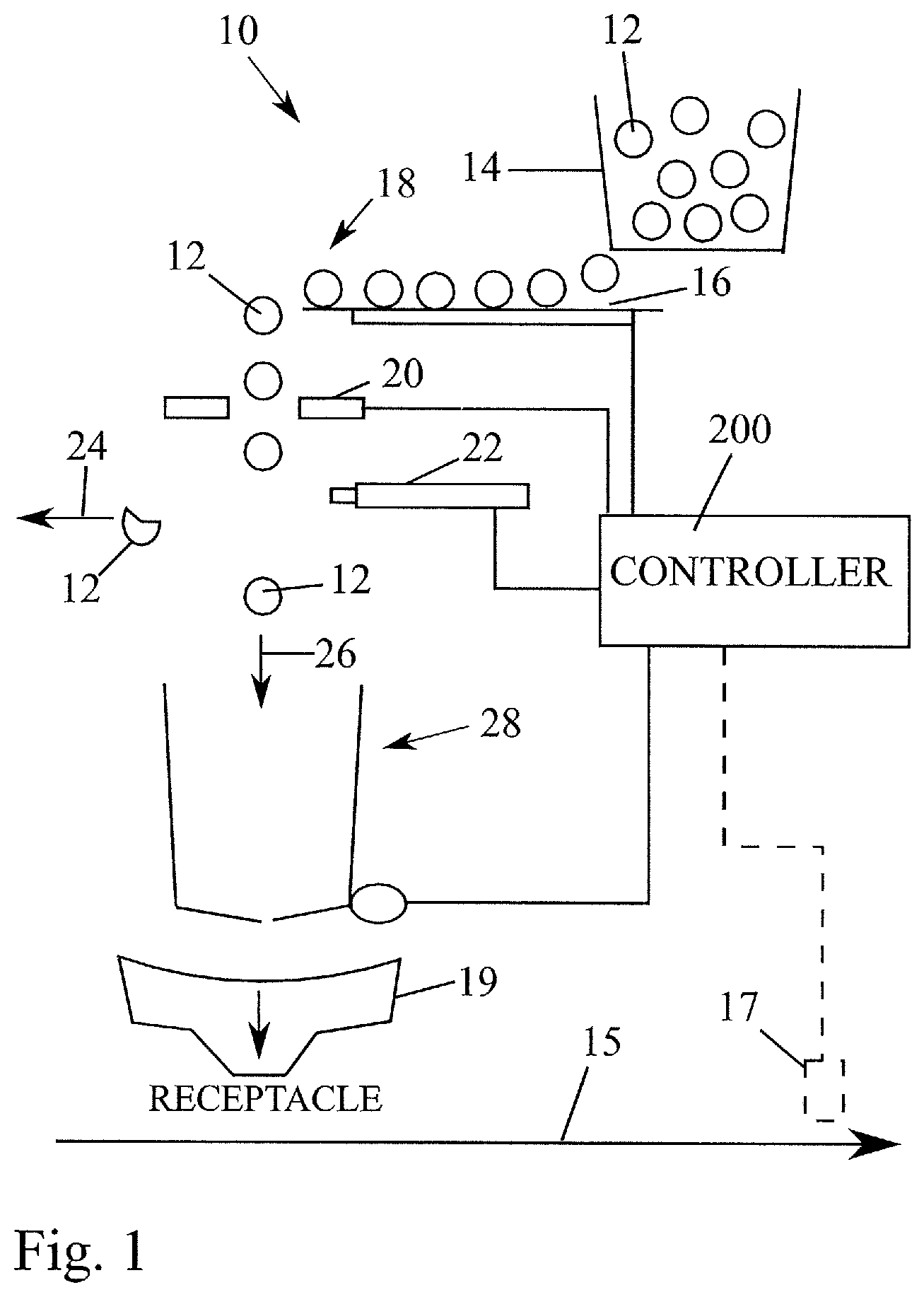
is schematic depiction of a filling machine;
is a perspective view of an exemplary filling machine;
is a perspective exploded view of one embodiment of a vibratory conveyor assembly of the filling machine;
is a perspective view the vibratory conveyor assembly when in assembled position (housing top plate not shown);
is a front elevation view of ;
is another perspective view of the vibratory conveyor assembly;
is a cross-section of the assembly of taken along a vertical plane running through the longitudinal center axis of the assembly;
show an exemplary feed tray configuration;
show a jig assembly for production of feed trays;
A shows an embodiment of a flexural end cap;
B shows the end cap on an actuator;
C shows a cross-section with the end cap on the actuator;
shows an exemplary sensor feedback control system;
shows a schematic view of a parallel spring assembly of a drive train; and
shows exemplary movement curves.
DETAILED DESCRIPTION
shows a schematic depiction of a filling device 10 for conveying, counting and analyzing items 12 and feeding the items 12 to a container, package or other receptacle. By way of example, the items may be solid dose tablets, gelcaps or capsules (e.g., of the pharmaceutical variety) and the filling device may be either intermittent or continuous type. The device 10 includes a bulk feeder 14 that deposits the items 12 to a conveyor 16 , which aligns, singulates and spaces the items as they are moved to a drop point 18 . The conveyor 16 may, for example, be a vibratory conveyor mechanism, as described in more detail below. As the items 12 fall along an item fall path (e.g., under gravity) they pass a sensor system 20 , which counts the items as they pass so that an accurate and controlled fill count can be achieved. The sensor system 20 also analyzes the items for defects. In some cases, a reject mechanism 22 may be provided to move defective items to a reject path 24 . For example, in the case of solid dose tablets, chipped tablets such as tablet 12 ′ can be rejected. The reject mechanism could, for example, be a pressurized air unit the delivers a burst of pressurized air to move a defective item out of the item fall path and into the reject path 24 . The reject mechanism could alternatively be a flap mechanism selectively movable into the item fall path to divert the item out of the item fall path by contact with the flap mechanism. In other implementations, item reject could occur further downstream in a system (e.g., by using a downstream reject mechanism 17 (e.g. blow nozzle or mechanical pusher) to move a receptacle containing a defective tablet out of the flow of a receptacle conveyance path 15 after the defective tablet is filled into the receptacle). Items 12 that are not rejected follow the fill path 26 . A gate system 28 along the fill path 26 may be controlled as desired to achieve delivery of an appropriate item count to a drop chute 19 that feeds receptacles. In a typical filling device, the conveyor 16 may align the items 12 into multiple feed paths that feed the items to multiple drop points, each with a respective sensor system 20 , reject mechanism 22 and gating system 28 that feed to a common drop chute 19 .
Referring now to , one embodiment of a filling machine 50 is shown, which includes a single bulk item hopper 52 with three side-by-side outfeed sections 54 that each feed to a respective multi-level vibratory conveyor 56 (three side-by-side conveyors shown). Each conveyor conveys items to a respective item sense/count section 58 and gating section 60 . Each gating section includes an outlet that feeds into a respective drop chute 62 with a lower outlet opening. The drop chute outlet openings are positioned above a conveyor 66 that moves containers along a conveyance path beneath the drop chute openings, so that items can be dropped into containers moving along the conveyance path. Here, a belt conveyor transports containers, and a rotating feed screw 68 spaces apart the containers to provide a predetermined pitch. Other conveyor types are possible.
show one embodiment of a multi-level conveyor 56 that includes two separate conveyance sections or assemblies 56 - 1 and 56 - 2 . The upper section 56 - 2 includes an initial feed tray C 43 , and the lower section includes an intermediate feed tray C 46 and a distal feed tray C 48 . Here, the initial feed tray C 43 is driven (through any suitable drivetrain) by an electromagnetic linear actuator C 50 and both the intermediate feed tray C 46 and end feed tray C 48 are driven (through any suitable drivetrain) by another, common electromagnetic linear actuator C 80 . Actuator C 50 is part of an electromagnetic actuator assembly C 51 that also includes an electromagnetic linear actuator C 53 that is oriented in an opposed relationship to actuator C 50 . Similarly, actuator C 80 is part of an electromagnetic actuator assembly C 52 that also includes an electromagnetic linear actuator C 81 that is oriented in opposed relationship to actuator C 80 .
In the illustrated embodiments, each electromagnetic linear actuator is formed as a “moving coil” type actuator or “voice coil linear actuator” in which linear motion is achieved by magnetic field interaction between a movable coil (or winding or bobbin) and one or more fixed permanent magnets. However, in alternative implementations the electromagnetic linear actuator may be formed a “moving magnet” type actuator in which the coil (or winding or bobbin) remains fixed and the permanent magnet(s) move linearly.
The initial feed tray C 43 is configured differently and driven separately and differently than feed trays C 46 and C 48 because the function of the initial feed tray C 43 is different than that of feed trays C 46 and C 48 . In particular, the initial feed tray C 43 is vibrated at a frequency and amplitude intended to cause items to spread out in a relatively uniform manner as they move toward the drop end C 54 of the tray. The initial feed tray includes boundary walls at the upstream end and lateral sides. Notably, the upstream portion of the item support surface or body of the initial feed tray is substantially planar and the downstream portion, near the drop end C 54 , includes a set of rising guide walls C 55 that form distinct drop paths C 58 that begin to segment the items on the initial feed tray into groups that align with pairs of feed channels C 60 formed on the feed tray C 46 . Here, four drop paths or groupings C 58 are formed on the initial feed tray C 43 , and each drop path or grouping drops into two respective item feed channel paths C 60 on the next feed tray C 46 . However, the number of paths/groupings and the number of channels could vary.
The intermediate and end feed trays C 46 and C 48 are configured and driven in a manner to singulate the items being conveyed such that only one item at a time drops from the drop end C 56 of the end feed tray C 48 to move through the item sensing arrangement. Here, the feed trays C 46 and C 48 take the form of plate structures that are configured to provide a plurality of V-channels, each of which defines a respective feed channel path C 60 for items. Here, by way of example, four sets or pairs C 62 of adjacent feed paths C 60 are provided, where a lateral spacing between the adjacent sets or pairs C 62 is larger than the lateral spacing between the adjacent feed paths C 60 of each pair.
In the illustrated embodiment, two channeled feed trays C 46 and C 48 are provided, with feed tray C 46 dropping items to feed tray C 48 . The use of the pair of stepped feed trays C 46 and C 48 provides an advantage, as compared to a single feed tray having a length comparable to the combined length of trays C 46 and C 48 . In particular, a single long feed tray would tend to flex more when subjected to high acceleration as a result of frequency and stroke length settings for reciprocating movement, reducing or inhibiting desired item feed control, and placing more restrictive limits on the amplitude and speed at which the feed tray could be driven.
In one implementation, in order to maximize feed tray rigidity per unit weight, the feed trays C 46 and C 48 may be formed of a titanium material (e.g., Titanium Grade 2). Each titanium feed tray is assembled together using an adhesive, such as structural adhesive. In the case of an assembly process using an adhesive, show a feed tray C 46 in which a titanium plate body C 47 is stamped to produce a set end profile (profile in end view looking along the feed direction axis or longitudinal axis) that defines the plurality of feed channels extending along the feed direction of the feed tray. A rigid sub-frame C 49 is fixed to the titanium plate body bC 47 by an adhesive material. The rigid sub-frame C 49 extends across a width of the titanium plate body to hold the titanium plate in the set profile, and includes lateral support bars C 64 for this purpose. The lateral support bars are interconnected by a central beam B 10 having a bottom side that forms a pair of pockets C 66 , one of which is configured to enable a drive train to be connected thereto. In particular, end sections of one the pockets has end recesses C 69 into which opposed expansion clamp arms can be engaged. The rigid sub-frame C 49 may be machined from a non-titanium metal or metal alloy (such as aluminum), and has lateral support beams C 64 with an upper surface profile that is precisely set to the desired profile for the plate body C 47 .
As seen in , a jig assembly C 68 can be used to position the rigid sub-frame precisely and repeatably on the titanium plate body. Fixture components C 61 and C 63 come apart from each other. The rigid sub-frame is set into a fixed position on component C 63 by use of end clamps. The jig component C 61 includes downwardly projecting elongated V-beams to engage the V-channels of the titanium plate body and is used to clamp the titanium plate body down onto the rigid sub-frame until the structural adhesive (applied between the two) cures. The clamping process will also cause the profile of the plate body to conform to the set profile of the lateral support bars C 64 to the rigid sub-frame. By way of example, the structural adhesive may be any one of MASTERBOND® EP42HT-2FG: 2 part epoxy, MASTERBOND® EP21TDCSMed: 2 part silver-epoxy, USP Class VI, 3M Scotch-Weld™ 8407: 2 part Acrylic or 3M Scotch-Weld™ DP420: 2 part Epoxy. However, use of other adhesives is also possible. Notably, the use of a structural adhesive to connect the tray components makes precise assembly repeatable as compared to use of a welding process because welding tends to cause thermal expansion and warping, making it difficult to repeat with precision.
Although titanium is preferred for the tray body, in some cases, an aluminum material may be used for the feed trays. In addition, rather than an adhesively assembled tray, a single casting could be used or a single part machined out of solid block could be used, or multiple welded together pieces could be used. In addition, in some embodiments the feed trays need not incorporate titanium material (e.g., a single piece or multipiece feed tray of aluminum or stainless steel). The adhesive assembly process could also be used for feed trays that do not include titanium (e.g., feed tray body of stamped aluminum or stainless plate and rigid sub-frame of stamped aluminum or stainless plate).
Referring again to , the electromagnetic linear actuator C 80 is connected to rapidly move a drive train formed in part by a driven frame C 70 that includes fixed upwardly extending clamp arms C 72 and movable upwardly extending clamp arms C 76 . The clamp arms engage into the clamping socket recesses at the underside of the rigid-subframe of each feed tray C 46 and C 48 to connect the drive train to each feed tray. In one implementation, the driven frame C 70 may be a machined aluminum, but other materials are also possible (e.g., carbon fiber of stainless steel).
The electromagnetic linear actuator C 80 includes a cylindrical housing body C 80 A that is secured to a mount plate C 82 that extends between two side frame plates C 83 . The side frame plates C 83 are in turn fixed to another frame/housing portion of the machine by mounts C 85 . Here, the mounts are designed to engage with a top plate 70 ( ) of the machine housing to secure the conveyance assembly C 56 - 1 in place. The top plate 70 remains stationary during the movement of the feed trays, and includes openings through which the clamp arms extend to engage the feed trays. The conveyance assembly 56 - 2 includes similar mounts to engage the top plate, and similar openings for its clamp arms (mentioned below). Thus, the two separate conveyance sections or assemblies 56 - 1 and 56 - 2 can be separately connected to and removed from the top plate 70 of the machine.
Referring again to , the electromagnetic linear actuator assembly C 52 includes a rear side with an electromagnetic linear actuator C 81 , which is connected at the side of plate C 82 that is opposite actuator C 80 , to move a dummy weight C 120 . The actuators C 80 and C 81 are operated synchronously, in opposed manner, so that as the driven frame C 70 is moved forward (i.e., right to left in ) the dummy weight C 120 moves rearward, and likewise as the driven frame C 70 moves rearward, the dummy weight C 120 moves forward. The mass of the dummy weight C 120 should, preferably, be such that the total moving mass in the case of actuator C 81 is the same as the total moving mass in the case of actuator C 80 . This configuration and manner operation of the electromagnetic linear actuator assembly C 52 provides dynamic balancing by opposing motion, such that the resulting forces induced by the two actuators C 80 and C 81 sums to zero or substantially zero. If the force sum is not zero or near zero, undesired oscillation of the whole system could be induced, adversely affecting the ability to achieve the vibration desired for movement of the feed trays in a manner that results in desired movement of the items being conveyed. Moreover, the residual vibration is also transmitted to machine frame, potentially causing undesired noise and other problems (e.g., loosening of fasteners, electrical signal noise, etc.). By balancing the forces using the opposed actuators driving similar mass, more precise vibratory movement of the feed trays can be achieved, with reduced undesirable vibrations that would typically need to be damped by some mechanical structure. Electromagnetic linear actuator C 53 is likewise connected to a dummy weight C 121 to achieve a similar benefit for the actuator assembly C 51 that drives the feed tray C 43 . The actuator C 50 is connected to move a driven frame C 71 that includes a fixed upwardly extending clamp arm C 73 and a movable upwardly extending clamp arm C 77 , which clamp arms engage in a clamping socket at the bottom of the feed tray C 43 .
In the case of both the connection of the electromagnetic linear actuator C 80 to the driven frame C 70 , the connection of the electromagnetic linear actuator C 81 to the dummy weight C 120 , and similarly for the connection of actuator C 50 to driven frame C 71 and the connection of actuator C 53 to dummy weigh C 121 , spring/flexural elements may be used. By way of example, as seen in A- 13 C , a spring/flexure element useable in connection the electromagnetic linear actuators takes the form of an end cap C 321 that includes a cylindrical rim C 321 A which is connectable to the actuator housing C 80 A, where a series of spiral slots C 326 are formed on the rim. At least two spiral slots are provided so that oppositely oriented helical portions are formed on the rim. A mount bracket C 330 connects to the rim and forms the end face or end plate of the end cap. The mount bracket C 330 is in turn connected (directly or indirectly) to whatever component is to be driven by the actuator (e.g., driven frame C 70 ). The spiral slots 326 allow axial movement of the end portion C 323 of the rim C 321 A from which the mount bracket C 330 extends, while the opposite end portion C 325 remains fixed on the housing body C 80 A. The moving coil body C 340 of the electromagnetic linear actuator C 80 is partially disposed within the stationary housing body C 80 A, with a cylindrical portion C 341 slidable along a gap between the housing C 80 A and the permanent magnet structure C 342 of the actuator. The end face C 344 of the coil body is connected to the mount bracket C 330 . Thus, the driven frame C 70 , mount bracket C 330 and coil body are all rigidly connected to move in unison with each other. The slotted portion of the end cap forms an intermediate flex region along an axial length of the end cap (length in the movement direction of the actuator), and the intermediate flex region is disposed around one of the fixed housing body C 80 A or the moving coil body portion C 341 to maintain alignment of the intermediate flex region with a movement axis C 346 of the electromagnetic linear actuator. Here, the cylindrical rim of the end cap is disposed primarily around the moving body portion C 341 and the end C 325 of the rim connects to the open end of the fixed housing body C 80 A.
This type of connection functions to guide/align coaxially the moving bobbin/coil in the housing C 80 A by blocking two degrees of freedom (up/down translation and translation transverse to the axis of motion) while permitting translation along the axis C 346 .
The coil/bobbin of each electromagnetic linear actuator is energized to produce electrical current through the bobbin. The resulting electromagnetic field has a field orientation dictated by the direction of the electrical current in the conductor. The electromagnetic filed interacts with the magnetic field of the permanent magnet(s) structure C 342 to produce movement of the coil/bobbin body C 340 into or out of the actuator body C 80 A depending upon the orientation of the magnetic field produced by the coil.
As best seen in , the driven frame C 70 is connected to the side frame portions of conveyance assembly 56 - 1 by laterally oriented lamellar steel band segments C 88 . These connections form flexural support bearings, with the lamellar steel segments bending back and forth during rapid movement of the driven frame C 70 . These flexural bearings function to guide the vibratory plates by blocking 5 degrees of freedom (sideways translation, up/down translation, and rotation around all three axes), while permitting translation in the motion axis of the electromagnetic linear actuator C 80 . Thus, the flexural bearings act as a conventional linear bearing or bushing would, but avoid friction contact between moving parts and therefore avoid or substantially eliminate bearing wear problems. More specifically, the outer portion of the flexure elements are held stationary (e.g., by the side frame portions) and linear forces applied to the driven frame C 70 cause the flexure elements to bend in an s-shape curve (and slightly stretch) allowing a relative displacement parallel to the movement axis of the electromagnetic linear actuator C 80 . Similar lamellar mounts for the driven frame C 71 of the conveyance assembly 56 - 2 may be used.
In the case of any of the above-noted electromagnetic linear actuators, a closed loop control of the actuator is preferably provided to enhance performance of the vibratory conveyor. In particular, as schematically depicted in for electromagnetic linear actuator C 80 that drives the driven frame component C 70 , a sensor C 174 is located at a fixed position alongside the driven frame component C 70 to detect, for example, movement of detectable indicators C 176 on the driven frame component C 70 . In one example, the sensor C 174 is a magnetic sensor and the indicators C 176 are magnetic strips. However, other sensor and indicator types are possible (e.g., optical). The sensor information is provided as feedback to the system controller C 200 , which in turn also controls energization of the actuator C 80 . The controller C 200 uses the data feedback from sensor C 174 to compare actual movement (e.g., position, speed and/or acceleration) of component C 70 to expected or desired movement of component C 70 (e.g., as indicated by a stored reference profile), and makes adjustments to energization of the actuator coil(s) to achieve or maintain the expected or desired movement over time. A P-I-D type feedback control may be utilized. Each of the other actuators C 81 , C 50 and C 53 includes its own similar sensor system for feedback control.
The closed loop actuation is important to achieve the previously explained dynamic balancing of opposed actuators. For example, the front actuator C 80 driving the font trays C 48 and C 46 , the position control of which is achieved with the sensor C 174 , is electronically cammed to or synchronized with the rear actuator C 81 , the position control of which is achieved with a separate sensor. This electronic camming provides consistent synchronized opposed movement of the actuators in order to assure smooth running (low undesirable/residual vibration), and reduces the need for further damping elements.
Performance of the electromagnetic linear actuators is enhanced by the inclusion of parallel spring assemblies for each actuator. By way of example, referring to the schematic of , the driven frame component C 70 may be connected mechanically in parallel with a spring assembly C 190 , such that the spring is repeatedly compressed and expanded as the driven component C 70 moves linearly back and forth per arrow C 194 along or otherwise in parallel with the movement axis C 196 of the actuator. This parallel arrangement is achieved by assuring that both the moving part of the actuator C 80 and the driven component C 70 are rigidly connected for common movement with the moving portion of the spring assembly C 190 . In the embodiment, described above, such parallel spring assemblies are formed by the end caps (e.g., C 321 ) of each actuator.
The use of one or more parallel spring assemblies in the drive train acts to store energy and therefore reduces the overall power consumption and reduces the peak force required by the electromagnetic linear actuator to achieve a desired reciprocating motion. When the actuator is in a neutral stationary state, there is no motion and no potential energy. If the actuator is energized to bring the spring element to a compressed position, there is still no motion but there is potential energy stored in the spring. If the hold on the position of the component is then released, and if the actuator is not being energized, the drive assembly will then start to oscillate naturally for some time until it stops again at its neutral position. This movement is a damped harmonic oscillation (e.g., see curve C 260 in ) made possible by the energy stored in the spring element C 192 . Such damped harmonic oscillation results from a single pulse of energy (the initial compression of the spring by way of the actuator). However, the system can be excited with a varying amplitude current signal in a manner to achieve a full sinusoidal oscillating motion (e.g., see curve C 262 ). Using the energy of the spring element, the full sinusoidal oscillation motion can be achieved with less electrical current energy delivered to the actuator to drive the mass (e.g., the electrical current provided is the level needed to make up for the variance between the desired physical position of the moving part of the actuator, represented by point C 264 on the curve C 262 , and the physical position that the spring element alone would cause, represented by position C 266 on the curve C 260 ). The aforementioned closed-loop control is important to facilitate the necessary application of controlled current amplitude to the actuator. This ideal timing or frequency for the excitation of the system is called the natural frequency at which it requires the least energy input to achieve motion. This natural frequency is a function of the mass and rigidity and therefore is fixed for a given system.
As used herein, the term controller is intended to broadly encompass any circuit (e.g., solid state, application specific integrated circuit (ASIC), an electronic circuit, a combinational logic circuit, a field programmable gate array (FPGA)), processor(s) (e.g., shared, dedicated, or group—including hardware or software that executes code), software, firmware and/or other components, or a combination of some or all of the above, that carries out the control functions of the device/machine or the control functions of any component thereof.
It is to be clearly understood that the above description is intended by way of illustration and example only, is not intended to be taken by way of limitation, and that other changes and modifications are possible.
Figures (14)
Citations
This patent cites (174)
- US2444134
- US4373638
- US4455496
- US4913281
- US4940850
- US5148923
- US5190139
- US5209355
- US5236092
- US5353917
- US5379949
- US5409101
- US5409901
- US5522512
- US5524746
- US5638657
- US5779058
- US5816386
- US5819953
- US5865990
- US6179117
- US6191859
- US6202832
- US6230875
- US6308822
- US6357579
- US6363687
- US6378572
- US6488141
- US6494022
- US6619470
- US6629611
- US6631799
- US6639167
- US6651807
- US6659267
- US6675955
- US6708815
- US6736269
- US6753640
- US6784996
- US6884956
- US6894970
- US6925782
- US7004306
- US7100581
- US7107741
- US7111740
- US7216757
- US7222717
- US7222750
- US7298870
- US7315929
- US7339660
- US7350640
- US7355140
- US7392640
- US7392897
- US7399383
- US7480038
- US7571800
- US7656520
- US7754984
- US7784604
- US7810632
- US7878366
- US7956623
- US7968814
- US8006468
- US8051974
- US8083078
- US8102170
- US8118174
- US8220657
- US8225925
- US8225939
- US8251204
- US8285029
- US8373081
- US8436268
- US8662312
- US8770413
- US8833566
- US8857601
- US8917100
- US8960505
- US8972049
- US8984844
- US8985342
- US9027759
- US9038815
- US9063096
- US9085380
- US9097359
- US9101962
- US9132966
- US9181037
- US9254965
- US9259766
- US9296019
- US9415941
- US9468948
- US9481526
- US9492849
- US9796534
- US10046916
- US20010019008
- US20010019009
- US20030034282
- US20040173031
- US20050115807
- US20050263375
- US20060016735
- US20060271237
- US20070108016
- US20070125624
- US20070193858
- US20080307757
- US20090008219
- US20090020562
- US20090056825
- US20090255856
- US20100166499
- US20130056398
- US20130092592
- US20130134071
- US20130146512
- US20130174519
- US20140061103
- US20140116571
- US20160039614
- US20160244265
- US20160250665
- US20160289007
- US20170008036
- US20190100380
- US20190111455
- US20190265689
- US2749623
- US3038711
- US1276222
- US1281642
- US1214156
- US1737119
- US1541506
- US1899245
- US1731451
- US1535866
- US1967470
- US2335835
- US2208693
- US2664551
- US2484609
- US2671824
- US2777829
- US2787281
- US2835183
- US2578519
- US2896583
- US2010/059036
- US2015/052157
- US2016/132281
- US2017/023469
- US2017/158496
- US2017/167446
- US2017/201906
- US2018/069819
- US2018/087274
- US2018/087316
- US2018/139127
- US2018/153812
- US2018/166894
- US2019/014713
- US2019/017581