Taping Apparatus and Taping Method
Abstract
Disclosed is a taping apparatus including: a tray storage device supplying a designated one of plural kinds of trays on which respective different kinds of parts are scattered; a carrier tape feed device intermittently moving a designated one of plural kinds of carrier tapes which correspond to the respective different kinds of parts; a first camera capturing an image of the scattered parts on the designated tray; a first image recognizing device recognizing respective centers of the scattered parts; a rotary head individually sucking the scattered parts to rotatable suction nozzles; a second camera capturing an image of the parts sucked to the suction nozzles; a second image recognizing device recognizing respective orientations of the sucked parts; and a part inserting device adjusting the orientations of the sucked parts to orientations insertable into part storage recesses defined in the designated carrier tape and then inserting the parts into the part storage recesses, respectively.
Claims (5)
1. A taping method comprising: supplying a designated one of a plurality of kinds of trays on which respective different kinds of parts are scattered, using a tray storage device; capturing an image of the scattered parts on the designated tray supplied by the tray storage device, using a first camera; recognizing respective centers of the scattered parts based on the image thereof captured by the first camera, using a first image recognizing device; individually sucking the scattered parts to a plurality of rotatable suction nozzles based on the respective centers of the scattered parts recognized by the first image recognizing device, using a rotary head comprising the plurality of suction nozzles; capturing an image of the parts sucked to the plurality of suction nozzles of the rotary head, using a second camera; recognizing respective orientations of the sucked parts based on the image thereof captured by the second camera, using a second image recognizing device; intermittently moving a designated one of a plurality of kinds of carrier tapes which correspond to the respective different kinds of parts, using a carrier tape feed device; and adjusting the orientations of the sucked parts to orientations insertable into part storage recesses defined in the designated carrier tape by rotating the plurality of suction nozzles, based on the respective orientations of the sucked parts recognized by the second image recognizing device, and then inserting the parts into the part storage recesses, respectively, using a part inserting device.
Show 4 dependent claims
2. The taping method according to claim 1 , further comprising: receiving the designated tray supplied by the tray storage device on a first table and delivering the first table in a Y direction, using a tray delivery device.
3. The taping method according to claim 2 , further comprising: delivering a second table, with the rotary head mounted thereon, in an X direction, using a rotary head delivery device.
4. The taping method according to claim 1 , wherein the respective centers of the scattered parts recognized by the first image recognizing device are represented by XY coordinates.
5. The taping method according to claim 1 , wherein the respective orientations of the sucked parts recognized by the second image recognizing device are represented by angles with respect to a standard line established in an XY coordinate system.
Full Description
Show full text →
CROSS REFERENCE TO RELATED APPLICATION
This application is a divisional application of U.S. patent application Ser. No. 16/444,269, filed Jun. 18, 2019, which is based upon and claims benefit of priority from Japanese Patent Application No. 2018-117602, filed on Jun. 21, 2018, the entire contents of which are incorporated herein by reference.
BACKGROUND
The present disclosure relates to a taping apparatus and a taping method for manufacturing a part storage tape.
A part storage tape is manufactured by inserting parts into respective part storage recesses in a carrier tape and applying a cover tape to the carrier tape to close the part storage recesses. The part storage tape is generally supplied in the form of a coil on a reel to a user such as a device manufacturer or the like. Providing the parts on the part storage tape are small, the total number of the parts on the reel may be several tens of thousands.
Some users demand fewer-parts reels, i.e., reels that store fewer parts such as several hundred parts or carry shorter part storage tapes for the reason that they manufacture fewer devices or they need to make pre-production assessment, for example. However, even if such fewer-parts reels are to be supplied, part storage tapes that are wound on the fewer-parts reels are manufactured in the same manner as part storage tapes for more-parts reels, i.e., part storage tapes that store more parts or that are longer.
In other words, when fewer-parts reels are to be manufactured, it is necessary to prepare taping apparatus (see, for example, Japanese Patent Laid-Open Nos. 2002-029505, 2006-168754, and 2010-070271) that are similar to those used for manufacturing more-parts reels. Consequently, the total cost including time and expenses required to prepare those taping apparatus may not balance the value received from providing the manufactured fewer-parts reels, possibly resulting in losses.
SUMMARY
The present disclosure has been made in view of the above circumstances, and provides a taping apparatus and a taping method for minimizing losses even when fewer-parts reels, i.e., reels that store fewer parts or carry shorter part storage tapes, are demanded by the user.
According to an embodiment of the present disclosure, there is provided a taping apparatus including a tray storage device configured to supply a designated one of a plurality of kinds of trays on which respective different kinds of parts are scattered; a carrier tape feed device configured to intermittently move a designated one of a plurality of kinds of carrier tapes which correspond to the respective different kinds of parts; a first camera configured to capture an image of the scattered parts on the designated tray supplied from the tray storage device; a first image recognizing device configured to recognize respective centers of the scattered parts based on the image thereof captured by the first camera; a rotary head configured to individually suck the scattered parts to a plurality of rotatable suction nozzles based on the respective centers of the scattered parts recognized by the first image recognizing device; a second camera configured to capture an image of the parts sucked to the suction nozzles of the rotary head; a second image recognizing device configured to recognize respective orientations of the sucked parts based on the image thereof captured by the second camera; and a part inserting device configured to adjust the orientations of the sucked parts to orientations insertable into part storage recesses defined in the designated carrier tape by rotating the suction nozzles, based on the respective orientations of the sucked parts recognized by the second image recognizing device, and then insert the parts into the part storage recesses, respectively.
According to another embodiment of the present disclosure, there is also provided a taping method including: supplying a designated one of a plurality of kinds of trays on which respective different kinds of parts are scattered, using a tray storage device; capturing an image of the scattered parts on the designated tray supplied from the tray storage device, using a first camera; recognizing respective centers of the scattered parts based on the image thereof captured by the first camera, using a first image recognizing device; individually sucking the scattered parts to a plurality of rotatable suction nozzles based on the respective centers of the scattered parts recognized by the first image recognizing device, using a rotary head; capturing an image of the parts sucked to the suction nozzles of the rotary head, using a second camera; recognizing respective orientations of the sucked parts based on the image thereof captured by the second camera, using a second image recognizing device; intermittently moving a designated one of a plurality of kinds of carrier tapes which correspond to the respective different kinds of parts, using a carrier tape feed device; and adjusting the orientations of the sucked parts to orientations insertable into part storage recesses defined in the designated carrier tape by rotating the suction nozzles, based on the respective orientations of the sucked parts recognized by the second image recognizing device, and then inserting the parts into the part storage recesses, respectively, using a part inserting device.
The taping apparatus and the taping method according to the present disclosure are able to minimize losses even when fewer-parts reels, i.e., reels that store fewer parts or carry shorter part storage tapes, are demanded by the user.
The above and other objects, features, and advantages of the present disclosure will become more apparent from the following description when taken in conjunction with the accompanying drawings.
BRIEF DESCRIPTION OF THE DRAWINGS
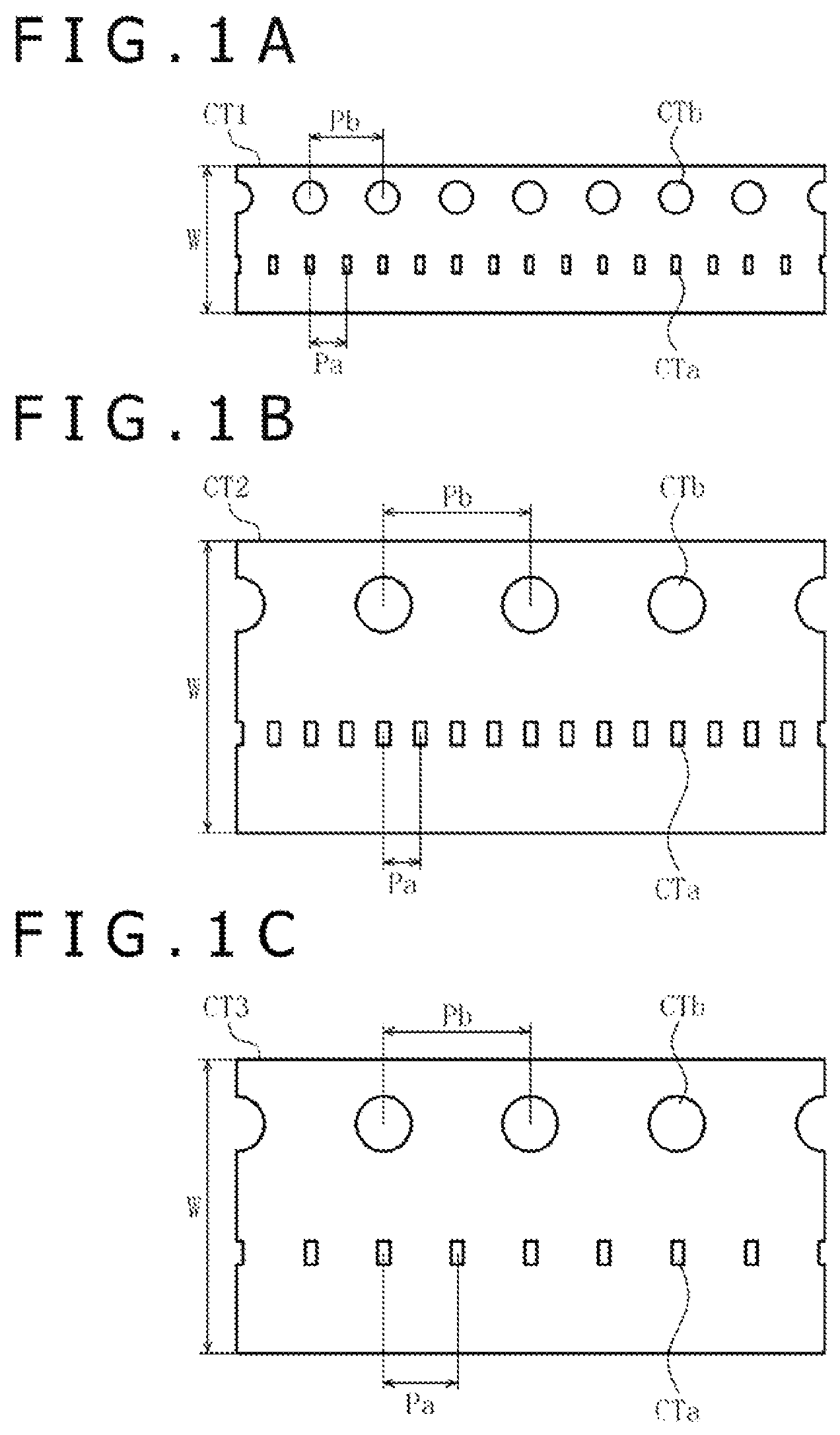
A, 1 B and 1 C are fragmentary plan views of examples of carrier tapes;
is a plan view of a taping apparatus according to an embodiment of the present disclosure;
A is a perspective view of a tray illustrated in ;
B is a side elevational view of a stack of trays illustrated in A ;
C is a fragmentary perspective view of a tray storage device illustrated in ;
is a perspective view of a first table illustrated in ;
A is a side elevational view of a rotary head illustrated in ;
B is an enlarged fragmentary cross-sectional view of the rotary head illustrated in A ;
C is an enlarged fragmentary cross-sectional view of the rotary head illustrated in B ;
D is an enlarged bottom view of the rotary head illustrated in A ;
is a block diagram of a control system of the taping apparatus illustrated in ;
is a flowchart of a part inserting condition setting process carried out in preparation for operation of the taping apparatus illustrated in ;
A is a flowchart of a tray supplying process carried out by the taping apparatus illustrated in ;
B is a plan view of the taping apparatus illustrated in as it operates to supply the tray;
A is a flowchart of a first image recognizing process carried out by the taping apparatus illustrated in ;
B is a plan view of the taping apparatus illustrated in as it operates to carry out the first image recognizing process;
A is a flowchart of a part sucking process carried out by the taping apparatus illustrated in ;
B is a plan view of the taping apparatus illustrated in as it operates to carry out the part sucking process;
A is a flowchart of a second image recognizing process carried out by the taping apparatus illustrated in ;
B is a plan view of the taping apparatus illustrated in as it operates to carry out the second image recognizing process;
A is a flowchart of a part inserting process carried out by the taping apparatus illustrated in ;
B is a plan view of the taping apparatus illustrated in as it operates to carry out the part inserting process;
A is a view similar to D , illustrating the manner in which the taping apparatus operates to carry out the second image recognizing process illustrated in A and 11 B ;
B is a view similar to D , illustrating the manner in which the taping apparatus operates to carry out the part inserting process illustrated in A and 12 B ;
A is a flowchart of a tray retrieving process carried out by the taping apparatus illustrated in ;
B is a plan view of the taping apparatus illustrated in as it operates to carry out the tray retrieving process; and
A and 15 B are enlarged fragmentary cross-sectional views of a modification of a nozzle support and a suction nozzle illustrated in C .
DETAILED DESCRIPTION OF THE PREFERRED EMBODIMENTS
First, examples of carrier tapes and examples of parts that can be inserted into the carrier tapes will be described below with reference to A, 1 B and 1 C . The carrier tapes and the parts to be described below are illustrated by way of example only, and should not be taken as limiting the kinds of carrier tapes and parts that can be used in a taping apparatus to be described later.
A, 1 B and 1 C illustrate three kinds of carrier tapes CT 1 , CT 2 , and CT 3 , respectively. In A, 1 B and 1 C , W represents a tape width, CTa represents part storage recesses, each in the form of a rectangular parallelepiped, defined in the carrier tapes CT 1 , CT 2 , and CT 3 , CTb represents tape feed holes, each of a circular shape, defined in the carrier tapes CT 1 , CT 2 , and CT 3 , Pa represents a pitch between the part storage recesses CTa, and Pb represents a pitch between the tape feed holes CTb. The carrier tape CT 2 is different from the carrier tape CT 1 in that the tape width W of the carrier tape CT 2 is twice the tape width W of the carrier tape CT 1 , the pitch Pb of the carrier tape CT 2 is twice the pitch Pb of the carrier tape CT 1 , and the part storage recesses CTa and the tape feed holes CTb of the carrier tape CT 2 are different in size from the part storage recesses CTa and the tape feed holes CTb of the carrier tape CT 1 . The carrier tape CT 3 is different from the carrier tape CT 2 in that the pitch Pa of the carrier tape CT 3 is twice the pitch Pa of the carrier tape CT 2 and the part storage recesses CTa of the carrier tape CT 3 are different in size from the part storage recesses CTa of the carrier tape CT 2 .
Examples of specific numerical values will be described below. The tape width W of the carrier tape CT 1 is 4 mm, the pitch Pa thereof is 1 mm, and the pitch Pb thereof is 2 mm. Each of the part storage recesses CTa of the carrier tape CT 1 is capable of storing therein a part C 1 (see ) in the form of a rectangular parallelepiped that has a length of 0.4 mm, a width of 0.2 mm, and a height of 0.2 mm, each representing a standard dimension without tolerances. The tape width W of the carrier tape CT 2 is 8 mm, the pitch Pa thereof is 1 mm, and the pitch Pb thereof is 4 mm. Each of the part storage recesses CTa of the carrier tape CT 2 is capable of storing therein a part C 2 (see ) in the form of a rectangular parallelepiped that has a length of 0.6 mm, a width of 0.3 mm, and a height of 0.3 mm, each representing a standard dimension without tolerances. The tape width W of the carrier tape CT 3 is 8 mm, the pitch Pa thereof is 2 mm, and the pitch Pb thereof is 4 mm. Each of the part storage recesses CTa of the carrier tape CT 3 is capable of storing therein a part C 3 (see ) in the form of a rectangular parallelepiped that has a length of 0.6 mm, a width of 0.3 mm, and a height of 0.15 mm, each representing a standard dimension without tolerances. The parts C 1 through C 3 are mainly electronic parts each in the form of a rectangular parallelepiped, such as capacitor elements, varistor elements, inductor elements, and so on, though they may be parts other than electronic parts insofar as they are in the form of a rectangular parallelepiped or they may be parts not in the form of a rectangular parallelepiped insofar as they need orientation control for insertion into the part storage recesses CTa.
A taping apparatus according to an embodiment of the present disclosure will be described below with reference to , 3 A, 3 B, 3 C, 4 , 5 A, 5 B, 5 C and 5 D . illustrates the carrier tapes CT 1 through CT 3 and the parts C 1 through C 3 described above for illustrative purposes. However, the illustrated carrier tapes and parts should not be taken as limiting the kinds of carrier tapes and parts that can be used in a taping apparatus according to the present disclosure.
As illustrated in , the taping apparatus includes a base plate BP, a tray storage device 10 , a plurality of trays 20 , a tray delivery device 30 , a rotary head delivery device 40 , a first camera 50 , a rotary head 60 , a second camera 70 , and a carrier tape feed device 80 . The taping apparatus also includes a cover tape applying device, not illustrated.
As illustrated in A , each of the trays 20 is of a rectangular shape as viewed in plan. The tray 20 has a pair of legs 21 disposed respectively on the opposite edges of a lower surface thereof and a soft mat 22 made of synthetic rubber, synthetic resin, or the like and disposed on an upper surface thereof except its peripheral edges. As illustrated in B , the trays 20 can be vertically arrayed in a vertical stack where the legs 21 of each tray 20 , except the lowest tray 20 , are placed on the lower tray 20 , leaving a space over the mat 22 of the lower tray 20 .
The taping apparatus illustrated in is designed to handle three kinds of parts C 1 through C 3 . Therefore, the taping apparatus includes three kinds of trays 20 prepared in advance that carry the different kinds of parts C 1 through C 3 thereon. Specifically, a number of parts C 1 are scattered on each of the stacked trays 20 of one of the three kinds. Similarly, a number of parts C 2 are scattered on each of the stacked trays 20 of another one of the three kinds, and a number of parts C 3 are scattered on each of the stacked trays 20 of the third kind. The parts C 1 through C 3 that are scattered on the trays 20 are spread randomly over the mats 22 without an overlap. Since the mats 22 are soft, each of the parts C 1 through C 3 scattered thereon are prevented from sliding around due to contact with the mats 22 even when the trays 20 are moved.
The tray storage device 10 includes a main body 11 disposed on the base plate BP and having a rectangular shape as viewed in plan, three tray storage sections 12 for storing the respective three kinds of trays 20 in vertical stacks, and a single tray retrieval section 13 for retrieving used trays 20 in a vertical stack. The tray storage sections 12 and the tray retrieval section 13 are arrayed in Y directions. Each of the tray storage sections 12 and the tray retrieval section 13 has a surface facing a first table 31 , to be described later, the surface being open preferably in only an upper portion thereof.
Each of the tray storage sections 12 includes a tray supply mechanism 14 for pushing the uppermost tray 20 on the stack toward the first table 31 . As illustrated in C , the tray supply mechanism 14 includes an air cylinder 14 a and a presser 14 c mounted on a rod 14 b of the air cylinder 14 a . When the air cylinder 14 a is actuated, its rod 14 b pushes the presser 14 c in a +X direction out of a cavity 12 a defined in the main body 11 to push the uppermost tray 20 on the stack in the tray storage section 12 toward the first table 31 and supply the tray 20 onto the first table 31 . Each of the tray storage sections 12 has a mechanism, not illustrated, for lifting a second tray 20 on the stack to the uppermost position after the uppermost tray 20 has been supplied, e.g., a lifting and lowering mechanism actuatable by an electric motor.
The tray retrieval section 13 may be a space for housing therein a vertical stack of used trays 20 . The tray retrieval section 13 may include a mechanism for lowering the vertical stack of used trays 20 by a distance corresponding to one tray after it has retrieved a used tray 20 , e.g., a lifting and lowering mechanism actuatable by an electric motor. The tray storage device 10 may include as many tray retrieval sections 13 as the number of the tray storage sections 12 , i.e., three tray retrieval sections 13 , for retrieving the respective kinds of trays 20 that have been used.
The tray delivery device 30 , which is disposed on the base plate BP, includes a linear drive mechanism, not illustrated, actuatable by an electric motor 30 a (see ) for moving a movable member, not illustrated, in the Y directions. The first table 31 is fixed to the movable member.
The first table 31 has a tray housing recess 31 a defined in an upper surface thereof for housing a tray 20 therein. The tray housing recess 31 a is open through a side of the first table 31 that faces the tray storage sections 12 and the tray retrieval section 13 . The tray housing recess 31 a in the first table 31 is disposed in a vertical position aligned with the vertical position of the uppermost tray 20 stored in each of the tray storage sections 12 . Therefore, the tray housing recess 31 a can receive and house the uppermost tray 20 that is supplied from either one of the tray storage sections 12 of the tray storage device 10 .
The first table 31 also has a tray retrieval mechanism 32 for pushing the tray 20 housed in the tray housing recess 31 a toward the tray retrieval section 13 . As illustrated in , the tray retrieval mechanism 32 includes an air cylinder 32 a and a presser 32 c mounted on a rod 32 b of the air cylinder 32 a . When the air cylinder 32 a is actuated, its rod 32 b pushes the presser 32 c in a −X direction out of a cavity 31 b defined in the first table 31 to push the tray 20 housed in the tray housing recess 31 a toward the tray retrieval section 13 , which retrieves the tray 20 .
The rotary head delivery device 40 , which is disposed on the base plate BP, includes a linear drive mechanism, not illustrated, actuatable by an electric motor 40 a (see ) for moving a movable member, not illustrated, in X directions. The rotary head delivery device 40 also includes a second table 41 that is fixed to the movable member. The first camera 50 and the rotary head 60 are fixed to a lower surface of the second table 41 . The first camera 50 and the rotary head 60 are arrayed in the Y directions and directed downwardly. The rotary head delivery device 40 is disposed in a vertical position higher than the vertical position of the tray delivery device 30 so that the first camera 50 can capture images of one at a time of the kinds of scattered parts C 1 through C 3 and the rotary head 60 can suck one at a time of the kinds of parts C 1 through C 3 without fail.
When the tray 20 that is housed in the tray housing recess 31 a in the first table 31 is moved in the +Y direction to a position below the first camera 50 , the first camera 50 captures an image of one of the kinds of scattered parts C 1 through C 3 on the mat 22 of the tray 20 .
As illustrated in A , the rotary head 60 includes a hollow cylindrical head body 61 rotatable about its own vertical central axis by a head rotating mechanism 62 mounted on the second table 41 . The head rotating mechanism 62 includes an electric motor 62 a having a drive shaft 41 a extending through a hole 41 a defined in the second table 41 and coupled to an upper surface of the head body 61 .
As illustrated in B and 5 D , the head body 61 has a total of eight holes 61 a defined in a bottom wall thereof at equal angular intervals around the vertical central axis of the head body 61 . The rotary head 60 includes a total of eight nozzle holders 63 rotatably disposed respectively in the holes 61 a . The nozzle holders 63 have respective lower portions protruding downwardly from a lower surface of the bottom wall of the head body 61 . The nozzle holders 63 have respective vertical central axes spaced equal distances from the vertical central axis of the head body 61 . The nozzle holders 63 are arranged at equally spaced angular intervals, i.e., 45° in D , around the vertical central axis of the head body 61 .
As illustrated in C , each of the nozzle holders 63 has a hole 63 a defined in a bottom wall thereof, and a hollow cylindrical nozzle support 64 is vertically movably disposed in the hole 63 a . The nozzle support 64 has a lower portion protruding downwardly from a lower surface of the bottom wall of the nozzle holder 63 . The nozzle support 64 includes a rotation stop 64 a in the shape of a polygonal prism, preferably a quadrangular prism or a hexagonal prism, on an upper portion thereof. The rotation stop 64 a is vertically movably and nonrotatably disposed in a space 63 b in the shape of a polygonal prism, preferably a quadrangular prism or a hexagonal prism, defined in the nozzle holder 63 , and is normally urged to move upwardly by a compression spring 64 b.
As illustrated in C , each of the nozzle holders 63 supports on its upper end a nozzle lifting and lowering mechanism 65 for lifting and lowering the nozzle support 64 . The nozzle lifting and lowering mechanism 65 includes an air cylinder 65 a having a rod 65 b extending into the nozzle holder 63 and held in contact with an upper surface of the nozzle support 64 . The nozzle support 64 is lowered by downward movement of the rod 65 b of the air cylinder 65 a when the air cylinder 65 a is actuated, and is lifted by upward movement of the rod 65 b of the air cylinder 65 a when the air cylinder 65 a is actuated and also by the biasing force from the compression spring 64 b.
As illustrated in A, 5 B, 5 C and 5 D , suction nozzles 66 , each in the shape of a cylindrical or a quadrangular prism, used for sucking parts C 1 through C 3 are integrally combined with respective lower ends of the nozzle supports 64 . The nozzle supports 64 and the suction nozzles 66 have suction holes, not illustrated, defined therein that extend to respective lower surfaces of the suction nozzle 66 . Air tubes, not illustrated, for transmitting a negative or positive pressure therethrough are connected respectively to the suction holes.
As illustrated in B , nozzle rotating mechanisms 67 for rotating the nozzle holders 63 , respectively, are disposed in the head body 61 . Each of the nozzle rotating mechanisms 67 includes an electric motor 67 a mounted on the bottom wall of the head body 61 , a gear 67 c fixed to a drive shaft 67 b of the electric motor 67 a , and a series of gear teeth 67 d disposed on an upper outer surface of the nozzle holder 63 and held in mesh with the gear 67 c . When the electric motor 67 a is energized, the drive shaft 67 b is rotated about its own axis, causing the gear 67 c and the gear teeth 67 d to rotate the nozzle holder 63 about its vertical central axis.
Therefore, the head body 61 of the rotary head 60 is rotatable about its vertical central axis, and the nozzles 66 thereof are vertically movable and rotatable about their vertical central axes.
The second camera 70 is disposed on the base plate BP at a position aligned with the first camera 50 and the rotary head 60 along the X directions parallel to the rotary head delivery device 40 . When the rotary head 60 on the second table 41 is moved in the +X direction to a position above the second camera 70 , the second camera 70 captures an image of one of the kinds of parts C 1 through C 3 that are sucked by the eight suction nozzles 66 of the rotary head 60 .
As illustrated in , the carrier tape feed device 80 has a pair of supports 81 disposed on the base plate BP and a shaft 82 supported on the supports 81 . Three supply reels TR 1 , TR 2 , and TR 3 are rotatably and removably mounted on the shaft 82 with a spacer ring 83 interposed therebetween. Caps 84 are mounted respectively on both ends of the shaft 82 for preventing the shaft 82 from being pulled out of the supports 81 . Of the three supply reels TR 1 through TR 3 , the supply reel TR 1 carries the carrier tape CT 1 wound thereon, the supply reel TR 2 carries the carrier tape CT 2 wound thereon, and the supply reel TR 3 carries the carrier tape CT 3 wound thereon.
As illustrated in , the carrier tape feed device 80 also has three tape guides 85 , 86 , and 87 for individually guiding the carrier tapes CT 1 through CT 3 , respectively, unreeled from the supply reels TR 1 through TR 3 . The tape guides 85 through 87 have respective guide grooves 85 a , 86 a , and 87 a defined therein whose widths are commensurate with the tape widths W of the carrier tapes CT 1 through CT 3 . Two two-dot-and-dash lines that extend in the X directions across the tape guides 85 through 87 represent a part inserting position IP and a cover tape applying position AP, respectively. As can be seen from D , an extension of the two-dot-and-dash line that represents the part inserting position IP passes through a center of one of the eight suction nozzles 66 of the rotary head 60 , i.e., the lowermost suction nozzle 66 in D .
The carrier tape feed device 80 further has three take-up reels, not illustrated, for winding carrier tapes CT 1 through CT 3 , i.e., part storage tapes, after the parts C 1 through C 3 have been inserted in the part storage recesses CTa and cover tapes, not illustrated, have been applied thereto, and three electric motors 105 (see ) for intermittently rotating the take-up reels individually about their own axes.
The cover tape applying device, not illustrated, applies cover tapes individually to the carrier tapes CT 1 through CT 3 after the parts C 1 through C 3 have been inserted in the part storage recesses CTa, in the cover tape applying position AP, thereby closing the part storage recesses CTa. The cover tape applying device has heating units, not illustrated, with built-in heaters for heating the carrier tapes CT 1 through CT 3 , respectively, solenoids 106 (see ) for lifting and lowering the heating units, and three cover tape supply reels, not illustrated, for supplying the cover tapes to be applied respectively to the carrier tapes CT 1 through CT 3 .
A control system of the taping apparatus illustrated in will be described below with reference to .
The control system illustrated in includes a main controller 101 , an input unit 102 , a display unit 103 , the air cylinder 14 a of the tray supply mechanism 14 referred to above, the electric motor 30 a of the tray delivery device 30 referred to above, the air cylinder 32 a of the tray retrieval mechanism 32 referred to above, the electric motor 40 a of the rotary head delivery device 40 referred to above, the first camera 50 referred to above, the second camera 70 referred to above, and a data storage unit 104 .
The control system also includes the electric motor 62 a of the head rotating mechanism 62 of the rotary head 60 referred to above, the air cylinders 65 a of the nozzle lifting and lowering mechanisms 65 of the rotary head 60 referred to above, the electric motors 67 a of the nozzle rotating mechanisms 67 of the rotary head 60 referred to above, the electric motors 105 for rotating the take-up reels of the carrier tape feed device 80 referred to above, and the solenoids 106 for lifting and lowering the heating units of the cover tape applying device referred to above.
The main controller 101 has a microcomputer, various drivers, various interfaces, and so on, and sends operation signals to the connected devices according to operation control programs stored in a read only memory (ROM). The input unit 102 includes a keyboard, etc. for entering part inserting conditions, to be described later, etc., based on a screen displayed on the display unit 103 after the main controller 101 is activated. The data storage unit 104 stores image data of images captured by the first camera 50 and image data of images captured by the second camera 70 , and also stores the entered part inserting conditions, etc.
An example of operation of the taping apparatus illustrated in will be described below with reference to , 8 A, 8 B, 9 A, 9 B, 10 A, 10 B, 11 A, 11 B, 12 A, 12 B, 13 A, 13 B, 14 A and 14 B . The operation to be described below is by way of example only, and should not be taken as limiting the manner in which the taping apparatus illustrated in operates.
The taping apparatus illustrated in is designed to handle three kinds of parts C 1 through C 3 . Three kinds of trays 20 that carry the respective different kinds of parts C 1 through C 3 scattered on the mats 22 are prepared, and are stored in vertical stacks respectively in the three tray storage sections 12 of the tray storage device 10 (see ).
The numbers of the parts C 1 through C 3 scattered on the mats 22 of the trays 20 are not limited to any particular values. However, if the distances between the scattered parts C 1 through C 3 are too small, then a first image recognizing process, to be described later, and a part sucking process, to be described later, may possibly be disrupted. Therefore, a certain maximum value or upper limit may be set for the number of scattered parts depending on the size of the mats 22 . For example, the maximum value may be a multiple (e.g., 80 , 160 , or 240 ) of the number ( 8 ) of the suction nozzles 66 of the rotary head 60 or a value approximate thereto.
Inasmuch as the taping apparatus illustrated in is designed to handle three kinds of parts C 1 through C 3 , the supply reel TR 1 that carries the carrier tape CT 1 wound thereon, the supply reel TR 2 that carries the carrier tape CT 2 wound thereon, and the supply reel TR 3 that carries the carrier tape CT 3 wound thereon are prepared, and the supply reels TR 1 through TR 3 are rotatably installed on the shaft 82 . The carrier tapes CT 1 through CT 3 are drawn from the respective supply reels TR 1 through TR 3 and placed in the guide grooves 85 a through 87 a in the tape guides 85 through 87 . The ends of the drawn carrier tapes CT 1 through CT 3 are attached respectively to the take-up reels, not illustrated, by adhesive tapes or the like.
After the three trays 20 have been stored, the three supply reels TR 1 through TR 3 have been installed on the shaft 82 , and the carrier tapes CT 1 through CT 3 have been attached to the take-up reels, part inserting conditions are set according to a part inserting condition setting process, which includes steps S 101 through S 104 , illustrated in . Based on a screen displayed on the display unit 103 , the operator, using the input unit 102 (see ), enters the kinds of parts C 1 through C 3 in association with the respective tray storage sections 12 of the tray storage device 10 (step S 101 ), enters the kinds of the carrier tapes CT 1 through CT 3 in association with the supply reels TR 1 through TR 3 of the carrier tape feed device 80 (step S 102 ), and enters the numbers of parts C 1 through C 3 to be inserted in the carrier tapes CT 1 through CT 3 and the order in which to insert the parts C 1 through C 3 (step S 103 ). The entered data are stored in the data storage unit 104 (step S 104 ).
The step of entering the numbers of parts C 1 through C 3 to be inserted in the carrier tapes CT 1 through CT 3 (step S 103 ) will be described in greater detail below. If a take-up reel that carries a part storage tape based on a combination of the parts C 1 and the carrier tape CT 1 is required to bear a total of 500 parts C 1 , for example, then the operator enters 500 as the number of parts C 1 to be inserted. If a take-up reel that carries a part storage tape based on a combination of the parts C 2 and the carrier tape CT 2 is required to bear a total of 800 parts C 2 , for example, then the operator enters 800 as the number of parts C 2 to be inserted. If a take-up reel that carries a part storage tape based on a combination of the parts C 3 and the carrier tape CT 3 is required to bear a total of 1000 parts C 3 , for example, then the operator enters 1000 as the number of parts C 3 to be inserted. When entering the numbers of parts to be inserted, the operator may enter numerical values representing the sums of the numbers of parts to be inserted and extra values that are approximately 5% to 20% of the total numbers of parts to be inserted, in order to avoid a shortage of parts on the part of a user such as a device manufacturer or the like at the time of using part storage tapes.
After completing the setting of the part inserting conditions, the operator enters an operation start command through the input unit 102 (see ), causing the taping apparatus illustrated in to start a sequence of operation for manufacturing part storage tapes.
If the order in which to insert the parts C 1 through C 3 indicates that the parts C 1 are to be inserted first, the parts C 2 second, and the parts C 3 third, then the tray 20 designated as a first tray is supplied according to a tray supplying process, which includes steps S 111 and S 112 , illustrated in A . Specifically, as illustrated in B , the first table 31 is moved in the +Y direction by the tray delivery device 30 and stopped at a position facing the tray storage section 12 that stores the trays 20 where the parts C 1 are scattered on the mats 22 (step S 111 ). The tray supply mechanism 14 operates to push the uppermost tray 20 in the tray storage section 12 toward the first table 31 , and places the uppermost tray 20 on the first table 31 where the tray 20 is received in the tray housing recess 31 a (step S 112 ).
Then, a first image recognizing process, which includes steps S 121 through S 123 illustrated in A , is carried out. Specifically, as illustrated in B , the first table 31 that stores the tray 20 designated as the first tray is moved in the +Y direction by the tray delivery device 30 and stopped at a position below the first camera 50 (step S 121 ). The first camera 50 captures an image of the parts C 1 scattered on the mat 22 of the tray 20 (step S 122 ). The centers of the respective parts c 1 are recognized based on the image captured by the first camera 50 , and are stored (step S 123 ). The centers of the respective parts C 1 are recognized according to a pattern detection method or an edge detection method, and the recognized centers are stored as XY coordinates.
Then, a part sucking process, which includes steps S 131 and S 132 illustrated in A , is carried out. Specifically, as illustrated in B , the second table 41 is moved in the −X direction by the rotary head delivery device 40 and stopped in a position where the rotary head 60 is positioned above the tray 20 designated as the first tray (step S 131 ). Based on the respective centers or XY coordinates of the recognized scattered parts C 1 , the scattered parts C 1 are sucked by the eight suction nozzles 66 of the rotary head 60 (step S 132 ).
The step of sucking the parts C 1 to the eight suction nozzles 66 (step S 132 ) will be described in greater detail below. Each of the parts C 1 is sucked to one of the eight suction nozzles 66 that is positioned on the extension of the two-dot-and-dash line that represents the part inserting position IP illustrated in D . Initially, as one of the suction nozzles 66 , i.e., a first suction nozzle 66 , is positioned on the extension of the two-dot-and-dash line, the first table 31 is moved in the +Y direction or the −Y direction and the second table 41 is moved in the +Y direction or the −Y direction to bring the center of the first suction nozzle 66 into alignment with the center or XY coordinates of a part C 1 to be sucked, after which the part C 1 is sucked to the first suction nozzle 66 . Then, the head body 61 of the rotary head 60 is turned 45° about its vertical central axis to position a next one of the suction nozzles 66 , i.e., a second suction nozzle 66 , on the extension of the two-dot-and-dash line, and the first table 31 is moved in the +Y direction or the −Y direction and the second table 41 is moved in the +Y direction or the −Y direction to bring the center of the second suction nozzle 66 into alignment with the center or XY coordinates of a next part C 1 to be sucked, after which the next part C 1 is sucked to the second suction nozzle 66 . In this manner, parts C 1 are sucked to the eight suction nozzles 66 . Each part C 1 is sucked to the suction nozzle 66 on the extension of the two-dot-and-dash line by developing a negative pressure in the suction hole in the suction nozzle 66 and lowering the suction nozzle 66 with the nozzle lifting and lowering mechanism 65 until the suction nozzle 66 touches the part C 1 on the mat 22 , whereupon the part C 1 is sucked to the suction nozzle 66 under the negative pressure. After the part C 1 has been sucked to the suction nozzle 66 , the suction nozzle 66 is lifted back by the nozzle lifting and lowering mechanism 65 .
Then, a second image recognizing process, which includes steps S 141 through S 143 illustrated in A , is carried out. Specifically, as illustrated in B , after the parts C 1 have been sucked to the suction nozzles 66 , the second table 41 is moved in the +X direction by the rotary head delivery device 40 and stopped in a position where the rotary head 60 is positioned above the second camera 70 (step S 141 ). Images of all of the parts C 1 sucked to the suction nozzles 66 are captured by the second camera 70 (step S 142 ). Based on the images captured by the second camera 70 , respective orientations of the parts C 1 are recognized and stored (step S 143 ). The orientations of the respective parts C 1 are recognized in step S 143 according to a pattern detection method or an edge detection method, and each of the recognized orientations is stored as an angle θ with respect to a standard line established in an XY coordinate system, i.e., the extension of the two-dot-and-dash line that represents the part inserting position IP as illustrated in A .
Then, a part inserting process, which includes steps S 151 and S 152 illustrated in A , is carried out. Specifically, as illustrated in B , the second table 41 is moved in the +X direction by the rotary head delivery device 40 and stopped at a position where the suction nozzle 66 of the rotary head 60 which is positioned on the extension of the two-dot-and-dash line is disposed above a part storage recess CTa in the carrier tape CT 1 designated as a first carrier tape (step S 151 ). Based on the orientation, i.e., the angle θ, that has been recognized, the suction nozzle 66 is turned about its own vertical central axis to adjust the orientation of the part C 1 so that the part C 1 can snugly be inserted into the part storage recess CTa. Then, the part C 1 is inserted into the part storage recess CTa (step S 152 ). After the part C 1 has been inserted into the part storage recess CTa, the carrier tape CT 1 is moved in the +Y direction by a distance commensurate with the pitch Pa between the part storage recesses CTa. Each time the part C 1 is inserted into the part storage recess CTa, the carrier tape CT 1 is intermittently moved in the +Y direction by distances commensurate with the pitch Pa between the part storage recesses CTa, and the above part inserting step is repeated until the parts C 1 on all the eight suction nozzles 66 are inserted into respective part storage recesses CTa.
The step of inserting the parts C 1 from the eight suction nozzles 66 into the respective part storage recesses CTa (step S 152 ) will be described in greater detail below. The parts C 1 are inserted into the respective part storage recesses CTa in the part inserting position IP where only one of the suction nozzles 66 , i.e., a first suction nozzle 66 , is positioned at a time. Initially, as one of the suction nozzles 66 , i.e., the first suction nozzle 66 , is disposed in the part inserting position IP, if the part C 1 sucked to the first suction nozzle 66 is oriented at the angle θ as illustrated in A , then the first suction nozzle 66 is turned by the nozzle rotating mechanism 67 until the angle θ is eliminated, as illustrated in B . Thereafter, the part CT 1 on the first suction nozzle 66 is inserted into a corresponding part storage recess CTa in the carrier tape CT 1 . For inserting the parts C 1 from the second and subsequent suction nozzles 66 into respective part storage recesses CTa in the carrier tape CT 1 , the head body 61 is intermittently turned through 45° to bring the parts C 1 into the part inserting position IP. When each of the parts C 1 has reached the part inserting position IP, the orientation of the part C 1 is calculated based on the orientation or angle θ of the previously recognized part C 1 , and the suction nozzle 66 is turned by the nozzle rotating mechanism 67 until the calculated orientation is eliminated. The correctly oriented parts C 1 are then inserted from the second and subsequent suction nozzles 66 into respective part storage recesses CTa in the carrier tape CT 1 . The part C 1 is inserted from each of the suction nozzles 66 by lowering the suction nozzle 66 in the part inserting position IP with the nozzle lifting and lowering mechanism 65 and applying a positive pressure to the suction hole in the suction nozzle 66 to insert the part C 1 into the part storage recess CTa. After the part C 1 has been inserted from each of the suction nozzles 66 into the corresponding part storage recess CTa, the suction nozzle 66 is lifted back by the nozzle lifting and lowering mechanism 65 .
After the parts C 1 have been inserted into all the part storage recess CTa in the carrier tape CT 1 , a cover tape, not illustrated, is applied to the carrier tape CT 1 in the cover tape applying position AP. The carrier tape CT 1 with the cover tape applied thereto, i.e., a part storage tape, is wound on a take-up reel, not illustrated.
The part sucking process described above with reference to A and 10 B , the second image recognizing process described above with reference to A and 11 B , and the part inserting process described above with reference to A and 12 B are repeated as many times as the number of parts C 1 on the mat 22 of the first tray 20 . Actually, since it is difficult to suck all the parts C 1 on the mat 22 on account of the accuracy of the first image recognizing process and the accuracy of the part sucking process, the parts inserted into the part storage recesses CTa may be fewer than the parts scattered on the mat 22 .
After the parts C 1 on the first tray 20 have been sucked and inserted, a tray retrieving process, which includes steps S 161 through S 163 illustrated in A , is carried out. Specifically, as illustrated in B , the first table 31 is moved in the −Y direction by the tray delivery device 30 and stopped in a position where the first table 31 faces the tray retrieval section 13 (step S 161 ). The tray 20 in the tray housing recess 31 a in the first table 31 is pushed toward the tray retrieval section 13 by the tray retrieval mechanism 32 , and stored in the tray retrieval section 13 . Then, the second table 41 is moved back in the −X direction by the rotary head delivery device 40 . Thereafter, the tray supplying process described above with reference to A and 8 B and the first image recognizing process described above with reference to A and 9 B are carried out. If it is possible to insert a required number of parts from a single tray 20 into respective part storage recesses in a carrier tape, then the tray supplying process described above with reference to A and 8 B and the first image recognizing process described above with reference to A and 9 B are not carried out.
The insertion of parts C 1 designated as first parts into the part storage recesses CTa in the carrier tape CT 1 designated as a first carrier tape is completed when the total number of inserted parts C 1 has reached a designated number. After the insertion of parts C 1 has been completed, the carrier tape CT 1 with the cover tape applied thereto, i.e., the part storage tape, is severed, and the take-up reel that carries the part storage tape where the total number of inserted parts is the designated number is removed from the taping apparatus and readied for shipment.
If the order in which to insert the parts C 1 through C 3 is such that the parts C 1 are to be inserted first, the parts C 2 are to be inserted second, and the parts C 3 are to be inserted third, then the parts C 1 designated as first parts are inserted into the part storage recesses CTa in the carrier tape CT 1 designated as a first carrier tape, thereafter the parts C 2 designated as second parts are inserted into the part storage recesses CTa in the carrier tape CT 2 designated as a second carrier tape, and then the parts C 3 designated as third parts are inserted into the part storage recesses CTa in the carrier tape CT 3 designated as a third carrier tape. If the total number of parts C 1 to be inserted is 500, for example, the total number of parts C 2 to be inserted is 800, for example, and the total number of parts C 3 to be inserted is 1000, for example, then three kinds of single fewer-parts reels, i.e., a total of three reels that store fewer parts, including a take-up reel carrying a total of 500 parts C 1 , a take-up reel carrying a total of 800 parts C 2 , and a take-up reel carrying a total of 1000 parts C 3 are successively manufactured by the single taping apparatus.
Since the order in which to insert the parts C 1 through C 3 can be set to any desired order, the order may be such that the parts C 1 are to be inserted first, the parts C 2 are to be inserted second, the parts C 3 are to be inserted third, the parts C 1 are to be inserted fourth, the parts C 2 are to be inserted fifth, and the parts C 3 are to be inserted sixth, so that three kinds of two fewer-parts reels, i.e., a total of six reels that store fewer parts (two reels of one kind, two reels of one kind, and two reels of one kind), can be successively manufactured by the single taping apparatus. Alternatively, the order may be such that the parts C 1 are to be inserted first, the parts C 2 are to be inserted second, the parts C 3 are to be inserted third, the parts C 1 are to be inserted fourth, and the parts C 3 are to be inserted fifth, so that three kinds of fewer-parts reels, i.e., a total of five reels that store fewer parts (two reels of one kind, one reel of one kind, and two reels of one kind), can be successively manufactured by the single taping apparatus. Furthermore, the order may be such that the parts C 1 are to be inserted first, the parts C 2 are to be inserted second, the parts C 1 are to be inserted third, and the parts C 2 are to be inserted fourth, so that two kinds of two fewer-parts reels, i.e., a total of four reels that store fewer parts (two reels of one kind and two reels of one kind), can be successively manufactured by the single taping apparatus.
Modifications of the taping apparatus will be described below.
<Modification 1>
illustrates the taping apparatus that handles the three kinds of parts C 1 through C 3 and the three kinds of carrier tapes CT 1 through CT 3 into which the respective kinds of parts C 1 through C 3 can be inserted. However, a taping apparatus may be designed to handle four or more kinds of parts and as many kinds of carrier tapes into which the respective kinds of parts can be inserted, or specifically a taping apparatus may incorporate more kinds of trays 20 , a tray storage device 10 with more tray storage sections 12 , and a carrier tape feed device 80 with more supply reels, so that four or more kinds of fewer-parts reels, i.e., reels that store fewer parts, can be manufactured by the single taping apparatus by appropriately setting the order in which to insert the parts.
<Modification 2>
and, 5 A, 5 B, 5 C and 5 D illustrate the rotary head 60 having the eight suction nozzles 66 that can be lifted and lowered and can be rotated about their own axes. However, the number of suction nozzles 66 can be increased or reduced depending on the size of the head body 61 . If the number of suction nozzles 66 of the rotary head 60 is nine or more, then the number of parts that can be inserted by the single rotary head 60 is increased to reduce the period of time that is required to manufacture each fewer-parts reel.
<Modification 3>
illustrates the taping apparatus in which the first camera 50 is mounted on the second table 41 . However, the rotary head 60 may be disposed in the position of the first camera 50 on the second table 41 , and the first camera 50 may be fixedly disposed above the rotary head 60 out of contact with the second table 41 . According to such a modification, the second table 41 may be temporarily moved in the −X direction or the +X direction in the first image recognizing process described above with reference to A and 9 B .
<Modification 4>
A, 5 B, 5 C and 5 D illustrate the suction nozzles 66 that are integrally combined with the respective nozzle supports 64 . However, if it is difficult to use common nozzles as the suction nozzles 66 owing to the kinds of parts to be inserted, then the suction nozzles 66 may be removably mounted on the nozzle supports 64 . For example, as illustrated in A , a nozzle support 64 has a nozzle insertion hole 64 c defined axially in a lower end portion thereof and a plurality of ball receiving grooves 64 d defined radially in the lower end portion thereof. The nozzle support 64 may also have a spring retainer 64 e protruding radially outwardly from an outer circumferential surface thereof. A helical compression spring 64 f is disposed around the nozzle support 64 and extends axially between the spring retainer 64 e and an unlocking tube 68 axially slidably fitted over the lower end portion of the nozzle support 64 and retained on the nozzle support 64 against removal therefrom. Locking balls 67 are radially movably disposed in the respective ball receiving grooves 64 d . The unlocking tube 68 has an annular ball retracting slot 68 a defined in an inner circumferential surface thereof. A suction nozzle 66 has an annular ball locking slot 66 a defined in an outer circumferential surface thereof near an upper end thereof. When the unlocking tube 68 is in a lower position under the bias of the compression spring 64 f , its inner circumferential surface displaces the locking balls 67 radially inwardly, keeping the locking balls 67 partly in the annular ball locking slot 66 a in the suction nozzle 66 . Therefore, the suction nozzle 66 is locked in the nozzle insertion hole 64 c in the nozzle support 64 by the locking balls 67 , as illustrated in A . When the unlocking tube 68 is pushed upwardly against the bias of the compression spring 64 f until the locking balls 67 are displayed radially outwardly and partly received in the annular ball retracting slot 68 a , as indicated by the arrows in B , the suction nozzle 66 can be pulled out of the nozzle insertion hole 64 c in the nozzle support 64 .
If each of the nozzle supports 64 is constructed to allow a suction nozzle 66 to be removably mounted thereon, as illustrated in A and 15 B , then the taping apparatus may include a vertically movable nozzle retrieval device, not illustrated, having nozzle receiving holes for retrieving the suction nozzles 66 from the rotary head 60 and a vertically movable nozzle supply device, not illustrated, for supplying suction nozzles 66 to the rotary head 60 . The nozzle retrieval device and the nozzle supply device may be disposed in a range in which the second table 41 is movable and below the rotary head 60 . When the rotary head 60 is moved to a position above the nozzle retrieval device, the nozzle retrieval device is lifted and pulls all the suction nozzles 66 from the respective nozzle insertion holes 64 c in the nozzle supports 64 . When the rotary head 60 is then moved to a position above the nozzle supply device, the nozzle supply device is lifted and inserts other suction nozzles into the respective nozzle insertion holes 64 c in all the nozzle supports 64 . In other words, the nozzle retrieval device and the nozzle supply device may automatically replace all the suction nozzles 66 on the rotary head 60 with other suction nozzles.
The present disclosure contains subject matter related to that disclosed in Japanese Priority Patent Application JP 2018-117602 filed in the Japan Patent Office on Jun. 21, 2018, the entire content of which is hereby incorporated by reference.
It should be understood by those skilled in the art that various modifications, combinations, sub-combinations and alterations may occur depending on design requirements and other factors insofar as they are within the scope of the appended claims or the equivalent thereof.
Figures (13)
Citations
This patent cites (22)
- US6333483
- US6634159
- US20030136087
- US20040168774
- US20130321981
- US2000289709
- US2000289709
- US2002-029505
- US2006-168754
- US2006264749
- US2006264749
- US2010-070271
- US5544461
- US5544461
- US201625474
- US201625474
- US2014087492
- USWO-2014087485
- USWO-2014087492
- US2015097865
- USWO-2015097865
- US2014087485