Abstract
A high-frequency module includes a transmission signal amplifier that outputs a transmission signal to an antenna terminal side; a reception signal amplifier that amplifies a reception signal supplied from an antenna terminal; a switch that selectively connects the antenna terminal to either an output of the transmission signal amplifier or an input of the reception signal amplifier; and a directional coupler that is provided on a transmission signal path and detects a signal level of the transmission signal. The transmission signal amplifier is controlled by a first control signal supplied from a first control circuit. The reception signal amplifier is controlled by a second control signal supplied from a second control circuit. The switch is controlled by a switch control signal supplied from the first control circuit. The directional coupler is controlled by a coupler control signal supplied from the first control circuit.
Claims (6)
1. A high-frequency module comprising: a first antenna terminal; a second antenna terminal; a first transmission signal amplifier configured to amplify a radio frequency signal, and to output a first transmission signal to the first antenna terminal and/or the second antenna terminal; a first reception signal amplifier configured to amplify a reception signal supplied from the first antenna terminal and/or the second antenna terminal, and to output a first reception signal; a first directional coupler in a first transmission signal path between the first transmission signal amplifier and the first and second antenna terminals, the first directional coupler being configured to detect a signal level of the first transmission signal; a first switch circuit configured to selectively connect the first or second antenna terminal to an output of the first transmission signal amplifier or to an input of the first reception signal amplifier; and a second switch circuit configured to selectively connect the first switch circuit to the first antenna terminal and/or the second antenna terminal, wherein the first directional coupler is connected between the first switch circuit and the second switch circuit.
Show 5 dependent claims
2. The high-frequency module according to claim 1 , further comprising: a second reception signal amplifier configured to amplify a reception signal supplied from the first antenna terminal and/or the second antenna terminal, and to output a second reception signal, wherein: the second reception signal amplifier is connected to the second switch, and the first directional coupler is not in a signal path between the second switch circuit and the second reception signal amplifier.
3. The high-frequency module according to claim 2 , wherein the second switch circuit is configured to selectively connect the first antenna terminal or the second antenna terminal to the first switch circuit or an input of the second reception signal amplifier.
4. The high-frequency module according to claim 1 , further comprising: a band pass filter in the first transmission signal path between the first switch circuit and the first directional coupler.
5. The high-frequency module according to claim 1 , further comprising: a second transmission signal amplifier configured to amplify a second radio frequency signal, and to output a second transmission signal to the first antenna terminal and/or the second antenna terminal; and a second directional coupler in a second transmission signal path between the second transmission signal amplifier and the first and second antenna terminals, the second directional coupler being configured to detect a signal level of the second transmission signal, wherein the second directional coupler is connected between the first switch circuit and the second switch circuit.
6. The high-frequency module according to claim 5 , further comprising: a second reception signal amplifier configured to amplify a reception signal supplied from the first antenna terminal and/or the second antenna terminal, and to output a second reception signal; a third switch circuit configured to selectively connect the second switch circuit to an output of the second transmission signal amplifier or an input of the second reception signal amplifier; a first bandpass filter in a first signal path between the first switch circuit and the second switch circuit; and a second bandpass filter in a second signal path between the third switch circuit and the second switch circuit.
Full Description
Show full text →
This is a continuation of U.S. patent application Ser. No. 17/015,477 filed on Sep. 9, 2020, which is a continuation of U.S. patent application Ser. No. 16/788,625 filed on Feb. 12, 2020, which is a continuation of U.S. patent application Ser. No. 16/215,777 filed on Dec. 11, 2018, which claims priority from Japanese Patent Application No. 2017-244351 filed on Dec. 20, 2017, Japanese patent Application No. 2018-065691 filed on Mar. 29, 2018 and Japanese Patent Application No. 2018-119249 filed on Jun. 22, 2018. The contents of these applications are incorporated herein by reference in their entireties.
BACKGROUND
The present disclosure relates to a high-frequency module. There has been a high-frequency module that includes a transmission circuit and a reception circuit, and that switches between these circuits and connects one of them to an antenna by using a switch circuit to transmit and receive a radio frequency (RF) signal to and from a base station.
For example, United States Patent Application Publication No. 2008/0180169 discloses a power amplification module including an amplifier that outputs, as a transmission signal, an amplified signal obtained by amplifying an input signal to an antenna side, and a directional coupler coupled to a transmission signal line formed between the amplifier and an antenna.
In a high-frequency circuit, it is demanded that transmission characteristics of a transmission signal in a predetermined frequency band of each communication system are further increased, and that a transmission signal in the predetermined frequency band is inhibited from being reflected and flowing into a transmission circuit side due to, for example, antenna mismatching. Furthermore, a function of monitoring, with great accuracy, an antenna for which a communication environment is favorable is demanded. For this reason, a function of detecting, with great accuracy, not only traveling waves of transmission signals in a plurality of frequency bands output from each communication system but also a reflected wave of a transmission signal being reflected at and returning from an antenna is demanded.
In this regard, in a communication device employing a recent communication scheme, such as a multiple input and multiple output (MIMO) scheme, a plurality of antennas are used. In the case where a plurality of antennas are used, a function of monitoring an antenna direction state is demanded to select an antenna for which a communication environment is favorable. For this reason, it is greatly demanded that an antenna for which a communication environment is favorable is detected with little time delay at a point in time when control is switched from reception control to transmission control.
BRIEF SUMMARY
Thus, the present disclosure has been made in view of the above-described issues to provide a high-frequency module that enables switching to a state in which an antenna for which a communication environment is favorable is able to be detected with little time delay when transmission control and reception control are switched.
A high-frequency module according to one embodiment of the present disclosure includes a transmission signal amplifier configured to amplify a radio frequency signal and output a transmission signal to an antenna terminal side; a reception signal amplifier configured to amplify a reception signal supplied from an antenna terminal; a switch configured to selectively connect the antenna terminal to either an output of the transmission signal amplifier or an input of the reception signal amplifier; and a directional coupler provided on a transmission signal path between the transmission signal amplifier and the antenna terminal and configured to detect a signal level of the transmission signal. The transmission signal amplifier is controlled by a first control signal supplied from a first control circuit. The reception signal amplifier is controlled by a second control signal supplied from a second control circuit. The switch is controlled by a switch control signal supplied from the first control circuit. The directional coupler is controlled by a coupler control signal supplied from the first control circuit.
Embodiments of the present disclosure enable, in the high-frequency module, switching to a state in which an antenna for which a communication environment is favorable is able to be detected with little time delay when transmission control and reception control are switched.
Other features, elements, characteristics and advantages of the present disclosure will become more apparent from the following detailed description of embodiments of the present disclosure with reference to the attached drawings.
BRIEF DESCRIPTION OF THE SEVERAL VIEWS OF THE DRAWINGS
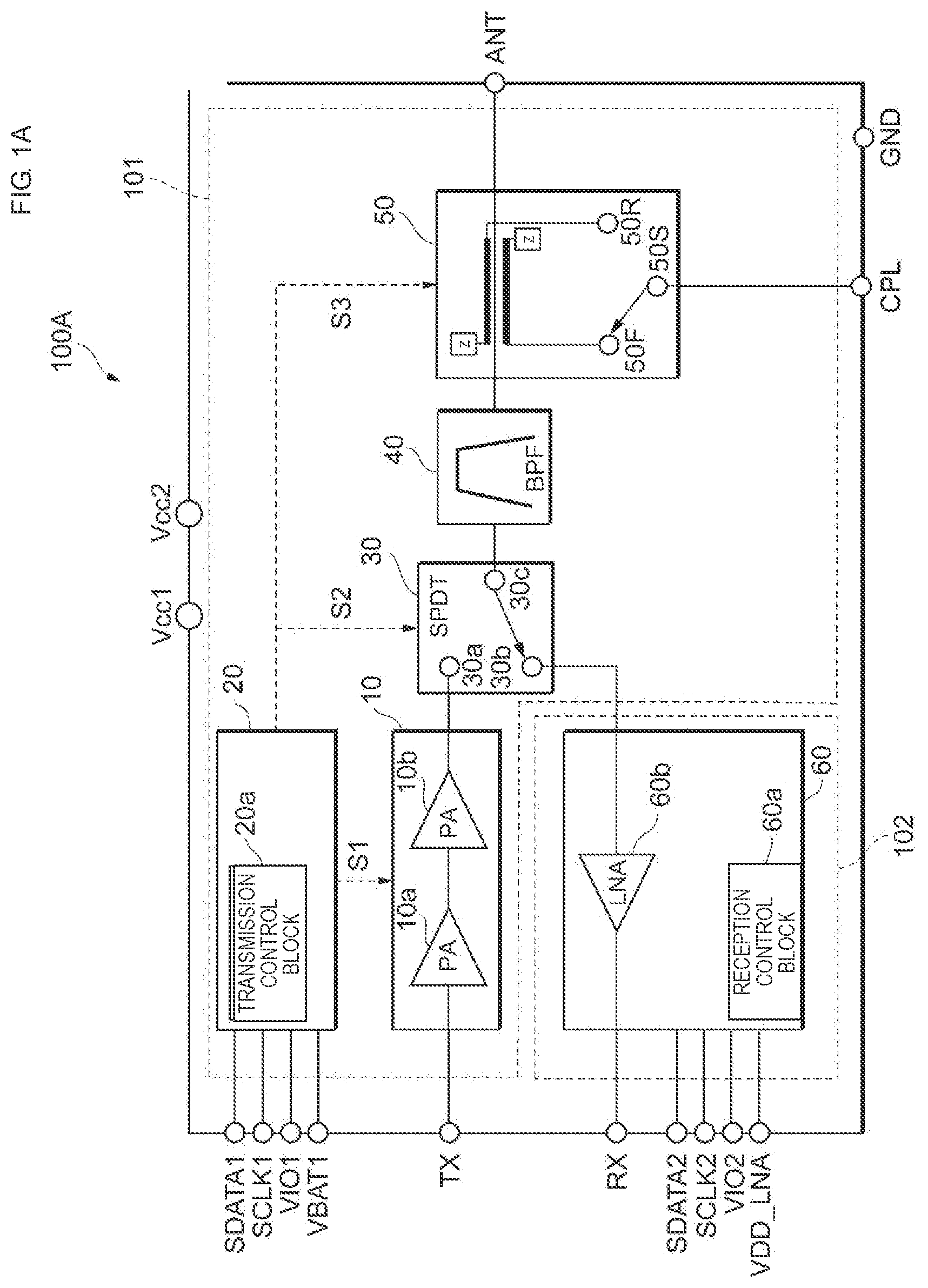
A illustrates an example of a configuration of a high-frequency module according to a first embodiment of the present disclosure;
B illustrates an example of a configuration of a high-frequency module according to a first modification of the first embodiment of the present disclosure;
C illustrates an example of a configuration of a high-frequency module according to a second modification of the first embodiment of the present disclosure;
D illustrates an example of a configuration of a high-frequency module according to a third modification of the first embodiment of the present disclosure;
E illustrates an example of a configuration of a high-frequency module according to a fourth modification of the first embodiment of the present disclosure;
F illustrates an example of a configuration of a high-frequency module according to a fifth modification of the first embodiment of the present disclosure;
illustrates an example of a configuration of a high-frequency module according to a second embodiment of the present disclosure;
A illustrates an example of a configuration of a high-frequency module according to a third embodiment of the present disclosure;
B illustrates an example of a configuration of a high-frequency module according to a first modification of the third embodiment of the present disclosure;
illustrates an example of a configuration of a high-frequency module according to a fourth embodiment of the present disclosure;
A illustrates an example of a configuration of a high-frequency module according to a fifth embodiment of the present disclosure;
B illustrates an example of a configuration of a high-frequency module according to a first modification of the fifth embodiment of the present disclosure;
C illustrates an example of a configuration of a high-frequency module according to a second modification of the fifth embodiment of the present disclosure;
D illustrates an example of a configuration of a high-frequency module according to a third modification of the fifth embodiment of the present disclosure;
E illustrates an example of a configuration of a high-frequency module according to a fourth modification of the fifth embodiment of the present disclosure;
illustrates an example of a configuration of a high-frequency module according to a sixth embodiment of the present disclosure; and
illustrates an example of a configuration of a high-frequency module according to a reference example.
DETAILED DESCRIPTION
Embodiments of the present disclosure will be described in detail below with reference to the drawings. Note that elements that are the same are denoted by the same reference numerals, and repeated description thereof is omitted.
(1) First Embodiment
(1-1) First Embodiment
A illustrates an example of a configuration of a high-frequency module (high-frequency module 100 A) according to a first embodiment of the present disclosure. The high-frequency module 100 A is used in, for example, a mobile communication device, such as a cellular phone, to transmit and receive various signals, such as voice and data, to and from a base station. The high-frequency module 100 A supports a plurality of frequency bands (multiple bands) of radio frequencies (RF). The high-frequency module 100 A also supports a plurality of communication schemes (multiple modes), such as a third generation mobile communication system (3G), a fourth generation mobile communication system (4G), and a fifth generation mobile communication system (5G). A communication scheme supported by the high-frequency module 100 A is not limited to these. Furthermore, the high-frequency module 100 A may support carrier aggregation.
As illustrated in A , the high-frequency module 100 A includes a front-end unit 101 and a front-end unit 102 . The high-frequency module 100 A includes a terminal TX for inputting a transmission signal, a terminal RX for outputting a reception signal, and a terminal ANT (antenna terminal) for connection to an antenna. A path connecting the terminal TX and the terminal ANT constitutes a transmission signal path (first signal path). A path connecting the terminal RX and the terminal ANT constitutes a reception signal path (second signal path).
Hereinafter, on the transmission signal path, “previous stage” refers to a side opposite to the antenna terminal, and “subsequent stage” refers to an antenna terminal side. Furthermore, on the reception signal path, “previous stage” refers to the antenna terminal side, and “subsequent stage” refers to the side opposite to the antenna terminal.
The high-frequency module 100 A further includes, for example, terminals Vcc 1 , Vcc 2 , SDATA 1 , SCLK 1 , VIO 1 , VBAT 1 , SDATA 2 , SCLK 2 , VIO 2 , VDD LNA, CPL, and GND. The terminals Vcc 1 and Vcc 2 are connected to an amplifier unit 10 , and a power-supply voltage to be supplied to the amplifier unit 10 is input to the terminals Vcc 1 and Vcc 2 . The terminal VBAT 1 is connected to a transmission control integrated circuit (IC) 20 , and a power-supply voltage to be supplied to the transmission control IC 20 is input to the terminal VBAT 1 . The terminal VDD LNA is connected to a reception control unit 60 , and a power-supply voltage to be supplied to the reception control unit 60 is input to the terminal VDD LNA. The terminals SDATA 1 , SCLK 1 , and VIO 1 are connected to the transmission control IC 20 , and control signals SDATA 1 , SCLK 1 , and VIO 1 to be supplied to the transmission control IC 20 are respectively input to the terminals SDATA 1 , SCLK 1 , and VIO 1 . The terminals SDATA 2 , SCLK 2 , and V 102 are connected to the reception control unit 60 , and control signals SDATA 2 , SCLK 2 , and V 102 to be supplied to the reception control unit 60 are respectively input to the terminals SDATA 2 , SCLK 2 , and VIO 2 . The terminal CPL is connected to a terminal 50 S of a coupler 50 , and a detection signal of a traveling wave or reflected wave of a transmission signal is output from the terminal CPL as described later. The terminal GND is a ground terminal. The same signal or different signals may be input to the terminals SDATA 1 , SCLK 1 , VIO 1 , SDATA 2 , SCLK 2 , and VIO 2 .
The front-end unit 101 includes the amplifier unit 10 , the transmission control IC 20 , a single pole double throw (SPDT) switch 30 , a band pass filter (BPF) 40 , and the coupler 50 . The SPDT switch 30 is connected to a subsequent stage subsequent to the amplifier unit 10 (the antenna terminal side of the amplifier unit 10 ), the BPF 40 is connected to a subsequent stage subsequent to the SPDT switch 30 , and the coupler 50 is connected to a subsequent stage subsequent to the BPF 40 .
The amplifier unit 10 (transmission signal amplifier) is formed on the transmission signal path, amplifies the power of a transmission signal supplied from the terminal TX to a level necessary to transmit the transmission signal to a base station, and outputs an amplified signal to an antenna side. The amplifier unit 10 may include a plurality of amplifiers. In the examples illustrated in A to 1 F , the amplifier unit 10 includes a first-stage (driver-stage) amplifier 10 a and a subsequent-stage (power-stage) amplifier 10 b . In the amplifier unit 10 , a bias or gain is controlled based on a control signal S 1 supplied from a transmission control block 20 a . For example, when the high-frequency module 100 A operates to perform reception control (when a low noise amplifier (LNA) 60 b operates and terminals 30 b and 30 c are connected to each other in the SPDT switch 30 ), the amplifier unit 10 may stop the supply of a bias to the amplifiers 10 a and 10 b.
The transmission control IC 20 is a chip in which the transmission control block 20 a (first control circuit) is formed. The transmission control block 20 a supplies, based on the control signals SDATA 1 , SCLK 1 , VIO 1 , and so forth, control signals in synchronization with one another to elements, such as the amplifier unit 10 , the SPDT switch 30 , and the coupler 50 , constituting the transmission signal path. Specifically, the transmission control block 20 a respectively supplies the control signal S 1 (first control signal), a control signal S 2 (switch control signal), and a control signal S 3 (coupler control signal) in synchronization with one another to the amplifier unit 10 , the SPDT switch 30 , and the coupler 50 .
The SPDT switch 30 is a high-frequency switch element having 1×2 input-output terminals. Specifically, the SPDT switch 30 includes a terminal 30 a on a transmission signal path side, the terminal 30 b on a reception signal path side, and the terminal 30 c on the antenna side. The SPDT switch 30 switches, based on the control signal S 2 supplied from the transmission control block 20 a , the connection of the terminal 30 c on the antenna side between the terminal 30 a on the transmission signal path side and the terminal 30 b on the reception signal path side. That is, when the terminal 30 a is connected to the terminal 30 c , the transmission signal path between the terminal ANT and the terminal TX is formed, and when the terminal 30 b is connected to the terminal 30 c , the reception signal path between the terminal ANT and the terminal RX is formed. Furthermore, The SPDT switch 30 may be configured to terminate a terminal not operating.
The BPF 40 is a filter circuit that removes a spurious component or an out-of-band interference wave from a transmission signal or reception signal to thereby allow a frequency in a predetermined band to pass through. With respect to a frequency in the predetermined band that is allowed to pass through by the BPF 40 , frequency characteristics are able to be set by freely changing a circuit configuration of the filter circuit in accordance with a communication scheme. That is, filter components are replaced.
The coupler 50 is a bidirectional coupler coupled via an electromagnetic field to a signal path and detects a power level of a traveling wave that propagates to the antenna and a power level of a reflected wave that propagates from the antenna. The coupler 50 includes a terminal 50 F that outputs a detection signal of a traveling wave, a terminal 50 R that outputs a detection signal of a reflected wave, and the terminal 50 S that is selectively connected to either the terminal 50 F or 50 R. The coupler 50 switches, based on the control signal S 3 supplied from the transmission control block 20 a , the connection of the terminal 50 S between the terminal 50 F and the terminal 50 R. The terminal 50 S is connected to the terminal CPL included in the high-frequency module 100 A. The terminal CPL is connected to, for example, an RFIC provided at a previous stage previous to the high-frequency module 100 A (on a side opposite to the antenna), and a detection signal of a traveling wave or reflected wave is supplied to the RFIC.
The front-end unit 102 includes the reception control unit 60 . The reception control unit 60 is a chip in which a reception control block 60 a and the LNA 60 b are formed.
The reception control block 60 a (second control circuit) supplies, based on the control signals SDATA 2 , SCLK 2 , VIO 2 , and so forth, a control signal to the LNA 60 b.
The LNA 60 b (reception signal amplifier) is formed on the reception signal path, amplifies, based on a control signal supplied from the reception control block 60 a , a reception signal supplied via the terminal ANT, and outputs an amplified signal to the RFIC or the like, which is not illustrated, provided on the side opposite to the antenna.
In the high-frequency module 100 A according to the first embodiment of the present disclosure, the amplifier unit 10 , the SPDT switch 30 , and the coupler 50 respectively operate based on the control signals S 1 , S 2 , and S 3 supplied in synchronization with one another from the transmission control block 20 a . This enables switching to a state in which the quality of the antenna for which a communication environment is favorable is able to be detected with little time delay when transmission control and reception control are switched.
(1-2) First Modification of First Embodiment
B illustrates an example of a configuration of a high-frequency module (high-frequency module 100 B) according to a first modification of the first embodiment of the present disclosure. Hereinafter, a respect in which the configuration of the high-frequency module 100 B differs from the configuration of the high-frequency module 100 A will be described, and description of respects in which the configuration of the high-frequency module 100 B is similar to the configuration of the high-frequency module 100 A is appropriately omitted.
As illustrated in B , in the high-frequency module 100 B, the SPDT switch 30 is connected to a subsequent stage subsequent to the amplifier unit 10 , the coupler 50 is connected to a subsequent stage subsequent to the SPDT switch 30 , and the BPF 40 is connected to a subsequent stage subsequent to the coupler 50 . That is, the BPF 40 is disposed on the antenna terminal side with respect to the coupler 50 and the LNA 60 b . This may inhibit an unwanted signal from flowing to the coupler 50 and the LNA 60 b in the high-frequency module 100 B from the antenna terminal.
(1-3) Second Modification of First Embodiment
C illustrates an example of a configuration of a high-frequency module (high-frequency module 100 C) according to a second modification of the first embodiment of the present disclosure. Hereinafter, a respect in which the configuration of the high-frequency module 100 C differs from the configuration of the high-frequency module 100 A will be described, and description of respects in which the configuration of the high-frequency module 100 C is similar to the configuration of the high-frequency module 100 A is appropriately omitted.
A typical RFIC is able to perform digital predistortion (DPD) in which an output signal to be supplied to a high-frequency module is adjusted so as to compensate for distortion of an output signal caused by an amplifier unit of the high-frequency module. In this regard, as illustrated in C , in the high-frequency module 100 C, the coupler 50 is connected to a subsequent stage subsequent to the amplifier unit 10 , the SPDT switch 30 is connected to a subsequent stage subsequent to the coupler 50 , and the BPF 40 is connected to a subsequent stage subsequent to the SPDT switch 30 . Thus, an output signal of the amplifier unit 10 is directly supplied to the coupler 50 , and the coupler 50 directly detects the output signal of the amplifier unit 10 and is able to supply a detection signal from the terminal CPL to the RFIC, which is not illustrated. As a result, the RFIC is able to perform, based on the direct detection signal, DPD with a high degree of accuracy.
Furthermore, in the above-described configuration, the SPDT switch 30 and the BPF 40 are disposed on the antenna terminal side with respect to the coupler 50 , and thus the coupler 50 is able to detect matching states of the SPDT switch 30 , of the BPF 40 , and on the antenna terminal side.
The coupler 50 may be a directional coupler that detects only a traveling wave. This enables reductions in loss between the amplifier unit 10 and the antenna terminal and loss between the LNA 60 b and the antenna terminal, and also increases the reception sensitivity of the LNA 60 b . Furthermore, the number of components of the coupler 50 is reduced, and the coupler 50 is able to be constituted by a board pattern, a ceramic component, or the like, thus enabling a reduction in the manufacturing cost of the high-frequency module 100 C.
(1-4) Third Modification of First Embodiment
D illustrates an example of a configuration of a high-frequency module (high-frequency module 100 D) according to a third modification of the first embodiment of the present disclosure. Hereinafter, a respect in which the configuration of the high-frequency module 100 D differs from the configuration of the high-frequency module 100 A will be described, and description of respects in which the configuration of the high-frequency module 100 D is similar to the configuration of the high-frequency module 100 A is appropriately omitted.
As illustrated in D , the high-frequency module 100 D includes two antenna terminals ANT 1 and ANT 2 , and two terminals RX 1 and RX 2 that output a reception signal. The high-frequency module 100 D further includes a double pole double throw (DPDT) switch 31 and an LNA 60 c . Here, the DPDT switch 31 is a high-frequency switch element having 2×2 input-output terminals and is connected to a subsequent stage subsequent to the coupler 50 . The DPDT switch 31 includes a terminal 31 a connected to the coupler 50 , a terminal 31 b connected to the LNA 60 c , a terminal 31 c connected to the antenna terminal ANT 1 , and a terminal 31 d connected to the antenna terminal ANT 2 .
The transmission control block 20 a respectively supplies a control signal S 21 and a control signal S 22 to the SPDT switch 30 and the DPDT switch 31 . In the high-frequency module 100 D, the SPDT switch 30 and the DPDT switch 31 constitute, as one unit, a switch that selectively connects the antenna terminals ANT 1 and ANT 2 to the transmission signal path and the reception signal path.
In the high-frequency module 100 D, as a path extending through the terminal 31 b of the DPDT switch 31 and the LNA 60 c , a reception signal path that does not extend through the coupler 50 is able to be constructed. The high-frequency module 100 D includes the two antenna terminals ANT 1 and ANT 2 , and thus is able to select, from these two antenna terminals, an antenna terminal of which the reception sensitivity is high to connect the antenna terminal to the reception signal path. Furthermore, the high-frequency module 100 D includes the two antenna terminals ANT 1 and ANT 2 , and thus is able to support a communication scheme, such as a MIMO scheme, in which two signals are simultaneously received.
The high-frequency module 100 D may further include, on the reception signal path, a BPF disposed at a previous stage previous to the LNA 60 c and at a subsequent stage subsequent to the DPDT switch 31 . Thus, in the reception signal path that does not extend through the coupler 50 as well, a spurious component or an out-of-band interference wave is removed from a reception signal, and a frequency in a predetermined band is thereby allowed to pass through.
(1-5) Fourth Modification of First Embodiment
E illustrates an example of a configuration of a high-frequency module (high-frequency module 100 E) according to a fourth modification of the first embodiment of the present disclosure. Hereinafter, a respect in which the configuration of the high-frequency module 100 E differs from the configuration of the high-frequency module 100 D will be described, and description of respects in which the configuration of the high-frequency module 100 E is similar to the configuration of the high-frequency module 100 D is appropriately omitted.
As illustrated in E , the high-frequency module 100 E includes a terminal eLAA. The terminal eLAA is a terminal for connection to another high-frequency module (not illustrated) for enhanced licensed assisted access (eLAA), which is a communication scheme. The high-frequency module 100 E includes a three pole double throw (3PDT) switch 32 in place of the DPDT switch 31 . Here, the 3PDT switch 32 is a high-frequency switch element having 3×2 input-output terminals. Specifically, the 3PDT switch 32 includes a terminal 32 a connected to the coupler 50 , a terminal 32 b connected to the LNA 60 c , a terminal 32 c connected to the terminal eLAA, a terminal 32 d connected to the antenna terminal ANT 1 , and a terminal 32 e connected to the antenna terminal ANT 2 . Thus, the other high-frequency module and the antenna terminals ANT 1 and ANT 2 of the high-frequency module 100 E are able to be supplied.
(1-6) Fifth Modification of First Embodiment
F illustrates an example of a configuration of a high-frequency module (high-frequency module 100 F) according to a fifth modification of the first embodiment of the present disclosure. Hereinafter, a respect in which the configuration of the high-frequency module 100 F differs from the configuration of the high-frequency module 100 A will be described, and description of respects in which the configuration of the high-frequency module 100 F is similar to the configuration of the high-frequency module 100 A is appropriately omitted.
As illustrated in F , the high-frequency module 100 F includes a coupler 52 in place of the coupler 50 . The coupler 52 includes only one sub line and is able to detect a traveling wave and a reflected wave. The coupler 52 includes a terminal 52 F that outputs a detection signal of a traveling wave, a terminal 52 R that outputs a detection signal of a reflected wave, and a terminal 52 S that is selectively connected to either the terminal 52 F or 52 R. In the coupler 52 , when the terminal 52 S is connected to the terminal 52 F, the terminal 52 R is connected to a termination resistor Z, and, when the terminal 52 S is connected to the terminal 52 R, the terminal 52 F is connected to the termination resistor Z.
(2) Second Embodiment
illustrates an example of a configuration of a high-frequency module (high-frequency module 200 ) according to a second embodiment of the present disclosure. Hereinafter, a respect in which the configuration of the high-frequency module 200 differs from the configuration of the high-frequency module 100 A will be described, and description of respects in which the configuration of the high-frequency module 200 is similar to the configuration of the high-frequency module 100 A is appropriately omitted.
As illustrated in , the high-frequency module 200 further includes a DPDT switch 33 and an SPDT switch 34 in place of the SPDT switch 30 . The DPDT switch 33 is connected to a subsequent stage subsequent to the amplifier unit 10 , the BPF 40 is connected to a subsequent stage subsequent to the DPDT switch 33 , the SPDT switch 34 is connected to a subsequent stage subsequent to the BPF 40 , and the coupler 50 is connected to a subsequent stage subsequent to the SPDT switch 34 . The transmission control block 20 a respectively supplies the control signal S 21 and the control signal S 22 to the DPDT switch 33 and the SPDT switch 34 , respectively. In the high-frequency module 200 , the DPDT switch 33 and the SPDT switch 34 constitute, as one unit, a switch that selectively connects the antenna terminal ANT to the transmission signal path and the reception signal path.
The DPDT switch 33 includes a terminal 33 a connected to the amplifier 10 b , a terminal 33 b connected to the LNA 60 b , a terminal 33 c connected to the BPF 40 , and a terminal 33 d connected to a terminal Aux 1 . The SPDT switch 34 includes a terminal 34 a connected to the BPF 40 , a terminal 34 b connected to a terminal Aux 2 , and a terminal 34 c connected to the coupler 50 . The high-frequency module 200 further includes the terminals Aux 1 and Aux 2 . The terminals Aux 1 and Aux 2 are terminals for connection to an external BPF. Thus, the BPF 40 and the external BPF are able to be selectively used in accordance with a desired frequency band.
An envelope tracking power supply 71 and a direct current to direct current (DCDC) power supply 72 are selectively connected to the terminals Vcc 1 and Vcc 2 of the high-frequency module 200 . During envelope tracking operation in which a bias is controlled in accordance with an envelope waveform of a signal, a power-supply voltage is supplied by the envelope tracking power supply 71 to the amplifier unit 10 via the terminals Vcc 1 and Vcc 2 . During average power tracking operation in which a bias is controlled based on an average value of signal levels, a power-supply voltage is supplied by the DCDC power supply 72 to the amplifier unit 10 via the terminals Vcc 1 and Vcc 2 .
(3) Third Embodiment
(3-1) Third Embodiment
A illustrates an example of a configuration of a high-frequency module (high-frequency module 300 A) according to a third embodiment of the present disclosure. Hereinafter, a respect in which the configuration of the high-frequency module 300 A differs from the configuration of the high-frequency module 200 will be described, and description of respects in which the configuration of the high-frequency module 300 A is similar to the configuration of the high-frequency module 200 is appropriately omitted.
As illustrated in A , the high-frequency module 300 A does not include the terminals Aux 1 and Aux 2 . The high-frequency module 300 A further includes a BPF 41 . Each of the terminal 33 d of the DPDT switch 33 and the terminal 34 b of the SPDT switch 34 is connected to the BPF 41 . That is, the BPF 41 is disposed at a subsequent stage subsequent to the DPDT switch 33 and at a previous stage previous to the SPDT switch 34 in parallel with the BPF 40 . Thus, the BPF 40 and the BPF 41 are able to be selectively used in accordance with a desired frequency band.
(3-2) First Modification of Third Embodiment
B illustrates an example of a configuration of a high-frequency module (high-frequency module 300 B) according to a first modification of the third embodiment of the present disclosure. Hereinafter, a respect in which the configuration of the high-frequency module 300 B differs from the configuration of the high-frequency module 300 A will be described, and description of respects in which the configuration of the high-frequency module 300 B is similar to the configuration of the high-frequency module 300 A is appropriately omitted.
As illustrated in B , the transmission control IC 20 of the high-frequency module 300 B includes a switch 21 . The switch 21 includes a terminal 21 a connected between the amplifier 10 b and the terminal 33 a of the DPDT switch 33 , a terminal 21 b connected to the terminal Vcc 1 , and a terminal 21 c connected to the terminal Vcc 2 .
Furthermore, the high-frequency module 300 B includes capacitors C 1 and C 2 that each serves as a bypass capacitor. One end of the capacitor C 1 is connected between the terminal 21 b and the terminal Vcc 1 , and the other end is connected to a ground terminal GND of the high-frequency module 300 B. One end of the capacitor C 2 is connected between the terminal 21 c and the terminal Vcc 2 , and the other end is connected to a ground terminal GND of the high-frequency module 300 B.
In the high-frequency module 300 B, different bypass capacitors are able to be selected in accordance with different power supplies (the envelope tracking power supply 71 and the DCDC power supply 72 in the example illustrated in B ).
(4) Fourth Embodiment
illustrates an example of a configuration of a high-frequency module (high-frequency module 400 ) according to a fourth embodiment of the present disclosure.
Hereinafter, a respect in which the configuration of the high-frequency module 400 differs from the configuration of the high-frequency module 100 will be described, and description of respects in which the configuration of the high-frequency module 400 is similar to the configuration of the high-frequency module 100 is appropriately omitted.
The high-frequency module 400 includes two terminals TX 1 and TX 2 for inputting a transmission signal, and the two terminals RX 1 and RX 2 for outputting a reception signal. The amplifier unit 10 includes the first-stage amplifier 10 a and the subsequent-stage amplifier 10 b that are formed along a transmission signal path (first transmission signal path) extending from the terminal TX 1 . Furthermore, the amplifier unit 10 includes a first-stage amplifier 10 c and a subsequent-stage amplifier 10 d that are formed along a transmission signal path (second transmission signal path) extending from the terminal TX 2 . The reception control unit 60 includes the LNA 60 b formed along a reception signal path (first reception signal path) extending from the terminal RX 1 , and the LNA 60 c formed along a reception signal path (second reception signal path) extending from the terminal RX 2 .
The high-frequency module 400 includes an SPDT switch 35 , the DPDT switch 33 , a single pole three throw (SP3T) switch 36 , and BPFs 40 , 41 , and 42 . The SP3T switch 36 is a high-frequency switch element having a 1×3 input-output terminal. The SPDT switch 35 and the DPDT switch 33 are respectively connected to a subsequent stage subsequent to the amplifier unit 10 and a subsequent stage subsequent to the reception control unit 60 . The BPF 42 is connected to a subsequent stage subsequent to the SPDT switch 35 , and each of the BPFs 40 and 41 is connected to a subsequent stage subsequent to the DPDT switch 33 . The SP3T switch 36 is connected to subsequent stages subsequent to the BPFs 40 , 41 , and 42 . The coupler 50 is connected to a subsequent stage subsequent to the SP3T switch 36 .
The transmission control block 20 a respectively supplies the control signal S 21 , the control signal S 22 , and a control signal S 23 to the SPDT switch 35 , the DPDT switch 33 , and the SP3T switch 36 . In the high-frequency module 400 , the SPDT switch 35 , the DPDT switch 33 , and the SP3T switch 36 constitute, as one unit, a switch that selectively connects the antenna terminal ANT to the transmission signal paths and the reception signal paths.
(5) Fifth Embodiment
(5-1) Fifth Embodiment
A illustrates an example of a configuration of a high-frequency module (high-frequency module 500 A) according to a fifth embodiment of the present disclosure. Hereinafter, a respect in which the configuration of the high-frequency module 500 A differs from the configuration of the high-frequency module 400 will be described, and description of respects in which the configuration of the high-frequency module 500 A is similar to the configuration of the high-frequency module 400 is appropriately omitted.
The high-frequency module 500 A includes the antenna terminals ANT 1 and ANT 2 , and terminals CPL 1 and CPL 2 . Furthermore, the high-frequency module 500 A includes a double pole three throw (DP3T) switch 37 in place of the SP3T switch 36 . The DP3T switch 37 is a high-frequency switch element having a 2×3 input-output terminal.
The DP3T switch 37 includes a terminal 37 a connected to the BPF 42 , a terminal 37 b connected to the BPF 40 , a terminal 37 c connected to the BPF 41 , a terminal 37 d connected to a coupler 51 , and a terminal 37 e connected to the coupler 50 .
The high-frequency module 500 A further includes the coupler 51 . The coupler 51 is connected to a subsequent stage subsequent to the DP3T switch 37 . The coupler 51 includes a terminal 51 F that outputs a detection signal of a traveling wave, a terminal 51 R that outputs a detection signal of a reflected wave, and a terminal 51 S that is selectively connected to either the terminal 51 F or 51 R.
The transmission control block 20 a respectively supplies the control signal S 1 , the control signal S 21 , the control signal S 22 , the control signal S 23 , a control signal S 31 , and a control signal S 32 to the amplifier unit 10 , the SPDT switch 35 , the DPDT switch 33 , the DP3T switch 37 , the coupler 50 , and the coupler 51 .
In the high-frequency module 500 A, two systems of transmission signal paths and two systems of reception signal paths are constructed, thus enabling simultaneous operation for two frequency bands.
(5-2) First Modification of Fifth Embodiment
B illustrates an example of a configuration of a high-frequency module (high-frequency module 500 B) according to a first modification of the fifth embodiment of the present disclosure. Hereinafter, a respect in which the configuration of the high-frequency module 500 B differs from the configuration of the high-frequency module 500 A will be described, and description of respects in which the configuration of the high-frequency module 500 B is similar to the configuration of the high-frequency module 500 A is appropriately omitted.
The high-frequency module 500 B includes terminals Aux 1 , Aux 2 , Aux 3 , and Aux 4 . The high-frequency module 500 B includes a DPDT switch 38 in place of the SPDT switch 35 and includes a double pole four throw (DP4T) switch 39 in place of the DP3T switch 37 . The DP4T switch 39 is a high-frequency switch element having a 2×4 input-output terminal. Furthermore, the high-frequency module 500 B does not include the BPF 41 .
The DPDT switch 38 includes a terminal 38 a connected to the amplifier 10 b , a terminal 38 b connected to the LNA 60 c , a terminal 38 c connected to the BPF 42 , and a terminal 38 d connected to the terminal Aux 1 . The terminal 33 d of the DPDT switch 33 is connected to the terminal Aux 3 . The DP4T switch 39 includes a terminal 39 a connected to the terminal Aux 2 , a terminal 39 b connected to the BPF 42 , a terminal 39 c connected to the BPF 40 , a terminal 39 d connected to the terminal Aux 4 , a terminal 39 e connected to the coupler 51 , and a terminal 39 f connected to the coupler 50 .
The terminals Aux 1 and Aux 2 are terminals for connection to an external BPF. Similarly, the terminals Aux 3 and Aux 4 are terminals for connection to an external BPF. Thus, in the high-frequency module 500 B, the BPFs 40 and 42 , the external BPF connected to the terminals Aux 1 and Aux 2 , and the external BPF connected to the terminals Aux 3 and Aux 4 are able to be selectively used in accordance with a desired frequency band.
(5-3) Second Modification of Fifth Embodiment
C illustrates an example of a configuration of a high-frequency module (high-frequency module 500 C) according to a second modification of the fifth embodiment of the present disclosure. Hereinafter, a respect in which the configuration of the high-frequency module 500 C differs from the configuration of the high-frequency module 500 B will be described, and description of respects in which the configuration of the high-frequency module 500 C is similar to the configuration of the high-frequency module 500 B is appropriately omitted.
The high-frequency module 500 C further includes a terminal RX 3 for outputting a reception signal. A reception signal path extending from the terminal RX 3 is taken as a third reception signal path. Furthermore, the high-frequency module 500 C includes a 3PDT switch 80 in place of the DPDT switch 33 . The reception control unit 60 of the high-frequency module 500 C further includes an LNA 60 d.
Furthermore, the high-frequency module 500 C includes an n pole n throw (nPnT) switch 81 . The nPnT switch 81 is a high-frequency switch element having an n×n (where n is a natural number) input-output terminal. In C , for convenience of explanation, only terminals 81 a , 81 b , 81 c , and 81 d of the nPnT switch 81 are illustrated. The transmission control block 20 a supplies a control signal S 24 to the nPnT switch 81 .
The 3PDT switch 80 includes a terminal 80 a connected to the amplifier 10 d , a terminal 80 b connected to the LNA 60 b , a terminal 80 c connected to the LNA 60 d , a terminal 80 d connected to the BPF 40 , and a terminal 80 e connected to the terminal Aux 3 . Thus, in the high-frequency module 500 C, three systems of reception signal paths corresponding to desired frequency bands are constructed, thereby increasing sensitivity to a reception signal. Furthermore, gain control of an LNA corresponding to a desired frequency is also able to be performed.
(5-4) Third Modification of Fifth Embodiment
D illustrates an example of a configuration of a high-frequency module (high-frequency module 500 D) according to a third modification of the fifth embodiment of the present disclosure. Hereinafter, a respect in which the configuration of the high-frequency module 500 D differs from the configuration of the high-frequency module 500 A will be described, and description of respects in which the configuration of the high-frequency module 500 D is similar to the configuration of the high-frequency module 500 A is appropriately omitted.
The high-frequency module 500 D does not include the DP3T switch 37 and includes an SPDT switch 82 in place of the DPDT switch 33 . The coupler 51 is connected to a subsequent stage subsequent to the SPDT switch 35 , and the coupler 50 is connected to a subsequent stage subsequent to the SPDT switch 82 . The SPDT switch 82 includes a terminal 82 a connected to the amplifier 10 d , a terminal 82 b connected to the LNA 60 b , and a terminal 82 c connected to the coupler 50 .
The high-frequency module 500 D includes, in place of the BPFs 40 , 41 , and 42 , a duplexer 90 that separates a frequency higher and a frequency lower than a predetermined frequency from each other. Furthermore, in the high-frequency module 500 D, the coupler 51 is provided on the first transmission signal path extending from the terminal TX 1 , and the coupler 50 is provided on the second transmission signal path extending from the terminal TX 2 . This enables one antenna of a terminal to be shared by two systems of transmission signal paths and two systems of reception signal paths.
(5-5) Fourth Modification of Fifth Embodiment
E illustrates an example of a configuration of a high-frequency module (high-frequency module 500 E) according to a fourth modification of the fifth embodiment of the present disclosure. Hereinafter, a respect in which the configuration of the high-frequency module 500 E differs from the configuration of the high-frequency module 500 D will be described, and description of respects in which the configuration of the high-frequency module 500 E is similar to the configuration of the high-frequency module 500 D is appropriately omitted.
In the high-frequency module 500 E, the duplexer 90 is connected to a subsequent stage subsequent to each of the SPDT switch 35 and the SPDT switch 82 . Specifically, the duplexer 90 is connected to a terminal 35 c of the SPDT switch 35 and the terminal 82 c of the SPDT switch 82 . In the high-frequency module 500 E, the coupler 50 is connected to a subsequent stage subsequent to the duplexer 90 . Furthermore, the high-frequency module 500 E does not include the coupler 51 . The duplexer 90 may be a surface acoustic wave (SAW) filter, a bulk acoustic wave (BAW) filter, or an LC filter.
In the high-frequency module 500 E, the coupler 50 is connected to a previous stage previous to the antenna terminal ANT, thus enabling one antenna of a terminal to be shared by two systems of transmission signal paths and two systems of reception signal paths. Furthermore, the number of RF systems is one and one coupler is enough, thus contributing to a reduction in the size of the module.
(6) Sixth Embodiment
illustrates an example of a configuration of a high-frequency module (high-frequency module 600 ) according to a sixth embodiment of the present disclosure. Hereinafter, a respect in which the configuration of the high-frequency module 600 differs from the configuration of the high-frequency module 100 A will be described, and description of respects in which the configuration of the high-frequency module 600 is similar to the configuration of the high-frequency module 100 A is appropriately omitted.
The high-frequency module 600 includes the two terminals TX 1 and TX 2 for inputting a transmission signal, and the two terminals RX 1 and RX 2 for outputting a reception signal. The terminal TX 1 and the terminal RX 1 are connected to an RFIC 1000 , and the terminal TX 2 and the terminal RX 2 are connected to an RFIC 2000 . Here, the RFICs 1000 and 2000 are RFICs used for respective different communication schemes. The RFIC 1000 supplies a transmission signal to the terminal TX 1 and receives supply of a reception signal from the terminal RX 1 . The RFIC 2000 supplies a transmission signal to the terminal TX 2 and receives supply of a reception signal from the terminal RX 2 .
The high-frequency module 600 includes an SPDT switch 83 (second switch) and an SPDT switch 84 (third switch). In the SPDT switch 83 , a terminal 83 a is connected to the terminal TX 1 , a terminal 83 b is connected to the terminal TX 2 , and a terminal 83 c is connected to the amplifier 10 a of the amplifier unit 10 . In the SPDT switch 84 , a terminal 84 a is connected to the terminal RX 1 , a terminal 84 b is connected to the terminal RX 2 , and a terminal 84 c is connected to the LNA 60 b of the reception control unit 60 .
The SPDT switch 83 is connected to a previous stage previous to the amplifier unit 10 and selectively connects the amplifier unit 10 to the terminals TX 1 and TX 2 . The SPDT switch 84 is connected to a previous stage previous to the reception control unit 60 and selectively connects the LNA 60 b of the reception control unit 60 to the terminals RX 1 and RX 2 . Thus, in the high-frequency module 600 , a plurality of different communication schemes are able to be switched.
(7) Reference Example
illustrates an example of a configuration of a high-frequency module (high-frequency module 700 ) according to a reference example. Hereinafter, a respect in which the configuration of the high-frequency module 700 differs from the configuration of the high-frequency module 100 A will be described, and description of respects in which the configuration of the high-frequency module 700 is similar to the configuration of the high-frequency module 100 A is appropriately omitted.
In the high-frequency module 100 A, the transmission control block 20 a controls the SPDT switch 30 and the coupler 50 . However, in the high-frequency module 700 , the reception control block 60 a may control the SPDT switch 30 and the coupler 50 . Specifically, the reception control block 60 a respectively supplies a control signal S 4 , a control signal S 5 , and a control signal S 6 to the LNA 60 b , the SPDT switch 30 , and the coupler 50 . Subsequently, the LNA 60 b , the SPDT switch 30 , and the coupler 50 respectively operate based on the control signal S 4 , the control signal S 5 , and the control signal S 6 . Thus, in the high-frequency module 700 , the SPDT switch 30 and the coupler 50 are able to be controlled in synchronization with the control of a reception signal.
The embodiments according to the present disclosure have been described above. A high-frequency module according to one embodiment of the present disclosure includes a transmission signal amplifier configured to amplify a radio frequency signal and output a transmission signal to an antenna terminal side; a reception signal amplifier configured to amplify a reception signal supplied from an antenna terminal; a switch configured to selectively connect the antenna terminal to either the transmission signal amplifier or the reception signal amplifier; and a directional coupler provided on a transmission signal path between the transmission signal amplifier and the antenna terminal and configured to detect a signal level of the transmission signal. The transmission signal amplifier is controlled by a first control signal supplied from a first control circuit. The reception signal amplifier is controlled by a second control signal supplied from a second control circuit. The switch is controlled by a switch control signal supplied from the first control circuit. The directional coupler is controlled by a coupler control signal supplied from the first control circuit.
This enables switching to a state in which the quality of an antenna for which a communication environment is favorable is able to be detected with little time delay when transmission control and reception control are switched.
Furthermore, in the high-frequency module according to the one embodiment of the present disclosure, the directional coupler may be connected to an antenna terminal side of the switch.
This enables impedance matching on a side close to the antenna terminal to be checked.
Furthermore, in the high-frequency module according to the one embodiment of the present disclosure, the switch may be connected to an antenna terminal side of the directional coupler.
This enables the directional coupler to directly detect an output of the transmission signal amplifier.
Furthermore, in the high-frequency module according to the one embodiment of the present disclosure, the switch may be constituted by a plurality of switch elements.
This increases flexibility in circuit layout in the high-frequency module.
Furthermore, in the high-frequency module according to the one embodiment of the present disclosure, the switch may be constituted by a single switch element.
This reduces the manufacturing cost of the high-frequency module and also increases the ease of assembly.
Furthermore, in the high-frequency module according to the one embodiment of the present disclosure, the directional coupler may be a bidirectional coupler configured to further detect a signal level of a reflected wave of the transmission signal.
This enables detection of a signal level of a reflected wave of the transmission signal.
Furthermore, the high-frequency module according to the one embodiment of the present disclosure may further include a band pass filter configured to remove a frequency component outside a predetermined frequency band from a signal and provided on at least either the transmission signal path or a reception signal path between the reception signal amplifier and the antenna terminal.
This enables a transmission signal and/or a reception signal in a desired frequency band to be obtained.
Furthermore, the high-frequency module according to the one embodiment of the present disclosure may include a terminal configured to connect the high-frequency module to an external band pass filter configured to remove a frequency component outside a predetermined frequency band from a signal.
This enables a transmission signal and/or a reception signal in a desired frequency band to be obtained more easily.
Furthermore, the high-frequency module according to the one embodiment of the present disclosure may further include a second switch connected to a side of the transmission signal amplifier opposite to the antenna terminal.
This enables switching of the transmission signal path in accordance with a plurality of communication schemes.
Furthermore, the high-frequency module according to the one embodiment of the present disclosure may further include a third switch connected to a side of the reception signal amplifier opposite to the antenna terminal.
This enables switching of the reception signal path in accordance with a plurality of communication schemes.
The above-described embodiments are intended to facilitate understanding of the present disclosure but are not intended for a limited interpretation of the present disclosure. The present disclosure can be changed or improved without departing from the gist thereof and includes equivalents thereof. That is, appropriate design changes made to the embodiments by those skilled in the art are also included in the scope of the present disclosure as long as the changes have features of the present disclosure. For example, the elements included in the embodiments, and the arrangements, materials, conditions, shapes, sizes, and so forth of the elements are not limited to those exemplified in the embodiments and can be appropriately changed. Furthermore, the elements included in the embodiments can be combined as much as technically possible, and such combined elements are also included in the scope of the present disclosure as long as the combined elements have the features of the present disclosure.
While embodiments of the disclosure have been described above, it is to be understood that variations and modifications will be apparent to those skilled in the art without departing from the scope and spirit of the disclosure. The scope of the disclosure, therefore, is to be determined solely by the following claims.
Figures (17)
Citations
This patent cites (57)
- US5101172
- US5117505
- US5548838
- US6236841
- US6297696
- US6567648
- US7149496
- US10116347
- US10218393
- US10263570
- US10340971
- US10804955
- US11496178
- US20040113719
- US20040192237
- US20040203552
- US20040224643
- US20050104685
- US20050197095
- US20050221767
- US20050245283
- US20050287976
- US20060061434
- US20060094393
- US20060140573
- US20060270367
- US20060286947
- US20080180169
- US20080181337
- US20090161586
- US20090207764
- US20100102897
- US20100203847
- US20110195670
- US20110221529
- US20120293235
- US20130063208
- US20130114470
- US20130258915
- US20130309985
- US20150208345
- US20150333791
- US20160277061
- US20160344484
- US20170077967
- US20170085279
- US20170141909
- US20170310355
- US20180041174
- US20180102752
- US20180138929
- US20180241109
- US20180279219
- US20190238169
- US20190273519
- US20200021024
- US2007/129716