Electrical Connector with Protrusions on the Outer Peripheral Wall of the Shield and Device Using the Same
Abstract
A connector includes a housing, an outer shield including a tubular portion, and a terminal surrounded by the tubular portion of the outer shield. The connector is connected to a mating connector by moving toward the mating connector in a predetermined direction relatively with respect to the mating connector. A first end of the tubular portion of the outer shield is located in the predetermined direction in the tubular portion. The tubular portion of the outer shield has an inner circumferential surface facing a hollow space, an outer circumferential surface opposite to the inner circumferential surface, and a distal end surface provided at the first end. At least one of the distal end surface, the outer circumferential surface, and the inner circumferential surface is seamless over an entire circumference of the tubular portion surrounding the hollow space along a circumferential direction of the tubular portion.
Claims (21)
1. A connector configured to be connected to a mating connector including a mating terminal and a mating shield, the connector comprising: a housing; a shield fixed to the housing; and a first terminal held by the housing, the first terminal being configured to be electrically connected to the mating terminal of the mating connector, wherein the connector is configured to be connected to the mating connector by moving toward the mating connector in a predetermined direction relatively with respect to the mating connector, the shield is extended in a circumferential direction surrounding the first terminal such that the shield surrounds the first terminal, the shield includes a first shield portion and a second shield portion which face each other in a first direction perpendicular to the predetermined direction, the first shield portion includes a first protrusion and a second protrusion which are arranged along the circumferential direction with a space between the first protrusion and the second protrusion, the first protrusion and the second protrusion being configured to contact the mating shield while the connector is connected to the mating connector, the second shield portion includes a third protrusion and a fourth protrusion which are arranged along the circumferential direction with a space between the third protrusion and the fourth protrusion, the third protrusion and the fourth protrusion being configured to contact the mating shield while the connector is connected to the mating connector, a maximum frequency of a transmission signal configured to flow through the first terminal is higher than or equal to 5 GHz, and a creepage distance between the first protrusion and the second protrusion along the first shield portion and a creepage distance between the third protrusion and the fourth protrusion along the second shield portion are equal to or less than ¼ of a wavelength of the maximum frequency.
11. A connector configured to be connected to a mating connector including a mating terminal and a mating shield, the connector comprising: a housing; a shield fixed to the housing; and a first terminal held by the housing, the first terminal being configured to be electrically connected to the mating terminal of the mating connector, wherein the connector is configured to be connected to the mating connector by moving toward the mating connector in a predetermined direction relatively with respect to the mating connector, the shield is extended in a circumferential direction surrounding the first terminal such that the shield surrounds the first terminal, the shield includes: a first shield portion; a second shield portion facing first shield portion in a first direction perpendicular to the predetermined direction; and a third shield portion disposed between the first shield portion and the second shield portion, the third shield portion being connected to the first shield portion, the first shield portion includes a first protrusion configured to contact the mating shield while the connector is connected to the mating connector, the third shield portion includes a second protrusion configured to contact the mating shield while the connector is connected to the mating connector, the first protrusion and the second protrusion being arranged along the circumferential direction with a space between the first protrusion and the second protrusion, a maximum frequency of a transmission signal configured to flow through the first terminal is higher than or equal to 5 GHz, and a creepage distance between the first protrusion and the second protrusion along the shield is equal to or less than ¼ of a wavelength of the maximum frequency.
Show 19 dependent claims
2. The connector of claim 1 , wherein the first terminal is disposed between the first protrusion of the first shield portion and the third protrusion of the second shield portion.
3. The connector of claim 1 , further comprising: a second terminal configured to flow therethrough a power current or a signal with a frequency lower than a frequency of a signal configured to flow through the first terminal, wherein the first protrusion of the first shield portion faces the third protrusion of the second shield portion in the first direction, and the first terminal is disposed between the first protrusion of the first shield portion and the third protrusion of the second shield portion.
4. The connector of claim 1 , further comprising: a second terminal configured to flow therethrough a power current or a signal with a frequency lower than a frequency of a signal configured to flow through the first terminal, wherein the first protrusion of the first shield portion faces the third protrusion of the second shield portion in the first direction, and the second terminal is disposed between the first protrusion of the first shield portion and the third protrusion of the second shield portion.
5. The connector of claim 1 , wherein a part of the first shield portion defining the creepage distance between the first protrusion and the second protrusion is configured to face the mating shield in a direction perpendicular to the predetermined direction while the connector is connected to the mating connector.
6. The connector of claim 1 , wherein the shield further includes a third shield portion and a fourth shield portion which face each other in a direction perpendicular to the predetermined direction and the first direction, and the first shield portion is connected to at least one of the third shield portion and the fourth shield portion.
7. The connector of claim 1 , wherein a width of the first protrusion in the circumferential direction is larger than a width of the first protrusion in the predetermined direction.
8. The connector of claim 1 , further comprising a second terminal, wherein the housing includes: a bottom wall having a bottom surface directed in a direction opposite to the predetermined direction; a peripheral wall protruding from the bottom wall in the predetermined direction, the shield being disposed at the peripheral wall; and a wall portion protruding from the bottom wall in the predetermined direction, at least one of the first terminal and the second terminal being disposed at the wall portion.
9. A connector device comprising: the connector of claim 1 ; and the mating connector.
10. A device comprising: the connector of claim 1 ; and a circuit board connected to the connector, the circuit board being disposed at a position in a direction opposite to the predetermined direction from the connector.
12. The connector of claim 11 , wherein the first protrusion faces the first terminal in the first direction.
13. The connector of claim 11 , wherein the second protrusion faces the first terminal in a second direction perpendicular to the first direction.
14. The connector of claim 11 , wherein a part of the shield defining the creepage distance between the first protrusion and the second protrusion is configured to face the mating shield in a direction perpendicular to the predetermined direction while the connector is connected to the mating connector.
15. The connector of claim 11 , wherein the third shield portion is connected to the first shield portion and the second shield portion.
16. The connector of claim 11 , wherein a width of the first protrusion in the circumferential direction is larger than a width of the first protrusion in the predetermined direction.
17. The connector of claim 11 , wherein a width of the second protrusion in the circumferential direction is larger than a width of the second protrusion in the predetermined direction.
18. The connector of claim 11 , further comprising a second terminal, wherein the shield includes an inner shield facing the third shield portion in a second direction perpendicular to the predetermined direction and the third direction, the inner shield is disposed between the first terminal and the second terminal, and the first terminal is surrounded by the first shield portion, the second shield portion, the third shield portion, and the inner shield.
19. The connector of claim 11 , further comprising a second terminal, wherein the housing includes: a bottom wall having a bottom surface directed in a direction opposite to the predetermined direction; and a wall portion protruding from a surface of the bottom wall directed in the predetermined direction, at least one of the first terminal and the second terminal being disposed at the wall portion.
20. A connector device comprising: the connector of claim 11 ; and the mating connector.
21. A device comprising: the connector of claim 11 ; and a circuit board connected to the connector, the circuit board being disposed at a position in a direction opposite to the predetermined direction from the connector.
Full Description
Show full text →
CROSS-REFERENCE TO RELATED APPLICATIONS
This application is a continuation of U.S. patent application Ser. No. 17/134,689, filed on Dec. 28, 2020, now U.S. Pat. No. 11,444,414, which claims priority to Japanese Patent Application No. 2020-004745, filed on Jan. 15, 2020, the entire disclosures each of which are hereby incorporated by reference.
TECHNICAL FIELD
The present disclosure relates to a connector including a shield, and to a connector device including the connector.
DESCRIPTION OF RELATED ART
Japanese Patent Laid-Open Publication No. 2013-182808 discloses a connector and a shield cover covering the connector. The connector electrically connects a first circuit board to a second circuit board by engaging a socket installed on the first circuit board with a header installed on the second circuit board. The shield cover is engaged with an engagement portion formed on the first circuit board or the second circuit board. The connector includes plural contacts arranged in a single direction.
SUMMARY
A connector includes a housing, an outer shield fixed to the housing and including a tubular portion, and a terminal held by the housing and surrounded by the tubular portion of the outer shield. The tubular portion has a first end and a second end opposite to each other. The first end and the second end of the tubular portion open. The tubular portion surrounds a hollow space. The connector is configured to be connected to a mating connector by moving toward the mating connector in a predetermined direction relatively with respect to the mating connector. The first end of the tubular portion of the outer shield is located in the predetermined direction in the tubular portion. The tubular portion of the outer shield has an inner circumferential surface facing the hollow space, an outer circumferential surface opposite to the inner circumferential surface, and a distal end surface provided along an inner edge of the tubular portion at the first end. At least one of the distal end surface, the outer circumferential surface, and the inner circumferential surface is seamless over an entire circumference of the tubular portion surrounding the hollow space along a circumferential direction of the tubular portion.
This connector reduces radiation noise.
BRIEF DESCRIPTION OF THE DRAWINGS
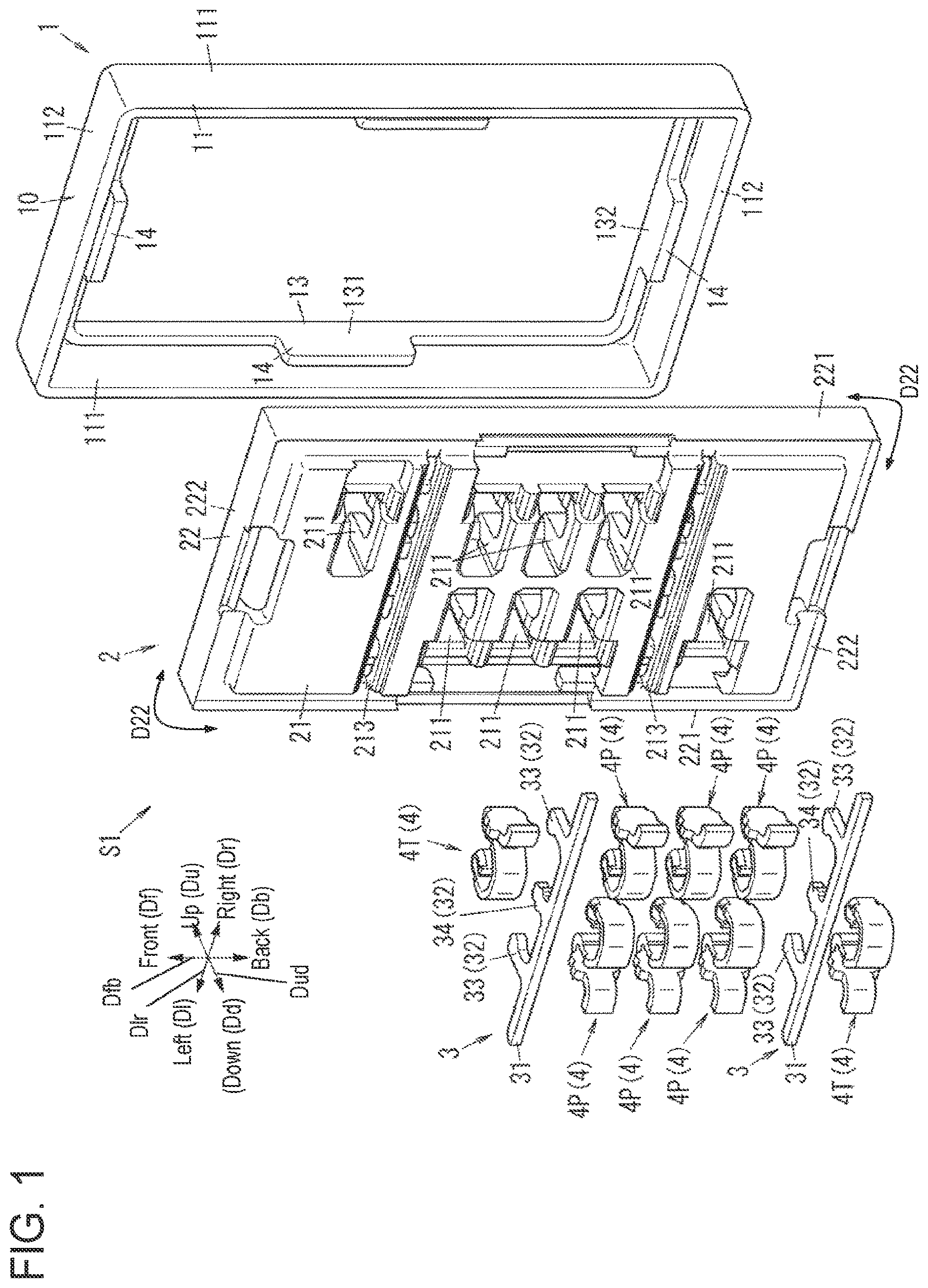
is an exploded perspective view of a socket (connector) according to an exemplary embodiment.
is a bottom view of the socket.
is a plan view of the socket.
is a perspective view of an outer shield of the socket.
is an exploded perspective view of a header (connector) according to the exemplary embodiment.
is a plan view of the header.
is a bottom view of the header.
is a perspective view of an outer shield of the header.
is a sectional view of the connector where the socket is separated the header, illustrating including respective inner shields of the socket and the header.
is a sectional view of the connector where the socket is connected to the header, illustrating the inner shields of the socket and the header.
is a sectional view of the connector where the socket is separated from the header, illustrating two terminals of each of the socket and the header.
is a sectional view of the connector where the socket is connected to the header, illustrating the two terminals of each of the socket and the header.
is a bottom view of the connector schematically illustrating the socket.
is a graph illustrating a noise level of the socket and the header and a noise level of a comparative example of a socket and a header.
is a bottom view of modification example 1 of the socket.
is a plan view of modification example 1 of the socket;
is a plan view of modification example 1 of the header.
is a bottom view of modification example 1 of the header.
is a perspective view of modification example 2 of the connector for illustrating two terminals of each of a socket and a header where the socket is separated from the header.
is a perspective view of modification example 2 of the connector for illustrating two terminals of each of the socket and the header where the socket is connected to the header.
is a bottom view of another modification example of the socket.
DETAILED DESCRIPTION OF PREFERRED EMBODIMENT
(1) Overview
A connector and a connector device according to an exemplary embodiment will be described below with reference to drawings. The following exemplary embodiment is just one of various exemplary embodiments of the present disclosure. The following exemplary embodiment can be variously modified in accordance with the design and the like as long as the object of the present disclosure can be achieved. The drawings described in the following exemplary embodiment are schematic diagrams, and the ratio of the size and the thickness of each component in the drawings does not necessarily reflect the actual dimensional ratio.
As illustrated in , connector device 100 includes a first connector (socket S 1 ) and a second connector (header H 1 ). In the following description, the first connector is also referred to as a “socket S 1 ”, and the second connector is also referred to as a “header H 1 ”. Socket S 1 is connected to header H 1 . At this moment, terminal 4 of socket S 1 is electrically connected to a terminal 8 of header H 1 . When viewed from socket S 1 , header H 1 is a “mating connector” connected to socket S 1 . On the contrary, when viewed from header H 1 , socket S 1 is a “mating connector” connected to header H 1 . That is, connector device 100 includes the connector (socket S 1 or header H 1 ) and the mating connector. When viewed from socket S 1 , terminal 8 of header H 1 is a “mating terminal” electrically connected to terminal 4 of socket S 1 . On the contrary, when viewed from header H 1 , terminal 4 of socket S 1 is a “mating terminal” electrically connected to terminal 8 of header H 1 .
(1.1) Configuration 1
As illustrated in , 5 , 9 , and 13 , in the exemplary embodiment, the connector (socket S 1 or header H 1 ) includes outer shield 1 (or 5 ), terminal 4 (or 8 ), housing 2 (or 6 ), and inner shield 3 (or 7 ). Terminal 4 (or 8 ) is surrounded by outer shield 1 (or 5 ). Terminal 4 (or 8 ) is electrically connected to the mating terminal of the mating connector. Outer shield 1 (or 5 ) is fixed to housing 2 (or 6 ). Housing 2 (or 6 ) holds terminal 4 (or 8 ). Inner shield 3 (or 7 ) is surrounded by outer shield 1 (or 5 ). Inner shield 3 (or 7 ) includes two tip regions r 1 (or r 7 ). Two tip regions r 1 (or r 7 ) includes tip region r 1 (or r 7 ) that faces or is directly coupled to outer shield 1 (or 5 ) and tip region r 1 (or r 7 ) that faces or is directly coupled to outer shield 1 (or 5 ). The longest loop length of electrically-closed loops LO 1 , LO 2 , and LO 3 that do not surround other electrically-closed loops among plural electrically-closed loops described below is shorter than the wavelength of a maximum frequency of a transmission signal flowing through terminal 4 (or 8 ). Each of tip regions r 1 (or r 7 ) of inner shield 7 is connected to outer shield 1 (or 5 ) by respective one of shortest distance L 1 (or L 7 ) via respective one of virtual paths W 7 and W 8 (or W 9 and W 10 ). Each of the plural electrically-closed loops includes outer shield 1 (or 5 ), inner shield 3 (or 7 ), and two virtual paths W 7 and W 8 (or W 9 and W 10 ), and surrounds terminal 4 (or 8 ). When viewed from socket S 1 , inner shield 7 of header H 1 is a mating inner shield. On the contrary, when viewed from header H 1 , inner shield 3 of socket S 1 is a mating inner shield. When viewed from socket S 1 , outer shield 5 of header H 1 is a mating outer shield. On the contrary, when viewed from header H 1 , outer shield 1 of socket S 1 is a mating outer shield.
The above configuration reduces resonance of a transmission signal in the electrically-closed loop.
In the present disclosure, the “maximum frequency of the transmission signal flowing through the terminal” means, in a case that the signal is transmitted through the terminal, the maximum frequency of a carrier wave of a signal, for example, when a radio frequency (RF) signal is transmitted, and means the frequency being harmonics of three to five times a clock frequency when a digital signal is transmitted. The maximum frequency has, for example, a value determined by a manufacturer or the like of a connector in accordance with the specifications of the connector, or a value determined by the standard or the like of the connector. The maximum frequency is described, for example, as the value of the maximum frequency of which the operation is guaranteed, in the specifications provided by the manufacturer.
(1.2) Configuration 2
As illustrated in , 4 , 5 , 8 , and 9 , in the exemplary embodiment, the connector (socket S 1 or header H 1 ) includes outer shield 1 (or 5 ), terminal 4 (or 8 ), and housing 2 (or 6 ). Outer shield 1 (or 5 ) includes tubular portion 10 (or 50 ). Both ends of tubular portion 10 (or 50 ) in a predetermined direction are open. Terminal 4 (or 8 ) is surrounded by outer shield 1 (or 5 ). Terminal 4 (or 8 ) is electrically connected to the mating terminal of the mating connector. Outer shield 1 (or 5 ) is fixed to housing 2 (or 6 ). Housing 2 (or 6 ) holds terminal 4 (or 8 ). Outer shield 1 (or 5 ) has distal end surface 102 (or 502 ) of tubular portion 10 (or 50 ), outer circumferential surface 101 (or 501 ) of tubular portion 10 (or 50 ), and inner circumferential surface 103 (or 503 ) of tubular portion 10 (or 50 ). Distal end surface 102 (or 502 ) is provided along the inner edge of tubular portion 10 (or 50 ) at one (which will be described next) of both ends of tubular portion 10 (or 50 ). One end is the end that is on the mating connector side when the connector and the mating connector are transitioned from the disconnected state to the connected state. At least one of distal end surface 102 (or 502 ), outer circumferential surface 101 (or 501 ), and inner circumferential surface 103 (or 503 ) is seamless over the entire circumference of tubular portion 10 (or 50 ) in circumferential direction D 10 (or D 50 ).
In the present disclosure, “seamless” means that there are no seams or breaks.
The above configuration reduces noise radiated from outer shield 1 (or 5 ) in comparison to a case where each of distal end surface 102 (or 502 ), outer circumferential surface 101 (or 501 ), and inner circumferential surface 103 (or 503 ) has seams or breaks.
In the connector as disclosed in Japanese Patent Laid-Open Publication No. 2013-182808, radiation noise may be generated even though the shield cover is attached.
On the other hand, the connector in the exemplary embodiment, as described above, reduces noise radiated from outer shield 1 (or 5 ).
(1.3) Configuration 3
As illustrated in , 5 , and 10 , in the exemplary embodiment, the connector (socket S 1 or header H 1 ) includes plural terminals 4 (or 8 ). Terminals 4 (or 8 ) are electrically connected to the mating terminals of the mating connector, respectively. The connector further includes housing 2 (or 6 ) and inner shield 3 (or 7 ). Housing 2 (or 6 ) holds terminals 4 (or 8 ). The connector is connected to the mating connector by moving at least one toward the other in up-down direction Dud relatively. Terminals 4 (or 8 ) include two terminals 4 (or 8 ). Two terminals 4 (or 8 ) are arranged on both sides of inner shield 3 (or 7 ) in front-back direction Dfb perpendicular to up-down direction Dud. Inner shield 3 (or 7 ) includes base 31 (or 71 ) and extension 32 (or 72 ). Base 31 (or 71 ) extends in left-right direction D 1 r perpendicular to up-down direction Dud and front-back direction Dflo. Extension 32 (or 72 ) protrudes from base 31 (or 71 ) in up-down direction Dud. Housing 2 (or 6 ) includes a shield holder (accommodation portion 28 or 68 ). The shield holder holds extension 32 (or 72 ).
Since two terminals 4 (or 8 ) are arranged on both sides of inner shield 3 (or 7 ), the above configuration reduces noise propagation between two terminals 4 (or 8 ) more than a connector where inner shield 3 (or 7 ) is not provided. Since extension 32 (or 72 ) of the connector is positioned by the shield holder (accommodation portion 28 or 68 ), the accuracy of alignment between extension 32 (or 72 ) of the connector and the mating connector is improved. In the exemplary embodiment, extension 32 (or 72 ) of the connector is electrically connected to the inner shield of the mating connector. This configuration improves the accuracy of the electrical connection between extension 32 (or 72 ) of the connector and the inner shield of the mating connector.
In the connector disclosed in Japanese Patent Laid-Open Publication No. 2013-182808, radiation noise may be generated by the noise propagating between plural contacts (terminals).
On the other hand, the connector in the exemplary embodiment, as described above, reduces noise propagation between two terminals 4 (or 8 ).
(1.4) Configuration 4
As illustrated in , 2 , 5 , and 6 , in the exemplary embodiment, the connector (socket S 1 or header H 1 ) includes plural terminals 4 (or 8 ), housing 2 (or 6 ), and inner shield 3 (or 7 ). Terminals 4 (or 8 ) are electrically connected to the mating terminals of the mating connector, respectively. Housing 2 (or 6 ) holds terminals 4 (or 8 ). The connector is connected to the mating connector by moving at least one toward the other in up-down direction Dud relatively. In the exemplary embodiment, socket S 1 being the connector is connected to header H 1 by moving toward header H 1 to header H 1 being the mating socket in an upward direction Du being a predetermined direction relatively with respect to header H 1 . Terminals 4 (or 8 ) include two terminals 4 (or 8 ). Two terminals 4 (or 8 ) are arranged on both sides of inner shield 3 (or 7 ) in front-back direction Dfb perpendicular to up-down direction Dud.
The above configuration reduces noise propagation between two terminals 4 (or 8 ) more than a connector where inner shield 3 (or 7 ) is not provided.
In the above configuration, the connector preferably further include outer shield 1 (or 5 ). Outer shield 1 (or 5 ) surrounds terminals 4 (or 8 ) and inner shield 3 (or 7 ).
The connector including outer shield 1 (or 5 ) reduces the propagation or the radiation of noise between the inside and the outside of outer shield 1 (or 5 ).
(2) Details
The connectors (socket S 1 and header H 1 ) according to the exemplary embodiment will be detailed below with reference to to 14 .
Unless otherwise specified, description will be made on the assumption that a direction in which socket S 1 and header H 1 are connected or separated to or from each other is up-down direction Dud, and header H 1 side when viewed from socket S 1 is upward direction Du. The description will be made on the assumption that the longitudinal direction of housing 2 of socket S 1 , which is perpendicular to up-down direction Dud, is front-back direction Dfb. The description will be made on the assumption that a direction perpendicular to up-down direction Dud and front-back direction Dfb, that is, the lateral direction of housing 2 is left-right direction D 1 r . That is, in and the like, as indicated by the arrows of “up”, “down”, “front”, “back”, “left”, and “right”, upward direction Du, downward direction Dd, forward direction Df, backward direction db, leftward direction D 1 , and rightward direction Dr are defined. The above directions are not intended to define the directions in which socket S 1 and header H 1 are used. The arrows indicating the directions in the drawing are shown only for the explanation, and are not accompanied by actual ones.
As described above, the connector and the mating connector are connected to each other by moving at least one toward the other in up-down direction Dud. In the exemplary embodiment, socket S 1 and header H 1 are connected to each other by at least one of a method in which socket S 1 is disposed below header H 1 , and socket S 1 moves in upward direction Du, and a method in which the socket is disposed below the header, and header H 1 moves in downward direction Dd. Therefore, “the mating connector side when the connector and the mating connector are transitioned from the disconnected state to the connected state” means the upper side when socket S 1 is used as the connector, and means the lower side when header H 1 is used as the connector.
In the exemplary embodiment, socket S 1 and header H 1 are attached to circuit boards 150 and 550 (see ) such as printed wiring boards or flexible printed wiring boards, respectively. Socket S 1 and header H 1 are used for electrically connecting plural circuit boards mounted into a portable terminal, such as a smartphone, for example. This description does not intend to limit the use of socket S 1 and header H 1 , and socket S 1 and header H 1 may be used in an electronic device, such as a camera module, other than a portable terminal. The use of socket S 1 and header H 1 is not limited to the use of electrically connecting plural circuit boards to each other. The socket and the header may be used for electrically connecting plural components, for example, electrically connecting a circuit board and a display or electrically connecting a circuit board and a battery, to each other.
Socket S 1 and header H 1 may be provided in a state of not being connected to circuit boards 150 and 550 , respectively, or may be provided in a state of being connected.
(2.1) Configuration of Socket
Firstly, a configuration of socket S 1 according to the exemplary embodiment will be described.
Socket S 1 is two-fold symmetrical with respect to an axis passing through the center of socket S 1 along up-down direction Dud, as a symmetric axis. As illustrated in , socket S 1 includes outer shield 1 , housing 2 , plural (two) inner shields 3 , and plural (eight) terminals 4 . Each of outer shield 1 and inner shields 3 is an electrostatic shield. Outer shield 1 surrounds terminals 4 . That is, outer shield 1 is disposed outside terminals 4 . Inner shields 3 are arranged inside outer shield 1 Inner shields 3 are arranged inside housing 2 .
Circuit board 150 (see ) is mechanically and electrically connected to socket S 1 . In the exemplary embodiment, circuit board 150 is a double-sided board, but circuit board 150 may be a multi-layered board. Circuit board 150 includes substrate 160 (see ) and conductors 170 and 180 (see ). Substrate 160 is, for example, a semiconductor substrate or a glass substrate. Conductor 170 is a pattern of, for example, a copper foil provided on a surface of substrate 160 . For example, conductor 170 is provided substantially on the entire surface of substrate 160 to which socket S 1 is connected. Conductor 180 is, for example, solder. Conductor 180 is provided in a predetermined region (land) of conductor 170 . Conductor 170 is electrically connected to outer shield 1 , inner shields 3 , and terminals 4 through conductor (solder) 180 . Outer shield 1 and inner shields 3 are electrically connected to, e.g. a ground provided on circuit board 150 . In , a region in which conductor (solder) 180 is provided is illustrated by a two-dot chain line.
(2.1.1) Housing of Socket
Housing 2 is made of a molded resin. Housing 2 has electrical insulating properties. As illustrated in to 3 , housing 2 has bottom wall 21 and peripheral wall 22 . Bottom wall 21 has a rectangular shape in which the length thereof in front-back direction Dfb is longer than the length thereof in left-right direction D 1 r in a plan view. Peripheral wall 22 protrudes from the entire circumference of the outer circumferential portion of one surface (upper surface) of bottom wall 21 in a thickness direction of the bottom wall, i.e., in upward direction Du. Housing 2 has a rectangular parallelepiped shape which is flat to extend perpendicularly to up-down direction Dud, and has recess 24 (see ) in the center of the upper surface which is a surface facing header H 1 among both sides of the housing in up-down direction Dud. The recess is surrounded by peripheral wall 22 .
Peripheral wall 22 has a tubular shape. Peripheral wall 22 surrounds plural terminals 4 . Peripheral wall 22 extends continuously over the entire circumference of peripheral wall 22 in circumferential direction D 22 (see ). In other words, peripheral wall 22 has no break over the entire circumference of peripheral wall 22 in circumferential direction D 22 . As illustrated in , peripheral wall 22 includes two peripheral walls 221 and two peripheral walls 222 . Two peripheral walls 221 are portions of peripheral wall 22 , and extend substantially parallel to front-back direction Dfb. Two peripheral walls 221 face each other in left-right direction D 1 r across recess 24 . Two peripheral walls 222 are portions of peripheral wall 22 , and extend substantially parallel to left-right direction D 1 r . Two peripheral walls 222 face each other in front-back direction Dfb across recess 24 . Each of two peripheral walls 222 connects the ends of two peripheral walls 221 to each other. That is, housing 2 has a shape in which one opening surface (lower surface) of peripheral wall 22 having a rectangular tubular shape with a quadrangular cross section is closed by bottom wall 21 .
As illustrated in , housing 2 further includes wall portion 25 , wall portion 26 , and wall portion 27 . Wall portion 25 , wall portion 26 , and wall portion 27 protrude from bottom wall 21 in upward direction Du. Wall portion 25 , wall portion 26 , and wall portion 27 are arranged in recess 24 . That is, wall portion 25 , wall portion 26 , and wall portion 27 are surrounded by peripheral wall 22 . Wall portion 25 , wall portion 26 , and wall portion 27 have rectangular parallelepiped shapes. When viewed in up-down direction Dud, each of wall portion 25 , wall portion 26 , and wall portion 27 is longer in front-back direction Dfb than in left-right direction D 1 r . That is, wall portion 25 , wall portion 26 , and wall portion 27 are wall portions having a thickness in the direction along left-right direction D 1 r . Wall portion 25 , wall portion 26 , and wall portion 27 are arranged in this order from the left to the right, that is, in rightward direction Dr.
Each of the wall portions (wall portion 25 , wall portion 26 , and wall portion 27 ) includes plural (two) accommodation portions 28 . Extension 32 of inner shield 3 is accommodated in each of accommodation portions 28 . Each of accommodation portions 28 is a through-hole provided in the wall portion. Accommodation portion 28 passes through the wall portion in up-down direction Dud. Accommodation portion 28 also passes through bottom wall 21 in up-down direction Dud. When viewed in up-down direction Dud, accommodation portions 28 provided in wall portion 25 and the wall portions 27 are recesses penetrating from the side surface (surface intersecting in left-right direction D 1 r ) of wall portion 25 (wall portion 27 ).
Each of the wall portions (wall portion 25 , wall portion 26 , and wall portion 27 ) includes plural terminal holders 29 . Each of terminal holders 29 holds terminal 4 . Each of terminal holders 29 is a through-hole provided in the wall portion. This through-hole passes through terminal holder 29 in up-down direction Dud. When viewed in up-down direction Dud, terminal holder 29 is a recess penetrating from the side surface (surface intersecting in left-right direction D 1 r ) of the wall portion. Two of terminal holders 29 correspond to one set. One set of two terminal holders 29 corresponding to each other are arranged in left-right direction D 1 r . A portion of bottom wall 21 between two terminal holders 29 corresponding to each other is through-hole 211 into which terminal 4 is inserted.
Plural terminals 4 are fixed to housing 2 by press fitting. That is, Terminals 4 are held in housing 2 by being pushed into housing 2 in one direction (upward). In the exemplary embodiment, eight terminals 4 are fixed to housing 2 . Eight terminals 4 are arranged in two rows. That is, four terminals 4 among eight terminals 4 form a first row, and the remaining four terminals 4 form a second row. Four terminals 4 in each row are arranged in front-back direction Dfb. Each of four terminals 4 forming the first row is held by terminal holder 29 of wall portion 25 and terminal holder 29 of wall portion 26 . Each of four terminals 4 forming the second row is held by terminal holder 29 of wall portion 26 and terminal holder 29 of wall portion 27 . That is, each of terminals 4 is disposed between the two wall portions and is supported from both sides of the each terminal by the two wall portions.
As illustrated in , bottom wall 21 has plural notches 212 provided therein. Notches 212 are provided at positions facing board connection portions 45 (described later) of terminals 4 when viewed in up-down direction Dud. Bottom wall 21 has plural (two) accommodation grooves 213 provided therein. Each of accommodation grooves 213 is a groove provided in the lower surface of bottom wall 21 . Accommodation groove 213 is longer in left-right direction D 1 r than in front-back direction Dfb. Accommodation groove 213 accommodates base 31 of inner shield 3 therein.
Peripheral wall 22 includes plural (four) insertion portions 223 . Plural (four) insertion portions 223 are recesses penetrating from the side surfaces (inner surfaces) of two peripheral walls 221 and two peripheral walls 222 . As described later, shield protrusion 14 which is a portion of outer shield 1 is inserted into each of plural (four) insertion portions 223 .
(2.1.2) Outer Shield of Socket
Outer shield 1 surrounds terminals 4 and inner shields 3 . Outer shield 1 contains metal as a main material or a material forming the surface, such as plating. Here, as an example, outer shield 1 is made of metal as main material. As illustrated in , outer shield 1 includes tubular portion 10 and plural (four) shield protrusions 14 . Tubular portion 10 includes outer peripheral wall 11 , top wall 12 , and inner peripheral wall 13 .
Outer peripheral wall 11 has a rectangular tubular shape with a rectangular cross section. Outer peripheral wall 11 includes two outer peripheral walls 111 and two outer peripheral walls 112 . Two outer peripheral walls 111 are portions of outer peripheral wall 11 , and extend substantially in front-back direction Dfb. Two outer peripheral walls 111 face each other in left-right direction D 1 r . Two outer peripheral walls 112 are portions of outer peripheral wall 11 , and extend substantially in left-right direction D 1 r . Two outer peripheral walls 112 face each other in front-back direction Dfb. Each of two outer peripheral walls 112 connects the ends of two outer peripheral walls 111 to each other. The lower end portions (lower surfaces) of outer peripheral wall 111 and outer peripheral wall 112 are parallel to a plane extending in left-right direction D 1 r and front-back direction Dfb.
Top wall 12 has a rectangular frame shape when viewed in up-down direction Dud. Top wall 12 is connected to the upper end of outer peripheral wall 11 and extends toward inside outer peripheral wall 11 when viewed in up-down direction Dud.
Inner peripheral wall 13 is provided inside outer peripheral wall 11 . Inner peripheral wall 13 has a rectangular tubular shape with a rectangular cross section. The upper end of outer peripheral wall 11 and the upper end of inner peripheral wall 13 are joined to each other by top wall 12 .
Inner peripheral wall 13 includes two inner peripheral walls 131 and two inner peripheral walls 132 . Two inner peripheral walls 131 are portions of inner peripheral wall 13 , and extend substantially in front-back direction Dfb. Two inner peripheral walls 131 face each other in left-right direction D 1 r . Two inner peripheral walls 132 are portions of inner peripheral wall 13 , and extend substantially parallel to left-right direction D 1 r . Two inner peripheral walls 132 face each other in front-back direction Dfb. Each of two inner peripheral walls 132 connects the ends of two inner peripheral walls 131 to each other.
Outer peripheral wall 11 , top wall 12 , and inner peripheral wall 13 constitute tubular portion 10 having both ends which open in up-down direction Dud. The outer circumferential surface of outer peripheral wall 11 corresponds to outer circumferential surface 101 of tubular portion 10 . The inner circumferential surface of inner peripheral wall 13 corresponds to inner circumferential surface 103 of tubular portion 10 . Outer shield 1 has distal end surface 102 . Distal end surface 102 is provided at one end (upper end) among both the ends of tubular portion 10 in up-down direction Dud. The one end is on the mating connector side when the connector (socket S 1 ) and the mating connector (header H 1 ) are transitioned from the disconnected state to the connected state. Distal end surface 102 has a loop shape extending along the inner edge of tubular portion 10 . The upper surface of top wall 12 corresponds to distal end surface 102 . The inner edge of distal end surface 102 corresponds to the inner edge of tubular portion 10 at the upper end of tubular portion 10 .
Boundary b 1 between distal end surface 102 and outer circumferential surface 101 is a surface arcuate when viewed in front-back direction Dfb (see ). Boundary b 2 between distal end surface 102 and inner circumferential surface 103 is a surface arcuate when viewed in front-back direction Dfb (see ). Distal end surface 102 is defined as a region of the outer surface of tubular portion 10 forming an acute angle with respect to up-down direction Dud is equal to or larger than 0 degrees and smaller than 45 degrees. The outer surface forming an acute angle equal to or larger than 45 degrees is defined as outer circumferential surface 101 . The inner surface having an acute angle which is equal to or larger than 45 degrees is defined as inner circumferential surface 103 . Tubular portion 10 surrounds hollow space 10 S. Boundary b 1 includes a portion of distal end surface 102 and a portion of outer circumferential surface 101 over the entire circumference in circumferential direction D 10 (see ) surrounding hollow space 10 S of tubular portion 10 . Boundary b 2 includes a portion of distal end surface 102 and a portion of inner circumferential surface 103 over the entire circumference of tubular portion 10 in circumferential direction D 10 .
Plural (four) shield protrusions 14 are provided corresponding to two inner peripheral walls 131 and two inner peripheral walls 132 , respectively. Each of the shield protrusions 14 protrudes downward from corresponding inner peripheral wall 131 or inner peripheral wall 132 . Each of plural (four) shield protrusions 14 corresponds to respective one of plural (four) insertion portions 223 (see ) provided in housing 2 . Each of shield protrusions 14 is inserted into corresponding one of insertion portions 223 .
Outer shield 1 is insert-molded with housing 2 . More specifically, outer shield 1 is insert-molded with housing 2 so that peripheral wall 22 of housing 2 is inserted between outer peripheral wall 11 and inner peripheral wall 13 of outer shield 1 .
The entire surface of outer shield 1 is seamlessly formed. Outer shield 1 is formed, for example, by drawing. Thus, the entire surface of outer shield 1 is seamlessly formed. In the exemplary embodiment, at least outer circumferential surface 101 and inner circumferential surface 103 among the surfaces of outer shield 1 are seamless over the entirety of tubular portion 10 in circumferential direction D 10 (that is, there are no seams or breaks). In the exemplary embodiment, distal end surface 102 is seamless over the entirety of tubular portion 10 in circumferential direction D 10 .
For example, regarding outer circumferential surface 101 , as illustrated in , outer circumferential surface 101 includes outer surface 1110 of each of two outer peripheral walls 111 and outer surface 1120 of each of two outer peripheral walls 112 . Each of outer surface 1110 and outer surface 1120 is seamless. Outer surface 1110 and outer surface 1120 which have different normal directions are seamlessly connected to each other. Outer circumferential surface 101 is thus seamless over the entirety of tubular portion 10 in circumferential direction D 10 .
For example, regarding inner circumferential surface 103 , as illustrated in , inner circumferential surface 103 includes outer surface 1310 of each of two inner peripheral walls 131 and outer surface 1320 of each of two inner peripheral walls 132 . Each of outer surface 1310 and outer surface 1320 is seamless. Outer surface 1310 and outer surface 1320 which have different normal directions are seamlessly connected to each other. Inner circumferential surface 103 is thus seamless over the entirety of tubular portion 10 in circumferential direction D 10 .
At least one (both in the exemplary embodiment) of boundary b 1 between distal end surface 102 and outer circumferential surface 101 and boundary b 2 between distal end surface 102 and inner circumferential surface 103 is seamless over the entire circumference of tubular portion 10 in circumferential direction D 10 .
For example, at the upper right (corner portion of outer shield 1 ) in , outer surface 1110 of outer peripheral wall 111 , outer surface 1120 of outer peripheral wall 112 , and distal end surface 102 are seamlessly connected. That is, outer surface 1110 , outer surface 1120 , and distal end surface 102 which have different normal directions are seamlessly connected to one another. On the right in , outer surface 1110 and distal end surface 102 which have different normal directions are seamlessly connected to each other. At the upper portion in , outer surface 1120 and distal end surface 102 which have different normal directions are seamlessly connected to each other. Boundary b 1 is thus seamless over the entirety of tubular portion 10 in circumferential direction D 10 .
For example, at the lower left (corner portion of outer shield 1 ) in , outer surface 1310 of inner peripheral wall 131 , outer surface 1320 of inner peripheral wall 132 , and distal end surface 102 are seamlessly connected to one another. That is, outer surface 1310 , outer surface 1320 , and distal end surface 102 which have different normal directions are seamlessly connected to one another. On the left in , outer surface 1310 and distal end surface 102 which have different normal directions are seamlessly connected to each other. At the lower portion in , outer surface 1320 and distal end surface 102 which have different normal directions are seamlessly connected to each other. Boundary b 2 is thus seamless over the entirety of tubular portion 10 in circumferential direction D 10 .
(2.1.3) Inner Shield of Socket
In the exemplary embodiment, two inner shields 3 have the same shape. Inner shield 3 contains metal as a main material or a material forming the surface, such as plating. Here, inner shield 3 is made of metal as main material. As illustrated in , inner shield 3 includes base 31 and plural (three) extensions 32 (two extensions 33 and one extension 34 ).
Base 31 has a length in along left-right direction D 1 r . Base 31 has a plate shape. When viewed in a thickness direction (front-back direction Dfb) of base 31 , base 31 is longer in left-right direction D 1 r than in up-down direction Dud. Base 31 is accommodated in accommodation groove 213 provided in bottom wall 21 of housing 2 .
As illustrated in , plural extensions 32 protrude upward from base 31 . That is, extensions 32 protrude in up-down direction Dud to be directed to the mating connector side when the connector (socket S 1 ) and the mating connector (here, header H 1 ) are transitioned from the disconnected state to the connected state. Extensions 32 have plate shapes. When viewed in a thickness direction (front-back direction Dfb) of each of extensions 32 , each of extensions 32 is longer in up-down direction Dud than in left-right direction D 1 r . The thickness direction of extension 32 may be left-right direction D 1 r.
Extension 33 includes extension body 331 and contacting portion 332 . Extension body 331 protrudes from base 31 . Contacting portion 332 is configured to contact the mating inner shield (inner shield 7 ) of the mating connector (header H 1 ). Contacting portion 332 protrudes from extension body 331 in a longitudinal direction (direction D 1 or direction Dr). Contacting portion 332 is provided on surface 332 S (here, left surface or right surface) of extension 33 (extension body 331 ) in the longitudinal direction of extension 33 . That is, contacting portion 332 protrudes from extension body 331 in left-right direction D 1 r.
Contacting portions 332 of two extensions 33 face each other in left-right direction D 1 r . Contacting portion 332 is configured to contact contacting portion 720 of inner shield 7 of header H 1 while socket S 1 is connected to header H 1 (see ). Thus, each of two inner shields 3 is electrically connected to corresponding one of inner shields 7 of two inner shields 7 of header H 1 . Specifically, two extensions 72 of inner shield 7 are inserted between two extensions 33 of inner shield 3 . At this moment, two extensions 72 are pressed against two extensions 33 due to elasticity of two extensions 72 and two extensions 33 .
Extension 34 includes extension body 341 and plural (two) holding protrusions 342 . Extension body 341 protrudes from base 31 . Two holding protrusions 342 protrude from extension body 341 . Two holding protrusions 342 are provided on the left end and the right end of extension body 341 . That is, one of two holding protrusions 342 protrudes from extension body 341 in the left direction D 1 , and the other protrudes from extension body 341 in the right direction Dr.
Socket S 1 includes three extensions 32 on each of two inner shields 3 . That is, socket S 1 includes six extensions 32 in total. Each of six accommodation portions 28 (see ) provided in housing 2 corresponds to respective one of six extensions 32 . Each of extensions 32 is accommodated in corresponding accommodation portion 28 . More specifically, extension 33 is accommodated in accommodation portion 28 of wall portion 25 and wall portion 27 . Extension 34 is accommodated in accommodation portion 28 of wall portion 26 . In extension 34 , the width including two holding protrusions 342 in left-right direction D 1 r is slightly larger than the width of accommodation portion 28 in left-right direction D 1 r . Inner shield 3 is fixed to housing 2 by press fitting. That is, inner shield 3 is held in housing 2 by being pushed into housing 2 in one direction (upward). Inner shield 3 is held in housing 2 while two holding protrusions 342 are sandwiched by the inner surfaces of accommodation portion 28 in between.
The accommodation space of each of two extensions 33 in the shield holder (accommodation portion 28 ) is larger than each of two extensions 33 . That is, a margin is provided in the alignment between each of two extensions 33 and the inner surface of accommodation portion 28 . This function of holding inner shield 3 in housing 2 is realized by at least extension 34 . That is, inner shield 3 is held in housing 2 by press fitting at least extension 34 into accommodation portion 28 . Plural extensions 32 include extension 33 including contacting portion 332 contacting inner shield 7 of the mating connector (here, header H 1 ) and extension 34 held in the shield holder (accommodation portion 28 ). Extension 34 may also include a contacting portion configured to contact inner shield 7 of the mating connector (here, header H 1 ).
As illustrated in , base 31 of inner shield 3 is located at the lower end of socket S 1 . Inner shield 3 is surrounded by outer shield 1 . Inner shield 3 includes two tip regions r 1 facing outer shield 1 . Two tip regions r 1 are provided at both ends (left end and right end) of base 31 in a longitudinal direction of the base.
Outer shield 1 has end e 1 and end e 2 . End e 1 is an end (upper end) that is on the mating connector side when the connector (here, socket S 1 ) and the mating connector (here, header H 1 ) are transitioned from the disconnected state to the connected state. End e 2 is an end (lower end) opposite to end e 1 . End e 2 is a region of outer shield 1 extending over the entire circumference of tubular portion 10 in circumferential direction D 10 . Outer shield 1 faces two tip regions r 1 in the region of outer shield 1 including end e 2 .
Outer shield 1 faces at least one of two tip regions r 1 with gap g 1 in between in the region of outer shield 1 including end e 2 . As illustrated in , conductors 170 and 180 of circuit board 150 are electrically connected to outer shield 1 . Conductors 170 and 180 are provided to bridge end e 2 of outer shield 1 to two tip regions r 1 of inner shield 3 , respectively. That is, outer shield 1 is electrically connected to inner shield 3 through conductors 170 and 180 . In a state where circuit board 150 is not provided, outer shield 1 is electrically insulated from at least one (both in the exemplary embodiment) of two tip regions r 1 via gap g 1 . Shortest distance L 1 between outer shield 1 and at least one of two tip regions r 1 in gap g 1 is equal to or greater than 0.01 mm and equal to or less than 0.1 mm.
Inner shield 3 has end e 3 and end e 4 . End e 3 is an end (upper end) that is on the mating connector side when the connector (here, socket S 1 ) and the mating connector (here, header H 1 ) are transitioned from the disconnected state to the connected state. End e 4 is an end (lower end) opposite to end e 3 . Inner shield 3 has connection surface 310 (lower surface) at end e 4 . Connection surface 310 is configured to be electrically connected to circuit board 150 . Connection surface 310 is flat and continuously extends over two tip regions r 1 . More specifically, connection surface 310 is a rectangular flat surface connecting two tip regions r 1 to each other.
(2.1.4) Terminal of Socket
(2.1.4.1) Arrangement
As illustrated in , plural (eight) terminals 4 include plural (six) low-frequency terminals 4 P and plural (two) high-frequency terminals 4 T. Each of terminals 4 is inserted into through-hole 211 of bottom wall 21 of housing 2 and is held by terminal holder 29 .
Two high-frequency terminals 4 T are arranged on both sides of at least one inner shield 3 . In other words, at least one inner shield 3 is disposed between two high-frequency terminals 4 T. This configuration reduces noise propagation between two high-frequency terminals 4 T.
More specifically, two high-frequency terminals 4 T are arranged on both sides of at least one inner shield 3 in front-back direction Dfb, that is, arranged on the front side and the back side of inner shield 3 . Focusing on one of two inner shields 3 in , one high-frequency terminal 4 T is disposed in front of inner shield 3 , that is, in forward direction Df from inner shield 3 . In addition, the remaining one high-frequency terminal 4 T is disposed behind inner shield 3 , that is, in backward direction db from inner shield 3 . Two inner shields 3 are arranged between two high-frequency terminals 4 T. A longitudinal direction (left-right direction D 1 r ) of inner shield 3 is a direction intersecting with a direction (substantially front-back direction Dfb) in which two high-frequency terminals 4 T are arranged.
Six low-frequency terminals 4 P are arranged between two inner shields 3 . That is, one of two inner shields 3 separates a space in which one of two high-frequency terminals 4 T is disposed from a space in which six low-frequency terminals 4 P are arranged. The other of two inner shields 3 separates a space in which the other of two high-frequency terminals 4 T is disposed from the space in which six low-frequency terminals 4 P are arranged. Six low-frequency terminals 4 P are arranged in two rows each containing three thereof in front-back direction Dfb.
Three low-frequency terminals 4 P in each row are arranged at equal pitches in front-back direction Dfb. High-frequency terminals 4 T are arranged in front of or behind low-frequency terminal 4 P at the end of each row, that is, in forward direction Df or backward direction db from low-frequency terminal 4 P at the end of each row. The pitch between low-frequency terminal 4 P and high-frequency terminal 4 T is an integer multiple (twice in the exemplary embodiment) of the pitch between three low-frequency terminals 4 P. This arrangement allows six low-frequency terminals 4 P and two high-frequency terminals 4 T to be easily assembled into housing 2 .
In the exemplary embodiment, the pitch between low-frequency terminal 4 P and high-frequency terminal 4 T is longer than the pitch between three low-frequency terminals 4 P. This arrangement secures a space for arranging inner shield 3 between low-frequency terminal 4 P and high-frequency terminal 4 T.
A space in which plural low-frequency terminals 4 P are arranged is provided between two high-frequency terminals 4 T. This configuration secures the distance between two high-frequency terminals 4 T, and accordingly reduces noise propagation between two high-frequency terminals 4 T. Two high-frequency terminals 4 T are arranged at diagonal positions inside peripheral wall 22 of housing 2 , accordingly increasing the distance between two high-frequency terminals 4 T.
Two high-frequency terminals 4 T are electrically connected to a signal line made of conductor 170 patterned on circuit board 150 . At least one of six low-frequency terminals 4 P is electrically connected to a power line made of conductor 170 patterned on circuit board 150 . A signal having a higher frequency is transmitted through two high-frequency terminals 4 T than the frequency in six low-frequency terminals 4 P. The frequency of the signal transmitted by two high-frequency terminals 4 T ranges, for example, from about 5 to 50 GHz.
At least one of six low-frequency terminals 4 P may be electrically connected to inner shield 3 , thus having a potential equal to the potential of inner shield 3 . Specifically, the potential of the at least one of six low-frequency terminals 4 P and the potential of inner shield 3 are a ground potential. At least one of six low-frequency terminals 4 P may be electrically connected to inner shield 3 , for example, through conductors 170 and 180 of circuit board 150 . At least one of six low-frequency terminals 4 P may be electrically connected to inner shield 3 not through circuit board 150 .
(2.1.4.2) Shape
Terminals 4 have the same shape. Terminals 4 are formed, for example, by punching and bending a metal plate. As illustrated in , each of terminals 4 includes contact portion 41 , base 42 , joining portion 43 , protruding portion 44 , board connection portion 45 , and contact portion 46 .
Board connection portion 45 is electrically connected to, for example, conductor 180 (solder) of circuit board 150 . That is, board connection portion 45 is bonded to circuit board 150 by a connecting method, such as soldering. Thus, terminal 4 is electrically and mechanically connected to circuit board 150 . As illustrated in , board connection portion 45 is surrounded by outer shield 1 when viewed in up-down direction Dud. At least a portion of board connection portion 45 and at least a portion of outer shield 1 are located on one plane perpendicular to up-down direction Dud.
Joining portion 43 has a U-shape opening in downward direction Dd. Joining portion 43 joins the upper end portion of base 42 to the upper end portion of contact portion 41 . The lower end portion of base 42 is connected to board connection portion 45 .
Protruding portion 44 has a U-shape opening in upward direction Du. Protruding portion 44 connects the lower end portion of contact portion 41 to contact portion 46 . Contact portion 41 faces contact portion 46 in left-right direction D 1 r . In the exemplary embodiment, at least joining portion 43 and protruding portion 44 of terminal 4 have elasticity.
While terminal 4 is held in housing 2 , at least respective portions of contact portion 41 and contact portion 46 is exposed when viewed from above. Contact portion 41 and contact portion 46 contact corresponding terminals 8 among plurality of terminals 8 (mating terminals) of header H 1 (mating connector) to be electrically connected to terminal 8 (see ). Specifically, contact portion 81 and contact portion 84 of terminal 8 are inserted between contact portion 41 and contact portion 46 . At this moment, contact portion 41 and contact portion 46 are pressed against terminal 8 by the elasticity of protruding portion 44 .
Terminal 4 further includes force-sensing portion 47 . Force-sensing portion 47 generates a click feeling when terminal 4 contacts terminal 8 (mating terminal). Force-sensing portion 47 is a protrusion that protrudes from contact portion 41 . When force-sensing portion 85 (protrusion) of terminal 8 moves over force-sensing portion 47 , the click feeling is generated. Specifically, if force-sensing portion 85 moves downward and over force-sensing portion 47 , the magnitude of a force acting between terminal 4 and terminal 8 decreases. Therefore, a worker who connects terminal 4 to terminal 8 senses the decrease in the magnitude of the force by the click feeling. The worker recognizes the progress of the connection between socket S 1 and header H 1 by sensing the click feeling. The connection between socket S 1 and header H 1 and the connection between terminal 4 and terminal 8 which accompanies the connection between socket S 1 and header H 1 are not necessarily performed manually, but by a machine.
When terminal 4 is connected to terminal 8 , contact portion 46 is inserted into dent 840 of terminal 8 . When terminal 4 and terminal 8 are transitioned from the connected state to the disconnected state, a certain amount or larger of force is required to cause force-sensing portion 85 to move upward and over force-sensing portion 47 and to remove contact portion 46 from dent 840 . As described above, a combination of force-sensing portion 85 and force-sensing portion 47 and a combination of contact portion 46 and dent 840 constitute lock mechanisms maintaining the connected state between socket S 1 and header H 1 .
As illustrated in , contacting portion 332 of inner shield 3 and contact portion 41 of at least one of terminals 4 are arranged in front-back direction Dfb.
(2.1.5) Circuit Board on Socket Side
Socket S 1 is electrically connected to conductor 180 (solder) on circuit board 150 . In , a region in which conductor 180 is provided on the lower surface of socket S 1 is indicated by a two-dot chain line. Some of conductors 180 are provided on the lower surface of outer shield 1 along circumferential direction D 10 of outer shield 1 . Here, conductors 180 are provided on the lower surface of outer shield 1 in each of plural regions spaced from each other along circumferential direction D 10 of outer shield 1 . Conductors 180 may continuously extend on the lower surface of outer shield 1 over the entire circumference of outer shield 1 along circumferential direction D 10 . That is, outer shield 1 may continuously contact conductors 180 over the entire circumference of circumferential direction D 10 .
Some of conductors 180 are provided to bridge outer shield 1 to each of inner shields 3 . Some of conductors 180 are provided on the lower surface of each of inner shields 3 in the longitudinal direction of inner shield 3 . Here, conductors 180 are provided on the lower surface of each of inner shields 3 in each of plural (three) regions spaced from each other along the longitudinal direction of inner shield 3 . Conductors 180 may continuously extend on the lower surface of each of inner shields 3 over the entire longitudinal direction of inner shield 3 . That is, inner shield 3 may continuously contact conductors 180 over the entire longitudinal direction of the inner shield.
Some of conductors 180 are electrically connected to outer shield 1 and each of inner shields 3 as described above, and are electrically connected to conductor 170 having a ground potential among conductors 170 of circuit board 150 . That is, outer shield 1 and inner shields 3 have the ground potential. Most of the surface of substrate 160 on the side to which socket S 1 is connected is preferably occupied by conductor 170 having the ground potential. That is, a so-called ground plane is preferably provided on circuit board 150 , thereby improving a shielding effect.
Some of conductors 180 are electrically connected to board connection portions 45 of terminals 4 . Terminal 4 is electrically connected to a circuit through conductor 170 (wiring pattern) of circuit board 150 . For example, plural high-frequency terminals 4 T are electrically connected to a circuit that processes a signal. For example, at least some of low-frequency terminals 4 P are electrically connected to wirings for transmitting a signal having a frequency lower than the frequency of a signal transmitted by high-frequency terminal 4 T, or to a power supply circuit or the ground.
(2.1.6) Electrically-Closed Loop of Socket
schematically illustrates the arrangement of outer shield 1 , plural (two) inner shields 3 , and plural (eight) terminals 4 when viewed from below.
In socket S 1 , at least plural (three) electrically-closed loops LO 1 , LO 2 , and LO 3 described below are formed. Each of electrically-closed loops LO 1 , LO 2 , and LO 3 includes at least outer shield 1 and one or two inner shields 3 among outer shield 1 , two inner shields 3 , and virtual paths W 7 , W 8 , W 9 , and W 10 . That is, each of electrically-closed loops LO 1 , LO 2 , and LO 3 necessarily includes a path completed in outer shield 1 and a path completed in one inner shield 3 or each of two inner shields 3 , and optionally includes at least one of virtual paths W 7 , W 8 , W 9 , and W 10 . Each of two virtual paths W 7 and W 8 (or W 9 and W 10 ) connects outer shield 1 to respective one of two tip regions r 1 of inner shield 3 by shortest distance L 1 . Each of electrically-closed loops LO 1 , LO 2 , and LO 3 surrounds at least one terminal 4 . Each of electrically-closed loops LO 1 , LO 2 , and LO 3 does not surround other electrically-closed loops. The other electrically-closed loops include at least outer shield 1 and one or two inner shields 3 among the outer shield 1 , two inner shields 3 , and virtual paths W 7 , W 8 , W 9 , and W 10 . Electrically-closed loop LO 1 does not surround electrically-closed loops LO 2 and LO 3 . Electrically-closed loop LO 2 does not surround electrically-closed loops LO 1 and LO 3 . Electrically-closed loop LO 3 does not surround electrically-closed loops LO 1 and LO 2 .
In the present disclosure, when one electrically-closed loop (referred to as a first closed loop below) surrounds another electrically-closed loop (referred to as a second closed loop below), a portion of the first closed loop may overlap a portion of the second closed loop.
The longest loop length among the loop lengths of electrically-closed loops LO 1 , LO 2 , and LO 3 is shorter than the wavelength of the maximum frequency of a transmission signal flowing through terminal 4 . This configuration reduces resonance of a transmission signal. Here, the maximum frequency refers to the maximum frequency of the transmission signal flowing through high-frequency terminal 4 T. That is, in the exemplary embodiment, the maximum frequency is determined in accordance with the specifications of high-frequency terminal 4 T.
Paths W 7 and W 8 , inner shield 3 , and paths W 2 , W 3 , and W 3 along outer shield 1 constitute electrically-closed loop LO 5 . Paths W 9 and W 10 , inner shield 3 , and paths W 2 , W 1 , and W 4 along outer shield 1 constitute electrically-closed loop LO 6 . Thus, outer shield 1 , inner shield 3 , and two of virtual paths W 7 to W 10 constitute plural electrically-closed loops LO 1 , LO 2 , LO 3 , LO 5 , and LO 6 each passing through outer shield 1 , inner shield 3 , and two of virtual paths W 7 to W 10 and include outer shield 1 and inner shield 3 . Each of electrically-closed loops LO 1 , LO 2 , LO 3 , LO 5 , and LO 6 surrounds terminal 4 . Electrically-closed loop LO 5 out of plural electrically-closed loops LO 1 , LO 2 , LO 3 , LO 5 , and LO 6 surrounds electrically-closed loops LO 2 and LO 2 other than electrically-closed loop LO 5 per se. Electrically-closed loop LO 6 out of plural electrically-closed loops LO 1 , LO 2 , LO 3 , LO 5 , and LO 6 surrounds electrically-closed loops LO 1 and LO 2 other than electrically-closed loop LO 6 per se. Each of one or more particular electrically-closed loops LO 1 , LO 2 , and LO 3 out of plural electrically-closed loops LO 1 , LO 2 , LO 3 , LO 5 , and LO 6 does not surround any electrically-closed loop out of plural electrically-closed loops LO 1 , LO 2 , LO 3 , LO 5 , and LO 6 other than the each of one or more particular electrically-closed loops LO 1 , LO 2 , and LO 3 per se. The longest loop length of one or more particular electrically-closed loops LO 1 , LO 2 , and LO 3 is shorter than the wavelength of the maximum frequency of a transmission signal flowing through terminal 4 .
In the case that the connector includes a single inner shield, two virtual paths are formed at both ends of the single inner shield in total. The two virtual paths, the inner shield, and the outer shield constitute plural electrically-closed loops.
In the connector as disclosed in Japanese Patent Laid-Open Publication No. 2013-182808, resonance of the transmission signal transmitted by the connector may occur.
In contrast, the connector in the exemplary embodiment reduces the resonance of the transmission signal flowing through terminal 4 .
Upon not limiting to a plane perpendicular to up-down direction Dud, electrically-closed loops other than electrically-closed loops LO 1 , LO 2 , and LO 3 are also formed in socket S 1 . However, any of these electrically-closed loops has a loop length which is shorter than the loop lengths of electrically-closed loops LO 1 , LO 2 , and LO 3 , hence not being described here.
Paths W 1 to W 10 constituting electrically-closed loops LO 1 , LO 2 , and LO 3 will be described below.
Two inner shields 3 are arranged on the front and back parts in socket S 1 . Region r 2 and region r 3 are provided on the left side surface of outer shield 1 . Region r 2 faces tip region r 1 on the left side of the front inner shield 3 . Region r 3 faces tip region r 1 on the left side of back inner shield 3 . Region r 4 and region r 5 are provided on the right side surface of outer shield 1 . Region r 4 faces tip region r 1 on the right side of the front inner shield 3 . Region r 5 faces tip region r 1 on the right side of the back inner shield 3 .
Path W 1 is included in the front region of outer shield 1 and connects region r 4 to region r 2 along outer shield 1 . Path W 2 connects region r 2 to region r 3 along the left side surface of outer shield 1 .
Path W 3 is included in the back region of outer shield 1 and connects region r 3 to region r 5 along outer shield 1 . Path W 4 connects region r 5 to region r 4 along the right side surface of outer shield 1 .
Path W 5 connects two tip regions r 1 of upper inner shield 3 to each other. Path W 6 connects two tip regions r 1 of lower inner shield 3 to each other.
Path W 7 connects region r 2 of outer shield 1 to tip region r 1 on the left side of front inner shield 3 by shortest distance L 1 . Path W 8 connects region r 4 of outer shield 1 to tip region r 1 on the right side of front inner shield 3 by shortest distance L 1 .
Path W 9 connects region r 3 of outer shield 1 to tip region r 1 on the left side of back inner shield 3 by shortest distance L 1 . Path W 10 connects region r 5 of outer shield 1 to tip region r 1 on the right side of back inner shield 3 by shortest distance L 1 .
Electrically-closed loop LO 1 is constituted by paths W 1 , W 7 , W 5 , and W 8 . Electrically-closed loop LO 2 is constituted by paths W 2 , W 9 , W 6 , W 10 , W 4 , W 8 , W 5 , and W 7 . Electrically-closed loop LO 3 is constituted by paths W 3 , W 10 , W 6 , and W 9 .
As described above, in the present disclosure, in the case that an electrically-closed loop (first closed loop) surrounds another electrically-closed loop (second closed loop), the portion of the first closed loop may overlap the portion of the second closed loops. For example, in , a first closed loop constituted by paths W 4 , W 1 , W 2 , W 9 , W 6 , and W 10 overlaps electrically-closed loop LO 1 as a second closed loop in path W 1 . The first closed loop surrounds the second closed loop.
In the exemplary embodiment, the loop length of electrically-closed loop LO 2 is the longest among the loop lengths of electrically-closed loops LO 1 , LO 2 , and LO 3 . The longest loop length ranges, e.g. from about 6 mm to 7 mm.
In the case that maximum frequency fMAX of a transmission signal flowing through terminal 4 is 10 GHz (1010 Hz), wavelength λ of maximum frequency fMAX of the transmission signal is expressed as λ=3×10 8 /fMAX=0.03[m]=30 [mm]. The longest loop length ranging from 6 to 7 [mm] satisfies the condition that the longest loop length is shorter than wavelength λ of maximum frequency fMAX.
Outer shield 1 constitutes electrically-closed loop LO 4 surrounding terminal 4 without inner shield 3 . Electrically-closed loop LO 4 is constituted by paths W 1 , W 2 , W 3 , and W 4 . That is, tubular portion 10 (see ) of outer shield 1 continuously extending along circumferential direction D 10 constitutes electrically-closed loop LO 4 . Electrically-closed loop LO 4 surrounds electrically-closed loops LO 1 , LO 2 , and LO 3 .
Since outer shield 1 has no gap therein along circumferential direction D 10 of tubular portion 10 , outer shield 1 solely constitutes electrically-closed loop LO 4 . Outer shield 1 may constitute electrically-closed loop LO 4 together with conductor 170 and/or 180 of circuit board 150 . That is, in the case that a gap is provided in outer shield 1 , conductor 170 and/or 180 may constitute a path connecting both ends of the gap to each other, and electrically-closed loop LO 4 may include this path. Here, conductor 170 and/or 180 may not necessarily be included in the configuration of socket S 1 .
(2.2) Configuration of Header
A configuration of header H 1 according to the exemplary embodiment will be described below. Description of components of header H 1 that are similar to those of socket S 1 will be appropriately omitted.
Header H 1 is two-fold symmetric with respect to a symmetric axis passing through the center of header H 1 along up-down direction Dud. As illustrated in , header H 1 includes outer shield 5 , housing 6 , plural (two) inner shields 7 , and plural (eight) terminals 8 . Each of outer shield 5 and inner shields 7 is an electrostatic shield. Outer shield 5 surrounds plural terminals 8 . That is, outer shield 5 is disposed outside plural terminals 8 . Inner shields 7 are arranged inside outer shield 5 . Inner shields 7 are arranged inside housing 6 .
Circuit board 550 (see ) is mechanically and electrically connected to header H 1 . Circuit board 550 includes substrate 560 (see ) and conductors 570 and 580 (see ) as components similar to substrate 160 and conductors 170 and 180 of circuit board 150 connected to socket S 1 . For example, conductor 570 is provided on substantially the entire surface of substrate 560 on the side on which header H 1 is connected. In , a region in which conductor (solder) 580 is provided is denoted by a two-dot chain line.
(2.2.1) Housing of Header
Housing 6 is made of a molded resin. Housing 6 has electrical insulating properties. Housing 6 includes bottom wall 61 and peripheral wall 62 . Bottom wall 61 has a rectangular shape in which the length thereof in front-back direction Dfb is longer than the length thereof in left-right direction D 1 r in a plan view. Peripheral wall 62 protrudes from the outer circumferential portion of one surface (lower surface) of bottom wall 61 in downward direction Dd, i.e., a thickness direction of the bottom wall. The left side surface and the right side surface of housing 6 have plural notches 601 (two on the left side surface and two on the right side surface in ) penetrating bottom wall 61 and peripheral wall 62 in up-down direction Dud. Plural notches 601 are provided at positions facing board connection portions 83 of terminals 8 when viewed in up-down direction Dud (see ).
As illustrated in , housing 6 further includes two wall portions 65 . Each of wall portions 65 protrudes from bottom wall 61 in downward direction Dd. Wall portion 65 has a rectangular parallelepiped shape having a cylindrical lower surface (see ). The front end and the back end of wall portion 65 are connected to peripheral wall 62 . When viewed in up-down direction Dud, wall portion 65 is longer in front-back direction Dfb than in left-right direction D 1 r . That is, wall portion 65 has a thickness in the direction along left-right direction D 1 r . Two wall portions 65 are arranged in left-right direction D 1 r.
Each of wall portions 65 includes plural (two) accommodation portions 68 . Each of extensions 72 of inner shield 7 is accommodated in respective one of plural accommodation portions 68 . Each of accommodation portions 68 is a through-hole provided in wall portion 65 . Accommodation portion 68 passes through wall portion 65 in up-down direction Dud. Accommodation portion 68 also penetrates bottom wall 61 in up-down direction Dud. When viewed in up-down direction Dud, accommodation portions 68 provided in wall portion 65 are recesses penetrating from the side surface (surface intersecting in left-right direction D 1 r ) of wall portion 65 .
Each of wall portions 65 includes plural (four) terminal holders 69 . Each of terminal 8 is held by respective one of terminal holders 69 . Each terminal holder 69 is a dent provided in wall portion 65 .
Plural terminals 8 are insert-molded with housing 6 . In the exemplary embodiment, eight terminals 8 are fixed to housing 6 . Each of eight terminals 8 of header H 1 corresponds to respective one of eight terminals 4 of socket S 1 . Each of terminals 8 is disposed at a position to be connected to corresponding one of terminals 4 .
As illustrated in , bottom wall 61 has plural (two) accommodation grooves 613 provided therein. Each of accommodation grooves 613 is a groove provided in the upper surface of bottom wall 61 . Accommodation groove 613 is longer in left-right direction D 1 r than in front-back direction Dfb. Accommodation groove 613 accommodates base 71 of inner shield 7 therein.
As illustrated in , peripheral wall 62 includes plural (two) insertion portions 623 . Each of plural (two) insertion portions 623 is a recess provided in the bottom surface (lower surface) of peripheral wall 62 . As described later, shield protrusion 54 which is a portion of outer shield 5 is inserted into each of plural (two) of insertion portions 623 .
(2.2.2) Outer Shield of Header
Outer shield 5 surrounds plural terminals 8 and plural inner shields 7 . Outer shield 5 contains metal as a main material or a material forming the surface, such as plating. Here, outer shield 5 is made of metal as the main material. As illustrated in , outer shield 5 includes outer peripheral wall 51 , plural (four) top walls 52 , plural (two) shield protrusions 54 , and bottom wall 55 .
Outer peripheral wall 51 has a rectangular tubular shape with a rectangular cross section. Outer peripheral wall 51 includes two outer peripheral walls 511 and two outer peripheral walls 512 . Two outer peripheral walls 511 are portions of outer peripheral wall 51 , and extend substantially in front-back direction Dfb. Two outer peripheral walls 511 face each other in left-right direction D 1 r . Two outer peripheral walls 512 are portions of outer peripheral wall 51 , and extend substantially in left-right direction D 1 r . Two outer peripheral walls 512 face each other in front-back direction Dflo. Each of two outer peripheral walls 512 connects the ends of two outer peripheral walls 511 to each other.
Outer shield 5 further includes plural protrusions 56 that protrude from outer peripheral wall 51 . Protrusions 56 function as contact portions configured to contact outer shield 1 of the mating connector (here, socket S 1 ). Outer peripheral wall 51 , top wall 52 , and protrusions 56 constitute tubular portion 50 having both ends which are open in up-down direction Dud. That is, tubular portion 50 includes outer peripheral wall 51 , top wall 52 , and plural protrusions 56 . Outer circumferential surface 501 of tubular portion 50 includes a portion of the outer circumferential surface of outer peripheral wall 51 and surfaces of protrusions 56 . Tubular portion 50 surrounds hollow space 50 S.
Outer shield 5 of the connector (here, header H 1 ) has a side surface (outer circumferential surface 501 ) in up-down direction Dud. The side surface (outer circumferential surface 501 ) has a protruding structure. That is, a structure formed by plural protrusions 56 corresponds to the protruding structure. Outer shield 5 of the connector (here, header H 1 ) contacts outer shield 1 of the mating connector (here, socket S 1 ) at the protruding structure (plural protrusions 56 ). More specifically, protrusions 56 contact inner circumferential surface 103 of tubular portion 10 of outer shield 1 (see ).
In comparison to a connector where outer circumferential surface 501 is flat without protrusions 56 , outer shield 1 of the connector according to the embodiment may be pushed into outer shield 5 even though the dimensions of outer shields 1 and 5 have variations. This configuration reduces poor contact occurring such that outer shields 1 and 5 contact each other in one direction in left-right direction D 1 r or one direction in front-back direction Dfb and are separated from each other in the other directions.
Each of two outer peripheral walls 511 includes three protrusions 56 . One protrusion 56 is provided on two outer peripheral walls 512 . Plural protrusions 56 are spaced from each other along circumferential direction D 50 (see ) surrounding hollow space 50 S of tubular portion 50 . The maximum value of creepage distances L 2 and L 3 between plural protrusions 56 is equal to or less than ¼ of wavelength λ of the maximum frequency of a transmission signal flowing through terminal 8 . This configuration reduces noise leaking from a region between plural protrusions 56 (region of outer shield 5 that is not electrically connected to outer shield 1 ). Here, creepage distance L 2 between protrusion 56 provided on outer peripheral wall 511 and protrusion 56 provided on outer peripheral wall 512 is larger than creepage distance L 3 between plural protrusions 56 provided on outer peripheral wall 511 . That is, the maximum value of the creepage distance between plural protrusions 56 is creepage distance L 2 . Here, the maximum frequency refers to the maximum frequency of the transmission signal flowing through high-frequency terminal 8 T among plural terminals 8 . That is, in the exemplary embodiment, the maximum frequency is determined in accordance with the specifications of the high-frequency terminal 8 T.
Each of plural (four) top walls 52 has an L-shape when viewed in up-down direction Dud. Plural (four) top walls 52 are connected to the lower ends of the four corners of outer peripheral wall 51 , and extend toward the inside of outer peripheral wall 51 when viewed in up-down direction Dud.
Bottom wall 55 has a rectangular frame shape when viewed in up-down direction Dud. Bottom wall 55 is connected to the upper end of outer peripheral wall 51 and extends toward the outside of outer peripheral wall 51 when viewed in up-down direction Dud. The lower surface of bottom wall 55 extends in front-back direction Dfb and left-right direction D 1 r , that is, parallel to a plane perpendicular to up-down direction Dud.
The inner circumferential surface of outer peripheral wall 51 corresponds to inner circumferential surface 503 of tubular portion 50 . Outer shield 5 has distal end surface 502 . Distal end surface 502 is provided at one end (lower end) of tubular portion 50 among both the ends of tubular portion 50 in up-down direction Dud. The one end is on the mating connector side when the connector (here, header H 1 ) and the mating connector (here, socket S 1 ) are transitioned from the disconnected state to the connected state. Distal end surface 502 extends along the inner edge of tubular portion 50 . Here, the upper surface of top wall 52 corresponds to distal end surface 502 . The inner edge of distal end surface 502 corresponds to a portion of the inner edge of tubular portion 50 at the lower end of tubular portion 50 .
Boundary b 3 between distal end surface 502 and outer circumferential surface 501 is an arcuate surface when viewed from front-back direction Dfb (see ). Here, distal end surface 502 is defined as a region of the outer surface of tubular portion 50 , and forms an acute angle with respect to up-down direction Dud which is equal to or larger than 0 degrees and smaller than 45 degrees. An outer surface of tubular portion 50 forming an acute angle of 45 degrees or larger is defined as outer circumferential surface 501 . Boundary b 3 has a predetermined length along circumferential direction D 50 of tubular portion 50 .
Each of plural (two) shield protrusions 54 corresponds to respective one of two of plural (four) top walls 52 . Each of shield protrusions 54 protrudes upward from the corresponding top wall 52 . Each of plural (two) of shield protrusions 54 corresponds to respective one of plural (two) of insertion portions 623 (see ) provided in housing 6 . Each of shield protrusions 54 is inserted into corresponding one of insertion portions 623 .
Outer shield 5 is fixed to housing 6 by press fitting. That is, outer shield 5 is held in housing 6 by being pushed into housing 6 in one direction (upward). At this moment, plural top walls 52 of outer shield 5 cover at least a portion of peripheral wall 62 of housing 6 . At this moment, each of shield protrusions 54 is inserted into corresponding insertion portion 623 .
The entire surface of outer shield 5 is seamlessly formed. In the exemplary embodiment, at least outer circumferential surface 501 and inner circumferential surface 503 among the surfaces of outer shield 5 are seamless over the entirety of tubular portion 50 along circumferential direction D 50 (that is, there are no seams or breaks).
As illustrated in , outer circumferential surface 501 includes outer surface 5110 and outer surface 5120 . Outer surface 5110 includes the surface of outer peripheral wall 511 and the surface of protrusion 56 , and corresponds to each of two outer peripheral walls 511 . Outer surface 5120 includes the surface of outer peripheral wall 512 and the surface of protrusion 56 , and corresponds to each of two outer peripheral walls 512 . Each of outer surface 5110 and outer surface 5120 is seamless. Outer surface 5110 and outer surface 5120 having different normal directions are seamlessly connected to each other. Outer circumferential surface 501 is thus seamless over the entirety of tubular portion 50 along circumferential direction D 50 .
As illustrated in , inner circumferential surface 503 includes inner surface 5111 of each of two outer peripheral walls 511 and inner surface 5121 of each of two outer peripheral walls 512 . Each of inner surface 5111 and inner surface 5121 is seamless. Inner surface 5111 and inner surface 5121 having different normal directions, re seamlessly connected to each other. Inner circumferential surface 503 is thus seamless over the entirety of tubular portion 50 along circumferential direction D 50 .
Boundary b 3 between outer circumferential surface 501 and distal end surface 502 is seamless. For example, at the upper right (corner portion of outer shield 5 ) of the surface of paper in , outer surface 5110 , outer surface 5120 , and distal end surface 502 having different normal directions are seamlessly connected.
(2.2.3) Inner Shield of Header
In the exemplary embodiment, two inner shields 7 have the same shape.
Inner shield 7 contains metal as a main material or a material forming the surface, such as plating. Here, inner shield 7 is made of metal as main material. As illustrated in , inner shield 7 includes base 71 and plural (two) extensions 72 .
Base 71 has a length in left-right direction D 1 r . Base 71 has a plate shape. When viewed in the thickness direction (front-back direction Dfb) of base 71 , base 71 is longer in left-right direction D 1 r than in up-down direction Dud. Base 71 is accommodated in accommodation groove 613 provided in bottom wall 61 of housing 6 .
Plural extensions 72 protrude downward from base 71 . That is, plural extensions 72 protrude in up-down direction Dud to be directed to the mating connector side when the connector (here, header H 1 ) and the mating connector (here, socket S 1 ) are transitioned from the disconnected state to the connected state. Each of extensions 72 has a rectangular plate shape. When viewed in the thickness direction (front-back direction Dfb) of each of extensions 72 , each of extensions 72 is longer in up-down direction Dud than in left-right direction D 1 r . The thickness direction of extension 72 may be left-right direction D 1 r.
Extension 72 includes contacting portion 720 (contact surface) configured to contact inner shield 3 of the mating connector (socket S 1 ). Contacting portion 720 is provided on a surface (here, left surface or right surface) of extension 72 in the longitudinal direction of extension 72 . Contacting portions 720 of two extensions 72 are directed in opposite directions (rightward direction Dr and leftward direction DO.
Header H 1 includes two extensions 72 on each of two inner shields 7 . That is, header H 1 includes four extensions 72 in total. Each of four accommodation portions 68 (see ) provided in housing 6 corresponds to respective one of four extensions 72 . Each of extensions 72 is accommodated in corresponding accommodation portion 68 .
Inner shield 7 is fixed to housing 6 by press fitting. That is, inner shield 7 is held in housing 6 by being pushed into housing 6 in one direction (downward). At this moment, each of extensions 72 is accommodated in corresponding accommodation portion 68 . Here, the accommodation space of each of two extensions 72 in the shield holder (accommodation portion 68 ) is larger than each of two extensions 72 .
As illustrated in , base 71 of inner shield 7 is located at the upper end of header H 1 . Here, outer shield 5 has end e 5 and end e 6 . End e 5 is an end (lower end) that is on the mating connector side when the connector (here, header H 1 ) and the mating connector (here, socket S 1 ) are transitioned from the disconnected state to the connected state. End e 6 is an end (upper end) opposite to end e 5 . Here, end e 6 covers the entire circumference along circumferential direction D 50 that surrounds hollow space 50 S of bottom wall 55 of outer shield 5 . Outer shield 5 faces two tip regions r 7 of inner shield 7 in a region including end e 6 .
Outer shield 5 faces at least one of two tip regions r 7 with gap g 7 , in the region including end e 6 . As illustrated in , conductors 570 and 580 of circuit board 550 are electrically connected to outer shield 5 . Conductors 570 and 580 are provided to bridge end e 6 of outer shield 5 over two tip regions r 7 of inner shield 7 , respectively. That is, outer shield 5 is electrically connected to inner shield 7 through conductors 570 and 580 . While circuit board 550 is not provided, outer shield 5 is electrically insulated from at least one (both in the exemplary embodiment) of two tip regions r 7 via gap g 7 . Shortest distance L 7 between outer shield 5 and at least one of two tip regions r 7 in gap g 7 is equal to or greater than 0.01 mm and equal to or less than 0.1 mm.
Inner shield 7 has end e 7 and end e 8 . End e 7 is an end (lower end) that is on the mating connector side when the connector (here, header H 1 ) and the mating connector (here, socket S 1 ) are transitioned from the disconnected state to the connected state. End e 8 is an end (upper end) opposite to end e 7 . Inner shield 7 has connection surface 710 (upper surface) at end e 8 . Connection surface 710 is configured to be electrically connected to circuit board 550 . Connection surface 710 is flat and continuously extends over two tip regions r 7 . More specifically, connection surface 710 has a rectangular flat surface connecting two tip regions r 7 to each other.
(2.2.4) Terminal of Header
As illustrated in , plural (eight) terminals 8 include plural (six) low-frequency terminals 8 P and plural (two) high-frequency terminals 8 T. The arrangement of plurality of terminals 8 is similar to the arrangement of plurality of terminals 4 of socket S 1 . That is, the content described in the section of “(2.1.4.1) Arrangement” is also applied to plural terminals 8 .
Terminals 8 have the same shape. Terminals 8 are formed by, for example, punching and bending a metal plate. As illustrated in , each of terminals 8 includes contact portion 81 , winding tongue 82 , board connection portion 83 , and contact portion 84 .
Board connection portion 83 is configured to be electrically connected to, for example, conductor 580 (solder) of circuit board 550 . That is, board connection portion 83 is bonded to circuit board 550 by, e.g. soldering. Thus, circuit board 550 is electrically and mechanically connected to terminals 8 . As illustrated in , board connection portion 83 is surrounded by outer shield 5 when viewed in up-down direction Dud. At least a portion of board connection portion 83 and at least a portion of outer shield 5 are flush on one plane perpendicular to up-down direction Dud.
Contact portion 81 and contact portion 84 have lengths in up-down direction Dud. Contact portion 81 is configured to contact contact portion 41 of terminal 4 of socket S 1 . Contact portion 84 is configured to contact contact portion 46 of terminal 4 of socket S 1 . Winding tongue 82 has a U-shape opening in upward direction Du. Winding tongue 82 joins the lower end portion of contact portion 81 to the lower end portion of contact portion 84 . Board connection portion 83 protrudes from the upper end portion of contact portion 81 .
While terminal 8 is held in housing 6 , at least a portion of contact portion 81 and contact portion 84 is exposed when viewed from below. Contact portion 81 and contact portion 84 contact corresponding terminals 4 among plural terminals 4 (mating terminals) of socket S 1 (mating connector) to be electrically connected to terminal 4 (see ).
Terminal 8 further includes force-sensing portion 85 . Force-sensing portion 85 generates a click feeling when terminal 8 contacts terminal 4 (mating terminal). Force-sensing portion 85 is a protrusion that protrudes from contact portion 81 . Upon moving over force-sensing portion 47 of terminal 4 , force-sensing portion (protrusion) 85 generates a click feeling.
Contact portion 84 has dent 840 in a contact surface of contact portion 84 contacting contact portion 46 . That is, contact portion 46 is inserted into dent 840 . Here, contact portion 46 contacts a side surface of dent 840 .
As illustrated in , contacting portion 720 of inner shield 7 and contact portion 81 of at least one of plural terminals 8 are arranged in front-back direction Dfb.
(2.2.5) Circuit Board on Header Side
Header H 1 is configured to be electrically connected to conductor 580 (solder) on circuit board 550 . In , a region in which conductor 580 is provided on the upper surface of header H 1 is denoted by a two-dot chain line. The arrangement and the electrical connection relation of conductors 570 and 580 of circuit board 550 , outer shield 5 , plural inner shields 7 , and plural terminals 8 are similar to the arrangement and the electrical connection relation of conductors 170 and 180 of circuit board 150 , outer shield 1 , plural inner shields 3 , and plural terminals 4 of socket S 1 .
(2.2.6) Electrically-Closed Loop of Header
The arrangement of outer shield 5 , plural (two) inner shields 7 , and plural (eight) terminals 8 of header H 1 is similar to the arrangement of outer shield 1 , plural (two) inner shields 3 , and plural (eight) terminals 4 of socket S 1 which is illustrated in . Therefore, in header H 1 , similar to socket S 1 , at least plural (three) electrically-closed loops LO 1 , LO 2 , and LO 3 are formed. The details regarding electrically-closed loops LO 1 , LO 2 , and LO 3 of header H 1 are similar to the details regarding electrically-closed loops LO 1 , LO 2 , and LO 3 of socket S 1 . Outer shield 5 constitutes electrically-closed loop LO 4 surrounding terminal 8 without inner shield 7 , similar to outer shield 1 .
Here, since outer shield 5 has no gap along circumferential direction D 50 of tubular portion 50 , outer shield 5 solely constitutes electrically-closed loop LO 4 . Outer shield 5 may constitute electrically-closed loop LO 4 together with conductor 570 and/or 580 of circuit board 550 . That is, in the case that a gap is formed in outer shield 5 , conductor 570 and/or 580 may constitutes a path connecting both ends of the gap to each other, and electrically-closed loop LO 4 may include this path. Here, conductor 570 and/or 580 may not necessarily be included in the configuration of header H 1 .
(3) Assembling Process
Processes of connecting socket S 1 to header H 1 so as to assemble connector device 100 will be described below with reference to to 12 .
Circuit board 150 is mechanically and electrically connected to socket S 1 . Circuit board 550 is mechanically and electrically connected to header H 1 . In this state, as illustrated in , socket S 1 is disposed below header H 1 . At least one of the upward movement of socket S 1 and the downward movement of header H 1 is performed. Thus, as illustrated in , socket S 1 and header H 1 are mechanically connected. As illustrated in , inner shield 3 of socket S 1 and inner shield 7 of header H 1 contact each other and are electrically connected to each other. As illustrated in , plural terminals 4 of socket S 1 and plurality of terminals 8 of header H 1 contact each other and are electrically connected to each other. As illustrated in , outer shield 1 of socket S 1 and outer shield 5 of header H 1 contact each other and are electrically connected to each other. As illustrated in , two wall portions 65 of housing 6 of header H 1 are inserted into a space between wall portion 25 and wall portion 26 of housing 2 of socket S 1 and a space between wall portion 26 and wall portion 27 .
Here, when socket S 1 and header H 1 (connector and the mating connector) are transitioned from the disconnected state to the connected state, the components of socket S 1 and the components of header H 1 contact each other in the following order.
First, socket S 1 contacts header H 1 at outer shields 1 and 5 . That is, a region of socket S 1 near the upper end of inner circumferential surface 103 of tubular portion 10 of outer shield 1 contacts a region of header H 1 near the lower end of outer circumferential surface 501 of tubular portion 50 of outer shield 5 .
Then, socket S 1 contacts header H 1 at terminals 4 and 8 . That is, at least one of a case where contact portion 41 contacts contact portion 81 and a case where contact portion 46 contacts contact portion 84 is performed.
Then, socket S 1 contacts header H 1 at inner shields 3 and 7 . That is, contacting portion 332 of inner shield 3 contacts contacting portion 720 of inner shield 7 .
Then, force-sensing portion 47 (or 85 ) of the connector (socket S 1 or header H 1 ) contacts the mating terminal (terminal 8 or 4 ). That is, at least one of a case where force-sensing portion 47 contacts contact portion 81 of terminal 8 and a case where force-sensing portion 85 contacts contact portion 41 of terminal 4 is performed. The force-sensing portions 47 and 85 generate a click feeling.
Then, outer shield 5 of the connector (here, header H 1 ) contact outer shield 1 of the mating connector (here, socket S 1 ) at the protruding structure (plural protrusions 56 also referred to as contact portions). That is, plural protrusions 56 contact inner circumferential surface 103 of tubular portion 10 of outer shield 1 (see ). More specifically, firstly, plural protrusions 56 contact the region near the upper end of inner circumferential surface 103 . Then, contact pressure between each protrusion 56 and inner circumferential surface 103 further moves plural protrusions 56 down while outer shield 1 elastically deforms so that inner peripheral wall 13 of outer shield 1 is directed toward the outer side (outer peripheral wall 11 side). Finally, as illustrated in , plural protrusions 56 contact a region of inner circumferential surface 103 along up-down direction Dud. Socket S 1 is thus connected to header H 1 .
As described above, a click feeling is generated at terminals 4 and 8 before the contact pressure and a frictional force between outer shields 1 and 5 increases by plural protrusions 56 contacting outer shield 1 . Therefore, the worker can perceive the click feeling more easily than a connector where the click feeling is generated after plural protrusions 56 contact outer shield 1 , thus preventing the click feeling by the frictional force from being perceived. The positional relation between outer shields 1 and 5 fixed by plural protrusions 56 contacting outer shield 1 is not changed in the subsequent processes, and thus, improves the positioning accuracy, accordingly, securing the contact area between outer shields 1 and 5 .
(4) Noise Level
The solid line in represents the analysis result of radiation noise of connector device 100 in the exemplary embodiment. The broken line in represents the analysis result of the radiation noise of a comparative example of a connector device. The horizontal axis represents a frequency [GHz]. The vertical axis represents the noise level ([dBμV/m]).
The comparative example of the connector device is different from connector device 100 in the exemplary embodiment in that each of outer shields 1 and 5 is formed by bending a metal plate. Other components of the connector device in the comparative example are the same as those in connector device 100 in the exemplary embodiment. Therefore, there are seams or breaks in circumferential direction D 10 (D 50 ) of tubular portion 10 ( 50 ), for example, on the outer circumferential surface and the inner circumferential surface of tubular portion 10 ( 50 ) of each of outer shields 1 and 5 of the connector device in the comparative example. On the other hand, in connector device 100 in the exemplary embodiment, each of outer shields 1 and 5 is formed by drawing a metal. Therefore, the outer circumferential surface and the inner circumferential surface of tubular portion 10 ( 50 ) of each of outer shields 1 and 5 are seamlessly formed over the entire circumference of tubular portion 10 ( 50 ) along circumferential direction D 10 (D 50 ), so that there are no seams or breaks therein.
As illustrated in , the noise level of connector device 100 in the exemplary embodiment is lower than that of the comparative example of the connector device at each frequency. That is, in comparison to the comparative example, in the exemplary embodiment, since the seams of outer shields 1 and 5 are removed, not only an effect of suppressing the influence of resonance, but also an effect of reducing the noise radiated from the seams are obtained.
Modification Example 1
Socket S 2 and header H 2 according to modification example 1 will be described below with reference to to 18 . Components similar to those in the exemplary embodiment are denoted by the same reference numerals, and the description thereof will be omitted. In , regions in which the conductors (solder) 180 and 580 are provided are indicated by two-dot chain lines.
As illustrated in , socket S 2 includes only one inner shield 3 . Socket S 2 includes only two terminals 4 . Thus, the shapes of outer shield 1 A and housing 2 A are different from the shapes of outer shield 1 and housing 2 in the exemplary embodiment. These configurations will be detailed below.
Housing 2 A schematically has a shape in which the region in which six low-frequency terminals 4 P are provided is omitted from housing 2 in the exemplary embodiment. Outer shield 1 A schematically has a shape in which the region in which six low-frequency terminals 4 P are provided is omitted from outer shield 1 in the exemplary embodiment.
Each of wall portion 25 , wall portion 26 , and wall portion 27 of housing 2 includes one accommodation portion 28 . Three extensions 32 of inner shield 3 are accommodated in three accommodation portions 28 , respectively.
Each of wall portion 25 and wall portion 27 includes one terminal holder 29 . Wall portion 26 includes two terminal holders 29 . One of two terminals 4 is held by terminal holder 29 of wall portion 25 and one terminal holder 29 of wall portion 26 . The other of two terminals 4 is held by terminal holder 29 of wall portion 27 and the other terminal holder 29 of wall portion 26 .
Two terminals 4 are high-frequency terminals 4 T, but the present disclosure is not limited to this. At least one of two terminals 4 may be low-frequency terminal 4 P.
Two high-frequency terminals 4 T are arranged on both sides (front side and back side) of inner shield 3 . Therefore, similarly to the exemplary embodiment, it is possible to reduce noise propagation between two high-frequency terminals 4 T.
As illustrated in , header H 2 includes only one inner shield 7 . Header H 2 includes only two terminals 8 . Thus, the shapes of outer shield 5 A and housing 6 A are different from the shapes of outer shield 5 and housing 6 in the exemplary embodiment. These configurations will be detailed below.
Housing 6 A schematically has a shape in which the region in which six low-frequency terminals 8 P are provided is omitted from housing 6 in the exemplary embodiment. Outer shield 5 A schematically has a shape in which the region in which six low-frequency terminals 8 P are provided is omitted from outer shield 5 in the exemplary embodiment.
Each of two wall portions 65 of housing 6 includes one accommodation portion 68 . Two extensions 72 of inner shield 7 are accommodated in two accommodation portions 68 , respectively.
Each of two wall portions 65 includes one terminal holder 69 . Terminal 8 is held by terminal holder 69 .
Two terminals 8 are high-frequency terminals 8 T, but the present disclosure is not limited to this. At least one of two terminals 8 may be low-frequency terminal 8 P.
Two high-frequency terminals 8 T are arranged on both sides (front side and back side) of inner shield 7 . Therefore, similarly to the exemplary embodiment, it is possible to reduce the possibility of the noise propagation between the two high-frequency terminals 8 T.
Modification Example 2
Socket S 1 and header H 1 according to modification example 2 will be described below with reference to . Components similar to those in the exemplary embodiment are denoted by the same reference numerals, and their description thereof will be omitted. In , only two high-frequency terminals 4 T and two high-frequency terminals 8 T in socket S 1 and header H 1 are extracted and illustrated.
In socket S 1 of modification example 2, low-frequency terminal 4 P has a different shape from high-frequency terminal 4 T. In header H 1 , low-frequency terminal 8 P has a different shape from high-frequency terminal 8 T.
That is, socket S 1 of modification example 2 includes plural terminals 4 . Header H 1 includes plural terminals 8 . Plural terminals 4 (or 8 ) include a first terminal (low-frequency terminal 4 P or 8 P) and a second terminal (high-frequency terminal 4 T or 8 T). The second terminal has a shape different from the first terminal. Inner shield 3 (or 7 ) is disposed between the first terminal and the second terminal (see ).
For example, low-frequency terminal 4 P has a shape similar to the shape of low-frequency terminal 4 P in the exemplary embodiment. For example, low-frequency terminal 8 P has a shape similar to the shape of the low-frequency terminal 8 P in the exemplary embodiment.
For example, high-frequency terminal 4 T of modification example 2 includes two contact portions 41 , base 42 , and board connection portion 45 , as illustrated in . High-frequency terminal 4 T is formed by, for example, punching and bending a metal plate.
Base 42 is has a U-shape opening in upward direction Du. Board connection portion 45 is connected to the lower end portion of base 42 . One contact portion 41 protrudes from the left end of base 42 in front-back direction Dfb. The other contact portion 41 protrudes from the right end of base 42 in front-back direction Dfb.
For example, high-frequency terminal 8 T includes two contact portions 81 , base 86 , and board connection portion 83 , as illustrated in . High-frequency terminal 8 T is formed by, for example, punching and bending a metal plate.
Base 86 has a U-shape opening in downward direction Dd. Board connection portion 83 is connected to the upper end portion of the base 86 . One contact portion 81 protrudes from the left end of the base 86 in leftward direction D 1 . The other contact portion 81 protrudes from the right end of the base 86 in rightward direction Dr.
In a process for connecting socket S 1 to header H 1 , as illustrated in , each high-frequency terminal 4 T is connected to corresponding high-frequency terminal 8 T. That is, high-frequency terminal 8 T is inserted between two contact portions 41 of high-frequency terminal 4 T. Thus, each of the two contact portions 41 contacts corresponding contact portion 81 . At this moment, the distance between two contact portions 41 in left-right direction D 1 r increase.
Terminals 4 and 8 may have shapes described below. Since low-frequency terminal 4 P ( 8 P) may be connected to a power supply wiring and the ground, low-frequency terminal may have a width larger than the width of high-frequency terminal 4 T ( 8 T) so as to have low resistance. The contact area between low-frequency terminal 4 P and low-frequency terminal 8 P may be larger than the contact area between high-frequency terminal 4 T and high-frequency terminal 8 T so that low-frequency terminals 4 P and 8 P have low resistance. In order to allow a high-speed signal to pass, high-frequency terminal 4 T ( 8 T) may have a shape providing high-frequency terminal with a characteristic impedance matching with the characteristic impedance of a signal line formed on circuit board 150 ( 550 ).
Only one of socket S 1 and header H 1 may include low-frequency terminal 4 P ( 8 P) and high-frequency terminal 4 T ( 8 T) having shapes different form each other.
Other Modification Examples of Exemplary Embodiment
Other modification examples of the exemplary embodiment will be described below. The following modification examples may be realized in appropriate combinations. The following modification examples may be realized in appropriate combination with the above-described first modification example.
Outer shield 1 ( 5 ) and inner shield 3 ( 7 ) are not necessarily connected electrically to each other through conductor 180 ( 580 ) of circuit board 150 ( 550 ). Outer shield 1 ( 5 ) and inner shield 3 ( 7 ) may be electrically connected to each other through another conductive member.
At least one of outer shield 1 ( 5 ), plural inner shields 3 ( 7 ), and plural of terminals 4 ( 8 ) may contact conductor 170 ( 570 ), thereby being electrically connected to conductor 170 ( 570 ).
As illustrated in , in socket S 1 , at least one (both in ) of two tip regions r 1 of inner shield 3 may be directly connected to outer shield 1 . Similarly, in header H 1 , at least one of two tip regions r 7 of inner shield 7 may be directly connected to outer shield 5 . For example, the length of inner shield 3 ( 7 ) may be larger in comparison to that in the exemplary embodiment, and thus inner shield 3 ( 7 ) may be connected to outer shield 1 ( 5 ) by, e.g. welding, press fitting or caulking. Alternatively, a portion of inner shield 3 ( 7 ) including tip region r 1 (r 7 ) and at least a portion of outer shield 1 ( 5 ) may be made of one member. Inner shield 3 ( 7 ) may be seamlessly connected to outer shield 1 ( 5 ).
Extension 32 (or 72 ) does not necessarily protrude from base 31 (or 71 ) in up-down direction Dud. For example, extension 32 (or 72 ) may protrude from base 31 (or 71 ) in front-back direction Dfb.
The number of the components of the connector in the exemplary embodiment is just an example, and is not limited to the number described in the exemplary embodiment. For example, the number of extensions 32 ( 72 ) of inner shield 3 ( 7 ) may be appropriately changed. The number of terminals 4 ( 8 ) of each of the connectors (socket S 1 and header H 1 ) may be appropriately changed. Each of the connector may include only low-frequency terminal 4 P ( 8 P) out of terminal 4 ( 8 ), or may include only high-frequency terminal 4 T ( 8 T) out of terminal 4 ( 8 ).
The portion formed as the recess or the dent in the exemplary embodiment may be appropriately replaced with a through-hole. On the contrary, the portion formed as a through-hole in the exemplary embodiment may be appropriately replaced with a recess or a dent.
In the exemplary embodiment, the portions coupled by press fitting may be coupled by insert molding. On the contrary, in the exemplary embodiment, the portions coupled by insert molding may be coupled by press fitting. Instead of press fitting or insert molding, another bonding method, such as bonding, welding, or caulking may be adopted.
Outer shields 1 and 5 are formed by, for example, molding instead of drawing. Thus, at least a portion (for example, entirety of the outer circumferential surfaces 101 and 501 ) of the surfaces of outer shields 1 and 5 may be seamlessly formed. For example, at least a portion of the surfaces of outer shields 1 and 5 may be seamlessly formed by welding.
Plural protrusions 56 of outer shield 5 may be provided on inner circumferential surface 503 instead of outer circumferential surface 501 of tubular portion 50 .
A portion of the configuration of socket S 1 in the exemplary embodiment may be appropriately applied to header H 1 . On the contrary, a portion of the configuration of header H 1 in the exemplary embodiment may be appropriately applied to socket S 1 . For example, plural protrusions 56 may be provided on both outer shields 1 and 5 , or may be provided only on outer shield 1 among outer shields 1 and 5 .
In the exemplary embodiment, terms, such as the up-down direction, the front-back direction, and the left-right direction, indicating directions indicate relative directions determined only by the relative positional relation between constituent members of the connector and the mating connector, and do not indicate absolute directions such as a vertical direction.
OVERVIEW
The following aspects are disclosed from the exemplary embodiment described above.
According to a first aspect, the connector (socket S 1 or S 2 , or header H 1 or H 2 ) includes the outer shield ( 1 or 1 A, or 5 or 5 A), the terminal ( 4 or 8 ), and the housing ( 2 or 2 A, or 6 or 6 A). The outer shield ( 1 or 1 A, or 5 or 5 A) includes the tubular portion ( 10 or 50 ). Both ends of the tubular portion ( 10 or 50 ) in the predetermined direction open. The terminal ( 4 or 8 ) is surrounded by the outer shield ( 1 or 1 A, or 5 or 5 A). The terminal ( 4 or 8 ) is electrically connected to a mating terminal of a mating connector. The outer shield ( 1 or 1 A, or 5 or 5 A) is fixed to the housing ( 2 or 2 A, or 6 or 6 A). The housing ( 2 or 2 A, or 6 or 6 A) holds the terminal ( 4 or 8 ). The outer shield ( 1 or 1 A, or 5 or 5 A) has a distal end surface ( 102 or 502 ), an outer circumferential surface ( 101 or 501 ) of the tubular portion ( 10 or 50 ), and an inner circumferential surface ( 103 or 503 ) of the tubular portion ( 10 or 50 ). The distal end surface ( 102 or 502 ) is provided along an inner edge of the tubular portion ( 10 or 50 ) at one (which will be described below) of both ends of the tubular portion ( 10 or 50 ). One end is the end that is on the mating connector side when the connector and the mating connector are transitioned from the disconnected state to the connected state. At least one of the distal end surface ( 102 or 502 ), the outer circumferential surface ( 101 or 501 ), and inner circumferential surface ( 103 or 503 ) is seamless over the entire circumference of the tubular portion ( 10 or 50 ) along the circumferential direction.
The above configuration reduces noise radiated from the outer shield ( 1 or 1 A, or 5 or 5 A) in comparison to a connector where each of the distal end surface ( 102 or 502 ), the outer circumferential surface ( 101 or 501 ), and the inner circumferential surface ( 103 or 503 ) has seams or breaks.
According to a second aspect, in the connector (socket S 1 or S 2 , or header H 1 or H 2 ) according to the first aspect, at least one of the boundary (b 1 or b 3 ) between the distal end surface ( 102 or 502 ) and the outer circumferential surface ( 101 or 501 ) and the boundary (b 2 ) between the distal end surface ( 102 or 502 ) and the inner circumferential surface ( 103 or 503 ) is seamless over the entire circumference of the tubular portion ( 10 or 50 ) along the circumferential direction.
The above configuration reduces noise radiated from the outer shield ( 1 or 1 A, or 5 or 5 A) in comparison to a connector where each of the boundaries (b 1 , b 2 , or b 3 ) has seams or breaks.
According to a third aspect, in the connector (socket S 1 or S 2 , or header H 1 or H 2 ) according to the first or second aspect, the housing ( 2 or 2 A, or 6 or 6 A) includes an insertion portion ( 223 or 623 ). The outer shield ( 1 or 1 A, or 5 or 5 A) includes a shield protrusion ( 14 or 54 ). The shield protrusion ( 14 or 54 ) is a protrusion inserted into the insertion portion ( 223 or 623 ).
The above configuration reduces misalignment between the outer shield ( 1 or 1 A, or 5 or 5 A) and the housing ( 2 or 2 A, or 6 or 6 A).
According to a fourth aspect, in the connector (socket S 1 or S 2 , or header H 1 or H 2 ) according to any one of the first to third aspects, the outer circumferential surface ( 101 or 501 ) and the inner circumferential surface ( 103 or 503 ) are seamless over the entire circumference of the tubular portion ( 10 or 50 ) along the circumferential direction.
The above configuration reduces noise radiated from the outer shield ( 1 or 1 A, or 5 or 5 A) in comparison to a connector where each of the outer circumferential surface ( 101 or 501 ) and the inner circumferential surface ( 103 or 503 ) has seams or breaks.
According to a fifth aspect, in the connector (socket S 1 or S 2 ) according to any one of the first to fourth aspects, the housing ( 2 or 2 A) includes a tubular peripheral wall ( 22 ). The peripheral wall ( 22 ) surrounds the terminal ( 4 ). The peripheral wall ( 22 ) continuously extends over the entire circumference of the peripheral wall ( 22 ) along the circumferential direction of the peripheral wall.
The above configuration secures the strength of the peripheral wall ( 22 ).
According to a sixth aspect, in the connector (socket S 1 or S 2 , or header H 1 or H 2 ), according to any one of the first to fifth aspects, the outer shield ( 1 or 1 A, or 5 or 5 A) includes a contact portion (inner circumferential surface 103 or protrusion 56 ). The contact portion is configured to contact an outer shield of the mating connector.
The above configuration allows the outer shield ( 1 or 1 A, or 5 or 5 A) of the connector to be electrically connected to the outer shield of the mating connector.
According to a seventh aspect, in the connector (header H 1 or H 2 ), according to the sixth aspect, the outer shield ( 5 or 5 A) includes a protrusion ( 56 ) as the contact portion on at least one of the outer circumferential surface ( 501 ) and the inner circumferential surface ( 503 ) of the tubular portion ( 50 ).
The above configuration allows one outer shield to be pushed into the other outer shield even if the dimensions of the outer shield ( 5 or 5 A) of the connector and the outer shield ( 1 or 1 A) of the mating connector have some variations, thus improving the dimensional tolerances of the outer shield ( 5 or 5 A) of the connector and the outer shield ( 1 or 1 A) of the mating connector.
According to an eighth aspect, in the connector (header H 1 or H 2 ), according to the seventh aspect, the outer shield ( 5 or 5 A) includes plural protrusions ( 56 ). The protrusions ( 56 ) are spaced from each other along the circumferential direction of the tubular portion ( 50 ).
The above configuration improves the dimensional tolerances of the outer shield ( 5 or 5 A) of the connector and the outer shield ( 1 or 1 A) of the mating connector.
According to a ninth aspect, in the connector (socket S 1 or S 2 , or header H 1 or H 2 ) according to the eighth aspect, the maximum value of the creepage distance between the protrusions ( 56 ) is equal to or less than ¼ of the wavelength of the maximum frequency of the transmission signal flowing in the terminal.
The above configuration reduces noise leaking from the region between the plurality of protrusions ( 56 ) (region of the outer shield ( 5 or 5 A), which is not electrically connected to the outer shield ( 1 or 1 A) of the mating connector).
According to a tenth aspect, in the connector (socket S 1 or S 2 , or header H 1 or H 2 ) according to any one of the sixth to ninth aspects, the terminal ( 4 or 8 ) includes a force-sensing portion ( 47 or 85 ). The force-sensing portion ( 47 or 85 ) is configured to generate a click feeling when the terminal ( 4 or 8 ) contacts the mating terminal. When the connector and the mating connector are transitioned from the disconnected state to the connected state, the force-sensing portion ( 47 or 85 ) of the connector contacts the mating terminal, and then, the contact portion (inner circumferential surface 103 or protrusion 56 ) of the outer shield ( 1 or 1 A, or 5 or 5 A) of the connector contacts the outer shield of the mating connector.
The above configuration improves the accuracy of positioning between the connector and the mating connector.
According to an eleventh aspect, in the connector (socket S 1 or S 2 , or header H 1 or H 2 ) according to the tenth aspect, the terminal ( 4 or 8 ) includes a board connection portion ( 45 or 83 ). The board connection portion ( 45 or 83 ) is configured to be electrically connected to the circuit board ( 150 or 550 ). When viewed in the predetermined direction, the board connection portion ( 45 or 83 ) is surrounded by the outer shield ( 1 or 1 A, or 5 or 5 A).
The above configuration reduces noise propagation in the board connection portion ( 45 or 83 ).
The configuration other than the first aspect is not an essential configuration for the connector (socket S 1 or S 2 , or header H 1 or H 2 ) and may be appropriately omitted.
According to a twelfth aspect, the connector device ( 100 ) includes the connector (socket S 1 or S 2 , or header H 1 or H 2 ) according to any one of the first to the eleventh aspects, and the mating connector.
The above configuration reduces noise radiated from the outer shield ( 1 or 1 A, or 5 or 5 A) in comparison to a connector where each of the distal end surface ( 102 or 502 ), the outer circumferential surface ( 101 or 501 ), and the inner circumferential surface ( 103 or 503 ) has seams or breaks.
Figures (20)
Citations
This patent cites (16)
- US9455511
- US20170033505
- US20180198242
- US20190173233
- US20190214772
- US20200244011
- US20200350658
- US20210098952
- US20210175649
- US20210175666
- US2013-182808
- US2016-177884
- US2017-027671
- US2018-022631
- US2019-530164
- US2021/029306