Method of Manufacturing Integrated Circuit Device
Abstract
An integrated circuit device is provided. The integrated circuit device includes a fin-type active region that extends in a first direction on a substrate, a gate structure that intersects with the fin-type active region and extends in a second direction, perpendicular to the first direction, on the substrate, and a first contact structure that is disposed on the gate structure, and has a greater width at a top surface than a bottom surface thereof.
Claims (18)
1. A method of manufacturing an integrated circuit device, comprising: forming a gate structure on a fin-type active region extending in a first direction on a substrate; forming an interlayer insulating layer to cover the gate structure; forming a contact hole in the interlayer insulating layer to expose a top surface of the gate structure, the contact hole including a step and having a top width greater than a bottom width; forming a liner layer on a side wall of the contact hole; forming an upper insulating liner and a lower insulating liner by removing a portion of the liner layer using a side wall rounding process; and forming a first contact in the contact hole, the first contact being connected to the gate structure, wherein during the forming of the upper insulating liner and the lower insulating liner, a portion of the interlayer insulating layer between the upper insulating liner and the lower insulating liner has a sloped side wall profile and is exposed to the contact hole.
7. A method of manufacturing an integrated circuit device, comprising: forming a gate structure on a fin-type active region extending in a first direction on a substrate; forming an interlayer insulating layer to cover the gate structure; forming a buried insulating layer having a buried insulating layer opening on the interlayer insulating layer; forming a contact hole by removing a first portion of the interlayer insulating layer in a position overlapping the buried insulating layer opening using the buried insulating layer as an etching mask; enlarging the buried insulating layer opening by performing a pull-back process to the buried insulating layer; enlarging an upper portion of the contact hole by removing a second portion of the interlayer insulating layer in a position overlapping the enlarged buried insulating layer opening such that a width of the upper portion of the contact hole is greater than a width of a lower portion of the contact hole; forming an upper insulating liner and a lower insulating liner on a side wall of the contact hole; and forming a first contact in the contact hole.
15. A method of manufacturing an integrated circuit device, comprising: forming a fin-type active region extending in a first direction on a substrate; forming a gate structure extending in a second direction on the fin-type active region; forming source/drain regions on both sides of the gate structure and on the fin-type active region; forming an interlayer insulating layer to cover the fin-type active region, the gate structure, and the source/drain regions; forming a first contact hole in the interlayer insulating layer to expose a top surface of the gate structure, the first contact hole including a step and having a top width greater than a bottom width; forming a second contact hole in the interlayer insulating layer to expose a top surface of the source/drain regions; forming a liner layer on a side wall of the first contact hole and a side wall of the second contact hole; forming an upper insulating liner and a lower insulating liner that form a continuous surface by removing a portion of the liner layer disposed on the side wall of the first contact hole using a side wall rounding process; and forming a first contact in the first contact hole and forming a second contact in the second contact hole, the first contact being connected to the gate structure, the second contact being connected to the source/drain regions, wherein after the side wall rounding process, the side wall of the first contact hole has a variably-sloped side wall profile.
Show 15 dependent claims
2. The method of claim 1 , wherein after the side wall rounding process, the portion of the interlayer insulating layer between the upper insulating liner and the lower insulating liner forms a part of the side wall of the contact hole and has a variably-sloped side wall profile.
3. The method of claim 1 , wherein a width of the lower insulating liner in the first direction gradually decreases from the top surface of the gate structure toward a top surface of the first contact.
4. The method of claim 1 , wherein an upper portion of the lower insulating liner is tapered.
5. The method of claim 1 , wherein the contact hole includes: an expanded upper region having a first width, and a lower region connected to the expanded upper region and having a second width smaller than the first width, wherein the step is defined between the expanded upper region and the lower region, wherein the step is removed after the side wall rounding process.
6. The method of claim 5 , wherein the forming of the contact hole comprises: forming a buried insulating layer having a buried insulating layer opening on the interlayer insulating layer; forming the lower region of the contact hole by removing a first portion of the interlayer insulating layer in a position overlapping the buried insulating layer opening using the buried insulating layer as an etching mask; enlarging the buried insulating layer opening by performing a pull-back process to the buried insulating layer; and forming the expanded upper region by removing a second portion of the interlayer insulating layer in a position overlapping the enlarged buried insulating layer opening.
8. The method of claim 7 , wherein in the enlarging of the upper portion of the contact hole, the contact hole includes: an expanded upper region; a lower region connected to the expanded upper region; and a step defined between the expanded upper region and the lower region.
9. The method of claim 8 , wherein the forming of the upper insulating liner and the lower insulating liner comprises: forming a liner layer on the side wall of the contact hole to cover the step; and forming the upper insulating liner and the lower insulating liner by removing a portion of the liner layer using a side wall rounding process, the upper insulating liner being spaced apart from the lower insulating liner.
10. The method of claim 9 , wherein during the side wall rounding process, a portion of the interlayer insulating layer between the upper insulating liner and the lower insulating liner is exposed to the side wall of the contact hole.
11. The method of claim 9 , wherein after the side wall rounding process, the side wall of the contact hole has a variably-sloped side wall profile.
12. The method of claim 9 , wherein a width of the lower insulating liner in the first direction gradually decreases from a top surface of the gate structure toward a top surface of the first contact.
13. The method of claim 9 , wherein after the side wall rounding process, the step is removed.
14. The method of claim 7 , wherein an upper portion of the lower insulating liner is tapered.
16. The method of claim 15 , wherein during the side wall rounding process, a portion of the liner layer disposed on the side wall of the second contact hole is not removed while a portion of the liner layer disposed on the top surface of the source/drain regions is removed.
17. The method of claim 15 , wherein the forming of the first contact hole comprises: forming a buried insulating layer having a buried insulating layer opening on the interlayer insulating layer; forming the first contact hole by removing a first portion of the interlayer insulating layer in a position overlapping the buried insulating layer opening using the buried insulating layer as an etching mask; enlarging the buried insulating layer opening by performing a pull-back process to the buried insulating layer; and enlarging an upper portion of the first contact hole by removing a second portion of the interlayer insulating layer in a position overlapping the enlarged buried insulating layer opening.
18. The method of claim 15 , wherein during the side wall rounding process, a portion of the interlayer insulating layer between the upper insulating liner and the lower insulating liner is exposed to the side wall of the first contact hole.
Full Description
Show full text →
CROSS-REFERENCE TO THE RELATED APPLICATIONS
This application is a Continuation application of U.S. application Ser. No. 16/951,260, filed Nov. 18, 2020, which is a Continuation application of U.S. application Ser. No. 16/443,349, filed on Jun. 17, 2019, in the United States Patent and Trademark Office, which claims priority from Korean Patent Application No. 10-2018-0106107, filed on Sep. 5, 2018, in the Korean Intellectual Property Office, the disclosures of which are incorporated herein in their entireties by reference.
BACKGROUND
The inventive concept relates to an integrated circuit device, and more particularly, to an integrated circuit device including a fin-type active region.
As electronic products tend to be light, thin, short, and small, demands for making integrated circuit devices highly integrated are increasing. As the integrated circuit devices are downscaled, short channel effects of transistors occur, and, accordingly, the reliabilities of the integrated circuit devices deteriorate. In order to reduce the short channel effects, the integrated circuit devices including fin-type active regions are suggested. However, as design rules are reduced, the sizes of the fin-type active regions, gate lines, and source/drain regions are also reduced.
SUMMARY
The inventive concept provides an integrated circuit device having a reduced size and high electrical performance.
According to an aspect of the inventive concept, there is provided an integrated circuit device which may include: a fin-type active region extending in a first direction on a substrate; a gate structure intersecting with the fin-type active region and extending in a second direction, perpendicular to the first direction, on the substrate; and a first contact structure disposed on the gate structure, and having a greater width at a top surface than a bottom surface thereof.
According to an aspect of the inventive concept, there is provided an integrated circuit device which may include: a plurality of fin-type active regions protruding from a top surface of a substrate and extending in a first direction on the substrate; a plurality of gate structures intersecting with the plurality of fin-type active regions and extending in a second direction, perpendicular to the first direction, on the substrate; a plurality of source/drain regions disposed in the fin-type active region at both sides of the plurality of gate structures; a first contact structure disposed on a first gate structure among the plurality of gate structures, and having a greater width at a top surface than a bottom surface thereof; and an insulating liner surrounding at least a portion of a sidewall of the first contact structure.
According to an aspect of the inventive concept, there is provided an integrated circuit device which may include: a fin-type active region protruding from a top surface of a substrate and extending in a first direction on the substrate; a gate structure intersecting with the fin-type active region and extending in a second direction, perpendicular to the first direction, on the substrate; an interlayer insulating layer disposed on the gate structure; a contact structure disposed in a contact hole, passing through the interlayer insulating layer, to be electrically connected to the gate structure, and having a greater width at a top surface than a bottom surface thereof; an insulating liner surrounding at least a portion of a side wall of the contact structure.
BRIEF DESCRIPTION OF THE DRAWINGS
Exemplary embodiments of the inventive concept will be more clearly understood from the following detailed description taken in conjunction with the accompanying drawings, in which:
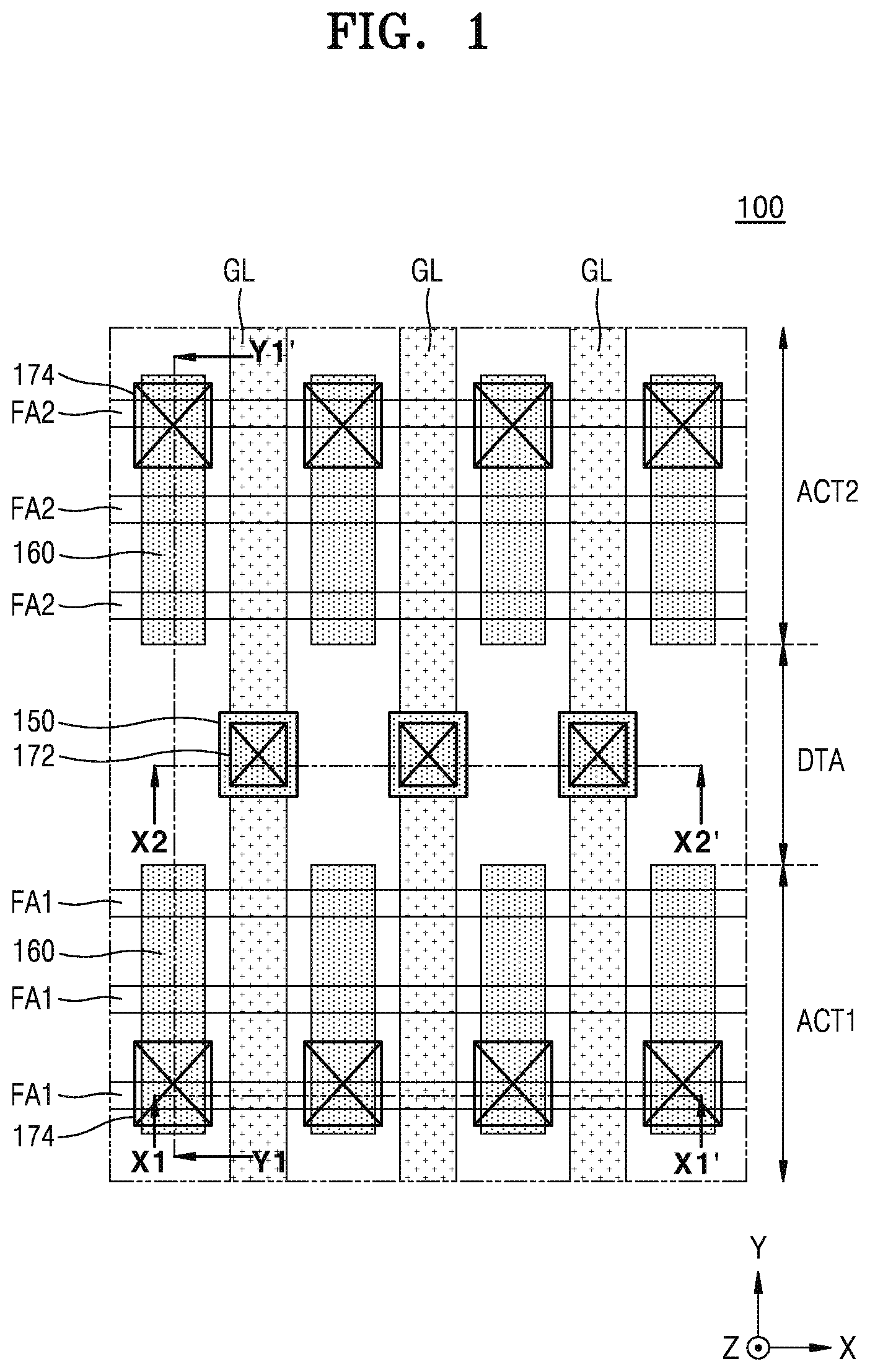
is a layout diagram illustrating an integrated circuit device according to exemplary embodiments;
is a cross-sectional view taken along the line X 1 -X 1 ′ and the line X 2 -X 2 ′ of ;
is a cross-sectional view taken along the line Y 1 -Y 1 ′ of ;
is an enlarged view of the CX 1 region of ;
is a cross-sectional view illustrating an integrated circuit device according to exemplary embodiments;
is an equivalent circuit diagram illustrating an integrated circuit device according to exemplary embodiments;
is a layout diagram of an integrated circuit device according to exemplary embodiments;
is a cross-sectional view taken along the line X 3 -X 3 ′ and the line X 4 -X 4 ′ of ; and
to 20 are cross-sectional views illustrating a method of manufacturing an integrated circuit device according to exemplary embodiments.
DETAILED DESCRIPTION OF THE EMBODIMENTS
Exemplary embodiments of the spirit of the inventive concept will be described in detail with reference to the accompanying drawings. It will be understood that when an element or layer is referred to as being “over,” “above,” “on,” “connected to” or “coupled to” another element or layer, it can be directly over, above, on, connected or coupled to the other element or layer or intervening elements or layers may be present. In contrast, when an element is referred to as being “directly over,” “directly above,” “directly on,” “directly connected to” or “directly coupled to” another element or layer, there are no intervening elements or layers present. Like numerals refer to like elements throughout. As used herein, the term “and/or” includes any and all combinations of one or more of the associated listed items.
is a layout diagram illustrating an integrated circuit device 100 according to exemplary embodiments. is a cross-sectional view taken along the line X 1 -X 1 ′ and the line X 2 -X 2 ′ of . is a cross-sectional view taken along the line Y 1 -Y 1 ′ of . is an enlarged view of the CX 1 region of . Partial components of the integrated circuit device 100 are omitted in .
Referring to to 4 , a substrate 110 may include a first active region ACT 1 , a deep trench region DTA, and a second active region ACT 2 . The first active region ACT 1 and the second active region ACT 2 may be apart from each other with the deep trench region DTA therebetween.
In exemplary embodiments, the first active region ACT 1 may be an active region for a p-type metal-oxide-semiconductor (PMOS) transistor, and the second active region ACT 2 may be an active region for an n-type metal-oxide-semiconductor (NMOS) transistor. In other embodiments, the first active region ACT 1 may be an active region for an NMOS transistor having a first threshold voltage, and the second active region ACT 2 may be an active region for an NMOS transistor having a second threshold voltage, the second threshold voltage being different from the first threshold voltage.
In exemplary embodiments, the first active region ACT 1 , the second active region ACT 2 , and the deep trench region DTA may form standard cells performing a logical function. The standard cells may include various kinds of logic cells including a plurality of circuit devices such as a transistor and a register. The logic cells may form, for example, an AND, a NAND, an OR, a NOR, an exclusive OR (XOR), an exclusive NOR (XNOR), an inverter (INV), an adder (ADD), a buffer (BUF), a delay (DLY), a filter (FIL), a multiplexer (MXT/MXIT), an OR/AND/INVERTER (OAI), an AND/OR (AO), an AND/OR/INVERTER (AOI), a D flip-flop, a reset flip-flop, a master-slave flip-flop, and a latch.
On the first active region ACT 1 , a plurality of first fin-type active regions FA 1 may protrude from a top surface 110 F 1 of the substrate 110 , and may extend in a first direction (an X direction). On the second active region ACT 2 , a plurality of second fin-type active regions FA 2 may protrude from the top surface 110 F 1 of the substrate 110 , and may extend in the first direction (the X direction). Both side walls of each of the plurality of first fin-type active regions FA 1 and both side walls of each of the plurality of second fin-type active regions FA 2 may be covered with an isolation layer 112 . In the deep trench region DTA, a deep trench DT may be formed to a predetermined depth from the top surface 110 F 1 of the substrate 110 , and the isolation layer 112 may fill the inside of the deep trench DT.
In exemplary embodiments, the substrate 110 may include a Group IV semiconductor such as Si or Ge, a Group IV-IV compound semiconductor such as SiGe or SiC, or a Group III-V compound semiconductor such as GaAs, InAs, or InP. The substrate 110 may include a conductive region, for example, a well doped with impurities or a structure doped with impurities.
A gate structure GS may extend in a second direction (a Y direction) to intersect with the plurality of first fin-type active regions FA 1 and the plurality of second fin-type active regions FA 2 . The gate structure GS may include a gate electrode GL, a gate insulating layer 124 , a gate capping layer 126 , and a gate spacer 128 .
The gate electrode GL may include doped polysilicon, metal, conductive metal nitride, conductive metal carbide, conductive metal silicide, or a combination of the above materials. For example, the gate electrode GL may be formed of aluminum (Al), copper (Cu), titanium (Ti), tantalum (Ta), tungsten (W), molybdenum (Mo), TaN, NiSi, CoSi, TiN, WN, TiAl, TiAlN, TaCN, TaC, TaSiN, or a combination of the above metals. However, the inventive concept is not limited thereto. In exemplary embodiments, the gate electrode GL may include a work function metal containing layer and a gap-fill metal layer. The work function metal containing layer may include at least one metal selected from Ti, W, ruthenium (Ru), niobium (Nb), Mo, hafnium (Hf), nickel (Ni), cobalt (Co), platinum (Pt), ytterbium (Yb), terbium (Tb), dysprosium (Dy), erbium (Er), and palladium (Pd). The gap-fill metal layer may include a W layer or an Al layer. In exemplary embodiments, the gate electrode GL may include a TiAlC/TiN/W stack structure, a TiN/TaN/TiAlC/TiN/W stack structure, or a TiN/TaN/TiN/TiAlC/TiN/W stack structure. However, the inventive concept is not limited thereto.
A gate insulating layer 124 may extend from a bottom surface and side walls of the gate electrode GL in the second direction. The gate insulating layer 124 may be disposed between the gate electrode GL and a fin-type active region FA and between the gate electrode GL and a top surface of the isolation layer 112 . The gate insulating layer 124 may include silicon oxide, silicon oxy-nitride, a high-k dielectric material having a high dielectric constant higher than that of silicon oxide, or a combination of the above materials. The high-k dielectric layer may be formed of a metal oxide or a metal oxy-nitride. For example, the high-k dielectric layer that may be used as the gate insulating layer 124 may be formed of HfO 2 , HfSiO, HfSiON, HfTaO, HfTiO, HfZrO, ZrO 2 , Al 2 O 3 , or a combination of the above materials. However, the inventive concept is not limited thereto.
A gate capping layer 126 may be disposed on the gate electrode GL. The gate capping layer 126 covers a top surface of the gate electrode GL, and may extend in the second direction (the Y direction of ). In exemplary embodiments, the gate capping layer 126 may include silicon nitride or silicon oxy-nitride.
The gate spacer 128 may be disposed on both side walls of the gate electrode GL and on both side walls of the gate capping layer 126 . The gate spacer 128 may extend on the both side walls of the gate electrode GL in an extension direction of the gate electrode GL. A gate insulating layer 124 may be between the gate electrode GL and the gate spacer 128 . In exemplary embodiments, the gate spacer 128 may include SiO x , SiN x , SiO x N y , SiC x N y , SiO x C y N z , or a combination of the above materials.
In exemplary embodiments, the gate spacer 128 may include a plurality of layers formed of different materials. In , it is exemplarily illustrated that the gate spacer 128 includes a single layer. However, unlike this, the gate spacer 128 may include a first spacer layer (not shown), a second spacer layer (not shown), and a third spacer layer (not shown) that are sequentially stacked on the side walls of the gate electrode GL. In exemplary embodiments, the first spacer layer and the third spacer layer may include silicon nitride, silicon oxide, or silicon oxy-nitride. The second spacer layer may include an insulating material having a dielectric constant smaller than that of the first spacer layer. In some embodiments, the second spacer layer may include an air space.
On a first active region ACT 1 , a first recess region RS 1 that extends to the insides of the first fin-type active regions FA 1 at both sides of the gate structure GS may be formed. A first source/drain region 132 may be formed in the first recess region RS 1 . On a second active region ACT 2 , a second recess region RS 2 that extends to the insides of the second fin-type active regions FA 2 at both sides of the gate structure GS may be formed. A second source/drain region 134 may be formed in the second recess region RS 2 .
The first source/drain region 132 may have a polygonal cross-section having a plurality of inclined side walls (not shown). As illustrated in , side walls of the first source/drain region 132 that are connected to one of the plurality of first fin-type active regions FA 1 may be connected to side walls of the first source/drain region 132 that are connected to a first fin-type active region FA 1 adjacent to the one of the plurality of first fin-type active regions FA 1 . However, the inventive concept is not limited thereto.
The first source/drain region 132 may include a doped SiGe layer, a doped Ge layer, a doped SiC layer, or a doped InGaAs layer. However, the inventive concept is not limited thereto. The first recess region RS 1 is formed by removing parts of the first fin-type active regions FA 1 at both sides of the gate structure GS, and the first source/drain region 132 may be formed by growing a semiconductor layer that fills the inside of the first recess region RS 1 by an epitaxy growth process.
In exemplary embodiments, when the first fin-type active regions FA 1 are active regions for a PMOS transistor, the first source/drain region 132 may include doped SiGe and, when the first fin-type active regions FA 1 are active regions for an NMOS transistor, the first source/drain region 132 may include doped SiC. However, the spirit of the inventive concept is not limited thereto.
In exemplary embodiments, the first source/drain region 132 may include a plurality of semiconductor layers having different compositions. For example, the first source/drain region 132 may include a lower semiconductor layer (not shown), an upper semiconductor layer (not shown), and a capping semiconductor layer (not shown) that sequentially fill the recess region RS 1 . For example, the lower semiconductor layer, the upper semiconductor layer, and the capping semiconductor layer include SiGe and Si and Ge with different amounts.
The second source/drain region 134 may include the doped SiGe layer, the doped Ge layer, the doped SiC layer, or the doped InGaAs layer. However, the inventive concept is not limited thereto. The second recess region RS 2 is formed by removing parts of the second fin-type active regions FA 2 at both sides of the gate structure GS and the second source/drain region 134 may be formed by growing a semiconductor layer that fills the inside of the second recess region RS 2 by an epitaxy growth process.
In exemplary embodiments, the second source/drain region 134 may include a plurality of semiconductor layers having different compositions. For example, the second source/drain region 134 may include a lower semiconductor layer (not shown), an upper semiconductor layer (not shown), and a capping semiconductor layer (not shown) that sequentially fill the second recess region RS 2 . For example, the lower semiconductor layer, the upper semiconductor layer, and the capping semiconductor layer include SiC and Si and C with different amounts.
Although not shown, an etch stop layer (not shown) may be further formed on the side walls of the first source/drain region 132 , side walls of the second source/drain region 134 , and the top surface of the isolation layer 112 . The etch stop layer may include at least one of silicon nitride, silicon oxy-nitride, silicon oxycarbonitride, and silicon oxide.
An inter-gate insulating layer 142 that covers the first source/drain region 132 and the second source/drain region 134 may be formed between the gate structure GS. A first interlayer insulating layer 144 may be formed on the gate structure GS and the inter-gate insulating layer 142 . The inter-gate insulating layer 142 and the first interlayer insulating layer 144 may include at least one of silicon oxy-nitride, silicon oxycarbonitride, and silicon oxide.
A first contact structure 150 , that passes through the first interlayer insulating layer 144 and is connected to the gate electrode GL, may be disposed on the gate structure GS. A first contact hole 150 H passes through the first interlayer insulating layer 144 and extends to the inside of the gate structure GS. The first contact structure 150 may be disposed in the first contact hole 150 H. The first contact structure 150 may include a first contact plug 152 and a first conductive barrier 154 that surrounds a bottom surface and side walls of the first contact plug 152 .
As exemplarily illustrated in , a width of an upper portion of the first contact hole 150 H may be greater than a width of a lower portion of the first contact hole 150 H, and the first contact hole 150 H may have an expanded upper region 150 HU. A first width W 11 of the first contact hole 150 H at a top surface thereof may be greater than a second width W 12 of the first contact hole 150 H at a bottom surface thereof. A side wall 150 S of the first contact structure 150 may have a gradually rounded profile without kinks or a step 150 HK (refer to ).
A lower insulating liner 156 and an upper insulating liner 158 may be apart from each other on an inner wall of the first contact hole 150 H. The lower insulating liner 156 surrounds a lower portion of the side wall 150 S of the first contact structure 150 . The upper insulating liner 158 may be apart from the lower insulating liner 156 in a vertical direction and may surround an upper portion of the side wall 150 S of the first contact structure 150 .
The lower insulating liner 156 may be disposed on an inner wall (that is, a side wall of the gate spacer 128 that faces the gate electrode GL) of the gate spacer 128 . The lower insulating liner 156 has a third width W 21 in the first direction (the X direction). The third width W 21 of the lower insulating liner 156 may gradually decrease from a top surface of the gate spacer 128 upward. For example, an upper end of the lower insulating liner 156 may be tapered.
The upper insulating liner 158 may be disposed in the expanded upper region 150 HU of the first contact hole 150 H, may be apart from the lower insulating liner 156 in a vertical direction (a Z direction), and may surround the upper portion of the side wall 150 S of the first contact structure 150 . A top surface of the upper insulating liner 158 is at the same level as a top surface of the first contact structure 150 . A bottom surface of the upper insulating liner 158 may be at the same level as a bottom portion of the expanded upper region 150 HU. The upper insulating liner 158 may have a fourth width W 22 in the first direction (the X direction). In , the fourth width W 22 of the upper insulating liner 158 is exemplarily illustrated as gradually decreasing from the bottom surface of the upper insulating liner 158 toward the top surface of the upper insulating liner 158 . However, the inventive concept is not limited thereto. Unlike in , the upper insulating liner 158 may have substantially the same fourth width W 22 in an entire region of the upper insulating liner 158 .
A part of the side wall 150 S of the first contact structure 150 , positioned at a level higher than a level LV 1 of a top surface of the lower insulating liner 156 and lower than a level LV 2 of the bottom surface of the upper insulating liner 158 , may be surrounded by the first interlayer insulating layer 144 .
In an exemplary manufacturing process of forming the first contact structure 150 , after the first contact hole 150 H that exposes the top surface of the gate electrode GL is formed, the expanded upper region 150 HU may be formed by laterally expanding the first contact hole 150 H by a predetermined depth from the top surface of the first contact hole 150 H. Then, an insulating liner layer 166 P (refer to ) is formed on the inner wall of the first contact hole 150 H, and a side wall rounding process is performed on the insulating liner layer 166 P so that the first contact hole 150 H having a gradually-sloped side wall profile may be formed. Then, the first contact structure 150 may be formed in the first contact hole 150 H. A part of the insulating liner layer 166 P is removed by the side wall rounding process. A part of the insulating liner layer 166 P that resides in the expanded upper region 150 HU may be referred to as the upper insulating liner 158 , and a part of the insulating liner layer 166 P that resides in the first contact hole 150 H at a level lower than that of the expanded upper region 150 HU may be referred to as the lower insulating liner 156 .
In general, since a width of the first contact structure 150 is small and a height of the first contact structure 150 is large, in a process of filling the inside of the first contact hole 150 H with a metal material, the metal material may not be completely filled. In such a case, a void may be formed in the first contact structure 150 and resistance of the first contact structure 150 increases, and thus, an electrical characteristic of the integrated circuit device 100 may deteriorate. However, according to the above-described exemplary embodiments, the expanded upper region 150 HU is formed and the side wall rounding process is performed on the insulating liner layer 166 P so that the first contact structure 150 having an increased upper width and the gradually-sloped side wall profile may be formed.
A second contact structure 160 may be disposed on the first source/drain region 132 and the second source/drain region 134 . A second contact hole 160 H passes through the first interlayer insulating layer 144 and the inter-gate insulating layer 142 , and may expose top surfaces of the first source/drain region 132 and the second source/drain region 134 . The second contact structure 160 may be disposed in the second contact hole 160 H.
The second contact structure 160 includes a second contact plug 162 and a second conductive barrier 164 . The second contact plug 162 and the second conductive barrier 164 may include the same materials included in the first contact plug 152 and the first conductive barrier 154 , respectively. A top surface of the second contact structure 160 may be disposed at the same level as that the top surface of the first contact structure 150 .
A side wall 160 S of the second contact structure 160 may be surrounded by a liner structure 166 . The liner structure 166 may include a first insulating liner 166 A and a second insulating liner 166 B. The first insulating liner 166 A is disposed on the side wall 160 S of the second contact structure 160 , and the second insulating liner 166 B may surround a side wall of the first insulating liner 166 A. The second insulating liner 166 B may contact the inter-gate insulating layer 142 and the first interlayer insulating layer 144 . The liner structure 166 is disposed on a side wall of the second contact hole 160 H, and may not cover a part of the top surfaces of the first source/drain region 132 and the second source/drain region 134 that are exposed by the second contact hole 160 H. A fifth width W 23 of the liner structure 166 in the first direction may be greater than a third width W 21 of the lower insulating liner 156 in the first direction.
In manufacturing processes according to exemplary embodiments, the second contact hole 160 H that exposes the top surfaces of the first source/drain region 132 and the second source/drain region 134 is formed. Then, after forming the second insulating liner 166 B on an inner wall of the second contact hole 160 H, a buried insulating layer 320 (refer to ) that fills a residual portion of the second contact hole 160 H may be formed. Then, the first contact hole 150 H that exposes the top surface of the gate electrode GL is formed by removing parts of the buried insulating layer 320 and the first interlayer insulating layer 144 , a pull-back process is performed on the buried insulating layer 320 , and the upper portion of the first contact hole 150 H is expanded by using a pulled-back buried insulating layer 320 E as an etching mask so that the expanded upper region 150 HU may be formed. Then, the buried insulating layer 320 is removed, the insulating liner layer 166 P (refer to ) is formed on the side walls of the first contact hole 150 H and the second contact hole 160 H, and the side wall rounding process is performed on the insulating liner layer 166 P so that the first contact hole 150 H having the gradually-sloped side wall profile may be formed. Then, the first contact structure 150 and the second contact structure 160 that respectively fill the first contact hole 150 H and the second contact hole 160 H may be formed.
As exemplarily illustrated in , a lower portion of the side wall 150 S of the first contact structure 150 is surrounded by the lower insulating liner 156 and may have the second width W 12 at the same level as that of a bottom surface of the first contact structure 150 . The upper portion of the side wall 150 S of the first contact structure 150 is surrounded by an upper insulating liner 158 disposed in the expanded upper region 150 HU and may have the first width W 11 greater than the second width W 12 at the same level as that of the top surface of the first contact structure 150 . By performing the above-described side wall rounding process, the side wall 150 S of the first contact structure 150 may have the profile gradually connected or smoothly connected from the lower portion toward the upper portion. As the upper portion of the side wall 150 S of the first contact structure 150 expands, it is possible to prevent a void from being formed in a process of filling a metal material.
An etch stop layer 168 may be formed on the first contact structure 150 , the second contact structure 160 , and the first interlayer insulating layer 144 . A second interlayer insulating layer 170 may be formed on the etch stop layer 168 .
A first via structure 172 may be disposed to pass through the etch stop layer 168 and the second interlayer insulating layer 170 and to be connected to the first contact structure 150 . A second via structure 174 may be disposed to pass through the etch stop layer 168 and the second interlayer insulating layer 170 and to be connected to the second contact structure 160 . The first via structure 172 and the second via structure 174 may respectively include via conductive layers 172 P and 174 P and via barrier layers 172 B and 174 B that respectively surround side walls and bottom surfaces of the via conductive layers 172 P and 174 P.
According to the above-described exemplary embodiments, the first contact structure 150 connected to the gate structure GS has the gradually connected side wall profile, and a width of the upper portion of the first contact structure 150 may be greater than a width of the lower portion of the first contact structure 150 . Therefore, it is possible to prevent a void from being formed in the process of filling the metal material to form the first contact structure 150 , and the integrated circuit device 100 A including the first contact structure 150 may have a high electrical characteristic.
is a cross-sectional view illustrating an integrated circuit device 100 A according to exemplary embodiments. In , the same reference numerals as those of to 4 denote the same components.
Referring to , a third interlayer insulating layer 146 is further formed between the first interlayer insulating layer 144 and the etch stop layer 168 . Further, a first contact hole 150 HA passes through the third interlayer insulating layer 146 and the first interlayer insulating layer 144 , and may expose the top surface of the gate electrode GL. A first contact structure 150 A disposed in the first contact hole 150 HA may have a top surface disposed at a higher level than that of a top surface of the second contact structure 160 .
The bottom portion of the expanded upper region 150 HU of the first contact hole 150 HA may be defined by a top surface of the first interlayer insulating layer 144 and side walls of the third interlayer insulating layer 146 . The upper insulating inner 158 may be disposed on the inner wall of the expanded upper region 150 HU. The top surface of the upper insulating liner 158 is disposed at the same level as that of the top surface of the third interlayer insulating layer 146 . The bottom surface of the upper insulating liner 158 may be disposed at the same level as that of the bottom surface of the third interlayer insulating layer 146 . A side wall of the upper insulating liner 158 is surrounded by the third interlayer insulating layer 146 , and a side wall of the lower insulating liner 156 may be surrounded by the first interlayer insulating layer 144 .
The second contact structure 160 may be surrounded by the second insulating liner 166 B and the first insulating liner 166 A described in to 4 may be omitted.
In exemplary manufacturing processes, after forming the second contact hole 160 H that exposes the top surfaces of the first source/drain region 132 and the second source/drain region 134 and forming the second insulating liner 166 B on the inner wall of the second contact hole 160 H, the second contact structure 160 that fills a residual portion of the second contact hole 160 H may be formed. Then, the third interlayer insulating layer 146 and the buried insulating layer 320 (refer to ) may be sequentially formed on the second contact structure 160 and the first interlayer insulating layer 144 . Then, parts of the buried insulating layer 320 , the third interlayer insulating layer 146 , and the first interlayer insulating layer 144 are removed so that the first contact hole 150 HA that exposes the top surface of the gate electrode GL is formed, the pull-back process is performed on the buried insulating layer 320 , and the upper portion of the first contact hole 150 HA is expanded by using the pulled-back buried insulating layer 320 E as the etching mask so that the expanded upper region 150 HU may be formed. Then, the buried insulating layer 320 is removed, the insulating liner layer 166 P (refer to ) is formed on the side wall of the first contact hole 150 HA, and the side wall rounding process is performed on the insulating liner layer 166 P so that the first contact hole 150 HA having the gradually-sloped side wall profile may be formed. Then, the first contact structure 150 A that fills the first contact hole 150 HA may be formed.
According to the above-described exemplary embodiments, the first contact structure 150 A has a side wall profile gradually connected to the gate structure GS, and a width of an upper portion of the first contact structure 150 A may be greater than a width of a lower portion of the first contact structure 150 A. Therefore, it is possible to prevent a void from being formed in the process of filling the metal material to form the first contact structure 150 A, and the integrated circuit device 100 A including the first contact structure 150 A may have a high electrical characteristic.
is an equivalent circuit diagram illustrating an integrated circuit device 200 according to exemplary embodiments. In , a circuit diagram of a 6T static random access memory (SRAM) cell including six transistors is illustrated.
Referring to , the integrated circuit device 200 may include a pair of inverters INV 1 and INV 2 connected between a power node Vcc and a ground node Vss in parallel and a first pass transistor PS 1 and a second pass transistor PS 2 that are respectively connected to output nodes of the inverters INV 1 and INV 2 . The first pass transistor PS 1 and the second pass transistor PS 2 may be respectively connected to a bit line BL and a complementary bit line/BL. Gates of the first pass transistor PS 1 and the second pass transistor PS 2 may be connected to a word line WL.
The first inverter INV 1 includes a first pull-up transistor PU 1 and a first pull-down transistor PD 1 that are serially connected to each other, and the second inverter INV 2 includes a second pull-up transistor PU 2 and a second pull-down transistor PD 2 that are serially connected to each other. The first pull-up transistor PU 1 and the second pull-up transistor PU 2 may be formed of PMOS transistors, and the first pull-down transistor PD 1 and the second pull-down transistor PD 2 may be formed of NMOS transistors.
In order for the first inverter INV 1 and the second inverter INV 2 to form a latch circuit, an input node of the first inverter INV 1 is connected to an output node of the second inverter INV 2 and an input node of the second inverter INV 2 may be connected to an output node of the first inverter INV 1 .
is a layout diagram of an integrated circuit device 200 A according to exemplary embodiments. is a cross-sectional view taken along the line X 3 -X 3 ′ and the line X 4 -X 4 ′ of . In , the same reference numerals as those of to 6 denote the same components.
Referring to , the integrated circuit device 200 A may include an SRAM cell 210 A disposed on a substrate 110 . The SRAM cell 210 A may include six finFETs.
The SRAM cell 210 A includes a plurality of fin-type active regions F 1 A, F 2 A, F 3 A, and F 4 A that are parallel with each other and extend in the first direction (the X direction). The plurality of fin-type active regions F 1 A, F 2 A, F 3 A, and F 4 A may protrude from a top surface of the substrate 110 in the Z direction.
In addition, the SRAM cell 210 A may include a plurality of gate lines SGL 1 , SGL 2 , SGL 3 , and SGL 4 that extend to cover both side walls and a top surface of the plurality of fin-type active regions F 1 A, F 2 A, F 3 A, and F 4 A in parallel in the second direction (the Y direction) that intersects with the first direction (the X direction). The plurality of gate lines SGL 1 , SGL 2 , SGL 3 , and SGL 4 may have a similar characteristic to that of the gate line GL described with reference to to 4 . Among the plurality of gate lines SGL 1 , SGL 2 , SGL 3 , and SGL 4 , between two adjacent gate lines disposed on a straight line in the second direction (the Y direction), a gate cut insulating layer 220 may be disposed.
The first pull-up transistor PU 1 , the first pull-down transistor PD 1 , the first pass transistor PS 1 , the second pull-up transistor PU 2 , the second pull-down transistor PD 2 , and the second pass transistor PS 2 that form the SRAM cell 210 A may be implemented by fin-type transistors. In particular, the first pull-up transistor PU 1 and the second pull-up transistor PU 2 may be formed of PMOS transistors, and the first pull-down transistor PD 1 , the second pull-down transistor PD 2 , the first pass transistor PS 1 , and the second pass transistor PS 2 may be formed of NMOS transistors.
Transistors may be formed at intersections between the plurality of fin-type active regions F 1 A, F 2 A, F 3 A, and F 4 A that extend in the X direction and the plurality of gate lines SGL 1 , SGL 2 , SGL 3 , and SGL 4 that extend in the Y direction.
The first pass transistor PS 1 is formed at an intersection between the fin-type active region F 4 A and the gate line SGL 3 , and the second pass transistor PS 2 may be formed at an intersection between the fin-type active region F 1 A and the gate line SGL 2 . The first pull-down transistor PD 1 is formed at an intersection between the fin-type active region F 4 A, and the gate line SGL 1 and the second pull-down transistor PD 2 may be formed at an intersection between the fin-type active region F 1 A and the gate line SGL 4 . The first pull-up transistor PU 1 is formed at an intersection between the fin-type active region F 3 A, and the gate line SGL 1 and the second pull-up transistor PU 2 may be formed at an intersection between the fin-type active region F 2 A and the gate line SGL 4 .
As exemplarily illustrated in , various contact structures may be disposed in the SRAM cell 210 A. In detail, one word line contact C_WL may be connected to the gate line SGL 3 of the first pass transistor PS 1 , and the other word line contact C_WL may be connected to the gate line SGL 2 of the second pass transistor PS 2 . A bit line contact C_BL may be connected to a drain of the first pass transistor PS 1 , and a complementary bit line contact C_/BL may be connected to a drain of the second pass transistor PS 2 . One power node contact C_Vcc may be connected to a source of the first pull-up transistor PU 1 , and the other power node contact C_Vcc may be connected to a source of the second pull-up transistor PU 2 . One ground node contact C_Vss may be connected to a source of the first pull-down transistor PD 1 , and the other ground node contact C_Vss may be connected to a source of the second pull-down transistor PD 2 . A first storage node contact C_SN 1 may be connected to a source of the first pass transistor PS 1 and drains of the first pull-up transistor PU 1 and the first pull-down transistor PD 1 . A second storage node contact C_SN 2 may be connected to a source of the second pass transistor PS 2 and drains of the second pull-up transistor PU 2 and the second pull-down transistor PD 2 .
The word line contact C_WL may include the first contact structure 150 . The first contact structure 150 may be electrically connected to the gate lines SGL 2 and SGL 3 . The lower insulating liner 156 and the upper insulating liner 158 are apart from each other in the vertical direction, and may surround a side wall of the first contact structure 150 .
The power node contact C_Vcc, the ground node contact C_Vss, the bit line contact C_BL, and the complementary bit line contact C/BL may include the second contact structure 160 . The power node contact C_Vcc, the ground node contact C_Vss, the bit line contact C_BL, and the complementary bit line contact C/BL may be disposed on a source/drain region 232 that extends from one of the plurality of fin-type active regions F 1 A, F 2 A, F 3 A, and F 4 A. Although not shown, an intermediate layer (not shown) formed of at least one of tungsten (W), cobalt (Co), nickel (Ni), ruthenium (Ru), copper (Cu), aluminum (Al), a silicide of the above metals, and an alloy of the above metals may be further formed between the source/drain region 232 and the second contact structure 160 .
The first storage node contact C_SN 1 and the second storage node contact C_SN 2 may include a third contact structure 250 . The third contact structure 250 may be formed in the third contact hole 250 H, and may include a third contact plug 252 and a third conductive barrier 254 .
The third contact structure 250 may include a first portion 250 _ 1 that extends in the first direction (the X direction) and a second portion 250 _ 2 that extends in the second direction (the Y direction). The third contact structure 250 may have an L-shaped horizontal cross-section. The first portion 250 _ 1 may vertically overlap the gate line GL, and the second portion 250 _ 2 may vertically overlap the source/drain region 232 adjacent to the gate line GL. As exemplarily illustrated in , the second portion 250 _ 2 may be disposed on the source/drain region 232 that extends from two adjacent fin-type active regions among the plurality of fin-type active regions F 1 A, F 2 A, F 3 A, and F 4 A. The first portion 250 _ 1 of the third contact structure 250 may be asymmetrical with respect to the first direction (the X direction). A side wall of the first portion 250 _ 1 of the third contact structure 250 may have a gradually extending side wall profile.
A third contact hole 250 H may expose top surfaces of the gate lines SGL 1 and SGL 4 and a top surface of the source/drain region 232 adjacent to the top surfaces of the gate lines SGL 1 and SGL 4 . As illustrated in , a part of the gate line GL exposed by the third contact hole 250 H may have a tail GLT that extends in the vertical direction (the Z direction) along a profile of a side wall of the fin-type active region F 3 A, and the tail GLT may be disposed on the isolation layer 112 . However, the inventive concept is not limited thereto.
A liner structure 260 may be disposed on an inner wall of the third contact hole 250 H, and the third contact structure 250 may be disposed on the liner structure 260 to fill the inside of the third contact hole 250 H. The liner structure 260 may include a first insulating liner 266 A and a second insulating liner 266 B. In the first insulating liner 266 A, a part disposed on an inner wall of an expanded upper region 250 HU may be referred to as an upper insulating liner 266 AU, and a part apart from the upper insulating liner 266 AU in a vertical direction and disposed on the gate electrode GL may be referred to as a lower insulating liner 266 AL.
In general, since widths of the first contact structure 150 and a first portion 250 _ 1 of the third contact structure 250 are relatively small and heights of the first contact structure 150 and a first portion 250 _ 1 of the third contact structure 250 are relatively large, in a process of filling the insides of the first contact hole 150 H and a third contact hole 250 H with a metal material, the insides of the first contact hole 150 H and a third contact hole 250 H may not be completely filled. In such a case, a void may be formed in the first contact structure 150 and the first portion 250 _ 1 of the third contact structure 250 and resistance of the first contact structure 150 and the first portion 250 _ 1 of the third contact structure 250 increases so that an electrical characteristic of the integrated circuit device 200 A may deteriorate.
However, according to the above-described exemplary embodiments, as the expanded upper regions 150 HU and 250 HU are formed and the side wall rounding process is performed on the first contact hole 150 H and the third contact hole 250 H, the first contact structure 150 and the first portion 250 _ 1 of the third contact structure 250 having increased upper widths and gradually-sloped side wall profiles may be formed. Therefore, it is possible to prevent a void from being formed in the process of filling the metal material to form the first contact structure 150 and the first portion 250 _ 1 of the third contact structure 250 , and the integrated circuit device 200 A may have a high electrical characteristic.
to 20 are cross-sectional views illustrating a method of manufacturing an integrated circuit device 100 according to exemplary embodiments.
In to 20 , the same reference numerals as those of to 8 denote the same components. In addition, for convenience sake, in to 20 , only an example in which the first fin-type active region FA 1 and the first source/drain region 132 are formed on the first active region ACT 1 is illustrated. However, the second fin-type active region FA 2 and the second source/drain region 134 may be formed on the second active region ACT 2 by the same method as a method of forming the first fin-type active region FA 1 and the first source/drain region 132 on the first active region ACT 1 .
Referring to , the first fin-type active region FA 1 that protrudes from the top surface 110 F 1 of the substrate 110 in a vertical direction and extends in the first direction (the X direction) may be formed by etching a partial region of the first active region ACT 1 of the substrate 110 .
The isolation layer 112 that covers the both side walls of the first fin-type active region FA 1 may be formed on the substrate 110 . Although not shown, an interface layer (not shown) that conformally covers the side walls of the first fin-type active region FA 1 may be further formed between the isolation layer 112 and the first fin-type active region FA 1 .
Then, a stacked structure of a sacrifice gate insulating layer pattern (not shown), a sacrifice gate (not shown), and a hard mask pattern (not shown) is formed on the substrate 110 and the gate spacer 128 may be formed on a side wall of the stacked structure. The gate spacer 128 may include silicon nitride. However, the inventive concept is not limited thereto.
Then, a first recess region RS 1 may be formed by etching a part of the first fin-type active region FA 1 at both sides of the stacked structure and the gate spacer 128 . In exemplary embodiments, a process of forming the first recess region RS 1 may include a dry etching process, a wet etching process, or a combination of the above processes.
In the process of forming the first recess region RS 1 , a part of the first fin-type active region FA 1 under the gate spacer 128 is further removed so that the first recess region RS 1 may expand laterally and a part of the first recess region RS 1 may vertically overlap the gate spacer 128 .
Then, the first source/drain region 132 may be formed on an inner wall of the first recess region RS 1 . The first source/drain region 132 may be formed by an epitaxy growth process by using a side wall of the first fin-type active region FA 1 and a top surface of the substrate 110 that are exposed at the inner wall of the first recess region RS 1 as seed layers. The epitaxy growth process may be a chemical vapor deposition (CVD) process such as a vapor-phase epitaxy (VPE) process or an ultra-high vacuum chemical vapor deposition (UHV-CVD) process, molecular beam epitaxy, or a combination of the above processes. In the epitaxy growth process, the first source/drain region 132 may be formed at a process pressure of about 50 Torr to about 400 Torr by using a liquid or vapor precursor as a precursor required for forming the first source/drain region 132 . In the epitaxy growth process of forming the first source/drain region 132 , first impurities may be in-situ doped in the first source/drain region 132 .
The first source/drain region 132 may include a lower semiconductor layer (not shown), an upper semiconductor layer (not shown), and a capping semiconductor layer (not shown). In respective processes of forming the lower semiconductor layer, the upper semiconductor layer, and the capping semiconductor layer, different feeding concentrations of precursors and different doping concentrations of impurities may be used.
Then, an insulating layer (not shown) that covers the stacked structure, the gate spacer 128 , and the first source/drain region 132 is formed on the substrate 110 , and the insulating layer is planarized until top surfaces of the stacked structure and the gate spacer 128 are exposed so that the inter-gate insulating layer 142 may be formed.
Then, after removing the hard mask pattern, the sacrifice gate, and the sacrifice gate insulating layer pattern, the gate insulating layer 124 may be formed on inner walls of the pair of gate spacers 128 and the first fin-type active region FA 1 . Then, after forming a conductive layer (not shown) that fills a space between the pair of gate spacers 128 on the gate insulating layer 124 , an upper portion of the conductive layer is etched back so that the gate electrode GL may be formed. Then, after forming an insulating layer (not shown) that fills a residual portion between the pair of gate spacers 128 on the gate electrode GL and the inter-gate insulating layer 142 , an upper portion of the insulating layer is removed until a top surface of the inter-gate insulating layer 142 or the gate spacer 128 is exposed so that the gate capping layer 126 may be formed. Therefore, the gate structure GS including the gate electrode GL, the gate insulating layer 124 , the gate capping layer 126 , and the gate spacer 128 may be formed.
Then, the first interlayer insulating layer 144 may be formed on the gate structure GS and the inter-gate insulating layer 142 .
Referring to , a first mask pattern 312 including a plurality of first openings 312 H may be formed on the first interlayer insulating layer 144 . For example, the plurality of first openings 312 H may vertically overlap the first source/drain region 132 , and a width of each of the plurality of first openings 312 H in the first direction (the X direction) may be greater than a width of each of the plurality of first openings 312 H in the second direction (the Y direction).
Referring to , a second contact hole 160 H may be formed by removing the first interlayer insulating layer 144 and the inter-gate insulating layer 142 by using the first mask pattern 312 as the etching mask. A top surface of the first source/drain region 132 may be exposed at a bottom portion of the second contact hole 160 H. An outer wall of the gate spacer 128 may be exposed by two side walls apart from each other in the X direction of the second contact hole 160 H.
Referring to , a top surface of the first interlayer insulating layer 144 may be exposed again by removing the first mask pattern 312 (refer to ).
Then, an insulating layer (not shown) is formed on an inner wall of the second contact hole 160 H and the first interlayer insulating layer 144 , and an anisotropic etching process is performed on the insulating layer so that the second insulating liner 166 B may reside on the side wall of the second contact hole 160 H. The top surface of the first source/drain region 132 may be exposed again by the anisotropic etching process.
Referring to , the buried insulating layer 320 may be formed on the inner wall of the second contact hole 160 H and the first interlayer insulating layer 144 . For example, the buried insulating layer 320 may include a spin-on hardmask (SOH). However, the inventive concept is not limited thereto. The buried insulating layer 320 may fill the inside of the second contact hole 160 H.
Then, a second mask pattern 314 including a plurality of second openings 314 H may be formed on the buried insulating layer 320 . For example, the plurality of second openings 314 H may vertically overlap the gate structure GS on the deep trench region DTA.
Then, a buried insulating layer opening 320 H may be formed by removing a part of the buried insulating layer 320 by using the second mask pattern 314 as an etching mask.
The first contact hole 150 H may be formed by sequentially removing the first interlayer insulating layer 144 and the gate capping layer 126 by using the buried insulating layer 320 as an etching mask. The top surface of the gate electrode GL may be exposed to a bottom portion of the first contact hole 150 H, and the inner wall of the gate spacer 128 may be exposed by the two side walls apart from each other in the X direction of the first contact hole 150 H.
Then, the second mask pattern 314 may be removed.
Referring to , the pulled-back buried insulating layer 320 E may be formed by performing the pull-back process on the buried insulating layer 320 .
In exemplary embodiments, in the pull-back process, a region to a partial thickness is removed from a surface of the buried insulating layer 320 . For comparison, in , a top surface and side walls of the buried insulating layer 320 before the pull-back process are schematically illustrated in a dotted line.
After the pull-back process, a part of a top surface of the first interlayer insulating layer 144 adjacent to the first contact hole 150 H may be exposed without being covered with the pulled-back buried insulating layer 320 E. For example, the buried insulating layer 320 may be removed to a thickness of about 1 to 10 nm by the pull-back process. In addition, the buried insulating layer opening 320 H may expand laterally by the pull-back process, and an expanded buried insulating layer opening 320 HE may be formed.
Referring to , the expanded upper region 150 HU may be formed by removing a part from the top surface of the first contact hole 150 H by using the pulled-back buried insulating layer 320 E as an etching mask. The expanded upper region 150 HU may have a side wall aligned with a side wall of the expanded buried insulating layer opening 320 HE. A bottom portion of the expanded upper region 150 HU may be disposed at a higher level than that of a bottom surface of the first interlayer insulating layer 144 .
The first contact hole 150 H may include the step 150 HK at the same level as that of the bottom portion of the expanded upper region 150 HU. The step 150 HK may be formed by an exposed top surface of the first interlayer insulating layer 144 in the bottom portion of the expanded upper region 150 HU and may refer to a region in which a slope of the side wall of the first contact hole 150 H rapidly changes.
Referring to , the pulled-back buried insulating layer 320 E (refer to ) may be removed.
As the pulled-back buried insulating layer 320 E is removed, the top surface of the first source/drain region 132 and a side wall of the second insulating liner 166 B that are covered with the pulled-back buried insulating layer 320 E in the second contact hole 160 H may be exposed again.
Referring to , an insulating liner layer 166 P may be formed on the first interlayer insulating layer 144 . The insulating liner layer 166 P may be conformally formed on the inner wall of the first contact hole 150 H and the inner wall of the second contact hole 160 H. The insulating liner layer 166 P may be formed to a predetermined thickness along side wall profiles of the expanded upper region 150 HU and the step 150 HK.
In exemplary embodiments, the insulating liner layer 166 P may be formed by an atomic layer deposition (ALD) process or the CVD process by using at least one of silicon nitride, silicon oxy-nitride, silicon oxycarbonitride, and silicon oxide.
Referring to , the side wall rounding process may be performed on the insulating liner layer 166 P. For example, the side wall rounding process may include a dry etching process using a fluorine-based etching gas. For example, the side wall rounding process may be performed at a pressure of about 10 mTorr to about 100 Torr at an etching atmosphere including at least one of a fluorine-based etching gas, Argon (Ar), and oxygen (O). However, the inventive concept is not limited thereto.
The step 150 HK (refer to ) is removed by the side wall rounding process and a side wall 150 HS of the first contact hole 150 H may have a gradually-sloped profile. This is because, in the side wall rounding process, the first interlayer insulating layer 144 adjacent to the step 150 HK may be exposed to or collide with a greater amount of etching gases so that a greater amount of the first interlayer insulating layer 144 adjacent to the step 150 HK is removed. For example, after the side wall rounding process, an upper width of the first contact hole 150 H may be greater than a lower width of the first contact hole 150 H.
As the step 150 HK is removed by the side wall rounding process, a part of the insulating liner layer 166 P disposed on the step 150 HK may be removed together with the step 150 HK. Therefore, the upper insulating liner 158 resides on the inner wall of the expanded upper region 150 HU, and the lower insulating liner 156 may reside on a lower portion of the side wall 150 HS of the first contact hole 150 H. At a level lower than that of a bottom surface of the upper insulating liner 158 and higher than that of a top surface of the lower insulating liner 156 , the side wall 150 HS of the first contact hole 150 H has a rounded profile gradually connected and expanding upward.
The insulating liner layer 166 P on the top surface of the gate electrode GL is removed by the side wall rounding process so that the top surface of the gate electrode GL may be exposed. In addition, the insulating liner layer 166 P on the top surface of the first source/drain region 132 is removed by the side wall rounding process in the bottom portion of the second contact hole 160 H. The top surface of the first source/drain region 132 may be exposed. The first insulating liner 166 A may reside on the side wall of the second contact hole 160 H. The first insulating liner 166 A and the second insulating liner 166 B that are disposed in the second contact hole 160 H may be referred to as the liner structure 166 .
Referring to , a barrier layer 154 P and a conductive layer 152 P may be sequentially formed on the inner walls of the first contact hole 150 H and the second contact hole 160 H.
As the side wall 150 HS (refer to ) of the first contact hole 150 H has a rounded profile gradually connected and expanding upward, it is possible to prevent a void from being formed in the process of filling the inside of the first contact hole 150 H with the metal material.
Referring to , top portions of the barrier layer 154 P and top portions of the conductive layer 152 P are removed until the top surface of the first interlayer insulating layer 144 is exposed so that the first contact structure 150 may reside in the first contact hole 150 H and the second contact structure 160 may reside in the second contact hole 160 H. At this time, the barrier layer 154 P in the first contact hole 150 H may be referred to as the first conductive barrier 154 and the barrier layer 154 P in the second contact hole 160 H may be referred to as the second conductive barrier 164 . The conductive layer 152 P in the first contact hole 150 H may be referred to as the first contact plug 152 , and the conductive layer 152 P in the second contact hole 160 H may be referred to as the second contact plug 162 .
Referring to again, the etch stop layer 168 and the second interlayer insulating layer 170 may be sequentially formed on the first contact structure 150 , the second contact structure 160 , and the first interlayer insulating layer 144 .
A first via hole 172 H that exposes the top surface of the first contact structure 150 and a second via hole 174 H that exposes the top surface of the second contact structure 160 may be formed by removing parts of the second interlayer insulating layer 170 and the etch stop layer 168 . Then, the via barrier layers 172 B and 174 B are formed on inner walls of the first via hole 172 H and the second via hole 174 H, and the via conductive layers 172 P and 174 P that fill the first via hole 172 H and the second via hole 174 H may be formed.
The integrated circuit device 100 may be completed by performing the above-described process.
In general, since a width of the first contact structure 150 is relatively small and a height of the first contact structure 150 is relatively large, in the process of filling the inside of the first contact hole 150 H with the metal material, the first contact hole 150 H may not be completely filled. In such a case, a void may be formed in the first contact structure 150 and resistance of the first contact structure 150 increases so that the electrical characteristic of the integrated circuit device 100 may deteriorate.
However, according to the above-described exemplary embodiments, the expanded upper region 150 HU is formed by the pull-back process of the buried insulating layer 320 and the side wall rounding process is performed on the insulating liner layer 166 P so that the first contact structure 150 having an increased upper width and the gradually-sloped side wall profile may be formed. Therefore, in the process of filling the metal material to form the first contact structure 150 , it is possible to prevent a void from being formed and the integrated circuit device 100 including the first contact structure 150 may have a high electrical characteristic.
On the other hand, after performing the processes described with reference to to 12 , the second contact structure 160 that fills a residual portion of the second contact hole 160 H may be first formed on the second insulating liner 166 B. Then, the third interlayer insulating layer 146 and the buried insulating layer 320 may be sequentially formed on the second contact structure 160 and the first interlayer insulating layer 144 . In such a case, the integrated circuit device 100 A described with reference to may be manufactured.
In addition, in the processes described with reference to to 12 , in the etching process of forming the second contact hole 160 H, a second portion (that is, a portion corresponding to the second portion 250 _ 2 of the third contact structure 250 ) of the third contact hole 250 H may be formed together with the second contact hole 160 H. Then, in the etching process of forming the first contact hole 150 H, a first portion (that is, a portion corresponding to the first portion 250 _ 1 of the third contact structure 250 ) of the third contact hole 250 H may be formed together with the first contact hole 150 H. In such a case, the integrated circuit device 200 A described with reference to may be manufactured.
While the inventive concept has been particularly shown and described with reference to embodiments thereof, it will be understood that various changes in form and details may be made therein without departing from the spirit and scope of the following claims.
Figures (20)
Citations
This patent cites (33)
- US7071517
- US8969878
- US9064801
- US9184090
- US9466494
- US9812400
- US9875938
- US9905671
- US9935168
- US10096688
- US10553582
- US10763254
- US20090004856
- US20150093893
- US20150380305
- US20160233298
- US20170222014
- US20170278747
- US20180047808
- US20180076086
- US20190006515
- US1499578
- US102270644
- US103426928
- US106847812
- US106972015
- US107452797
- US2001-0066326
- US2002-0009098
- US10-0459816
- US1020090000324
- US10-2010-0008942
- US10-2017-0142698