Integrated Circuit Device and Method
Abstract
An IC device includes a first active area extending away from a first endpoint in a first direction, a second active area extending away from a second endpoint in the first direction, a third active area positioned between the first and second active areas, and a gate structure perpendicular to the first through third active areas. The gate structure overlies each of the first and second endpoints and the third active area, and the third active area extends away from the gate structure in a second direction opposite the first direction.
Claims (20)
1. An integrated circuit (IC) device comprising: a plurality of active areas, the active areas of the plurality of active areas being parallel to each other; and a gate structure extending perpendicular to the plurality of active areas, the gate structure overlying each active area of the plurality of active areas, wherein a first active area of the plurality of active areas is between a second active area and a third active area of the plurality of active areas, the gate structure overlies an edge of the first active area and a portion of the first active area extending continuously to the edge of the first active area, the first active area extends in a first direction, and each of the second active area and the third active area extends away from the gate structure in a second direction opposite to the first direction.
8. An integrated circuit (IC) device comprising: first through third active areas extending in a first direction; and first and second gate structures arranged in parallel perpendicular to the first through third active areas, wherein the first and second gate structures are positioned at respective first and second gate structure locations along the first direction, each of the first and second active areas extends from the first gate structure location only along the first direction to the second gate structure location, and the third active area is positioned between the first and second active areas and extends across the first gate structure.
15. A method of manufacturing an integrated circuit (IC) device, the method comprising: forming a plurality of active areas, each active area of the plurality of active areas extending in a first direction; and fabricating a first gate structure extending in a second direction perpendicular to the first direction, the first gate structure overlying each active area of the plurality of active areas, wherein a first active area of the plurality of active areas is between a second active area of the plurality of active areas and a third active area of the plurality of active areas, the first active area of the plurality of active areas extends across the first gate structure, and the first gate structure overlies both an edge and a portion extending continuously to the edge of each of the second active area of the plurality of active areas and the third active area of the plurality of active areas.
Show 17 dependent claims
2. The IC device of claim 1 , wherein the plurality of active areas further comprises a fourth active area, the second or third active area is positioned between the first and fourth active areas, the gate structure overlies an edge of the fourth active area, and the fourth active area extends away from the gate structure in the first direction.
3. The IC device of claim 1 , further comprising: another gate structure perpendicular to the first through third active areas and overlying edges of each of the second and third active areas.
4. The IC device of claim 1 , wherein the first active area is positioned closer to the third active area than to the second active area.
5. The IC device of claim 4 , wherein the plurality of active areas further comprises a fourth active area positioned between the first and third active areas, the gate structure overlies an edge of the fourth active area, and the fourth active area extends away from the gate structure in the first direction.
6. The IC device of claim 1 , further comprising: a first conductive layer segment extending parallel to the gate structure and overlying and electrically connected to each of the first through third active areas.
7. The IC device of claim 6 , further comprising: a second conductive layer segment extending parallel to the gate structure and overlying and electrically connected to the first active area.
9. The IC device of claim 8 , wherein a distance between the first and third active areas is greater than a distance between the second and third active areas.
10. The IC device of claim 8 , wherein the third active area and the first gate structure are configured as a transistor.
11. The IC device of claim 10 , wherein the transistor comprises a fin field-effect transistor (FinFET).
12. The IC device of claim 8 , further comprising: a conductive layer segment extending between the first and second gate structures and overlying and electrically connected to each of the first through third active areas.
13. The IC device of claim 8 , further comprising: a fourth active area positioned between the first and third active areas and extending across the first gate structure.
14. The IC device of claim 8 , further comprising: a fourth active area extending across the first gate structure, wherein the second active area is positioned between the third and fourth active areas.
16. The method of claim 15 , further comprising: fabricating a second gate structure extending in the second direction and overlying each active area of the plurality of active areas, wherein each of the edge of the second active area of the plurality of active areas and the edge of the third active area of the plurality of active areas is a first edge of the corresponding second or third active area of the plurality of active areas, and the second gate structure overlies a second edge of each of the second active area of the plurality of active areas and the third active area of the plurality of active areas.
17. The method of claim 15 , wherein the forming the plurality of active areas comprises forming the first active area closer to the second active area than to the third active area.
18. The method of claim 15 , wherein the forming the plurality of active areas comprises forming a fourth active area between the first and second active areas.
19. The method of claim 15 , wherein the forming the plurality of active areas comprises forming a fourth active area, and the third active area of the plurality of active areas is between the first and fourth active areas of the plurality of active areas.
20. The method of claim 15 , further comprising: forming a first conductive layer segment extending parallel to the first gate structure and overlying and electrically connected to each of the first through third active areas of the plurality of active areas.
Full Description
Show full text →
PRIORITY CLAIM
The present application is a continuation of U.S. application Ser. No. 16/936,175, filed Jul. 22, 2020, which is a continuation of U.S. application Ser. No. 16/204,678, filed Nov. 29, 2018, now U.S. Pat. No. 10,741,540, issued Aug. 11, 2020, which claims the priority of U.S. Provisional Application No. 62/691,610, filed Jun. 29, 2018, each of which is incorporated herein by reference in its entirety.
BACKGROUND
An integrated circuit (IC) typically includes a number of semiconductor devices otherwise known as IC devices. One way to represent an IC device is with a plan view diagram referred to as a layout diagram, or IC layout diagram. An IC layout diagram is hierarchical and includes modules which carry out high-level functions in accordance with the IC device's design specifications. The modules are often built from a combination of cells that can include both standard and custom cells, each of which represents one or more semiconductor structures.
Cells are configured to provide common, low-level functions, often performed by transistors based on gate regions that intersect active regions, sometimes known as oxide definition (OD) regions. The elements of a cell are arranged within a cell boundary and electrically connected to other cells through interconnect structures.
BRIEF DESCRIPTION OF THE DRAWINGS
Aspects of the present disclosure are best understood from the following detailed description when read with the accompanying figures. It is noted that, in accordance with the standard practice in the industry, various features are not drawn to scale. In fact, the dimensions of the various features may be arbitrarily increased or reduced for clarity of discussion.
is a flowchart of a method of generating a layout diagram of an IC, in accordance with some embodiments.
is a depiction of an IC layout diagram, in accordance with some embodiments.
is a depiction of an IC layout diagram, in accordance with some embodiments.
is a depiction of an active region, in accordance with some embodiments.
A is a schematic representation of an IC corresponding to IC layout diagrams, in accordance with some embodiments.
B 1 - 5 H 2 are depictions of IC layout diagrams, in accordance with some embodiments.
is a flowchart of a method of generating a layout diagram of an IC, in accordance with some embodiments.
is a depiction of an IC layout diagram, in accordance with some embodiments.
is a depiction of an IC layout diagram, in accordance with some embodiments.
is a depiction of an IC layout diagram, in accordance with some embodiments.
is a depiction of an IC layout diagram, in accordance with some embodiments.
is a depiction of an IC device, in accordance with some embodiments.
is a depiction of an IC device, in accordance with some embodiments.
is a schematic view of an electronic design automation (EDA) system, in accordance with some embodiments.
is a depiction of an IC manufacturing system and an IC manufacturing flow associated therewith, in accordance with some embodiments.
DETAILED DESCRIPTION
The following disclosure provides many different embodiments, or examples, for implementing different features of the provided subject matter. Specific examples of components, values, operations, materials, arrangements, or the like, are described below to simplify the present disclosure. These are, of course, merely examples and are not intended to be limiting. Other components, values, operations, materials, arrangements, or the like, are contemplated. For example, the formation of a first feature over or on a second feature in the description that follows may include embodiments in which the first and second features are formed in direct contact, and may also include embodiments in which additional features may be formed between the first and second features, such that the first and second features may not be in direct contact. In addition, the present disclosure may repeat reference numerals and/or letters in the various examples. This repetition is for the purpose of simplicity and clarity and does not in itself dictate a relationship between the various embodiments and/or configurations discussed.
Further, spatially relative terms, such as “beneath,” “below,” “lower,” “above,” “upper” and the like, may be used herein for ease of description to describe one element or feature's relationship to another element(s) or feature(s) as illustrated in the figures. The spatially relative terms are intended to encompass different orientations of the device in use or operation in addition to the orientation depicted in the figures. The apparatus may be otherwise oriented (rotated 90 degrees or at other orientations) and the spatially relative descriptors used herein may likewise be interpreted accordingly.
In various embodiments, an IC layout includes a first cell having a boundary protrusion on one side and a second cell having a compatible boundary recess on a side proximal to the first cell so that, when the cells are abutted in a layout method, the protrusion fits within the recess. The resultant layout is thereby capable of having a gate region used to define a transistor by intersecting an active region in the protrusion of the first cell and extending into the second cell. The IC layouts of the various embodiments, and IC devices based on the IC layouts, avoid the use of dummy gate regions at cell boundaries, thereby reducing area requirements compared to approaches that do not include a gate region capable of defining a transistor in a first cell and extending into a second cell.
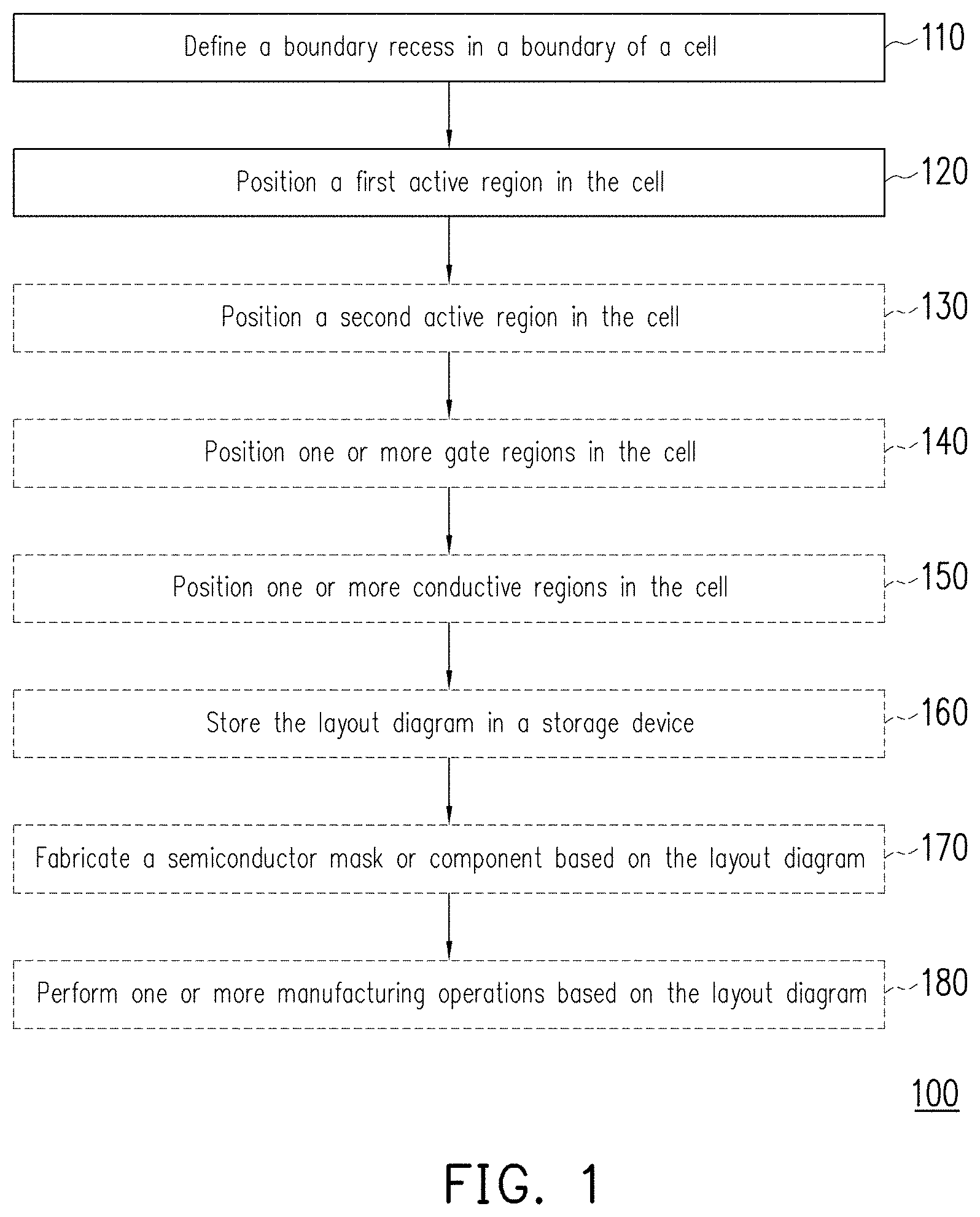
is a flowchart of a method 100 of generating a layout diagram of an IC, in accordance with some embodiments. The operations of method 100 are capable of being performed as part of a method of forming one or more IC devices, e.g., one of IC devices 1100 or 1200 discussed below with respect to , respectively, manufactured based on the generated IC layout diagram. Non-limiting examples of IC devices include memory circuits, logic devices, processing devices, signal processing circuits, and the like.
In some embodiments, some or all of the operations of method 100 are capable of being performed as part of an automated placement and routing (APR) method. In some embodiments, some or all of the operations of method 100 are capable of being performed by an APR system, e.g., a system included in an EDA system 1300 , discussed below with respect to , and configured to perform the APR method.
In some embodiments, some or all of the operations of method 100 are performed as part of a method 600 of generating a layout diagram of an IC discussed below with respect to . Some or all of the operations of method 100 are capable of being performed as part of a design procedure performed in a design house, e.g., a design house 1420 discussed below with respect to .
In some embodiments, some or all of the operations of method 100 are executed by a processor of a computer. In some embodiments, some or all of the operations of method 100 are executed by a processor 1302 of EDA system 1300 , discussed below with respect to .
In some embodiments, the operations of method 100 are performed in the order depicted in . In some embodiments, the operations of method 100 are performed in an order other than the order depicted in . In some embodiments, one or more operations are performed before, between, during, and/or after performing one or more operations of method 100 .
B 1 - 5 H 2 are depictions of non-limiting examples of respective IC layout diagrams 200 - 400 and 500 B 1 - 500 H 2 generated by executing one or more operations of method 100 , in some embodiments. IC layout diagrams 200 - 400 and 500 B 1 - 500 H 2 are simplified for the purpose of clarity. In various embodiments, one or more of IC layout diagrams 200 - 400 and 500 B 1 - 500 H 2 includes features in addition to those depicted in B 1 - 5 H 2 , e.g., one or more transistor elements, power rails, isolation structures, wells, conductive elements, or the like.
Each of B 1 - 5 H 2 further depicts an X direction and a Y direction perpendicular to the X direction. The X direction being depicted as horizontal and the Y direction being depicted as vertical are a non-limiting example for the purpose of illustration. In various embodiments, the X and Y directions are perpendicular to each other and have orientations other than those depicted in B 1 - 5 H 2 .
The X direction includes a positive X direction depicted in B 1 - 5 H 2 and a negative X direction (not labeled) opposite to the positive X direction. The Y direction includes a positive Y direction depicted in B 1 - 5 H 2 and a negative Y direction (not labeled) opposite to the positive Y direction.
is a depiction of IC layout diagram 200 including a cell 200 C, in accordance with some embodiments. Cell 200 C includes a boundary 200 B and active regions 210 , 220 , 230 , and 240 .
is a depiction of IC layout diagram 300 including a cell 300 C, in accordance with some embodiments. Cell 300 C includes a boundary 300 B and active regions 210 , 220 , 230 , and 240 .
In addition to cells 200 C and 300 C, each of depicts gate tracks T 1 through T 6 . Gate tracks T 1 through T 6 extend in the Y direction, have a gate pitch GP in the X direction, and correspond to locations at which gate regions (not shown) are aligned in IC layout diagrams, e.g., IC layout diagrams 200 and 300 .
In various embodiments, one or both of IC layout diagrams 200 or 300 includes one or more cells (not shown) in addition to respective cell 200 C or cell 300 C.
In various embodiments, one or both of cell 200 C or cell 300 C is a layout diagram of a standard cell, a custom cell, an engineering change order (ECO) cell, a logic gate cell, a memory cell, or another type of cell or combination of cells capable of being defined in an IC layout diagram. In various embodiments, a logic gate cell includes a layout diagram of one or more of an AND, OR, NAND, NOR, XOR, INV, AND-OR-Invert (AOI), OR-AND-Invert (OAI), MUX, Flip-flop, BUFF, Latch, delay, or clock device. In various embodiments, a memory cell includes a layout diagram of one or more of a static random access memory (SRAM), a dynamic RAM (DRAM), a resistive RAM (RRAM), a magnetoresistive RAM (MRAM), or read only memory (ROM) cell, or another device capable of having multiple states representative of logical values.
As depicted in , boundary 200 B of cell 200 C includes portions B 1 B through B 12 . Portion B 12 extends along the Y direction and is contiguous with portion B 1 B, which extends along the X direction. For each of the other portions B 2 B through B 11 , a given portion B[n] is contiguous with a portion B[n−1], contiguous with a portion B[n+1], and extends along one of the X or Y direction perpendicular to the other of the X or Y direction along which each of portions B[n−1] and B[n+1] extends.
Portion B 1 B extends in the positive X direction from a point corresponding to gate track T 1 to a point corresponding to gate track T 5 . Portion B 2 B extends along gate track T 5 in the negative Y direction from portion B 1 B to portion B 3 . In various embodiments, portion B 1 B extends from a location other than the point corresponding to gate track T 1 and/or portion B 1 B extends to a location other than the point corresponding to gate track T 5 and portion B 2 B extends along a location other than that of gate track T 5 .
Portion B 3 extends in the positive X direction from portion B 2 B to a point corresponding to gate track T 6 . Portion B 4 extends along gate track T 6 in the negative Y direction from portion B 3 to portion B 5 . In various embodiments, portion B 3 extends from a location other than the point corresponding to gate track T 5 and/or portion B 3 extends to a location other than the point corresponding to gate track T 6 and portion B 4 extends along a location other than that of gate track T 6 .
Portion B 5 extends in the negative X direction from portion B 4 to a point corresponding to gate track T 5 . Portion B 6 extends along gate track T 5 in the negative Y direction from portion B 5 to portion B 7 . In various embodiments, portion B 5 extends from a location other than the point corresponding to gate track T 6 and/or portion B 5 extends to a location other than the point corresponding to gate track T 5 and portion B 6 extends along a location other than that of gate track T 5 .
Portion B 7 extends in the negative X direction from portion B 6 to a point corresponding to gate track T 1 . Portion B 8 extends along gate track T 1 in the positive Y direction from portion B 7 to portion B 9 . In various embodiments, portion B 7 extends from a location other than the point corresponding to gate track T 5 and/or portion B 7 extends to a location other than the point corresponding to gate track T 1 and portion B 8 extends along a location other than that of gate track T 1 .
Portion B 9 extends in the positive X direction from portion B 8 to a point corresponding to gate track T 2 . Portion B 10 extends along gate track T 2 in the positive Y direction from portion B 9 to portion B 11 . In various embodiments, portion B 9 extends from a location other than the point corresponding to gate track T 1 and/or portion B 9 extends to a location other than the point corresponding to gate track T 2 and portion B 10 extends along a location other than that of gate track T 2 .
Portion B 11 extends in the negative X direction from portion B 10 to a point corresponding to gate track T 1 . Portion B 12 extends along gate track T 1 in the positive Y direction from portion B 11 to portion B 1 B. In various embodiments, portion B 11 extends from a location other than the point corresponding to gate track T 2 and/or portion B 11 extends to a location other than the point corresponding to gate track T 1 and portion B 12 extends along a location other than that of gate track T 1 .
In the embodiment depicted in , each of portions B 1 B, B 3 , B 5 , B 7 , B 9 , and B 11 extends in the X direction. In various embodiments, one or more of portions B 1 B, B 3 , B 5 , B 7 , B 9 , or B 11 extends in a direction other than the X direction and includes a component in the X direction.
In the embodiment depicted in , each of portions B 2 B, B 4 , B 6 , B 8 , B 10 , and B 12 extends in the Y direction. In various embodiments, one or more of portions B 2 B, B 4 , B 6 , B 8 , B 10 , or B 12 extends in a direction other than the Y direction and includes a component in the Y direction.
In the embodiment depicted in , portion B 2 B aligns with portion B 6 along the Y direction, portion B 3 aligns with portion B 11 along the X direction, portion B 5 aligns with portion B 9 along the X direction, and portion B 8 aligns with portion B 12 along the Y direction. In various embodiments, one or more of portion B 2 B does not align with portion B 6 along the Y direction, portion B 3 does not align with portion B 11 along the X direction, portion B 5 does not align with portion B 9 along the X direction, or portion B 8 does not align with portion B 12 along the Y direction.
A boundary having a shape other than a rectangular shape is considered to have one or more protrusions and/or one or more recesses based on one or more deviations from a rectangular shape. By the configuration of boundary 200 B discussed above, portions B 3 , B 4 , and B 5 have a shape of a boundary protrusion 200 P 1 of cell 200 C, portions B 7 , B 8 , and B 9 have a shape of a boundary protrusion 200 P 2 of cell 200 C, portions B 11 , B 12 , and B 1 B have a shape of a boundary protrusion 200 P 3 of cell 200 C, portions B 2 B and B 3 have a shape of a boundary recess 200 R 1 of cell 200 C, portions B 5 and B 6 have a shape of a boundary recess 200 R 2 of cell 200 C, and portions B 9 , B 10 , and B 11 have a shape of a boundary recess 200 R 3 of cell 200 C.
In the embodiment depicted in , cell 200 C thereby includes two boundary protrusions 200 P 2 and 200 P 3 along a left side of cell 200 C, one boundary protrusion 200 P 1 along a right side of cell 200 C, zero boundary protrusions along a top of cell 200 C, and zero boundary protrusions along a bottom of cell 200 C. In various embodiments, cell 200 C includes fewer or greater than two boundary protrusions along the left side, greater than one boundary protrusion along the right side, one or more boundary protrusions along the top, and/or one or more boundary protrusions along the bottom.
In the embodiment depicted in , cell 200 C thereby includes one boundary recess 200 R 3 along the left side, two boundary recesses 200 R 1 and 200 R 2 along the right side, zero boundary recesses along the top, and zero boundary recesses along the bottom. In various embodiments, cell 200 C includes greater than one boundary recess along the left side, fewer or greater than two boundary recesses along the right side, one or more boundary recesses along the top, and/or one or more boundary recesses along the bottom.
In the embodiment depicted in , each of boundary protrusions 200 P 1 , 200 P 2 , and 200 P 3 , and each of boundary recesses 200 R 1 , 200 R 2 , and 200 R 3 extends in the X direction a distance equivalent to gate pitch GP. In various embodiments, one or more of boundary protrusions 200 P 1 , 200 P 2 , or 200 P 3 or boundary recesses 200 R 1 , 200 R 2 , or 200 R 3 extends in the X direction a distance other than gate pitch GP, e.g., a multiple of gate pitch GP or a fraction of gate pitch GP.
In the embodiment depicted in , each of boundary protrusions 200 P 1 , 200 P 2 , and 200 P 3 , and each of boundary recesses 200 R 1 , 200 R 2 , and 200 R 3 has a shape based on right angles formed by contiguous boundary portions. In various embodiments, one or more of boundary protrusions 200 P 1 , 200 P 2 , or 200 P 3 or boundary recesses 200 R 1 , 200 R 2 , or 200 R 3 has a shape based on one or more configurations other than a right angle formed by contiguous boundary portions, e.g., an acute or obtuse angle formed by contiguous boundary portions, a semicircular boundary portion, or a boundary portion including one or more arcs.
As depicted in , boundary 300 B of cell 300 C includes portions B 21 through B 36 . Portion B 36 extends along the Y direction and is contiguous with portion B 21 , which extends along the X direction. For each of the other portions B 22 through B 35 , a given portion B[n] is contiguous with a portion B[n−1], contiguous with a portion B[n+1], and extends along one of the X or Y direction perpendicular to the other of the X or Y direction along which each of portions B[n−1] and B[n+1] extends.
Portion B 21 extends in the positive X direction from a point corresponding to gate track T 1 to a point corresponding to gate track T 5 . Portion B 22 extends along gate track T 5 in the negative Y direction from portion B 21 to portion B 23 . In various embodiments, portion B 21 extends from a location other than the point corresponding to gate track T 1 and/or portion B 21 extends to a location other than the point corresponding to gate track T 5 and portion B 22 extends along a location other than that of gate track T 5 .
Portion B 23 extends in the positive X direction from portion B 22 to a point corresponding to gate track T 6 . Portion B 24 extends along gate track T 6 in the negative Y direction from portion B 23 to portion B 25 . In various embodiments, portion B 23 extends from a location other than the point corresponding to gate track T 5 and/or portion B 23 extends to a location other than the point corresponding to gate track T 6 and portion B 24 extends along a location other than that of gate track T 6 .
Portion B 25 extends in the negative X direction from portion B 24 to a point corresponding to gate track T 5 . Portion B 26 extends along gate track T 5 in the negative Y direction from portion B 25 to portion B 27 . In various embodiments, portion B 25 extends from a location other than the point corresponding to gate track T 6 and/or portion B 25 extends to a location other than the point corresponding to gate track T 5 and portion B 26 extends along a location other than that of gate track T 5 .
Portion B 27 extends in the positive X direction from portion B 26 to a point corresponding to gate track T 6 . Portion B 28 extends along gate track T 6 in the negative Y direction from portion B 27 to portion B 29 . In various embodiments, portion B 27 extends from a location other than the point corresponding to gate track T 5 and/or portion B 27 extends to a location other than the point corresponding to gate track T 6 and portion B 28 extends along a location other than that of gate track T 6 .
Portion B 29 extends in the negative X direction from portion B 28 to a point corresponding to gate track T 2 . Portion B 30 extends along gate track T 2 in the positive Y direction from portion B 29 to portion B 31 . In various embodiments, portion B 29 extends from a location other than the point corresponding to gate track T 6 and/or portion B 29 extends to a location other than the point corresponding to gate track T 2 and portion B 30 extends along a location other than that of gate track T 2 .
Portion B 31 extends in the negative X direction from portion B 30 to a point corresponding to gate track T 1 . Portion B 32 extends along gate track T 1 in the positive Y direction from portion B 31 to portion B 33 . In various embodiments, portion B 31 extends from a location other than the point corresponding to gate track T 2 and/or portion B 31 extends to a location other than the point corresponding to gate track T 1 and portion B 32 extends along a location other than that of gate track T 1 .
Portion B 33 extends in the positive X direction from portion B 32 to a point corresponding to gate track T 2 . Portion B 34 extends along gate track T 2 in the positive Y direction from portion B 33 to portion B 35 . In various embodiments, portion B 33 extends from a location other than the point corresponding to gate track T 1 and/or portion B 33 extends to a location other than the point corresponding to gate track T 2 and portion B 34 extends along a location other than that of gate track T 2 .
Portion B 35 extends in the negative X direction from portion B 34 to a point corresponding to gate track T 1 . Portion B 36 extends along gate track T 1 in the positive Y direction from portion B 35 to portion B 21 . In various embodiments, portion B 35 extends from a location other than the point corresponding to gate track T 2 and/or portion B 35 extends to a location other than the point corresponding to gate track T 1 and portion B 36 extends along a location other than that of gate track T 1 .
In the embodiment depicted in , each of portions B 21 , B 23 , B 25 , B 27 , B 29 , B 31 , B 33 , and B 35 extends in the X direction. In various embodiments, one or more of portions B 21 , B 23 , B 25 , B 27 , B 29 , B 31 , B 33 , or B 35 extends in a direction other than the X direction and includes a component in the X direction.
In the embodiment depicted in , each of portions B 22 , B 24 , B 26 , B 28 , B 30 , B 32 , B 34 , and B 36 extends in the Y direction. In various embodiments, one or more of portions B 22 , B 24 , B 26 , B 28 , B 30 , B 32 , B 34 , or B 36 extends in a direction other than the Y direction and includes a component in the Y direction.
In the embodiment depicted in , portion B 22 aligns with portion B 26 along the Y direction, portion B 23 aligns with portion B 35 along the X direction, portion B 24 aligns with portion B 28 along the Y direction, portion B 25 aligns with portion B 33 along the X direction, portion B 27 aligns with portion B 31 along the X direction, portion B 30 aligns with portion B 34 along the Y direction, and portion B 32 aligns with portion B 36 along the Y direction. In various embodiments, one or more of portion B 22 does not align with portion B 26 along the Y direction, portion B 23 does not align with portion B 35 along the X direction, portion B 24 does not align with portion B 28 along the Y direction, portion B 25 does not align with portion B 33 along the X direction, portion B 27 does not align with portion B 31 along the X direction, portion B 30 does not align with portion B 34 along the Y direction, or portion B 32 does not align with portion B 36 along the Y direction.
By the configuration of border 300 B discussed above, portions B 23 , B 24 , and B 25 have a shape of a boundary protrusion 300 P 1 of cell 300 C, portions B 27 , B 28 , and B 29 have a shape of a boundary protrusion 300 P 2 of cell 300 C, portions B 31 , B 32 , and B 33 have a shape of a boundary protrusion 300 P 3 of cell 300 C, portions B 35 , B 36 , and B 21 have a shape of a boundary protrusion 300 P 4 of cell 300 C, portions B 22 and B 23 have a shape of a boundary recess 300 R 1 of cell 300 C, portions B 25 , B 26 , and B 27 have a shape of a boundary recess 300 R 2 of cell 300 C, portions B 30 and B 31 have a shape of a boundary recess 300 R 3 of cell 300 C, and portions B 33 , B 34 , and B 35 have a shape of a boundary recess 300 R 4 of cell 300 C.
In the embodiment depicted in , cell 300 C thereby includes two boundary protrusions 300 P 3 and 300 P 4 along a left side of cell 300 C, two boundary protrusions 300 P 1 and 300 P 2 along a right side of cell 300 C, zero boundary protrusions along a top of cell 300 C, and zero boundary protrusions along a bottom of cell 300 C. In various embodiments, cell 300 C includes fewer or greater than two boundary protrusions along the left side, fewer or greater than two boundary protrusions along the right side, one or more boundary protrusions along the top, and/or one or more boundary protrusions along the bottom.
In the embodiment depicted in , cell 300 C thereby includes two boundary recesses 300 R 3 and 300 R 4 along the left side, two boundary recesses 300 R 1 and 300 R 2 along the right side, zero boundary recesses along the top, and zero boundary recesses along the bottom. In various embodiments, cell 300 C includes fewer or greater than two boundary recesses along the left side, fewer or greater than two boundary recesses along the right side, one or more boundary recesses along the top, and/or one or more boundary recesses along the bottom.
In the embodiment depicted in , each of boundary protrusions 300 P 1 , 300 P 2 , 300 P 3 , and 300 P 4 , and each of boundary recesses 300 R 1 , 300 R 2 , 300 R 3 , and 300 R 4 extends in the X direction a distance equivalent to gate pitch GP. In various embodiments, one or more of boundary protrusions 300 P 1 , 300 P 2 , 300 P 3 , or 300 P 4 or boundary recesses 300 R 1 , 300 R 2 , 300 R 3 , or 300 R 4 extends in the X direction a distance other than gate pitch GP, e.g., a multiple of gate pitch GP or a fraction of gate pitch GP.
In the embodiment depicted in , each of boundary protrusions 300 P 1 , 300 P 2 , 300 P 3 , and 300 P 4 and each of boundary recesses 300 R 1 , 300 R 2 , 300 R 3 , and 300 R 4 has a shape based on right angles formed by contiguous boundary portions. In various embodiments, one or more of boundary protrusions 300 P 1 , 300 P 2 , 300 P 3 , or 300 P 4 or boundary recesses 300 R 1 , 300 R 2 , 300 R 3 , or 300 R 4 has a shape based on one or more configurations other than a right angle formed by contiguous boundary portions, e.g., an acute or obtuse angle formed by contiguous boundary portions, a semicircular boundary portion, or a boundary portion including one or more arcs.
At operation 110 , a boundary recess in a boundary of an IC cell is defined. Defining the boundary recess includes extending a first portion of the boundary along a first direction, extending a second portion of the boundary away from the first portion in a second direction perpendicular to the first direction, the second portion being contiguous with the first portion, and extending a third portion away from the first portion in the second direction, the third portion being contiguous with the first portion.
Extending the first portion in the first direction and the second and third portions in the second direction forms a first recess in the boundary. In some embodiments, defining the boundary recess includes forming one or more boundary recesses in addition to the first boundary recess. In various embodiments, defining the boundary recess includes forming one or more protrusions in the boundary.
In some embodiments, defining the boundary recess includes forming an entirety of the boundary having a closed loop. In various embodiments, defining the boundary recess includes forming an entirety of one of boundaries 200 B or 300 B, discussed above with respect to , respectively.
In some embodiments, defining the boundary recess includes defining at least some of boundary 200 B of cell 200 C, extending the first portion in the first direction includes extending portion B 10 in the positive or negative Y direction, extending the second and third portions in the second direction includes extending portions B 9 and B 11 in the negative X direction, thereby forming boundary recess 200 R 3 , discussed above with respect to .
In some embodiments, defining the boundary recess includes defining at least some of boundary 300 B of cell 300 C, extending the first portion in the first direction includes extending portion B 34 in the positive or negative Y direction, extending the second and third portions in the second direction includes extending portions B 33 and B 35 in the negative X direction, thereby forming boundary recess 300 R 4 , discussed above with respect to .
In some embodiments, defining the boundary recess includes defining at least some of boundary 300 B of cell 300 C, extending the first portion in the first direction includes extending portion B 26 in the positive or negative Y direction, extending the second and third portions in the second direction includes extending portions B 25 and B 27 in the positive X direction, thereby forming boundary recess 300 R 2 , discussed above with respect to .
In various embodiments, defining the boundary recess includes further defining the boundary by extending one or more additional portions along the first or second direction or along one or more directions opposite to the first or second direction.
In some embodiments, further defining the boundary includes forming an entirety of the boundary having a closed loop. In various embodiments, further defining the boundary includes forming an entirety of one of boundaries 200 B or 300 B, discussed above with respect to , respectively.
In some embodiments, further defining the boundary includes forming one or more boundary recesses in addition to the first boundary recess. In some embodiments, further defining the boundary includes forming one or both of boundary recesses 200 R 1 or 200 R 2 , discussed above with respect to . In some embodiments, further defining the boundary includes forming one or more of boundary recesses 300 R 1 , 300 R 2 , 300 R 3 , or 300 R 4 , discussed above with respect to .
In some embodiments, further defining the boundary includes forming one or more protrusions in the boundary. In some embodiments, further defining the boundary includes forming one or more of boundary protrusions 200 P 1 , 200 P 2 , or 200 P 3 , discussed above with respect to . In some embodiments, further defining the boundary includes forming one or more of boundary protrusions 300 P 1 , 300 P 2 , 300 P 3 , or 300 P 4 , discussed above with respect to .
Each of active regions 210 , 220 , 230 , and 240 is a layout component that extends along the X direction and defines an active area of one or more transistor structures formed at one or more locations at which active regions 210 , 220 , 230 , and 240 intersect gate tracks T 1 through T 6 . In various embodiments, a transistor structure includes one or more of a switching, logic, amplification, rectification, storage, or other IC device.
Each of active regions 210 , 220 , 230 , and 240 defines an active area in which source, drain, and channel features of one or more transistor structures are formed in and/or on a semiconductor substrate. A given active region 210 , 220 , 230 , or 240 is either a p-type active region that defines a p-type active area of one or more PMOS transistor structures or an n-type active region that defines an n-type active area of one or more NMOS transistor structures. In some embodiments, each of active regions 210 and 220 defines a p-type active area of one or more PMOS transistor structures, and each of active regions 230 and 240 defines an n-type active area of one or more NMOS transistor structures.
In various embodiments, one or more of active regions 210 , 220 , 230 , or 240 includes a single, continuous active region or a plurality of active regions. In some embodiments, each of active regions 210 , 220 , 230 , and 240 includes a same number of active regions. In various embodiments, one or more of active regions 210 , 220 , 230 , or 240 includes a number of active regions that differs from a number of active regions included in another one or more of active regions 210 , 220 , 230 , or 240 .
In various embodiments, one or more of active regions 210 , 220 , 230 , or 240 is included in one or more planar transistors and/or one or more fin, field-effect transistors (FinFETs) in one or both of cell 200 C or cell 300 C. In some embodiments, one or more of active regions 210 , 220 , 230 , or 240 is active region 400 , discussed below with respect to .
In the embodiments depicted in , each of active regions 210 , 220 , 230 , and 240 extends across three of gate tracks T 2 through T 5 . In various embodiments, one or more of active regions 210 , 220 , 230 , or 240 extends across fewer than three of gate tracks T 2 through T 5 , greater than three of gate tracks T 2 through T 5 , or across one or more gate tracks other than gate tracks T 2 through T 5 .
In the embodiment depicted in , active region 210 is located between portions B 12 and B 2 B, is aligned with portions B 12 and B 2 B along the X direction, and extends into protrusion 200 P 3 , and spaces (not labeled) separate active region 210 from each of portions B 12 and B 2 B. In various embodiments, active region 210 abuts one or both of portions B 12 or B 2 B and/or is aligned with one or both of gate tracks T 1 or T 5 .
In some embodiments, cell 200 C includes one or more active regions (not shown) in addition to active region 210 that is located between portions B 12 and B 2 B, aligned with portions B 12 and B 2 B along the X direction, and extends into protrusion 200 P 3 .
In the embodiment depicted in , each of active regions 220 and 230 is located between portions B 10 and B 4 , is aligned with portions B 10 and B 4 along the X direction, and extends into protrusion 200 P 1 , and spaces (not labeled) separate each of active regions 220 and 230 from each of portions B 10 and B 4 . In various embodiments, one or both of active regions 220 or 230 abuts one or both of portions B 10 or B 4 and/or is aligned with one or both of gate tracks T 2 or T 6 .
In some embodiments, cell 200 C includes one or more other active regions (not shown) in addition to active regions 220 and 230 that is located between portions B 10 and B 4 , aligned with portions B 10 and B 4 along the X direction, and extends into protrusion 200 P 1 . In some embodiments, cell 200 C does not include one of active regions 220 or 230 and one of active regions 220 or 230 is a single active region located between portions B 10 and B 4 , aligned with portions B 10 and B 4 along the X direction, and extending into protrusion 200 P 1 .
In the embodiment depicted in , active region 240 is located between portions B 8 and B 6 , is aligned with portions B 8 and B 6 along the X direction, and extends into protrusion 200 P 2 , and spaces (not labeled) separate active region 240 from each of portions B 8 and B 6 . In various embodiments, active region 240 abuts one or both of portions B 8 or B 6 and/or is aligned with one or both of gate tracks T 1 or T 5 .
In some embodiments, cell 200 C includes one or more active regions (not shown) in addition to active region 240 that is located between portions B 8 and B 6 , aligned with portions B 8 and B 6 along the X direction, and extends into protrusion 200 P 2 .
In the embodiment depicted in , active region 210 is located between portions B 36 and B 22 , is aligned with portions B 36 and B 22 along the X direction, and extends into protrusion 300 P 4 , and spaces (not labeled) separate active region 210 from each of portions B 36 and B 22 . In various embodiments, active region 210 abuts one or both of portions B 36 or B 22 and/or is aligned with one or both of gate tracks T 1 or T 5 .
In some embodiments, cell 300 C includes one or more active regions (not shown) in addition to active region 210 that is located between portions B 36 and B 22 , aligned with portions B 36 and B 22 along the X direction, and extends into protrusion 300 P 4 .
In the embodiment depicted in , active region 220 is located between portions B 34 and B 24 , is aligned with portions B 34 and B 24 along the X direction, and extends into protrusion 300 P 1 , and spaces (not labeled) separate active region 220 from each of portions B 34 and B 24 . In various embodiments, active region 220 abuts one or both of portions B 34 or B 24 and/or is aligned with one or both of gate tracks T 2 or T 6 .
In some embodiments, cell 300 C includes one or more active regions (not shown) in addition to active region 220 that is located between portions B 34 and B 24 , aligned with portions B 34 and B 24 along the X direction, and extends into protrusion 300 P 1 .
In the embodiment depicted in , active region 230 is located between portions B 32 and B 26 , is aligned with portions B 32 and B 26 along the X direction, and extends into protrusion 300 P 3 , and spaces (not labeled) separate active region 230 from each of portions B 32 and B 26 . In various embodiments, active region 230 abuts one or both of portions B 32 or B 26 and/or is aligned with one or both of gate tracks T 1 or T 5 .
In some embodiments, cell 300 C includes one or more active regions (not shown) in addition to active region 230 that is located between portions B 32 and B 26 , aligned with portions B 32 and B 26 along the X direction, and extends into protrusion 300 P 3 .
In the embodiment depicted in , active region 240 is located between portions B 30 and B 28 , is aligned with portions B 30 and B 28 along the X direction, and extends into protrusion 300 P 2 , and spaces (not labeled) separate active region 240 from each of portions B 30 and B 28 . In various embodiments, active region 240 abuts one or both of portions B 30 or B 28 and/or is aligned with one or both of gate tracks T 2 or T 6 .
In some embodiments, cell 300 C includes one or more active regions (not shown) in addition to active region 240 that is located between portions B 30 and B 28 , aligned with portions B 30 and B 28 along the X direction, and extends into protrusion 300 P 2 .
is a depiction of an active region 400 , in accordance with some embodiments. Active region 400 is usable as one or more of active regions 210 , 220 , 230 , or 240 , discussed above with respect to . In addition to active region 400 , depicts the X and Y directions, discussed above with respect to , a gate track TR, and a gate region P. In some embodiments, gate track TR corresponds to one of gate tracks T 1 through T 6 , discussed above with respect to .
Active region 400 includes a number M of active lines 410 [ 1 ] . . . 410 [M]. Each active line 410 [ 1 ] . . . 410 [M] extends along the X direction and defines, at least in part, a fin structure of a FinFET. In some embodiments, each active line 410 [ 1 ] . . . 410 [M] is an active area separate from each other active line 410 [ 1 ] . . . 410 [M]. In some embodiments, two or more of active lines 410 [ 1 ] . . . 410 [M] are part of a same active area.
In various embodiments, active region 400 includes the number M of active lines 410 [ 1 ] . . . 410 [M] ranging from one to four. In some embodiments, region 400 includes the number M of active lines 410 [ 1 ] . . . 410 [M] greater than four. Because both a current capacity of the FinFET and an area occupied by the FinFET increase as the number M of active lines 410 [ 1 ] . . . 410 [M] increases, the number M is based on current and area design criteria for an IC that includes active region 400 , in some cases.
Gate region P extends along the Y direction, is located at gate track TR, and intersects each active line 410 [ 1 ] . . . 410 [M]. Gate region P defines, at least in part, a gate electrode of a gate structure included in the FinFET. In various embodiments, gate region P defines, at least in part, a gate electrode including one or more of a polysilicon layer, a metal layer, a work function layer, or another material suitable for controlling a channel of a FinFET.
At operation 120 , a first active region is positioned in the cell by extending the first active region away from the first portion in a third direction opposite to the second direction. In some embodiments, positioning the first active region in the cell includes revising the layout diagram. Extending the first active region away from the first portion in the third direction is based on positioning the first active region by aligning the first active region and the first portion in the second and third directions.
Because the second and third portions of the boundary are extended away from the first portion in the second direction, extending the first active region in third direction opposite to the second direction causes the first active region to be positioned within the cell boundary and aligned with the first boundary recess in the second and third directions.
In some embodiments, the second direction corresponds to the negative X direction and the third direction corresponds to the positive X direction, each discussed above with respect to B 1 - 5 H 2 .
In some embodiments, positioning the first active region in the cell includes positioning the first active region within a protrusion of the cell boundary. In various embodiments, positioning the first active region in the cell includes positioning the first active region within one of boundary protrusions 200 P 1 , 200 P 2 , or 200 P 3 , discussed above with respect to , or within one or more of boundary protrusions 300 P 1 , 300 P 2 , 300 P 3 , or 300 P 4 , discussed above with respect to .
In some embodiments, positioning the first active region in the cell includes positioning the first active region to be non-overlapping with a boundary recess of the cell. In various embodiments, positioning the first active region in the cell includes positioning the first active region to be non-overlapping with one or more of boundary recesses 200 R 1 , 200 R 2 , or 200 R 3 , discussed above with respect to , or non-overlapping with one or more of boundary recesses 300 R 1 , 300 R 2 , 300 R 3 , or 300 R 4 , discussed below with respect to .
In various embodiments, positioning the first active region includes positioning one or more of active regions 210 - 240 in one of cells 200 C or 300 C, discussed above with respect to . In some embodiments, positioning the first active region includes positioning active region 400 , discussed above with respect to .
At operation 130 , in some embodiments, a second active region is positioned in the cell. Positioning the second active region includes positioning the second active region along the second and third directions, thereby in parallel with the first active region. In various embodiments, positioning the second active region includes aligning one, both, or neither of a first or second endpoint of the second active region with a first or second endpoint of the first active region along the first direction.
In various embodiments, positioning the second active region includes positioning the second active region defining one of an N-type or P-type active area the same or different as an active area defined by the first active region.
In various embodiments, positioning the second active region in the cell includes positioning one or more of active regions 210 - 240 in one of cells 200 C or 300 C, discussed above with respect to . In some embodiments, positioning the second active region includes positioning active region 400 , discussed above with respect to .
In some embodiments, positioning the second active region in the cell includes positioning the second active region within a protrusion of the cell boundary. In various embodiments, positioning the second active region in the cell includes positioning the second active region within one of protrusions 200 P 1 , 200 P 2 , or 200 P 3 , discussed above with respect to , or within one or more of protrusions 300 P 1 , 300 P 2 , 300 P 3 , or 300 P 4 , discussed above with respect to .
In some embodiments, positioning the second active region in the cell includes positioning the second active region to be non-overlapping with a boundary recess of the cell. In various embodiments, positioning the second active region in the cell includes positioning the second active region to be non-overlapping with one or more of boundary recesses 200 R 1 , 200 R 2 , or 200 R 3 , discussed above with respect to , or non-overlapping with one or more of boundary recesses 300 R 1 , 300 R 2 , 300 R 3 , or 300 R 4 , discussed below with respect to .
In some embodiments, positioning the second active region includes revising the IC layout diagram.
A is a schematic representation of an IC 500 corresponding to IC layout diagrams 500 B 1 - 500 H 2 depicted in B 1 - 5 H 2 , respectively, in accordance with some embodiments. IC 500 is a transmission gate circuit and each of IC layout diagrams 500 B 1 - 500 H 2 is a non-limiting example of a corresponding IC layout diagram generated by executing one or more operations of method 100 , in some embodiments.
IC 500 includes a PMOS transistor 1 P 1 having a gate terminal A 1 , a PMOS transistor 1 P 2 having a gate terminal B 1 , an NMOS transistor N 1 having a gate terminal B 2 , and an NMOS transistor N 2 having a gate terminal A 2 . Gate terminal A 1 is electrically connected to gate terminal A 2 , and gate terminal B 1 is electrically connected to gate terminal B 2 .
First source/drain terminals of transistors 1 P 1 , 1 P 2 , N 1 , and N 2 are electrically connected to each other. A second source/drain terminal of transistor 1 P 1 is electrically connected to a second source/drain terminal of transistor N 1 , and a second source/drain terminal of transistor 1 P 2 is electrically connected to a second source/drain terminal of transistor N 2 .
B 1 , 5 C 1 , 5 D 1 , 5 E 1 , 5 F 1 , 5 G 1 , and 5 H 1 depict respective IC layout diagrams 500 B 1 , 500 C 1 , 500 D 1 , 500 E 1 , 500 F 1 , 500 G 1 , and 500 H 1 , each based on cell 200 C, discussed above with respect to . B 2 , 5 C 2 , 5 D 2 , 5 E 2 , 5 F 2 , 5 G 2 , and 5 H 2 depict respective IC layout diagrams 500 B 2 , 500 C 2 , 500 D 2 , 500 E 2 , 500 F 2 , 500 G 2 , and 500 H 2 , each based on cell 300 C, discussed above with respect to .
Each of B 1 - 5 H 2 depicts one of respective IC layout diagrams 500 B 1 - 500 H 2 including active regions 210 - 240 positioned in accordance with one of cells 200 C or 300 C, but does not depict either of boundaries 200 B or 300 B for the purpose of clarity. In addition to active regions 210 - 240 , each IC layout diagram 500 B 1 - 500 H 2 includes gate terminals A 1 , A 2 , B 1 , and B 2 and additional IC layout elements that define electrical connections to and within an IC device, e.g., one of IC devices 1100 or 1200 discussed below with respect to , manufactured based on the respective IC layout diagram 500 B 1 - 500 H 2 and corresponding to IC 500 .
In the various embodiments depicted in B 1 - 5 H 2 , the additional IC layout elements include gate regions P 1 -P 5 , conductive regions MD 1 -MD 5 , and conductive regions M 1 and M 2 extending along the Y direction, conductive regions M 01 -M 07 B and a cut poly region CP extending along the X direction, vias V 0 and V 1 .
Each gate region P 1 -P 5 defines, at least in part, a gate electrode of a gate structure included in a transistor structure. In various embodiments, one or more of gate regions P 1 -P 5 defines, at least in part, a gate electrode of a FET, a FinFET, or a dummy device. In various embodiments, one or more of gate regions P 1 -P 5 defines, at least in part, a gate electrode including one or more of a polysilicon layer, a metal layer, a work function layer, or another material suitable for controlling a channel of a transistor.
Gate regions P 1 -P 5 are positioned at locations corresponding to subsets of tracks T 1 -T 6 , discussed above with respect to .
Each conductive region MD 1 -MD 5 defines, at least in part, a segment of a conductive layer electrically connected to an underlying active region. In some embodiments, one or more of conductive regions MD 1 -MD 5 is referred to as a metal diffusion region. In various embodiments, one or more of conductive regions MD 1 -MD 5 defines, at least in part, a segment of a conductive layer including copper or another metal suitable for forming an electrical connection to an underlying active region.
Conductive regions MD 1 -MD 5 are positioned at locations parallel to, and separate from, locations at which gate regions P 1 -P 5 are positioned.
Each conductive region M 1 and M 2 defines, at least in part, a segment of a conductive layer overlying the other additional elements of the IC device. In some embodiments, conductive regions M 1 and M 2 define segments in a metal one layer of the IC device. In various embodiments, one or more of conductive regions M 1 and M 2 defines, at least in part, a segment of a conductive layer including copper or another metal suitable for forming electrical connections in and to the IC device.
Each conductive region M 01 -M 07 B defines, at least in part, a segment of a conductive layer overlying segments defined by conductive regions MD 1 -MD 5 and gate electrodes defined by gate regions P 1 -P 5 , and underlying segments defined by conductive regions M 1 and M 2 . In some embodiments, conductive regions M 01 -M 07 B define segments in a metal zero layer of the IC device. In various embodiments, one or more of conductive regions M 01 -M 07 B defines, at least in part, a segment of a conductive layer including copper or another metal suitable for forming electrical connections in the IC device.
Cut poly region CP defines, at least in part, an area in which one or more gate electrodes defined by gate regions P 1 -P 5 are prevented from being formed such that a gate region P 1 -P 5 intersected by cut poly region CP is divided into separately controllable gate electrodes.
Each via V 0 (only one of which is labeled for clarity) is a conductive region that defines, at least in part, a segment of a conductive layer between a segment defined by a conductive region M 01 -M 07 B and either an underlying segment defined by a conductive region MD 1 -MD 5 or an underlying gate electrode defined by a gate region P 1 -P 5 . In various embodiments, one or more of vias V 0 defines, at least in part, a segment of a conductive layer including copper or another metal suitable for forming electrical connections in the IC device.
Each via V 1 (only one labeled for clarity) is a conductive region that defines, at least in part, a segment of a conductive layer between a segment defined by a conductive region M 1 or M 2 and an underlying segment defined by a conductive region M 01 -M 07 B. In various embodiments, one or more of vias V 1 defines, at least in part, a segment of a conductive layer including copper or another metal suitable for forming electrical connections in the IC device.
B 1 depicts IC layout diagram 500 B 1 including cut poly region CP separating gate region P 2 into gate terminals A 1 and B 2 , and gate region P 3 into gate terminals B 1 and A 2 . Gate terminal A 1 is electrically connected to gate terminal A 2 through conductive regions M 01 , MD 4 , and M 05 B, and four vias V 0 . Gate terminal B 1 is electrically connected to gate terminal B 2 through conductive region M 03 , gate region P 5 , conductive region M 07 , and four vias V 0 .
B 2 depicts IC layout diagram 500 B 2 including cut poly region CP separating gate region P 2 into gate terminals A 1 and B 2 , and gate region P 3 into gate terminals B 1 and A 2 . Gate terminal A 1 is electrically connected to gate terminal A 2 through conductive regions M 01 , MD 4 , and M 07 , and four vias V 0 . Gate terminal B 1 is electrically connected to gate terminal B 2 through conductive region M 03 B, gate region P 5 , conductive region M 05 , and four vias V 0 .
C 1 depicts IC layout diagram 500 C 1 including cut poly region CP separating gate region P 2 into gate terminals A 1 and B 2 , and gate region P 3 into gate terminals B 1 and A 2 . Gate terminal A 1 is electrically connected to gate terminal A 2 through conductive region M 01 , gate region P 5 , conductive region M 05 , and four vias V 0 . Gate terminal B 1 is electrically connected to gate terminal B 2 through conductive regions M 03 , MD 4 , and M 07 , and four vias V 0 .
C 2 depicts IC layout diagram 500 C 2 including cut poly region CP separating gate region P 2 into gate terminals A 1 and B 2 , and gate region P 3 into gate terminals B 1 and A 2 . Gate terminal A 1 is electrically connected to gate terminal A 2 through conductive region M 01 , gate region P 5 , conductive region M 07 , and four vias V 0 . Gate terminal B 1 is electrically connected to gate terminal B 2 through conductive regions M 03 B, MD 4 , and M 05 , and four vias V 0 .
D 1 depicts IC layout diagram 500 D 1 including cut poly region CP separating gate region P 2 into gate terminals A 1 and B 2 , and gate region P 3 into gate terminals B 1 and A 2 . Gate terminal A 1 is electrically connected to gate terminal A 2 through conductive regions M 01 , M 1 , M 05 , two vias V 0 , and two vias V 1 . Gate terminal B 1 is electrically connected to gate terminal B 2 through conductive regions M 03 , M 2 , and M 07 , two vias V 0 , and two vias V 1 .
D 2 depicts IC layout diagram 500 D 2 including cut poly region CP separating gate region P 2 into gate terminals A 1 and B 2 , and gate region P 3 into gate terminals B 1 and A 2 . Gate terminal A 1 is electrically connected to gate terminal A 2 through conductive regions M 01 , M 1 , M 07 , two vias V 0 , and two vias V 1 . Gate terminal B 1 is electrically connected to gate terminal B 2 through conductive regions M 03 , M 2 , and M 05 , two vias V 0 , and two vias V 1 .
E 1 depicts IC layout diagram 500 E 1 including cut poly region CP separating gate region P 2 into gate terminals A 1 and B 2 . Gate region P 3 corresponds to gate terminal A 2 , and gate region P 4 corresponds to gate terminal B 1 . Gate terminal A 1 is electrically connected to gate terminal A 2 through conductive region M 01 and two vias V 0 . Gate terminal B 1 is electrically connected to gate terminal B 2 through conductive region M 07 and two vias V 0 .
E 2 depicts IC layout diagram 500 E 2 including cut poly region CP separating gate region P 2 into gate terminals A 1 and B 2 . Gate region P 3 corresponds to gate terminal B 1 , and gate region P 4 corresponds to gate terminal A 2 . Gate terminal A 1 is electrically connected to gate terminal A 2 through conductive region M 01 and two vias V 0 . Gate terminal B 1 is electrically connected to gate terminal B 2 through conductive region M 05 and two vias V 0 .
F 1 and 5 F 2 depict respective IC layout diagrams 500 F 1 and 500 F 2 , neither of which includes cut poly region CP. In each of IC layout diagrams 500 F 1 and 500 F 2 , gate region P 3 corresponds to gate terminals A 1 and A 2 , and gate region P 4 corresponds to gate terminals B 1 and B 2 .
G 1 and 5 G 2 depict respective IC layout diagrams 500 G 1 and 500 G 2 , neither of which includes cut poly region CP. In each of IC layout diagrams 500 G 1 and 500 G 2 , gate region P 2 corresponds to gate terminals A 1 and A 2 , and gate region P 3 corresponds to gate terminals B 1 and B 2 .
H 1 and 5 H 2 depict respective IC layout diagrams 500 H 1 and 500 H 2 , neither of which includes cut poly region CP. In each of IC layout diagrams 500 H 1 and 500 H 2 , gate region P 2 corresponds to gate terminals A 1 and A 2 , and gate region P 3 corresponds to gate terminals B 1 and B 2 .
At operation 140 , in some embodiments, one or more gate regions are positioned in the cell. Positioning the one or more gate regions includes positioning the one or more gate regions along the first direction.
Positioning the one or more gate regions includes positioning at least one gate region to intersect at least two active regions of the cell, a third active region of the cell being positioned between the at least two active regions. An active region is considered to intersect a gate region by extending across the gate region and away from the gate region in both the second and third directions.
Positioning the at least one gate region to intersect the at least two active regions includes the third active region extending away from the at least one gate region in only one of the second or third directions. In some embodiments, a gate region of the at least one gate region overlaps an edge of the third active region. In various embodiments, a gate region of the at least one gate region includes a poly on OD (active region) edge (PODE) or continuous PODE (CPODE) region that overlaps an edge of the third active region. In some embodiments, no gate region of the at least one gate region overlaps an edge of the third active region.
In various embodiments, positioning the one or more gate regions includes positioning one or more of gate regions P 2 -P 4 , as illustrated in the non-limiting examples depicted in B 1 - 5 H 2 . In various embodiments, positioning the at least one gate region to intersect the at least two active regions includes positioning gate region P 2 or P 3 to intersect active regions 210 and 240 , as illustrated in the non-limiting examples depicted in B 1 , 5 C 1 , 5 D 1 , 5 E 1 , 5 F 1 , 5 G 1 , and 5 H 1 . In various embodiments, positioning the at least one gate region to intersect the at least two active regions includes positioning gate region P 2 or P 3 to intersect active regions 210 and 230 or positioning gate region P 3 or P 4 to intersect active regions 210 and 230 , as illustrated in the non-limiting examples depicted B 2 , 5 C 2 , 5 D 2 , 5 E 2 , 5 F 2 , 5 G 2 , and 5 H 2 .
In various embodiments, positioning the one or more gate regions in the cell includes positioning one or more gate regions in addition to the at least one gate region corresponding to the third active region extending away from the at least one gate region in only one of the second or third directions. In various embodiments, positioning the one or more additional gate regions includes positioning the one or more additional gate regions to intersect the third active region or to have a combination of the configurations discussed above.
In some embodiments, positioning the one or more gate regions includes positioning one or more cut poly regions. Positioning the one or more cut poly regions includes dividing one or more gate regions into two or more sections. In various embodiments, positioning the one or more cut poly regions includes positioning cut poly region CP, as illustrated in the non-limiting examples depicted in B 1 - 5 E 2 .
In some embodiments, positioning the one or more gate regions includes positioning at least one gate region at a location corresponding to a gate track. In various embodiments, positioning at least one gate region at a location corresponding to a track includes positioning at least one gate region at a location corresponding to at least one of tracks T 1 -T 6 , discussed above with respect to .
In some embodiments, positioning the one or more gate regions in the cell includes positioning at least one gate region extending into a boundary recess of the cell. In various embodiments, positioning at least one gate region extending into a boundary recess includes positioning at least one gate region extending into one or both of boundary recesses 200 R 1 or 200 R 2 , or into boundary recess 200 R 3 , discussed above with respect to . In various embodiments, positioning at least one gate region extending into a boundary recess includes positioning at least one gate region extending into one or both of boundary recesses 300 R 1 or 300 R 2 , or into one or both of boundary recesses 300 R 3 or 300 R 4 , discussed above with respect to .
In some embodiments, positioning the one or more gate regions in the cell includes positioning at least one gate region within a boundary protrusion of the cell. In various embodiments, positioning at least one gate region within a boundary protrusion includes positioning at least one gate region within boundary protrusion 200 P 1 , or within one or both of boundary protrusions 200 P 2 or 200 P 3 , discussed above with respect to . In various embodiments, positioning at least one gate region within a boundary protrusion includes positioning at least one gate region within one or both of boundary protrusions 300 P 1 or 300 P 2 , or within one or both of boundary protrusions 300 P 3 or 300 P 4 , discussed above with respect to .
In some embodiments, positioning the one or more gate regions in the cell includes revising the IC layout diagram.
At operation 150 , in some embodiments, one or more conductive regions are positioned in the cell. Positioning the one or more conductive regions includes positioning one or more regions in an IC layout diagram that define, at least in part, one or more IC device structural elements capable of forming an electrical connection to active areas and/or gate electrodes defined by the active and gate regions.
In various embodiments, positioning the one or more conductive regions includes positioning the one or more conductive regions along the first direction and/or along the second and third directions. In various embodiments, positioning the one or more conductive regions includes positioning one or more regions that define, at least in part, one or more of a metal diffusion segment, a source/drain contact, a metal zero segment, a metal one segment, a higher level metal segment, or a via extending from a metal diffusion segment or gate electrode to an overlying metal segment.
In various embodiments, positioning the one or more conductive regions includes positioning one or more of conductive regions MD 1 -MD 5 , M 1 , M 2 , or M 01 -M 07 B, or vias V 0 or V 1 , as illustrated in the non-limiting examples depicted in B 1 - 5 H 2 .
In some embodiments, positioning the one or more conductive regions includes positioning at least one of the one or more conductive regions within a protrusion of the cell boundary. In various embodiments, positioning the one or more conductive regions in the cell includes positioning at least one of the one or more conductive regions within one of protrusions 200 P 1 , 200 P 2 , or 200 P 3 , discussed above with respect to , or within one or more of protrusions 300 P 1 , 300 P 2 , 300 P 3 , or 300 P 4 , discussed above with respect to .
In some embodiments, positioning the one or more conductive regions in the cell includes positioning at least one of the one or more conductive regions to be non-overlapping with a boundary recess of the cell. In various embodiments, positioning the one or more conductive regions in the cell includes positioning at least one of the one or more conductive regions to be non-overlapping with one or more of boundary recesses 200 R 1 , 200 R 2 , or 200 R 3 , discussed above with respect to , or non-overlapping with one or more of boundary recesses 300 R 1 , 300 R 2 , 300 R 3 , or 300 R 4 , discussed below with respect to .
In some embodiments, positioning the one or more conductive regions in the cell includes revising the IC layout diagram.
At operation 160 , in some embodiments, the layout diagram, as revised, is stored in a storage device. In various embodiments, storing the layout diagram in the storage device includes storing the layout diagram in a non-volatile, computer-readable memory or a cell library, e.g., a database, and/or includes storing the layout diagram over a network. In some embodiments, storing the layout diagram in the storage device includes storing the layout diagram over network 1314 of EDA system 1300 , discussed below with respect to .
At operation 170 , in some embodiments, at least one of one or more semiconductor masks, or at least one component in a layer of a semiconductor IC is fabricated based on the layout diagram, as revised. Fabricating one or more semiconductor masks or at least one component in a layer of a semiconductor IC is discussed below with respect to .
At operation 180 , in some embodiments, one or more manufacturing operations are performed based on the layout diagram, as revised. In some embodiments, performing one or more manufacturing operations includes performing one or more lithographic exposures based on the layout diagram. Performing one or more manufacturing operations, e.g., one or more lithographic exposures, based on the layout diagram is discussed below with respect to .
By executing some or all of the operations of method 100 , an IC layout diagram is generated in which a cell includes a gate region that intersects one or more active regions in the cell and is capable of intersecting one or more active regions of an adjacent cell. IC layout diagrams, and IC devices manufactured based on the IC layout diagrams, are thereby capable of avoiding dummy gate regions at cell boundaries, thereby reducing area requirements compared to approaches that do not include a gate region that intersects one or more active regions in a cell and is capable of intersecting one or more active regions of an adjacent cell.
is a flowchart of a method 600 of generating a layout diagram of an IC, in accordance with some embodiments. The operations of method 600 are capable of being performed as part of a method of forming one or more IC devices, e.g., one of IC devices 1100 or 1200 discussed below with respect to , respectively, manufactured based on the generated IC layout diagram. Non-limiting examples of IC devices include memory circuits, logic devices, processing devices, signal processing circuits, and the like.
In some embodiments, some or all of the operations of method 600 are capable of being performed as part of an APR method. In some embodiments, some or all of the operations of method 600 are capable of being performed by an APR system, e.g., a system included in EDA system 1300 , discussed below with respect to , and configured to perform the APR method.
Some or all of the operations of method 600 are capable of being performed as part of a design procedure performed in a design house, e.g., a design house 1420 discussed below with respect to .
In some embodiments, some or all of method 600 is executed by a processor of a computer. In some embodiments, some or all of method 600 is executed by a processor 1302 of EDA system 1300 , discussed below with respect to .
In some embodiments, the operations of method 600 are performed in the order depicted in . In some embodiments, the operations of method 600 are performed in an order other than the order depicted in . In some embodiments, one or more operations are performed before, between, during, and/or after performing one or more operations of method 600 .
are depictions of non-limiting examples of respective IC layout diagrams 700 - 1000 generated by executing one or more operations of method 600 , in some embodiments. IC layout diagrams 700 - 1000 are simplified for the purpose of clarity. In various embodiments, one or more of IC layout diagrams 700 - 1000 includes features in addition to those depicted in , e.g., one or more transistor elements, power rails, isolation structures, wells, conductive elements, or the like.
is a depiction of IC layout diagram 700 , in accordance with some embodiments. Layout diagram 700 includes cells 200 C- 1 and 200 C- 2 , active regions 210 - 2 , 220 - 1 , 230 - 1 , and 240 - 2 , gate tracks T 1 -T 7 , gate pitch GP, gate regions P 1 -P 7 , a place-and-route boundary (prBoundary) PR 1 , and the X and Y directions. In various embodiments, IC layout diagram 700 includes one or more active regions (not shown) in addition to active regions 210 - 2 , 220 - 1 , 230 - 1 , and 240 - 2 .
is a depiction of IC layout diagram 800 , in accordance with some embodiments. Layout diagram 800 includes cells 300 C- 1 and 300 C- 2 , active regions 210 - 2 , 220 - 1 , 230 - 2 , and 240 - 1 , gate tracks T 1 -T 7 , gate pitch GP, gate regions P 1 -P 7 , a prBoundary PR 2 , and the X and Y directions. In various embodiments, IC layout diagram 800 includes one or more active regions (not shown) in addition to active regions 210 - 2 , 220 - 1 , 230 - 2 , and 240 - 1 .
is a depiction of IC layout diagram 900 , in accordance with some embodiments. Layout diagram 900 includes cells 200 C- 1 through 200 C- 5 and the X and Y directions.
is a depiction of IC layout diagram 1000 , in accordance with some embodiments. Layout diagram 1000 includes cells 300 C- 1 through 300 C- 5 and the X and Y directions.
Each of cells 200 C- 1 through 200 C- 5 is an embodiment of cell 200 C, discussed above with respect to , and each of cells 300 C 1 through 300 C- 5 is an embodiment of cell 300 C, discussed above with respect to . Each of active regions 210 - 2 , 220 - 1 , 230 - 1 , 230 - 2 , 240 - 1 , and 240 - 2 is an embodiment of a respective active region 210 - 240 , discussed above with respect to .
Gate tracks T 1 -T 7 and gate pitch GP are equivalent to gate tracks T 1 -T 6 having gate pitch GP, discussed above with respect to . Gate regions P 1 -P 7 are equivalent to gate regions P 1 -P 6 , discussed above with respect to B 1 - 5 H 2 . The X and Y directions are discussed above with respect to B 1 - 5 H 2 .
Each of prBoundaries PR 1 and PR 2 is a closed boundary that defines an area in which a set of electrical connections is routed to and/or from various features within the closed boundary from and/or to various features outside of the area defined by the closed boundary in one or more routing operations. In some embodiments, the one or more routing operations are part of an APR method.
In various embodiments, one or more of IC layout diagrams 700 - 1000 includes one or more cells (not shown) in addition to the two or more of cells 200 C- 1 through 200 C- 5 or cells 300 C- 1 through 300 C- 5 depicted in .
In IC layout diagram 700 , as depicted in , cell 200 C- 1 includes boundary recesses 200 R 1 - 1 through 200 R 3 - 1 and boundary protrusions 200 P 1 - 1 through 200 P 3 - 1 , and cell 200 C- 2 includes boundary recesses 200 R 1 - 2 through 200 R 3 - 2 and boundary protrusions 200 P 1 - 2 through 200 P 3 - 2 . The respective boundary recesses correspond to boundary recesses 200 R 1 - 200 R 3 and the respective boundary protrusions correspond to boundary protrusions 200 P 1 - 200 P 3 , each discussed above with respect to .
Cell 200 C- 1 is abutted with cell 200 C- 2 , boundary protrusion 200 P 1 - 1 thereby fitting within boundary recess 200 R 3 - 2 , boundary protrusion 200 P 2 - 2 thereby fitting within boundary recess 200 R 2 - 1 , and boundary protrusion 200 P 3 - 2 thereby fitting within boundary recess 200 R 1 - 1 .
Each of gate regions P 4 and P 5 is aligned along the Y direction at a location corresponding to respective gate tracks T 4 and T 5 , and is included in both of cells 200 C- 1 and 200 C- 2 . Gate region P 4 intersects boundary protrusion 200 P 1 - 1 , and gate region P 5 intersects boundary protrusions 200 P 2 - 2 and 200 P 3 - 2 .
Gate region P 4 also intersects active regions 220 - 1 and 230 - 1 , and is thereby capable of being used in one or more transistors having one or more components in protrusion 200 P 1 - 1 . Gate region P 5 also intersects active regions 210 - 2 and 240 - 2 , and is thereby capable of being used in one or more transistors having one or more components in one or both of protrusions 200 P 2 - 2 or 200 P 3 - 2 .
Because each of adjacent gate regions P 4 and P 5 is included in both of cells 200 C- 1 and 200 C- 2 and is capable of being used in one or more transistors, IC layout diagram 700 includes cell 200 C- 1 abutting cell 200 C- 2 without a dummy gate region between cells 200 C- 1 and 200 C- 2 .
In IC layout diagram 800 , as depicted in , cell 300 C- 1 includes boundary recesses 300 R 1 - 1 through 300 R 4 - 1 and boundary protrusions 300 P 1 - 1 through 300 P 4 - 1 , and cell 300 C- 2 includes boundary recesses 300 R 1 - 2 through 300 R 4 - 2 and boundary protrusions 300 P 1 - 2 through 300 P 4 - 2 . The respective boundary recesses correspond to boundary recesses 300 R 1 - 300 R 4 and the respective boundary protrusions correspond to boundary protrusions 300 P 1 - 300 P 4 , each discussed above with respect to .
Cell 300 C- 1 is abutted with cell 300 C- 2 , boundary protrusion 300 P 1 - 1 thereby fitting within boundary recess 300 R 4 - 2 , boundary protrusion 300 P 2 - 1 thereby fitting within boundary recess 300 R 3 - 2 , boundary protrusion 300 P 3 - 2 thereby fitting within boundary recess 300 R 2 - 1 , and boundary protrusion 300 P 4 - 2 thereby fitting within boundary recess 300 R 1 - 1 .
Each of gate regions P 4 and P 5 is aligned along the Y direction at a location corresponding to respective gate tracks T 4 and T 5 , and is included in both of cells 300 C- 1 and 300 C- 2 . Gate region P 4 intersects boundary protrusions 300 P 1 - 1 and 300 P 2 - 1 , and gate region P 5 intersects boundary protrusions 300 P 3 - 2 and 200 P 4 - 2 .
Gate region P 4 also intersects active regions 220 - 1 and 240 - 1 , and is thereby capable of being used in one or more transistors having one or more components in one or both of protrusion 300 P 1 - 1 or 300 P 2 - 1 . Gate region P 5 also intersects active regions 210 - 2 and 230 - 2 , and is thereby capable of being used in one or more transistors having one or more components in one or both of protrusions 300 P 3 - 2 or 300 P 4 - 2 .
Because each of adjacent gate regions P 4 and P 5 is included in both of cells 300 C- 1 and 300 C- 2 and is capable of being used in one or more transistors, IC layout diagram 800 includes cell 300 C- 1 abutting cell 300 C- 2 without a dummy gate region between cells 300 C- 1 and 300 C- 2 .
In IC layout 700 , as depicted in , each of cells 200 C- 1 and 200 C- 2 has a same height (not labeled) in the Y direction. In IC layout diagram 900 , as depicted in , cell 200 C- 2 has a height (not labeled) that differs from heights (not labeled) of each of cells 200 C- 1 , 200 C- 3 , 200 C- 4 , and 200 C- 5 , and cell 200 C- 2 includes greater numbers of recesses and protrusions than are included in each of cells 200 C- 1 , 200 C- 3 , 200 C- 4 , and 200 C- 5 . Cell 200 C- 2 is thereby capable of abutting multiple cells in one or both of the positive or negative X directions.
In the embodiment depicted in , cell 200 C- 2 abuts two cells, cells 200 C- 1 and cell 200 C- 4 in the negative X direction and two cells, cells 200 C- 3 and cell 200 C- 5 in the positive X direction. In various embodiments, cell 200 C- 2 abuts fewer or greater than two cells in one or both of the negative or positive X directions.
In IC layout 800 , as depicted in , each of cells 300 C- 1 and 300 C- 2 has a same height (not labeled) in the Y direction. In IC layout diagram 1000 , as depicted in , cell 300 C- 2 has a height (not labeled) that differs from heights (not labeled) of each of cells 300 C- 1 , 300 C- 3 , 300 C- 4 , and 300 C- 5 , and cell 300 C- 2 includes greater numbers of recesses and protrusions than are included in each of cells 300 C- 1 , 300 C- 3 , 300 C- 4 , and 300 C- 5 . Cell 300 C- 2 is thereby capable of abutting multiple cells in one or both of the positive or negative X directions.
In the embodiment depicted in , cell 300 C- 2 abuts two cells, cells 300 C- 1 and cell 300 C- 4 in the negative X direction and two cells, cells 300 C- 3 and cell 300 C- 5 in the positive X direction. In various embodiments, cell 300 C- 2 abuts fewer or greater than two cells in one or both of the negative or positive X directions.
At operation 610 , in some embodiments, a layout diagram of a first cell and a layout diagram of a second cell are received. In various embodiments, receiving the layout diagrams of the first and second cells includes receiving a layout diagram of a standard cell, a custom cell, an engineering change order (ECO) cell, a logic gate cell, a memory cell, or another type of cell or combination of cells capable of being defined in an IC layout diagram. In various embodiments, a layout diagram of a logic gate cell includes a layout diagram of one or more of an AND, OR, NAND, NOR, XOR, INV, AND-OR-Invert (AOI), OR-AND-Invert (OAI), MUX, Flip-flop, BUFF, Latch, delay, or clock device. In various embodiments, a layout diagram of a memory cell includes a layout diagram of one or more of a static random access memory (SRAM), a dynamic RAM (DRAM), a resistive RAM (RRAM), a magnetoresistive RAM (MRAM), or read only memory (ROM) cell, or another device capable of having multiple states representative of logical values.
In some embodiments, receiving the layout diagrams of the first and second cells includes receiving one or more IC layout diagrams by executing some or all of the operations of method 100 , discussed above with respect to . In various embodiments, receiving the layout diagrams of the first and second cells includes receiving one or both of cells 200 C or 300 C, discussed above with respect to respective , and/or receiving two or more of cells 200 C- 1 through 200 C- 5 , discussed above with respect to , and/or receiving two or more of cells 300 C- 1 through 300 C- 5 , discussed above with respect to .
In various embodiments, receiving the layout diagrams of the first and second cells includes receiving one or more electronic files and/or receiving the layout diagrams of the first and second cells from a cell library. In some embodiments, receiving the layout diagrams of the first and second cells includes receiving the layout diagrams of the first and second cells over a network. In some embodiments, receiving the layout diagrams of the first and second cells includes receiving the layout diagrams of the first and second cells over network 1314 of EDA system 1300 , discussed below with respect to .
In some embodiments, receiving the layout diagrams of the first and second cells includes receiving one or more layouts 1422 usable by an IC manufacturing system as part of an IC manufacturing flow, e.g., IC manufacturing system 1400 , discussed below with respect to .
Receiving the layout diagrams of the first and second cells includes receiving the layout diagram of the first cell including at least one boundary protrusion and the layout of the second cell including at least one boundary recess.
In some embodiments, receiving the layout diagrams of the first and second cells includes receiving the layout diagrams of the first cell and the second cell having a same gate pitch. In some embodiments, receiving the layout diagrams of the first and second cells includes receiving the layout diagrams of the first cell and the second cell having differing gate pitches.
In some embodiments, receiving the layout diagrams of the first and second cells includes receiving the layout diagrams of the first cell and the second cell having gate pitches in which one gate pitch is a multiple of the other gate pitch. In some embodiments, receiving the layout diagrams of the first and second cells includes modifying one or more gate pitches so that the layout diagrams of the first cell and the second cell having the same gate pitch.
In some embodiments, receiving the layout diagrams of the first and second cells includes receiving at least one of the layout diagrams of the first or second cells including one or more conductive regions positioned therein. In various embodiments, the one or more conductive regions include one or more conductive regions exemplified by conductive regions MD 1 -MD 5 , M 1 , M 2 , M 01 -M 07 B, via V 0 , or via V 1 , discussed above with respect to B - 5 H 2 .
In operation 620 , the first cell is abutted with the second cell by fitting a boundary protrusion of the first cell within a boundary recess of the second cell, and intersecting a first gate region of the IC layout with the boundary protrusion and with a first active region of the second cell.
In some embodiments, fitting the boundary protrusion of the first cell within the boundary recess of the second cell includes the boundary protrusion of the first cell matching the boundary recess of the second cell. In some embodiments, fitting the boundary protrusion of the first cell within the boundary recess of the second cell includes leaving one or more gaps between the boundary protrusion of the first cell and the boundary recess of the second cell.
In some embodiments, fitting the boundary protrusion of the first cell within the boundary recess of the second cell includes fitting more than one boundary protrusion of the first cell within more than one boundary recess of the second cell. In some embodiments, fitting the boundary protrusion of the first cell within the boundary recess of the second cell includes fitting one or more boundary protrusions of the second cell within one or more boundary recesses of the first cell.
In various embodiments, abutting the first cell with the second cell includes abutting the first cell with one or more cells in addition to the second cell by one or more of fitting one or more boundary protrusions of the first cell within one or more boundary recesses of the second and/or additional cells or fitting one or more boundary protrusions of the second and/or additional cells within one or more boundary recesses of the first cell.
In various embodiments, abutting the first cell with the second cell includes abutting one or more of cells 200 C- 1 through 200 C- 5 or 300 C- 1 through 300 C- 5 with another one or more of cells 200 C- 1 through 200 C- 5 or 300 C- 1 through 300 C- 5 , discussed above with respect to .
In some embodiments, intersecting the first gate region with the boundary protrusion and the first active region includes forming the first gate region by merging a gate region of the first cell with a gate region of the second cell. In various embodiments, intersecting the first gate region with the boundary protrusion and the first active region includes either intersecting the first gate region of the first cell with the first active region of the second cell or intersecting the first gate region of the second cell with the boundary protrusion of the first cell.
In various embodiments, intersecting the first gate region with the boundary protrusion and the first active region includes one or both of intersecting the first gate region with one or more additional boundary protrusions of the first cell or intersecting the first gate region with one or more additional active regions of the second cell.
In various embodiments, intersecting the first gate region with the boundary protrusion and the first active region includes one or both of intersecting the first gate region with one or more boundary protrusions of one or more additional cells or intersecting the first gate region with one or more active regions of one or more additional cells.
In various embodiments, intersecting the first gate region with the boundary protrusion includes intersecting one or more of gate regions P 1 -P 7 with one or more of boundary protrusions 200 P 1 - 1 through 200 P 3 - 2 or 300 P- 1 through 300 P 4 - 2 , discussed above with respect to . In various embodiments, intersecting the first gate region with the first active region includes intersecting one or more of gate regions P 1 -P 7 with one or more of active regions 210 - 1 through 240 - 2 , discussed above with respect to .
In some embodiments, intersecting the first gate region with the boundary protrusion and the first active region includes aligning the first cell and the second cell based on a gate track. In some embodiments, aligning the first cell and the second cell based on the gate track includes aligning the first cell and the second cell based on one or more of gate tracks T 1 -T 7 , discussed above with respect to , 3 , 7 , and 8 .
In some embodiments, abutting the first cell with the second cell includes revising the IC layout diagram.
At operation 630 , in some embodiments, the first cell and the second cell are positioned within a prBoundary. In some embodiments, positioning the first cell and the second cell within the prBoundary includes positioning the first cell and the second cell within one of prBoundaries PR 1 or PR 2 , discussed above with respect to , respectively.
In some embodiments, positioning the first cell and the second cell within the prBoundary includes forming one or more clear areas within the prBoundary corresponding to one or more boundary recesses of one or both of the first cell or the second cell.
In some embodiments, positioning the first cell and the second cell within the prBoundary includes revising the IC layout diagram.
At operation 640 , in some embodiments, one or more electrical connections are routed to the first cell and the second cell. In some embodiments, routing the one or more electrical connections includes routing the one or more electrical connections in accordance with the prBoundary.
In some embodiments, routing the electrical connections includes routing the electrical connections as part of an APR method. In some embodiments, routing the electrical connections is performed by an APR system, e.g., a system included in EDA system 1300 , discussed below with respect to , and configured to perform the APR method.
Routing the one or more electrical connections includes positioning one or more conductive regions within the IC layout diagram. Positioning a conductive region includes defining, at least in part, a region in a conductive layer, e.g., metal one, metal two, etc., such that a segment of the conductive layer in an IC device manufactured based on the IC layout diagram forms an electrical connection with one or more underlying elements of the IC device. In various embodiments, positioning the one or more conductive regions defines, at least in part, a segment of a conductive layer including copper or another metal suitable for forming electrical connections to the IC device.
In various embodiments, positioning the one or more conductive regions within the IC layout diagram includes positioning one or more conductive regions exemplified by conductive regions MD 1 -MD 5 , M 1 , M 2 , M 01 -M 07 B, via V 0 , or via V 1 , discussed above with respect to B - 5 H 2 .
In some embodiments, routing the electrical connections to the first cell and the second cell includes revising the IC layout diagram.
At operation 650 , in some embodiments, the layout diagram, as revised, is stored in a storage device. In various embodiments, storing the layout diagram in the storage device includes storing the layout diagram in a non-volatile, computer-readable memory or a cell library, e.g., a database, and/or includes storing the layout diagram over a network. In some embodiments, storing the layout diagram in the storage device includes storing the layout diagram over network 1314 of EDA system 1300 , discussed below with respect to .
At operation 660 , in some embodiments, at least one of one or more semiconductor masks, or at least one component in a layer of a semiconductor IC is fabricated based on the layout diagram, as revised. Fabricating one or more semiconductor masks or at least one component in a layer of a semiconductor IC is discussed below with respect to .
At operation 670 , in some embodiments, one or more manufacturing operations are performed based on the layout diagram, as revised. In some embodiments, performing one or more manufacturing operations includes performing one or more lithographic exposures based on the layout diagram. Performing one or more manufacturing operations, e.g., one or more lithographic exposures, based on the layout diagram is discussed below with respect to .
By executing some or all of the operations of method 600 , an IC layout diagram is generated in which abutted cells include a gate region that intersects a boundary protrusion of one of the abutted cells and intersects one or more active regions of the other one of the abutted cells. IC layout diagrams, and IC devices manufactured based on the IC layout diagrams, are thereby capable of avoiding dummy gate regions at cell boundaries, thereby reducing area requirements compared to approaches that do not include a gate region that intersects one or more active regions in a cell and is capable of intersecting one or more active regions of an adjacent cell.
is a diagram of IC device 1100 , in accordance with some embodiments. IC device 1100 is formed by executing some or all of the operations of methods 100 and/or 600 and is configured in accordance with IC layout diagrams 200 and 700 , discussed above with respect to , respectively.
is a diagram of IC device 1200 , in accordance with some embodiments. IC device 1200 is formed by executing some or all of the operations of methods 100 and/or 600 and is configured in accordance with IC layout diagrams 300 and 800 , discussed above with respect to , respectively.
The depictions of IC device 1100 in and IC device 1200 in are simplified for the purpose of clarity. depict plan views of IC devices 1100 and 1200 with various features included and excluded to facilitate the discussion below. Each of further depicts the X and Y directions, discussed above with respect to .
IC device 1100 includes active areas 1110 , 1120 , 1130 , and 1140 , each of which extends along the X direction, and gate structures G 1 and G 2 , each of which extends along the Y direction and overlies each of active areas 1110 , 1120 , 1130 , and 1140 .
Active areas 1110 , 1120 , 1130 , and 1140 are N-type or P-type active areas configured in accordance with respective active regions 210 , 220 , 230 , and 240 , and gate structures G 1 and G 2 are gate structures configured in accordance with various ones of tracks T 1 -T 6 , each of which is discussed above with respect to .
In the embodiment depicted in , IC device 1100 includes four active areas and two gate structures. In various embodiments, IC device 1100 includes fewer or greater than four active areas and/or fewer or greater than two gate structures, each of which is configured in accordance with respective active and gate regions as discussed above with respect to IC layout diagram 200 and .
In accordance with IC layout diagram 200 , gate structure G 1 overlies edges of active areas 1120 and 1130 , each of active areas 1110 and 1140 extends across gate structure G 1 , gate structure G 2 overlies edges of active areas 1110 and 1140 , and each of active areas 1120 and 1130 extends across gate structure G 2 .
In various embodiments, one or more of gate structure G 1 and active area 1110 , gate structure G 1 and active area 1140 , gate structure G 2 and active area 1120 , or gate structure G 2 and active area 1130 is configured as an NMOS or PMOS transistor.
IC device 1200 includes active areas 1210 , 1220 , 1230 , and 1240 , each of which extends along the X direction, and gate structures G 3 and G 4 , each of which extends along the Y direction and overlies each of active areas 1210 , 1220 , 1230 , and 1240 .
Active areas 1210 , 1220 , 1230 , and 1240 are N-type or P-type active areas configured in accordance with respective active regions 210 , 220 , 230 , and 240 , and gate structures G 3 and G 4 are gate structures configured in accordance with various ones of tracks T 1 -T 6 , each of which is discussed above with respect to .
In the embodiment depicted in , IC device 1200 includes four active areas and two gate structures. In various embodiments, IC device 1200 includes fewer or greater than four active areas and/or fewer or greater than two gate structures, each of which is configured in accordance with respective active and gate regions as discussed above with respect to IC layout diagram 300 and .
In accordance with IC layout diagram 300 , gate structure G 3 overlies edges of active areas 1220 and 1240 , each of active areas 1210 and 1230 extends across gate structure G 3 , gate structure G 4 overlies edges of active areas 1210 and 1230 , and each of active areas 1220 and 1240 extends across gate structure G 4 .
In various embodiments, one or more of gate structure G 3 and active area 1210 , gate structure G 3 and active area 1230 , gate structure G 4 and active area 1220 , or gate structure G 4 and active area 1240 is configured as an NMOS or PMOS transistor.
In various embodiments, one or both of IC devices 1100 or 1200 includes additional IC device elements (not shown), e.g., doped and/or epitaxial regions, wells, or isolation structures, suitable for configuring one or more combinations of active areas and gate structures as one or more NMOS or PMOS transistors.
In various embodiments, one or both of IC devices 1100 or 1200 includes one or more conductive elements (not shown), e.g., contacts, vias, or segments of a metal diffusion, metal zero, metal one, or higher metal layer, configured in accordance with conductive regions exemplified by conductive regions MD 1 -MD 5 , M 1 , M 2 , M 01 -M 07 B, via V 0 , or via V 1 , discussed above with respect to B - 5 H 2 , the one or both of IC devices 1100 or 1200 thereby including one or more electrical connections to the one or more NMOS or PMOS transistors.
In various embodiments, one or more of gate structure G 1 is divided into two portions by a cut portion G 1 CP, gate structure G 2 is divided into two portions by a cut portion G 2 CP, gate structure G 3 is divided into two portions by a cut portion G 3 CP, or gate structure G 4 is divided into two portions by a cut portion G 4 CP in accordance with one or more cut poly regions exemplified by cut poly region CP discussed above with respect to B 1 - 5 E 2 , each portion of a given gate structure thereby being separately controllable relative to each other portion of the given gate structure.
In various embodiments, in addition to active areas 1110 - 1140 and gate structures G 1 and G 2 configured in accordance with IC layout diagram 200 , IC device 1100 includes one or more further combinations of active areas and gate structures (not shown) configured in accordance with IC layout diagram 200 such that IC device 1100 is configured in accordance with one of IC layout diagrams 700 or 900 discussed above with respect to respective or 9 .
In various embodiments, in addition to active areas 1210 - 1240 and gate structures G 3 and G 4 configured in accordance with IC layout diagram 300 , IC device 1200 includes one or more further combinations of active areas and gate structures (not shown) configured in accordance with IC layout diagram 300 such that IC device 1200 is configured in accordance with one of IC layout diagrams 800 or 1000 discussed above with respect to respective or 10 .
By being manufactured through execution of some or all of the operations of methods 100 and 600 , and being configured in accordance with IC layouts 200 , 300 , or 700 - 1000 , discussed above with respect to , each of IC devices 1100 and 1200 enables the realization of the advantages discussed above with respect to methods 100 , 600 , and .
is a block diagram of EDA system 1300 in accordance with some embodiments.
In some embodiments, EDA system 1300 includes an APR system. Methods described herein of designing layout diagrams and representing wire routing arrangements, in accordance with one or more embodiments, are implementable, for example, using EDA system 1300 , in accordance with some embodiments.
In some embodiments, EDA system 1300 is a general purpose computing device including a hardware processor 1302 and a non-transitory, computer-readable storage medium 1304 . Storage medium 1304 , amongst other things, is encoded with, i.e., stores, computer program code 1306 , i.e., a set of executable instructions. Execution of instructions 1306 by hardware processor 1302 represents (at least in part) an EDA tool which implements a portion or all of, e.g., the methods described herein in accordance with one or more embodiments (hereinafter, the noted processes and/or methods).
Processor 1302 is electrically coupled to computer-readable storage medium 1304 via a bus 1308 . Processor 1302 is also electrically coupled to an I/O interface 1310 by bus 1308 . A network interface 1312 is also electrically connected to processor 1302 via bus 1308 . Network interface 1312 is connected to a network 1314 , so that processor 1302 and computer-readable storage medium 1304 are capable of connecting to external elements via network 1314 . Processor 1302 is configured to execute computer program code 1306 encoded in computer-readable storage medium 1304 in order to cause EDA system 1300 to be usable for performing a portion or all of the noted processes and/or methods. In one or more embodiments, processor 1302 is a central processing unit (CPU), a multi-processor, a distributed processing system, an application specific integrated circuit (ASIC), and/or a suitable processing unit.
In one or more embodiments, computer-readable storage medium 1304 is an electronic, magnetic, optical, electromagnetic, infrared, and/or a semiconductor system (or apparatus or device). For example, computer-readable storage medium 1304 includes a semiconductor or solid-state memory, a magnetic tape, a removable computer diskette, a random access memory (RAM), a read-only memory (ROM), a rigid magnetic disk, and/or an optical disk. In one or more embodiments using optical disks, computer-readable storage medium 1304 includes a compact disk-read only memory (CD-ROM), a compact disk-read/write (CD-R/W), and/or a digital video disc (DVD).
In one or more embodiments, storage medium 1304 stores computer program code 1306 configured to cause EDA system 1300 (where such execution represents (at least in part) the EDA tool) to be usable for performing a portion or all of the noted processes and/or methods. In one or more embodiments, storage medium 1304 also stores information which facilitates performing a portion or all of the noted processes and/or methods. In one or more embodiments, storage medium 1304 stores a library 1307 of standard cells including such standard cells as disclosed herein.
EDA system 1300 includes I/O interface 1310 . I/O interface 1310 is coupled to external circuitry. In one or more embodiments, I/O interface 1310 includes a keyboard, keypad, mouse, trackball, trackpad, touchscreen, and/or cursor direction keys for communicating information and commands to processor 1302 .
EDA system 1300 also includes network interface 1312 coupled to processor 1302 . Network interface 1312 allows EDA system 1300 to communicate with network 1314 , to which one or more other computer systems are connected. Network interface 1312 includes wireless network interfaces such as BLUETOOTH, WIFI, WIMAX, GPRS, or WCDMA; or wired network interfaces such as ETHERNET, USB, or IEEE-1364. In one or more embodiments, a portion or all of noted processes and/or methods, is implemented in two or more EDA systems 1300 .
EDA system 1300 is configured to receive information through I/O interface 1310 . The information received through I/O interface 1310 includes one or more of instructions, data, design rules, libraries of standard cells, and/or other parameters for processing by processor 1302 . The information is transferred to processor 1302 via bus 1308 . EDA system 1300 is configured to receive information related to a UI through I/O interface 1310 . The information is stored in computer-readable medium 1304 as user interface (UI) 1342 .
In some embodiments, a portion or all of the noted processes and/or methods is implemented as a standalone software application for execution by a processor. In some embodiments, a portion or all of the noted processes and/or methods is implemented as a software application that is a part of an additional software application. In some embodiments, a portion or all of the noted processes and/or methods is implemented as a plug-in to a software application. In some embodiments, at least one of the noted processes and/or methods is implemented as a software application that is a portion of an EDA tool. In some embodiments, a portion or all of the noted processes and/or methods is implemented as a software application that is used by EDA system 1300 . In some embodiments, a layout diagram which includes standard cells is generated using a tool such as VIRTUOSO® available from CADENCE DESIGN SYSTEMS, Inc., or another suitable layout generating tool.
In some embodiments, the processes are realized as functions of a program stored in a non-transitory computer readable recording medium. Examples of a non-transitory computer readable recording medium include, but are not limited to, external/removable and/or internal/built-in storage or memory unit, e.g., one or more of an optical disk, such as a DVD, a magnetic disk, such as a hard disk, a semiconductor memory, such as a ROM, a RAM, a memory card, and the like.
is a block diagram of an integrated circuit (IC) manufacturing system 1400 , and an IC manufacturing flow associated therewith, in accordance with some embodiments. In some embodiments, based on a layout diagram, at least one of (A) one or more semiconductor masks or (B) at least one component in a layer of a semiconductor integrated circuit is fabricated using manufacturing system 1400 .
In , IC manufacturing system 1400 includes entities, such as a design house 1420 , a mask house 1430 , and an IC manufacturer/fabricator (“fab”) 1450 , that interact with one another in the design, development, and manufacturing cycles and/or services related to manufacturing an IC device 1460 . The entities in system 1400 are connected by a communications network. In some embodiments, the communications network is a single network. In some embodiments, the communications network is a variety of different networks, such as an intranet and the Internet. The communications network includes wired and/or wireless communication channels. Each entity interacts with one or more of the other entities and provides services to and/or receives services from one or more of the other entities. In some embodiments, two or more of design house 1420 , mask house 1430 , and IC fab 1450 is owned by a single larger company. In some embodiments, two or more of design house 1420 , mask house 1430 , and IC fab 1450 coexist in a common facility and use common resources.
Design house (or design team) 1420 generates an IC design layout diagram 1422 . IC design layout diagram 1422 includes various geometrical patterns designed for IC device 1460 . The geometrical patterns correspond to patterns of metal, oxide, or semiconductor layers that make up the various components of IC device 1460 to be fabricated. The various layers combine to form various IC features. For example, a portion of IC design layout diagram 1422 includes various IC features, such as an active region, gate electrode, source and drain, metal lines or vias of an interlayer interconnection, and openings for bonding pads, to be formed in a semiconductor substrate (such as a silicon wafer) and various material layers disposed on the semiconductor substrate. Design house 1420 implements a proper design procedure to form IC design layout diagram 1422 . The design procedure includes one or more of logic design, physical design or place and route. IC design layout diagram 1422 is presented in one or more data files having information of the geometrical patterns. For example, IC design layout diagram 1422 can be expressed in a GDSII file format or DFII file format.
Mask house 1430 includes data preparation 1432 and mask fabrication 1444 . Mask house 1430 uses IC design layout diagram 1422 to manufacture one or more masks 1445 to be used for fabricating the various layers of IC device 1460 according to IC design layout diagram 1422 . Mask house 1430 performs mask data preparation 1432 , where IC design layout diagram 1422 is translated into a representative data file (“RDF”). Mask data preparation 1432 provides the RDF to mask fabrication 1444 . Mask fabrication 1444 includes a mask writer. A mask writer converts the RDF to an image on a substrate, such as a mask (reticle) 1445 or a semiconductor wafer 1453 . The design layout diagram 1422 is manipulated by mask data preparation 1432 to comply with particular characteristics of the mask writer and/or requirements of IC fab 1450 . In , mask data preparation 1432 and mask fabrication 1444 are illustrated as separate elements. In some embodiments, mask data preparation 1432 and mask fabrication 1444 can be collectively referred to as mask data preparation.
In some embodiments, mask data preparation 1432 includes optical proximity correction (OPC) which uses lithography enhancement techniques to compensate for image errors, such as those that can arise from diffraction, interference, other process effects and the like. OPC adjusts IC design layout diagram 1422 . In some embodiments, mask data preparation 1432 includes further resolution enhancement techniques (RET), such as off-axis illumination, sub-resolution assist features, phase-shifting masks, other suitable techniques, and the like or combinations thereof. In some embodiments, inverse lithography technology (ILT) is also used, which treats OPC as an inverse imaging problem.
In some embodiments, mask data preparation 1432 includes a mask rule checker (MRC) that checks the IC design layout diagram 1422 that has undergone processes in OPC with a set of mask creation rules which contain certain geometric and/or connectivity restrictions to ensure sufficient margins, to account for variability in semiconductor manufacturing processes, and the like. In some embodiments, the MRC modifies the IC design layout diagram 1422 to compensate for limitations during mask fabrication 1444 , which may undo part of the modifications performed by OPC in order to meet mask creation rules.
In some embodiments, mask data preparation 1432 includes lithography process checking (LPC) that simulates processing that will be implemented by IC fab 1450 to fabricate IC device 1460 . LPC simulates this processing based on IC design layout diagram 1422 to create a simulated manufactured device, such as IC device 1460 . The processing parameters in LPC simulation can include parameters associated with various processes of the IC manufacturing cycle, parameters associated with tools used for manufacturing the IC, and/or other aspects of the manufacturing process. LPC takes into account various factors, such as aerial image contrast, depth of focus (“DOF”), mask error enhancement factor (“MEEF”), other suitable factors, and the like or combinations thereof. In some embodiments, after a simulated manufactured device has been created by LPC, if the simulated device is not close enough in shape to satisfy design rules, OPC and/or MRC are be repeated to further refine IC design layout diagram 1422 .
It should be understood that the above description of mask data preparation 1432 has been simplified for the purposes of clarity. In some embodiments, data preparation 1432 includes additional features such as a logic operation (LOP) to modify the IC design layout diagram 1422 according to manufacturing rules. Additionally, the processes applied to IC design layout diagram 1422 during data preparation 1432 may be executed in a variety of different orders.
After mask data preparation 1432 and during mask fabrication 1444 , a mask 1445 or a group of masks 1445 are fabricated based on the modified IC design layout diagram 1422 . In some embodiments, mask fabrication 1444 includes performing one or more lithographic exposures based on IC design layout diagram 1422 . In some embodiments, an electron-beam (e-beam) or a mechanism of multiple e-beams is used to form a pattern on a mask (photomask or reticle) 1445 based on the modified IC design layout diagram 1422 . Mask 1445 can be formed in various technologies. In some embodiments, mask 1445 is formed using binary technology. In some embodiments, a mask pattern includes opaque regions and transparent regions. A radiation beam, such as an ultraviolet (UV) beam, used to expose the image sensitive material layer (e.g., photoresist) which has been coated on a wafer, is blocked by the opaque region and transmits through the transparent regions. In one example, a binary mask version of mask 1445 includes a transparent substrate (e.g., fused quartz) and an opaque material (e.g., chromium) coated in the opaque regions of the binary mask. In another example, mask 1445 is formed using a phase shift technology. In a phase shift mask (PSM) version of mask 1445 , various features in the pattern formed on the phase shift mask are configured to have proper phase difference to enhance the resolution and imaging quality. In various examples, the phase shift mask can be attenuated PSM or alternating PSM. The mask(s) generated by mask fabrication 1444 is used in a variety of processes. For example, such a mask(s) is used in an ion implantation process to form various doped regions in semiconductor wafer 1453 , in an etching process to form various etching regions in semiconductor wafer 1453 , and/or in other suitable processes.
IC fab 1450 includes wafer fabrication 1452 . IC fab 1450 is an IC fabrication business that includes one or more manufacturing facilities for the fabrication of a variety of different IC products. In some embodiments, IC Fab 1450 is a semiconductor foundry. For example, there may be a manufacturing facility for the front end fabrication of a plurality of IC products (front-end-of-line (FEOL) fabrication), while a second manufacturing facility may provide the back end fabrication for the interconnection and packaging of the IC products (back-end-of-line (BEOL) fabrication), and a third manufacturing facility may provide other services for the foundry business.
IC fab 1450 uses mask(s) 1445 fabricated by mask house 1430 to fabricate IC device 1460 . Thus, IC fab 1450 at least indirectly uses IC design layout diagram 1422 to fabricate IC device 1460 . In some embodiments, semiconductor wafer 1453 is fabricated by IC fab 1050 using mask(s) 1445 to form IC device 1460 . In some embodiments, the IC fabrication includes performing one or more lithographic exposures based at least indirectly on IC design layout diagram 1422 . Semiconductor wafer 1453 includes a silicon substrate or other proper substrate having material layers formed thereon. Semiconductor wafer 1453 further includes one or more of various doped regions, dielectric features, multilevel interconnects, and the like (formed at subsequent manufacturing steps).
Details regarding an integrated circuit (IC) manufacturing system (e.g., system 1400 of ), and an IC manufacturing flow associated therewith are found, e.g., in U.S. Pat. No. 9,256,709, granted Feb. 9, 2016, U.S. Pre-Grant Publication No. 20150278429, published Oct. 1, 2015, U.S. Pre-Grant Publication No. 20140040838, published Feb. 6, 2014, and U.S. Pat. No. 7,260,442, granted Aug. 21, 2007, the entireties of each of which are hereby incorporated by reference.
In some embodiments, an IC device includes a plurality of active areas active areas of the plurality of active areas being parallel to each other, and a gate structure extending perpendicular to the plurality of active areas, the gate structure overlying each active area of the plurality of active areas. A first active area of the plurality of active areas is between a second active area and a third active area of the plurality of active areas, the gate structure overlies an edge of the first active area, the first active area extends in a first direction, and each of the second active area and the third active area extends away from the gate structure in a second direction opposite the first direction. In some embodiments, the plurality of active areas includes a fourth active area, the second or third active area is positioned between the first and fourth active areas, the gate structure overlies an edge of the fourth active area, and the fourth active area extends away from the gate structure in the first direction. In some embodiments, the IC device includes another gate structure perpendicular to the first through third active areas and overlying edges of each of the second and third endpoints. In some embodiments, the first active area is positioned closer to the third active area than to the second active area. In some embodiments, the plurality of active areas includes a fourth active area positioned between the first and third active areas, the gate structure overlies an edge of the fourth active area, and the fourth active area extends away from the gate structure in the first direction. In some embodiments, the IC device includes a first conductive layer segment extending parallel to the gate structure and overlying and electrically connected to each of the first through third active areas. In some embodiments, the IC device includes a second conductive layer segment extending parallel to the gate structure and overlying and electrically connected to the first active area.
In some embodiments, an IC device includes first through third active areas extending in a first direction, and a first gate structure extending in a second direction perpendicular to the first direction, the first gate structure overlying each of the first through third active areas. The first active area is between the second and third active areas and closer to the second active area than to the third active area, the first gate structure overlies an edge of the first active area, and each of the second and third active areas extends across the first gate structure. In some embodiments, the IC device includes a fourth active area between the first and third active area and the first gate structure overlies an edge of the fourth active area. In some embodiments, the IC device includes a second gate structure extending in the second direction and overlying each of the first through third active areas and the second gate structure overlies edges of each of the second and third active areas. In some embodiments, the first active area extends across the second gate structure. In some embodiments, the first gate structure and the second active area are configured as a first transistor, and the first gate structure and the third active area are configured as a second transistor. In some embodiments, each of the first and second transistors is configured as a FinFET. In some embodiments, the IC device is configured as a transmission gate including the first and second transistors. In some embodiments, the IC device includes first and second conductive layer segments extending parallel to the first gate structure, the first gate structure is between the first and second conductive layer segments, each of the first and second conductive layer segments overlies and is electrically connected to each of the second and third active areas, and a first portion of the first gate structure corresponding to the first transistor is electrically isolated from a second portion of the first gate structure corresponding to the second transistor.
In some embodiments, an IC device includes first through third active areas extending in a first direction and first and second gate structures arranged in parallel perpendicular to the first through third active areas. Each of the first and second active areas extends only along the first direction from the first gate structure to the second gate structure, and the third active area is positioned between the first and second active areas and extends across the first gate structure. In some embodiments, a distance between the first and third active areas is greater than a distance between the second and third active areas. In some embodiments, the third active area and the first gate structure are configured as a transistor. In some embodiments, the transistor includes a FinFET. In some embodiments, the IC device includes a conductive layer segment extending between the first and second gate structures and overlying and electrically connected to each of the first through third active areas. In some embodiments, the IC device includes a fourth active area positioned between the first and third active areas and extending across the first gate structure. In some embodiments, the IC device includes a fourth active area extending across the first gate structure, and the second active area is positioned between the third and fourth active areas.
In some embodiments, a method of manufacturing an IC device includes forming a plurality of active areas, each active area of the plurality of active areas extending in a first direction, and fabricating a first gate structure extending in a second direction perpendicular to the first direction, the first gate structure overlying each active area of the plurality of active areas. A first active area of the plurality of active areas is between a second active area of the plurality of active areas and a third active area of the plurality of active areas, the first active area of the plurality of active areas extends across the first gate structure, and the first gate structure overlies an edge of each of the second active area of the plurality of active areas and the third active area of the plurality of active areas. In some embodiments, the method includes fabricating a second gate structure extending in the second direction and overlying each active area of the plurality of active areas, wherein each of the edge of the second active area of the plurality of active areas and the edge of the third active area of the plurality of active areas is a first edge of the corresponding second or third active area of the plurality of active areas, and the second gate structure overlies a second edge of each of the second active area of the plurality of active areas and the third active area of the plurality of active areas. In some embodiments, forming the plurality of active areas includes forming the first active area closer to the second active area than to the third active area. In some embodiments, forming the plurality of active areas includes forming a fourth active area between the first and second active areas. In some embodiments, forming the plurality of active areas includes forming a fourth active area, and the third active area of the plurality of active areas is between the first and fourth active areas of the plurality of active areas. In some embodiments, the method includes forming a first conductive layer segment extending parallel to the first gate structure and overlying and electrically connected to each of the first through third active areas of the plurality of active areas.
The foregoing outlines features of several embodiments so that those skilled in the art may better understand the aspects of the present disclosure. Those skilled in the art should appreciate that they may readily use the present disclosure as a basis for designing or modifying other processes and structures for carrying out the same purposes and/or achieving the same advantages of the embodiments introduced herein. Those skilled in the art should also realize that such equivalent constructions do not depart from the spirit and scope of the present disclosure, and that they may make various changes, substitutions, and alterations herein without departing from the spirit and scope of the present disclosure.
Figures (20)
Citations
This patent cites (19)
- US6237129
- US6341083
- US6834003
- US6917560
- US7260442
- US9012287
- US9256709
- US9412742
- US10256155
- US10741540
- US20070002605
- US20110103137
- US20140040838
- US20150243667
- US20150278429
- US20160063166
- US20180254287
- US20190311954
- US20160121770