Abstract
Methods and systems for garbage collection are described. In some embodiments, Garbage collector threads may maximize local accesses and minimize remote access by copying Young objects and Old objects differently. When copying a Young object, a garbage collector thread may determine the lgroup of the pool that contains the object and copy the object to a pool of the same lgroup. The garbage collector thread may spread Old objects among lgroups by copying Old objects to pools of the same lgroup as the respective garbage collector thread. Additional methods and systems are disclosed.
Claims (15)
1. A non-transitory machine-readable medium comprising instructions, which when executed by one or more processors, cause the one or more processors to perform the following operations: identifying, by a first garbage collector thread a first object to be copied from a first memory region associated with a first locality group (lgroup) among a plurality of lgroups, to a second memory region associated with a second lgroup, among the plurality of lgroups, the first garbage collector thread associated with the second memory region; wherein the first garbage collector thread identifies the first object by a first object identifier in a first remote queue of the first garbage collector thread, wherein the first garbage collector thread includes a first local queue storing identifying information of objects stored in the second memory region and the first remote queue storing identifying information of objects stored in the first memory region; identifying, by the first garbage collector thread, a second object to be copied from the second memory region, wherein the first garbage collector thread identifies the second object by a second object identifier in a second remote queue of a second garbage collector thread, the second garbage collector thread associated with the first memory region, responsive to determining: (a) the first object is to be copied from the first memory region, and (b) the second object is to be copied from the second memory region: prioritizing, by the first garbage collector thread, a first operation for copying the second object from the second memory region above a second operation for copying the first object from the first memory region.
6. A method, comprising: identifying, by a first garbage collector thread a first object to be copied from a first memory region associated with a first locality group (lgroup) among a plurality of lgroups, to a second memory region associated with a second lgroup, among the plurality of lgroups, the first garbage collector thread associated with the second memory region; wherein the first garbage collector thread identifies the first object by a first object identifier in a first remote queue of the first garbage collector thread, wherein the first garbage collector thread includes a first local queue storing identifying information of objects stored in the second memory region and the first remote queue storing identifying information of objects stored in the first memory region; identifying, by the first garbage collector thread, a second object to be copied from the second memory region, wherein the first garbage collector thread identifies the second object by a second object identifier in a second remote queue of a second garbage collector thread, the second garbage collector thread associated with the first memory region, responsive to determining: (a) the first object is to be copied from the first memory region, and (b) the second object is to be copied from the second memory region: prioritizing, by the first garbage collector thread, a first operation for copying the second object from the second memory region above a second operation for copying the first object from the first memory region.
11. A system, comprising: one or more processors; and memory storing instructions that, when executed by the one or more processors, cause the system to perform: identifying, by a first garbage collector thread a first object to be copied from a first memory region associated with a first locality group (lgroup) among a plurality of lgroups, to a second memory region associated with a second lgroup, among the plurality of lgroups, the first garbage collector thread associated with the second memory region; wherein the first garbage collector thread identifies the first object by a first object identifier in a first remote queue of the first garbage collector thread, wherein the first garbage collector thread includes a first local queue storing identifying information of objects stored in the second memory region and the first remote queue storing identifying information of objects stored in the first memory region; identifying, by the first garbage collector thread, a second object to be copied from the second memory region, wherein the first garbage collector thread identifies the second object by a second object identifier in a second remote queue of a second garbage collector thread, the second garbage collector thread associated with the first memory region, responsive to determining: (a) the first object is to be copied from the first memory region, and (b) the second object is to be copied from the second memory region: prioritizing, by the first garbage collector thread, a first operation for copying the second object from the second memory region above a second operation for copying the first object from the first memory region.
Show 12 dependent claims
2. The medium of claim 1 , wherein the first garbage collector thread includes a first local queue storing location information for objects to be copied from the second memory region; wherein the operations further comprise: identifying, by the first garbage collector thread, a third object to be copied from the second memory region; wherein the first garbage collector thread identifies the third object by a third object identifier in the first local queue of the first garbage collector thread, responsive to identifying the third object based on the third object identifier in the first local queue: prioritizing, by the first garbage collector thread, a third operation for copying the third object above the first operation for copying the second object.
3. The medium of claim 1 , wherein the first garbage collector thread includes a first local queue storing identifying information for objects to be copied from the second memory region; wherein the operations further comprise: applying, by the first garbage collector thread, a set of rules to prioritize copying operations of objects by the first garbage collector, the set of rules comprising: (1) assigning a highest priority level to copying objects associated with third object identifiers stored in the first local queue; (2) assigning a second-highest level priority to copying objects associated with second object identifiers stored in the second remote queue, based on the objects being located in the second memory region; (3) assigning a third-highest level priority to copying objects associated with first object identifiers stored in the first remote queue, based on the objects being located in the first memory region; and (4) assigning a lowest priority to copying objects associated with fourth object identifiers stored in the second remote queue, based on the objects being located in the first memory region.
4. The medium of claim 1 , wherein the operations further comprise: identifying, by the first garbage collector thread a third object to be copied from a third memory region associated with a third locality group (lgroup) among a plurality of lgroups, the third memory region associated with a third garbage collector thread; wherein the first garbage collector thread identifies the third object by a third object identifier in a third remote queue, the third remote queue associated with the first garbage collector thread, responsive to determining: (a) the third object is to be copied from the third memory region, and (b) the second object is to be copied from the second memory region: prioritizing, by the first garbage collector thread, the first operation for copying the second object above a third operation for copying the third object from the third memory region.
5. The medium of claim 4 , wherein the operations further comprise: obtaining, by the first garbage collector from a call stack, a fourth object identifier of a fourth object; responsive to determining the fourth object is to be copied from the third memory region, storing the fourth object identifier in the third remote queue; obtaining, by the first garbage collector from the call stack, a fifth object identifier of a fifth object; responsive to determining the fifth object is to be copied from the first memory region, storing the fifth object identifier in the first remote queue.
7. The method of claim 6 , wherein the first garbage collector thread includes a first local queue storing identifying information for objects to be copied from the second memory region; wherein the operations further comprise: identifying, by the first garbage collector thread, a third object to be copied from the second memory region; wherein the first garbage collector thread identifies the third object by a third object identifier in the first local queue of the first garbage collector thread, responsive to identifying the third object based on the third object identifier in the first local queue: prioritizing, by the first garbage collector thread, a third operation for copying the third object above the first operation for copying the second object.
8. The method of claim 6 , wherein the first garbage collector thread includes a first local queue storing location information for objects to be copied from the second memory region; wherein the method further comprises: applying, by the first garbage collector thread, a set of rules to prioritize copying operations of objects by the first garbage collector, the set of rules comprising: (1) assigning a highest priority level to copying objects associated with third object identifiers stored in the first local queue; (2) assigning a second-highest level priority to copying objects associated with second object identifiers stored in the second remote queue, based on the objects being located in the second memory region; (3) assigning a third-highest level priority to copying objects associated with first object identifiers stored in the first remote queue, based on the objects being located in the first memory region; and (4) assigning a lowest priority to copying objects associated with fourth object identifiers stored in the second remote queue, based on the objects being located in the first memory region.
9. The method of claim 6 , further comprising: identifying, by the first garbage collector thread a third object to be copied from a third memory region associated with a third locality group (lgroup) among a plurality of lgroups, the third memory region associated with a third garbage collector thread; wherein the first garbage collector thread identifies the third object by a third object identifier in a third remote queue, the third remote queue associated with the first garbage collector thread, responsive to determining: (a) the third object is to be copied from the third memory region, and (b) the second object is to be copied from the second memory region: prioritizing, by the first garbage collector thread, the first operation for copying the second object above a third operation for copying the third object from the third memory region.
10. The method of claim 9 , further comprising: obtaining, by the first garbage collector from a call stack, a fourth object identifier of a fourth object; responsive to determining the fourth object is to be copied from the third memory region, storing the fourth object identifier in the third remote queue; obtaining, by the first garbage collector from the call stack, a fifth object identifier of a fifth object; responsive to determining the fifth object is to be copied from the first memory region, storing the fifth object identifier in the first remote queue.
12. The system of claim 11 , wherein the first garbage collector thread includes a first local queue storing identifying information for objects to be copied from the second memory region; wherein the operations further comprise: identifying, by the first garbage collector thread, a third object to be copied from the second memory region; wherein the first garbage collector thread identifies the third object by a third object identifier in the first local queue of the first garbage collector thread, responsive to identifying the third object based on the third object identifier in the first local queue: prioritizing, by the first garbage collector thread, a third operation for copying the third object above the first operation for copying the second object.
13. The system of claim 11 , wherein the first garbage collector thread includes a first local queue storing location information for objects to be copied from the second memory region; wherein the instructions further cause the system to perform: applying, by the first garbage collector thread, a set of rules to prioritize copying operations of objects by the first garbage collector, the set of rules comprising: (1) assigning a highest priority level to copying objects associated with third object identifiers stored in the first local queue; (2) assigning a second-highest level priority to copying objects associated with second object identifiers stored in the second remote queue, based on the objects being located in the second memory region; (3) assigning a third-highest level priority to copying objects associated with first object identifiers stored in the first remote queue, based on the objects being located in the first memory region; and (4) assigning a lowest priority to copying objects associated with fourth object identifiers stored in the second remote queue, based on the objects being located in the first memory region.
14. The system of claim 11 , wherein the instructions further cause the system to perform: identifying, by the first garbage collector thread a third object to be copied from a third memory region associated with a third locality group (lgroup) among a plurality of lgroups, the third memory region associated with a third garbage collector thread; wherein the first garbage collector thread identifies the third object by a third object identifier in a third remote queue, the third remote queue associated with the first garbage collector thread, responsive to determining: (a) the third object is to be copied from the third memory region, and (b) the second object is to be copied from the second memory region: prioritizing, by the first garbage collector thread, the first operation for copying the second object above a third operation for copying the third object from the third memory region.
15. The system of claim 14 , wherein the instructions further cause the system to perform: obtaining, by the first garbage collector from a call stack, a fourth object identifier of a fourth object; responsive to determining the fourth object is to be copied from the third memory region, storing the fourth object identifier in the third remote queue; obtaining, by the first garbage collector from the call stack, a fifth object identifier of a fifth object; responsive to determining the fifth object is to be copied from the first memory region, storing the fifth object identifier in the first remote queue.
Full Description
Show full text →
INCORPORATION BY REFERENCE; DISCLAIMER
The following application is hereby incorporated by reference: application Ser. No. 13/077,619 filed on Mar. 31, 2011. The Applicant hereby rescinds any disclaimer of claim scope in the parent application(s) or the prosecution history thereof and advises the USPTO that the claims in this application may be broader than any claim in the parent application(s).
FIELD OF THE INVENTION
This invention relates generally to memory management, and more specifically to non-uniform memory access (NUMA) aware garbage collection.
BACKGROUND
Memory is generally allocated for a program during execution from a pool of a memory area called a heap. Garbage collection is a form of memory management for programs. During execution, the garbage collector attempts to identify memory allocated to objects that are not in use by the program, so that they may be deallocated (also referred to as “reclaimed”). An object may be in use by the program, or reachable, if the object can be accessed (also referred to as “reached”) by the program's current state. Since the precise allocation of space in the heap to objects is not known in advance, the memory allocated to objects cannot be accessed via the actual address of the memory. Rather, the memory may be accessed indirectly by the program utilizing references. An object is reachable if it is referenced by a local variable or parameter in a currently invoked function or a global variable, or is referenced by a reachable object. The garbage collector deallocates memory allocated to objects that are no longer reachable. It must not deallocate memory occupied by objects that are still reachable.
For non-uniform memory access (NUMA) computing devices, the cost of memory accesses by processing units (as well as hardware threads, cores, and so on) is not constant. Rather, in such computing devices, the cost of memory access depends on whether the memory is local or remote to a particular processing unit. In such computing devices, a first memory may be classified as local to a particular processing unit and a second classified as remote when the particular processing unit is able to access the first memory faster than the second memory.
An “lgroup” (locality group) is a group of processing units (and/or hardware threads, cores, and so on) and memory in a NUMA computing device for which all memory accesses are local. Memory access from a processing unit in one lgroup to memory of another lgroup would result in a remote, and hence slower, access. Lgroups may correspond to a single processing unit socket and the m mory attached to it, multiple processing units and memories attached to a single printed circuit board when the computing device includes multiple printed circuit boards each with one or more processing units and memories, multiple computing devices arranged in a cloud computing configuration, and so on.
Maximization of local memory accesses (i.e., keeping memory accesses within an lgroup as much as is possible) and minimizing remote memory accesses may improve overall system performance and efficiency. Typically, approaches to maximizing local memory accesses and minimizing remote memory accesses in NUMA computing devices deal with optimizing accesses by application threads. Overall system performance and efficiency may be improved by maximizing local memory accesses and minimizing remote memory accesses in NUMA computing devices for garbage collector threads.
SUMMARY
In some embodiments, a young object is accessed from a source region of a first pool by a garbage collector thread. The first pool is associated with a lgroup. A processing unit and a memory are in communication with and local to a processing unit being grouped in the lgroup. The first pool is deployed within heap space of the memory. Space is allocated for the young object in a survivor region associated with a second pool. The second pool is associated with the same lgroup. The young object is copied to the allocated space in the survivor region associated with the second pool.
In some embodiments, an object is accessed from a source region of a first pool by a garbage collector thread. The first pool is associated with a lgroup among. A processing unit and a memory in communication with and local to the processing unit being grouped in the lgroup. The first pool is deployed within heap space of the memory. The garbage collector thread is associated with a second pool associated with a different lgroup. Space is allocated for the object in an old region associated with the second pool. The object is copied to allocated space in the old region associated with the second pool.
It is to be understood that both the foregoing general description and the following detailed description are exemplary and explanatory only and are not necessarily restrictive of the present disclosure. The accompanying drawings, which are incorporated in and constitute a part of the specification, illustrate subject matter of the disclosure. Together, the descriptions and the drawings serve to explain the principles of the disclosure.
BRIEF DESCRIPTION OF THE DRAWINGS
The present disclosure may be better understood and its numerous features made apparent to those skilled in the art by referencing the accompanying drawings.
is a block diagram illustrating a first example system for non-uniform memory access aware garbage collector thread processing, in accordance with an embodiment of the present disclosure;
is a block diagram illustrating a second example system for non-uniform memory access aware garbage collector thread processing, in accordance with an embodiment of the present disclosure;
is a block diagram illustrating a third example system for non-uniform memory access aware garbage collector thread processing, in accordance with an embodiment of the present disclosure;
A is a method diagram illustrating a method for non-uniform memory access aware garbage collector thread processing, which may be performed by the systems of , 2 , 3 , and so on in accordance with an embodiment of the present disclosure;
B is a method diagram illustrating sub-operations for the operation of the method of A of processing queues in the ordered sequence, in accordance with the present disclosure;
A is a method diagram illustrating a method for queuing objects for non-uniform memory access aware garbage collector thread processing, which may be performed by the systems of , 2 , 3 , and so on in accordance with the present disclosure;
B is a method diagram illustrating sub-operations for the operation of the method of A of determining the lgroup of the pool that contains an object, in accordance with the present disclosure;
A is a block diagram illustrating a structure of references in a heap space in an example implementation of the system of ;
B is a block diagram illustrating the heap space of A divided into a number of pools;
C is a block diagram illustrating an example lgroup table for the pools illustrated of B ;
D is a block diagram illustrating garbage collector threads executing on the example implementation of the system of ;
E (i) through 6 E(x) are block diagrams illustrating an example of the garbage collector threads of D queuing the objects of the heap space illustrated in A and 6 B according to a breadth-first algorithm and then processing the queues;
F (i) through 6 F(xii) are block diagrams illustrating an example of the garbage collector threads of D queuing the objects of the heap space illustrated in A and 6 B according to a depth-first algorithm and processing the queues according to the same ordering as E (i) through 6 E(x);
G (i) is a block diagram illustrating the heap space shown in B with the pools divided into Young regions and Old regions;
G (ii) is a block diagram illustrating the heap space shown in G (i) after the processing shown in F (i) through 6 F(xii) where the processing is a first example of a region based copying garbage collection cycle;
G (iii) is a block diagram illustrating the heap space shown in G (i) after the processing shown in F (i) through 6 F(xii) where the processing is second example of a region based copying garbage collection cycle;
G (iv) is a block diagram illustrating a more balanced version of the heap space shown in G (iii);
is a block diagram illustrating a fourth example system for non-uniform memory access aware garbage collector thread processing, in accordance with an embodiment of the present disclosure;
is a block diagram illustrating the regions of , in accordance with an embodiment of the present disclosure;
A is a method diagram illustrating a method for non-uniform memory access aware garbage collector thread processing, which may be performed by the system of , in accordance with an embodiment of the present disclosure;
B is a method diagram illustrating sub-operations for the method of A of copying a Young object by determining an lgroup of a containing pool and copying to a pool with same lgroup, in accordance with the present disclosure;
C is a method diagram illustrating sub-operations of the method of A of copying an Old object by copying to a pool with the same lgroup as the respective garbage collector thread, in accordance with the present disclosure;
A is a block diagram illustrating a structure of references in a heap space in an example implementation of the system of ;
B is a block diagram illustrating the heap space of A divided into a number of pools with the pools divided into Young regions and Old regions;
C is a block diagram illustrating the heap space shown in B after a first example of one or more region based copying garbage collection cycles;
D is a block diagram illustrating the heap space shown in B after a second example of one or more region based copying garbage collection cycles;
A is a block diagram illustrating thread structures in communication with an allocation region in an example implementation of the system of ;
B is a block diagram illustrating the thread structures and the allocation region of A where a portion of a thread local allocation buffer has been allocated;
C is a block diagram illustrating the thread structures and the allocation region of B where a new thread local allocation buffer is created; and
D is a block diagram illustrating the thread structures and the allocation region of C where a portion of the new thread local allocation buffer is allocated.
DETAILED DESCRIPTION
The present disclosure describes systems and methods for non-uniform memory access aware garbage collector thread processing. In some implementations, a heap space is divided into pools and garbage collector threads include one or more separate queues for objects contained in pools of local and remote lgroups. In such implementations, the garbage collector threads maximize local memory accesses and minimize remote memory accesses by ordered processing of the separate queues. In various implementations, a heap space is divided into pools, which are further divided into regions. In such implementations, garbage collector threads maximize local memory accesses and minimize remote memory accesses by copying Young objects to pools of the same lgroup as the previous containing pool and Old objects to pools of the same lgroup as the respective garbage collector thread. In these ways, overall system performance and efficiency may be improved by maximizing local memory accesses and minimizing remote memory accesses for the garbage collector threads. In addition, copying Young objects to pools of the same lgroup as the previous containing pool causes these objects to be retained in the same lgroup as the allocating thread.
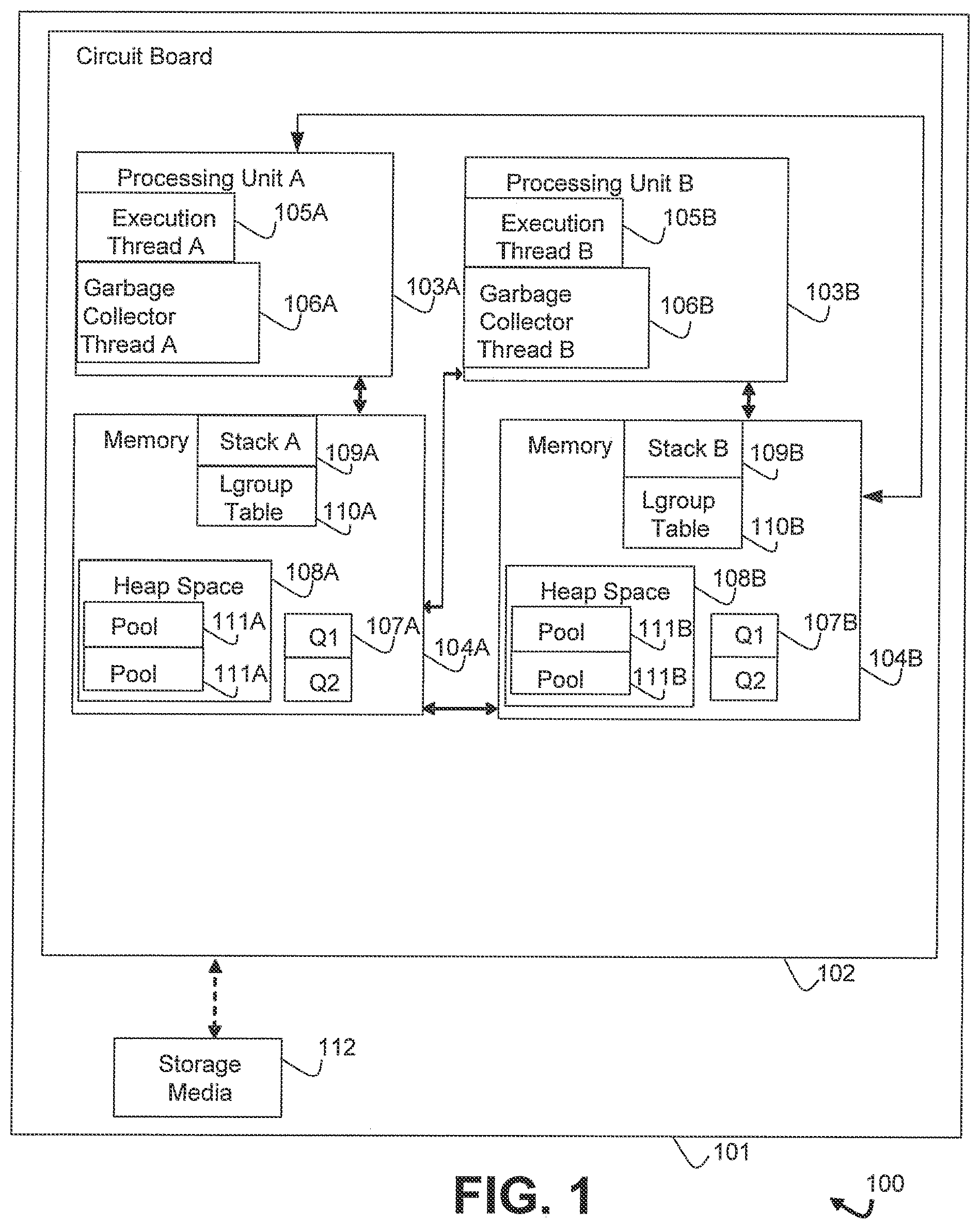
illustrates a first example of a system 100 for non-uniform memory access aware garbage collector thread processing, in accordance with an embodiment of the present disclosure. The system 100 has a computing device 101 which includes a circuit board 102 . The circuit board 102 includes two processing units 103 A and 103 B which are coupled to two memories 104 A and 104 B.
The processing units 103 A and 103 B are both operable to access memories 104 A and 104 B. However, in this first example, the processing unit 103 A is operable to access the memory 104 A faster than the memory 104 B and similarly the processing unit 103 B is operable to access the memory 104 B faster than the memory 104 A. Thus, the memory 104 A is defined as local to the processing unit 103 A and remote to the processing unit 103 B and the memory 104 B is defined as local to the processing unit 103 B and remote to the processing unit 103 A. As such, the processing unit 103 A and the memory 104 A are grouped into a first lgroup and the processing unit 103 B and the memory 104 B are grouped into a second lgroup.
The processing units 103 A and 103 B are each configured to execute instructions implementing any number of execution threads 105 A and 105 B of possible programs as well as garbage collector threads 106 A and 106 B. Each garbage collector thread may be assigned to the same lgroup as the respective processing unit that executes the garbage collector thread. As illustrated, the memories 104 A and 104 B include a heap space 108 A and 108 B for the programs related to the execution threads 105 A and 105 B. The heap spaces 108 A and 108 B are divided into a number of pools 111 A and 111 B that are assigned to the same lgroup as the respective memory that contains the pool.
The processing units 103 A and 103 B may process instructions that operate to maximize accesses to memories in the same lgroup as the respective processing unit and minimize accesses to memories in other lgroups to reduce latency and improve overall system performance and efficiency. The garbage collector threads 106 A and 106 B are each associated with a number of queues 107 A and 107 B located in the memory 104 A and 104 B respectively. As illustrated, the garbage collector threads 106 A and 106 B are associated with a local queue Q1 for objects contained in pools assigned to the same lgroup as the respective garbage collector thread and a remote queue Q2 for objects contained in pools assigned to different lgroups than the respective garbage collector thread, although in various implementations the garbage collector threads 106 A and 106 B may include a remote queue Q2 for each lgroup other than the lgroup of the respective garbage collector thread. Each garbage collector thread may process the queues in an ordered sequence to maximize accesses to the garbage collector threads lgroup and minimize accesses to other lgroups. The processing of the queues may be part of one or more garbage collection cycles, one or more marking cycles, and so on.
When a garbage collector thread queues an object, the garbage collector thread may determine the lgroup of the pool that contains the object and add the object to the local queue Q1 if the lgroup of the pool is the same as the lgroup of the garbage collector thread or the remote queue Q2 if the lgroup of the pool is different than the lgroup of the garbage collector thread. The garbage collector thread may determine the lgroup of the pool that contains the object by constructing and referencing an lgroup table. The lgroup table may be a coarse granularity table that includes an lgroup entry for each of the pools. The garbage collector thread may reference the lgroup table by computing an index from the address of the object and mapping that index to the lgroup table.
For example, each pool may be 4000 kilobytes in size and the garbage collector thread may compute an index from the address of an object by dividing the address by 4000 and discarding the remainder. In this example, an index of 0 may be computed from either an object in the first pool in the heap space with an address of 2048 or an object in the first pool with an address of 2304. Similarly, an index of 2 may be computed from either an object in the third pool in the heap space with an address of 8192 or an object in the third pool in the heap space with an address of 8448. Although the present example presents a particular formula for generating indexes from the address of an object in a pool, it is understood that numerous formula involving numerous mathematical operations could be utilized to generate indexes from the addresses of objects such that the indexes are the same for objects in the same pool and different for objects in different pools.
Further, as illustrated, each memory 104 A includes a Stack A 109 A for the execution threads executing on the processing unit A 103 A and the memory 104 B includes a Stack B 109 B for the execution threads executing on the processing unit B 103 B. When queuing objects, each garbage collector thread may first scan root stacks of threads of processing units of the same lgroup as the garbage collector thread before scanning root stacks of execution threads executing on processing units assigned to lgroups different from the garbage collector thread. As execution threads in the same lgroup as the garbage collector thread may reference more objects contained in pools of the same lgroup as the garbage collector thread than objects contained in pools of different lgroups, the garbage collector threads may thus queue more objects contained in pools of the same lgroup as the garbage collector thread than objects contained in pools of other lgroups.
In some implementations, the garbage collector threads 106 A and 106 B may be threads of a regionalized copying garbage collector that divides the heap space into at least one or more Young regions and one or more Old regions. Each pool may contain one or more of the Young regions and/or one or more of the Old regions. When an object is allocated, the object may be termed “Young” and contained within a Young region. If the Young object has not been deallocated after a period of time, such as one or more garbage collection cycles, the object may be copied to an Old region, promoting the object to the status of an “Old object.” In such implementations, in addition to ordered processing of the queues 106 A and 106 B, the garbage collector threads 106 A and 106 B may maximize local accesses and minimize remote accesses by copying Young objects and Old objects differently.
When copying a Young object, a garbage collector thread may determine the lgroup of the pool that contains the object and copy the object to a pool of the same lgroup. As most Young objects may be used primarily by the execution thread that created the objects, Young objects will thusly be kept local to the lgroup that may primarily utilize the objects. However, Old objects may not be primarily utilized by any particular execution thread and thus the garbage collector threads may spread Old objects among the lgroups by copying Old objects to pools of the same lgroup as the respective garbage collector thread. In order to implement such copying, garbage collector threads may include pointers to free space in one or more pools of each lgroup to indicate where the garbage collector thread will copy Young objects and a pointer to free space in one or more pools of the same lgroup as the respective garbage collector thread to indicate where the garbage collector thread will copy Old objects.
However, if one or more garbage collector threads of a particular lgroup copy more Old objects than garbage collector threads of other lgroups, the Old objects may not be spread across the various lgroups. As such, the garbage collector threads may monitor the copying of Old objects during one or more garbage collection cycles to determine that the Old objects are not evenly spread across lgroups. If the garbage collector threads determine that the Old objects are not evenly spread across lgroups, the garbage collector threads may copy Old objects to pools of various lgroups, such as in a round-robin fashion, rather than copying Old objects to pools of the same lgroup as the garbage collector thread.
While the system 100 has been described as including computing device 101 , a circuit board 102 , processing units 103 A and 1038 , and memories 104 A and 104 B, it will be understood that system 100 is illustrative and that one or more computing devices 101 , which may be communicably coupled; dual core, multiple core, parallel processing, and other processing unit 103 A and 103 B configurations; and/or multiple memories 104 A and 104 B and types of memory 104 A and 104 B such as random access memory, read-only memory, flash memory, cache memory, on-chip memory, off-chip memory, and etc. may be utilized without departing from the scope of the present disclosure.
By way of a first illustration, is a second example of a system 200 for non-uniform memory access aware garbage collector thread processing. The system 200 has a computing device 201 which includes communicably coupled circuit boards 202 A and 202 B. The circuit board 202 A includes a processing unit A 203 A communicably coupled to a memory 204 A and the circuit board 202 B includes a processing unit B 203 B communicably coupled to a memory 204 B. The processing units 203 A and 203 B are both operable to access memories 204 A and 204 B. However, in this second example, the processing unit 203 A is operable to access the memory 204 A faster than the memory 204 B and similarly the processing unit 203 B is operable to access the memory 204 B faster than the memory 204 A. Thus, the memory 204 A is defined as local to the processing unit 203 A and remote to the processing unit 203 B and the memory 204 B is defined as local to the processing unit 203 B and remote to the processing unit 203 A. As such, the processing unit 203 A and the memory 204 A are grouped into a first lgroup and the processing unit 203 B and the memory 204 B are grouped into a second lgroup.
By way of a second illustration, is a third example of a system 300 for non-uniform memory access aware garbage collector thread processing. The system 300 includes a first computing device 301 A communicably coupled through a network communication link to a second computing device 301 B. The first computing device 301 A includes a processing unit A 303 A communicably coupled to a memory 304 A and the second computing device 301 B includes a processing unit B 303 B communicably coupled to a memory 304 B. The processing units 303 A and 303 B are both operable to access memories 304 A and 304 B. However, in this third example, the processing unit 303 A is operable to access the memory 304 A faster than the memory 304 B and similarly the processing unit 303 B is operable to access the memory 304 B faster than the memory 304 A. Thus, the memory 304 A is defined as local to the processing unit 303 A and remote to the processing unit 303 B and the memory 304 B is defined as local to the processing unit 303 B and remote to the processing unit 303 A. As such, the processing unit 303 A and the memory 304 A are grouped into a first lgroup and the processing unit 303 B and the memory 304 B are grouped into a second lgroup.
Referring again to , the computing device 101 may also include one or more tangible machine-readable storage media 112 , communicably coupled to the processing units 103 A and 103 B and/or the memories 104 A and 104 B, which may include, but are not limited to, magnetic storage media such as a floppy diskette; optical storage media such as a CD-ROM; magneto-optical storage media; read only memory; random access memory; erasable programmable memory such as EPROM or EEPROM; flash memory; or other types of media suitable for storing electronic information. The computing device 101 may also include, not shown, one or more input and/or output devices such as displays, keyboards, mice, printers, scanners, and so forth; one or more buses such as universal serial bus, small computer system interface, and so forth; and/or one or more communication components such as modems, Ethernet adapters, wireless Ethernet adapters, and so forth. The instructions the processing units 103 A and 103 B execute to implement the execution threads 105 A and 105 B and the threads of a garbage collector 106 A and 106 B may be stored in the memories 104 A and 104 B and/or the storage media 112 .
A illustrates a method 400 for non-uniform memory access aware garbage collector thread processing, which may be performed by the system 100 , in accordance with an embodiment of the present disclosure. Although method 400 will be described below as performed by the system 100 , the method 400 may be performed by the system 200 , the system 300 , or other computer systems without departing from the scope of the present disclosure. The method 400 is a computer-implemented method, and as such is performed by a processing unit, such as the processing units 103 A and 103 B, executing one or more sets of instructions included in a computer program product stored in a machine-readable medium, such as the memories 104 A and 104 B.
An operating system of the computing device 101 assigns processing units and memories into lgroups based on access latency between each of the processing units and the memories. A processing unit may be assigned to the same lgroup as a memory if the access latency between that processing unit and that memory is less than between that processing unit and other memories.
In an operation 420 , the computing device 101 divides a heap space into a number of pools that are each contained in one of the memories. The computing device 101 assigns each of the pools to the same lgroup as the memory that contains the respective pool. Each of the pools may be the same size, such as 1024 kilobytes.
In an operation 430 , the computing device 101 provides a number of garbage collector threads executing on one or more processing units, each garbage collector thread including a number of queues. The computing device 101 assigns each garbage collector thread to the same lgroup as the processing unit that executes the respective garbage collector thread. The number of queues for each garbage collector thread includes at least a local queue for objects contained in pools of the same lgroup as the respective garbage collector thread and at least one remote queue for objects contained in pools of different lgroups from the respective garbage collector threads. In some implementations, the number of queues may include a separate remote queue for each lgroup other than the lgroup of the respective garbage collector thread.
In an operation 440 , the computing device 101 executes the garbage collector threads to process the queues in an ordered sequence to maximize accesses to the respective garbage collector thread's lgroup and minimize accesses to other lgroups.
B illustrates sub-operations that may be involved in processing the queues in the ordered sequence. In a sub-operation 440 A, a garbage collector thread may process the local queue. In a sub-operation 440 B, the garbage collector thread may process the queues of other garbage collector threads that are for objects stored in pools of the same lgroup as the garbage collector thread. In a sub-operation 440 C, the garbage collector thread may process the remote queue(s). In a sub-operation 440 D, the garbage collector thread may process the queues of other garbage collector threads that are for objects stored in pools of lgroups different than the lgroup of the garbage collector thread. By processing the queues in this ordered sequence, each garbage collector thread is biased to process objects contained in pools of the same lgroup as the respective garbage collector thread as much as possible without being idle.
A illustrates a method 500 for queuing objects for non-uniform memory access aware garbage collector thread processing, which may be performed by the system 100 , in accordance with an embodiment of the present disclosure, Although method 500 will be described below as performed by the system 100 , the method 500 may be performed by the system 200 , the system 300 , or other computer systems without departing from the scope of the present disclosure. The method 500 is a computer-implemented method, and as such is performed by a processing unit, such as the processing units 103 A and 103 B, executing one or more sets of instructions included in a computer program product stored in a machine-readable medium, such as the memories 104 A and 104 B.
In an operation 510 , a garbage collector thread determines the lgroup of the pool that contains an object. In an operation 520 , the garbage collector thread adds the object to the local queue if the lgroup of the pool is the same lgroup as that of the garbage collector thread. In an operation 530 , the garbage collector thread adds the object to the remote queue(s) if the lgroup of the pool is different than the lgroup of the garbage collector thread.
B illustrates sub-operations that may be involved in determining the lgroup of the pool that contains the object. In a sub-operation 510 A, the computing device 101 constructs an lgroup table that includes entries specifying the lgroup of each of the pools. In a sub-operation 510 B, the garbage collector thread computes an index to the lgroup table from the address of the object. In a sub-operation 510 C, garbage collector thread maps the index to an entry in the lgroup table.
A is a block diagram illustrating the structure of references in a heap space in an example implementation of the system 100 . As illustrated, the heap space includes references from a root set of references in the Stack A 109 A and references from a root set of references in the Stack B 109 B. The root sets of references may include external references from anywhere in the respective call stack, local variables and parameters in functions currently being invoked, and any global variables. As illustrated, the heap includes memory that has been allocated to objects A through Z.
The root set of references in the Stack A 109 A includes external references to objects A, B, and C. The root set of references in the Stack B 109 B includes external references to objects L and M. Object A references objects D and E. Object E references objects J and K. Object B references objects F, G, and H. Object C references object I. Object L references objects N, O, and P. Object N references objects T, U, and V. Object P references objects W and X. Object M references objects Q, R, and S. Object Q references object Y. Object S references object Z. Thus, in this example, all objects A through Z are currently reachable and no objects are currently unreachable.
B is a block diagram illustrating the heap space of A divided into a number of pools contained in the memories 104 A and 104 B. As illustrated, pools 1 , 2 , and 3 are contained in memory 104 A. As memory 104 A is assigned to lgroup 1 in this example, pools 1 , 2 , and 3 are also assigned to lgroup 1. Also as illustrated, pools 4 , 5 , and 6 are contained in memory 104 B. As memory 104 B is assigned to lgroup 2 in this example, pools 4 , 5 , and 6 are also assigned to lgroup 2. Objects A, C, D, E, L, and M are currently contained in pool 1 . Objects G, H, T, U, V, W, and X are currently contained in pool 2 . Objects B, F, J, K, Y, and Z are currently stored in pool 4 . Objects I, N, O, P, Q, R, and S are currently stored in pool 6 . No objects are currently stored in pools 3 and 5 .
C is an example lgroup table for the pools illustrated in B . As illustrated, the lgroup table includes an entry for each of the pools 1 through 6 that specifies the lgroup of the respective pool. As further illustrated, the entry for each pool includes an index. An index computed from the address of any object contained in pool 1 may be 0. Similarly, an index computed from the address of any object contained in pool 2 may be 1, an index computed from the address of any object contained in pool 3 may be 2, and so on. Thus, the index computed from the address of an object in one of the pools may be mapped to the lgroup table to determine the lgroup of the pool that contains the object.
D is a block diagram illustrating three garbage collector threads A 1 , A 2 , and B 1 executing on the example implementation of the system 100 . As illustrated, garbage collector threads A 1 and A 2 have been assigned to lgroup 1 and garbage collector thread B 1 has been assigned to lgroup 2. Also as illustrated, each garbage collector thread includes a local queue Q1 for objects contained in pools of the same lgroup as the respective garbage collector thread and a remote queue Q2 for objects contained in pools of lgroups different than the respective garbage collector thread.
E (i) through 6 E(x) illustrate an example of the three garbage collector threads of D queuing the objects of the heap space illustrated in A and 6 B according to a breadth-first algorithm and then processing the queues. The queuing of the objects is performed according to a breadth-first algorithm as all references into the heap space from the root set of references are queued before processing the queues. In this example, garbage collector thread A 1 is operable to begin scanning for references into the heap from the beginning of the root set of Stack A, garbage collector thread A 2 is operable to begin scanning for references into the heap from the middle of the root set of Stack A, and garbage collector thread B 1 is operable to begin scanning for references into the heap from the beginning of the root set of Stack B.
Thus, as illustrated in E (i), garbage collector thread A 1 queues object A, garbage collector thread A 2 queues objects B and C, and garbage collector thread B 1 queues objects L and M. Garbage collector thread A 1 queues object A in the local queue Q1 because object A is contained in pool 1 , which is assigned to the same lgroup as garbage collector thread A 1 . Garbage collector thread A 2 queues object B in the remote queue Q2 because object B is contained in pool 4 , which is assigned to a different lgroup than the garbage collector thread A 2 . Garbage collector thread A 2 queues object C in the local queue Q1 because object C is contained in pool 1 , which is assigned to the same lgroup as garbage collector thread A 2 . Garbage collector thread B 1 queues objects L and M in the remote queue Q2 because objects L and M are contained in pool 1 , which is assigned to a different lgroup than the garbage collector thread B 1 .
After queuing all references into the heap space from the root set of references, the garbage collector threads A 1 , A 2 , and B 1 perform the ordered processing of the queues. As garbage collector thread A 1 includes object A in the local queue Q1, garbage collector thread A 1 will first process object A. As garbage collector thread A 2 includes object C in the local queue Q1, garbage collector thread A 2 will first process object C. Garbage collector thread B 1 does not include any objects in the local queue Q1 and will thus process object B from the remote queue Q2 of garbage collector A 2 as that queue is for objects stored in pools assigned to the same group as garbage collector thread B 1 .
E (ii) illustrates garbage collector thread A 1 processing object A, garbage collector thread A 2 processing object C, and garbage collector thread B 1 processing object B. In processing these objects, garbage collector thread A 1 queues objects D and E which are referenced by object A, garbage collector thread A 2 queues object I which is referenced by object C, and garbage collector thread B 1 queues objects F, G, and H which are referenced by object B. As objects D and E are contained in a pool of the same lgroup as the garbage collector thread A 1 , garbage collector thread A 1 queues objects D and E in the local queue Q1. As object I is contained in a pool of the an lgroup different than the garbage collector thread A 2 , garbage collector thread A 2 queues object I in the remote queue Q2. As object F is contained in a pool of the same lgroup as garbage collector thread B 1 and objects G and H are contained in pools of another lgroup, garbage collector thread B 1 queues object F in the local queue Q1 and objects G and H in the remote queue Q2.
Next, garbage collector thread A 1 selects object D from the local queue Q1 for processing and garbage collector thread B 1 selects object F from the local queue Q2 for processing. Garbage collector thread A 2 does not include any objects in the local queue Q1 and will thus process object L from the remote queue Q2 of garbage collector B 1 as that queue is for objects stored in pools assigned to the same lgroup as garbage collector thread A 2 . E (iii) illustrates garbage collector thread A 1 processing object D, garbage collector thread A 2 processing object L, and garbage collector thread B 1 processing object F. In processing object L, garbage collector thread A 2 queues objects N, O, and P in the remote queue Q2 as these objects referenced by object L are contained in a pool of a different lgroup than garbage collector thread A 2 .
Garbage collector thread A 1 then selects object E from the local queue Q1 for processing. Garbage collector thread A 2 and garbage collector thread B 1 do not include any objects in their local queues Q1 and thus garbage collector thread A 2 will process object M from the remote queue Q2 of garbage collector thread B 1 and garbage collector thread B 1 will process object I from the remote queue Q2 of garbage collector thread A 2 . As shown in E (iv), in processing these objects garbage collector thread A 1 queues objects J and K in the remote queue Q2 and garbage collector thread A 2 queues objects Q, R, and S in the remote queue Q2.
Then, as none of the illustrated garbage collector thread include an object in their local queues Q1, garbage collector thread A 1 selects object G from the remote queue Q2 of garbage collector thread B 1 , garbage collector thread A 2 selects object H from the remote queue of garbage collector thread B 1 , and garbage collector thread B 1 selects object N from the remote queue Q2 of garbage collector thread A 2 . E (v) illustrates that in processing object N, garbage collector thread B 1 queues objects T, U, and V in the remote queue Q2.
Subsequently, as none of the illustrated garbage collector thread include an object in their local queues Q1, garbage collector thread A 1 selects object T from the remote queue Q2 of garbage collector thread B 1 , garbage collector thread A 2 selects object U from the remote queue of garbage collector thread B 1 , and garbage collector thread B 1 selects object O from the remote queue Q2 of garbage collector thread A 2 . This is illustrated in E (vi).
Next, as garbage collector thread A 1 does not include any objects in its local queue Q1, garbage collector thread A 1 selects object V from the remote queue Q2 of garbage collector thread B 1 . As garbage collector thread A 2 does not include any objects in its local queue Q1 and there are no objects in queues of other garbage collector threads that are of the same lgroup as garbage collector thread A 2 , garbage collector thread A 2 selects object P from its own remote queue Q2 for processing. As garbage collector garbage collector thread B 1 does not include any objects in its local queue Q1, garbage collector garbage collector thread B 1 selects object Q from the remote queue Q2 of garbage collector thread A 2 . E (vii) illustrates that, in processing these objects, garbage collector thread A 2 queues objects W and X in its local queue Q1 and garbage collector thread B 1 queues object Y in its local queue Q1.
Following the processing of objects V, P, and Q, garbage collector thread A 2 selects object W and garbage collector B 1 selects object Y from their respective local queues Q1 for processing. As garbage collector thread A 1 does not include any objects in its local queue Q1, garbage collector thread A 1 selects object X from the local queue Q1 of garbage collector thread A 2 . This is illustrated in E (viii). Next, garbage collector thread A 1 selects object J from its own remote queue Q2 as its own local queue Q1 is empty and there are no objects in queues of other garbage collector threads that are contained in pools of the same lgroup as garbage collector thread A 1 . Similarly, garbage collector thread A 2 selects object R from its own remote queue Q2 as its own local queue Q1 is empty and there are no objects in queues of other garbage collector threads that are contained in pools of the same lgroup as garbage collector thread A 2 . As its own local queue Q1 is empty, garbage collector thread B 1 selects object S from the remote queue Q2 of garbage collector thread A 2 . As illustrated in E (ix), in processing object S, garbage collector thread B 1 queues object Z in its local queue Q1.
Finally, garbage collector thread A 1 selects object K from its own remote queue Q2 as its own local queue Q1 is empty and there are no objects in queues of other garbage collector threads that are contained in pools of the same lgroup as garbage collector thread A 1 . Garbage collector thread B 1 selects object Z from its local queue Q1. As no objects remain in any queues, garbage collector thread A 2 is idle. This is illustrated in E (x). Thus, all objects have been processed.
F (i) through 6 F(xii) illustrate an example of the three garbage collector threads of D queuing the objects of the heap space illustrated in A and 6 B according to a depth-first algorithm and processing the queues according to the same ordering as E (i) through 6 E(x). The queuing of the objects is performed according to a depth-first algorithm as each garbage collection thread queues a reference into the heap space from the root set of references and then processes the queues before queuing the next reference into the heap space from the root set of references.
It is understood that although E (i) through 6 E(x) illustrate queuing objects of the heap space illustrated in A and 6 D according to a breadth-first algorithm and F (i) through 6 F(xii) illustrate queuing objects of the heap space illustrated in A and 6 D according to a depth-first algorithm, other queuing algorithms are possible without departing from the scope of the present disclosure. For example, in a hybrid approach that combines breadth-first and depth first, a certain number of references into the heap from the root set may be queued, such as 10. The queues may then be processed before queuing additional references into the heap from the root set.
The processing of objects of the heap space illustrated in F (i) through 6 F(xii) may be performed as part of a garbage collection cycle of a region-based copying garbage collector. G (i) illustrates an example of the heap space shown in B with the pools divided into Young regions and Old regions. While G (i) shows each pool with a single Young region and a single Old region, a pool can contain multiple Young regions and/or multiple Old regions. A pool need not have both types of regions or the same number of regions. In addition, the pools of a heap space need not have the number and/or types of regions. For example, one pool could have one or multiple Young regions, another pool could have one or multiple Old regions, and yet another pool could have one or multiple of both Young and Old regions.
Objects shown as contained in a Young region are defined as Young objects and objects shown as contained in Old regions are defined as Old objects. In this example, through the processing of objects of the heap space illustrated in F (i) through 6 F(xii) copies objects from regions in pools 1 , 2 , 4 , and 6 to regions in pools 3 and 5 before reclaiming the regions in pools 1 , 2 , 4 , and 6 .
G (ii) shows the heap space of G (i) after the processing illustrated in F (i) through 6 F(xii) where all Young objects are copied to Young regions in pools of the same lgroup as the pool that previously contained the Young object and all Old objects are copied to pools of the same lgroup as the garbage collector thread that processes the object. However, this results in far more Old objects being contained in pools in lgroup 1 than are contained in pools in lgroup 2.
G (iii) shows the heap space of G (i) after the processing illustrated in F (i) through 6 F(xii). All Young objects have been copied to Young regions in pools of the same lgroup as the pool that previously contained the Young object and Old objects have been copied to pools of the same lgroup as the garbage collector thread that processes the object. When monitoring of copying determines that the Old objects are not being evenly spread across lgroups, Old objects may be copied to pools of lgroups in a round robin fashion to balance the objects. G (iv) shows a more balanced version of G (iii) where some of the objects contained in the Old region of pool 3 have been moved to the Old region of pool 5 .
illustrates a fourth example of a system 800 for non-uniform memory access aware garbage collector thread processing, in accordance with an embodiment of the present disclosure. The system 800 has a computing device 801 which includes a circuit board 802 . The circuit board 802 includes two processing units 803 A and 803 B which are coupled to two memories 804 A and 804 B.
The processing units 803 A and 803 B are both operable to access memories 804 A and 804 B. However, in this fourth example, the processing unit 803 A is operable to access the memory 804 A faster than the memory 804 B and similarly the processing unit 803 B is operable to access the memory 804 B faster than the memory 804 A. Thus, the memory 804 A is defined as local to the processing unit 803 A and remote to the processing unit 803 B and the memory 804 B is defined as local to the processing unit 803 B and remote to the processing unit 803 A. As such, the processing unit 803 A and the memory 804 A are grouped into a first lgroup and the processing unit 803 B and the memory 804 B are grouped into a second lgroup.
The processing units 803 A and 803 B are each configured to execute instructions implementing any number of execution threads 805 A and 805 B of possible programs. As illustrated, the memories 804 A and 804 B include a heap space 808 A and 808 B for the programs related to the execution threads 805 A and 805 B. The heap space 808 A and 808 B is divided into a number of pools 809 A and 809 B that are assigned to the same lgroup as the respective memory that contains the pool. The processing units 803 A and 803 B are also each configured to execute instructions implementing any number of garbage collector threads 806 A and 806 B of a regional copying garbage collector that divides the pools 809 A and 809 B of the heap space 808 A and 808 B into a number of regions 810 A and 810 B. The regions 810 A and 810 B include at least one or more Young regions and one or more Old regions. Each garbage collector thread may be assigned to the same lgroup as the respective processing unit that executes the garbage collector thread.
The processing units 803 A and 803 B operate to maximize accesses to memories in the same lgroup as the respective processing unit and minimize accesses to memories in other lgroups to reduce latency and improve overall system performance and efficiency. When an object is allocated, the object may be termed “Young” and contained within a Young region. If the Young object has not been deallocated after a period of time, such as one or more garbage collection cycles, the object may be copied to an Old region, promoting the object to the status of an “Old object.”
The garbage collector threads 806 A and 806 B may maximize local accesses and minimize remote access by copying Young objects and Old objects differently. When copying a Young object, a garbage collector thread may determine the lgroup of the pool that contains the object and copy the object to a pool of the same lgroup. As most Young objects may be used primarily by the execution thread that created the objects, Young objects will thusly be kept local to the lgroup that may primarily utilize the objects. However, Old objects may not be primarily utilized by any particular execution thread and thus the garbage collector threads may spread Old objects among the lgroups by copying Old objects to pools of the same lgroup as the respective garbage collector thread. In order to implement such copying, garbage collector threads may include pointers to free space in one or more pools of each lgroup to indicate where the garbage collector thread will copy Young objects and a pointer to free space in one or more pools of the same lgroup as the respective garbage collector thread to indicate where the garbage collector thread will copy Old objects.
However, if one or more garbage collector threads of a particular lgroup copy more Old objects than garbage collector threads of other lgroups, the Old objects may not be spread across the various lgroups. As such, the garbage collector threads may monitor the copying of Old objects during one or more garbage collection cycles to determine that the Old objects are not evenly spread across lgroups. If the garbage collector threads determine that the Old objects are not evenly spread across lgroups, the garbage collector threads may copy Old objects to pools of various lgroups, such as in a round-robin fashion, rather than copying Old objects to pools of the same lgroup as the garbage collector thread.
is a block diagram illustrating various regions that may be used with . In general, new objects are allocated in the young region and, when they survive for a certain period of time, are promoted or moved as long-lived objects to an old region 812 . A pool may include a young region, the old region 812 , or both the young region and the old region 812 . The young region of a pool is either an allocation region 816 or a survivor region 814 . The allocation region 816 is used by execution threads 805 A, 805 B to reserve memory for most newly created objects. The survivor region 814 is used by garbage collector threads 806 A, 806 B as storage in which the garbage collector threads 806 A, 806 B save the live but short-lived objects. Typically, objects that survive their first garbage collection are moved from the allocation region 816 to the survivor region 814 .
A illustrates a method 900 for non-uniform memory access aware garbage collector thread processing, which may be performed by the system 800 , in accordance with an embodiment of the present disclosure. The method 900 is a computer-implemented method, and as such is performed by a processing unit, such as the processing units 803 A and 803 B, executing one or more sets of instructions included in a computer program product stored in a machine-readable medium, such as the memories 804 A and 804 B.
The computing device 801 assigns processing units ( 803 A, 803 B) and memories ( 804 A, 804 B) into lgroups based on access latency between each of the processing units 803 A, 803 B and the memories 804 A, 804 B. A processing unit may be assigned to the same lgroup as a memory if the access latency between that processing unit and that memory is less than between that processing unit and other memories.
In an operation 920 , the computing device 801 divides a heap space ( 808 A, 808 B) into a number of pools ( 809 A, 809 B) that are each contained in one of the memories 804 A, 804 B and divides the number of pools 809 A, 809 B into at least a number of Young Regions and Old Regions. The computing device 801 assigns each of the pools 809 A, 809 B to the same lgroup as the memory 804 A, 804 B that contains the respective pool. Each of the pools 809 A, 809 B may be the same size, such as 256 kilobytes.
In an operation 930 , the computing device 801 utilizes a garbage collector thread ( 806 A or 806 B) to copy a Young object as part of one or more garbage collections. As part of copying the Young object, the garbage collector thread determines the lgroup of the pool that previously contained the Young object and copies the Young object to a pool of the same lgroup. In an operation 940 , the computing device 801 utilizes a garbage collector thread to copy an Old object as part of the garbage collection. As part of copying the Old object, the garbage collector thread copies the Old object to a pool of the same lgroup as the garbage collector thread.
The method 900 may also include operations 950 through 970 . In an operation 950 , the computing device 801 utilizes the garbage collector thread to monitor the copying of objects during the garbage collection. The garbage collector thread may monitor the copying of Old objects and/or Young objects. In an operation 960 , the garbage collector thread determines, based on the monitoring, that objects in the heap space are not evenly spread across lgroups. This determination may be based on Old objects and/or Young objects. In an operation 970 , when the garbage collector thread copies Old objects, the garbage collector thread copies old objects to pools of the various lgroups in a round-robin fashion.
The copying of objects described in the above operations 930 , 940 may move the objects between regions. The operation 930 may copy a Young object from the allocation region 816 to the survivor region 814 . The operation 940 may copy a Young object from the survivor region 814 to the Old region, thereby re-designating the Young object as an Old object. Certain lgroup affinities, or association of objects with regions of certain lgroups, may be maintained during the operations 930 , 940 .
B illustrates sub-operations that may be involved in copying a Young object to a pool with the same lgroup by determining the lgroup of the object's containing pool. In a sub-operation 930 A, the garbage collector thread accesses a Young object from a source region of a first pool. The source region may be an allocation region or a source survivor region. The Young object may be accessed as part of a first garbage collection process or during a subsequent garbage collection process. The first pool may be associated with a particular lgroup among a number of lgroups. The particular lgroup includes a particular processing unit and a particular memory in communication with and local to the particular processing unit.
In a sub-operation 930 B, the garbage collector thread determines the particular lgroup associated with the first pool. In a sub-operation 930 C, the garbage collector thread may select the survivor region 814 associated with the second pool based on a determination that the particular lgroup is associated with the first pool. In a sub-operation 930 D, the garbage collector thread allocates space for the Young object in the survivor region 814 associated with a second pool associated with the same particular lgroup. The allocation of space may then be based on selection of the survivor region 814 . In a sub-operation 930 E, the garbage collector thread copies the Young object to allocated space in the survivor region 814 associated with the second pool. The Young object may thus be copied from the allocation region or the source survivor region to the survivor region 814 . The Young object may be copied multiple times using the foregoing sub-operations while staying within survivor regions of the same lgroup.
C illustrates sub-operations that may be involved in copying an Old object to pool with the same lgroup as the respective garbage collector thread. In a sub-operation 940 A, the garbage collector thread accesses an object from a source region of a first pool. The first pool may be associated with a particular lgroup among a number of lgroups. The source region may be an allocation region, a source survivor region, or a source old region. The garbage collection thread may be associated with a second pool associated with a different lgroup than the particular lgroup.
In some embodiments, the accessed object is primarily being manipulated by the execution thread that created the object. In other embodiments, the object is being manipulated by a different execution thread than the execution thread created the object.
In general, objects are accessed from the pool with which the garbage collector thread is associated. However, if a determination is made that there are no further objects to access in the associated pool, the Young object may then be accessed from the source region of a different pool. For example, a Young object may be accessed from an allocation region of a pool associated with a first lgroup by a garbage collection thread executing on a different processing unit and associated with a second, different lgroup.
In a sub-operation 940 B, the garbage collector thread determines that the particular lgroup is associated with the first pool. In a sub-operation 940 C, the garbage collector thread selects the Old region associated with the second pool based on a determination that the particular lgroup is associated with the first pool. In a sub-operation 940 D, the garbage collector thread allocates space for the object in an Old region associated with the second pool. The allocation of space may be based on selection of the Old region. In a sub-operation 940 E, the garbage collector thread copies the object to allocated space in the Old region associated with the second pool. The object may thus be copied from the allocation region, the source survivor region, or the source Old region to the Old region associated with the second pool.
In some embodiments, the operations performed in the B and 9 C may maximize the efficiency of the execution threads 805 A, 805 B. By more evenly distributing objects among processing units 803 A, 803 B hot spots or areas of concentrated processing on the processing unit 803 A, 803 B that would otherwise interfere with execution efficiency may be avoided.
A is a block diagram illustrating the structure of references in a heap space in an example implementation of the system 800 . As illustrated, the heap space includes references from a root set of references. The root sets of references may include external references from anywhere in the call stack, local variables and parameters in functions currently being invoked, and any global variables. As illustrated, the heap includes memory that has been allocated to objects a through z. The root set of references includes external references to objects a, b, c, l, and m. Object a references objects d and e. Object e references objects j and k. Object b references objects f, g, and h. Object c references object i. Object l references objects n, o, and p. Object n references objects t, u, and v. Object p references objects w and x. Object m references objects q, r, and s. Object q references object y. Object s references object z. Thus, in this example, all objects a through z are currently reachable and no objects are currently unreachable.
B is a block diagram illustrating the heap space of A divided into a number of pools 809 A and 809 B contained in the memories 804 A and 804 B with the pools divided into Young regions and Old regions. Objects shown as contained in a Young region are defined as Young objects and objects shown as contained in Old regions are defined as Old objects. As illustrated, pools 1 , 2 , and 3 are contained in memory 804 A. As memory 804 A is assigned to lgroup 1 in this example, pools 1 , 2 , and 3 are also assigned to lgroup 1. Also as illustrated, pools 4 , 5 , and 6 are contained in memory 804 B. As memory 804 B is assigned to lgroup 2 in this example, pools 4 , 5 , and 6 are also assigned to lgroup 2.
Young objects a, c, and d are currently contained in a Young region in pool 1 . Old objects e, l, and m are currently contained in an Old region in pool 1 . Young objects g, h, t, u, v, and w are currently contained in a Young region in pool 2 . Old object x is currently contained in an Old region in pool 2 . Young objects b, f, j, and k are currently contained in a Young region in pool 4 . Old objects y and z are currently contained in an Old region in pool 4 . Young objects l, n, o, s, and r are currently contained in a Young region in pool 6 . Old objects p and q are currently contained in an Old region in pool 6 . No objects are currently stored in pools 3 and 5 .
C is a block diagram illustrating the heap space of B after one or more garbage collection cycles that results in copying of objects from regions in pools 1 , 2 , 4 , and 6 to regions in pools 3 and 5 in accordance with operations 910 through 940 . As shown, all Young objects were copied to Young regions in pools of the same lgroup as the pool that previously contained the Young object. As further shown, Old objects z, y, x, q, p, and m were copied by one or more garbage collector threads of lgroup 1 and Old objects l and e were copied by one or more garbage collector threads of lgroup 2. Thus, Old objects z, y, x, q, p, and m were copied to an Old region in pool 3 and Old objects l and e were copied to an Old region in pool 5 . However, this results in far more Old objects being contained in pools in lgroup 1 than are contained in pools in lgroup 2.
D is a block diagram illustrating the heap space of B after one or more garbage collection cycles that results in copying of objects from regions in pools 1 , 2 , 4 , and 6 to regions in pools 3 and 5 in accordance with operations 910 through 970 . As shown, all Young objects are copied to Young regions in pools of the same lgroup as the pool that previously contained the Young object. Also as shown, Old objects were copied to pools of the same lgroup as the garbage collector thread that processed the object until monitoring of copying determined that the Old objects are not being evenly spread across lgroups. Then, Old objects were copied to pools of lgroups in a round robin fashion. Thus, the Old objects contained in pools more evenly spread across lgroup 1 and lgroup 2.
When objects are allocated or moved to various regions, there is the potential for multiple threads to seek to manipulate the same region or object space at the same time and thus cause a programming error. One option to avoid a programming error is to lock the entire region while one thread is accessing the region thereby preventing other threads from manipulating the same space. However, this option may cause a delay as certain threads wait for others threads to finish before starting their operations. Another option that avoids frequent use of locks and the aforementioned programming error includes splitting each region into local allocation buffers that are individually associated with threads. Since these portions of the regions are only manipulated by their respective threads, locks are not needed when multiple threads access the same region at the same time.
A is a block diagram illustrating thread structures in communication with the allocation region 816 in an example implementation of the system 800 . As illustrated, the allocation region 816 includes allocation sub-regions 1102 - 1114 . An unallocated sub-region 1102 not associated with a thread local allocation buffer (TLAB) is shown. In general, a TLAB is a portion of a region that is used for allocation by a single thread. The use of a TLAB enables the thread to perform faster object allocation than by use of an atomic operation on a top pointer that is shared across multiple threads. A TLAB 1 includes an allocated sub-region 1104 and an unallocated sub-region 1106 . An unallocated sub-region 1108 not associated with a TLAB is further shown, followed by an allocated sub-region 1110 and an unallocated sub-region 1112 of TLAB 2 . A further unallocated sub-region 1114 is shown. Unallocated sub-regions of the allocation region 816 may be used to space out allocated sub-regions (e.g., to avoid hotspots) or to be available for further TLABs.
Two thread structures 1116 , 1118 are shown to have pointers into the allocation region 816 . A thread structure 1 includes a top pointer 1120 to the end of the allocated sub-region 1104 of TLAB 1 and an end pointer 1122 to the end of the unallocated sub-region 1106 of TLAB 1 . A thread structure 2 includes a top pointer 1124 to the end of the allocated sub-region 1110 of TLAB 2 and an end pointer 1126 to the end of the unallocated sub-region 1112 of TLAB 2 .
B is a block diagram illustrating the thread structures and the allocation region 816 of A where a portion of a TLAB has been allocated. As illustrated, the unallocated sub-region 1106 of A has been allocated without the use of an allocation lock. As such, allocated sub-region 1104 has grown to include the unallocated sub-region 1106 of A . The top pointer 1120 has been incremented and thus is shown to now point to the end of the allocated region 1104 . Thus, the top pointer 1120 and the end pointer 1122 are now pointing to the same position. TLAB 1 is now full and as such, no further objects can presently be created in TLAB 1 .
In general, the allocation lock is used to prevent multiple threads from trying to access or otherwise manipulate the same space in the allocation region at the same time. Since each TLAB is exclusively associated with a particular thread, there is no need for an allocation lock when writing to the TLAB. The allocation lock may be used, however, when creating a new TLAB and associating the unallocated space of the TLAB with a particular thread.
C is a block diagram illustrating the thread structures and the allocation region 816 of A where a new TLAB is created. As illustrated, the un-allocated sub-region 1114 is divided into unallocated sub-regions 1128 , 1130 , and 1132 . The new unallocated sub-region 1130 becomes TLAB 3 and is associated with thread structure 1 . The top pointer 1120 points to the beginning of the unallocated sub-region 1130 and the end pointer 1122 points to the end of the unallocated sub-region 1130 . As such, additional objects can be created by the thread associated with thread structure 1 in the unallocated sub-region 1130 without the need for an allocation lock.
D is a block diagram illustrating the thread structures and the allocation region of A where a portion of the new TLAB is allocated. As illustrated, an allocated sub-region 1134 is allocated from a portion of the unallocated sub-region 1130 of the TLAB 3 . The top pointer 1120 is incremented so that the pointer points at the beginning of the unallocated sub-region 1132 .
As described above, the TLABs may be used to limit the number of allocation locks used when creating new objects in the allocation region. The threads are able to access portions of the allocation region through the thread structure and pointer system to identify a space in the allocation region for the new objects. Thus, synchronization with multiple threads through extensive use of locks may be avoided.
Similarly, promotion local allocation buffers (PLABs) may be used for objects that are copied in the Survivor region and the Old region. Each thread may have a PLAB in the Survivor region and the Old region where objects may be copied. For example, during the operations 930 , 940 , objects may be copied into PLABs associated with a garbage collector thread. By use of PLABs, the number of times a lock is used during object copying may also be limited.
The description above includes example systems, methods, techniques, instruction sequences, and/or computer program products that embody techniques of the present disclosure. However, it is understood that the described disclosure may be practiced without these specific details.
In the present disclosure, the methods disclosed may be implemented as sets of instructions or software readable by a device. Further, it is understood that the specific order or hierarchy of steps in the methods disclosed are instances of example approaches. Based upon design preferences, it is understood that the specific order or hierarchy of steps in the method can be rearranged while remaining within the disclosed subject matter. The accompanying method claims present elements of the various steps in a sample order, and are not necessarily meant to be limited to the specific order or hierarchy presented.
The described disclosure may be provided as a computer program product, or software, that may include a machine-readable medium having stored thereon instructions, which may be used to program a computer system (or other electronic devices) to perform a process according to the present disclosure. A machine-readable medium includes any mechanism for storing information in a form (e.g., software, processing application) readable by a machine (e.g., a computer). The machine-readable medium may include, but is not limited to, magnetic storage medium (e.g., floppy diskette), optical storage medium (e.g., CD-ROM); magneto-optical storage medium, read only memory (ROM); random access memory (RAM); erasable programmable memory (e.g., EPROM and EEPROM); flash memory; or other types of medium suitable for storing electronic instructions.
It is believed that the present disclosure and many of its attendant advantages will be understood by the foregoing description, and it will be apparent that various changes may be made in the form, construction and arrangement of the components without departing from the disclosed subject matter or without sacrificing all of its material advantages. The form described is merely explanatory, and it is the intention of the following claims to encompass and include such changes.
While the present disclosure has been described with reference to various embodiments, it will be understood that these embodiments are illustrative and that the scope of the disclosure is not limited to them. Many variations, modifications, additions, and improvements are possible. More generally, embodiments in accordance with the present disclosure have been described in the context of particular implementations. Functionality may be separated or combined in blocks differently in various embodiments of the disclosure or described with different terminology. These and other variations, modifications, additions, and improvements may fall within the scope of the disclosure as defined in the claims that follow.
Figures (20)
Citations
This patent cites (42)
- US6199107
- US6216127
- US6463500
- US6493730
- US6675229
- US6826583
- US6874074
- US6910213
- US7293051
- US7340494
- US7373514
- US7567973
- US7599973
- US7627573
- US7694065
- US8244775
- US8438334
- US20020038301
- US20040016862
- US20040172507
- US20040186862
- US20050044134
- US20050138012
- US20050216677
- US20050262323
- US20060230242
- US20070005795
- US20070094312
- US20070100919
- US20080104152
- US20080133615
- US20080147705
- US20090327372
- US20100017447
- US20100082886
- US20100287216
- US20100293206
- US20110153931
- US20110208792
- US20120191936
- US20120254266
- US20120254267