Digital Glasses Having Display Vision Enhancement
Abstract
An eyewear device that adjusts aspects of a displayed object as a function of a user's eyeglass prescription. A detector identifies object edges for displayed far objects. A correction chart stores brightness corrections as a function of eyeglass prescriptions. The object edges are brightened as a function of the brightness corrections to sharpen objects displayed for a user with nearsightedness and/or farsightedness.
Claims (20)
1. Eyewear, comprising: a frame; a see-through display supported by the frame and configured to display an object; an electronic component configured to control an aspect of the displayed object based on a characteristic of a user's eye; and memory storing a display correction chart including brightness corrections based on a plurality of characteristics, wherein the electronic component is configured to adjust the brightness of the object based on one of the characteristics.
9. A method of configuring eyewear having a frame, a see-through display supported by the frame and configured to display an object, an electronic component configured to control an aspect of the displayed object, and memory storing a display correction chart including brightness corrections based on a plurality of characteristics, the method comprising: receiving a characteristic of a user's eye; controlling an aspect of the displayed object based on the characteristic of the user's eye; and adjusting the brightness of the displayed object based on one of the characteristics.
17. A non-transitory computer-readable medium storing program code which, when executed, is operative to cause a computing device to perform the steps of: obtaining a characteristic of a user's eye; controlling an aspect of an object displayed by a see-through display of eyewear based on the characteristic of the user's eye; and adjusting the brightness of the object based on a brightness correction stored in a display correction chart based on the characteristic.
Show 17 dependent claims
2. The eyewear of claim 1 , wherein the aspect is a brightness of the displayed object.
3. The eyewear of claim 2 , wherein the aspect is a brightness of edges of the displayed object.
4. The eyewear of claim 1 , wherein the brightness correction is greater for one of the characteristics than for another of the characteristics.
5. The eyewear of claim 1 , wherein the electronic component is configured to adjust the aspect of the displayed object based on an application.
6. The eyewear of claim 5 , wherein the application is a Canny edge detector.
7. The eyewear of claim 1 , wherein the displayed object is a far object in an image.
8. The eyewear of claim 7 , further comprising a depth map indicative of the far object.
10. The method of claim 9 , wherein the aspect is a brightness of the displayed object.
11. The method of claim 9 , wherein the aspect is a brightness of edges of the displayed object.
12. The method of claim 9 , wherein the brightness correction is greater for one of the characteristics than for another of the characteristics.
13. The method of claim 9 , further comprising the electronic component adjusting the aspect of the displayed object based on an application.
14. The method of claim 13 , wherein the application is a Canny edge detector.
15. The method of claim 9 , wherein the displayed object is a far object in an image.
16. The method of claim 15 , further comprising using a depth map indicative of the far object.
18. The non-transitory computer readable medium as specified in claim 17 , wherein the brightness correction is greater for one of the characteristics than for another of the characteristics.
19. The non-transitory computer readable medium as specified in claim 17 , wherein the code is operative to adjust a brightness of an edge of the object.
20. The non-transitory computer readable medium as specified in claim 17 , wherein the code is operative to adjust the aspect of the displayed object based on an application.
Full Description
Show full text →
CROSS-REFERENCE TO RELATED APPLICATIONS
This application is a Continuation of U.S. application Ser. No. 17/464,338 filed on Sep. 1, 2021, which is a Continuation of U.S. application Ser. No. 16/850,102 filed on Apr. 16, 2020, now issued as U.S. Pat. No. 11,112,609, and claims priority to U.S. Provisional Application Ser. No. 62/844,184 filed on May 7, 2019, the contents of all of which are incorporated fully herein by reference.
TECHNICAL FIELD
The present subject matter relates to see-through displays for an eyewear device, e.g., smart glasses.
BACKGROUND
Portable eyewear devices, such as smartglasses, headwear, and headgear available today integrate cameras and see-through displays. Users with less than perfect vision may have issues with using these eyewear devices.
BRIEF DESCRIPTION OF THE DRAWINGS
The drawing figures depict one or more implementations, by way of example only, not by way of limitations. In the figures, like reference numerals refer to the same or similar elements.
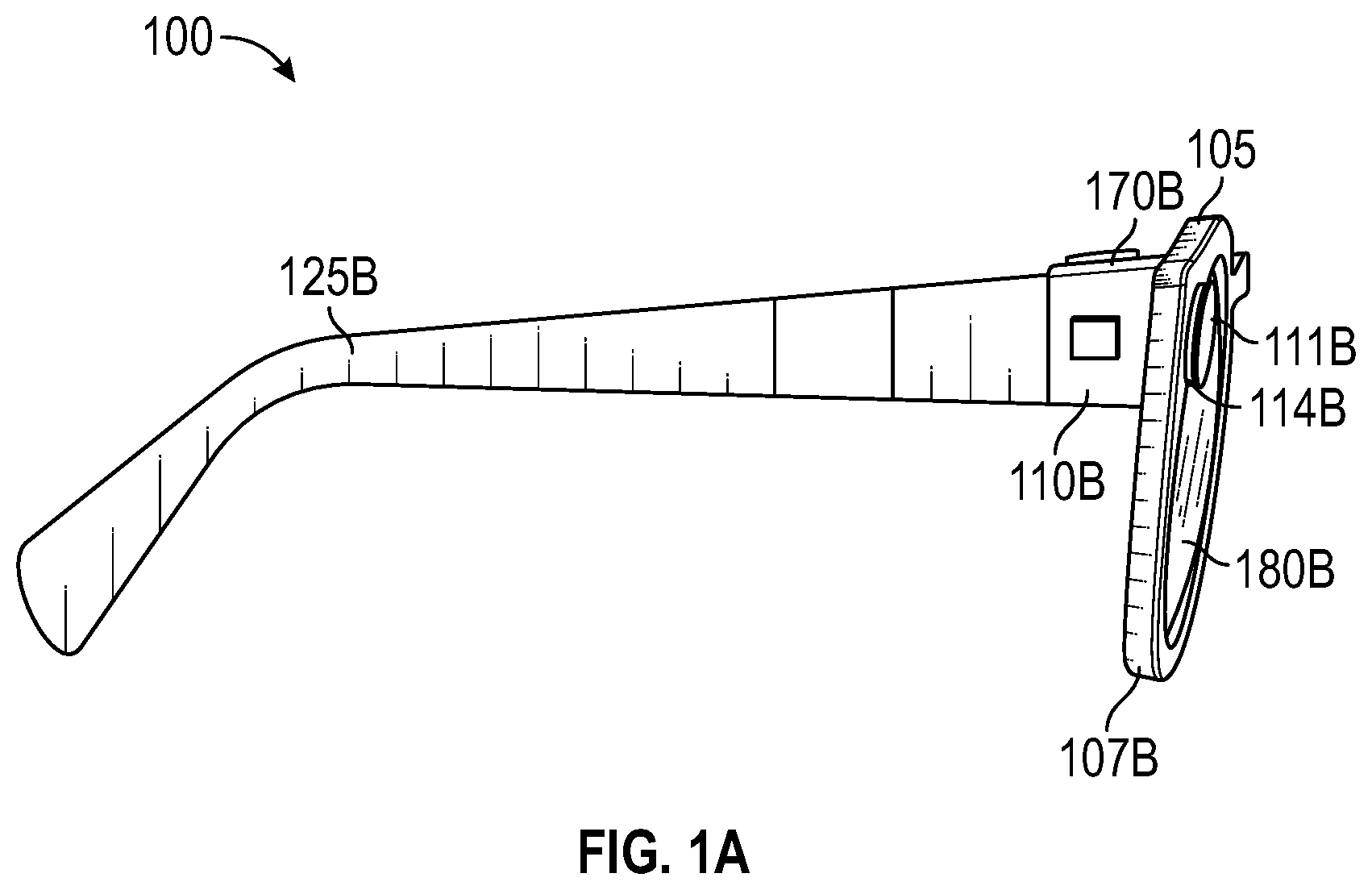
A is a side view of an example hardware configuration of an eyewear device, which shows a right optical assembly with an image display, and field of view adjustments are applied to a user interface presented on the image display based on detected head or eye movement by a user;
B is a top cross-sectional view of a chunk of the eyewear device of A depicting a visible light camera, a head movement tracker for tracking the head movement of the user of the eyewear device, and a circuit board;
A is a rear view of an example hardware configuration of an eyewear device, which includes an eye scanner on a frame, for use in a system for identifying a user of the eyewear device;
B is a rear view of an example hardware configuration of another eyewear device, which includes an eye scanner on a chunk, for use in a system for identifying a user of the eyewear device;
C and 2 D are rear views of example hardware configurations of the eyewear device, including two different types of image displays.
shows a rear perspective view of the eyewear device of A depicting an infrared emitter, an infrared camera, a frame front, a frame back, and a circuit board;
is a cross-sectional view taken through the infrared emitter and the frame of the eyewear device of ;
illustrates detecting eye gaze direction;
illustrates detecting eye position;
A depicts an example of visible light captured by the left visible light camera as a left raw image and visible light captured by the right visible light camera as a right raw image;
B illustrates creating a depth map;
A illustrates a clear image generated by a camera;
B illustrates a blurred image as viewed by a user with nearsightedness or farsightedness;
C illustrates the output of a Canny edge detector showing increased brightness of far objects;
D illustrates a displayed image having brighter object edges based on the output of the Canny edge detector;
illustrates a correction chart for increasing the brightness of edges for far objects as a function of a user's eye prescription;
illustrates color correction for displayed images;
shows a block diagram of electronic components of the eyewear device; and
is a flowchart of the operation of the eyewear device.
DETAILED DESCRIPTION
Users with nearsightedness, farsightedness and color blindness may have trouble using eyewear devices, including those with see-through displays. This disclosure includes examples of eyewear with camera-based compensation that improves the user experience of eyewear devices for user's having nearsightedness, farsightedness and color blindness. To compensate for nearsightedness and farsightedness, the camera-based compensation determines edges of objects using a software application, and then enhances a displayed image by increasing the brightness of object edges.
For example, the greater the eye correction of a prescription, the greater the enhancement of brightness of displayed object edges. If the prescription of a user's eye is +1 or −1, the brightness of the determined object edges is increased a predetermined amount of x. If the prescription of a user's eye is +2 or −2, the brightness of the object edges is increased a predetermined amount of 2x. Each see-through display of the eyewear is individually corrected based on the prescription of the respective eye. For example, the left eye of a user may have a prescription of +1 and the brightness of the object edges in the left display of the eyewear is increased x, and the right eye may have a prescription of −2 and thus the brightness of the object edges in the right display of the eyewear is increased 2x.
For color blindness, each eyewear display can be color adjusted as a function of a user's color blindness, such as enhancing the display of blue and green colors.
Execution of the programming by the processor configures the eyewear to perform these camera-based enhancements. The execution of the programming by the processor configures enables a user to enter the prescription for each of the user's eyes, such that each display of the eyewear is enhanced based on the respective prescription for each eye.
Additional objects, advantages and novel features of the examples will be set forth in part in the description which follows, and in part will become apparent to those skilled in the art upon examination of the following and the accompanying drawings or may be learned by production or operation of the examples. The objects and advantages of the present subject matter may be realized and attained by means of the methodologies, instrumentalities and combinations particularly pointed out in the appended claims.
In the following detailed description, numerous specific details are set forth by way of examples in order to provide a thorough understanding of the relevant teachings. However, it should be apparent to those skilled in the art that the present teachings may be practiced without such details. In other instances, well known methods, procedures, components, and circuitry have been described at a relatively high-level, without detail, in order to avoid unnecessarily obscuring aspects of the present teachings.
The term “coupled” as used herein refers to any logical, optical, physical or electrical connection, link or the like by which signals or light produced or supplied by one system element are imparted to another coupled element. Unless described otherwise, coupled elements or devices are not necessarily directly connected to one another and may be separated by intermediate components, elements or communication media that may modify, manipulate or carry the light or signals.
The orientations of the eyewear device, associated components and any complete devices incorporating an eye scanner and camera such as shown in any of the drawings, are given by way of example only, for illustration and discussion purposes. In operation for a particular variable optical processing application, the eyewear device may be oriented in any other direction suitable to the particular application of the eyewear device, for example up, down, sideways, or any other orientation. Also, to the extent used herein, any directional term, such as front, rear, inward, outward, towards, left, right, lateral, longitudinal, up, down, upper, lower, top, bottom and side, are used by way of example only, and are not limiting as to direction or orientation of any optic or component of an optic constructed as otherwise described herein.
Reference now is made in detail to the examples illustrated in the accompanying drawings and discussed below.
A is a side view of an example hardware configuration of an eyewear device 100 , which includes a right optical assembly 180 B with an image display that increases the brightness of object edges as a function of a user's eye correction in a prescription. Eyewear device 100 includes multiple visible light cameras 114 A-B that form a stereo camera, of which the right visible light camera 114 B is located on a right chunk 110 B.
In the example of A , the left and right visible light cameras 114 A-B are sensitive to the visible light range wavelength. Each of the visible light cameras 114 A-B have a different frontward facing angle of coverage, for example, visible light camera 114 B has the depicted angle of coverage 111 B. The angle of coverage is an angle range which the image sensor of the visible light camera 114 A-B picks up electromagnetic radiation and generate images. Examples of such visible lights camera 114 A-B include a high-resolution complementary metal-oxide-semiconductor (CMOS) image sensor and a video graphic array (VGA) camera, such as 640p (e.g., 640×480 pixels for a total of 0.3 megapixels), 720p, or 1080p. Image sensor data from the visible light cameras 114 A-B are captured along with geolocation data, digitized by an image processor, and stored in a memory.
To provide stereoscopic vision, visible light cameras 114 A-B may be coupled to an image processor (element 912 of ) for digital processing along with a timestamp in which the image of the scene is captured. Image processor 912 includes circuitry to receive signals from the visible light camera 114 A-B and process those signals from the visible light camera 114 into a format suitable for storage in the memory. The timestamp can be added by the image processor or other processor, which controls operation of the visible light cameras 114 A-B. Visible light cameras 114 A-B allow the stereo camera to simulate human binocular vision. Stereo camera provides the ability to reproduce three-dimensional images based on two captured images from the visible light cameras 114 A-B having the same timestamp. Such three-dimensional images allow for an immersive life-like experience, e.g., for virtual reality or video gaming. For stereoscopic vision, a pair of images is generated at a given moment in time—one image for each of the left and right visible light cameras 114 A-B. When the pair of generated images from the frontward facing angles of coverage 111 A-B of the left and right visible light cameras 114 A-B are stitched together (e.g., by the image processor), depth perception is provided by the optical assembly 180 A-B.
In an example, a user interface field of view adjustment system includes the eyewear device 100 . The eyewear device 100 includes a frame 105 , a right temple 110 B extending from a right lateral side 170 B of the frame 105 , and a see-through image display 180 D ( A-B ) comprising optical assembly 180 B to present a graphical user interface to a user. The eyewear device 100 includes a left visible light camera 114 A connected to the frame 105 or the left temple 110 A to capture a first image of the scene. Eyewear device 100 further includes a right visible light camera 114 B connected to the frame 105 or the right temple 110 B to capture (e.g., simultaneously with the left visible light camera 114 A) a second image of the scene which partially overlaps the first image. Although not shown in A-B , the user interface field of view adjustment system further includes a processor (element 932 of ) coupled to the eyewear device 100 and connected to the visible light cameras 114 A-B, a memory (element 934 of ) accessible to the processor 932 , and programming in the memory (element 934 of ), for example in the eyewear device 100 itself or another part of the user interface field of view adjustment system.
Although not shown in A , the eyewear device 100 also includes a head movement tracker (element 109 of B ) or an eye movement tracker (element 113 , 213 of A-B ). Eyewear device 100 further includes the see-through image displays 180 C-D of optical assembly 180 A-B for presenting a sequence of displayed images, and an image display driver (element 942 of ) coupled to the see-through image displays 180 C-D of optical assembly 180 A-B to control the image displays 180 C-D of optical assembly 180 A-B to present the sequence of displayed images, which are described in further detail below. Eyewear device 100 further includes the memory (element 934 of ) and the processor (element 932 of ) having access to the image display driver (element 942 of ) and the memory (element 934 of ). Eyewear device 100 further includes programming (element 934 of ) in the memory. Execution of the programming by the processor (element 932 of ) configures the eyewear device 100 to perform functions, including functions to present, via the see-through image displays 180 C-D, an initial displayed image of the sequence of displayed images, the initial displayed image having an initial field of view corresponding to an initial head direction or an initial eye gaze direction ( ).
Execution of the programming by the processor (element 932 of ) further configures the eyewear device 100 to detect movement of a user of the eyewear device by: (i) tracking, via the head movement tracker (element 109 of B ), a head movement of a head of the user, or (ii) tracking, via the eye movement tracker (element 113 , 213 of A-B , ), an eye movement of an eye of the user of the eyewear device 100 . Execution of the programming by the processor (element 932 of ) further configures the eyewear device 100 to determine a field of view adjustment to the initial field of view of the initial displayed image based on the detected movement of the user. The field of view adjustment includes a successive field of view corresponding to a successive head direction or a successive eye direction. Execution of the programming by the processor (element 932 of ) further configures the eyewear device 100 to generate a successive displayed image of the sequence of displayed images based on the field of view adjustment. Execution of the programming by the processor (element 932 of ) further configures the eyewear device 100 to present, via the see-through image displays 180 C-D of the optical assembly 180 A-B, the successive displayed image.
B is a top cross-sectional view of the chunk of the eyewear device 100 of A depicting the right visible light camera 114 B, a head movement tracker 109 , and a circuit board. Construction and placement of the left visible light camera 114 A is substantially similar to the right visible light camera 114 B, except the connections and coupling are on the left lateral side 170 A. As shown, the eyewear device 100 includes the right visible light camera 114 B and a circuit board, which may be a flexible printed circuit board (PCB) 140 . The right hinge 126 B connects the right chunk 110 B to a right temple 125 B of the eyewear device 100 . In some examples, components of the right visible light camera 114 B, the flexible PCB 140 , or other electrical connectors or contacts may be located on the right temple 125 B or the right hinge 126 B.
As shown, eyewear device 100 has a head movement tracker 109 , which includes, for example, an inertial measurement unit (IMU). An inertial measurement unit is an electronic device that measures and reports a body's specific force, angular rate, and sometimes the magnetic field surrounding the body, using a combination of accelerometers and gyroscopes, sometimes also magnetometers. The inertial measurement unit works by detecting linear acceleration using one or more accelerometers and rotational rate using one or more gyroscopes. Typical configurations of inertial measurement units contain one accelerometer, gyro, and magnetometer per axis for each of the three axes: horizontal axis for left-right movement (X), vertical axis (Y) for top-bottom movement, and depth or distance axis for up-down movement (Z). The accelerometer detects the gravity vector. The magnetometer defines the rotation in the magnetic field (e.g., facing south, north, etc.) like a compass which generates a heading reference. The three accelerometers to detect acceleration along the horizontal, vertical, and depth axis defined above, which can be defined relative to the ground, the eyewear device 100 , or the user wearing the eyewear device 100 .
Eyewear device 100 detects movement of the user of the eyewear device 100 by tracking, via the head movement tracker 109 , the head movement of the head of the user. The head movement includes a variation of head direction on a horizontal axis, a vertical axis, or a combination thereof from the initial head direction during presentation of the initial displayed image on the image display. In one example, tracking, via the head movement tracker 109 , the head movement of the head of the user includes measuring, via the inertial measurement unit 109 , the initial head direction on the horizontal axis (e.g., X axis), the vertical axis (e.g., Y axis), or the combination thereof (e.g., transverse or diagonal movement). Tracking, via the head movement tracker 109 , the head movement of the head of the user further includes measuring, via the inertial measurement unit 109 , a successive head direction on the horizontal axis, the vertical axis, or the combination thereof during presentation of the initial displayed image.
Tracking, via the head movement tracker 109 , the head movement of the head of the user further includes determining the variation of head direction based on both the initial head direction and the successive head direction. Detecting movement of the user of the eyewear device 100 further includes in response to tracking, via the head movement tracker 109 , the head movement of the head of the user, determining that the variation of head direction exceeds a deviation angle threshold on the horizontal axis, the vertical axis, or the combination thereof. The deviation angle threshold is between about 3° to 10°. As used herein, the term “about” when referring to an angle means ±10% from the stated amount.
Variation along the horizontal axis slides three-dimensional objects, such as characters, Bitmojis, application icons, etc. in and out of the field of view by, for example, hiding, unhiding, or otherwise adjusting visibility of the three-dimensional object. Variation along the vertical axis, for example, when the user looks upwards, in one example, displays weather information, time of day, date, calendar appointments, etc. In another example, when the user looks downwards on the vertical axis, the eyewear device 100 may power down.
The right chunk 110 B includes chunk body 211 and a chunk cap, with the chunk cap omitted in the cross-section of B . Disposed inside the right chunk 110 B are various interconnected circuit boards, such as PCBs or flexible PCBs, that include controller circuits for right visible light camera 114 B, microphone(s), low-power wireless circuitry (e.g., for wireless short-range network communication via Bluetooth™), high-speed wireless circuitry (e.g., for wireless local area network communication via WiFi).
The right visible light camera 114 B is coupled to or disposed on the flexible PCB 140 and covered by a visible light camera cover lens, which is aimed through opening(s) formed in the right chunk 110 B. In some examples, the frame 105 connected to the right chunk 110 B includes the opening(s) for the visible light camera cover lens. The frame 105 includes a front-facing side configured to face outward away from the eye of the user. The opening for the visible light camera cover lens is formed on and through the front-facing side. In the example, the right visible light camera 114 B has an outward facing angle of coverage 111 B with a line of sight or perspective of the right eye of the user of the eyewear device 100 . The visible light camera cover lens can also be adhered to an outward facing surface of the right chunk 110 B in which an opening is formed with an outward facing angle of coverage, but in a different outward direction. The coupling can also be indirect via intervening components.
Left (first) visible light camera 114 A is connected to the left see-through image display 180 C of left optical assembly 180 A to generate a first background scene of a first successive displayed image. The right (second) visible light camera 114 B is connected to the right see-through image display 180 D of right optical assembly 180 B to generate a second background scene of a second successive displayed image. The first background scene and the second background scene partially overlap to present a three-dimensional observable area of the successive displayed image.
Flexible PCB 140 is disposed inside the right chunk 110 B and is coupled to one or more other components housed in the right chunk 110 B. Although shown as being formed on the circuit boards of the right chunk 110 B, the right visible light camera 114 B can be formed on the circuit boards of the left chunk 110 A, the temples 125 A-B, or frame 105 .
A is a rear view of an example hardware configuration of an eyewear device 100 , which includes an eye scanner 113 on a frame 105 , for use in a system for determining an eye position and gaze direction of a wearer/user of the eyewear device 100 . As shown in A , the eyewear device 100 is in a form configured for wearing by a user, which are eyeglasses in the example of A . The eyewear device 100 can take other forms and may incorporate other types of frameworks, for example, a headgear, a headset, or a helmet.
In the eyeglasses example, eyewear device 100 includes the frame 105 which includes the left rim 107 A connected to the right rim 107 B via the bridge 106 adapted for a nose of the user. The left and right rims 107 A-B include respective apertures 175 A-B which hold the respective optical element 180 A-B, such as a lens and the see-through displays 180 C-D. As used herein, the term lens is meant to cover transparent or translucent pieces of glass or plastic having curved and flat surfaces that cause light to converge/diverge or that cause little or no convergence/divergence.
Although shown as having two optical elements 180 A-B, the eyewear device 100 can include other arrangements, such as a single optical element depending on the application or intended user of the eyewear device 100 . As further shown, eyewear device 100 includes the left chunk 110 A adjacent the left lateral side 170 A of the frame 105 and the right chunk 110 B adjacent the right lateral side 170 B of the frame 105 . The chunks 110 A-B may be integrated into the frame 105 on the respective sides 170 A-B (as illustrated) or implemented as separate components attached to the frame 105 on the respective sides 170 A-B. Alternatively, the chunks 110 A-B may be integrated into temples (not shown) attached to the frame 105 .
In the example of A , the eye scanner 113 includes an infrared emitter 115 and an infrared camera 120 . Visible light cameras typically include a blue light filter to block infrared light detection, in an example, the infrared camera 120 is a visible light camera, such as a low-resolution video graphic array (VGA) camera (e.g., 640×480 pixels for a total of 0.3 megapixels), with the blue filter removed. The infrared emitter 115 and the infrared camera 120 are co-located on the frame 105 , for example, both are shown as connected to the upper portion of the left rim 107 A. The frame 105 or one or more of the left and right chunks 110 A-B include a circuit board (not shown) that includes the infrared emitter 115 and the infrared camera 120 . The infrared emitter 115 and the infrared camera 120 can be connected to the circuit board by soldering, for example.
Other arrangements of the infrared emitter 115 and infrared camera 120 can be implemented, including arrangements in which the infrared emitter 115 and infrared camera 120 are both on the right rim 107 B, or in different locations on the frame 105 , for example, the infrared emitter 115 is on the left rim 107 A and the infrared camera 120 is on the right rim 107 B. In another example, the infrared emitter 115 is on the frame 105 and the infrared camera 120 is on one of the chunks 110 A-B, or vice versa. The infrared emitter 115 can be connected essentially anywhere on the frame 105 , left chunk 110 A, or right chunk 110 B to emit a pattern of infrared light. Similarly, the infrared camera 120 can be connected essentially anywhere on the frame 105 , left chunk 110 A, or right chunk 110 B to capture at least one reflection variation in the emitted pattern of infrared light.
The infrared emitter 115 and infrared camera 120 are arranged to face inward towards an eye of the user with a partial or full field of view of the eye in order to identify the respective eye position and gaze direction. For example, the infrared emitter 115 and infrared camera 120 are positioned directly in front of the eye, in the upper part of the frame 105 or in the chunks 110 A-B at either ends of the frame 105 .
B is a rear view of an example hardware configuration of another eyewear device 200 . In this example configuration, the eyewear device 200 is depicted as including an eye scanner 213 on a right chunk 210 B. As shown, an infrared emitter 215 and an infrared camera 220 are co-located on the right chunk 210 B. It should be understood that the eye scanner 213 or one or more components of the eye scanner 213 can be located on the left chunk 210 A and other locations of the eyewear device 200 , for example, the frame 105 . The infrared emitter 215 and infrared camera 220 are like that of A , but the eye scanner 213 can be varied to be sensitive to different light wavelengths as described previously in A .
Similar to A , the eyewear device 200 includes a frame 105 which includes a left rim 107 A which is connected to a right rim 107 B via a bridge 106 ; and the left and right rims 107 A-B include respective apertures which hold the respective optical elements 180 A-B comprising the see-through display 180 C-D.
C-D are rear views of example hardware configurations of the eyewear device 100 , including two different types of see-through image displays 180 C-D. In one example, these see-through image displays 180 C-D of optical assembly 180 A-B include an integrated image display. As shown in C , the optical assemblies 180 A-B includes a suitable display matrix 180 C-D of any suitable type, such as a liquid crystal display (LCD), an organic light-emitting diode (OLED) display, a waveguide display, or any other such display. The optical assembly 180 A-B also includes an optical layer or layers 176 , which can include lenses, optical coatings, prisms, mirrors, waveguides, optical strips, and other optical components in any combination. The optical layers 176 A-N can include a prism having a suitable size and configuration and including a first surface for receiving light from display matrix and a second surface for emitting light to the eye of the user. The prism of the optical layers 176 A-N extends over all or at least a portion of the respective apertures 175 A-B formed in the left and right rims 107 A-B to permit the user to see the second surface of the prism when the eye of the user is viewing through the corresponding left and right rims 107 A-B. The first surface of the prism of the optical layers 176 A-N faces upwardly from the frame 105 and the display matrix overlies the prism so that photons and light emitted by the display matrix impinge the first surface. The prism is sized and shaped so that the light is refracted within the prism and is directed towards the eye of the user by the second surface of the prism of the optical layers 176 A-N. In this regard, the second surface of the prism of the optical layers 176 A-N can be convex to direct the light towards the center of the eye. The prism can optionally be sized and shaped to magnify the image projected by the see-through image displays 180 C-D, and the light travels through the prism so that the image viewed from the second surface is larger in one or more dimensions than the image emitted from the see-through image displays 180 C-D.
In another example, the see-through image displays 180 C-D of optical assembly 180 A-B include a projection image display as shown in D . The optical assembly 180 A-B includes a laser projector 150 , which is a three-color laser projector using a scanning mirror or galvanometer. During operation, an optical source such as a laser projector 150 is disposed in or on one of the temples 125 A-B of the eyewear device 100 . Optical assembly 180 A-B includes one or more optical strips 155 A-N spaced apart across the width of the lens of the optical assembly 180 A-B or across a depth of the lens between the front surface and the rear surface of the lens.
As the photons projected by the laser projector 150 travel across the lens of the optical assembly 180 A-B, the photons encounter the optical strips 155 A-N. When a particular photon encounters a particular optical strip, the photon is either redirected towards the user's eye, or it passes to the next optical strip. A combination of modulation of laser projector 150 , and modulation of optical strips, may control specific photons or beams of light. In an example, a processor controls optical strips 155 A-N by initiating mechanical, acoustic, or electromagnetic signals. Although shown as having two optical assemblies 180 A-B, the eyewear device 100 can include other arrangements, such as a single or three optical assemblies, or the optical assembly 180 A-B may have arranged different arrangement depending on the application or intended user of the eyewear device 100 .
As further shown in C-D , eyewear device 100 includes a left chunk 110 A adjacent the left lateral side 170 A of the frame 105 and a right chunk 110 B adjacent the right lateral side 170 B of the frame 105 . The chunks 110 A-B may be integrated into the frame 105 on the respective lateral sides 170 A-B (as illustrated) or implemented as separate components attached to the frame 105 on the respective sides 170 A-B. Alternatively, the chunks 110 A-B may be integrated into temples 125 A-B attached to the frame 105 .
In one example, the see-through image displays include the first see-through image display 180 C and the second see-through image display 180 D. Eyewear device 100 includes first and second apertures 175 A-B which hold the respective first and second optical assembly 180 A-B. The first optical assembly 180 A includes the first see-through image display 180 C (e.g., a display matrix of C or optical strips 155 A-N′ and a projector 150 A). The second optical assembly 180 B includes the second see-through image display 180 D e.g., a display matrix of C or optical strips 155 A-N″ and a projector 150 B). The successive field of view of the successive displayed image includes an angle of view between about 15° to 30, and more specifically 24°, measured horizontally, vertically, or diagonally. The successive displayed image having the successive field of view represents a combined three-dimensional observable area visible through stitching together of two displayed images presented on the first and second image displays.
As used herein, “an angle of view” describes the angular extent of the field of view associated with the displayed images presented on each of the left and right image displays 180 C-D of optical assembly 180 A-B. The “angle of coverage” describes the angle range that a lens of visible light cameras 114 A-B or infrared camera 220 can image. Typically, the image circle produced by a lens is large enough to cover the film or sensor completely, possibly including some vignetting (i.e., a reduction of an image's brightness or saturation toward the periphery compared to the image center). If the angle of coverage of the lens does not fill the sensor, the image circle will be visible, typically with strong vignetting toward the edge, and the effective angle of view will be limited to the angle of coverage. The “field of view” is intended to describe the field of observable area which the user of the eyewear device 100 can see through his or her eyes via the displayed images presented on the left and right image displays 180 C-D of the optical assembly 180 A-B. Image display 180 C of optical assembly 180 A-B can have a field of view with an angle of coverage between 15° to 30°, for example 24°, and have a resolution of 480×480 pixels.
shows a rear perspective view of the eyewear device of A . The eyewear device 100 includes an infrared emitter 215 , infrared camera 220 , a frame front 330 , a frame back 335 , and a circuit board 340 . It can be seen in that the upper portion of the left rim of the frame of the eyewear device 100 includes the frame front 330 and the frame back 335 . An opening for the infrared emitter 215 is formed on the frame back 335 .
As shown in the encircled cross-section 4 in the upper middle portion of the left rim of the frame, a circuit board, which is a flexible PCB 340 , is sandwiched between the frame front 330 and the frame back 335 . Also shown in further detail is the attachment of the left chunk 110 A to the left temple 325 A via the left hinge 126 A. In some examples, components of the eye movement tracker 213 , including the infrared emitter 215 , the flexible PCB 340 , or other electrical connectors or contacts may be located on the left temple 325 A or the left hinge 126 A.
is a cross-sectional view through the infrared emitter 215 and the frame corresponding to the encircled cross-section 4 of the eyewear device of . Multiple layers of the eyewear device 100 are illustrated in the cross-section of , as shown the frame includes the frame front 330 and the frame back 335 . The flexible PCB 340 is disposed on the frame front 330 and connected to the frame back 335 . The infrared emitter 215 is disposed on the flexible PCB 340 and covered by an infrared emitter cover lens 445 . For example, the infrared emitter 215 is reflowed to the back of the flexible PCB 340 . Reflowing attaches the infrared emitter 215 to contact pad(s) formed on the back of the flexible PCB 340 by subjecting the flexible PCB 340 to controlled heat which melts a solder paste to connect the two components. In one example, reflowing is used to surface mount the infrared emitter 215 on the flexible PCB 340 and electrically connect the two components. However, it should be understood that through-holes can be used to connect leads from the infrared emitter 215 to the flexible PCB 340 via interconnects, for example.
The frame back 335 includes an infrared emitter opening 450 for the infrared emitter cover lens 445 . The infrared emitter opening 450 is formed on a rear-facing side of the frame back 335 that is configured to face inward towards the eye of the user. In the example, the flexible PCB 340 can be connected to the frame front 330 via the flexible PCB adhesive 460 . The infrared emitter cover lens 445 can be connected to the frame back 335 via infrared emitter cover lens adhesive 455 . The coupling can also be indirect via intervening components.
In an example, the processor (element 932 of ) utilizes eye tracker 213 to determine an eye gaze direction 230 of a wearer as shown in , and an eye position 236 of the wearer within an eyebox as shown in . The eye tracker 213 is a scanner which uses infrared light illumination (e.g., near-infrared, short-wavelength infrared, mid-wavelength infrared, long-wavelength infrared, or far infrared) to captured image of reflection variations of infrared light from the eye to determine the gaze direction 230 of a pupil 232 of an eye 234 , and also the eye position 236 with respect to the see-through display 180 D.
A depicts an example of capturing visible light with cameras. Visible light is captured by the left visible light camera 114 A with a left visible light camera field of view 111 A as a left raw image 758 A. Visible light is captured by the right visible light camera 114 B with a right visible light camera field of view 111 B as a right raw image 758 B that overlaps 713 with the left visible light camera field of view 111 A. Based on processing of the left raw image 758 A and the right raw image 758 B, a three-dimensional depth map 715 of a three-dimensional scene is generated by processor 932 ( ).
B depicts the depth map 715 created by comparing the images 758 A-B from the left and right cameras 114 A-B, respectively. By overlapping and comparing the images 758 A-B, far objects will look to be in the same general location of the combined image as shown at 760 , and closer objects will be in different positions as shown at 762 . The far objects are used by the processor (element 932 , ) to enhance the displayed images to the user.
Referring to A- 8 D , users of eyewear 100 having nearsightedness, farsightedness and/or color blindness may have trouble using eyewear devices, including those with see-through displays. The eyewear 100 has camera-based compensation that improves the user experience of eyewear devices for user's having nearsightedness, farsightedness and color blindness. To compensate for nearsightedness and farsightedness, the camera-based compensation determines edges of far objects using a software application, and then enhances displayed images by increasing the brightness of far object edges, such as using a Canny edge detector, to create sharper images.
In addition, if someone is color blind, the sensitive colors can be rendered by the displays 180 C and 180 D as different colors as desired by the user.
In an example, the greater the eye correction of a user's eyeglass prescription, the greater the enhancement of brightness of displayed object edges. If, for example, the prescription of a user's eye is +1 or −1, the brightness of the determined object edges is increased by a processor (element 932 , ) a predetermined amount of x. If, for example, the prescription of a user's eye is +2 or −2, the brightness of the object edges is increased more by a predetermined amount, such as 2x. Each see-through display 180 A and 180 B of the eyewear 100 is individually corrected based on the eyeglass prescription of the respective eye. For example, the left eye of a user may have a prescription of +1 and the brightness of the object edges in the left display 180 A of the eyewear 100 is increased x, and the right eye may have a prescription of −2 and thus the brightness of the object edges in the right display of the eyewear is increased more, such as 2x.
As shown in A , left and right cameras 114 A-B create a clear image as displayed by displays 180 A and 180 B, respectively. As shown in B , a user of the displayed image that is nearsighted or farsighted may perceive an out of focus image. As shown in C , an image edge detection application is used to ascertain edges of the far objects in the image. C is a color inverted image for readability. One example of an edge detection application is a Canny edge detector (element 950 , ) which are commercially available. The Canny edge detector 950 is an edge detection operator that uses a multi-stage algorithm to detect a wide range of edges in images. Canny edge detection is a technique to extract useful structural information from different vision objects and dramatically reduce the amount of data to be processed. It has been widely applied in various computer vision systems. As shown in D , the output of the Canny edge detector 950 is combined by a processor 932 ( ) with the displayed image shown in A to obtain a clearer image where far object images are displayed brighter. The brighter object edges make the image objects easier to observe by a user that is nearsighted of farsighted.
As shown in , the relative brightness increase of the detected object edges in each display 180 A-B is a function of a user's eyeglass prescription for the respective eye, which prescription is entered by the user into memory 934 of the eyewear 100 and 200 ( ). shows a correction chart 945 stored in memory 934 , which is a color inverted image for readability, illustrating additive object edge brightness where a user's prescription is −1, and where a user's prescription is −2. The brightness of the additive correction is greater for the stronger eye prescription of −2, which as shown, is double the brightness of the additive correction for the weaker eye prescription of −1. This correction chart 945 is simplified, and other additive correction for numerous other prescriptions can be included. For instance, additive correction for prescriptions of +1, +1.5, +2 etc. can be included in correction chart 945 . In an example, the additive corrections can be the same for −1 and +1.
illustrates color blindness correction for eyewear user's that have color blindness. Using a preset colorblindness setting, the cameras 114 A-B detect colors and reassign the colors digitally. The algorithm could be, for example, a lookup table with preset settings. For example, green 255→blue 255. The display 180 A-B overlays the corrected color in the correct position and will be apparent with sufficient brightness.
depicts a high-level functional block diagram including example electronic components disposed in eyewear 100 and 200 . The illustrated electronic components include the processor 932 , which includes the Canny edge detector 950 , and the memory 934 , which includes static and/or dynamic memory, and which includes the correction chart 945 shown in .
Processor 932 includes instructions for execution by processor 932 to implement functionality of eyewear 100 / 200 including instructions for processor 932 to sharpen displayed object edges using the Canny edge detector 950 as shown in D . Processor 932 receives power from battery (not shown) and executes instructions stored in memory 934 , or integrated with the processor 932 on-chip, to perform functionality of eyewear 100 / 200 such as image processing of see-through display 180 D, controlling operation of eyewear 100 / 200 , and communicating with external devices via wireless connections.
A user interface adjustment system 900 includes a wearable device, which is the eyewear device 100 with an eye movement tracker 213 (e.g., shown as infrared emitter 215 and infrared camera 220 in B ). User interface adjustments system 900 also includes a mobile device 990 and a server system 998 connected via various networks. Mobile device 990 may be a smartphone, tablet, laptop computer, access point, or any other such device capable of connecting with eyewear device 100 using both a low-power wireless connection 925 and a high-speed wireless connection 937 . Mobile device 990 is connected to server system 998 and network 995 . The network 995 may include any combination of wired and wireless connections.
Eyewear device 100 includes at least two visible light cameras 114 A-B (one associated with the left lateral side 170 A and one associated with the right lateral side 170 B). Eyewear device 100 further includes two see-through image displays 180 C-D of the optical assembly 180 A-B (one associated with the left lateral side 170 A and one associated with the right lateral side 170 B). Eyewear device 100 also includes image display driver 942 , image processor 912 , low-power circuitry 920 , and high-speed circuitry 930 . The components shown in for the eyewear device 100 are located on one or more circuit boards, for example a PCB or flexible PCB, in the temples. Alternatively, or additionally, the depicted components can be located in the chunks, frames, hinges, or bridge of the eyewear device 100 . Left and right visible light cameras 114 A-B can include digital camera elements such as a complementary metal-oxide-semiconductor (CMOS) image sensor, charge coupled device, a lens, or any other respective visible or light capturing elements that may be used to capture data, including images of scenes with unknown objects.
Memory 934 includes an eye direction database of calibrated images of eyes of the user 950 that are captured during the calibration procedure of the eye movement tracker 213 . Memory 934 further includes initial images of reflection variations of the emitted pattern of infrared light 959 A-N and successive images of reflection variations of emitted pattern of infrared light 960 A-N. Memory 934 further includes eye movement tracking programming to perform the functions described herein, including the user interface field of view adjustment interactions with the displayed content presented on left and right see-through image displays 180 C-D of optical assembly 180 A-B.
Eye movement tracking programming implements the user interface field of view adjustment instructions, including, to cause the eyewear device 100 to track, via the eye movement tracker 213 , the eye movement of the eye of the user of the eyewear device 100 . Other implemented instructions (functions) cause the eyewear device 100 to determine, a field of view adjustment to the initial field of view of an initial displayed image based on the detected eye movement of the user corresponding to a successive eye direction. Further implemented instructions generate a successive displayed image of the sequence of displayed images based on the field of view adjustment. The successive displayed image is produced as visible output to the user via the user interface. This visible output appears on the see-through image displays 180 C-D of optical assembly 180 A-B, which is driven by image display driver 942 to present the sequence of displayed images, including the initial displayed image with the initial field of view and the successive displayed image with the successive field of view.
As shown in , high-speed circuitry 930 includes high-speed processor 932 , memory 934 , and high-speed wireless circuitry 936 . In the example, the image display driver 942 is coupled to the high-speed circuitry 930 and operated by the high-speed processor 932 in order to drive the left and right image displays 180 C-D of the optical assembly 180 A-B. High-speed processor 932 may be any processor capable of managing high-speed communications and operation of any general computing system needed for eyewear device 100 . High-speed processor 932 includes processing resources needed for managing high-speed data transfers on high-speed wireless connection 937 to a wireless local area network (WLAN) using high-speed wireless circuitry 936 . In certain examples, the high-speed processor 932 executes an operating system such as a LINUX operating system or other such operating system of the eyewear device 100 and the operating system is stored in memory 934 for execution. In addition to any other responsibilities, the high-speed processor 932 executing a software architecture for the eyewear device 100 is used to manage data transfers with high-speed wireless circuitry 936 . In certain examples, high-speed wireless circuitry 936 is configured to implement Institute of Electrical and Electronic Engineers (IEEE) 802.11 communication standards, also referred to herein as WiFi. In other examples, other high-speed communications standards may be implemented by high-speed wireless circuitry 936 .
Low-power wireless circuitry 924 and the high-speed wireless circuitry 936 of the eyewear device 100 can include short range transceivers (Bluetooth™) and wireless wide, local, or wide area network transceivers (e.g., cellular or WiFi). Mobile device 990 , including the transceivers communicating via the low-power wireless connection 925 and high-speed wireless connection 937 , may be implemented using details of the architecture of the eyewear device 100 , as can other elements of network 995 .
Memory 934 includes any storage device capable of storing various data and applications, including, among other things, color maps, camera data generated by the left and right visible light cameras 114 A-B and the image processor 912 , as well as images generated for display by the image display driver 942 on the see-through image displays 180 C-D of the optical assembly 180 A-B. While memory 934 is shown as integrated with high-speed circuitry 930 , in other examples, memory 934 may be an independent standalone element of the eyewear device 100 . In certain such examples, electrical routing lines may provide a connection through a chip that includes the high-speed processor 932 from the image processor 912 or low-power processor 922 to the memory 934 . In other examples, the high-speed processor 932 may manage addressing of memory 934 such that the low-power processor 922 will boot the high-speed processor 932 any time that a read or write operation involving memory 934 is needed.
Server system 998 may be one or more computing devices as part of a service or network computing system, for example, that include a processor, a memory, and network communication interface to communicate over the network 995 with the mobile device 990 and eyewear device 100 . Eyewear device 100 is connected with a host computer. For example, the eyewear device 100 is paired with the mobile device 990 via the high-speed wireless connection 937 or connected to the server system 998 via the network 995 .
Output components of the eyewear device 100 include visual components, such as the left and right image displays 180 C-D of optical assembly 180 A-B as described in C-D (e.g., a display such as a liquid crystal display (LCD), a plasma display panel (PDP), a light emitting diode (LED) display, a projector, or a waveguide). The image displays 180 C-D of the optical assembly 180 A-B are driven by the image display driver 942 . The output components of the eyewear device 100 further include acoustic components (e.g., speakers), haptic components (e.g., a vibratory motor), other signal generators, and so forth. The input components of the eyewear device 100 , the mobile device 990 , and server system 998 , may include alphanumeric input components (e.g., a keyboard, a touch screen configured to receive alphanumeric input, a photo-optical keyboard, or other alphanumeric input components), point-based input components (e.g., a mouse, a touchpad, a trackball, a joystick, a motion sensor, or other pointing instruments), tactile input components (e.g., a physical button, a touch screen that provides location and force of touches or touch gestures, or other tactile input components), audio input components (e.g., a microphone), and the like.
Eyewear device 100 may optionally include additional peripheral device elements. Such peripheral device elements may include biometric sensors, additional sensors, or display elements integrated with eyewear device 100 . For example, peripheral device elements may include any I/O components including output components, motion components, position components, or any other such elements described herein.
For example, the biometric components of the user interface field of view adjustment 900 include components to detect expressions (e.g., hand expressions, facial expressions, vocal expressions, body gestures, or eye tracking), measure biosignals (e.g., blood pressure, heart rate, body temperature, perspiration, or brain waves), identify a person (e.g., voice identification, retinal identification, facial identification, fingerprint identification, or electroencephalogram based identification), and the like. The motion components include acceleration sensor components (e.g., accelerometer), gravitation sensor components, rotation sensor components (e.g., gyroscope), and so forth. The position components include location sensor components to generate location coordinates (e.g., a Global Positioning System (GPS) receiver component), WiFi or Bluetooth™ transceivers to generate positioning system coordinates, altitude sensor components (e.g., altimeters or barometers that detect air pressure from which altitude may be derived), orientation sensor components (e.g., magnetometers), and the like. Such positioning system coordinates can also be received over wireless connections 925 and 937 from the mobile device 990 via the low-power wireless circuitry 924 or high-speed wireless circuitry 936 .
According to some examples, an “application” or “applications” are program(s) that execute functions defined in the programs. Various programming languages can be employed to create one or more of the applications, structured in a variety of manners, such as object-oriented programming languages (e.g., Objective-C, Java, or C++) or procedural programming languages (e.g., C or assembly language). In a specific example, a third party application (e.g., an application developed using the ANDROID™ or IOS™ software development kit (SDK) by an entity other than the vendor of the particular platform) may be mobile software running on a mobile operating system such as IOS™, ANDROID™ WINDOWS® Phone, or another mobile operating systems. In this example, the third-party application can invoke API calls provided by the operating system to facilitate functionality described herein.
is a flowchart 1200 of the operation of the eyewear device 100 / 200 and other components of the eyewear created by the high-speed processor 932 executing instructions stored in memory 934 . Although shown as occurring serially, the blocks of may be reordered or parallelized depending on the implementation.
At block 1202 , the cameras 114 A and 114 B capture left and right images, respectively. These individual images are presented to the respective eyes of the user to create a stereo image. According to an example in this disclosure, the processor 932 processes each of these images with the Canny edge detector 950 to provide additive brightness correction.
At block 1204 , the processor 932 processes the images created by the cameras 114 A and 114 B to create the depth map 715 , as shown in B . The depth map 715 is created by comparing the images 758 A-B from the left and right cameras 114 A-B. The created depth map 715 is based on the three-dimensional depth images of a three-dimensional scene.
At block 1206 , the processor 932 compares the images from both cameras 114 A and 114 B to determine which viewed objects are near and far with respect to the eyewear 100 . By comparing the images 758 A-B, far objects will look to be in the same general location of the image as shown at 760 , and closer images will be in different positions as shown at 762 . The far objects are selected by the processor 932 for Canny edge detection and correction.
At block 1208 , the processor 932 processes the far objects in the images using the Canny edge detector 950 . The output of the Canny edge detector 950 includes the brightened edges of the far objects as shown in C , where C is a color inverted image for readability.
At block 1210 , the processor 932 determines an eyeglass prescription of a user's eye 234 . This can be done by retrieving the eyeglass prescription from memory, as shown in . In another example, the eyeglass prescription can either be input by user, or determined by the eyewear 100 itself, e.g., using autorefractor or aberrometer techniques.
At block 1212 , the processor 932 adjusts and increases the brightness of edges for far objects displayed in the left image of display 180 C based on output of the Canny edge detector 950 and the left eye prescription as shown in the additive correction chart of . The processor 932 also adjusts the brightness of edges for far objects displayed in the right image of display 180 D based on the additive correction provided by the Canny edge detector 950 and the right eye prescription as shown in the additive correction chart of .
At block 1214 , the modified images 180 C and 180 D are displayed. The displayed images are more readable by a user with nearsightedness and farsightedness because the increased brightness of edges of far object images complements light from the environment. Since the enhancement of the edge brightness is a function of the user's eye prescription, the eyewear can be customized to the user.
It will be understood that the terms and expressions used herein have the ordinary meaning as is accorded to such terms and expressions with respect to their corresponding respective areas of inquiry and study except where specific meanings have otherwise been set forth herein. Relational terms such as first and second and the like may be used solely to distinguish one entity or action from another without necessarily requiring or implying any actual such relationship or order between such entities or actions. The terms “comprises,” “comprising,” “includes,” “including,” or any other variation thereof, are intended to cover a non-exclusive inclusion, such that a process, method, article, or apparatus that comprises or includes a list of elements or steps does not include only those elements or steps but may include other elements or steps not expressly listed or inherent to such process, method, article, or apparatus. An element preceded by “a” or “an” does not, without further constraints, preclude the existence of additional identical elements in the process, method, article, or apparatus that comprises the element.
Unless otherwise stated, any and all measurements, values, ratings, positions, magnitudes, sizes, and other specifications that are set forth in this specification, including in the claims that follow, are approximate, not exact. Such amounts are intended to have a reasonable range that is consistent with the functions to which they relate and with what is customary in the art to which they pertain. For example, unless expressly stated otherwise, a parameter value or the like may vary by as much as ±10% from the stated amount.
In addition, in the foregoing Detailed Description, it can be seen that various features are grouped together in various examples for the purpose of streamlining the disclosure. This method of disclosure is not to be interpreted as reflecting an intention that the claimed examples require more features than are expressly recited in each claim. Rather, as the following claims reflect, the subject matter to be protected lies in less than all features of any single disclosed example. Thus, the following claims are hereby incorporated into the Detailed Description, with each claim standing on its own as a separately claimed subject matter.
While the foregoing has described what are considered to be the best mode and other examples, it is understood that various modifications may be made therein and that the subject matter disclosed herein may be implemented in various forms and examples, and that they may be applied in numerous applications, only some of which have been described herein. It is intended by the following claims to claim any and all modifications and variations that fall within the true scope of the present concepts.
Figures (17)
Citations
This patent cites (19)
- US8135227
- US8890773
- US9955862
- US10353219
- US10386645
- US10515484
- US11112609
- US11506902
- US20020063666
- US20080247620
- US20110043644
- US20160132281
- US20160270656
- US20160309134
- US20170000332
- US20180095282
- US20180336732
- US20200137665
- US20200296354