Articulated Non-destructive Testing Device Having a Plurality of Actuation Systems and a Method of Articulating the Device
Abstract
A non-destructive testing device includes a tubular housing including a proximal end and a distal end. A conduit section is arranged at the proximal end, and a bendable articulation section secured to the conduit section and arranged at the distal end. A plurality of actuation systems each includes a control cable extending along the tubular housing and arranged at a respective circumferential position within the bendable articulation section, and an actuator disposed at the proximal end of the tubular housing and secured to the control cable.
Claims (19)
1. A non-destructive testing device, comprising: a tubular housing including a proximal end and a distal end, including: a conduit section arranged at the proximal end; and a bendable articulation section secured to the conduit section and arranged at the distal end, wherein the bendable articulation section includes a bendable neck covered in a non-porous material and a plurality of wobble washers configured to maintain a shape of the bended articulation section; and a plurality of actuation systems, each actuation system including: a control cable extending along the tubular housing within a sheath extending along the conduit section, the control cable arranged at a respective circumferential position within the bendable articulation section; and an actuator disposed at the proximal end of the tubular housing and secured to the control cable, and a force sensor configured to measure a tension of each control cable; wherein each control cable of the plurality of actuation systems extends within channels formed between an outer wall and an inner wall of the bendable articulation section.
12. A method of articulating a non-destructive testing device, comprising: receiving, by a control unit communicatively coupled to a plurality of actuation systems, an actuation command, each of the plurality of actuation systems including: a control cable extending along a tubular housing within a sheath extending along a conduit section of the tubular housing, and the control cable arranged at a respective circumferential position within the tubular housing; and an actuator disposed at the proximal end of the tubular housing and secured to the control cable; and actuating the plurality of actuation systems based on the actuation command in order to bend a bendable articulation section of the tubular housing, wherein the bendable articulation section includes a bendable neck covered in a non-porous material and a plurality of wobble washers configured to maintain a shape of the bended articulation section, and wherein each actuation system is configured to be independently operable; wherein each control cable of the plurality of actuation systems extends within channels formed between an outer wall and an inner wall of the bendable articulation section.
Show 17 dependent claims
2. The non-destructive testing device of claim 1 , wherein each circumferential position of each control cable of the plurality of actuation systems is substantially equally spaced apart circumferentially around the bendable articulation section.
3. The non-destructive testing device of claim 2 , wherein each actuator of the plurality of actuation systems is configured to extend or retract the control cable secured to the actuator.
4. The non-destructive testing device of claim 3 , wherein each control cable of the plurality of actuation systems is configured to be independently controlled.
5. The non-destructive testing device of claim 1 , wherein each circumferential position of each control cable of the plurality of actuation systems is unequally spaced apart circumferentially around the bendable articulation section.
6. The non-destructive testing device of claim 5 , wherein the bendable articulation section is configured to articulate a substantially 360° angle about the conduit section.
7. The non-destructive testing device of claim 1 , further comprising: a head section coupled to the distal end of the tubular housing; and a control unit housing coupled to the proximal end of the tubular housing.
8. The non-destructive testing device of claim 7 , wherein each actuator of the plurality of actuation systems is arranged within the control unit housing.
9. The non-destructive testing device of claim 1 , wherein the plurality of actuation systems includes a first actuation system, a second actuation system, and a third actuation system.
10. The non-destructive testing device of claim 9 , wherein the bendable articulation section is configured to bend when only the first actuation system is actuated.
11. The non-destructive testing device of claim 9 , wherein the bendable articulation section is configured to bend when only the second actuation system and the third actuation system are actuated in the same direction.
13. The method of claim 12 , wherein each circumferential position of each control cable of the plurality of actuation systems is substantially equally spaced apart circumferentially around the bendable articulation section.
14. The method of claim 13 , wherein each actuator of the plurality of actuation systems is configured to extend or retract the control cable secured to the actuator.
15. The method of claim 14 , wherein each actuator of the plurality of actuation systems includes a force sensor configured to measure the tension of each control cable.
16. The method of claim 15 , wherein each control cable is extended or retracted based on the tension of each control cable of the plurality of actuation systems.
17. The method of claim 12 , wherein the plurality of actuation systems comprise a first actuation system, a second actuation system, and a third actuation system.
18. The method of claim 17 , further comprising: actuating the first actuation system to apply tension to a first control cable bends the bendable articulation section in a first direction; and actuating the second actuation system and the third actuation system to apply tension to a second control cable and a third control cable bends the bendable articulation section in a second direction, opposite the first direction.
19. The method of claim 18 , wherein the bendable articulation section is configured to be actuated 360° about the conduit section.
Full Description
Show full text →
CROSS REFERENCE TO RELATED APPLICATIONS
This application is a continuation of U.S. application Ser. No. 16/805,690, filed Feb. 28, 2020 and entitled “ARTICULATED NON-DESTRUCTIVE TESTING DEVICE HAVING A PLURALITY OF ACTUATION SYSTEMS AND A METHOD OF ARTICULATING THE DEVICE,” the entire contents of which are hereby incorporated by reference herein in its entirety.
BACKGROUND
Certain equipment and facilities, such as power generation equipment and facilities, oil and gas equipment and facilities, aircraft equipment and facilities, manufacturing equipment and facilities, and the like, include interrelated systems and processes. For example, power generation plants can include turbine systems and processes for operating and maintaining the turbine systems. Likewise, oil and gas operations can include carbonaceous fuel retrieval systems and processing equipment interconnected via pipelines. Similarly, aircraft systems can include airplanes and maintenance hangars useful in maintaining airworthiness and providing for maintenance support. During equipment operations, the equipment can degrade, encounter undesired conditions such as corrosion, wear and tear, etc., potentially affecting overall equipment effectiveness. Certain inspection techniques, such as non-destructive inspection techniques or non-destructive testing (NDT) techniques, can be used to detect undesired equipment conditions.
SUMMARY
Certain NDT devices can be used to observe the inner mechanisms of complex machines, such as turbines and oil and gas equipment. NDT devices (i.e., borescopes, endoscopes, etc.) can be fed through these complex machines to perform maintenance checks with dismantling the whole machine. Such NDT devices require the ability to be actuated in order to maneuver through the small openings of these complex machines. Therefore, it is beneficial to increase the maneuverability and accuracy of an NDT device.
In general, systems and methods are provided for controlling non-destructive testing devices.
In one embodiment, non-destructive testing devices can include a tubular housing and a plurality of actuation systems. The tubular housing can include a proximal end and a distal end, a conduit section arranged at the proximal end, and a bendable articulation section secured to the conduit section and arranged at the distal end. The each actuation system of the plurality of actuation systems can include a control cable extending along the tubular housing and arranged at a respective circumferential position within the bendable articulation section, and an actuator disposed at the proximal end of the tubular housing and secured to the control cable.
In another embodiment, each circumferential position of each control cable of the plurality of actuation systems can be substantially equally spaced apart circumferentially around the bendable articulation section.
In another embodiment, each actuator of the plurality of actuation systems can be configured to extend or retract the control cable secured to the actuator.
In another embodiment, each control cable of the plurality of actuation systems can be configured to be independently controlled.
In another embodiment, the plurality of actuation systems can include a first actuation system, a second actuation system, and a third actuation system.
In another embodiment, the bendable articulation section can be configured to bend when only the first actuation system is actuated.
In another embodiment, the bendable articulation section can be configured to bend when only the second actuation system and the third actuation system are actuated in the same direction.
In another embodiment, each control cable of the plurality of actuation systems can extend within channels formed between an outer wall and an inner wall of the bendable articulation section.
In another embodiment, each circumferential position of each control cable of the plurality of actuation systems can be unequally spaced apart circumferentially around the bendable articulation section.
In another embodiment, the bendable articulation section can be configured to articulate a substantially 360° angle about the conduit section.
In another embodiment, the non-destructive testing device can further include a head section coupled to the distal end of the tubular housing and a control unit housing coupled to the proximal end of the tubular housing.
In another embodiment, each actuator of the plurality of actuation systems can be arranged within the control unit housing.
Methods for articulating a non-destructive testing device are also provided. In one embodiment, a method can include receiving, by a control unit communicatively coupled to a plurality of actuation systems, an actuation command. Each of the plurality of actuation systems can include a control cable extending along a tubular housing and arranged at a respective circumferential position within the tubular housing, and an actuator disposed at the proximal end of the tubular housing and secured to the control cable. The plurality of actuation systems can be actuated based on the actuation command in order to bend a bendable articulation section of the tubular housing, wherein each actuation system is configured to be independently operable.
In another embodiment, each circumferential position of each control cable of the plurality of actuation systems can be substantially equally spaced apart circumferentially around the bendable articulation section.
In another embodiment, each actuator of the plurality of actuation systems can be configured to extend or retract the control cable secured to the actuator.
In another embodiment, each actuator of the plurality of actuation systems can include a force sensor configured to measure the tension of each control cable.
In another embodiment, each control cable can be extended or retracted based on the tension of each control cable of the plurality of actuation systems.
In another embodiment, the plurality of actuation systems can include a first actuation system, a second actuation system, and a third actuation system.
In another embodiment, the method of articulating a non-destructive testing device can further include actuating the first actuation system to apply tension to a first control cable bends the bendable articulation section in a first direction, and actuating the second actuation system and the third actuation system to apply tension to a second control cable and a third control cable bends the bendable articulation section in a second direction, opposite the first direction.
In another embodiment, the bendable articulation section can be configured to articulate a substantially 360° angle about the conduit section.
BRIEF DESCRIPTION OF THE DRAWINGS
A brief description of each drawing is provided to more sufficiently understand drawings used in the detailed description of the present disclosure.
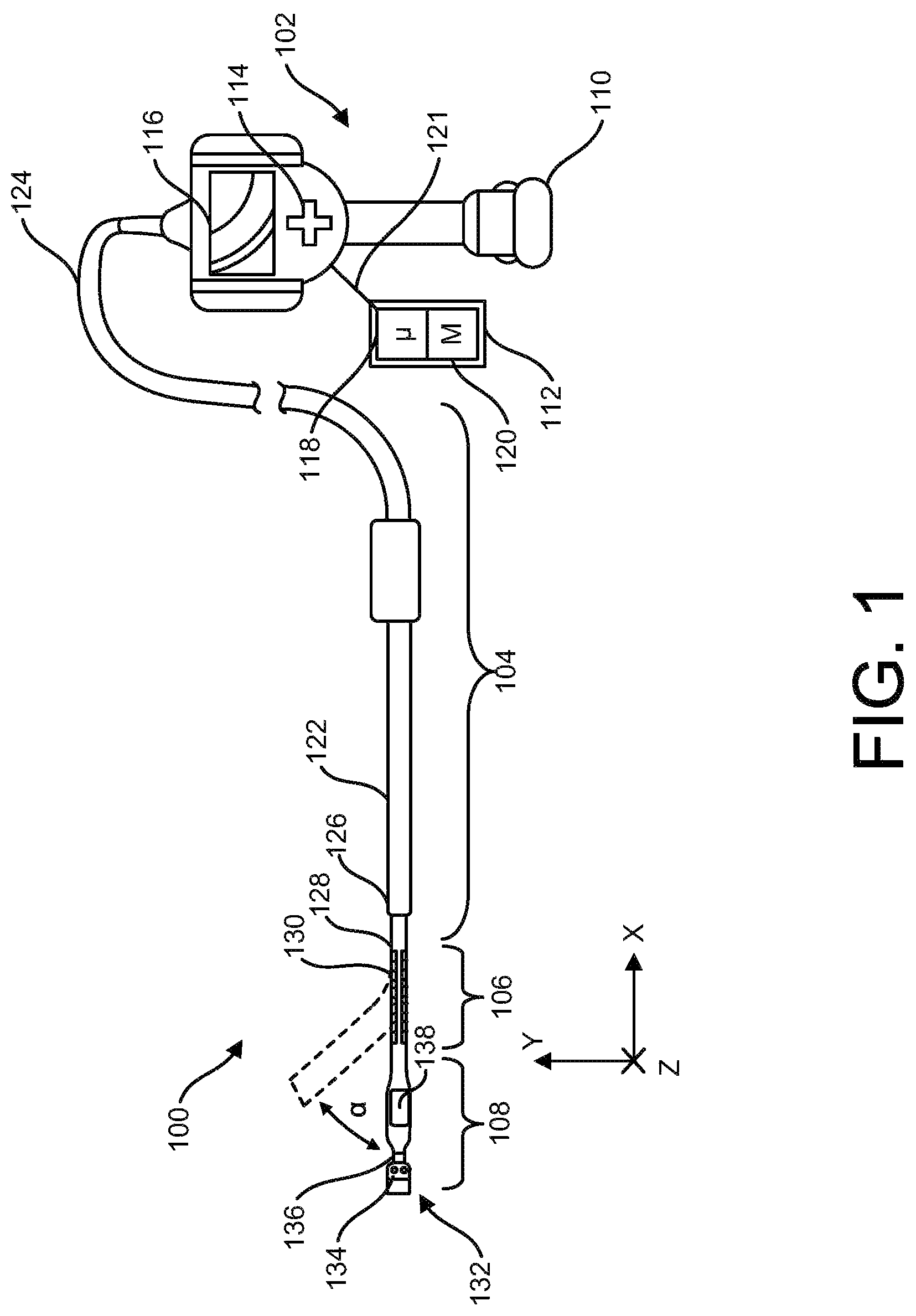
is a schematic illustration of one exemplary embodiment of a non-destructive testing (NDT) device;
A is a perspective schematic illustration of the NDT device of ;
B is a cross-sectional schematic illustration of the NDT device of A taken generally along line 2 B- 2 B in A
C is a cross-sectional schematic illustration of the NDT device of A taken generally along line 2 C- 2 C in A ;
D is a cross-sectional schematic illustration of one exemplary embodiment of a NDT device;
A is a schematic illustration of one exemplary embodiment of a NDT device;
B is a cross-sectional schematic illustration of the NDT device of A taken generally along line 3 B- 3 B in A ; and
is an exemplary embodiment of a method of actuating the NDT device of C .
It should be understood that the above-referenced drawings are not necessarily to scale, presenting a somewhat simplified representation of various features illustrative of the basic principles of the disclosure. The specific design features of the present disclosure, including, for example, specific dimensions, orientations, locations, and shapes, will be determined in part by the particular intended application and use environment.
DETAILED DESCRIPTION
Non-destructive testing systems and devices can be used to inspect a variety of equipment and facilities without destroying the systems and/or devices being inspected. As an example, the NDT systems and devices can include cameras and other measurement devices to obtain images and data of the equipment and facilities as well as inside the equipment and facilities. In use, the measurement devices and cameras that can be inserted into various locations in or around the equipment and facilities. The measurement devices and cameras can remotely couple to other devices that an operator can use to view the data gathered by the measurement device and camera as well as control the measurement device and camera. In embodiments, buttons, a joystick, and/or relative control gestures on a touchscreen associated with the NDT system or device, can be used to control a positioning of the imaging device in an asset (e.g., to move the imaging device from a first position to a second position).
In order to actuate the NDT system, various positioning systems can be used which can bend a distal end of the NDT system to varying degrees of articulation. For example, a plurality of cables can extend along the length of the NDT system and be actuated by various motors arranged at a proximal end of the NDT system. However, some cable systems can be actuated in such a way which allows for slack to be introduced into cables of the NDT system, causing a decrease in accuracy and performance of the NDT system. It is common, for example, that during inspection of machinery the NDT equipment's insertion tube is greatly undulated. When undulated it takes greater force to articulate the end of the instrument due to friction, which results in greater cable slack in all typical 4-wire steering embodiments. This type of slack is partially from elastic cable stretch and elastic insertion tube compression, which degrades the responsiveness of the NDT system's articulation, but is not permanent as the system will rebound when the cables are relaxed. In addition, normal wear over the life of the NDT system can introduce cable slack as the cables inelastically stretch and the insertion tube inelastically compresses among other wear effects. In embodiments of the current subject matter, each control cable is coupled to a separate actuator which can be actuated separately. Since each control cable is separately controllable, each control cable can be under tension simultaneously, which allows for greater control of the NDT device. Additionally, since tension is maintained on the control cables at all times, the NDT system can inherently compensate for normal wear and deliver consistent performance over the service life of the system. The invention can also inherently compensate for cable slack caused by a greatly undulated insertion tube while in use to compensate for previously mentioned elastic effects in the system. The benefit of this invention increases the longer a system's insertion tube is, since longer insertion tubes can for example experience greater inelastic cable stretch and greater insertion tube compression.
Referring now to , a schematic illustration of an NDT device 100 is generally depicted. NDT device 100 includes a control unit 102 , a conduit section 104 , a bendable articulation section 106 , and a head section 108 . Each of the sections 104 , 106 , and 108 can be integral with one another, or can be removable detachable from each section depending on specific applications. For example, if a longer conduit section 104 is required, the shorter conduit section 104 can be removed and a longer conduit section 104 can be attached to the control unit 102 . As depicted, the conduit section 104 is suitable for insertion into a variety of locations, such as inside turbomachinery, equipment, pipes, conduits, underwater locations, curves, bends, inside or outside of an aircraft system, and the like.
Referring still to , the control unit 102 includes a control unit housing 110 , a controller 112 , a directional input 114 , and a screen 116 . The controller 112 can include a processor 118 and a readable memory 120 containing computer readable instructions which can be executed by the processor 118 in order to actuate the NDT device 100 . The controller 112 is communicatively coupled to the control unit 102 via a signal 121 . In embodiments, the controller 112 can be arranged within the control unit housing 110 , or can be arranged outside the control unit housing 110 . The directional input 114 is for a user to input direction controls to the control unit 102 in order to actuate the NDT device 100 . The screen 116 can display visual information being received by an optical sensor arranged in the head section 108 , which allows the user to better guide the NDT device 100 using the directional input 114 . In embodiments, the directional input 114 and the screen 116 are communicatively coupled to the controller 112 via signal 121 , which can be a hard-wired connection or a wireless signal, such as WI-FI™ or Bluetooth™.
Referring still to , the conduit section 104 includes a tubular housing 122 including a proximal end 124 and a distal end 126 . In embodiments, the control unit 102 is arranged at the proximal end 124 of the tubular housing 122 , and the bendable articulation section 106 is arranged at the distal end of the tubular housing 122 . The tubular housing 122 can be a flexible member along its whole length, or can be rigid at the proximal end 124 and become more flexible travelling down the length of the conduit section 104 towards the distal end 126 . Additionally, in embodiments, the tubular housing 122 can be formed from a non-porous material to prevent contaminants from entering the NDT device 100 via the conduit section 104 .
Referring still to , the bendable articulation section 106 includes a bendable neck 128 and washers 130 . The bendable neck 128 is arranged at the distal end 126 of the tubular housing 122 , and is able to be actuated 360° in the Y-Z plane. In embodiments, the washers 130 can be wobble washers, which allow the washers 130 to slide against one another as the bendable neck 128 is articulated, keeping the shape of the bendable articulation section 106 . The washers 130 can be copper or some other suitable rigid material, and have angled surfaces which allow for the bendable neck 128 to be articulated. The bendable neck 128 can be wrapped in a non-porous material to prevent contaminants from entering the NDT device 100 via the bendable articulation section 106 , and specifically between the washers 130 during articulation of the bendable neck 128 .
Referring still to , the head section 108 includes a head assembly 132 . The head assembly 132 includes one or more lights 134 (e.g., LEDs or a fiber optic bundle with lights at the proximal end), a camera 136 , and one or more of a sensor 138 . In general, the head section 108 includes one or more sensors that collect data about the surrounding environment (e.g., a sensor 138 , a camera 136 , etc.).
As mentioned above, the camera 136 of the NDT device 100 can provide images and video suitable for inspection to the screen 116 of the control unit 102 . The lights 134 can be used to provide for illumination when the head section 108 is disposed in locations having low light or no light. The sensor 138 can record data including temperature data, distance data, clearance data (e.g., distance between a rotating element and a stationary element), flow data, and so on. In certain embodiments, the NDT device 100 includes a plurality of replacement head assemblies 132 . For example, the head assemblies 132 can include retrieval tips such as snares, magnetic tips, gripper tips, and the like. The head assemblies 132 can additionally include cleaning and obstruction removal tools, such as wire brushes, wire cutters, and the like. The head assemblies 132 can additionally include tips having differing optical characteristics, such as focal length, stereoscopic views, 3-dimensional (3D) phase views, shadow views, and so on. Additionally or alternatively, the head section 108 includes a removable and replaceable portion of the head section 108 . Accordingly, a plurality of the head sections 108 , bendable necks 128 , and conduit sections 104 can be provided at a variety of diameters from approximately one millimeter to ten millimeters or more.
During use, the bendable articulation section 106 can be controlled, for example, by the control inputs (e.g., relative control gestures, physical manipulation device) from the directional input 114 . The directional input can be a joystick, D-pad, touch pad, trackball, optical sensor, or a touchscreen over the screen 116 . The directional input 114 can also be a similar device that is located outside the control unit housing 110 and connected by wire or wireless means. In particular, a set of control inputs can be used to control the bendable articulation section 106 . The bendable articulation section 106 can steer or “bend” in various dimensions, and can use actuators and wires, or a combination thereof, arranged within the control unit 102 , to adjust the orientation (e.g., a positioning) of the head section 108 . The actuators can be electric, pneumatic, or ultrasonically operated motors or solenoids, shape alloy, electroactive polymers, dielectric elastomers, polymer muscle material, or other materials. For example, the bendable articulation section 106 can enable movement of the head section 108 in an X-Y plane, X-Z plane, and/or Y-Z plane. Indeed, the directional input 114 can be used to perform control actions suitable for disposing the head section 108 at a variety of angles, such as the depicted angle α. In this manner, the head section 108 can be positioned to visually inspect desired locations. Once the head section 108 is in a desired position, the camera 136 can operate to capture, for example, a stand-still visual image or a continuous visual image, which can be displayed on the screen 116 of the control unit 102 , and can be recorded by the NDT device 100 . In embodiments, the screen 116 can be multi-touch touch screens using capacitance techniques, resistive techniques, infrared grid techniques, and the like, to detect the touch of a stylus and/or one or more human fingers. Additionally or alternatively, captured visual images can be transmitted into a separate storage device for later reference.
Referring now to A , a perspective view of the NDT device 100 is depicted without the control unit housing 110 . The control unit 102 includes a plurality of actuation systems 140 arranged with in the control unit housing 110 . Each actuation system of the plurality of actuation systems 140 includes a control cable extending along the tubular housing 122 and arranged at a respective circumferential position within the tubular housing 122 , and an actuator disposed at the proximal end 124 of the tubular housing 122 and secured to the control cable. For example and as depicted, the plurality of actuation systems 140 include actuators 142 A, 144 A, and 146 A.
Still referring to A , the actuator 142 A includes a rotor 142 B, a force sensor 142 C, and a control cable 142 D. The actuator 142 A is mounted to the force sensor 142 C such that when a tension is imparted to the control cable 142 D, the tension in the control cable 142 D can be measured by the force sensor 142 C. The rotor 142 B is non-rotatably connected to the actuator 142 A. When the actuator 142 A receives a control signal 121 from the controller 112 , the rotor 142 B is rotated by the actuator 142 A. Additionally, the control cable 142 D is secured to the rotor 142 B such that when the rotor 142 B rotates, the control cable 142 D is extended or retracted by either being unwound or spooled onto the rotor 142 B, respectively. The control cables 142 D, 144 D, and 146 D are secured to the bendable articulation section 106 such that when at least one control cable is either extended or retracted, the bendable articulation section 106 is articulated to some degree.
Still referring to A , the actuator 144 A includes a rotor 144 B, a force sensor 144 C, and a control cable 144 D. The actuator 144 A is mounted to the force sensor 144 C such that when a tension is imparted to the control cable 144 D, the tension in the control cable 144 D can be measured by the force sensor 144 C. The rotor 144 B is non-rotatably connected to the actuator 144 A such that when the actuator 144 A receives a control signal 121 from the controller 112 , the rotor 144 B is rotated by the actuator 144 A. Additionally, the control cable 144 D is secured to the rotor 144 B such that when the rotor 144 B is rotates, the control cable 144 D is extended or retracted by either being unwound or spooled onto the rotor 144 B, respectively.
Still referring to A , the actuator 146 A includes a rotor 146 B, a force sensor 146 C, and a control cable 146 D. The actuator 146 A is mounted to the force sensor 146 C such that when a tension is imparted to the control cable 146 D, the tension in the control cable 146 D can be measured by the force sensor 142 C. The rotor 146 B is non-rotatably connected to the actuator 146 A such that when the actuator 146 A receives a control signal 121 from the controller 112 , the rotor 146 B is rotated by the actuator 146 A. Additionally, the control cable 146 D is secured to the rotor 146 B such that when the rotor 146 B is rotates, the control cable 146 D is extended or retracted by either being unwound or spooled onto the rotor 146 B, respectively.
Still referring to A , each actuator 142 A, 144 A, and 146 A can be independently controlled with respect to one another. This allows for each individual control cable 142 D, 144 D, and 146 D to be independently controlled (i.e., extended or retracted) in order to actuate the bendable articulation section 106 of the NDT device 100 . Each control cable 142 D, 144 D, and 146 D enters the tubular housing 122 at the proximal end 124 and is supported by a guide 150 having apertures 152 arranged therein. In embodiments, the bendable articulation section 106 is bent along lines L 1 , L 2 , and L 3 when only a single actuator 142 A, 144 A, and 146 A is actuated to either extend or retract a corresponding control cable 142 D, 144 D, and 146 D. Additionally, if a combination of actuators 142 A, 144 A, and 146 A are actuated, then the bendable articulation section 106 can bend along angles α 1 , α 2 , and α 3 . This allows for the bendable articulation section to achieve 360° articulation in the Y-Z plane with only three actuation systems 140 . Since each actuation system 140 is secured to a single control cable, no lag or additional slack is introduced into the system during articulation of the bendable articulation section 106 . This allows for greater control and accuracy of the NDT device 100 compared to device which introduce slack into the control cables during articulation.
Referring now to B , a cross-sectional schematic illustration of the conduit section 104 (as shown in ) of the NDT device 100 taken generally along line 2 B- 2 B in A is depicted. As depicted, the control cables 142 D, 144 D, and 146 D pass through sheaths 142 E, 144 E, and 146 E along the length of the conduit section 104 within the tubular housing 122 . The sheaths 142 E, 144 E, and 146 E can be secured to the guide 150 and the first washer 130 of the bendable neck 128 , but not secured to the inner wall 122 B. A working volume 153 is arranged within the inner wall 122 B of the tubular housing 122 . The outer wall 122 A of the tubular housing 122 protects the internal components of the tubular housing 122 . In embodiments, various objects, such as electrical cables 10 or optical fibers 12 , may also be arranged within the working volume 153 along the length of the tubular housing 122 . The sheaths 142 E, 144 E, and 146 E can prevent wear against the electrical cables 10 or optical fibers 12 as the control cables 142 D, 144 D, and 146 D are actuated to bend the bendable neck 128 .
Referring now to C , a cross-sectional schematic illustration of the bendable articulation section 106 (as shown in ) of the NDT device 100 taken generally along line 2 C- 2 C in A is depicted. As depicted, the control cables 142 D, 144 D, and 146 D pass through a stack of washers 130 having channels 142 F, 144 F, and 146 F, respectively, stacked within the outer wall 128 A of the bendable neck 128 . In embodiments, each channel 142 F, 144 F, and 146 F, and therefore corresponding control cable 142 D, 144 D, and 146 D, is arranged at a circumferential position within the bendable neck 128 . The circumferential positions of the control cables 142 D, 144 D, and 146 D can be substantially equally spaced apart circumferentially around the bendable neck 128 . A working volume 154 is arranged within the bendable neck 128 and bound by the inner wall 122 B of the wobble washers. The working volume can extend the whole length of the bendable articulation section 106 and the conduit section 104 (as shown in ) to allow tools and devices 10 , 12 (as shown in A ) to pass through the bendable neck 128 and the tubular housing 122 from the proximal end 124 to the distal end 126 , through the bendable articulation section 106 , and through the head section 108 . In embodiments where only three control cables 142 D, 144 D, and 146 D are required to actuate the bendable articulation section 106 , a larger working volume 154 is present within the tubular housing 122 and bending neck 128 when compared to an embodiment requiring four control cables, as shown in B .
Still referring to C , when only the control cable 146 D is retracted by the actuator 146 A, and the control cables 142 D and 144 D are kept in tension, the bendable articulation section 106 will bend along line L 1 . When only the control cable 144 D is retracted by the actuator 144 A, and the control cables 142 D and 146 D are kept in tension, the bendable articulation section 106 will bend along line L 3 . When only the control cable 142 D is retracted by the actuator 142 A, and the control cables 144 D and 146 D are kept in tension, the bendable articulation section 106 will bend along line L 2 . When only the control cables 142 D and 144 D are retracted by the actuators 142 A and 144 A, respectively, and the control cable 146 D is kept in tension, the bendable articulation section 106 will bend 180° opposite line L 1 .
In embodiments, when the bendable articulation section 106 is articulated, the controller 112 receives the force measurements from each force sensor 142 C, 144 C, and 146 C. As a control cable 142 D, 144 D, or 146 D is retracted in order to bend the bendable articulation section 106 , the control cables not being retracted can be extended to aid in the articulation. During an articulation, the tension in a control cable being retracted can be in a range of 10-50 lbf, and in a preferable range of 20-42 lbf, while the tension in a control cable being extended can be in a range of 0-5 lbf, and in a preferable range of 0.5-1 lbf. The control cables 142 D, 144 D, and 146 D can be made of stainless steel, tungsten, or another suitable material. Additionally, the control cables 142 D, 144 D, and 146 D can have a length in a range of 1-100 ft, and have a diameter of 0.014 in.
Referring now to D , a cross-section schematic illustration of a conduit section 104 ′ is depicted. It should be noted that conduit section 104 ′ is similar to the conduit section 104 depicted in C , except for the circumferential locations of channels 142 F′, 144 F′, and 146 F′. The bendable articulation section 106 ′ includes channels 142 F′, 144 F′, and 146 F′ which are not equally spaced apart circumferentially around the bendable neck 128 ′. The channels 142 F′, 144 F′, and 146 F′ are spaced apart asymmetrically, where α 1 ′ is equal to α 2 ′, but α 3 ′ is larger than α 1 ′ and α 2 ′. This arrangement allows for a differently shaped working volume 154 ′, where the portion of the working volume 154 ′ bound by α 3 ′ is larger than the portion of the working volume 154 ′ bound by α 3 in B . This allows for a larger tool or device to be fed through the bendable neck 128 ′ when compared to the bendable neck 128 . The larger working volume 154 ′ can also be used for additional electrical cables 10 or optical fibers 12 to improve capability and performance of the product.
Now referring to A , a schematic illustration of a NDT device 200 is depicted. It should be noted that NDT device 200 is similar to the NDT device 100 depicted in , except for the plurality of actuation systems 240 and control cables. The NDT device 200 includes a conduit section 204 , a bendable articulation section 206 , and a head section 208 . The conduit section includes a tubular housing 222 extending from a proximal end 224 to a distal end 226 . The bendable articulation section 206 includes a bendable neck 228 and washers 230 . The head section 208 includes a head assembly 232 , which includes lights 234 , camera 236 , and sensor 238 . A plurality of actuation systems 240 is arranged to actuate control cables in order to articulate the bendable neck 228 . Articulation assembly 242 includes actuator 242 A, rotor 242 B, control cable 242 C, and control cable 242 D. Articulation assembly 244 includes actuator 244 A, rotor 244 B, control cable 244 C, and control cable 244 D. The arrangement of having a single rotor 242 B, 244 B control two separate control cables 242 C, 242 D, and 244 C, 244 D simultaneously introduces slack into the system. For example, as the rotor 242 B rotates clockwise, control cable 242 D will be in tension, while control cable 242 C slackens due to a loss of tension. This reduces accuracy and reaction time of the NDT device 200 , and can contribute to decreased device life expectancy due to the system's inability to take up control cable slack as it develops over time.
Referring now to B , a cross-sectional schematic illustration of the bendable articulation section 206 taken along line 3 B- 3 B in A is depicted. Control cables 242 C, 242 D, 244 C, and 244 D extend within the tubular housing 222 along the conduit section 204 and the bendable articulation section 206 , and through channels 242 E, 242 F, 244 E, and 244 F formed within washer 230 , stacked within the outer wall 222 A of the bendable neck 228 . Due to the diametric configuration of the control cables 242 C, 242 D, 244 C, and 244 D, the bendable articulation section 206 is articulated in a single direction along lines L 4 , L 5 , L 6 , or L 7 by applying tension to a single control cable and slackening the control cable directly opposite the tensioned control cable. In order to articulate the bendable articulation section 206 along angles β 1 , β 2 , β 3 , or β 4 , at least two control cables must be tensioned, with the remaining two control cables slackened to accommodate for the additional tension.
Referring now to , a method 300 of articulating a non-destructive testing device is depicted. At step 302 , a control unit communicatively coupled to a plurality of actuation systems receives an actuation command. The directional input 114 of the control unit 102 can be used to generate an actuation command which is then translated to the plurality of actuation system 140 . At step 304 , the first actuation system is actuated to apply tension to a first control cable to bend the bendable articulation section in a first direction. As stated above, when only the control cable 146 D is retracted by the actuator 146 A, and the control cables 142 D and 144 D are extended by actuators 142 A and 144 A, respectively, to relieve tension, the bendable articulation section 106 will bend along line L 1 . In embodiments, the distance which control cable 146 D is retracted is substantially equal to the distance that control cables 142 D and 144 D are extended. At step 306 , the second actuation system and the third actuation system are actuated to apply tension to a second control cable and a third control cable to bend the articulating section in a second direction, opposite the first direction. As stated above, when only the control cables 142 D and 144 D are retracted by the actuators 142 A and 144 A, respectively, and the control cable 146 D is extended by actuator 146 A to relieve tension, the bendable articulation section 106 will bend 180° opposite line L 1 . Each actuation system of the plurality of actuation system 140 is configured to be independently operable.
As set forth herein, a NDT device according to exemplary embodiments of the present disclosure includes a tubular housing including a proximal end and a distal end. A conduit section is arranged at the proximal end, and a bendable articulation section secured to the conduit section and arranged at the distal end. A plurality of actuation systems each includes a control cable extending along the tubular housing and arranged at a respective circumferential position within the bendable neck of the tubular housing, and an actuator disposed at the proximal end of the tubular housing and secured to the control cable. Applications for the present disclosure include use in a borescope, endoscope, or the like for NDT purposes.
The present disclosure is not limited to the exemplary embodiments described herein and can be embodied in variations and modifications. The exemplary embodiments are provided merely to allow one of ordinary skill in the art to understand the scope of the present disclosure, which will be defined by the scope of the claims. Accordingly, in some embodiments, well-known operations of a process, well-known structures, and well-known technologies are not be described in detail to avoid obscure understanding of the present disclosure. Throughout the specification, same reference numerals refer to same elements.
The terminology used herein is for the purpose of describing particular embodiments only and is not intended to be limiting of the disclosure. As used herein, the singular forms “a”, “an” and “the” are intended to include the plural forms as well, unless the context clearly indicates otherwise. It will be further understood that the terms “comprises” and/or “comprising,” when used in this specification, specify the presence of stated features, integers, steps, operations, elements, and/or components, but do not preclude the presence or addition of one or more other features, integers, steps, operations, elements, components, and/or groups thereof. As used herein, the term “and/or” includes any and all combinations of one or more of the associated listed items.
Unless specifically stated or obvious from context, as used herein, the term “about” is understood as within a range of normal tolerance in the art, for example within 2 standard deviations of the mean. “About” can be understood as within 10%, 9%, 8%, 7%, 6%, 5%, 4%, 3%, 2%, 1%, 0.5%, 0.1%, 0.05%, or 0.01% of the stated value. Unless otherwise clear from the context, all numerical values provided herein are modified by the term “about.”
Hereinabove, although the present disclosure is described by specific matters such as concrete components, and the like, the exemplary embodiments, and drawings, they are provided merely for assisting in the entire understanding of the present disclosure. Therefore, the present disclosure is not limited to the exemplary embodiments. Various modifications and changes can be made by those skilled in the art to which the disclosure pertains from this description. Therefore, the spirit of the present disclosure should not be limited to the above-described exemplary embodiments, and the following claims as well as all technical spirits modified equally or equivalently to the claims should be interpreted to fall within the scope and spirit of the disclosure.
Figures (6)
Citations
This patent cites (3)
- US20170045550
- US20170219814
- US20170219815